



Abstract
While telecollaborative initiatives have flourished in promoting intercultural communicative competence (ICC) across Asian higher education, the lack of sustained Asia–Latin America partnerships reveals a significant gap in global intercultural education. Addressing this gap, the present study examined the impact of a 9-week telecollaborative program with Colombian peers on Chinese mainland students’ ICC development. A mixed-methods design was adopted, combining quantitative data from a questionnaire, analyzed using paired samples t-test and ANCOVA in SPSS, and qualitative data from focus group interviews, analyzed thematically in ATLAS.ti. A total of 65 participants were divided into an experimental group (n = 32) and a control group (n = 33). Results showed that, compared with the control group, the experimental group achieved significantly greater ICC improvement (p ≤ .001), particularly in the skills and awareness dimensions. However, ANCOVA results revealed no significant difference in the knowledge-self dimension between groups, likely because Chinese mainland students were already accustomed to political education and had previously developed relatively high levels of knowledge-self before the intervention. Interview data further highlighted key benefits of telecollaboration: (a) significant growth in cultural, linguistic, and digital aspects, and (b) stronger bonds through a shared EFL identity. These findings make two key contributions. Theoretically, they extend intercultural communicative competence research by highlighting Asia–Latin America telecollaboration as an effective context for fostering holistic ICC through reciprocal peer interaction. Practically, the study offers guidance for designing English-as-a-lingua-franca-based telecollaborative programs that combine linguistic simplicity with intercultural depth.
Plain Language Summary
This study explored how Chinese university students improved their intercultural communication skills by working online with Colombian peers using English as a shared second language. Over nine weeks, the students took part in activities like sharing stories and discussing cultural topics. Compared to students who only learned in traditional classrooms, those who joined the online exchange showed greater progress in understanding other cultures, communicating effectively, and thinking critically
Keywords
Introduction
Mastering English alone is not enough to guarantee effective intercultural communication. With globalization, the effort to develop foreign language learners’ intercultural communicative competence (ICC) has gained increasing attention. ICC is not only a language competence, but also encompasses the knowledge, attitude, and skills necessary to interact appropriately and effectively with people from a different culture. Hoa and Thi (2020) have proposed the integration of ICC into the language curriculum, while Svensson and Wihlborg (2010) have emphasized the role of intercultural exchange in the classroom.
Despite increased attention to ICC development, Chinese EFL learners still have difficulty developing ICC. Studies indicated that limited real ICC exposure constrains the development of Chinese EFL learners’ ICC (Chau et al., 2024). Besides, a lack of understanding of the construct of ICC and ICC assessment among Chinese EFL teachers (Gu, 2016) further marginalizes ICC in language teaching and research. Along this line, telecollaboration, also known as virtual or online intercultural exchange, has emerged as a promising approach. Over the last two decades, it has been taking a central role in internationalization at home, facilitating sustained intercultural contact across borders without physical mobility.
However, most existing studies have predominantly focused on collaborations with native English speakers (Hilliker, 2020; Schreiber, 2019; Üzüm et al., 2020), reinforcing “an overrepresentation of anglophone cultures” (Baker, 2015, p. 9). More recent research advocates for viewing English as a lingua franca, promoting bidirectional ICC enhancement for both EFL learners (Freiermuth & Huang, 2021). This shift is evident in projects involving Chinese EFL learners particularly in Taiwan and Hong Kong, often paired with peers from other Asian countries such as Japan and Vietnam or dominant Western countries such as France and Germany (Cappellini et al., 2022; Freiermuth & Huang, 2012, 2021; Fuchs, 2019; Vinanda, 2024). Nevertheless, inter-regional exchanges between Asia and Latin America, particularly between China and Latin America, remain scarce. Establishing such a connection not only diversifies research on English as lingua franca beyond Eurocentric or similar Asian settings but also supports UNESCO’s agenda for equitable Inter-Regional South–South educational collaboration (UNESCO, 2020). In Asia, like China, collectivism and emotional restraint shape communication (Wang & Liu, 2010), whereas in Latin America, such as Colombia, individualism and emotional openness guide learner interactions (Salvador et al., 2024). These diverse cultural differences provide a rich context for exploring ICC development through telecollaboration.
Moreover, few studies have examined students’ intercultural experiences or perceptions of telecollaboration (Sardegna et al., 2025). Although L2 exchanges have been shown to enhance ICC more than L1 exchanges, Sevilla-Pavón (2019) attributed these differences to cultural similarities but did not thoroughly investigate students’ perspectives. Furthermore, focus-group interviews, which offer deeper insights into collective experiences, are seldom used in previous studies (Shadiev & Yu, 2024).
Given these identified gaps in research context, content, and methodology, the present study investigates a telecollaboration intervention between Chinese mainland and Colombian EFL learners, employing a mixed-methods design with focus-group interviews in the qualitative phase. This study aims to address the following research questions:
To what extent does telecollaboration enhance Chinese EFL learners’ ICC?
How do Chinese EFL learners perceive telecollaboration with Colombian peers and its impact on improving their ICC?
Literature Review
Intercultural Communicative Competence
ICC has been defined in multiple ways, often using terms like intercultural communication competence and intercultural competence interchangeably. Chen and Starosta’s (2000) ICC model consisted of intercultural awareness, sensitivity, and adroitness, later reframed by Chen and Yang (2016) into cognitive, affective, and behavioral domains. Deardorff’s (2006) Process Model further emphasizes the iterative development of knowledge, skills, and attitudes in intercultural interactions. Fantini (2000) described ICC as a spiral progression, evolving over time. Among the various models, Byram’s conceptualization is particularly influential, defining ICC as a multidimensional construct encompassing “knowledge of others; knowledge of self; skills to interpret and relate; skills to discover and to interact; attitudes of valuing others’ values, beliefs, and behaviors and relativizing oneself; and critical cultural awareness (Byram, 1997, p. 34).
Empirical studies have tested and extended these models. Wang et al. (2025) identified English language proficiency as a key predictor of ICC, while Munezane (2021) suggested incorporating Willingness to Communicate (WTC) into the ICC model, linking foreign language learning with intercultural learning. Recent studies have also explored technology’s role in enhancing ICC. Wang and Hu (2025) showed that digital storytelling (DST) enhanced intercultural learning through a five-dimensional ICC model—knowledge, affective orientation, self-efficacy, behavior, and awareness—tailored to Taiwanese EFL learners, while Gutiérrez-Santiuste and Ritacco-Real (2023) observed the evolution of ICC’s affective, cognitive, and behavioral dimensions through telecollaboration. Wu et al. (2013) developed, and Peng et al. (2015) validated ICC scales in Chinese mainland contexts, aligning with Byram’s dimensions and providing a reliable tool for measuring Chinese mainland EFL learners’ ICC in this study.
Telecollaboration in Enhancing ICC
Telecollaboration refers to online intercultural exchanges that use digital tools to promote language and intercultural competence (Helm, 2015). Its value has been particularly evident during the COVID-19 pandemic. Typical telecollaborative projects include virtual tours, project-based learning, and DST intercultural exchanges. For instance, Shadiev et al. (2025) showed how virtual collaborative activities reduced intercultural anxiety and enhanced ICC for Asian learners. Casañ-Pitarch and Candel-Mora (2021) examined the enhancement of ICC through research project-based telecollaborative learning. DST exchange is the most widely used, for instance, Oakley et al. (2023) and Toscu and Erten (2020) demonstrated how DST-based videoconferencing enabled EFL learners paired with native speakers to engage in intercultural dialogue to improve intercultural learning. Telecollaboration is generally implemented through three stages: a pre-task (familiarization), a task (interaction), and a post-task (evaluation; Hauck & Youngs, 2008; Helm & Guth, 2010). Tecedor and Vasseur (2020) highlighted that the final reflection stimulates their critical thinking to develop ICC.
A key debate in telecollaboration revolves around its collaborative cultures. Scholars such as Chimeva and Trenchs-Parera (2024) have recently argued that different interlocutors shape ICC development. Early studies focused on native-speaker norms, particularly American English (Üzüm et al., 2020; Yeh & Heng, 2023). Telecollaboration with English as a lingua franca enhances ICC and internationalization at home by fostering exchanges across diverse educational contexts (Ferreira-Lopes et al., 2021; Golubeva, 2025). Spanish has also been used as a lingua franca in collaborations involving Mexico, Poland, Spain, and the USA (Lenkaitis & Loranc, 2021). The USA and Spain remain the most common collaborative cultures in telecollaboration research (Toscu & Erten, 2020), though scholars call for broader cultural comparisons (Ito Morales & Fuse, 2025).
Related Theories and Approaches
The theoretical base of telecollaboration has been enriched by some frameworks, including Byram’s (1997, 2020) ICC model, Chen and Yang (2016)’s framework, activity theory (Engeström, 2001), computer-supported learning environments (Kreijns et al., 2003), and the concept of “third space” (Bhabha, 2004). Among these, Byram’s ICC model and the “third space” theory offer complementary accounts of how and where competence develops in digitally mediated exchanges.
Byram’s ICC model differs from other models by emphasizing a “cultural turn,” urging a shift from native-speaker norms toward communication with speakers from different linguistic and cultural backgrounds. This conceptualization incorporates knowledge of self and others, as well as skills for interpreting, relating, discovering, and interacting, underscoring the interlinking of these components, with critical cultural awareness being central (Byram, 2020). Meanwhile, the third space, defined as “moments or processes that are produced in the articulation of cultural differences” (Bhabha, 2004, p. 2) and further elaborated by Kramsch and Uryu (2020) allows the coexistence of the self and the other while emphasizing the creation of opportunities for shared meaning-making during collaborative tasks.
The assessment of ICC in telecollaboration is predominantly qualitative, given its reliance on interpretive approaches (Shadiev & Yu, 2024). Qualitative data are primarily derived from sources such as individual semi-structured interviews, reflection journals, or telecollaborative discourse (Gutiérrez-Santiuste & Ritacco-Real, 2023). Given the complexity of ICC, which necessitates in-depth qualitative analysis, an increasing number of studies are adopting mixed methods approaches (Toscu & Erten, 2020).
Methods
Research Design
This study used an explanatory sequential mixed-methods design, as the quantitative results were used to frame the qualitative data (Creswell & Clark, 2018). First, quantitative data were collected and analyzed, and then qualitative data were collected and analyzed to help explain the results. In the first phase, participants completed a pre-test and post-test ICC questionnaire to measure changes in their ICC after participating in a telecollaboration program. The experimental group took part in a telecollaboration program with Colombian peers, whereas the control group did not. Following the pre-test and post-test, focus group interviews were conducted with Chinese EFL participants to gather qualitative data on their experiences in the program, aiming to explain the reasons behind and the mechanisms of any changes in ICC. This mixed-method design yielded quantitative measures of intercultural learning and qualitative insights into students’ perceptions of the telecollaboration and its impact on ICC.
Context and Sampling
This study was jointly conducted by a privately funded Chinese university and a public Colombian university, both of which were well-equipped with multimedia resources that enabled students to access personal computers and smartphones, which were crucial for this research. As international platforms, such as Zoom meetings, had been blocked in China, Chinese EFL learners were proficient in VooV Meetings (the global version of Tencent Meetings). In contrast, Colombian students had no prior exposure to it. To bridge this gap, the researchers trained the Colombian teacher during their first meeting, who then instructed 16 Colombian students to download and use VooV Meetings before the telecollaboration.
Using convenience sampling, the experimental group consisted of 32 Chinese English major students from various grades, all of whom had an intermediate level of English proficiency based on their college entrance exam scores, which ranged from 110 to 130 out of 150. The control group consisted of 33 Chinese students with intermediate English proficiency, as determined by the same exam used for the experimental group. Maintaining equivalent language proficiency between the two groups was essential to ensure the validity of the study comparisons. Foreign participants included 16 Colombian sophomores and juniors, who chose English as their major. The Colombian students’ English proficiency was tested before the experiment. All Chinese participants across both groups reported being native Mandarin speakers and having no prior experience studying or living abroad. In contrast, the Colombian participants were all native Spanish speakers from Colombia, although two individuals had previously traveled outside Colombia. Written informed consent was obtained from all participants prior to participation, and they were assured of confidentiality, anonymity, and voluntary involvement throughout the study. Table 1 presents the demographic profile of participants.
Participant Demographics of Colombian and Chinese Groups.

Note. All participants were between 19 and 22 years old.
Intervention Program
To begin with, a control group (n = 33) with traditional intercultural instruction could help determine whether Chinese EFL learners’ ICC changed due to the intervention of telecollaboration with Colombian students. Specifically, the Chinese learners of English in the controlled group attended a real classroom with the instructor to perform activities for approximately 80 min per session, whereas the experimental group participants used the online synchronous tool VooV meeting in the study. For the experimental group (n = 32) with the intervention, telecollaboration was conducted weekly for 80 min of VooV videoconferencing, involving digital storytelling tasks and exchanging opinions on various weekly topics, as shown in Table 2.
Weekly Telecollaboration Tasks and Descriptions for the Experimental Group.

Sardegna et al. (2025) proposed a four-stage telecollaboration model consisting of the preparatory, getting-to-know-each-other, collaboration, and reflection stages, whereas Hauck and Youngs (2008) outlined a three-stage framework encompassing familiarization, interaction, and evaluation debriefing. The four-stage instructional design overemphasizes the reflection phase, leaving little time for meaningful interaction. Given the significant cultural differences between China and Colombia, more time for interaction and meaningful exchange was necessary. Therefore, we primarily adopted a three-phase instructional design. Additionally, considering students’ need for technical training on both sides, we integrated the technical preparation phase into the familiarization stage: (a) a preparatory and familiarization stage, involving self-introduction, digital literacy training, and platform orientation; (b) an interaction stage, which included weekly theme-based cultural exchanges and sustained communication activities; and (c) summary and evaluation stage, focusing on collaborative synthesis and individual reflection on intercultural learning outcomes. This telecollaboration project aimed to foster intercultural learning through structured tasks with gradually reduced teacher support, promoting students’ autonomy, as in these two teaching models.
The interaction stage was adapted from a previous intervention project of Toscu and Erten (2020), with some modifications that better suit the cultural pairing of Chinese and Colombian students (e.g., “food and eating habits” was expanded to “food and festivals,” and the categories of “timing and punctuality” and “raising children and education” were combined under one category, namely, “common behaviors and values”). These topics were selected because they were expected to facilitate intercultural communication and comparison. Students in the experimental group were asked to share their cultural stories through digital storytelling during the first 8 weeks, and they were instructed to provide prompts with visuals (e.g., pictures or scaffolded PowerPoint slides) in synchronous interactions. In the last week, each group of four to five students produced a collaborative video summarizing their experience and knowledge. The final digital story served both as a reflection element (i.e., a digital story created by students to reflect on their experiences and learning) and as a measure of students’ intercultural learning after interacting with their Colombian peers for a long period.
Although each weekly task focused on a specific cultural theme, the telecollaboration emphasized two-way interaction rather than one-way presentation. Both Chinese and Colombian students shared materials, exchanged feedback, and discussed cultural similarities and differences during and after each session. Later activities, such as common behaviors and values, encouraged joint reflection and negotiation of meaning. In the final week, mixed intercultural groups co-produced short digital storytelling videos, ensuring genuine collaboration and mutual engagement throughout the program.
Research Instruments
To assess the impact of the program on Chinese EFL learners’ ICC, students in the experimental and control groups completed the questionnaire at the beginning and end of the program. Telecollaboration effects were determined by calculating the differences between experimental and control groups from the pre-test to the post-test. The demographic information for the ICC scale was condensed into critical information regarding gender, grade, language proficiency, and intercultural communication experience at the beginning of the ICC scale.
Questionnaire
To assess participants’ ICC, this study adopted a questionnaire originally developed and validated for use in Chinese EFL contexts. The instrument is based on Byram’s (1997) ICC model and Fantini and Tirmizi’s (2006) ICC scale and was initially developed by Wu et al. (2013), later validated and refined by Peng et al. (2015) as the Assessment of Intercultural Competence of Chinese College Students (AIC-CCS). The final version consists of 28 items, conceptualizing ICC across six dimensions: knowledge of self and others, attitudes, intercultural communicative skills, intercultural cognitive skills, and intercultural awareness, based on a Likert-type format. Although these skills have been labeled differently, they correspond to Byram’s skills of discovery and interaction and skills of interpreting and relating, respectively (Wu et al., 2013). The scale has since been used in ICC research without further adaptation; for instance, Chau et al. (2024) applied the AIC-CCS scale in a telecollaborative project involving Taiwanese and Vietnamese EFL learners, where significant ICC gains were reported. Given its proven applicability, reliability, and alignment with the Chinese EFL context, the AIC-CCS scale, based on a Likert-type format, was adopted for the present study, with ratings ranging from one to five for each item.
For the pre-test administered to the Chinese participants in the experimental group, the instrument demonstrated strong psychometric properties: The KMO value was 0.709 and Bartlett’s test was significant (p < .001), indicating sampling adequacy for factor analysis. The overall Cronbach’s α was .967, and reliability for each dimension was satisfactory: 0.923, 0.931, 0.918, 0.958, 0.904, and 0.880, respectively (the relatively high overall alpha may be due to the large number of items and moderate inter-factor correlations). These results indicate that the questionnaire possesses excellent reliability and acceptable construct validity.
Focus Group Interviews
Using focus group interviews can assess the ability to think from multiple perspectives. Additionally, the interactive feature of these interviews promotes in-depth reflection and discussion among participants, unearthing new research topics (Geampana & Perrotta, 2025). The focus group interview protocol in this study had three sections. Section A detailed research goals and procedures, leading the discussion from greetings to closure. Section B was for building rapport, while Section C, the key part, had two components. First, their perceptions of telecollaboration: (a) What do you think of the telecollaboration this semester? What do you like or dislike about it? (b) What challenges did you encounter during the telecollaboration? (c) Do you have any suggestions for improvement? Second, their insights regarding their ICC: Was the telecollaboration relevant to support your communication with people from other cultures? In what ways does telecollaboration impact your intercultural communication competence, skills, attitudes toward other cultures, critical cultural awareness, and intercultural knowledge? Each focus group interview lasted approximately 35 min. All sessions were audio-recorded using a mobile phone, and field notes were taken to ensure accurate and comprehensive data capture.
Data Collection
Due to the small sample size and low tolerance for error, data collection methods were designed with rigorous considerations to ensure validity and reliability. After the 9-week intervention, the items in the post-test questionnaire were randomized to reduce the likelihood of participants recalling their former answers and/or manipulating their scores. All 65 students completed the online questionnaire, achieving a 100% response rate. Participants’ response times were also monitored to ensure quality data, and any questionnaire that was completed in less than 1 min was considered careless answering and participants were asked to complete the questionnaire again with better attention and effort. Focus group interviews were conducted after the intervention program ended. A focus group is composed of four to six participants who are purposively selected for three to four focus group interviews (Guest et al., 2017). The sessions take place in a comfortable and interactive setting that encourages participants to communicate with one another (Khan & Abedin, 2022). Thus, the interviews were conducted in a classroom setting using the native Chinese language with 16 Chinese participants in the experimental group (three focus group interviews with each group of five to six students). They were interviewed about their telecollaboration experience based on purposive sampling. The inclusion criteria of “purposive sampling” for this study are as follows: (a) telecollaborative involvement; subjects should be one of the students in the experimental group; (b) demographic diversity; they shall have male and female respondents in a group, with different grades; (c) varied changes in major dependent variables; they either demonstrate some significant changes or no changes in ICC from their quantitative data. Participants in the controlled group were not asked questions about the interview regarding the treatment’s effect on their ICC at the end of the project, as they did not participate in the telecollaboration.
Data Analysis
Before conducting statistical analyses, data cleaning was performed to ensure data quality and accuracy. Duplicate submissions and responses completed in unrealistically short times were removed, and participants with such entries were asked to resubmit. The final dataset included 65 valid responses with no missing value. Quantitative data were analyzed using SPSS 27, while qualitative data were examined with ATLAS.ti 24. Preliminary diagnostics, including the Shapiro–Wilk and Levene’s tests as well as checks for linearity, confirmed that the data met all statistical assumptions. Paired-samples t-tests were conducted to compare pre- and post-test ICC scores within the experimental and control groups. To determine the relative effectiveness of telecollaboration and traditional instruction on Chinese EFL learners’ ICC, a one-way between-groups analysis of covariance (ANCOVA) was performed, controlling for initial group differences by entering pre-test scores as covariates.
For the qualitative phase, interview transcripts from 16 participants in the telecollaboration group were thematically coded to explore ICC development (Research Question 1) and Chinese EFL students’ experiences of telecollaboration (Research Question 2). An initial inter-coder reliability of 80% was established. Coding discrepancies were resolved through iterative discussions among the researchers and coders until consensus was reached. One coder then completed the remaining transcripts, while the second coder reviewed and refined the coding framework. Any remaining disagreements were resolved through negotiated agreement to ensure consistency and reliability in the final coding scheme.
Results
Answer to Research Question 1: Quantitative Results on Improvement in ICC
To quantitatively evaluate the impact of telecollaboration on Chinese EFL learners’ ICC performance, a paired-samples t-test was first conducted on the overall ICC test scores as well as on each ICC component—knowledge (self), knowledge (others), attitude, skill (communicative), skill (cognitive), and awareness for both the experimental and control groups. Table 3 presents the ICC scale interpretation according to the AIC-CCS. Table 4 reports the comparison of Chinese participants’ ICC in the experimental group and the control group before and after the telecollaboration intervention. The descriptive analysis demonstrated a highly significant change in participants’ ICC from the pre-test to the post-test across both groups, as evidenced by a p-value of less than .001 and moderate effect sizes of 0.59 and 0.54, respectively. Notably, within the experimental group, every dimension of ICC showed a statistically significant difference after the implementation of the telecollaboration intervention, whereas the control group demonstrated a largely significant difference only in the knowledge and attitude aspect.
ICC Scale Interpretation According to AIC-CCS.

Paired Differences Between Chinese Participants’ ICC Across the Groups

As shown in Table 4, among the six dimensions of ICC, the most significant change occurred in the awareness dimension, with the mean score increasing from 3.72 to 4.444 (mean gain = 0.72). The second-highest improvement was seen in the skill-cognitive dimension, which increased from an average of 3.49 to 4.07 (mean gain = 0.58), while both the attitude and knowledge-others dimensions increased almost equally modestly (mean gain = 0.57, 0.56). The skill-communicative dimension showed a relatively remarkable improvement from 3.57 to 4.08 (mean improvement = 0.51). The self-knowledge dimension showed the least change, with the average score increasing from 3.88 to 4.33, and the mean gain is 0.45. Overall, the results of the pre-post test showed a significant and positive change in each dimension (knowledge, skills, attitude, and awareness), indicating that the intervention could improve the ICC of Chinese EFL participants in the experimental group.
The control group only made modest improvement. As shown in Table 5, the largest improvement was in knowledge-others, which increased from 2.21 to 2.67 (mean improvement = 0.46), followed by attitude, which increased from 3.74 to 4.17 (mean improvement = 0.43), and knowledge-self, which increased minimally from 3.69 to 4.07 (mean improvement = 0.38). However, the skills-communication, skills-cognitive, and awareness dimensions did not show improvement compared with the pre-test, and the mean scores increased only slightly and remained nonsignificant (p > .05). In contrast, the experimental group showed significant improvements across all domains, as indicated by the paired t-test results, suggesting a potential divergence in developmental outcomes between the two groups.
Changes in ICC Dimensions Across Experimental and Control Groups.

To further verify differences in ICC improvement across groups, a one-way ANCOVA was conducted. As shown in Table 6, no significant difference was found between the two groups in the knowledge-self domain, indicating that telecollaboration was not more effective than traditional classroom instruction in enhancing this aspect of ICC.
ANCOVA, Examining the Differences Between the Two Groups’ Knowledge.
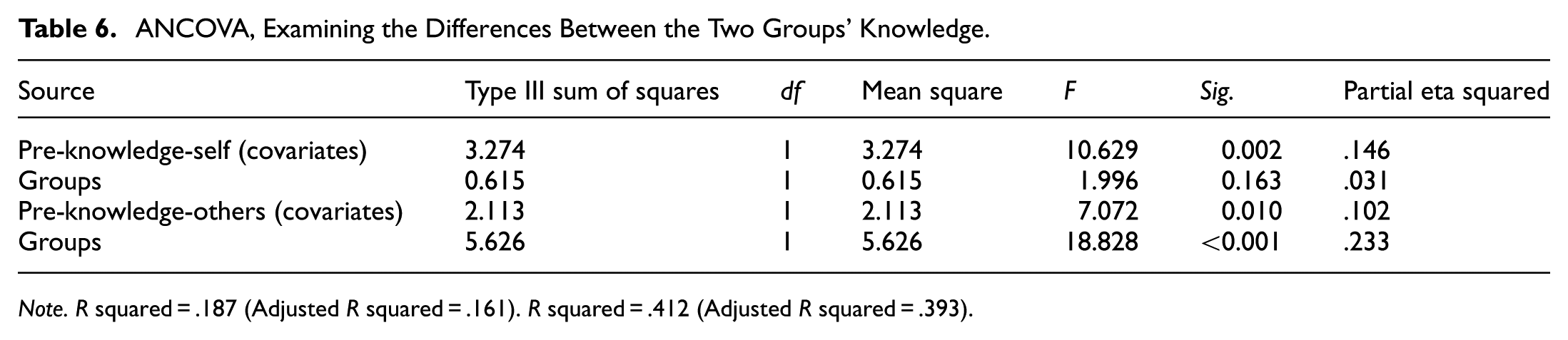
Note. R squared = .187 (Adjusted R squared = .161). R squared = .412 (Adjusted R squared = .393).
As for knowledge-others, it shows significant differences between the two groups, which reveals that telecollaboration had added value in improving Chinese EFL learners’ knowledge-others compared with the traditional teaching method.
Tables 7–9 indicate that telecollaboration improved Chinese EFL learners’ attitude, skill and awareness more significantly than traditional instruction, with p value less than .05 and R square larger than .25, according to the standard set by Cohen (2013; R 2 ≈ .25, large level), indicating a strong level of explanatory power. The significant group effect further underscores the role of the telecollaboration in shaping attitude, skill, and awareness. Table 10 further displays the results of one-way ANCOVA, examining the differences between the two groups’ total ICC performance.
ANCOVA, Examining the Differences Between the Two Groups’ Attitude.

Note. R squared = .301 (Adjusted R squared = .279).
ANCOVA, Examining the Differences Between the Two Groups’ Skill.

Note. R squared = .350 (Adjusted R squared = .329). R squared = .247 (Adjusted R squared = .223).
ANCOVA, Examining the Differences Between the Two Groups’ Awareness.

Note. R squared = .365 (Adjusted R squared = .344).
ANCOVA, Examining the Differences Between the Two Groups’ ICC.

Note. R squared = .445 (Adjusted R squared = .427).
As evident in Table 10, the final ANCOVA indicated a significant main effect of intervention type on participants’ post-test ICC scores, F (1, 62) = 32.603, p < .001, partial η2 = .345, with a large effect size and a strong level of explanatory power (R2 = .445, Adjusted R2 = .427). Thus, after controlling pre-test scores, participants in the telecollaboration group demonstrated significantly higher ICC levels than those in the traditional classroom instruction group.
The findings strongly indicated that telecollaboration with Colombian counterparts represented a practical approach for enhancing the ICC of Chinese EFL learners. This mode of interaction appeared to facilitate a more efficient acquisition of intercultural communicative skills and awareness, enabling learners to bridge the gap between theoretical cultural knowledge and practical application in real-world communication scenarios.
Answer to Research Question 2: Qualitative Results on Chinese EFL Learners’ Perceptions
Perceived Benefits of Telecollaboration
This study also explored their perceptions of telecollaboration with Colombian peers. Despite the 13-hr time difference between the two countries, Chinese and Colombian EFL students remained actively engaged in the telecollaboration activities. Overall, students expressed predominantly positive perceptions, with 58 references to favorable experiences compared to only 15 negative references. A closer examination of the positive perceptions revealed two major themes and six sub-themes that emerged from the interview transcripts regarding the benefits of engaging with fellow EFL learners, as outlined in Tables 11 and 12. The first theme, significant growth in cultural, linguistic, and digital aspects, includes four sub-themes: (a) expanded cultural knowledge, (b) improved language skills, (c) increased confidence in interaction, and (d) enhanced digital literacy. The second theme, closer bonds through shared EFL learning identity, consists of two sub-themes: (a) the formation of friendships based on equity and sincerity, and (b) a relaxed and flexible communication style shaped by a shared understanding of the challenges faced by both Chinese and Colombian EFL learners.
Theme 1: Growth in Cultural, Linguistic, and Digital Skills.

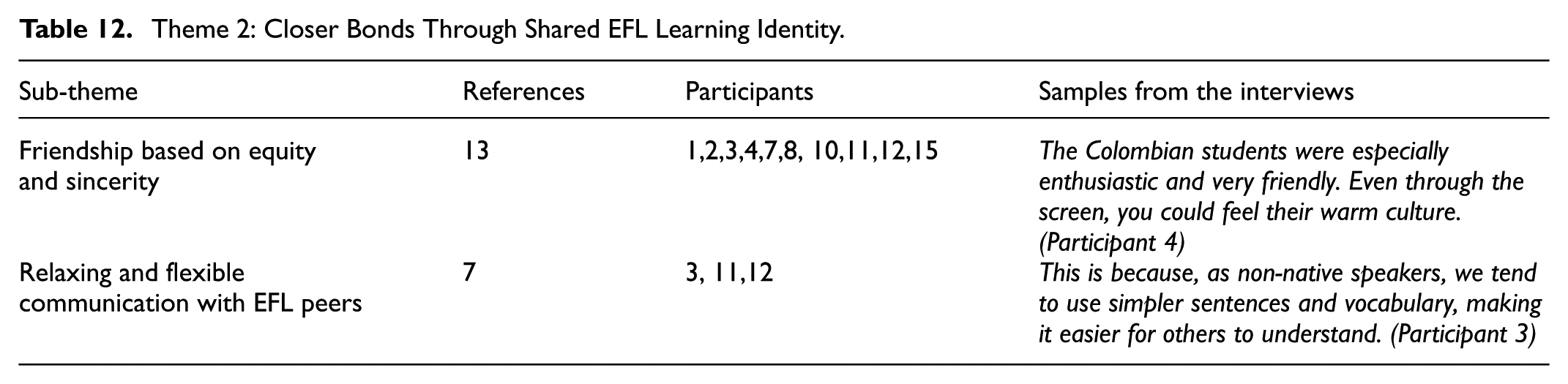
Theme 2: Closer Bonds Through Shared EFL Learning Identity.
Significant Growth in Cultural, Linguistic, and Digital Aspects
As shown in Table 11, the first subtheme, “expand cultural knowledge,” has 15 references from 10 students, indicating the positive role of telecollaboration in broadening their cultural knowledge due to the positive and authentic cultural surroundings. Most of the interviewees believed that this virtual exchange inspired them to travel the world to learn more about other cultures. The sub-theme of “Improve language skills” comprises eight references from seven students. They perceived that Colombian EFL learners’ good pronunciation could help them speak better. “Bold and confident to interact” emerges from eight references. Most of them felt apprehensive at the beginning. However, they later became braver to interact mostly through a favorable linguistic atmosphere with more peers’ positive feedback and partly through their intercultural exchange practices. Finally, digital storytelling tasks also enabled them to develop their digital literacy.
Closer Bonds Through Shared EFL Learning Identity
As shown in Table 12, the interview analysis indicated that 10 students highlighted friendship based on equity and sincerity, with 13 references. The Colombian students’ similar age, warmth, and enthusiasm—despite interacting through screens—contributed to Chinese EFL students’ enjoyment of the telecollaboration experience. Another key factor that fostered closeness and reduced anxiety between EFL learners was the relaxed and flexible communication style typically observed in interactions between non-native speakers, noted in seven references. Most of the participants reported that such communication often involved the use of simpler vocabulary and sentence structures, making interactions more accessible and comprehensible. In addition, these exchanges were marked by a high degree of tolerance for linguistic errors and a willingness to repeat or rephrase messages when necessary. This communicative environment encouraged learners to take risks, make mistakes, and seek clarification without fear of judgment. As Participant 3 reflected, engaging with other non-native speakers heightened their awareness of the challenges associated with learning and using English. This awareness, in turn, motivated them to simplify their own speech and strive for mutual understanding, which they viewed as a significant advantage of communicating with fellow EFL learners.
Perceived Impact on ICC
Thematic analysis revealed that telecollaboration has affected the ICC dimensions of Chinese EFL learners to varying extents. Figure 1 and Table 13 indicate their codes and references in the respective subcategories of ICC. The coding process was done using ATLAS.ti 24, as shown in Figure 1. Figure 2 provides a sample of the coding process. Figure 1 illustrates a thematic network of ICC based on focus group interviews, organized around four main dimensions—knowledge, awareness, attitude, and skill—each linked to its respective sub-components and frequency of mention.

Conceptual map of ICC: Themes emerged from the interviews.
Themes, Codes, and Samples From Chinese EFL Students’ Responses.

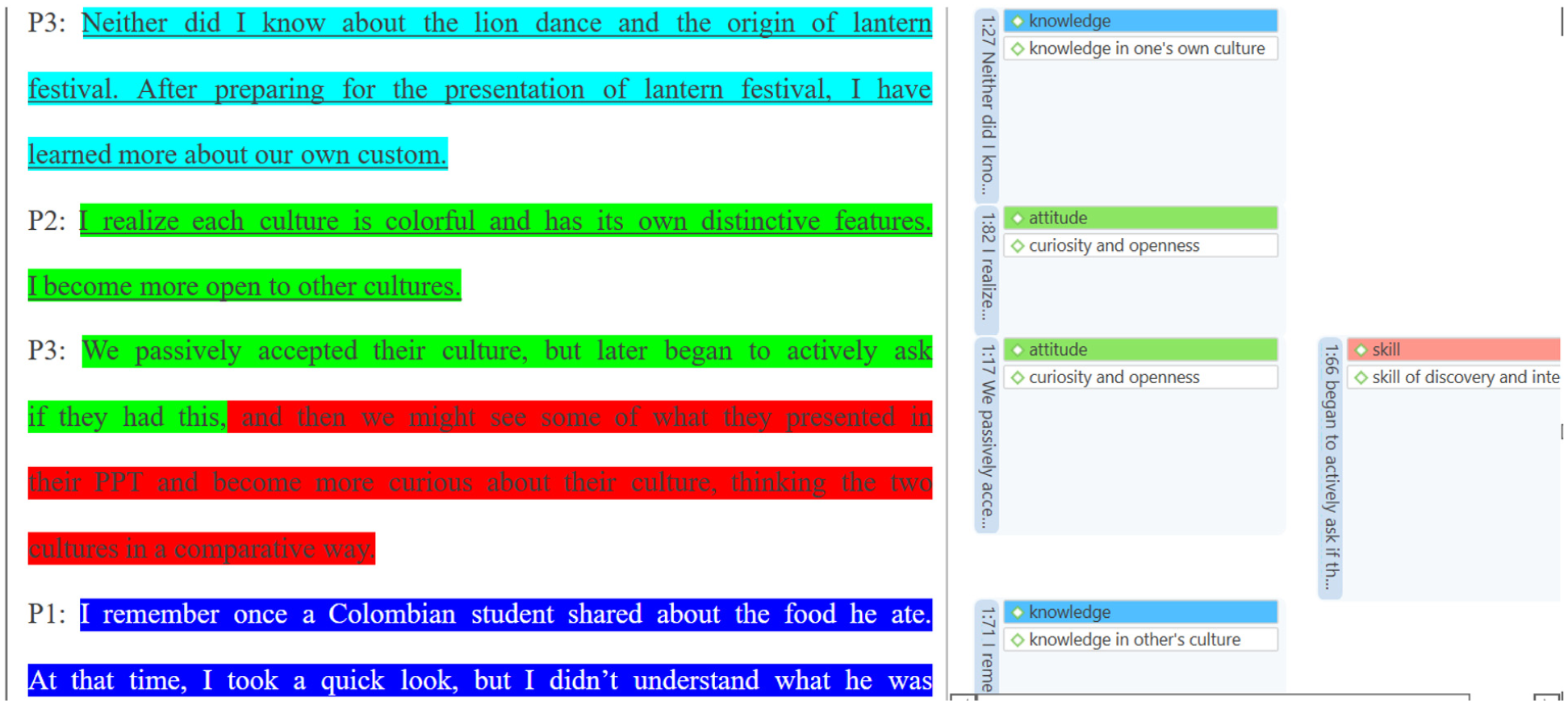
Coding focus group interview 2.
Grounded in Byram’s (2020) ICC model, the thematic analysis of interview transcripts reveals two central aspects of the knowledge dimension: knowledge of one’s own culture (12 references) and knowledge of others’ cultures (24 references). The analysis showed that Chinese EFL participants in the experimental group have expanded their knowledge of self and others, especially gaining more knowledge about Colombia. Notably, Garrett-Rucks (2016) explains that knowledge in an intercultural context involves understanding of one’s culture in a “global and comparative” situation (p. 49). Moreover, telecollaboration helped students widen their perspectives to examine their own culture and become more confident, as shown in the quotes from Participant 2 (Table 13).
The theme of attitude emerged from responses indicating that most Chinese students had become less prejudiced and ethnocentric, displaying greater openness toward other cultures. In the interviews, students shared specific experiential perceptions reflecting this shift. For example, they reported that after the intervention program, they developed confidence in their own culture and showed increased readiness to suspend disbelief about it. Some even noted a willingness to question assumptions about other cultures. Participant 5, for example, expressed surprise at the strict graduation requirements for Colombian undergraduates, while Participant 3 remarked on becoming more open to diverse perspectives. Overall, most students demonstrated a readiness to adapt their behavior, such as preparing more thoroughly, to promote effective intercultural communication.
In line with Byram’s (2020) framework, the theme of skill includes two sub-themes: (a) the ability to interpret and relate, and (b) skills of discovery and interaction. The former sub-theme refers to the capacity to analyze, compare, and contextualize cultural elements without necessarily engaging in direct interaction. This often occurs through texts, media, and structured discussions. During interviews related to sessions on common behaviors and values, the interviewees frequently moved beyond guided topics to engage in meaningful discussions about their daily lives and educational systems. Such exchanges demonstrated a growing ability to interpret and relate cultural experiences. In terms of the skills of discovery and interaction, most of the Chinese EFL participants highlighted how exposure to Colombian students’ fluency and expressiveness in English encouraged them to improve their own communicative clarity. For instance, Participant 9 noted that hearing Colombian students speak English with accents helped normalize linguistic diversity and reduced their anxiety about speaking English, thereby increasing their confidence in intercultural communication (Table 13).
The theme of awareness was evidenced by students’ growing recognition of both their own cultural values and those of others as the telecollaborative sessions progressed. This theme was supported by 25 coded references in the interview data. Most of the interviewees reflected on shifts in their cultural perceptions. For example, Participant 6 noted the contrasts in educational values between the Chinese and Colombian contexts. Moreover, the development of cultural awareness included recognizing the need to negotiate and explain cultural differences to avoid misunderstanding. For example, Participant 15 highlighted instances where Colombians confused Chinese and Japanese cultural features, prompting a heightened sensitivity to how cultures are perceived and the importance of intercultural clarification in fostering mutual understanding.
Based on the qualitative data analysis, the theme of knowledge emerged as the most frequently referenced category, with 34 mentions. This overarching theme encompassed two distinct subthemes: knowledge in one’s own culture (12 references) and knowledge in other’s culture (22 references). Following closely was the theme of awareness. The theme of attitude was referenced in the subsequent rank, while skill was the least mentioned category among all themes.
Discussion
Discussion of Research Question 1
Quantitative results demonstrated that the experimental group experienced more significant gains across almost all ICC dimensions, including knowledge-others, skills, attitudes, and critical cultural awareness. However, knowledge-self, which showed no significant difference across groups, was an exception. This suggests that knowledge of one’s own culture may have improved to a similar extent in both groups, regardless of the intervention, at least in the short term. This outcome is likely because both groups—particularly the experimental group—had already achieved a relatively high level of self-knowledge before the program, stemming from their prior political education in mainland China. In contrast, the control group demonstrated only modest improvements, mainly in knowledge-others and attitude, with non-significant progress in the skill-based and awareness components of ICC. More substantial gains in these dimensions may require longer-term exposure or more innovative pedagogical approaches.
These findings align with and expand upon Helm’s (2015) definition of telecollaboration as a practice that promotes both language learning and ICC through online intercultural exchanges. More specifically, our study demonstrates how telecollaboration can foster advanced intercultural competences—particularly when learners from culturally distant regions, such as East Asia and Latin America, interact through English as a lingua franca. This directly addresses the research gap identified by Chau et al. (2024) and Ito-Morales and Fuse (2025), who called for broader cultural comparisons beyond the commonly studied contexts of East Asia or Europe-Europe exchanges.
Discussion of Research Question 2
Regarding research question two, analysis of qualitative data revealed two primary perceived benefits of telecollaboration: (a) growth in cultural, linguistic, and digital skills, and (b) the development of close interpersonal bonds through a shared EFL learner identity. These findings are consistent with those reported by Freiermuth and Huang (2021) and Yeh and Heng (2023), who have recently highlighted the motivational and relational advantages of peer interaction in telecollaborative settings. Participants in our study have emphasized that communicating with non-native speakers felt more accessible and equitable. This is because it involves simpler language, mutual patience, and shared understanding of the challenges of learning English. These findings are also consistent with recent studies that reposition telecollaboration within the paradigm of English as a lingua franca (Sevilla-Pavón, 2019; Shadiev & Yu, 2024). Such contexts appear to emancipate EFL learners’ shared identity, to foster greater empathy, tolerance for ambiguity, and resourceful collaborative meaning-making (Kohn & Hoffstaedter, 2017).
With respect to its impact on ICC, participants’ self-reports indicated that each dimension was positively affected by the intervention. Within the context of telecollaboration in this study, the notion of a third space functioned as an intercultural mediatory zone in which learners transcended fixed cultural binaries and collaboratively negotiated meaning. Participants reported that this process enabled them to reassess their assumptions about Colombian education from a Chinese epistemological lens. This revealed differing expectations regarding academic qualifications for employment. Such dynamic negotiations mirror the kind of critical reflection emphasized in the findings of Sevilla-Pavón (2019), who reported that L2 online exchanges can lead to greater ICC gains than L1 exchanges. However, unlike Sevilla-Pavón (2019), who did not fully explore learners’ voices, the current research offers rich qualitative insights into how Chinese EFL learners themselves interpret and reflect on these developmental shifts.
Finally, our study offers methodological contributions by incorporating focus group interviews within a mixed-methods design—a relatively underused method of data collection in previous studies on telecollaboration. The use of this method in our study enabled us to generate a deeper understanding of Chinese EFL learners’ intercultural experiences and perception of ICC development following the telecollaboration intervention program. Furthermore, it helped address the third gap identified in the literature (Chau et al., 2024). Participants’ responses in the focus group interviews allowed us to shed light on how equity, shared identity, and communicative flexibility collectively contributed to a positive and meaningful intercultural experience. These outcomes were reinforced by the open-group design and the empathetic relationships among EFL learners, which created a supportive atmosphere for intercultural exchange. The findings indicate that effective telecollaborative interventions should maintain a flexible structure that promotes spontaneous interaction and peer support. Teachers play a crucial role in sustaining this openness by monitoring and guiding discussions without dominating them.
Hence, this study affirms the value of telecollaboration for the development of ICC among EFL learners, who are in linguistically and culturally diverse settings. Furthermore, the study highlights the importance of leveraging English as a lingua franca to enhance mutual understanding and highlights the significant role of the pedagogically structured digital storytelling and reflective dialogue in advancing intercultural awareness and global citizenship. These findings contribute to the growing body of research that calls for more inclusive, context-sensitive approaches to intercultural language education in digitally mediated environments.
Practical Recommendations
To effectively foster EFL learners’ ICC, actionable recommendations are needed at both the instructional and institutional levels. At the instructional level, teachers should design telecollaborative projects that connect EFL learners from diverse cultural contexts, enabling authentic and egalitarian interaction. Teachers are advised to act primarily as participant-observers in intercultural discussions while allowing students to take the lead as facilitators to sustain openness and balance. When appropriate, teachers provide some guidance, such as brief post-task reflection and focused vocabulary-building activities to enhance proficiency without losing the advantage of their linguistic simplicity. Finally, integrating emerging technologies such as artificial intelligence and virtual reality into telecollaborative frameworks can further enhance digital literacy while strengthening both intercultural awareness and linguistic competence.
At the institutional level, teacher training should emphasize skills for managing structured intercultural tasks and cultivating inclusive, low-stress communication environments. Additionally, sustained institutional support is essential for providing technological infrastructure and establishing long-term partnerships that ensure the continuity of telecollaborative programs across schools and countries.
Limitations and Future Studies
Similar to other studies, our research has some limitations. First, the sample size was relatively small due to some challenges in recruiting participants outside of China. Hence, future studies should include larger and more diverse populations to enhance the generalizability of findings. Second, the 9-week duration of the intervention may be too short to capture the long-term development of ICC. So, longer-term studies could offer more comprehensive insights into how ICC evolves over time. Third, this study focused on telecollaboration between Chinese and Colombian EFL learners. Future studies could investigate how ICC development differs when collaborating with L1 English speakers versus L2 users, using robust mixed-methods approaches. Finally, while our findings have demonstrated the value of telecollaboration in this specific context, they may not be fully applicable to all EFL contexts. Taking this into account, future investigation can explore diverse cultural pairings—such as collaborations involving learners from the Middle East—or examine different learner groups, including adult and lifelong learners, to assess the broader adaptability of telecollaborative practices.
Conclusion
To challenge the dominant focus on telecollaborative exchanges between Asian or Western Contexts, this study offers empirical insights into the underexplored intercultural dynamics between Asian and Latin American EFL learners. Specifically, it highlights the pedagogical value of using English as a lingua franca in focusing on ICC. In line with Freiermuth and Huang’s (2021) call toward valuing all EFL accents and cultural diversity, we highlighted two major factors that contributed to the success of telecollaboration between EFL learners. First, despite the potential communication anxiety when using English as a lingua franca, our findings confirmed that contact with other non-native speakers fosters the development of intercultural communicative competence, but we challenged the assumption that shared cultural backgrounds might play a role in this process. In fact, our participants’ sense of belonging to the same category of English learners created a more empathetic and tolerant communicative climate. Second, unlike the lack of focus on intercultural skills in conventional language instruction, EFL–EFL telecollaboration created a genuine and supportive environment for learners to prepare for the negotiation of cognitive, relational, and critical cultural awareness. In other words, even though the participating learners were apart in cultural distance, the same learning identities and pedagogically-structured interaction made the collaboration build intercultural competence possible.
Footnotes
Acknowledgements
We thank all Chinese and Colombian students who participated in this study.

Ethical Considerations
Approval was obtained from both Jiangxi Institute of Technology and Universidad Pedagógica y Tecnológica de Colombia.
Consent to Participate
All participants in this study were fully informed about the nature and purpose of the research before providing their voluntary consent to participate. Informed consent was obtained in writing, and participants were informed of their right to withdraw from the study at any time without consequences.
Author Contributions
Yan Qilin: Conceptualization, methodology, and writing—original draft preparation. Omer Hassan Ali Mahfoodh: Contribution of interpreting results, editing, supervision, critical revision of the manuscript, and writing the final draft. Paula Andrea Pérez Rubiano: Review and editing.
Funding
The authors disclosed receipt of the following financial support for the research, authorship, and/or publication of this article: This work was supported by Jiangxi Provincial Teaching and Reform Foundation of China under Grant [number: JXJG-23-24-9] (A Research of College Students’ Intercultural Communicative Competence Growth Based on Telecollaboration).
Declaration of Conflicting Interests
The authors declared no potential conflicts of interest with respect to the research, authorship, and/or publication of this article.
Data Availability Statement
The datasets generated and analyzed during the current study are available from the corresponding author upon reasonable request.