



Abstract
With the rapid development of global industrialization and urbanization, air pollution has become a major challenge threatening human health and the ecological environment, and there is an urgent need for innovative governance solutions relying on technological progress. To explore the role of digital infrastructure in environmental governance, this study employs panel data from 285 prefecture-level cities in China from 2003 to 2023 and applies a fixed-effects model to systematically examine the impact of digital infrastructure development on urban air pollution and its underlying mechanisms. The findings reveal that digital infrastructure development significantly reduces urban air pollution, a conclusion that remains robust after controlling for fixed effects and employing instrumental variable approaches. Mechanism analysis demonstrates that digital infrastructure improves air quality through two distinct pathways: (1) enhancing regulatory capacity by improving monitoring accuracy and enforcement efficiency and (2) fostering green innovation by lowering barriers to technological development and application. The study extends the research domain of environmental economics and digital technology, providing novel theoretical perspectives and empirical evidence for understanding the role of digital technology in environmental governance.
Keywords
Introduction
With the acceleration of global urbanization, air pollution has emerged as a critical threat to human health and ecosystems. Human activities—including industrial emissions, vehicular exhaust, construction operations, and energy consumption—release substantial harmful pollutants into the atmosphere, such as fine particulate matter, sulfur dioxide, nitrogen oxides, and ozone. These contaminants not only degrade air quality but also amplify the incidence of respiratory diseases, cardiovascular conditions, and cancer, imposing long-term health hazards on urban populations. According to World Health Organization (WHO) data, approximately 8.1 million premature deaths occur annually due to air pollution, with urban areas in developing countries and emerging economies disproportionately affected. 1 Furthermore, air pollution disrupts climate systems by exacerbating global warming and extreme weather events (Arshad et al., 2024). Despite governmental initiatives to restrict high-pollution industries, promote clean energy, and optimize transportation management, pollution control faces persistent challenges: inadequate monitoring capabilities, inefficient policy implementation, and cross-regional coordination deficits. Consequently, developing more efficient and intelligent governance approaches has become imperative for contemporary environmental management.
Current research on air pollution encompasses extensive findings across policy regulation, technological innovation, public participation and spatial planning dimensions.
In terms of policy regulation, early studies leveraged the Environmental Kuznets Curve (EKC) to examine the nonlinear relationship between economic growth and pollution emissions, while prioritizing pollution source apportionment (Guarnieri et al., 2014) and emission inventory development (Shahbazi et al., 2022) to identify key contributors and formulate targeted abatement strategies. Advances in environmental economics have facilitated rigorous evaluations of policy instruments such as carbon taxes (L. Yang, 2024), emissions trading systems (Fisher-Vanden & Olmstead, 2013), and green subsidies (Xie et al., 2021), underscoring market mechanisms’ role in air pollution governance. Notably, empirical evidence reveals a paradox regarding policy efficacy: although economic incentives theoretically possess the greatest potential for driving emissions reduction, their market-based behavioral advantages often remain unrealized in practice, resulting in the lowest actual effectiveness among policy tools. Conversely, command-control strategies and persuasive instruments dominate implementation frequency while demonstrating superior emission reduction outcomes. These approaches collectively constitute the prevailing, empirically validated governance toolkit (Du et al., 2021). In recent years, policy studies have increasingly emphasized the synergistic effects among different policy instruments. Research has found that an appropriate combination of command-and-control and market-incentive policies can produce a synergistic effect where “the whole is greater than the sum of its parts” (Stavins, 2022). Scholars are also paying greater attention to the regional heterogeneity of policies, recognizing that regions with different levels of economic development, industrial structures, and environmental carrying capacities require differentiated policy designs.
In the area of technological innovation, progress primarily manifests in three interconnected domains: clean energy transition, production process optimization, and end-of-pipe treatment. The rapid advancement of renewable energy technologies provides critical support for reducing fossil fuel dependence, with International Renewable Energy Agency (IRENA) data indicating that global renewable power capacity reached 3,865 GW in 2023—displacing approximately 1.2 billion metric tons of standard coal equivalent in fossil energy consumption and directly curtailing emissions from coal and natural gas combustion (International Renewable Energy Agency, 2024). In terms of production processes, the application of clean technologies has yielded significant results. In open-pit mining operations, surface mining activities are a primary source of inhalable hazardous dust in the air. Wet spray dust suppression systems, which inject water directly onto dust sources, can effectively achieve dust control at the point of origin (Cecala et al., 2012; Hixson et al., 2010). In the field of end-of-pipe treatment technologies, W. Wang et al. (2022) highlighted the multi-scenario applicability of stainless steel catalysts in gaseous pollutant control, including but not limited to diesel exhaust treatment, volatile organic compound purification, and denitrification reactions (W. Wang et al., 2022). Their study emphasized the potential value of such catalysts in controlling pollution from both mobile and stationary sources. With technological advancements, air pollution control has demonstrated a clear trend toward synergistic integration of diverse technologies, aiming to achieve coordinated management of the entire process and multiple pollutants.
In the area of public participation, research primarily focuses on how individual behaviors (Fogg-Rogers et al., 2024), community actions (Ward et al., 2022), and multi-stakeholder collaboration can compensate for the limitations of policies and technologies (Z. Li et al., 2021). Air pollution governance cannot rely solely on governments and enterprises but must promote deep synergy within social systems. Current studies reveal that behavioral science provides a basis for air pollution interventions by analyzing the psychological drivers of pro-environmental behaviors (Sunstein & Reisch, 2014). Simultaneously, practices in information empowerment demonstrate that the disclosure and visualization of air quality data can effectively enhance public risk perception, promoting social oversight and self-behavioral adjustments (Lin et al., 2021). Additionally, studies on collective action examine bottom-up networks, such as civil society organizations and citizen science, exploring how they can form synergistic oversight and stimulate governance innovation. Overall, the rise of the public participation perspective signifies a paradigm shift in air pollution governance from “technical control” to “societal co-governance,” with the core objective of transforming pollution control responsibilities into endogenous practices collectively embraced by society, thereby enhancing the sustainability and equity of governance (Peng et al., 2024; Yuan et al., 2025).
In terms of spatial planning, research mainly explores three levels: urban, regional, and ecological. At the urban scale, studies focus on reducing pollution exposure risks by optimizing urban form and functional layouts. High-density monocentric cities often face problems of concentrated traffic pollution, while polycentric network structures can significantly reduce local emission intensity by decentralizing employment and residential functions (J. Yang et al., 2020). At the ecological scale, research emphasizes exploring the pollution blocking and purification functions of green infrastructure. Urban forest systems have been proven to have significant air filtration effects, with trees in 86 Canadian cities removing 16,500 tons of air pollution in 2010, providing human health benefits valued at 227.2 million Canadian dollars (Nowak et al., 2018). At the regional scale, research primarily focuses on cross-jurisdictional collaborative governance and industrial spatial restructuring. Research by Ge et al. (2023) found that regional collaborative governance reduces air pollution by strengthening environmental supervision, improving environmental governance efficiency, and promoting environmental protection technologies. The inhibitory effect of regional collaborative governance on air pollution is long-term and temporarily increasing, while its spillover effects are only significant within specific ranges and decay spatially. In summary, while existing research has developed a relatively comprehensive understanding of air pollution and its governance, several issues warrant further investigation. Although traditional governance approaches have achieved certain results, they frequently encounter practical challenges such as delayed information acquisition, inefficient regulatory enforcement, and difficulties in cross-regional coordination. These limitations significantly constrain the precision and effectiveness of pollution control measures. Recent studies have begun focusing on industrial spatial restructuring and pollution transfer mechanisms within urban agglomerations, as well as how to coordinate environmental protection interests across different regions through the establishment of cross-regional ecological compensation mechanisms. Notably, with advancements in spatial analysis technologies, spatial simulation methods based on multi-source remote sensing data and big data analytics have provided new perspectives for understanding the spatial distribution patterns of air pollution and their driving mechanisms. However, research on systematically integrating digital technologies into spatial planning practices remains in its nascent stages.
In summary, while existing research has developed a relatively comprehensive understanding of air pollution and its governance, several issues warrant further investigation. Although traditional governance approaches have achieved certain results, they frequently encounter practical challenges such as delayed information acquisition, inefficient regulatory enforcement, and difficulties in cross-regional coordination. These limitations significantly constrain the precision and effectiveness of pollution control measures. In recent years, the rapid advancement of digital technologies has positioned urban digital infrastructure development and upgrades as a crucial driver for modernizing environmental governance. In this study, “urban digital infrastructure” specifically refers to the digital technology system directly serving environmental perception, decision-making, and control. Its core components include IoT monitoring networks, environmental big data and cloud platforms, intelligent transportation and emission control systems, which collectively form the technological foundation enabling real-time monitoring, in-depth analysis, and precise intervention. Currently, China has established the world’s largest 5G network, achieved comprehensive coverage of IoT environmental monitoring devices in key urban areas, and widely implemented environmental big data platforms across cities. These digital infrastructures are fundamentally transforming conventional environmental governance models through real-time monitoring, intelligent analysis, and precise management. However, the mechanisms through which digital infrastructure construction impacts urban air quality remain systematically understudied, with a notable lack of empirical evidence regarding its pathways and effectiveness. This study will focus on examining how digital infrastructure construction influences urban air quality through three key pathways: technological innovation, regulatory optimization, and collaborative governance, thereby providing theoretical foundations and policy references for urban environmental governance in the digital era.
The innovation of this study lies in systematically constructing an analytical framework for the impact of digital infrastructure on air pollution governance. It empirically examines the pollution reduction effects of digital infrastructure, systematically elucidates the dual pathways—technological innovation empowerment and regulatory model optimization—through which it influences air quality. This work addresses theoretical gaps in research on air governance mechanisms within digitalized environments, providing scholarly support and policy references for advancing the transition to intelligent governance.
Theoretical Framework and Research Hypotheses
Digital Infrastructure and Air Pollution Governance: A Technology Empowerment Perspective
The analysis of the relationship between digital infrastructure and air pollution governance can be effectively grounded in the technology empowerment theory, which offers a more nuanced perspective than traditional technological instrumentalism. While conventional views treat digital technologies as passive governance tools, the technology empowerment theory emphasizes their active transformative potential, positioning digital technologies not merely as instruments but as driving forces for governance model innovation (Milakovich, 2021; J. Wang & Wang, 2023).
From this theoretical standpoint, the interaction between digital infrastructure and air pollution governance operates through three interconnected dimensions. First, in terms of technological restructuring, digital infrastructure serves as the physical network foundation for dynamic air pollution monitoring and analysis (Nie et al., 2025). The spatial coverage and deployment density of digital infrastructure directly determine the accuracy of pollutant distribution tracking, while its data processing and transmission capabilities substantially shorten the response time for pollution identification and early warning systems (Kong et al., 2025; P. Wang, Yao, et al., 2019). Second, regarding governance transformation, digital infrastructure provides the platform basis for cross-jurisdictional and cross-departmental collaborative air pollution governance. Through standardized data interfaces and sharing mechanisms, it enables information integration and regulatory coordination among different governance entities, establishing the operational foundation for a unified regional governance framework (Pardo & Tayi, 2007; Z. Wang et al., 2025). Third, in the dimension of social coordination, digital infrastructure reduces the information and technical barriers for multi-stakeholder participation in air pollution governance. By providing standardized data access channels and public feedback interfaces, it significantly lowers participation costs for citizens and enterprises in pollution monitoring, regulatory compliance, and policy feedback processes, thereby facilitating the institutionalized integration of broader societal forces into governance systems (Asimakopoulos et al., 2025).
Based on this theoretical framework, we propose
The Impact Mechanism of Digital Infrastructure on Air Pollution
The impact mechanism of digital infrastructure on air pollution can be analyzed from two main actors: government and enterprises. At the government level, digital infrastructure can improve the precision of environmental regulation and enhance governance capacity, thereby suppressing pollution emissions. At the market level, digital infrastructure reduces information barriers for green technology innovation, optimizes R&D resource allocation, and accelerates technology diffusion, promoting enterprises to adopt cleaner production methods and consequently reduce pollution. These two pathways together form a dual mechanism of “regulatory strengthening-innovation driving” that ultimately improves air quality.
The Mediating Role of Environmental Regulatory Intensity
The construction and application of digital infrastructure have significantly enhanced the government’s environmental regulatory capacity, thereby positively impacting air pollution control.
First, the government’s regulatory model is shifting from traditional passive response to proactive prevention and control. Through the widespread deployment of IoT terminal devices and deep integration with big data analytics and AI algorithms, the government has established a high-precision environmental monitoring network covering urban core areas and key pollution sources. This enables dynamic simulation and tracking of pollutant dispersion trajectories, allowing regulatory agencies to predict pollution trends in advance and transition from post-incident remediation to preemptive intervention. As a result, the identification of pollution sources such as industrial exhaust emissions and non-compliant vehicle emissions has become more accurate and timelier (Yue & Han, 2025). Second, the collaborative efficiency of government regulation has markedly improved. The integration and optimization of environmental information platforms, driven by strong government initiatives, have eliminated departmental barriers and information silos inherent in traditional regulatory models. Supported by digital infrastructure and guided by unified government planning and coordination, standardized data interfaces and real-time sharing mechanisms have been established across departments, resulting in smoother operational collaboration (Zhang et al., 2022). Finally, the efficiency and deterrent effect of government enforcement have been comprehensively enhanced. The adoption of cloud computing and edge computing technologies has significantly improved data processing capabilities, enabling regulatory agencies to identify abnormal emission behaviors within milliseconds. The government’s intelligent decision-making system can rapidly generate response plans and disseminate them to enforcement personnel in real time through administrative networks (H. Wang & Guo, 2024). Equipped with government-issued mobile enforcement terminals, inspectors can immediately receive task instructions and data support, allowing for quick location and on-site verification of enterprises violating emission standards.
Based on this, we propose
The Mediating Role of Green Technology Innovation
The widespread application of digital infrastructure has profoundly transformed the conditions and environment for enterprises to conduct environmental technology innovation, providing new technological pathways for improving air pollution (Zhou & Li, 2025). First, the large-scale construction and popularization of digital infrastructure have lowered the barriers and costs for enterprises to access innovation resources. Small and medium-sized enterprises, often constrained by funding shortages and information gaps, have historically struggled to access cutting-edge environmental technology information and high-end R&D equipment, placing them at a long-term disadvantage in environmental innovation. Digital tools such as cloud-based technology-sharing databases and remote R&D collaboration systems break down communication barriers between enterprises, facilitating cross-regional and cross-industry technological exchanges and cooperation. This efficient collaborative interaction accelerates breakthroughs in green technology from conceptualization to prototype design, enabling faster transition of innovations from the laboratory to the market (R. Li et al., 2022). Second, the powerful computing support provided by data processing centers injects strong momentum into the R&D process of corporate environmental technology innovation. Leveraging the supercomputing capabilities of digital infrastructure, enterprises can construct precise digital twin models to conduct multi-dimensional, full-cycle simulations and optimization validation of environmental solutions such as desulfurization, denitrification processes, and wastewater treatment technologies, significantly shortening the technology development cycle. Additionally, the innovation factor optimization mechanism driven by digital technology allows enterprises to use big data analytics to accurately identify resource waste in the R&D process, directing more funds, talent, and equipment toward core technology development and practical applications of cleaner production processes (Liu et al., 2024). Finally, with comprehensive support from digital infrastructure, corporate environmental technology innovation forms a virtuous cycle. Real-time emission reduction data accumulated during production is continuously fed back to the enterprise’s R&D center via sensors. The R&D team uses big data analytics tools to conduct in-depth analysis of this data, identifying shortcomings and areas for improvement in technology application. This enables targeted iterative upgrades, ultimately achieving systematic reductions in total air pollutant emissions (Zhivkov et al., 2025).
Based on this, we propose
Based on the above analysis, the framework of our research hypotheses can be integrated into the following progressive relationship: the construction and improvement of digital infrastructure can enhance the precision and coordination of government environmental regulation while reducing the barriers and costs for enterprises’ green technology innovation. These dual pathways collectively contribute to the reduction of air pollutant emissions, ultimately achieving overall air quality improvement. The schematic diagram of our research hypotheses is presented in Figure 1.

The hypothetical analysis framework.
Research Design
Data Sources
The dataset of this study covers prefecture-level cities across China (excluding Xinjiang, Tibet, Taiwan, Hong Kong, and Macao) for which data are available. After excluding four provincial-level municipalities and cities that underwent significant administrative boundary adjustments during the research period, a balanced city-year panel dataset was constructed, comprising 285 cities spanning the years 2003 to 2023. Data on digital infrastructure development were sourced from the China City Statistical Yearbook and prefectural-level government work reports. Air pollution indices were obtained from monitoring data published by China’s Ministry of Ecology and Environment, while all other data were derived from the Chinese Research Data Services Platform. To ensure data accuracy, observations with missing key variables were excluded. To mitigate the influence of outliers, all major continuous variables were winsorized at the 1st and 99th percentiles. The final dataset consists of 5,478 city-year observations.
Variables
Dependent Variable
Following F. Xu, Huang, et al. (2023), we use PM2.5 concentrations to measure air pollution levels. Based on monthly PM2.5 data released by China’s Ministry of Ecology and Environment, we calculate annual average PM2.5 concentrations for each prefecture-level city as the proxy for local air pollution intensity, with units in micrograms per cubic meter (μg/m3).
Independent Variable
Building upon the methodological framework established by Chao et al. (2021), this study employs text analysis techniques to quantitatively assess digital infrastructure development across prefecture-level cities. The analytical process involves systematic collection and computational processing of municipal government work reports, utilizing Python-based natural language processing for lexical segmentation and frequency analysis. Specifically, we perform comprehensive word segmentation on the corpus, enumerating both total lexical items and digital infrastructure-specific terminology, subsequently calculating their proportional representation as a quantitative development index. This methodological approach ensures both measurement objectivity and cross-regional comparability while providing a standardized metric for evaluating spatial disparities in digital infrastructure advancement. The analytical lexicon incorporates 51 conceptually relevant keywords spanning critical technological domains, including 5G networks, mobile communication systems, and information technologies, thereby constructing a robust and representative term frequency database for systematic assessment. The selected terminology encompasses fundamental infrastructure components, emerging technologies, and implementation indicators that collectively capture the multidimensional nature of digital infrastructure development. The text-based measurement approach offers distinct advantages over traditional infrastructure metrics by capturing policy priorities, implementation intensity, and technological focus areas through systematically analyzed governmental discourse, thereby providing a novel and replicable methodology for digital development assessment in urban contexts. The variable is measured as a percentage (%).
Mediating Variables
Following the methodological approach developed by Chen and Chen (2018), this study operationalizes the measurement of environmental regulatory intensity by quantifying the relative frequency of environment-related terminology within prefecture-level government work reports. The variable is expressed as a percentage (%). The analytical framework incorporates a comprehensive lexicon of environmental concepts, including policy-oriented terms, ecological descriptors, and specific pollution indicators. For assessing green technology innovation capacity, the study adopts the methodological specification from Q. Wang, Qu, et al. (2019), employing the natural logarithm transformation of granted green invention patent counts as a quantitative proxy for regional green innovation performance. This dual-measurement approach captures both the policy emphasis dimension through textual analysis of governmental discourse and the technological output dimension through patent-based innovation metrics, thereby establishing a robust empirical foundation for analyzing the interplay between regulatory frameworks and technological advancement in environmental governance. This variable is a dimensionless index.
Control Variables
In accordance with existing research, we have incorporated multiple control variables that may influence air pollution levels to ensure the accuracy and reliability of our analytical results. At the economic level, we control for GDP (in billions of RMB) and its quadratic term, while also accounting for the effects of fiscal revenue and financial loans (both in billions of RMB; S. Li & Yang, 2025). For demographic factors, we control for population density and human capital intensity (measured as the number of college students per 10,000 people) (Qiao et al., 2022). Additionally, we consider the impacts of technological capability (R&D expenditure in billions of RMB) and openness to foreign investment FDI (in billions of RMB; Lv et al., 2025).
The descriptive statistical results of the main variables are as follows in Table 1.
Descriptive Statistics

Empirical Model
To test the hypotheses proposed in section “Theoretical Framework and Research Hypotheses,” we construct Model (1) to examine the impact of digital infrastructure construction on air pollution:

To examine the mediating roles of environmental regulatory intensity and green technology innovation in the relationship between digital infrastructure construction and air pollution, this study adopts the three-step mediation effect test proposed by Wen et al. (2004). The empirical models are specified as follows:


Here,
To ensure the statistical significance and comparability of regression coefficients, all variables were standardized prior to conducting the regression analysis. This transformation allows for direct interpretation of coefficients as effect sizes measured in standard deviations, facilitating cross-variable comparisons while maintaining the integrity of statistical inference.
Regression Results
Baseline Regression Results
The baseline regression results presented in Table 2 systematically examine the impact of digital infrastructure development on air pollution. The findings reveal that digital infrastructure development exerts a statistically significant inhibitory effect on air pollution, a conclusion that remains robust across different model specifications.
Baseline Regression Results.

Note. Robust standard errors standard is given in parentheses.
, **, * show level of significance of parameter at 1%, 5%, and 10%, respectively.
In Column (1), which includes only the explanatory variable, the regression coefficient for digital infrastructure is −0.369 and statistically significant at the 1% level, indicating that a 1-unit increase in digital infrastructure leads to a 0.369-unit reduction in air pollution levels. When socioeconomic control variables such as GDP, population density, and foreign direct investment are introduced in Column (2), the coefficient for digital infrastructure decreases slightly to −0.351 while maintaining statistical significance at the 1% level. This suggests that the pollution-reducing effect of digital infrastructure is independent and cannot be fully explained by other socioeconomic factors. Notably, after further controlling for city fixed effects and year fixed effects in Column (3), the absolute value of the digital infrastructure coefficient decreases substantially to −0.014 yet remains statistically significant at the 5% level. This implies that while part of digital infrastructure’s pollution-reducing effect operates through influencing city-specific characteristics, its direct effect persists.
The baseline regression results demonstrate that digital infrastructure can significantly improve air quality, while also suggesting that digital infrastructure may influence air pollution levels through multiple channels, warranting further investigation of its mechanisms. Therefore, Hypothesis 1 is supported.
Robustness Tests
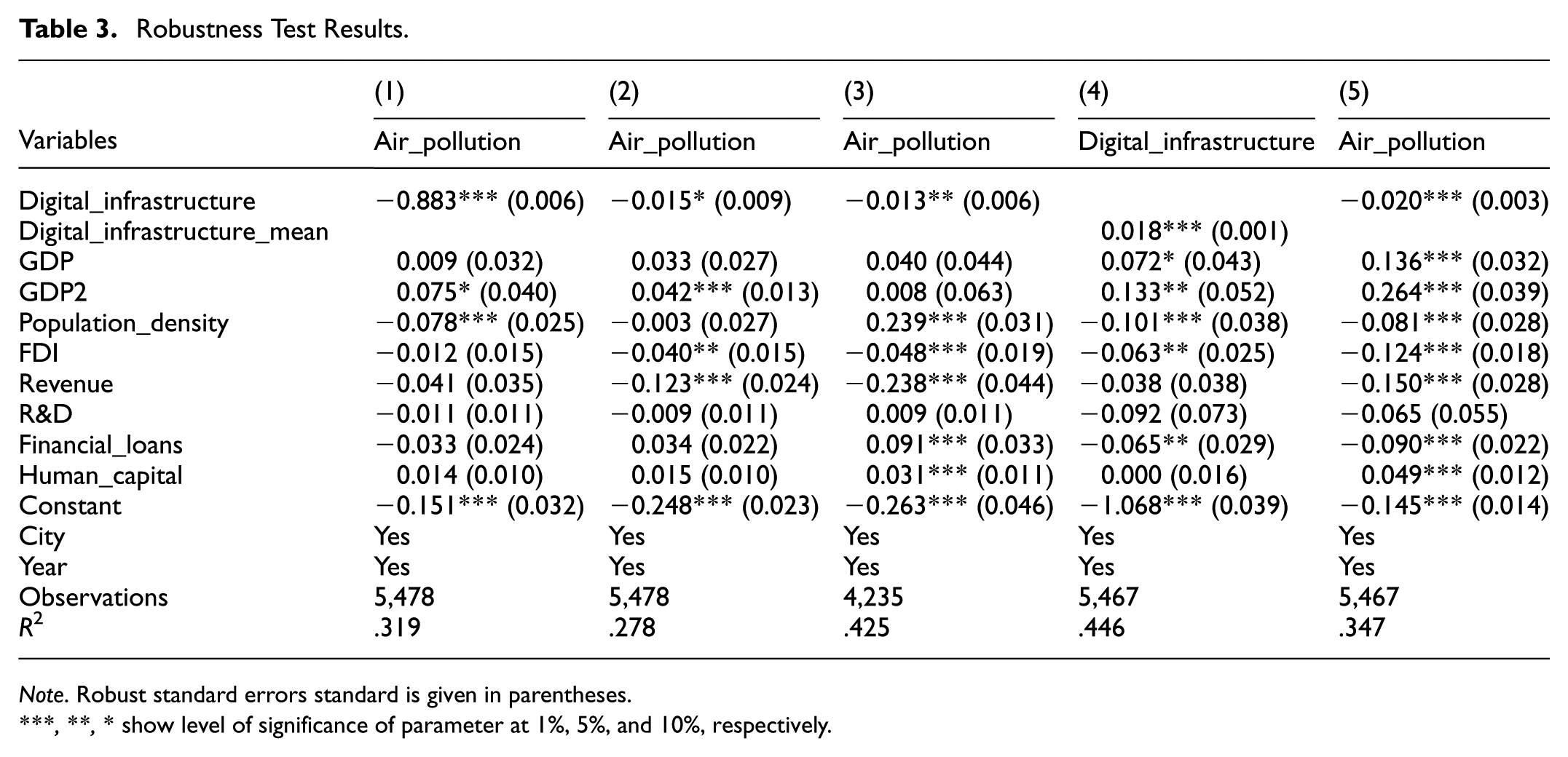
This study systematically examines the robustness of baseline regression results through multiple approaches. First, we replace the explanatory variable by using the total word frequency of digital infrastructure-related keywords as an alternative measure. Second, we substitute the dependent variable by adopting industrial sulfur dioxide emissions as an alternative indicator of air pollution. Third, we adjust the sample scope by excluding observations from 2020 to 2023 during the COVID-19 pandemic. Finally, we employ an instrumental variable approach, selecting the average level of digital infrastructure construction in other prefecture-level cities within the same province as the instrumental variable, and estimate the model using two-stage least squares (2SLS). The results of these robustness tests are presented in Table 3.
Robustness Test Results.
Note. Robust standard errors standard is given in parentheses.
, **, * show level of significance of parameter at 1%, 5%, and 10%, respectively.
The robustness test results demonstrate that the inhibitory effect of digital infrastructure on air pollution remains statistically significant across different testing methods, confirming the reliability of the baseline regression findings. When replacing the explanatory variable, the regression coefficient remains negative and statistically significant. Similarly, the estimates obtained after sample adjustment continue to support the baseline conclusions. The first-stage regression of the instrumental variable approach confirms a significant correlation between the instrumental variable and the endogenous variable. The second-stage estimation results further validate the pollution-reducing effect of digital infrastructure.
Mechanism Analysis
Environmental Regulatory Intensity
To further investigate the mechanisms through which digital infrastructure affects air pollution, this study first examines the mediating role of environmental regulatory intensity. The mechanism analysis in Table 4 demonstrates that digital infrastructure significantly strengthens environmental regulatory intensity with a coefficient estimate of 0.075 that is statistically significant at the 1% level. Simultaneously, enhanced environmental regulation exerts a significant negative impact on air pollution with a coefficient estimate of negative 0.009 that achieves statistical significance at the 10% level. These empirical findings confirm that digital infrastructure improves air quality by empowering environmental regulators with more effective monitoring and control capabilities over pollution emissions, thereby validating research Hypothesis H2 regarding the regulatory enhancement mechanism.
Analysis Results of the mediating Effect of Green Technological Innovation.

Note. Robust standard errors standard is given in parentheses.
, **, * show level of significance of parameter at 1%, 5%, and 10%, respectively.
Green Technological Innovation
Beyond the dimension of environmental regulation, this study further incorporates green technology innovation into the analytical framework, with particular focus on its mediating role in the process through which digital infrastructure influences air pollution control. The empirical results presented in Table 5 demonstrate that digital infrastructure construction significantly promotes green technology innovation activities, with a coefficient estimate of 0.020 that is statistically significant at the 1% level. Concurrently, green technology innovation exhibits a significant inhibitory effect on air pollution, showing a coefficient estimate of −0.258 that achieves statistical significance at the 10% level. These findings reveal that digital infrastructure improves air quality not only through direct effects but also indirectly by stimulating green technology innovation to reduce pollution emissions. This technological empowerment effect ultimately contributes to air quality improvement through cleaner production and emission reduction. Consequently, research Hypothesis H3 is empirically validated.
Analysis Results of the mediating Effect of Green Technological Innovation.

Note. Robust standard errors standard is given in parentheses.
, **, * show level of significance of parameter at 1%, 5%, and 10%, respectively.
Discussion
This study systematically investigates the significant inhibitory effect of digital infrastructure construction on air pollution and its underlying mechanisms through comprehensive empirical analysis. The baseline regression results demonstrate a stable negative correlation between digital infrastructure development and air pollution levels. Particularly noteworthy is that after controlling for city fixed effects and year fixed effects, the coefficient for digital infrastructure, while reduced in magnitude, retains statistical significance. This indicates that digital technologies not only improve environmental quality by influencing city-specific characteristics but also exhibit direct pollution control effects. These findings provide novel empirical evidence for understanding the environmental externalities of the digital economy, thereby expanding the research perspective on the societal benefits of digital technologies (Wan & Shi, 2022).
In the mechanism analysis, this study focuses on two key transmission pathways: environmental regulatory intensity and green technology innovation. The mediation test for environmental regulatory intensity demonstrates that digital infrastructure significantly enhances environmental governance effectiveness by strengthening government regulatory capacity. Jin et al. (2023) found that digital government transformation reduces corporate environmental violations, with pressure from both government environmental supervision and public environmental oversight serving as important influencing mechanisms. The application of digital technologies has transformed environmental monitoring systems from traditional manual sampling to intelligent real-time monitoring, substantially improving regulatory efficiency and response speed. These findings align with existing research on digital government governance (Linghu & Guo, 2024), but this study further quantifies the specific degree to which digital technologies enhance regulatory effectiveness through rigorous empirical analysis.
The mediation analysis of green technology innovation reveals another critical pathway through which digital infrastructure affects environmental quality. Our findings are consistent with existing research demonstrating that digital technologies provide essential support for green innovation activities (Shen & Zhang, 2024). Ren et al. (2023) found that internet development not only significantly reduces local environmental pollution but also mitigates pollution in neighboring regions, primarily by enhancing technological innovation, industrial upgrading, human capital development, and financial sector growth. Furthermore, based on data from China’s A-share resource-intensive listed enterprises, Q. Xu, Li, and Guo (2023) empirically examined the direct impact of digital transformation on corporate environmental performance and its transmission mechanisms. Their research indicates that digital transformation significantly improves firms’ environmental performance by stimulating green technology innovation, accelerating human capital accumulation, increasing environmental information disclosure, and strengthening environmental governance.
When comparing the effect sizes of the two mechanism pathways, the study found that the mediating effect of green technology innovation exhibits larger absolute coefficient values. This difference likely reflects the distinct levels at which digital technologies influence environmental quality: enhanced environmental regulation primarily manifests as institutional improvements, while green innovation incentives directly drive transformations in production technologies. This distinction suggests that the environmental impact of digital technologies constitutes a multidimensional, multilayered complex process that requires comprehensive evaluation from multiple perspectives. Moreover, the complementary nature of these two pathways indicates that the environmental benefits of digital infrastructure may stem from the synergistic effects of both institutional improvements and technological advancements.
The findings of this study engage in a multi-layered academic dialogue with existing literature, deepening the understanding of how digital technology empowers environmental governance. In terms of research perspective, unlike studies that predominantly examine the macro-level “digital economy,” this paper focuses on “digital infrastructure” as its material foundation, providing more concrete, meso-level evidence for understanding how technology embeds itself in and reshapes governance structures. Regarding mechanisms, diverging from research that only addresses the direct environmental effects of technology, this study systematically reveals the transmission chain from capacity building to governance behavioral changes by identifying two core pathways—“regulatory enhancement” and “innovation-driven development”—thereby enriching the theoretical understanding of technological empowerment processes. Theoretically, this research demonstrates that the proliferation of digital infrastructure represents not merely an efficiency improvement in governance tools, but more importantly, catalyzes the evolution of environmental governance from traditional models reliant on administrative orders, experiential judgment, and jurisdictional management toward a new governance system characterized by data-driven decision-making, intelligent responsiveness, and multi-stakeholder collaboration (Barns et al., 2017). These findings provide empirical support from the environmental sector for comprehending the underlying logic of modernizing national governance capabilities in the digital era, while also highlighting important policy directions for optimizing digital infrastructure deployment to systematically enable sustainable development.
Conclusions
The accelerating global urbanization process has made air pollution a severe threat to human health and ecological environments. This study empirically examines the impact of digital infrastructure construction on urban air pollution and its underlying mechanisms using panel data from 285 Chinese prefecture-level cities from 2003 to 2023, employing fixed-effects models and mediation analysis methods. The baseline regression results demonstrate that digital infrastructure construction exerts a robust inhibitory effect on air pollution. After controlling for city and year fixed effects, the regression coefficient for digital infrastructure remains at −0.014 and statistically significant at the 5% level. Regarding the mechanisms, this study identifies two key transmission pathways. The environmental regulation channel analysis reveals that digital infrastructure construction significantly enhances regulatory intensity, thereby improving air pollution control, while the green technology innovation channel analysis indicates that digital technology development promotes green patent output, which in turn significantly reduces pollution emissions.
Based on the above findings, this study proposes the following policy recommendations: First, prioritize the construction of high-density environmental sensor networks in heavily polluted areas and incorporate monitoring capabilities into the digital infrastructure evaluation system. Second, leverage digital platforms to achieve precise pollution source tracing and efficient matching of technology supply and demand. Third, implement differentiated governance strategies—focusing on real-time emission monitoring in industrial cities while emphasizing intelligent traffic regulation in metropolitan areas—to systematically unleash the pollution control potential of digital infrastructure.
This study has several limitations: First, constrained by data availability, the analysis primarily relies on macro-level data at the prefectural city level. Future research could employ more granular enterprise- or county-level data, incorporate meteorological station data or remote sensing environmental indicators, and introduce spatial econometric models to more accurately identify both the direct effects and indirect spillover effects of digital infrastructure. Second, while the mechanism analysis examined two transmission pathways, digital technologies may influence outcomes through additional channels worthy of exploration. Furthermore, the study does not fully account for the differential environmental impacts of various types of digital infrastructure. These limitations point to promising directions for future research, including micro-level analyses, investigation of additional mechanisms, and examination of technological heterogeneity in digital infrastructure’s environmental effects.
Footnotes

Ethical Considerations
This article does not contain any studies with human or animal participants performed by any of the authors.
Funding
The authors received no financial support for the research, authorship, and/or publication of this article.
Declaration of Conflicting Interests
The authors declared the following potential conflicts of interest with respect to the research, authorship, and/or publication of this article: The authors declare that the research was conducted in the absence of any commercial or financial relationships that could be construed as a potential conflict of interest.
Data Availability Statement
All the data used in the present study are available upon direct request by contacting the corresponding author.