



Abstract
This paper investigates the relationship between Green Absorptive Capacity (GAC) and Green Innovation (GI) on Environmental Performance (ER) using the moderation role of Environmental Regulations (ER). A survey method was employed by the researchers to gather data from a sample of 467 SMEs manufacturing firms in Pakistan, with participation from management. The researchers employed Partial Least Squares-Structural Equation Modeling version 4 (PLS-SEM) to analyze the data and evaluate the hypotheses. Based on the Resource-Based View theory (RBV), the results indicate a positive and significant relationship between GAC and GI, and GI indicates a positive and significant relationship between EP. ER indicates a negative significance between GI and EP. This study provides valuable insights for SMEs manufacturing firms, suggesting that they should utilize GAC for GI implementations to enhance EP, financial, and social performance. This study establishes that GAC plays a crucial role in facilitating the successful implementation of GI and moderating ER, thereby leading to enhanced and more sustainable EP.
Keywords
Introduction
Climate change and its adverse effects such as resource deterioration global warming, and pollution, are substantial challenges that the current world faces (Chandio et al., 2023; Mirón et al., 2023; Rehman et al., 2023). Enterprises are encouraged to pursue green innovation to address environmental issues and assume their social responsibilities (Eweje & Sakaki, 2015; Yang et al., 2019). GI balance helps balance profitability and environmental responsibility (Lian et al., 2022) and is essential for achieving sustainable development and responding to environmental protection requirements (X. Xie et al., 2022). However, SMEs encounter a significant challenge in developing and introducing GAC, primarily reducing the deficiency in competitive and cutting-edge green knowledge and technical competencies (Naqvi et al., 2023; Wu, 2013). To the best of the researcher’s knowledge, there is a lack of studies examining the collective impact of GAC, GI, on EP within the context of SMEs operating in Pakistan. Notably, no prior research has investigated the synergistic effect of these factors while considering the influence of ER as an intervention mechanism aimed at addressing environmental concerns and enhancing GAC, particularly within the SMEs manufacturing sector. This study seeks to bridge this gap by applying the RBV theory to investigate the interplay of these complex combinations of endogenous and exogenous variables. The RBV theory posits that firms can achieve a competitive advantage through the development and utilization of unique resources and capabilities (Dhrubo et al., 2024).
Furthermore, the GAC of enterprises may be enhanced due to the expansion of knowledge exchange channels (J. Zhang et al., 2020). GAC signifies the ability of an enterprise to discern, assimilate (Aboelmaged & Hashem, 2019), and leverage external knowledge. It is widely acknowledged as an indispensable capability for enterprises to EP (Cohen & Levinthal, 1990). GI refers to an organization’s adoption of environmentally friendly procedures and the creation of innovative, resource-efficient goods and services, which has emerged as a key metric for measuring the sustainable competitive advantage of for-profit businesses (Elkhwesky, 2022). The previous present research provides empirical evidence supporting the substantial impact of green supply chain management on enhancing the GI of organizations and manufacturing establishments, ultimately leading to environmental improvement in the context of Malaysia’s manufacturing industry (Al-Swidi, Al-Hakimi, Al-Sarraf, & Al Koliby, 2024; Seman et al., 2012).
The existing studies have endeavors have independently explored the connections between GAC->GI (Aboelmaged & Hashem, 2019; Albort-Morant, Leal-Rodríguez, & De Marchi, 2018; Du & Wang, 2022; Qu et al., 2022; Song et al., 2020; J. Zhang et al., 2020) GI->EP (Kitsis & Chen, 2021; Seman et al., 2019; Singh et al., 2020) and the role of ER as moderator (Cai et al., 2020; J. Zhang et al., 2020). However, there is a significant gap in the literature regarding the integrated examination of these variables within the framework of the RBV theory.
The outcome of the current paper provides a novel contribution to the literature on environmental sustainability. First, this study extends the RBV by investigating the mechanism through which GAC can influence the GI and EP of manufacturing SMEs. Second, this research addresses the literature gap on the mediation effect of GI on the association between GAC and EP. Thus, firms can outline measures to improve their employees’ core abilities, eventually affecting their EP. Third, the ER moderates between GI and EP. Hence the outcome of this study ER negatively significantly moderates between GI and EP. Lastly, the current analysis has provided empirical evidence highlighting how GAC can stimulate GI practices and EP. Moreover, the study has enumerated several practical measures that managers, stakeholders, and enterprises can learn how to improve environmental sustainability. Hence this research intends to achieve the following objective.
To evaluate the effect of GAC on GI and the impact of GI on EP.
To examine the mediating effect of GAC on the relationship between GAC and EP.
To investigate the moderation effect of ER on the connection between GI and EP.
SMEs are widely acknowledged as essential in economic growth and development catalysts, making substantial contributions to GDP and employment creation (Soomro, Abdelwahed, & Shah, 2019). This holds in the context of Pakistan, where SMEs have played a significant role in fostering technological progress and expanding international market access (Nazir & Khan, 2024; Szirmai & Verspagen, 2015, pp. 1950–2005). SMEs in Pakistan contribute 14% to 16% of the country’s GDP, with over 90% of global business coming from them (Ahmed et al., 2010; Akhtar et al., 2023), and 3.2 million SMEs engaged in the industry, playing a significant role in improving people’s lifestyles and societal standing (Soomro, Shah, & Mangi, 2019).
While prior research has explored the influence of green absorptive capacity on GI and environmental performance individually, a gap exists in our understanding of the mediating role of GI in this relationship. Along with that previous literature have established the positive influence of GAC on GI and EP, the impact of environmental regulation on this relationship remains unclear. Some studies suggest that stricter regulations can promote innovation, while others suggest they might stifle it. This study aims to address this gap by investigating how GAC influences EP through the development of green innovation practices within SMEs. Furthermore, the moderating effect of ER on the relationship between GI and EP remains under-explored. This study examines how stringent environmental regulations might influence the effectiveness of green innovation in achieving environmental sustainability. By investigating these relationships, the current research offers valuable insights for SMEs, policymakers, and stakeholders seeking to improve environmental sustainability practices.
Theoretical Background and Hypothesis Development
Resource Based View
The RBV theory postulated that firms’ heterogeneous resources such as valuable, rare, inimitable, and non-substitutable (VRIN) play a vital role in attaining competitive advantage (Barney, 1991). The RBV theory supports the relationship between organizational resources and dynamic capabilities essential for organizational success (Acosta-Prado & Tafur-Mendoza, 2024; Goh & Loosemore, 2017). Moreover, RBV theory gives significance to organizational resources and capabilities that lead to superior performance and competitive advantage. The RBV is a suitable theoretical framework for this study as it acknowledges that each firm possesses distinct intangible and tangible resources (Barney, 1991). Hence, if organizations want to attain long-term competitive advantage or improve performance, they should concentrate on intangible and unique resources that cannot be copied easily. RBV interacts in distinct ways to create a competitive advantage (Z. Zhang et al., 2022) from the perspective of GAC. GAC is a resource representing the organization’s ability to acquire and assimilate green knowledge, technologies, and practices (Albort-Morant, Henseler et al., 2018). GI is considered a capability, representing the firm’s ability to develop and implement innovative green solutions (Duque-Grisales et al., 2020). ER can be an external factor that influences the availability and use of resources and capabilities. EP can be regarded as an outcome that reflects the competitive advantage gained through the deployment of resources and capabilities (Al-Swidi, Al-Hakimi, & Al-Hattami, 2024; Ray et al., 2004).
Hypothesis Development
Green Absorptive Capacity and Green Innovation
To attain a competitive edge, organizations must cultivate the capability to assimilate fresh knowledge through the acquisition and integration of external insights, which are subsequently amalgamated with pre-existing internal knowledge to address environmental challenges (Al Issa et al., 2023; Sohu et al., 2024). GAC furnishes an organization with the capability to execute its strategic initiatives (Aboelmaged & Hashem, 2019; Danquah et al., 2018). GAC empowers an organization to comprehensively grasp and integrate external knowledge into its existing internal knowledge base, thereby converting it into a valuable lake of innovation (Chen et al., 2015; Qu et al., 2022). The concept of GAC extends an organization’s capacity to effectively manage environmental knowledge, RBV thereby enhancing the organization’s ability to expand its green innovation capabilities (Bedford et al., 2022; Roberts, 2015).
The literature on GI recognizes a firm’s absorptive capacity as a fundamental and influential driver of innovation (Gupta et al., 2007; Kashan et al., 2023). Indeed, GI manifest as a result of actively seeking green technological competitiveness (Ziegler & Seijas Nogareda, 2009). The requirement entails the introduction of fresh products or processes. When SMEs adopt a green development strategy, they must allocate additional time and resources to identify, acquire, assimilate, comprehend, and apply green technological knowledge. This approach is essential for the development of green products and production processes (Du & Wang, 2022). Numerous studies have investigated the connection between GAC and GI (Delmas et al., 2011; Gluch et al., 2009; M. Zhou et al., 2021). Several scholars within the field of green management have emphasized that organizations possessing GAC are better equipped to identify environmental issues and, consequently, possess the knowledge and capability to overcome green inertia (Pacheco et al., 2018). Consequently, we propose that the GAC exerts a positive and substantial impact on both GI.
H1.GAC will be positively influence on GI
Green Innovation and Environmental Performance
The academic literature has primarily focused on larger firms rather than SMEs regarding organizational sustainability and the responsible utilization of resources (Fassin et al., 2011). Although SMEs collectively contribute significantly to the environmental effects of commercial activities (Boiral et al., 2019), limited research has been conducted on this aspect (Tang & Tang, 2012). However, regarding GI, EP as an outcome variable is still under much research. For example, it considered only how GI, whether process innovation or product innovation, affects the organizations’ green image and competitive advantage (Chen, 2008; Hongyun et al., 2023). The limitations of this are that these empirical studies could not reflect how green process innovation or green product innovation affects the environmental performance of the organizations. More so, the level to which green managerial innovation affected environmental performance lay beyond the scope of these studies.
EP refers to organizational refers to meet and exceed societal expectations regarding the natural environment (Darnall et al., 2008), going beyond compliance with regulations and considering the environmental effects of processes, products (Aftab et al., 2023), and resource consumption while incorporating sustainability into business operations and product development (Singh et al., 2020). GI including product and process innovation, is essential for firms to improve their environmental performance (Dubey et al., 2015; Kherazi et al., 2024), reduce costs, and gain a competitive advantage by proactively addressing stakeholder pressures and enhancing EP. Numerous studies have used the RBV hypothesis to explain the connection between GI and EP (Chen, 2008; see Table 1).
H2.GI will be positively influenced on EP
literature of Hypothesis Variable.

Mediating Role of Green Innovation
The GI acts as a connection or intermediary factor between GAC and EP. It helps to explain the process through which the organization’s capacity to absorb and utilize green knowledge, technologies, and practices leads to improved EP (Makhloufi et al., 2022; Mo et al., 2022). It implies that it partially or fully mediates the relationship in the middle of GAC and EP. In other words, the positive impact of GAC on EP is channeled through the innovative initiatives and practices developed by the GI (Makhloufi, Zhou, & Siddik, 2023).
An analysis of the existing literature indicates that the adoption of GAC within an organization has a significant impact on the overall EP of the organization. However, to quantify the direct influence of GAC on EP. GI has been recognized as an intermediary factor in the correlation between GAC and EP. In essence, rather than having an indirect impact from GAC on EP, GAC initially influences GI, which subsequently affects the environmental performance (Bilal et al., 2024; Dakhan et al., 2020; Preacher & Hayes, 2008). Implementation of GAC in an organization ultimately influences EP. However, it is significant to consider a (mediating) to measure the direct influence of GAC on EP. GI has been found as a mediator in the relationship between GAC and EP. EP will not be directly affected by the GAC but by the GI that has been practiced in the organization. These are also known as the direct effect and indirect effect.
H4.GI will be positively influence between GAC and EP
Table 1 shows literature of hypothesis variable, we explained the previous study of the countries and sample size. Previous studies which method used to analyze the data this table helps the researchers to find out the gap in the study. For example the Previous study (Chen, 2008) take the GI as mediation and use the PLS-SEM method to analysis the data in the context of Taiwan and receive the data from the business directory 2006. Therefore, all the previous studies in the table of literature of hypothesis variable.
The Moderating Role of Environmental Regulations
Heightening level of environmental concern and associated issues has prompted governments to implement more stringent policies (de Medeiros et al., 2022) Government agencies often categorize ER into two main groups: command and control regulation and market-based regulation (J. Zhang et al., 2020). The term command and control regulation relates to the government-determined maximums or criteria for pollution elimination, including emission regulations and extra fines (Hou et al., 2022; J. Zhang et al., 2020). Market-based regulation primarily relies on price or market-based policies (tax credits) to incentivize innovation minimizing pollution and waste.
ER acts as an external force that allows the transfer of new information and skills between different organizations, thus opening new opportunities motivated by environmentally friendly criteria. Additionally, it employs the use of discharge excess fees or tradable permits to mitigate environmental. The previously study mentioned conditions were familiar with serve as catalysts for fostering ER within organizations (Mady et al., 2022). The findings of previous study suggest that both command-and-control regulation as well as market-based regulation have a positive impact on the adoption of GAC and GI (J. Zhang et al., 2020). ER frequently establish benchmarks and objectives for EP, encompassing aspects such as the reduction of emissions or the enhancement of resource efficiency (Singh et al., 2023). Environmental limitations have been successful in restricting the study of EP. Academic institutions differ on how ER affects corporate concerns about GI since the rules provide a formal framework that puts tremendous institutional pressure on corporations. Therefore, we predict that hypothesis. Figure 1 presents the conceptual framework of this study, which integrates GAC, GI, ER, and EP. This framework is grounded in the RBV theory, which posits that firms can achieve competitive advantages through the development and utilization of unique resources and capabilities.
H5. ER will Positively significant moderated between GI and EP

Conceptual framework.
Methodology
This section details the research methods employed to investigate the relationships between green absorptive capacity, green innovation, environmental regulation, and environmental performance in SMEs from Pakistan. Table 2 provides an overview of the demographic characteristics of the sample population participating in the study. It includes information on job titles, educational backgrounds, gender distribution, and industry representation of the respondents from SMEs. The demographic information in Table 2 helps to establish the representativeness of the sample and provides context for interpreting the study’s results. By understanding the characteristics of the respondents, we can gain insights into whether the findings can be generalized to a broader population of SMEs.
Demographic Information.

A significant portion of respondents hold master’s degrees (38%), followed by graduation (27%) and Above Master’s degrees (17%). Technical degrees represent 18% of the sample. Branch Managers comprise the largest group (35%), followed by managers (22%) and operations managers (15%). Directors and operations supervisors make up a smaller portion of the sample (7% and 21%, respectively). The sample is predominantly male (76%), with females constituting 24%. The study includes SMEs from various industries, with the most prominent being Textile (10%), Automobile (12%), and Pharmaceutical (10%).
Sample and Data
This study has been conducted employing a stratified random sampling methodology. This means the population of SMEs in the manufacturing sector was divided into subgroups (strata) based on pre-defined characteristics (e.g., industry type, location). Representatives were then randomly chosen from each subgroup to ensure a sample that reflects the diversity of the population. The specific industries chosen for this study were surgical instrument manufacturers, sports equipment manufacturers, textile manufacturers, and sugar producers. This selection aimed to achieve a representative sample of SMEs within the manufacturing sector. For the survey-based approach, we assembled listed manufacturing firms by accessing data from the chamber of commerce and the industry (Awan et al., 2021). A data collection agency was engaged to assemble data from directors and operations/branch managers within SMEs in manufacturing firms.
Data Collection and Scale Development
To collect data, a close-ended questionnaire was developed. This type of questionnaire provides participants with pre-defined answer choices, limiting ambiguity and simplifying analysis. The questionnaire content was established by adapting questions from well-regarded journals and authors to ensure its relevance to the research objectives (content validity). To further refine the questionnaire and improve its clarity, a pilot test was conducted with a small group of managers from manufacturing SMEs. Based on the pilot test results, the questionnaire was revised to ensure it addressed all research objectives effectively. Two industry experts and one academic expert reviewed the questionnaires to enhance clarity and avoid potential mistakes. We distributed 1,058 questionnaires to the directors and operations/branch managers who were contacted through email and various social media platforms.
Out of 1,058 responses, the response rate was 62.2% which is 658 responses. After removing 191 unfilled or missing responses, 467 questionnaires were considered valid for further analysis. Details about the research population and survey respondents are provided Table 2. The study acknowledges the potential for non-response bias due to the response rate (467 out of 1,058 questionnaires). To partially address this limitation, reliability and validity tests, including the VIF, were employed to assess the data quality.
Measurement Scales
All hypotheses employed in this study were derived from established literature and assessed using a five-point Likert scale, which ranged from “strongly disagree” to “strongly agree”. For GAC, four items were adapted (M. Zhou et al., 2021). Sample item included “My company can effectively apply new external green knowledge to commercial demands.” GI six items were adapted (Yousaf, 2021). Sample item included “The manufacturing process of the company effectively reduces the emission of hazardous substances or waste.” For EP four items were adapted (Momayez et al., 2023). Sample item included “Our industry overall environmental performance has increased over the past three years.” To measure the impact of ER, this study adopted four items from (Zameer et al., 2023).
Measurement Model
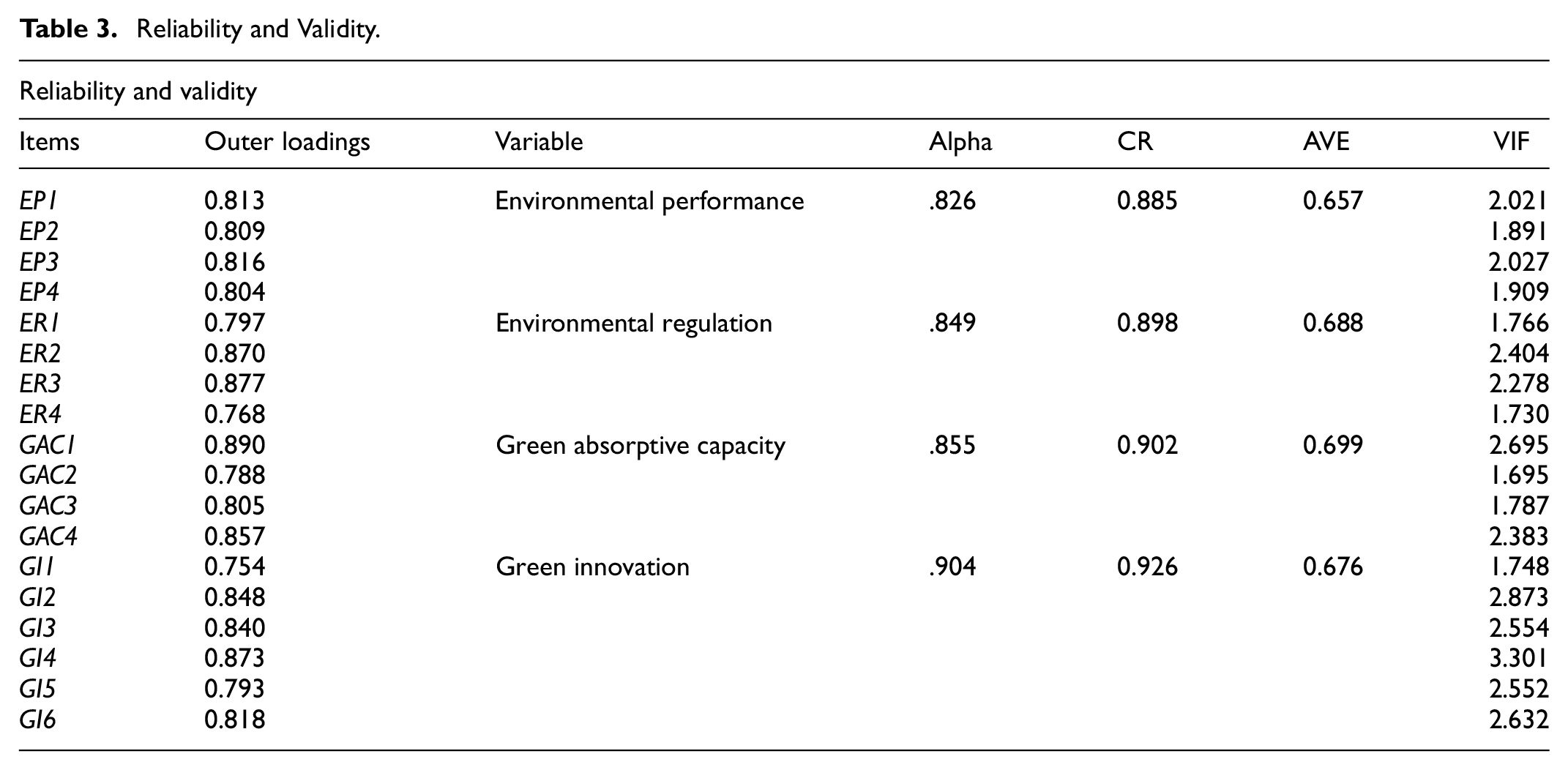
The measurement model’s validity was assessed by conducting convergent and discriminant validity tests. Convergent validity was evaluated through the examination of factor loadings (outer loadings), composite reliability, Cronbach’s Alpha, and AVE (Hair et al., 2020). Chin et al. (2008) argue that analysis indicates that all item loadings exceeded the threshold of 0.70 (Table 3). The CR values, representing the extent to which the indicators of the construct signify the underlying latent construct, exceeded the critical threshold of 0.7. Moreover, the AVE, which captures the overall variance explained by the latent construct indicators, surpassed the recommended threshold of 0.5 (Hair et al., 2020). Cronbach’s Alpha was employed to assess internal consistency, which gauges the reliability through the interrelatedness of the observed item variables. The obtained values exceeded the requisite threshold of 0.70 (Hair et al., 2019). This study observed widely recognized standards to evaluate the reliability of the measurement model, including criteria such as AVE, discriminant validity, and convergent validity. The reliability assessment consistently met the criterion of 0.70 across all constructs (Hair et al., 2020).
Reliability and Validity.
Discriminant Validity
Discriminant validity is predicted by three different criteria. First is the Heterotrait-Monotrait Ratio, then the Fornell and Larcker criterion, and last is cross loadings. All three criteria are under threshold and successfully evaluated that all constructs in the model are distinct from each other and measure different underlying concepts (Henseler et al., 2015). Hence, it supports the discriminant validity established. To further check for the discriminant validity, Table 4 has highlighted results.
Discriminant and Correlations.

Data Analysis and Results
Analytical Tools and Techniques
The collected data were analyzed using Smart-PLS, version 4, which was chosen for its variance-based PLS-SEM methodology and selected for various methodological considerations. This quality renders it suitable for exploratory, survey-based analyses (Hair et al., 2012). Moreover, PLS-SEM exhibits greater robustness, even when applied to smaller, non-normally distributed samples (Ernst et al., 2011), and it is well-suited for reflective models.
F Square
F Square is used to measure the proportion of variance explained in the dependent variable or effect size by adding a specific independent variable to the model. Higher F Square values indicate that a larger proportion of variance in the underlying constructs. Table 5 provides for the endogenous construct, the F Square values for ER and EP (0.080), and the F Square values for GI and EP is 0.174. The remaining F square values are highlighted in Table 5. In this study, the inner (VIF) method, as introduced by Kock (2015), was utilized to examine the presence of CMB. This involved conducting a comprehensive collinearity test to assess potential issues related to shared method variance.
Variance Inflation Factor and F Square.

R Square and Adjusted R Square
The model’s fitness is estimated by values of R-squared (R2) and adjusted R-squared (R2 adjusted). They provide information about how well the independent variables explain the variance in the dependent variable. The explanatory power of a model can be quantified by calculating its R2 value. For the GI and EP, the R2 values are .358 and .377, respectively (see Table 6). To evaluate the predictive power of the model researchers used Q2 value technique (Shmueli et al., 2019). Q2 helps determine how much an exogenous construct influences an endogenous construct. Q2 values of EP and GI are 0.322 and 0.373, which imply substantial predictive importance of model.
R2 and Q2.

Structural Model
Bootstrapping employs a resampling process with replacement to augment the effective sample size, allowing for improved statistical inference and estimation of parameters. In the process of bootstrapping, every observation is repeatedly drawn from the population with replacement, ensuring that all elements within the datasets have an equal opportunity to be selected as samples. This approach helps generate a representative and robust distribution of statistics or parameters. Indeed, during bootstrapping, it is possible for an observation to be chosen multiple times (with replacement), or in some instances, not to be included in the generated sample. This characteristic of bootstrapping allows for variability in the resampled datasets, which is crucial for statistical analysis and inference. The smallest sample size for bootstrapping typically equals the size of the actual sample. In most cases, researchers create resamples with replacements from their original datasets, maintaining the same sample size to preserve the statistical properties of the data (Wetzels et al., 2009). The study employed bootstrapping with 10,000 sub-samples to enhance the precision of estimates for the relationships defined within the model, as well as to ascertain the significance and robustness of these relationships. This larger number of sub-samples helps to provide more reliable and stable statistical results (Hair et al., 2019).
In SEM, the outer model assesses measurement reliability and validity, while the inner model evaluates predictive efficacy (Henseler et al., 2015). Model fit was evaluated using the SRMR and the NFI. The calculated SRMR value of 0.050 and the NFI value of 0.853 both suggest a good fit of the model to the data.
Direct Path Analysis
The outcomes of the analysis provided support for all the direct relationships posited in hypotheses H1 to H4 in Table 7. H1 proposed a direct and positive effect of GAC on GI (β = .614, T-value = 23.331, p < .0000), H2 GI positive and direct impact on EP (β = .403, T-value = 10.882, p < .0000), further results are shown below.
Path Coefficients.

Mediation Analysis
The mediation analysis in this study demonstrates that GI significantly mediates the relationship between GAC and EP. When incorporating GI as a mediator, the indirect effect through GI was also significant (β = .248, p < .000), confirming that GI partially mediates this relationship See Table 8.
Mediation Analysis.

Moderation Analysis
The moderation analysis in this study indicates that ER significantly moderates the relationship between GI and EP. While GI positively influences EP (β = .403, p < .000), the inclusion of ER as a moderator reveals a significant negative interaction effect (β = −.16, p < .000), suggesting that stringent regulatory pressures weaken the positive impact of GI on EP (see in Figure 2). This finding implies that under high regulatory constraints, firms may prioritize compliance over innovation, thereby reducing the beneficial effects of GI on EP. These results highlight the importance of designing balanced regulatory frameworks that encourage both compliance and innovation to optimize environmental outcomes (see Table 9). The X-axis represents the level of GI, while the Y-axis represents EP. The graph depicts two lines, one for the low level of ER and another for the high level of ER. The positive slope of these lines will indicate the positive relationship between GI and EP. The moderation analysis table (Table 9) shows multiple values, while the figure seems to depict two data points. The difference in the slopes of the two lines will represent the moderating effect of ER. A steeper slope for the low ER line indicates that GI has a stronger positive effect on EP when environmental regulations are less stringent.
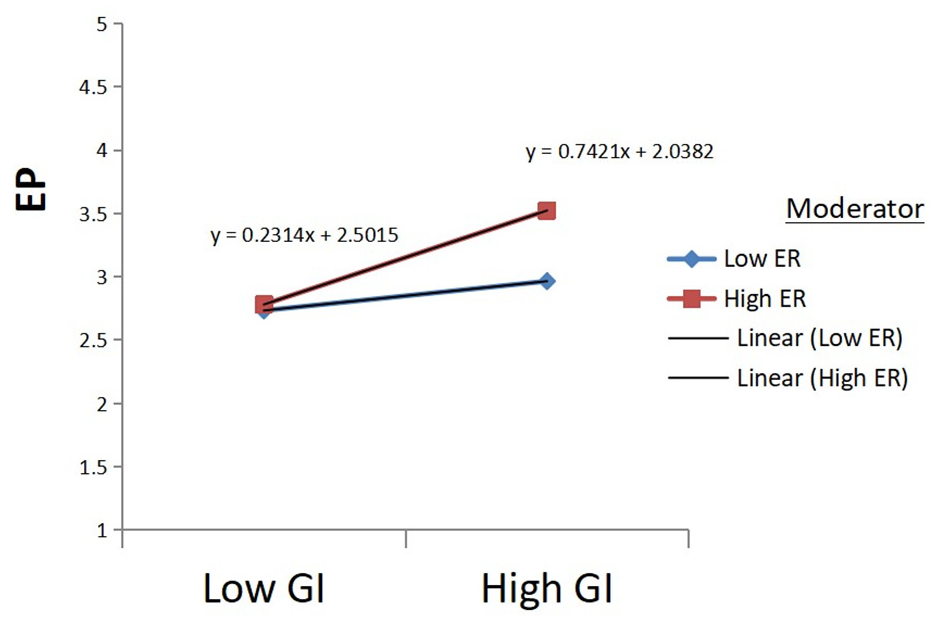
ER × GI -> EP.
Moderation Analysis.

Dissuasion and Findings
The aforementioned results offer support for the direct relationships proposed in hypotheses H1 through H5. Each variable within the conceptual model underwent individual scrutiny, and the computed empirical values surpassed the predefined threshold. The results prove that GAC helps to improve EP in SMEs manufacturing firms. GAC is vigorous in bolstering EP. First, the study findings supported the proposed H1 which indicate that GAC has a positive and significant impact on GI. Previous studies have additionally showed that the pivotal role of GAC as a mediator in the connection between GIC and EP (Asamoah et al., 2023). The study also finds a significant positive relationship between GI and EP (H2), aligning with the literature that emphasizes the benefits of green innovation in enhancing environmental performance (Javeed et al., 2023; S. Zhou et al., 2023). Our findings suggest that implementing green innovations can help firms meet environmental standards and improve resource efficiency, thereby boosting overall EP (Rana & Arya, 2024; J. Xie et al., 2024). The findings of H3 results show that ER has a positive and significant impact on EP. The intensity of these two types of ER should be improved differently by the EP. The mediating role of GI between GAC and EP (H4) further supports the notion that GAC enhances EP indirectly through GI. This mediation effect is corroborated by studies such as, which emphasize the pathway through which absorptive capacity translates into improved environmental performance via innovation (Makhloufi, Djermani, & Meirun, 2023; Preacher & Hayes, 2008). Regarding the moderating role of Environmental Regulation (ER), our results indicate that ER negatively moderates the relationship between GI and EP (H5). This finding is in line with, who noted that while regulations are essential for compliance, they can sometimes hinder innovation by shifting the focus toward meeting regulatory requirements rather than pursuing innovative solutions (Mulaessa & Lin, 2021). This highlights the need for a balanced regulatory approach that supports both compliance and innovation. RBV are very effective to enhance EP when integrated with GI and GAC. Furthermore, we have elaborated the discussion part in more detail below

Conclusion
The primary goal of the present paper was to investigate the impact of GAC on the EP of SMEs in Pakistan. The study also conducted tests to assess the mediating effect of GI on the relationship between GAC and EP. The research also evaluated the moderating impact of the ER on the relationship between GI and EP. The study formulated several hypotheses to attain the principal objectives of this research. Furthermore, the RBV was utilized as the theoretical framework to provide insight into how these variables can contribute to the achievement of environmental sustainability. Given that manufacturing SMEs are acknowledged as a significant contributor to carbon emissions, particularly in emerging nations like Pakistan, it becomes imperative to assess their role in influencing policies and implementing actions to mitigate ecological pollution. GAC positively influences GI. GI positively influence on EP. Green innovation is positively significant between GI and EP. ER negatively significantly moderates between GI and EP. It becomes weaker or less favorable when there is a higher level of ER. Higher regulatory requirements possibly will shift the focus of organizations toward compliance rather than proactively seeking innovative solutions. Our results are similar to the previous study ER negatively moderated (J. Zhang et al., 2020). Therefore, the research aimed its respondents SMEs to fill out this research’s questionnaires. In return, the researchers collected 467 responses from the SMEs in Pakistan. The study used the PLS-SEM for analyzing the proposed model with direct, mediation, and moderation analyses. From an empirical perspective, this study provides evidence that SMEs’ internal capabilities, such as GAC, and external pressures, like ER, play crucial roles in shaping environmental outcomes. Conceptually, the integration of GAC, GI, and ER within the RBV framework offers a comprehensive model for understanding how firms can achieve competitive advantages through sustainable practices.
Managerial Implications
For practitioners, particularly managers in SMEs, the study offers actionable insights. The positive impact of GAC on GI and EP underscores the need for firms to invest in developing their absorptive capacities. Managers should focus on enhancing their ability to assimilate and utilize external green knowledge, which can drive innovative practices and improve EP. Furthermore, the moderation analysis highlights that while compliance with ER is essential, it should not stifle innovation. Managers should advocate for regulatory frameworks that incentivize green innovation while ensuring compliance. Policymakers, on the other hand, should design regulations that strike a balance between enforcing environmental standards and encouraging innovative practices. Incentives for GI, along with support for capacity-building initiatives, can help firms achieve sustainable development goals without compromising their competitive edge.
Theoretical Implications
The theoretical implications of this study are significant. By integrating GAC, GI, and EP within the RBV framework, the research provides a comprehensive model that underscores the importance of internal capabilities and external regulatory factors in achieving sustainable environmental outcomes. The findings challenge the conventional view that stricter regulations always lead to better environmental performance, suggesting instead that the interplay between innovation and regulation needs careful consideration. This study thus calls for a reevaluation of how regulatory policies are designed and implemented, advocating for a balanced approach that supports both compliance and innovation.
Limitations and Future Directions
This study provides valuable insights into the relationships between GAC, GI, and environmental performance in SMEs. However, some limitations are worth noting. The study employed a cross-sectional research design, limiting our ability to establish causal relationships between the variables. Future studies should explore the long-term relationships between GAC, GI, and EP to provide stronger indications of causality. Longitudinal studies can offer more robust insights into how these variables interact over time.
Future studies could employ longitudinal research designs to investigate how GAC, GI, and EP interact and evolve over time. For example, a longitudinal study could examine “How do fluctuations in market demand over time affect the relationship between green absorptive capacity and environmental performance in SMEs?” Researchers should consider using mixed-method approaches, combining quantitative and qualitative methods, to gain a more holistic understanding of the topic. Comparative studies across different sectors or regions could further enrich the findings and provide broader generalizability. Investigating the role of different types of environmental regulations and their specific impacts on GAC, GI, and EP can provide more nuanced insights into how policy frameworks can best support sustainable innovation. Extending the application of the RBV theory to other contexts, such as service industries or different cultural settings, can help validate the findings and explore the universality of the proposed model.
Supplemental Material
sj-docx-1-sgo-10.1177_21582440251342496 – Supplemental material for Navigating the SMEs Green Path: Exploring the Role of Green Absorptive Capacity, Green Innovation, and Environmental Regulation in Enhancing Environmental Performance
Supplemental material, sj-docx-1-sgo-10.1177_21582440251342496 for Navigating the SMEs Green Path: Exploring the Role of Green Absorptive Capacity, Green Innovation, and Environmental Regulation in Enhancing Environmental Performance by Cai Li, Sadaf Akhtar, Jan Muhammad Sohu, Sonia Najam Shaikh, Ikramuddin Junejo and Muhammad Iatzaz-Ul-Hassan in SAGE Open
Footnotes

Author Contributions
Cai Li: Writing—review and editing, Project administration, Funding and acquisition, supervision. Sadaf Akhtar and Jan Muhammad Sohu: Conceptualization, Methodology, Software and data analysis, Writing—review and editing. Sonia Najam and Ikramuddin: Conceptualization, Writing original draft, Data collection, Validation. Muhammad Iatzaz: Data collection, Validation, Investigation.
Funding
The author(s) received no financial support for the research, authorship, and/or publication of this article.
Declaration of Conflicting Interests
The author(s) declared no potential conflicts of interest with respect to the research, authorship, and/or publication of this article.
Data Availability Statement
Data sharing is not applicable to this article as no datasets were generated or analyzed during the current study.
Supplemental Material
Supplemental material for this article is available online.
References
Supplementary Material
Please find the following supplemental material available below.
For Open Access articles published under a Creative Commons License, all supplemental material carries the same license as the article it is associated with.
For non-Open Access articles published, all supplemental material carries a non-exclusive license, and permission requests for re-use of supplemental material or any part of supplemental material shall be sent directly to the copyright owner as specified in the copyright notice associated with the article.
