




Abstract
Based on the instrumental variable method and the panel data of 283 prefecture-level cities in China from 2004 to 2016, we explore the relationship between carbon emission, air pollution, and total factor productivity (TFP). The results show that: (1) Both carbon emission-induced and air pollution-induced environmental regulations positively promote TFP. For every 1% increase in the two indicators of the intensity of environmental regulation, carbon emission, and air pollution, TFP will increase by 1.7150 percentage points and 0.6366 percentage points respectively. (2) Carbon emission-induced and air pollution-induced environmental regulation have similar coefficients on TFP, indicating that the effects of the two are synergistic. Carbon emission has a greater impact on TFP, so enhancing environmental regulation on carbon emission can better promote the improvement of TFP. (3) Financial scale and government intervention have a significant intermediary effect between environmental regulation in both aspects and TFP.
Introduction
Since the “Kyoto Protocol” was passed in 1997, the international community has been controlling the emissions of carbon dioxide and other greenhouse gas to prevent global warming from causing harm to the economy and human society. In September 2020, in Chinese president Xi Jinping’s speech at the General Debate of the Seventy-fifth United Nations General Assembly, China proposed to adopt more powerful policies and measures, to strive to reach the peak of carbon dioxide emission by 2030, and to achieve carbon neutral by 2060 (Hereinafter, “carbon peak and carbon neutral” will be referred to as “dual carbon goals”). This will bring profound changes to China’s economic structure and greatly promote clean production in various regions in China. The “dual carbon goals” extend the environmental regulation coverage to both the high-pollution industries and high-emission industries, which sparks research interest in academia on environmental regulation theories and policies on pollution reduction and carbon reduction.
The use of fossil energy (such as driving fuel-powered vehicles, thermal power generation, etc.) does not only emit carbon dioxide and other greenhouse gases but also harmful substances such as sulfur dioxide, an important source of air pollution in China. Therefore, carbon reduction and air pollution control can provide synergy.
China’s previous environmental regulation generally targeted air pollution, and rarely targeted carbon emissions. However, after the “dual carbon goals” proposal, China set its carbon dioxide emission target as a binding indicator in the outline of the “14th Five-Year Plan,” included the carbon peak related work into the central ecological and environmental protection and inspection, and clarified the carbon peaking target and measures for each region. Chongqing, Zhejiang, and other provinces and cities have piloted projects to incorporate carbon emission assessment into the environmental assessment. For example, Chongqing issued the “Technical Guidelines for Environmental Impact Assessment of Construction Projects in Chongqing–Carbon Emission Assessment (Trial)” to evaluate the carbon emissions and the indicators of carbon emission intensity of key industries such as steel, thermal power, and chemical industries.
In the future, the Chinese government will adopt stronger environmental regulatory policies and measures, which will encourage enterprises to obtain financial resources through various channels to increase investment in innovation, and improve cleanliness and productivity, thereby reducing carbon emissions and air pollution. In the relationship between carbon emission, air pollution, and total factor productivity (TFP), factors such as financial development and government intervention are important intermediary factors. Therefore, under the “dual carbon goals,” the relationship and transmission mechanism between China’s environmental regulation on carbon emission and air pollution and TFP has become an important research topic. The main motivation of the paper is to jointly study the impact of regulations induced by air pollution and carbon emissions on TFP, and whether there exists synergy among the two types of regulations.
Compared with the previous literature, the main contributions of this paper are summarized as follows:
(1) While most existing literature is based on province-level or county-level statistics (Xian & Zhou, 2021; W. Zhang et al., 2020), we study 283 prefecture-level cities in China, sort out the direct and indirect effects of environmental regulation of carbon emission and air pollution on TFP, and propose a theoretical framework with intermediary variables.
(2) The existing literature often uses the investment in pollution control or pollution emission were often used as indicators to measure environmental regulation (J. Wang & Liu, 2016; Wei et al., 2015; C. Zhang et al., 2011). We innovatively introduce the indicators of carbon emission and air pollution to measure the intensity of environmental regulation on carbon emission and air pollution respectively.
(3) We create an instrument variable by dividing the distance between each prefecture-level city and the capital city Beijing by the number of environmental emergencies in China over the years, which summarizes the characteristics of the city and the state of the environment. The reason for choosing the distance between each prefecture-level city and the capital Beijing is that the effectiveness of China’s environmental policies will vary with the distance between each prefecture-level city and the capital.
(4) We adopt the 2SLS method to minimize the endogeneity problem of the measurement variables of environmental regulation intensity and explore the relationship between China’s environmental regulation and TFP. We contribute to the literature by showing that both carbon emission and air pollution-induced environmental regulations have a positive effect on TFP, implying synergistic effects of the two while existing research on the relationship between carbon emission and production efficiency is inconclusive (Xian & Zhou, 2021; Zhong & Wang, 2021). Furthermore, carbon emission has a greater impact on TFP, so enhancing environmental regulation on carbon emission can better improve TFP.
(5) Given the empirical results that there is a significant relationship between the intensity of environmental regulation and TFP, we further test the intermediary effect of the financial scale, financial efficiency, and government intervention between environmental regulation and TFP, which enriches the existing research on the mechanism between environmental regulation and TFP (Arouri et al., 2012; Guo et al., 2017).
The rest of the paper is organized as follows: section 2 provides the literature review; section 3 discusses the theoretical mechanism and hypotheses of the relationship between environmental regulation and TFP; section 4 introduces the models and methodology; section 5 presents and discusses the empirical results; section 6 concludes and provides policy recommendations on the improvement of TFP and environmental regulation.
Literature Review
In this section, we provide a theoretical background of environmental pollution, regulation, and economic development, followed by the literature review. The major theories that explore the relationship between environmental quality and economic development include the Environmental Kuznets Curve, the Pollution Haven Hypothesis, and the Porter Hypothesis.
The Kuznets curve was proposed by Nobel laureate Simon Smith Kuznets in the 1950s, who believed that in the initial stage of economic development, the income gap will widen with economic development. When economic development reaches a certain level, the income gap will narrow with economic development, that is, the relationship between income and economic growth presents an inverted “U” curve relationship. The Environmental Kuznets Curve (EKC) was introduced by Grossman and Krueger (1991) and has been the dominant approach among economists to model ambient pollution concentrations and aggregate emissions. Supporters of EKC believe that environmental quality deterioration is a necessary stage of industrial development, and when the economy develops to a certain stage, environmental quality will gradually improve. Panayotou (1994) introduces the inverted “U” curve relationship between economic growth and income gap in the study of environmental quality and economic growth and finds that the relationship between environmental quality and economic growth presents an inverted “U” curve. The Pollution Haven Hypothesis was first proposed by Copeland and Taylor (1994) when they studied the relationship between North and South and the environment. The hypothesis holds that free trade will cause highly polluting industries to migrate from developed countries to developing countries. This situation arises because developed countries are more environmentally conscious and have higher environmental standards, which will lead to higher production costs. In contrast, countries with lower environmental standards have a low-cost advantage, and high-polluting industries in developed countries will be transferred to developing countries, which become pollution havens for developed countries.
The famous “Porter hypothesis” completely overturned the traditional neoclassical economic theoretical research on environmental regulation and firm competitiveness. Porter and Linde (1995) suggest that environmental protection and enhancing the competitiveness of enterprises can coexist, and appropriate environmental regulations can encourage enterprises to innovate, offsetting the cost increase caused by pollution control, therefore improving production efficiency and competitiveness.
The environmental regulations induced by carbon emission and air pollution have various effects on economic growth and production efficiency, and current research on this subject is quite diversified. In this section, we review the existing literature from two aspects: the relationship between carbon emission and economic indicators, and the relationship between environmental regulation and production efficiency.
Research on the Relationship Between Carbon Emission, Air Pollution and Economic Indicators
Regarding the relationship between carbon emission and economic growth, the existing literature mainly revolves around the environmental Kuznets curve (EKC) hypothesis. Grossman and Krueger (1991) state that there is an inverted U-shaped relationship between economic growth and environmental pollution, that is, pollution rises with the increase of GDP per capita at low-income levels and decreases with the increase of GDP per capita at high-income levels. Subsequent research use data from different years and regions to validate the hypothesis by constructing structural equations, panel models, and other methods, and the conclusions are inconsistent. Some studies support this hypothesis (Lee & Brahmasrene, 2013; Qian et al., 2020) while others reject it (Agras & Chapman, 1999; He & Richard, 2010; Zhao et al., 2021).
Regarding the relationship between carbon emission and technological innovation, the existing literature primarily focuses on the impact of technological progress on carbon emissions. For example, Garbaccio et al. (1999) maintains that technological innovation can effectively reduce energy consumption per unit of GDP; while some studies find that technological progress can effectively promote the reduction of carbon emissions (Fischer & Newell, 2008; Sun, 2020). The research results of Song et al. (2020) show that there is a U-shaped relationship between environmental regulation and green product innovation.
Current research on the relationship between carbon emission and production efficiency is inconclusive. Zhong and Wang (2021) find that the impact of forestry total factor productivity on carbon emissions presents an inverted U-shaped curve. Y. Chen et al. (2021) adopt a three-stage SBM-DEA model and find that the agricultural green total factor productivity will decrease if carbon dioxide emissions and nonpoint source (NPS) pollution are considered simultaneously. Xian and Zhou (2021) analyze the relationship between TFP and carbon emission at the county level and show that carbon emissions decrease with the increase of TFP, especially in the central and western regions in China.
In terms of research on air pollution and productivity, C. Wang et al. (2022) find that a 1 standard deviation increase in daily ozone pollution decreases courier productivity by 6.8%. Xue et al. (2021) examine whether air pollution affects the formation of corporate human capital and their firm performance.
Research on the Relationship Between Environmental Regulation and Production Efficiency
Current research has no consensus on the relationship between environmental regulation and production efficiency. An overview of the main perspectives is provided in this section.
First, environmental regulation will inhibit the improvement of production efficiency. Arouri et al. (2012) find that the increase in the intensity of environmental regulation has led to higher production costs and management expenses of enterprises, which is not conducive to improving production efficiency. C. Li and Bi (2012) analyze the data of industrial enterprises in the western regions of China and suggest that the greater the intensity of environmental regulation, the less time enterprises spend improving their strength, which indirectly leads to the decline of productivity.
Second, environmental regulation will promote the improvement of production efficiency. Some scholars believe that appropriate environmental regulations can stimulate enterprises to innovate, offset the cost increase caused by pollution control, and improve the production efficiency of enterprises (Lannelongue et al., 2017; Porter & Linde, 1995). Guo et al. (2017) analyze the data of U.S. companies and the empirical results show that environmental policies and regulations have promoted the production efficiency of companies to a certain extent. Guan & Wu (2020) estimate the spatial model and conclude that with the tightening of local environmental regulations, the spatial spillover effect of green total factor productivity between regions is further strengthened.
Third, the impact of environmental regulation on production efficiency is uncertain. Yuan and Zhang (2017) maintain that environmental regulations inhibit environmental performance but promote the economic and energy performance of the manufacturing industry. H. Chen et al. (2017) find that environmental regulations have reduced the production efficiency in China’s main grain-producing areas from a static perspective but have promoted the total factor productivity of the agriculture industry from a dynamic perspective. Some scholars also argue that the intensity of environmental regulation and production efficiency presents a U-shaped relationship (Shen et al., 2017; B. Yin, 2012).
In summary, the existing research on the relationship among carbon emission, environmental regulation, and production efficiency is mostly concentrated on the environmental Kuznets curve (EKC) hypothesis, the relationship between carbon emission and economic indicators, and the impact of environmental regulation (excluding the regulation on carbon emission) on enterprises’ production efficiency. However, the research results are quite different. For example, whether the role of environmental regulation on TFP is positive, negative, or uncertain is still controversial, which leads to different opinions among policymakers. On the other hand, there is insufficient research on the impact mechanism of environmental regulation on TFP. Most research is limited to the direct effects of environmental regulation on TFP, while not much attention is given to indirect effects from intermediary variables such as financial development and government intervention. In addition, most existing literature is based on province-level statistics, while few works of literature study the prefecture-level cities. More prominently, the existing research on the impact of regulation on carbon emission on TFP is relatively scarce, which provides an opportunity for this study to enrich the literature, and the measures proposed in the paper are conducive to the realization of China’s “dual carbon goals.”
Conceptual Framework
This paper studies the impact of carbon emission and air pollution-induced environmental regulations on TFP. In this section, we expound on the impact mechanism of environmental regulation on TFP from two aspects: direct and indirect effects.
The Direct Impact of Environmental Regulation on TFP
Porter’s Hypothesis believes that appropriate environmental regulation can stimulate enterprises to innovate, thus improving their production efficiency, and TFP is one of the important indicators of production efficiency. Therefore, this paper studies the impact of environmental regulation caused by carbon emissions and environmental regulation caused by air pollution on TFP. Figure 1 shows that an increase in carbon emissions will cause the temperature to rise. On the one hand, the temperature increase will cause the high temperature in summer to be intolerable, resulting in the outflow of employees. On the other hand, it will increase the rest time of workers during work hours. Both are not conducive to improving TFP. Carbon emission-induced environmental regulation leads to carbon reduction, which slows down the temperature rise, subsequently reduces employee outflow and rest time, and is ultimately conducive to the improvement of TFP.
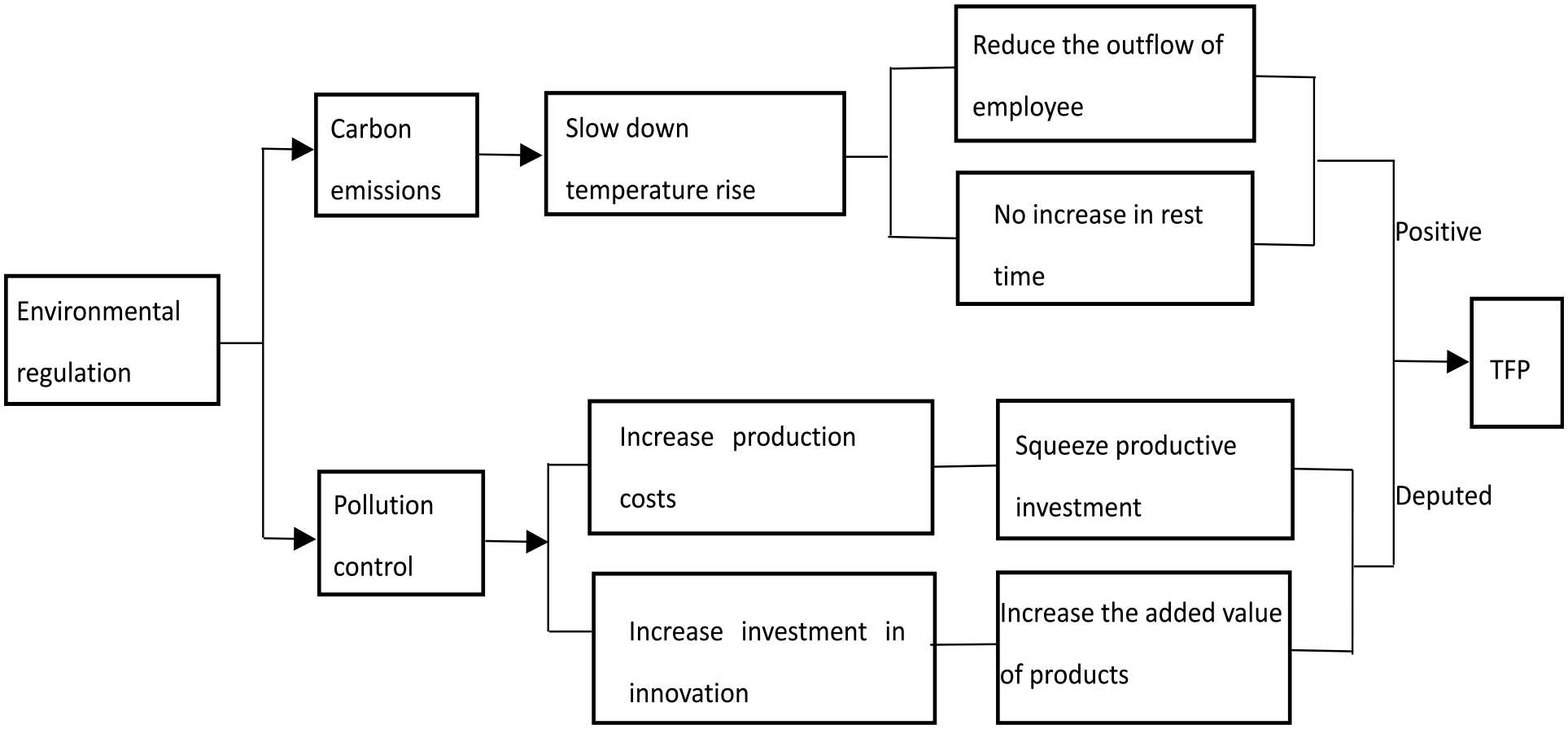
The direct impact mechanism of environmental regulation on TFP.
The outcome of air pollution-induced environmental regulation is pollution control, which can have both inhibition and promotion impact on TFP. The inhibitory effect of pollution control on TFP is largely reflected in the cost. Specifically, the implementation of environmental regulations and policies increases the costs of pollution control for manufacturers, such as the recycling cost of solid waste and the purchase cost of clean production factors, crowding out other expenditures such as human capital training and the R&D investment in clean technology, which hurts TFP improvement. The promotion effect of pollution control on TFP is largely reflected in innovation, that is, the strengthening of environmental regulation will encourage manufacturers to increase investment in innovation, reduce pollution emissions and increase the added value of products, thereby boosting TFP. Therefore, the net effect of pollution control on TFP depends on the relative magnitude of inhibition and promotion effect. In the long term, the promotion effect of pollution control offsets or even exceeds the inhibition effect, which will help achieve the dual goals of environmental protection and the improvement of TFP.
Based on the above discussion, we propose the following hypothesis on the relationship between environmental regulation and TFP.
Hypothesis 1: The net effect of increasing the intensity of environmental regulation on TFP is positive in China.
The Indirect Impact of Environmental Regulation on TFP
Chinese enterprises are capital-hungry with a large demand for funds, and capital is the cornerstone of technological upgrading and innovation of enterprises. In China, funds are mainly provided by the Ministry of Finance of China, banks, and other financial institutions, therefore financial development and government intervention are important intermediary factors (M. Wang et al., 2022; J. Zhang & Chen, 2021).
In this section, we explore how environmental regulations can exert an impact on TFP indirectly through financial development and government intervention. Figure 2 exhibits the transmission mechanism of the indirect impact.

The indirect impact mechanism of environmental regulation on TFP.
Financial development can guide capital and economic resources from high-pollution, high-emission industries to advanced and low-carbon industries, attract funds to introduce environment-friendly technologies, optimize factor allocation, and ultimately improve TFP.
When facing more strict policies and measures of environmental regulation, companies must reduce the proportion of polluting production or switch to cleaner production, therefore need to raise funds to purchase equipment, technology, and related services for the transformation. Common sources of funds include companies’ funds or external financing. However, many companies do not have sufficient internal funds and may have been heavily leveraged. Therefore, it is critical to have a well-developed financial system that can help enterprises obtain financing to increase capital expenditures for technological innovation and clean production. Companies also need to bear the rising costs, which is the price for cleaner production. Nevertheless, the technological innovation and cleaner production of enterprises can improve TFP and increase sales of environmentally responsible products, offsetting the increase in costs from complying with the strengthened environmental regulations.
However, if the local financial system is less developed, businesses will find it difficult to access sufficient financial resources, and therefore cannot afford large capital expenditures for technological innovation. Consequently, this will delay the clean production implementation and the TFP improvement in the region. Based on the above analysis, this paper proposes:
Hypothesis 2a: The indicators of financial scale in various regions of China play an intermediary role between environmental regulation and TFP.
Hypothesis 2b: The indicators of financial efficiency in various regions of China play an intermediary role between environmental regulation and TFP.
As a necessary means to correct market failures, government intervention can reduce the pollution by local governments or businesses through adjusting fiscal budget expenditures, guiding businesses to transform into eco-friendly businesses, and improving the efficiency of resource utilization, which will improve TFP ultimately. Therefore, this paper also proposes:
Hypothesis 3: The indicators of government intervention in various regions of China play an intermediary role between environmental regulation and TFP.
Methodology and Model Construction
Index Selection
Table 1 contains the variables used in this paper and their explanations.
Variables and Their Explanations .

Explained Variable
The explained variable in our study is the total factor productivity (TFP). Under the modern economic growth model, the contribution of production factors and the efficiency of technological progress are widely used to measure the increase in both the quantity and quality of economic growth, indicating the increasingly important role of TFP in economic and social development. In this paper, we use the DEA-Malmquist productivity index method to calculate the TFP of all prefecture-level cities in China to measure their economic production efficiency.
Core Explanatory Variables
The core explanatory variable we adopt is the intensity of environmental regulation (CEV, including CO2 and SO2). Although there is no universal standard to measure the intensity of environmental regulation, several popular methods are used in the literature: (1) GDP per capita (J. Yin et al., 2015); (2) from the perspective of the policies of environmental regulation, the number of the policies related to pollution prevention and environmental protection (Low & Yeats, 1992) or the number of the policies of carbon emission trading (Y. Zhang & Qiao, 2021); (3) from the perspective of different pollutant emission, the total emissions of sulfur dioxide in the economy (Kolstad & Xing, 2002) or the consumer carbon emissions per 100 RMB (Huang & Chen, 2021).
We investigate the environmental regulation from two aspects: environmental regulation induced by carbon emission (CO2), and environmental regulation induced by air pollution (SO2). This paper uses SO2 as the representative of air pollutants. Carbon emissions and pollutant emissions from businesses respond to local environmental regulatory policies. Hence, if the amount of carbon emissions and pollutant emissions is greater, the intensity of environmental regulation in the region is lower, and vice versa.
The amount of carbon emissions or pollutant emissions in one region can only reflect the pollution discharged into the environment in that region but may not strictly distinguish the degree of environmental pollution at different levels of economic development. To eliminate the impact of economic size on environmental pollution, we use the reciprocal of CO2 emissions per unit of output and the reciprocal of SO2 emissions per unit of output as proxy indicators for the environmental regulation intensity. The higher the indicators, the more intense the environmental regulation.
Instrumental Variables
The omission of unobservable variables in the model is almost inevitable, and the relationship between environmental regulation and TFP may be due to reverse causality. To solve the endogeneity problem of the model, we use the Index of Distance from Beijing (JUL) as the instrumental variable of environmental regulation to solve the endogeneity problem. This index, defined as the ratio of the distance between the prefecture-level city and the capital city Beijing to nationwide environmental emergencies, summarizes the urban characteristics and the state of the environment of each prefecture-level city and satisfies the condition of being an effective instrumental variable. On the one hand, the index is related to the explanatory variable environmental regulation. The fewer the number of environmental emergencies across the country, the more effective environmental regulations are. Moreover, the distance between cities and the capital city can also provide an estimate of the degree of environmental regulation. In general, the closer a city is to the capital, the tighter the city’s environmental regulation is due to the pressure of being inspected at any time. On the contrary, the further away a city is from the capital, the looser the environmental regulation, because it gets more difficult to implement policies. On the other hand, the index is not closely related to the explained variable TFP because environmental emergencies typically occur suddenly and unexpectedly. Furthermore, since the distance between each prefecture-level city and the capital city Beijing is fixed and historical, it will also not have a direct impact on TFP, which satisfies the exogeneity condition.
Control Variables
To control the influence of the omitted variables on the estimation results, we follow the existing literature (X. Chen, 2020; W. Zhang et al., 2020) and use these control variables: the level of economic development (PGDP), dependence on foreign trade (DOF), level of urbanization (URB), level of industrial added value (PIAV), technological innovation (TEC) and degree of marketization (MAR).
Intermediary Variables
As previously discussed, both financial development and government intervention can play an intermediary role between environmental regulation and TFP, therefore we include intermediary variables that can proxy financial development and government intervention in the model. Financial development can be proxied by financial scale or size (FSC), the structure of the financial market, and financial efficiency (FEF). Financial scale is measured by the ratio of the sum of deposit balance and loan balance of banks to GDP, financial market structure is measured by the ratio of stock market capitalization to GDP, and financial efficiency can be measured by the ratio of the loan balance to deposit balance or the ratio of capital formation to the gross domestic savings. As China’s stock market is small and immature, the study did not use the dimension of financial structure to consider financial development. We follow X. Zhang and Dai (2020) and Yang and Sun (2021) and use financial scale and financial efficiency as the intermediary variables. The combination of moderate environmental regulation and a high level of financial development in a region can promote enterprises’ innovation.
Fiscal expenditure is an important means for local governments to achieve certain economic goals, we use the proportion of government spending in GDP as the proxy for government intervention (GOV).
Model Construction
This paper uses panel data regression model to study the causal relationship between environmental regulation and TFP in China’s prefecture level cities. The model takes the intensity of environmental regulation as the core explanatory variable and other factors affecting TFP as the control variable. To eliminate the influence of heteroscedasticity and multicollinearity among variables, the absolute value indicators such as CO2, SO2, and PGDP are logarithmized. The model is constructed as follows:

where i represents the prefecture-level city, t represents the year;
Secondly, due to the possible omitted variables, mutual causality, and other factors, the estimation results of the general ordinary least squares regression may be biased and not truly reflect the causal relationship between environmental regulation and TFP. Therefore, this paper introduces the distance from the Beijing index (JUL) as an instrumental variable of environmental regulation, and constructs a two-stage minimal regression model as follows:


where JULit is the instrumental variable, the index of distance from Beijing. If the index of distance from Beijing is an effective instrumental variable for environmental regulation, the estimated coefficient
Finally, to investigate whether environmental regulation affects TFP through intermediary variables, in another word, whether the intermediary effects of the financial scale, financial efficiency, or government intervention exist, we estimate the following models:


In Equation 4, the explained variable can be one of the intermediary variables:
Empirical Results and Discussion
Descriptive Statistics
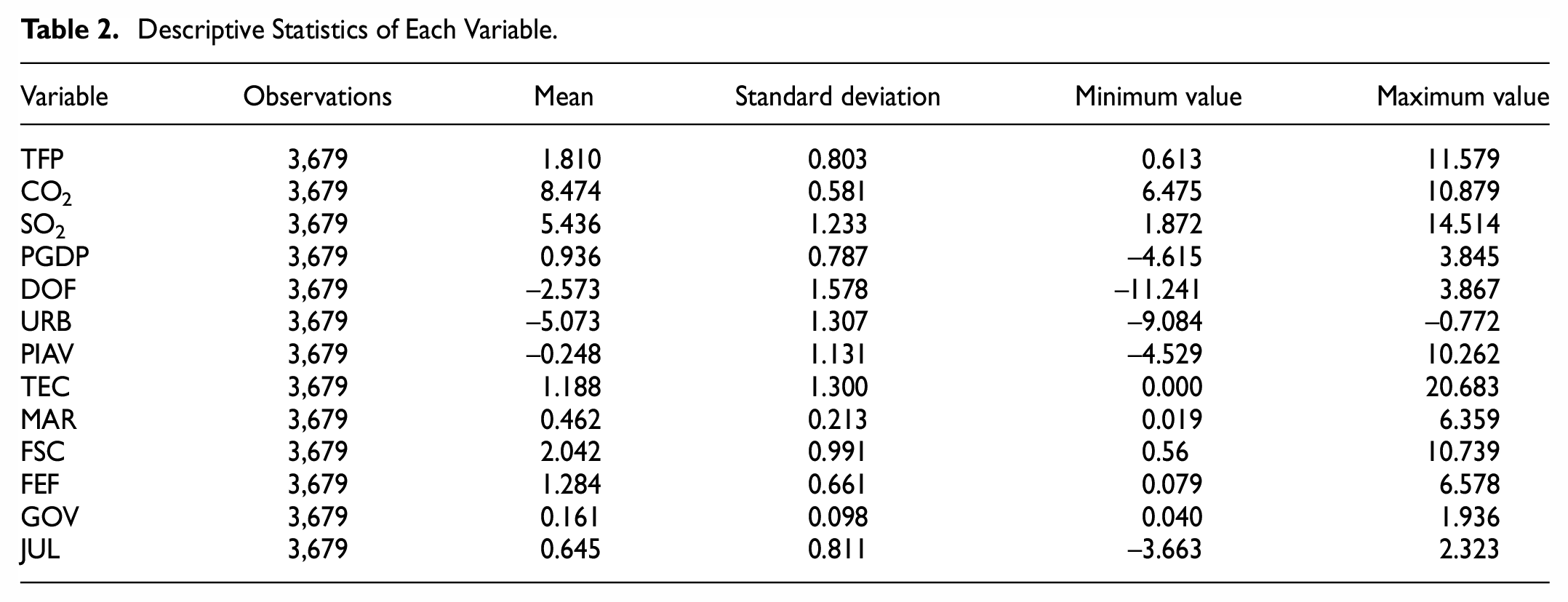
In this paper, we study 283 prefecture-level cities in China, such as Suzhou, Hangzhou, Guangzhou, and Wuhan. All the original data are obtained from the Statistical Yearbook of Chinese Cities, the Statistical Yearbook of each province and city, as well as the Statistical Bulletin of National Economic and Social Development of each prefecture-level city. To exclude the impact of price fluctuations on related indexes, we use the GDP price index and the investment in fixed asset price index as price deflators with 2004 as the base period. All the price indexes are from the DRC website. The descriptive statistics of the variables are shown in Table 2.
Descriptive Statistics of Each Variable.
Baseline Regression Results
In this section, we discuss the preliminary results from the two-way fixed effect model on the relationship between carbon emission and air pollution-induced environmental regulations and TFP. The regression results are exhibited in Table 3. The regression coefficients of the environmental regulation are significantly positive regardless of whether environmental regulation is induced by CO2 or SO2. This indicates that the less CO2 and SO2 emissions per unit of output, the greater the intensity of environmental regulation in the region, and the higher the TFP. Therefore, our preliminary conclusion is that both environmental regulations induced by carbon emission and by air pollution have a positive effect on TFP, which is consistent with hypothesis 1.
Baseline Regression Results With CO2 and SO2 as the Core Explanatory Variable Respectively.

Note.*, **, and ***represent the significance levels of 10%, 5%, and 1% respectively, with standard errors in brackets; the control variables of the following models are consistent with those of the baseline regression.
Two-Stage Instrumental Variable Method Results
The benchmark regression results may be biased or inconsistent if there are endogeneity problems in the model. Therefore, we conduct the Durbin–Wu–Hausman (DWH) test to examine the endogeneity of the core explanatory variable. The p-value is .000, which indicates that environmental regulation is not exogenous, and OLS is not consistent. To handle the model with endogenous variables, we estimate the two-stage least squares method (2SLS) and use an instrumental variable. Tables 4 and 5 provide the results. The first-stage regression results in column (1) of Tables 4 and 5 show that the instrumental variable JUL and the endogenous explanatory variable environmental regulation induced by CO2 emissions per unit of output and SO2 emissions per unit of output are all significantly positive at 1% level. The coefficients are 0.3628 and 0.9774 respectively, which satisfies the correlation condition of an instrumental variable. Moreover, the F-statistics of the weak instrument test are 15.8656 and 39.7392, respectively, which are both greater than 10, indicating no weak instrument problem. Therefore, we believe that the index of distance from Beijing can serve as a reasonable and effective instrumental variable.
Two-stage Results of the Instrumental Variable Method With CO2 as the Core Explanatory Variable.

Note. *** represents the significance levels of 1%, with standard errors in brackets.
Two-stage Results of the Instrumental Variable Method With SO2 as the Core Explanatory Variable.

Note. *** represents the significance levels of 10%, with standard errors in brackets.
The second-stage regression results of 2SLS are reported in column (3) of Tables 4 and 5. When the core explanatory variable is carbon emissions (air pollution), the regression coefficient on environmental regulation is 1.7150 (0.6366) and significantly positive at a 1% level. In another word, for a 1% increase in the intensity of regulation on carbon emission (air pollution), TFP will increase by 1.7150 (0.6366) percentage points, which is in line with the expected effect of environmental regulation. Furthermore, the Tobit model results are consistent with 2SLS.
The above results indicate that the smaller the CO2 and SO2 emissions per unit of output, the stronger the environmental regulation induced by carbon emission and air pollution in a region. Stricter environmental regulations impose greater pressure on enterprises to pay higher fines, be forced to relocate and even file for bankruptcy, therefore motivate enterprises to invest more on R&D of clean production technology, which improves the TFP. The regression results support hypothesis 1, the strengthening of environmental regulation in various regions of China has positive impacts on TFP.
Our results are comparable with existing research, although these results may only apply to certain types of industries or different environmental regulatory indicators. W. Li and Zhang (2019) find that the worse the air pollution, the lower the company’s productivity. Specifically, for every 1% increase in PM2.5, the company’s productivity will decrease by 0.692 percentage points. Although this is the closest to our research results, the indicators of air pollution used are different. Guan and Wu (2020) suggest that for every 1% increase in the intensity of environmental regulation, the green total factor productivity of the neighboring areas will increase by 4.6 percentage points. Although their estimated result is significantly stronger than ours, both the measurement methods of environmental regulation and total factor productivity are different from this paper. Xian and Zhou (2021) maintain that the emissions of carbon dioxide will decrease along with the increase of total factor productivity, while we conclude that total factor productivity will increase with the decrease of carbon dioxide emissions.
It is worth noting that in Tables 4 and 5, the coefficients on environmental regulation estimated by 2SLS are significant at a 1% level, higher than the benchmark regression results. The obvious improvement indicates that the estimation result is more credible after the endogeneity problem is addressed.
Robustness Test
Robustness Test of Core Explanatory Variables
To fully consider the reliability of the model, improve the creditability of the results, and avoid the emergence of the contingency of the regression results, we further test the stability of the model. We use PM10 emissions per unit of output as a new proxy for the core explanatory variable environmental regulation and estimate a two-stage least squares regression with the instrumental variable. The results are shown in column (1) of Table 6. Both the direction and significance of the core explanatory variable environmental regulation and TFP have little changes.
Robustness Test Results With CO2 and SO2 as the Core Explanatory Variable Respectively.

Note.*, **, and *** represent the significance levels of 10%, 5%, and 1% respectively, with standard errors in brackets.
Robustness Test of Control Variables
We also run robustness tests by using different proxy variables to estimate control variables, and by removing some control variables. First, we use the proportion of the number of employees in scientific research and technology service industry in total employment as a new proxy variable for technological innovation (TEC), and the ratio of the retail sales of consumer goods to GDP as a new measure of the degree of marketization (MAR). Columns (4) and (6) of Table 6 show the results. Second, we remove two control variables, the degree of urbanization (URB) and the level of industrial added value (PIAV) from the regressions, and the results are shown in columns (3) and (5) of Table 6. It can be found that the coefficients and significance of the main regression results have small changes. At this point, there are sufficient reasons to believe that the model is robust.
Intermediary Effect Test of the Financial Scale, Financial Efficiency, and Government Intervention
Our empirical results support hypothesis 1, which states both carbon emission and air pollution-induced environmental regulations have positive impacts on TFP. In this section, we further explore the mechanism of the relationship between environmental regulation and TFP. To explore the transmission path between environmental regulations induced by CO2 per unit of output and environmental regulations induced by SO2 per unit of output and TFP respectively, this paper uses financial scale (the ratio of the sum of deposit balance and loan balance of banks to GDP), financial efficiency (the ratio of the loan balance to deposit balance), and government intervention (the proportion of government spending in GDP) as the intermediary variables between environmental regulations and TFP to test the intermediary effect.
As shown in Tables 7 and 8, when the core explanatory variable is carbon emissions, after including the intermediary variable financial scale (FSC), the regression coefficients of both financial scale and environmental regulation are significant. This indicates that the financial scale has at least a partial intermediary effect between environmental regulation and TFP. In fact, the intermediary effect of financial scale accounts for 7.51% of the total effect. When the core explanatory variable is air pollution, the financial scale also imposes a partial intermediary effect between environmental regulation and TFP, and it accounts for 13.43% of the total effect. Our results provide evidence to support hypothesis 2a, which states that the financial scale of various regions in China has played an intermediary role between both carbon emission and air pollution-induced environmental regulations and TFP.
Results of Intermediary Effect Test With CO2 as the Core Explanatory Variable.

Note.*, **, and ***represent the significance levels of 10%, 5%, and 1% respectively, with standard errors in brackets.
Results of Intermediary Effect Test With SO2 as the Core Explanatory Variable.

Note.** and *** represent the significance levels of 5% and 1% respectively, with standard errors in brackets.
On the other hand, when financial efficiency (FEF) is used as the intermediary variable, the relationship between environmental regulation and financial efficiency is not significant regardless of the core explanatory variable being carbon emissions or air pollution, and it does not pass the Sobel test. Therefore, financial efficiency does not play a role in the link between environmental regulation and TFP and hypothesis 2b is rejected. This may be due to the slow growth in loan lines in domestic and foreign currencies of Chinese financial institutions, especially the decline in the growth rate of domestic and foreign currency deposits of financial institutions, which leads to the slow improvement of the financial efficiency and the low quality of financial development in China. As a result, it is difficult for environmental regulations to improve TFP through the financial efficiency channel.
Lastly, when using the core explanatory variable CO2 and adding the intermediary variable government intervention (GOV), the regression results show that both coefficients of government intervention and environmental regulation on TFP are significant. This suggests that government intervention has a partial intermediary effect between environmental regulation and TFP, accounting for 5.63% of the total effect. When the core explanatory variable is air pollution, government intervention also shows a partial intermediary effect between environmental regulation and TFP, which accounts for 12.37% of the total effect. The regression results, therefore, support hypothesis 3, which states that the government intervention of various regions in China has played an intermediary role between both carbon emission and air pollution-induced environmental regulations and TFP.
Comparison of Results With CO2 and SO2 as Core Explanatory Variables
To compare the contribution and transmission path of carbon emission-induced and air pollution-induced environmental regulations in promoting TFP, we tabulate the main results in Table 9. For every 1% increase in the two indicators of the environmental regulation intensity, carbon emission, and air pollution, TFP will increase by 1.7150 percentage points and 0.6366 percentage points respectively. Therefore, the strategy of coordinating emission reduction of greenhouse gases and air pollutants is effective. Furthermore, since carbon emissions have a greater impact on TFP, environmental regulations targeting carbon emissions should be further strengthened to better promote the TFP improvement.
Comparison of Results With CO2 and SO2 as a Core Explanatory Variable.
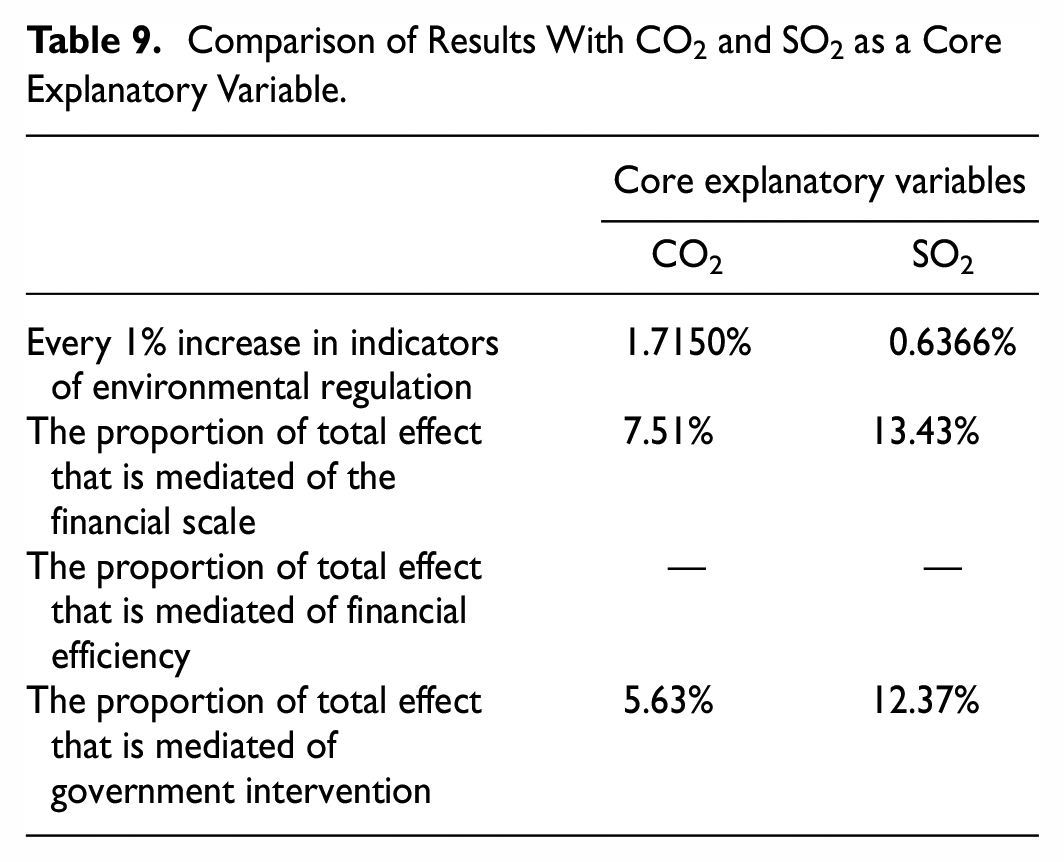
In addition, it can be seen from Table 9 that regardless of whether the core explanatory variable is carbon emissions or air pollution, financial efficiency does not play an intermediary role between environmental regulations and TFP. While the financial scale and government intervention both impose a partial intermediary effect, the impact of the financial scale is stronger than that of government intervention.
Conclusions and Recommendations
This paper empirically tests whether environmental regulations can promote the improvement of TFP by estimating fixed-effect regression models with instrumental variables. The main empirical conclusions are summarized as follows:
(1) Both carbon emission-induced and air pollution-induced environmental regulations play a positive role in promoting TFP. Specifically, for a 1% increase in the intensity of regulation targeting carbon emission and air pollution, TFP will increase by 1.7150 percentage points and 0.6366 percentage points respectively. This suggests that strengthening environmental regulation has a positive effect on TFP, which supports hypothesis 1. Both carbon emission and air pollution-induced environmental regulations impose positive effects on TFP with similar coefficients, indicating that the effects of the two are synergistic. Since carbon emission has a greater impact on TFP, imposing tighter environmental regulations on carbon emission can better improve TFP.
(2) The results of the intermediary effect test show that the financial scale has a partial intermediary effect, which accounts for 7.51% and 13.43% of the total effect with the core explanatory variable being carbon emissions and air pollution respectively. Both provide supporting evidence for hypothesis 2a, which argues the financial scale has played an intermediary role between environmental regulation and TFP of various regions in China. The results of the intermediary effect test of financial efficiency fail the Sobel test, however, suggesting no intermediary effect from the financial efficiency, and rejecting hypothesis 2b.
(3) The results of the intermediary effect test of government intervention show a partial intermediary effect, accounting for 5.63% and 12.37% of the total effect with the core explanatory variable being carbon emissions and air pollution respectively. Both results support hypothesis 3, which proposes that government intervention of various regions in China has played an intermediary role between environmental regulation and TFP.
Based on the above empirical results, we provide the following recommendations to policymakers to strengthen the positive promotion effect of environmental regulations on TFP:
(1) When making environmental policies, it is important to adhere to systematic thinking and coordinate the promotion of pollution reduction and carbon reduction. Various levels of governments shall research, formulate, and implement differentiated yet coordinated strategies to control carbon emission and air quality given the differences in regional economic development, industrial structure, and resource reserves. Policies should focus on high-pollution and high-emission areas, gradually establish and improve the local standard system of “coordinated emission reduction of carbon dioxide and air pollutants,” which can impose effective constraints on enterprises’ production behavior. Environmental policies should aim at guiding enterprises toward green production, encouraging technological innovations such as optimizing production processes, thereby improving the overall production efficiency of the region.
(2) It is also important to strengthen environmental regulations targeting carbon emissions to improve TFP. Local governments should scientifically design the measures of carbon emission reduction, explore the mechanism of cost assessment of the industry and regional carbon emission reduction policies, and improve related risk assessment methods and tools. In addition, it is necessary for regulatory agencies at all levels to strengthen the supervision of the carbon emission intensity, increase the sampling frequency of key pollutants, and increase penalties.
(3) The financial industry can help to reduce pollution and carbon emissions. While expanding financial scale and enhancing financial efficiency, financial institutions shall improve the accuracy of green finance identification, tilt financial resources toward low-carbon and green transformation projects, raise the loan threshold for high-polluting and high-emission companies, and allocate production factors to more efficient and environmentally friendly enterprises. The financial industry can establish scientific and technological financial risk pools, green capital risk pools, etc., and explore new paths for financial institutions to support the transformation and upgrading of high-polluting and high-emission enterprises and to ultimately increase TFP.
Although this paper compares the two results of SO2 and CO2 as core explanatory variables, further research is needed in the future on collaborative pollution and carbon reduction.
Footnotes
Declaration of Conflicting Interests
The author(s) declared no potential conflicts of interest with respect to the research, authorship, and/or publication of this article.
Funding
The author(s) disclosed receipt of the following financial support for the research, authorship, and/or publication of this article: This work receives financial support provided by the Chinese National Natural Science Foundation “Environmental Regulation and Technological Innovation: Theoretical Mechanism, Time and Space Differentiation and International Competition” under grant No. 72064014.
Ethics Declarations
Authors are solely responsible for all remaining errors.
