




Abstract
Against the backdrop of frequent trade frictions, this study draws on world system theory (WST) to investigate how inequalities caused by the “core-periphery” structure influence differences in countries’ trade behavior, and explores the mechanisms by which the Belt and Road Initiative (BRI) reshapes trade patterns. Based on global high-tech and low-tech medical goods trade networks from 1995 to 2021, we used stochastic actor-oriented models (SAOM) to empirically test the influence of country, R&D, and political attributes on the trade patterns of core and peripheral countries. Unlike previous studies, we expanded the application of network modeling in trade analysis and policy evaluation, offering new insights into the heterogeneous behavioral logic of countries at different trade positions. The results reveal three key findings. First, core countries exhibit a rigid structure where developed countries dominate exports, while less developed countries rely on imports. Peripheral countries’ affluence has limited effects on exports. However, emerging BRI countries overcome export restrictions through market size advantages, demonstrating strong export tendencies in both core and peripheral regions. Regional cooperation reverses the unidirectional flow of country factors toward the core. Second, developed countries lead high-tech medical goods exports, while emerging BRI countries break through high-tech export barriers. Meanwhile, developed BRI countries shift toward import dominance in high-tech sectors, restructuring traditional technological gradient lock-ins through regional cooperation. Further analysis indicates that R&D investment in core BRI countries enhances high-tech exports, but excessive trade agreements suppress cooperation. Peripheral BRI countries achieve technological upgrading through technology spillovers and trade agreement expansion. These findings provide a systemic perspective on restructuring power dynamics under asymmetric trade dependence and offer implications for enhancing export competitiveness in key technology sectors.
Keywords
Introduction
The medical industry, as a strategic field crucial to national interests and public welfare, carries the dual missions of fostering emerging industries and ensuring global health security (World Health Organization, 2022). In the current international context characterized by growing uncertainties, such as intensifying geopolitical conflicts and sudden public health crises, the medical industry has emerged as a strategic focal point contested by countries and enterprises in a new round of global competition, leading to the restructuring of the global medical goods trade networks (Bai et al., 2022; Huttin, 2020). The United States has reinforced its dominance through technological blockades, imposing an additional 25% tariff on Chinese medical equipment in 2023, obstructing the export of 22 high-end products, including cardiac pacemakers. Meanwhile, China’s exports of active pharmaceutical ingredients (APIs), accounting for 14% of the U.S. market, face risks of supply disruption due to intensified FDA inspections. In response, China has expanded diversified markets by leveraging regional cooperation frameworks such as the Belt and Road Initiative (BRI). In 2023, China’s exports of medical products to ASEAN increased by 11.1%, capturing a market share of 68.8%, with API exports surging by 41.2%, effectively mitigating dependency on traditional markets. This restructuring is reflected not only in the adjustment of trade flows but also in the deepening of regional division of labor. Developed countries continue to dominate high value-added segments by virtue of technological monopolies; among the top 10 global medical enterprises, American and European companies constitute 80%, with their R&D expenditure accounting for 65% of the industry total. Concurrently, regional synergies have accelerated industrial transfers; the number of new production facilities established by multinational medical companies in Central and Eastern Europe rose by 23% year-on-year in 2023. These developments preliminarily indicate that the country and trade system for medical products is evolving toward a multi-layered, highly dynamic, and strongly interdependent structure (United Nations Conference on Trade and Development [UNCTAD], 2020), consistent with the fundamental perspectives of world system theory (WST). The resulting multipolar trade pattern signifies extensive and profound shifts in power balances within the global country system.
WST posits that trade behavior is rooted in the structurally hierarchical “core-periphery” configuration. Countries of differing statuses exhibit distinct behavioral patterns within the global division of labor (Jacinto, 2023; C. Wang & Zhou, 2022). Core countries are characterized by high-income levels, monopolistic advantages, and technology-intensive exports. They accumulate profits primarily through monopoly rents and capital returns. In contrast, peripheral countries, constrained by limited resources, tend to specialize in labor-intensive exports and rely on low-cost factors to generate profits (Khan et al., 2024). In medical trade, this structure is further reflected in the dominance of core countries in the production and pricing of high value-added products. They reinforce structural constraints on peripheral countries through patent protections and trade barriers (Borja Reis & Pinto, 2022; Soyyiğit & Eren, 2022). However, WST does not describe a static system; rather, it emphasizes dynamic evolution within the system. Emerging economies, for example, have leveraged innovations in patent regimes and the integration of supply chain networks to build scale advantages in generic drugs and active pharmaceutical ingredients (Peng et al., 2024). This export expansion has gradually eroded core countries’ pricing power over low-tech products. As a key mechanism of structural transformation, the BRI has strengthened regional cooperation among countries along the BRI, reduced trade barriers, and facilitated technology diffusion. These institutional supports have enabled emerging economies to enhance domestic capacities and challenge hierarchical lock-in (Pu et al., 2023). Such shifts stem from the structural elasticity within the global economic order. When peripheral countries accumulate sufficient capital and technological capabilities in specific segments, the alternative supply networks they develop through regional frameworks can partially undermine the monopoly power of core countries (Zhou, 2020).
Existing research has focused on analyzing the existing power structures within the global economic and trade system (Cairó-i-Céspedes & Palacios Cívico, 2022; Hoang et al., 2022; Paul et al., 2022), or on identifying countries’ positions within the core-periphery hierarchy (Elliott et al., 2020; Nie et al., 2025; Shen et al., 2021). However, this literature tends to emphasize static network representations and qualitative analysis, with limited attention to higher-order dependencies and dynamic evolution within trade networks. In particular, there is a lack of systematic modeling of hierarchical structures in medical trade. Existing studies on medical goods trade networks primarily describe static network topology or unidirectional interactions between hierarchical tiers. For instance, some use centrality measures to identify a country’s trade position (Pu et al., 2023), or interpret the influence of core countries on peripheral ones through simplified linear processes such as technology spillovers (Borja Reis & Pinto, 2022), price transmission (Huttin, 2020), and market access (Cao et al., 2023). Yet, trade behavior and policy are often shaped by interdependencies among multiple third-party economies, which may in turn alter a country’s position within the trade network (Grell-Brisk, 2017). Although some research incorporates bilateral attributes, it remains constrained by binary logic and fails to capture the higher-order dependency structures embedded in trade networks. Moreover, these approaches often overlook the key structural dimensions emphasized in WST. Therefore, it is necessary to approach the analysis from a “network” rather than a “chain” perspective, in order to uncover how countries exhibit differentiated hierarchical behaviors within the global medical goods trade network. To this end, this study employs a longitudinal stochastic actor-oriented model (SAOM) to examine the dynamic trade behaviors of core and peripheral countries from an actor-centered perspective. This approach allows for an exploration of how hierarchical structures shape countries’ trade decisions and actions, thereby responding to WST’s call to understand structural inequality and systemic evolution in global trade.
In view of this, we proposed to examine differentiated trade behavior patterns among countries within the hierarchical structure of the global medical goods trade networks. We also analyzed the pathways and potential through which the BRI reshapes the core-periphery structure of global medical goods trade networks. Following Lu et al. (2021), we selected 64 countries participating in the BRI for our analysis. Specifically, we raised the following three research questions: (1) How is the power hierarchy in the trade network of medical goods with different technical contents? In this process, what is the evolution path of the trade status of countries along the BRI? (2) Which endogenous dynamic mechanisms and exogenous contextual factors drive the formation and evolution of differentiated trade behaviors between core and peripheral countries? (3) How does the BRI influence differentiated trade behaviors among regional core and peripheral countries through endogenous dynamic mechanisms and exogenous contextual factors? Exploring the answers to the above questions will have important theoretical and practical significance for deepening the understanding of the dynamics of international trade in medical goods, clarifying the actual impact of the BRI in the global trade pattern of medical products, and formulating more effective targeted trade policies and regional cooperation strategies.
The contributions of this study to existing literature are reflected in the following three aspects: First, this study uncovers trade interaction and competitive patterns between core and peripheral countries in a multipolar medical goods trade system. It systematically examines the evolutionary trends in the hierarchical structure of global trade networks across medical goods of different technological contents. Additionally, this study explores changes in the trade positions of countries participating in the BRI, thus deepening the understanding of underlying factors driving differentiated trade behaviors caused by imbalanced hierarchical positions. Second, this study applies longitudinal network data and innovatively employs the concept of weighted-network rich-club to identify core-periphery positions of countries. Furthermore, we constructs a SAOM to empirically demonstrate how countries’ hierarchical positions influence the relationships among their country attributes, product advantage structures, and trade behaviors. Third, by integrating the BRI into the analytical framework, this study extends the research scope of WST in trade networks. It analyzes the impact of regional cooperation mechanisms on trade behavior patterns of countries with differing trade positions. These insights provide effective policy entry points for enhancing international trade positions in key technological fields and fostering competitive advantages in strategic emerging industries.
The structure of this paper is as follows: The “Literature Review and Hypothesis Development” section summarizes relevant existing studies and proposes research hypotheses. The “Methodology and Data” section introduces the SAOM method, data sources, and variable construction. The “Results” section presents empirical results based on the entire network, the network of countries along the BRI and the network of non-BRI countries, along with their country implications. It also reports robustness checks and model validity tests. The “Further Analysis” section reports the results of heterogeneity analysis, mechanism analysis, and dynamic temporal analysis. Finally, the “Conclusions and Policy Implications” section provides relevant conclusions and policy recommendations.
Literature Review and Hypothesis Development
The Impact of Country Development Levels in Core Countries on Their Trade Behaviors
In the global trade network, core countries leverage their technological and capital advantages to dominate high value-added industries. Through unequal exchange, surplus value from peripheral countries flows into the core as profit, resulting in wealth disparities and reinforcing the power of core regions. This creates a cyclical mechanism of capital accumulation (Hartmann et al., 2020; Mahutga and Smith, 2011). The structural relationship also shapes national strategies for resource allocation, market access, and product upgrading. Core countries with larger market size typically control upstream segments of global value chains and formulate trade rules to strengthen their export influence. In contrast, peripheral countries with smaller market size often lack opportunities for technological spillovers and are left in a passive position, primarily importing low-end products (Magerman et al., 2020).
With the acceleration of global economic integration, such stratification becomes even more prominent in high value-added and R&D-intensive industries. The high R&D investment and intellectual property barriers associated with varying technological levels further intensify the core-periphery divide (Mahutga & Smith, 2011). According to Ferreira and Trejos (2022), the combination of capital intensity and demand from high-income markets creates economies of scale and a “market lock-in effect,” consolidating the advantage of certain high-income countries in high-tech exports. Low-income countries, lacking sufficient capital accumulation, tend to depend on low-tech exports, which leads to internal stratification and growing competition. At the same time, affluent countries increase their imports of low-tech products in order to maintain supply chain diversity. Emerging economies have used their labor cost advantages and production capacity to build complementary supply-demand networks in low-tech trade (Hartmann et al., 2020). As a result, high-tech trade is concentrated among countries that possess both capital and market scale, while countries with limited resources are more likely to achieve breakthroughs in low-tech sectors (Cao et al., 2023). Based on the above discussion, we propose the following hypotheses:
The Impact of Country Development Levels in Peripheral Countries on Their Trade Behaviors
In international trade of high-tech products, peripheral countries are often in subordinate positions due to limited resources and insufficient technological capacity. However, global industrial relocation and intensified technological cooperation have allowed some emerging economies with large market size but low per capita income to gradually overcome the technological barriers imposed by core countries (Cairó-i-Céspedes & Palacios Cívico, 2022). These countries are expanding their medium- and high-tech manufacturing sectors by introducing foreign capital and technology, while relying on domestic low-cost production factors (Feng et al., 2023). At the same time, growing internal demand and government support are driving the development of research infrastructure. This helps improve their competitiveness in areas such as patent development and advanced manufacturing processes (Palan et al., 2021). Some underdeveloped countries still depend on imports to meet domestic needs. This is mainly due to weak technological foundations and financial constraints. As a result, only a few peripheral countries have benefited from knowledge spillovers and economies of scale. The majority remain reliant on high-end innovative products produced by core countries (Hausmann et al., 2007).
In low-tech product trade, this differentiation is also evident. Some emerging economies have secured stable export shares by using their labor resources and production systems to maintain cost advantages (Grell-Brisk, 2017). Their ability to scale production and connect with external markets enhances their value-adding potential (Horner, 2021). Some developed peripheral countries choose to import low-tech products to reduce costs and concentrate their resources in high value-added industries. While they do not hold rule-setting power in the global trade system, this approach allows them to redirect capital and labor into technology-intensive sectors (Yang et al., 2020). Based on the above discussion, we propose the following hypotheses:
The Role of BRI in Reshaping Countries’ Trade Behavior
The BRI has become an important catalyst for some emerging economies with industrial foundations to improve their position in high-tech trade. Through infrastructure investment (Li et al., 2024), factor optimization (S. Wang et al., 2022), and industrial coordination (Liu et al., 2021), the BRI enables these countries—once dependent on technological spillovers from core economies—to enhance their research and development capacity through investment and knowledge exchange. Compared to the traditional global trade system where they relied heavily on technologies from developed countries, these economies now have the opportunity to overcome institutional barriers by cooperating with countries along the BRI. Joint efforts such as establishing R&D centers and simplifying cross-border regulatory procedures have helped strengthen their high-tech export capabilities (Li et al., 2024). Lower transport and tariff costs have also improved their international competitiveness. When these countries establish effective production specialization with regional partners, the hierarchical structure between core and peripheral economies begins to adjust. Emerging economies can gradually increase their influence in high value-added industries (Wu et al., 2020).
At the same time, the country’s trade behavior patterns in the peripheral regions are not homogeneous. Some affluent countries with mature institutions and sufficient capital play a key role as demand-side actors for high value-added products within the BRI framework (Cheng & Zhai, 2021). Although they lack rule-making power in the global division of labor, they benefit from strong policy capacity and hold advantages in regional agreements and market access. As the BRI corridors expand, these affluent peripheral countries gain access to high-end products from the core with lower institutional and transaction costs. This enhances their domestic innovation potential (Wu et al., 2020). As a result, they are able to take advantage of BRI facilitation policies to accelerate integration into high-tech supply chains. By forming complementary trade relationships with emerging exporters, they improve their strategic leverage in both high-end product imports and resource allocation (Cheng & Zhai, 2021). Based on this, we propose the following hypotheses:
Methodology and Data
Methodology
We adopted the SAOM proposed by Snijders and van Duijn (1997). In trade networks, countries are represented as nodes connected through interdependent ties. The structural relationships and time sequences in such networks are highly dependent, making it difficult for traditional statistical models to capture the interaction dynamics and structural evolution occurring in continuous time. SAOM, as a dynamic network analysis tool, offers two key advantages. First, it extends static “network cross-section” analysis into a “network panel” framework, allowing the identification of causal mechanisms behind actor behavior over time and relaxing the assumption of independence among observations. Second, the model treats countries as goal-oriented actors and simulates their strategic choices based on both network structures and external attributes, which better reflects real-world decision-making processes.
Compared with other mainstream network modeling approaches, SAOM provides stronger capabilities in modeling temporal dynamics and explaining micro-level mechanisms. Unlike the Exponential Random Graph Model (ERGM), SAOM incorporates actor-based simulation processes, which help avoid the issue of model degeneracy often observed in dense networks. Compared with the Temporal Exponential Random Graph Model (TERGM), SAOM not only models state transitions over time but also emphasizes the gradual adjustment logic of actor behavior. Grounded in WST, we focuse on behavioral heterogeneity and status evolution of core and peripheral countries within the global medical goods trade network. SAOM makes it possible to simulate how countries make strategic decisions based on their structural positions, economic capacities, and institutional objectives. This allows for the identification of mechanisms driving differentiated behaviors under structural inequality and enhances both the theoretical explanatory power and the reliability of model estimates.
The SAOM models network dynamics using two core components: a rate function that governs how frequently a country receives an opportunity to change its ties, and an evaluation function that models the utility of possible changes. At each moment t, a country i is randomly selected, and the waiting time until the next change follows an exponential distribution. Given the current network state x, the probability that i gets the opportunity to change is governed by the rate function

where
The probability of country i changing its tie to country j, yielding a new state x′, depends on the change statistic:

This reflects how the model prioritizes changes that increase the evaluation function based on current network structure and covariate information.
Network Construction and Data
Network Construction
The global medical goods trade network consists of actors and the relationships between them. Each actor is a node. Relationships connecting actors represent edges (Ripley et al., 2011). To construct this network, we used the WTO’s classification standard and customs codes (World Trade Organization, 2021). This classification system was proposed by the WTO during the COVID-19 pandemic. It offers strong practical relevance and policy value, and is more suitable for trade-oriented network structure analysis, effectively aligning with the research focus on the trade attributes of medical goods. Specifically, WTO divides medical goods into four categories: medicines, medical supplies, medical equipment, and personal protective equipment (PPE). The WTO applies HS customs codes version 2017. To match the trade data, we convert HS codes from version 2017 to version 1992. Ultimately, 75 medical product categories are identified using six-digit customs codes.
The product technology classification by Lall et al. (2006) is widely used in international trade research (Hartmann et al., 2020; Nazlioglu et al., 2024). From the perspective of “national capability building,”Lall et al. (2006) emphasize that comparative advantages depend not only on resource and factor endowments but also on a country’s capability to acquire, absorb, and utilize advanced technology. Resource-based (RB) products typically rely on local natural resources and mature production processes; their competitiveness mainly stems from factor endowments and cost advantages. Low-tech (LT) products have relatively stable technologies and low learning costs, relying on price competitiveness and labor cost advantages. By contrast, medium-tech (MT) and high-tech (HT) products involve higher R&D investment, complex technological applications, and prolonged learning curves. Their competitiveness derives primarily from key technology development, specialized skills, and collaborative innovation between enterprises and research institutions. Thus, from the perspectives of technological input intensity and competitiveness sources, RB and LT categories share similar characteristics in production processes, R&D requirements, and competitive strategies, and are therefore grouped as “low-tech medical goods.” Meanwhile, MT and HT categories are more similar in terms of R&D investment, technological complexity, and learning barriers, and thus are grouped together as “high-tech medical goods.” Based on this classification, this paper categorizes a total of 14 RB and LT product groups as low-tech medical goods, and 61 MT and HT product groups as high-tech medical goods. This categorization enables analysis of differentiated trade behaviors among countries in international medical goods trade across varying technological intensities. Using the bilateral trade data described above, we constructed high-tech and low-tech medical goods trade networks from 1995 to 2021. Countries serve as actors, and trade relationships between countries constitute network edges. These edges are weighted by trade values and are differentiated into export and import directions, thereby forming two sets of directed, weighted networks.
Data
The bilateral trade data used in this study are sourced from the BACI sub-database of the CEPII database, which is developed by the French research center CEPII. The BACI database reorganizes and harmonizes UN Comtrade data, covering bilateral trade flows involving 251 countries (countries or regions) from 1995 to 2021. BACI addresses issues commonly found in original Comtrade reports, such as missing values, duplicates, and mirror mismatches, and thus has been widely utilized in international trade studies (Gaulier & Zignago, 2010).
Regarding monadic control variables, countries’ GDP, GDP per capita (GDPPC), and population data are sourced from the WBD database. Data on labor force participation rates, patent applications, R&D expenditure, and health expenditure come from the WDI database. Information on political regimes is taken from the Polity5 sub-database of the INSCR. Data from different countries may vary due to differing statistical standards, collection methods, or reporting timeliness, and some countries fail to fully report data for certain years, introducing missing values or measurement errors. Thus, years or countries with extensive missing data or notable statistical inconsistencies are excluded from the analysis to ensure maximum data comparability.
Regarding dyadic control variables, data on trade complementarity and trade competition are sourced from CEPII’s BACI sub-database. Data on bilateral distances, common languages, colonial ties, and shared religions are sourced from CEPII’s GRAVITY sub-database. Data on trade agreements between countries come from the MLRTA and DESTA databases. Since trade agreements typically involve multiple stages (such as signing, ratification, and official enforcement) and differ in records regarding timing and coverage across databases, we cross-check each trade agreement’s implementation date and scope according to multiple sources. This ensures the trade agreement variable is as accurate and timely as possible.
Variable Descriptions
Dependent Variable
The dependent variable in this paper is the probability that an actor (country) i initiates a tie in the network. When actor i decides to export to a new trading partner j, it creates a new trade relationship based on the existing network and thus changes the network structure. Therefore, this variable can capture the dynamic behavior of countries actively expanding their trade relationships in the global medical goods trade network.
Due to the high density of the original networks, we first excluded countries with incomplete trade data based on GDP, GDPPC, population, and total trade volume. We then ranked bilateral trade flows and selected each country’s top two import and export partners. To ensure sample stability over time, we retained 178 and 177 countries in the high-tech and low-tech networks, respectively, forming two backbone networks of major global economies. The retained trade relationships accounted for over 80% of total trade volume, indicating strong representativeness. In addition, we adjusted the selection criterion to include the top three trade partners for robustness checks.
Independent Variables
The core explanatory variables in this paper include the monadic covariates, that is, the core position, GDP and GDPPC of countries; and the dyadic covariates, that is, the structural relationship of trade between countries. Specific descriptions are given in Table 1. We applied the method of Opsahl et al. (2008) to identify the core-periphery structure of the network. The approach is based on the “rich-club” effect, suggesting that nodes with higher connectivity and stronger connection weights in a trade network tend to link closely together, forming a stable core group. This method aligns with WST, where core countries maintain dominance through intensive country interactions, while peripheral countries are dependent on core countries (Jacinto, 2023). Core countries typically control major global trade hubs, causing value-added accumulation to concentrate in the core, whereas peripheral countries, with weaker trade ties, are more susceptible to the market and policy influences of core countries. Specifically, all nodes in the trade network are ranked by defining their out-degree as the richness coefficient
Description of Variables for the SAOM.


We used the GDP and GDPPC of countries to measure their market size and affluence. The monadic covariate effects based on GDP and GDPPC utilized the five-effect setting specification developed by Snijders and Lomi (2019), including aspiration effects, normative effects, social effects, the square of social effects, and homophily effects. A quadratic parameter construction for monadic covariate effects of exporters and importers is established to create a unimodal utility function. By observing the optimal value positions of the utility function, we can discern the different mechanisms of the monadic covariate, facilitating a more detailed analysis of how a country’s market size and affluence influence trade behavior.
To explore the differences in export trade behavior between core and peripheral countries within the global medical goods trade networks, we set a group of interaction terms: the interaction between core exporter effect and GDP five-effects, the interaction between core exporter effect and GDPPC five-effects, and the interaction between core exporter effect and the dyadic covariate effects of trade structure. Utilizing these interaction effects allows us to test whether the export behavior of core countries, compared to that of peripheral countries, is more positive or negative under various individual attribute conditions.
Control Variables
The control variables mainly include endogenous structural variables, monadic control variables and dyadic control variables, as shown in Table 1.
Results
Characteristic Factual Analysis
Network Topology Characteristics Analysis
We measured the structural characterization indicators of the high and low-tech networks separately for the years 1995 to 2021, as shown in Table 2. Firstly, the expansion of network size is reflected in the increase in the number of countries, with the high-tech network growing from 213 to 226 countries and the low-tech network growing from 210 to 226 countries, indicating the role of global country integration and specific global events like the pandemic in driving the medical trade network. Secondly, the continuous rise in network density and reciprocity suggests strengthened trade cooperation relationships and reciprocal actions, particularly in the trade of high-tech medical products, reflecting the growing demand among countries for high-quality medical products. Additionally, the hierarchical structure of the trade network reveals the phenomenon of vertical international division of labor, with the degree centrality and negative degree correlation in high and low-tech networks indicating the presence of core and peripheral countries within the network. Lastly, despite a decline in regional homogeneity, the trade network still demonstrates a tendency for countries to prefer collaboration with geographically proximate partners.
Descriptive Statistical Characterization of Medical Goods Trade Networks.

Core-Periphery Pattern Analysis
Figure 1 illustrates the evolution of the core–periphery structure in both high-tech and low-tech networks from 1995 to 2021. In the high-tech network, core countries in 1995 were primarily located in North America, Central and Western Europe, East Asia, and parts of Oceania, while peripheral countries were widely distributed across South America, the Middle East, and Africa. By 2021, countries such as Finland had exited the core area of the high-tech network, while several developing countries from the Middle East, Africa, and Southeast Asia had entered the core. A closer examination reveals that most Asian countries that moved into the core were within the scope of the BRI, including Kazakhstan, Kyrgyzstan, and the Philippines. In contrast, the core area of the low-tech network included more countries from South America and Southeast Asia. In 1995, the number of core countries in the low-tech network exceeded that of the high-tech network, with not only traditional developed countries but also some developing economies occupying central positions. By 2021, the core shifted toward western countries along the BRI, with Peru, Bolivia, and Myanmar emerging as new core members.

Core-periphery pattern of global medical goods trade networks.
By comparing the annual trade growth rates of countries in core and peripheral regions (Table 3), we found that the BRI has effectively mitigated the imbalance between core and periphery within the network and has promoted the synchronization of trade growth. In the high-tech network, countries along the BRI show an average annual trade growth rate gap of only 2.35%, significantly smaller than the overall gap of 4.97%. In the low-tech network, the gap is 6.86% among BRI countries, compared to 17.87% globally. Based on these characteristics, it can be inferred that the BRI has played a multifaceted role in promoting the synchronization of trade between core and peripheral countries. In addition to large-scale infrastructure investments and cross-regional policy coordination, comprehensive synergistic effects have emerged in the areas of trade facilitation as well as knowledge and technology transfer. On the one hand, improvements in transportation, communication, and energy networks have significantly reduced transaction costs for economies that are geographically remote or face substantial institutional barriers, thereby easing their integration into international markets (Li et al., 2024). On the other hand, countries are increasingly aligning their policies in terms of tariff reductions, customs clearance efficiency, industrial cooperation, and technology exchange, thus lowering the barriers faced by peripheral economies in “going global” (Cheng & Zhai, 2021; S. Wang et al., 2022). These efforts have provided peripheral nations with opportunities to develop in both high-tech and low-tech sectors, further narrowing the growth gap with core countries.
Average Rate of Growth in Trade Volume.

Core-Periphery Country Attributes Analysis
Table 4 shows that the core countries in global medical goods trade are generally more developed than the peripheral countries, and that less affluent countries have a greater advantage in the low-tech network, which is particularly evident in the countries along the Belt and Road. GDP analyses show that the market sizes of the countries involved in high and low-tech network are similar, but that the core countries have significantly larger markets than the peripheral countries and there is greater variation in market sizes among the core countries. GDPPC analyses show that countries involved in high and low-tech network are similarly wealthy, but the core countries are wealthier than the peripheral countries. In the high-tech network, there is more pronounced variation in affluence among the core countries. However, in low-tech network, affluence is more dispersed among peripheral countries. This suggests that some developed countries may not have a clear production advantage in low-tech network.
Descriptive Statistical Analysis of Country Attributes.

Benchmark Model Results
We used the RSiena empirical network simulation toolkit developed by Ripley and Snijders in the R software to perform the conditional moment estimation method (MOM) for Equation 1. In order to make the comparison between different models more intuitive, the benchmark results obtained in this paper are represented using a set of forest plots (Figures 2 to 4). Since the mechanisms of control effects remain consistent across the five main models, in order to save space, this paper only specifies the results of the control variable estimates for the model without interaction effects.
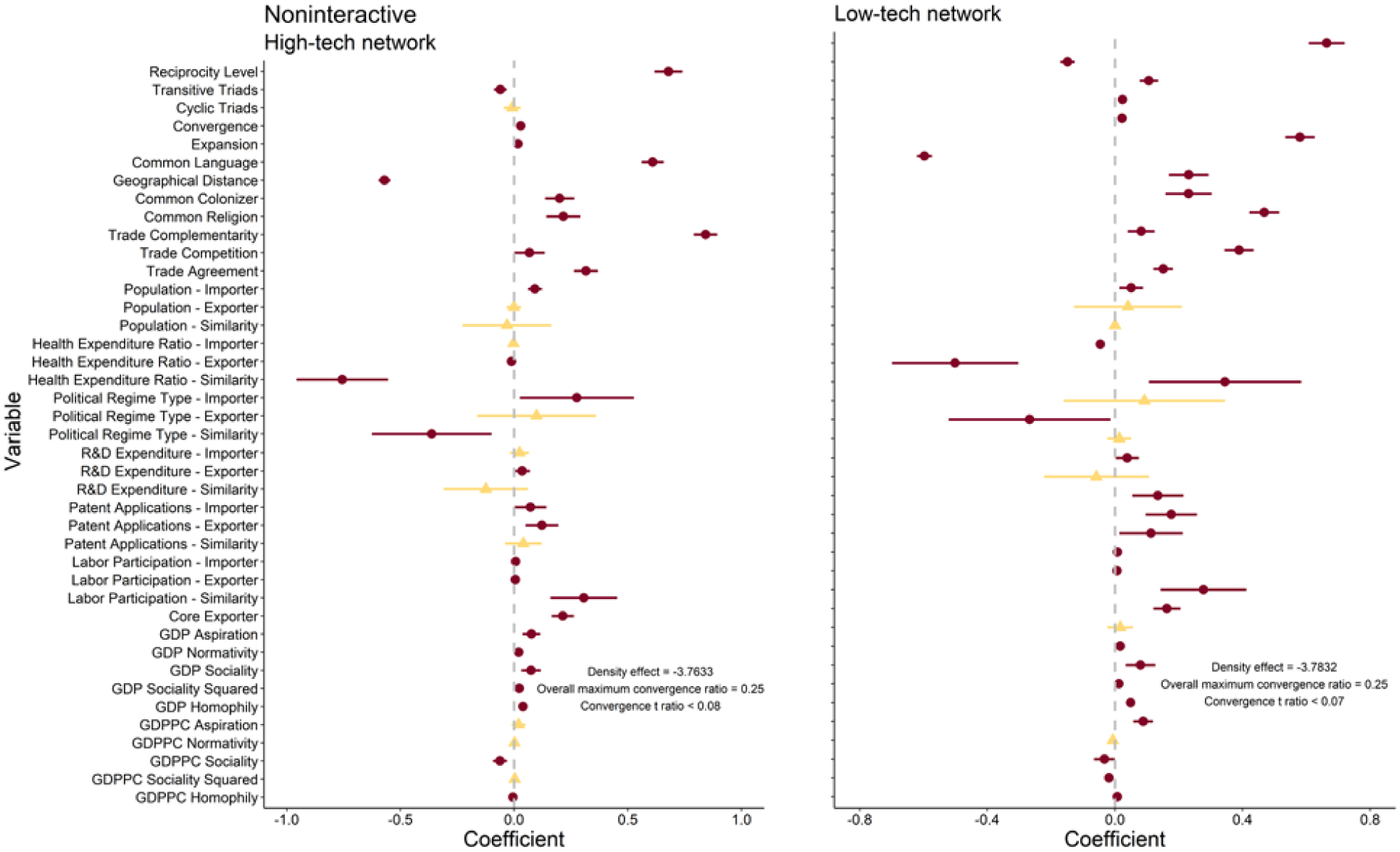
Noninteractive model.

GDP interaction model.

GDPPC interaction model.
First, it is necessary to verify the adaptability of the vertical network data of the high and low-tech network with the SAOM model. We used the Jaccard index to measure it (Ripley et al., 2011). The Jaccard index is used to reflect the degree of similarity and difference between continuous networks, reflecting the stability between adjacent time-step networks. Generally, a larger index indicates a higher degree of similarity, while a smaller index indicates that the network edges are changing too quickly to be considered a network in the process of evolution. The model estimation results show that the Jaccard indices of the high-tech medical trade network range from 0.489 to 0.574 in the four main models, and the Jaccard indices of the low-tech medical trade network range from 0.434 to 0.572 in the four main models, all of which satisfy the requirements of the random actor oriented model SAOM with Jaccard indices above 0.3 and below 0.7.
Figure 2 presents the estimation results from the model without interaction effects. In both the high-tech and low-tech medical trade networks, the core exporter effect is significantly positive, with coefficient estimates of 0.2144 and 0.1631, respectively. This indicates that if a country occupies a core position in the medical trade network, its probability of forming a new export tie increases by 23.91% in the high-tech network and by 17.72% in the low-tech network (e^0.2144-1 = 1.2391-1 = 0.2391, e^0.1631-1 = 1.1772-1 = 0.1772).
The social, homophily, and normative effects of GDP are significantly positive in both networks. Countries with larger market size, greater GDP differences, or GDP levels closer to the network average are more likely to form export relationships. In contrast, the social effect of GDP per capita is significantly negative in both cases. This indicates that countries with lower levels of affluence but larger markets tend to initiate exports, which reflects the characteristics of emerging economies. In the low-tech network, the squared social effect of GDP per capita is also negative, suggesting that less affluent countries are more actively involved in low-tech medical exports. Results from the structural control variables show that both networks exhibit a hierarchical structure, where exports are concentrated among core countries. Trade relationships are significantly influenced by dyadic factors such as geographic distance, common language, shared religion, colonial ties, and trade agreements. In addition, monadic variables such as R&D spending, population size, and the number of patent applications significantly affect the likelihood and direction of a country’s participation in medical trade.
Figure 3 presents the estimation results after introducing interaction terms between the core exporter effect and the five GDP effects. These results are used to explore differences in export behavior between core and peripheral countries under varying market sizes. In both the high-tech and low-tech medical trade networks, the core exporter effect remains significantly positive. The main effects of GDP are also consistently positive across models. However, the interaction terms show divergent results, indicating that export behavior among peripheral countries remains relatively stable, while core countries display more variation. Specifically, the coefficient estimates for the five main GDP-related effects are all significantly positive. This suggests that within the peripheral region, countries with larger market size, greater deviation from or proximity to the network norm are more likely to initiate or receive trade ties. The interaction terms for the social effect of GDP are also significantly positive. This indicates that within the core region, countries with larger markets are more likely to export medical products. By contrast, the interaction terms for the aspiration effect of GDP are significantly negative. This shows that within the core region, countries with smaller market size are more likely to be on the receiving end of trade ties. These findings suggest that the direction of trade within the core is strongly influenced by internal market structure.
Figure 4 presents the estimation results from the model that includes interaction terms between the core exporter effect and the five GDPPC effects. The goal is to examine how levels of national affluence influence export behavior among core and peripheral countries. In both high-tech and low-tech medical trade networks, the core exporter effect remains significantly positive, indicating that core countries are consistently more likely to export medical products. The interaction terms for the social effect of GDPPC are significantly positive in both networks, while those for the aspiration effect are significantly negative. Combined with the GDP-related findings, the results suggest that within core regions of both high-tech and low-tech networks, countries with larger market size and higher affluence are more likely to export. In contrast, countries with smaller markets and lower income levels are more likely to import. This pattern reflects a vertically stratified structure in trade behavior. Hypothesis 1a is supported, while Hypothesis 1b is not. A potential explanation is that affluent core countries have strengthened their export advantage in low-tech medical products through supply chain integration and market lock-in effects (Hartmann et al., 2020). In contrast, less affluent countries within the core remain more dependent on imports due to lower levels of network embeddedness and limited access to technological and capital resources.
The main effect of GDPPC for the social term is significantly negative in both the high-tech and low-tech networks. Combined with the GDP estimates, the results show that in the peripheral region, emerging economies with large markets but lower levels of affluence tend to exhibit a strong propensity to export. However, in the high-tech network, the aspiration effect of GDPPC is not statistically significant. This indicates that imports of high-tech medical products by peripheral countries are not clearly influenced by their level of affluence. Hypothesis 2a is only partially supported. A possible explanation is that peripheral countries generally face structural constraints such as weak institutional capacity and high dependence on foreign technology. These shared external dependencies and barriers to market access in the high-tech sector limit their ability to import, regardless of their affluence. In the low-tech network, the main effect of GDPPC for the aspiration term is significantly positive. When considered together with GDP estimates, the results suggest that affluent countries in the peripheral region are more likely to import low-tech medical products. Hypothesis 2b is supported.
Distinction Between BRI and Non-BRI Countries
Considering that the BRI aims to promote the establishment of a unified trade market in Asia, Europe and Africa, there may be differences in the evolution law of the medical product trade network between countries along the route and countries not along the route. Therefore, we further examined the differences between the BRI countries and non-BRI countries in the trade networks of high- and low-tech medical goods in terms of market size and affluence, which were obtained in Tables 5 and 6, respectively. It is evident that countries along the BRI are more likely to expand their trade relations by leveraging the advantage of market size, whereas non-BRI countries tend to rely more on national wealth. This suggests that the formation of trade relations among BRI countries is more dependent on market potential and regional coordination, while non-BRI countries still exhibit a traditional division of labor in which export advantages are primarily concentrated in high-income countries.
GDP Interaction Model.

p < .1. **p < .01. ***p < .001.
GDPPC Interaction Model.

p < .1. **p < .01. ***p < .001.
In high-tech network, the Belt and Road network shows a significantly positive social interaction effect for GDP and a significantly negative social interaction effect for GDPPC. This indicates that, under the influence of the Belt and Road Initiative, emerging countries in core regions with larger market sizes tend to export high-tech medical goods, which is different from the core developed countries in the whole network. Hypothesis H3a is supported. The GDP and GDPPC aspiration interaction effects are both significantly negative, suggesting that small underdeveloped countries with lower market sizes and lower levels of affluence are more active in imports. The main social effects of GDP and GDPPC align with their interaction effects, indicating that countries in peripheral areas also rely on larger market sizes to drive exports. However, the main aspiration effects of GDP and GDPPC are both significantly positive, suggesting that more affluent developed countries are more inclined to import high-tech medical goods, which is different from the marginal underdeveloped countries in the overall network. Hypothesis H3b is supported. Comparing the results from the non-BRI network, the coefficients for the GDP and GDPPC social interaction terms are significantly positive, whereas the coefficient for the GDP aspiration interaction term is significantly negative. This indicates that developed countries—characterized by large market sizes and high levels of affluent—exhibit more proactive export behavior in the core region, while less developed countries with smaller market sizes display more proactive import behavior. These findings are consistent with the results of the main effects model and reflect the traditional division of labor in the global medical goods trade system. In the low-tech network, the trade behavior of countries along the BRI generally reflects structural patterns similar to those observed in the overall network.
Selection Function Graph Analysis
In order to further study the differences between the export behaviors of core and peripheral countries, we used the selection function of SAOM model to further show the estimated results, as shown in Figures 5 and 6. The selection function captures the value of the utility function of GDP and GDPPC on whether or not the core and peripheral countries choose to enter into an export trade relationship; the higher the value of the utility function, the higher the preference of actor i for that selection.

High-tech network selection function graph.

Low-tech network selection function graph.
The choice function plots provide further validation of the empirical results. In both the high-tech and low-tech networks, the utility values for core countries increase as market size and GDPPC rise. This indicates that countries with both large markets and higher levels of affluence gain greater utility when forming export trade ties. In contrast, countries with smaller markets and lower GDPPC show lower utility values when acting as exporters. Within the peripheral region, emerging economies obtain higher utility in export decisions, particularly when GDPPC is low. The utility curves in the high-tech network are steeper, suggesting that economic attributes have a stronger marginal effect on export-related utility. This finding further supports the structural explanation of inequality in trade positions.
Robustness Tests
We conducted robustness tests through the following three strategies: First, we selected the data with a 1-year interval to reconstruct the network for SAOM analysis, and the results are shown in Table S2. Second, we used different screening criteria for the network edges to vary the sample size of the real participants in the regression, and the results are shown in Table S3. Finally, we replaced the core independent variable—the measurement method of the core position of the economy. The core-periphery identification strategy is replaced by the “k-core” method of the unweighted trade network, and the results are shown in Table S4. The results of the test reaffirm the reliability of the findings of this paper.
Model Validity Tests
In order to verify the reliability of the SAOM model, we analyzed the reasonableness of the model setup and estimation method using GOF test, convergence ratios, wald-type test, and score-type test. The results are shown in Figure S1 and Tables S5 and S6. There is strong evidence that the model estimation results as well as the variable settings are reasonable and valid.
Further Analysis
Heterogeneity Analysis of the Overall Network
Global Value Chain Position
High-tech medical goods can be categorized into three groups according to end-use categories: (1) intermediate products that are consumed in the production process during the accounting period; (2) capital goods that are used repeatedly or in connection with production over multiple accounting periods; and (3) final consumer goods that are used to satisfy individual or collective needs and desires. The products of the three categories differ in terms of technological content, labor factors, production stages, and end uses. Therefore, based on the level of country development and trade structure, the relationship between a countries’ core position and export trade behavior may be heterogeneous across these two product categories. To this end, we draw upon the approach of Lv et al. (2015), classifying 61 high-tech medical goods according to the BEC (Rev.4) classification standards defined by the WTO. Within this framework, 21 of these high-tech medical goods are designated as intermediate products, while the remainder are categorized as capital products. The BEC classification of high-tech medical goods is detailed in Table S1.
Estimates of heterogeneity based on BEC show that intermediate medical trade displays similar estimation results to the benchmark model for high-tech network. The results of the SAOM estimation of the high-tech network based on BEC are detailed in Table S7. Comparing the estimated coefficients of intermediate and capital products, it can be found that the absolute value and significance of the estimated coefficients of the results for capital products are larger than those for intermediate products. This implies that differences in production efficiency and technology levels lead to a stronger moderating effect of country attributes on the relationship between an economy’s power position and its trade behavior. In addition, active export behavior for emerging countries within peripheral regions is observed only in the intermediate medical trade network. This suggests that the R&D and production strengths of emerging countries are more concentrated in the area of high-tech medical products with lower value added. For the core countries, developed countries with large markets and high levels of affluence have active exporting behavior, both in the intermediate and capital-medical trade networks. This suggests that their higher levels of domestic production and research and development will help them gain an advantage in exporting products at the higher end of the value chain.
Regional Position
When countries are located in different regions, their behavioral patterns in high-tech and low-tech medical goods trade networks often differ significantly. We treated a country’s region (the Americas, Asia, Europe, Africa, and Oceania) as a monadic covariate. We multiplied this variable with the core exporter effect and with each of the five effects of GDP, GDPPC, or trade structure to form triple interaction terms. These terms allow us to observe the trade behavior of countries across different regions in both high-tech and low-tech networks. The results are shown in Tables S8 and S9. The findings indicate that trade behavior varies markedly among regions.
In the Americas, Europe, and Oceania, developed countries generally possess large market sizes and high levels of affluence. These countries are actively involved in the import and export of high-tech medical products, forming dense core trade networks led by the United States, Germany, the United Kingdom, and Canada. In contrast, less developed countries in the same regions primarily engage in exporting low-tech medical goods. In peripheral regions, emerging economies—with large markets but lower levels of affluence—tend to export medical products across both high- and low-tech segments. Meanwhile, more affluent countries in these areas are more inclined to import. This trade structure reflects patterns of comparative advantage and confirms existing conclusions about regional economic stratification and the concentration of high-tech industries in innovation-driven countries (Krugman, 2018; Porter, 1990).
Asian countries show broad participation by emerging economies in both high- and low-tech segments of the global medical goods trade network, particularly in exports. This reflects their efforts to ascend the global value chain by capitalizing on scale–cost advantages (Gereffi & Wyman, 2014; UNCTAD, 2020). Furthermore, in core areas, less affluent countries are more active in imports, while in peripheral regions, more affluent countries exhibit stronger import tendencies. These patterns suggest ongoing industrial upgrading and structural transformation within Asia (Pereira, 2014).
In Africa, where general economic conditions remain weak, countries with small markets and low levels of affluence demonstrate a “high demand–high dependency” trade pattern. In core regions, less developed countries are relatively active in both importing and exporting medical products, indicating strong reliance on external sources for medical supply (Mahajan, 2019). In peripheral regions, emerging economies such as Nigeria and Egypt are gradually strengthening their domestic pharmaceutical capabilities and increasingly importing high-tech medical goods to meet internal demand or for reprocessing and re-export. This points to an emerging trend of mutually beneficial trade relationships (Rodrik, 2017).
Heterogeneity Analysis of BRI Networks
Technological Innovation Capacity
Following Benfratello et al. (2022), we used R&D expenditure to measure a country’s technological innovation capacity. We treated it as a monadic covariate and multiplied it by the core exporter effect to form the explanatory variable. This approach allowed us to analyze how a country’s R&D expenditure level influences the relationship between its trade position and export behavior under the BRI. We aimed to explain how the leap from the periphery to the core among BRI countries reflects changes in their level of technological innovation capacity. Table S10 presents the results.
From Column (1) of Table S10, in the high-tech network, both the R&D social effects and their interaction terms are positive and statistically significant. This indicates that higher R&D levels are associated with a stronger tendency to export medical products, regardless of whether a country is core or peripheral. However, this tendency is more pronounced among core countries. In contrast, the R&D aspiration effects and their interaction terms are negative and significant, suggesting that countries are less likely to select high-R&D countries as export destinations. This “repulsion” effect is stronger among core countries, likely due to intense competition and patent barriers among high-R&D economies, which hinder the establishment of cooperative trade relationships. At the same time, this dynamic creates space for low-R&D countries to engage with core exporters. As technology spillovers, market complementarities, and mutual recognition of standards continue to progress under the BRI, peripheral countries are increasingly able to strengthen their own R&D capacities. This process may help narrow the gap between peripheral and core economies, highlighting the potential for a “periphery-to-core” transition within the broader geopolitical and economic structure, in line with the logic of WST.
From Column (3) of Table S10, in the low-tech network, both the R&D social effects and their interaction terms are negative and statistically significant. This indicates that countries with lower R&D levels are more likely to export low-tech medical products. The coefficient for the square of social effects is also negative, suggesting that as R&D investment increases, comparative advantages in the low-end market diminish. This negative impact is more pronounced among core countries, reflecting the tendency of R&D-intensive economies to move further upstream in the global value chain. The interaction term for R&D aspiration effects is positive and significant, indicating that core countries prefer high-R&D partners in low-end trade. This preference likely stems from the desire to reduce transaction risks and ensure product quality and regulatory compliance. As a result, core countries are more inclined to cooperate with partners that have relatively well-developed industrial and regulatory infrastructures (Hartmann et al., 2020). Given the limited profit margins of low-tech products, low-R&D countries are offered a differentiated entry point into international markets. Their paths to upgrading depend on access to external technology and capital. The BRI is facilitating this process by helping these countries overcome technological lock-in, integrate into higher value-added segments, and advance their positions within the global medical goods trade network.
Political Alliance Embedment
Drawing on Zhou (2020), we used the number of trade agreements a country has joined to measure its degree of political alliance embedment. We treated this as a monadic covariate and multiplied it by the core exporter effect to form the explanatory variable. This approach allowed us to analyze how the number of trade agreements a country has joined influences the relationship between its trade position and export behavior under the BRI. We aimed to explain how the leap from the periphery to the core among BRI countries reflects changes in their level of political alliance embedment. Table S10 presents the results.
From Column (2) of Table S10, in the high-tech network, the interaction term for RTA social effects is positive while the square of social effects is negative, indicating an inverted U-shaped relationship between core countries’ level of political alliance participation and their likelihood of forming high-tech medical export partnerships. Moderate participation enhances technical coordination and negotiation capacity, thereby promoting exports. However, excessive involvement raises compliance costs, which can undermine trade cooperation. The interaction term for RTA aspiration effects is negative, suggesting that core countries tend to avoid exporting to states highly embedded in political alliances. This may be because such partners typically have stricter standards and stronger bargaining positions, creating technical barriers and competitive exclusion effects (Mansfield & Milner, 2012). The main effects of both RTA social and aspiration effects are not statistically significant, implying that peripheral countries cannot overcome barriers in the high-tech global medical goods trade network by simply increasing the number of RTAs. Instead, they must rely on the BRI to enhance their technological absorptive capacity and institutional alignment through capacity cooperation or standard recognition mechanisms, thereby improving their trade position.
From Column (4) of Table S10, in the low-tech network, the main effect and interaction term of RTA social effects for core countries are significantly positive, while the square of social effects and its interaction are significantly negative. This indicates that low-tech medical exports exhibit an inverted U-shaped relationship with RTA participation in both core and peripheral regions. Initial RTA expansion facilitates exports, but excessive participation may lead to conflicting provisions and compressed profit margins, ultimately reducing export incentives (Baccini, 2019). In contrast to the high-tech network, the interaction term for RTA aspiration effects is significantly positive in this context. This suggests that core countries are more willing to export low-tech medical goods to highly RTA-embedded partners, likely because such countries offer more stable regulatory frameworks and payment systems, which help mitigate transaction risks. As a result, peripheral countries can deepen their integration into international trade by expanding their RTA networks. Through trade and capacity coordination mechanisms promoted under the BRI, these countries may also achieve gradual technological upgrading (S. Wang et al., 2022).
Conclusions and Policy Implications
Conclusion
This paper posed three key research questions; the first asked what is the current power hierarchy structure in global medical goods trade networks of different technological levels? Descriptive statistical results reveal a clear “core–periphery” stratification in both high- and low-tech networks. However, the high-tech network exhibits a stronger degree of hierarchy, with the core dominated by a few affluent, developed countries. Against this backdrop, how has the trade status of countries along the BRI evolved? Findings show that these countries hold a relatively higher share of the core in low-tech networks. Over time, several Asian countries along the BRI have ascended into the core of the high-tech network. Moreover, the trade volume gap in high-tech pharmaceuticals among BRI economies has significantly narrowed, indicating a trend toward a more balanced structure. This supports Ma (2022)’s argument that regional economic cooperation can promote more equitable trade specialization under a cooperative framework.
The second research question asked what endogenous driving mechanisms and exogenous contextual factors shape and evolve the differentiated trade behaviors of core and peripheral countries? Empirical results based on the SAOM indicate that affluent countries in core regions tend to specialize in exports, while less developed countries are more import-oriented. In peripheral regions, emerging economies exhibit a strong export orientation, whereas more affluent countries tend to import more. This stratified pattern is more pronounced in high-tech networks, suggesting the presence of significant entry barriers in high-tech markets (Magerman et al., 2020). Core countries rely on their technological advantages to maintain export dominance. These findings align with the path dependency mechanism emphasized by Djelic and Quack (2007), which plays a critical role in shaping national shifts within the global trade hierarchy, consistent with the framework of WST.
The third research question asked how does the BRI influence differentiated trade behaviors of core and peripheral countries through endogenous driving mechanisms and exogenous contexts? By distinguishing between BRI and non-BRI networks and conducting SAOM empirical tests separately, results show that core emerging economies along the BRI are reshaping traditional export structures and gaining ground in high value-added trade. In contrast, affluent countries in peripheral BRI regions tend to import more high-tech products, reflecting the positive impact of regional cooperation and industrial chain restructuring. High-R&D countries dominate high-tech exports, while peripheral countries benefit from technology spillovers through trade linkages. The effect of political alliances on trade follows an inverted U-shape—moderate involvement promotes exports, but excessive agreements raise compliance costs and inhibit trade, especially among core countries. As Perla (2021) emphasizes, technology diffusion and institutional coordination are key mechanisms for elevating trade status and restructuring the global value chain, offering less advantaged countries a path to industrial upgrading and enhanced competitiveness.
Policy Implications
Based on the empirical findings, policy recommendations are as follows: First, core economies should optimize global trade rules and promote fair trade. This approach will reduce market entry barriers for peripheral countries. Results show a hierarchical structure in high-tech medical product trade networks. Core countries dominate exports, while peripheral countries face technical and market barriers. Therefore, core economies should refine intellectual property rules, enhance technology sharing, and lower trade barriers. International R&D funds and joint intellectual property platforms can help reduce patent obstacles and promote technology transfer. Additionally, inclusive market access policies—such as tariff reductions, lower non-tariff barriers, and simplified certification—can encourage peripheral countries to increase exports of high-value medical products.
Second, regional cooperation mechanisms should be strengthened, matching trade policies to the economic attributes of trade destinations. Policymakers should design tailored trade policies. For core-region countries with large markets but lower affluence, measures like medical industry parks, infrastructure connectivity, and regulatory coordination are beneficial. For affluent peripheral countries, investment protections and reduced institutional trade costs can encourage high-tech imports. Tailored policy interventions will reduce trade disparities and enhance regional trade resilience.
Third, peripheral countries should leverage low-tech medical exports as stepping stones to technological upgrading. Emerging peripheral economies excel in low-tech medical exports, showing a clear “periphery—semi-periphery—core” trajectory due to path dependence. To accelerate this upgrading, peripheral countries should use targeted industrial funds and subsidies. Such measures channel innovation resources toward large-scale, low-tech production while gradually increasing R&D investment in high-value products. This balances labor-intensive manufacturing advantages with innovation capacity. Additionally, appropriate participation in regional trade agreements emphasizing standard recognition and regulatory harmonization can deepen industrial integration. This approach facilitates external technology and knowledge spillovers without incurring excessive compliance costs, supporting a strategic move upward in global value chains.
Limitations and Future Research
This study has some limitations and provides directions for future research. First, this study only examines the global medical goods trade network. Future research could include more industries to explore sectoral differences in core-periphery trade behavior. Second, this study adopts a structural method based on the “rich-club” principle to identify core and peripheral countries. However, it does not yet incorporate non-structural factors—such as geopolitical dynamics and institutional environments—that may also influence the formation of core-periphery structures. Future research could consider integrating multiple dimensions for a more comprehensive identification and cross-validation analysis. Third, this study does not predict the impact of external shocks, such as trade conflicts or public health crises, on future global medical goods trade patterns. Future research could employ scenario simulation methods to address this issue.
Supplemental Material
sj-docx-1-sgo-10.1177_21582440261423256 – Supplemental material for The Belt and Road Initiative and Behavioral Reshaping in Global Medical Goods Trade Networks: A Core-Periphery Perspective
Supplemental material, sj-docx-1-sgo-10.1177_21582440261423256 for The Belt and Road Initiative and Behavioral Reshaping in Global Medical Goods Trade Networks: A Core-Periphery Perspective by Linqing Liu, Weiran Wang, Qiang Wang and Jiajie Tang in SAGE Open
Footnotes

Author Contributions
Funding
The authors disclosed receipt of the following financial support for the research, authorship, and/or publication of this article: The research was supported by the National Social Science Foundation of China (Project No. 24&ZD076) and the Humanities and Social Sciences Fund Project of the Ministry of Education of China (Project No. 23YJA630063).
Declaration of Conflicting Interests
The authors declared no potential conflicts of interest with respect to the research, authorship, and/or publication of this article.
Data Availability Statement
The data that support the findings of this study are available from the corresponding author upon reasonable request.
Supplemental Material
Supplemental material for this article is available online.
References
Supplementary Material
Please find the following supplemental material available below.
For Open Access articles published under a Creative Commons License, all supplemental material carries the same license as the article it is associated with.
For non-Open Access articles published, all supplemental material carries a non-exclusive license, and permission requests for re-use of supplemental material or any part of supplemental material shall be sent directly to the copyright owner as specified in the copyright notice associated with the article.
