




Abstract
The journey to reinforce connectivity between China and ASEAN-5 through the Belt and Road Initiative (BRI) presents various risks and non-life insurance development opportunities. This research investigates the factors that affect non-life insurance development in China and ASEAN-5. This study has offered novel evidence highlighting the impacts of trade variables and a multidimensional economic freedom measure consisting of nine components on non-life insurance development. Panel regression results indicate that trade and the BRI itself are decisive factors that stimulate insurance development. Higher economic freedom, however, has a negative influence on non-life insurance development. In terms of policy implications, regulatory interventions represent a more practical way to enhance the resilience and development of the non-life insurance sector to accomplish the BRI goals.
Introduction
Since the year 2013, a lot of effort and money had been invested in reconstituting the historic Silk Road as part of the Belt and Road Initiative (BRI) in stimulating trade with Asian and European countries. Therefore, the functions of non-life insurance by providing risk mitigation could facilitate global integration of the financial services market. The BRI implementation is likely to provoke a new wave of trade liberalization to provide substantial economic opportunities for both ASEAN and China. Given the global supply chain’s recalibration under the pressure of trade war, ASEAN comes forth as one of China’s largest trading partner, with total merchandise trade reaching USD368 billion in 2016 (Swiss Re, 2016). Nonetheless, BRI will not materialize if the economic growth is emphasized without considering the associating risks (Belt and Road Portal, 2013). Insurance, especially non-life insurance, is one of the most important tools to facilitate the integration of financial services market between ASEAN and China. Non-life insurance claims are offering coverage for property insurance for the losses due to incidents such as fire, accidents, or man-made mishaps (Apergis & Poufinas, 2020). Non-life insurance is able to provide risk transfer and indemnification of losses which help expand aggregate economic activities.
Empirical studies had documented that insurance can contribute to economic growth and have identified some macroeconomics factors such as economic growth, stock market capitalization, inflation, and interest rate that influence insurance development (Chang & Lee, 2012; Pradhan et al., 2017). However, the insurance market studies mostly focus on developed countries like Europe and America (Kjosevski & Petkovski, 2015; Liu et al., 2016). Thus, studies on the insurance market in China and ASEAN-5 are as yet somewhat limited in scope and are incomplete in some respects. For instance, they do not consider the potential impact of a resurgent China due to the BRI established in 2013. Besides, they do not consider all the economic freedom indices when examining the impact of economic freedom on insurance development. Economic freedom tempers the risk-taking incentives of non-life insurance services. Albeit its economic significance, contemporary studies have devoted substantial attention to the impacts of economic freedom on various financial areas that influence economic outcomes (see Andersson, 2016; Iamsiraroj, 2016; Ojede & Kishan, 2017; Swamy & Narayanamurthy, 2018) but not the non-life insurance development. In this endeavor, we enrich the literature by evaluating the impacts of macroeconomic variables on non-life insurance development in China and ASEAN-5, focusing on trade relationships, economic freedom, and the BRI.
The objectives of this study are threefold. First, due to the crucial role that the non-life insurance sector could potentially play in the fruition of the BRI plan, this study seeks to identify the factors that affect the development of the non-life insurance industry in ASEAN-5 and China. It is in contrast to the previous studies by Esho et al. (2004) and Lee et al. (2013) investigating the macroeconomic factors that influence the insurance industry across various countries based on randomly selected countries. This study provides empirical evidence on the factors with the focus on trade variables and other control variables that influence the non-life insurance in ASEAN-5 and China.
Second, this study investigates the influence of economic freedom on insurance development in this region by examining each of its sub-components’ effect. It is envisaged that a multidimensional economic freedom measure consisting of nine components (property rights, government integrity, tax burden, government spending, business freedom, monetary freedom, trade freedom, investment freedom, and financial freedom) could provide a more comprehensive evaluation than a single indicator. Furthermore, economic freedom is likely to play an interacting role with the trade activities due to the BRI in affecting insurance market growth.
Third, this study examines the BRI effect in stimulating the development of the insurance industry in China and ASEAN-5 by introducing a BRI dummy in the model from 2014 onwards. There is a dire need for guidelines on economic cooperation in China and ASEAN-5 as the BRI rests on well-articulated and evolving ideas, solid economic foundations, and a sound institutional framework whereby the new discourse of integration between China and ASEAN-5 is rising.
Using several statistical models, our results show that trades in ASEAN-5 and China that result from the BRI positively affect non-life insurance development. Meanwhile, the controlled variables on the interest rate and inflation are detrimental for non-life insurance development. Institutional factors such as economic freedom, property rights, business freedom, and investment freedom are found to have a negative influence on non-life insurance development. The findings suggest that enforcement of regulations to restrict these freedoms would facilitate non-life insurance development. Notwithstanding, this study also finds that investment freedom and economic freedom interact with trade stimulates non-life insurance growth, indicating that economic freedom can further reinforce trade’s beneficial effect on non-life insurance development.
The novelties of this study contribute to the literature in two ways. First, the non-life insurance policies protect businesses from the possibility of trade agreements collapsing due to elevated duties on goods flowing between countries. Therefore, understanding the impact of trade and other macroeconomic variables on non-life insurance is important to overcome supply-side constraints and increase public knowledge about the advantages of insurance protection. Second, by examining a comprehensive measurement of economic freedom through nine sub-components, some sub-components of economic freedom postulate negative impacts on non-life insurance development, which implies that some sub-component of economic freedom might produce inferior social goods. This approach allows policymakers to identify which sub-components of economic freedom require appropriate attention in stimulating non-life insurance development. This application creates the best opportunities to earn a better quality of life for the development of the countries. In sum, we contribute to the literature and provide valuable insights for policymakers to understand the drivers of non-life insurance development, especially the intermediate role of economic freedom in reinforcing the beneficial effect of trade on non-life insurance development, which may help them coordinate their policies and regulations while enhancing the development of the non-life insurance sector.
The remainder of the paper is organized as follows: in section 2, the related literature is reviewed. Then, in section 3, the data and methodology are described. It is then followed by section 4 in which a detailed discussion of the findings is presented. Lastly, in section 5, some conclusions are drawn, and the implications of this study are highlighted. Some recommendations are also made for future research based on the limitations of this study.
Literature Review
In general, the main functions of the non-life insurance industry as a subsector of the financial industry are to allocate efficient financial resources, produce liquidity, diversify financial losses, and facilitate investment in an economy (Lee, Low et al., 2018; Outreville, 1996). The significance of non-life insurance means an immense amount of emphasis has been placed on the regulation and supervision of this sector to ensure that non-life insurance firms can mitigate the insolvency risk and safeguard the soundness of the financial system a whole. The non-life insurance development has been discussed by several studies (Dragos, 2014; Esho et al., 2004; Feyen et al., 2011; Kjosevski & Petkovski, 2015). Most of these studies have demonstrated that macroeconomic factors such as trade, interest rate, inflation rate, stock market development and banking development are the drivers of non-life insurance development. Apart from the traditional macroeconomics factors as the determinants of non-life insurance development, the recent literature argue that institutional environment associated with the countries such as economic freedom, culture effect, and legal stability affect the development of non-life insurance (Lee, Cheng et al., 2018; Trinh et al., 2020, 2021). At the empirical level, the impact of the macroeconomics factors and economic freedom on non-life insurance in the ASEAN and China have not been studied as extensively as the developed countries and European countries.
Macroeconomics Factors as the Drivers of Non-Life Insurance
One of the macroeconomics factors that the literature considers is trade (Kjosevski & Petkovski, 2015; Petkovski & Jordan, 2014). Insurance protects against the risks involved in international and domestic trade, such as price or currency fluctuations and non-payment. A more significant amount of trading in goods and services implies that a country is relatively more open; hence such a country will accumulate more insurable assets. In recent years, China and ASEAN-5 have become more important trading partners for all developing countries/regions (Hu et al., 2018). Export and import activities generate additional variations in trading costs due to the need for freight insurance (Contessi & De Nicola, 2013). Therefore, the hypothesis below is formed.
H1: Trade is positively related to the development of the non-life insurance market.
Other macroeconomics factors that influence non-life insurance development are interest rate, inflation rate, the stock traded, and availability of credit. The interest rate can affect the rate of return on investment from the investment of insurance premiums. The underwriting profit and loss account of an insurance company is derived from the earned net premiums minus the loss incurred plus the investment income affected by the interest rate. When the interest rate increase, there would be gains from investing the premiums on financial markets; thus, the supply of insurance will increase. Therefore, a higher interest rate induces a higher development in non-life insurance (Akhter et al., 2020; Millo, 2016). Higher stock market capitalization denotes a more market-based financial system (Hou & Cheng, 2017; Law & Singh, 2014; Sephton & Mann, 2015). Since the stock market and economic growth tend to converge in the long run, a more capitalized stock market and high economic growth can have a substantial impact on non-life insurance development (Pradhan et al., 2020). The inflation rate acts as a gage of the market risk and is another variable that could influence the stability of insurance development (Lee, Cheng et al., 2018). A rise in inflation could potentially deteriorate the insurance companies’ solvency margin, leading them into the insolvency trap. It implies that inflation has an inverse relationship with the demand for insurance that could impede the growth of the non-life insurance sector (Lee, Cheng et al., 2018; Yuan & Jiang, 2020). Furthermore, Bobovnik (2016) suggests that the higher availability of credit from financial institutions indicates that households are more in debt and that they have a higher probability of encountering risky events that affect their expected future wealth. Thus, non-life insurance is required to mitigate these unexpected risks. Hence, we form the following hypotheses:
H1a: The interest rate is positively connected to the development of the non-life insurance market.
H1b: The stock traded is positively associated with the development of the non-life insurance market.
H1c: Inflation is negatively connected to the development of the non-life insurance market.
H1d: Credit available is positively related to the development of the non-life insurance market.
Economic Freedom as the Driver of Non-Life Insurance
Governments in emerging countries may implement non-life insurance instruments such as insurance credit subsidies to promote exports, which may have a relationship on the extent of economic freedom. It has been argued that “regulator stability” theory does not favor economic freedom. It has been suggested that regulation leads to a reduction in unit prices, a reduction in the size of the involuntary market, and improvements in products, leading to insurance market growth (McShane et al., 2010). It has also been argued that strict regulation could enhance insurance governance’s effectiveness and lead to an improvement in the risk-control ability and business acumen of insurance providers (Li et al., 2017). Conversely, it has been suggested that “regulatory fragility” favors economic freedom. Under this view, regulation causes higher loss ratios, supply shortages, and inefficient sales techniques that hinder insurance market growth (Fields et al., 2012; Weiss et al., 2010). These critical insights have directed this study toward exploring the impacts of economic freedom on the development of the non-life insurance industry.
According to the Heritage Foundation (2018), economic freedom can be defined as the fundamental right of every individual to manage their property. The Foundation also claims that by improving economic dynamism, governments can expand opportunities for their citizens. It also means that when governments implement economic policies that allow freedom, this encourages greater entrepreneurship. Hence, it is reasonable to hypothesize that greater economic freedom will enhance the opportunity for insurance development. In a free financial institution environment, the marketplace itself should be the primary source of protection by undertaking third-line risk management mitigation and performing the role of an independent auditor. Hence, insurance companies are more willing to provide insurance services in a country where there is less regulation because they believe that in such a context they can manage their business well and provide the goods and services that best respond to the needs and desires of consumers.
As explained by Trinh et al. (2016), higher economic freedom and more significant income amplify both wealth and the value of risky assets, which increases the demand for non-life insurance. Besides, Park et al. (2002) explain that countries with higher economic freedom tend to offer a more tranquil environment in which insurance companies can develop and grow because it allows them to gain customers effortlessly. Elango and Jones (2011) state that financial freedom positively influences expenditure on non-life insurance. Moreover, it has been argued that financial restrictions should be minimized because more regulations will cause insurance firms to experience difficulties selling their insurance products. Thus, there should be more financial freedom for insurers in operating their insurance services to attract and retain customers. According to supply-leading theory, Outreville (1996) postulates that a financial system can develop the economy by promoting the accumulation of social capital and allocating social resources efficiently. Since financial development could increase economic growth, this implies that government interference could harm the economy. Furthermore, higher economic freedom could also lead to non-life insurance market being competitive, as proposed by Trinh et al. (2020). In their empirical work based on the sample from Organization for Economic Co-operation and Development (OECD) countries, they find that an individual will increase the non-life insurance expenditure when the value of the asset at risk increases.
Generally, the literature supports the decisive role that economic freedom can play in insurance development and claims that it is an essential driver of insurance development. The non-life insurance sector has always been deemed the main element in the capital formation mechanism that leads to significant productive investments. Thus, the non-life insurance growing system potentially decreases the government-mandated duty, thereby allowing the government to utilize its ability to develop other parts of the economy. Since the developing countries in Southeast Asia are among the countries that are slow to develop insurance services, the contributing influence of economic factors on insurance in this region will differ to that in other regions. Based on the above discussion, we proposed the following testable hypotheses::
H2: Economic freedom is positively associated with the non-life insurance market.
However, there may be institutional conditionality in the relationship between trade and insurance growth. Lee et al. (2016) and Roe and Siegel (2011) indicate that trade openness and the related factors that mediate trade activities cannot function well in an environment with less economic freedom. Thus, the well-functioning of other economic freedom dimensions, such as trade, investment, and financial freedom, are directly linked to insurance activities. In light of the above, economic freedom could also be valuable in the trade–insurance growth relationship. Hence, in addition to evaluating the independent influences of trade and economic freedom on insurance growth, this study further contributes to the literature by directly examining the complementary role of economic growth in the trade–insurance growth nexus in ASEAN-5 and China is in dire need of development. We formed the hypothesis as follows:
H2a: Economic freedom will interact with trade and increase the growth of the non-life insurance market.
Regional Project Development as the Driver of Non-Life Insurance
China is a crucial factor both in the region and on the world’s economic and political stage. China’s escalating geo-economic power has transformed the country into the leading trading and economic partner for most Asian countries. The establishment of the Belt and Road Initiative (BRI) has made China be the center of geo-economics not only in the region but also beyond. Focusing on transportation connectivity, commercial space, networks, commerce, investment, trade, and financial and economic strengths intends to create a sustainable economy. Moreover, in order to realize the BRI objectives of strengthening policy communication, improving road connectivity, promoting trade facilitation, enhancing monetary circulation, and strengthening people-to-people exchanges, the Chinese government has integrated and rebranded a mixture of existing provincial collaboration instruments to expedite regional economic integration and move forward with its national economic strategy. These collaborations include the ASEAN plus China (10 + 1) cooperation mechanism through which China seeks support from the respective countries of ASEAN in promoting the BRI.
The realization of the BRI is one of China’s leading economic goals for several reasons. First, China is keen to help Asian countries to transform their infrastructure and ameliorate cross-border transportation and other essential infrastructure facilities. In return, this will help China to forge well-built bilateral economic and trade relationships with its Asian neighbors. Infrastructure development could also overcome the geographical limitations and reduce the high production costs experienced by landlocked countries in the region. It has been suggested that connectivity is a shortcut to economic prosperity (Yu, 2017). Therefore, infrastructure development is critical. This focus on infrastructure will lead to increased demand for non-life insurance products will increase to mitigate the risks arising from infrastructure development. Furthermore, China’s bilateral trade and economic ties with ASEAN-5 increase, creating the opportunity for the insurance industry in China and ASEAN-5 to grow further. Hence, this research examines the impact of BRI on insurance development in both China and ASEAN-5 and hypothesis that:
H3: BRI is positively affect the non-life insurance market.
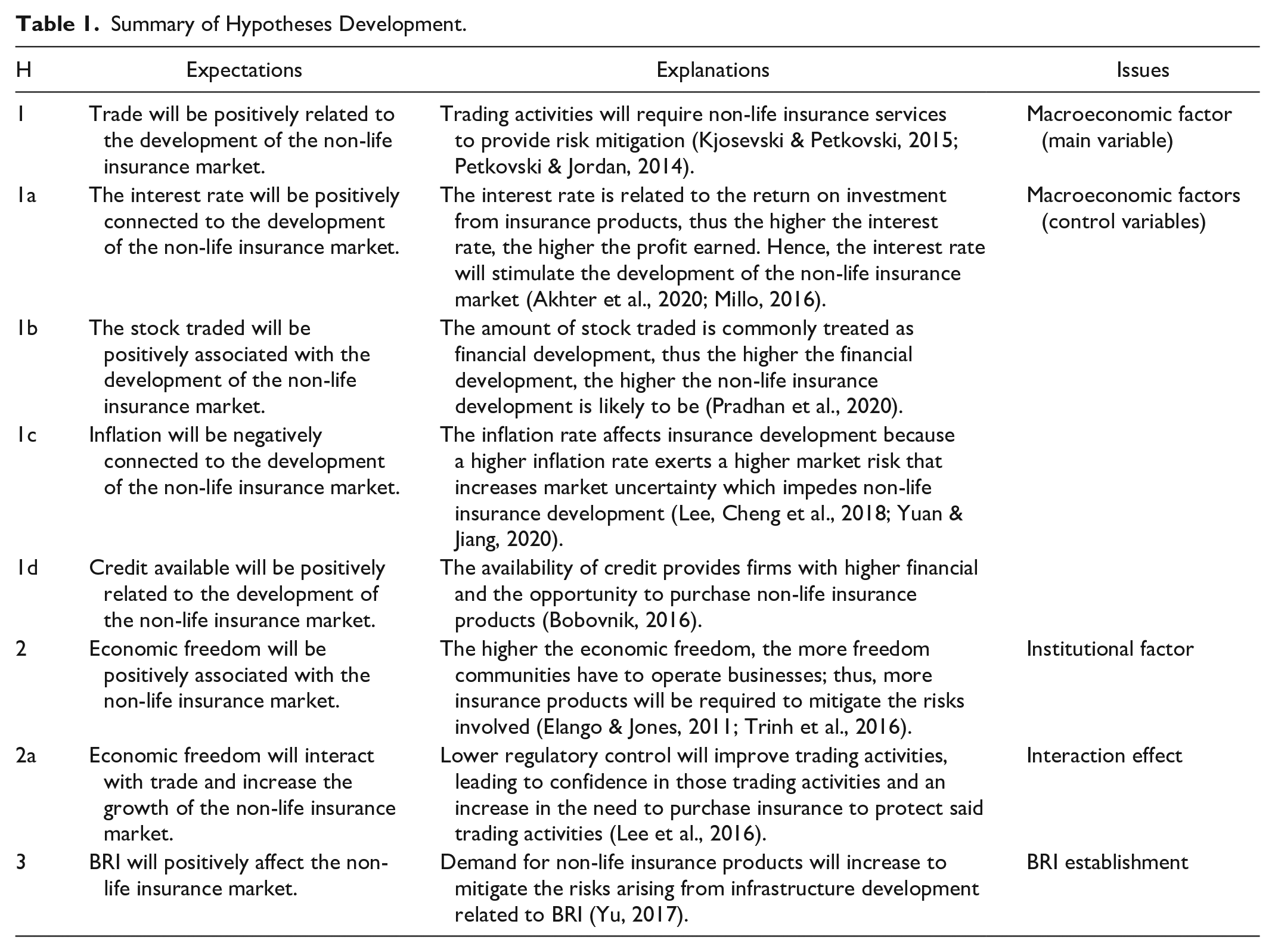
Drawing together the above strands in the literature, three main hypotheses are formulated for this study, which is summarized in Table 1 below.
Summary of Hypotheses Development.
Data and Methodology
This study analyses data from ASEAN-5 (Indonesia, Malaysia, Philippines, Singapore, and Thailand) and China spanning the period from 1995 to 2015, The ASEAN-5 countries are the core countries among the 10 ASEAN member states because their economic growth status and involvement in the BRI is higher than the other five countries. The insurance data is extracted from the Global Financial Development Database, the macroeconomic data is obtained from the World Development Indicator, and the economic freedom index is sourced from the Heritage Foundation. Overall economic freedom consists of nine specific freedoms that together define multiple rights and liberties. Unlike previous studies that have employed an aggregated economic freedom index, this study adopts different components to represent different dimensions of the economic freedom environment, namely property rights, government integrity, tax burden, government spending, business freedom, monetary freedom, trade freedom, investment freedom, and financial freedom.
The period covered by this study begins from 1995 because the dataset provided by the Heritage Foundation starts from 1995 and ends with 2015 because the Global Financial Development Database is updated every 2 years and the latest available data is for 2015.
In this study, the dependent variable is non-life insurance density (total premiums/total GDP). In contrast, the independent variables are the ratio of trade to GDP, real interest rate, inflation rate, the ratio of stock traded to GDP, and the ratio of credit provided by financial institutions to GDP.
This research study follows the models proposed by Elango and Jones (2011) and Trinh et al. (2016). As a common in-demand function specified on macroeconomic variables, we transform all the variables into natural logarithm in order to minimize the heterogeneity of variance in the model and the estimated coefficients are interpreted as elasticity (Cheng & Yu, 2019; Lee, Cheng et al., 2018). Hence the panel regression model after the logarithm transformation on the variables are:

Concerning equation (1) above, the BRI was outlined by President Xi Jinping while on his visit to Indonesia and Kazakhstan in October 2013 (Yu, 2017). BRI officially kicked off in the year 2013 and the projects related to BRI started to roll out in ASEAN in the year 2014 (Cox et al., 2018). Thus, a dummy variable value of 1 is included in the model starting from the year 2014 to capture the impact of the BRI on insurance development. The years before 2014 are assigned a value of 0. In the above,
The effect of trade on insurance is contingent on the level of economic freedom. It is because the presence of an intervention mechanism in trading activities will influence insurance growth. There are two views on how the relationship between trade and insurance growth is interacted by economic freedom. The first suggests that stringent regulatory control can impede the chaos within trading activities, which leads to underlying confidence in trading activities, thus reducing the need to purchase insurance to protect trading activities. As protectionism limits international trade and impedes free market participation, more freedom is favored by trading activity to stimulate insurance growth (Herrera-Echeverri et al., 2014). The other view proposes that intensified international competition provokes many firms to call for government protection. However, as economic freedom increases, more trade and investment appears to have a detrimental impact on growth, suggesting that the “too much of a good thing” phenomenon exists in transition economies (Law & Singh, 2014). Hence, less freedom is favored by trading activity to motivate insurance growth. To assess the interaction effect, the economic freedom index is included in equation (1) to produce equation (2):

A description of the variables investigated in this study is presented in Table 2 below.
Descriptions of the Variables.

Note. Full information related to the index of economic freedom can be obtained from The Heritage Foundation (https://www.heritage.org/index/about). GFDD = global financial development database; WDI = world development indicators; HF = heritage foundation
Estimation Procedures
First, the pooled ordinary linear regression model (pooled OLS) is exploited to present results based on the poolabality of the data while disregarding the panel structure of the data. The second model employed is the random effect model (REM) which handles the constants for each section as random parameters. The third model is the fixed effect model (FEM), where the constant is treated as group-specific, allowing different constants for each country. The selection of pooled OLS or the REM is based on the Breusch-Pagan Lagrangian multiplier test where the null hypothesis denotes that the pooled OLS is preferred versus the alternative hypothesis that denotes that the REM is preferred. The choice between the REM and the FEM is based on the Hausman test where the null hypothesis indicates that the REM is preferred as opposed to the FEM (Gujarati & Porter, 2009; Lee, Cheng et al., 2018) The dynamic ordinary least squares (DOLS) model is utilized to get an unbiased estimate of the model’s long-term parameters to check robustness.
Data Analysis and Interpretation
Table 3 presents a descriptive summary of the data. The insurance density in the six countries has an average value of 2.18. Generally, the insurance density for China, Indonesia, and the Philippines is below 2.00, whereas for Malaysia, it is about 2.00 over the entire period of study. However, for Thailand, it showed an increasing trend from 1.15 in 1995 to 3.90 in 2015. Singapore’s insurance density has the highest variance among the six countries with a value of 2.35 in 1995 and 5.56 in 2015, with a peak of 9.02 in 2001. 1 Since the average insurance density for the area under study is 2.18, which is far below other countries such as Hong Kong, the United Kingdom, and Taiwan that have an average value of above 10, 2 China and ASEAN-5 provide a niche in the insurance sector, supporting the economists’ forecast that the insurance premiums in China and ASEAN-5 should outshine those in the rest of the world in the coming years.
Descriptive Summary of the Variables.
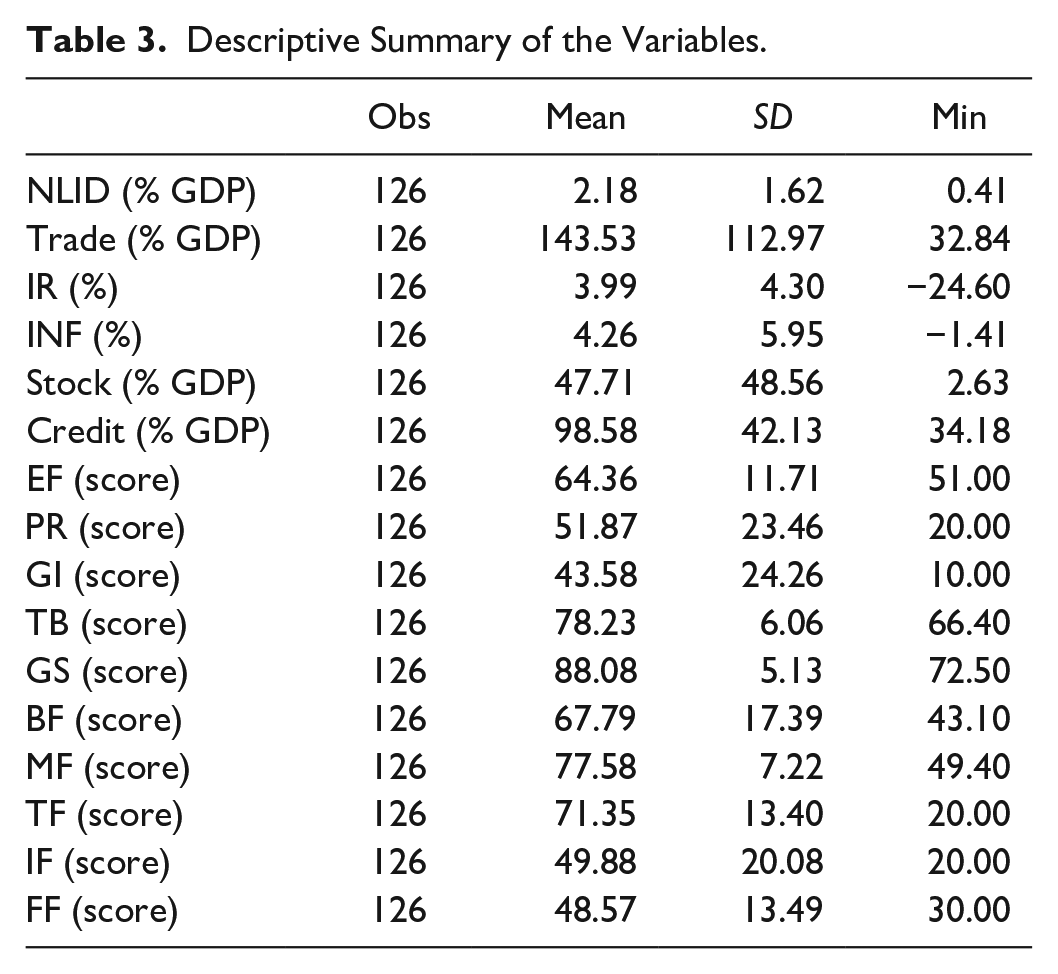
Trade as a percentage of GDP has the highest average value (142.53%) compared to the other variables, which indicates that China and ASEAN-5 are heavily involved in trading activities. Singapore’s trading value hovers between 300% and 450%, the highest compared to the other five countries. A notable result is that China has the lowest value when it comes to trading as a percentage of GDP, at an average of 46%, whereas Indonesia is at 57%, the Philippines is at 85%, Thailand is at 120%, Malaysia is at 182%, and Singapore is at 369%. This result suggests that China may have developed the BRI because its current trading activities are low compared to other countries even though it has the world’s largest population.
Generally, the overall economic freedom comes to a score of 64.36%, which is considered relatively low compared to Singapore, which has the highest score of 89.4% (the only developed country in the study sample). This result suggests that the economic freedom in China and ASEAN-5 is low except for Singapore. Among the economic freedom index components, only tax burden freedom has a high score at an average of 78.23%, which indicates that the governments in these countries permit individuals to manage a larger share of their income for their benefit which maximizes economic freedom. Hence they can pursue their goals in the marketplace effectively.
Table 4 presents the impact of the variables of interest (trade, realization of BRI, and economic freedom) and four other control variables (interest rate, inflation, stock, and availability of credit) on non-life insurance development. Except for the availability of credit, the other four variables exert statistically significant impacts on insurance development in the 12 models. Trade is positively associated with non-life insurance growth at the 1% significance level. This result indicates that the BRI, which is a strategy to encourage trade among these countries, could provide more opportunities for the insurance business and stimulate its development. It is consistent with the findings by Lee et al. (2016). The evidence for the supporting influence of trade on insurance growth is further reaffirmed after controlling for other macroeconomic variables, the BRI dummy variable, and the economic freedom variables (regressions 2–12). The estimated coefficients remain significant and positive in all these additional 11 regressions.
Results of the Impact of Macroeconomics, Economic Freedoms and China’s BRI on Insurance Development.

Note. The value in the parentheses is the standard error.
**, and * indicate that the impact is significant at a p-value of .01, .05, and.1, respectively.
As postulated, the interest rate has a significant negative relationship with insurance development. In other words, the lower the interest, the lower the profit that can be earned. This result contradicts the findings by Cummins and Venard (2008) and Petreski (2015), who state that the impact of the interest rate on non-life insurance is not significant. The difference in results lies in the fact that their studies are focused on countries with high insurance density or on European countries that are less vulnerable to changes in the interest rate. Given that the insurance sector is expanding in China and ASEAN-5, it is more vulnerable to interest rate shocks in these countries compared to mature markets. Similarly, the insurance markets in China and ASEAN-5 are negatively associated with inflation. A rise in inflation could potentially deteriorate insurance companies’ solvency margin, which would then lead them into the insolvency trap, thus dampening insurance growth.
With regards to stock traded, this variable has a positive and significant influence on the development of insurance, which may indicate that money devoted to stocks will foster economic growth and increase the need for insurance products, consistent with the findings by Sephton and Mann (2015). On the other hand, the ratio of credit provided by financial institutions to GDP does not significantly influence the development of the insurance industry. It might be because firms are more in debt and therefore have a lower cash value or fewer funds to create a demand for insurance.
As for the economic freedom indicators, overall economic freedom, property rights, business freedom, and investment freedom are negatively associated with insurance development. These results corroborate the ideas of Dewenter et al. (2018) that explain countries with higher economic freedom are supported by good institution environment that require less demand on insurance for risk mitigation purpose. In our study, it implies that both China and ASEAN-5 still have a high need for restrictions on economic freedom to stimulate insurance growth, which is particularly true for the four developing countries in ASEAN-5 (Singapore is a developed country). On the other hand, tax burden freedom, money freedom, and trade freedom have a positive relationship with insurance development. The finding is consistent with Wang and Luo (2019) that the removal of existing regulations imposed on the financial institutions may offer financial institutions more flexibility to expand their business. Therefore, the non-life insurance companies could accept the non-life risks from these regions by collecting the insurance premium according to their risk appetite. In other words, it allows the non-life insurance industry to be more financial liberalize, become freer to underwrite the insurance business based on their capital ratio adequacy, and thus it will increase the operational efficiency. The other two freedoms, namely government integrity and financial freedom, show a non-significant result.
In the case of property rights, the result suggests that lower freedom to obtain property rights will increase insurance demand. The reason for this could be that when owners encounter difficulty in obtaining property rights over their assets, this makes them appreciate their belongings more, which then leads them to purchase insurance to protect their assets. On the other hand, it is found that business freedom and investment freedom can harm insurance demand. One possible explanation for this is that when firms face difficulties in expanding their business and complexities in increasing their investment, they use an insurance mechanism as a tool to help them to channelize funds appropriately to support their business. These findings contradict Trinh et al. (2016), whose findings support the proposition that economic freedom is one of the critical drivers of insurance growth. However, the positive relationship of tax burden freedom, money freedom, and trade freedom with insurance development reveals that the demand for non-life insurance is fostered by the lower tax burden borne by individuals, a free money market environment supported by strong price stability, and lower tariff barriers that enhance trade.
Lastly, most of the models indicate that the BRI dummy variable, which was included in order to ascertain whether the BRI influences insurance development, does stimulate the non-life insurance sector in China and ASEAN-5.
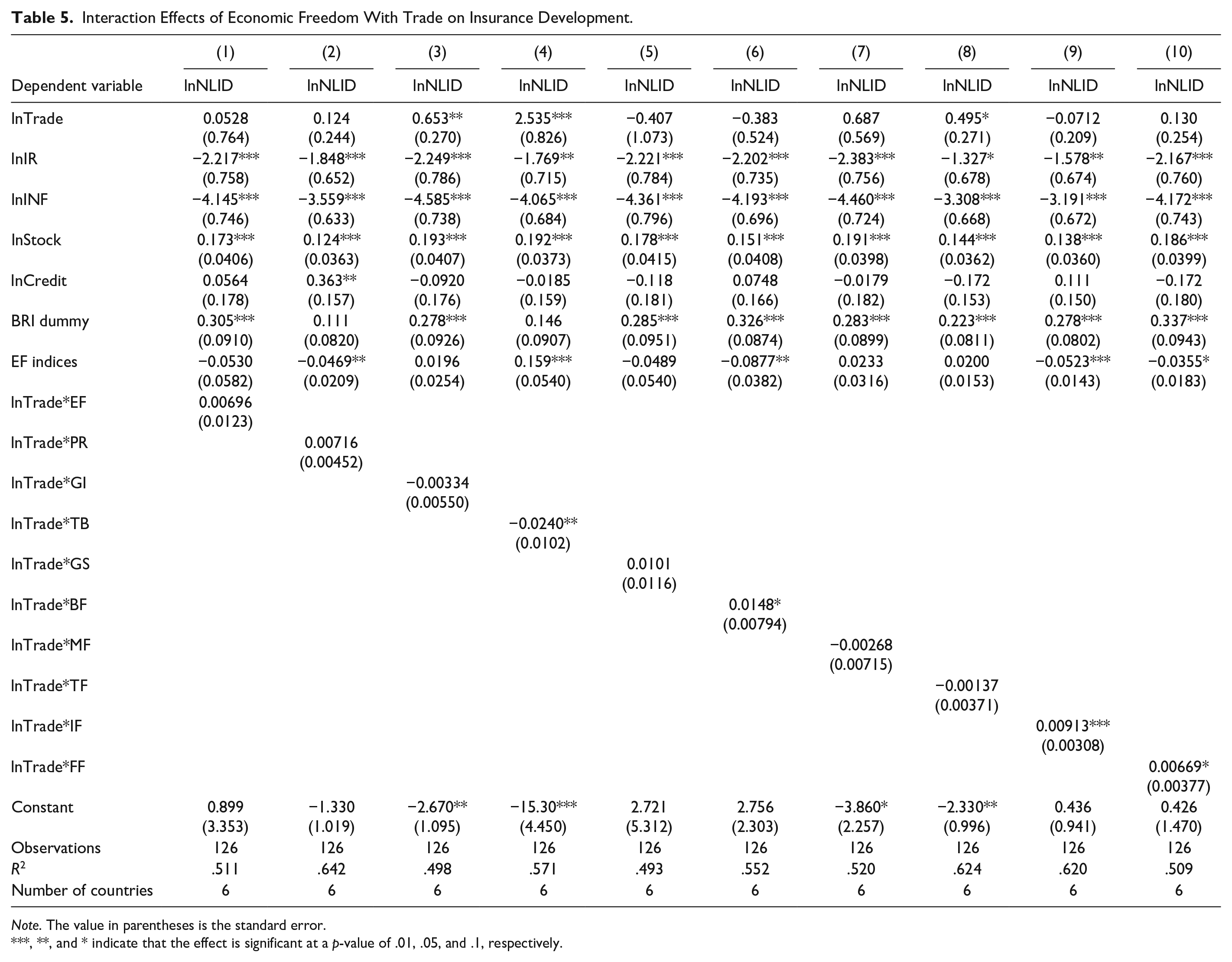
This study then proceeded to estimate equation (2) to ascertain economic freedom interactions with trade on insurance growth. Table 5 presents the results, which provide some evidence that the effect of trade on insurance development is contingent on the level of economic freedom from the following components: tax burden, business freedom, investment freedom, and financial freedom. Except for tax burden, three of these components positively interact with trade. One plausible explanation for this result could be that firms are less attracted to engage in the purchase of insurance products when they have a lower tax burden. In other words, insurance growth is benefited from trade in countries with higher business freedom, investment freedom and financial freedom. Trade that is supported by business, investment, and financial freedom requires insurance to indemnify losses that may be incurred during the process of trading. The diagnostic statistics, which are serial correlation test statistics, reveal that the residuals of the level regressions do not show autocorrelation problems, thus affirming the adequacy of the models estimated.
Interaction Effects of Economic Freedom With Trade on Insurance Development.
Note. The value in parentheses is the standard error.
**, and * indicate that the effect is significant at a p-value of .01, .05, and .1, respectively.
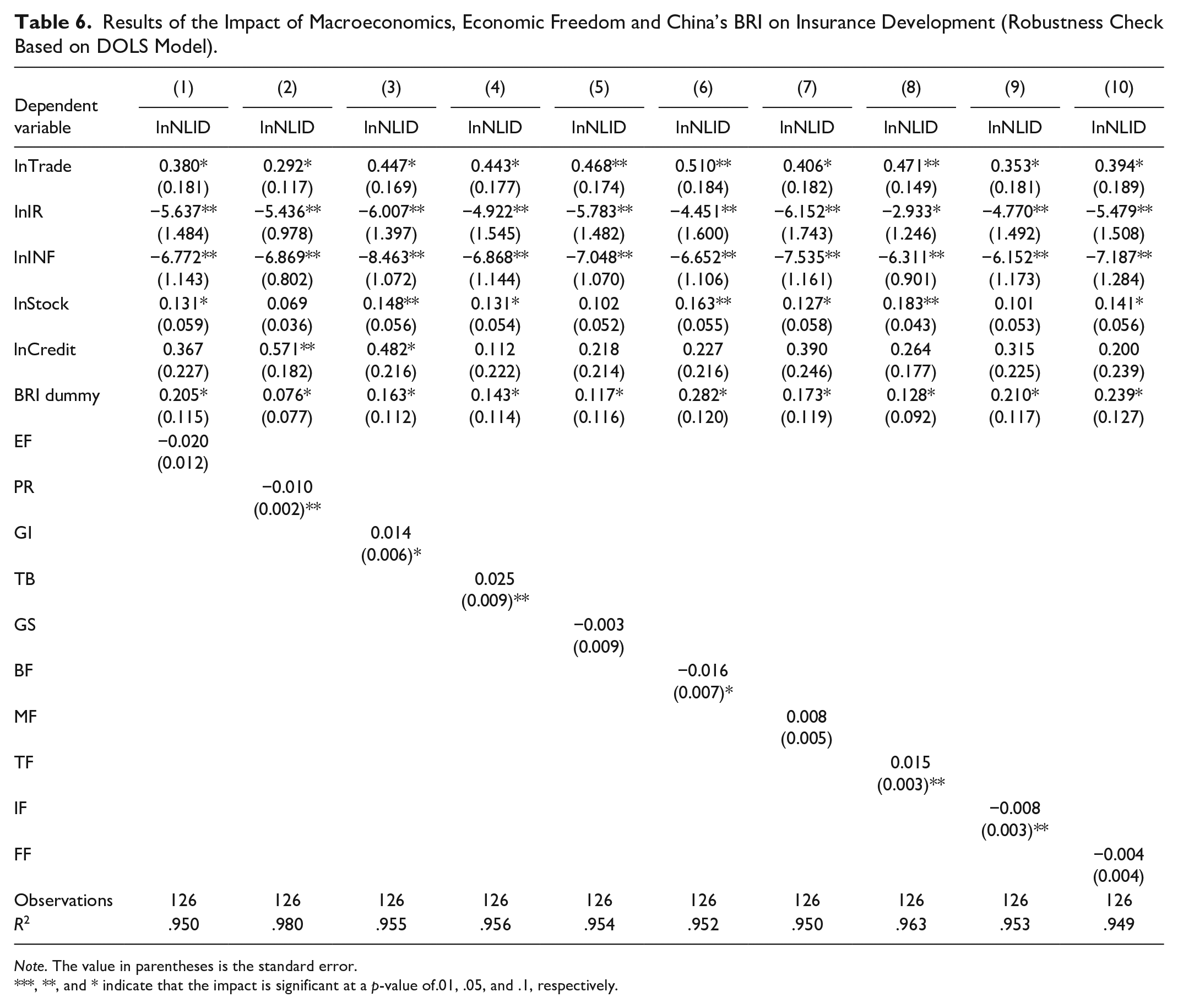
The DOLS model was also utilized as a robustness check in order to confirm the results. As regards the effects of the economic freedom components of property rights, business freedom, and investment freedom remains negative variables for insurance growth, as shown in Models 2, 6, and 9 in Table 6. It confirms that higher economic freedom hinders non-life insurance growth in ASEAN-5 and China. As for the interaction effects, investment freedom and financial freedom consistently have complementary roles in trading on non-life insurance development, as shown in Models 9 and 10 in Table 7, while trade impedes insurance growth with higher tax burden freedom.
Results of the Impact of Macroeconomics, Economic Freedom and China’s BRI on Insurance Development (Robustness Check Based on DOLS Model).
Note. The value in parentheses is the standard error.
**, and * indicate that the impact is significant at a p-value of.01, .05, and .1, respectively.
Interaction Effects of Economic Freedom With Trade on Insurance Development (Robustness Check Based on DOLS Model).

Note. The value in parentheses is the standard error.
**, and * indicate that the effect is significant at a p-value of .01, .05, and .1, respectively.
Variance by Country
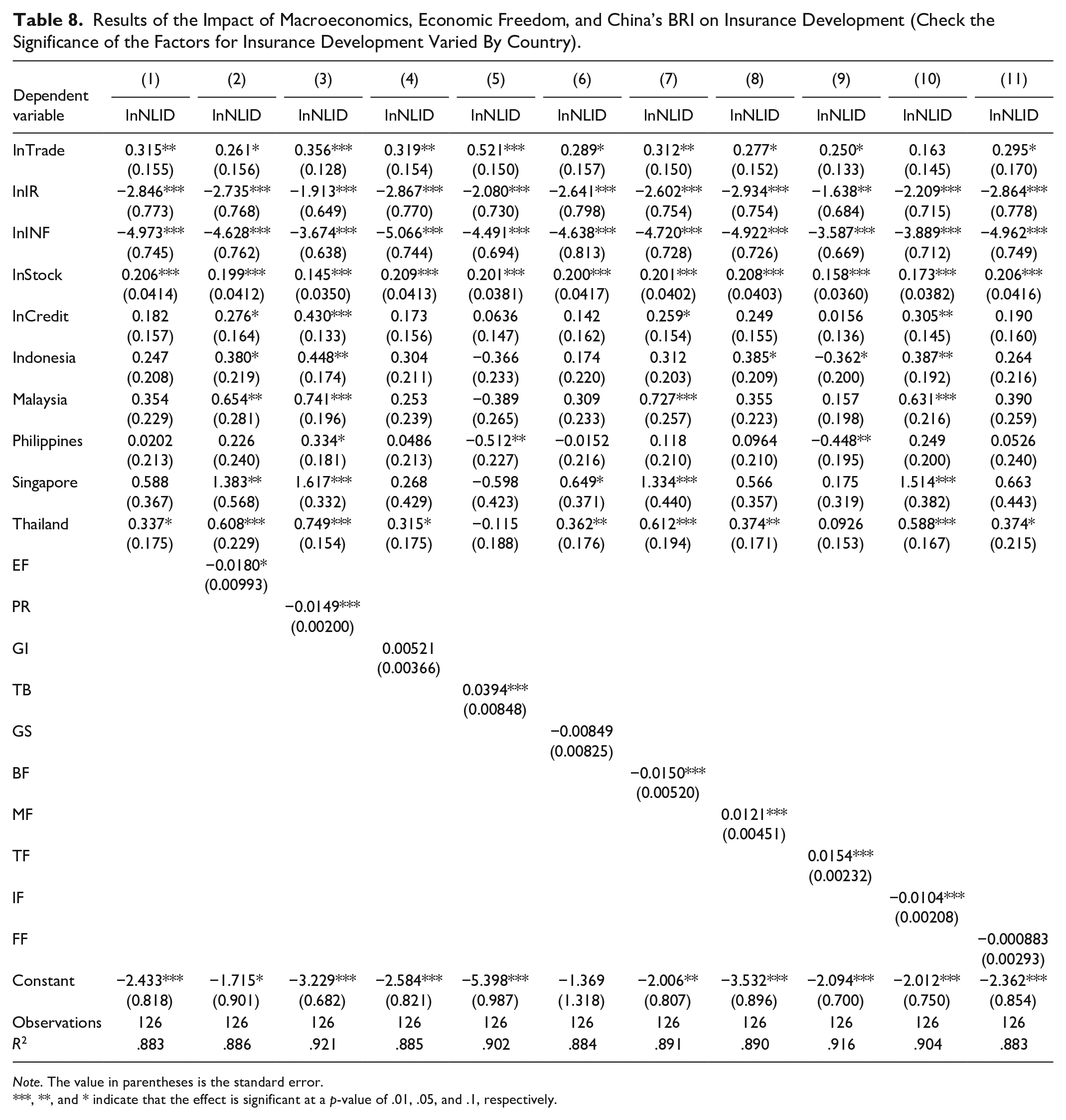
Since the panel regression pool utilized the data from six countries, this study also sought to ascertain whether these countries shared the same slope from the regression in order to gain any insights into whether the significance of the factors for insurance development varied by country. Therefore, we perform least square dummy variable (LSDV) estimation to test whether the country effect is needed in the model specification by examining whether all countries can share the same intercept.
From Table 8, it can be seen that there is some variance by country. The impacts of the macroeconomic variables and economic freedom variables do not change as compared to Table 4. However, in the case of the overall economic freedom index model and business freedom model, as depicted in Model 2 and Model 7, respectively, the results show that the impacts of these two variables on insurance development are higher in the case of Malaysia, Singapore, and Thailand compared to China, Indonesia, and the Philippines because the first three countries’ slopes in the regression are 5% statistically different from that of China. Also, the property rights and investment freedom models in Model 3 and Model 10, respectively, show that the impacts of these two freedoms are higher in Indonesia, Malaysia, Singapore, and Thailand than in China and the Philippines. Lastly, the impacts of tax burden freedom and trade freedom in the Philippines are statistically different and lower compared to the impact in the other five countries, namely China, Indonesia, Malaysia, Singapore, and Thailand. This result may imply that tax and trading activity in the Philippines is less significant in stimulating insurance development.
Results of the Impact of Macroeconomics, Economic Freedom, and China’s BRI on Insurance Development (Check the Significance of the Factors for Insurance Development Varied By Country).
Note. The value in parentheses is the standard error.
**, and * indicate that the effect is significant at a p-value of .01, .05, and .1, respectively.
Alternative Specification
As a general rule, the credibility of the results is enhanced when the main conclusions can withstand robustness analyses. Therefore, an initial screening was performed based on Cook’s distance to eliminate gross outliers. This approach is a form of robust regression because it represents a compromise between excluding these points entirely from the analysis and including all of the data points and treating all of them equally. Robust regression aims to weigh the sample differently based on how well behaved the data is. Figure 1 illustrates the outliers generated by Cook’s distance test. The lines in Figure 1 illustrate the average values of leverage and the (normalized) residuals squared. Dots to the right of the vertical line have larger-than-average residuals; dots above the horizontal line have higher-than-average leverage. The figure demonstrates there are four dots that are higher than average leverage and residuals. None of the dots fall in the upper right of the figure and we could conclude that the datasets do not have extreme outliers. To ensure that this study is robust, a set of results excluding these outliers is presented in Table 9. Generally, the results in Table 9 do not differ much from those in Table 4. Therefore it can be concluded from this alternative specification check that this study and its results are robust.
Results of the Impact of Macroeconomics, Economic Freedom, and China’s BRI on Insurance Development (Excluding Outliers).

Note. The value in parentheses is the standard error.
**, and * indicate that the impact is significant at a p-value of .01, .05, and .1, respectively.

Identification of outliers.
Since the Global Financial Development Database releases data in the year-end and once every 2 years, we also extend the data up to the year 2017. Table 10 is the replicated results and we will compare them with the baseline results in Table 4. Generally, the results remain consistent as the impacts of our variables of interest in this study, namely trade (positive), economic freedom (negative), and BRI (positive) to non-life insurance development, remain the same as in Table 4.
Results of the Impact of Macroeconomics, Economic Freedoms, and China’s BRI on Insurance Development (Robustness Check for the Updated Data Once the Global Financial Development Database Releases the Latest Data Up to the Year 2017).

Note. The value in parentheses is the standard error.
**, and * indicate that the impact is significant at a p-value of .01, .05, and .1, respectively.
Conclusion, Policy Recommendations, and Future Research Directions
Conclusion
The main aim of the BRI is to forge a positive image of the New Silk Road strategy among the international community (Chen, 2017; Du & Zhang, 2018; Huang, 2016). As this far-reaching strategy will have regional and global repercussions in future decades, it has caught the attention of the business community, governments, and academia, which are all showing an increasing interest in the potential consequences associated with its implementation. The BRI aspires to drive economic empowerment, regional cooperation, and social change. Moreover, the Chinese government has described ASEAN-5 as a significant commercial hub along the maritime Silk Road route that could play an indispensable role in expanding China’s trade with the outside world (Yu, 2017). Thus, this initiative will surely trigger a new wave of trade liberalization and economic activity, which in turn will provide opportunities for insurers in China and ASEAN-5.
Although it is widely recognized that the insurance industry makes a significant contribution to trade and development, little is known about the impact of socio-economic factors such as economic freedom on the development of the insurance sector itself. Furthermore, policymakers around the world have proclaimed their intention to improve the insurance sector’s framework to promote the overall stability of the financial sector. Hence, studies need to be undertaken to explore the role of economic freedom in driving insurance development and how it can be harnessed to build a more sustainable, robust, and sound insurance industry. In this context, this study aimed to fill a gap in the literature by examining the factors that influence non-life insurance development in ASEAN-5 and China by looking into the institutional factors from the economic freedom perspective and the traditional factors from the economic development perspective.
The findings of this study suggest that trade has a positive effect on non-life insurance development. This study also revealed that the trade resulting from the BRI in ASEAN-5 and China could boost the insurance industry’s development. Regarding the control variables, the interest rate and the inflation rate are negatively related to non-life insurance development. The outcomes identified by this study also suggest that the non-life insurance industry in China and ASEAN-5 is susceptible to interest rate risk, which is a proxy for market risk. As for the influence of institutional factors such as overall economic freedom, property rights, business freedom, and investment freedom, these all negatively influence insurance development.
This study’s empirical findings also demonstrated that economic freedom could affect insurance growth directly and indirectly through interaction with trade. Overall economic freedom is a negative and significant determinant of insurance growth, but trade is a positive and significant determinant of insurance growth. When economic freedom interacts with trade, higher economic freedom will hamper the growth of insurance stemming from trade. Thus, where there is stringent enforcement of policies and analysis of risks, this may lead to the prosperity and growth of the insurance industry that would, in turn, bolster the economic development and linkages between Southeast Asia and China.
Policy Recommendations
Thus, a key policy implication of the above findings is that the enforcement of regulations to restrict these freedoms would facilitate insurance development. These findings are in line with the statement made by the chairman of the 20th ASEAN-China Summit (2017), who welcomed the efforts being made to reinforce anti-corruption cooperation and to harmonize domestic efforts to promote good governance and the rule of law in order to strengthen the ASEAN–China strategic partnership in a wide range of economic, political-security, and socio-cultural areas.
Furthermore, government action is necessary for the citizens of a nation to defend themselves and promote the peaceful evolution of insurance and economic growth. It is because, according to the Heritage Foundation, the goal of economic freedom is not merely the absence of government constraints, but rather the formation and continuation of reciprocal wisdom of liberty for all. The results presented here will be useful to the government in these countries in helping them to modify their policies to encourage the development of trade and insurance while simultaneously providing support to realize the BRI objectives. In the longer term, the world might see a convergence in ASEAN and China’s economic development as well as the BRI strategy for China’s international commitment in trade and finance.
Future Research Directions
In closing it should be noted that although this study attempted to extract the most comprehensive and latest available data, the period covered is still relatively short, meaning that the impact of the BRI on the insurance development has only been captured for the years 2014 and 2015. Moreover, an analysis of the effects of economic freedom and spillovers on insurance growth and convergence would improve the empirical analyses and help to establish a more robust causal inference or otherwise. Nevertheless, this study provides some useful preliminary findings on the impact of the BRI on insurance development whether the effects of economic freedom and the BRI on insurance development are transitory or permanent remains to be seen and will be a topic for future research.
Footnotes
Acknowledgements
The authors appreciate the comments from Mr. Ou Kai Win and feedback from the participants of the 9th International Conference On Financial Risk And Corporate Finance Management to improve the version of this article.
Declaration of Conflicting Interests
The author(s) declared no potential conflicts of interest with respect to the research, authorship, and/or publication of this article.
Funding
The author(s) disclosed receipt of the following financial support for the research, authorship, and/or publication of this article: This research was funded by the Universiti Tunku Abdul Rahman Research Fund IPSR/RMC/UTARRF/2021-C1/L02.
