




Abstract
Autonomy-supportive teaching (AST) is widely recognised for enhancing student motivation, satisfaction, and engagement, particularly in foreign language learning contexts. However, the role of individual learner characteristics such as academic resilience (AR) in shaping these relationships remains underexplored. Grounded in Self-Determination Theory (SDT), the current study investigates academic resilience as both a mediator and moderator in the relationships between AST and key student outcomes that are learner satisfaction (LS), engagement (LE), and continuance intention (CI). Data were collected from 304 undergraduate students in India preparing for English-medium higher education. Partial Least Squares Structural Equation Modelling (PLS-SEM) was employed to analyse the data. Results confirmed that academic resilience significantly mediates the effects of AST on learner satisfaction and continuance intention, and fully mediates the indirect effect via satisfaction. However, a surprising pattern emerged in the moderation analysis, while AR positively strengthened the AST to satisfaction link, it negatively moderated the relationships between AST and both engagement and continuance intention. This suggests that highly resilient learners may derive less incremental benefit from autonomy support in terms of behavioural engagement and persistence, possibly because they are already self-sufficient. These findings challenge assumptions of universally positive effects of AST and highlight the importance of differentiated instructional strategies based on students’ resilience levels. The study contributes to SDT by integrating resilience as a dual-mechanism variable and offers practical insights for designing adaptive, resilience-informed EFL pedagogy.
Keywords
Introduction
Autonomy-supportive teaching (AST) has emerged as a pivotal pedagogical approach in modern education, grounded in Self-Determination Theory (SDT), a well-established framework that emphasises the fulfilment of three fundamental psychological needs: autonomy, competence, and relatedness (Ryan & Deci, 2001). Within this framework, AST refers to instructional practices that minimise controlling behaviours and instead promote choice, ownership, and self-direction in learning (Reeve, 2024; Reeve et al., 2020). Rather than positioning students as passive recipients of knowledge, AST encourages them to become active participants in their educational journey through decision-making, goal-setting, and reflective learning (Stefanou et al., 2004). In practice, this may involve allowing learners to select topics of personal interest, co-create assessment criteria, or regulate the pace of their study—strategies that strengthen perceptions of autonomy and intrinsic motivation. The benefits of AST are well documented across diverse educational domains. A growing body of research consistently links autonomy-supportive environments to higher levels of learner engagement, satisfaction, intrinsic motivation, and persistence (Deci, 2009; Gustavsson et al., 2016; Vasconcellos et al., 2020). Consequently, AST does more than enhance participation it creates a motivational foundation that helps students confront setbacks productively. By creating conditions that satisfy learners’ need for autonomy, competence, and relatedness, teachers help students build the confidence and adaptive coping strategies needed to sustain effort even in the face of difficulties (Ryan & Deci, 2001). Moreover, when teachers adopt controlling or directive behaviours, learners are more likely to disengage, characterised by silence, minimal participation, and compliance without commitment (Jang et al., 2010)
These dynamics are particularly salient in foreign language education, where learners are frequently confronted with cognitive overload, communication anxiety, and fear of error. Language learners often navigate linguistic insecurity, cultural distance, and high-stakes assessments, all of which elevate psychological pressure (MacIntyre & Gregersen, 2012). In such contexts, AST provides a safe space for experimentation, risk-taking, and authentic communication. When students feel empowered to make choices about content or methods of learning, they are more likely to invest emotionally and cognitively, initiate discussions, and persist through grammatical or communicative challenges (Jang et al., 2010). However, while AST can reduce academic pressures and increase motivation, it alone may not be sufficient to ensure positive outcomes for all learners. The success of autonomy-supportive practices may depend heavily on individual learner characteristics, particularly their capacity for academic resilience. Academic resilience is defined as the psychological capacity to adapt, recover, and thrive despite adversity (Cassidy, 2016). It is not a static trait but a dynamic process shaped by the interplay between individual dispositions and environmental supports (Patall et al., 2018). Resilient learners demonstrate perseverance, emotional regulation, and a growth mindset, enabling them to reframe setbacks as opportunities for growth rather than reasons to withdraw (Yeager & Dweck, 2012). In contrast, less resilient learners may perceive autonomy as overwhelming or unstructured, particularly in high-pressure contexts such as language classrooms (Ang et al., 2022). This highlights resilience’s role as a protective mechanism, while AST establishes external conditions for motivation, resilience influences how learners internalise and act upon those conditions. Students frequently encounter setbacks such as poor grades, misunderstanding of material, or social and institutional pressures that can lead to demotivation and disengagement (Skinner et al., 2014). By persisting through adversity instead of surrendering to it, resilient students transform routine difficulties into meaningful opportunities for growth (Amotz et al., 2022; Freiberg-Hoffmann et al., 2024). In this way, resilience not only mitigates vulnerability to disengagement but actively supports learners’ willingness to persevere in the face of ongoing challenges.
This interplay is particularly relevant in English as a Foreign Language (EFL) education, where linguistic insecurity and fear of failure are widespread. Research demonstrates that resilient language learners report lower anxiety and greater willingness to communicate, enabling them to take risks and learn from mistakes (MacIntyre & Gregersen, 2012). Such learners exemplify the phenomenon of “beating the odds,” achieving academic success despite systemic challenges such as poverty, discrimination, or unstable home environments (Howard & Johnson, 2004; Maldonado & Morales, 2020). By contrast, students with low resilience may withdraw or disengage despite the presence of autonomy-supportive teaching, underscoring the necessity of integrating both constructs into pedagogical research. This leads to an important theoretical proposition, academic resilience may serve a dual role in the AST process, functioning as both a mediator and a moderator. As a mediator, resilience explains how AST influences academic outcomes. According to SDT, when teachers support autonomy, learners experience greater psychological need satisfaction, which strengthens their belief in their ability to overcome challenges. This, in turn, fosters adaptive coping strategies such as goal-setting, help-seeking, and persistence, which sustain motivation despite adversity (Cassidy, 2016). As a moderator, resilience determines for whom and under what conditions AST is most effective. The differential susceptibility hypothesis suggests that individuals vary in their responsiveness to environmental influences depending on intrinsic traits (Assary et al., 2023). Resilient learners, equipped with emotional regulation and growth mindsets, are more likely to leverage autonomy-supportive strategies effectively, thereby amplifying their benefits (Pishghadam et al., 2023).
Despite these insights, prior research has rarely examined academic resilience as both a mediator and moderator in the relationship between AST and student outcomes. Most studies treat AST and resilience as independent constructs, overlooking the complex ways in which they interact. This leaves critical questions unanswered: Does resilience transmit the benefits of AST, or does it amplify them under specific conditions? Could resilience even weaken the impact of AST for highly self-regulated learners? The present study addresses this gap by investigating academic resilience as both a mediator and a moderator in the relationship between AST and three key student outcomes: satisfaction, engagement, and continuance intention. Situated within the context of EFL education in India, where students prepare for higher education in English-speaking countries, this study examines how pedagogical practices and learner characteristics interact to shape motivation and persistence. By analysing resilience as a dual-mechanism variable, the research extends theoretical understanding of SDT and AST while offering practical insights into how educators can combine autonomy-supportive practices with resilience-building interventions such as mindset training or reflective journaling (Yeager & Dweck, 2012). The study contributes to a more nuanced perspective on learner motivation, highlighting resilience’s complementary role in shaping the efficacy of autonomy-supportive teaching environments.
Theoretical Framework, Literature Review and Hypothesis Development
Self-Determination Theory and AST
Self-determination theory (SDT), a theory of human motivation, posits that individuals thrive when their psychological needs for autonomy, competence, and relatedness are fulfilled (Ryan & Deci, 2001). Within educational contexts, SDT underscores the importance of autonomous support teaching (AST), an instructional approach that prioritises students’ intrinsic motivation by fostering choice, relevance, and self-directed learning (Reeve et al., 2020). AST aligns with SDT by designing environments where educators minimise controlling behaviours (e.g., rigid deadlines, punitive feedback) and instead encourage curiosity, collaboration, and ownership of learning goals (Ryan & Deci, 2020). For instance, in foreign language classrooms, AST might involve allowing students to select culturally relevant topics for projects or co-creating assessment criteria, enhancing their sense of agency and investment (Vansteenkiste et al., 2004). Empirical studies demonstrate that AST enhances academic outcomes such as engagement, persistence, and satisfaction, as it satisfies students’ innate psychological needs (Jang et al., 2010). However, SDT also acknowledges individual differences in how students internalise extrinsic support. While AST provides the external conditions for motivation, its efficacy may depend on intrinsic factors such as students’ resilience, which influences their capacity to leverage autonomy for overcoming challenges (Amotz et al., 2022). This framework positions AST as both a catalyst for nurturing motivation and a variable whose impact is mediated or moderated by learner traits, thereby establishing a theoretical basis for examining resilience’s role in optimising AST’s benefits. In line with COR theory (Hobfoll, 2002), resilience is conceptualised both as a process through which resources are mobilised (mediation role) and as a capacity that buffers against stressors (moderation role). This dual conceptualisation has been widely recognised in resilience scholarship (Fletcher & Sarkar, 2013). Thus, resilience may simultaneously explain how autonomy-supportive teaching exerts its effects and when its effects are amplified or diminished.”
Mediation by Academic Resilience Between AST, Learner Satisfaction and Continuance Intention
Drawing on Conservation of Resources (COR) theory (Hobfoll, 2002), resilience can be understood as a dynamic process through which individuals mobilise psychological and social resources to cope with academic demands. Within this framework, autonomy-supportive teaching fosters the development of resilience by equipping learners with the motivational and cognitive resources necessary to manage challenges more effectively. In turn, this heightened resilience facilitates greater engagement, satisfaction, and continuance intention. Consistent with prior resilience scholarship (Ang et al., 2022; Fletcher & Sarkar, 2013). Resilience therefore functions as a transmission mechanism that explains how autonomy-supportive teaching exerts its influence on student outcomes. This transmission mechanism referred in SEM to mediation occurs when a mediator (academic resilience) explains part of the relationship between an independent variable (AST) and dependent variables (satisfaction/engagement), while the direct effect of AST remains significant (Zhao & Baharom, 2024). Within the English as a foreign language (EFL) context, AST fosters psychological need satisfaction (autonomy, competence, relatedness), which cultivates resilience by empowering learners to reframe challenges as opportunities for growth (Ryan & Deci, 2020). Resilient students, in turn, exhibit greater persistence in navigating language barriers (e.g., complex grammar and pronunciation difficulties) and proactively seek feedback, thereby deepening their engagement and satisfaction (MacIntyre & Khajavy, 2021). Further Namaziandost et al. (2023) found that EFL learners with higher resilience reported greater engagement in autonomy-supportive classrooms than peers with lower resilience, as they internalised teacher support into self-regulated learning strategies. Academic resilience does not merely transmit AST’s influence but amplifies it: learners who perceive teaching practices as autonomy-supportive develop stronger coping mechanisms, which sustain motivation during setbacks (e.g., failed language proficiency tests) and reinforce satisfaction through mastery experiences (Wang & Derakhshan, 2023). This dual pathway underscores resilience’s role as both a conduit and enhancer of AST’s benefits, suggesting that interventions targeting resilience-building (e.g., reflective journaling, mindset training) could synergise with AST to maximise EFL outcomes (Reeve et al., 2020). Based on these findings, we can further the research by hypothesising the following relationship.
Moderation by Academic Resilience Between AST, EFL Learner Satisfaction and Engagement
Moderation occurs when a variable (academic resilience) alters the effect of an independent variable (AST) on dependent variables (satisfaction/engagement), creating conditional outcomes (Hayes, 2018). Specifically, resilient EFL learners, who possess traits such as a growth mindset, emotional regulation, and adaptive help-seeking behaviours (Yeager & Dweck, 2012), are better equipped to translate autonomy-supportive practices into sustained motivation and positive emotional experiences. For example, in AST-driven classrooms, resilient learners may perceive teacher flexibility (e.g., self-paced tasks) as empowering opportunities to experiment with language structures, amplifying engagement (Pishghadam et al., 2023). Empirical studies corroborate this moderating role where resilience had a moderating role in reducing stress (Choi et al., 2023). These findings align with the risk-buffering hypothesis, which posits that resilience mitigates the adverse effects of challenges by enhancing learners’ capacity to leverage supportive environments (Masten et al., 2021). For instance, resilient EFL learners in AST contexts are more likely to persist through pronunciation errors or cultural misunderstandings, viewing them as growth opportunities rather than failures (Amotz et al., 2022). Based on this discussion, we postulate the following hypothesis.
Moderation by Academic Resilience Between AST and Continuance Intention
In addition to its role as a mediating process, resilience is also recognised as a buffering capacity that alters the strength of stressor–outcome relationships (Connor & Davidson, 2003). Within this view, resilience functions as a protective factor that shapes how strongly autonomy-supportive teaching predicts student outcomes, consistent with the stress-buffering model widely discussed in resilience research (Masten et al., 2021). To provide a coherent framework for this dual conceptualisation, we draw on the Process Model of Self-Regulation (Carver & Scheier, 1998), which allows resilience to be understood both as a self-regulatory process that explains how autonomy-supportive teaching fosters adaptive learning engagement (mediation) and as a personal capacity that conditions the extent to which autonomy-supportive teaching yields positive effects.
Students with higher resilience exhibit traits like perseverance, growth mindset, and emotional regulation (Yeager & Dweck, 2012), are better positioned to translate AST’s emphasis on autonomy, competence, and relatedness (Ryan & Deci, 2020). As an example, in AST-driven environments, resilient learners may interpret teacher flexibility (e.g., student-led group projects) as opportunities to exercise leadership and responsibility, thereby reinforcing positive conduct (Wang & Derakhshan, 2023). While resilience may operate as a process through which autonomy-supportive teaching influences outcomes, it can also be regarded as a pre-existing capacity that alters the impact of autonomy support. From the standpoint of COR theory (Hobfoll, 2002), students differ in the personal resources they bring to academic settings. Those with higher resilience are better positioned to benefit from the autonomy and encouragement provided by their instructors, which should strengthen the effects of autonomy-supportive teaching on engagement, satisfaction, and continuance intention. In contrast, students with lower resilience may lack the adaptive capacity to fully respond to autonomy-supportive practices, leading to weaker effects. This conditional role of resilience aligns with research that describes resilience as a protective factor that moderates the influence of environmental demands on individual outcomes (Fletcher & Sarkar, 2013). Therefore, students with lower resilience may perceive the same autonomy as unstructured or overwhelming, leading to disengagement or disruptive behaviours, particularly in high-pressure academic settings (Jang et al., 2010). Choi et al. (2023) demonstrated that resilience moderated the effect of AST on stress handling, with resilient learners exhibiting a greater propensity to resolve peer disputes constructively in autonomy-supportive classrooms. This aligns with the differential susceptibility hypothesis, which posits that individuals vary in their responsiveness to environmental influences based on intrinsic traits (Assary et al., 2023). Resilient students, for example, leverage AST’s emphasis on self-direction to internalise school norms as personal values, fostering intrinsic motivation for positive behaviour (Yeager & Dweck, 2012). Based on this discussion, we postulate the following hypothesis.
We develop the following model based on the preceding hypothesis developments and literature review (Figure 1).

Conceptual model.
Research Design and Methodology
Sample Design
This study employed Structural Equation Modelling (SEM) to model the relationships; therefore, initial sample size considerations were required for the SEM study. Researchers refer to traditional rules of thumb, such as the guideline suggesting a sample size 10 times the number of formative indicators in the most complex construct (Bentler & Chou, 1987; Hoelter, 1983). However, this heuristic has been widely critiqued for its oversimplification and potential to yield underpowered studies (MacCallum et al., 1996; Wolf et al., 2013). Consequently, to ensure robust statistical power and more precise parameter estimates, we adopted a more rigorous approach to sample size determination. We employed a priori power analysis in G-star power, setting the significance level (α) at .05 (corresponding to a 95% confidence level) and statistical power (1−β) at .95 (with β, the Type II error rate, at .05; Cohen, 2016). The analysis yielded a sample size of 194. We further used Kock and Hadaya’s (2018) inverse square method. It operates on the principle that the standard error of path coefficient estimates is inversely proportional to the square root of the sample size; the method calculates the sample size where this precision becomes adequate to identify the targeted effects. The inverse analysis yielded a sample size of 233. This sample size was deemed adequate to detect the hypothesised effects within our model with sufficient statistical power (Hair et al., 2019).
Data Collection and Research Instrument
To overcome potential researcher bias and ensure the objectivity of responses, the data for this study were collected in India via peer collaborations. The data collection was undertaken at an Indian university among students taking English classes for Higher study entrance examinations. We developed a structured questionnaire using validated multi-item scales from prior studies to test our hypotheses. We measured Autonomy-Supportive Teaching (AST), Academic Resilience (AR), Learner Engagement (LE), Learner Satisfaction (LS), and Continuance Intention (CI). We adapted the AST scale from Standage et al. (2005), which was reworded by Chen and Adesope (2016) for the English learning context. The learning engagement scale was adopted from (Eerdemutu et al., 2024). For AR, we used the scale by Cassidy (2016). The learner satisfaction scale was adopted from, and the CI scale was adopted from Zhang et al. (2018) with minor adaptations to fit the EFL context. Participants rated each item on a 7-point Likert scale (1 = Strongly Disagree to 7 = Strongly Agree). We sent out the survey instrument in the form of a Google form to our peers in India and instructed them to guide their students in filling in the data, making sure they understand each statement. We received a total of 353 responses, out of which 49 were identified as straight-lining cases and subsequently removed, resulting in a final sample of 304 valid responses. Straight-lining was defined as instances where respondents provided identical ratings across more than 80% of the items, indicating a lack of attention or engagement with the questionnaire (Hair et al., 2019). This approach aligns with established practices for identifying careless responding in online survey research. Each flagged case was verified manually to ensure that removal was based on consistent response patterns rather than genuine uniform perceptions. The remaining 304 cases exceeded the minimum required sample size and were sufficient to provide robust statistical power for hypothesis testing. The survey instrument was distributed by instructors directly to students during class sessions, and responses were collected in the presence of the instructor. This procedure ensured that only the targeted cohort of English preparatory students participated, eliminating the risk of uncontrolled snowballing and confirming that responses stemmed solely from the intended population. We have revised the methodology section to make this process explicit for readers.
Data Analysis
We used a multi-variate quantitative technique to analyse our data in the form of partial least squared- Structural equation modelling (PLS-SEM) by using the R package SeminR (Hair Jr et al., 2021). But firstly, we had to determine how the participants weighed on the academic resilience scale, that is, we needed to identify if the students who participated in our survey thought of themselves as resilient. To understand that we took the mean of the responses we received for academic resilience, which was at 5.43, this meant that the students did not think of them to be highly resilient and neither too low, and we formulated our hypothesis accordingly. The mean of the AST perceptions was at 4.35, which meant the students did not think of their environment to be highly autonomous, presenting a very interesting case for us to add other dimensions to the previous literature. Although our hypothesis does not pinpoint the effect, we expect to have significant mediation and moderation. There is a two-stage approach in PLS-SEM, where we first study the measurement model to establish the reliability and validity of our constructs and then the measurement model that uses Bootstrap to find the relationships between our constructs. We first studied the measurement model, and then we followed it with a structural analysis based on partial least squares, as it can fit data to formulate a new theory. Our paper is an interesting step in advancing the theory of academic resilience by examining its mediatory and moderator roles.
Common Method Bias
To examine the possibility of common method variance (CMV), Harman’s single-factor test was performed using the psych package in R. This diagnostic approach assesses whether a single latent factor can account for the majority of variance among the measured items, which would indicate potential bias arising from the measurement method itself rather than from the constructs being studied (Podsakoff et al., 2024). The analysis was executed using the fa() function with the argument nfactors = 1 and rotate = “none.” The specification of one factor allows all observed variables to load on a single latent dimension, while the absence of rotation ensures that the variance is not redistributed across multiple dimensions. This unrotated solution preserves the natural loading structure and provides an accurate estimate of the total variance attributable to one general factor. Upon computation, the first unrotated factor explained 34.1% of the total variance. Since this proportion is well below the commonly accepted threshold of 50%, it can be inferred that common method bias does not pose a significant threat to the integrity of the data. In other words, the covariance among the variables is not dominated by a single underlying source of measurement, indicating that the responses reflect meaningful construct-level variation rather than artefacts of the measurement procedure. Thus, based on Harman’s single-factor test, the dataset demonstrates acceptable levels of method independence, supporting the reliability of subsequent analyses that build upon these measures.
Measurement Model
Indicator reliability was evaluated through the outer loadings of the items on their respective constructs. Most item loadings exceeded the commonly recommended threshold of 0.708 (Hair Jr et al., 2021). Specifically, for construct AST, loadings ranged from 0.612 (a5) to 0.780 (a1); for AR, from 0.516 (r5) to 0.756 (r1); for LS, from 0.739 (s2) to 0.926 (s4); for LE, from 0.733 (en2) to 0.831 (en3); and for CI, from 0.764 (c3) to 0.828 (c1). While some items for AST from the Academic Resilience Scale (r2 and r5) and two items from the Autonomy-Supportive Teaching Scale exhibited loadings below the 0.66 threshold. While such values may raise concerns, it is important to note that thresholds for item retention in PLS-SEM are not strict cutoffs. As (Hair et al., 2019) emphasise, items with loadings between 0.40 and 0.70 may be retained if their exclusion does not lead to a substantial improvement in reliability indices namely composite reliability (CR) and average variance extracted (AVE) and if they capture theoretically essential content. In the present study, both conditions were satisfied: the removal of these items did not produce a meaningful increase in CR or AVE, and the items in question reflected important dimensions of academic resilience and autonomy-supportive teaching that would otherwise have been underrepresented. Retaining these indicators was therefore justified to preserve theoretical coverage while maintaining acceptable psychometric quality.
Internal consistency reliability was assessed using Cronbach’s alpha, composite reliability (rhoC), and Dillon-Goldstein’s rho (rhoA). Cronbach’s alpha values for most constructs were above the generally accepted threshold of .70 (Hair et al., 2019; Nunnally & Bernstein, 1994) ranging from .673 (LE) to .908 (LS). The construct LE (α = .673) showed a Cronbach’s alpha slightly below .70, which can be acceptable in exploratory stages (Hair et al., 2019). All constructs exhibited strong composite reliability (rhoC), with values ranging from .788 (AR) to .932 (LS), well above the recommended .70 thresholds (Fornell, 1992; Hair et al., 2019). Similarly, rhoA values were generally robust, ranging from .681 (LE) to .921 (LS), also supporting construct reliability, with most values meeting or exceeding the .70 guideline (Hair et al., 2019); LE (rhoA = .681) was marginally below the threshold. The validity and reliability findings are presented elaboratively in Table 1.
Indicator Reliability and Validity.

Note. AST = Autonomous Supportive teaching; AR = Academic Resilience; LS = Learner Satisfaction; LE = Learner Engagement; CI = Continuance intention.
Discriminant Analysis
In PLS-SEM, discriminant validity refers to the extent to which a construct (or latent variable) is truly distinct from other constructs in your model. Essentially, it’s about ensuring that your measures for different concepts are not so highly correlated that they are practically measuring the same underlying thing. There are two methods to measure discriminant validity: the first one is the Fornell and Larcker Criterion, and the second one is the Heterotrait-Monotrait ratio of correlations (HTMT) criterion, with the latter gaining prominence over the former. We employed HTMT criteria and found our discriminant validity with values below the prescribed range of <0.85 (Henseler et al., 2015). A detailed account of discriminant validity is given in Table 2.
HTMT Criterion for Discriminant Validity.

Note. AST = Autonomous Supportive teaching; AR = Academic Resilience; LS = Learner Satisfaction; LE = Learner Engagement; CI = Continuance intention.
Structural Model
To validate our structural model, we used the 5,000 bootstrapped samples procedure, achieving acceptable significance levels (p < .05) in most cases. All our relationships were significant except LE → CI which yielded an insignificant negative relationship. The findings have been presented visually in Figure 2.
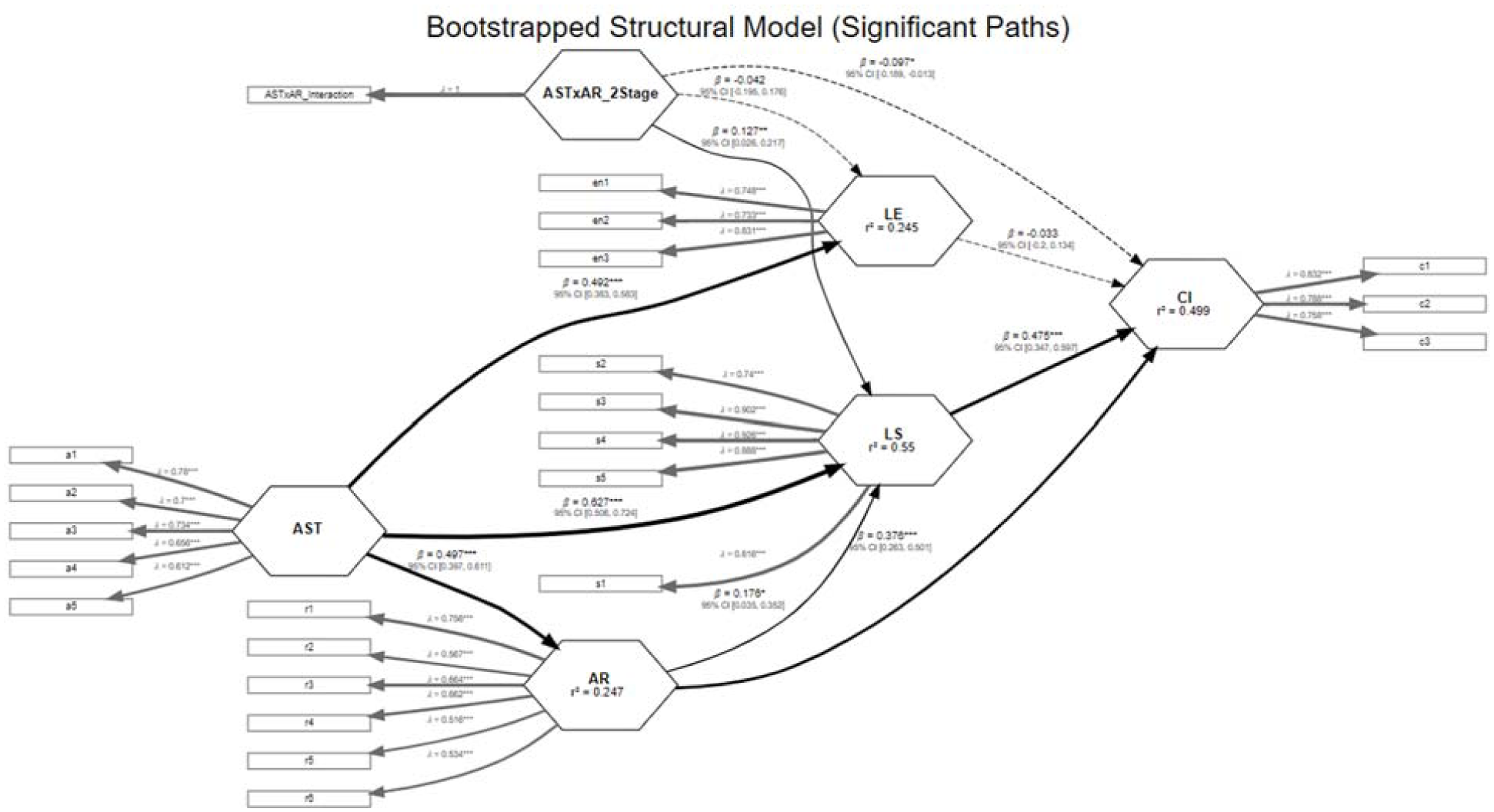
Structural model depicting the relationships between hypothesised models.
The detailed analysis of results is given in Table 3
Results of Path Models With Values of Significance.

Model Predictive Validity (R2 and Q2)
In addition to path significance testing, the explanatory and predictive quality of the model was assessed using R2 and Stone–Geisser’s Q2 values. R2 indicates the proportion of variance explained in the endogenous constructs, while Q2 assesses the predictive relevance of the model through a blindfolding-based cross-validation procedure (Hair et al., 2019). The results indicate that all three endogenous constructs demonstrated moderate levels of variance explained (R2 between .41 and .50) according to Hair et al. (2019). Furthermore, the positive Q2 values across all constructs confirm the predictive relevance of the model (Chin, 1998). Continuance intention (CI) showed the highest predictive relevance (Q2 = 0.478), suggesting that the model is especially effective in forecasting students’ persistence in language learning contexts. Collectively, these values provide strong evidence of the model’s robustness and its applicability in explaining and predicting learner outcomes within autonomy-supportive teaching environments. The results have elaboratively given in Table 4.
R 2 and Q2 Values for Model and Fit and Prediction Power.

Mediation by Academic Resilience
The mediation effect in our analysis yielded interesting results, where almost every relationship was weakened by the mediatory intervention of Academic Resilience. This supports our hypothesis where we posited high resilience to strengthen the relationships and low resilience to weaken them. Since our participants did not exhibit high resilience scores, the weakening effect is in agreement with our proposed hypothesis. The bootstrapped indirect effect of resilience between AST and CI was significant. Importantly, the direct effect of AST on CI also remained significant, indicating that resilience partially, mediated this relationship. Thus, we observed a slight weakening effect due to AR mediation, which can be understood by comparing the direct and mediation relationships from Tables 3 and 5. The weakening effects have also been visually depicted in Figure 3.
Mediation Results.

Note. Asterisks indicate bootstrap-based statistical significance of the path coefficients (two-tailed): *p < .05, **p < .01, ***p < .001.
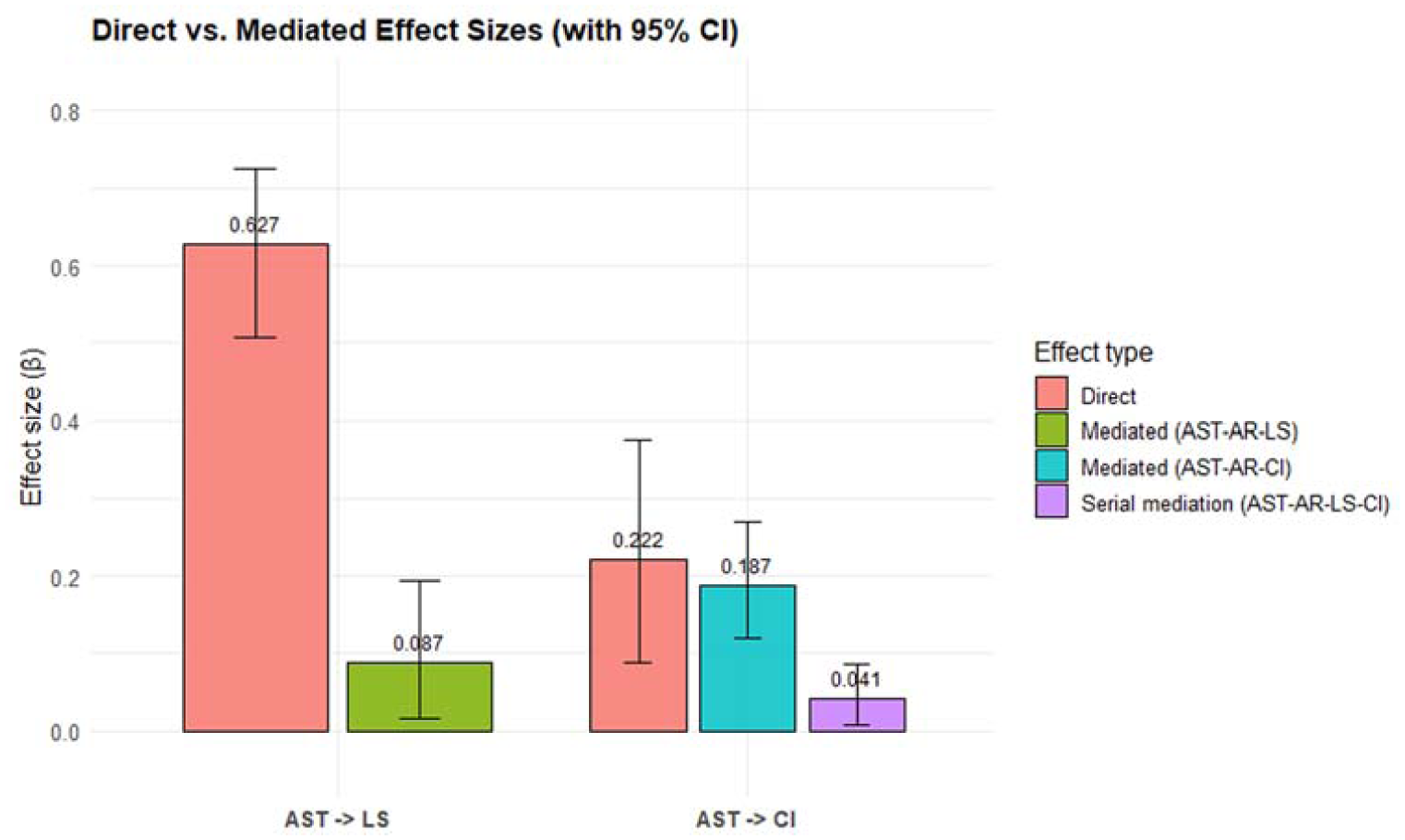
Comparison of direct and mediation relationships showing how resilience might be counterproductive in certain contexts.
Moderation Analysis
The moderation analysis was conducted using interaction moderation (Hair Jr et al., 2021). The analysis was undertaken to understand the role of academic resilience as a moderator in the relationships between AST, learner engagement, satisfaction and continuance intention. In moderation analysis, these levels of AR are represented at the mean (average resilience, or 0 SD), and at points one standard deviation above (+1 SD) and below (−1 SD) the mean. +1 signifies a high level of academic resilience, which is characteristic of students well above the average in this trait, while −1 SD indicates a low level, representing students below the average (Hair et al., 2021; Rasoolimanesh et al., 2021). We examined three moderations by Academic resilience, the first one was the moderation by academic resilience between AST and learner satisfaction.
The plot for Learner Satisfaction (LS) reveals a positive moderation by AR; this means that while AST generally boosts satisfaction, this positive effect is significantly amplified for students with high AR (+1 SD). They derive the most significant increase in satisfaction from more autonomy-supportive teaching environments compared to their peers with average or low (−1 SD) resilience. The analysis revealed positive moderation by AR in the relationship between AST and Learner Satisfaction (LS). Students with high resilience (+1 SD) experienced significantly greater satisfaction when exposed to autonomy-supportive teaching than their peers with average or low resilience. This suggests that AR amplifies the beneficial effects of AST on LS. Resilient learners, characterised by emotional regulation, perseverance, and a growth mindset, likely interpret autonomy and choice as affirmations of their competence and agency, deriving deeper satisfaction from learning environments that empower them (Figure 4).

Moderation by AR between AST and learner satisfaction.
However, the influence of AR becomes more complex and counterintuitive when examining Continuance Intention (CI) and Learner Engagement (LE). For CI, AR negatively moderates the AST-outcome relationship strikingly: as AST increases, students with high academic resilience (+1 SD) show a decrease in their intention to continue. This directly contrasts students with low AR (−1 SD), whose continuance intention increase with increased AST. A similar pattern of negative moderation is indicated for Learner Engagement (LE). This suggests that for highly resilient students (the +1 SD group), the typically positive impact of AST on engagement is either diminished or manifests differently, not yielding the same degree of benefit seen in students with lower or average levels of resilience. These counterintuitive findings can be attributed to a lower resilience score of our sample, which, as described in earlier sections, clocked at 4.35. The mean scores of the rest of the constructs were higher on the Likert scale. These findings are well aligned with the previous literature, where high resilience would moderate the relationships with positive attitudes positively (Amotz et al., 2022). Since our data scored lower on resilience, we noticed the negative moderation. These findings add new dimensions to the existing literature, strengthening it with new data. Further several contextual and theoretical factors may also account for the observed negative moderation. First, consistent with the over-autonomy or substitution effect (Wielenga-Meijer et al., 2010), even highly resilient students may already possess strong self-regulatory skills and therefore experience diminishing marginal gains from additional autonomy support. For such learners, further autonomy cues can appear redundant, producing weaker engagement and continuance responses. Second, the cultural and pedagogical context of the present study may influence how autonomy is interpreted. In Indian higher-education environments, students are accustomed to structured, teacher-directed instruction; hence, autonomy-supportive practices might be perceived by highly resilient students as reduced guidance or instructor detachment. Prior cross-cultural studies (Jang et al., 2010; Pishghadam et al., 2023) similarly show that autonomy is not uniformly valued across contexts, particularly where collectivist classroom norms prevail. Third, from a self-regulation perspective (Carver & Scheier, 1998), resilient learners may engage in adaptive disengagement strategically reducing reliance on external scaffolds to preserve cognitive resources for self-initiated regulation. Thus, lower engagement or continuance intention among high-resilience students does not necessarily indicate demotivation but may reflect their preference for independent regulation. Together, these interpretations situate the negative moderation within broader theoretical and cultural frameworks, offering a richer explanation than statistical variance alone (Figures 5 and 6).
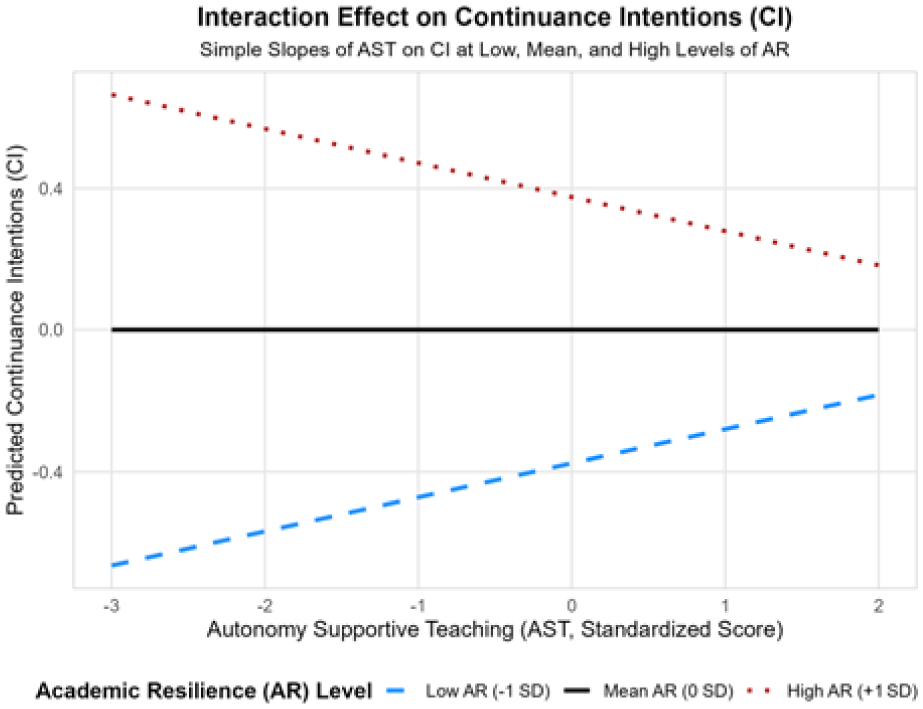
Moderation by AR between AST and continuance intention.

Moderation by AR between AST and learner engagement.
In summary, the moderation analysis uncovered a multifaceted relationship between academic resilience and the impact of autonomy-supportive teaching. While AR significantly enhances learner satisfaction under AST, it concurrently attenuates engagement and continuance intention for the most resilient learners. These findings underscore the need for differentiated pedagogical strategies: while structured autonomy and scaffolding may benefit learners with lower resilience, highly resilient students may thrive better under open, inquiry-driven, and self-paced learning models that offer deeper levels of challenge and freedom.
Further, Resilience (M = 5.54, SD = 0.97) was probed as a moderator at ±1 SD from the mean. Although the −1 SD group represents lower resilience, it still comprised 40 participants (17% of the sample), which provides adequate observations for slope estimation. To test robustness, we further probed at the 16th, 50th, and 84th percentiles and applied Johnson–Neyman analysis. Both approaches reproduced the interaction pattern, with the J–N test indicating that the AST → CI slope remains significant across the full observed range of resilience (see Figure 7). These results strengthen confidence that the moderation effect is not driven by distributional artefacts.

Johnson–Neyman plot showing that the effect of AST on CI remains significant across the full range of resilience.
Discussion and Implications
The primary objectives of this study were to understand the effects of academic resilience as a mediator and a moderator in AST environments and its impact on students. This study examined how autonomy-supportive teaching (AST) interacts with academic resilience (AR) to influence key educational outcomes in foreign language learning contexts. Drawing on the theoretical foundations of Self-Determination Theory (SDT), we explored the moderator and mediatory role of academic resilience on the relationships between AST, learning engagement and satisfaction. Firstly, we investigated the mediation results of our study. We examined the relationship between academic resilience between AST and learner satisfaction, engagement and continuance intention. Previous literature in the comprehensive meta-analysis by Mammadov and Schroeder (2023)reveals a consistent, positive association between autonomy support and a range of positive learning outcomes, strongly indicating that environments nurturing student autonomy are pivotal in building academic resilience. The strong links observed with autonomous motivation and behavioural engagement) suggest that autonomy-supportive practices directly equip students with the intrinsic drive and active participation crucial for navigating and overcoming academic challenges, which are core facets of resilience. However, these studies need more context and additional roles played by resilience. Our mean of 4.35 of combined AST factors does not scale very high on the 7-point scale, which is why the seeming anomalies in our results perfectly complement the previous findings, if the students perceive the environment as low on autonomy, the resulting relationships with other behavioural constructs are not very high and this is what we observe in both our mediation and moderation results. We see resilience weakening all three direct mediations in our study, as depicted by Mammadov and Schroeder (2023); lower AST environments in our context lead to lower resilience. The same phenomenon was noticed in the moderation relationship, where the only positive moderation was seen in the case of AST, learner satisfaction mediation by resilience. The other moderations were negative, which is a result of lower AST scores. Our study adds dimensionality to existing literature, especially in the peculiarity of our dataset, where AST was low compared to studies in the previous literature, where AST scores were high. The three analyses make the interaction of resilience in AST environments clear. Our direct paths were positive, which were weakened by resilience as the students did not perceive the environment to be adequately autonomous. Similar findings were observed in moderation analyses. Our research adds profound impetus to existing literature, where most of the studies have been conducted in high AST environments.
Theoretical Implications
This study’s theoretical implications significantly improve our understanding of the relationship between AST environments and student psychological traits, particularly emphasising the crucial role of academic resilience in the framework of autonomy-supportive teaching (AST). Our non-significant LE → CI path aligns with prior meta-analyses showing only a small behavioural-engagement effect on persistence (Mammadov & Avci, 2025; Mammadov & Schroeder, 2023; Vasconcellos et al., 2020). This convergence suggests that continuance intention is shaped more strongly by proximal predictors such as satisfaction and resilience, rather than engagement alone. Engagement appears to have only a weak influence on continuance intention, suggesting that satisfaction and resilience may act as more proximal predictors. The counterintuitive moderation whereby resilience weakens AST → CI may be explained by the over-autonomy effect (Wielenga-Meijer et al., 2010). Highly resilient learners, already confident in their coping resources, may no longer rely on autonomy-supportive scaffolding, reducing its impact on their continuance intention. This aligns with SDT’s recognition that the benefits of autonomy support are not uniform but contingent upon learner traits such as resilience and self-efficacy. The study empirically demonstrates resilience as a mediator and moderator, providing robust evidence of its essential role in converting external educational inputs into positive student outcomes, including engagement and satisfaction. Mediation analyses showed that resilience explains nearly half of the influence of AST on engagement and satisfaction, underscoring its role as a critical mechanism for translating external support into adaptive outcomes. Yet moderation analyses revealed a more complex dynamic: while autonomy support enhances satisfaction across all learners, its impact on engagement and continuance diminishes at higher resilience levels. This suggests that resilient students may thrive better under challenge-based, self-directed models, whereas less resilient students benefit more from structured autonomy and teacher scaffolding. Moderation analyses, however, introduce an important qualification: while high levels of autonomy support show diminishing returns with increasing resilience, low autonomy support produces a negative association between resilience and engagement in two key domains. This pattern implies that highly motivated students may disengage rather than comply when faced with controlling instructional demands. Specifically, resilience appears to enhance engagement primarily in autonomy-supportive environments, whereas its role becomes more complex and potentially counterproductive in contexts lacking such support. This nuanced relationship underscores the importance of considering both individual differences in resilience and contextual factors when examining resilience in educational settings.
Although lower AST scores showed moderation in opposite directions in two cases. Within the context of Self-Determination Theory (SDT), our study adds impetus to cultivating autonomous learning environments. This dual role broadens the conventional comprehension of instructional efficacy by integrating internal psychological mechanisms as crucial explanatory factors and expanding the main motivational pathways of SDT to encompass adaptive coping skills. Thus, the findings prompt academics to reconsider incorporating psychological resilience into educational theories and models, promoting a more holistic, iterative, and integrative methodology. This enhanced theoretical framework allows future research to explore supplementary personal resources, such as grit or growth mindset, that may likewise influence or regulate educational results, thereby improving and broadening current pedagogical and motivational theories.
Practical Implications
The study provides significant, practical insights for educators and policymakers. Educators are encouraged to intentionally include resilience-building interventions into their teaching methodologies, including structured resilience training workshops, individualised mentorship programmes, introspective exercises, and focused emotional regulation activities. By integrating choice-based activities with structured challenges, such as multi-phase projects that allow for autonomy at each stage, educators may concurrently fulfil students’ demands for autonomy and enhance their coping abilities. Curriculum designers and educational institutions must systematically incorporate resilience-oriented strategies into their instructional designs and institutional policies, ensuring that syllabi, assessments, and faculty development programmes prioritise autonomy support and resilience enhancement. Comprehensive, resilience-oriented educational frameworks may significantly enhance students’ academic experiences by cultivating environments that equally address emotional, psychological, and intellectual aspects. Institutions implementing comprehensive policies are likely to experience significant enhancements in student involvement, satisfaction, and overall educational quality.
Limitations and Future Scope
This study, while insightful, has certain limitations that should be acknowledged. It was conducted within a specific cultural and institutional context, which may influence how autonomy-supportive teaching and resilience manifest among students. Additionally, the reliance on self-reported data introduces the potential for response bias and limits the ability to capture behavioural dynamics more accurately. Future research could extend this inquiry by examining similar models in diverse educational settings and incorporating longitudinal or mixed-method designs to validate causal pathways. Greater precision in operationalising resilience using validated psychological instruments may also offer more profound insight into how this trait interacts with instructional strategies across different learner profiles. Building on these foundations, further exploring how personal attributes such as grit, self-efficacy, or adaptability intersect with autonomy-supportive pedagogy may advance a more refined understanding of student-centred learning design. Furthermore, while the strong predictive relevance (Q2) of our model indicates its potential robustness, future research should empirically test these relationships across diverse educational settings. A critical next step would be to validate the mediating and moderating role of academic resilience in technology-enhanced contexts, such as smart learning environments or AI-powered tutoring systems, to further establish the generalizability and boundary conditions of our findings.
Footnotes
Acknowledgements
The authors would like to thank all participants who voluntarily contributed their time to complete the survey for this research.

Ethical Considerations
This study was conducted in accordance with ethical principles. All data were collected using online guided forms. There was no direct personal interaction between the researchers and the participants. Formal ethics approval from an institutional review board or ethics committee was not obtained for this study. This research was conducted independently and did not fall under the purview of an institutional ethics committee at the time of data collection. or The study involved non-sensitive, completely anonymous data from adults regarding non-controversial topics and was assessed by the authors as posing minimal to no risk to participants, and therefore, formal ethics approval was not sought in line with common practices for this type of research.
Consent to Participate
Participation in this study was voluntary. Informed consent was obtained from all participants prior to their inclusion in the study. The first page of the online form provided a detailed explanation of the research objectives, the nature of participation, the methods of data collection, how data would be stored and used, and an assurance of anonymity and confidentiality. Participants were informed that their completion and submission of the online form would be considered as their consent to participate. They were also informed of their right to withdraw at any time by closing the browser window before final submission. All data collected were anonymised at the point of collection, and no personally identifiable information was solicited or stored. The collected data have been stored securely and will be used solely for the purposes of this research.
Funding
The authors disclosed receipt of the following financial support for the research, authorship, and/or publication of this article: This research was funded by the Shaoxing Ideological and Political Special Project for 2024, grant number No. JWJ00042.
Declaration of Conflicting Interests
The authors declared no potential conflicts of interest with respect to the research, authorship, and/or publication of this article.
Data Availability Statement
The dataset generated and/or analysed during the current study is available from the corresponding author on reasonable request.