




Abstract
In recent years, soft skills have gained growing attention as key factors influencing students’ academic performance and psychological well-being. This study investigates the extent to which soft skills are associated with undergraduate students’ engagement, and whether this relationship is mediated by positive emotional experiences and overall life satisfaction. The research involved 335 undergraduates enrolled at four universities located in South-Sichuan, China. Participants completed four validated online self-report instruments designed to assess their levels of soft skills, positive affect, life satisfaction, and engagement. Analyses revealed that soft skills exert a significantly positive effect on students’ positive emotions, life satisfaction, and engagement. Moreover, both positive emotions and life satisfaction served as partial mediators in the link between soft skills and engagement, emphasizing their intermediary role in fostering greater academic performance. This research contributes to the limited body of empirical studies examining the influence of soft skills on university students’ academic behaviors within the Chinese higher education context. The results underscore the dual value of soft skills in promoting psychological well-being and enhancing academic commitment. Additionally, the findings provide empirical support for the Broaden-and-Build Theory, suggesting that soft skills function as foundational assets that nurture both personal growth and educational achievement.
Plain language summary
This study explores how soft skills contribute to academic engagement, positive emotions, and life satisfaction among university students. It also examines how positive emotions and life satisfaction mediate the relationship between soft skills and academic engagement. Based on data from 335 students in southern Sichuan, China, the findings reveal that soft skills directly improve positive emotions, life satisfaction, and academic engagement. Additionally, positive emotions and life satisfaction play a partial mediating role, emphasizing their importance in fostering student involvement. This research highlights the value of cultivating soft skills to enhance well-being and academic success, supporting the Engine of Well-being and Broaden and Build theory in the context of Chinese universities.
Introduction
Soft skills, commonly conceptualized as non-cognitive skills or personal attributes, encompass a wide range of qualities related to emotional, behavioral, and cognitive regulation in everyday life (D. Park et al., 2017). These skills are considered crucial in the 21st century, supporting employability (Heckman & Kautz, 2012), academic achievement (Muenks et al., 2017, and life satisfaction (Bruna et al., 2019). The World Economic Forum emphasizes the importance of soft skills such as curiosity, adaptability, and leadership, identifying them as critical competencies for effectively regulating emotions, cognition, and behavior (N. Park et al., 2004; Robles, 2012). These attributes not only facilitate interpersonal engagement but also play a pivotal role in achieving long-range objectives (Feraco et al., 2021).
The integration of soft skills into educational contexts has gained considerable attention. Feraco (2021) highlighted the practical relevance of soft skills, advocating for their inclusion in formal education to support holistic student development (Feraco et al., 2021). Empirical research has established significant correlations between soft skills and academic success, particularly through fostering positive classroom behaviors, such as diligence and collaboration (Weber & Ruch, 2012). Studies have also demonstrated that soft skills promote student success across various educational levels, including secondary and tertiary education (Lounsbury et al., 2009; N. Park & Peterson, 2006).
Despite these findings, research directly linking soft skills and academic engagement within higher education remains limited. While growing evidence supporting the broad benefits of soft skills, the mechanisms through which they influence specific academic outcomes, such as engagement, are less understood. The study aims to clarify how soft skills influence academic engagement (behavior) among undergraduate students, particularly considering the mediating effects of positive emotions (emotions) and life satisfaction (cognition).
Positive Emotions and Life Satisfaction
University entry is a key adjustment period, both psychologically and behaviorally, particularly for students in late adolescence and emerging adulthood (Willoughby et al., 2020). During this phase, individuals encounter intensified academic pressures while simultaneously engaging in identity exploration and navigating unfamiliar social environments (Willoughby et al., 2020). The dual demands of academic excellence and psychosocial development place university students at elevated risk for emotional strain, cognitive overload, and disengagement (Klinkenberg et al., 2024). Within this developmental and educational context, non-cognitive resources—such as soft skills, emotional states, and life evaluations—play a foundational role in students’ capacity to adapt and succeed (Heffner & Antaramian, 2016; L. Li et al., 2020; Shek et al., 2023).
Among these resources, positive emotional states and life satisfaction are central to understanding how students build psychological resilience and sustain academic involvement (Heffner & Antaramian, 2016; L. Li et al., 2020). Despite their recognized importance, these indicators of well-being are often suboptimal in the university population, as students frequently report low or fluctuating levels of positive emotions due to academic stress, performance pressure, social uncertainty, and identity-related conflicts (Kuang-Tsan & Fu-Yuan, 2017; X. Liu et al., 2019; Y. Wang et al., 2022). Simultaneously, life satisfaction tends to decline or remain moderate during academic transitions, particularly when students experience high expectations but limited perceived support (J. Li et al., 2021; Salmela-Aro & Tuominen-Soini, 2010; Volet & Jones, 2012; Xu et al., 2015).
The current study’s focus on positive emotions and life satisfaction is grounded in the Broaden-and-Build (B&B) Theory (Fredrickson, 2001; King & dela Rosa, 2019). It indicates that positive emotions not only reflect current well-being but also expand ones’ momentary thought–action repertoires, thereby enhancing cognitive flexibility, creative thinking, social openness, and exploratory behaviors (Fredrickson, 2001). Crucially, these broadened behavioral and cognitive tendencies, when repeated over time, enable individuals to build enduring psychological resources, including resilience, self-regulation, and social connectedness (Fredrickson, 2001). Within the higher education settings, where academic and developmental demands are high, these psychological resources are support students’ continued engagement and performance. However, positive emotional experiences are often limited in university settings due to academic overload, adjustment difficulties, and future uncertainties (Visser & Law-van Wyk, 2021; Zhang et al., 2025). Thus, disruptions in the broadening–building cycle may undermine students’ ability to stay motivated, manage stress, and engage meaningfully with their academic tasks.
Life satisfaction, meanwhile, functions as global cognitive evaluations of individuals’ life circumstances and perceived fulfillment (B. Liu & Fu, 2022). Within the framework of the B&B theory, life satisfaction can be viewed as an accumulated cognitive resource that stems from repeated experiences of positive emotions (X. Wang et al., 2025). While positive emotions serve to enlarge one’s short-term thought and behavioral tendencies, which, over time contribute to the building of enduring personal resources, including stable beliefs about one’s life quality and purpose (Chang et al., 2019). Thus, life satisfaction reflects long-term cognitive outcome of positive emotional experiences, representing a stable indicator of psychological well-being.
Given the self-directed nature of university life—marked by self-regulate learning, long-term decisions about careers, and autonomy-related stress—life satisfaction plays a central role in promoting students’ commitment and continued academic involvement (Lewis et al., 2011; Rodríguez et al., 2022). Students with higher life satisfaction, shaped by positive emotional experiences and resource accumulation, tend to exhibit greater emotional stability, motivation, and persistence when encountering academic or personal challenges (Tang et al., 2020). In contrast, lower life satisfaction has been linked to academic withdrawal, decreased effort, and higher dropout risk (Fairlamb, 2022; Haider et al., 2022).
Thus, the present study, life satisfaction and positive emotions, is hypothesized to function as a dual mediator that links soft skills to academic engagement, providing a theoretically grounded explanation for how emotional and cognitive resources jointly promote sustained behavioral involvement in learning.
Academic Engagement
Academic engagement refers to “the active and constructive participation of students in academic activities” (Reeve et al., 2020), encompassing vigor, dedication, and absorption (Schaufeli et al., 2002). High level of academic engagement is crucial for student’s personal development and academic success, as engagement is directly linked to “measurable outcomes,” as well as “high-quality learning outcomes” (Krause & Coates, 2008). Kuh suggests that engagement can be used as a proxy indicator of education quality (Kuh, 2009), and “the value of engagement is no longer questioned” (Trowler & Trowler, 2010).
Despite its recognized importance, a significant number of university students show low levels of academic engagement. For instance, some students perceive “no class” as an indication of having “nothing” to do, leading them to disengage from academic activities and even leave the campus (Ping, 2016). Indeed, these students invest less time and energy in effective academic activities, which is attributed to the failure to stimulate active academic engagement. Although it has become commonplace to bemoan low levels of student engagement, and academically engaged students is a minority on campus (Brint et al., 2008). However, in the process of promoting university education quality, issue of academic engagement is of the greatest concern.
Thus, this study seeks to incorporate established some selected predictors of academic engagement as well as investigate the relationships with these variables.
Rationale of the Study and Hypotheses
Soft skills, such as adaptability and curiosity, are critical personalities for personal growth and development, which are strongly associated with positive psychological outcomes, including positive emotions, life satisfaction, and academic engagement (Dametto & Noronha, 2019; Feraco, Resnati, et al., 2023; Karatzias et al., 2002). This study provides a robust framework for understanding how non-cognitive factors (soft skills) contribute to positive emotions and life satisfaction (emotions and cognition), and finally enhance academic engagement (behavior). However, existing research has often examined soft skills in isolation and neglected the psychological mechanisms through which they contribute to students’ academic engagement and well-being in higher education settings (Aryani et al., 2021; Mohamed et al., 2023).
To fill the gap, the present study draws on Fredrickson’s B&B theory as the theoretical foundation, which offers a compelling framework for understanding how emotional experiences contribute to adaptive functioning over time (Fredrickson, 2001). It highlights that positive emotions not only support immediate academic performance but also contribute to the long-term development of personal resources, such as resilience and self-regulation (Pekrun & Stephens, 2010). These resources, in turn, promote sustained academic engagement and academic success over time (Pekrun & Linnenbrink-Garcia, 2012). Conceptualized as fundamental psychological foundation, soft skills—such as adaptability and curiosity—enable students to appraise academic demands constructively, leading to more frequent and enduring positive emotions (Kashdan & Steger, 2007; Martin et al., 2013). In this sense, soft skills serve as the “fuel” that activates and sustains the B&B cycle: by increasing the likelihood of positive emotional experiences, they initiate the process through which students develop adaptive cognitive and behavioral patterns, ultimately enhancing their academic engagement (Wu & Yu, 2024).
Moreover, the study incorporates life satisfaction as a complementary but distinct component of psychological well-being. Unlike the fleeting nature of positive emotions, life satisfaction represents a stable, cognitive appraisal of how individuals perceive their life quality (Bai et al., 2021). While not explicitly emphasized in the original B&B model, life satisfaction can be understood as both an outcome of repeated positive emotional experiences and a predictive resource that sustains motivation, goal-directed behavior, and persistence in academic settings (Ojeda et al., 2011).
Thus, this study proposes a dual mediation model where soft skills exert their influence on academic engagement via positive emotions and life satisfaction. Soft skills increase the likelihood of experiencing positive emotions and greater life satisfaction (Feraco, Resnati, et al., 2023). In turn, these psychological states broaden students’ academic outlooks and build internal resources that support sustained academic effort and engagement (X. Wang et al., 2025). This research advances the traditional scope of the B&B theory by integrating it with the role of soft skills -non-cognitive personalities, such as adaptability and curiosity, and perseverance—which are hypothesized to serve as precursors to the experience of positive emotions (Gallagher & Lopez, 2007; Kern, 2017; Orkibi et al., 2024). While B&B theory typically emphasizes how positive emotions generate psychological resources, we propose a complementary pathway: that possessing soft skills may increase the likelihood of experiencing positive emotions and greater life satisfaction, particularly under academic stress (Feraco, Sella, et al., 2023; Garrosa et al., 2017). These positive emotions and life satisfaction then initiate the broadening and building processes, ultimately promoting higher academic engagement (Junça Silva & Caetano, 2024; Lewis et al., 2011). In this way, both positive emotions (emotions) and life satisfaction (cognition) function as key mediators linking soft skills (non-cognitive resources) to academic engagement (behavior).
By framing soft skills as upstream resources that facilitate positive emotions and life satisfaction, the current study extends the B&B framework beyond its original emotion-centered scope, offering a novel perspective on how well-being interface with personality attributes to influence academic behavior.
Based on established theoretical frameworks and empirical evidence, the following hypotheses are proposed (Figure 1):
H1: Soft skills positively influence (i) positive emotions, (ii) life satisfaction, (iii) engagement.
H2: (i) Positive emotions, (ii) life satisfaction positively influence engagement.
H3: Soft skills affect academic engagement through the mediation of (i) positive emotions and (ii) life satisfaction.

Conceptual model.
Methodology
Participants
The sampling size of the study was determined by Cohran’s sample size formula, which is commonly employed for estimating sample sizes in surveys with large populations. Based on this formula, the calculated sample size was 267. However, following Hair et al.’s (2019) recommendation that sample sizes should range between 100 and 400, depending on the number of constructs and communalities, 400 questionnaires were administered. Of these, 335 were completed and returned, representing an effective response rate of 83.75%. Table 1 presents the demographic information.
Demographic Statistics (N = 335).

Materials
The Soft Skills Questionnaire
The soft skills questionnaire was developed by Feraco, Resnati, et al. (2023). It includes six key dimensions of soft skills: adaptability, curiosity, initiative, perseverance, social awareness and leadership. Each subscale consisting of six items, except for the leadership subscale, which consists of four items, for example, “I like discovering new things.” The items are rated by participants on a 6-point Likert scale, ranging from 1 (not at all) to 6 (very much). For each subscale, mean scores were calculated to obtain an overall measurement of the soft skills.
The Positive Emotions Scale
To measure students’ emotional experiences, this study employed the Positive and Negative Affect Schedule (PANAS), originally formulated by Watson et al. (1988). The PANAS is well-validated tool employed to evaluate both positive and negative affect through self-reported responses. For the purposes of this research, only the positive affect subscale was utilized, which consists of 10 items, with a 5-point rating, ranging from 1 (very slightly or not at all) to 5 (extremely). Average scores were calculated, with higher values reflecting stronger positive emotional experiences.
The Satisfaction With Life Scale
The study utilized the Satisfaction with Life Scale (SWLS), developed by Diener et al. (1985), which is widely used in the field of happiness research. It is a self-report survey comprising five statements, for example, “in most ways my life is close to my ideal,” devised to assess individuals’ cognitive judgments of their overall life satisfaction. Participants rated these statements on a 7-point Likert rating, where 1 represents “strongly disagree” and 7 represents “strongly agree.” Mean score is obtained from five items, with higher values corresponding to greater life satisfaction.
The Academic Engagement Scale
The Utrecht Work Engagement Scale for Students (UWES-S) was utilized in the study (Schaufeli et al., 2006). The original scale, commonly used to measure work engagement, was modified to suit the academic context by replacing references to “work” or “job” with “study” or “"laboratory.” This ensures that the scale accurately reflects students’ academic experiences, rather than professional work environments.
This instrument assesses measures three key aspects of engagement: dedication, vigor, and absorption. Each of the three dimensions is assessed with three items, for example, “Time flies when I am studying,” with a 7-point Likert scale, ranging from 1 (never) to 7 (always). Greater scores indicate higher engagement across three dimensions.
Instrument Development
To ensure the accuracy and consistency of the data collected, the instruments used in this study were carefully developed and evaluated for both reliability and validity. Two bilingual experts were consulted to ensure that the translation items were culturally and linguistically appropriate for the Chinese study population. Necessary modifications were made based on their feedback to enhance clarity and contextual accuracy.
In addition, the content validity of the instruments was assessed by three experts, who evaluated the items for relevance and appropriateness in measuring the intended constructs. A pilot test was administered with 40 participants to validate the instrument’s item formulation and overall usability. The results indicated strong internal consistency, as evidenced by Cronbach’s alpha scores between .710 and .946 (see Supplemental Material for details).
Data Collection
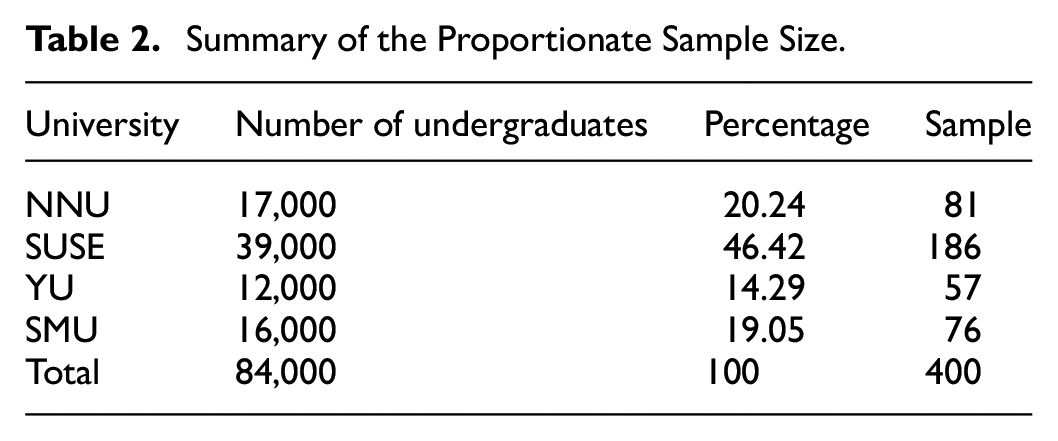
To ensure an unbiased selection of universities, we employed a random sampling method, drawing university names without replacement and giving each institution an equal chance of being selected (Gog, 2015). Out of the five universities in the region, four were randomly selected. Proportional random sampling was used to ensure representation based on each university’s student body size (see Table 2). This approach maintained both representativeness and practical feasibility. Next, three faculties—Education, Literature, and Management—were selected based on a combination of academic diversity and budget constraints. While this selection limited the inclusion of students from other disciplines, it balanced feasibility with the goal of capturing a diverse sample.
Summary of the Proportionate Sample Size.
Data collection followed a structured protocol to ensure ethical integrity and participant anonymity. Approval for the study was granted by the institutional ethics committee, and consent was secured from the selected universities. Faculty counselors were then enlisted to assist with data collection and underwent standardized training to ensure unbiased survey administration. The questionnaire was made available online, allowing students to complete the survey anonymously and at their convenience.
Statistical Analysis
The analytical strategy incorporated SPSS 22.0 for preliminary data screening and assumption testing, and AMOS 24.0 for structural equation modeling, enabling the examination of both direct and mediated effects. All results were considered statistically significant at the p < .05.
Results
Preliminary Data Screening
Missing Data
This study was conducted using an online questionnaire platform that automatically checked for missing responses. Participants were prompted to complete any unanswered items before submission. If subjects did not fully complete the questionnaire, their responses were not retained, and as a result, all submitted questionnaires contain complete data.
Normality
Skewness and kurtosis are two key components of normality. According toByrne (2010), the assumption of normality is typically considered valid if skewness falls within range of −2 to +2, and kurtosis within range of −7 to +7. In this study, skewness values ranged from −0.324 to 1.023, and kurtosis values ranged from −0.171 to 1.355, all of which fall comfortably within these thresholds, indicating that the continuous variables used in this research are normally distributed.
Multicollinearity
The investigation of diagnostics of multicollinearity, such as variance inflation factor (VIF) and tolerance values, was conducted at multivariate level.Hair et al. (2010) concluded that VIF values exceeding 10 and tolerance values below 0.10 indicate the presence of multicollinearity. The findings of this study indicated that there was no evidence of multicollinearity between any of the independent variables.
Reliability and Validity
All measures demonstrated a good internal consistency, as evidenced by the Cronbach’s values for the present sample falling between .836 and .940 (see Table 3). Besides, according to Table 3, CR for all variables were above .7, AVE were above 0.5, and the squared root of AVE of each construct were higher than their respective inter-construct correlations, which means that all the variables have a sound convergent validity and discriminant validity.
Summary of CR, AVE, Cronbach’s Alphas, and Correlations.

Note. The squared root of AVE of each construct presented on the diagonal and correlation coefficients are located on the correlational matrix. AVE = average variance extracted; CR = construct reliability.
p < .01.
Model Fit
Prior to conducting the analysis, the measurement model and two structural models (direct model and mediated model) were tested to assess the structural reliability of the variables. The results of the model fit are presented in Table 4. While these indicators of model fit are not perfect but acceptable.
Fit Indices of the Measurement and Structural Models.
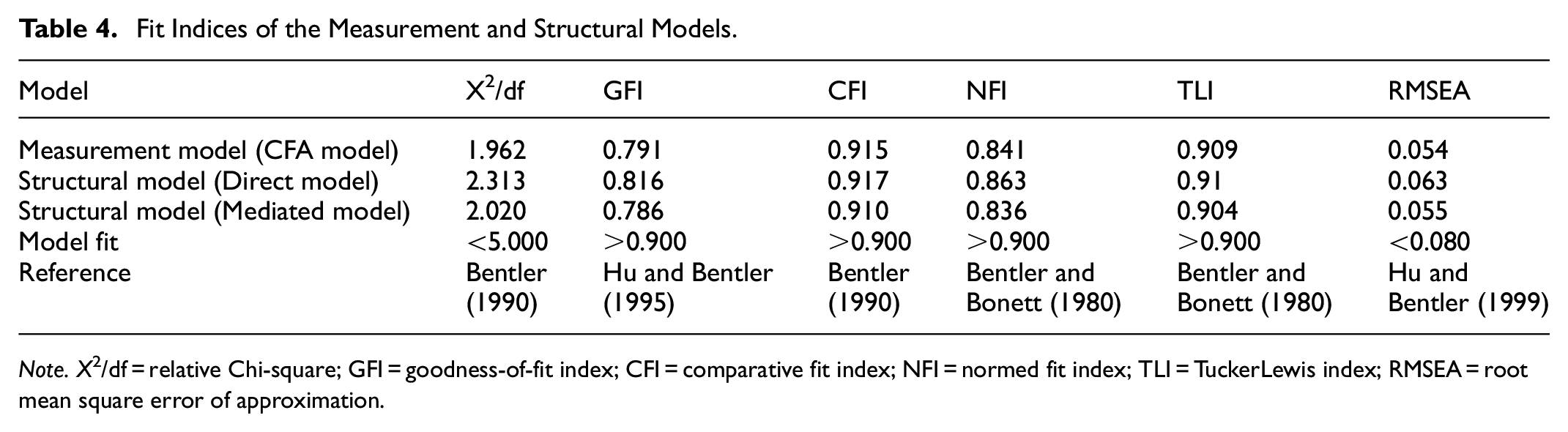
Note. X 2/df = relative Chi-square; GFI = goodness-of-fit index; CFI = comparative fit index; NFI = normed fit index; TLI = TuckerLewis index; RMSEA = root mean square error of approximation.
Correlation Analysis
According to Table 3, soft skills were significantly associated with positive emotions (r = .677, p < .01), life satisfaction (r = .581, p < .01) and academic engagement (r = .648, p < .01). These correlation coefficients suggest that individuals with higher soft skills tend to experience more positive emotional states, greater life satisfaction, and higher academic involvement. Notably, all observed correlations exceed the .50 threshold, indicating moderate to strong relationships among the constructs (Cohen, 2013) Additionally, positive emotions (r = .651, p < .01) and life satisfaction (r = .647, p < .01) were also significantly correlated with academic engagement, suggesting that students who report higher positive emotions and greater satisfaction with life tend to engage in academic activities. These correlations provide initial empirical support for the hypothesized associations between soft skills and these three outcome variables.
Positive Emotions and Life Satisfaction as Parallel Mediators
According to Table 5 and Figure 2, soft skills are strong positive predictors of positive emotions (β = .689, p < .001), life satisfaction (β = .599, p < .001), explaining a substantial proportion of the variance in these constructs. These standardized coefficients indicate that for every standard deviation increase in soft skills, positive emotions and life satisfaction increase by approximately 0.69 and 0.60 standard deviations, respectively—suggesting a robust predictive relationship. Soft skills also directly predicted academic engagement (β = .301, p < .001), albeit with a moderate effect size, supporting Hypothesis 1.
Path Coefficients of the Mediation Model.
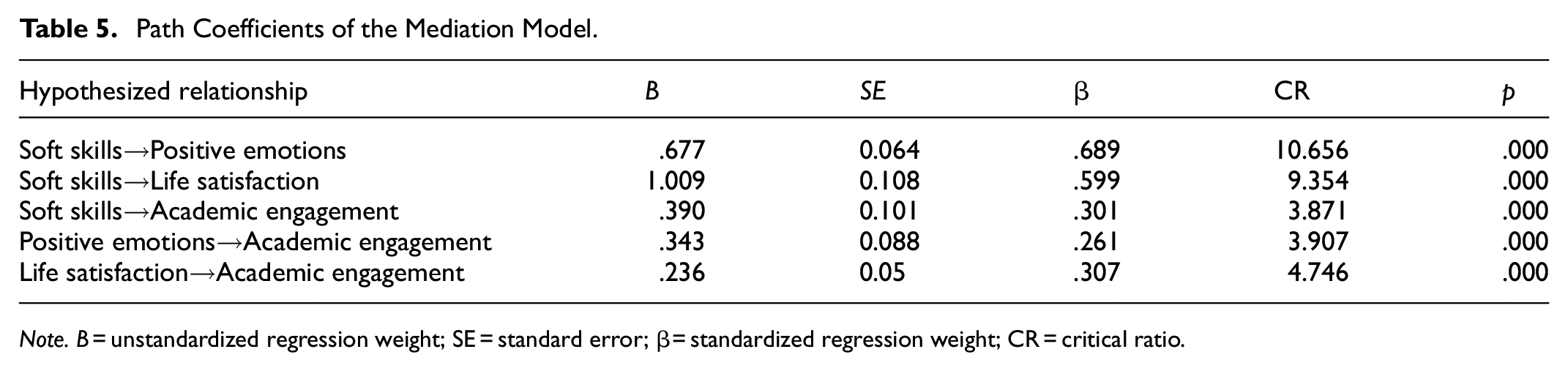
Note. B = unstandardized regression weight; SE = standard error; β = standardized regression weight; CR = critical ratio.

The relationships between soft skills and academic engagement.
Besides, positive emotions (β = .261, p < .001) and life satisfaction (β = .307, p < .001) were also significant predictors of academic engagement, supporting Hypothesis 2. These results imply that students who report more positive emotional experiences and greater life satisfaction are more engaged academically. Although these individual path coefficients are smaller than the direct effect of soft skills on emotional and life satisfaction outcomes, their statistical significance and effect sizes remain meaningful and theoretically relevant.
Table 6 outlines the direct and mediated models. In the direct model of soft skills and engagement, soft skills were found to significantly influence academic engagement (β = .644, p < .001). However, when positive emotions and life satisfaction were included as mediators, direct effect of soft skills on academic engagement reduced to β = .301, while both indirect paths were statistically significant. The indirect effect through positive emotions was β = .180 [95% CI 0.087, 0.286], and through life satisfaction was β = .184 [95% CI 0.103, 0.288], indicating partial mediation. Therefore, Hypothesis 3 was supported.
Bootstrap Results: Mediating Effects of Positive Emotions and Life Satisfaction.

Note. β = standardized regression weight; 95% CI BC = bias corrected at 95% confident interval; LB = lower boundary; UB = upper boundary.
Importantly, these indirect effects accounted for 27.07% and 27.67% of the total effect, respectively. Collectively, the total indirect effect (β = .364) explained 54.74% of the total effect of soft skills on academic engagement. This finding highlights critical mediating roles of emotional and cognitive well-being in translating soft skills into academic motivation and involvement. In practical terms, even though soft skills exert a direct influence on academic engagement, their effect is substantially amplified through the enhancement of students’ emotional states and satisfaction with life.
Discussion
The present study aimed to explore the associations among soft skills, emotional and cognitive well-being, and academic engagement among university students. Previous research has consistently demonstrated the beneficial role of soft skills in individual development, particularly academic achievement (Feraco, Casali, et al., 2023), but most of studies separately explored the roles of soft skills, well-being, and academic outcomes (Dametto & Noronha, 2019; Feraco, Casali, et al., 2023; Feraco, Resnati, et al., 2023), few have empirically tested the integrative model proposed here, which captures both the direct and indirect pathways of influence. Thus, this study advances existing knowledge by highlighting the cognitive, emotional and behavioral mechanisms through which soft skills contribute to students’ academic engagement.
It’s worth noting that the regression analysis confirmed that soft skills serve as strong predictors of positive emotions (β = .689, p < .001), life satisfaction (β = .599, p < .001), and academic engagement (β = .301, p < .001), supporting Hypothesis 1. These results underscore the significance of soft skills in promoting well-being and academic involvement. Previous research has consistently demonstrated the influence of soft skills on psychological and academic outcomes. For instance, curiosity, leadership, social awareness, and perseverance have been identified as key predictors of positive emotions (Dametto & Noronha, 2019). Additionally, adaptability and perseverance significantly contribute to life satisfaction (Ellena et al., 2021). Social awareness enables individuals to engage successfully in social interactions, fostering supportive networks that enhance well-being (Joubert, 2006). In academic settings, soft skills have been widely recognized as crucial for fostering engagement. Specifically, curiosity drives deeper engagement with course material, while adaptability helps students navigate changes in their academic environment (Chamorro-Premuzic et al., 2010). Furthermore, social awareness, initiative, and leadership facilitate collaboration, encourage classroom participation, and contribute to a supportive academic atmosphere (Almeida & Buzady, 2023; Tatiana et al., 2022).
Additionally, both positive emotions (β = .261, p < .001) and life satisfaction (β = .307, p < .001) were significant predictors of academic engagement, supporting Hypothesis 2. Fredrickson’s B&B theory (Fredrickson, 1998, 2001), posits that positive emotions broaden cognitive and behavioral repertoires, allowing ones to expand enduring psychological and social assets (Fredrickson, 2001). Our findings extend empirical support for this framework within the higher education setting, demonstrating that students with strong positive emotions exhibit an expanded capacity for academic engagement, aligning with previous findings (Hagenauer et al., 2018; King & dela Rosa, 2019). Furthermore, this study highlights the role of life satisfaction—a cognitive appraisal of well-being—in strengthening academic engagement. The results highlight the interconnectedness of well-being and academic involvement, offering valuable insights for educators seeking to enhance student success (Jayawickreme et al., 2012).
Moreover, the mediation analysis provided deeper insights into the mechanisms through which soft skills enhance academic engagement. Both positive emotions and life satisfaction partially mediated this relationship, accounting for 27.07% and 27.67% of the variance, respectively. The total indirect effect contributed to 54.74% of the overall effect, demonstrating that while soft skills directly influence academic engagement, a substantial portion of their impact is channeled through psychological well-being factors. The findings provide strong empirical support for Hypothesis 3. In contrast to prior research, which has primarily linked well-being to general mental health or life outcomes (Otto et al., 2021), this study empirically validates the mediating role of well-being—encompassing both emotional and cognitive factors—in shaping students’ academic behaviors. These findings underscore the significance of soft skills as essential psychological resources that foster a self-reinforcing cycle of well-being and academic involvement, ultimately contributing to students’ long-term academic success.
Conclusion and Implication
This research adds to existing literature by examining how soft skills influence students’ emotional well-being, cognitive evaluations of life, and academic participation within university setting. It further highlights the partial mediating roles observed for positive emotions and life satisfaction further enrich this framework. By establishing these relationships, this study provides empirical evidence supporting the argument that soft skills are not merely supplementary attributes but fundamental components that drive students’ academic and personal success.
Despite its meaningful insights, its limitations merit consideration for future research. Primarily, a cross-sectional design limits the ability to infer causal relationships. Longitudinal studies are needed to track how soft skills evolve and shape well-being and academic engagement over time, extending beyond the university years into students’ careers. Second, as the sample consisted solely of undergraduate students from southern Sichuan, China, the extent to which the findings can be generalized to other populations may be limited. Future studies should explore more diverse populations and investigate additional factors, such as motivation and self-efficacy, to gain more holistic understandings of how to support students’ academic and personal development effectively. Additionally, while self-reported measures provide valuable insights, they are subject to biases such as social desirability and self-perception distortions. Incorporating multi-source data, including teacher assessments, peer evaluations, and objective performance indicators, could strengthen the validity and robustness of future findings. Moreover, another limitation concerns the use of varying Likert-type scales for measuring different constructs. While we retained the original scale formats to maintain the validity and cultural consistency of the instruments, this variation may introduce scale-related bias when comparing constructs. Although such practice is not uncommon in related literature, the lack of scale uniformity may affect the comparability of standardized path coefficients in the structural equation model. Therefore, to improve measurement consistency and cross-variable comparability, future research should consider using unified Likert-type scales across constructs or apply standardization methods such as z-score transformation prior to analysis.
As for the theoretical implications, this study extends the scope of Fredrickson’s B&B Theory by providing empirical evidence on how soft skills contribute to students’ academic engagement through the mediation of emotional and cognitive well-being within the higher education settings. Specifically, building on the B&B theory, this study not only underscores the predictive power of positive emotions in predicting academic engagement but also demonstrates that soft skills serve as fundamental and enduring psychological attributes, which foster sustained positive emotions and life satisfaction, thereby promoting long-term academic engagement. Furthermore, this study also enriches the literature, which conceptualizes well-being as a dynamic and self-reinforcing system. The partial mediation effects observed in this study indicate that developing soft skills may serve as an engine that continuously enhances students’ well-being, reinforcing their engagement in academic pursuits. These insights suggest that soft skills should not be viewed in isolation but as integral components of a broader framework that links personal attributes, well-being, and academic performance.
From a practical perspective, the findings have significant implications for educational policy and practice. University administrators and educators should recognize soft skills as fundamental rather than supplementary to students’ well-being and academic engagement. Institutions should integrate soft skills development into both formal curricula and co-curricular programs. To achieve this, universities can implement targeted interventions such as soft skills training workshops, mentorship programs, and experiential learning opportunities. These initiatives should focus on fostering adaptability, curiosity, initiative, perseverance, social awareness, and leadership—skills identified in this study as essential for academic and personal success. Additionally, incorporating structured reflection exercises and guided discussions within coursework can further enhance students’ self-awareness and intentional skill development.
Beyond individual institutions, policymakers should consider embedding soft skills education within national higher education frameworks. A structured approach to soft skills development can equip students with the competencies needed to navigate academic challenges, build emotional resilience, and sustain long-term personal and professional growth.
Supplemental Material
sj-docx-1-sgo-10.1177_21582440251367655 – Supplemental material for Boosting Academic Engagement Through Soft Skills: The Mediation of Positive Emotions and Life Satisfaction
Supplemental material, sj-docx-1-sgo-10.1177_21582440251367655 for Boosting Academic Engagement Through Soft Skills: The Mediation of Positive Emotions and Life Satisfaction by Xiaoling Wang, Wan Marzuki Wan Jaafar and Rose Manisah Sulong in SAGE Open
Footnotes
Acknowledgements
The authors would like to express their gratitude to the assistant teachers from the four universities in southern Sichuan, China, for their cooperation and valuable responses.

Ethical Considerations
All procedures performed in this study involving human participants complied with the ethical standards of the institutional and/or national research committee and adhered to the principles outlined in the 1964 Declaration of Helsinki and its later amendments. Ethical approval was obtained from the Ethics Committee for Research Involving Human Subjects of Universiti Putra Malaysia (JKEUPM) under approval number JKEUPM-2024-033. Informed consent was obtained from all individual participants prior to their participation in the study.
Consent to Participate
Verbal informed consent was obtained from all participants before data collection.
Funding
The authors received no financial support for the research, authorship, and/or publication of this article.
Declaration of Conflicting Interests
The authors declared no potential conflicts of interest with respect to the research, authorship, and/or publication of this article.
Data Availability Statement
The authors of this article will make the raw data supporting the conclusions available without reservation.
Supplemental Material
Supplemental material for this article is available online.
References
Supplementary Material
Please find the following supplemental material available below.
For Open Access articles published under a Creative Commons License, all supplemental material carries the same license as the article it is associated with.
For non-Open Access articles published, all supplemental material carries a non-exclusive license, and permission requests for re-use of supplemental material or any part of supplemental material shall be sent directly to the copyright owner as specified in the copyright notice associated with the article.
