




Abstract
Numerous studies on blended learning have mentioned the positive impact of social support on students’ attitudes and behaviors. However, organizational support is also crucial and should not be ignored. Therefore, this study examined the relationships between organizational support, information and communication technology (ICT) self-efficacy, student engagement, and student satisfaction in a blended learning environment. A questionnaire survey was conducted on 245 students in China and validated with the structural equation model (SEM). The results showed that organizational support positively predicted perceived usefulness (PU) but was not significantly associated with student engagement; student engagement was positively predicted by PU and ICT self-efficacy; student satisfaction was positively predicted by ICT self-efficacy and student engagement; ICT self-efficacy complete mediated engagement, with the proportion of the indirect effect being 95.78%, and student engagement complete mediated student satisfaction, with the proportion of the indirect effect being 53.85%. Guidelines were proposed for higher education institutions to provide organizational support, increase students’ ICT self-efficacy, and improve student engagement and satisfaction in blended learning via various programs.
Plain Language Summary
Numerous studies on blended learning have mentioned the positive impact of social support on students’ attitudes and behaviors. However, organizational support is also crucial and should not be ignored. Therefore, this study examined the relationships between organizational support, information and communication technology (ICT) self-efficacy, student engagement, and student satisfaction using SEM in a blended learning environment. This proposed model focuses on examining the effects of systematic organizational support from higher education institutions on students’ intrinsic and extrinsic motivation for blended learning. This study extends previous research on the effects of OSBL on students’ attitudes and behaviors and has theoretical and practical significance, especially for providing systematic organizational support of higher education institutions. Guidelines were proposed for higher education institutions to provide organizational support, increase students’ ICT self-efficacy, and improve student engagement and satisfaction in blended learning via various programs.
Keywords
Introduction
Blended learning defined as, “the thoughtful integration of classroom face-to-face learning experiences with online learning experiences” (Garrison & Kanuka, 2004, p. 96), is becoming increasingly common in higher education (Norberg et al., 2011). These learning experiences increasingly depend on ICT competencies, which has been shown by numerous studies to be associated with students’ learning self-efficacy (Aesaert & Van Braak 2014; Aesaert et al., 2017; Q. Chen & Ma, 2022; Rohatgi et al., 2016). ICT self-efficacy is rooted in Bandura’s broader concept of self-efficacy, which refers to the belief in one’s capabilities to successfully perform a task using both computer and Internet media (Feng et al., 2023). Students’ ICT self-efficacy has become an important factor in measuring their learning abilities (H. Y. Zhang et al., 2023). Students with high ICT self-efficacy tend to have better information retrieval skills, which may explain their improved online learning outcomes. Blended learning promotes the effectiveness, convenience, and flexibility of independent and autonomous learning behaviors (Berga et al., 2021; Bouilheres et al., 2020; Garrison & Kanuka, 2004; X. Li et al., 2022; Morton et al., 2016). Although research has demonstrated the benefits of blended learning, many students remain unwilling to engage in it because they lack of confidence in their ICT skills (Legrain et al., 2015; Q. Wang & Zhao, 2021).
To date, numerous studies have shown the relationship between students’ ICT self-efficacy and support, indicating that new technology assistance improves their ICT self-efficacy. Karakose et al. (2023) and Troulinaki (2023) pointed out that individuals’ self-efficacy is influenced by organizational training and can predict their attitudes toward their actions. However, existing research primarily focuses on providing social support for students’ ICT self-efficacy, rather than organizational support. Only a few studies (e.g., Ye et al., 2022) have studied blended learning under organizational support, but they have mainly targeted teachers, not students. Social support provided by individuals in social networks (Sarason et al., 1990), primarily focuses on providing a sense of belonging and connectedness for individuals facing challenges or difficulties, and it operates within an informal structure (Bächtold et al., 2023). Organizational support refers to the formal structure and processes within organization, which typically include individual assistance programs, training programs, and other professional development resources that help individuals progress within the organization (Eisenberger et al., 1986). Existing literature has not identified a direct relationship between organizational support and social support (Türe & Akkoç, 2020). However, based on the above concepts, organizational support provides more systematic and basic assistance than social support. Therefore, studying the impact of organizational support is deemed more necessary than studying the impact of social support.
In China, blended learning has gained popularity, and educational supervisors in universities have encouraged teachers to adopt this instructional process. Teachers use blended e-learning systems to design student-centered curriculum resources and interactive activities. Blended learning has become the only option for students to catch up with learning progress (Ye et al., 2022). Chinese students now have been exposed to different blended e-learning systems, such as Teachermate, Chaoxing, and Treenity, to complete their curricula. Adopting an information system (IS) has become a crucial step in implementing blended learning for students. The technology acceptance model (TAM), developed by Davis (1989), is widely used as a theoretical model for explaining and predicting students’ adoption of new technologies. It was one of the most robust theoretical models for examining attitudes and behaviors in a blended learning environment. TAM stipulates that certain factors can affect students’ perceptions and evaluations of IS usage (Esteban-Millat et al., 2018), leading to changes in their attitudes and behaviors toward blended learning. Katsaris and Vidakis (2021) suggested that providing personalized design support to learners in an e-learning environment can improve their learning engagement and learning experiences.
Drawing on previous research, this study analyzes the influencing factors of blended learning from the perspective of organizational support provided by higher education institutions, rather than focusing on social support. Although previous research has provided valuable insights into blended learning, its understanding of this field is still limited in the context of this study. The proposed model attempts to demonstrate the relationship among students’ ICT self-efficacy, PU, engagement, and satisfaction with organizational support. Through this analysis, empirical evidence is provided to support intervention by higher education institutions in promoting student engagement in blended learning and improving satisfaction with the learning approach. The TAM model serves as the primary framework aims to address the following research problems in blended learning:
To determine the impact of organizational support on students’ PU, ICT self-efficacy, and engagement. Additionally, the study aims to identify measures that higher education institutions should implement based on the research findings.
To examine the influence of ICT self-efficacy on students’ PU, engagement, and satisfaction within the context of organizational support. Additionally, the study seeks to identify the necessary discussions that higher education institutions should initiate based on these findings.
To explore the mediating effect of organizational support as an antecedent of ICT self-efficacy on student engagement. Additionally, the study seeks to examine the mediating effect of student engagement on student satisfaction.
Literature Review
This study combines Eisenberger et al.’s (1986) organizational support theory with Davis (1989) TAM to explain students’ ICT self-efficacy, engagement, and satisfaction in a blended learning environment. TAM provides a framework for understanding and predicting how students’ PU of IS in learning, which subsequently affects their level of engagement and satisfaction with learning.
TAM
The original TAM comprises six variables, with PU being one of the primary variables. In a blended learning environment, PU refers to the degree to which students perceive using technology-related IS to improve learning outcomes. Esteban-Millat et al. (2018) confirmed that PU is the main external motivation that affects attitudes and behaviors toward using IS. Troulinaki (2023) concluded through empirical comparisons that those who have received training related to IS find it more useful and effective than those who have not. In TAM, the only uncertain variable of PU is the antecedent variable, which provides a valuable basis for researchers to develop, extend, and modify the structure of TAM in different contexts. For example, Suliman et al. (2023) extended TAM using PCF to understand students’ intention to use mobile learning. Furthermore, some researchers argue that additional internal or external influences should be considered, in order to clarify why and how variables affect the intention in different research contexts (Al-Azawei et al., 2017; Bazelais et al., 2018; X. Chen et al., 2022; Esteban-Millat et al., 2018; Gangwar et al., 2015; Lazar et al., 2020; Martín García et al., 2019; Sánchez & Hueros, 2010; Shakeel et al., 2022; Ye et al., 2022). In the proposed model of this study, organizational support is regarded as the PU antecedent variable to investigate its influence on students’ attitudes and behaviors in the context of blended learning.
Organizational Support
Perceived organizational support was initially proposed by Eisenberger et al. (1986). Based on the reciprocity norm, organizations are expected to fulfill employees’ socioemotional needs and performance-reward expectancies, while employees, in turn, experience reciprocal motivation to contribute toward the organization’s goals (Eisenberger et al., 2001). Organizations should consider organizational support as a critical resource for employees to improve their task performance, and it can also strengthen their abilities to cope with stressful situations (Lee et al., 2010). Empirical research has shown that organizational support corresponds with various outcomes, such as facilitating the successful implementation of new policies, programs, and practices (Rasool et al., 2022; Shea et al., 2014), decreasing individuals’ levels of stress levels (Burlison et al., 2021; Viswesvaran et al., 1999; Zhou et al., 2022), strengthening employees’ sense of belonging to the organization (Rasool et al., 2021), and positively influencing employee engagement and satisfaction (Oubibi et al., 2022). Higher education institutions, as unique organizations in which students are the most important members, may also face situations similar to those found in organizations, such as psychological, ability, attitude, and behavioral problems (Trullas et al., 2018). For instance, Lavidas et al. (2022) found that students’ self-efficacy in using ICT decreases when they lack support, such as IS training, equipment, or internet connectivity, leading to a sustained decline in learning interest.
ICT Self-efficacy
ICT self-efficacy is commonly defined as the belief in one’s abilities to perform a task on the Internet using computer technology (Feng et al., 2023). Students with high ICT self-efficacy demonstrate proficiency in using multiple strategies to engage in online exploration to complete learning tasks (Aesaert et al., 2017). Moreover, students with high ICT self-efficacy are also better at adapting to technology-based learning than students with low ICT self-efficacy (Hatlevik & Bjarnø, 2021). Feng et al. (2023) conducted an analysis that students’ ICT self-efficacy significantly influences their engagement in three aspects: ability, effort, and environmental control. Despite the frequent use of blended learning by university instructors, students with relatively low ICT self-efficacy tend to experience lower satisfaction with their learning outcomes (Al-Rahmi et al., 2020). Tezci (2011) and Hatlevik et al. (2018) analyzed individuals’ self-efficacy in using ICT for organizational support and found that self-efficacy is positively related to the use of ICT in blended learning (Huang et al., 2021).
Student Engagement and Satisfaction in a Blended Learning Environment
Blended learning has been widely used in various fields, particularly in education, business, and management (Berga et al., 2021; Q. Chen et al., 2022; Jin et al., 2020; N. Wang et al., 2021; X. Wang & Zhang, 2022). Student engagement and satisfaction with blended learning influence their educational outcomes. Student engagement reflects the quality of the institution’s productivity (Bouilheres et al., 2020). Even minimal training support from education institutions can foster students’ enthusiasm for collaboration with peers and teachers (Troulinaki, 2023). Furthermore, engagement is an essential aspect of academic success in both traditional and technology-enhanced instruction (de Brito Lima et al., 2021). Much of student satisfaction with blended learning can be attributed to ICT self-efficacy (Morton et al., 2016; Ye et al., 2022). Evaluating student engagement and satisfaction serves as an important baseline measurement for classes that are conducted in blended learning (Garrison & Kanuka, 2004), and high ICT self-efficacy can promote student engagement and improve student satisfaction and academic performance (Bouilheres et al., 2020). However, further research is still needed to fully understand the relationships among variables that influence student engagement and satisfaction in learning (Spanjers et al., 2015).
Research Hypotheses
Organizational Support for Blended Learning (OSBL), PU of Blended Learning (PUBL), and ICT Self-efficacy for Blended Learning (ICTSE)
Q. Chen and Ma (2022) showed that organizational support, including emotional and instrumental support, is positively associated with ICTSE and the PU of technology-based instruction. Learners may benefit from organizational support as it provides relevant information on data visualization and video resources during the learning process (Daniels & Bulut, 2020; Nong et al., 2022; Rets et al., 2021; Spanjers et al., 2015) and is also potentially related to students’ PU in learning (Nong et al., 2022). L. Li et al. (2021) suggested that other strategic interventions can use aspects of organizational support to enhance students’ PUBL. Additionally, students may also benefit from faculty providing the necessary support to optimize the adoption of technology-based learning (Dunn et al., 2021). With organizational support, students’ ICT self-efficacy can increase, while their perceptions of PU play a critical role in blended learning practices. Numerous studies have shown that college ICT support has a direct impact on the development of students’ self-efficacy (Guo et al., 2022; Q. Wang & Zhao, 2021; Yildiz et al., 2022). Tondeur et al. (2018) emphasized that students use of strategies (e.g., collaboration, authentic technology experiences, and curriculum feedback) is reflected in their awareness through an increased sense of ICT self-efficacy during learning. In addition, the gap in students’ ICT self-efficacy may narrow when technology-based education, particularly organizational support, is used as an intervention (Kaarakainen et al., 2018). Based on these antecedents, the following hypotheses were made:
H1: OSBL is positively correlated with PUBL.
H2: OSBL is positively correlated with ICTSE.
H3: ICTSE is positively correlated with PUBL.
OSBL, PUBL, ICTSE, and Student Engagement in Blended Learning (SEBL)
Student engagement is considered an organizing construct for institutional assessment, accountability, and improvement efforts (Kuh, 2009), and interest in it has increased among researchers over the past decade (Bonner et al., 2023) because of its relevance to learning outcomes. Jung and Lee (2018) reported that factors such as organizational support, PU, and self-efficacy influence student engagement. There is also research findings that teacher support is the primary interindividual factor that influences student engagement (Vayre & Vonthron, 2017), and has the greatest impact on students’ learning (Q. Chen & Ma, 2022). Furthermore, teacher support is positively related to student engagement in learning (Martin & Rimm-Kaufman 2015). Gutiérrez et al. (2017) found that organizational support predicts student engagement in school. Additionally, Martin and Rimm-Kaufman (2015) showed that students’ perceptions were significantly related to learning enjoyment, while organizational support compensated for students’ lack of engagement. Empirical evidence also suggested that student engagement in blended learning can be greatly enhanced by ICT self-efficacy (Çakıroğlu et al., 2017; Ma & Qin, 2021; Zylka et al., 2015). Students with low self-efficacy report lower engagement during class than those with high self-efficacy (Martin & Rimm-Kaufman, 2015). Moreover, PU directly impacts student engagement in blended learning (Gao et al., 2020) and even has a large impact on app (Arghashi & Yuksel, 2022; Y. Li et al., 2023; McLean, 2018). PU is a prerequisite for learning usefulness and is directly correlated with the digital technology in universities (Henderson et al., 2015). Gao et al. (2020) demonstrated that student engagement in blended learning is increased by their recognition of its usefulness. Based on this research, it is theorized that organizational support, PU, and ICT self-efficacy are closely related to student engagement in blended learning. Subsequently, the following hypotheses were made:
H4: OSBL is positively correlated with SEBL.
H5: PUBL is positively correlated with SEBL.
H6: ICTSE is positively correlated with SEBL.
ICTSE and Student Satisfaction With Blended Learning (SSBL)
Student satisfaction refers to positive evaluations of a specific learning environment (Nie & Lau, 2009), and is crucial for assessing the effectiveness of blended learning (W. S. Chen & Tat Yao, 2016). Sahin and Shelley (2008) showed that if students can use ICT and perceive a learning approach as being useful, flexible, and interactive, they will enjoy the instructional method. Therefore, it is worthwhile to determine the mechanisms that affect student satisfaction (Hofverberg et al., 2022). Shen et al. (2013) divided ICT into five dimensions, including completing courses, interacting with classmates and instructors, and coping with mastering blended learning systems. Furthermore, increasing ICT self-efficacy improves student satisfaction (Abdelrady & Akram, 2022) and improving ICT self-efficacy serves as a good starting point for increasing students’ learning satisfaction (Dincer & Sahinkayasi, 2011). Student satisfaction with blended learning has been found to have a positive association with ICT self-efficacy (Areepattamannil & Santos, 2019). Given the numerous studies that have established a relationship between ICT self-efficacy and student satisfaction, the following hypothesis was formulated:
H7: ICTSE is positively associated with SSBL.
SEBL and SSBL
Lack of support in a learning environment is closely related to students’ passive attitudes and affects students’ effectiveness and enjoyment of their educational experiences (Tharapos et al., 2023). Sahin and Shelley (2008) found that when students exhibit ICT self-efficacy and PU, their learning experiences can promote student engagement and, consequently, increase their level of student satisfaction. Student engagement is a topic of interest among researchers in the field of educational psychology as it is related to student satisfaction (Gutiérrez et al., 2017; Luo et al., 2019). These results also show that when students are initially satisfied, their engagement predicts higher satisfaction later (Ji et al., 2022). In addition, learners’ motivation is related to their engagement and satisfaction (Liu et al., 2022), and there is a positive relationship between engagement and satisfaction (Rajabalee & Santally, 2021). Additionally, student engagement in blended learning improves their satisfaction (Fisher et al., 2021). Subsequently, the following hypothesis was made:
H8: SEBL is positively associated with SSBL.
The Mediating Roles of ICTSE and SEBL
Research has shown that self-efficacy and extrinsic behavioral motivation, such as commitment, serve as reliable mediating variables. D. Zhang and Wang (2020) found that academic interest and academic achievement were mediated by self-efficacy. Moreover, ICTSE partially mediated the effects of organizational support, with organizational support acting as a precondition for improving extrinsic motivation (Q. Wang & Zhao, 2021). Gutiérrez et al. (2017) showed that student engagement mediates the relationship between organizational support and student satisfaction, indicating that organizational support indirectly influences student satisfaction. ICT self-efficacy mediates behavioral motivation, while behavioral motivation mediates the relationship between student satisfaction and organizational support (Moreira-Fontán et al., 2019). Wu et al. (2020) found a mediation effect of student engagement between motivation and academic performance, with self-efficacy complete mediating extrinsic behavioral motivation. Both self-efficacy and behavioral engagement have been shown to mediate the relationship between organizational support and academic achievement (Yang et al., 2021). Subsequently, the following hypotheses were made:
H9: OSBL and SEBL are mediated by ICTSE.
H10: ICTSE and SSBL are mediated by SEBL.
Further, a conceptual model was developed, to describe the influences of organizational support on PUBL, ICT self-efficacy, student engagement, and student satisfaction (Figure 1), which was adapted from TAM.
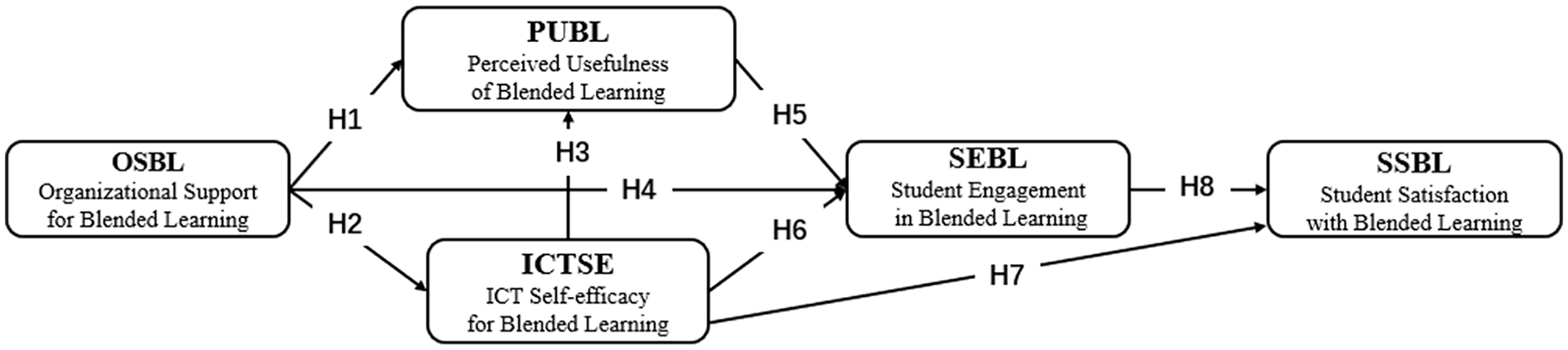
The conceptual model of blended learning.
Research Methodology
Participants
The survey data were collected from college students at one university in Tianjin, China, using Wenjuanxing. Interested participants were recruited online and confirmed that they understood the survey process and could complete the questionnaire objectively. Before implementing the formal questionnaire, 30 participants were selected for pretesting. In response to the questions raised in the questionnaire, experts were asked to make corrections to ensure the validity and reliability of the subscale and to align the questions in accordance with the research background. The survey questionnaire was distributed between January 3 and January 10, 2023. Data from a total of 323 students were collected. After removing the invalid data (e.g., those with short response time, the same IP address, and the same option for all questions), the sample included 245 valid questionnaires (75.85%).
Instruments
To ensure the reliability and validity of the instruments, the proposed model included the latent and observed variables from authoritative scales and existing studies were involved in the proposed model. The questionnaire consisted of two parts, namely, students’ characteristics and five latent variables, including 18 observed variables. Students’ characteristics included their gender, year, major, and time spent on blended learning. The students’ characteristics that were reported on the valid questionnaires are shown in Table 1. The 18 observed variables represented five latent constructs that measured the factors of blended learning. Among them, organizational support (Eisenberger et al., 1997) consists of three observed variables (“I have received assistance programs, training programs, and other resources for continuing education courses from universities”); PU (Davis, 1989) consists of three observed variables (“blended learning has brought me many benefits”); ICTSE (Aesaert & van Braak, 2014; Schwarzer & Jerusalem, 1995) consists of four observed variables (“I have mastered different ICT strategies to find the necessary information for blended learning”); and student engagement (Ergün & Koçak Usluel, 2015; Huebner, 1994) consists of four observed variables (“I can participate in blended learning in a variety of ways”); student satisfaction (Huebner, 1994; Nie & Lau, 2009) consists of four observed variables (“the curriculum design, resources, etc. in blended learning meet my requirements”). The observed variables of the survey questionnaire were rated on a 5-point Likert scale.
Students’ Characteristics.

Common Method Bias (CMB)
Since the questionnaire was self-reported and came from the same source, the possibility of a CMB was tested using the Harman one-factor method. The results showed that the first unrotated factor explained 46.167% of the total variance and did not exceed the 50% criterion (Podsakoff et al., 2003), indicating that there were no serious CMB problems.
Structural Equation Model
SEM, also known as model fit, is a commonly used statistical method in the social sciences that analyzes the relationships between variables based on covariance matrices. It can effectively reveal the complex relationships between latent variables and observed variables, as well as between latent variables. All empirical analyzes in this study were conducted using SPSS 28 and AMOS 26. To ensure the availability of the measurement scale, the reliability, validity, and goodness-of-fit analyzes of the proposed model were examined. In addition, this study confirmed the preamble research hypotheses.
Reliability refers to the accuracy of a scale in measuring the value of the same set of observed objects repeatedly and is an important indicator for assessing the performance of the scale. Using SPSS 28 for reliability analysis, the Cronbach’s α model was performed on the observed variables corresponding to each latent variable to obtain the Cronbach’s α coefficients of reliability. The analysis process shows that all observed variables positively support the latent variables, and there are no observed variables that need to be removed. The internal consistency for the latent variables is shown in Table 2. The Cronbach’s α coefficients range from 0.766 to 0.851 (>0.7; Nunnally, 1968). The questionnaire data are ideal, indicating good reliability and that they can be used for further analysis.
Reliability and Validity Analysis.
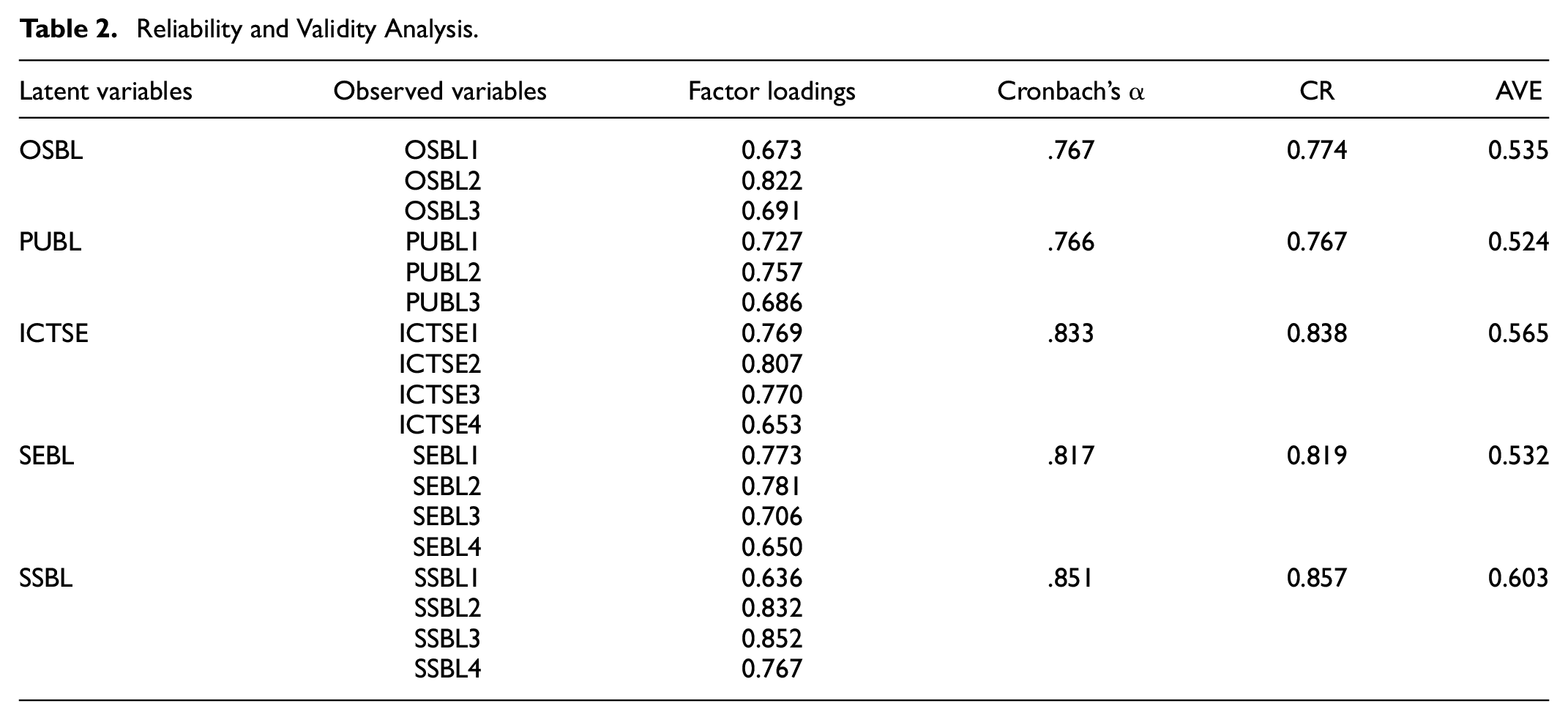
Validity refers to the consistency between the content measured by a scale and the actual construct being assessed and is also an important indicator for assessing scale performance. The scale’s validity was examined through confirmatory factor analysis (CFA) using AMOS 26. The results of the analysis are described in Tables 2 and 3. The standardized factor loadings reflect the strength of the relationship between observed variables and latent variables and can express the degree of interpretation of observed variables to latent variables. This is an important indicator for evaluating the model fit in SEM (Campbell & Fiske, 1959; Chin et al., 1997). Composite reliability (CR) refers to the proportion of the variance of each variable in a measurement model to its own measurement error and common variation with other variables. It reflects the stability or reliability of the measurement results. Higher CR value indicates better stability and lower error (Hair, 2009). The average variance extracted (AVE) refers to the extraction of the average variance, that is, the ratio of the variance that the latent variables can explain to the total variance. It is used to evaluate the validity of measurement model and measure the degree to which latent variables are explained by the measurement variables. Larger AVE value indicates better validity of the measurement model (Hair et al., 2019). In this proposed model, the standardized factor loading values (>0.5), CR values (>0.7), and AVE values (>0.5) are all higher than the reference values (Table 2). The latent variables, which consisted of observed variables meet the convergent validity condition. The goodness-of-fit indices for the five-factor model are better than those of the four-factor, three-factor, two-factor, and single-factor models (Table 3). When compared with the five-factor model, each of the fit indices for the other models deteriorates, with chi-square values being significant at p < .001. This indicates that the five-factor model satisfies the discriminant validity condition.
Fit Indices of Different Factor Models.

Note. O = organizational support; P = perceived usefulness; I = ICT self-efficacy; E = student engagement; S = student satisfaction.
p < .001.
The goodness-of-fit indices of the five-factor model (χ2 = 240.190, df = 127, χ2/df = 1.891, RMSEA = 0.060, SRMR = 0.050, GFI = 0.902, CFI = 0.949, TLI = 0.939, IFI = 0.950; Table 3) indicated that the model fit is within the recommended ranges (Hayes, 2013; Hu & Bentler, 1999) and showed that the proposed model have a good fit.
Results
Descriptive Statistics and Correlation Analysis
Pearson correlation analysis was performed using SPSS 28 to examine the relationship between the latent variables: OSBL, PUBL, ICTSE, SEBL, and SSBL. Table 4 illustrates the mean values, standard deviation (SD) and correlation coefficients of the latent variables. The results indicate that there are positive relationships between the latent variables, all of which are statistically significant at the p < .01 level.
Descriptive Statistics and Correlation Coefficients.

p < .01.
Hypotheses Testing
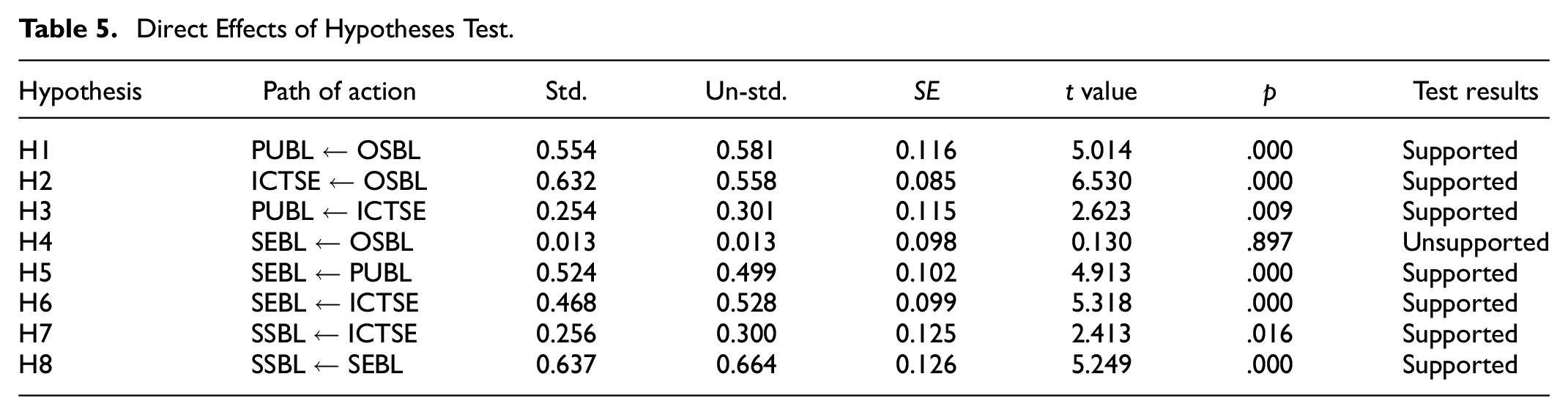
SEM is based on a covariance matrix and uses it to analyze the relationships among the five latent variables. The proposed model includes several variables that require testing with AMOS 26. Firstly, the proposed model, composed of latent variables and their arrow-path relationships, was drawn using AMOS 26. Then, all observed variables corresponding to each latent variable were added, and the data file was imported. During the analysis process, it is possible to encounter observed variables with a standardized factor loading below 0.36. This indicates that this observed variable does not strongly support the latent variable and should be removed. Additionally, there may also be situations where the model fit indices do not align with the reference values. In such cases, observed variables with high pairwise correlation can be selected to pull the correlation and improve the model fit index. Fortunately, none of these issues occurred during the analysis process. The results obtained are presented in Table 5 and Figure 2.
Direct Effects of Hypotheses Test.

The standardized path coefficients of SEM.
Table 5 and Figure 2 illustrate the path coefficients and their significance levels. The path coefficients from OSBL to PUBL and ICTSE are 0.554 and 0.632, respectively, both of which are significant (p < .001). OSBL is positively related to PUBL and ICTSE, supporting H1 and H2. The path coefficient from ICTSE to PUBL is 0.254 (p < .01). indicating that ICTSE has a significant effect on PUBL, supporting H3. However, the path coefficient from OSBL to SEBL is 0.013 (p > .05), suggesting that OSBL does not significantly predict SEBL, which does not support H4. The path coefficient from PUBL to SEBL is 0.524 (p < .001). Therefore, PUBL is significantly and positively related to SEBL, supporting H5. Furthermore, the path coefficients from ICTSE to SEBL and SSBL are 0.468 (p < .001) and 0.25 (p < .05), respectively. This means that ICTSE significantly predicts SEBL and SSBL, supporting H6 and H7. Additionally, the path coefficient from SEBL to SSBL is 0.637 (p < .001). Therefore, this indicates that SEBL is a significant positive predictor of SSBL, supporting H8.
Since all the independent, intermediate, and dependent variables were all latent, a bootstrap of the multiple intermediate analysis was performed using AMOS 26. The number of replicate samples was set at 5,000, and the bias-corrected (BC) and percent (PC) confidence intervals (CI) were set at 95%. Bootstrap maximum likelihood estimation was used, considering covariance differences. Table 6 shows the mediating effects of ICTSE and SEBL.
Mediating Effects of Hypotheses Test.

Table 6 reveals that the indirect and total effects of ICTSE on SEBL are significant, with the BC and PC containing 95% CI excluding 0. However, the direct effect is not significant, with the BC and PC containing 95% CI containing 0. This indicates that ICTSE complete mediates the relationship between OSBL and SEBL, with the indirect effect proportion being 95.78%. This significant effect proportion provides support for H9. Similarly, the indirect and total effects of SEBL between ICTSE and SSBL are significant, with the BC and PC containing 95% CI excluding 0. However, the direct effect is not significant, with the BC and PC containing 95% CI containing 0. Therefore, SEBL was found to complete mediate the relationship between ICTSE and SSBL, with the indirect effect proportion being 53.85%. Hence, H10 is also supported.
Discussion and Limitations
The descriptive statistical mean scores of OSBL, PUBL, and ICTSE are in the middle range, indicating that students’ experiences and perceptions of blended learning are considered to be generally valid. It is understandable that universities may not prioritize the provision of OSBL as reflected in the limited literature mentioned. In blended learning, there seems to be a lack of emphasis on content delivery, curriculum design, and resource provision, which hinders students’ abilities to learn independently, interact, and explore content in depth. Lavidas et al. (2022) suggested that education institutions can support effective learning activities by offering systematic online guides and innovative methods for students. The descriptive statistical mean scores of SEBL and SSBL also fell within also an intermediate range, suggesting that the full benefits of blended learning have not yet been realized. Feng et al. (2023) reported a significant association between ICTSE and SEBL, indicating that SEBL is significantly influenced by the use of ICT. This may indicate that SEBL is limited to activities such as online previewing before class, submitting homework, and following up after, which does not reflect deep learning with ICTSE. While blended e-learning systems offer convenience for students (Berga et al., 2021; Garrison & Kanuka, 2004; Morton et al., 2016), the presence of numerous curriculum resources, unfriendly user interfaces, and delayed system feedback can negatively affect SEBL and SSBL. Consequently, blended learning has not overcome all of the disadvantages associated with face-to-face learning (Nie & Lau, 2009) and online learning (L. Li et al., 2021), including that there is limited teacher-student and student-student interaction, poor SEBL (Yang et al., 2021), mediocre academic performance (Wu et al., 2020), and overall SSBL (Tharapos et al., 2023).
Pearson correlation analysis shows that OSBL is significantly associated with PUBL and ICTSE and PUBL as well as ICTSE. SEM analysis further shows that OSBL significantly predicts PUBL and ICTSE. Additionally, OSBL has a stronger influence on ICTSE than PUBL. This difference in influence can be attributed to the fact that self-efficacy depends on organizational training support (Troulinaki, 2023), while the usefulness of support for blended learning is more dependent on individual motivation (Bächtold et al., 2023). Therefore, a causal relationship exists between OSBL and ICTSE, which can also increase students’ perceptions of the usefulness of blended learning and significantly and positively predicts SSBL via SEBL. It is somewhat surprising that OSBL has no significant impact on SEBL. However, interestingly, OSBL mediates SEBL through ICTSE, with the indirect effect of ICTSE accounting for up to 95.78%. This finding undoubtedly confirms the previous notion that ICTSE plays a crucial role in technology related learning (Aesaert & Van Braak et al., 2014, 2017; Feng et al., 2023). In a blended learning environment with organizational support, the key to improving SSBL lies in SEBL, which not only exhibits the strongest relationship with SSBL but also the greatest impact on SSBL. The relationship between SEBL and SSBL aligns with previous research findings (Fisher et al., 2021; Gao et al., 2020; Gutiérrez et al., 2017; Hofverberg et al., 2022; Ji et al., 2022; Liu et al., 2022; Rajabalee & Santally, 2021; Tharapos et al., 2023). In this research context, it can be assumed that when students receive OSBL, they become aware of the benefits of blended learning, and at the same time, their self-efficacy in ICT also increases, which encourages them to actively engage in blended learning and be satisfied with the results. In addition, blended learning compensates for the lack of face-to-face communication in online learning, which is critical to building and maintaining engagement (N. Wang et al., 2021). The timely provision of OSBL can alleviate students’ negative emotions regarding the learning process, increase their readiness to learn, and sustain SSBL.
The aforementioned research provides theoretical and empirical support for blended learning. However, it also has certain limitations. Firstly, the data collected only pertains to students in a blended learning environment at a college were included. Furthermore, factors such as gender, field of study, or degree level, could impact students’ perceptions and ICTSE in blended learning, which in turn could impact student engagement and satisfaction related to organizational support. Therefore, further research should include more in-depth studies involving students with similar perceptions and ICT self-efficacy levels. Additionally, this study did not consider the practicality or applicability of any kind of blended e-learning system.
Conclusion and Implications
The benefits of blended learning have been recognized by the field of education (Berga et al., 2021). However, the successful implementation of blended learning cannot be separated from various support (Al-Azawei et al., 2017). Previous studies have emphasized the important role of social support in improving blended learning, while marginalizing the fundamental and crucial role of organizational support. To address this gap, in this study, a conceptual model was proposed to analyze the relationships among OSBL, PUBL, ICTSE, SEBL, and SSBL and to further investigate the mediating roles of ICTSE and SEBL. This proposed model focuses on examining the effects of systematic organizational support from higher education institutions on students’ intrinsic and extrinsic motivation for blended learning. OSBL was found in the study to be instrumental in improving students’ attitudes and behaviors toward blended learning. Although some students felt that OSBL did not promote their engagement, the indirect effect of ICTSE changed their depth of engagement in blended learning. Through OSBL, students acquired ICTSE to engage in blended learning. In addition, OSBL can also improve students’ motivation to learn and thus indirectly increase their SEBL and SSBL. The research findings have utility for improving SEBL and SSBL and provide guidance for new policies. The results show that students have positive blended learning experiences when they receive external organizational support, which can improve their PUBL and ICTSE in blended learning. Additionally, PUBL and ICTSE derived from OSBL promoted students’ initiative in blended learning, which can improve their engagement and satisfaction. Regarding the complete mediating effect. It can be seen that students’ ICTSE directly determines SEBL. That is, students with higher ICTSE will have higher SEBL, and the determining effect of SEBL on SSBL is also the same.
This study extends previous research on the effects of OSBL on students’ attitudes and behaviors and has theoretical and practical significance, especially for providing systematic organizational support of higher education institutions. The implications are as following: first, higher education institutions need to provide the necessary hardware and software support for blended learning, including networks, projectors, electronic whiteboards, and various online learning platforms and tools, such as MOOCs, private courses, and online discussion forums. Second, blended learning requires that faculty possess appropriate educational technology skills and teaching methods. Therefore, higher education institutions should provide appropriate training and support to foster teachers’ blended learning skills and methods enabling them to effectively use the various learning tools. Third, blended learning requires appropriate resource support, including various textbooks, course materials, learning videos, exercise banks, etc. Higher education institutions must provide students with rich and diverse learning resources to meet the needs of diverse students. Fourth, blended learning requires appropriate learning environment support, including quiet spaces for self-study, online learning spaces, and learning communities. Higher education institutions need to provide students with a good learning environment and create a positive learning atmosphere for students to actively engage in blended learning. Fifth, blended learning requires effective learning methods. Therefore, higher education institutions can provide some instructional learning method guidance courses on learning methods or lectures to help students master the skills and methods of blended learning and improve learning efficiency. Finally, blended learning requires appropriate technical support, including computer maintenance, network technical support, online learning platform maintenance and updating, and so on. Higher education institutions need to provide timely technical support and services to students to ensure the smooth operation of blended learning.
Footnotes
Acknowledgements
I would like to express our profound gratitude to Tianjin University of Finance and Economic Pearl River College for providing grant to support this study. Secondly, I would thank for all the participants in the study. Thirdly, I would like to thank Editage Language Editing Services ( .) for English language editing.
Declaration of Conflicting Interests
The author declared no potential conflicts of interest with respect to the research, authorship, and/or publication of this article.
Funding
The author disclosed receipt of the following financial support for the research, authorship, and/or publication of this article: This work was funded by the Major Program of Tianjin University of Finance and Economics Pearl River College [ZJJG22-01Z].