




Abstract
The current study examines how gender, a significant demographic variable, influences consumers’ online buying behaviour by considering six predictors: Perceived Usefulness, Perceived Enjoyment, Perceived Trust, Perceived Risk, Perceived Ease of Use, and Legislative Framework. This study is based on a survey of 489 Bangladeshi online shoppers and investigates how their perceptions of online shopping experiences relate to the above six predictors. Factor analysis combined with multivariate analysis of variance was utilised to analyse the data. Empirical observations suggest that female shoppers experience greater enjoyment from online shopping than male shoppers, whereas male shoppers find online shopping friendlier than their female counterparts. Results furthermore demonstrate that females perceive online shopping as much riskier and less trustworthy than male shoppers. However, the analysis reveals no significant disparities between male and female shoppers in their perceptions of legislative adequacy and usefulness. Findings demonstrate that women’s online purchasing behaviour often relies on affective or hedonistic reasoning, underscoring the influence of social and emotional factors. Conversely, men typically exhibit a goal-oriented disposition, emphasising utility and product efficacy over emotional considerations. The present investigation broadens the scope of the “theory of reasoned action” by incorporating empirical evidence from the context of developing nations. This study also contributes to organisational policies by showing how men and women purchase online in similar and different ways. Finally, the current study emphasises that addressing gender-specific challenges by strengthening the nation’s legal safeguards and ensuring adherence to rules and regulations is essential for promoting safe and inclusive e-commerce experiences.
Plain Language Summary
The proliferation of internet use has transformed the traditional market system into a digital one worldwide. Bangladesh, a country of around 164 million people, has both opportunities and challenges to make its market digital for consumers and entrepreneurs. One of the challenges is gender composition, which significantly influences consumers’ buying intentions. This investigation sought to investigate the impact of gender, a substantial demographic variable, on the online purchasing behaviours of consumers by examining six predictors: PE, PT, PR, PEU, and LF. With an emphasis on gender, the impacts of demographic traits on attitudes regarding online buying were investigated using factor analysis in conjunction with multivariate regression. Results of the current study reveal that male shoppers find Internet shopping more helpful than female consumers, whereas women enjoy online shopping more than men. The analysis shows no appreciable differences between male and female consumers regarding perceived risk, perceived ease of use, perceived trust, and perceived legislative adequacy. The current study highlights that encouraging safe and inclusive e-commerce experiences requires addressing gender-specific issues by bolstering the country’s legal protections and guaranteeing adherence to norms and regulations.
Keywords
Introduction
The remarkable progress and proliferation of Information and Communication Technology (ICTs) have significantly expanded peoples’ digital activities compared to previous decades. Among these digital activities, online purchases have emerged as one of the popular and essential functions of ICTs in contemporary societies (Acilar, 2022; Karmaker et al., 2025; Vinerean et al., 2022). Nonetheless, it is crucial to acknowledge that not all individuals can equally utilise or access the advantages of digital marketing globally (Acilar, 2022; Tutar et al., 2024). Past studies emphasise that demographic attributes such as socioeconomic status, age, gender and level of education shape the landscape of consumer behaviour when it comes to online purchasing (Akhlaq & Ahmed, 2016; Kanwal et al., 2021). However, among these demographic attributes, gender plays a significant role in consumers’ online purchasing intention (Pradhana & Sastiono, 2019; Tutar et al., 2024). For example, when it comes to online shopping, men and women may act differently based on the type of products they purchase, their decision-making processes, and the reasons behind their choices (Akhlaq & Ahmed, 2016; Kanwal et al., 2021). According to previous studies, women may be more concerned with selection, perceived risk, and the whole shopping experience, while men tend to place a higher value on speed and simplicity of use (Dai et al., 2019; Pradhana & Sastiono, 2019). Furthermore, as e-marketers struggle to address the opportunities and issues brought forth by the rapidly growing online shopping market, it is becoming increasingly essential to comprehend the elements impacting customers’ shopping decisions (Akhlaq & Ahmed, 2016). Previous studies on online purchasing have shed light on the personal and environmental factors that influence adoption and utilisation (e.g., risk, privacy, security, reliability, trust, etc.), and the varying importance of these determinants. However, rather than being thoroughly investigated, demographic disparities—particularly the influence of gender—were mentioned in passing (Tutar et al., 2024). Moreover, while online purchasing intentions have been extensively examined through the lens of the Technology Acceptance Model (TAM) to identify factors driving digital marketing demand, research on the effects of gender remains limited, necessitating the present study. Therefore, such studies are imperative and timely for developing nations like Bangladesh, where online shopping is experiencing tremendous growth in a market of 171 million people (Islam et al., 2023; Mavis, 2024). The current study aims to address the research gaps by examining the influence of gender on online purchasing intention—an area that has remained noticeably understudied in Bangladesh to date. This study may provide fresh insights into delineating gender-specific behaviour and suggest policy interventions for addressing the emerging online market challenges faced by consumers and businesses.
The consumers of developed countries indeed use online shopping more than those of developing and underdeveloped countries (Acilar, 2022). Currently, the global average number of online users is 67.5%, equating to 5.52 billion people (Petrosyan, 2024). In fact, online marketing has accelerated in recent years, mainly due to the COVID-19 epidemic more or less in every region or country. For example, online marketing reached over $800 billion in the USA, a 34% growth in 2020 (Enam et al., 2024). While Norway and the Netherlands have the highest percentage of internet users (99%) among European nations (Petrosyan, 2024), many other countries have not yet experienced this striking rate across the globe (Acilar, 2022). The South Asian region, particularly Bangladesh, made a delayed debut in internet usage and online marketing, though the use of the internet, and online purchases have grown significantly in recent years (Enam et al., 2024).
The number of internet users surged from approximately 12.18 million in January 2024 to 130 million in June 2024, indicating a significant escalation in internet use in Bangladesh (Hasan, 2024). Currently, Bangladesh is positioned as the 31st biggest e-business market, generating US$10.96 billion in national revenue, with an anticipated growth of 23.2% by 2028 (Zahid, 2024). This increasing rate of online marketing suggests numerous opportunities for entrepreneurs and consumers. In particular, the necessity to examine the gender effect is especially significant in the Bangladeshi setting due to two critical factors. Bangladesh has a rapidly expanding online market, with a population of 170 million, ranking it as the eighth most populous country in the world, where the male-to-female ratio is almost equal, according to the most recent population census held in 2022 (Rahim, 2024). Furthermore, the Bangladeshi digital consumer market, characterised by inadequate infrastructure, insecurity, mismanagement, corruption, and deficiencies in regulation and oversight, may yield varied consequences for online consumers amid its swift growth (Islam et al., 2023; Karmaker et al., 2025). Though previous research has highlighted the applications of technology and factors contributing to the growth of internet marketing, investigations into the impact of gender appear to be lacking, to our knowledge. Furthermore, while several studies examining gender influence on online buying behaviour have been conducted in developed nations, there is a notable paucity of similar research in rapidly expanding online markets in developing economies like Bangladesh. The present research may yield new insights into gender-specific behaviour among online shopping consumers, examining the underlying theories for these differences and similarities while considering various observed latent variables, including perceived trust, user-friendliness, enjoyment, regulatory frameworks, risk, and usefulness.
Theoretical Framework
The present investigation is founded on the Theory of Reasoned Action (TRA), which asserts that an individual’s behavioural intention is determined by their attitude toward the behaviour, which is in turn influenced by their fundamental beliefs regarding the actions they intend to do (Fishbein & Ajzen, 1975). TRA is extensively utilised by a substantial number of earlier studies, effectively indicating how online purchasing behaviour is influenced by affecting the actual buying attitudes of online consumers (Hansen et al., 2004; Panjaitan & Cahya, 2025; Sulehri & Soomro, 2017). Hansen et al. (2004) discovered that the Theory of Reasoned Action (TRA) could elucidate a significant amount (exceeding 55%) of the variance in future online purchasing intentions, hence demonstrating an adequate fit to the data. However, the application of the Theory of Reasoned Action to investigate gender disparities in online purchasing intentions in the developing countries setting, like Bangladesh, is noticeably lacking, hence warranting the current study’s expansion of TRA. In the context of online shopping, constructs such as perceived usefulness, enjoyment, risk, ease of use, trust, and legal protection can be viewed as salient behavioural beliefs that influence consumers’ attitudes toward e-commerce adoption. When consumers believe that online shopping will lead to favourable outcomes (e.g., greater convenience or enjoyment) and minimal negative consequences (e.g., low risk or strong protections), they are likely to form a positive attitude and stronger intention to shop online (Fishbein & Ajzen, 1975). Conversely, unfavourable beliefs correspond to negative attitudes and weaker intentions. Gender serves as an important moderator in this framework: men and women often differ in these belief perceptions due to psychological and contextual factors, which can lead to systematic attitude differences between genders. Prior technology adoption research supports this view, showing that males and females emphasise different criteria when evaluating new technologies (e.g., men often focus on utility and performance, whereas women prioritise ease, safety, and trust cues; Venkatesh et al., 2012). In a developing country like Bangladesh, socio-cultural norms and infrastructural constraints further condition these belief-attitude links, potentially amplifying gender gaps in online shopping intentions. The subsections below define each construct as a belief under TRA and review key findings, emphasising gender differences and considering wider literature and the Bangladeshi context.
Literature Reviews and Hypotheses
Perceived Usefulness (PU)
Perceived usefulness (PU) is one of the significant predictors influencing consumers’ propensity to make online purchases (Islam et al., 2023; Sarkar et al., 2020). Perceived usefulness typically underlies the assumption that implementing a new system will result in an increase in usefulness as a performance utility (Lim et al., 2016). According to Davis (1989), PU is the degree to which an individual believes that using a particular system would enhance their performance or productivity. In the e-commerce domain, this translates to performance utility, where consumers assess whether online platforms help them achieve their shopping goals more effectively. Perceived usefulness (PU) also refers to customers’ perception of online purchasing as enhancing efficiency and convenience (Jain & Kaur, 2020; Siahaan & Nasution, 2018). PU significantly impacts consumer behaviour by providing several benefits: it saves time, enables efficient job organisation, facilitates product comparison, offers quick access to relevant purchasing information, and minimises travel costs (Jain & Kaur, 2020). Kamal et al. (2020) demonstrate that consumers are more likely to make an online purchase when they find a shopping platform that offers utility benefits, including an easier shopping experience, a wider selection of products, and greater convenience. Online shopping provides the advantage of obtaining optimal prices for desired products, allowing them to promptly compare prices and various product details, including quality, warranty, and after-sales services (Matubatuba et al., 2014). Likewise, Zhang et al. (2019) found a positive correlation between perceived usefulness and desire to make an online purchase. Other research, however (see Mulyani et al., 2021), found no positive association between perceived utility and intention to buy online.
Regarding gender influence, previous studies indicate that perceived usefulness may differ by gender, with males often considering online shopping platforms more advantageous than females. This disparity may be linked to the divergent assessments of factors such as usability, digital self-efficacy, product-category mix, and/or risk sensitivity differences between males and females consumers (Acilar, 2022; Akhlaq & Ahmed, 2016; Kanwal et al., 2021). Women typically emphasise trust and security, influencing their assessment of usefulness, particularly if they consider the platform inadequately addresses these concerns (Sebastianelli et al., 2008). Forsythe et al. (2006) assert that women demonstrate heightened caution in online purchasing, which may make them perceive it as less desirable, particularly when they perceive a danger. This suggests that a platform’s perceived utility for women may diminish if they encounter usability or security issues that males might overlook (Amin et al., 2020). TRA theory suggests that women and men online buying choices might be motivated differently. For instance, while women’s greater vigilance about security and lower average digital self-efficacy systematically discount the performance benefits of online shopping, men may give focus on saving time shopping time and the intensity of need. Previous research has indicated that female consumers perceive lower usefulness compared to males, who exhibit reduced sensitivity to security concerns but a greater emphasis on usability requirements (Dillon et al., 2014; Forsythe et al., 2006; Islam et al., 2023; Sebastianelli et al., 2008). Additionally, women’s typical product mix (often involving more experience goods that are hard to evaluate online) can further reduce the utility they perceive from internet shopping, relative to men (Matubatuba et al., 2014).
In Bangladesh, the desire to purchase online is affected by cultural, societal aspects (Islam et al., 2023; Rahman et al., 2018). The potential for gender-specific behaviour in online purchasing might be high due to the prevalence of gendered roles and religious conservativeness in Bangladesh, which has a Muslim population of over 90% (Islam et al., 2024). Given that most public activities, including shopping, are predominantly undertaken by men, women may perceive online purchasing as less useful to them. Moreover, male consumers appreciate the convenience, product diversity, and time efficiency of e-commerce; female consumers, however, may raise concerns about payment security and product reliability, which are still significant challenges in the e-commerce environment of Bangladesh (Rahman et al., 2018). Women, specifically, demonstrate hesitance towards online purchasing due to these concerns, potentially reducing their perceived value compared to men (Islam et al., 2023; Karim et al., 2023). Moreover, women’s limited familiarity with ICT knowledge may restrict their perceived usefulness (Islam et al., 2023). Thus, online platforms plagued by cultural, technological and security constraints may lead female consumers to perceive online purchases as less useful than those of male consumers, supporting the following hypothesis.
Perceived Enjoyment (PE)
Distinct from the utilitarian belief of usefulness, Perceived Enjoyment (PE) is a hedonic belief representing the intrinsic pleasure derived from the act of online shopping itself. It is defined as the extent to which the activity of using a system is perceived to be enjoyable in its own right, apart from any performance consequences. This belief is shaped by feelings of fun, excitement, and engagement experienced during the online shopping process (Hasan et al., 2021; Ulaan et al., 2016). Delight, thrill, and engagement influence this pleasure, which may further moderate the connection between perceived utility and usability (Hasan et al., 2021). Prior studies demonstrate that intuitive technologies improve the purchasing experience and elevate shopper satisfaction (Cheema et al., 2013). Chouhan and Kumar (2020) contend that online shopping improves consumers’ technological competence, increasing the experience’s perceived value and enhancing perceived enjoyment. Despite these advantages, many consumers necessitate assistance with online buying due to complex user interfaces that may reduce their stated pleasure (Shafeeque & Thomachan, 2017).
Gender-based differences in PE may be linked to digital self-efficacy and facilitating conditions. According to TRA, variation in product-category mix and interface affordances elicits different hedonic responses across genders. A complementary mechanism is that heightened sensitivity to security and privacy cues functions as a boundary condition on enjoyment, independent of performance-utility considerations (Cheema et al., 2013; Park et al., 2009; Sebastianelli et al., 2008). However, research on gender differences in PE has yielded mixed results, suggesting its relationship with online shopping attitudes is complex. Female customers often prioritise product categories associated with contemporary cultural trends for enjoyment, whereas male consumers focus on utility values, eschewing the latest trend (Dai et al., 2019; Sebastianelli et al., 2008). In this vein, Park et al. (2009) maintains that women generally exhibit greater diligence in their searches, especially for experiential products, perhaps affecting their enjoyment derivation (Park et al., 2009). However, some past studies indicate that men experience a more pronounced effect of PE on shopping intentions (Khedhaouria & Beldi, 2017), though a few other studies suggest that PE affects both genders uniformly (Ulaan et al., 2016).
Regarding Bangladesh, according to Islam et al. (2023), perceived enjoyment (PE) is a significant factor influencing online shopping behaviour, alongside perceived usefulness and ease of use. However, considering the increasing popularity of online marketplaces in modern-day Bangladesh, women may find that the time spent shopping online might be enjoyable (Enam et al., 2024). The increased number of women in the workforce may also contribute to this, since they may enjoy purchasing online due to time constraints (Islam, 2016). Even women who are not engaged in formal employment may enjoy online shopping as a leisurely activity. Furthermore, the availability of items and their variations, as well as advancements in social media advertising, have likely contributed to the increase in the number of women who enjoy shopping online more than men. Considering the literature discussed above, we propose the following hypothesis:
Perceived Risk (PR)
Perceived Risk (PR) is a critical negative behavioural belief reflecting a consumer’s unreliability about the potential adverse outcomes of shopping online (Forsythe et al., 2006; Zendehdel et al., 2016). These multifaceted beliefs stemming from Perceived Risk (PR) signify the uncertainty and possible adverse outcomes buyers associate with online purchasing, including financial fraud, hidden costs, or the delivery of inferior products (Akhlaq & Ahmed, 2016; Dai et al., 2019; Islam et al., 2023). Dai et al. (2019) assert that website credibility, safe payment options, and transparent product details affect purchase intentions. Concerns over dangers such as deception, concealed fees, and product dissatisfaction inhibit consumers from participating in online transactions, as observed by Islam et al. (2023). Chouhan and Kumar (2020) note that concerns over payment security and product legitimacy are particularly pronounced in developing economies. In addition, perceived risk differs according to demographic variables, with research suggesting that women typically assess greater risk in online buying than men (Kanwal et al., 2021).
A consistent finding in the literature is that women tend to perceive higher levels of risk in online shopping than men (Dillon et al., 2014; Korrapti & Ford, 2004; Marianty, 2015; Sharma & Kurien, 2017). Korrapti and Ford (2004) observe that women exhibit heightened apprehensions regarding security, privacy, and financial hazards, especially concerning sharing personal data. Dillon et al. (2014) discovered that women frequently see themselves as more susceptible to fraud and identity theft during e-commerce purchases. Nonetheless, perceived risk may differ by product category, with women seeing more dangers in fashion and cosmetic products, as Dillon et al. (2014) reported. Sharma & Kurien (2017) found that performance and financial risks substantially influence customers’ online purchasing intentions. Rajini and Krithika (2019) highlighted that women exhibit heightened sensitivity to physical and product-related dangers, including receiving erroneous items. Likewise, Arora and Rahul (2018) noted that although risk perception may not consistently impact women’s buying choices, security threats remain a predominant concern. The findings indicate that gender is crucial in perceived risk, highlighting the necessity for customised risk-reduction methods catering to women’s unique issues.
Regarding Bangladesh, past studies highlight major financial, product, delivery, and privacy concerns that increase risk in Bangladesh (Islam et al., 2023; Panwar, 2018). The most direct mechanism for gender differences in PR is heightened risk sensitivity, where women may exhibit greater vigilance regarding privacy and financial loss, a tendency amplified in contexts with weak consumer protections like Bangladesh (Karim et al., 2023; Rahman et al., 2018; Sharma & Kurien, 2017). Further, consumers frequently express concerns about payment security, with many preferring cash on delivery to mitigate financial risks (Karim et al., 2023; Rahman et al., 2018). The inability to physically examine products also adds to hesitation (Rahman et al., 2018). Complementing this account, socialisation and role-based stewardship of household resources can heighten women’s risk sensitivity, especially where financial autonomy is constrained (Islam et al., 2023). According to TRA, motivation may encompass subjective norms, wherein men and women perceive risk differently, given that women’s engagement in outside activities and financial matters is more susceptible than men’s, resulting in greater mistrust among women in online buying. Therefore, we suggest the following hypothesis:
Perceived Ease of Use (PEU)
Perceived Ease of Use (PEU), also referred to as user-friendliness, is a behavioural opinion regarding the effort necessary for online buying engagement stemming from hedonic motivation (Pradhana & Sastiono, 2019). It is defined as the extent to which a person believes that utilising a specific system will require no effort (Davis, 1989). Consumers are more likely to adopt a user-friendly system, which affects their willingness to adopt the technology (Islam et al., 2023; Karmaker et al., 2025). Islam et al. (2023) found that interface design, user experience, and explicit instructions significantly affect the perceived ease of use, thereby improving platform accessibility for diverse user demographics (Chouhan & Kumar, 2020). Sebastianelli et al. (2008) stated that user-friendly platforms that meet multiple needs are vital for broader adoption, especially across cultures. Perceived ease of use (PEU) significantly enhances perceived utility, which is strongly linked to digital literacy and technological familiarity, thereby influencing user experiences (Ellitan & Prayogo, 2022). Users who struggle with complex interfaces or limited usability may consider these platforms less useful, lowering engagement in online purchasing (Pengnate & Sarathy, 2017).
Previous evidence suggests gender-specific trends in technology usage; for instance, Hilbert (2011) notes a reduction in average daily usage among women compared to men. Lim et al. (2016) observed that male consumers utilise product-related websites more often than their female counterparts, presumably due to their superior computer proficiency, encompassing operating systems, programming, databases, and website development. Likewise, usability challenges may lead women to perceive online platforms as less user-friendly, as evidenced by gender comparisons in online shopping conducted by Dai et al. (2019). Other previous studies (see Hsiao & Tang, 2015; Islam et al., 2023; Matubatuba et al., 2014) find that internet buying is predominantly male-oriented, attributed to men’s superior technological proficiency and ease of use. A theory-consistent mechanism is that differences in digital self-efficacy and facilitating conditions (e.g., prior exposure, social/technical support) make identical interfaces feel more effortful for some users; when self-efficacy is lower—often reported among women in some contexts—users rely more on intuitive design and guidance cues, whereas greater technology experience and confidence typically elevate men’s PEU (Islam et al., 2023; Sebastianelli et al., 2008; Venkatesh et al., 2012). PEU differences may also reflect the product-category mix: shopping tasks that require complex navigation or specialised configuration tools magnify effort costs and can differentially depress perceived ease of use (Dai et al., 2019; Pengnate & Sarathy, 2017).
In Bangladesh, factors influencing online shopping behaviour align with global patterns and also reflect unique local nuances (Islam et al., 2023; Rana & Abir, 2022). Given that Bangladesh is a predominantly male-dominated nation, the ubiquity of gendered division of labour constrains women’s outside activities, including shopping (Islam et al., 2023). Concerning the gender digital divide, women continue to trail behind men in both technology competencies and traditional schooling. Thus, gender dynamics in Bangladesh significantly impact societal roles, where man is viewed as the principal actors within families, and societal expectations, together with gender stereotypes, may restrict women’s perceived accessibility and confidence in utilising digital platforms (Karim et al., 2023). Though some previous studies report no significant gender differences in certain regions, Bangladesh’s traditional gender roles likely affect men and women differently when navigating online shopping platforms (Islam, 2016; Rahman et al., 2018). These influences may lead to women perceiving online platforms as less user-friendly and secure, affecting their engagement compared to men, since the following hypothesis is proposed:
Perceived Trust (PT)
Trust is essential in online shopping since it mitigates perceived risks that may negatively affect purchasing online (Shareef et al., 2013). Perceived Trust (PT) is the belief in an online vendor’s competence, integrity, and benevolence, reflecting a consumer’s willingness to be vulnerable to the vendor’s actions in a transaction (Kim et al., 2012). In the uncertain e-commerce environment, trust is a foundational belief that mitigates risk perceptions and is essential for forming a positive attitude toward online purchasing (Shareef et al., 2013). Consumers are more likely to engage in e-commerce transactions when they believe in its ability to protect their privacy and personal information (Tiangsoongnern, 2007; Zhu et al., 2011). Privacy protection, secure payment systems, and reliable delivery services are crucial for building online consumers’ trust (Zhu et al., 2011). TRA suggest that trust functions as a complex behavioural belief heavily influenced by social cues, allowing it to serve as a partial proxy for subjective norms.
Previous research indicates that women typically demonstrate more significant scepticism towards online buying than men (Shareef et al., 2013; Zhu et al., 2011). Gender differences in perceived trust may stem from differential reliance on social proof versus technical cues; women may place greater weight on peer reviews and community ratings—a proxy for subjective norms—to build trust, while men may be more influenced by a platform’s stated technical security features. So, the mechanism is that higher risk sensitivity and stronger privacy expectations raise the threshold of trust signals required by many women; correspondingly, men may rely more on technical performance cues, while women place greater weight on social proof and third-party assurances (Sebastianelli et al., 2008; Shareef et al., 2013; Tiangsoongnern, 2007).
In Bangladesh, the perceived trust in online shopping is shaped by cultural and socioeconomic factors, with widespread concerns about security, payment reliability, and product authenticity (Enam et al., 2024; Miah et al., 2022). Women exhibit heightened caution about personal and financial information online, reflecting broader worries about payment security and delivery reliability (Islam et al., 2023). Trust challenges are intensified by the limited access to secure online payment options, leading numerous women to prefer cash-on-delivery as a risk mitigation strategy (Karim et al., 2023). Social influences, including peer evaluations and recommendations, impact Bangladeshi women, who often pursue external affirmation to bolster their confidence in online purchasing decisions (Amin et al., 2020). Payment and enforcement frictions in Bangladesh function as boundary conditions that magnify the demand for strong trust cues (e.g., verified sellers’ authenticity, secure payment gateways, etc.), which can differentially depress women’s PT when such assurances are weak (Karim et al., 2023; Rahman et al., 2018). To investigate the impact of gender on the perceived trust component, we propose the following hypothesis:
Legal Framework (LF)
Legal frameworks govern e-commerce transactions, delineating the rights and responsibilities of consumers and businesses (Rahman, 2023). Legal frameworks are crucial for protecting consumers from fraud, misrepresentation, and unfair practices, enhancing trust in the online marketplace (Kabir, 2022; Sony, 2023). The legal framework recognises electronic contracts as enforceable and provides consumers access to dispute resolution mechanisms, including mediation and legal remedies (Manung et al., 2023). This robust framework ensures business accountability, allowing customers to engage confidently in online transactions. A relevant mechanism is that weak enforcement and limited redress amplify legal vulnerability and interact with women’s higher risk sensitivity, thereby lowering perceived adequacy of protections; conversely, clear remedies (e.g., verified sellers, transparent returns, data-protection provisions) function as legal assurance cues that can narrow gender gaps in perceived adequacy (Kabir, 2022; Rahman, 2023; Rahman et al., 2018). Also, gender differences in the perceived adequacy of the LF can be attributed to frictions in legal enforcement and redress, which may disproportionately affect women who, due to higher risk sensitivity, are more attuned to the practical difficulties of resolving disputes or seeking remedies for fraud.
The legal landscape for online entrepreneurs and consumers in Bangladesh faces significant challenges due to the absence of a consolidated e-commerce law and coherent regulations (Rahman, 2023). The Consumer Rights Protection Act of 2009 and the Sale of Goods Act of 1930 are antiquated regulations governing online businesses. The lack of well-timed legislation fosters an environment conducive to illicit activities, erodes customer trust, and leads to fraud (Kabir, 2022; Sony, 2023). A robust digital regulatory framework that ensures consumer protection and fosters ethical business practices is urgently needed to align Bangladesh’s e-commerce sector with international norms (Haq, 2024). Considering women’s lower participation in public activities, such as shopping, female consumers can be encouraged to make online purchases if a robust legal framework is in place for operating and maintaining online businesses (Khatun et al., 2021; Rahman et al., 2018), which suggests the following hypothesis.
Methods and Materials
Sample Size and Sample Selection
The present study employed a quantitative research methodology to investigate the impact of gender-specific behaviours in online purchasing on a broad range of observable latent variables. The quantitative method allows the statistical measurement of the differences and similarities in the responses of male and female participants when they make online purchases. Quantitative research involves transforming qualitative data, such as views or opinions, into quantitative indicators, facilitating efficient analysis (Merriam, 2002). Drawn upon survey techniques data were collected from the Bangladeshi online consumers irrespective of their educational background, gender, socio-economic class and religion. Dhaka was chosen because of its large population size and the centrality of business, where the availability of online consumers is comparatively higher than in other locations in Bangladesh. Additionally, because it would be logistically challenging to gather data from all other cities across the country, this metropolis was chosen based on the accessibility and influence of the participants in online purchases. We used a mixed sample, for example, men and women, to comprehensively understand gender dynamics in online purchase behaviour. However, some exclusion criteria were implemented to standardise the study population, including a minimum age of 18 years, not habituated to online purchasing, and possessing at least moderate skills in operating technological devices, such as a PC, Cell phone or other internet-connected electronic gadgets.
Development of Instruments
The present study was founded on an empirical survey conducted among Bangladeshi online users. The constructs under consideration were created based on the current literature to assess the research scope. However, essential adjustments were implemented to these items to measure the underlying components of online purchasing attitudes that may differ by gender, considering the Bangladeshi setting and context. The questionnaire we developed consisted of 27 items, each of which was measured using a 5-point Likert Scale with a range of 1 to 5 (strongly disagree, disagree, neither agree nor disagree, agree and strongly agree). The close-ended structured questionnaire was split into two main sections: demographic profiles (e.g., gender, age, civil status, education, employment status, online shopping experience and online buying frequency) and 6 reflective latent variables, comprising 27 constructs that might explain how gender affects online buying behaviour. Of these 6 reflective latent variables, perceived usefulness comprises 5 items, perceived enjoyment consists of 4 items, perceived risk includes 6 items, perceived trust contains 4 items, perceived ease of use encompasses 5 items and legal framework consists of 3 items (see Table 1). The survey questionnaire adequately offered these items and was organised in line with the study’s primary objectives. Each item was meticulously selected and crafted, with essential alterations to ensure clarity and relevance, grounded in previous studies to uphold validity and reliability of the current study. All stated questions were articulated in plain language to the greatest extent feasible, and the ethical statement, along with the researchers’ contact details were provided at the outset of the questionnaire. A pilot study with a sample size 22 was conducted over approximately 2 weeks. A few adjustments were made to make the instructions and questions more clear, along with a little observation of demographic profiles based on responses and feedback from the pilot study participants.
Attitudinal Indicators.

Source. Literature Reviews.
Data Collection
Participants were recruited using convenience and snowball sampling techniques after acquiring institutional formal ethics approval. The structured, closed-ended survey questionnaire was designed with two sections. Section I includes the demographic variables of the respondents, such as age, gender, civil status, education level, etc. Section II of the questionnaire, as mentioned earlier, consisted of 27 items under 6 reflective latent variables that might explain how gender affects online buying behaviour. In the initial phase, we interacted with our acquaintances at our convenience. However, snowball sampling subsequently allowed us to encourage them to connect with their acquaintances who are accustomed to making online purchases. We employed a nonprobability sample since it effectively facilitated access to the targeted people necessary for directly fulfilling the research objectives (Stratton, 2023). Uncertainty in engaging the intended participants may result in a discrepancy between the sampled individuals and the generalisations drawn from the ensuing data analysis (Rafail, 2018). Barker (2013) noted that non-probability samples enhance the likelihood of engaging exclusively with targeted participants, hence facilitating the effective achievement of the research objective. In fact, the researcher needs to differentiate between sample collecting and generalisation to a broader population, as this divergence might lead to a disparity between the sampled subjects and the extent of any generalisations produced from data analysis (Rafail, 2018). Additionally, we ensured the accuracy of the data by focusing on respondents with a wide range of traits, including age, gender, civil status, educational levels and occupational status. Despite the study being conducted in a major metropolis, the minimal sample size for a robust statistical measurement, such as SEM, is at least 200 samples (Kline, 2022); thus, a sample size of 489 substantially fulfils this criterion. While a limited sample size may not adequately reflect the data, a large sample size may increase the risk to a greater number of individuals (Michaelides, 2021). Consequently, our optimal sample size would be appropriate to ensure statistically significant differences and scientifically credible results (see Gumpili & Das, 2022).
Participants were made aware of the self-administered questionnaire through Email and on several virtual platforms, including social media such as Facebook, WhatsApp, and Messenger, as well as various professional virtual groups. Upon obtaining the initial response from the potential respondents, we delivered the Google link via Email with the questionnaire after confirming their written consent. Participation in this study was entirely voluntary, and there were no financial or other rewards associated with this participation. We sent the questionnaire to around 615 respondents and requested that they return the filled-in questionnaire within 5 weeks, with a 1-week extension if they are required to meet their busy schedules. The data collection took place from the third week of November 2024 to the end of January 2025 for approximately 9 weeks. Finally, we received 489 filled-in returned questionnaires, suggesting a response rate of 79.51%. The defective filed-in questionnaires were automatically redacted upon the completion of the survey by the participants since all the responses received were deemed for analysis.
Analytical Model
The statistical programme SPSS 26 was utilised in the investigation to analyse the descriptive statistics. The AMOS version 25 and Smart PLS version 3 were used to perform the confirmatory factor analysis. In the confirmatory analysis, the study utilised several statistical tools as—factor loading, alpha, composite reliability (CR), average variance extracted (AVE), Fornell-larker criterion (FL test) and Heterotrait-Monotrait ratio (HTMT test). Next, the effect of gender on online shopping attitudes was explored using multivariate analysis of variance (MANOVA). Each of the component factors was converted into a dependent variable, and the impact of the explanatory variable of interest (gender) on the factor was examined through a multivariate analysis model.
Results
This section covers the demographic profile of the respondents, confirmatory factor analysis tools and multivariate analysis of variance (MANOVA).
Demographic Profiles of the Respondents
Regarding the demographic profiles of the sample, the proportion of male and female responders is roughly equal. The respondents’ ages range from 25 to 30, which is considered a reasonably youthful age range; nevertheless, the age bracket reported as the highest was between 55 and 60 years (Table 2). Because they are more accustomed to using technology, the majority of online shoppers are relatively young (85.9%; aged 20–30 years). An undergraduate degree is held by 75.7% of the population and 79.3% of them are single. The majority of them are members of the student population (68.7%), while some of them are employed. However, a few of them are either self-employed, working part-time, or jobless. Further, the results demonstrate that 24.3% of the respondents shop in online regularly, about 12% of them shop frequently and most of them (48.1%) go for online shopping depending on occasions or festivals such as Eid, Puja etc. Regarding the online purchasing experience, the predominant group (41.5%) possesses 1 to 3 years of experience, while the least experienced group (5.3%) has between 10 and 12 years of experience.
Demographic Profile of the Respondents.

Source. Field data.
Confirmatory Factor Analysis (CFA)
As the supportive analysis of the CFA, the study tests for multicollinearity by checking the variance inflation factor (VIF). The results showed that the VIF for all of the items is below 3.00 (presented in the Table 3) that indicates that there is no multicollinearity issue among the measurement items of the constructs since all the values of VIF is below the recommended value 3.3 (Kock, 2017).
CFA Results Including VIF, Reliability and Validity.

Note. Model fit indices: CMIN/DF = 1.976; GFI = 0.929; AGFI = 0.906; NFI = 0.928; CFI = 0.963; SRMR = 0.384; RMSEA = 0.045.
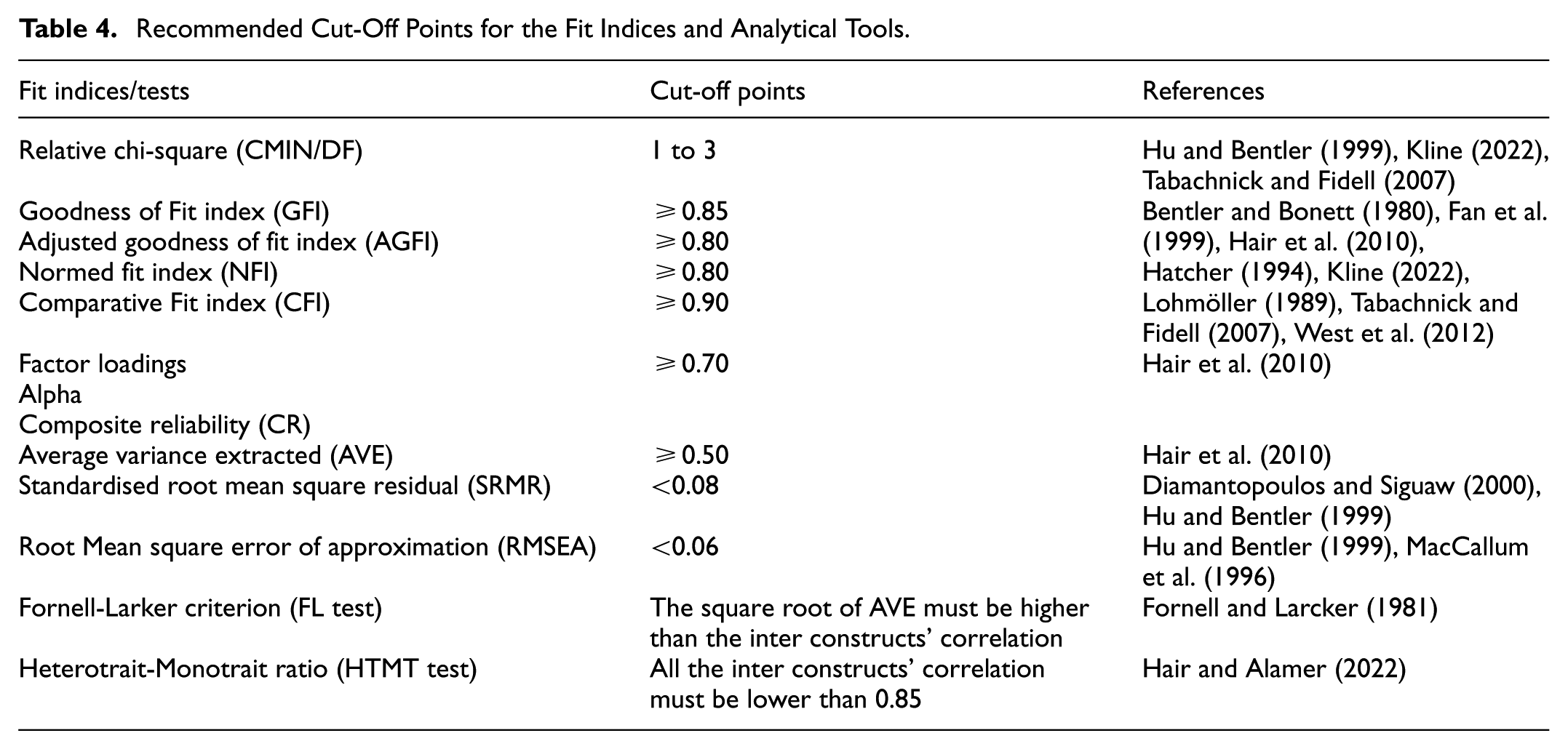
Confirmatory Factor Analysis (CFA) is used to justify the factor structure of the observed variables. It allows researchers to test the hypothesis that a relationship between observed variables and their underlying latent constructs exists. The confirmatory factor analysis goes through several steps—the analysis of item loadings under the relevant construct, assessment of the validity and reliability of data and justification of the model fit indices. The statistical tools and indices utilised to conduct CFA are given in Table 4 along with their standard recommended cut-off values.
Recommended Cut-Off Points for the Fit Indices and Analytical Tools.
The CFA is conducted with six constructs along with 28 of their corresponding measurement items as explored through the EFA. An item PR4 having a poor loading value in the CFA model was deleted during the analysis in order to have better model fit indices. The item specific. Variances (loading values), validity & reliability statistics and model fit indices are given in the Table 3.
The values of the model fit indices presented at the bottom of the Table 3 express the suitable fit of the measurement model of the study as all the values are successfully pass the recommended criteria. The relative chi-square is 1.96, GFI, AGFI, NFI and CFI are all above 0.90. SRMR is 0.038 and RMSEA is 0.045 whereas the standard value is 0.08 and 0.06 respectively.
Validity and Reliability Analysis
For validity assessment, the study utilised convergent and divergent validity measures. For the convergent validity assessment, the study used item loadings and average variance extracted (AVE). According to the recommended cut-off points (Table 4) the data satisfy the sufficient convergent validity since all the loading values are above 0.70 and the AVE values are all above 0.50. To measure the divergent validity, the researchers applied FL test and HTMT test. Table 5 shows that the square root of AVE (in the bolded diagonal) is greater than all other inter constructs’ correlation. The results of HTMT test shown in Table 6, reveals that all the inter constructs’ correlation is lower the recommended threshold (0.85) presented in the Table 6. Therefore, the data ensure sufficient convergent and discriminant validity.
Fornell-Larker Criterion (FL Test).

Heterotrait-Monotrait Ratio (HTMT Test).

For reliability analysis, the study used Cronbach’s alpha, composite reliability measures. According to the recommended cut-off point, the values of alpha and CR must be higher than .70 (Table 4). In the Table 3, all the values of alpha and CR are above the cut-off point. Thus, the data ensure sufficient reliability.
Multivariate Analysis of Variance (MANOVA)
MANOVA was performed to investigate the difference between men and women among the online shoppers concerning to the dependent variables of the study—Perceived Risk (PR), Perceived Ease of Use (PEU), Perceived Enjoyment (PE), Perceived Usefulness (PU), Perceived Trust (PT) and Legislative Framework (LF). Wilks’ Lambda test was used to identify the gender differences regarding combined effect of the above mentioned dependent variables. The Lambda value was found to be statistically significant at the level of p ≤ .05 (shown in the Table 7). That means there is a notable difference between men and women shopping experiences regarding combined effects of the above issues such as perceived risk, perceived enjoyment or perceived trust etc.
Results of the Multivariate Tests.

Furthermore, when the results for the dependent variables were considered separately using multivariate analysis of variance (MANOVA), some variables showed statistically significant values, as presented in Table 8. The analysis shows that the p value regarding the dependent variables-Perceived Enjoyment (PE), Perceived Risk (PR), Perceived Ease of Use (PEU) and Perceived Trust (PT) are statistically significant at the level of p ≤ .05, and another two variables-Perceived Usefulness (PU) and Legislative Framework (LF) are found to be non-significant.
Tests of Between-Subjects Effects.

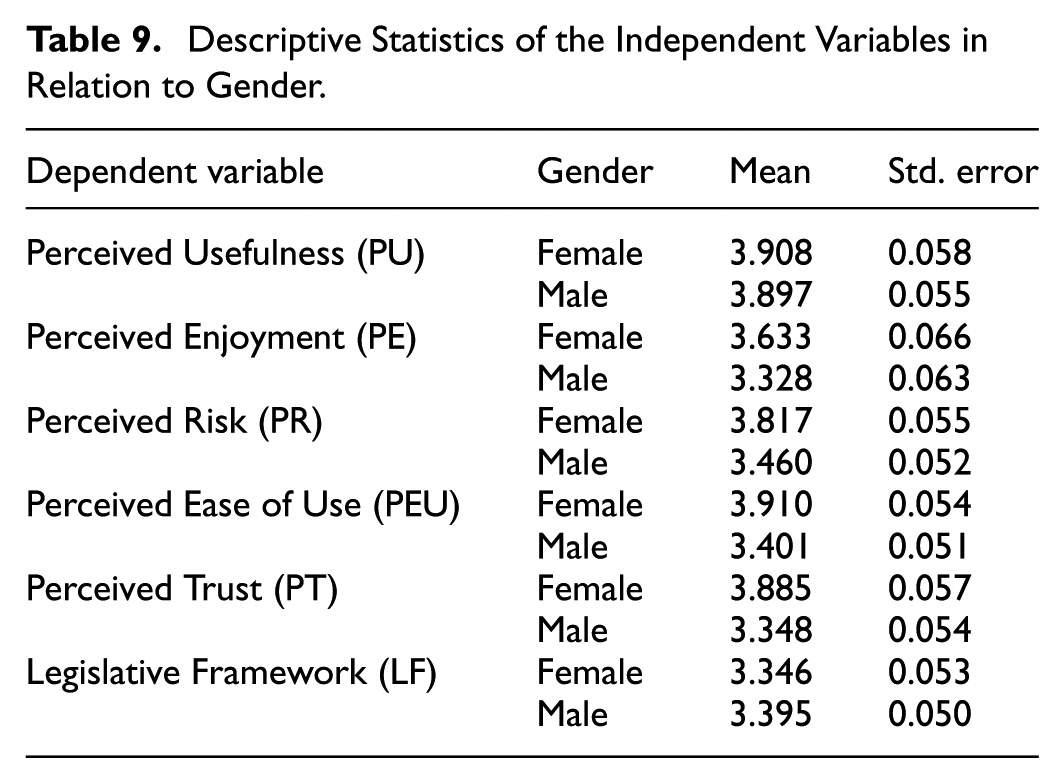
The mean scores with regard to gender (male and female) for all of the independent variables—PE, PEU, PU, PT, PR and LF, are presented separately in Table 9. Based on the mean scores presented in Table 9 regarding the independent variables, the study determines whether to accept or reject the assumed hypotheses in the current study. The mean values of Perceived Enjoyment and Perceived Risk for female respondents are significantly higher than those of male respondents; hence, hypotheses H2 and H3 are supported. On the other hand, the mean scores of Perceived Ease of Use and Perceived Trust for females are significantly lower than those of the male respondents. This supports the assumptions of hypotheses H3 and H4. Therefore, the hypotheses H3 and H4 are also supported. The mean scores for Perceived Usefulness (PU) and Legislative Framework (LF) do not differ significantly between male and female respondents. Hence, the hypotheses H1 and H6 are not supported. Table 10 presents a summary of the study’s acceptance and rejection of the hypotheses.
Descriptive Statistics of the Independent Variables in Relation to Gender.
Summary of the Test of the Hypotheses.
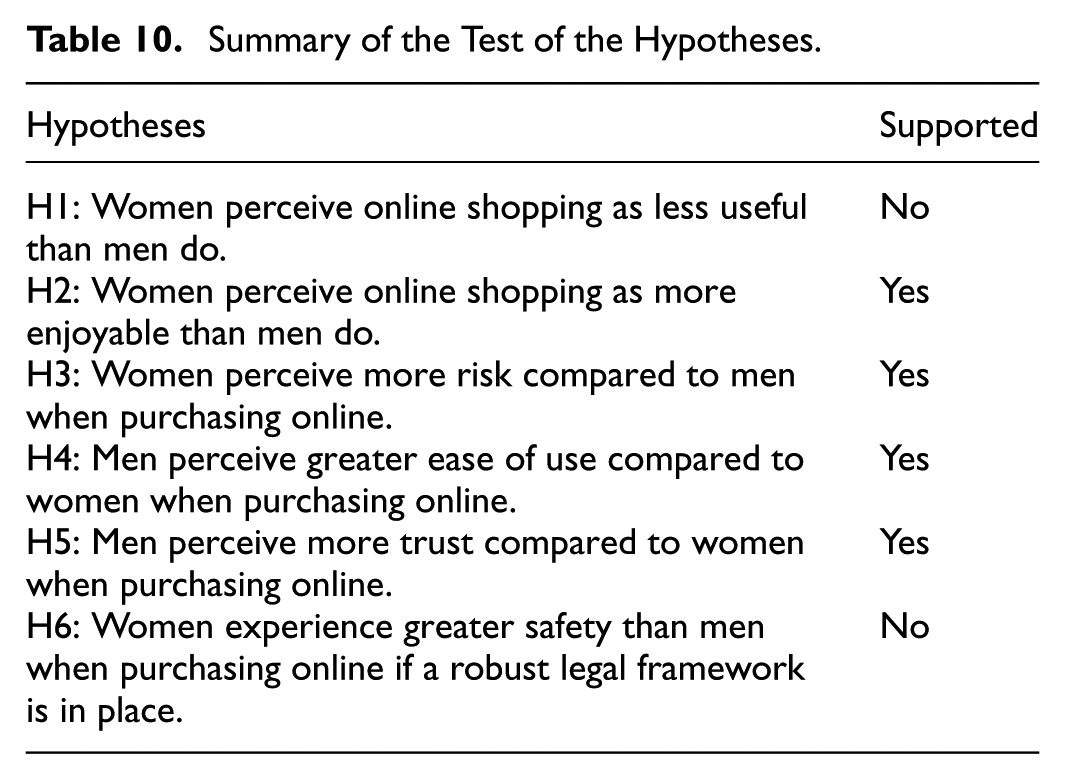
As Table 10 illustrates, out of the six hypotheses, four were supported, while two were not supported. The assumptions that have been supported show that women experience a greater level of enjoyment from internet shopping than men do. When compared to male online shoppers, female shoppers tend to perceive internet shopping as less user-friendly and therefore less trustworthy. The findings also suggest that women have a more negative perception of the perceived risks associated with internet buying than men do. The examination of the perceptions of usefulness and legal adequacy among male and female respondents revealed no significant difference, suggesting that these factors equally affect male and female online shoppers in the Bangladeshi context.
Discussion
The present study investigated six online purchasing determinants: perceived enjoyment, usefulness, trust, user-friendliness, risk and legislative adequacy among online consumers in the Bangladeshi setting. The results indicate a statistically significant difference between males and females regarding the combined dependent variables of internet purchasing. However, not all dimensions of online shopping attitude are equally affected by gender-specific behaviour. For example, perceived usefulness is not significantly affected by gender, nor is the perception of the adequacy of the legal framework. On the other hand, perceived risk, perceived ease of use, perceived enjoyment and perceived trust are affected by the perceptions of male and female online shoppers. The findings indicate that females derive greater pleasure from online buying compared to males, whereas male shoppers perceive internet shopping as more user-friendly than female consumers. Regarding the risk and trust issues, female customers perceive online shopping as much riskier and less trustworthy than male customers.
As stated earlier, females experience greater enjoyment from online shopping than males, whereas male shoppers find internet shopping more user-friendly than their female counterparts. These findings regarding gender-specific behaviour in online purchases align with previous literature examined in cross-cultural contexts (Chouhan & Kumar, 2020; Dai et al., 2019; Ellitan & Prayogo, 2022; Hasan et al., 2021; Siahaan & Nasution, 2018; Ulaan et al., 2016). Previous research has demonstrated that women who are not well-versed in technology exhibit a lower level of interest in online purchasing (Dai et al., 2019; Ellitan & Prayogo, 2022). Past studies contend that online purchasing necessitates distinct competencies, such as navigating applications, utilising one-time passwords (OTPs), and executing online payments, which may provide challenges for women less familiar with technical proficiency (Pengnate & Sarathy, 2017; Pradhana & Sastiono, 2019).
Our quantitative data analysis reveals certain advantages for females in online purchases. Our findings demonstrate that females enjoy internet shopping more than males. Some earlier studies also reported similar findings (Jain & Kaur, 2020; Siahaan & Nasution, 2018; Tutar et al., 2024). Pradhana and Sastiono (2019), who explored the Indonesian context, note that women frequently perceive shopping as a recreational rather than a chore task. Females enjoy shopping, comparing things, and spotting trends. According to Kanwal et al. (2021), women enjoy online shopping more since it offers a wide range of fashion, cosmetics, and home décor. On the contrary, men value efficiency and may find the many options daunting and time-consuming. However, some other findings, for instance, Akhlaq and Ahmed (2016) observed no significant difference in online shopping enjoyment between men and women in Pakistan.
Our analysis further revealed that male and female online shoppers had similar perceptions of usefulness and legislative adequacy, rejecting the hypotheses we assumed. However, these results both contrast and support earlier studies. For instance, Khusaini et al. (2021) found no gender differences in attitudes toward the usefulness of online shopping, supporting our findings. Hossain and Afrin (2021) discovered that men and women like online shopping equally because of its versatility. While men choose clothes, shoes, electronics, food, groceries, tickets, and hotel reservations, women prefer personal care, jewellery, cosmetics, beauty products, and home decor. Regarding the adequacy of the legal framework, Akhlaq and Ahmed (2016) found no discernible variation between male and female online shoppers, which aligns with the current study’s results.
Regarding trust and risk determinants, the current study reveals that women perceive more risk and less trust in online shopping than men. These findings are consistent with those of Sebastianelli et al. (2008). They pointed out that women are often more concerned about security and privacy issues, especially when disclosing personal information like credit card numbers. Similarly, Khatun et al. (2021) claim that women express more substantial concerns than males regarding payment security, product quality, and fraud or scams. Similar findings are also reported by Akhlaq and Ahmed (2016), who observed significant differences between male and female online consumers in terms of perceived risk and trust issues. Our findings, however, also contradict those of some earlier studies. In this vein, Pradhana and Sastiono (2019) found that while risk aversion factors have a significant impact on men’s online shopping spending, they have no discernible effect on women’s online purchasing intention.
However, these inconsistent findings, in contrast to earlier studies, require analysis considering the changing socioeconomic context of Bangladesh and the increasing participation of women in the digital economy. These changes may elucidate and justify the purchase choices and behaviours of men and women. For instance, the literacy rates are 73% for women and 79% for men, indicating a minor gender disparity (World Bank, 2024), which may positively influence women’s online purchase behaviours in contemporary Bangladesh. Furthermore, technological engagement is equitable between men and women in Bangladesh in various aspects. The Bangladesh Bureau of Statistics reported that 89.9% of males and 90% of females utilised mobile phones, while 68.9% of females and 67.7% of males accessed the internet daily in 2022 (The Daily Star, 2024). As of 2024, over 500,000 Bangladeshi Facebook company pages exist, with approximately 60,000 consistently generating sales. Babu (2024) indicates that nearly all E-commerce entrepreneurs are youthful, educated, and technologically proficient, contributing to 65% of the digital commerce company volume (including ride-sharing) and 80% of e-commerce product sales. In 2023, women owned 70% of Facebook-based businesses established since the onset of the COVID-19 epidemic, and the number of Instagram-based enterprises owned by women has risen by 65% (Seddique, 2024). The rise of women entrepreneurs in online business has encouraged female consumers to shop (Islam et al., 2023). Thus, these online shopping behaviours facilitate their shopping enjoyment. Women exhibit a greater propensity for hedonism, leading them to partake in online purchasing for pleasure, networking, and social interaction.
Further, cash on delivery constitutes the predominant payment method in these transactions, accounting for 60 to 80% of payments in 2023, affirmatively impacting women’s online shopping (Islam et al., 2023; Kader, 2024). Individuals prefer cash on delivery despite possessing credit cards or mobile money accounts, as it mitigates concerns about trust, risk, and product quality. The products may be examined upon delivery and before payment, and a return option is available. Sometimes, online purchasing is more prevalent among Bangladeshi women than men, reducing their physical shopping (Enam et al., 2024), which may facilitate enjoyment of online shopping. For women with concerns about home or safety, online shopping offers them greater mobility. As mentioned in the study’s findings, this may explain why women prefer online shopping more easily than traditional market-based shopping. However, consistent with our findings, female online shoppers in Bangladesh still perceive risk and possess less trust due to concerns about fraud, poor-quality products, and information security.
Theoretical and Practical Implications
This study uses the “Theory of Reasoned Action” (TRA) to explain rational and emotional decision-making. The TRA, established by Fishbein and Ajzen (1975), measures an individual’s willingness to perform various behaviours. This study shows that the TRA states that intents, beliefs, and motives shaped by external and internal factors drive customer behaviour (Vinerean et al., 2022). Shopping for certain items may boost women’s self-esteem and social standing, making them more emotionally committed. Online purchases by women often involve affective reasoning, demonstrating that social and emotional variables are important (Ellitan & Prayogo, 2022; Kanwal et al., 2021; Tam et al., 2020). Women prefer peer or social media approval before buying. TRA shows that women choose reputable brands and websites for their shopping habits. On the contrary, goal-oriented men may value functionality and product efficacy over emotional importance (Dai et al., 2019; Pradhana & Sastiono, 2019). Our findings also demonstrate that TRA reflects men’s online buying behaviours. Men use cognitive reasoning to make sensible, efficient purchases. Men are more familiar with technology, which makes it easier for them to make online purchases, though they also sometimes rely on expert reviews to make these purchases (Dai et al., 2019; Vinerean et al., 2022).
The current study has a broad spectrum of practical applications, given the burgeoning online market prospects within a substantial consumer society such as Bangladesh, with a population of 170 million women sharing equally. Consequently, it is imperative to implement a gender-neutral e-commerce system to ensure that both men and women reap the advantages of online buying. The present study may assist entrepreneurs and corporate executives in developing their products and service quality to motivate both genders equally while online purchasing. The study significantly contributes to organisational policies by highlighting findings that reveal gender-specific behaviours. For instance, male online shoppers are more swayed by user-friendliness and convenience, as evidenced by outcomes. In contrast, female shoppers are more influenced by a hedonistic approach, such as the enjoyment of shopping. Finally, this research contributes to understanding gender disparities in e-commerce literature, particularly in developing nations such as Bangladesh. Very few studies have examined the South Asian context, in which Bangladesh is situated, in the context of online purchasing. In the present investigation, we address the disparity and investigate whether men and women exhibit distinct responses to specific critical predictors (PE, OEU, PU, PT, PR, and LF) that impact their online purchasing behaviour.
Conclusion
Globally, the traditional market system has been transformed into a digital one due to the widespread use of the Internet. Given that Bangladesh is an emerging digital-driven economy, entrepreneurs and consumers have both possibilities and challenges in these shifting circumstances, where important demographic aspects like gender orientation play essential roles while purchasing online decisions. The present study was designed to investigate the impact of gender as an influential demographic variable on online purchasing behaviour. Gender orientation was applied to six predictors: PU, PE, PT, PR, PEU, and LF, which may assess the influence of gender on online shopping perceptions among Bangladeshi men and women. These predictors were derived from prior research observed in cross-cultural settings and contexts. Our detailed quantitative analyses have yielded nuanced insights revealing gender disparities in perceived enjoyment and user-friendliness, while commonalities exist in other factors such as perceived risk, usefulness, trust and legal adequacy. Compared to past studies, our findings are closely aligned with and contradictory to broader research on how gender orientation can influence the online purchasing decisions of men and women in distinct and similar ways. The current study emphasises that addressing these gender-specific challenges by strengthening legal safeguards and ensuring adherence to rules is essential to promoting safe and inclusive e-commerce experiences.
Limitation and Future Research
Despite the application of methodological rigours, we acknowledge that the present study has some evident shortcomings. The sample size was limited to 498 individuals, all of whom were situated in the capital city of Bangladesh, Dhaka. We recommend further investigations with more robust samples, incorporating a larger quantity, to enhance the generalizability of the results to a broader population. We do not rule out the possibility of sampling bias because we used convenience and snowball sampling. We therefore acknowledge the limitations of convenience and snowball sampling, especially with regard to external validity and broader generalisation. We recommend additional future research with a larger sample size to guarantee more representativeness and more reliable results. The present study used quantitative analysis to highlight the importance of demographic factors like gender orientation in influencing men’s and women’s online purchasing behaviours. However, consumer behaviour is intrinsically dynamic, and quantitative analysis may not provide a comprehensive understanding of the study’s context and the subjective experiences of consumers. We suggest conducting a qualitative and mixed-methods study to showcase the research context intensively and obtain more nuanced findings. Furthermore, given how quickly the digital industry and online buying scenario are evolving, the findings might not be as relevant now. We recommend that longitudinal research is required to track the psychological factors influencing online consumers’ preferences, enjoyment and convenience, trustiness, risk factors, and legal adequacy over time.
Footnotes
Acknowledgements
We acknowledge and thank the participants who took the time to complete the survey.

Ethical Considerations
This study was reviewed and approved by the Institutional Ethics Review Board (IERB) of United International University (UIU), Bangladesh, on November 17, 2024, since the study is based on the survey of human opinion. The Reference Number for approval is IREB-2024-013. After reviewing the survey instrument and the study’s methodology, the Ethical Review Board confirmed that the study was compliant with the university’s ethical standards and guidelines.
Consent to Participate
All participants received a written document outlining their informed consent for participation in the survey. Through the informed consent form, the participants were informed that their participation in this survey is voluntary and that their anonymity and the confidentiality of the responses/data were assured. The participants’ written informed consent also ensured that the data collected from them would be used for academic purposes, for example, publication of the article.
Authors Contribution
SI: Conceptualisation, methodology, critical analysis of literature reviews, formal analysis, writing original draft, producing the first edition, acquisition of funding and supervision of the project. SA: Data collection, data analysis, reviewing and editing. TA: Data collection, developing literature reviews, editing and finalising the references.
Funding
The authors received no financial support for the research, authorship, and/or publication of this article.
Declaration of Conflicting Interests
The authors declared no potential conflicts of interest with respect to the research, authorship, and/or publication of this article.
Data Availability Statement
Data is available on request.