




Abstract
The trend to shop secondhand products (SHPs) is accelerating owing to a substantial interest of customers particularly toward online shopping of SHPs. Drawing on the expectation–confirmation model (ECM), this study aims to examine the relationships among customer expectation, perceived enjoyment, perceived ease of use (PEOU), satisfaction, and repurchase intention of online shopping of used products. Data were collected using a convenience sampling technique from 400 Chinese shoppers often acquire used products online. The results revealed that expectation significantly affects perceived enjoyment, PEOU, and satisfaction. The findings further reported that perceived enjoyment has a positive influence on satisfaction and repurchase intention. Likewise, satisfaction has a positive direct effect on repurchase intention. Our results affirmed that satisfaction partially mediates the relationships among expectation, perceived enjoyment, and repurchase intention, whereas no mediation established among PEOU, satisfaction, and repurchase intention. Finally, an insignificant effect of PEOU on satisfaction and repurchase intention was observed. The study empirically furnishes insightful information for the organizations to offer SHPs online to enhance organizational profit. Theoretical and managerial implications along with research opportunities are reported.
Keywords
Introduction
The scope of information technology (IT) has dramatically progressed in recent years. Such expansion has widely been shifted the way of managing business operations. Simultaneously, an Internet and varied of electronic gadgets rehabilitated the way of communication, shopping, and brought additional services for better customer service with respect to quality and speed (Guiot & Roux, 2010; Hennig-Thurau et al., 2010). IT has shaped the innovative promotional ideas for the advertisers where a Web is one of the prime inventions to broadcast information in a better and productive way. Because of IT growth, selling secondhand products (SHPs) online is an entirely new idea for businesses (Dellarocas, 2003; Jiang & Benbasat, 2007). Customers prefer to buy online products because of convenience, product variety, time-saving, and easy to find an affordable price (Hennig-Thurau et al., 2010; Koong, Liu, Bai, & Wei, 2008; Waheed & Yang, 2018). To squeeze this trend, many companies provide the facility to buy SHPs online in China such as Taobao (Schaefer, 2016), Zhuanzhuan, and Kongfz. Taobao is the most famous and largest retail platform to buy products online. Taobao has launched its online retail platform for SHPs to assist nearly 200,000 daily sales of SHPs (Schaefer, 2016). However, according to the recent report issued by Coresight.com, China’s recommerce or digital flea market is growing, which leads by two integrated platforms, for example, Taobao Xianyu and Zhuanzhuan with more than 90% combined market share (Deep dive: China’s online fashion recommerce market-part 1-2, 2017).
The shopping for SHPs and browsing at flea markets were considered a niche activity (Guiot & Roux, 2010), where such trend highly emerged in recent years. SHPs have received amplified attention over the past years (Roux, 2006). There are numerous factors that attract the customers to buy SHPs such as minimizing household consumption cost (Roux, 2006), provision of financial benefits (Williams & Paddock, 2003), affordable price (Guiot & Roux, 2010), availability of wide range (Roux & Guiot, 2008), outlets opportunities for searching unusual items (Roux & Guiot, 2008), attractive environment (Roux, 2006), attractive for lower income populations (Williams & Paddock, 2003), great interest of buyers in SHPs (Guiot & Roux, 2010), economic necessity (Williams & Paddock, 2003), less expensive with more advantages (Cervellon, Carey, & Harms, 2012), uniqueness (Cervellon et al., 2012), and reduction in budgetary pressure of the shoppers (Guiot & Roux, 2010). Furthermore, secondhand shopping has become part and parcel of human’s daily life, which is a growing phenomenon and getting tremendous attention concerning consumers and retailing research (Roux & Guiot, 2008). Nowadays, almost every product can be searched online anytime and anywhere at a reasonable price (Hennig-Thurau et al., 2010). A low transaction and Internet search costs (Ghose, Smith, & Telang, 2006) have extensively assisted consumer-to-consumer (C2C) transactions.
In various dimensions, numerous scholars have studied an online shopping phenomenon and consumers’ behavior within the diverse domain (Bai, Law, & Wen, 2008; Lian & Lin, 2008; Nawi, Al-Mamun, & Raston, 2015; Waheed & Jianhua, 2018; Wen, Prybutok, & Xu, 2011). However, there is not enough literature available related to online shopping with respect to SHPs with consideration of customers expectation (EXP), perceived enjoyment (PE), perceived ease of use (PEOU), satisfaction (SAT), and repurchase intention (RPI). This research contributes to the literature on marketing with empirical results from the Chinese context. In addition, we focus on SHPs (i.e., apparel and books) because apparel is a top-selling category with selling operations through Xianyu, which estimated 170 million sales of used products till March 2016 (Deep dive: China’s online fashion recommerce market-part 1-2, 2017). The findings of the research could benefit secondhand players, policy makers, managers, and practitioners to understand buyers’ perceptions and to explain whether used goods’ availability influences customers’ satisfaction, which, in turn, repurchase intention.
Inspired by the previous studies (Bhattacherjee, 2001; Hsu, Chang, & Chuang, 2015; Joo, Park, & Shin, 2017; Thong, Hong, & Tam, 2006), we applied Bhattacherjee’s (2001) expectation–confirmation model (ECM) to examine the factors affecting RPI of SHPs online. For instance, in marketing, Bhattacherjee (2001) proposed ECM, which is retrieved from expectation–confirmation theory (ECT). ECT is widely used in the marketing field to study buyers’ satisfaction and RPI. ECM is applied to emphasize on post-expectations of the customer and illustrated the relationships among EXP, SAT, and RPI. It is justifiable to apply ECM to explain SHPs buyers’ behavior. PEOU and PE constructs are added to the model where it is affirmed by earlier studies that PEOU influences SAT (Hammoud, Bizri, & El Baba, 2018; Liao, Chen, & Yen, 2007; Thong et al., 2006) and intention to continuance use (Okumus & Bilgihan, 2014) or intention to continuance IT usage (Thong et al., 2006). Similarly, PE significantly influences the SAT and intention to continuance (Hsiao, Chang, & Tang, 2016; Oghuma, Libaque-Saenz, Wong, & Chang, 2016). Finally, each of the research constructs, that is, dependent, independent, and mediating variables are described as follows (Table 1).
Definition of the Latent Variable.

Note. Computed by authors.
The rest of the study is organized as follows. First, an overview of the comprehensive literature related to Bhattacherjee (2001)—ECM, SHPs, EXP, PE, PEOU, SAT, and RPI—is reported as groundwork for the formation of the hypotheses. The methodologies are presented immediately after the literature. The results and findings are accordingly discussed. Theoretical implications of the research and managerial implications are given after the results and findings. In concluding remarks, the study’s limitations and future opportunities are discussed.
Literature Review and Hypotheses Development
ECM
Bhattacherjee (2001) proposed an ECM based on ECT. ECM has been extensively tested in marketing, technological environment, and IT domain by experts to examine such as the factors affecting RPI (Wen et al., 2011), digital textbooks (Joo et al., 2017), mobile instant messaging users (Oghuma et al., 2016), e-commerce and consumer repeat purchase intention (Hsu et al., 2015), e-service (Liao et al., 2007), mobile social apps users (Hsiao et al., 2016), and mobile Internet users (Hong, Thong, & Tam, 2006). ECT explains that the user purchasing experience has a significant influence on proceeding-behavior such as customer expectation, disconfirmation, attitude, satisfaction, and intention to continuance use (Oliver, 1980). In marketing, ECT is widely used to study the users’ expectation, satisfaction, repurchase, or postpurchase behavior (Dabholkar, Shepherd, & Thorpe, 2000). If the perceived value of good or service meets customers’ expectation, customers would be satisfied; as a result, customers more likely would use IT for online purchasing (Bhattacherjee, 2001). Inspired by the study by Hsu et al. (2015), we cited some prior studies on ECM and their findings (see Table 2).
Prior Studies on ECM and Findings.

Note. ECM = expectation–confirmation model; → = significant.
Not significant.
SHPs
Roux and Guiot (2008) defined SHPs as “the extent to which an acquisition of used objects takes place.” Scholars have studied SHPs or secondhand marketplace in different contexts (Brengman, Geuens, & Faseur, 2002; Cervellon et al., 2012; Ghose, 2009; Ghose et al., 2006; Guiot & Roux, 2010). Selling of SHPs based on the Internet has reduced the transactions cost, time, and search cost both for buyers and sellers (Ghose et al., 2006). The secondhand products’ market is proliferating (Guiot & Roux, 2010). Although used items are often not packed and warranty does not exist (Guiot & Roux, 2010), providing more productive information (i.e., quality of the product) may still encourage the buyers to purchase such SHPs (Stroeker & Antonides, 1997).
EXP, PE, and PEOU
In digital environments, scholars confirmed that EXP positively influences PE (Joo et al., 2017; Oghuma et al., 2016). Studies affirmed a positive relationship between confirmation and PE (Oghuma et al., 2016) or expectation and PE (Thong et al., 2006). Once the users’ expectation with an initial experience is satisfied, they likely to use such services to maintain the cognitive balance (B. Kim, 2010). According to Joo et al. (2017), expectation has a significant correlation with PE.
The researchers have studied PEOU in different contexts and suggested PEOU as a key element of technology acceptance model (TAM) and continuance usage behavior (Davis, 1989; Moon & Kim, 2001). In prior literature with respect to TAM, PEOU has been widely used to describe user behavior and IT adoption. PEOU is an essential user perception and cognitive belief in defining users’ attitude toward IT adoption and usage behavior (Davis, 1989; Thong et al., 2006). Numerous studies (Hong et al., 2006; Liao et al., 2007) confirmed that expectation influences PEOU. If the interaction medium (i.e., website or apps) is not user-friendly, easy to use, or effortless, it can negatively influence customers’ attitude during the online shopping process. The following hypotheses are formed to examine the relationships from the Chinese context:
EXP, PE, PEOU, and SAT
It is observed in the past studies that there is a positive correlation between EXP and SAT (Hsu et al., 2015; Joo et al., 2017). According to Parasuraman, Zeithaml, and Berry (1988), EXP is the users’ perception and feelings about product or service. Diverse researchers have defined that EXP is a crucial element of SAT and suggested on how to meet, fulfill, and manage such circumstances (Boulding, Kalra, Staelin, & Zeithaml, 1993; Kotler, 2000). It is crucial to manage expectation to achieve a high level of satisfaction (Hsieh, Yuan, & Kuo, 2011).
PE is the users’ experience of fun, happiness, and interest, which could be evaluated during the shopping process (Arnold & Reynolds, 2003). Several studies examined the relationships between EXP, PEOU, PE, and SAT in different contexts (Hong et al., 2006; Hsu et al., 2015; Thong et al., 2006). Besides, the studies on PE and SAT were conducted in unlike contextualization by experts, such as the study of Joo et al. (2017) on digital textbooks, Jung and Chung (2012) on Internet Protocol TV, Hsiao et al. (2016) on mobile social apps, Lin, Wu, and Tsai (2005) on Web-portal site users, and the research of Oghuma et al. (2016) on mobile instant messaging that affirmed a positive outcome between PE and SAT.
PEOU is a user belief where a particular system must be explicable, easy to know, and free of effort (Davis, 1989; Jen & Hung, 2010). Few scholars affirmed a nonsignificant relationship between PEOU and SAT (D. Kim & Chang, 2007), as well as PEOU and RPI or intention to continuance (Premkumar & Bhattacherjee, 2008; Venkatesh & Davis, 2000). However, Liao et al. (2007). However, Hong et al. (2006) confirmed a significant relationship between PEOU and SAT. Furthermore, ease of use, efficiency, reliability, communication, responsiveness, privacy, and security have a significant influence on satisfaction (Hammoud et al., 2018). Hence, we developed the following relationships to explore the linkage from the Chinese consumer’s market:
PEOU and PE
The relationship between PEOU and PE is evaluated in various contexts (Igbaria, Iivari, & Maragahh, 1995; Van der Heijden, 2004). The study by Igbaria et al. (1995) reported that PEOU strongly correlated with both intrinsic, that is, PE and extrinsic motivation, that is, PU. Igbaria et al. (1995) found a substantial direct effect of PEOU on PE. Moreover, researchers confirmed that PEOU has a positive relationship with PE (Davis, Bagozzi, & Warshaw, 1992; Teo, Lim, & Lai, 1999). With the intention to above importance of PEOU with respect to PE, we hypothesized the following association:
SAT, PE, PEOU, and RPI
Satisfaction is an essential and crucial construct in marketing (McQuitty, Finn, & Wiley, 2000). It is an indispensable factor to increase RPI and to establish a long-term relationship between company and customers, particularly in online shopping (Lee, Lee, Lee, & Babin, 2008; Wen et al., 2011). Wen et al. (2011) confirmed that SAT has a direct and indirect influence on consumers’ continuance intention. Prior studies in the technological contexts have shown the significant effects of SAT toward RPI (Hsiao et al., 2016; Oghuma et al., 2016). SAT is a reliable and good predictor of purchase attitude (e.g., purchase intention, brand choice, repurchase intention, or continuance intention to use), which contributes a vital role (McQuitty et al., 2000; Oliver, 1993).
PE is a consistent predictor of behavior (Childers, Carr, Peck, & Carson, 2001). The hedonic factor (i.e., perceived enjoyment) influenced positively the online RPI (Wen et al., 2011) either on purchasing attitude or intention to buy or both (Koufaris, Kambil, & LaBarbera, 2001), intention to continuance use of blogs (Shiau & Luo, 2013), continuance use of mobile instant messaging (Oghuma et al., 2016), and continuance use of mobile social apps (Hsiao et al., 2016). PEOU has a dual effect (direct and indirect) on consumer online shopping intention. The literature reported that PEOU has a positive relationship with the intention to continuance use of Smartphone apps (Okumus & Bilgihan, 2014) and continuance intention of using the mobile Internet (Hong et al., 2006). In summary, the hedonic factor (i.e., PE), utilitarian factor (i.e., PEOU), and psychological/social factors (i.e., trust and satisfaction) directly and indirectly influenced buyers’ intention continuance in the online shopping (Wen et al., 2011). The following hypotheses are developed, and the summary of all proposed relationships are shown in Figure 1:

Research framework.
Methodology
Sampling and Data Collection
Data collected from 400 respondents based on a convenience sampling technique between the period of May 2018 and June 2018. The respondents who preferably purchase online SHPs within the domain of China were approached (see Table 3). Initially, the anticipated respondents were 500, and the surveys were circulated. However, we finalized 400 valid responses after deleting improperly filled or doubted questionnaire indicating 80% response rate. Questionnaires were distributed through an online approach based on the 25-item scale, including 6 demographic items. There were more female respondents (299 responses, 74.8%) than male respondents (101 responses, 25.3%). Although the salary of a person depends on experience, education, skills, locations, industries, private sector, government sector, and remainder roles and regulations. Nevertheless, the average white-collar salary stands between US$900 and US$1500, whereas salary for senior-level job holders stands between US$1,500 and US$3,000 in China (“China White-Collar Average Salary Dips in the First Quarter of 2018,” 2018). However, the monthly income of the current respondents ranged from $500 to $900 (see Table 3). In addition, Table 3 shows the detail descriptions of participant’s attributes.
Respondents Profile (n = 400).

Other professional diploma holders.
Instruments and Selection
Five constructs are used such as EXP, PE, PEOU, SAT, and RPI. The questionnaire was developed in English and translated into Chinese with the help of the professor and lab fellows. We used both languages in the questionnaire during the data collection procedure for a better and clear understanding of each statement. The construct for EXP, PE, PEOU, and RPI formed based on a 7-point Likert-type scale (ranged, 1 = strongly disagree to 7 = strongly agree), whereas SAT construct was developed based on a 7-point Likert-type scale (ranged, 1 = strongly dissatisfied to 7 = strongly satisfied). Cronbach’s alpha values of all constructs were above 0.70 (Table 5). Besides, the scale developed by Bhattacherjee (2001) was adapted to examine EXP and RPI. SAT was measured using Bhattacherjee (2001) and M.-J. Kim, Chung, and Lee (2011) scale. PEOU and PE instruments were measured using the Moon and Kim (2001) scale (see appendix).
Data Analysis
Data were analyzed using SmartPLS 3 (Ringle, Wende, & Becker, 2015) and SPSS 21 to test the proposed hypotheses. SmartPLS software was used to evaluate and interpret the PLS-SEM model, whereas SPSS was used to estimate the inter-construct correlation and descriptive statistics, including Skewness and Kurtosis. Following the study of Joo et al. (2017), Skewness and Kurtosis were examined to make sure either data are normally distributed. The inter-construct correlation among the variables was evaluated along with the mean and SDs of the variables. Finally, SEM was performed to investigate the relationships among EXP, PE, PEOU, SAT, and intention to repurchase with respect to online SHPs.
Results
Table 4 shows the values of inter-construct correlation, mean, SD, Kurtosis, and Skewness, respectively. The values of the mean range from 3.40 to 4.08, SD range from 0.99 to 1.21, Skewness range from −0.06 to 0.10, and Kurtosis range between −0.02 and 0.77, respectively. Hence, there is no considerable issue in the collected data because the value of Kurtosis was below 10 and the value of Skewness is below 3 (Kline, 2011). The correlation among the constructs was statistically significant (see Table 4).
Correlation and Descriptive Analysis.

Note. SK = skewness; KT = kurtosis; EXP = expectation; PEOU = perceived ease of use; PE = perceived enjoyment; SAT = satisfaction; RPI = repeat purchase intention.
Correlation significant at .01 level.
Measurement Model
Overall goodness-of-fit of the SEM structural model was analyzed by a standardized root mean square residual (SRMR) and the normed-fit index (NFI). According to Hu and Bentler (1998), the threshold value of SRMR is 0.08, where the lowest value indicates superior fitness. In this study, the SRMR value is 0.06, which is lower than the suggested 0.08 level (Hu & Bentler, 1998). According to Bentler (1990), the value of NFI should between 0 and 1, in which higher values representing a better model fit (Bentler, 1990). The value of NFI is 0.78, which is closer to 1 and is acceptable (Bentler, 1990). To examine the reliability of the constructs, α was calculated. The minimum acceptable value for α is 0.7 (Nunnally, 1978). Furthermore, convergent validity (CV) and discriminant validity (DV) was analyzed, in which CV was examined using recommended criteria (Fornell & Larcker, 1981), where factor loadings (FL) should be exceeded 0.5, construct reliabilities should higher than 0.8, and average variance extracted (AVEs) should be higher than 0.5. The results indicate that FL values are above the recommended 0.7 level except for two items (PEOU1 and PEOU3). Composite reliability (CR) of all variables greater than 0.8, and AVEs of all constructs have exceeded the threshold 0.5 value. The detail description is given in Table 5.
Reliability and Validity Results.

Note. FL= factor loadings; α = Cronbach’s alpha; AVE = average variance extracted; CR = composite reliability; EXP = expectation; PE = perceived enjoyment; PEOU = perceived ease of use; SAT = satisfaction; RPI = repurchase intention.
Furthermore, DV evaluates whether indicators are sufficiently differentiating among each other. It is confirmed by the square root of AVE of each variable, where outcome values of AVE should be greater than inter-construct correlation (Fornell & Larcker, 1981). Table 6 presents the DVs of all constructs that depict the adequate values.
Discriminate Validity.

Note. Correlations (non-bold); square root of AVE in bold. PEOU = perceived ease of use; PE = perceived enjoyment; EXP = expectation; RPI = repurchase intention; SAT = satisfaction; AVE = average variance extracted.
Structural Model
Bootstrapping with a random sample of 5,000 was run to calculate the results for hypotheses testing as suggested tool by Chin (2010) and Sanchez (2013). The results supported all hypotheses except two, i.e., PEOU to SAT and PEOU to RPI. First, the effect of EXP on PE was accepted at β = 0.741***, t = 29.14, p < .001. The influence of EXP on PEOU was found significant at β = 0.219***, t = 3.910, p < .001. Similarly, H3 relationships such as EXP to SAT, H4 relationships such as PE to SAT, and H6 relationships such as PEOU to PE are supported at β = 0.540***, t = 11.28, p < .001; β = 0.282***, t = 5.480, p < .001; and (β = 0.102***, t = 2.930, p < .001; respectively. The relationships proposed in H7 such as SAT to RPI and H8 such as PE to RPI have strong significant impact on RPI at β = 0.358***, t = 7.550, p < .001 and β = 0.517***, t = 11.39, p < .001, respectively. The effect of PEOU to SAT proposed in H5 and PEOU to RPI in H9 that is found nonsignificant at β = −0.033, t = 0.880, p > .05 and β = 0.050, t = 1.590, p > .05 are summarized in Table 7 and Figure 2.
Hypotheses Testing.

Note. H = hypotheses; EXP = expectation; PE = perceived enjoyment; PEOU = perceived ease of use; SAT = satisfaction; ns = not significant; RPI = repurchase intention; bootstrapping sample = 5,000.
p < .001.

Structural model with path coefficients.
Mediation Analysis
The mediation performed following the procedure of Hair, Hult, Ringle, and Sarstedt (2016). First, the direct effect (without a mediator) of EXP, PE, and PEOU toward RPI was measured. Thereafter, an indirect effect with the mediator was examined. The total effect of EXP, PE, and PEOU toward RPI was determined, respectively. The results showed that SAT partially mediates the effect of EXP and PE on RPI, which depicts SAT as an essential construct in customer’s RPI with respect to online SHPs. In comparison, SAT did not mediate the effects of PEOU on RPI. In summary, SAT partially mediates the effect of EXP and PE toward RPI, whereas no mediation found between PEOU and RPI through SAT, respectively (see Table 8).
Mediation Analysis.
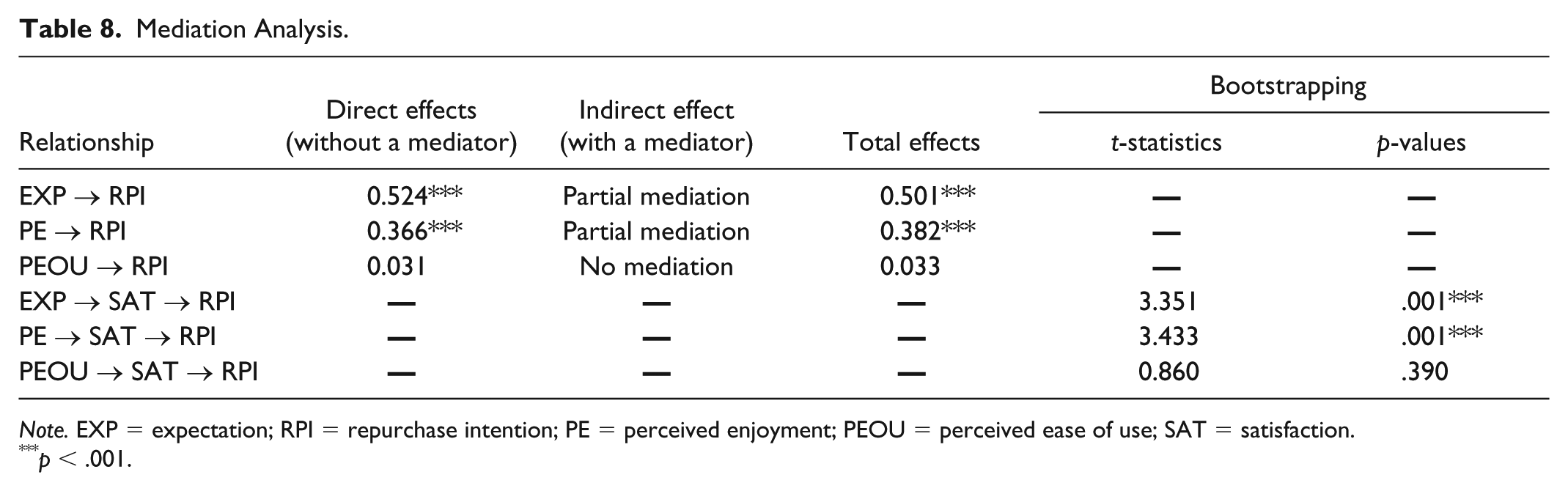
Note. EXP = expectation; RPI = repurchase intention; PE = perceived enjoyment; PEOU = perceived ease of use; SAT = satisfaction.
p < .001.
Discussion and Implications
Although the agenda of this study was encouraging the firms to sell SHPs particularly through online platforms to ensure its potential in enhancing firms’ profit and facilitating those consumers who often prefer to obtain SHPs because of budgetary concern. Therefore, this study furnishes an important step comprehending the relationships among EXP, PE, PEOU, SAT, and RPI of online SHPs based on Bhattacherjee’s (2001) ECM with empirical results. The results revealed that EXP significantly affects PE, PEOU, and SAT. The findings further showed that PE has a strong positive influence on SAT and RPI. PEOU has significant effects on PE. Furthermore, the results showed that SAT partially mediates the relationships between EXP, PE, and RPI, whereas no mediation was found between PEOU, SAT, and RPI. Finally, the effect of PEOU on both satisfaction and RPI was found insignificant. This study has several implications based on such findings as follows.
First, EXP significantly affects PE, PEOU, and satisfaction as supported by prior studies (Hong et al., 2006; Joo et al., 2017; Liao et al., 2007). The results show that EXP has a positive relationship with PE, PEOU, and satisfaction. Second, prior studies found a significant effect of PE on satisfaction, RPI, or intention to continuance (Hsiao et al., 2016; Jung & Chung, 2012; Wen et al., 2011). Likewise, the current results are in line with earlier studies because we found the strong relationships between PE, satisfaction, and RPI. Third, scholars studied the relationship between PEOU and PE where PEOU significantly affects PE (Teo et al., 1999; Van der Heijden, 2004). The findings of this study are similar to prior studies (Teo et al., 1999; Van der Heijden, 2004). Fourth, according to earlier studies, satisfaction is the strong predictor of RPI (Hsu et al., 2015), it is the main factor of intention to continuance (Ifinedo, 2018), and it directly and indirectly influences RPI in online shopping (Wen et al., 2011). Our results are in accord with the literature; for example, this study also claims that SAT is the strong predictor of intention to repurchase of SHPs online, and has a direct and indirect influence on RPI. Finally, current results revealed that PEOU has nonsignificant influence both with satisfaction (β = −0.033; p > .05) and intention to repurchase of SHPs online (β = 0.050; p > .05), where such results are consistent with the few studies (D. Kim & Chang, 2007; Premkumar & Bhattacherjee, 2008; Venkatesh & Davis, 2000). The study of D. Kim and Chang (2007) found nonsignificant (β = −1.32; p > .05) relationship between PEOU and SAT, whereas the study of Premkumar and Bhattacherjee (2008) reported nonsignificant (β = 0.08; p > .05) relationship between PEOU and intention to continuance.
This study suggests that organizations should offer online SHPs to enhance organizational profit, especially in developing countries like China because most of the customers preferred to purchase SHPs (Guiot & Roux, 2010), because SHPs are less expensive (Cervellon et al., 2012). Our findings showed that customers’ expectation and PE are strong determinants influencing customers’ satisfaction and RPI in online shopping of SHPs. The results further indicated that secondhand online players must develop appropriate customer expectation level, modify marketing strategy/programs, and strive to fulfill buyers’ expectations and needs to enhance customer satisfaction level, enjoyment, ease of use, and repeat purchase. For example, the expectation may differ across diverse buyers; consequently, a better approach for online secondhand retailers to evaluate customer expectations (EXP) is to segment customers with respect to customers’ needs and blend marketing mix for each segment (Bhattacherjee, 2001). In marketing, SAT is a crucial index and key predictor to build a long-term relationship with customers and RPI (Bai et al., 2008; Hsu et al., 2015). In e-commerce, SAT is a strong construct that directly influences RPI (Wen et al., 2011). Several success factors are observed for business, where SAT is one of the key factors. To build a dynamic and profitable relationship with customers, companies need to meet customers’ expectation. In addition, EXP, PE, and SAT are significant predictors of customers RPI, especially in an online shopping and intention to continuance (Hong et al., 2006; Hsiao et al., 2016; Hsu et al., 2015; Khalifa & Liu, 2007; Thong et al., 2006; Wen et al., 2011).
In a theoretical standpoint, this article provides empirical evidence to contribute to the growing literature on customer perception, PE, PEOU, satisfaction, and RPI with respect to online SHPs. In the past, few quantitative studies are witnessed in such domain, especially in developing countries like China. This article is based on quantitative research where primary data were obtained from 400 secondhand Chinese consumers to fill such a literature gap. This research might be undertaken as an extension of ECM of Bhattacherjee (2001) within a marketing context. In e-commerce of SHPs, this research contributes to the prior academic literature related to SHPs in distinct contextualization (Cervellon et al., 2012; Ghose et al., 2006; Guiot & Roux, 2010; Roux & Guiot, 2008).
In a managerial standpoint, we focused on such consumers who preferably buy SHPs using the Internet, particularly low-income consumers in China. For instance, the worth of China recommerce market is nearly ¥400 billion as of 2016 (Deep dive: China’s online fashion recommerce market-part 1-2, 2017). Our results depict that secondhand players can employ online platforms to support digital buyers to seek desired SHPs to enhance customer’s engagement and their unique experience, especially for lower income populations. Our findings can be applied to secondhand players who wish to amplify organizational profit, customer’s support, and maintaining the positive connections with low-level income customers by offering online SHPs.
The findings additionally asserted that customers enjoy shopping of SHPs and subsequently wish to repurchase. Such a trend has shifted over the past years due to the recent technological advancement and societal development regarding used products shopping (Guiot & Roux, 2010). Consequently, firms may shape such strategies in which SHPs might be offered for such low budgetary customers. Finally, our results indicate that secondhand marketers should ensure the customers that buying used products is an easy, secure, and user-friendly process. For example, several studies advocated that PEOU is a prime element of continuance usage behavior (Davis, 1989; Moon & Kim, 2001). Hence, it is suggested to the management that the interaction medium (i.e., website or apps) should be user-friendly and easy to use that positively and fruitfully influence customers’ attitude during the online shopping process. We suggest the companies introduce SHPs on online platforms for customer’s convenience, which ultimately will lead to profit maximization.
Limitation and Further Research
Although this study found the interesting findings, however, still limitations exist, which could be undertaken in the future work. First, the sample was limited to 400 respondents where female respondents were higher than male respondents. The future studies might be performed increasing samples size with an equal ratio of male and female respondents. Second, data were collected from China, which is a developing country. In contrast, the comparison between developing and developed countries might be performed in the further study with respect to SHPs. Third, we just verified the mediating role of customers’ satisfaction though scholars can conduct another study adding additional mediators such as perceived trust, risk perception, and shopping habits. Finally, the authors did not use any particular moderating variable, consequently new research should be conducted, including moderators among the relationships of EXP, PE, PEOU, SAT, and RPI in terms of SHPs within Chinese market and global arena.
Footnotes
Appendix

| Construct | Items | Source |
|---|---|---|
| Customer expectation | 1. My experience with online shopping of used products was better than what I expected. | Bhattacherjee (2001) |
| 2. The service level provided by online shopping sites for used products was better than what I expected. | ||
| 3. Overall, most of my expectations with online shopping of used products were confirmed. | ||
| Perceived ease of use | 1. It is difficult for me to place an online order for used products. | Moon and Kim (2001) |
| 2. It will be impossible to place an online order for used products without expert help. | ||
| 3. It takes too long a time to place an online order for used products. | ||
| 4. Online shopping for used products requires a lot of mental effort. | ||
| Perceived enjoyment | 1. I enjoy online shopping for used products. | Moon and Kim (2001) |
| 2. Online shopping of used products gives enjoyment to me. | ||
| 3. Online shopping for used products gives fun to me. | ||
| 4. Online shopping for used products keeps me happy. | ||
| Satisfaction | 1. I am very satisfied with the online shopping of used products. | Bhattacherjee (2001); M.-J. Kim, Chung, and Lee (2011) |
| 2. The online shopping sites service provider of used products has met my expectations. | ||
| 3. I am absolutely delighted with online shopping of used products. | ||
| 4. Overall, how satisfied are you with online shopping for used products? | ||
| 5. I was satisfied with the online buying of used products when compared with offline buying. | ||
| Repurchase intention | 1. I intend to continue online shopping of used products rather than discontinue its use. | Bhattacherjee (2001) |
| 2. My intentions are to continue online shopping of used products than using any alternative means (offline shopping). | ||
| 3. If I could, I would like to discontinue my use of online shopping of used products (reverse coded). |
Acknowledgements
We are grateful to our professor for his support in overcoming several obstacles throughout the research. We would like to thank our colleagues for their help and feedback during the accomplishment of the article, especially during the data collection procedure. The authors are further fancy to thank the editor and the anonymous reviewers for their valuable remarks and insightful suggestions to improve the quality of this piece of work.
Declaration of Conflicting Interests
The author(s) declared no potential conflicts of interest with respect to the research, authorship, and/or publication of this article.
Funding
The author(s) received no financial support for the research, authorship, and/or publication of this article.
