




Abstract
The major contribution of present study is to revisit how consumer obtain high adoption intention of artificial intelligence (AI)’s production/service based on symmetric and asymmetric thinking in data analysis. In recent years, technology involving AI has become key technology for success worldwide and has received prominence among academics and practitioners. Accordingly, it is necessary to identify the relationships among relationship marketing, AI perceived usefulness, perceived ease of use, perceived risk, and adoption intention. The main contribution of the symmetric approach (i.e., SEM, structure equation modeling) is to test the research hypothesis to determine the net effect between the variables, and asymmetric approach (i.e., fsQCA, fuzzy set qualitative comparative analysis) contributes to the identification of sufficient conditions leading to high level adoption intention in the concept of fuzzy sets. With symmetric approach, results of path analysis of SEM indicate that impacts of trust are greater than that of commitment. Similarly, perceived usefulness of AI has a greater impact on the adoption intention. Furthermore, AI perceived risk is negative associate with adoption intention. With asymmetric approach, intermediate solutions from fsQCA show that there are three sufficient conditions for high adoption intention of AI. For instance, one of configurations or sufficient conditions is trust, commitment, and AI perceived usefulness present but perceived ease of use absent.
Plain Language Summary
The major contribution of present study is to revisit how consumer obtain high adoption intention of artificial intelligence (AI)’s production/service based on symmetric and asymmetric thinking in data analysis. The main contribution of the symmetric approach (i.e., SEM, structure equation modeling) is to test the research hypothesis to determine the net effect between the variables, and asymmetric approach (i.e., fsQCA, fuzzy set qualitative comparative analysis) contributes to the identification of sufficient conditions leading to high level adoption intention in the concept of fuzzy sets. With symmetric approach, results of path analysis of SEM indicate that impacts of trust are greater than that of commitment. Similarly, perceived usefulness of AI has a greater impact on the adoption intention. Furthermore, AI perceived risk is negative associate with adoption intention. With asymmetric approach, intermediate solutions from fsQCA show that there are three sufficient conditions for high adoption intention of AI. For instance, one of configurations or sufficient conditions is trust, commitment, and AI perceived usefulness present but perceived ease of use absent.
Keywords
Introduction
For nearly a 100 years, technological innovation has continuously improved human life. In the digital age, AI can be used to enhance perception and expand our sense of reality in many ways (Al Halbusi, 2023). However, will human intelligence prefer to use products or services based on artificial intelligence technology? What factors influence adoption intention? Are their effects different? Are there sufficient conditions that would surely lead to a high level of adoption intention? To answer these questions, this study contributes to extend knowledge of relationship marketing and technology acceptance model (TAM) to measurement of adoption intention in AI market based on perspectives of symmetric (i.e., exploring the difference in impact) and asymmetric (i.e., exploring the sufficient condition of high level of adoption intention) thinking in data analysis.
In recent years, AI-related technologies has received prominence among academics and practitioners (e.g., Adel et al., 2022; Boaventura et al., 2022; Colombo et al., 2019; Gursoy et al., 2019; Khan et al., 2021; van Esch et al., 2019). The development of AI is becoming more and more important globally (Suh & Ahn, 2022). AI-related technology is a key strategic element on a global market. AI technology has the potential to reduce the workload of laborers (Yunjiu et al., 2022). The use of AI devices to replace human existence has always been a controversial topic, so that most consumers do not have a firm stand on whether to accept or reject AI devices and robots (Gursoy et al., 2019). Jarrahi (2018) proposes that AI has penetrated many organizational processes, and it is necessary to understand complementarity of humans and AI. Human-computer communication has not yet been popularized, and the rules of human-computer interaction need to be explored urgently. Accordingly, the present study focuses on AI and proposes that managers must understand customer behavior in AI-related marketing strategy to enhance competition of business activities. To evaluate or explore consumer behaviors of new technology, several study of social sciences or consumer behaviors are paying much attention to technology acceptance model (TAM), theory of planned behavior (TPB) (e.g., Baby & Kannammal, 2020; Boley et al., 2018; Chuah et al., 2021; Singh & Verma, 2017), or their extentions, such as interactive technology acceptance model (iTAM) (e.g., Go et al., 2020), TAM2 (e.g., Wang et al., 2022), or technology-organizational-environment (TOE) (e.g., Chatterjee et al., 2021). Although these are well-known adoption models, this study focuses on analyzing the consumer behavior related to AI products or services based on symmetric and asymmetric approaches. Accordingly, the present study contributes to revisit relationships among relevant antecedents of adoption intention based on TPB and TAM. TPB has been used extensively to predict engagement in behaviors and understand why do individuals engage in certain behaviors (Boley et al., 2018). Based on TPB, the present study investigatges the antecedents of AI adoption intentions. Based on TAM, several research point out that PU (perceived usefulness) and PEOU (perceived ease of use) are the main factors affecting willingness to adopt new technologies (e.g., Ben-Mansour, 2016; Chen & Lu, 2016; Cormick, 2019; Haile & Altmann, 2016). Accordingly, the present study attemps to explore effectiveness of PU and PEOU on adoption intention of AI.
Although TAM’s knowledge has been provided valuable contributions by many studies, AI adoption intention can also be influenced by other factors. In the field of customer relationship management (CRM), many scholars believe that relationship marketing strategy is one of the hidden influential factors (e.g., Guerola-Navarro et al., 2021; Hanaysha & Al-Shaikh, 2022; Li & Xu, 2022; San-Martín et al., 2016; Youn & Jin, 2021). For instance, Li and Xu (2022) proposes that CRM is a powerful strategy that focuses on long-term consumer relations. Youn and Jin (2021) indicates that customer relationship management is the basis of marketing, and trust is one of the key elements of customer relationship management. Guerola-Navarro et al. (2021) shows that CRM is one of the most powerful modern tools for managing the business reality of customer relationships and should focus on long-term trust and commitment.
As the competition among business activities becomes more prevalent, practitioners and academia are paying more and more attention to the effectiveness of relationship marketing strategies, and several studies focus on trust and commitment to explore relationship marketing (e.g., Akrout & Nagy, 2018; Armstrong & Kotler, 2009; Brown et al., 2019; Salem, 2021). Relationship marketing strategies can be regarded as necessary for companies to survive in a fiercely competitive market (Armstrong & Kotler, 2009). For the market where AI technology is applied, relationship marketing can effectively maintain and develop existing customer bases, and at the same time develop new customer bases or markets. Accordingly, relationship marketing (i.e., trust and commitment) has become the main method to adapt to a dynamic competitive environment. For instance, Alalwan et al. (2021) proposes that the rapid development of information technology has changed the interaction relationship, and the trust-commitment theory of relationship marketing has become the key driving source of most research concerns.
According to the users’ prospective, they may ask themselves: Who or what that can I trust? Is it worthwhile to adopt? Does it involve risks? Bonnin (2020) suggests that customer’s evaluation of the undesirable consequences and uncertainty of purchasing or using services or products can be usually defined as perceived risk and become a focal issue for both academics and practitioners. According to these regards, the present study further explores the effectiveness of perceived risk on AI adoption intention.
While several studies have provided valuable contributions to the knowledges of adoption intention, most of these studies focused on applying multiple regression analysis (MRA) or structure equation modeling (SEM) to explore the net effects estimation approach. However, several problems in social science can be considered verbal and can be formulated in terms of sets and set relations, and social science theorists have developed a large number of concepts and methods for asymmetric relations (Ragin, 2017). The net effects estimation approach appears to be more difficult to assess the sufficiency of a high degree of AI adoption intention. To fill this gap, this study further using fsQCA that focus on treat configurations for testing social science theories rather than net effects estimation approach to combine relevant antecedents (i.e., relationship marketing, AI PU, PEOU, and risk) into various causal recipes to explore the configurations for achieving high AI adoption intention. In sum, adoption intention plays a critical role in AI consumer behavior that it can be regarded as the main determinant of the success of artificial intelligence companies, and this study focuses on exploring adoption intention of AI by integrating the perspectives of relationship marketing, AIPU, PEOU, and risk from both symmetric thinking (i.e., SEM) and asymmetric thinking (i.e., fsQCA) in data analysis.
Literature Review
Theory of Planned Behavior (TPB) and Technology Acceptance Model (TAM)
In the field of customer behavior research, several researchers apply TAM or TPB and have shown great interest in the interrelationships among PU, PEOU, and adoption or purchase intention (e.g., Bediako et al., 2018; Dong et al., 2022; Han et al., 2019). TPB is an extension of theory of reasoned actions that aims to understand the impact of norms, attitudes, and behavioral perspectives on behavioral changes (Abdelfattah et al., 2022), and it has been used extensively to predict engagement in behaviors and understand why individuals engage in certain behaviors (Boley et al., 2018). According to TPB, intention to perform behavior, such as purchase intention or adoption intention, plays a critical role in investigating actually consumer behavior. Behavioral intention focuses on individual strength to perform a specific action based on perceptions of response and desired outcome (Chi, 2018).
To understanding of the antecedents of AI adoption intention, the technology acceptance model is powerful model that developed by Davis et al. (1989). Technology acceptance model takes into account the parametric attributes of behavior relevant components of attitudes, and specifies how external components are casually linked to attributes (Baby & Kannammal, 2020). Based on technology acceptance model, several studies focus on exploring impacts of perceived usefulness and perceived ease of use on intention to adopt new technology (e.g., Ben-Mansour, 2016; Chen & Lu, 2016; Chuah et al., 2021; Haile & Altmann, 2016; Liu et al., 2022). For instance, Liu et al. (2022) shows that TAM is suitable for explaining users’ AI service robots adopt intentions. The technology acceptance model appears to be the most widely accepted among new technology researchers, and it addresses two constructs, that is, perceived usefulness and perceived ease of use, that affect the acceptance of technical innovations (Ben-Mansour, 2016; Chen & Lu, 2016). Based on these regards, AI PU, PEOU, and adoption intention are applied in the conceptual framework of this study based on TPB and TAM.
Relationship Marketing and AI PU/PEOU
As artificial intelligence is one of new technologies that created the third industrial revolution, it is indeed necessary to understand the relationship among marketing strategy, PU, and PEOU associate with AI. Existing literature in the fields of marketing has express a strong interest in relationship marketing that is major weapon for developing long-term win-win relationship in the highly competitive marketplace (e.g., Brown et al., 2019; Casais et al., 2020; Gilboa et al., 2019; Šerić et al., 2020; Youn & Jin, 2017). In practice, more and more companies use AI-related technology (such as chatbots) to improve the effectiveness of relationship marketing through digital media (such as facebook, line, IG, twitter or blogs). For example, APPLEFANS can generate stronger cohesion, and continue to attract and care for new members. In the era of rapid growth of AI-related technologies, most researchers believe that trust and commitment are key constructs of relationship marketing (e.g., Alalwan et al., 2021; Brown et al., 2019; Casais et al., 2020; Gilboa et al., 2019). New technologies used to overcome trust issues tend to strengthen co-creation processes and enhance effectiveness of relationships marketing (Casais et al., 2020). Many companies enhance trust and commitment by employing advanced technologies to manage the customer experience based on virtual, non-human interactions with customers (Gilboa et al., 2019). Relationship marketing could be considered as a process and emphasized developing and continuing the relationships with the customers. Armstrong and Kotler (2009) believes that maintaining a win-win marketing relationship between the company and the customer will help improve the customer’s positive evaluation or performance They further suggest that long-term customer value is the key to the success of relationship marketing. Scholars in the field of marketing generally believe that keeping customers happy throughout the shopping period is an important issue that companies should pay attention because positive emotions affect the ability to maintain effective public ratings and satisfaction levels (e.g., Armstrong & Kotler, 2009; Youn & Jin, 2017). The ultimate value of relationship marketing is usually to effectively strengthen or improve long-term customer performance and evaluation, and continue to provide customers with high satisfaction (Armstrong & Kotler, 2009). Yu and Tung (2013) suggests that escellent relationship marketing will reduce the cost of cultivating new customers when establishing long-term mutually beneficial relationships, and generate satisfied customers and create a good reputation.
The major purpose of relationship marketing is to gain customer value and cultivate customer loyalty by establishing long-term mutually beneficial relationships. In general, marketing needs to focus on customer needs to help its customers create value in the process based on relationship marketing. Trust influence relationship outcomes in relationship marketing literature. Hirshberg and Shoham (2017) suggests that trust is the most common construct investigated and plays central role in the relationship marketing paradigm. Guo et al. (2017) further shows that from the perspective of relationship marketing, trust or emotional commitment is usually related to social exchange, and calculative commitment has been associated with an economic exchange based on perceived benefits. According to existing literature in the field of relationship marketing, trust is the general expectation that consumers can rely on the AI provider, and commitment is the degree of emotional attachment and identification of consumers to the AI provider in this study. Therefore, firm’s managers need focus on improve the degree of trust and commitment to enhance positive evaluations of their customers.
In AI marketing, the technology acceptance model is powerful model to understanding customer behavior or evaluation, and mostly researches focus on explore causal conditions or consequences of PU and PEOU (e.g., Alalwan et al., 2018; Rafique et al., 2020). Based on these regards, AI provider focuses on developing relationship marketing associate with trust or commitment may enhance customer’s positive evaluation, including PU (i.e., customers think that using specific AI products or services will improve their outcomes) and PEOU (i.e., customers think that using specific AI products or services will be free of effort). Although both commitment and trust may positively influence AI PU and PEOU, trust seems more associate with customer’s confidence or belief, but commitment more refers affective condition of customer that emotionally attached to and identify with the AI provider. Trust can be seen as user confidence and is a key factor in usage and acceptance (Al Halbusi et al., 2022).
Several empirical results indicate that trust may be more influential than commitment in relationship marketing efforts (e.g., Akrout & Nagy, 2018; Gilboa et al., 2019; Šerić et al., 2020). For instance, Akrout and Nagy (2018) shows that influence of trust on relationship quality is greater than influence of commitment on relationship quality. Gilboa et al. (2019) proposes that although both trust and commitment in relationship marketing may positively influence word-of-mouth or customer loyalty, but trust has more positively linked to communication or treatment benefits, and commitment is more associate with social benefits. Accordingly, effectiveness of trust may differ with commitment on AI PU and PEOU. Therefore, this study develops H1 and H2 to explore relationships among trust, commitment, AI PU, and PEOU.
H1: The impact of trust on AI PU is greater than commitment on AI PU.
H2: The impact of trust on AI PEOU is greater than commitment on AI PEOU.
Relationship Marketing and AI PR
In general, trust and confidence play an important role in the risk assessment process (Al Halbusi et al., 2021). Effectiveness of trust may also differ with commitment on AI PR. Šerić et al. (2020) further proposes that brand trust will have a positive impact on affective brand commitment. Though both trust and commitment may influence the degree of perceived risks, trust is a more complex and multifunctional effects. Trust is the subjective view of someone acting in a certain way based on an implicit or explicit promise (Casais et al., 2020). Akrout and Nagy (2018) highlights the positive effects of economic and hedonic benefits on trust. Gilboa et al. (2019) proposes trust is major factor that leads to relationship development and reduce uncertainty. In other words, trust can reduce more uncertainties or unknown situations that require more information or experience. Moreover, productive efficiency and costs may moderate the positive effect of commitment on perceived risk. Accordingly, this study develops H3 to explore relationships among trust, commitment, and AI PR.
H3: The impact of trust on AI PR is greater than commitment on AI PR.
AI PU/PEOU and Adoption Intention
Typically, behavior intention is defined as the intention to certain behaviors (Ghazali et al., 2023). Both TPB and TAM suggest that intention for a specific action is based on an assessment of the consequences of taking that action. More recent studies have extended and validated TAM and found positive relationships among PU, PEOU, and behavioral intention. For example, Alalwan et al. (2018) shows that PU, enjoyment, trust and innovation will have a significant impact on customers’ willingness to adopt mobile Internet. PU and PEOU are major sources that can positive influence intention to use new technology at the inner level, and then in turn enhance actual use of new technology based on technology acceptance model. Chen and Lu (2016) applies TAM to explore using intention of green transportation and proposes that both green PU and PEOU can positively influence their using intentions. Baby and Kannammal (2020) uses TAM to explore PU and PEOU which deals toward the attitude toward using a technology. PEOU is a critical effective factor for the mobile ticketing service adoption intentions and most studies have further pointed out that PEOU has a positive impact on the intentions of technology users (Ben-Mansour, 2016). Haile and Altmann (2016) shows that the use intention simply means that if the technology is used based on utility theory, the utility will increase, and PU has been found to be a powerful predictor of technology use intention. Ben-Mansour (2016) further indicates that PU is the main and direct factor affecting behavioral intention, and influence of PEOU on intentions mainly through PU based on TAM.
In generally, consumers’ rational pre-assessment of the usefulness of the innovation will help them to use the innovation. Manis and Choi (2019) proposes that PU had PU usually has a direct impact on usage attitude and usage behavior intention, and PEOU can inference PU and attitude toward using. Both PU and PEOU will affect consumers’ attitudes toward using new technologies, and PEOU can further enhances PU of information technology. Rafique et al. (2020) proposes that PEOU will have a significant positive impact on PU. Consumers also need to be able to use technology according to their level of ability, and consider that PEOU is the determinant of consumers’ adoption of technological innovation (Armstrong & Kotler, 2009). Based on these regards, though both AI PU and PEOU may influence the degree of adoption intention, PEOU will produce a more complex and more functional effect. In particular, AI PU may positively influence on customer’s adoption intention, but it may differ with the impact of PEOU on customer’s adoption intention. Based on these regards, we developed the following hypothesis:
H4: The impact of AI PU on adoption intention is greater than AI PEOU on adoption intention.
AI PR and Adoption Intention
For most people, risk barriers usually have a negative effect on the user’s intentions and behavior (Alshallaqi et al., 2022). Perceived risk is one of the important concepts for adopting or not adopting new and intangible products/services for adoption or non-adoption of a new and intangible product/service (e.g., Ma et al., 2020; Qiu et al., 2020). Individuals may not consider risky situation in decision making. In general, perceived risk is a powerful indicator commonly used to predict fear or an important barrier for consumers who were considering whether to make a purchase, and then it plays a key role in the decision-making process (Hussain et al., 2017). In-depth understanding of risk perception is an important factor in risk decision analysis Lopes et al. (2020) proposes that perceived risk should be used as the main predictor of consumer behavioral intentions. Perceived risk can usually be used to predict personal fears, and then to predict their possible avoidance behaviors. Hussain et al. (2017) proposes that perceived risk may affect the extent to which information is adopted through the quality of the argument. Han et al. (2019) focuses on electric airplane and suggests that reducing customers’ perceived risk is critical to a positive attitude toward electric aircraft, which has significantly stimulated their adoption and willingness to pay. Based on these regards, higher level of perceived risks may reduce the AI consumer’s overall adoption intention. Accordingly, we developed the following hypothesis:
H5: AI PR is negative associate with adoption intention.
Empirical Research
To capture the nature of consumer behavior in AI market, the major purpose of this research is to evaluate the willingness to adopt artificial intelligence through the perspectives of integrated relationship marketing, artificial intelligence perceived usefulness, ease of use and risk. The development of the questionnaire project is divided into the following stages. First of all, integrate previous research and theories to formulate key components related to artificial intelligence adoption intentions
In order to integrate the structure of relationship marketing strategies in the artificial intelligence market, this research uses trust, commitment, PU, PEOU, PR, and adoption intention as the research structures. The previous research related to the research structure was reviewed to formulate the empirical measures for this research. Secondly, this research invited professors who are proficient in marketing research related issues and experts such as well-known corporate managers to participate in the selection of suitable projects. The questionnaire items have been revised based on the results of the pilot study before it is finally formed. Hair et al. (2019) proposes that items with factor loading less than 0.5 can be considered for removal. Accordingly results of pilot study, two items (i.e., AIPR03 and AIAI01) were deleted based on the principle of low factor loading. Then, participants asked to rate the relevance of each item to the research structure on the Likert seven-point scale, based on “strongly disagree” to “strongly agree.” Regarding trust and commitment in relationship marketing, this study defines trust as the general expectation that consumers can rely on artificial intelligence providers, and commitment is defined as the degree of consumer’s emotional attachment and identification with artificial intelligence providers. To measure trust and commitment in relationship marketing, this study mainly uses Akrout and Nagy (2018) and Hirshberg and Shoham (2017). Eight questions to determine trust and commitment with relationship marketing, such as I trust the product or service quality of AI. In addition, this research focuses on the artificial intelligence market and defines PU as the degree to which customers believe that the use of specific artificial intelligence will improve their performance, and PEOU is the degree to which customers believe that using artificial intelligence does not require effort. Eight items for PU and PEOU were adopted from Ben-Mansour (2016), such as I believe that using AI’s production/service can improve my working effectiveness. According to previous research relating to the constructs of perceived risk (Han et al., 2019), this study defines perceived risk as an evaluation function of potentially uncertain negative outcomes of AI, and the sample item of questionnaire as: It is probable that AI’s production/service would not be worth its cost. Based on TPB and TAM, the present study defines AI adoption intention as the degree of willing to adopt AI’s production. Four items assessing were adopted from Bediako et al. (2018) and Singh and Verma (2017) to measure AI adoption intention. The sample questionnaire item as follows: I am willing to adopt AI’s production/service. This study focuses on investigating the relationship among trust, commitment, PU, PEOU, risk, and adoption intention in AI market. AI has been widely used in multiple markets as a powerful technical tool. All the questionnaire items were translated from English to Chinese using a back-translation procedure suggested by Brislin (1980) with two bilingual professionals.
The population of this study are customers with AI’s production/service consumption experience. Specifically, this study employs purposive sampling and uses an Internet-based questionnaires surveys (i.e., Google forms) based on anonymous approach and collect primary data in evaluating the applicability of this conceptual model. First of all, we send a link to the online questionnaire through an online platform (such as Line or facebook) to participants with experience (such as those who have used automatic driving systems, chat robots, AI voice assistants or smart homes, etc.) are asked to fill in the questionnaire anonymously. Second, the present research sends a reminder 3 weeks later, and then 1 month after the recipient agrees to participate. The present study firstly evaluate the characteristics of the respondents. In order to verify the dimensionality and reliability of the research structure, this study carried out a purification process, including factor analysis and internal consistency analysis (i.e., Cronbach α) have been conducted in this study. The main purpose of this research is to reveal the relationship between trust, commitment, PU, PEOU, PR, and willingness to adopt.
To evaluate the structure of the model, this study uses path analysis. For path analysis, this study uses the AMOS 22.0 system to evaluate the conceptual research model as a structural equation model (SEM). SEM is indeed one of the great and popular statistical analysis tools, and covariance-based SEM (i.e., CB-SEM) and variance-based partial lease squares (i.e., PLS-SEM) are the most widely used types. PLS-SEM is indeed an excellent and popular statistical analysis tool. However, several studies propose that compared to PLS-SEM, CB-SEM is better at providing model fit indices and unbiased estimation and is more suitable for factor-based models or for confirmation of established theory (Dash & Paul, 2021; Hair et al., 2017; Šiška, 2017). In order to discover the relationships within the whole research model of this study, covariance based SEM has be used. The AMOS 22.0 package software analyzes the relationships within the entire research model to discover the relationships among variables, such as trust, commitment, perceived usefulness, ease of use, risk, and adoption intention. The model fit indices have been adopted for this study including the CMIN/DF (Minimum value of discrepancy, C, divided by its degrees of freedom) is less than 3, goodness of fit index (GFI > 0.9), the adjusted goodness of fit index (AGFI > 0.9), the normed fit index (NFI > 0.9), and the root mean square error of approximation (RMSEA < 0.08) based on Hair et al. (2019). According to the results of path analysis, each hypothesis has been tested.
fsQCA has been generally accepted as a normative model of set theory connections, and has been widely used as a powerful analytical tool for the analysis of social science theories. According to user’s guide of fsQCA (Ragin, 2017), this study explore the configurations for achieving high adoption intention of AI step by step, including transform ordinary data into fuzzy sets, conduct true table, recognize configurations, and interpresentation (see Figure 1). The first step is to transform ordinary data into fuzzy sets based on Ragin (2017). In order to transform antecedents (i.e., trust, commitment, PU, and PEOU) and adoption intention into fuzzy variables, it is necessary to calibrate these constructs. In this study, participants asked to rate the relevance of each item to the research structure on the Likert seven-point scale, and then sets original values of 1, 4, 7 from Likert seven-point scale to correspond to full non-membership (5%), cross-over anchors (50%), and full membership (95%), respectively. The second step is to identify a valid truth table by specifying the consistent cutoff value as 0.85 and the case number threshold as 1. Specify analysis and standard analysis are two possibilities for fsQCA, and Ragin (2017) recommended recommended that standard analysis is better than specify analysis, because standard analysis can generate “intermediate” solution.

Steps of fsQCA.
Based on user’s guide of fsQCA (Ragin, 2017), each standard analysis can generate parsimonious solution, intermediate solution, and complex solution. However, intermediate solution keep valid logical remainder and will not allow removal of necessary conditions. In other words, intermediate solution is better than complex solution and parsimonious solution. Based on these regards, this study provides the intermediate solution in the third step to identify causal configurations or sufficient conditions of adoption intention in AI market.
Results
To capture the nature of consumer behavior in AI market, this study contribute to explore relationships among relationship marketing, AI PU, PEOU, PR, and adoption intention of AI. This study employs Internet-based questionnaires surveys based on anonymous approach and collect primary data, and 235 valid samples were obtained from respondents with AI’s production/service consumption experience between January 2021 and December 2021. For the main sample structure, most of the respondents are male (i.e., approximately 66%), married (i.e., more than 73%), 36 to 45 years old (i.e., more than 65%), and had college education (i.e., more than 53%). The reliabilities and validities for the constructs are shown in Table 1.
Results of Factor, Reliability Analyses, and SEM.
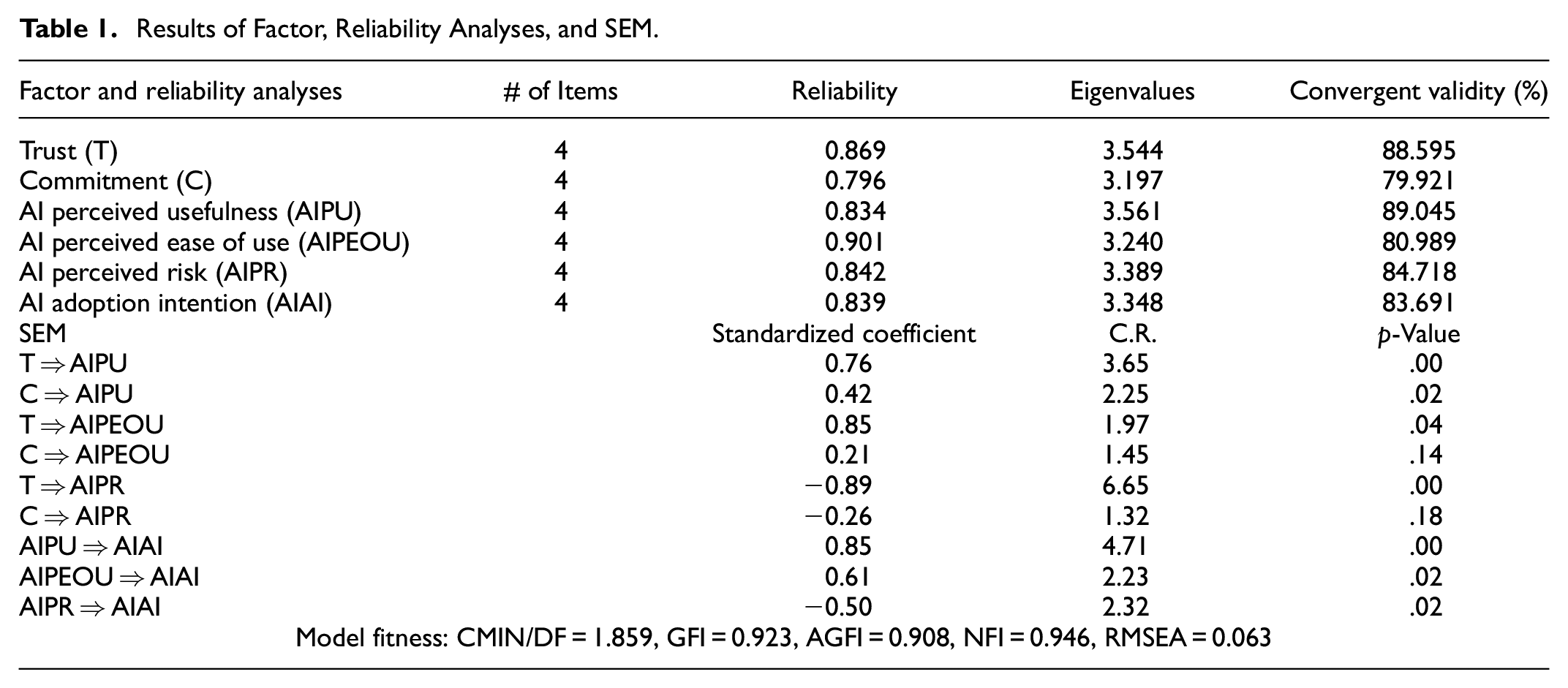
Results of confirmatory factor analysis indicate that the model fitness of six-factor model (CMIN/DF = 1.420, GFI = 0.899, AGFI = 0.845, RMSEA = 0.059, NFI = 0.889, IFI = 0.980, and CFI = 0.979) is significantly better than that of one-factor model (CMIN/DF = 5.102, GFI = 0.688, AGFI = 0.588, RMSEA = 0.188, NFI = 0.506, IFI = 0.566, and CFI = 0.558), and explained variance of each factor are below 20%. According to Podsakoff et al. (2012) and Podsakoff et al.’s (2003), these results propose that common method bias was not an issue in this study. Values of reliabilities these constructs are more than 0.79 (i.e., greater than 0.6) and values of convergent validity are more than 79.92% (i.e., greater than 60%). According to Hair et al. (2019) these results indicate that reliability and effectiveness of relationship marketing, AI PU, PEOU, PR, and adoption intention of AI are acceptable in this study.
Empirical evidence from SEM shows that CMIN/DF is 1.859 (<3), GFI is 0.923 (>0.9), AGFI is 0.908 (>0.9) NFI is 0.946 (>0.9), RMSEA is 0.063 (<0.08) (see Table 1). These results show that the research structure of relationship marketing, AI PU, PEOU, PR, and adoption intention in this study has acceptable model fit based on Hair et al. (2019). Results of path analysis indicate that impact of trust on AIPU (i.e., 0.76, t = 3.65, p < .01) is greater than commitment on AIPU (i.e., 0.42, t = 2.25, p < .05), impact of trust on AIPEOU (i.e., 0.85, t = 1.97, p < .05) is greater than commitment on AIPEOU (i.e., 0.21, t = 1.45, p > .05), impact of trust on AIPR (i.e., −0.89, t = 6.65, p < .01) is greater than commitment on AIPR (i.e., −0.26, t = 1.32, p > .05), the impact of AIPU on adoption intention (i.e., 0.85, t = 4.71, p < .01) is greater than AIPEOU on adoption intention (i.e., 0.61, t = 2.23, p < .05), and AIPR is negative associate with adoption intention (i.e., −0.51, t = 2.32, p < .05). Therefore, all five hypotheses are supported by path analysis of SEM.
Results of fsQCA indicate that there are three acceptable sufficient conditions (i.e., solution coverage > 0.1 and solution consistency > 0.6) that can lead to high adoption intention of AI (see Table 2). According to user’s guide of fsQCA (Ragin, 2017), values of solution coverage and solution consistency in this study are 0.826 (more than 0.1) and 0.935 (more than 0.6), and these results identify these causal configurations explain a large proportion of adoption intention of AI. Path 1 signals a logical statement “Trust*Commitment*AIPU*∼AIPEOU” (e.g., trust, commitment, and AI perceived usefulness present but perceived ease of use and risk absent), and this sufficient condition shows that it can achieve high adoption intention of AI when the values of trust, commitment, and AI perceived usefulness are high with lower value of AI perceived ease of use (see Figure 2). Path 2 shows that trust and AI perceived usefulness present but commitment and perceived risk absent, and this sufficient condition indicates that when the values of trust, AI perceived usefulness are high with lower values of commitment and perceived risk, it can achieve high adoption intention of AI. Path 3 identifies that it can achieve high adoption intention of AI when the values of trust, AI PU, and AI PEOU are high with lower value of PR.
The Causal Configurations for High Adoption Intention of AI.

Note. Black circles “•” indicate the presence of causal conditions (i.e., antecedents). White circles “○” indicate the absence or negation of causal conditions. The blank cells represent “don’t care” conditions.

The sufficient conditions for high adoption intention of AI.
Discussion
This study contributions to identify relationships among relationship marketing, AI PU, PEOU, PR, and AI adoption intention from both symmetric thinking (i.e., SEM) and asymmetric thinking (i.e., fsQCA) in data analysis. With symmetric thinking approach, the present study uses SEM for path analysis, and then the impacts or interrelationships among research variables have be compared, and all five hypotheses are supported by path analysis of SEM. Both trust and commitments can enhance AIPU and AIPEOU, trust can further reduce AIPR, and then improve AI adoption intention. In particular, impacts of trust are greater than that of commitment, the impact of AIPU on adoption intention is greater than AIPEOU on adoption intention, and AIPR is negative associate with adoption intention. The majority of participants in this study were married males with 36 to 45 years old and had college degree. They may place greater emphasis on trust, perceived usefulness, and perceived risk due to social and economic conditions (i.e., culture of the country, economic situations, working conditions). Although most studies have been conducted on knowledge building of relationship marketing, theory of planned behavior (TPB) and technology acceptance model (TAM), almost rare of them have comparative effectiveness of trust, commitment, AIPU, and AIPEOU. Therefore, the contribution of this study is to extend knowledge by confirming that trust and AIPU are more influential than commitment and AIPEOU.
With asymmetric thinking approach, this study focuses on using trust, commitment, AI PU, PEOU, PR as antecedents into causal recipes for achieving high adoption intention of AI. The sufficient conditions for fsQCA to produce results mainly based on the concept of Boolean algebra (Ragin, 2017). Accordingly, the present study further contributes to revisit sufficient conditions for high adoption intention of AI from intermediate solution of fsQCA. When there are k causal conditions, there will be have multidimensional vector space with 2k rows representing logically possible combinations of causal conditions. Therefore, the initial truth table in this study has 32 (i.e., 25) rows in this study, and intermediate solutions can identify three sufficient conditions found to be sufficient for high adoption intention of AI. These results can provide decision makers with different strategic thinking. For instance, several studies in the fields of relationship marketing, TPB, or TAM highlight that low level commitment or AIPEOU may lead to negative consumer evaluation. However, path 1 shows that even if the company cannot improve AIPEOU in the short term, there is still a chance to enhance adoption intention of AI. Similarly, path 2 proposes that even if the company cannot improve commitment in the short term, as long as it can improve trust, AIPU, and reduce AIPR at the same time, it can still achieve a high degree of adoption intention of AI. These contributions extend the knowledge of relationship marketing, PTB, and TAM.
Conclusions
AI can be regarded as one of the important engines driving the progress of the times, and AI has been widely used as a powerful technical tool for developing products or services. Accordingly, the present study contributes to extend knowledge of relationship marketing to measurement of adoption intention via intermediary variables in AI market based on perspectives of symmetric and asymmetric thinking in data analysis to derive several contributions. Specifically, results of SEM identify that impacts of trust on AIPU, AIPEOU, and AIPR are greater than commitment, impact of AIPU is also greater than AIPEOU on adoption intention of AI, and AIPR is negative associate with adoption intention. Accordingly, In the AI market, it seems that trust and AI perceived usefulness are more important. Furthermore, results of fsQCA can revist the three determinants of high AI adoption intention. Path 1 shows that even if the company cannot effectively improve AI perceived ease of use in the short term, it can also improve adoption intention of AI by strengthening trust, commitment, and AI perceived usefulness. Path 2 shows that improve trust, AI perceived usefulness, and reduce perceived risk can increase adoption intention of AI when level of commitment is not high. Path 3 identifies that whether the level of commitment is high or low, it can achieve high adoption intention of AI when the values of trust, AI PU, and PEOU are high with lower value of PR.
Theoretical Implications
The present study has made several contributions to the existing literature related to relationship marketing, TPB, and TAM. Firstly, the existing literature have focus on impacts of trust, commitment, PU, or PEOU on consumer behavior. Thus, the present study advances research that explore the effectiveness of trust, commitment, PU, or PEOU by comparing the impacts of them. As far as we know, fewer studies have explored these comparative relationships. Therefore, our findings support this relationship in a previously unstudied context when comparing effects between variables. Secondary, most of current researches generally only focused on the net effects among variables. The net effects estimation approach appears to be more difficult to identify the sufficient conditions of high level AI adoption intention. To fill this gap, this study further contributions to the knowledge of AI adoption intention by using asymmetric thinking in data analysis (i.e., fsQCA) to combine relevant antecedents (i.e., trust, commitment, AIPU, AIPEOU, and AIPR) into various causal recipes to identify three configurations for achieving high AI adoption intention. Set-based approach can further propose the effectiveness of trust, commitment, AIPU, AIPEOU, and AIPR, and provides opportunities or solutions when the dilemma (i.e., low levels of AIPEOU or commitment) cannot be changed in the short term.
Practical Implications
This research also makes some practical contributions to management practice, which can provide AI product or service providers with reference when making decisions. Firstly, trust and AIPU are more influential than commitment and AIPEOU, so managers or decision makers should focus more on developing strategies to strengthen trust and AIPU. For example, managers can consider establishing a quality assurance mechanism for AI products or services or provide more specific AI information to consumers. In addition, because lowering the AIPR can improve the AI adoption intention, managers can also provide subsidies or compensation programs when the production/service of artificial intelligence does not work properly.
Third, results of fsQCA provide opportunities for managers to comprehensively consider relevant antecedents (i.e., trust, commitment, AIPU, AIPEOU, and AIPR) into various causal recipes at the same time and explore solutions to dilemmas. Path 1 shows that it can also improve adoption intention of AI by strengthening trust, commitment, and AI perceived usefulness even if AIPR cannot effectively improved in the short term. For example, managers can consider simultaneous improvement in AI product or service quality, provide long-term assurance, or demonstrate effective improvement in performance. Path 2 imply that the solution to solve commitment is not high is to improve trust, AIPU, and AIPR at the same time. Accordingly, managers can consider to provide credible information, consumer experience, and establishing assurance mechanisms. Path 3 suggests that managers need to pay attention to trust, AIPU, AIPEOU, and AIPR at the same time. For instance, manager can consider to provide credible information, consumer experience, easy to use method, and establishing assurance mechanisms.
Limitations and Future Research
There are five major limitations in this study. The first limitation is the sampling process and period. The present study uses purposive sampling to collect empirical data through online questionnaires, and the questionnaire collection period is from January 2021 to December 2021. Based on this limitation, future research may be considered for conducting a couple years or longer period to analyze the effects of time series. International readers and organizational scientists may focus on effects over time or across cultures. Second, this study focused on understanding how consumer can achieve high adoption intention of artificial intelligence’s production/service based on symmetric and asymmetric thinking in data analysis. Accordingly, future research may consider other causal conditions (e.g., innovation, brand, technology application ability, culture of the country, economic situations, working conditions, or other dimensions of CRM, etc.) or outcome variables (e.g., performance, loyalty, or repurchase intention). Third, AI PU, PEOU, and adoption intention are applied in the conceptual framework of this study based on TPB and TAM. Therefore, future research may use other will-known adoption models such as technology-organizational-environment (TOE) or TAM2. Forth limitation of this study is that the method of collecting primary data is the application of online questionnaires. Accordingly, future research can consider using other methods to collect primary data or use secondary data. Finally, this study focused on using symmetric thinking (i.e., SEM) and asymmetric thinking (i.e., fsQCA) in data analysis, and future research can consider other methods of multivariate analysis (e.g., regression analysis or ANOVA) or qualitative research methods (such as the interview or the Delphi method).
Footnotes
Declaration of Conflicting Interests
The author(s) declared no potential conflicts of interest with respect to the research, authorship, and/or publication of this article.
Funding
The author(s) received no financial support for the research, authorship, and/or publication of this article.
Ethical Approval Statement
All procedures performed in studies involving human participants were in accordance with the ethical standards of World Medical Association Declaration of Helsinki.

Data Availability Statement
The data that support the findings of this study are available from the corresponding author, upon reasonable request.