




Abstract
Face-swap apps bring various benefits and incur risks for app users. The face swap apps are enjoyful for most users but the disclosure of personal information when using these apps is associated with an increase in threats such as identity theft, personal information leaks, and fraud. This research aims to integrate the Technology Acceptance Model (TAM) and the Protection Motivation Theory (PMT) to examine the influence of face swap app benefits and Perceived risks on face swap app usage intention. The research is conducted through an online/offline survey of 289 participants from different demographics in Vietnam. Structural equation modeling is applied to investigate the relationships between the variables. This study recognizes the negative impact of potential deepfake risks associated with the usage of face-swap applications. The results demonstrate that elevated Privacy Risk, Information Manipulation and Security Risk Perceptions result in a decreased intention to use face-swapping applications (standardized β = −.135; −.125; −.163, respectively), whereas Entertainment level, Ease of use, Social Influence substantially encourage user engagement with these applications (standardized β = .305; .280; .248, respectively). This study employs a comprehensive theoretical model that combine PMT and TAM to investigate the effects of perceived benefits and risk dimensions on face-swap apps usage intention. This study has practical implications for AI app and social media developers by offering deeper insights into the factors that attract or discourage face-swap users.
Keywords
Introduction
Today’s society is experiencing a rapid development of artificial intelligence (AI), which brings both opportunities and challenges. The emergence of Face Swap technology has enabled the production of videos that are highly realistic and depict human actions that have never occurred (Westerlund, 2019). Face-swap technology allows users to modify their appearance, movement of the eyes and lips, haircut, age, and other physical attributes (Etienne, 2021). Faces synthesized by AI are identical to human faces. The idea that humans are not able to accurately identify deepfakes is supported by experiments conducted using altered videos (Yin, 2024). There might be two possible explanations for this low detection rate: AI-generated pictures are viewed as more reliable than actual faces, and deepfakes are occasionally thought to be more genuine than the original movies. Besides the convenience and entertainment, it brings to social life, national security, personal rights, social security, and the judicial system are all significantly challenged by emerging deepfake technologies due to the spread of fake videos, difficulty in distinguishing between legitimate and fake media (videos, or images) and causing users to experience anxiety of privacy concern (Mukta, et al., 2023).
The literature on face swap usage and deepfake has increased sharply since 2017, and many of these papers warn primarily about their dangers (Kietzmann et al., 2020). Because deepfakes are thought to pose a threat, a number of academics have focused mostly on computer-assisted detection of deepfakes, or automated detection via machine learning (Westerlund, 2019). The upshot of these studies is that individuals fail to detect deepfake images, so criminals may abuse face swap applications to do nefarious things for crime or fraudulent purposes. Given that we are still in the early stages of deepfake research, academics, companies, and consumers can benefit from research that examines the origins and antecedents of face swap customer behaviors. There are few studies on how to raise awareness and educate the public about the risks and dangers of face swap usage, and how to prevent potential deepfakes spread in the digital world (Tolosana et al., 2020). A better understanding of consumers’ actions and attitudes toward face swap applications will help us to make more precise recommendations for consumer education for deepfake detection (Mukta et al., 2023).
Recent studies also show that online disclosure is influenced by both perceived benefits and perceived risks (Ho et al., 2023). Previous researchers determine the antecedents of the behavioral intention of communication technology including environmental factors (Social Media and Social Influence, Venkatesh et al., 2003; Wang & Lin, 2011); Electronic communication; peer influence (Birrer & Just, 2024), personal factors (Alalwan, 2020), Entertainment Level (Alalwan, 2020), human abilities (Avornyo et al., 2019). Scholars also draw attention to the significant impact of perceived risks on the intentional behavior of using high-tech applications (Peng et al., 2016). This study applies both the Technology Acceptance Model to examine the influence of Social Influence, Ease of Use, Entertainment Level and the Protection Motivation Theory to investigate the impact of perceived risk on users’ face swapping app usage intention. To the best of our knowledge, this is the first research that combined the two theories to investigate the intention to use face-swap apps.
In addition, previous studies concentrated on security risk, and privacy risk as two main dimensions of users’ perceived risks in new technology adoption research (Adhikari & Panda, 2018, Lin & Lin, 2023). Since face-swap apps provide false information for users (Ha et al., 2023), this research adds a third dimention of risk—information manipulation risk—as a determinant of the intention to use face-swap apps.
The research context focuses on Vietnam, a developing nation experiencing significant digital transformation, yet it is facing limitations in terms of institutional framework, infrastructure, and digital literacy among the population. The world is undergoing dramatic changes, marking the advent of a new era strongly influenced by digital transformation and Vietnam is also joining the digital transformation race. Digital transformation in Vietnam has been related to the integration of digital technology into all facets of human social life. However, Vietnam is also substantially behind its main rivals due to lacking necessary digital skills (Pham, 2020). Simultaneously, citizens experience increasing identity theft, personal information leaks, and fraud in the digital transformation. It is necessary to examine the impact of user perception of risks in using AI-based technology as well as face swap apps in the new context of Vietnam.
The research answers the question: What are determinants of the intention to use face-swap apps. The research aims to contribute to better understanding of customers behaviors in using AI-powered applications with face-changing features.
The following is the structure of this study. In Section “Literature Review and Hypothesis Development,” this research provides a comprehensive review of the literature related to the field, which includes the theoretical background and the model with hypotheses. In Section “Material and Methods,” the study describes the implemented methodology. Section “Results and Discussion” provides a discussion of the findings. Section “Conclusion” presents the conclusion, implications, and potential further research.
Literature Review and Hypothesis Development
Theoretical Background
Face Swap Apps
AI Face Swap algorithm employs deep compositing technology to merge, combine, replace and superimpose existing images to generate new facial images (Cowan et al., 2021). Synthesizing with this technology initially required a significant amount of time; however, it has since been streamlined to a mere few dozen seconds, and the process is exceedingly facile (Birrer & Just, 2024). The “face swap” can be executed by users by simply uploading their facial images and selecting the appropriate texture. Face Swap apps provide a simple and quick way to swap the faces of people, using hundreds of effects and inbuilt lenses (Ha et al., 2023). Face Swap apps are one type of entertainment-oriented and Internet-based information technology.
However, face swap technology places the public in an information environment where it is challenging to differentiate between reality and fiction, thereby disrupting the social consensus that “face is real” and resulting in cognitive distortion (Lin & Lin, 2023). The AI face-swap phenomenon originates from the network and disseminates throughout it (Wazid et al., 2024). Due to the anonymity of personal information and the virtual nature of cyberspace, it is challenging to regulate the conduct of Internet users in network life, which has led to a series of legal implications. Furthermore, the network platform will generate a substantial volume of new information each day, which will be interwoven into a complex “network.” This complexity will make it more challenging to retrieve information, collect evidence, and track suspects. Consequently, an increasing number of criminals will rely on the network to commit crimes (Yin, 2024). Thus, face swap apps provide both benefits and risks to users.
Theoretical Approaches
The technology Acceptance Model (TAM) is largely regarded as the most accepted model for adopting innovations. TAM posits that the perception of ease of use directly impacts the intention to adopt a tecnological innovation. Several researchers have attempted to replicate this model to investigate the elements that influence individuals’ intentions to use new technology (Arora & Sahney, 2018). A number of authors have expanded the original TAM model by incorporating other theories (theory of planned behavior, Innovation Diffusion Theory) to add more factors that determine the usage intention such as social norm (Hsu & Lu, 2004; Venkatesh et al., 2003), personal affection, attitude (Arora & Sahney, 2018), perceived enjoyment (Ha et al., 2023). Hsu and Lu (2004), Arora and Sahney (2018) suggested that an integrated model (an extension of TAM) may provide more explanatory power than either model alone.
The protection motivation theory (PMT) explains how people process and respond to threats and risks (Rogers, 1975). Since deepfake technology incures risks, it enables cybercriminals to duplicate realistic audio and video content for criminal purposes (Vaccari & Chadwick, 2020). Based on cost–benefit perspective, the study uses the extension of TAM with PMT models to examine the influence of face swap benefits and risks on face-swap app usage intention.
Hypothesis Development
Ease of Use and Face-Swap App Usage Intention
Ease of use is defined as the degree to which a person feels that utilizing a technology will be effortless (Davis, 1989). Recent studies on TAM have shown that ease of use has a direct impact on behavioral intention (Hsu & Lu, 2004). Ease of use is a belief about the decision-making process in using information technology. More specifically, it is how a person perceives the ease of using technology, indicating the extent to which they believe that technology can make their work easier. Ease of use is considered one of the important factors influencing the acceptance and use of new technologies. Consumers who use the service easily will produce high-performance results and they can easily integrate the service’s many applications into their daily activities (Davis, 1989; Venkatesh et al., 2003). Although Hsu and Lu (2004) have found that the association between perceived ease of use is the least significant, leading others to abandon this correlation, several replication studies have extensively validated this model (Ha et al., 2023).
H1: The ease of use has a positive effect on face-swap app usage intention.
Social Influence and Face-Swap App Usage Intention
Social influence is an important factor shaping the usage intention of an individual or a social group in lieu of technology (Ha et al., 2023). According to reference group theory, individuals often follow the instructions from a group with relevant expertise or opinion leaders. Eventually, they may develop standards for their behavior by referring to the information, normative practices, and value expressions of the reference group or individual (Hsu & Lu, 2004). Researchers have therefore suggested that to minimize cognitive effort when developing technology perception or deciding on certain application usage, an individual often consults opinions and choices from society, especially those who are important (Venkatesh et al., 2003). In the era of technological development, Wang and Lin (2011) believed that bloggers, or in other words, influencers have a great contribution in shaping the usage decisions of their followers. Additionally, users adopt and use a certain technology because of the influence of others or simply following the trend, making popularity synonymous with quality. Therefore, the fact that technology is becoming an indispensable part of life also motivates individuals to increase interpersonal interactions in social relationships through the common use of a particular technology. Researchers have therefore suggested that to minimize cognitive effort when developing technology perception or deciding on certain mobile application usage, an individual often consults opinions and choices from society, especially those who are important In terms of the utility of AI technology, social impact also plays a role in an individual’s decision (Gursoy et al., 2019; Trivedi et al., 2024). Therefore:
H2: Social influence has a positive effect on face-swap app usage intention
Entertainment Level and Face-Swap App Usage Intention
Face-swap apps have become increasingly popular in recent years because of the entertainment they provide to users. Entertainment can be seen as an activity that inspires the recipient by allowing them to express their pleasure, sorrow, or the skills of themselves and others, creating a sense of enjoyment (Liu et al., 2012). Entertainment encompasses activities that are intended to captivate and maintain the audience’s attention, with the objective of bringing pleasure, igniting interest, or offering a temporary break from the everyday grind by offering a momentary escape from reality (Chen & Lin, 2018).
Entertainment is a significant motivator in the use of social networks, as it reflects the desire of users to have fun, escape from daily stress, and appreciate the entertaining experiences they provide (Curras-Perez et al., 2014). Chen and Lin, (2018) assert that individuals are primarily motivated to trust and utilize Pinterest applications for the entertainment they provide. According to Ha et al. (2023) the level of entertainment has a significant positive effect on consumer involvement. Alalwan (2020) and Avornyo et al. (2019) suggest that perceived enjoyment is a significant driver of e-commerce acceptance, the primary motivation for using WeChat applications is the pursuit of leisure activities, which encompasses the need for entertainment, enjoyable downtime, and relaxation. In the context of using face-swap apps, the novel and lively features that are highly entertaining become attractive to users and promote the usage. Therefore, the study poses the following hypotheses:
H3: The level of entertainment has a positive effect on face-swap app usage intention.
Face Swap app Perceived Risks
Rogers (1975) established the Protection Motivation Theory (PMT) to explain the cognitive factors underlying the decision to follow or not follow a suggested conduct. This model explains how people may adopt actions based on their cognitive perception of risk. Previous liturature mentions Security risks and Privacy risks as two key dimentions of perceived risk associated with Face Swap apps (Ho et al., 2023; Lin & Lin, 2023). Besides, Tolosana et al., (2020); Sivathanu et al. (2023) state that deepfake can create information manipulation with misleading visuals and defamatory information about individuals. Therefore, we consider that risk will be assessed on three aspects to consider its impact on intention to use Face swap apps (namely security risk, privacy risk and information risk).
Information Manipulation and Face Swap Apps Usage Intention
Information manipulation is done by violating the information’s quantity, quality, and relation by providing the product/service information with content that highlights the positive aspects of the offerings while removing any concerns or faults, as well as any unfavorable internet reviews (Peng et al., 2016). Face swap manipulation is a kind of information risk by giving false information for decision-making (Sivathanu et al., 2023).
To ensure that deepfake videos are visually appealing, a variety of photos, videos, and sounds are combined with cutting-edge technology, such as AI. These are natural imaging that creates life-like audio-visuals to provide information to internet users. Several types of manipulation, such as identity swapping, modifying attributes, manipulating expressions, and creating whole nonexistent face images, can be used to create deepfake films (Wazid et al., 2024).
The previous liturature mentions the positive effect of deepfake information manipulation on attracting consumers and encrease shopping intention. Maras and Alexandrou (2019), Sivathanu et al. (2023) show that with the attractiveness of music and pictures of the products, these videos entice viewers to click through by watching internet-based item videos. These methods of information manipulation are applied in deepfakes to attract users and favorably sway their opinions via the application (Tolosana et al., 2020). Compared to oral or written information, individuals perceive visual information—such as pictures and videos—with less effort. Visual perception catches our attention immediately and with precision (Vaccari & Chadwick, 2020). The ripple effect is accelerated by the record number of individuals who can now easily access the Internet through smart devices and participate in social networks and messaging services. As a result, intentionally altered images and audiovisuals deceive not just a single person but the entire community. (Etienne, 2021; Kietzmann et al., 2020).
However, Susser et al., (2019) argue that online manipulation is the use of information technology to covertly influence consumers’ decision-making, by targeting and exploiting their decision-making vulnerabilities. Since manipulation is highly prevalent in the marketplace, it raise the worries about potential harms and manipulation problems in marketing and consumer research (Ho et al., 2023). According to Vaccari and Chadwick (2020), deliberate information manipulation is intended to instill false beliefs, deception, and uncertainty in others. We suggest that the perceived risk associated with deepfake manipulation can negatively impact face-swap application usage intention.
H4: Face-swap manipulation has a negative effect on face-swap app usage intention.
Security Risks and Face-Swap App Usage Intention
Consumers are concerned about the value of an application through its features and security capabilities. However, without adequate information about security tools, usage intentions are discouraged. The study by Ho et al., (2023), Ha et al. (2023) suggested that security risk resulting from the user’s assessment of the likelihood of privacy violations, such as data leaks, intentional or unintentional data disclosures caused by the application, and the user’s level of privacy concern about negative consequences link with usage intentions. Lu et al. (2011)demonstrated that disclosure of financial information, including credit card numbers, account numbers, and secure PINs, is associated with security. There is an agreement that security fear is one of the barriers for users (Cowan et al., 2021). Consumers who lack confidence in the product, are more likely to avoid providing their personal information and tend to provide incomplete and inaccurate information or not to use the online systems (Kayworth & Whitten, 2010).
Harris et al. (2016) demonstrated that there is a significant relationship between security risk and technology advancement using intention. This implies that the lower intention to use the application can be related to a higher perceived security risk. Terrorism or criminality are the most concerning applications of AI (Tolosana et al., 2020)
H5: Perceived security risks have a significant negative effect on face swap app usage intention.
Privacy Risks and Face Swap Apps Usage Intention
In a world where people are increasingly concerned about their privacy and the use of their personal data, the use of Face-swap technologies can raise concerns regarding privacy issues, especially when it comes to facial features (Cowan et al., 2021). The human face represents a user’s personal identity and is a physical feature that consumers pay particular attention to (Ha et al., 2023). To create individualized customer experiences, face-changing applications can also capture, store, and analyze users’ personal and environmental data. This raises privacy concerns regarding the apps for both the user and others (Cowan et al., 2021; Ho et al., 2023).
Over the past few decades, the practice of posting intimate images, selfies on social media has made people’s faces and bodies more accessible to a larger audience (Cowan et al., 2021). Due to the inevitable degree of self-disclosure involved in online self-presentation, users are concerned about their privacy when they share personal information on social media platforms and take selfies (Malhotra et al., 2004). For instance, worries about receiving unfavorable feedback from others or being branded in an unappealing way are among the privacy issues associated with selfies (Dhir et al., 2017).
Cowan et al. (2021) study found that privacy concerns directly influence behavioral intentions toward augmented reality, which is possible because these applications collect users’ facial biometric data. Therefore, the study hypothesizes the following:
H6: Perceived privacy risk has a significant negative influence on face swap applications usage intention.
From all the above hypotheses, the research model is Figure 1) as below:

Research model.
Material and methods
Data Collection
The participants in this study are Vietnamese consumers of various age groups. A total of 305 people participate in the survey through a convenience sampling method. Authors control gender, age, occupation to ensure that representative proportional data should be obtained from each demographic group. After filtering out invalid responses, the study collected 289 samples (Table 1). The selection criteria requires participants to have a smartphone, participate voluntarily, and not be under any pressure when completing the questionnaire. Participants are not offered any incentives to complete the questionnaire, and they are free to withdraw from the study if they encounter any discomfort with any aspect of the questionnaire.
Respondents’ Demographic (N = 289).

Source. Authors own work.
The invitation to participate was sent online through social media platforms, such as Facebook, where they were provided with a URL link that directed them to the survey page. Additionally, the authors also directly distributed survey papers at crowded places like universities and shopping malls. We adopted Podsakoff et al. (2003) mehod for avoiding the magnitude of common method bias. Participants were informed of the anonymity and confidentiality of the research to reduce evaluation apprehension. Respondents were entirely voluntary, and participants were informed that this survey collects their perceptions about the face-changing feature of an application and is for research purposes. The online survey began by requesting demographic information such as gender, age, occupation, and income. To ensure the anonymity of the participants and encourage their responses, their names, email addresses, and mobile phone numbers are not required.
Measurements
The measurement scales used in this study are all taken from previous studies and have gone through a process of reliability and validity testing. The scale for the Privacy Risk variable is taken from Lu et al. (2011), and the Security Risk scale is from Adhikari and Panda (2018). The Entertainment Level scale is adopted from Liu et al. (2012), and the Social Influence scale is from Wang and Lin (2011). The Information Risk scale is from Peng et al. (2016). This study used the scale from Davis’s (1989) research to measure the Easy-to-Use variable, and the scale from Koo and Ju’s (2010) research to measure Usage Intention. Five-point Likert scales are used since five-point Likert scale may reduce the cognitive load on respondents, it is simple and more intuitive for participants to understand, leading to more accurate responses (Hair et al., 2010).
Data Analysis
This is a quantitative study, designed to investigate the existence of relationships between the variables. The analysis process is divided into two main stages: preliminary analysis and advanced analysis.
The preliminary analysis aims to ensure the validity and reliability of all measurement scales and includes data cleaning. Before merging datasets obtained through online and offline data collection methods, statistical tests were conducted to ensure the comparability of demographic characteristics and response patterns (Hair et al., 2010). The measurement scales in this study are tested through Cronbach’s alpha reliability assessment, Exploratory Factor Analysis (EFA), and Confirmatory Factor Analysis (CFA). Then, the advanced SEM analysis is conducted to test the hypotheses. SEM is an extension of the general linear model. This model can combine all techniques such as multivariate regression, factor analysis, and path analysis to test the complex relationships of the factors studied in the model.
Results and Discussion
Testing for Measurements
First, Harman’s one-factor test has been conducted for common method bias. The total variance extracted by one factor is 30.922% less than the recommended threshold of 50% confirming that the common method bias is not a significant concern in this research (Podsakoff et al., 2003).
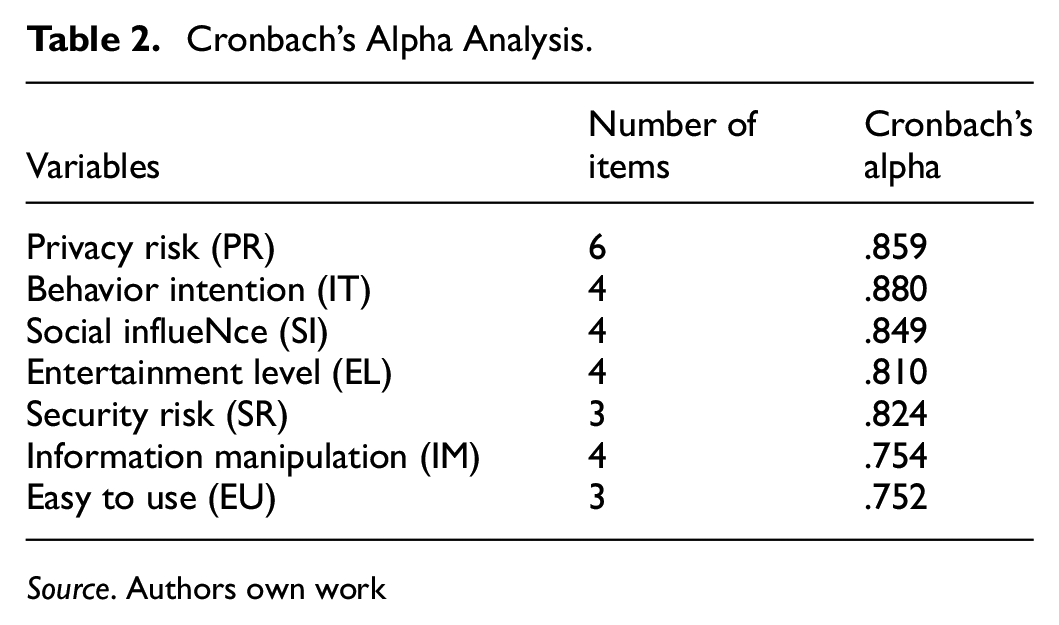
Then, Cronbach’s alpha analysis is used to test for reliability of scales. Cronbach’s alpha test to eliminate observed variables that do not ensure quality (Table 2). The results show that all Cronbach’s alpha values for all factor scales are greater than .7 and the Corrected Item—Total Correlation of all observed variables are closely related which is greater than .4, proving that the scale is effective in measurement ensuring the internal consistency among the items (Hair et al., 2010).
Cronbach’s Alpha Analysis.
Source. Authors own work
Exploratory factor analysis (EFA) is applied to test the one-dimensionality of the scales. EFA is applied simultaneously to all independent and dependent variables. The KMO–Bartlett’s Test shows that Eigenvalue >1; KMO = .802 is greater than .5; Bartlett’s Test of p-value = .000 < .05 meeting the testing requirements. The total variance explained by the 28 observed variables of the scale is 67.326%, exceeding the recommended threshold of 50% (Hair et al., 2010). All seven factors load in the original factors. The results show the standardized regression weights of all factors are greater than 0.5. Therefore, the consistency and internal reliability of the scales are confirmed.
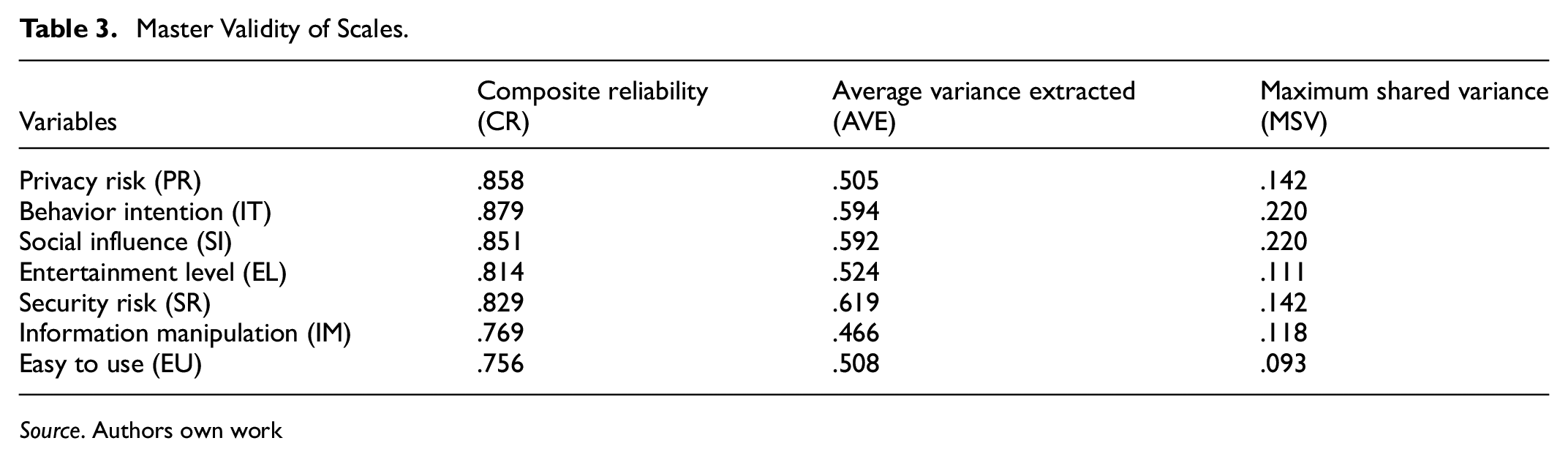
The Confirmatory factor analysis (CFA) is conducted to assess both the convergent and discriminant validity of the scales. The model has a Chi-square value with degrees of freedom (Chi-square/df) of 1.927 < 2. In addition, the CFI value = .909 is greater than .9, RMSEA = .057 is less than .06. The GFI coefficient = .859 and the TLI coefficient = .896 > .8 is acceptable (Hair et al., 2010). The results exhibit an adequate model fitness. All requirements of the measurement model are met. All constructs and dimensions have composite reliability (CR) above .7, ensuring reliability and consistency. The average variance extracted (AVE) scores are greater than the threshold of .5, ensuring the convergent validity of the constructs. The AVE of IM = .466 is acceptable, because Malhotra et al. (2004) argue that the AVE coefficient is often too strict, and reliability can be established through CR alone, combined with careful content analyses of the IM factor, we keep all the observed variables for the variable. The Maximum Shared Variance (MSV) coefficients of all factors are all smaller than the AVE coefficients, demonstrating that the scales achieved discriminant validity (Table 3). Therefore, all scales used in the research model ensure reliability, convergent validity, and discriminant validity, suggesting that the constructs can be used to investigate the conceptual model.
Master Validity of Scales.
Source. Authors own work
Structural Equation Modeling Analysis
Structural Equation Modeling (SEM) is applied to test the hypothesized relationships in the structural model. The results show that the proposed structural model was well-fitted to the data with Chi-square/df = 1.853 < 2; GFI= .869 > .8; CFI = .919 > .9; TLI = .907 > .9; RMSEA= .054 < .06; and PCLOSE=.138 > .05 (Figure 2). These indices all meet the allowable standard threshold, confirming that the overall tested research model is correct, thereby allowing further testing of the research hypotheses.

SEM analysis.
The results provide support for H1, H2, H3 hypotheses (Table 4). Intention to use the face-changing feature has been significantly positively impacted by the ease of use (standardized β = .280, p < .05), level of entertainment (standardized β = .305, p < .05), Social Influence (β = .248, p < .05)
Results of Testing the Effects of Factors.

Source. Authors own work.
The results also provide support for H4, H5, H6 hypotheses. Intention to use the face-changing feature has been significantly negatively impacted by the Perceived Privacy Risks (standardized β = −.135, p < .05), Perceived Security Risk (standardized β = −.163, p < .05), face swap manipulation (standardized β = −.125, p < .05).
Discussion
The results confirm that the perception of ease of use had a positive impact on customers’ intention to use the face-swap apps. This result is similar to previous studies (Davis, 1989; Hsu & Lu, 2004; Venkatesh et al., 2003), and demonstrates the relevance of TAM model in studies of consumers’ technology adoption.
Besides, the level of entertainment also has a positive effect on face swap appusage intention. This finding also supports the arguments of Alalwan (2020) and Avornyo et al. (2019) that the level of entertainment is a significant driver of consumer involvement. In addition, the above results also confirm the observations of Curras-Perez et al. (2014) that enjoyment positively affects attitudes, affecting the willingness to recommend and use a particular social platform. Ha et al., 2023 and Peng et al., 2016 also note that viewers enjoy and watch face swap videos because they are captivating and include smooth audio-visual effects. The entertainment aspect meets consumers’ enjoyment needs and grabs their attention, making it an essential characteristic. This result supports Yin (2024), Jiang et al. (2024) arguments that the entertainment capability is key to maintaining consumer interaction, creating memorable experiences, and building emotional connections with the audience. The reasons reflect that the higher the entertainment level of the application for users, the greater their intention to use the application.
Social Influence is positively related to the intention to use face-swap apps. This finding supports the arguments of Hsu and Lu (2004) that social influence plays a major role in shaping an individual’s behavioral intention. In addition, the above results also confirm the observations of Trivedi et al. (2024) that social influence affects an individual’s intention to use and accept a new AI technology. With the development of the Internet and social networks, it is very easy for influencers, or opinions and behaviors of the online community to influence an individual’s intention (Chen & Lin, 2018). In the technology era, individuals can easily be exposed to or search for many subjective opinions about a technology they are interested in, enhancing word-of-mouth effect, leading to an impact on individuals’ thoughts and intentions to use (Wang & Lin, 2011).
The results showed that Perceived Security Risk has a negative influence on face swap user’s intentions. This finding is in line with prior research and further reinforces the importance of the ‘Perceived security risk’ variable as a barrier to internet usage intention (Harris et al, 2016; Ho et al., 2023). Consumers are concerned about the value of an application through its features and security capabilities, without adequate information about security, usage intentions are discouraged. Wazid et al. (2024) also mentioned that face swap users’ perceived security risk is a result of the user’s assessment of the likelihood of online violations, such as data leaks, intentional or unintentional data disclosures caused by the application, risks associated with being leaked online leading to impersonation scams or cyber-attacks. The research results confirm that users’s level of concern about negative consequences or the increased level of users’ perceived security risk leads to a lower intention to use face swap apps.
Perceived Privacy Risk is negatively related to the intention to use face-swap apps. This finding is consistent with Cowan et al.’s (2021) empirical study, which shows that when users perceive privacy risks, customers will feel anxious and risky if using the application, their intention to use the face-changing feature also decreases. Privacy concerns play a direct role in shaping users’ behavioral intentions toward augmented reality technologies, particularly because these applications collect facial biometric data. This is also in line with Kayworth and Whitten (2010), Dhir et al. (2017) that consumers who lack confidence in the product are more likely to avoid providing their personal information and have a tendency to provide incomplete and inaccurate information or not to use the online systems. Therefore, perceived privacy risks are an important factor influencing users’ intention to use the face-changing feature.
Face swap information manipulation has a negative impact on the face swap usage intention. While previous studies Susser et al. (2019), Tolosana et al. (2020), Sivathanu et al. (2023), demonstrate that information manipulation is strategically employed through curiosity-driven advertising and limited-time free trials to increase users’ usage intention. By presenting idealized face-swapped images, these apps spark curiosity and enhance perceived desirability, encouraging users’ intention to use the app, including their likelihood to download, and disclose personal data. Customers’ thoughts aren’t overly burdened by these deepfake videos, images from applying these apps, because they are so captivating. Marketers employ a variety of deepfake apps, movies to encourage viewers to want to utilize their products (Mukta et al. 2023). However, Wazid et al. (2024) noted that the application of deepfakes enables the creation of convincingly realistic but entirely fabricated information. This research explores a reverse effect of deepfake information manipulation—the perceived information risk. The finding confirms that the perceived risk of face swap information manipulation decreases the face swap usage intention. This result is in line with Ha et al., (2023) argument that while this manipulative design may temporarily boost the usage intention of face-swapping apps, it can also raise long-term privacy concerns. Utilization of deepfakes can potentially engender confusion or erode trust (Vaccari, & Chadwick, 2020).
Conclusion
Theoretical Contribution
The research contributes to the existing literature in the social networking context by manifesting that the integration of PMT and TAM adequately explains the intention to use face-swap apps. The findings confirm the positive impact of Social Influence, Entertainment Level, Ease of use on the intention to use face-swap applications. Most previous studies have focused on the negative impact of Privacy Risk and Security Risk on the intention to use face-swap apps, the study highlights the role of the risk of information manipulation in developing intention to use face-swap apps. The study has also provided valuable insights into the factors influencing the face-swap apps usage intention in the context of Vietnam—a digital transition country.
Managerial Implications
Through this paper, from the practitioner’s perspective, the findings suggest that the Government can use the results to invigorate the sector and foment its use among a nation’s entire population. The government should educate the public about deepfakes to protect citizens and help them avoid insecure behaviors resulting from the risks of deepfakes. Governments may introduce legislation or use a combination of existing legal frameworks to deal with spreading harmful or illegal content such as disinformation and non-consensual pornography. The government needs to introduce regulations to mitigate privacy and cybersecurity risks to ensure a safe, secure, and trustworthy development and use of AI.
With regards to businesses, this article provides AI application and social media developers with deeper insights into the encouragement of users when developing usage intention of face-swap apps. Businesses should offer websites that are easy to use, offer a variety of enjoyable features, minimize the users’ risks, especially customers’ privacy information and cybercrime security risks. Face swap app developers should consider that technology adoption functions as a social system, provide clear notifications about privacy risks when using the app and suggest information protection solutions for users.
Limitations and Future Research Directions
Some limitations emerged. First, this study is conducted using cross-sectional data. Since this type of data cannot be used to examine usage behaviors over a timeframe, future research could look at a longitudinal approach that indicates changes in users’ usage intention over time. Future studies should attempt to replicate the present findings when the awareness of deepfakes becomes more widespread in the future. Next, this study lacks diversity in terms of geography bracket when the majority of the respondents were in Hanoi- the capital of Vietnam. Since there may be possible bias related to the digital literacy and education level of participants in city or countryside regions, researchers’ hereafter could consider conducting separate research across different minorities, occupations, and geographic groups and consider the technological knowledge base of each. Future researchers may examine diverse samples from a cross-country perspective to empirically validate this study’s findings. Future research may also want to investigate socio-psychological traits that are crucial in explaining online behavior such as group dynamics, personality, and network. While the focus of this research was on TAM and TPB comparisons and interactions, we hope future research may investigate interactions from yet other technology adoption models such as UTAUT or the ‘motivation model’ that focuses on intrinsic, extrinsic, and/or apathetic motivations.
Footnotes

Ethical Considerations
Since this was a non-experimental, voluntary survey, there were no ethical issues associated with this survey. The responses were fully anonymous, and the topic of the survey was far from sensitive.
Funding
The author(s) disclosed receipt of the following financial support for the research, authorship, and/or publication of this article: This research is funded by National Economics University, Vietnam.
Declaration of Conflicting Interests
The author(s) declared no potential conflicts of interest with respect to the research, authorship, and/or publication of this article.
Data Availibility Statement
Data available upon request the correspondence: