




Abstract
The study considers the creative leadership, the organizational culture, and the learning institution's motivation. The study uses a cross-sectional survey research design and a convenience sampling strategy, sampling a target number of 612 preschool, primary, secondary, and high school teachers from the city of Bursa Turkey, during the academic year 2023–2024. The four structures of cultures’ mediating functions: Clan, Adhocracy, Market, and Hierarchy, were estimated by the structural equation model. The analysis indicated creative leadership had a significant motivational influence, but prime motivators were Adhocracy and Clan cultures which foster teamwork, confidence, and innovation. The Market culture had a double impact of increasing the level of performance as well as diminishing intrinsic motivation. The second case witnessed the interaction between creative leadership and the set of the motivational factors eliminated by the adverse contribution of Hierarchy culture, which elevated rigidity and control. This finding supports the claim for the necessity of having supple and caring cultural structures in place for educational institutions for achieving the optimum motivational influence of creative leadership.
Plain Language Summary
This study examines the impact of school principals’ creative leadership practices on the motivation of teachers and how various types of school culture influence this relationship. Creative leadership refers to leadership behaviors that encourage new ideas, collaboration, flexibility, and openness to change. Teacher motivation is crucial because it impacts teaching quality, job satisfaction, and student learning outcomes. The study was conducted in public schools in Turkey and included 612 teachers working in pre-school, primary, secondary, and high school levels. Data were collected through online questionnaires and analyzed using statistical modeling techniques. The findings show that creative leadership has a direct positive effect on the motivation of teachers. More importantly, this effect becomes stronger when schools have supportive and collaborative cultures, especially those that emphasize trust, teamwork, and innovation. These cultural environments help teachers feel valued, safe, and motivated to engage in their work. On the other hand, school cultures that focus heavily on rules, hierarchy, competition, and performance pressure tend to weaken the positive impact of creative leadership on motivation. This effect is particularly visible in secondary schools, where teachers reported lower levels of motivation and support. The results suggest that school leaders and policymakers should not focus only on leadership skills but also on creating supportive school cultures. Encouraging collaboration, reducing excessive control, and supporting teacher autonomy can help increase motivation. Although the study focuses on Turkey, the findings may also be useful for other education systems facing similar challenges related to accountability and centralization.
Introduction
Within the changing learning space, the schools of the world continue to need adaptation due to changing technology, new learning endeavors, and a transformation of society. Teachers today must provide great learning as well as lead change, taking an active part of continued professional growth as well as innovation. To meet the high goals, the spaces of the school must provide enthusiasm as well as creativity for the staff. Leadership also forms a significant aspect of this multifaceted process. This shapes the organizational culture in which the teacher operates, impacting the level of their involvement, their level of pleasure, as well as a willingness for innovation (Al-Sada et al., 2017; Cameron & Quinn, 2006). When the studies in the literature are examined, it is evident that the form of leadership proves effective in determining the organizational culture, impacting the outcomes for employees. Leadership sets workplace norms, values, and behavior, which together construct the organizational culture. Studies indicate the strong impacts of transformational leadership, which stimulates and galvanises followers by a vision and charisma (Bass & Riggio, 2006); of the participative leadership, which involves shared decision-making (Al-Sada et al., 2017); and of the supporting leadership, which revolves around communication, acknowledgment, and the development of confidence (Khaliq et al., 2021). The styles have been continuously associated with increased job pleasure, organisational devotion, and innovation behavior (Khan et al., 2020). Though the styles engender the hope for stimulation as well as for desired cultures, rising complexity for educational settings demands a more reactive and prospective model.
With the well-documented effects of leadership upon organizational culture as well as staff enthusiasm, it would behove researchers to investigate how specific paradigms particular fit these dynamics. Amongst new leadership models, creative leadership represents one of the highly appropriate models for this modern era of learning environments amidst change and complexity (Amabile & Khaire, 2008; Anderson et al., 2014). Diverging from other forms of customary leadership, all too readily emphasizing structure or domination, creative leadership encompasses innovation, flexibility, and facilitation of mental states—proportions doubly critical for the facilitation of robust organizational cultures as well as maintenance of robust enthusiasm levels. Recent research suggests the leadership behavior of principals, as facilitating collaborative innovation processes, boosting teachers’ disposition towards change and creative practice (de Jong et al., 2022). As a byproduct, deriving a characterization for the contribution of creative leadership represents a further nuanced insight into the means by which leaders might identify settings which not only facilitate but also revitalize successive growth and enthusiasm.
At the same time, organizational culture has been recognized as a key contextual mechanism that mediates the influence of leadership on motivational outcomes (Imransyah et al., 2024; Mochklas, 2022). Research indicates that cultural forms such as Clan and Adhocracy can strengthen the impact of leadership by fostering trust, collaboration, and openness to change (Cameron & Quinn, 2006; Denison et al., 1995). In contrast, Market and Hierarchy cultures may diminish this relationship by placing excessive emphasis on performance metrics or rigid structures, thereby weakening teachers’ intrinsic motivation (Hofstede et al., 2010). Nevertheless, few studies have systematically examined how distinct organizational culture types mediate the relationship between leadership and motivation in schools, leaving a significant gap in the literature. Teacher motivation itself has been widely studied, often through Self-Determination Theory (Deci & Ryan, 2000; Ryan & Deci, 2000), which highlights the importance of autonomy, competence, and relatedness. Motivation is a central driver of professional performance, instructional quality, and ultimately student achievement (Anderson et al., 2014). However, much of the existing research has conceptualized motivation in isolation, without sufficiently exploring how it emerges from the interaction between leadership style and organizational culture in educational contexts.
Taken together, this body of research underscores a critical gap: while leadership, organizational culture, and motivation have each received substantial scholarly attention, the integrative examination of these three elements—particularly the mediating role of specific culture types in the relationship between creative leadership and teacher motivation—remains limited in the field of education. As any other organizations strive for enhanced performance and adaptability in the face of change, educational organizations also try to increase teachers’ and students’ performance in terms of both academic success and social interactions. The culture within educational institutions significantly influences the behaviors, attitudes, and interactions of both staff and students. A constructive culture that prioritizes collaboration, support, and ongoing improvement has the potential to foster a more engaged and motivated workforce (Cameron & Quinn, 2006). For instance, a culture that promotes professional development and acknowledges accomplishments can enhance teachers’ morale and dedication, resulting in increased job satisfaction, motivation and lower turnover rates. Educators, like other professionals, require a culture that not only supports innovative practices but also fosters intrinsic motivation to enhance student engagement and academic achievement. Moreover, as educational institutions face increasing demands for change and improvement, cultivating a culture that encourages creative leadership is essential for inspiring both teachers and students to excel in a rapidly evolving educational landscape. Moreover, comprehending the factors that drive employee motivation within educational institutions is crucial for fostering a conducive and efficient workplace. Educators who are motivated tend to dedicate more effort to their instructional practices and are inclined to exceed expectations in facilitating student learning and development (Anderson et al., 2014).
Within these institutions, wherein the criticality of the leadership affects learning and pedagogical results, the significance of learning how the creative leadership, the organizational culture, and the employee motivation play their part grows even larger. Investigating the concepts of creative leadership, organizational culture, and the employees' motivation for the educational centers becomes the core reason for creating a fertile ground for effective learning, teaching, and the overall educational activities. In the academic context, creative leadership generates the growth of pedagogical policies as well as administration policies aiding the organization change the dynamic condition of the educational ecosystem (Amabile & Khaire, 2008). Innovative leaders may support teachers by developing new lessons or employing up-to-date technology during class for enhancing student learning. As revealed by latest research post-COVID, teacher motivational change may occur due to new working environments, blended or online classes, as well as the demand for support of a personal kind. For instance, Wang and Shakibaei (2025) noted that teachers’ motivation during post-COVID classes significantly pertains to how engaged they feel, in particular when the need for independence and skills cannot be fulfilled. Similarly, Katz and Moé (2024) also indicated that the motivational style attuning teachers’ emotional requirements may prevent adverse repercussions from the pandemic. The research implies innovative leadership and favorable working environments may sustain the enthusiasm of teachers when faced with adverse or changing circumstances.
These researches all indicate that the development of concepts of how creative leadership, organizational culture, and staff motivation all interrelate makes possible the development of mechanisms whereby teacher productivity and innovation would increase. This would best correspond with increasing the achievements of students. A framework of this kind would best involve a school continually changing and innovating as methods of satisfying evolving students and staff requirements in an evolving environment.
Given the above, this study aims to examine educators' perceptions of the creative leadership exhibited by school administrators and its influence on their motivation. Moreover, it seeks to investigate the potential mediating role of organizational culture in this relationship. In light of the ongoing transformation and evolving expectations within educational settings, this research intends to provide empirical evidence on how leadership styles shape motivational outcomes through the lens of organizational culture. The research model is presented in Figure 1.

Research model.
In line with the multidimensional structure of organizational culture, as defined by Cameron and Quinn (2006), and considering the separate subscales used in the measurement instrument, the following hypotheses were formulated with sub-categorized labels (e.g., H1a–d) to account for each culture type individually.
Theoretical Framework
Creative Leadership
Creative leadership is the ability of administrators or principals to inspire innovation, adaptability, and mental empowerment of teachers. Different from other leadership points of focus such as command or structure, creative leadership places prime importance on openness for change, experimentation, and collaborative problem-solving (Amabile & Khaire, 2008; Anderson et al., 2014).
Creative leadership involves the facilitation of innovative thinking, the provision of a supporting environment in which teachers feel free to experiment, and the development of a culture attuned for continued improvement. Those individuals who exhibit the attributes of creative leadership share a desire for change, the capacity for managing the unknown, and the skill for developing collaborative work teams utilizing the strengths of diversity. Amabile and Khaire (2008) also contend that creative leadership emerged into the central stage at a moment when the environment became extremely uncertain and dynamic. Learning institutions require not only adaptable but also resilient and creative teachers for them to thrive in such settings. Anderson et al. (2014) also contend that creative leadership not only constructs the creative capability of individuals as well as intrinsic interest but also increases organizational innovation significantly.
Research establishes the necessity of creating organizational climates for creative leadership. Shalley and Gilson (2004) further indicate that if Psychological Safety and Autonomy are offered by the principals/leaders, teachers freely engage in risk-taking. Similarly, Randel and Jaussi (2019) show that contextual enablers such as participative decision-making and trust significantly influence the emergence of creative leadership. Recent scholarship continues to show that leadership which explicitly nurtures creativity and innovation is associated with stronger innovative behavior among educators and staff. At the system level, school leaders who orchestrate collaborative innovation—for example by structuring participation, feedback, and joint problem-solving—strengthen teachers’ engagement with change and elevate creative practices in classrooms (de Jong et al., 2022). Beyond education, contemporary evidence links leadership that enables exploration and empowerment to followers’ creativity and innovative behavior, underscoring the practical mechanisms (e.g., psychological safety, commitment to change) through which leadership supports creativity (Chen et al., 2022; Jun & Lee, 2023).
In educational settings, creative leadership extends beyond fostering innovation and problem-solving by also reinforcing teachers’ sense of purpose and commitment to public and educational values. From the perspective of Public Service Motivation (PSM), defined as individuals’ motivation to contribute to society and serve the public interest (Perry & Wise, 1990), teachers’ engagement is often shaped by the perceived social significance of their work. Creative leaders strengthen this orientation by articulating a shared mission, encouraging collective responsibility, and framing innovation as a means of improving educational quality and student outcomes. By emphasizing the broader societal value of teaching, creative leadership supports value-driven motivation while simultaneously creating conditions that promote autonomy, professional competence, and meaningful collaboration. In this respect, creative leadership functions as a contextual catalyst that links leadership practices with public service-oriented motivation, a relationship that is further elaborated within the motivational framework of the present study.
Complementing these findings, studies in schools report positive associations between principals’ creative leadership and teacher outcomes, including organizational “intelligence” and adaptive capacity (Sağlam & Uçar, 2022). Taken together, this literature supports positioning creative leadership as a context-sensitive, enabling influence that operates through participation, safety, and shared agency to cultivate teachers’ innovative work behaviors. Thus, it is possible to say that creative leadership is particularly relevant in education because it aligns with the growing complexity of schools, where adaptability, innovation, and sustained motivation are essential for success.
Organizational Culture
Organizational culture encompasses the shared values, beliefs, and practices within an institution, shaping how leadership behaviors are perceived and how teachers experience motivation (Cameron & Quinn, 2006). It determines the norms and practices of the workplace, influencing both intrinsic and extrinsic motivation. Positive cultures that emphasize support, recognition, and development foster intrinsic motivation by making teachers feel valued and connected to a larger purpose (Cameron & Quinn, 2006). In contrast, toxic or unsupportive cultures undermine motivation, leading to disengagement and high turnover. Four culture types conceptualized by Cameron and Quinn (2006) are particularly useful for understanding the mediating role of culture in education:
Clan Culture
Clan culture is characterized by collaboration, trust, and a family-like atmosphere. It considers loyalty, mentoring, and teamwork, which make teachers feel part of the community and enhance the desire to work (Denison et al., 1995). They also positively correlate with teacher job satisfaction, professional dedication, and organizational citizenship.
Adhocracy Culture
Adhocracy culture emphasizes innovation, flexibility, and risk-taking. It creates fertile ground for creative leadership because both focus on adaptability and experimentation. Teachers in schools with adhocracy cultures are encouraged to innovate in pedagogy, test new instructional methods, and embrace change (Anderson et al., 2014). While this culture can be energizing, it also requires leaders to balance autonomy with sufficient support to avoid uncertainty fatigue.
Market Culture
Market culture prioritizes competitiveness, achievement, and performance outcomes. It can stimulate extrinsic motivation by rewarding measurable success, but may undermine intrinsic motivation if performance pressures overshadow collaboration and creativity (Hofstede et al., 2010). In school contexts, overemphasis on standardized testing and rankings reflects a market orientation, which may boost short-term outcomes but potentially harm long-term teacher engagement (Kotter, 2012).
Hierarchy Culture
Hierarchy culture emphasizes stability, structure, and formal rules. While it provides order and predictability, it often reduces autonomy and flexibility, limiting opportunities for innovation (Cameron & Quinn, 2006). In schools, hierarchy-oriented practices may ensure compliance with regulations but can diminish teachers’ intrinsic motivation by restricting professional discretion.
Motivation
Motivation is defined as the internal and external factors that drive individuals to initiate, sustain, and direct behavior toward specific goals. It encompasses both intrinsic factors, such as personal interest and satisfaction, and extrinsic factors, such as rewards and recognition. Motivation is crucial for teacher productivity, engagement, and well-being, directly influencing student learning outcomes (Ryan & Deci, 2000). According to Self-Determination Theory (SDT) (Deci & Ryan, 2000; Ryan & Deci, 2000), autonomy, competence, and relatedness are essential for sustaining high-quality motivation. Teachers who experience autonomy and recognition are more likely to feel psychologically safe, creative, and motivated to engage in innovative practices (Kark & Carmeli, 2009).
Beyond the perspective presented by SDT, educational motivation can also be holistically approached with the conceptual model of PSM (Perry, 1996). PSM is more concerned with prosocial values such as civic mindedness, altruism, and public interest devotion, which fit public teachers especially well since the mission of these teachers themselves is led by serving the public as well as students. Empirical studies also support the finding that PSM corresponds with intrinsic teacher motivation by placing the habitual behaviors into the broader context of societal goals. Likewise, it also demonstrates a strong correspondence for job involvement, job satisfaction, and organizational loyalty (Kim, 2012; Vandenabeele, 2007; Wright, 2007). As a result, the correspondence between SDT and PSM offers the broader conceptual context for the conceptualization of teacher motivation, which illuminates the interplay between internal mental need and societal value.
Although PSM and SDT are sometimes mentioned in connection with each other because of their synergistic role in intrinsic and prosocial motivations, they differ in their conceptual roots and explanations. PSM is mainly an explanation of motivations in terms of individual commitments to public values and service to society, in comparison to SDT's views on motivations, which center on the satisfaction of psychological needs of autonomy, competence, and relatedness (Ryan & Deci, 2000). These two approaches meet in an educational context where teachers' intrinsic motivations are simultaneously encouraged and nurtured through their sense of public responsibility and through leadership strategies aimed at their autonomy and competence in their profession. These two theories part ways on their views that PSM centers on motivations guided by public service values, in comparison to SDT's views on motivations guided by universal psychological principles of behaviors in general. It is in this particular study where creative leadership is viewed as a mediating tool for their connection in teacher psychological need satisfaction and through their increased commitments to educational and societal objectives.
From these conceptual origins, teacher motivation might be framed by two central dimensions: intrinsic and extrinsic motivation. Intrinsic motivation draws from internal pleasure and meaning from teaching, while extrinsic motivation focuses externally on pay and esteem. They both play a central role, but the impact depends on organizational culture and leadership practice making up teachers’ professional lives.
Intrinsic Motivation
Intrinsic motivation comes from inner fulfillment, interest, and personal achievement. Teachers are intrinsically motivated if they value what they do as a profession, find pleasure in creating new pedagogical methods, or feel successful when their students thrive. Enabling cultures like Clan and Adhocracy further boost intrinsic motivation by providing a sense of trust, cooperation, and development opportunities (Cameron & Quinn, 2006).
Extrinsic Motivation
Extrinsic motivation stems from external rewards, recognition, or performance standards. Organizational cultures that emphasize recognition and fair rewards enhance extrinsic motivation by acknowledging teachers’ efforts and achievements (Hofstede et al., 2010). At the same time, overreliance on extrinsic incentives may erode intrinsic motivation if teachers feel pressured by rigid standards. Research suggests that when extrinsic rewards are combined with supportive leadership and culture, they can complement rather than undermine intrinsic motivation (Mainemelis et al., 2015; Tremblay et al., 2009).
Hypotheses Development
Building on the reviewed literature concerning creative leadership, organizational culture, and teacher motivation, we propose a set of hypotheses that integrate these constructs into a coherent framework. The hypotheses are presented in Table 1 and they are derived from prior empirical findings and theoretical arguments, aiming to explain both the direct and indirect relationships among the variables under study.
Summary of Research Hypotheses.

H1a–d: Creative Leadership Has a Significant Positive Effect on Each Type of Organizational Culture (Clan, Adhocracy, Market, Hierarchy)
Leadership behaviors that enable participation, exploration, and psychological safety shape the shared norms that define organizational culture. Recent studies in educational contexts show that principals’ creative leadership significantly influences school culture; participatory, collaborative, and innovation-oriented practices strengthen cultural climate (de Jong et al., 2022; Widodo et al., 2024). Broader organizational research also provides empirical support for the mechanisms linking leadership, change, and culture (Bagga et al., 2023).
H2a–d: Each Type of Organizational Culture Has a Significant Positive Effect on Employee Motivation
Meta-analytic evidence shows that specific cultural patterns (particularly clan and adhocracy) are strongly associated with employee engagement and learning (Hartnell et al., 2011). In schools, supportive and collaborative cultures enhance teacher motivation and professional commitment, confirming that culture is a critical contextual resource for teachers’ motivation (Boudouaia et al., 2024; Suyitno, 2024).
H3: Creative Leadership Has a Significant Positive Effect on Motivation
Creative leadership stimulates teacher motivation by encouraging autonomy, innovation, and collective problem-solving. Recent evidence from schools highlights the positive impact of creative leadership on teachers’ motivation and creativity (Sağlam & Uçar, 2022; Tahir et al., 2024). Within the Self-Determination Theory framework, leadership practices that support autonomy, competence, and relatedness systematically strengthen motivation (Ryan & Deci, 2020).
H4a–d: The Relationship Between Creative Leadership and Motivation Is Mediated by Each Organizational Culture Type
Evidence suggests that leadership influences outcomes such as motivation primarily through organizational culture. Both in corporate contexts (Bagga et al., 2023) and in educational organizations, culture mediates the relationship between leadership and work outcomes (Burton, 2014). Recent findings also indicate that school culture partially mediates the effect of principal leadership on teacher motivation (Suyitno et al., 2023).
Method
Participants
The study sample consisted of 612 teachers working in pre-school, primary, secondary, and high school institutions during the 2023–2024 academic year. Data were collected from a total of 14 schools: three pre-schools, five primary schools, five secondary schools, and three high schools. The study adopted a convenience sampling method due to constraints of accessibility of teachers at different levels of education (Etikan et al., 2016). Using a convenience sampling method aided the researcher in collecting information from a varied population of teachers within a short period. Although a convenience sampling method aided in collecting information from different levels of education, it might be constrained in generalizing different levels of education based on the current study. Despite these constraints, a convenience sampling method has been widely used in collecting information for different studies, especially in education. When a convenience sampling method is followed appropriately, it helps in collecting effective information that is reliable and generalizable (Cooper & Schindler, 2011).
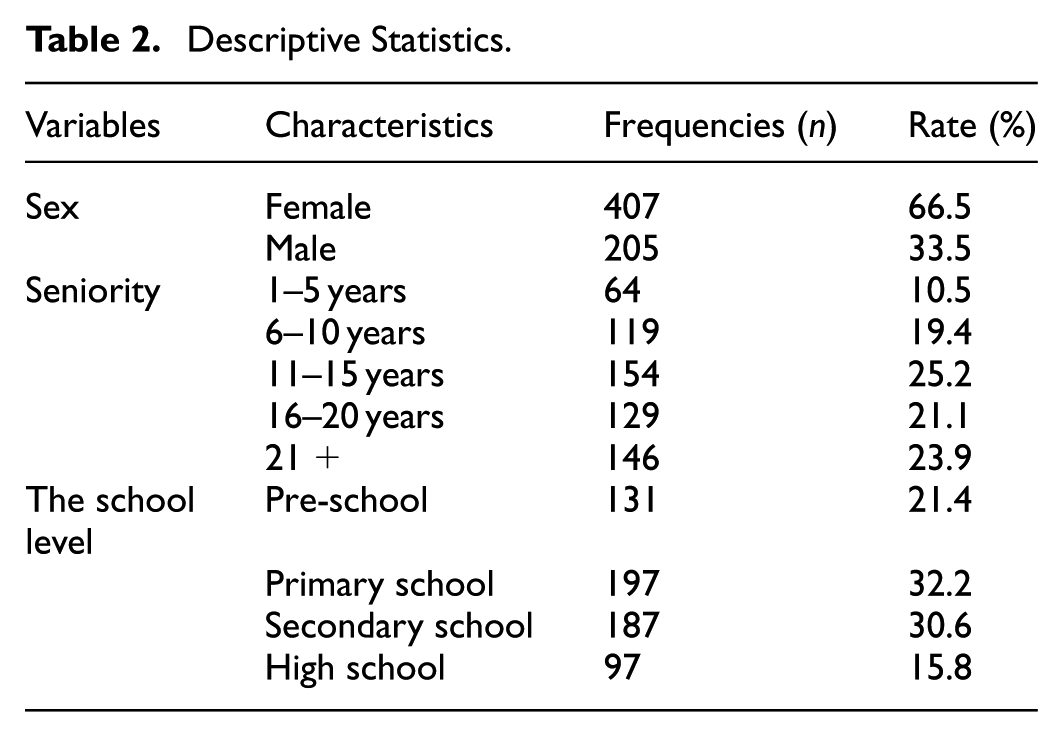
An analysis of the study participants indicates that 407 (66,5%) of them was female and 205 (33,5%) of them was male; 64 (10,5%) of them had seniority between 1 and 5 years, 119 (19,4%) of them had 6–10 years seniority, 154 (25,2%) of them had seniority of 11–15 years, 129 (21,1%) of them had 16–20 years of seniority, and 146 (23,9%) had more than 21 years of experience; 131 (21,4%)of them worked at pre-school institutions, 197 (32,2%) of them worked at primary schools, 187 (30,6%) of them worked at secondary schools, and 97 (15,8%) of them worked at high schools (Table 2).
Descriptive Statistics.
Ethical Considerations
This research was conducted in accordance with ethical standards. Approval was obtained from the Bursa Uludağ University Social and Human Sciences Research and Publication Ethics Committee (Decision No: 2023/12, dated 18/12/2023). The design of the study limited the risk of harm to participants, as the data collection involved only self-report surveys administered via Google Forms without any invasive or sensitive procedures. Participants were asked about professional perceptions and motivations, topics that posed minimal psychological or social risk. The potential benefits of the research—such as contributing to a deeper understanding of how creative leadership and organizational culture influence teacher motivation—were considered to outweigh any minor risks, as the results may inform policies and practices that improve school environments and teacher well-being. Informed consent was obtained electronically: at the beginning of the online survey, participants were provided with a clear statement about the aims of the study, confidentiality assurances, and their right to withdraw at any time without consequence. Only those who actively agreed to participate were able to proceed with completing the questionnaire.
Procedure
This study employed a cross-sectional survey design to examine the relationships among creative leadership, organizational culture, and teacher motivation. Data collection was carried out using an online survey distributed via Google Forms. The link was shared with teachers working in pre-school, primary, secondary, and high schools through school administrators and professional networks. The data collection process lasted for approximately two and a half months during the second semester of the 2023–2024 academic year. Participants were also informed of the purposes of the study before the administration of the questionnaire, and they were also assured of the confidentiality and anonymity of responses as well as the voluntary nature of the participation. Written informed consent from each participant followed before the release of data.
Measures
For collecting the data personal information form, Creative Leadership Scale (CLS), Organizational Culture Scale (OCS), and Work Extrinsic and Intrinsic Motivation Scale (WEIMS) were used in this study.
Creative Leadership Scale
The Creative Leadership Scale was developed by Uçar and Sağlam (2019) to measure school administrators’ creative leadership qualities. The scale consists of 29 items grouped under three dimensions: Entrepreneurship and Effective Communication, Openness to Innovation and Change, and Diversity. The scale is a 5-point Likert type instrument (1 = strongly disagree, 5 = strongly agree). An example item is: “The school principal encourages teachers to participate more enthusiastically in the educational process.” (Original: Öğretmenleri eğitim sürecine daha coşkulu katılmaları yönünde özendirir.) Confirmatory factor analysis supported the three-factor structure with satisfactory fit indices (e.g., CFI = .95, RMSEA = .06, SRMR = .04). The Cronbach’s alpha reliability coefficient was reported as .98 for the overall scale, with subscale alphas ranging between .80 and .97.
Organizational Culture Scale
The Organizational Culture Assessment Instrument (OCAI) developed by Cameron and Quinn (1999) was adapted into Turkish by Karakılıç (2019). The short version with 16 items measures four cultural dimensions: Clan, Adhocracy, Market, and Hierarchy. An example item from the clan culture dimension is: “Our organization is like a large family; people share a lot of themselves.” (original: “Kurumumuz, çalışanların çok şeylerini paylaştığı geniş bir aile gibidir.”). The instrument uses a 5-point Likert type scale ranging from 1 (strongly disagree) to 5 (strongly agree). The instrument has been widely validated, with reported Cronbach’s alphas above .70 for each dimension and acceptable fit indices (e.g., CFI > .90, RMSEA < .08).
Work Extrinsic and Intrinsic Motivation Scale
The Intrinsic and Extrinsic Motivation Scale, originally developed by Tremblay et al. (2009), was adapted into Turkish by Çetin and Çelebi (2021). The Turkish form consists of 18 items and six subdimensions: Intrinsic Motivation, Identified Regulation, Integrated Regulation, Introjected Regulation, External Regulation, and Amotivation. The Turkish form employs a 5-point Likert type scale (1 = strongly disagree, 5 = strongly agree). An example item is: “I work because I enjoy dealing with interesting challenges I encounter.” (original Turkish form: “Çalışırım çünkü karşılaştığım ilgi çekici zorluklarla uğraşmaktan zevk aldığım için) The confirmatory factor analysis confirmed the six-factor structure (χ2/df = 2.89, CFI = .93, RMSEA = .07). Cronbach’s alpha coefficients ranged from .58 to .89 across dimensions, with .86 for the overall scale.
Statistical Analysis
Data were analysed using SPSS 28.0 and AMOS 24.0 software packages. First, descriptive statistics and Pearson correlation analyses were conducted to examine the relationships among variables. To test the hypothesized model, Structural Equation Modelling (SEM) was employed, as it enables simultaneous testing of direct and indirect effects among latent constructs and is considered more powerful than traditional regression approaches for mediation analysis (Schumacker & Lomax, 2016). Model fit was evaluated using multiple indices recommended in the literature: χ2/df ratio, Comparative Fit Index (CFI), Tucker–Lewis Index (TLI), Root Mean Square Error of Approximation (RMSEA), and Standardized Root Mean Square Residual (SRMR). Values of CFI and TLI ≥ .90, RMSEA ≤ .08, and SRMR ≤ .08 were considered indicators of acceptable model fit (Hair et al., 2022).
Before starting data analysis, the suitability of data for analysis was examined. Four participants were excluded from data set since they answered all questions randomly (e.g. They chose 4 for all items in questionnaires). After that, 612 participants were included in analysis, which is an appropriate number for revealing indirect effects according to Fritz and MacKinnon (2007). To check the normal distribution of the data, skewness and kurtosis values for examined (Table 3), and it was seen that all of the scales’ skewness and kurtosis values were between −2 and +2, which is the accepted value for normal distribution (George & Mallery, 2010). As data were normally distributed, Pearson correlation analysis and SEM was used for the intermediary model.
Means, Standard Deviations, Reliabilities, and Bivariate Correlations.
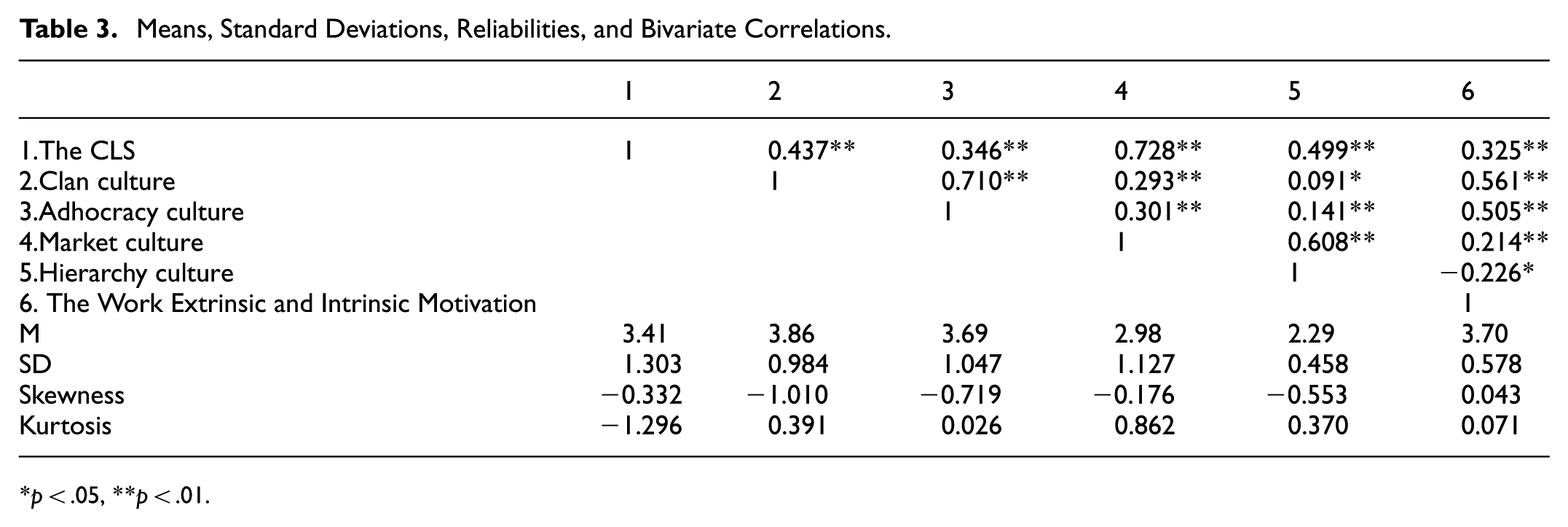
p < .05, **p < .01.
Results
Descriptive Analysis and Bivariate Correlation
The descriptive statistics of the scales are presented in Table 3. The descriptive results showed that the mean values of creative leadership (M = 3.41, SD = 1.30), clan culture (M = 3.86, SD = 0.98), adhocracy culture (M = 3.69, SD = 1.05), and motivation (M = 3.70, SD = 0.58) were above the midpoint of the scale. In contrast, the mean scores of market culture (M = 2.98, SD = 1.13) and hierarchy culture (M = 2.29, SD = 0.46) were relatively lower. Despite these differences, the skewness and kurtosis values for all variables ranged between −2 and +2 (George & Mallery, 2010), indicating that the data were normally distributed on a univariate level. The results of the bivariate correlation analysis (Table 1) indicated significant positive associations between creative leadership and all four organizational culture types: clan (r = .437, p < .01), adhocracy (r = .346, p < .01), market (r = .728, p < .01), and hierarchy (r = .499, p < .01). Moreover, creative leadership was also positively correlated with motivation (r = .325, p < .01). Each organizational culture type, with the exception of hierarchy culture (r = –.226, p < .05), was significantly and positively correlated with motivation: clan (r = .561, p < .01), adhocracy (r = .505, p < .01), and market (r = .214, p < .01). These findings provide preliminary support for the hypothesized relationships. Lastly, all bivariate correlations were below the threshold of multicollinearity concern (r < .80; Field, 2018), indicating that the constructs are statistically distinguishable and appropriate for further structural analysis.
Fit Indices
After the descriptives were analyzed, the structural equation modeling (SEM) has been conducted. The fit indices results are presented in Table 4 and, for four models in the study, the fit indices showed that the analysis shows acceptable and excellent fits, which led to the detailed SEM analysis. Model 1, examining the relationship between CL, CC, and M, demonstrates strong overall fit across multiple indices. The chi-square/degree of freedom (χ2/df) value is 3.192, which is within the acceptable range (Kline, 2015). The Normed Fit Index (NFI = 0.988), Comparative Fit Index (CFI = 0.992), and Tucker-Lewis Index (TLI = 0.980) all exceed the recommended threshold of 0.90, indicating excellent fit (Hu & Bentler, 1999). Additionally, the Root Mean Square Residual (RMR) is 0.025, well below the 0.05 cutoff, further supporting minimal residual error (Bentler, 1990). The Root Mean Square Error of Approximation (RMSEA) is 0.060, within the acceptable range but slightly higher than ideal for very strong fit (MacCallum et al., 1996). Overall, Model 1 performs exceptionally well and indicates that Clan Culture provides a strong foundation for understanding the interplay between CL and M.
Fit Indices for 4 Models.

Model 2 evaluates the relationship between CL, AC, and M. This model achieves a χ2/df value of 2.987, slightly better than Model 1, indicating an acceptable fit. The NFI (0.953), CFI (0.956), and TLI (0.989) are all above the 0.90 threshold, suggesting the model fits the data well, though NFI and CFI are comparatively weaker than in Model 1 (Hair et al., 2022; Hu & Bentler, 1999). The RMR value is 0.042, which is below the 0.05 benchmark, reflecting minimal residual error. However, the RMSEA value of 0.075 slightly exceeds the acceptable limit of 0.07, which weakens the model’s overall fit (MacCallum et al., 1996). Despite this, Model 2 remains an acceptable representation of the relationship, highlighting the role of flexibility and innovation in the relationship between leadership and motivation.
Model 3 explores the connection between CL, MC, and M. The χ2/df value is 3.098, indicating an acceptable fit according to Kline (2015). The NFI (0.972) and CFI (0.973) demonstrate strong fit, although the TLI (0.901) is at the lower end of the acceptable range, which slightly detracts from the model’s overall robustness (Hair et al, 2022; Hu & Bentler, 1999). The RMR value of 0.044 falls below the 0.05 threshold, supporting minimal residual error. The RMSEA value of 0.069 is within the acceptable range, though close to the upper boundary of good fit (MacCallum et al., 1996). Overall, Model 3 performs well, showing that a competitive and results-driven culture is moderately aligned with the relationship between leadership and motivation.
Model 4 examines the relationship between CL, HC, and M. This model achieves the best χ2/df value among all models at 2.863, indicating excellent fit in this regard (Kline, 2015). The NFI (0.914), CFI (0.919), and TLI (0.957) are all above the 0.90 threshold, but NFI and CFI are noticeably weaker compared to the other models (Hair et al., 2022). The RMR value is 0.028, well below the 0.05 cutoff, reflecting minimal residual error. However, the RMSEA value of 0.074 exceeds the recommended threshold of 0.07, indicating a less-than-ideal fit for this model (MacCallum et al., 1996). While the model captures certain aspects of the relationship, the weaker indices suggest that rigid and rule-based structures are less conducive to fostering motivation in the context of CL.
Across all models, Model 1 (CL-CC-M) demonstrates the strongest overall fit, with excellent performance in χ2/df, NFI, CFI, and RMR. This highlights the importance of collaborative and supportive organizational cultures, such as Clan Culture, in facilitating the relationship between CL and employee motivation. Model 2 (CL-AC-M) also performs well, emphasizing the value of innovative and flexible cultural environments, although its RMSEA value slightly weakens its fit. Model 3 (CL-MC-M) shows acceptable fit but is relatively weaker due to borderline TLI and higher RMSEA. Model 4 (CL-HC-M), while having the best χ2/df value, suffers from weaker NFI, CFI, and RMSEA, suggesting that rigid and hierarchical environments are less effective in supporting this relationship. These findings align with prior research, emphasizing that adaptive and collaborative cultures better nurture leadership and motivation (Hair et al., 2022; Kline, 2015; MacCallum et al., 1996).
To further examine construct reliability and validity, Composite Reliability (CR) and Average Variance Extracted (AVE) were calculated for each latent construct. As shown in Table 5, all CR values exceeded the recommended threshold of .70 and all AVE values were above .50, indicating satisfactory convergent validity (Hair et al., 2022).
Composite Reliability (CR) and Average Variance Extracted (AVE).

In addition, discriminant validity was assessed using the Fornell–Larcker criterion. Table 6 shows that, for all constructs, the square root of the AVE (diagonal) was greater than their inter-construct correlations, supporting discriminant validity.
Fornell–Larcker Discriminant Validity.

Note. MSV = Maximum Shared Variance. Diagonal values represent √AVE; off-diagonal values represent latent construct correlations.
Hypothesis Testing
For testing H1a–d, H2a–d, H3 and H4a–d, the structural equation modelling (SEM) was used, and it was conducted by using AMOS 22. The Table 7 presents the standardized regression coefficients (β), variance explained (R2), p-values, and the results of hypothesis testing related to the relationships between CL, various types of organizational culture, and motivation. The findings reveal a range of significant direct and mediated effects, with notable differences among the cultural types. The direct effects of CL on the four organizational culture types are all significant (p < .001). The strongest relationship is observed between CL and MC (β = .728, R2 = 0.531), indicating that CL strongly aligns with competitive, market-driven cultural environments. Conversely, the weakest direct relationship is between CL and AC (β = .346, R2 = .118), suggesting a moderate association between CL and innovative, flexible cultural settings. Similarly, significant relationships are noted between CL and CC (β = .437, R2 = .191) and CL and HC (β = .499, R2 = .248), highlighting the adaptability of CL across collaborative and hierarchical cultural contexts. The relationships between the four cultural dimensions and motivation also vary significantly. CC shows the strongest positive effect on M (β = .561, R2 = .314, p < .001), supporting the H2a that collaborative, clan-oriented cultures are conducive to employee motivation. In contrast, HC demonstrates a negative relationship with M (β = −.226, R2 = .119, p < .001), leading to the rejection of H2d. This finding underscores the potential detrimental impact of rigid, rule-based environments on motivation. AC has a moderate positive effect on M (β = .279, R2 = .255, p < .001), whereas MC shows a weaker but still significant positive relationship (β = .214, R2 = .046, p < .001). And lastly, the direct relationship between CL and M is significant (β = .325, R2 = .106, p < .001), supporting H3.
Hypotheses Testing.

Detailed mediation results are presented in the “Mediation Analysis” section
School Type Differences
To further examine whether teachers’ perceptions differed across school types, a one-way ANOVA with Tukey HSD post-hoc tests was conducted on creative leadership, organizational culture dimensions, and motivation. The results revealed significant differences across pre-school, primary, secondary, and high school teachers for all variables (Table 8).
One-Way ANOVA and Tukey HSD Results by School Type.
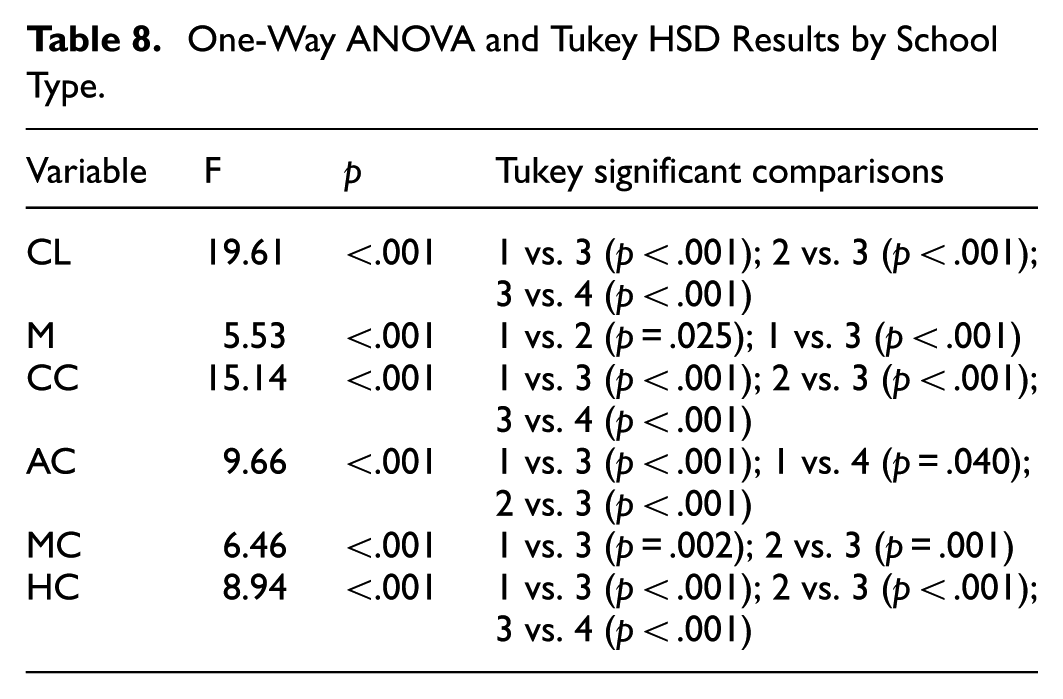
Specifically, teachers working in secondary schools consistently reported significantly lower levels of creative leadership, clan culture, and motivation compared to their peers in pre-school and primary schools. In addition, perceptions of adhocracy culture were lower among secondary school teachers compared to pre-school and primary school teachers, whereas high school teachers differed from pre-school teachers in certain aspects of adhocracy. Regarding market culture, secondary school teachers scored significantly lower than both pre-school and primary school teachers. Finally, for hierarchy culture, secondary school teachers again reported significantly lower perceptions compared to teachers in all other school types.
These patterns can be attributed to the structural and organizational features of secondary school settings. Secondary schools tend to be characterized by increased academic pressures, formal examinations, strict curricula, and performance-based accountability systems. These might limit the teachers’ professional autonomy and decrease interactions and participation in innovative endeavors. Consequently, the leadership styles articulated by creativity and innovation might be considered less prominent, while facilitating cultural aspects like clan and adhocracy might be lessened. Conversely, preschool and primary school settings usually enable more flexibility in classroom activities, more collegial ties among staff, and more pervasive developmental or student-oriented objectives, which might promote greater ratings on creativity-related leadership and motivation.
These findings suggest that secondary school settings may represent a particularly challenging context for fostering creative leadership, supportive organizational cultures, and teacher motivation. Such differences highlight the importance of tailoring leadership and cultural practices to the unique dynamics of each school level.
Mediation Analysis
The mediated effects between creative leadership and motivation through organizational culture reveal critical insights. The results are presented in Table 9. The indirect effect of CL on M through CC (β = .517, R2 = .322, p < .001) is the strongest, suggesting that collaborative cultures amplify the impact of CL on motivation (H4a verified). The mediation effect through AC is also significant (β = .446, R2 = .281, p < .001), supporting H4b. Conversely, the mediated effect of CL on M through MC is not significant (β = −.047, R2 = .107, p = .395), leading to the rejection of H12. Interestingly, the mediated effect of CL on M through HC is negative and significant (β = −.325, R2 = .106, p < .001), indicating that hierarchical cultures may hinder the motivational benefits of CL (H4c unverified). Overall, the results highlight the critical role of organizational culture in moderating the relationship between CL and motivation. Collaborative and innovative cultures (CC and AC) act as effective mediators, amplifying the positive influence of CL on motivation. In contrast, rigid and competitive cultures (HC and MC) either diminish or fail to support this relationship. These findings align with prior research emphasizing the importance of cultural adaptability and flexibility in enhancing the effectiveness of leadership and employee engagement (Hu & Bentler, 1999; Kline, 2015). The path diagrams are shown in Figure 2.
Mediation Analysis Results.

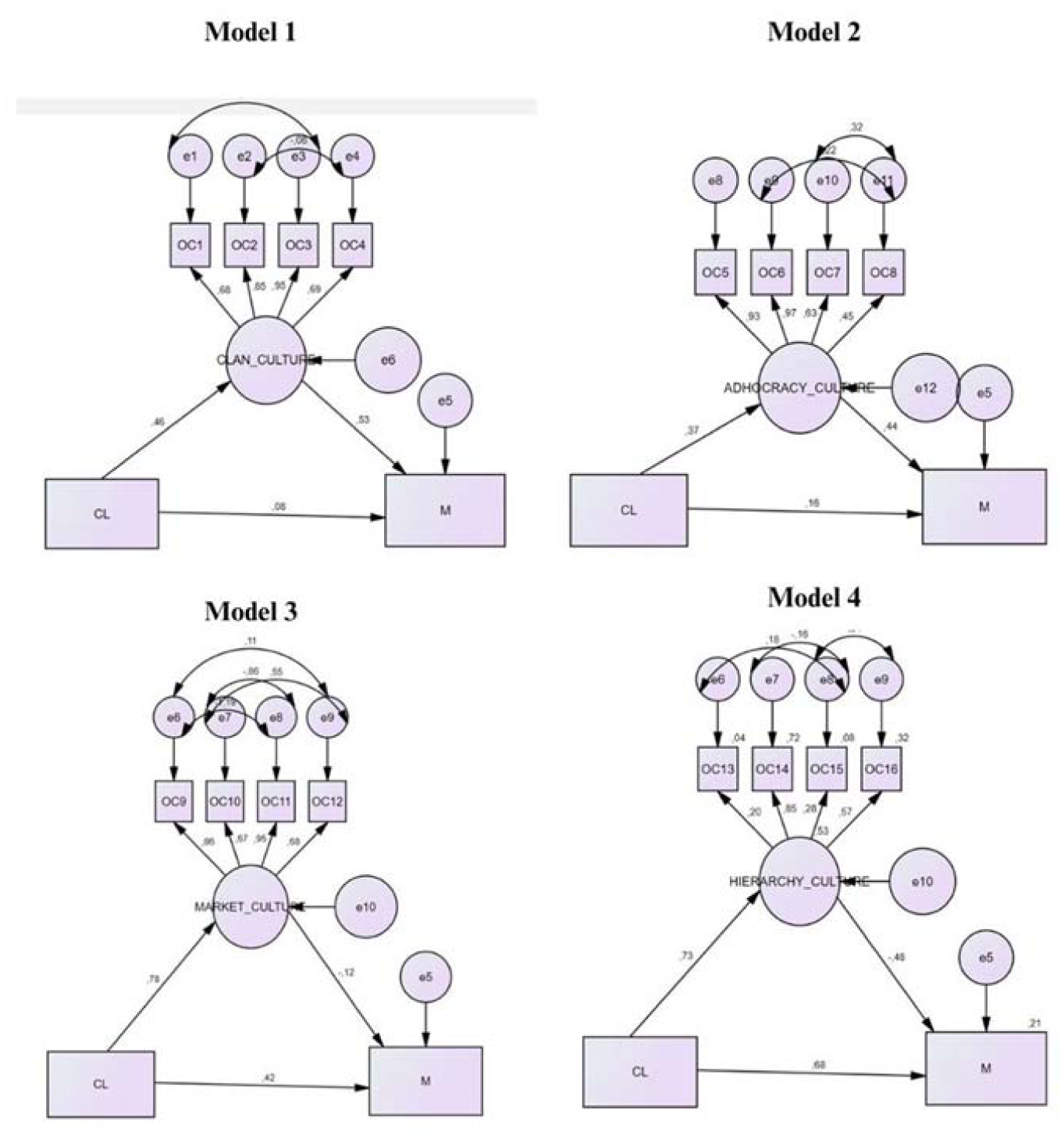
Path diagrams of the mediating effects of organizational culture and CL on motivation.
For Model 1, in which the mediating effect of CC is examined, the results showed that the standardized direct effect of CL on M is 0.081. While statistically significant (p = .034), the effect size is weak, suggesting that CL has a modest direct impact on motivation. This finding implies that while CL contributes to enhancing motivation, it alone may not be sufficient to drive significant changes without additional mediating factors. On the other hand, the direct effect of CL on CC is 0.458, a moderate positive effect that is highly significant (p < .001). The direct effect of CC on M is 0.533, which is both substantial and significant (p < .001). The indirect effect of CL on M through CC is 0.226, which is greater than the direct effect of CL on M. This finding indicates that CC serves as a crucial mediator in the relationship between CL and M. The total standardized effect of CL on M, combining both direct and indirect effects, is 0.325. The results reveal a dual pathway through which CL influences M directly and indirectly via CC. The indirect pathway through CC is particularly impactful, suggesting that leadership behaviors fostering collaboration, trust, and support within an organization significantly enhance employee motivation. In contrast, the relatively small direct effect of CL on M suggests that leadership creativity alone may not suffice in driving motivation unless coupled with a supportive cultural environment.
When it comes to Model 2, in which the mediating effect of AC is examined, the results showed that the standardized direct effect of CL on M is 0.141, indicating a weak but positive relationship. This suggests that while CL directly contributes to increasing M, its effect size is relatively small. The standardized regression weight is statistically significant (p < .001), highlighting that this relationship is meaningful. The standardized indirect effect of CL on M through AC is 0.154. This value indicates that part of the influence of CL on M is mediated through AC. The magnitude of this indirect effect is comparable to the direct effect, emphasizing the importance of AC as a pathway through which CL impacts M. The total standardized effect of CL on M, combining both direct and indirect effects, is 0.325. This suggests that while CL has a modest direct influence on M, its total impact becomes more substantial when the mediating role of AC is considered.
For Model 3, in which the mediating effect of MC is examined, the results showed that the standardized direct effect of CL on M is 0.421, which is statistically significant (p < .001). This demonstrates a moderate and positive influence of CL on employee motivation. The direct effect of CL on MC is 0.778, indicating a strong and positive relationship (p < .001). This suggests that CL is highly compatible with and effective in fostering a competitive and results-driven MC. Interestingly, the direct effect of MC on M is negative (β = −.124, p = .028). This indicates that, contrary to expectations, MC may have a detrimental impact on M. The result suggests that while MC is effective in driving results, its competitive and performance-focused nature could potentially demotivate employees, especially in contexts where intrinsic motivation and collaboration are valued. The indirect effect of CL on M through MC is -0.347, highlighting the mediating role of MC. The total standardized effect of CL on M, combining both direct and indirect effects, is 0.325. This suggests that despite the negative mediation by MC, CL still has a net positive impact on M. However, the results highlight the nuanced role of MC, which may reduce the overall motivational benefits of leadership creativity due to its emphasis on competition and performance metrics.
When it comes to last model, in which the mediating effect of HC is examined, the results showed that the standardized direct effect of CL on M is 0.675, which is statistically significant (p < .001). This indicates a strong positive direct influence of CL on M, suggesting that leadership creativity directly contributes to enhancing employee motivation even within a hierarchical cultural context. The direct effect of CL on HC is 0.729, representing a strong and positive relationship (p < .001). This result suggests that CL is effective in fostering hierarchical organizational structures, characterized by formal rules, stability, and clearly defined roles. Such environments may benefit from leadership creativity to maintain order while introducing innovative practices. Interestingly, the direct effect of HC on M is −0.480 (p < .001), indicating a significant negative influence. The indirect effect of CL on M through HC is −0.350, highlighting the mediating role of HC in this relationship. The negative indirect effect indicates that while CL enhances motivation directly, this impact is partially counteracted by the demotivating influence of HC. The total standardized effect of CL on M, combining both direct and indirect effects, is 0.325.
Discussion
The current study examined the interrelations between creative leadership, organizational culture and motivation with the aim of underlining how different types of organizational culture mediate the relationship between leadership and motivation. These findings provide significant insight into the mechanisms through which leadership behaviors will finally influence motivational outcomes, thus offering nuanced understanding within educational settings.
The direct effect of Creative Leadership on Motivation was significant in all models, implying that creative leaders are effective in enhancing intrinsic and extrinsic motivation. This is in concert with Amabile and Khaire (2008), which mentions that creative leaders facilitate an environment wherein employees can be more creative and innovative. The categories of leadership styles can further be equated to the transformational form of leadership, which has often been coupled with greater levels of engagement and motivation among workers (Bass & Riggio, 2006; Shalley & Gilson, 2004). This study extends these assertions by showing that the constructive relationship between creative leadership and the motivation also holds for students in Turkish settings, as well as garnering cross-cultural support for a line of research hitherto predominantly concerned with the populations of the West.
The results also provide a response to the gaps in the existing literature as identified by Ryan and Deci (2000), which contends that the vast amount of a person’s “autonomy, competence, and relatedness”—the principal elements of the theory of self-determination—stem from the support rendered by the leadership. That does not provide a definitive description of how leadership impacts the motivation by organizational culture but highlights the fact that the leadership impact for motivation depends on the contextual factors, which act as the mediator between them (Cameron & Quinn, 2006; Denison et al., 1995).
The results show that clan culture and adhocracy culture are a crucial mediating variable within the relationship between innovative leadership behaviors and the motivation of teachers. Supporting Competing Values Framework theory, clan culture, based on trust, cooperation, and a sense of belonging, appeared to be a very effective cultural means through which innovative leadership behaviors stimulated motivation (Cameron & Quinn, 2006). This finding aligns well with theories that assert a supportive relational environment promotes psychological security, which in turn stimulates internal processes of motivation (Inam et al., 2021; Kark & Carmeli, 2009; Rahman & Hermina, 2025; Ryan & Deci, 2000). This could be true within an education-based arena, within which a spirit of collaboration has been identified to be significantly important (Bryk & Schneider, 2002; Collie et al., 2012).
Likewise, adhocracy culture had a substantial mediating effect on the link between creative leadership and motivation, indicating the importance of flexibility, innovation, and change orientation (Cameron & Quinn, 2006). By its very essence, creative leadership can easily fit into an adhocracy-related environment where common traits include innovation and action orientation (Amabile & Khaire, 2008; Anderson et al., 2014). These results support assumptions that autonomy- and creativity-related work environments enhance both motivation and innovative work engagement (Ryan & Deci, 2000; Shalley & Gilson, 2004). In conclusion, based on overall results, it can be assumed that creative leadership works best when merged with environments that enable support for both values (clan) and innovative actions (adhocracy), ultimately enhancing both engaged and motivation-related behaviors.
The results regarding market and hierarchy cultures show a more limited set of channels through which the impact of creative leadership on motivation interacts. While being positively related, the indirect effect of creative leadership on motivation was negative, indicating a negative impact of a competitive- and performance-based context on intrinsic motivation mechanisms. This result aligns well with studies pointing to the negative effect of an external evaluation-driven, ranking, and performance-based construct on creativity and intrinsic motivation (Amabile, 1996; Hofstede et al., 2010). While competitive components can foster innovation when a balance between competition and cooperation exists in an organizational context (Baer & Frese, 2003), the present data make a case for the negative impact of market-based cultures on motivation mechanisms related to creative leadership in education, especially in a standardized testing accountability context.
In a similar way, hierarchy culture became a negative mediator for the relationship between creative leadership and motivation. Whereas creative leadership influenced the presence of hierarchical structures in an institution, it appears that a rigid and rule-governed culture like this hinders teachers’ feelings of autonomy and intrinsic motivation. According to Self-Determination Theory, feelings of autonomy are fundamental for long-term motivation, while overcontrolled and formalized settings can contribute to a degradation of motivational quality (Deci & Ryan, 2000). In line with CVF, hierarchical cultures can provide a certain guarantee for organizational stability, but these settings often provide low levels of adaptability, creativity, and motivations (Cameron & Quinn, 2006). In an academic setting, overcontrolled bureaucratic settings can thus diminish the potential of creative leadership in raising innovation levels, which necessitates balanced hierarchical settings that can effectively integrate participative and adaptive approaches to compensate for lost motivations (Rahmatullah & Kasmir, 2023; Spillane et al., 2004).
The additional analyses showed that there were significant differences in perceptions of creative leadership, organizational culture, and motivational levels between schools. The secondary school teachers reported lower motivational levels and creative leadership perceptions and clan and adhocracy cultural dimensions. In other words, leadership practices and organizational processes do not appear similar across various levels of education, but instead seem to be influenced by context-specific factors of the respective schools. This is contrary to studies conducted within Western settings, which indicated that secondary schools may also function as potential implementers of innovations under supportive leadership circumstances (Leithwood & Sun, 2018). In contrast, secondary education in Turkey is associated with heightened academic stress and strict government control and standardized testing, which may limit teacher autonomy and undermine their intrinsic motivational levels. This aligns with studies showing that competitive and results-oriented settings undermine intrinsic motivational and creative practices (Amabile, 1996; Hofstede et al., 2010).
On the other hand, it seems that pre-school and primary schools—where collaboration, flexibility, and development-oriented aspects receive more visibility—could offer relatively more favorable conditions for carrying out motivational and creative leadership. These findings illustrate that context-specific forms of leadership have become very important. In view of secondary schools, for instance, it seems that leaders would have to pay more attention to collaboration, teacher autonomy, and combating bureaucratic constraints so that the motivational penalties of accountability systems would be mitigated by these efforts and thus the motivational potentials of creative leadership would be optimized.
The study discovered creative leadership impacts teacher motivation positively both directly and indirectly by clan and adhocracy cultures but negatively by market and hierarchy cultures. Positioned on the competing values continuum, the study offers additional insight into the interplay between leadership, culture, and teacher motivation, emphasizing cultural embeddedness of learning environments. The study also shows leadership and cultural settings affect teacher motivation as a structural and a mental factor. Lastly, these research findings also bear several practical implications for educational administrators and educational policymakers, which are discussed further below.
Theoretical and Practical Implications
These research outcomes provide valuable lessons for education managers and policymakers. These outcomes reveal the importance of clan and adhocracy cultures in teacher motivation, through which creative leadership positively influences teacher motivation as a mediating factor. There exists, however, a pressing need for making leadership development policies more contextually oriented, especially in the Turkish education framework, where leadership in schools has always remained deeply entrenched in a strongly centralized administrative set-up. There could be a potential benefit in capacity-building training of education managers, specifically school principals, on creative leadership approaches, awareness of organizational cultural contingencies, and dynamically adaptable approaches towards decision-making. At the same time, these research outcomes provide valuable comparative insights for national education systems, especially where the structures of governance in education remain more standardized, bureaucratic, or centrally focused, similar to the present Turkish education framework, where teacher motivation becomes a significant challenge under the intense, high-pressured framework of education exams. These research outcomes offer valuable lessons for comparative studies of standardized education systems, where leadership development becomes a significant challenge, especially in relation to teacher motivation, innovation, and creativity in education. Beyond the Turkish framework, these research outcomes enter into the comparative domain of worldwide education systems, where accountability-based expectations of leadership performance in education have become a deep, pressing concern, especially in relation to leadership development, teacher motivation, innovation, and creativity in education.
Nevertheless, the negative mediating influences of market and hierarchy cultures point to the dangers of too much competition, too much accountability, or control by bureaucracy. Commenting on the Turkish educational context, in which educational governance is highly centralized with standardized testing being highly prominent, it could be suggested that leaders might take into consideration a balanced approach that incorporates teacher autonomy and creativity around accountability procedures. Leadership training courses could be enriched with training modules centered around cultural knowledge, leadership, and adaptive school planning, which might be highly important in the context of motivational difficulties in the secondary schools.
From a theoretical perspective, the current study contributes to leadership and motivation theories because it seeks to integrate Creative Leadership Theory with the Competing Values Framework in the educational setting. It demonstrates how varying levels of organizational culture serve to mediate the relationship between creative leadership and motivation, advancing theories which view organizational cultures in a homogenous manner. Finally, this current study seeks to integrate motivational theories derived from both Self-Determination Theory and Public Service Motivation with leadership theories, making it far more complex than previous studies with regard to developing motivational outcomes within educational institutions based upon leadership theories.
Limitations of the Study
Notwithstanding its contributions, the current research also has some limitations. Firstly, the use of self-report survey data from teachers in one geographical location may not be generalizable to other settings. Secondly, because it uses a cross-sectional method, it is not possible to make concrete causal conclusions about the inter-relationships between creative leadership, culture, and motivation. Thirdly, by using purely quantitative methods, it is possible that some context-sensitive and experience-oriented aspects regarding the inter-relationship between creative leadership and motivation may not be tapped by exclusively using the quantitative approach. Future research endeavors may use longitudinal methods and mixed approaches to investigate the inter-relationship between leadership, culture, and motivation. Further comparative research would be necessary to determine the generalizability of such relationships across various educational systems. Further research may investigate the use of other mediating factors such as psychological safety, trust, or emotional intelligence, and further expand such theoretical developments to include other outcomes such as educational achievement.
Footnotes
Acknowledgements
The author acknowledges the use of artificial intelligence–based tools (ChatGPT, OpenAI) during the preparation of this manuscript. These tools were used solely to support language refinement, improve clarity and coherence of academic English, and assist in identifying relevant scholarly literature. In addition, the tools were consulted for guidance on structuring the discussion section and for suggestions on how to develop and extend theoretical and empirical arguments based on existing literature. All substantive content, interpretations, analyses, and conclusions presented in the manuscript are the sole responsibility of the author. The author carefully reviewed, verified, and edited all AI-assisted outputs to ensure accuracy, originality, and compliance with academic and ethical standards

Ethical Considerations
This study was approved by Bursa Uludag University Institute of Social and Human Sciences Directorate Ethics Committee with the decision dated 18/12/2023 and numbered 2023/12. The studies were conducted in accordance with the local legislation and institutional requirements. The design of the study limited the risk of harm to participants, as the data collection involved only self-report surveys administered via Google Forms without any invasive or sensitive procedures. Participants were asked about professional perceptions and motivations, topics that posed minimal psychological or social risk. The potential benefits of the research—such as contributing to a deeper understanding of how creative leadership and organizational culture influence teacher motivation—were considered to outweigh any minor risks, as the results may inform policies and practices that improve school environments and teacher well-being. Informed consent was obtained electronically: at the beginning of the online survey, participants were provided with a clear statement about the aims of the study, confidentiality assurances, and their right to withdraw at any time without consequence. Only those who actively agreed to participate were able to proceed with completing the questionnaire.
Author Contributions
GGA: Writing – original draft, Writing – review & editing, Data collection, Formal analysis, Methodology, Resources, Supervision, Validation, Visualization.
Funding
The author received no financial support for the research, authorship, and/or publication of this article.
Declaration of Conflicting Interests
The author declared no potential conflicts of interest with respect to the research, authorship, and/or publication of this article.
Data Availability Statement
The raw data underpinning the findings of this article can be provided upon request.