




Abstract
The effects of environmental or individual internal factors on organizational creativity are well documented, but the mediating mechanisms of intrinsic motivation that explain the linkages between such effects remain unclear. Questionnaires completed by scientists at Japanese national research institutions were statistically analyzed by using structural equation modeling for teams (n = 65) and individuals (n = 420), and the results showed that the two variables associated with intrinsic motivation mediated the work environment and creative performance at both the individual and team levels. In revealing the similarities and differences between the team and individual measurements, the results showed that the psychological aspects of intrinsic motivation (job satisfaction), supervision, and communication are relatively significant for teams and that the behavioral aspects of intrinsic motivation (research activity), communication, and involvement are key for individuals. Furthermore, both levels of analysis showed that “Western-style” meetings are detractors for intrinsic motivation. The implications for organizational creativity theory and research management are ultimately discussed.
Keywords
Basic scientific research bolsters national competitiveness and economies and often results in industrial innovations that are relevant to daily life (Xie & Killewald, 2012). Given increasing global competition and the commensurate increasing scale, complexity and cost of basic research, the managerial aspects of scientific research practices have become an important focus. However, the understanding of the human resource practices that lead to creative performance improvements in scientific research in academia, the major channels of basic research, remain limited (Ryan & Hurley, 2007).
To understand these human resource implications, scholars have extensively highlighted the need to examine organizational theories and concepts for research in academia (Carayol & Matt, 2006). As with studies on organizational creativity, the cognitive-emotional or behavioral conditions of scientists working in organizations should also be strong predictors of scientific outcomes. Nevertheless, studies conducting empirical examinations based on an explanatory theoretical framework on organizational creativity into the mechanisms of these observed factors on scientific outcomes in academia remain scarce. In this article, we present a statistical analysis of the links between work environment perceptions, intrinsic motivation, and research performance for both individual scientists and scientific project teams based on organizational theories of creativity. By exploring the inner explanatory structures between the factors that enhance team 1 creative performance 2 and that promote individual scientists’ performance in creative work at national research organizations, we seek to place scientific practices in academia within the wider social context of human behavior studies in organizations. Although the study was conducted in a Japanese context, the findings may have global significance for researchers, policymakers, administrators, and managers interested in organizational creativity in science.
We first discuss the recent changes in scientific research practices in academia in developed countries, as such changes have been found by social science scholars to create special difficulties for managing scientific inquiry in academia by causing conflicts between individual scientists and collective efficiency demands. Second, we explain why and how current organizational theories of creativity are applicable to an understanding of the scientific practice of human resource management. Third, we statistically explore how the influence of the behavioral and cognitive-emotional aspects of intrinsic motivation in perceptions of the work environment affects creative work performance. For this purpose, we use structural equation modeling (SEM) to analyze both the individual and team levels. Fourth, based on the results, we discuss the theoretical and practical implications and offer suggestions for future research.
Theoretical Framework and Purpose
This study statistically analyzes the impact of perceptions of the work environment and intrinsic motivation on creative work performance at Japanese national scientific research institutions based on organizational theories of creativity. To explore this premise, we first consider the human resource management issues related to current scientific practices in academia.
Human Resource Practices Related to Science in Academia
In nations with advanced scientific and technological infrastructures, the scale of scientific research escalated significantly during the latter half of the 20th century, as exemplified by the development of large accelerator complexes (Hoddeson, Kolb, & Westfall, 2008). These enormous government-funded projects have changed scientific research practices in academia. National pride is now involved in the construction of massive, sophisticated, and costly observational equipment, and these undertakings, while engendering intense global competition, have also generated complex data in quantities larger than any individual can manage. 3 Consequently, hierarchy, collective effort, and project team achievements have seen increased emphasis over individual achievements (Andrade, de los Reyes Lopez, & Martin, 2009; Ziman, 1994, 2000). Scientists in academia have often been considered “intellectuals of freedom,” but their work environments have been completely altered because of these changes (Etzkowitz, 1983).
In reflecting on such circumstances, certain empirical evidence has shown the recent dominance of team science over individual pursuits (Wuchty, Jones, & Uzzi, 2007). Because there has conventionally been considered to be relatively little structural conflict of interest between the collective and individual actors in academic research organizations (Hirakimoto, 2006; Knorr, 1979), one might argue that in science studies, the ultimate variables of interest are now at the collective level of analyses, similar to that of organizational effectiveness studies. If the explanatory structure of various key work environmental perceptions on scientific outcomes is trivially concordant between the individual and team levels, there is less need to discuss the explanatory structure of the factors affecting the scientific outcome of individual scientists as the results of the investigating teams would also explain the individual factors. However, little prior research has actually empirically demonstrated the conformity between them.
Within the sociology of science, Merton (1968) proposes the concept of CUDOS, an acronym that describes the nature of the scientific community in academia: communalism, universalism, disinterestedness, originality, and skepticism. This viewpoint highlights the aspects of basic science as “public goods,” which places greater importance on openness, impartiality, and the lack of profitability attachments to the work. By contrast, Ziman (1994), a physicist who also contributed to the sociology of science, called CUDOS a social norm for individual scientists in academia and conceptualized the organization of recent scientific communities as “the PLACE,” which stands for proprietary, local, authoritarian, commissioned, and expert work. Furthermore, Ziman argued that CUDOS and PLACE are incompatible and noted that recent systemic shifts from individual to collective modes of scientific work introduce a conflict between personal scientific interests and the collective authority of the team (Ziman, 1994).
He further explained the situation: A scientist highly skilled in techniques such as software design or electronic engineering may be appreciated within the team, but this localized appraisal of the scientist who does not have individual scientific publications does not add to the global reputation of the scientist (Ziman, 1994). In prestudy interviews for this study, some scientists indicated a similar situation: They were uneasy because they had had no opportunity to write their own articles, as they were too busy with network management or data curation (the preparation of archived data from raw observational data for use by team members or other scientists; see Note 3). If they wanted to stay in the academic marketplace after completing work on a particular project, they may need to move to another research organization or even migrate internationally, and acceptance would often be judged through the published account of universal scientific knowledge (Ziman, 1994, 2000). Among the scientists who participated in our interviews, those who were in the early parts of their careers or had nonpermanent employment statuses highlighted the conflicts of interest between their personal goals and team objectives. Ziman (1994) noted this situation in the early 1990s: “For the moment, this type of highly organized teamwork rules the careers of only a minority of academic scientists” (p. 193). However, our interviews have suggested that there has been a possible increase in such cases, at least in Japan currently (see Note 3). The above discussion demonstrates that, contrary to conventional notions, there may be a structural conflict of interest between individual and collective actors in current academic research organizations.
In a more general context in organizational studies, Hennessey and Amabile (2010) note that most previous empirical studies on organizational creativity have discussed only one level of analysis within only one discipline at a time; therefore, they lack a comprehensive argument. J. B. Wu, Tsui, and Kinicki (2010) investigated the influence of leadership on employees’ positive emotional perceptions and empirically underscored Hill’s (2007) comment that managing teams cannot be equated with managing individuals within the team. These prior papers also have highlighted that a more thorough investigation could increase the understanding of organizational creativity by focusing on different levels of an organizational hierarchy in one empirical study. Therefore, the present study explores the mechanisms that explain the link between work environment perceptions, intrinsic motivation, and creative performance across the two levels of analysis: teams and individuals. Specifically, we examine whether any differences are located in the explanatory structures of the elements within those links for the scientific project teams and individual scientists.
Exploring organizational creativity by examining a profession that requires one of the highest levels of creativity would contribute to bridging the gap between social studies of science and organizational creativity studies. With this approach, the present study should also provide managerial insights for basic sciences in particular.
Connection Between Work Environment, Intrinsic Motivation, and Organizational Creativity
Intrinsic motivation principle of creativity
Current scientific practices in academia predominantly operate within organizations, and organizational researchers frequently define creativity as the production of novel and valuable ideas (Amabile, 1996; Shalley, Zhou, & Oldham, 2004; Woodman, Sawyer, & Griffin, 1993). Therefore, the production of scientific knowledge should require organizational creativity. The premise of organizational theories of creativity is hence that the work environment that influences individual/team creativity within organizations should also be applicable in a scientific context. In particular, we used Amabile’s organizational creativity theory (Amabile, 1996, 1997; Amabile & Pillemer, 2012), which places importance on employees’ perceptions of the social environment. The basic premise of the theory is that the work environment (external factors) affects the internal motivation of both individuals and teams, which in turn influences their creative pursuits (Amabile 1996, 1997; Amabile & Pillemer, 2012). This is known as the “intrinsic motivation principle of creativity” (Hennessey & Amabile, 2010). Amabile (1997) noted that “the poorer the work environment in the department, the lower the morale and the less creative the employees’ approach to their work” (p. 51). This premise of the theory is widely accepted in organizational creativity studies (Robbins, 2005; Zhou & Shalley, 2003); nevertheless, Shalley et al. (2004) claimed that “few studies actually measured intrinsic motivation and tested whether it empirically mediates the context-creativity relation” (p. 945).
Likewise, within science studies, few studies have quantitatively explored the extensive explanatory structure among psychological perceptions of the work environment, the intrinsic motivation for individual scientists and scientific project teams’ creative work performance. Furthermore, empirical studies on the “intrinsic motivation principle of creativity” in non-Western academic research organizations, such as those in Japan, are scarce. Therefore, to clarify the range of the theory in the context of academia in Japan, this study seeks to test the principle of Amabile’s hypothesis that the work environment influences the intrinsic motivation of both individual scientists and project teams, which in turn influences their creative performance.
Mediating role of intrinsic motivation
Extensive empirical organizational research has highlighted the relationship between intrinsic motivation and creativity (Alencar, 2012; Dewett, 2007) and between the work environment and creativity (Baer & Frese, 2003).
In the prior literature, Peltz and Andrews (1966) were probably the first to extensively study the direct relationship between various environmental elements and scientific productivity. Andrews (1979) extended this work to an international comparative study in six countries. However, as Andrews noted, almost without exception, the relationship between the environmental factors and scientific performance “tended to be of rather modest strength” (Hemptinne & Andrews, 1979, p. 11). In line with Peltz and Andrews’s findings, one relatively recent empirical investigation into the direct relationship between the perceived work environment and research performance for British scientists in academia also reported weak-to-moderate correlation coefficients of 0.1 to 0.3 (Ryan & Hurley, 2007). These findings suggest the possible existence of some mediator variables between the environment–creativity relationships and highlight the need for a more comprehensive inquiry into the explanatory mechanisms of this relationship.
Hence, the present study examines how intrinsic motivation mediates (A. D. Wu & Zumbo, 2008) the relationship between the perceived work environment and creative performance to test the adequacy of the “intrinsic motivation principle of creativity” with the models incorporating the observed key modules identified in previous studies.
Behavioral and Psychological Aspects of Intrinsic Motivation
Scholars in organizational studies have defined intrinsic motivation as the pleasure and satisfaction derived from doing work (Deci, 1975; Gagné1 & Deci, 2005; Vallerand et al., 1992); the drive to do something for enjoyment, interest, and personal challenge (Hennessey & Amabile, 2010); and the amplitude of effort (Erez & Judge, 2001; Naylor, Pritchard, & Ilgen, 1980). The first two definitions focus on the psychological (cognitive-emotional) aspects of intrinsic motivation, and the third focuses on the behavioral aspects of intrinsic motivation. Although emotional states and behavior are not equal, the differences in such intrinsic motivation concepts have not been sufficiently discussed in previous empirical studies.
Moreover, noting the absence of organizational creativity research that has empirically examined the mediating role of intrinsic motivation, Shalley et al. (2004) noted that studies in this area have provided inconsistent results (e.g., Shalley & Perry-Smith, 2001; Shin & Zhou, 2003; Kim & Lee, 2011). They further claimed that there is a need to develop and test alternative measures for the intrinsic motivation construct to explain that the relatively weak mediating effects of intrinsic motivation are possibly due to the used questionnaire’s measures. Therefore, by unpacking intrinsic motivation into psychological and behavioral aspects based on the definitions from prior organizational research and exploring how those aspects separately affect creative performance, we can contribute to theoretical discussions on the mediating role of intrinsic motivation.
Highly motivated scientists who produce scientific knowledge are involved in activities related to their research, so measuring the frequency of holding research meetings and workshops should tap into the behavioral aspects of intrinsic motivation as an “amplitude of effort.” We quantified the frequency with which scientists organized such research meetings and named this construct Level of Research Activity (Research Activity) by following the lead of scholars in organizational behavior who have quantified agents’ “amplitude of effort” as Activity Level, which includes the number of phone calls or interviews with clients (Erez & Judge, 2001).
For the psychological aspect of intrinsic motivation, we utilized the concept of job satisfaction (Locke, 1976) to measure the “pleasure and satisfaction derived from doing the work.” 4 Although job satisfaction should not be considered synonymous with morale or motivation (Latham, 2007), it can serve as a proxy for psychological aspects of intrinsic motivation if we assume that people who are satisfied with their work express a positive attitude toward it and are more likely adopt cooperative attitudes toward team members (Hirakimoto, 2006). Consequently, the morale of teams with highly satisfied members would be enhanced. Job satisfaction could be related to various emotional states, such as psychological well-being (Saari & Judge, 2004) and sense of accomplishment or self-efficacy (Judge, Bono, Thoresen, & Patton, 2001), and measures for job satisfaction can vary in different applications. In particular, this study focused on job satisfaction as a state of psychological well-being derived from doing the work to minimize the concept overlap between the two constructs of intrinsic motivation.
Hence, this study operationalized scientists’ intrinsic motivation by using two variables: level of research activity (a behavioral variable related to intrinsic motivation) and job satisfaction (a cognitive-emotional variable related to intrinsic motivation). Furthermore, we statistically examined how these variables separately mediate the environment–creativity relationship.
Work Environment
Because it is impossible to include all the environmental factors related to organizational creativity or scientific outcomes in a finite model, we focused on the two aspects of social context: organizational culture and resources.
Organizational culture
Scientific knowledge results from scientific practice, the quality of which is affected by the work environment, which includes the communication systems embedded in the laboratory culture (Kinsella, 1999; Knorr-Cetina, 1995). Social studies of science researchers have noted the cultural differences in laboratories in the West and in Japan (Kneller, 2007; Traweek, 1992); however, empirical research based on organizational creativity theories as a lens through which to examine how organizational culture influences scientific practices remains insufficient (Anderson, Potočnik, & Zhou, 2014).
In organizational studies, some evidence has suggested that organizational culture can influence creativity (McLean, 2005; Tesluk, Farr, & Klein, 1997), and researchers have shown considerable interest in the influence of the social environment on work creativity in various cultural contexts (Fleith, 2002; Raina, 1993). For instance, Hennessey and Amabile (2010) highlighted the need to verify whether Amabile’s intrinsic motivation principle, developed in a Western context, applies to Asian contexts. Anderson et al. (2014) noted the importance of identifying cultural similarities and differences between the East and the West with regard to organizational creativity. Therefore, to construct work environment factors, this study adopted the organizational culture concept to empirically examine how it affects creative performance in a Japanese academic context.
Organizational culture has frequently been described by organizational researchers as involving shared meaning, normative patterns, or expectations that evolve over time within organizations (Glaser, Zamanou, & Hacker, 1987; Schein, 2010; Schneider, Ehrhart, & Macey, 2013). Although the foci of these definitions vary, most agree that it is not an easily identifiable or neatly integrated concept; rather, it is an aggregation of complex subordinate concepts (Glaser et al., 1987). Of the quantitative scales that measure complex organizational cultures, this study used the Organizational Culture Survey (OCS) 5 developed by Glaser et al. (1987) to measure the work environment because it is relatively concise, because there is no scale that is considered an established and optimized perceptual measure for the organizational culture of the work environment in a science study context, and because the OCS has been successfully used to examine perceived work environments across various occupations (Ryan & Hurley 2007; Sheng, Pearson, & Crosby, 2004; Zamanou & Glaser, 1994), including non-Western cultural contexts (Taghipour & Dejban, 2013). The original OCS included five factors:
Supervision: pertinent feedback, encouragement, participative manner, and clear job expectations of the team leader;
Atmosphere: interpersonal cooperation and trust and team coordination;
Communication: organizational flow of communication to the pertinent people;
Involvement: sense of autonomous participation and commitment to the work; and
Meetings: productivity of team meetings.
A previous study (Ryan & Hurley, 2007) used this scale to measure the academic work environment for British scientists, and the results showed that the OCS is capable of summarizing a majority of the key workplace environmental factors (e.g., Heinze, Shapira, Rogers, & Senker, 2009), including the supervisory encouragement of the team leader, smooth information flow, a cooperative atmosphere, or the sense of autonomous involvement that could influence team science. Such aspects of the work environment are also noted to be key influences on organizational creativity (Anderson et al., 2014). Therefore, exploring the effect structures among variables composing aspects of organizational culture to examine their influences on scientific outcomes and identifying similarities and differences between the West and Japan would contribute to current debates on organizational creativity.
Resources
United Nations Educational, Scientific and Cultural Organization’s (UNESCO) empirical study into research unit productivity found a minimal or no correlation between economic and physical resources and scientific performance (Hemptinne & Andrews, 1979; Stolte-Heiskanen, 1979). However, recent studies have indicated that physical resources are correlated with a research unit’s creative performance (e.g., Bozeman, Fay, & Slade, 2013; Chawla & Singh, 1998; Heinze et al., 2009). Such a contradiction may reflect the recent structural changes in scientific research practices in academia. Furthermore, governments, scholars, and science policy practitioners have generally assumed that a relationship exists between the resource level and performance when establishing science policy (Carayol & Matt, 2006; Whitley, 2011). To elucidate the above discussion, we incorporated variables that measured perceptions regarding the economic and physical resources required for research as part of the work environment in our models.
In addition, from our prestudy interviews with the scientists, we felt that it was necessary to also consider research resources as assistance from clerical personnel and workspace issues that may influence creative performance. Stolte-Heiskanen (1979) addressed these issues in the UNESCO research and reported that sufficient personnel support may play a more important role in the effectiveness of research unit. She further noted that the resource-research effectiveness relationship in a team is likely more complex than macro-level models indicate and claimed research should conduct micro-level analyses on actual research units; nevertheless, an extensive literature review revealed that subsequent empirical studies on academic science have predominantly focused on economic resources, including research funding, and that they have not sufficiently addressed how other resources, such as personnel assistance and adequate workspaces, may differentially affect such economic resources. Therefore, we operationalized the concept of research resources by using a newly developed scale with two variables for the present study:
Personnel and Space: supportive staff and comfortable workspace for ease of concentration
Budget and Materials: adequate research budget and materials.
Individual and Team Internal Structural Mechanisms
The “intrinsic motivation principle” asserts that the work environment influences the creativity of both individuals and teams, which in turn can foster innovative outcomes (Amabile, 1997). If this positive cycle works well in Japanese academic science circles and if the conformity of the individual and team goals is evident, then the discordance between the individual and collective interests noted by Ziman (1994, 2000) would not be observed. However, the possibility of such discordance was observed during our prestudy interviews. Therefore, we assumed that different internal structural mechanisms may affect the link between work environment perceptions and intrinsic motivation, which can affect the creative work performance of individuals and teams. To test this hypothesis, we conducted further additional exploratory analyses to investigate the inner work environment structure that may affect the intrinsic motivation of individuals and teams.
Conceptual Framework
Figure 1 shows the conceptual framework that we derived from Amabile’s organizational creativity theory and the previous discussion. We tested the hypotheses presented below within the framework shown in Figure 1 with respect to both individuals and teams.
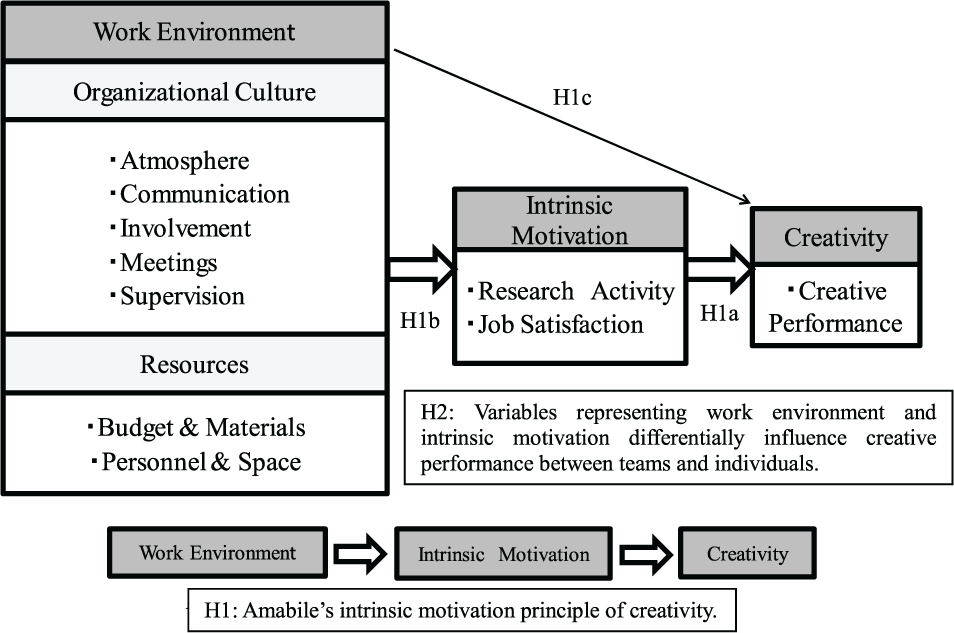
Conceptual framework.
Method
Survey Instruments
Questionnaire
A questionnaire was distributed from December 2010 to January 2011 to all active research scientists in five organizations in Japan: the National Astronomical Observatory of Japan, the National Institute for Fusion Science, the Institute for Molecular Science, the Institute of Space and Astronautical Science/the Japanese Aerospace Exploration Agency, and the High Energy Accelerator Research Organization. These national organizations operate under the purview of the Ministry of Education, Culture, Sports, Science, and Technology in Japan, and all of them are globally recognized as being at the forefront in developing state-of-the-art physical science and advanced scientific devices and conducting many large scale national projects. Therefore, scientists and project teams in these organizations are part of the recent growth in the scale of scientific research (Kato-Nitta & Maeda, 2013).
A total of 1,240 questionnaires were distributed, and 494 were returned completed (response rate = 39.8%). The respondents included 457 men and 37 women, with an average of 43.0 years of age (43.6 for men and 35.5 for women). The respondents comprised 292 full-time and permanent employees (average age = 45.7 years) and 196 limited-term or part-time employees (average age = 39.0 years). Of these, 413 held PhDs (83.8% of respondents), and of these, 70.2% had obtained doctorates from the Faculty of Science, 22.3% from the Faculty of Engineering, and 7.5% from other fields.
Creative work performance (creative performance)
We defined creative performance (see Note 2) as the publication of scientific papers and the receipt of patents. Five self-reported publication items from the UNESCO survey (Andrews, 1979) were modified and translated into Japanese and then revised on the basis of feedback from the scientists at the examined institutions. These publication items were (a) books, (b) scientific and technical articles in refereed journals as a first author, (c) scientific and technical articles in refereed journals as a coauthor, (d) scientific and technical articles published in conference proceedings as a first author, and (e) patents.
Creative performance over the previous 3 years was measured by totaling the number of publications and patent receipts in each category. Publications in nonrefereed articles in categories (b), (c), and (d) were excluded to ensure homogeneity when we measured creativity and work quality. If a respondent’s tenure was fewer than 3 years, we converted the number of years to 3 and used that value to measure creative performance. The number of publications in the five categories was defined as each scientist’s individual creative performance, and each team’s output was defined as the average of the individual output for each scientist on the team.
Work environment scales
Drawing on our theoretical construct and literature review, we measured the work environment factors on two scales: organizational culture and resources.
OCS Scale
First, a scale for the work environment was constructed by using the 31 OCS items. We excluded 45 responses with missing or inadequate answers and then performed a factor analysis (principal component method with the “eigenvalues greater than 1” rule and a promax rotation) on the remaining 449 responses. The five-factor structure presented in the original study by Glaser et al. (1987) was extracted (see Note 5): (a) supervision, (b) atmosphere, (c) communication, (d) involvement, and (e) meetings. The Kaiser–Meyer–Olkin measure of sampling adequacy for the data was 0.956, indicating that the factor analysis application was appropriate. A confirmatory factor analysis for the OCS scale was also conducted, and a sufficient result was obtained.
Second, the reliability coefficient for each OCS subscale was calculated (Table 1). The Cronbach’s alpha coefficient for the subordinate organizational culture concepts was 0.854 or higher. The factor analysis results and the reliability coefficients for each OCS subscale confirmed that this scale had sufficient reliability and internal consistency.
Cronbach’s α Reliabilities for the Work Environment and Intrinsic Motivation Subscale.

Note. OCS = organizational culture survey.
Resources Scale
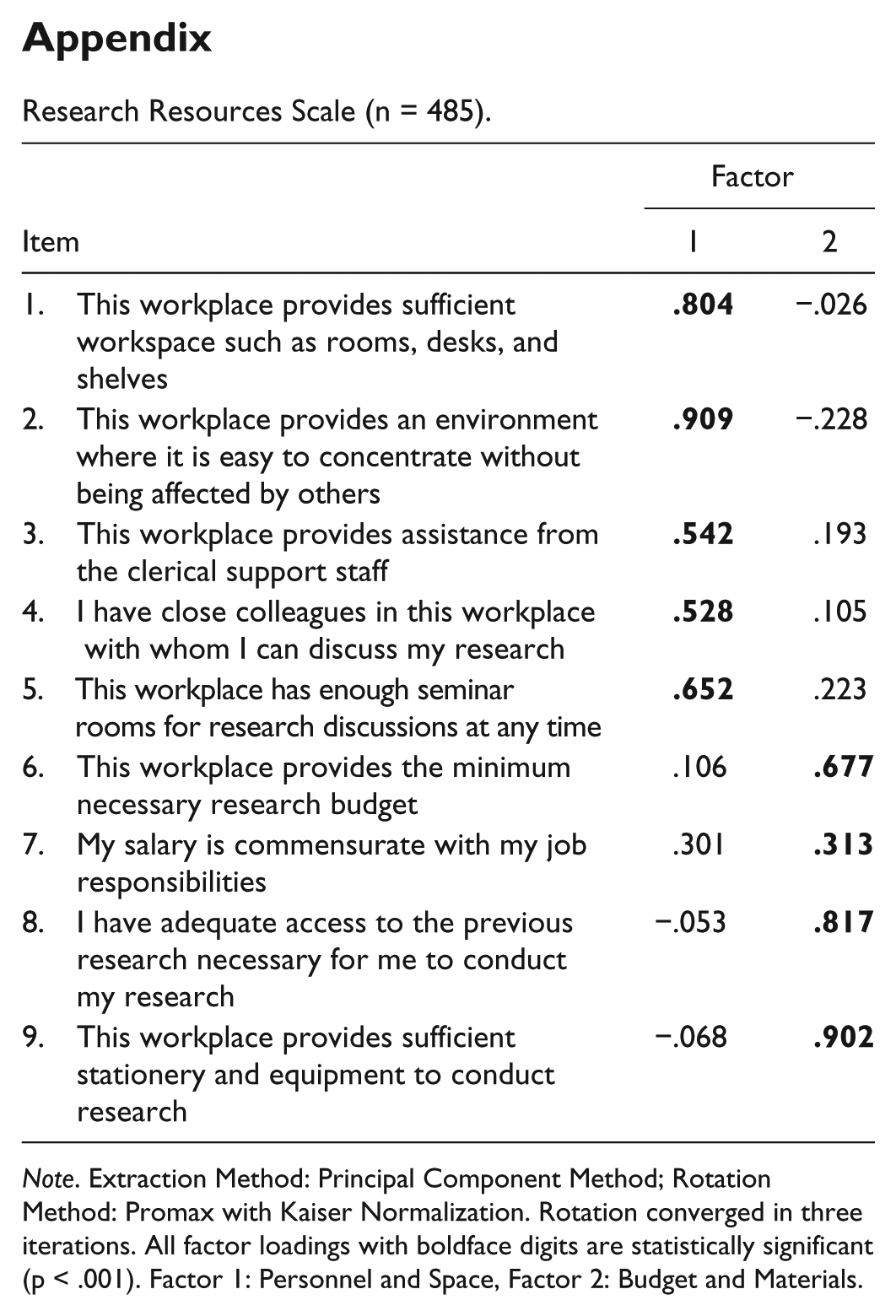
A newly developed nine-item scale to measure the resources of public sector scientific project teams was used, where each item was scored on a 5-point scale. We excluded nine cases with missing and inadequate answers and performed a factor analysis (principal component method with promax rotation) on the remaining 485 items. A two-factor structure—(1) personnel and space and (2) budget and materials—was extracted, with eigenvalues 1 or higher. The items included in this scale and the results of the factor analysis are presented in the appendix. The Kaiser–Meyer–Olkin measure of sampling adequacy was 0.824, indicating that the factor analysis was appropriate for the data. A confirmatory factor analysis was also conducted for the Resources scale, and a sufficient result was obtained. The Cronbach’s alpha reliability coefficients for the subordinate concepts in the Resources factor were 0.709 or higher (Table 1), and the factor analysis results and reliability coefficient for each subordinate concept confirmed the scale’s reliability and internal consistency.
Intrinsic motivation scales
Guided by the theoretical background and literature review, intrinsic motivation was measured across two variables: Job Satisfaction and Research Activity.
Job satisfaction
As shown below, four items from the job satisfaction scale developed by an organizational psychologist (Shimazu, 2004) were adapted and slightly modified to match the requirements of our study. Shimazu’s job satisfaction construct was developed to determine the psychological well-being and positive emotional states from work, with each item scored on a 5-point scale. The validity and reliability of these scales were confirmed in previous Japanese-language context studies. The Cronbach’s alpha for the following four items was 0.826 (Table 1): (a) satisfied with current work, (b) satisfied with current tasks, (c) satisfied with current duty position, and (d) I wish to work here for the next 5 years.
Research activity
The frequency with which scientists hosted research workshops and seminars was calculated (a) within their project groups, (b) in their organizations, and (c) outside their organizations, with each category measured on a 5-point scale. The Cronbach’s alpha for the three items was 0.833, indicating sufficient reliability and internal consistency (Table 1).
Results
Correlation Analysis
Table 2 shows the means and standard deviations for each variable (factor) and the correlations between the variables for the teams and individuals. In this study, 65 project teams of two or more respondents were extracted, and the teams’ average values were analyzed. The teams had between two and twenty-one members, with an average of seven members.
Correlation Matrix, Means, and Standard Deviations of the Variables.

Note. Pearson correlation, two-tailed. Intercorrelations for team level (n = 65) and individual level (n = 420) are presented above and below the diagonal, respectively. Means and standard deviations for group and individual levels are presented in the vertical columns and the horizontal rows, respectively.
p < .05. **p < .01.
As shown by the intercorrelations of the results for the individual scientists (below the diagonal in Table 2), no OCS variable denoting work environment was found to be significantly correlated with Creative Performance. Furthermore, the correlation for Resources was statistically significant and positive; the variables for intrinsic motivation significantly and positively correlated with Creative Performance; and involvement had the highest correlation with Job Satisfaction, with a relatively higher correlation with most other work environment variables.
As shown by the intercorrelations at the team level of analysis (above the diagonal in Table 2), some OCS work environment variables were found to be significantly correlated with Creative Performance, and Resources were also found to be significantly and positively correlated with Creative Performance. Furthermore, Supervision had the highest correlation with Job Satisfaction and showed significantly higher correlations with most other work environment variables.
Structural Equation Models at the Individual and Team Levels
SEM (Kaplan, 2000), using the observed variables, was applied under the constraint of the conceptual framework presented in Figure 1. Analyses were separately conducted at the individual and team levels to elaborate the models for both levels of analyses, and a maximum likelihood for parameter estimation was used. Figures 2 and 3 show the results at the individual and team levels, respectively.

Structural equation model at the individual level (n = 420).
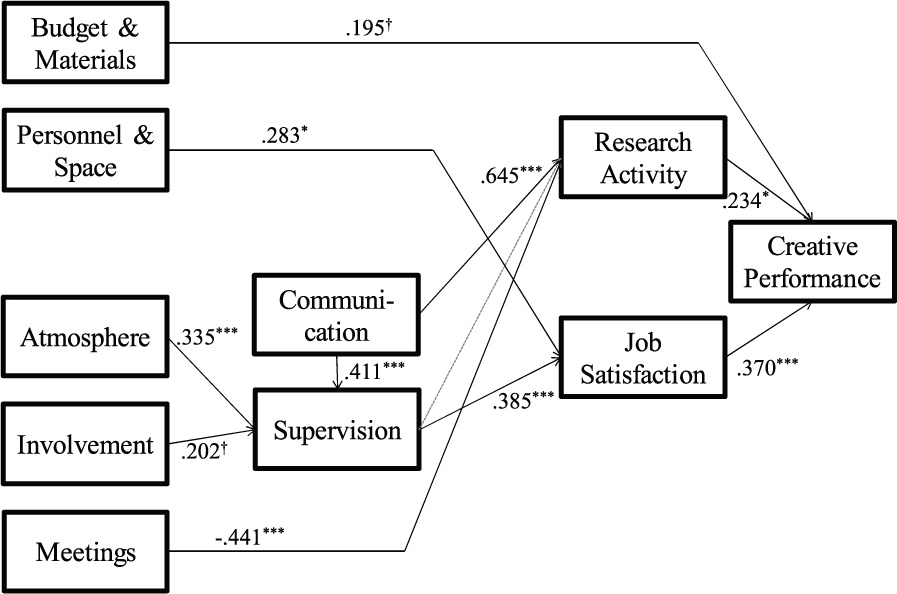
Structural equation model at the team level (n = 65).
Individual level of analysis
The individual level of analysis is shown in Figure 2. The model had an adequate fit with the observed data: The indices for the model fit were χ2 = 21.351, χ2/df = 1.256 (the chi-square test was nonsignificant), goodness-of-fit index (GFI) = 0.990, adjusted goodness-of-fit index (AGFI) = 0.967, comparative fit index (CFI) = 0.997, and root mean square error of approximation (RMSEA) = 0.025. The level of Research Activity was found to most strongly affect Creative Performance, and Job Satisfaction was found to directly affect Creative Performance. The path coefficient from Research Activity to Creative Performance was 0.256, and the path coefficient from Job Satisfaction to Creative Performance was 0.097, both of which were statistically significant.
Further investigation into the inner structure of the explanatory elements for intrinsic motivation in individual scientists indicated that Involvement had the strongest positive effect on Job Satisfaction and that Communication had the strongest positive effect on Research Activity. As Figure 2 shows, the path coefficient for Communication to Research Activity was 0.388, and the path coefficient for Involvement to Job Satisfaction was 0.444, both of which were statistically significant. The R2 for each endogenous variable were as follows: Involvement = 0.743, Job Satisfaction = 0.310, Research Activity = 0.069, and Creative Performance = 0.077.
The presented model shown in Figure 2 is the final version of the exploratory modeling. In the model selection process, several alternative nested models were tested. For example, a comparison between the present and simpler models (with fewer paths) was conducted to consider the confirmation bias noted by Shah and Goldstein (2006). The final model was chosen within the constraints of the conceptual framework in Figure 1, and it represented a significant improvement over models with fewer paths. For example, the chi-square value of the present model was 21.351, whereas the value was 90.677 for the model without a path from Communication to Involvement. Similarly, the presented model represented a significant improvement over models that did not have other paths. Conversely, the addition of paths to the present model was not found to significantly improve the model fit. Therefore, the presented model was concluded to be the final model.
The beginning variables that had significant standardized indirect (mediated) effects on the final dependent variable were Meetings and Communication (see Note 6). Thus, the indirect effects of the beginning variables were significant, and the relevance of the presented model with mediator variables is confirmed.
In summary, the analysis of the individual scientists revealed the following findings. First, intrinsic motivation mediates the relationship between work environment and creative performance (H1). Second, the two intrinsic motivation variables, Job Satisfaction and Research Activity, positively influence Creative Performance (H1a). Third, Involvement and Budget and Materials positively influence Job Satisfaction, whereas Meetings negatively influences Job Satisfaction (H1b). Fourth, Communication positively influences Research Activity (H1b).
Team level of analysis
Figure 3 presents the results at the team level of analysis. The model was found to fit the observed data adequately: The indices were χ2 = 14.746, χ2/df = 0.776 (the chi-square test was nonsignificant), GFI = 0.958, AGFI = 0.884, CFI = 1.000, and RMSEA = 0.000. Job Satisfaction exerted the strongest direct influence on Creative Performance, and the level of Research Activity exerted a relatively significant and direct effect on Creative Performance. The path coefficient for Research Activity to Creative Performance was 0.234, and the path coefficient for Job Satisfaction to Creative Performance was 0.370, both of which were statistically significant.
Of the variables constituting the external work environment factors, Budget and Materials was found to directly affect Creative Performance. Delving into the factors that explained the intrinsic motivation in teams, we found that Supervision had the strongest positive effect on Job Satisfaction, that Communication had the strongest positive effect on Research Activity, and that Meetings negatively affected Research Activity. As Figure 3 shows, the path coefficient for Communication to Research Activity was 0.645, and the path coefficient for Supervision to Job Satisfaction was 0.385, both of which were statistically significant. The R2s for each endogenous variable were as follows: Supervision = 0.693, Job Satisfaction = 0.310, Research Activity = 0.072, and Creative Performance = 0.295.
The presented model was the final version of the exploratory model. In selecting the model, we tested alternative nested models by removing several paths from the presented model and confirmed the change in the chi-square values to consider the confirmation bias noted by Shah and Goldstein (2006). For example, the model’s chi-square value changed from 14.746 to 28.771 when the path from Communication to Supervision was removed. Therefore, we concluded that the presented final model represented a significant improvement on models with fewer paths. Conversely, the addition of paths to the present model did not significantly improve the model fit.
The beginning variables that had a significant standardized indirect (mediated) effect on the final dependent variable were Meetings, Communication, and Personnel and Space (see Note 6). Hence, the indirect effects of the beginning variables were significant, and the relevance of the presented model with the mediator variables is confirmed.
The analysis of the scientific teams provided the following findings. First, intrinsic motivation mediates the relationship between work environment and creative performance (H1). Second, the two intrinsic motivation variables, Job Satisfaction and Research Activity, enhance Creative Performance (H1a). Third, Budget and Materials enhances Creative Performance (H1c). Fourth, Supervision and Personnel and Space enhance Job Satisfaction (H1b). Fifth, Communication enhances Research Activity, whereas Meetings are negatively related to Research Activity (H1b).
Our individual- and team-level analyses confirm the basic structure presented in Figure 1 (H1). Further exploration into the internal work environment elements that explain intrinsic motivation revealed structural differences in the interrelationships between the major explanatory variables (H2). Some similarities were also identified, as Figures 2 and 3 illustrate. Communication was found to exert a relatively significant positive effect on intrinsic motivation, whereas Meetings were found to have a negative effect for both individuals and teams.
Discussion
Theoretical Implications
The results of this study revealed that the two variables of research activity and job satisfaction mediate the relationship between work environment perceptions and creative work performance, suggesting that the intrinsic motivation principle of creativity is applicable for both teams and individuals in Japanese academic settings. Several theoretical implications can also be drawn from our approach of comprehensively investigating the inner correlations within the links between the work environment, intrinsic motivation, and creative work performance.
First, our results contribute to the elaboration of organizational creativity theories and models concerning intrinsic motivation. While the mediating effect of intrinsic motivation between the work environment and creative performance was confirmed for both levels of analysis (teams and individuals), the two variables representing intrinsic motivation affected creative performance differently. For teams, Job Satisfaction had a relatively greater impact on Creative Performance than on Research Activity. However, the result was the opposite for the individual scientists. These findings suggest that the psychological aspects of intrinsic motivation are relatively significant for teams, whereas the behavioral aspects of intrinsic motivation are relatively significant for individuals. Hence, the process by which intrinsic motivation mediates the work environment and creativity may differ for individuals and teams.
Second, our approach of focusing on the mediating role of intrinsic motivation identifies and fills a gap, as we provide a link between organizational creativity studies and science studies. Almost all the identified environmental factors related to scientific productivity in previous science studies were found to be rather modest (Hemptinne & Andrews, 1979). Furthermore, recent studies investigating the zero-order correlations between work environment perceptions and research performance by using OCS (Ryan & Hurley, 2007) also found weak-to-moderate correlation coefficients. We obtained statistically verifiable comprehensive findings by employing intrinsic motivation mediators and by linking these to environmental factors and creative performance based on the organizational theory of creativity.
Third, this study presents empirical findings that may support Ziman’s (1994, 2000) claim of a conflict between individual and collective interests in current scientific practices. By examining two levels of analysis (teams and individuals), we elucidate the similarities and differences in the explanatory structure between these two levels. Our results also imply that the managerial pathways for maximizing collective scientific creativity and individual scientific creativity may differ. Communication and Involvement were found to significantly enhance individual intrinsic motivation, whereas Communication and Supervision significantly enhanced team intrinsic motivation. The finding that a smooth flow of communication significantly enhances the intrinsic motivation of both groups and individuals coincides with findings in previous organizational studies (e.g., Berger, Roloff, & Roskos-Ewoldsen, 2010) and science studies (e.g., Bozeman et al., 2013; Ryan & Hurley, 2007). At the team level, the results concur with previous empirical science studies that have shown that the aspect of governance, including participative leadership behaviors of the supervisor, can affect the intrinsic motivation/performance of teams (Anderson et al., 2014; Knorr, 1979; Richard, 2007). At the individual level, Involvement, including a sense of autonomous commitment, was observed to have a strong effect on intrinsic motivation. This finding is consistent with that of a previous study on organizational management (e.g., Langfred & Moye, 2004) and those of previous studies on the direct relationship between autonomy and intrinsic motivation (Andrews et al., 1979). Put differently, our extended models successfully incorporated fragmented key modules from previous organizational studies and showed that the differences may reflect the conflict of interest between personal goals and team objectives observed in current academic science.
Fourth, we advance knowledge on research funding. The environmental factor Budget and Materials was found to directly influence Creative Performance for teams. This result is concordant with previous literature at a collective level of analysis, which has shown a direct relationship between resources and creative performance (Chawla & Singh, 1998; Heinze et al., 2009), which was contradictory to the results of Andrews et al. (Andrews, 1979). In the 1970s, when Andrews’s investigation was conducted, science in academia was depicted as having little structural conflict of interest between organizational goals and individual objectives. Because science scholars have repeatedly noted the recent institutional changes in scientific research (Etzkowitz, 1983; Heinze et al., 2009; Whitley, 2011; Ziman, 1994, 2000) and because the present study’s findings reveal different explanatory structures between teams and individuals, this contradiction can be interpreted as follows: There may be relatively greater conflict of interest between collective goals and individual objectives in current science in academia than in the 1970s, at least between the individual and team levels.
Practical Implications
Our results support the basic structure of theory and imply that the intrinsic motivation principle of creativity developed in a Western context should also contribute to promoting our understanding of human resource management in Japanese academic contexts.
In our analyses, meetings seemed to detract from the behavioral aspects of intrinsic motivation (Research Activity) at the team level and the cognitive-emotional aspects of intrinsic motivation (Job Satisfaction) at the individual level. In contrast, Ryan and Hurley (2007), utilizing the same OCS scale, found a significant positive correlation between research performance and meetings in a British context. Furthermore, Traweek’s (1992) work on comparative anthropological observations on physicists in the United States and Japan highlighted cultural differences in the decision-making process in meetings, and our results quantitatively underscore these findings. Hence, although the basic premise of Amabile’s model is confirmed in the Japanese academic context, the inner structure of the link may differ between the West and the East. In other words, a certain dimension of organizational culture can be either an enhancer or detractor of organizational creativity, and national culture may affect the relationships between these factors. The managerial implications, especially for leaders of cross-cultural scientific project teams, from these findings are that the most desirable way of conducting meetings in the West may not be productive in Japan.
Our results suggest that managers should pay more attention to psychological well-being to enhance team morale because, contrary to existing perceptions, Job Satisfaction appears to have a relatively stronger effect on Creative Performance than Research Activity at the team level of analysis. Science policies that indicate support, including items in a personnel appraisal or the evaluation of a team leaders’ ability to create and maintain the positive emotional states of team members, should be considered. Given that the job satisfaction-job performance relationship is likely reciprocal (Judge et al., 2001) 7 and that the intrinsic motivation principle is a cyclical model (Amabile, 1997), the notion that ‘the better the work environment, the higher the morale, and the more creative their approach to their work’ (Amabile, 1997) might be able to be put into scientific practice.
At the individual level, Involvement was a primary predictor of Job Satisfaction. Job satisfaction has been shown to have a relatively strong influence on absenteeism, turnover, and the mental health of employees in organizational studies (e.g., Judge et al., 2001; Latham, 2007). As such, research managers or leaders should be aware that ensuring a workplace environment that promotes a sense of autonomous commitment to the work is essential.
The factor Budget and Materials was found to have a direct impact on Creative Performance in the team analysis and on Job Satisfaction in the individual analysis. Therefore, policymakers should provide appropriate funding for both individuals and teams to ensure scientific progress. Moreover, the factor Personnel and Space was observed to significantly enhance team morale. Deeper discussions on both desirable research funding and the personnel and space arrangements required for each level should thus be encouraged.
The juxtaposition of the differing pattern of results between the team and individual levels observed in the present study underscores the fact that a group within an organization cannot be understood as a simple accumulation of individuals. Science policy and managerial approaches should thus not erroneously equate managing teams with managing individual scientists within the team.
Limitations and Suggestions for Future Research
By focusing on academic research as one of the most creative professions, the present study provides insights into the management of organizational creativity; nevertheless, whether the differences of explanatory structures on team creativity and individual creativity observed in our study are applicable to other creative professions should await further empirical studies.
The sample sizes in this study were relatively small, and the statistical confidence interval had to be set at 10% in our analyses at the team level. Our results thus need to be evaluated by using larger samples to fully confirm them. Furthermore, measurements should be expanded to encompass entire organizations to examine the differences at the individual, team, and organizational levels, and the models in our study need to be applied to and evaluated against other research teams or groups engaged in scientific pursuits within large national projects.
In addition, the internal components of expertise and creativity skills, as in Amabile (1996, 1997), were not included in our models. These skills are relevant to individual ability or competence generated from past experience of the individuals, an ability that researchers of cognitive psychology assert (Terasawa, 2008). Because our respondents, most of whom were PhD holders, were already hired with their academic expertise to conduct scientific work, we were unable to assess the differences of such abilities among the researchers in survey research. Future studies should thus more closely examine this issue by developing new measures for scientific creativity skills and expertise.
In our SEM analysis of the individual respondents, Involvement showed a negative path coefficient for Research Activity, and Communication showed a positive coefficient. The interpretation of this negative path coefficient requires statistical attention because the zero-order correlation analysis (Table 2) between Involvement and Communication indicated a relatively high positive coefficient (Bohrnstedt & Knoke, 1988). Respondents with high scores for Communication and lower scores for Involvement scored higher for Research Activity if we describe the results literally. However, we should not simply interpret lower scores for Involvement as implying greater research activity. Further interpretation should be made through a combination of other methods, such as qualitative interviews.
As for the individual level of analysis, instead of extracting the mixed effects of team- and individual-level antecedents on individual-level outcomes with a multi-level analysis, we focused on presenting separate levels of analyses for teams and individuals because our findings showed that the structural differences between them may be among the first findings to empirically reflect unique features or the difficulty in managing current science in an academic context, which has been anecdotally noted by both scientists and sociologists in scientific arguments. Thus, our findings need to be empirically extended through future investigations that also examine the joint effects of different levels of scientific organizations on individual outcomes with multi-level analyses.
In this study, team-level creative performance was measured by using the average scores of individual team members. Our results should thus be confirmed with alternative measures, such as ratings, by external raters who are the experts of the particular scientific field, and our individual-level results should be confirmed with alternative measures, such as personnel evaluations conducted by supervisors.
Our empirical models were based on estimations using SEM under the constraints of the conceptual model. Nevertheless, interrelationships between other variable combinations may yield structures that were mathematically equivalent to our results (Kline, 2005). Even so, the basic structure of our models concurred with the assumptions in Amabile’s creativity theory and previous research, so we feel that it has accomplished its purpose.
Conclusion
Focusing on the mediating role of intrinsic motivation, this study confirmed the links between work environment, intrinsic motivation, and creative performance, as outlined in the intrinsic motivation principle of creativity for science in national research organizations within a Japanese cultural context. We also identified the possibility of cultural specificity in Japanese science concerning meetings by delving into the inner structure of the models.
We advanced the organizational creativity literature by focusing on both the individual and team levels of analysis in one empirical study by identifying the key elements within the explanatory structures. Regarding factors that enhance creative performance, we established that the psychological aspects of intrinsic motivation may be highlighted in teams, whereas the behavioral aspects of intrinsic motivation may be highlighted for individuals by unpacking the concept of intrinsic motivation into the two variables of job satisfaction and level of research activity. These results have the practical implications: Psychological well-being should be incorporated as a significant variable of interest in science studies.
This research has elaborated the discussion on human resource management in science by identifying the similarities and differences in the explanatory structure of the work environment to intrinsic motivation, in which supervision and communication for teams and a sense of involvement and communication for individuals were observed to be the key enhancers. Furthermore, research resources were found to have a direct influence on creative performance at the team level and on intrinsic motivation at the individual level.
Unlike the conventional notion that there is little structural conflict of interest between individual and collective actors in academic science, the current results reveal that recent scientific practices in academia may have some discordance. Specifically, our results show how antecedent elements can affect scientific outcomes at different organizational levels and demonstrate that leaders of academic scientific teams should not erroneously equate managing individuals with managing teams.
Footnotes
Appendix
Research Resources Scale (n = 485).
| Item | Factor |
|
|---|---|---|
| 1 | 2 | |
| 1. This workplace provides sufficient workspace such as rooms, desks, and shelves |
|
−.026 |
| 2. This workplace provides an environment where it is easy to concentrate without being affected by others |
|
−.228 |
| 3. This workplace provides assistance from the clerical support staff |
|
.193 |
| 4. I have close colleagues in this workplace with whom I can discuss my research |
|
.105 |
| 5. This workplace has enough seminar rooms for research discussions at any time |
|
.223 |
| 6. This workplace provides the minimum necessary research budget | .106 |
|
| 7. My salary is commensurate with my job responsibilities | .301 |
|
| 8. I have adequate access to the previous research necessary for me to conduct my research | −.053 |
|
| 9. This workplace provides sufficient stationery and equipment to conduct research | −.068 |
|
Note. Extraction Method: Principal Component Method; Rotation Method: Promax with Kaiser Normalization. Rotation converged in three iterations. All factor loadings with boldface digits are statistically significant (p < .001). Factor 1: Personnel and Space, Factor 2: Budget and Materials.
Acknowledgements
The authors thank Nobuo Arimoto, Satoru Ikeuchi, Keisuke Matsuoka, Yoshio Saito, Taro Sakao, Saku Tsuneta, Shin-ya Nitta, and administrators and staff members at the five scientific research institutions who provided generous help in conducting the survey. We thank Kohji Hirata, Takashi Nakamura, Akira Sasaki, Hiroya Hirakimoto, Hiroki Takikawa, Koken Ozaki, and Hisashi Ohtsuki for their guidance and help throughout the research project. The authors are also grateful to the scientists who participated in the survey, and the leaders of the five scientific research institutions for their cooperation on this research project.
Authors’ Note
This study is based on Ph.D. thesis research by Naoko Kato-Nitta. Earlier versions of this paper were presented at the PhD student track of the R&D Management Conference 2011, Norrköping, Sweden, at the 2012 Annual Conference of the Japanese Association of Administrative Science, Kobe, Japan, and at Hitotsubashi University Innovation Center Summer School 2012.
Declaration of Conflicting Interests
The author(s) declared no potential conflicts of interest with respect to the research, authorship, and/or publication of this article.
Funding
The author(s) disclosed receipt of the following financial support for the research and/or authorship of this article: This work was supported by SOKENDAI grant for doctoral students.