




Abstract
This study aims to map the Asian literature on emotions in learning, teaching, and leadership through a review of published research in Web of Science Core Collection. In all, 862 articles published between 1990 and 2018 were retrieved and analyzed. Bibliographic coupling of the countries, bibliographic coupling of the authors, co-occurrences of author keywords, bibliographic coupling of the journals, and bibliographic coupling of the institutions were extracted through bibliographic visualization methods. All the h-classics publications were also reviewed and categorized according to their topics. People’s Republic of China (Hong Kong), Israel, Turkey, and Cyprus are the countries with most relevant evidence. The top authors are found to be D.W Chan and M. Zembylas, while emotional intelligence, empathy, burnout, emotion, and self-efficacy have been the most frequently studied concepts. Teaching and Teacher Education and Journal of Educational Psychology are the journals with prominent pertinent influence. Education University of Hong Kong, Chinese University of Hong Kong, and Ben-Gurion University of the Negev are the institutions with the most notable influence. The current situation and research trends are discussed in the article.
Introduction
Regardless of the organization in which it is exercised, leadership requires building strong professional connections, and in a school context, principals are at the center of these relationships in that they set the context for all other meaningful relationships in the school (Crawford, 2009, p. 8). Considering that great leadership is about driving “emotions in the right direction” (Goleman et al., 2013, p. 2), developing strong connections is a moral obligation for any person assuming leadership at any capacity in a school because, regardless of the leadership style employed in any given situation, empathy and understanding of emotions of constituents are primary tasks of school principals. For a school leader, this entails being aware of how teachers and students make sense of organizational events, what experiences they go through, and how they feel about those experiences.
The same applies to teachers who are expected to be leaders. There is now an almost universally agreed-upon recognition that school principals’ emotional abilities positively impact various job-related behaviors such as motivation, commitment, and job satisfaction, as evidenced in the review by Berkovich and Eyal (2015). It is also reassuring to see the growing body of theory and evidence (Beatty, 2000; Blackmore, 2010; Blase et al., 2008; Cai, 2011; Crawford, 2009) on the positive impact of empathy, awareness, understanding, and regulation of self and others’ emotions in education organizations.
Emotions in Leadership
A leader is an emotional guide, someone to whom a group of people look for affirmation and guidance when facing ambivalence or hazard (Goleman et al., 2013). The role of leader entails an understanding of emotions, the cultivation of correct emotions, and effectively dealing with toxic emotions that can easily develop in the school context due to the complex nature of teaching that is physically, psychologically, and cognitively demanding and that necessitates frequent displays of emotional labor. As teaching is human service work and human service work involves customer-related social stressors (Crawford, 2007, p. 22), teachers need buffering systems that would help them regulate their emotions toward students, colleagues, principals, parents, and the profession itself. In such a context, leadership needs to be redefined to include emotional abilities in addition to cognitive abilities (Gray, 2009). As stated by Crawford (2007, p. 96), “interior emotional spaces color how people frame situations, and the way that they engage with others” and school principals’ role in achieving this is to “examine the way they handle their own emotions, how that interacts with the emotional climate of a school and the implications for their own leadership” (p. 96).
Emotions in Learning and Teaching
Evidence shows that negative emotions from the teacher (specifically anger) may interfere with children’s ability to process emotional information (Rodrigo-Ruiz, 2016; Tyng et al., 2017). Considering that positive emotions have positive effects and negative emotions have adverse effects upon students (Rodrigo-Ruiz, 2016, p. 75), the absence of systems and people to nurture positive feelings toward tasks and people may interfere with the cognitive abilities of students because, in such contexts, students are likely to experience frustration, confusion, hopelessness, and become dispirited (Kort et al., 2001). In the context of learning, the displayed emotions of teachers significantly impact students’ identification, expression, application, understanding, and control of these emotions (Rodrigo-Ruiz, 2016, p.78). Immordino-Yang and Damasico (2007) highlight the effect of distressing experiences that students may have and how these experiences may negatively impact their attention, memory, and interest and hamper their perseverance in accomplishing tasks, and they point to the interconnectedness between emotions and high-order cognitive skills such as reasoning and decision making.
The review by Rodrigo-Ruiz (2016) shows that teachers are the primary sources of both positive and negative emotions in class. Focusing on the emotionality of the learning setting, Hascher (2010) supports this by stating that “if teachers often experience anger during instruction and if their anger leads to detachment from teaching and the students, their instruction will be less supportive in comparison to teachers with more positive emotions and attitudes” (p. 23). So, what message does the evidence of the detrimental effects of negative emotions on learning leave to educationalists in the context of teaching? That teaching is not only cultivating cognition but also developing the right feelings to support it and that just like skills, students can develop, improve, and change emotions with maturity and experience (Schmidt, 2017).
Leadership Influence on Teaching and Learning, and the Role of Emotions
Leithwood et al. (2010) conceptualized leadership influence as flowing along four paths toward student outcomes: Rational, Organizational, Family, and Emotions. Each path comprises a set of variables with substantial impacts on students’ emotions and learning. Leaders can impact student outcomes by improving the status of the variables included in each path (Leithwood et al., 2010, 2020):
The Rational Path includes both school- and classroom-level variables concerning teachers’ knowledge and skills about learning, teaching, and curriculum.
The Organizational Path includes certain features of schools that shape the interactions among the members, such as school climate, school culture, school structures, standard operating procedures, and policies.
The Family Path includes family-related variables, which influence the attitudes, behaviors, and learning of students, such as access to socioemotional and academic support at home.
The Emotions Path includes affective states, dispositions, or feelings of the members of the school society. These are affect-based attitudinal, dispositional, or behavioral constructs, with significant effects on the quality of learning and teaching, such as emotional competencies; stress; burnout; morale; trust in students, parents, and colleagues; individual and collective efficacy; engagement in the teaching profession or school; job satisfaction; and organizational commitment.
Sun and Leithwood’s (2015) meta-analysis synthesized the empirical evidence for the Emotions Path between the attitudes and behaviors of school leaders, teachers, and students. Relevant research showed that leader’s efforts fostering productive teacher emotions resulted in improved teaching practices and better learning outcomes in students (Sun & Leithwood, 2015).
The emotions of school leaders, teachers, and students are contagious within the school. Empirical evidence shows that school leader’s emotions have a profound influence on the affect-based outcomes of teachers in school (Johnson, 2008), and teachers’ emotions impact the affective outcomes of students in the classroom (Houser & Waldbuesser, 2017) through a similar emotional contagion process.
There are various ways that emotional contagion occurs at a school, such as the transmission of emotions between leader–teachers, teachers–teachers, teachers–students, and students–students. Empirical evidence shows that leader’s emotional competencies, positive emotional expressions, and utilization of emotions result in positive affect-based attitudes of teachers (Lambersky, 2016; Wong et al., 2010). Social relationships between teachers provide more information about the attitudes and feelings of others, and through this process, teachers transmit both positive and negative emotions and attitudes to their colleagues (Meredith et al., 2020). Students become more motivated and develop more positive attitudes toward their teachers through a positive emotional contagion process between students and teachers if teachers display their enthusiasm, happiness, and satisfaction in an appropriate manner (Burić, 2019; Moskowitz & Dewaele, 2019). Through a socioemotional contagion process between classmates, the students, studying together with highly engaged peers, become more involved in school activities (Mendoza & King, 2020).
Emotions in Asian Educational Contexts
The surrounding society and culture substantially impact how emotions are perceived, experienced, regulated, and expressed (Richeson & Boyd, 2005). Cultural orientation toward individualism or collectivism can explain the cross-cultural variations in the emotions (Markus & Kitayama, 1991). In individualistic cultures such as those found in Western countries, maintaining personal independence and the self is more strongly emphasized, and people are encouraged to display their feelings (Markus & Kitayama, 1991). On the contrary, in collectivistic cultures in Asian countries, attending to others is strongly emphasized, and individuals are expected to regulate their emotions and to be more sensitive to others’ feelings to maintain cooperation and fellowship (Oyserman et al., 2002; Qu & Zhang, 2005). Besides, individuals living in Asian cultural contexts demonstrate a dialectical emotional style, meaning that they are inclined to experience both positive and negative emotions more frequently and thus are more able to maintain a balance between the two, compared with the ones living in Western cultural contexts, who are inclined to experience more positive than negative emotions (or the reverse) over time with a nondialectical emotional style (Miyamoto & Ryff, 2011).
The research outputs on the role of emotions in teaching, learning, and leadership are dominated by Western countries, and there is a need to conduct more studies in Asian educational contexts to explore the distinctive emotional differences between the Eastern and Western countries (King & Chen, 2019). This study uncovers the accumulated knowledge base on the role of emotions in teaching, learning, and leadership in unique sociocultural contexts of Asian countries.
Aim and Significance of the Study
The literature on the consequences of teachers’ and students’ emotions is well established; however, there are relatively fewer studies on the emotions of educational leaders and their implications for teaching and learning. Within this specific area, there is a lack of research on the relation between leader emotions and student outcomes, although there are studies on the impact of leader emotions on teacher outcomes and the effect of teacher emotions on student outcomes (Leithwood et al., 2020; Robinson et al., 2008). There is a need to bridge the missing link between school leaders’ emotions and student outcomes through the mediational path of teacher emotions (Sun & Leithwood, 2015). Besides, the proposed influence of school leaders’, teachers’, and students’ emotional competencies and emotional expressions on school effectiveness denotes a need to study emotions in school as contrary to disciplinarian methods devoid of psychological knowledge of understanding of emotion.
Reviews to date, such as those by Berkovich and Eyal (2015) and Boyatzis and Saatcioglu (2008), have drawn a general narrative topography of existing empirical evidence, while the volume and nature of this evidence in a particular Asian context have not been investigated. Considering the contextual nature of leadership and its relative dependence on the local and national culture, collecting empirical evidence with a particular focus on the role of emotions not only in exercising effective leadership but also on learning and teaching in an Asian context is needed.
With these gaps in mind, this study aims to map out the body of existing evidence on the effect of leader, teacher, and student emotions on learning, teaching, and leadership. Thus, all the relevant publications that originated in Asian countries were retrieved and analyzed through the bibliometric analysis approach to map the accumulating knowledge and understand the research trends.
Materials and Methods
In this study, the related literature was mapped through bibliometric analysis and bibliometric visualization methods. Bibliometrics is a quantitative study of the bibliographies related to specific literature. Bibliometrics is “the application of mathematical and statistical methods to books and other media of communication” to shed light on the processes, nature, and course of development of a specific discipline, through analyzing the written literature (Pritchard, 1969, pp. 348–349). Its function is providing innovative perspectives of scholarship, technology, and science (White & McCain, 1989, p. 119). Bibliometrics, scientometrics, and informetrics terms have sometimes been used synonymously to describe part or all of this discipline (Hood & Wilson, 2001).
Using bibliometrics, the bibliographic information of the publications, researchers, or terms can be categorized and presented. Simple methods are used to organize the existing data on a group of research items. More advanced techniques to create, visualize, and explore the maps based on network data can also be employed. Existing network data can be used, or networks of authors, countries of origin, organizations, publications, journals, and keywords can be constructed. Research items can be connected in a constructed network by citations, co-citation links, bibliographic coupling, co-occurrence, and co-authorship. In modern bibliometrics, it is not enough to only quantify the scientific outputs. More in-depth measures and evaluative methods must be utilized to understand the impact of journals, researchers, countries, or organizations (Bornmann et al., 2008; Kline, 1998; McBurney & Novak, 2002). In this study, evaluative methods were utilized to create maps based on bibliographic data.
Both CitNetExplorer and VOSviewer are popular tools developed to analyze and visualize bibliometric data (Eck et al., 2017; Eck & Waltman, 2010, 2014a, 2014b). In the current research, bibliometric visualizing methods have been applied through VOSviewer to visualize further analysis results. Co-occurrences of author keywords and bibliographic couplings of the countries, authors, journals, and institutions were illustrated through VOSviewer.
After mapping the Asian literature, the h-index was calculated and the h-classics were extracted and reviewed. The number of papers with citation number ≥h can be defined as h-index (Hirsch, 2005). In other words, it is an “h” number of publications that have received h or more citations (Cancino et al., 2017). The h-index helps researchers to characterize the scientific outputs of the researchers for more than a decade. After calculating the h-index of the publications, the h-classics were identified, retrieved, and reviewed by the researchers. The h-classics mean h number of highly cited publications that received h or more than h citations (Martínez et al., 2015). It is a popular indicator to show the quality of publications or researchers (Cobo et al., 2014). The h-index was 29 for a total of 862 studies in this study. This index was used to extract the h-classics and as a selection criterion in bibliographic coupling analyses.
To create an Asian topography of emotions in learning, teaching, and leadership, a search for the related keywords in the Web of Science (WoS) Core Collection was conducted. WoS currently holds a central position in analytical information and scientific research. A large number of published academic studies have so far used WoS as a database for large-scale data-intensive studies within the last 20 years (Li et al., 2018). It can also be used as a versatile research and citation database supporting the tasks needed for a comprehensive bibliometric analysis. Various features of WoS were utilized to retrieve, refine, and analyze the information required.
In the WoS Core Collection, Science Citation Index (SCI), Expanded, Arts and Humanities Citation Index (AHCI), Social Sciences Citation Index (SSCI), and Emerging Sources Citation Index (ESCI) databases were searched on September 9, 2018. All the records were updated on December 23, 2018, to include the latest items published in 2018 and to update the citation counts. The keywords of emotion, emotional, positive affect, negative affect, affective, affectivity, affection, emotional intelligence, emotional labor, emotion regulation, empathy, pupil, school, student, learning, teaching, tutor, teacher, vice-principal, deputy principal, school administrator, superintendent, school principal, headteacher, and educational leader were searched in the topic field to find these terms in the author keywords, keywords plus, abstracts, and titles of the related publications.
These inclusion/exclusion criteria were used to refine the search results:
The non-Asian countries were excluded from the search using the regional classification of the United Nations (n.d.).
1990 was determined as the cutoff date to extract the literature of the last three decades on emotion research in Asia because there were few sporadic publications before this cutoff date.
Search results were delimited to the WoS Core Collection, and only the journals indexed in SSCI, SCI, AHCI, and ESCI were included.
Among the WoS categories, only the publications in the categories of Educational Psychology, Education and Educational Research, Special Education, and Education Scientific Disciplines were included.
Meeting abstracts, proceedings, books, book chapters, theses, reprints, editorial materials, news items, retracted publications, and corrections were excluded.
Only the studies that collected data from the samples of students, teachers, or school administrators were included.
Only the studies that focused on the affective constructs were included.
The researchers examined the relevancy of all items, and only the most relevant ones were included in the analyses. The first search yielded 2,094 results. After excluding irrelevant results and adding the latest results as of December 23, 2018, there were 862 items to be analyzed.
Results
In this section, distribution, volume, and growth trajectory of the publications are given, and the bibliometric analysis results, in terms of h-classics, co-occurrences of author keywords, and bibliographic couplings of the countries, authors, journals, and institutions, are illustrated and explained.
Distribution, Volume, and Growth Trajectory of the Publications
According to the document types, there were 853 articles and nine reviews in the corpus. Regarding the databases of the WoS Core Collection, 519 of those items were indexed in SSCI, 343 in ESCI, 31 in SCI-Expanded, and two in AHCI. Concerning the WoS categories, the numbers of publications, as shown in parentheses, are as follows: Education and Educational Research (695 items), Educational Psychology (161 items), Education Scientific Disciplines (38 items), and Special Education (25 items). Based on this, the Asian countries that contributed to the related literature and the numbers of publications as shown in parentheses are as follows: Turkey (250), People’s Republic of China (132), Israel (115), Taiwan (78), Iran (54), Japan (52), South Korea (33), Cyprus (33), Singapore (27), Malaysia (26), India (20), Philippines (8), Lebanon (7), Pakistan (6), Saudi Arabia (6), Indonesia (5), United Arab Emirates (5), Oman (4), Qatar (4), Vietnam (4), Thailand (4), Jordan (3), Brunei (2), Kazakhstan (2), Sri Lanka (2), Afghanistan (1), Bahrain (1), and Northern Cyprus (1).
The publication records by publication years are as follows: 2018 (126), 2017 (110), 2016 (140), 2015 (66), 2014 (68), 2013 (56), 2012 (71), 2011 (51), 2010 (31), 2009 (25), 2008 (27), 2007 (22), 2006 (11), 2005 (14), 2004 (5), 2003 (7), 2002 (4), 2001 (2), 2000 (6), 1999 (6), 1998 (4), 1997 (3), 1996 (1), 1995 (3), 1994 (2), and 1993 (1). The records of the publications by publication years show that the first paper appeared in 1993, and there was a different number of publications each year. The number of publications increased considerably, especially in 2005 and 2016. The year 2016 has the largest number of publications recorded. According to the selection criteria, only 12 studies in Asian literature focused on educational leaders’ emotions specifically. There were 92 studies focusing only on teachers’ emotions, and 399 studies focused only on students’ emotions. The rest of the publications (352) were related to various emotional variables affecting teaching and learning. Some of them focused on both emotions of students and teachers at the same time. These numbers reveal that most of the researchers focused on student emotions; however, leader emotions is the least studied area in this corpus.
Bibliographic Coupling of the Countries
Figure 1 illustrates the overlay visualization of the countries’ bibliographic coupling. The countries with less than five publications and 29 (h-index) citations were excluded from this analysis. Of the 29 countries, 12 met the threshold. For all countries, the first numbers are the numbers of publications, the second are the numbers of citations, and the third are the total link strengths. The countries have been ordered according to their total link strength: People’s Republic of China (132; 948; 9,634), Turkey (250; 575; 8,842), Israel (115; 1,078; 5,754), Iran (54; 75; 3,540), Taiwan (78; 333; 2,921), Singapore (27; 191; 2,871), South Korea (33; 240; 1,765), Malaysia (26; 131; 1,561), Cyprus (33; 507; 1,551), Japan (52; 134; 1,310), Philippines (8; 47; 976), India (20; 29; 477).

Overlay visualization of the bibliographic coupling of the countries.
The People’s Republic of China has the largest total link strength (9,634), Turkey has the highest number of publications (250), and Israel has the highest number of citations (1,078). Compared with Turkey, the People’s Republic of China (948) and Israel (1,078) have higher numbers of citations, whereas Cyprus has almost equal citations (507) despite their much smaller number of publications. Most of the influential papers that account for the citation count of People’s Republic of China originated in Hong Kong. If we compare the top three countries, People’s Republic of China (Hong Kong) and Israel have proportionately much higher citation counts than Turkey even if their numbers of publications were nearly half those of Turkey. This is related to the quality and impact of the publications that originated in those countries. Similarly, Taiwan, Singapore, and South Korea have proportionally high numbers of citations compared with their low numbers of publications.
Figure 1 shows overlay visualizations of the bibliographic coupling of the countries, weighted by total citations and scored by average citations through the color scale. Different colors represent average citations of the countries compared with their published items. Red shows the highest average on the scale. Israel, Cyprus, and People’s Republic of China (Hong Kong) have the best average citation scores. Singapore and South Korea follow them with relatively lower average citation scores, yet are better than the remainder of the list.
Bibliographic Coupling of the Authors
Figure 2 presents the overlay visualization of the bibliographic coupling of the authors. The authors who have at least h (29) number of publications were selected. Of the 1,593 authors, 46 met the threshold. These 46 authors were coupled bibliographically, and the most cited 10 authors were illustrated. The most substantial authors were D.W. Chan (Hong Kong, Chinese University of Hong Kong) and M. Zembylas (from Cyprus, Open University of Cyprus). D.W. Chan has the highest number of citations (463), and M. Zembylas has the highest number of publications (20) and the greatest total link strength (1,028). The first numbers in parentheses are the publication counts, the second are the citation counts, and the third are their total link strengths. D.W. Chan (Hong Kong, Chinese University of Hong Kong) (11; 463; 422), M. Zembylas (Cyprus, Open University of Cyprus) (20; 432; 1,028), A. Assor (Israel, Ben Gurion University of the Negev) (3; 382; 806), H. Kaplan (Israel, Ben Gurion University of the Negev) (3; 382; 806), Y. Kanat-Maymon (Israel, Interdisciplinary Center Herzliya) (3; 366; 701), G. Roth (Israel, Ben Gurion University of the Negev) (3; 362; 656), J. Reeve (South Korea, Korea University) (2; 109; 314), H.B. Yin (Hong Kong, Chinese University of Hong Kong) (8; 99; 674), E.K.P. Hui (Hong Kong, The University of Hong Kong) (1; 85; 130), and R.B. King (Hong Kong, Education University of Hong Kong) (9; 80; 750).

Overlay visualization of the bibliographic coupling of the authors.
There are four scholars from Israel (three of them from Ben Gurion University of the Negev), four scholars from Hong Kong (two of them from the Chinese University of Hong Kong), a scholar from Cyprus, and a scholar from South Korea. The colors in Figure 2 show the publication years of the items authored by these scholars. It shows the most recent publications among the most cited works written by H.B. Yin, R.B. King, and J. Reeve. When the number of publications is compared with the scores of citations, the best average scores of citations belong to the Israeli co-authors A. Assor, H. Kaplan, Y. Kanat-Maymon, and G. Roth. These four scholars, who co-authored all their publications in the h-classics, can be named as the most substantial research team in this area.
Co-Occurrences of the Author Keywords
Figure 3 illustrates the network visualization of the co-occurrences of the author keywords. The threshold value for the occurrence of a keyword was 10. Of the 2,371 keywords, 28 met the threshold. The first numbers in parentheses show the occurrences of keywords and the second show their total link strength. The most frequently mentioned keywords by the authors are, respectively, emotional intelligence (59; 31), empathy (36; 16), burnout (33; 29), emotion (27; 5), and self-efficacy (23; 19). These keywords reveal the most commonly mentioned concepts in the context of education on emotions in Asia.

Network visualization of the co-occurrences of keywords.
In Figure 3, the different colors represent different clusters in which the keywords have most frequently co-occurred. The first cluster illustrates the most commonly researched concepts with the samples of teachers and adolescents: adolescents (10; 9), emotion regulation (13; 14), emotional labor (10; 9), emotions (15; 6), loneliness (10; 11), social skills (13; 2), and teachers (22; 12). The second cluster shows the most frequently studied concepts in higher education and medical education research: attitude (10; 3), emotional intelligence (59; 31), empathy (36; 14), gender (15; 11), higher education (11; 6), medical education (10; 5), and medical students (12; 7). The third cluster reveals the most commonly examined concepts in the studies conducted in Hong Kong: Hong Kong (12; 8), life satisfaction (10; 6), self-esteem (10; 7), stress (10; 13), and subjective well-being (12; 10). The fourth cluster shows the most frequently studied concepts related to the well-being of teachers and students: emotion (27; 5), engagement (17; 11), motivation (15; 12), self-efficacy (23; 19), and well-being (10; 4). The fifth cluster indicates the most commonly emphasized concepts regarding burnout of teachers and students: academic achievement (10; 4), burnout (33; 26), emotional exhaustion (13; 9), and social support (15; 16).
Bibliographic Coupling of the Journals
In Figure 4, bibliographic coupling of the journals is shown with density visualization. Only the journals that have a minimum of five publications and 29 citations (h-index) were taken in this analysis. Of the 217 journals, 25 met the threshold and are bibliographically coupled. According to their citations and total link strength, the top 10 journals were selected and visualized. For these journals, publication counts, citation counts, and the total strength of the bibliographic coupling links were evaluated. The most influential journal has been Teaching and Teacher Education with 21 publications, 519 citations, and 1,538 total link strength. Journal of Educational Psychology has been the second most cited journal (381) in this field. Although the most significant publication number (35) in this list belongs to Japanese Journal of Educational Psychology, its citation count is in the ninth order. For all the journals on the list, the first numbers are the publication counts, the second are the citation counts, and the third are the total link strengths. In the order of their citation counts, the other journals were Journal of Educational Psychology (6; 381; 426), Educational Psychology (14; 190; 962), School Psychology International (20; 133; 400), Egitim ve Bilim—Education and Science (32; 81; 771), Kuram ve Uygulamada Egitim Bilimleri—Educational Sciences: Theory and Practice (25; 72; 778), Educational Studies (6; 71; 141), Teachers and Teaching (8; 62; 553), Japanese Journal of Educational Psychology (35; 62; 179), and Social Psychology of Education (7; 52; 520). The results showed the most preferred journals by the top Asian researchers who have been working on emotions in educational contexts. In Figure 4, different colors show the publication years of the related items that were included in these journals. Colors show that “Teachers and Teaching” and “School Psychology of Education” have the most recent publications in this literature.

Overlay visualization of journals weighted by citations.
Bibliographic Coupling of the Institutions
Figure 5 illustrates the overlay visualization of the bibliographic coupling of the institutions. The universities that have a minimum of 10 publications and 29 citations (h-index) were coupled bibliographically. Of the 541 organizations, 13 met the threshold. Education University of Hong Kong (Hong Kong Institute of Education) has the biggest number of publications (41) and strongest total link strength (3,063), Chinese University of Hong Kong has the highest count of citations (557), and Ben-Gurion University of the Negev has the second highest number of citations (510). The top institutions are given in the order of their total link strengths (the first numbers in parentheses are the publication counts, second are the citation counts, and third are the total link strengths): Education University of Hong Kong (Hong Kong) (41; 408; 3,063), Chinese University of Hong Kong (Hong Kong) (29; 557; 1,750), University of Hong Kong (Hong Kong) (26; 227; 1,035), Nanyang Technological University (Singapore) (24; 183; 950), Tel Aviv University (Israel) (20; 138; 852), Ben-Gurion University of the Negev (Israel) (17; 510; 770), University of Haifa (Israel) (15; 146; 662), Hebrew University of Jerusalem (14; 80; 548), Hacettepe University (Turkey) (23; 44; 505), Ankara University (Turkey) (13; 45; 483), Bar-Ilan University (Israel) (14; 77; 433), Open University of Cyprus (Cyprus) (17; 271; 413), and National Taiwan Normal University (Taiwan) (16; 91; 219).
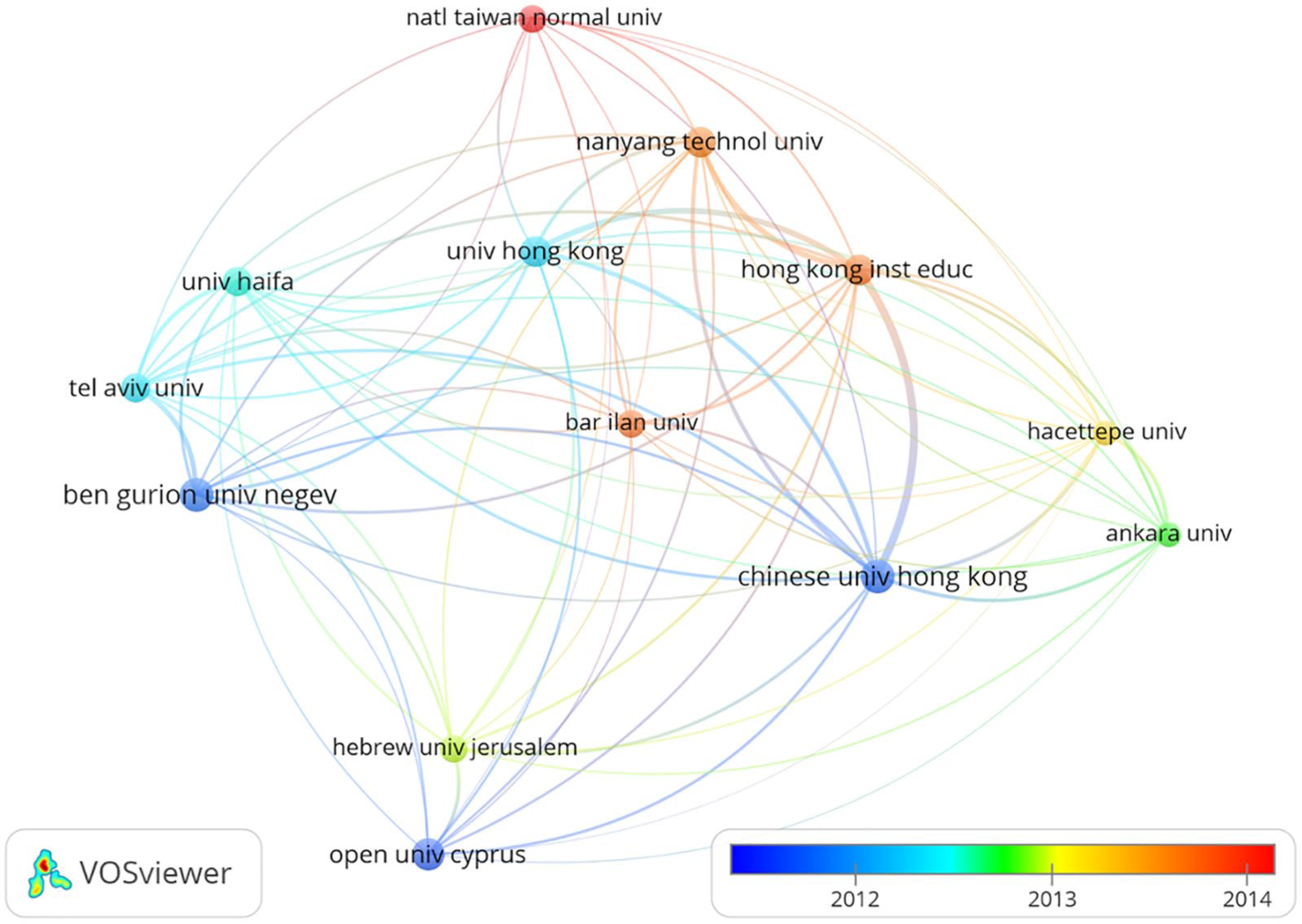
Overlay visualization of the bibliographic coupling of the institutions.
Of these strongest universities, there are three universities from Hong Kong at the top of this list, five universities from Israel, two universities from Turkey, and one university from each of these countries: Singapore, Taiwan, and Cyprus. In Figure 5, scores are scaled by different colors regarding the publication years of the studies. The colors show that the most recent studies have been published by scholars from National Taiwan Normal University, followed by these universities: Nanyang Technological University, Education University of Hong Kong, and Bar-Ilan University.
Analysis and Review of the h-Classics
The citation analysis report has been created for a total of 862 publications. The average citation count per item was 5.25. These 862 publications have so far been cited 4.532 times. When self-citations are excluded, there is a total of 4.253 citations. A total of 3.818 articles cited those publications without self-citations. The h-index was 29, meaning 29 publications in this list have 29 or more citations. These 29 publications are called h-classics for this area of study in Asia. Figure 6 shows the item density visualization of the h-classics weighted by their citations. These publications have been retrieved and reviewed by the researchers within several dimensions to present a general view of the most influential publications in the Asian literature of emotions in education. Table A1 (see Appendix) represents the review results of the h-classics. All the h-classics publications were reviewed according to their samples, countries of origin, methodologies, and findings.

Item density visualization of the h-classics.
Samples of the h-classics
Eighteen h-classics researched teacher samples. Three of them studied both teachers and their school administrators simultaneously, matching them in a multilevel design (Sari, 2004; Somech & Ron, 2007; Yin & Lee, 2012). These three studies are from Israel, Turkey, and Hong Kong. There are 11 studies with a focus on student samples in this list. Two of them focused on Israelite students and their teachers in a multilevel design (Assor et al., 2005; Roth et al., 2007). There is only one study on Cypriot students and their mothers in a multilevel design (Georgiou, 2008).
Methodologies of the h-classics
Most of the h-classics (17 out of 29) merely used quantitative design and analyses. Eight h-classics used various kinds of qualitative designs and analyses. One of these qualitative studies combined the critical literature review with various case studies (Zembylas, 2007). Three of the h-classics used a mixed model, incorporating both the qualitative and quantitative analyses (Somech & Ron, 2007; Wu & Huang, 2007; Zembylas et al., 2011). There is only one study published as a literature review (Neihart, 2007).
Countries of origin of the h-classics
Nine h-classics originate from Hong Kong, six from Israel, and five from Cyprus. These countries have two publications each in this list: South Korea, Turkey, and Malaysia. These countries each have a publication in this list: Taiwan, Singapore, and Japan. The top two articles are from Israel (Assor et al., 2005; Roth et al., 2007) and are authored by the same research team (A Assor, H. Kaplan, Y. Kanat-Maymon, and G. Roth). Seven publications (Chan, 2003, 2006, 2007, 2008, 2010, 2013; Chan & Hui, 1995) out of nine originating in Hong Kong were authored by D.W. Chan, who was the most influential author in this according to the bibliographic coupling of the authors. The authors of the other two publications (Wong et al., 2010; Yin & Lee, 2012) are from the Chinese University of Hong Kong, as is D.W. Chan. In other words, all the publications in the h-classics from Hong Kong are authored by scholars from the Chinese University of Hong Kong, corroborating the importance of this university as the most cited institution in Asia in this area. Four publications of the h-classics from the five from Cyprus (Zembylas, 2004, 2007, 2008; Zembylas et al., 2011) are authored by M. Zembylas.
Findings of the h-classics
Although there are some similarities in the topics examined in the h-classics, each of them focuses on different concepts related to students, teachers, and/or school administrators. These studies were reviewed and categorized according to their subject matter. After a thorough review, five categories were determined: (a) students’ emotions, motivations, engagement, and academic achievement levels (eight studies); (b) students’ emotional competencies, negative emotions, misbehaviors, and ways of coping (four studies); (c) teachers’ emotions, emotional climate, teaching, and learning (four studies); (d) teachers’ emotions, attitudes, behaviors, and emotional rules (four studies); and (e) teachers’ emotions, emotional competencies, burnout, job satisfaction, and well-being (nine studies). The most important findings of these studies in each category are summarized below:
There are eight studies related to students’ emotions, motivations, engagement, and academic achievement levels: Teachers’ autonomous motivation and controlling behaviors predict students’ emotions, their levels of motivation, and academic engagement (Assor et al., 2005; Roth et al., 2007). When students have choices and opportunities to participate in the classroom processes, they become more emotionally engaged and motivated (Wu & Huang, 2007). Classroom engagement, especially agentic engagement, increases students’ motivation levels and functions as a pathway to greater achievement (Reeve, 2013; Reeve & Lee, 2014). Students’ emotional intelligence is another important predictor of their academic achievement (Chew et al., 2013). In particular circumstances, to increase the gifted students’ motivation and achievement levels, teachers can use acceleration and ability grouping (Neihart, 2007). To increase students’ academic achievement and decrease their test anxiety levels, teachers can use an open choice assessment format (Birenbaum & Feldman, 1998).
There are four studies related to students’ emotional competencies, negative emotions, misbehaviors, and ways of coping: Students who have affective and cognitive empathy, and have more responsive mothers, are less likely to engage in bullying behaviors at school (Georgiou, 2008; Topcu & Erdur-Baker, 2012). Students who have higher emotional intelligence levels are less likely to engage in problem behaviors such as aggression and delinquency (Liau et al., 2003). Mindfulness meditation can be used to increase students’ self-awareness and increase their emotional regulation abilities to help them cope with such intense emotional states (Birnbaum, 2008).
There are four publications that studied teachers’ emotions, emotional climate, teaching, and learning: Emotional climate is an important part of learning and teaching (Zembylas, 2008). Emotional knowledge of teachers about learning and teaching is an essential component of the ecosystem of teacher knowledge (Zembylas, 2007). Various aspects of school climate, such as politics and power relations, influence the experiences and emotions of teachers (Zembylas, 2004). Political conflicts and ideological battles can be transformed into emotional issues, and teachers may have difficulty emotionally engaging with relevant pedagogical processes (Zembylas et al., 2011).
There are four articles that studied teachers’ emotions, attitudes, behaviors, and emotional rules: Teachers cannot be compelled to display prescribed emotions; they reflect their own feelings, and these emotions shape all their behaviors at school (Oplatka, 2007). Teachers’ positive attitudes and positive affectivity increase their organizational citizenship behaviors (OCB) (Somech & Ron, 2007). Teachers might have different feelings toward different focuses at school, and thus they can develop different attitudes and display different behaviors toward different focuses. Some teachers might have positive feelings of emotional warmth related to their students; however, they may feel more negatively about their relationships with colleagues and institutions (Cowie, 2011). No matter how they feel, some emotional rules, stemming from social and cultural norms, impact teachers’ behaviors and force them to hide negative emotions, maintain positive emotions, and use emotions to work effectively (Yin & Lee, 2012).
There are nine studies that examined teachers’ emotions, emotional competencies, burnout, job satisfaction, and well-being: Stress, positive hardiness, and negative hardiness are among the critical antecedents of teacher burnout (Chan, 2003). More experienced teachers and headteachers are more inclined to feel burned out (Sari, 2004). Emotional intelligence competencies, triarchic (analytical, synthetic, and practical) abilities, cognitive restructuring, positively reappraising the situation, and dispositional gratitude prevent teachers from experiencing burnout (Chan, 2006, 2007, 2010; Chan & Hui, 1995). Teachers with high emotional intelligence also have higher job satisfaction (Wong et al., 2010) and can more actively cope with negative emotions (Chan, 2008). School administrators’ emotional intelligence also predict teachers’ job satisfaction positively (Wong et al., 2010). Furthermore, teachers’ subjective well-being is positively predicted by their gratitude, ability to forgive, and meaningful life orientation (Chan, 2013).
Discussion
This study aimed at mapping the Asian literature of emotions in learning, teaching, and leadership. All the related publications in SSCI, SCI-Expanded, AHCI, and ESCI databases of WoS have been reviewed, analyzed, and visualized through bibliometric analysis techniques. In this context, co-occurrences of author keywords and bibliographic couplings of the countries, authors, journals, and institutions were extracted. Also, the citation analysis was performed, the h-index was calculated, and the h-classics were reviewed.
The citation analysis results showed that the h-index was 29, meaning that 29 publications received 29 or more citations. These 29 publications are called as the h-classics. The researchers reviewed these studies to develop a holistic picture of the most influential studies in Asian literature. Most of these articles (18) worked on teacher samples, and three of them (Sari, 2004; Somech & Ron, 2007; Yin & Lee, 2012) focused on both teachers and their school administrators. Eleven articles studied student samples, two of them (Assor et al., 2005; Roth et al., 2007) studied students and their teachers, and one article (Georgiou, 2008) worked on students and their mothers. Most of the h-classics (17) employed only quantitative designs, eight of them used qualitative designs, and three of them (Somech & Ron, 2007; Wu & Huang, 2007; Zembylas et al., 2011) used mixed models. The articles’ methodologies in the h-classics imply a need to conduct further research using more mixed-method, multilevel, experimental, or longitudinal designs to better understand and expand the current evidence and bring new evidence that could highlight underpinning rationale and mechanisms.
Nine of the h-classics originated in Hong Kong, six in Israel, and five in Cyprus. The top two articles (Assor et al., 2005; Roth et al., 2007) are authored by the same Israelite research team (A. Assor, H. Kaplan, Y. Kanat-Maymon, and G. Roth) that has been proven in the bibliographic coupling of the authors as the most prominent research team in this field. All the authors of the publications from Hong Kong were affiliated with the Chinese University of Hong Kong (the most cited institution in general), and D.W. Chan (the most influential author in general) authored most of these publications. Most of the publications from Cyprus, both in the h-classics and in the overall corpus, are authored by M. Zembylas, who was proven to be among the top two authors in this area and who is a good example of how a competent scholar can contribute to his country and institution by raising their publication output levels. These findings provide evidence that the strong influence of Cyprus (the fourth most cited in the overall corpus despite its low number of publications) comes from this author’s individual performance. However, the current evidence shows that the high productivity and influence of Hong Kong and Israel cannot be attributed to a specific author’s performance.
The findings regarding the overall corpus are consistent with those of the h-classics. Bibliographic coupling of the countries showed that those that contribute most to the literature in hand are People’s Republic of China (Hong Kong), Israel, Turkey, Cyprus, Singapore, South Korea, and Taiwan. People’s Republic of China (Hong Kong) and Israel have, comparatively, the best scores regarding the counts of publications, citations, and total link strengths. Turkey’s high number of publications received proportionally less number of citations compared with these countries. Bibliographic coupling of the authors showed that the most influential authors are D.W. Chan and M. Zembylas in general scores. The most influential and productive researchers and research teams and the most recent publications in this area are from Hong Kong and Israel. According to the bibliographic coupling of the institutions, the top three universities are located in Hong Kong, while Israel has five universities in this list because the most productive researchers in this area are affiliated with these universities. These results are consistent with the previous studies’ findings, confirming the regional leadership of Hong Kong and Israel in the scientific outputs of the Asian countries (Ersozlu & Karakus, 2019; Hallinger, 2020; Hallinger & Kovačević, 2019). The comparative ratio of the countries’ gross domestic products (GDPs) and their overall scientific outputs reveal that Hong Kong and Israel are successful examples in the Asian context in efficiently translating their economic wealth to scientific productivity (Prathap, 2018, 2019)
The h-classics publications were classified into five categories regarding their findings. In the first group, there are eight articles examining students’ emotions, motivations, engagement, and academic achievement levels. These studies showed the importance of teachers’ autonomous motivation (Roth et al., 2007) and controlling behaviors (Assor et al., 2005), choice and opportunities to participate in the classroom processes (Wu & Huang, 2007), agentic engagement (Reeve, 2013), classroom engagement (Reeve & Lee, 2014), emotional intelligence (Chew et al., 2013), acceleration and ability grouping (Neihart, 2007), and adaptive assessment approach (Birenbaum & Feldman, 1998) on increasing students’ motivation and academic achievement levels.
There are four articles in the second group on students’ emotional competencies, negative emotions, misbehavior, and coping ways. These articles showed the effects of affective and cognitive empathy (Topcu & Erdur-Baker, 2012), maternal responsiveness (Georgiou, 2008), emotional intelligence (Liau et al., 2003), and mindfulness meditation (Birnbaum, 2008) to cope with negative emotions and problem behaviors of students. In the third group, four publications show the influence of emotional climate (Zembylas, 2008), teachers’ emotional knowledge (Zembylas, 2007), politics and power relations (Zembylas, 2004), and political conflicts (Zembylas, 2011) on teachers’ emotions, teaching, and learning.
In the fourth group, there are also four articles on teachers’ emotions, attitudes, behaviors, and emotional rules, showing the authenticity of teachers’ emotions (Oplatka, 2007), the link between teachers’ emotions and OCB (Somech & Ron, 2007), teachers’ various emotions toward different focuses at school (Cowie, 2011), and the coercive emotional rules on teachers’ emotions (Yin & Lee, 2012). In the fifth group, there are nine articles on teachers’ emotions, emotional competencies, burnout, job satisfaction, and well-being. These studies showed the antecedents and correlations of teacher burnout (Chan, 2003, 2006, 2007, 2010; Chan & Hui, 1995; Sari, 2004), the antecedents of teachers’ subjective well-being (Chan, 2013), the effect of emotional intelligence on teachers’ job satisfaction (Wong et al., 2010), and ability to cope with negative emotions (Chan, 2008).
The co-occurrences of author keywords reveal trends through the whole corpus and reflect similar findings with the h-classics. Consistent with the most trending concepts used in the h-classics, the overall corpus also shows that the most frequently studied concepts in this literature are emotional intelligence, empathy, burnout, emotion, and self-efficacy. The other frequently studied concepts are engagement, social support, motivation, gender, emotion regulation, social skills, subjective well-being, stress, loneliness, self-esteem, emotional labor, life satisfaction, academic achievement, and well-being.
Overall, the h-classics publications reveal that the emotional competencies and affect-based attitudes of school leaders, teachers, and students impact the school climate, well-being of the individuals, and academic outcomes. Going through the synthesis of the h-classics publications, the evidence of Leithwood et al.’s (2010) “Four Paths Model,” about the ways leaders can impact student outcomes by improving the conditions of specific variables at each path, can be traced:
The Rational Path implies that students develop more positive emotions, and they become more motivated and academically engaged if the teachers refrain from directly controlling their behaviors (Assor et al., 2005) and select more participative classroom processes (Wu & Huang, 2007). The students’ motivation and achievement can be additionally improved if the teachers use acceleration and ability grouping in particular circumstances (Neihart, 2007) and select the most appropriate assessment methods (Birenbaum & Feldman, 1998).
The Organizational Path implies that various aspects of school climate such as power relations (Zembylas, 2004) and political conflicts (Zembylas, 2011), the emotional climate of a school (Zembylas, 2008), teacher’s emotional knowledge about teaching and learning as an essential component of the emotional ecology (Zembylas, 2007), and the social norms embedded in school culture concerning the utilization of emotions in certain situations (Yin & Lee, 2012) have an influence on the experiences and emotions of teachers and the quality of the teaching/learning processes.
The Family Path implies that students’ access to parental support at home helps their academic achievement and socioemotional adaptation and decreases their aggressive behaviors at school (Georgiou, 2008).
The Emotions Path provides evidence for teacher emotions’ possible mediation effect in the relationship between leader emotions and student outcomes. School administrators’ emotional intelligence positively influences teachers’ job satisfaction (Wong et al., 2010). Teachers with high emotional intelligence and positive affectivity can more easily cope with the adverse effects of the negative experiences at work (Chan, 2008), are less likely to experience burnout (Chan, 2006, 2007, 2010; Chan & Hui, 1995), have higher job satisfaction levels (Wong et al., 2010), and perform OCB more frequently (Somech & Ron, 2007), which are among the antecedents of high-quality teaching performance (Indarti et al., 2017). Students with high emotional competencies such as emotional intelligence, affective and cognitive empathy, self-awareness, and emotional regulation abilities can better cope with negative emotional states (Birnbaum, 2008), are less likely to engage in problem behaviors (Georgiou, 2008; Liau et al., 2003; Topcu & Erdur-Baker, 2012), and have higher academic performance (Chew et al., 2013).
The h-classics publications provided evidence for the emotional contagion process occurring between leaders, teachers, and students. Leaders’ efforts to improve teachers’ emotions or dispositions have a profound impact on the quality of teaching and learning, and the influence of leadership on student outcomes is generally mediated by the affect-based attitudes and behaviors of teachers (Sun & Leithwood, 2015). Leaders’ attention to teachers’ emotions would also influence a wide array of classroom- or school-level variables, which are the determinants of students’ well-being and success (Leithwood & Beatty, 2008). Emotions and emotion management have especially essential consequences in the collectivistic cultural contexts of Asian schools in which social harmony and interdependence of self are emphasized and people feel and demonstrate more other-focused emotions with a dialectical emotional style (Miyamoto & Ryff, 2011; Qu & Zhang, 2005; Yin & Lee, 2012). These unique cultural characteristics encourage a strong focus on personal and emotional relationships between school leader, teachers, and students (Yin & Lee, 2012) and generate a hierarchical but friendly climate at schools (Zhu et al., 2010). Overall, the research findings in the corpus of this study imply that leaders can create an emotional climate at school, develop positive attitudes and behaviors in teachers and students, improve the quality of teaching/learning practices, and increase students’ academic performance by investing their time and efforts in ameliorating the conditions of the selected variables at each path.
This study presents a current topographical analysis and the research trends of the Asian literature on emotions in learning, teaching, and leadership. Even in a restricted research area, there are many publications to be reviewed in this area. Although most of the studies in the h-classics are about teachers’ emotions, the overall corpus was different. In general, it was noticed that most of the publications were related to students’ emotions, and the least studied area was educational leaders’ emotions and the consequences of certain emotions of leaders. There is also a dearth of research on the emotional contagion process at schools through the interaction between leaders, teachers, and students. Given this, future research can focus more on this crucial area to understand the influence of school leaders’ various emotions on learning, teaching, and leadership. The general overview of the h-classics showed a lack of mixed-model, longitudinal, and multilevel research in this area. Future research can be performed on students, teachers, and educational leaders’ emotions, taking into account the disparate needs and demands of the subjects, using various tools and sources to collect data in a multilevel and/or longitudinal design, and performing both qualitative and quantitative analysis methods.
Limitations and Future Research
This study included only the journal articles indexed in the WoS Core Collection to examine the highest quality publications in this specific literature. Although it was justified in the methodology section, this sampling strategy led to the omission of the theses, meeting abstracts, proceedings, books, book chapters, editorial materials, and the other journal articles not indexed in WoS. Therefore, this review does not cover the entire literature on this topic. Future research can include other databases and different types of publications to give a more holistic picture of the Asian literature.
Another limitation is that the temporal variations in the selected corpus were averaged out in this study. Although the publications of the last three decades were analyzed, this approach could not answer the questions concerning the evolution of Asian literature on this topic. To capture this literature’s development in Asia, more specifically, other researchers can do comparative analyses based on decade-by-decade reviews (Wang et al., 2017).
Possibly biased citing behaviors of authors can be another limitation of such a scientific mapping study. Some authors might have cited specific publications as a habitual response rather than a conscious reflection of their shared opinions (White, 2004). Although this type of biased citation can be found, to some degree, no significant issue in our corpus could be found to argue that it had a considerable influence on the validity of our analyses.
Footnotes
Appendix
Key Findings of the Bibliometric Analysis.

| Questions | Key findings |
|---|---|
| The most influential countries | People’s Republic of China (Hong Kong) and Israel |
| The most influential authors | D.W. Chan and M. Zembylas |
| The most influential research team | A. Assor, H. Kaplan, Y. Kanat-Maymon, and G. Roth |
| The most eminent journals | Teaching and Teacher Education and Journal of Educational Psychology |
| The most eminent institutions | The Education University of Hong Kong, Chinese University of Hong Kong, and Ben-Gurion University of the Negev |
| The most frequently studied concepts | Emotional intelligence, empathy, burnout, emotion, self-efficacy, engagement, social support, motivation, gender, emotion regulation, social skills, subjective well-being, stress, loneliness, self-esteem, emotional labor, life satisfaction, academic achievement, and well-being |
Declaration of Conflicting Interests
The author(s) declared no potential conflicts of interest with respect to the research, authorship, and/or publication of this article.
Funding
The author(s) received no financial support for the research, authorship, and/or publication of this article.
