




Abstract
As in every organization, leadership plays the most important role in conducting business in school organizations as well. Organizations reach their goals more effectively and more efficiently when they are effective. The aim of this study is to assess data regarding qualities and training of effective school leaders. To achieve this end, a qualitative study was designed and related data were collected. A form consisting of six open-ended questions was developed as a data collection tool. The study was conducted with a group of 26 teachers and four administrators. The data were analyzed through content and descriptive analysis. It was expected that effective school principals have strong interpersonal relationships, have leadership qualities, and are considerate in terms of social and personality traits. Some suggestions regarding the training of principals were also presented.
Keywords
Introduction
Schools are planned, organized, and settled organizations that help people socialize, improve their economic productivity, recognize and realize themselves, and adopt the policies of the nation. The mission that schools are responsible for in terms of personal and social development is of vital importance. The reason why schools are essential for society is that it is the most productivity-based, concrete, and functional part of the education system (Açıkalın, 1994). If schools operate in the right way, pre-determined goals and expectations of society from education will be met.
According to Klopf, Schelden, and Brennan (1982), an effective school is defined as “the school where an optimum learning environment in which students’ cognitive, affective, psychomotor, social and aesthetic development is optimally ensured is formed” (Balcı, 2007, p. 10). Similarly, an effective school is related to social, academic, emotional, moral and aesthetic development, satisfaction of teachers, effective use of sources, and accomplishment of goals and environmental harmony (Şişman, 2011). In this sense, educational institutions enable students to learn in almost every field and to have behavioral changes. Considering the definitions given above, it is appropriate to add concepts such as art, music, and character to the learning dimensions of students of effective schools.
The prominent features of effective schools can be specified as follows: strong leadership, high expectations from students, a systematical school climate, high expectations from teachers, measuring student success and giving feedback, effective classroom management, believing that each and every student can learn, family participation, and a well-organized curriculum (Cohen, Manion, & Morrison, 2004; Edmonds, 1979; Mortimore, 1993; Reynolds, 1995).
According to Reynolds, Sammons, Stoll, Barber, and Hillman (1996), characteristics of effective schools are professional leadership, common vision and goals, existence of a learning environment, high quality of learning and teaching, high expectations, positive support, monitoring the development of students, and student rights and responsibilities. Considered to be the main characteristics of effective schools, these are only made possible through activities by school management.
Sergiovanni (1996) specified the following as the characteristics of effective schools: They are student-centered, teachers are always given support through in-service training programs, they foster creative problem solving, they ensure the participation of family and society, and they are supplied with opportunities that will help teachers perform their duties competently. To provide effectiveness in schools is to manage schools in an effective, healthy, productive, and dynamic way and to ensure the satisfaction of educational staff (Başaran, 2000).
Edmonds was a leading researcher of school reform in the 1970s, and his work is still highly respected by education leaders. He created what is now known as the “effective schools model.” Edmonds’ research noted the five following characteristics of successful schools (Daggett, 2007): strong administrative leadership, focus on basic skills, high expectations for student success, frequent monitoring of student performance, and safe and orderly schools. To establish effective schools, teachers should be always prepared to teach; the management should be competent in their fields, provide communication among staff members, have a vision, and carry leadership characteristics (Potter, Reynolds, & Chapman, 2002; Slater, & Teddlie, 1992). The importance of school principals as lead managers stands out especially among the effective school characteristics described above.
As lead managers, school principals play a key role in school success and their leadership skills highly contribute to the effectiveness of schools (Cemaloğlu, 2002; Şişman, 2004). A competent and effective leader is one who affects others in the success of the organization, motivates them, and includes them in the process. The primary duty of school principals is to have their school reach its goals. As the roles expected from school principals are related to the assumptions of leadership theories, school principals should carry the leadership features described in different leadership theories. Whether it is a primary or a secondary school, school principal is the most important person in a school’s success (Yavuz, 2006). Awareness of expectations from school principals and their accomplishing these tasks will increase the success of schools.
Developments in education management require school principals to play different roles. In the new information age, this change is much more rapid. Gorton and Schneider (1991) defined the six important roles of school principals in school management as follows: management, educational leadership, disciplinary control, facilitator in human relations, conciliator in conflicts, and evaluator. As in every organization, strong leadership has a crucial position in school organizations and strong leaders can create effective organizations (Gorton & Schneider, 1991). It is often perceived that the people responsible for a school’s success or failure are primarily school principals.
The existence of strong leaders guided by effective, creative, visionary, encouraging, knowledgeable, and principled leaders is vitally important to eliminate various problems in schools and to continuously improve school education (Girard, 2000). Strong leaders can help a school become effective because they constantly and consistently manage several simultaneously competing sets of tensions successfully (Day, Harris, & Hadfield, 2001). Choosing and replacing teachers carefully, frequently monitoring staff for school success, allocating most of their time and energy for school success, supporting teachers, and providing extra sources for the school are the activities that school principals do for school effectiveness (Mortimore, 1993).
Effective schools should not only be established by effective school principals but they should be managed by them as well. The skills of a school principal are directly proportionate to the school’s success and efficiency. In other words, the school principal is a leader in school and his management is directly related to the school’s existence.
Effective schools should also have particular characteristics. Existing studies classified these characteristics in different ways. For example, the Institute of Public Policy Research (Brighouse & Tomlinson, 1991) suggested seven key characteristics of effective schools, which are shown as follows:
Leadership at all levels: strong, purposeful, adoption of more than one style.
Management and organisation: clear, simple, flatter structures.
Collective self-review: involving all staff and leading to developing new practices.
Staff development: systematic and involving collective and individual needs.
Environment/building/uplifting ethos: visually and aurally positive, promoting positive behaviour, high expectations.
Teaching and learning: creative debate amongst teachers and curricula and pedagogy.
Parental involvement: parents as partners in education.
Sammons, Hillman, and Mortimore (1995) and Reynolds et al. (1996) also classified 11 factors of effective schools as follows:
Shared leadership (firm purposeful, participative—the leading professional);
Shared vision and goals (unity of purpose, consistency of practice, collegiality, and collaboration);
A learning environment (an orderly atmosphere and attractive environment);
Concentration on teaching and learning (maximization of learning time, academic emphasis, focus on achievement);
High expectations (all round, clear communication of expectations, providing intellectual challenge);
Positive reinforcement (clear and fair discipline, feedback);
Monitoring progress (monitoring pupil performance, evaluating school performance);
Pupil rights and responsibilities (high pupil self-esteem, positions of responsibility, control of work);
Purposeful teaching (efficient organization, clarity of purpose, structured lessons, adaptive practice);
A learning organization (school-based staff development);
Home–school partnership (parental involvement).
Moreover, Edmonds (1979) and Reynolds (1995) suggested some characteristics of the effective school as follows:
Higher achieving schools that their principals provide them with a significantly greater amount of support;
Teacher in higher achieving schools were more task-oriented in their classroom approach and exhibited more evidence of applying appropriate principles of learning than did teachers in lower-achieving schools;
The principals’ leadership ability and their attention to both the quality of instruction and to setting academic goals as of primacy;
A pervasive and broadly understood instructional focus;
An orderly, safe climate that is conducive to teaching and learning;
Teachers who have high expectations and whose behaviors convey the belief that all students can learn;
The use of measures of pupil achievement routinely within the school as measures of program evaluation.
The Importance of the Study
The effectiveness and efficiency of schools are significant in educating students and meeting society’s expectations. School management plays a key role in establishing effective schools (Fullan, 2005; Schulte, Slate, & Onwuegbuzie, 2010; Wong & Nicotera, 2007). However, the lack of education received by current managers can lead to serious educational problems. For the establishment of effective schools, the characteristics that a school principal should have must be determined (Davis, Darling-Hammond, LaPointe, & Meyerson, 2005). In this sense, a determination of the knowledge, skills, and behaviors that school management staff should have will provide insights for practitioners in arranging in-service and pre-service training of teachers.
Purpose
The purpose of this study is to determine the characteristics and roles of elementary school administrators according to teacher and administrator perspectives, and discuss their training in the context of effective schools. For this purpose, suggestions regarding the characteristics of administrators who establish and administer effective schools and how they should be trained are discussed.
Method
This research is a qualitative study. A phenomenological research pattern was used in the study. The phenomenological pattern focuses on phenomena that we are aware of, but do not have in-depth and detailed understanding of. This pattern is used to do research on phenomena that we are not completely unfamiliar with but, at the same time, cannot fully comprehend (Yıldırım & Şimşek, 2008). The effectiveness and success of schools and the role of school administrators in this effectiveness are current issues that are important in school development. This theme is often top of the agenda in school life, and discussions regularly take place regarding these topics. Accordingly, the phenomenological pattern is regarded as a significant method in assessing the role and training of administrators who play important roles in school effectiveness; hence, the study is conducted through this pattern.
The working group included 26 teachers and 4 school administrators working in three primary schools in Gaziantep, which are chosen as purposeful samples. See Table 1 in which the demographic characteristics of the participants are presented.
General Information on Demographic Variables of Participants.

Data Collection Tools
The data were obtained from interviews, focus group discussions, and a form consisting of open-ended questions. Efforts were made to verify the findings through focus group discussions, thereby increasing the reliability of the study. There were six questions in the form used as the data collection tool. These questions are constructed based on the parameters addressed by Edmonds (1979), Brighouse and Tomlinson (1991), Sammons et al. (1995), and Reynolds et al. (1996), which are provided in the “Introduction” section of this article.
Questions included in the form were as follows:
What are the effects of school management on student success?
What are the qualifications an effective school principal should have as leader?
What are the qualifications an effective vice principal should have?
What kind of effects may a school principal have on school development?
How should an effective school principal be trained?
How should effective vice presidents be chosen and trained?
Two academicians who are domain experts were consulted while preparing these questions. The findings obtained at the end of the research were discussed with these experts and the purpose and verifiability of the research questions were examined.
The fact that there was flexibility provided by asking open-ended questions, that different data collection tools were used to verify the findings, and that there were face-to-face discussions and continuous meetings with participants related to the study when necessary is a significant criterion in terms of the validity of the study. Other validity criteria in the study included direct quotations of the data gathered from the study from time to time, and explanations on how the conclusions were drawn by using the findings.
The fact that the participants and the frame of the study were defined, that concepts related to the study topic were explained, that information was given about data analysis (collection, analysis, commentary, etc.), and that the stages of the study were specified is a criterion related to the external reliability of the study. Internal criteria related to the study include that the data gathered were directly given in a descriptive approach, that the results of the study were verified by domain experts, and that analyses were done depending on the conceptual framework (Dey, 1993; Yıldırım & Şimşek, 2008).
Data Analysis
Efforts were made to analyze and comment on the data through descriptive and content analysis. Direct quotations were given to impartially reflect the views of individuals. Concepts that explain data gathered and the relationships among their concepts were discussed through content analysis, resulting in an in-depth clarification.
The data were collected via audio-records and by taking notes during interviews. After the individual interviews, the data were verified through focus group discussions in sessions carried out in three sub-groups. The verified data were then written in a text file and transferred to the program ATLAS.ti 6.0. Content analyses were done through ATLAS.ti 6.0. The content analyses were done initially by the primary researchers and then by two other researchers. The codes that were specified by researchers were compared to determine reliability. The formula “reliability = [number of agreements / (total number of agreement + disagreement)] × 100” was applied (Miles & Huberman, 1994). It was observed that there was an 84% concordance in this study.
Themes were created from the data gathered drawn from answers to each question; the codes were examined according to these themes and the data were then interpreted. The frequencies related to the data were given in the themes as well. Direct quotations were given with numbers allocated to the participants. The administrators were coded as A1, A2, A3, and A4 and the teachers were coded as T1, T2, T3, . . . , T25, T26.
Results
Answers to the six questions asked of the participants were discussed in this part of the study. Efforts were made to determine the roles and qualifications that elementary school administrators should have in effective school development.
In this section, answers to the question “What are the effects of school management on student success?” were examined. The codes obtained through content analyses of the data gathered from the participants and the themes that these codes create are presented in Table 2.
The Codes Obtained Related to the Effect of School Administration on Student Success and These Codes’ Themes.
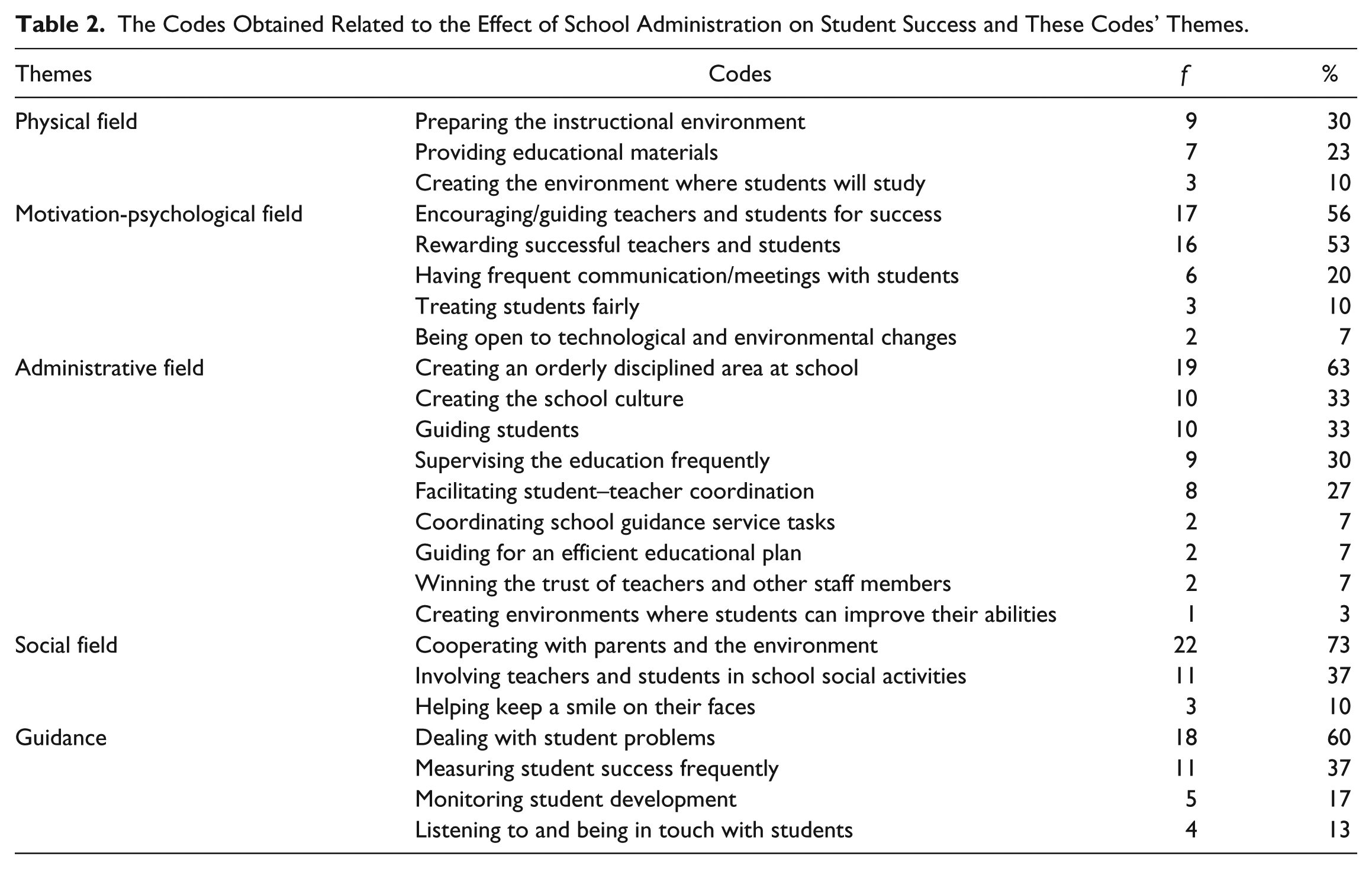
As can be seen in Table 2, it can be said that there is a strong relationship between school administration and student success. The school administration is the leader that carries the school to success, just like a ship’s captain. Accordingly, school administrations have important missions in student success and establishing effective schools.
School principals and vice principals were mainly stated as the school administrators. The school administration was viewed as an institution in itself. It is noted that school administration, especially the school principal, should prepare the educational environment and meet the “physical needs” because a physical environment is one of the basic variables. Another notable characteristic is motivating teachers and students. Motivation is the most important internal factor for learning. Again, administrators should have the necessary administration skills. Another salient characteristic is administrators being leaders in the social field. The role of administrators as guides is highlighted among other role behaviors.
The findings in this section can be summarized as follows: “preparing the school for education, remedy the deficiencies, being encouraging, being a guidance counselor, ensuring discipline and order, creating a school culture, inspection, supporting teachers and students, rewarding success, establish healthy communication, consistency between promises and actions, reassuring manners, providing motivation, effective administration planning, and a quick resolution of problems.”
The views of some participants on themes are presented through direct quotations below: School administrators should manage school activities according to learning and teaching principles by always focusing on student success. They should support teachers in the teaching process. (T3) Preparing an efficient learning/teaching environment is the duty of school administration. The school administration should take necessary precautions and increase motivation. (T7) School administration can contribute to development of schools by providing changes in school according to technological and socio-cultural changes. (T17) Successful students should definitely be rewarded by school administration. (T21) Disciplinary rules in schools should be applied to everybody equally; this is an indicator of school administrations’ reassurance. If schools are administered with strict disciplinary rules, student success is affected positively. (T24) School administration should always cooperate with parents and arrange motivational activities for students. For this purpose, they should arrange activities such as trips, surveys, theater, etc. (A1)
In this section, answers to the question “What are the qualifications an effective school principal should have as a leader?” are presented. The codes obtained through the content analyses of the data gathered from the participants and the themes that these codes create are presented in Table 3.
The Codes Obtained Relate to the Qualifications an Effective School Principal Should Have as a Leader and the Themes That These Codes Form.
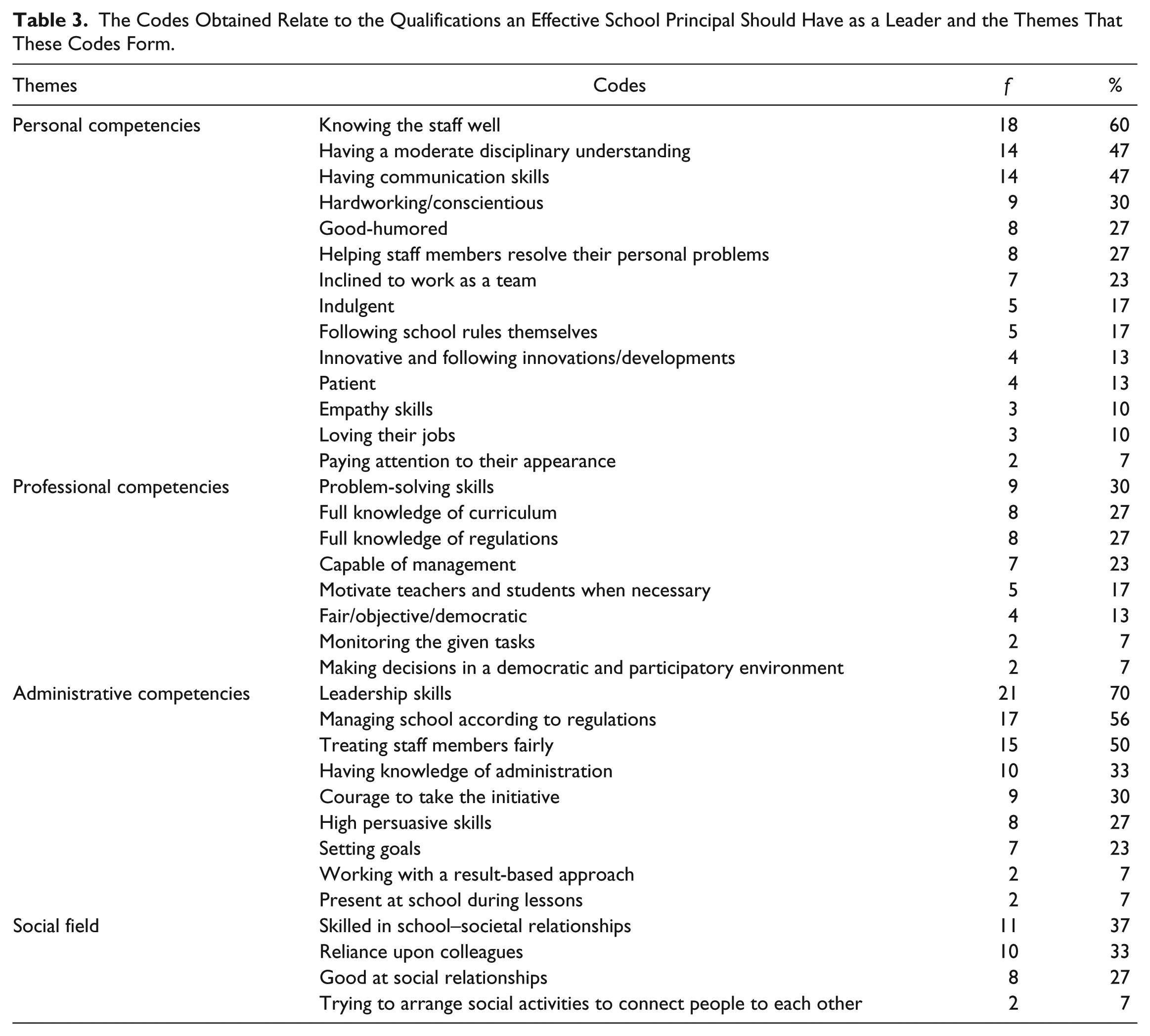
The most noted concepts from “the qualifications an effective school principal should have as leader” are generally the personal characteristics of the leader. A leader should also have some administrative skills to administer the school and individuals. Knowing the staff members well is the most important characteristic. Second, it is suggested that the school principal should neither oppress staff members nor ignore them. Among professional competencies, problem solving is the outstanding skill. In addition, “professional knowledge,” namely, the knowledge of education/instruction and regulations, is also mentioned. Among administrative skills, the prominent features are leadership skills, obeying the rules, being fair, and having knowledge of administration.
The findings in this section can be summarized as follows: “administrative knowledge, diligence, challenging, making appropriate decisions on time, fairness, leadership, discipline, morality, having a vision, being a good observer, indulgent, working in harmony, being good-humored, knowledge of curriculum and regulations, being intelligent, communication skills, obeying the rules themselves, empathy skills, knowledge of their team, and problem solving skills.”
The views of some participants in this section are presented through direct quotations below: The school principal should create an educational environment that will run smoothly. Teachers and students should feel comfortable in this environment. An effective administrator does not only notice deficiencies of teachers but also provides solutions to deal with them. (A3) School administrators themselves should obey rules and discipline before anything else. School principals who do not obey school rules lose their prestige. Tasks given to vice principals and teachers should be distributed fairly. If tasks are not assigned fairly, individuals become alienated from their jobs. (A4) School principals should know their staff members even if it is very crowded. They should know about each staff member’s characteristics. They should take these characteristics into consideration when communicating with them, motivating and leading them. (T1) School principals should be able to blend in. They should be authoritarian when needed and mild-mannered when necessary. They should have effective communication skills, praise good works and motivate teachers and students. (T5) School principals should be good-humored; they should listen to those staff members coming to their offices and help them solve their problems. They should not discriminate between staff members and earn the trust of both teachers and students. (T11) School principals should live their lives to the full. They should enjoy their lives because an unhappy administrator cannot make others happy. In this sense, administrators should provide a happy, healthy and orderly school environment for their team; they should serve as a connection between team members and know how to hold their teams together. A team which has unity and solidarity achieves success. (T18) As school leaders, school principals should have a positive attitude towards problems brought to them and look at events optimistically. Accordingly, they should see incidents with a humanistic perspective and try to solve problems with this approach. (T26)
In this section, answers to the question “What are the qualifications an effective vice principal should have?” are discussed. The codes obtained through the content analyses of the data gathered from the participants and the themes that these codes create are presented in Table 4.
The Codes Obtained Relate to the Qualifications That an Effective Vice Principal Should Have and These Codes’ Themes.

Vice principals are educators who help school principals with school administration and who are candidates for school presidency. Future school principals should have certain qualifications. Vice principals should have similar qualifications that school principals have. However, because school administration is the school principal’s responsibility in general, participants did not expect as many responsibilities from vice principals as they did from principals, while expressing their opinions about this.
Characteristics such as working in harmony and having communication skills were pointed out as the most important ones among personal characteristics of vice principals. Among professional competencies, having full knowledge of regulations and following up orders and instructions were emphasized.
The findings in this section can be summarized as follows: “following up orders and documents, helping the school principal in maintaining discipline, being modest toward parents and students, supportive and tolerant toward staff members, having good communication skills, making the connection between school aims and teachers, expressing openly the school principal’s mistakes, taking initiatives in providing discipline, and working in harmony with the school principal.”
The views of some participants in this section are presented through direct quotations below: Vice principals should work in harmony with both teachers and the school principal. They should be in touch with staff members just like the school principal does. School vice principals should follow the rules of the documents from the ministry or the provincial/district directorate and have full knowledge of school administration. (T9) School vice principals should warn school principals about their mistakes when necessary. They should not agree on wrong decisions by being influenced by the school principal. They should be aware of the fact that they are part of a school administration team and should not abstain from taking initiatives within the legislative framework. (T18) School vice principals should do their duties eagerly and be modest towards parents and students. They should be supportive and tolerant towards their colleagues. (T22) They should have full knowledge of laws and regulations and be worthy of the position. They should be positive in human relationships. They should interpret the regulations for the benefit of teachers. (T23)
School vice principals are first assistants of school principals and are the ones whom teachers will consult first. In this sense, school vice principals should have effective communication skills, know the regulations, and have indulgence toward students.
School vice principals, who are potential school principals, are in fact expected to have the characteristics that a school principal possesses.
In this section, answers to the question “What kind of effect may a school principal have on school development?” were discussed.
The findings in this section can be summarized as follows: “ensuring neighborhood support, involving parents, providing safety at school, arranging motivational activities, leading teachers and students, creating the language of ‘us,’ bringing innovations to school, paying attention to staff members and supporting them, following guidance services, creating projects for school development, and establishing good communications with local authorities.”
School principals, as leaders, should know about their environment and be able to provide support when necessary. They play important roles in school development by providing a safe environment and creating a positive atmosphere. In addition, they should create the language of “us” and place emphasis on staff development. School principals identifying with their schools is of vital importance for school development.
The views of some participants related to this section are presented through direct quotations below: School principals should use limited sources efficiently and make efforts to increase school resources. They should stick to the school vision, adapt to change and try to achieve the school mission. Success can be guaranteed by guiding teachers. (T12) School principals should make the school guidance service more functional and monitor its conformity to school and student success. Follow-up is easier when each and every student is monitored and their academic standings are recorded. In this way, success and school effectiveness will increase. (T16) School principals should be forward-looking. They should have a broad vision. They will influence teachers and students, sharing the same vision positively, and teacher and student success will increase. (T19) School principals should create a success-oriented school atmosphere. Good physical condition of the school will support teacher and student studies. When school principals are in good communication with teachers, there will be a more conformable atmosphere at school and staff members will be much more motivated. (T22) School principals should often get together with students, listen to them and help them solve their problems. They should place emphasis on social activities and create an environment where students can lighten their stress load through sports, music, theater, arts, etc. (T25) The primary keeper of school is the school principal. They should provide safety at school and monitor success. School principals should also provide environments where teachers can achieve their aims properly and comfortably. (A3) School principals should first and foremost know that she or he needs to achieve success with a team. Teachers and administrators are the building blocks of schools. School principals ensure coordination and trust their team; success comes naturally. (A4)
In this section, answers to the question “How should an effective school principal be trained?” were discussed.
The findings and suggestions related to this section are generally the following: “receiving education in administrative sciences, passing psychological tests before appointment to the position, receiving continuous in-service training, having experience as a teacher, having experience as vice principal for a certain period of time, establishing administrative academies and graduating school principal candidates from this institution, having a master’s degree, and receiving training before appointment to the position.”
In this section, three suggestions made regarding appointments of effective school principals are discussed below.
First suggestion: Selecting school principals from school vice principals via exam: In this selection stage, school principals are only selected from among vice principals. School vice principals who meet pre-determined criteria (seniority, success, education, etc.) should be tested and successful candidates should be asked to pass certain psychological and administrative exams. Candidates who are successful at this stage can be appointed as school principals. After this selection stage, in-service training should be given and candidates are again expected to be successful in this training.
Second suggestion: According to this suggestion, school principals should only be selected from individuals having master’s and doctoral degrees. A school principal can be appointed from those candidates holding master’s and doctoral degrees after they pass psychological and administrative exams.
Third suggestion: The National Ministry of Education is expected to establish institutions and schools that train leaders. These institutions can accept teachers who pass certain exams (administrative skills, emotional intelligence, etc.) and meet certain criteria and then these teachers can be trained. The successful ones after this training can be appointed as school principals.
The methods above were suggested by the study participants. Besides these selection methods, participants also stated that school principals should be selected from individuals who are humanitarian, have good social and empathy skills, and who should receive enough training in these areas. Moreover, it was pointed out that school principals should continue to receive training to keep up with constantly changing and improving technology and the world.
In this section, answers to the question “How should an effective school vice principal be selected and trained?” were discussed.
The findings and suggestions related to this section are as follows: “selection from among teachers through exams, carrying out interviews together with exams, and selection from among individuals who received education in the field of administration.”
The participants generally stated that school vice principals should be selected from teachers through exams and especially through interviews. They suggested that it is possible to get an idea whether the person can be an effective administrator provided that interviews are fair and objective. Besides these remarks, some other suggestions were made such as institutions should be established to train administrators, graduates of these institutions should be appointed as school principals, and appointments should be made from among individuals who have a master’s degree in educational administration. Another view suggested that school principals should be given the right to select their own vice principals and that school principals should be given the opportunity to choose vice principals from among teachers (on the condition that they receive the necessary training).
Discussion and Conclusion
School principals are like the engines of a train in that they are primary factors for school success. Achieving school goals and optimum learning by students is all about school effectiveness. This study intended to present and discuss the views of teachers on the characteristics and training of school administrators in effective school contexts. The following conclusions were reached at the end of the study.
When the findings about the effects of school administrations on student success are examined, it can be seen that school principals in particular have a key role in increasing student success by creating effective learning–teaching and social environment and increase students’ and teachers’ motivation. These findings are consistent with the results of many previous studies (Fullan, 2005; Schulte et al., 2010; Wong & Nicotera, 2007).
In increasing the academic success of students, features such as preparing the educational environment of schools in a physical area and preparing educational materials were highlighted about school administrations. Motivation of staff and students by administration was also regarded as an important value in terms of efficiency and success. In the administrative field, values such as creating an appropriate working environment, inspecting education, providing coordination with staff members, and contributing to the development of a school culture were pointed out and it was stated that these factors are significant in school effectiveness. These are similar results with those of recent studies (Ayik & Ada, 2009; Helvaci & Aydoğan, 2011).
Improving relationships with neighbors and carrying out social activities were expected from school administration for improving student success. Similarly, in many researches, cooperation of school administration with families was seen as a very important factor in improving student success and school effectiveness (Mortimore, Sammons, Stoll, Lewis, & Ecob, 1988; Sammons et al., 1995; Savaş, 2012).
Last, guidance services such as dealing with student problems, measuring student success, and monitoring their development were seen as school administration tasks in improving student success in effective schools. Similarly, Hampton (2005) confirmed that successful school principals are responsible for arranging educational programs and carrying out amendatory activities when necessary to improve student success. According to Harris (2007), it is crucial that the school principal should keep communication alive with the school and students.
The following personal characteristics of effective school principals as leaders stood out. Characteristics such as being good-humored, hardworking, and patient were stated as the outstanding ones. Having full knowledge of regulations, leadership skills, taking initiatives, and having a broad vision and persuasive skills were seen as administrative characteristics. Moreover, they have professional skills, such as having full knowledge of curriculum and regulations, successful management skills, ability to make unbiased and objective decisions, and ability to motivate teachers and students if required. According to Martineau (2012), effective school principals should be able to improve school vision and make changes in educational programs with a strong understanding of school reform. School principals are also expected to be socially remarkable individuals. This finding is parallel to the research of Lopez, Gonzalez, and Fierro (2006) who stated that effective educational leadership requires being helpful and caring and having good communication skills. Such skills play important roles for school principals in increasing teachers’ motivation to the whole life of the school and thus positively influence teachers’ fulfillment, satisfaction, and effectiveness (Brighouse & Woods, 1999; Stockard & Lehman, 2004).
School vice principals are the school principal’s closest co-workers. School vice principals were expected to follow both orders and formal correspondence, be modest toward co-workers and parents, and have good communication skills. Like school principals, vice principals were also expected that they have administration and professional characteristics, such as having full knowledge and leadership skills because such characteristics not only help them to efficiently coordinate between teachers and the principals but also enable them to successfully deal with difficult tasks when the principal is not available. Another expectation was described as “being capable of making decisions without asking everything of school principals.” In school development, having a broad vision, taking support from outside sources, motivating staff members, providing guidance to staff members, and establishing good relationships with superiors were recognized as important characteristics. Another characteristic is to be able to create the sense of “us.” Similarly, much research has indicated that a democratic decision-making process will empower internal capacity under the leadership of effective schools (Lambert, 2003; Leithwood, 1992; Wehlage, Rutter, & Turnbaugh, 1987).
To sum up, school principals are key factors in a school’s success by creating a cooperation culture with their teams and empowering staff members for teamwork (Suber, 2012). Moreover, by definition, good leaders are not only enthusiastic about their jobs and the potential and achievements of the organization in which they work, they are also believers in their own judgment (Day et al., 2001). Accordingly, they should serve as leaders and to be effective leaders, they should create a common vision, build effective terms to implement that vision, and engender commitment to task the persistent hard work needed to engender learning (Kirk & Jones, 2004). The efforts of schools that have a common vision and an effective curriculum, that have pre-determined cooperation norms, and that take a collective responsibility for academic success are constructive and encouraging (Balcı, 2011).
Four suggestions were developed for training school principals and the idea of carrying out exams stood out among these suggestions. It was also pointed out that, in addition to being successful in exams, candidates should also pass some tests on psychology and administrative skills. It was seen that teachers have an important level of perception of the Ministry of National Education, having crucial responsibilities in training school principals. Furthermore, it was stated that master’s and doctorate degrees have important roles and features in the appointment and training of school principals. The study participants also expressed the view that school vice principal candidates should pass relevant exams and have the necessary administrative skills to be selected and appointed.
Suggestions
The following suggestions can be developed as a result of this study:
Carrying out educational activities to illustrate the characteristics of effective school principals and to give training;
Establishing professional schools to train school administrators;
Creating and abiding by objective criteria in the appointment and training of school administrators;
Determining the codes of effective and successful schools and carrying out activities to have these codes widely adopted.
Footnotes
Declaration of Conflicting Interests
The author(s) declared no potential conflicts of interest with respect to the research, authorship, and/or publication of this article.
Funding
The author(s) received no financial support for the research and/or authorship of this article.