




Abstract
The basic objective of this study is to examine whether there is a relationship between spiritual leadership, school culture, and academic success. The data were collected by mixed method from teachers working in seven high schools and five achievement low level high schools in Şanlıurfa in 2018. The data obtained from the teachers were analyzed using quantitative and qualitative methods. The conducted analyses revealed two important results. First, it can be claimed that as spiritual leadership perception of teachers increase, so does their school culture perception. The second result is the impact of both spiritual leadership and school culture on academic success. Therefore, the impact of spiritual leadership and school culture on two variables (high success, low success) has been examined separately. As the spiritual leadership and school culture perception of teachers increase, so does academic success.
Keywords
Introduction
As a social reality that is as old as humanity, “leadership” is affected by the change as all social elements (King & Vaiman, 2019). Leadership studies are moving away from traditional organizations, centralists, formal and fear-based bureaucracy and coming closer to the human factor which is their constituent element (Baloğlu & Karadağ, 2009). Especially leadership theories emerged, which provided for more participation of the members in management and which gave more importance to their needs (Altınay et al., 2018; Lam et al., 2012). One of these approaches is that the importance of Spiritual Leadership has increased recently (Özgan et al., 2013). Some organizations (e.g., Google, Zappo) are incorporating spiritual workshops and lessons into their training programs for increased productivity (Low & Ayoko, 2020). As a result, increasingly successful organizations are led by leaders who prioritize spiritual values (Çimen & Karadağ, 2019).
Spiritual Leadership
Spiritual leadership is defined as values and behaviors which ensure the maintaining of spiritual (moral) existence and are necessary to prepare individuals for spiritual motivation (Bozkuş & Gündüz, 2015; Fry, 2003). Spiritual leadership motivates members of an organization in a working environment which is based on goodness as a principle of life and ethics and founded on love; it uses hope and belief to reach its objective (Fairholm, 1996). Spiritual leadership defends an understanding which makes employees feel that their working life has a meaning, believe that working changes the lives of people, and ensure that they internalize organizational commitment (Egel & Fry, 2017). Spiritual leadership theory emphasizes the spirituality of individual which is ignored by motivation theories and other leadership approaches. While defining individual, spiritual leadership argues that lacking spirituality has the same importance as other dimensions and that it even activates other aspects of individuals (Özgan et al., 2013). Spiritual leaders aim at meeting the needs of their subordinates according to their mood and give value to their addressee based on ethical understanding and principles and create common values (Akıncı & Ekşi, 2017; Fairholm, 1996).
Spiritual leaders remove the obstacles in front of the development and transformation of employees and increase their efficiency (Bozkuş & Gündüz, 2015; DePree, 1992). Spiritual leaders have ethics and principles, feel love for their employees and value them (Bozkuş & Gündüz, 2015; Keyes et al., 1999), stimulate the attachment between them, create common values (Akıncı & Ekşi, 2017; Fairholm, 1996; Sanders et al., 2003), trust the employees, motivate them to trust each other, and they themselves are internally motivated (Fry et al., 2005; Law, 2008; Mitroff & Denton, 1999). They reflect change and transformation to their environment starting with themselves and act as leaders using values that bridge between the minds and hearts of the employees (Bozkuş & Gündüz, 2015; Covey, 2005; Douglas, 2019; Pfeffer, 2003).
Previous studies have shown that spiritual leadership behavior can have many beneficial effects on followers, such as increasing their life satisfaction and organizational commitment (Fry & Slocum, 2008; Salehzadeh et al., 2015), improving their organizational citizenship behavior (Chen et al., 2013; Chen & Yang, 2012), and enhancing their in-role performance (Krishnakumar et al., 2015). Pio and Tampi (2018) state that spiritual leadership has direct effects on quality of life, job satisfaction, and organizational citizenship behavior.
More specifically, when spiritual leaders are perceived as having high levels of integrity, employees who experience high congruence between their values and those of their leaders may be more attentive and receptive to their spiritual leaders’ influence. Conversely, when spiritual leaders are perceived as having low levels of integrity, employees may feel more comfortable deviating openly from the values of their leaders (Hewlin et al., 2017; Low & Ayoko, 2020).
Education managers adopting spiritual leadership characteristics increase the devotion between managers, teachers and students (Rezach, 2002), commitment level of teachers (Malone & Fry, 2003), their motivations (Özgan et al., 2013), job satisfaction (Abdullah et al., 2009), and work-adherence and performances (Akıncı & Ekşi, 2017). It could be illuminated that spiritual leaders generate a welcoming sphere that members of the organization could easily communicate and interact with each other as well as elevate their sense of belongingness (Jones, 2008). In addition, spiritual leadership plays an important role in increasing the academic achievement of the school as a whole (Malone & Fry, 2003). Organizational citizenship behaviors and collective learning competence that occur in the school within the leadership characteristics of the school principal have a positive effect on the effectiveness and academic success of the school (Kalkan et al., 2020; Koç & Bastas, 2019b).
As a result, spiritual leadership is becoming more and more important because it creates a school culture together with teachers, parents, the environment, and students in the school. In addition, spiritual leadership is becoming more and more important in educational systems that aim to educate students as academically successful individuals, because spiritual and managerial variables are now of equal importance (Akar, 2010; Çimen & Karadağ, 2019).
School Culture
Since the last quarter of the 20th century, organizational culture concept has become popular in management sciences literature with studies that focus on the performance and efficiency of organizations, managerial effectiveness, and organizational behaviors (Alvesson, 1990). Several studies concluded that the concept of culture is critical in terms of organizational effectiveness (Denison, 1990; Lesinger et al., 2018). School culture is defined as the term generally referring to the beliefs, perceptions, relationships, attitudes, and written and unwritten rules that shape and influence every aspect of how a school functions. The term also encompasses more concrete issues such as the physical and emotional safety of students, the orderliness of classrooms and public spaces, or the degree to which schools embrace and celebrate racial, ethnic, linguistic, or cultural diversity (Glossary of Education Reform, 2013; Vélez et al., 2017).
In today’s educational environment, parents, educators, business people, and politicians have begun to direct more attention to the culture and climate of schools (Atasoy & Cemaloğlu, 2018; Smith & Shouppe, 2018). Therefore, school leaders must begin to focus more closely on their climates which augment the school’s mission, vision, purpose, and student achievement. Several writers had outlined that school leaders should put intensive efforts to transform educational institutions into a welcoming place that stakeholders feel comfortable (Fisher et al., 2012). It is important that managers improve the quality of life in organizations, ensure social integration, and value universal human and employee rights. Schools with a strong school culture are more developed than other schools in terms of social integration, quality of life, and education (Koç & Bastas, 2019a).
Various scholars had solicited that learning depends largely on characteristics such as school curriculum, school policy, and socioeconomic status (Glanz et al., 2008). However, the evidence is also emerging that supports the role of the social-emotional learning environment, or school climate in promoting student learning (Thapa et al., 2013). Academic achievement will continue to be a primary measure of school and student performance, but student achievement is related to school factors beyond curriculum and teaching preferences. Rather, student achievement is influenced by context-specific, non-academic factors within a complex social-ecological system. School culture is an important part of this system (Daily et al., 2019).
Impact of School Culture on Academic Achievement
Academic achievement can be defined as the average of scores obtained by a student from relevant courses as a result of measuring and evaluation performed with the purpose of controlling whether the course(s) delivered to the student throughout the education process realized their objectives at any education stage (Onuk, 2007). There are several variables that are effective for academic success. Razon (1987) had identified three variables which are playing a prominent role to feel academic success. These variables can be indicated as family-oriented, student-oriented, and school-oriented variables. Amsalu (2002) indicated that the performance of educational institutions could be determined by the nature of school culture including, quality administration, the commitment of teachers, and students’ motivation for their learning. Specifically, educational variables such as teacher and student behavior and school culture generally have an impact on students’ academic achievement (Maslowski, 2001; Melesse & Molla, 2018).
It is believed that school culture constituted the main characteristics of school and creates better understanding to identify the main differences among educational institutions. Stolp and Smith (1995) had indicated that educational institutions with a strong culture are more likely to stimulate learners’ motivation, enhance teachers’ cooperation, as well as elevate the learning capabilities of the students (Stolp & Smith, 1995). Mart (2013) disclosed that commitment is an essential element of successful teaching. School culture plays a potentially important role in promoting positive student health and academic outcomes (Thapa et al., 2013).
Similarly, Pervez et al. (2017) highlighted that school culture generates several outcomes such as academic achievement. To be more accurate it could be mentioned that positive school culture triggers a degree of trust in the educational context which in turn positively contributes to students’ motivation level that would encourage educators to advance their professional knowledge as well as put intensive efforts for better academic achievement. The contribution of school culture (school vision, mission, and values) to academic achievement of students is significant (Melesse & Molla, 2018). It is seen that the school environment significantly affects both reading and mathematics achievement (Smith & Shouppe, 2018).
Impact of Spiritual Leadership on School Culture and Academic Success
Spiritual leaders prefer to concentrate more on the organization. Spiritual leaders are putting intensive efforts to design the work sphere in a way that employees could demonstrate their qualifications to fuel their level of motivation (Karadağ, 2009) and trigger their loyalty toward the organizations (Fry et al., 2007). Some scholars mentioned that spirituality could act as the main engine to generate better school performance. To be more accurate, Jaafar (2004) stated that the existence of spirituality stimulates key values regarding teaching values as well as plays a vital role to create healthy school culture which in turn yields better school performance.
There is a positive correlation between organizational culture and school achievement (Çimen & Karadağ, 2019), and there is a positive significant correlation between spiritual leadership and organizational culture and academic achievement of the school (Koçyiğit, 2017). The school culture, which is the result of the efforts of the principal, also positively affects the academic success of the school (Lee & Louis, 2019). However, the school principal can affect the academic success of the students to a considerable extent with their observations and supervisions, decisions and high expectations for education, as well as leadership behaviors such as providing necessary resources for high-quality education, evaluating and improving teachers, and pioneering for creating a learning-based school culture (Şişman, 2014). Spiritual leadership plays a critical role in both school culture and increasing the academic success of the school as a whole (Malone & Fry, 2003). Thanks to the vision of the principal, it can be stated that the synergy emerged which is more than the sum of all the team members (synergy) and that the synergy increases the effectiveness of the school, the performance of the teachers, and the success of the students (Koç & Bastas, 2019b).
This study focuses on the impact of spiritual leadership and school culture, which are school-related variables, on the academic achievement of the school. Several studies have been conducted on spiritual leadership and school culture, and the relations between these variables have been examined. In these studies, it was concluded that spiritual leadership had a positive impact on school culture and academic success. In addition, it was argued that school principals with spiritual leadership abilities were effective on the academic success of students with the impact they left on students directly and through school culture indirectly. However, it can be said that no studies have been detected in high schools that provide religious education. It is known that the concept of spirituality and religion are in positive relationships. The source of spiritual leadership is an inner life or spiritual practice to enable one to step beyond self-interests to connect with and serve something greater that promotes the common good (Fry & Kriger, 2009; Sweeney & Fry, 2012). This connection to something greater can include being a member of an organization that serves others. Or, depending on one’s beliefs, the connection to something greater than oneself can include an ultimate, sacred, and divine Nondual force, Higher Power, Being, or God that provides people with purpose and meaning, altruistic spiritual values, rules to live by, and a source of strength and comfort during experiences of adversity (Benefiel et al., 2014; Egel & Fry, 2017).
Therefore, in this study, there will be a positive expectation between school principals and school culture and academic success of students in religious high schools. In the light of the explanations provided above, the basic objective of this study is to examine the relationship between spiritual leadership, school culture, and academic success. In addition, answers were sought to the following questions in line with this fundamental purpose:
According to the perception of teachers, what is the relationship between spiritual leadership perception and school culture perception?
Does school culture play an intermediary role in this relation between spiritual leadership and academic success?
What is the relation between spiritual leadership and school culture at schools with high and low academic success?
The importance of this study is that it provides a resource for education management. The reason that distinguishes this research from others is that this kind of research has not been done in religious schools which are thought to be the source of spiritual leadership. With this research, the role of the social aspect of the schools and the spiritual leadership of the administrators, which are thought to affect academic success in recent years, will be determined.
Method
In this study, a mixed research model was employed. The mixed method includes collecting, analyzing, and interpreting qualitative and quantitative data on the same fundamental facts in a single study or series of studies (Given, 2008; Leech & Onwuegbuzie, 2007). In this research, exploratory sequential design from mixed-method research design was used to use qualitative and quantitative methods together, to compare and integrate the obtained data, and to obtain data directly related to different but research questions. This pattern begins with the collection and analysis of quantitative data that responds to the research question with primary priority. This is followed by the collection and analysis of qualitative data (Creswell & Plano Clark, 2018).
Moreover, the qualitative dimension of this research is designed as a case study. The concept of a case study can be defined as an intensive and detailed description and analysis of one or more cases (Christensen et al., 2014). Case studies involve looking at what is happening in the working environment, collecting data systematically, analyzing data, and revealing the results based on them (Davey, 1991). The main features of case studies are determinism, description, and intuition (Merriam, 2013).
In the first stage of the study, teachers’ perceptions of spiritual leadership and school culture were measured through quantitative scales. The data obtained in the first stage were then analyzed in-depth with the help of the semi-structured interview. The research model is given in Figure 1.

Research model.
In the quantitative part of the study, the relationship is aimed to investigate (a) the correlation among spiritual leadership and school culture, (b) the correlation among school culture and academic achievement while in the qualitative part, the study attempted to explore (a) the impact of spiritual leadership on school culture and (b) the impact of school culture on academic achievement. The data obtained in the last stage determined whether the school culture between spiritual leadership and academic achievement is a tool. In addition, the spiritual leadership and school culture dimensions of the schools with high and low academic achievement were compared.
Population and Sample
In the study, Şanlıurfa was chosen among the five provinces which had the most religious high schools under the ministry of national education of the Republic of Turkey in the 2018–2019 academic year. The universe of the study is 1,521 teachers, 836 of whom are male and 685 of whom are female, who work at religious high schools in Şanlıurfa province.
Due to the large size of the universe constituted by teachers, a sample was taken instead of working with the universe. In this research, the study group was determined according to the criteria sampling method which is a sampling method based on academic success criteria. For the research, high schools providing religious education were chosen among the high schools in Şanlıurfa. A gradual process was followed in choosing schools depending on the criteria. First of all, an effort was paid to determine the success levels of high schools that offered religious education in central districts of Şanlıurfa province. As a success criterion, national exams and data provided by the e-school system were provided due to their objectivity. National exams were also preferred as success criteria in similar studies (Kenner, 2000). After determining the schools, the duty terms of principals at their schools were found out. Considering that school principals play an essential role in the creation and maintaining of school culture (Schein, 1997), the duty term of a principal at his or her school bears importance. In this study, the school principals were required to have served at their school for the last 2 years. After identifying the schools which meet the first two criteria, the willing school was determined at the end of the interviews held with school principals.
The sample of the study consists of 441 teachers working at seven high schools with high success and five high schools with low success levels in Şanlıurfa based on the mentioned criteria. The sample group is within the confidence interval in terms of representing the universe, and it can be claimed that the sample which consists of 441 units represents the universe of the study. Data collection was conducted between October 3, 2018, and January 6, 2019.
In this quantitative study, the data collection tool consisted of three sections. In the first section, some personal information on teachers were inquired. In the second section, spiritual leadership perception of teachers as regards school managers was determined using “Spiritual Leadership Scale” developed by Tuncay Akıncı and Halil Ekşi (2017). In the third section, “School Culture Scale” which was developed by Yücel Şimşek was employed (Şimşek, 2003). Permissions were obtained as regards the employment of the scales. Taking the structure of the scale into consideration, each item was evaluated based on a 5-point Likert-type scale, which expresses as (1 = completely disagree, 2 = disagree, 3 = neutral, 4 = agree, 5 = completely agree).
Furthermore, SPSS 24 was used to interpret the quantitative findings of this study. To be more precise, we conducted “Pearson Moments Correlation Coefficient,” “Independence Samples T-test,” and “MANOVA” analysis to transcribe quantitative findings of the study. For the entire Spiritual Leadership Scale applied to the teachers at schools, Cronbach’s alpha reliability coefficient was found as .98, whereas Cronbach’s alpha reliability coefficient for the entire “School Culture Coefficient” was calculated as .95.
A total of 30 teachers participated in the qualitative dimension of the study. Fifteen interviews were conducted in total with seven high-performing schools, with two teachers from each school. Similarly, a total of 15 interviews were conducted with five low-performing schools, with three teachers from each school. During the interviews conducted on a voluntary basis, attention was paid to ensure that the number of teachers was equal. Before preparing the questions of the semi-structured interview form, four questions were asked to five participants with similar characteristics to the study group. From the answers given to these four questions, a preliminary opinion pool was created and the data in the preliminary opinion pool were analyzed through content analysis and used as a database for the semi-structured interview form. As a result of the evaluations received from the participants, a semi-structured interview form consisting of six questions was prepared by taking expert opinion in the field of Education Management as follows:
What are your school principal’s attitudes and behaviors toward teachers, students, and the school?
What do you think about the practices of your school director about the future of the students and the school?
What is the difference between your school principal from other principals?
What do you think about your school principal’s pedagogical efficiency?
What are the strengths and weaknesses of your school?
Which physical, verbal, and functional symbols of your school are available?
The written consent form was obtained from all participants, audio recordings were conducted, and written notes were taken during each interview. Written notes, audio recordings, written answers, and observations from participants were analyzed and content analysis was conducted.
Findings
Findings obtained from the statistical analysis performed in accordance with the research problem and relevant comments are provided below.
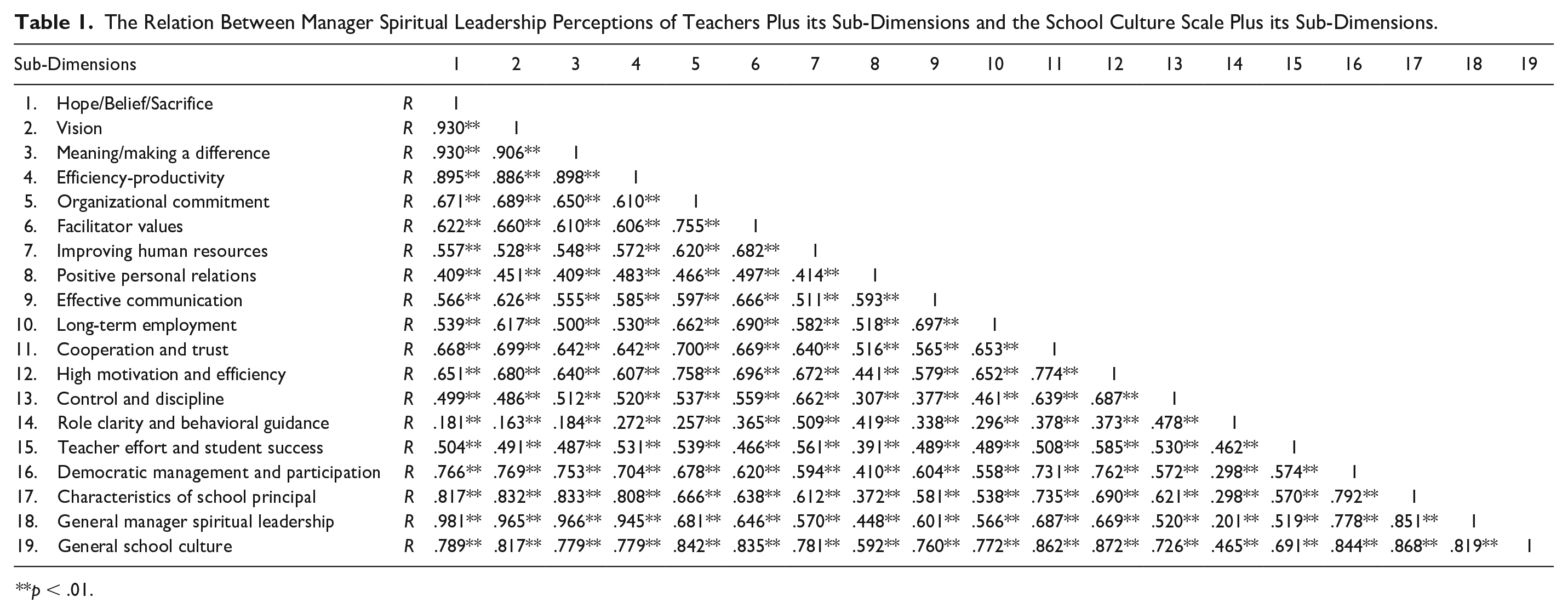
As seen in Table 1, Pearson correlation analysis was conducted to determine the relationship level between manager spiritual leadership perception of teachers plus its sub-dimensions and school culture scale plus its sub-dimensions.
The Relation Between Manager Spiritual Leadership Perceptions of Teachers Plus its Sub-Dimensions and the School Culture Scale Plus its Sub-Dimensions.
p < .01.
As indicated earlier, the Pearson correlation test was used to investigate the correlation among manager spiritual leadership perception of teachers plus its sub-dimensions and school culture scale plus its sub-dimensions. The results are documented in Table 1. An examination of the table shows that there are statistically significant and positive low-, medium-, and high-level correlations between manager spiritual leadership perception of teachers and school culture (**p < .01). In general terms, it has been found out that there is a significant and positive high correlation between manager spiritual leadership perception of teachers and school culture scale (R = .82, **p < .01). Accordingly, as the scores obtained by teachers from spiritual leadership perception and its sub-dimensions increase, so does the scores obtained from school culture and its sub-dimensions.
Comparison of Scores Obtained by Teachers From Manager Spiritual Leadership Perception and School Culture Scale Sub-Dimensions With the Academic Success of Their School
To examine whether the manager’s spiritual leadership perception and school culture scale sub-dimension scores of teachers vary according to the academic success of their school, a t-test was applied to the data for independent samples and findings are provided in Table 2.
Findings as Regards Whether Manager Spiritual Leadership Perception and School Culture Scales Sub-Dimension Scores of Teachers Vary According to the Academic Success of Their School.
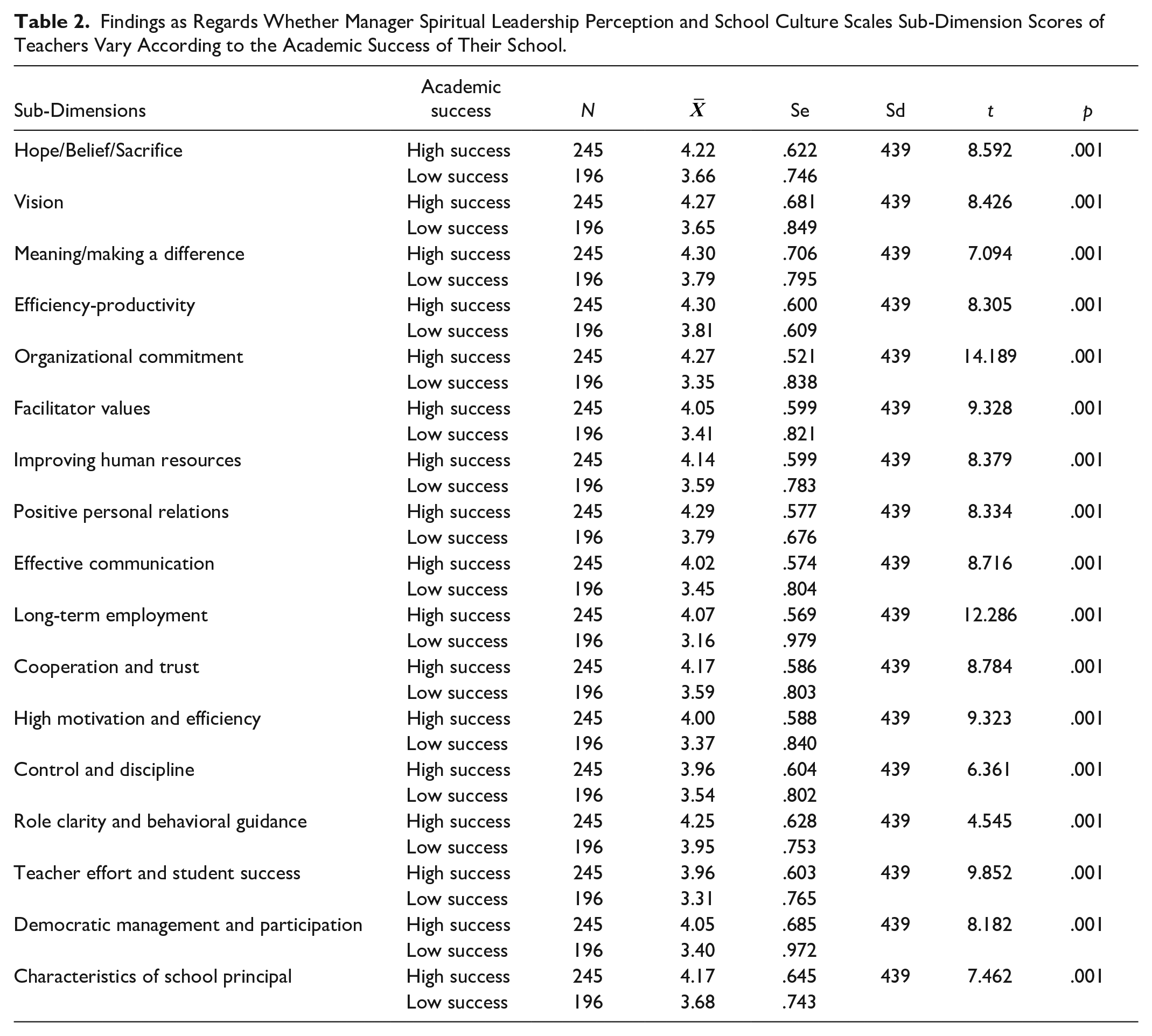
An examination of Table 2 shows that, as a result of t-tests conducted for independent samples, there is a significant difference between mean scores obtained by teachers from all sub-dimensions of manager spiritual leadership perception and school culture scales according to the academic success of the teachers (p < .05). In this case, it can be claimed that there is difference between all sub-dimensions of manager spiritual leader perception and school culture scales of schools with high success levels and that higher school success results in higher mean scores from hope/belief/sacrifice, vision, meaning/making a difference, efficiency-productivity, organizational commitment, facilitator values, improving human resources, positive personal relations, effective communication, long-term employment, cooperation and trust, high motivation and efficiency, control and discipline, role clarity and behavioral guidance, teacher effort and student success, democratic management and participation, and characteristics of school managers.
Comparison of Manager Spiritual Leadership Perception and School Culture Scores of Teachers According to the Academic Success of Their Schools
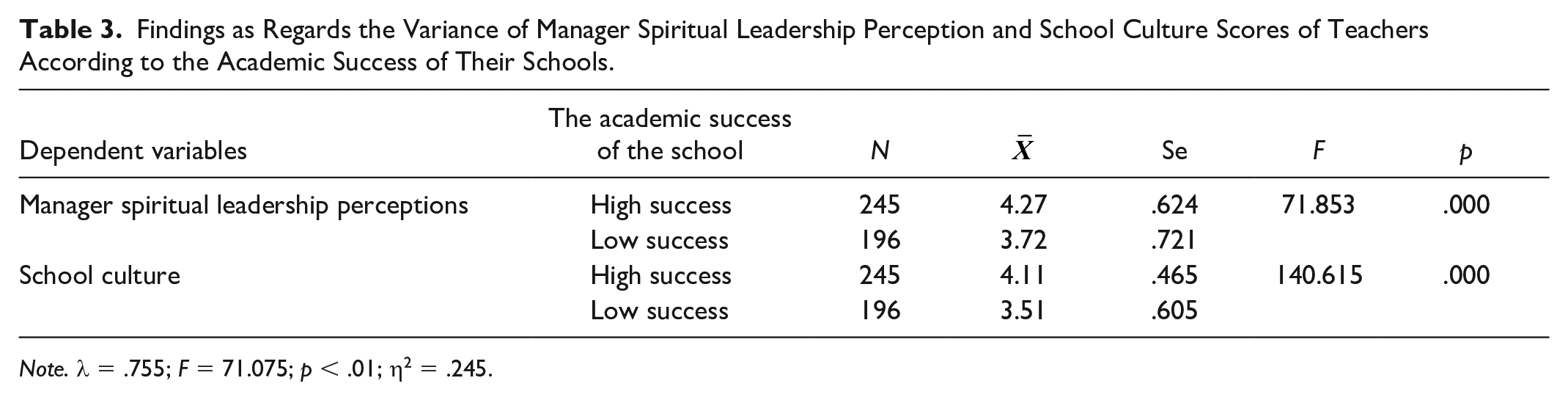
To examine whether the manager’s spiritual leadership perception and school culture scores of teachers varied according to the academic success of their schools, one-way multivariate analysis of variance (MANOVA) was applied to the data and findings are provided in Table 3.
Findings as Regards the Variance of Manager Spiritual Leadership Perception and School Culture Scores of Teachers According to the Academic Success of Their Schools.
Note. λ = .755; F = 71.075; p < .01; η2 = .245.
An examination of Table 3 shows that there is a significant difference between mean values of manager spiritual leadership perceptions and school culture scores of teachers according to the academic success of their school (λ = .755; F = 71,075; p < .01; η2 = .245). The least significant difference (LSD) test conducted showed that the most significant difference was in favor of schools with high academic success. In this case, it can be claimed that when the academic success of a school is high, a difference occurs between mean values of manager spiritual leadership perception and school culture scores; as the school success increases, so do mean values of manager spiritual leadership perception and school culture scores.
Analysis of Qualitative Data
In the qualitative section of the research, it was seen that some teachers did not answer some questions and others provided more than one opinion to some questions. Therefore, the total number of teachers whose opinions were expressed in the tables was less or more than the number of participants. Coding was developed by three researchers. The researchers then came together, compared the encodings, and finalized the analyses. As a result of the data obtained, tables were created in the findings section. Quotes are included to reflect the views and views of the people. Pre-service teachers were coded by giving letters and numbers such as “T (1, 2, . . . ).”
In accordance with the results of the quantitative data previously obtained, appropriate questions were prepared as interview forms. The answers given by the participants to the six questions in the semi-structured interview form were evaluated and themes and codes were created. Accordingly, a total of six codes were created under two themes. Four of these six factors positively assess teachers’ perceptions of the spiritual leadership of school principals. Two of them evaluate school culture characteristics as “strong” and “weak” culture. These results emerged from both observations made in schools during the research and the views of the participants. The frequencies of codes, analysis of themes, and participant opinions were included in the research.
Perceptions of Teachers on Spiritual Leadership of Principals
To determine the relationship between teachers’ perceptions of the spiritual leadership of principals and school culture and academic achievement, the data of the four codes were discussed in more depth. According to the teachers’ views, perceptions of the spiritual leadership of school principals are coded as follows, and the results are shown in Table 4.
Hope, belief, and self-sacrifice;
Vision;
Making sense and making a difference;
Efficiency and commitment.
The Relationship Between Teachers’ Perceptions of Spiritual Leadership of Principals and School Culture and Academic Success.

Hope, Belief, and Self-Sacrifice
Hope is the energy of struggling for accessible and most important objectives, and the will of a person to realize himself or herself. Belief, on the other hand, is defined as the assurance of hopes and believing in things that are invisible and physically unproven (Akıncı & Ekşi, 2017; Sheikh et al., 2019). In the interviews and observations, the ratio of expressions such as hope, belief, and self-sacrifice to the answers of the teachers in high-performing schools is 58% to 42%. It can be indicated that teachers in high-performing schools define their principals more strongly with a difference of 16%. A positive relationship of 53% has emerged between the characteristics of hope, belief, and self-sacrifice and school culture. An example of a teacher’s statement is as follows: I believe that I am in the right place when I witness the excitement of our principal, the inexhaustible effort and the sacrificing behavior towards the students. For example, the principal listens to the students very carefully, and sometimes he does the school cleaning himself. (T5)
It was observed that teachers’ statements in the schools with low success were positive but weak or negative or unanswered. For example, T18 stated, “The principal is an unskilled person who reduces the motivation of fellow teachers and students.”
Vision
The vision is to formulate the viewing of the future and the main purpose of the organization and to present its own role. The vision is to attribute value to the process of the future of the organization and the development of employees in finding their own internal meanings (Fry, 2005; Sheikh et al., 2019). In the interviews and observations, the teachers stated that the principals had a vision about the future of the school and the students in the high-performing schools. In this respect, the rate of the opinions stated is 57%, while the rate of the opinions of the teachers in low-performing schools is 43%. It has been observed that teachers of high-performing schools have a 14% higher ratio for stating that their principal has a vision. At the same time, we can say that having a vision has a positive relationship with school culture at a rate of 51%. For example, T12 said, In every ceremony, Mr. Principal briefly expresses his / her goals and ideas for the future and encourages success. He presents gifts to successful students. He also shares his goals about the school and students in his meetings with us.
T25, who works in a low-performing school, expressed: “Lack of interest among students, lack of responsibility of the parents and negative social setting leaves fruitless the efforts of both the teachers and Mr. Principal.”
Making Sense and Making a Difference
It is a dimension of the individual that will create awareness that life has a meaning. It is based on the understanding of the importance of the work and activities are done and to be done in an organization, the understanding that the work is conducted in line with the specified goals, and the expectation that each deed will make a difference in the lives of people (Akıncı & Ekşi, 2017). In interviews and observations with teachers, we tried to determine the extent to which the activities of school principals were understood and raised awareness. While 59% of the students stated that they had positive opinions in high-performing schools, this rate was 41% in the low-performing schools. The 18% difference between the ratios indicates a significant result. We can state that 60% of the meaning and difference-making features of the spiritual leader are positively related to school culture. T1 stated that “In order to increase the success of the students, our school principal conducts a final exam each month. He congratulates both the teacher and the student for their success.” In a low-performing school, T21 explained, “The low success of our students weakens the prospects of further efforts both for us and our principal. I believe that success is difficult with these students.” It was observed that both the principal and the teachers were suffering from exhaustion to make a difference for various reasons understood from the teacher’s statements.
Efficiency and Commitment
Efficiency is related to the effort and attitude toward achieving the objectives. It is expected that the people in the organization and field will do their best, give importance to the quality of work of everyone in the organization, and the working group will use and evaluate the resources available in the organization in the best way. In the spiritual leadership model, productivity is defined as efficiency in the outcome, benefit, and profit production (Torres, 2019). As a result of the interviews and observations conducted in this direction, it was calculated that the teacher opinions increased efficiency and commitment at 58% at high-performing schools and 42% at low-performing schools. There is a 16% difference between the two school groups in terms of having a principal who is able to increase efficiency and commitment. It was observed that the opinions of the teachers in high-performing schools were stronger and more open, and the opinions of the teachers in low- performing schools were weak and more implicit. The positive correlation between increasing productivity and commitment in the organization and school culture is 58%. For example, T15 stated, “Our principal expects it to be very beautiful and complete when given a task. For him, the education of the student has priority. He pushes for all possibilities when necessary.” T16 offered his opinions as follows: “He gives importance to working hard, I think it is aimed at meeting the formal requirements. I think his management philosophy goes beyond mere formalism.”
Opinions of Teachers on School Culture
A school needs a strong school culture to develop, improve its success, and serve the community in the best possible way. In this study, teachers’ opinions about school culture define the schools that are the subject of research in terms of strengths and weaknesses. In this respect, the data of the two codes were examined in-depth to determine the relationship between school culture and academic achievement. According to the teachers’ views, it is coded as follows, and the results are shown in Table 5.
Strong school culture;
Weak school culture.
The Relationship Between School Success and School Culture.

There are several elements that make up the school culture. During the interviews and observations with teachers, various symbols of schools, the cooperation of the organization, common values, communication, and characteristics of the principal were used. According to the content analysis, the high-performing schools have strong school culture characteristics based on the ratio of possession of these elements. However, it is stated that school culture is weak in low-performing schools.
Strong School Culture
As a result, 62% of successful schools have a stronger school culture in terms of physical, functional, and verbal symbols, cooperation and trust, common values, effective communication, and characteristics of their principal. In schools with high academic achievement, it was observed that the school culture elements identified in the interviews were expressed strongly and frequently. For example, T4 stated, Our principal buys us a meal after each activity. Every Wednesday we cycle to and back the Balıklı Lake. Archery, wrestling, table tennis, football, etc. are among the activities organized at school. And classes are not omitted during these activities.
T8 said, “Teachers are in constant contact with parents. Every teacher has a parent group. We communicate via Whatsapp. We visit parents outside school hours.”
Weak School Culture
We can say that the elements that make up the school culture are not fully developed for various reasons and that 38% of the low-performing schools have a weak school culture. The 24% difference between the two school groups indicates that there is a significant difference between the groups. In the interviews conducted in low-performing schools, it was observed that these items were expressed more weakly. For example, T20 used the following expressions: Only competitions and activities that are obligatory for religious education take place in our school. I think it is done because it is mandatory. The lack of physical, material and social facilities in the school prevents many activities to be done.
Conclusion and Discussion
The main purpose of this study is to determine the structural relationships between the high school teachers’ perceptions of spiritual leadership, school culture, and the success of the schools in which they work. In this direction, the study assumed that spiritual leadership has influenced the school culture and school culture has affected school success. Spiritual leadership and school culture were used as independent variables and school success was taken as a dependent variable.
In the quantitative dimension of the study, correlation, T-test, and MANOVA analyses were conducted to determine the relationships between variables by using descriptive statistics on teachers’ perceptions of spiritual leadership, school culture, and academic achievement. If the correlation values reached between the variables were less than .10, it means low correlation, whereas .30 means medium correlation and .50 means high correlation (Field, 2009). In addition, the data obtained from the interviews with the teachers and observations were analyzed meticulously and strong results supporting each other emerged. In the study, it was found that there was a high relationship between the spiritual leadership variable and school culture and academic achievement variables. In addition, it has been seen that high-performing schools have both spiritual leadership and strong school culture characteristics compared to low-performing schools.
The strongest results were found among the variables of spiritual leadership and school culture. As teachers’ perceptions of spiritual leadership increase, school culture perceptions increase as well. It can be expressed that effective communication, vision, organizational commitment, trust, and common values, which should be present in a school culture, are strongly supported by behaviors such as being promising and convincing, having a vision, making a difference, creating efficiency and commitment, which have to be found in a spiritual leader. Fry et al. (2010) support this result by stating that spiritual leadership requires organizational vision and organizational culture (Sheikh et al., 2019).
Similarly, Fry and Matherly (2006), in their study on spiritual leadership and organizational performance, stated that the spiritual leader should provide an organizational culture based on devotional values to increase the efficiency and interdependence of the members of the organization. According to Bodinson, leadership is one of the most important elements in the formation of organizational culture (Kılıç, 2018). The findings are consistent with the result of the study conducted by Karadağ (2009), in which the spiritual leadership behaviors of school principals affect the process of formation of organizational culture. As Markow and Klenke (2005) point out, as spirituality in organizations is embedded in organizational culture, spiritual leaders are highly influential in shaping organizational culture. In addition, they stated that the number of studies in the literature investigating the effect of spiritual leadership on organizational culture is inadequate. Based on these results, it can be understood that the commitment of teachers to school is possible only if the school principals meet the spiritual and psychological needs of the teachers. The school principal, as a leader, is an important part of school culture. Strong and effective leadership will positively affect the school culture and, in turn, the school culture will positively affect student achievement. For this effect, the school principal should create a setting where both teachers and students will feel comfortable and safe, share their problems, and communicate with respect and love. The school principal should encourage the teacher to work with a belief that can make a difference and have a vision. They should also ensure that they can work productively. All stakeholders are expected to be involved in a voluntary effort, focused on problem-solving with high expectations for students.
According to the findings of the research, the effect of school culture on school success is another result. Our study was carried out by forming two school groups according to their academic success. The effects of school culture on the two variables were investigated because they were represented by two observed variables, namely high-performing school and low-performing school. Both quantitative and qualitative data showed that teachers’ perceptions of school culture in high-performing schools were very strong compared to low-performing schools. We can claim that as teachers’ perceptions of school culture increase, students’ average academic achievement score increases, too. To achieve academic success, the student needs effective communication, common values, visionary management, differentiating organizations, and trustworthy environments. All these elements are essential features in strong school culture. The data obtained in low- and high-performing schools support a strong school culture. In schools with low success, this strong culture was observed to be low in parallel with success. This result between strong school culture and academic success can be attributed to the positive impact on student success played by school culture which includes trust between teachers and school management, efforts paid for academic success, and realist and high-performance expectations of teachers from students.
In addition to being effective in terms of productivity, effective communication, adaptation, and flexibility, schools with a strong school culture have an impact on school success as well (Daily et al., 2019; Kılıç, 2018). Balcı (2013) stated that a school culture that requires high but achievable performance expectations and which uses cooperative learning techniques should be established for school success and emphasized the effect of school culture on school achievement. Hoy and Miskel (2010), as an evaluation of research on school culture, emphasized that schools with effective and strong cultures and trust-based cultures provide high-level student achievement (Hoy & Miskel, 2010). Karadağ et al. (2014) stated that, as a result of the school culture, the cooperation, positive communication, and trust of school administrators and teachers working in the school were reflected in student achievement. Koçyiğit (2017) evaluated the effect of school culture on school success through meta-analysis. In his study, it was concluded that there was a positive relationship between school culture and school success (Kılıç, 2018). The existence of a culture that respects and values teachers in schools satisfies teachers and students and increases student achievement (Melesse & Molla, 2018; Yılmaz & Turan, 2015). In parallel with these opinions and the results of the study, several studies have been found in the related literature which determines that school culture has an effect on student achievement. There is a strong positive relationship between affirmative and strong school cultures, improved teacher collaboration, and improved attitudes of teachers toward their professions and high student motivation and success (Balcı, 2013; Hoy & Miskel, 2010; Stolp & Smith, 1995).
Footnotes
Author’s Note
Fahriye Altınay Aksal is now affiliated to University of Kyrenia, TRNC-Turkey.
Declaration of Conflicting Interests
The author(s) declared no potential conflicts of interest with respect to the research, authorship, and/or publication of this article.
Funding
The author(s) received no financial support for the research, authorship, and/or publication of this article.
