




Abstract
This study explores the linkage between Artificial Intelligence Capabilities (AIC) and creativity, emphasizing its two principal dimensions: radical and incremental creativity. The study aims to provide theoretical insights and practical recommendations for utilizing AIC to improve workplace creativity, streamline workflows, and tackle the socio-economic and socio-technical difficulties common in developing nations. We draw grounded theory approach and qualitative techniques, including in-depth, semi-structured interviews with professionals from several industries. Thematic analysis was employed to understand the data, resulting in the identification of four principal themes: AIC, employee creative self-efficacy, creativity (both radical and gradual), and dependent creative incentives. These issues enhance the discussion about artificial intelligence and creativity. The results demonstrate that AIC substantially enhances employee creative performance and self-efficacy, while creativity-oriented awards act as significant motivators, promoting both individual and organizational development. The study recommends that firms establish inclusive compensation systems, enable employees to proficiently implement AIC, and furnish essential resources to cultivate conditions that enhance creative self-efficacy, particularly in Pakistan. The study highlights the socio-economic impacts of AI adoption on society, underscoring the need for inclusive policies, workforce up-skilling, and addressing ethical concerns to mitigate the risk of AI-driven unemployment. By fostering AI-human collaboration, businesses can facilitate a future in which human creativity is enhanced, rather than diminished by AI.
Keywords
Introduction
Over the last three decades, researchers have increasingly focused on creativity and its broader impact (Amabile & Pratt, 2016; Bulut et al., 2022; Y. Zhang et al., 2021). Traditionally, creativity has been defined as the ability to produce ideas or products that are both creative and practical, and valuable in some manner (Sternberg & Karami, 2021). It is also seen as a key driver of growth and societal development (Y. Zhang et al., 2021). In today’s organizational context, creativity plays a dynamic role in problem-solving, innovation, and adopting continuous change (Li et al., 2022). Organizations now recognize creativity as an essential for success, defining it as the generation of novel and useful ideas through both individual and collaborative efforts (Nabi & Liu, 2021). Creative employees are highly valuable, prompting organizations to establish conditions that foster creativity. Researches have explored key predictors of workplace creativity, particularly the influence of artificial intelligence (AI) and its work-related technologies (Petrou & Jongerling, 2022). These advancements play a prominent role in activating incremental or radical productivity (O’Toole & Horvát, 2024). Fields like education, journalism, business, healthcare, and the humanities are just a few of the social and technical institutions that are progressively incorporating artificial intelligence (Atkinson & Barker, 2023). AI revolutionizes scientific work by facilitating data analysis, idea generation, and novel insights, ultimately transforming scientific and creative work (Christou, 2023).
AI-based tools and technologies, defined as machine learning and data analytics, have enabled organizations to approach creativity and innovation in new and more efficient ways in academic and multiple department contexts (Kumar et al., 2024), helping digital systems solve complex problems beyond human capabilities (Giuggioli & Pellegrini, 2023; Zhu et al., 2023). The literature highlights AI’s transformative role across industries and business sectors in developed and developing economies (Wangpitipanit et al., 2024). AI research has expanded significantly, particularly in R&D and its adoption across domains (Wang et al., 2024). This integration is not just enhancing creative output but also supporting both incremental and radical creativity. AI supports the employee in streamlining routine tasks that allow employees to focus on high-level creative thinking, such as data collection, analysis, and reporting, providing employees with more time to focus on creative problem-solving (Apell & Eriksson, 2023). These are minor but broader impact on enhancements in workflow, predictions, and services. Moreover, the AI system can analyze the overall performance of employees and predict the area of improvement, fostering a continuous cycle of incremental creativity within the organization (Bulut et al., 2022).
On the other hand, AI and its tools enable the employee to think beyond the boundaries and provide unique insights, and explore the uncovered areas and patterns in the data that the employee cannot easily detect, such as in product design or business models that can transform the industries. It helps to identify the untapped opportunities and leads to radical changes, thus promoting large-scale innovation (Grashof & Kopka, 2023). Economically, AI and its applications are cultivated and encourage economic growth for both businesses and countries. It boosts productivity and lowers expenses in business by automating processes. It enhances decision-making and encourages creativity. From a macroeconomic perspective, AI is a significant enabler of contemporary economics since it promotes global competitiveness, creates new jobs, transforms existing roles into more innovative and productive ones, and encourages investment (Shoukat et al., 2023).
Existing research (Tierney & Farmer, 2002; Zhai & Liu, 2023) has only specifically investigated the impact that artificial intelligence (AI) has on creative thinking within the framework of a corporate setting. The purpose of this study is to analyze the integration of artificial intelligence with employees to investigate how it might boost employee self-confidence and trust in their abilities and skills, which ultimately leads to better results. This area has not been thoroughly investigated. The majority of the research that has been done thus far has concentrated either on the role that artificial intelligence plays as a technology facilitator (Brynjolfsson & McAfee, 2017; Dwivedi et al., 2021; Huang & Rust, 2018), or on the individual psychological characteristics that make creativity possible (Gong et al., 2009; Tierney & Farmer, 2002). However, our study uniquely combines these streams by developing and empirically testing a model to see the impact on employee divergent and convergent thinking processes of the employee associated with research and development (R&D), and explore how it influences the cognitive and creative approach with external and internal motivation factors such as rewards based on their performance, to supportive to improve the creative outcomes in research and development institutions.
Additionally, this focused on how companies, especially in developing countries, are utilizing AI and associated technologies to support their workers, enabling them to increase productivity while reducing expenses and time. This study intends to address the difficulties that employees encounter in developing countries, where weaker economic situations frequently impair productivity. Last but not least, advancements in technology improve employee performance; promote economic growth through increased creativity, and organizational efficiency.
Consider the aspects we discussed; this study can offer some research avenues. Examining the application of AI and revolutionary technologies in R&D from a global perspective. The primary research question was:
And proposed thematic farmwork shows the relationship between R&D and its related areas of activities. This study first seeks to address the questions mentioned above, with an emphasis on implementing AI applications in the R&D function in a global setting. Second, this contributes to AI literature on how AI-based technologies affect the research and development operations by assessing outcomes at the personal and organizational levels. Considering the positive and negative consequences seen in the present literature, we propose future research directions. Third, this research indicates how important positive outcomes are produced by social-technical and employee perception related to technology and its utilization. Fourth, we show how Human-AI configurations play a significant role in encouraging positive change in employee and organizational outcomes. Fifth, we suggest a future research direction to direct theory-building efforts by concentrating on the themes of AI and its effects on research and development areas of work by emphasizing the how and why of implementing the AI, you may create possibilities and address organizational and personal problems by managing the opportunities and challenges presented by AI applications with the right social-technical and human setting and interventions. Sixth, we proposed the thematic framework that illustrates the linkage between research and development and related areas of activities, AI, and technological advancement. This framework also highlighted the impact these connections have on organizational and employee results.
Theory and Literature
Grounded Theory (GT), introduced by Glaser and Strauss (1967), was the primary methodology used in this study to investigate and develop a theory grounded in empirical data. This systematic qualitative approach emphasizes creating theory directly from the data, rather than relying on a predefined theoretical framework, ensuring that the findings are closely aligned with participants’ lived experiences (Annells, 2016). The study employed qualitative data collection methods, such as interviews and focus groups, to gather rich, in-depth insights from participants. Using these data, thematic frameworks were developed to identify key patterns and relationships that emerged from the data (Bradley et al., 2007; Charmaz, 2021). According to Biaggi and Wa-Mbaleka (2018), the core element of ‘grounded theory’ is that theory must be developed via methodical examination of empirical data. The efficiency of techniques is in their capacity to direct research across multiple significant domains. Initially, they offer a coherent and rational structure for the collection and analysis of data, guaranteeing the conclusions are based on rigorous investigation.
Furthermore, this methodology provides strategies for detecting and refining errors or omissions while simultaneously enhancing analytical views to improve theoretical clarity. They are especially significant for examining essential social and psychological processes in authentic situations, enabling researchers to grasp the complicated nature of human behavior. Finally, they facilitate the formulation of middle-range theories that connect empirical facts with larger theoretical insights, providing findings that are applicable and conceptually meaningful.
In addition, it provides an alternative viewpoint to the prevailing view of the time, which held that the only acceptable and objective means of ascertaining reality in given situations is by a qualitative approach (Bryant & Charmaz, 2007). Focusing on the qualitative exploration of employee cognitive and creative abilities, grounded theory emerges as a highly effective method for investigating such perceptions and demonstrating the practical implications of the proposed model (Chun Tie et al., 2019; Rahman et al., 2025). The most popular techniques for gathering data in the grounded theory approach are observations and interviews. In this study, we adopted the systematic design GT method, which enables an understanding of employees’ perspectives on AI and its related technologies and their impact on daily tasks, offering an authentic depiction of end-user experiences (Mohajan & Mohajan, 2022).
This methodology consists of adaptable techniques for guiding qualitative data collection and analysis. It is robust in several ways: (a) structuring data collection and analysis logically, (b) identifying and correcting errors to refine analytical concepts, (c) studying fundamental social and psychological processes in real-life settings, and (d) developing middle-range theories. Additionally, it challenges the dominant perspective that only qualitative approaches can objectively determine reality in given situations (Bryant & Charmaz, 2007; Wiesche et al., 2017). This study explores the relationship between AI capabilities, creative self-efficacy, creativity dimensions, and contingent rewards. It integrates prior research to develop a theoretical framework.
AI Tools and applications in the organizational context: The integration of Artificial Intelligence (AI) into Industry 5.0 marks a fundamental shift in business operations. AI’s ability to learn from industrial data enhances performance and efficiency (Joshi & Masih, 2023); Rashid and Kausik (2024) highlight AI’s impact across sectors, improving efficiency, knowledge management, transparency, and resource utilization. AI tools optimize system efficiency, staff performance monitoring, data analysis, and resource allocation, enabling businesses to meet employee demands effectively. AI reshapes job design, influencing worker demands and resources, thereby altering human–AI interactions (Bankins et al., 2024). It reduces physical and mental exhaustion while enhancing positive emotional states for service employees (Qiu et al., 2022). These benefits emerge when AI developers collaborate with human specialists to create hybrid work models. However, AI’s demands may also limit its advantages (Elahi et al., 2023).
Role of employee creative self-efficacy on creative outcomes: Creative self-efficacy (CSE) is rooted in Bandura’s self-efficacy theory, emphasizing its role in goal-directed behavior through emotional belongingness and cognitive-motivational states (Raihan & Uddin, 2023). It reflects an individual’s belief in generating and applying new ideas to achieve goals (Gelaidan et al., 2024). Tierney and Farmer define CSE as distinct from general self-efficacy, focusing specifically on creative performance. Employee engagement in tasks aligned with their interests boosts confidence, fosters strategic thinking, enhances proactivity in challenges, and strengthens risk management, ultimately improving creativity (Sun et al., 2022). Mentors play a key role in encouraging employees to share ideas (Peng et al., 2024). CSE helps employees cope with failures, supporting skill-oriented goals (Tierney & Farmer, 2011), and those with high CSE are less likely to abandon creative pursuits despite risks (Karimi et al., 2022).
Creativity- radical & incremental: Creativity has existed since humankind’s origin, playing a role in daily tasks and problem-solving. With the rise of AI, tools like Chat-GPT, Google Bard, Microsoft Bing, and Jasper have become central to research discussions (Habib et al., 2024). AI is a novel domain in social sciences (Graziani et al., 2023), medical (Apell & Eriksson, 2023), and media sciences (Wingström et al., 2024). Engineering and science have been examined since the Second World War. The term Artificial Intelligence was established in 1956 and articulated that AI comprises a collection of methodologies enabling computers to perform tasks that would typically require the reasoning capabilities inherent to human intelligence (Tapeh & Naser, 2023). Creativity has two dimensions: radical and incremental. Radical innovation is crucial for core competence and sustainable growth in competitive markets (Z. Liu et al., 2021). Incremental creativity modifies existing products, services, or processes to drive differentiation (Bulut et al., 2022). However, no single type of creativity is superior, as both enhance organizational performance.
Contingent creative rewards on creative performance: A creative workforce is crucial for a company’s sustainability, as businesses cannot compete without skilled employees. However, unlike machines, employees make errors and experience emotions that affect productivity (Tarigan et al., 2022). To enhance creativity, organizations implement reward systems, categorized as intrinsic and extrinsic (Frober & Lerche, 2023). Innovative employees drive organizational growth, efficiency, and sustainability (Nili & Tasavori, 2022). Employees in repetitive tasks tend to exhibit incremental rather than radical creativity, relying on external motivators like compensation. While creativity-contingent rewards enhance output, research on performance-based rewards remains inconsistent. This study uses in-depth interviews to explore the influence of AI-human collaboration on organizational creativity, the impact of employee creative self-efficacy on proficiency using AIC.
Methods and Materials
Design: This study explores the influence of AI capabilities on creativity using an exploratory research approach, with phenomenology providing insight into its overall impact (Hasan et al., 2022). Thematic analysis was employed, supported by 35 semi-structured in-depth interviews to capture employee attitudes, perceptions, experiences, and acceptance. This approach provided rich insights into societal trends, opinions, and beliefs, allowing participants complete freedom to share their experiences (Taherizadeh & Beaudry, 2023). The collected data helped identify root causes, opened new knowledge avenues, and aided in thematic analysis or theory development to contribute to the literature. Each in-depth interview lasted 30 min to 1 hr, covering 15 to 20 detailed questions on the topic (Rajashekar & Jain, 2024).
Research Context: Participants were selected based on specific criteria: (a) AI knowledge, (b) familiarity with multiple applications and software, (c) access to basic IT resources, and (d) affiliation with R&D, AI professions, decision-making, or research. They also provided detailed insights into AI capabilities (AIC) and creativity (Hasan et al., 2022). Data was collected from public and private sectors, including telecom, health, pharmaceuticals, FMCG, construction, manufacturing, textiles, medicine, and education, between January and May 2024. Participants were recruited via personal and professional referrals, minimizing bias. Before the interviews, the study’s purpose was explained, and written consent was obtained (Gomes et al., 2023). Interviews were conducted and recorded via phone calls, with some responses translated into English by a qualified transcriptionist (Abbas & Liu, 2022).
Sample: To select Pakistani end-user participants, convenience and purposive sampling were used. Educated urban individuals were interviewed to ensure in-depth knowledge and understanding (Hasan et al., 2022). Due to time constraints, the sample size was not predetermined, and data collection continued until saturation was reached. Participants ranged from 21 to over 45 years old, playing a key role in using AIC to enhance creativity. Their life experience provided insights into emotions, attitudes, and factors influencing decisions. No one was excluded based on gender, color, religion, or health status.
Interview Protocol & Key Questions: Before each interview, the goal of the study was made clear, with a focus on how AI fits into R&D workflows and the rights of the participants, such as the ability to quit at any time and the privacy of their answers. Before recording, verbal permission was asked for. The lead author introduced herself as a researcher looking into how AI can boost imagination and clarified that the goal was not to evaluate the employee’s performance, but to learn their real-life experience with the AI tool. Moreover, these interview questions were to get deep answers. They usually start with open-ended questions. Tell me about yourself, from your point of view, till now, which is the most significant invention or innovation related to technology, how do you perceive the use of technology…, how does it impact your creative abilities, how does it help you as a researcher, and in which aspects (Bearman, 2019; Saunders et al., 2018).
Qualitative Coding Procedure: The constructivist grounded theory (GT) was selected to design thematic analysis because it allows us to set the model component from the collective interpretation of the collected data (Charmaz, 2021; Makri & Neely, 2021; Rahman et al., 2025). The methods started with a thorough evaluation of pertinent literature and designing the research questions (Charmaz, 2014; Corbin & Strauss, 2014). Semi-structured interviews were conducted over the phone, which were the first step in the data collection process. Current note-taking was also used to record contextual information and subtle observations (Bryman, 2016). To find distinct acts, meaning, and processes arising from participants’ accounts, transcripts, and field notes were analyzed line-by-line throughout he open coding phase (Charmaz & Thornberg, 2021). The creation of preliminary codes based on the data was made possible by this inductive method. The analysis then proceeded to link categories and sub-categories by investigating their attributes, dimensions, and linkages during axial coding (Corbin & Strauss, 2014). During this phase, a continual comparative method is used to refine categories and identify patterns in data. When more interviews failed to produce new categories, the process of theoretical saturation established the endpoint of data collection (Glaser & Strauss, 2017; Guest et al., 2006). Ultimately, the most noteworthy categories were combined into a logical theoretical framework during the selective coding stage. In this step, the emergent themes were combined into an interpretive model that captured the connections between key ideas and took into account the researcher’s interpretative analysis as well as the lived experiences of the participants (Charmaz, 2014).
Extracting and developing the themes: First conducting the interviews then we transcribe all the interviews and make the field notes. Three coding stages make up the typical systematic design in grounded theory (Creswell, 2012; Taherdoost, 2021). Some papers outline a five-stage process, with interviewing the initial stage and theory development positioned as the fifth stage (Ariza, 2020; Mohajan & Mohajan, 2022; Taherizadeh & Beaudry, 2023). This study’s coding process comprised three interrelated stages aimed at constructing a grounded theoretical framework. Open coding was initially performed by segmenting the qualitative data and identifying keywords and phrases to establish preliminary categories, facilitating early concept development. The categories were systematically labeled and organized according to emerging patterns (Chong & Yeo, 2015; Chun Tie et al., 2019; Creswell, 2015). During the axial coding stage, a central category was identified, and its connections with other categories were examined through the analysis of causal conditions, contextual factors, strategies, and outcomes. The writer facilitated the establishment of a theoretical connection between primary categories and their sub-categories (Chun Tie et al., 2019). In the selective coding stage, we refined the code categories by retaining the most relevant variables and analyzing their interrelations. This process resulted in the creation of thematic farmwork and associated propositions, enhancing the comprehension of the relationship among the principal themes (Aslipour & Zargar, 2022; Chong & Yeo, 2015; Creswell, 2015; Walsh, 2015).
Data Analysis Procedures: For data analysis, we followed the methods (Gomes et al., 2023; Rahman et al., 2025), using open, axial, and selective coding as part of a systematic coding methodology. An iterative process of simultaneous data collection and analysis was employed in our interpretative approach. We actively sought new participants based on prior informants’ insights (Linneberg & Korsgaard, 2021). This dynamic sampling process continued until theoretical saturation was reached, marking the end of data collection and analysis when no new themes emerged. During open coding, we remained close to the informants’ terms, producing explicit coding concepts. Axial coding identified dense categories by examining logical relationships among codes (McCall & Edwards, 2021). This step allowed us to establish links and interactions between concepts. Finally, selective coding was used to create themes, representing the highest level of abstraction (Taherizadeh & Beaudry, 2023).
Results and Interpretation
Descriptive Statistics:Table 1 provides a summary of the participants’ demographic data. Male participants were dominant in this study by a ratio of 54.29%. The age range of the individuals who made up the majority was those older than 40 years, 37.14%. The most significant percentage of responders, 68.57%, were from the private sector, and 51.43% worked in the service industry. In total, 34.29% of the participants in the study exhibited 11 to 15 years of professional experience in their respective fields. Nonetheless, every interview conducted over the phone, and all were recorded, revealed that 54.29% of the participants were researchers, all aware of the use of AI for creativity and other forms of it, and related to R&D institutions.
Demographic Characteristics of Participants.

Source. Authors’ own works.
Thematic Analysis: The above thematic framework was used to develop the study’s thematic framework, which includes AIC, ECSE, Creativity, and CCR (Glaser & Strauss, 2017). Because grounded theory is better at developing theory from empirical evidence than it is at enforcing pre-existing conceptions, it was chosen (Charmaz, 2014). Because of this, themes were able to develop naturally from the viewpoints of the participants, guaranteeing the framework accurately represented real-world working experiences in Pakistan’s R&D institutions. The architecture of the framework is based on well-established ideas in organizational psychology and innovative management, namely, the connection between creative performance and technology adoption (Amabile & Pratt, 2016; Bandura & Wessels, 1997). AI was envisioned as an enabling capability that affects employee engagement, creativity, and CCR rather than just as a tool.
After coding all 35 interview transcripts, the identified codes were consolidated into 15 categories, resulting in four final themes (see Figure 1). Thematic analysis revealed a strong correlation between (AIC) and organizational creativity. Empirical results showed that AIC not only fosters employee creativity but also boosts confidence in creative abilities. When individual employees have access to a wide variety of resources and tools, including technology that utilizes AI, they can acquire a wide range of information that improves their learning, performance, and confidence in their capabilities (Kassa & Worku, 2025). The World Economic Forum identified the ability to focus on more complicated and creative responsibilities as a talent that will be vital for the future of work (Tong et al., 2025). AIC enables employees to focus on more difficult and creative tasks, and the reshaping of production paradigms, the re-engineering of innovation value chains, and the transformation of business models.

Thematic model.
Additionally, employees’ attitudes and work habits have been influenced. Understanding the cognitive evaluations that employees have of AI technologies and the implications that these technologies have for innovation is essential for the advancement of both theory and managerial practice in this environment (Q. Zhang et al., 2025). Additionally, it promotes collaborative learning, enabling employees to develop new skills and research methodologies for personal growth. Despite these advantages, challenges in the AIC-creativity link were identified, including limited AI access, inadequate training on advanced AI tools, and underutilization in the public sector. Concerns about redundancy, uniqueness, data security, and employee isolation also emerged. While AIC enhances daily work, these obstacles highlight the need for comprehensive strategies to mitigate drawbacks and ensure effective implementation in corporate settings. Below, we link four qualitative themes with the core research question (Table 2).
Thematic Interpretation and Linkage.

Source. Authors’ own works.
The primary themes discovered through data analysis serve as a framework for organizing the empirical findings. The following order is used to present the themes: Artificial intelligence capabilities (AIC), Employee creative self-efficacy (ECSE), Creativity (Radical & Incremental), and Contingent creative rewards (CCR).
Theme 1: Artificial Intelligence Capabilities (AIC)
A firm can select, compose, and leverage its AI-specific resources. The first themes include a few sub-themes: organizational infrastructure and supportive tools, organizational efficacy, employee productivity, and resource optimization. We divide these resources into two main categories: technical and non-technical resources. In technical resources, employees need proper tools, updated software and applications, and infrastructure design to streamline day-to-day operations and improve workflow efficiency within the organizational setting. This study found that (P-2) & (P-21), working in the service sector, have 10 years of experience, and they state:
Because as humans, sometimes we get stuck, feel we are bound, and have limited capacity to think. So, AIC helps us in this manner: Some multinational companies develop custom software to aid employee decision-making and problem-solving.
These resources in the manufacturing sector automate routine tasks and save time and organizational costs. Participants (P-1) and (P-6) express in this way:
……… save our time using the main application for sending email, and message, discussing strategies related to research and implementation…… supporting operating system and a new mechanism …. For precise summaries, it will help.
This automation also enhances data analysis capabilities, optimizes processes, reduces manual effort, and boosts employee productivity, allowing focus on valuable tasks. Non-technical resources like strategic partnerships, organizational culture, and human capital also enhance productivity. Organizations should conduct in-house training and skill development programs to provide new exposure to employees. These programs equipped the employee with new knowledge and skills to perform their job effectively. Organizational culture fosters innovation, strategic alliances, and a supportive environment for sustainable growth. One participant described this as:
Now we are increasing our outreach, which helps to understand our stakeholders more deeply and effectively. (P-1)
Each resource uniquely contributes to organizational success, driving growth and competitiveness. Consequently, we suggest many propositions. Concerning this theme, we recommend that:
Theme 2: Employee Creative Self-Efficacy (ECSE)
A higher degree of self-efficacy is a required (but not sufficient) condition for creative output, according to social cognitive theory. According to Bundra, restructuring and synthesizing knowledge into new ways of thinking and doing things is a significant component of innovation.
AI provides objective validation, enhancing ideas and boosting confidence where external recognition may be limited. (P-19)
The application of technologies in the workplace significantly enhances workers’ cognitive, creative, and personal skills. The participant observed;
Yes, it helps to solve the problems in the workplace, …………… (P-22)
And providing tools and resources that amplify the employee and collective creativity in the workplace. The participants commented:
Technologies providing tools, insights, and assistance that facilitate creative thinking and problem-solving. (P-26). …… potentially boosting confidence ………… However, it’s essential to balance the use of AI with personal input, as creativity often involves unique human perspectives. (P-30)
Advancing knowledge in this area is crucial, as digital technologies foster intrapreneurial behavior by streamlining innovation and value creation in businesses. Moreover, it supports the decision-maker in idea generation. Also, technology helps employees brainstorm to expand their thinking horizons.
This exposure borders the range of possibilities for an employee to boost their confidence level. Participant (P-2) expresses their thoughts:
Technology supports ………………………… It gives me a way to clarify my doubts. Even sometimes it just thinks outside of the box…………
Furthermore, AI-generated insight elevates employee trust in their decision-making. And reduces the number of errors, which strengthens the employee psychologically. This technological shift allows employees to think big; employee reinforce their creative abilities. Participants quoted:
In the past, I was a hard worker, but now I’m a smarter worker, and still I’m taking time to complete my tasks and assignments, and yes, it boosts my confidence. (P-11), it helps us to get more reliable and practical results in our field. (P-18).
The employee who believes they are competent to complete work will typically use more effective task techniques to accomplish their objectives.
………………………… people believe they can be creative, and ……………, and take creative risks. (P-26). It facilitates data analysis, personalized learning experiences, and innovative research approaches in development economics. (P-24)
The qualitative study reveals that effective employees tend to be more adaptable when taking in new information, methods, procedures, experiences, and technology, and they exhibit a higher level of intrinsic motivation to enhance their creativity and confidence. Further investigation is required. Consequently, we present the subsequent proposition.
Theme 3: Creative Contingent Rewards (CCR)
An organization frequently values creativity because it fosters organizational innovation (Y. Liu et al., 2019). Moreover, employee intrinsic motivation, the act of engaging in a task for the pure pleasure of it, is a prerequisite for creativity. Participants expressed that:
…………… win-win situation, when my client is satisfied and happy, ultimately, my organization is pleased with my performance, and I receive a reward (P-6). I received a certificate of appreciation ……………… motivates me to become more productive. (P-2)
The creativity-contingent rewards signal the value of innovation and direct efforts toward creative output. Their impact depends on employees’ traits, influencing how rewards are perceived. Psychologically, receiving rewards fosters a sense of value and respect among employees. One participant (P-29) remarked:
……………… it reinforces positive behaviors. It’s Boosting my Morale.
Recognition and rewards both significantly boost the employee’s creative abilities. In literature, employee intrinsic and extrinsic motivation is raised when they perceive that their creative effort is valued, which results in an increased level of creativity. Humans seek appreciation and respect, often motivated by external factors. Organizational support through training and mentorship encourages employees to adopt new methods and think innovatively. One participant (13) described:
They provide personal and professional satisfaction and affirm the value of innovative work. My team compensated financially, and they gave me new assignments and tasks; they even promoted me to a managerial level, so it was good for me. (P-10)
While extrinsic rewards may affect intrinsic motivation, aligning them with the creative process enhances performance. Recognizing inventive efforts and providing positive reinforcement inspires employees to take risks, think creatively, and develop novel solutions.
This approach may enhance the positive effects on employee outcomes when motivation from authority is derived from employees’ creative contributions. We propose the following:
Theme 4: Creativity (Incremental and Radical)
Workplace creativity drives innovation through ideas, approaches, procedures, and solutions. While usefulness reflects an outcome’s organizational value, novelty highlights its uniqueness. Several outstanding assessments have highlighted the relevance of creativity and innovation for organizations to preserve competitive advantage. One participant remarked:
In a simple world, any idea that is not proposed in the real world and you try to make it, OR modify the existing things. (P-3) With external help or with your inner mental ability, simply generate maximum output with minimum input, it is creativity……………………………………… (P-4)
Through this study, we highlight the impact of the implementation of (AIC) at the organizational level, and creativity positively correlates. Participant (P-16) mentioned that;
Take an example, it enhances human intelligence, we use tools, methods, different platforms for our research purpose, so it’s like it enhances, so it’s a link, it’s a positive correlation, I would say.
This positive correlation has shaped employee efforts over the decades, particularly in creativity, by integrating new digital tools and enhancing existing design and collaboration platforms. Compared to previous generations, modern applications have a far-reaching impact, not only enhancing production and process efficiency but also reshaping the creative process by expanding the scope of innovation. One participant (P-9) sherd the same thoughts;
If I’m working on something or creating anything, basically it will be my brainchild…………… AI can provide results for whatever I’m thinking, in both positive and negative ways. It generates results based on my input. ……………. AI is massive, tremendous. OpenAI provides guidance on how to perform the task, suggests helpful resources, and offers optimization methods. It enhances my skills and efficiency, delivering quick and highly optimized results. (P-10)
The influence of AI varies in terms of creativity levels and is dependent upon the specific sector of the organization. Consequently, we propose the following;
The study employs all the proposed themes to propose practical recommendations for organizations, such as prioritizing user-friendly AI systems, enhancing employee creative self-efficacy, developing effective reward systems, and cultivating environments conducive to both incremental and radical creativity. These strategies will guarantee that AI enhances organizational performance while cultivating a sustainable and innovative workforce, especially in sectors aiming to leverage AI for creative and competitive superiority. The qualitative narrative highlights AIC’s role in enhancing creativity across enterprises, benefiting sectors like customer care, finance, FMCG, healthcare, telecom, and education. It drives competence, innovation, and operational efficiency, fostering advanced methods and solutions. The word cloud captures key themes and subthemes in Figure 2.
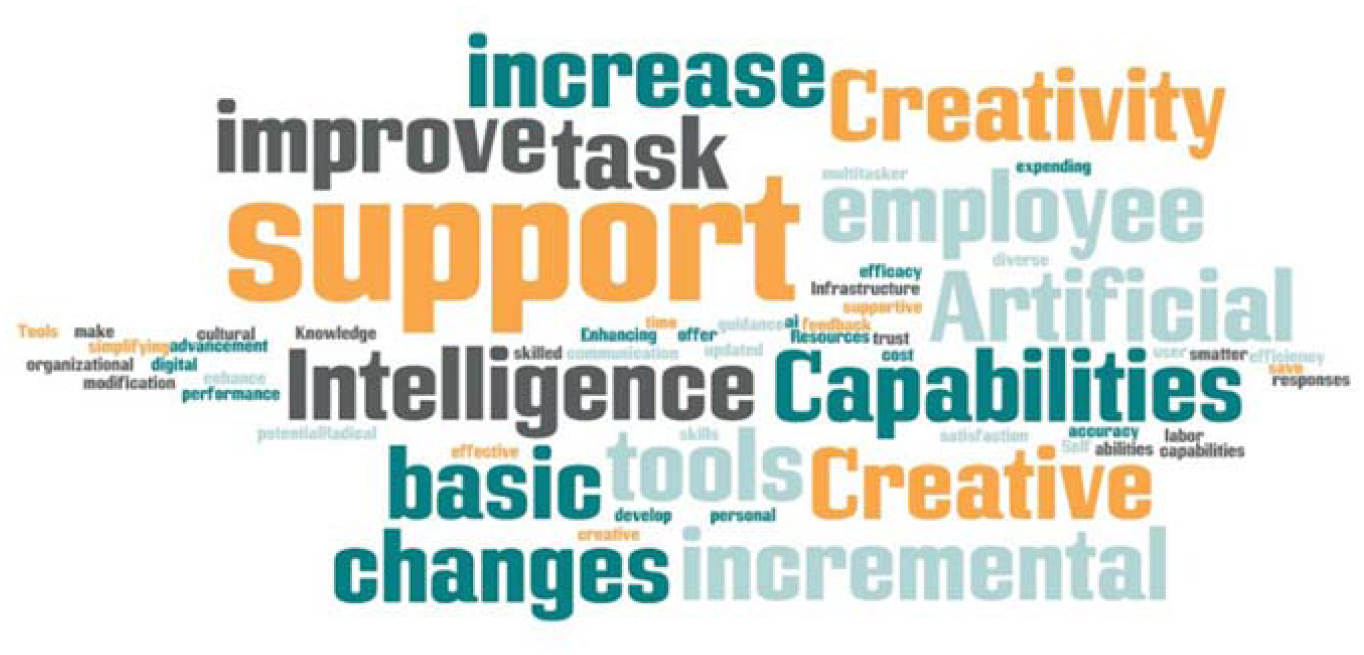
World cloud for proposed themes.
Implications
This study uncovers four interrelated thematic models (see Figure 1). Participants indicated that while artificial intelligence capabilities (AIC) enhance efficiency and foster innovation, AIC by itself is not enough to guarantee creative productivity (Rapanta et al., 2021). Organizations must invest in AIC’s potential by providing essential resources, tools, and infrastructure to attain impactful results (Christou, 2023). Furthermore, regardless of sector, recruiting a skilled workforce and providing comprehensive training are crucial to adapting to technological advances, improving employee performance, and fostering organizational creativity (Petrou & Jongerling, 2022).
Furthermore, the first theme, artificial intelligence capabilities (AIC), emerged as a key driver of innovation and efficiency in a variety of industries, such as manufacturing, healthcare, and finance through data-driven insights and automation (Mikalef & Gupta, 2021). In creative fields, such as entertainment and environmental sciences, producing original concepts and solutions is crucial (Dutta et al., 2020; Tam & Thuy, 2023). However, concerns about ethics and job displacement persist, especially in fields like education that are less tech-savvy (Turnbull et al., 2020). Effective AIC implementation requires adequate training, career consultation, and ethical guidelines to align with organizational needs (Deng et al., 2022).
The adoption of AIC is carefully linked to employee creative self-efficacy (ECSE), which signifies individuals’ belief in their innovative capabilities. Participants observed that growing self-efficacy is crucial for effectively utilizing AI tools and promoting innovation (Xie et al., 2019). In a male-dominant society like Pakistan, AIC promotes more equitable conditions and increases women’s self-esteem (Khalid et al., 2020), while providing data-driven validation that enables them to advocate for their contributions (Tallon et al., 2019). Sectors like entertainment and education, however, support creative self-efficacy through collaborative environments and inclusive practice. This highlights the organizational culture and leadership in enhancing employee confidence and driving creativity.
Based on self-efficacy, both radical and incremental creativity (RC, IC) are linked across all sectors. Participants addressed the significance of balancing groundbreaking discoveries with ongoing advancements to stay competitive (Martínez-Caro et al., 2020). Industries like pharmaceuticals and environmental sciences prioritize radical innovation, while customer-driven sectors like FMCG and textiles prioritize incremental creativity to improve current products (Heitzmann et al., 2021). Both types of creativity are essential, but radical creativity is harder to manage due to increased risks and resistance to change. These findings emphasize the need for specialized creative tactics that meet sector needs.
Contingent creative rewards (CCR) are crucial for motivating employees in creative tasks (Paais & Pattiruhu, 2020). Sectors such as sales, healthcare, and textiles benefit from reward systems that acknowledge both individual and organizational levels. However, inadequately structured reward systems have been observed to promote favoritism and detrimental competition, especially in budget-limited fields such as education and healthcare. Participants noted that while monetary rewards hold significance, intrinsic motivators like meaningful work, public recognition, and opportunities for professional growth substantially improve creative engagement (Ali & Anwar, 2021).
We interpret our findings within Pakistan’s distinctive socio-cultural and organizational framework. Pakistan’s workplace typically exhibits significant power distance and in-group collectives, with hierarchical systems where authority is concentrated and personal relationships profoundly affect workplace dynamics (M. A. Khan & Law, 2018; Nadeem & Tayyab, 2021). Cultural features can enhance dependence on AI capabilities (AIC) to overcome decision-making limitations or the inflexibility frequently observed in the innovation process. Collectivist standards may promote collaboration, but can also restrict individual creative expression (Nadeem & Tayyab, 2021; Tasneem & Qureshi, 2022; Yaqoob & Kitchlew, 2022). In these circumstances, employee creativity self-efficacy (ECSE) may be notably enhanced when AIC functions as a supportive instrument, empowering workers to navigate hierarchical structures with increased confidence. Additionally, a pronounced aversion to uncertainty and desire for structured methodologies may further solidify dependence on AI systems, diminishing risk aversion and fostering innovative behavior when technological support is regarded as reliable (M. A. Khan & Law, 2018).
Moreover, Pakistan’s resource limitations and developing digital infrastructure likely enhance the perceived significance of AIC in effectively promoting creativity. Employees can exhibit creativity by fostering innovations, improving technology, or refining procedures that result in inventions (Xu et al., 2022). This creativity is frequently enabled by financial resources, organizational backing, and innovative thinking among employees T. A. Khan and Niazi (2023), especially when contingent creative rewards (CCR) provide explicit managerial endorsement. In a cultural framework that frequently emphasizes group accomplishment above individual acknowledgment, AI can serve as a facilitator that not only amplifies creativity but also ECSE, allowing people to make significant contributions to collective innovation objectives. This culturally informed interpretation enhances the depth and significance of our thematic framework within the Pakistani R&D context.
The themes emphasize the inter-linkage of technology, self-confidence, creative approaches, and rewards in fostering organizational creativity. Leveraging AI capabilities requires a solid foundation of creative self-efficacy, promoting both incremental and radical creativity (Grashof & Kopka, 2023). Transparent and inclusive reward systems further enhance this, motivating employees to contribute creativity and fostering a creative environment (Darmaki et al., 2023). This interconnected approach enables organizations to navigate the creative complexities while addressing employee needs and sector-specific challenges.
Theoretical Contributions: Grounded theory (GT) serves as the basis for deriving theory from data. In this study, we initially permitted themes to arise by inductive coding (Davison, 2022). Only after formulating those themes did we analyze them using recognized frameworks, TAM, SCT, SDT, and CTC to enhance comprehension and link empirical data to overarching theories. This methodology aligns with previous research (de Souza Santos & Ralph, 2022), a grounded theory study on hybrid software teams and (da Silva, 2021) context-specific grounded theory model in ICT4D (da Silva & Fernández, 2020).
Through theory-based thematic analysis, the study proposes a theoretical framework that reinforces the findings, contributes to the theoretical knowledge, and to the broader understanding of AIC’s role in fostering creativity based on theory, by examining the relationship between artificial intelligence capabilities (AIC), self-efficacy, reward systems, and creativity in the socio-cultural setting of Pakistan. The study shows how AIC helps to improve employee creative self-efficacy and performance, especially in a male-dominated society, by using qualitative data from important industries like FMCG, pharmaceutical, telecom, education, and medicine. Hence, results highlighted how AIC may be used to empower workers, boost confidence, and promote creative thinking in Pakistan, where conventional values and hierarchical work cultures are common. The theme analysis supports the theoretical idea that AIC can enhance creativity by boosting self-efficacy. Furthermore, a crucial theoretical insight is shown by the private sector’s limited support for monetary rewards: non-monetary or intrinsic motivators may have a greater influence on fostering creative behaviors in developing nations. This realization enhances theories of motivation and creativity by placing them in contexts with limited resources.
AIC is grounded in the Technology Acceptance Model (TAM); through this model, research explains how the perceived ease of use and benefits of AIC encourage employee acceptance and utilization in the workplace (Marangunić & Granić, 2015). This model helps the employee in two significant aspects: first, it enhances their efficiency, and second, it helps to gain instantaneous comprehension to cultivate a creative environment. The AIC implementation in an organization not only automates the routine tasks but also empowers the employees to become more creative in decision-making and engage in both radical and incremental innovative work in the organization. The real-world implication of this model is that to increase employee enthusiasm for productivity with AIC, businesses must ensure that technology is easy to use and aligns with their job responsibilities (Legris et al., 2003; Verma et al., 2018).
The second theme, ECSE, is explored through Social Cognitive theory (SCT; Bandura & Wessels, 1994), which emphasizes the role of self-efficacy as a motivating factor to engage the employee in creative tasks. Employees exhibiting high creative self-efficacy are more inclined to utilize AIC or its tools to improve their skills, as they possess confidence in their capacity to generate innovative solutions (Luszczynska & Schwarzer, 2015). The practical application of this organization needs to concentrate on the development of a culture that strengthens employees’ creative self-efficacy through proper training and support, particularly in the utilization of AI for creative tasks. This can enhance the quality of ideas and solutions produced in the workplace, thereby promoting organizational growth and innovation (Gelaidan et al., 2024; Peng et al., 2024).
The third theme is tied to Self Determination Theory (SDT), a drive theory of human motivation and personality in a social context (Deci & Ryan, 2012). In this theory, they discuss how motivation is influenced by external rewards such as contingent creative rewards (CCR). They both claim that intrinsic and extrinsic rewards serve as strong motivators when employees recognize their effort as producing significant, successful outcomes (Deci et al., 2017). In the area of AI, employees who demonstrate increased creative output through the utilization of AI tools should receive appropriate rewards, thereby enhancing their motivation to stay engaged in innovative projects. Organizations should develop a reward system that acknowledges both individual and team-oriented creative accomplishments. This motivates employees to engage with AI technologies more effectively and promotes sustained innovation (Frober & Lerche, 2023).
Creativity (radical and incremental) was the fourth theme, which was explained by the Componential Theory of Creativity (CTC) in 1983. She proposed that task motivation, creative-relevant abilities, and domain-relevant skills are the three primary factors that drive creativity. According to Amabile and Mueller (2024), integrating AI tools in the workplace empowers employees to create incrementally and radically. Radical creativity involves groundbreaking innovations, while incremental creativity involves gradual, continuing advances. AI may expedite processes and provide insights to help staff focus on more complex and creative problem-solving, nurturing both types of creativity. This theory suggests that AI technologies should be created to help with everyday work and encourage innovative thinking at all levels of the organization, enabling incremental improvement and radical findings (Tapeh & Naser, 2023).
Practical Implications: This study recommends the practical implications for all industries in developing nations like Pakistan. According to the results, around 98% of participants acknowledged how AIC may improve decision-making, lessen physical labor, and encourage creative problem-solving. These findings imply that industries should invest in AIC adoption to encourage employee innovation and improve performance. However, the uneven application of monetary incentives, particularly in the private sector, suggests that other motivational techniques are required. To promote creativity, employers are urged to use development-oriented or recognition-based incentives, such as opportunities for skill development, career promotion, and public recognition. Furthermore, there is an urgent need to create gender-inclusive AI training programs that enable women in technology-driven professions, especially considering that the majority of responders were men. This study offers a valuable foundation for utilizing AIC to promote an innovative and creative culture within Pakistani organizations.
Conclusion
In the understudied environment of emerging economies, this study offers a nuanced view of how artificial intelligence capabilities (AIC) might catalyze corporate innovation, employee creativity, and self-efficacy. The results, which are based on qualitative insights from professionals in a variety of industries, such as FMCG, healthcare, education, telecom, and pharmaceuticals, show that AIC not only improves problem-solving and divergent thinking but also gives staff members the confidence to take on more creative jobs. The study combines psychological and technological viewpoints, showing how AIC influences both radical and incremental creativity by interacting with employee creative self-efficacy and creative contingent rewards. Adoption of AI was generally seen as a good thing; however, problems with insufficient pay structures surfaced, especially in the private sector.
The grounded theory method provides a comprehensive framework that connects organizational innovation, employee psychology, and emerging technology, filling in gaps in previous research that has frequently looked at AI as a purely technological tool or exclusively focused on individual creative attributes. By placing creativity and self-efficacy in the context of technology integration in resource-constrained situations, the study improves theory. It provides valuable advice for businesses looking to strike a balance between technology investments and the development of human capital. In doing so, it highlights the necessity of gender-responsive policies, inclusive innovation environments, and supporting organizational practices to guarantee that the adoption of AI produces significant and long-lasting creative results.
Limitations and Future Research Directions
This study has several constraints that may impact its findings and applicability to other contexts. Data collection was conducted entirely over the phone due to time differences and the high cost of international calls, using WhatsApp and WeChat to reduce expenses. However, not all participants were familiar with WeChat, limiting consistency in communication. The short data collection period restricted the depth and breadth of information gathered, affecting the comprehensiveness of responses and the ability to explore themes in detail. Coordinating interviews with full-time employees was challenging, which reduced participant availability and potentially limited the number of interviews conducted. Geographic barriers further complicated data collection, as Pakistani participants were hesitant to share information due to privacy concerns, which may have influenced the openness of responses. Moreover, the urban, educated, and predominantly male sample of this study represents the R&D sector, but it might not be as transferable to rural, less tech-savvy, or gender balanced settings.
Future research should address these limitations by increasing sample size, extending data collection periods, and employing diverse methodologies to build on these findings. The emphasis on R&D roles and urban settings might not fully capture the effects of AI in other industries or geographical areas. Last but not least, we recommend that future studies include more diverse participants and mixed-method approaches to test the robustness of this pattern. Despite these constraints, this exploratory study provides valuable insights into the relationship between incentives, employee creativity, and self-efficacy, serving as a foundation for further research.
Footnotes
Acknowledgements
I would like to express my sincere gratitude to all the participants across multiple sectors in Pakistan for their valuable time, insights, and support during the interview and data collection process. Lastly, I am especially thankful to my friends, Ms. Sheena Pitafi & Mrs. Erum Zaib, for their constructive feedback on the earlier version of the manuscript.

Consent to Participate
The interviews were conducted as telephone interviews with permission from the authorities and agreement from the participants. Before the interviews, the study’s purpose was explained, and written consent was obtained. The respondents were allowed to leave the interview at any time. They voluntarily participate without any coercion.
Funding
The authors disclosed receipt of the following financial support for the research, authorship, and/or publication of this article: “Fundamental Research Funds for the Central Universities” (Grant No. 2023WKFZZX104 & 2022WKFZZX002).
Declaration of Conflicting Interests
The authors declared no potential conflicts of interest with respect to the research, authorship, and/or publication of this article.
Data Availability Statement
The data supporting the findings of this study are available from the corresponding author upon reasonable request. Due to confidentiality agreements, interview transcripts are not publicly available.*