




Abstract
This research aims to delve into the mediating role of IT capabilities in the relationship between artificial intelligence and competitive advantage during the COVID-19 pandemic. The study was conducted on a sample of 224 individuals from e-commerce enterprises in Jordan. Smart PLS3 was employed to examine the information gathered to inform the research goal. The result of this study confirmed that the adoption of IT capabilities plays a mediator role between artificial intelligence and competitive advantage. The results of the study have implications for decision-makers as well as the current literature. Companies that adopted IT capabilities and artificial intelligence grasp the benefits of successfully overcoming the COVID-19 Pandemic challenges.
Keywords
Introduction
Nowadays where the ecosystems are interrelated and complex (Saura, 2021), companies have no time for indulgence (Awamleh & Ertugan, 2021). Therefore, Life as we know it is about to change dramatically as a result of IT advancements in networking, artificial intelligence, and major database processing (Jakšič & Marinč, 2019). Companies must assess and retain competitive strengths given the significant alterations and changes brought by IT advancements and the competitive pressures forced by businesses (Jakšič & Marinč, 2019). E-commerce organizations in these demanding times, where data analysis and AI are crucial for successful strategies (Duan et al., 2019) are struggling to achieve business goals and overcome the COVID-19 pandemic.
Artificial intelligence is indeed converting numerous domains, where the adoption of artificial intelligence leads to a more intelligent and creative world (Chu et al., 2019). In the business context, the importance of correct implementation and use of AI is vital for business success, since data-driven decision-making processes are increasingly common (Duan et al., 2019; Dwivedi et al., 2021). The amazing speed of artificial intelligence entering every sector force companies to enter the race to make their firms further intelligent (Galliers et al., 2020). Hence, it drives entrepreneurs, strategists, and investors to utilize artificial intelligence to produce new valuable sources for business and design contemporary strategies (Galliers et al., 2020).
Artificial intelligence reshapes organizations and industries (Chu et al., 2019). It contributes to business intelligence decisions, competitive intelligence, and knowledge discovery and management (Martinez-Lopez & Casillas, 2013). Long, complex, process-dependent operations can be performed almost immediately (Bessen et al., 2018). Big data sets can be collected, analyzed, and perform in a minute. In multinational companies, it is possible to communicate with people using real-time language processing to translate talking from various languages. From a geopolitics and global economy perspective, it is crucial to develop this technology, and deploy it in a well-studied and responsible manner. Customer experiences and digitization can be simplified across a wide range of sectors. However, amid these opportunities lies big responsibilities, applying artificial intelligence correctly can open extraordinary possibilities for handling goods (Bessen et al., 2018), but it is complex in terms of technical and implementation application.
IT is defined as a collection of equipment to obtain, process, store, and distribute audio, visual, text, and digital information through a combination of computing, communications, and video. Generally, IT represents the rapprochement of all sorts of computers, some electronic equipment (e.g., audio and video), all forms of software used with computers, technologies of automation, and communication programs and equipment (Lu, 2006; Lu & Ramamurthy, 2011). As a result, IT has strengthened the corporation’s ability to capitalize on opportunities, prevent dangers, and detect projected strengths and vulnerabilities, allowing it to sense what is going on in the outside world, by processing incoming data to make it able to improve development in the external environment (Lu & Ramamurthy, 2011). The existence of IT industry competencies and IT leadership are viewed as prerequisites for industry supremacy (Basheer et al., 2008).
Competitive advantage is a trait that a company can gain over its opponents by delivering high-quality products and services that add value to customers (Hadj et al., 2020). Therefore, companies’ relationships are required to consider essential conflicts because of IT-driven innovations (Chu et al., 2019). There are a large number of questions about the role of artificial intelligence, which play a fundamental role in the relationship with companies concerning smart computers that perform companies’ missions to understanding how a person thinks and behaves becomes increasingly important. Where firms should understand behavioral biases, social behavior, restrained rationality, etc., information spreads rapidly through IT, leaving society vulnerable to manipulation of their environment (Chu et al., 2019). In light of this, IT capabilities have stimulated artificial intelligence in the company further affecting the competitive advantage of companies’ orientation (Jakšič & Marinč, 2019).
Moreover, AI appears as an IT proactive stance that enhances the workplace ability to strive in the COVID-19 pandemic, essentially in the companies (Nabi, 2020; Whitelaw et al., 2020). AI, on one hand, is specified as an IT tool to face the impacts of the pandemic. On the other hand, AI allows avoiding the pandemic by applying social excluding measures (Kumar et al., 2020). Companies rely on IT capabilities to solve the way of adopting business processes, specifically, a deep redesigning of the whole rapidly changing environment model (Lu & Ramamurthy, 2011). All businesses must have IT capacities to foresee the COVID-19 pandemics unexpected and unpredictable external conditions (Kumar et al., 2020).
The AI literature up to date failed to provide certain patterns. In their paper (Sestino & de Mauro, 2022) the authors specified that AI has industrial applications in several sectors: medical sciences (Hassabis et al., 2017; Hosny et al., 2018; Jiang & Wen, 2020; Johnson et al., 2019; Szolovits, 2019), in the chemical industry and pharmacy (Hessler & Baringhaus, 2018; Venkatasubramanian, 2019). AI also has its footprint in social sciences such as politics (Hudson, 2019), marketing (Kumar et al., 2020; Martinez-Lopez & Casillas, 2013; Saura et al., 2021), and finance (Faccia et al., 2019). Furthermore, AI enables purchasing processes and supply models; price strategies; product development and scheduling; the management of services, respectively (Chou et al., 2015; Laínez et al., 2010; Li & Li, 2010; Metaxiotis & Psarras, 2003) and finally web intelligence and e–B2B commerce (Li, 2007; Zhong et al., 2018).
None of the previous studies on AI has mentioned competitive advantage, IT capabilities or both together. The role of AI Applications in the business setting is yet to be fully comprehended and broadly adapted for companies as managers still struggle with identifying and providing the organizational, cultural, and technology enablers (Chen, 2017; Johnson et al., 2019). Therefore, we propose a model that would help put IT capabilities as backbone support for AI to achieve competitive advantages. This study will open the door to further studies to address AI in more depth and to associate it with the companies’ infrastructure and achieving business goals.
Thus, this research attempts to explain the relationship between IT capabilities: artificial intelligence and competitive advantage in today’s employment conditions accordingly contributing to the current literature. Consequently, the substantial research question addressed in this study was: How do IT capabilities, artificial intelligence, and the two jointly have a positive effect on enhancing competitive advantage during the COVID-19 Pandemic? The present study’s novelty lies that none of the previous studies has addressed the mediating role of IT capabilities on the relationship between AI and competitive advantages.
The remainder of this manuscript is structured as follows: Firstly, the review of the literature is presented, followed by the research methodology. Secondly, the data analysis and discussion of the results are presented. Finally, the conclusions of the research are presented, which include the practical and theoretical implications of the research.
Literature Review
Artificial Intelligence
Artificial intelligence refers to multiple tools and technologies that can demonstrate a variety of feelings, be recognized, and perform with the ability to adapt over time and learn from experience (Jakšič & Marinč, 2019). Many authors argued that artificial intelligence is just a rebellion against how automation is changing people’s working patterns. During the Industrial Revolution, machines provided replacement methods, supplements, and human actions amplification, in addition to, the virtual upheaval such as apparatus were endowed with manners to replace the working routines. The AI mutiny has been announced to provide solutions for addressing, integrating, and magnifying all present human duties.
Despite the growing enthusiasm, most investigators concur with everything humans are witnessing is now the spreading of fragile artificial intelligence techniques, contrasting to strong AI (Basheer et al., 2008). Strong artificial intelligence points to virtual or superhuman virtual systems that simulate a human’s complex reasoning skills and execute multiple tasks, moral judgments, symbolic thinking, attitude management, and social ideas (Waltzman et al., 2020). Weak AI refers to systems that are capable of performing tasks that require one human ability, for example, dealing with complexity, context understanding, visual perception, and probabilistic thinking (Whitelaw et al., 2020). The weak shape of AI is what real applications are interested in because powerful AI mechanisms were always a work in progress in science fiction and speculation. The use of artificial intelligence contributes to business intelligence decisions, competitive intelligence, and knowledge discovery and management (Martinez-Lopez & Casillas, 2013). However, there is still a lack of scientific literature that studies the application of AI strategies (Saura et al., 2021).
IT Capabilities
IT Competencies are an organization’s powers to install another collection from ubiquitous podiums, for instance, “technical elements, systems, databases, programs, and human dexterity.” As to assess how well the organization manages these substrates (Basheer et al., 2008). The study of (Lu & Ramamurthy, 2011) aimed to realize the depth of the relationship between the ability of IT and the performance of companies to achieve organizational agility as a mechanism for mediating the impact of the organizational performance of IT.
According to (Lu & Ramamurthy, 2011) “there is a significant correlation between IT capabilities and the organization’s agility in the marketplace, in terms of spending on improving capabilities leading to the intelligence of the organization.” Besides, the research by Rezaei (2012), shows the strong relationship in the application of IT with the tendency to revise, connect expertise, and a united opinion.
IT Network aspects to IT materials such as devices, software, and networks are created through procedures and services because of a methodological foundation in favor of artefact development based on ‘IT and operational originality’ (Lu & Ramamurthy, 2011) ‘IT capabilities’ include a company’s knack to get hold of nationality or publish, gather, and repurpose IT investments to enhance and develop company strategy and operational routines (Chu et al., 2019). Momentarily, ‘IT capabilities’ are given a lot of weight, and it is being copied and imitated by competitors and other businesses (Basheer et al., 2008).
IT companies comprising capability seem to be the potential of a corporation’s administration to accept an idea and apply it to IT and business objectives, or to portray this potential to the extent that the company has a clear vision of the development of IT strategy, as well as the convergence of IT with business and strategic planning, enables an industry’s organization to grow and comprehend the worth of IT financing (Lu & Ramamurthy, 2011). The IT capability stresses the supremacy of an IT that affects industries’ business in terms of collaboration and integration (Chu et al., 2019). Communication and complementarity between IT and corporate leaders lead to IT operations being more successful in crucial decisions, stronger innovative deployments, and increased shareholder involvement, therefore, better execution (Attaran & Deb, 2018). “Found that IT capabilities have an impact on the long-term association among IT advancement and economic performance, as well as a strategy’’. Although science has begun to reach companies through the use of institutional analytics, IT capabilities for competitiveness can be developed. The ability of IT is crucial for an institution’s ability to generate business value and competitiveness (Lu & Ramamurthy, 2011). IT proactive positioning aspects to a company’s ability to function in the realm of exploration and the search for IT solutions and innovations in order to explore new methods to extend the use of IT (Chu et al., 2019).
Competitive Advantage
The competitive Advantage of firms was discussed by Porter and Kramer (2002), a competitive advantage is required to create and maintain great performance. A competitive advantage is a benefit that an enterprise has over its rivals; those may be obtained by supplying clients with better and more valuable services than rivals. (Awamleh & Ertugan, 2021). Brand loyalty is a result of target audiences’ preference for unique products or services (Attaran & Deb, 2018).
A company’s strategic strength is its capacity in the same industry, which allows it to exceed its competition. It attracts consumers, builds a brand for the business or its products, and increases customer perceptions of value and quality (Waltzman et al., 2020). According to Sigalas (2015), three main characteristics must be examined when quantifying market edge advantage: exploiting market possibilities, neutralizing risks, and reducing outlay. Such components look acceptable because they give a clear and realistic measure of competitive advantage that can aid executives in comprehending the notion of competitive advantage and its basic expressions (Hadj et al., 2020).
Hypothesis Scenery
The proposed theoretical framework of this study illustrates the speculative version of the relationship between artificial intelligence and competitive advantages, in addition to, the mediating role of IT capabilities. It takes into consideration the current literature state of knowledge and aims to fill the gap by explaining how the relationships between the study’s aspects benefit the companies during the COVID-19 pandemic (Figure 1).

Research model during the COVID-19 pandemic.
Hypothesis Development and Theoretical Linkages
Artificial Intelligence and IT Capabilities
Artificial intelligence and IT can help the organization to understand the challenges and apply knowledge to problem-solving (Jakšič & Marinč, 2019). This study considers three major dimensions for IT capabilities: business spanning (ITB), (ITI) equipment, and proactive stance (ITP). ITI is the capacity to install hardware platforms and accompanying software systems that confirm the organization’s ability. Whereas ITB is the capacity to demonstrate an organization’s ability to use IT resources to effectively support business goals. Finally, ITP focuses on how an enterprise utilizes extant IT assets to develop business potential (Chu et al., 2019).
Artificial intelligence has become a necessity for companies’ operations, and IT has proven to be a requirement in social interactions (Galliers et al., 2020). IT relies primarily on technological features to offer a dependable way of distributing high-quality information and business tasks (Chu et al., 2019). According to Huang et al. (2012), IT allows managers to control the processing of time-sensitive data and coordinate the most complex structures. AI start-ups are likely to offer technology that helps their clients make better decisions, better management and better data understanding and also it allows them to acquire new capabilities to improve services or deliver new products (Bessen et al., 2018). It is extremely important to have a clear realization of the relationship between AI, robotics, and work (Jakšič & Marinč, 2019). To formulate the first hypothesis, all the possible relationships between Artificial Intelligence and IT Capabilities dimensions are taken into consideration:
H1: Artificial Intelligence has a positive association with IT capabilities during the COVID-19 Pandemic.
IT Capabilities and Competitive Advantage
It is essential for corporations to continuously boost their electronic advancements such as cloud-based computing, which enable them to acquire lasting strategic benefits in an increasingly hostile market context (Niemand et al., 2020). IT expertise might help companies integrate resources to develop a digital asset base, along with managing and coordinating the innovation process to ensure bridge invention (Lyver & Lu, 2018).
Results from previous studies have shown that organizations can optimize their competitiveness by managing the competitive advantages which ranged from generating ideas to commercial marketing also, they improve the performance of technological innovation by optimizing IT (Chu et al., 2019; Galliers et al., 2020; Hadj et al., 2020). Consequently, IT is able to enhance enterprises’ competitive advantage (Awamleh & Ertugan, 2021). The integration between information systems and business planning is an important factor for successful business practice and gaining a competitive advantage in the changing world. Among the high priority of companies’ innovations, the use of IT and the latest software packages have changed the way that companies advance their competitive advantages (Neirotti & Raguseo, 2017). Hence, the second hypothesis can be formulated as follows:
H2: IT capabilities have a positive association with the competitive advantages during the COVID-19 Pandemic.
Mediation Effect of IT Capabilities
The faster institutions adopt modern technologies like artificial intelligence, the greater their ability to add longevity to the business (Bessen et al., 2018). Artificial Intelligence made it possible for software packages to expand and provide answers (Attaran & Deb, 2018). However, there is a backdrop in the continuing economic due to political uncertainty, worries about cybersecurity and damage to reputation, caused by the large-scale digital companies’ closures during the COVID-19 epidemic (Iandolo et al., 2020). Besides, market opportunities and investor enthusiasm continue to decline (Nabi, 2020).
Evidence from Market Intelligence suggests that global investment in artificial intelligence will uppermost the financial sector once again emphasize the confidence given in the potential for a shift in artificial intelligence. Previous studies discussed competitive advantage indicate that the companies with competitive advantages are more likely to produce worthy services and/or goods over their competitors (Galliers et al., 2020; Jakšič & Marinč, 2019). With AI in the picture, this will be easier due to the ability to provide automated services with an almost non-existent margin of error. AI ensure successful results by making companies’ services suitable to the customers’ expectations. When companies adopt artificial intelligence, the competitive landscape might change and create a winner and a loser (Basheer et al., 2008). Companies that can improve their decision-making process faster through artificial intelligence utilize the benefits, while slower adopters may lag (Jakšič & Marinč, 2019).
Argued that firms that are struggling during the transition of artificial intelligence may have to reduce their investments in artificial intelligence, which might lead to weaken their profitability and threaten their potential existence. With the potential to accelerate returns on cognitive capital (a mixture of human and mechanical intelligence), the first engine with the right data and expertise has the power to monopolize the market (Nabi, 2020). According to the global nature of the digital world, this can very quickly lead to a global race for sovereignty, forcing governments to innovate to protect their domestic industries and possibly pave the way for more protection and less globalization (Tu et al., 2020).
Moreover, companies have enhanced the workplace strive during the COVID-19 pandemic by applying AI in the shape of IT proactive stances (Nabi, 2020; Whitelaw et al., 2020). AI is specified as an IT tool which proven to be effective during pandemics (Whitelaw et al., 2020). On the other hand, AI has been used to minimize the pandemic’s harm by applying social excluding measures (Kumar et al., 2020). There is a reference to the role of IT capabilities in reshaping the way of adopting business processes and redesigning the whole rapidly changing environment model (Lu & Ramamurthy, 2011). The global market witnessing a dramatic transition as a result of technological advancements in networking, artificial intelligence, and big data insights (Jakšič & Marinč, 2019). Hence, the following hypotheses are suggested:
H3: Artificial Intelligence is positively associated with the competitive advantage during the COVID-19 Pandemic.
H4: Artificial Intelligence has positively associated with the competitive advantage through IT capabilities during the COVID-19 Pandemic.
Methods
Study Participants
The selection of the Jordanian market came due to the well-established infrastructure for conducting e-commerce transactions (S. G. Yaseen et al., 2016) and the government regulation support which stated new laws and legislations are in place that addresses cybercrimes and set rules for disputes (Z. Yaseen et al., 2015). The study population comprised Jordanian e-commerce enterprises’ employees from various positions, including the senior, medium, administrators, and lower levels. Out of the total population of around 550 administrative individuals at various levels, 224 personnel which is equivalent to 40.7% of responses acquired from workers from 13 Jordanian e-commerce enterprises using conscience questionnaires. Convenience sampling strategies were employed during the COVID-19 outbreak, the sample size, according to Malhotra et al. (2006), should be larger than 150 and optimally between 200 and 300 individuals which supports our sampling approach (Table 1).
The Sample of an e-Commerce Organization Portfolio From Jordan’s Numerous Regions.
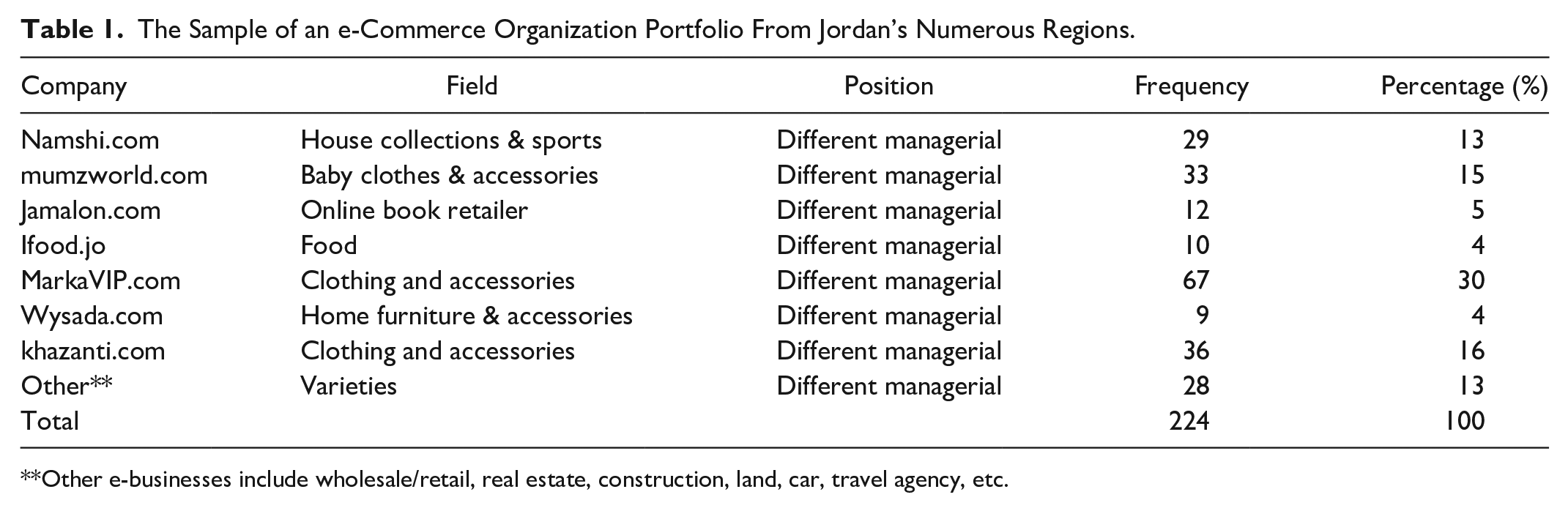
Other e-businesses include wholesale/retail, real estate, construction, land, car, travel agency, etc.
Measures
The actual results were gathered using a questionnaire that was developed based on three preceding studies (Awamleh & Ertugan, 2021; Chu et al., 2019; Hadj et al., 2020; Jakšič & Marinč, 2019). The questionnaire was designed during the COVID-19 Pandemic and consisted of four sections: Firstly, the applicants’ statistical information was explained. Secondly, the applicant’s attitude statements toward the artificial intelligence scale. Thirdly, the attitude statements of competitive advantage elements, and finally, the attitude statements of IT capability dimensions. The attitude statements were assessed on a scale of 1 to 10. A 5-point Likert scale, with “1” strongly disagree, “2” disagree, “3” neither agree nor disagree, “4” agree, and “5” strongly agree.
Artificial Intelligence
Using artificial intelligence in organizations impacts different aspects such as offerings, processes, strategic opportunities, and risks. AI also affect the way how companies obtain competitive advantages, move to new business, and get help from new competitors that are using AI (Galliers et al., 2020; Jakšič & Marinč, 2019; Waltzman et al., 2020).
Potential in Information Technology
IT skills infrastructure consists of three key aspects: organization ranging, pre-emptive posture, and commercial extending. One of several characteristics that confirms the organization’s capacity to install hardware platforms and accompanying software systems is IT infrastructure competency. IT-business bridging ability refers to, the ability of the organization’s IT resources to support business goals. The progressive IT strategy focuses on how businesses may leverage current IT resources to generate new business possibilities (Chu et al., 2019; Lu & Ramamurthy, 2011).
The Advantage in the Competition
Sigalas (2015) proposed that there are three primary assessment criteria to determine competitive advantage: attempting to take advantage of market possibilities, mitigating risks, and reducing overall costs. Firstly, market possibilities may be exploited in different ways such as the development of all exploiting market opportunities; Full development of exploiting market opportunities; more development of exploiting market opportunities. Secondly, threat mitigation has three options in comparison to its competitors. And finally, reducing overall costs is assessed in four ways: reducing total expenses, reducing operating expenses, a vast reduction in operating expenses divided by revenue, and a noticeable reduction in total expenses partitioned by sales (Hadj et al., 2020).
Design
In order to ensure a robust design, 30 employees participated in a pilot study (i.e., pre-testing) to confirm the questions were addressed properly. This study adopted a survey procedure that caused the least amount of disruption in the study’s typical workplace. In addition, it contributed to the current literature by providing a tested measure that could be used in further studies which addressed the gap in the previous literature that is; the lack of quantifiable evidence to measure the impact of AI (Markus et al., 2021). The information of each volunteer was only collected occasionally. The study is considered a cross-sectional study as it has been done once, and the participant was used as the quantifying variable (Ong & Puteh, 2017). The following section will discuss the study’s variables and the correlations between them.
Descriptive Statistics
“IBM SPSS 25” statistical software was used to analyze the collected data. Smart PLS3 was implemented to analyze the collected data from e-commerce companies. The suitability and the goodness of data were tested using a set of approaches. Firstly, building and testing the measurement model (outer model). Secondly, discriminant validity, statistical averages, and test of normality. Thirdly, the direct and indirect effect results (inner model). Finally, test the indirect effect of competitive advantage.
Results
Demographic Description as a General Characteristic of the Participants
Based on the data analysis, the overall characteristics of the participants were as follows: Employees that work full-day in a company were 141 males (63%) and 83 females (37%). As for the number of employees working in the company, the analysis shows that 41 (18.3%) of the participated companies had less than 20 employees, and about (62%) with 20 to 50 employees. The analysis of the status of participating organizations reveals that the least of (0.9%) were companies with over 20 years of experience while about (44.63%) were new companies with less than 5 years of working experience. Eighteen companies with less than 5 years of e-commerce product consumed, and (31.7%) had from 5 to 7 years of e-commerce product consumed. Eleven public enterprises accounted for (50.9%), while private companies accounted for 110 companies out of the total. The majority of the participants were from middle management and (12.5%) were from senior management (Table 2).
Demographic Characteristics (N = 224).

Outer Model Results
The analysis of the outer model shows that factor loading is above 0.70 for all items, AVE is more than 0.50 for each variable, and Cronbach’s alpha value has composite dependability of further approximately .70 for all variables which indicates that each construct of the outer model has good validity and reliability. This is consistence with other studies (Hayes, 2015; Ong & Puteh, 2017) which recorded convergent validity consists of individual item reliability (>70), composite reliability (>70), and average variance extracted validity (>50). (Table 3).
Outer Model Results.

Discriminant Validity, Statistical Averages, and Test of Normality
Discriminate validity consists of cross loading and the variable correlation of the squared correlations of the unique variable with all other variables should be higher than the quadratic correlations of the hidden variable with all relevant variables. This shows that each variable has a high level of discriminate validity (Götz et al., 2010).
Table 4 present the quantitative averages of the study’s variables. Artificial intelligence (M = 3.59, SD = 0.938), IT capabilities (M = 3.51, SD = 0.809), IT proactive stance has the best average (M = 4.05, SD = 0.943), competitive advantage (M = 3.50, SD = 0.980) and exploiting market opportunities with the best average (M = 3.76, SD = 0.782). The degree of utilization of the research factors by e-business enterprises was among the top-medium level (5-Fully agree). This is in agreement with the widely accepted figures that members of the research community know. In the normality test, all skewers and kurtosis scores are between +2.58, suggesting that all of the study’s variables have a normal distribution which is consistent with the other studies (Ong & Puteh, 2017).
Discriminant Validity, Statistical Averages, and Test of Normality.

Note. n = 224. AI = artificial intelligence; CA = competitive advantage; EMO = exploiting market opportunities; NT = neutralizing threats; RE = reducing overall costs; ITC = IT capabilities; ITI = IT infrastructure; ITB = IT business spanning; ITP = IT proactive stance; SAVE = square roots of AVE.
On the diagonal, the square roots of AVE are bolded.
p < .01.
The Direct and Indirect Effect Results of the Inner Model
After evaluating the outer model, Table 5 shows the result of the inner model’s examination to verify the interaction between dependent factors and independent factors. Also, to investigate the intermediary variables of the direct and indirect theories.
Direct and Indirect Effects.

Note. n = 224. AI = artificial intelligence; CA = competitive advantage; EMO = exploiting market opportunities; NT = neutralizing threats; RE = reducing overall costs; ITC = IT capabilities; ITI = IT infrastructure; ITB = IT business spanning; ITP = IT proactive stance.
p < .05. **p < .01. ***p < .001.
The t-test indicates direct and indirect effect results. The direct effect’s t-test results indicate that each of all variables has a significant effect at p < .05. On the other hand, the indirect effect’s t-test results indicate that each of all variables has a significant effect at p < .01. In addition, the relationship between each variable has a beneficial effect on another variable; if one variable grows by one unit, the other variable will also increase by one unit. These findings are in line with (Hayes, 2015; Ong & Puteh, 2017) and have been confirmed during the COVID-19 pandemic (Figure 2).

Inner replica assessment indicated the circuitous effect is the significance level at p < .01 and indicated the direct effect is the significance level at p < .05.
The Indirect Effect of Responsible Competitive Advantage
Table 6 shows the results of the indirect effect of responsible competitive advantage, the result came according to the approach as the separation between the minimum and maximum confidence intervals are the indirect and conditional effects were legitimate and the value zero was not included, otherwise, consequences are ruled out. The study used a 95% confidence interval score, and the CI of 5,000 smoothing samples was strengthened. As a result, the period defined by the confidence interval’s upper limits (95% ULCI) and (95% LLCI) lower limits for indirect effects of artificial intelligence and certification does not include the number zero (Hayes, 2015). Finally, the study found that AI applies to examine the limitations of competitive advantage. These results indicate the existence of reactive AI’s indirect effect on competitive advantage via the indirect effect of IT capabilities at p < .01 (Hayes, 2015). These results were supported during the COVID-19 Pandemic.
Indirect Effect of Responsible Competitive Advantage.

Discussion
The current business practice is about to witness a massive transition as a result of technological advancements in connectivity, big data, and artificial intelligence data processing (Jakšič & Marinč, 2019). There is an absence of previous studies that examine the mediation role of IT capabilities in the relationship between artificial intelligence and competitive advantages during the COVID-19 Pandemic. E-commerce enterprises gained a significant opportunity because of artificial intelligence and IT capabilities such as increasing the flexibility to seize opportunities, prevent hazards, and reduce overall cost. Thus, enabling companies to sense changes in the external environment by processing incoming data. There is ambiguity surrounding what we know about artificial intelligence, especially, the role of artificial intelligence in supporting business in companies, for example, how smart computers execute companies’ missions to understanding how a person thinks and behaves. Firms should understand behavioral biases, social behavior, restrained rationality, and information spreads rapidly through IT as it is the reason that leaves society vulnerable to manipulation of their environment. Moreover, IT’s proactive stance associated with AI can enhance the business’ efficiency and optimize the competitive advantage strategies which play a crucial role in overcoming the challenges of the COVID-19 pandemic through reduce face to face social interaction and enhancing the IT business strategy and economics by integration artificial intelligence strategy and IT capability resources.
This study aimed to investigate the effect of AI on the CA with the assistance of IT capabilities as a mediator of the relationship. The study findings suggested that AI, IT capabilities and competitive advantages are associated and affect each other. This is the essence of IT capabilities and their essential role in the business. This is consistent with the current literature, specifically, (Jakšič & Marinč, 2019) who stated that Artificial intelligence and IT can help understand the organizations’ objectives and apply knowledge to problem-solving.
The results of this study illustrated that artificial Intelligence is positively associated with IT capabilities during the COVID-19 Pandemic. IT relies heavily on technical features with the purpose of providing secure means of sending high-quality data. IT allows managers to control the processing of time-sensitive issues and coordinate the most complex structures. Consequently, IT is likely to offer technology that helps managers with decision-making, management, and acquiring new capabilities to improve services or deliver new products. It is extremely important to understand the relationships between AI, robotics, and business as they enhanced the business strategy during the COVID-19 Pandemic.
Previous literature has shown that organizations can effectively manage competitive advantages through IT, including stages from generating ideas to commercial marketing and improving the performance of technological innovation (Chu et al., 2019; Galliers et al., 2020; Hadj et al., 2020). This study extends the previous literature finding by confirming the same results in e-commerce companies in Jordan during the COVID-19 pandemic. The ability to use technology is positively related to utilizing competitive advantages during the COVID-19 Pandemic (Jakšič & Marinč, 2019). This study drew empirical evidence that IT functionalities can assist entities in integrating intrinsic and external factors by offering digital technologies which allow companies to survive the COVID-19 Pandemic. For example, using digital technologies to reduce face-to-face social interaction and enhance the business’ strategy and economics.
This study’s results go side by side with the results of the faster institutions adopt modern technologies like artificial intelligence, the greater their ability to add longevity to the business, and with Attaran and Deb (2018) and Basheer et al. (2008); Artificial Intelligence facilitates companies to expand their opportunities and provide answers to their problems. During the COVID-19 pandemic, the market fallback due to economic and political uncertainty; worries about cybersecurity; damage to reputation. Especially, after the large-scale digital companies’ closures in 2020 and the changing landscape, which affected the services and market opportunities of the companies and drove them to decline (Iandolo et al., 2020). Due to mentioned circumstances, the companies hurried to artificial intelligence to overcome the challenges that the pandemic suppressed. Respectively, this study result indicated that Artificial Intelligence is associated with competitive advantages during the COVID-19 Pandemic, its effect can be spotted by looking into the managers who used AI to improve their decision-making process, they have achieved their objectives in a short period, while slower adopters fall behind and missed the opportunity to create new valuable sources of business and design new strategies.
ITI’s capacity confirms the organization’s ability to install hardware platforms and accompanying software systems and ITB’s capacity demonstrates an organization’s ability to use IT resources to effectively support business goals. Furthermore, ITP emphasizes whether a company makes use of its existing IT resources to achieve its goals and develop commercial prospects (Chu et al., 2019). Artificial intelligence appears as an IT proactive stance that can enhance the companies’ workplace which is striving due to the COVID-19 pandemic (Nabi, 2020; Whitelaw et al., 2020). This helps avoid the pandemic consequences by applying social excluding measures (Kumar et al., 2020), hence agreeing with our study’s findings.
Implications
IT capabilities and their correlations to multiple corporate outcomes have been extensively researched in various fields. However, AI in the e-commerce industry has been starving for empirical evidence and investigators’ judgment, especially in emergent markets like Jordan. The purpose of this research is to discover a sustainable e-commerce paradigm in the present literature, specifically amidst the recession of the COVID-19 Pandemic. In terms of the academic implication, this study suggests that more studies and research, equivalent to this study, be conducted in various sectors and different markets, principally in established economies to examine intellectual and cultural viewpoints, as well as discrepancies between firms and other nations during the COVID-19 Pandemic. Secondly, this study provides a developed and robust model to explain artificial intelligence technological environment boosts positive impact on competitive advantage. Thirdly, this study proved that IT capabilities have a positive effect on artificial intelligence. Additionally, this research emphasizes the significance of the Proactive Stance to increase the use of IT in the realm of discovery and the quest for new ideas, answers, and possibilities. Fourthly, this study shed light on IT capabilities as a facilitator of the huge increase in artificial intelligence to control competitive advantages to produce greater results, particularly in terms of industry options.
In terms of practical implications, this research revealed that AI and IT capabilities help organizations improve their strategies by enlisting the help of staff members, vendors, and other partners who are capable to deal with both anticipated and unanticipated events. Consequently, building the long-term strategies for IT to integrate emerging breakthroughs. The proactive approach, on the other hand, defined how the firm leverages IT to start commercial venture prospects while also contributing to the development and reinforcement of IT infrastructure. The role of judgment is to establish standards and policies for a workforce to solve conceptual contradictions of inherent worth, promote the adaptation of one’s energies and leverage them to a respective purpose. This study inspires managers to artificial intelligence with IT capabilities to facilitate gaining a competitive edge, utilizing commercial opportunities and neutralizing threats practices. Furthermore, managers can use Artificial intelligence to enhance the company’s competitiveness by developing offerings, processes, strategic opportunities, and risks, hence, obtaining a competitive advantage, moving to new business, etc. This study encourages managers to use resources to promote IT capabilities in order to respond to the external environment factors and strategic planning, particularly during the COVID-19 pandemic.
Limitations
The application of this study in one sector, one setting, and one city will affect the generalization of results. Moreover, this evidence was featured throughout the COVID-19 pandemic which might restrict the study’s results generalization. However, the study can nevertheless contribute to science literature by revealing a mediating relationship of IT capabilities between artificial intelligence and competitive advantage. In addition, provide a robust model to quantify the relationships between IT capabilities, Artificial intelligence, and competitive advantages.
Future Research
The results of this study encourage researchers to use the study’s model in different settings such as new markets, different sectors, and different cultural backgrounds. The AI literature seemed to be scattered (Sestino & de Mauro, 2022) which means there are opportunities to provide some kind of pattern if the current study’s model will be applied in different settings. Furthermore, it would be beneficial to use the model in cross-cultural or cross sectors studies.
Conclusion
The purpose of this research was to look into the connection between artificial intelligence and competitive advantage using IT capabilities as a mediator. The study was conducted on a sample of Jordanian e-commerce companies throughout the outbreak of COVID-19. In order to obtain the research purpose, Smart PLS3 was implemented to analyze the collected data. The study’s findings showed a huge deal of compatibility between the assumed results. IT capabilities seem to play a mediator role between artificial intelligence and competitive advantage. Artificial intelligence has become a requirement in individual existence, and IT capabilities have become a requirement for effective business processes, especially during the COVID-19 pandemic. It is highly dependent on technological features to provide a reliable channel for the transmission of high-quality information during the period of the pandemic, IT capabilities and artificial intelligence become more important than ever to obtain a competitive advantage.
Footnotes
Declaration of Conflicting Interests
The author(s) declared no potential conflicts of interest with respect to the research, authorship, and/or publication of this article.
Funding
The author(s) received no financial support for the research, authorship, and/or publication of this article.
