




Abstract
This study explores the impact of Green Human Resource Management (GHRM) on Green Organizational Citizenship Behavior (GOCB) and Green In-role Performance (GIRP), focusing on the mediating role of Green Employee Empowerment (GEE) and the moderating role of Green Knowledge Sharing (GKS). Data were collected from 291 employees working in green-oriented organizations in Vietnam, specifically within job roles in Administrative and Office Support and Sales and Marketing sectors in the Hospitality and Tourism industry. Using Smart-PLS 4.0 for data analysis, the results reveal that both GHRM and GEE positively influence GOCB and GIRP. Additionally, GKS positively moderates the relationship between GHRM and GEE, highlighting the role of knowledge sharing in enhancing the effectiveness of GHRM practices. These findings provide context-specific insights for Vietnamese enterprises in Hospitality and Tourism, illustrating how GHRM practices can drive employee engagement in sustainability initiatives. The study underscores that effective GHRM can significantly enhance employee pro-environmental behaviors, contributing to organizational sustainability goals in emerging economy settings.
Plain Language Summary
This study looks at how eco-friendly human resource practices (Green HRM) can encourage employees to behave in environmentally responsible ways at work. We focused on the role of empowering employees and sharing green knowledge in making these practices more effective. Surveying 291 employees in Vietnam’s hospitality and tourism industry, we found that Green HRM and employee empowerment both help employees perform their green tasks better and go beyond their normal duties to support sustainability. Sharing green knowledge among employees further strengthens these effects. Our findings suggest that organizations in emerging economies, like Vietnam, can promote sustainability by using HR practices that empower employees and encourage knowledge sharing.
Keywords
Introduction
Climate change and ecological degradation have emerged as critical global challenges, posing severe threats to the livelihoods of a substantial proportion of the global workforce (Gürlek & Koseoglu, 2021; Yeşiltaş et al., 2022). These issues have prompted many countries, including Vietnam, to implement sustainable development strategies and goals, especially the commitment to achieve net zero emissions by 2050. In this context, modern businesses are encouraged to adopt more proactive and effective environmental management strategies in the workplace (Faisal & Naushad, 2020). Specifically, integrating environmental management activities into business has become a fairly common trend in the world, especially in areas such as management, accounting, marketing and retail (Chaudhary, 2019). In tandem with this broader shift, human resource management has undergone profound transformation, whereby Green human resource management has emerged as a strategic factor for advancing sustainability within organizations (Dumont et al., 2017; Shah & Soomro, 2023; Tang et al., 2018; Zibarras & Coan, 2015; Zhang et al., 2019). In particular, the application of GHRM in manufacturing industries highlights its role in promoting sustainable practices and improving environmental performance in manufacturing environments (Ichdan & Maryani, 2024).
Green human resource management (GHRM) has emerged as a concept that integrates environmental imperatives into organizational policies to bolster sustainable competitive advantage (Ahmad, 2015; Peerzadah et al., 2018). Despite growing scholarly and practical interest worldwide, GHRM remains nascent and largely unexplored in Vietnam where it is yet to be formalized into explicit policies and is primarily manifested through rudimentary environmental initiatives (Hong et al., 2024; Luu, 2023). Existing studies conducted in the Vietnamese context (Hong et al., 2024; Luu, 2023) have investigated the relationship between GHRM and corporate social responsibility, with a predominant focus on sectors including handicrafts, electricity, and hospitality and tourism. However, these contributions have mainly focused on the strategic level or green behavioral intentions, without fully considering voluntary behaviors beyond work requirements, such as Green organizational citizenship behavior (GOCB). Whereas international research has consistently demonstrated the positive impact of GHRM on employees’ green behaviors and outcomes, its adoption into Vietnamese enterprises remains in its infancy, largely restricted to basic environmental protection practices. Furthermore, the construct of Green in-role performance (GIRP) which captures the tangible and measurable outcomes of employees’ pro-environmental behaviors in the workplace, underscores the critical importance of incorporating this variable into the research model. Accordingly, there exists a compelling need for more in-depth inquiry into the mechanisms by which GHRM is converted into actual green behaviors and green task performance among employees within the Vietnamese setting.
Although the beneficial effects of Green Human Resource Management (GHRM) are well documented, its effective implementation remains inextricably linked to the provision of adequate organizational resources, which serve as a foundational enabler for sustaining and reinforcing green management practices (Gyensare et al., 2024). While international scholarship has consistently evidenced the positive influence of GHRM on employees’ pro-environmental behaviors and performance outcomes (Ahmad et al., 2023; Yang & Li, 2023), the underlying mediating mechanisms—most notably Green Employee Empowerment (GEE)—and the moderating role of Green Knowledge Sharing (GKS) remain significantly underexplored, particularly within service sectors in emerging economies (Khan et al., 2025). Therefore, the present study advances an integrated framework that incorporates two critical organizational mechanisms: The mediating role of Green employee empowerment (GEE) and the moderating role of Green knowledge sharing (GKS). This dual-mechanism approach is proposed to strengthen the synergistic engagement of leaders and employees in pro-environmental initiatives. Specifically, GEE captures the extent to which employees are granted autonomy and psychological ownership to proactively undertake environmental responsibilities within the organization (Zaki & Norazman, 2019). Such empowerment, when accompanied by leader trust and perceived respect, cultivates a positive psychological state that motivates employees to exhibit greater initiative and enhances the effectiveness of their green behaviors (Hameed et al., 2020; Shen et al., 2016). On the other hand, GKS is rooted in the broader concept of knowledge sharing, characterized by the reciprocal flow of information between individuals and the organization, thereby bridging cognition and environmentally responsible action. Drawing on Lin and Chen (2017), well-executed green knowledge management amplifies environmental knowledge stocks within the organization, thereby fostering heightened awareness and proactive green behaviors among employees. This insight serves as a key theoretical rationale for examining GKS as a moderator of the GHRM and employee green behavior/performance relationship.
Building on the aforementioned theoretical foundations and grounded in Ability–Motivation–Opportunity (AMO) theory, the study analyzes GHRM by incorporating the mediating role of GEE and the moderating role of GKS to deepen the understanding of GOCB in the workplace, thereby contributing to improved sustainable performance among employees. This research not only addresses the practical challenges associated with implementing sustainability initiatives in Vietnamese enterprises but also generates contextualized insights into an emerging economy setting. By integrating green governance, empowerment, and knowledge sharing, the study builds a solid theoretical framework that strengthens both GOCB and GIRP, thereby contributing to organizational sustainability in the face of global environmental imperatives. Moreover, in this study, the Hospitality and Tourism industry was selected due to its significant environmental impact and growing pressure to adopt sustainable practices. As a sector that exerts considerable pressure on substantially to global greenhouse-gas emissions and faces pressing challenges in waste management, the hospitality and tourism industry constitutes an ideal empirical context for examining the implementation of Green Human Resource Management (GHRM) practices, particularly in response to the escalating consumer demand for sustainable tourism (Naqvi et al., 2023; Serio et al., 2024). To address the aforementioned research objectives, the following research questions are proposed:
Literature Review
Ability–Motivation–Opportunity (AMO) Theory
The AMO theory (Appelbaum et al., 2000) serves as a cornerstone framework in human resource management, proposing that employee performance is driven by three key determinants: P = f(A × M × O). Specifically, ability refers to employees’ knowledge, experience, and skills that enable them to successfully carry out tasks and responsibilities. Motivation encompasses both intrinsic and extrinsic elements, which fuel an employee’s willingness to exert effort and engage in work activities. Opportunity pertains to the supportive working conditions and resources that organizations provide, fostering an environment where employees can perform their roles effectively. Previous research (e.g., San Román-Niaves et al., 2025; Yadate, 2024) has shown that integrating AMO factors within GHRM strategies significantly enhances employees’ green behaviors and their involvement in environmental initiatives. Therefore, in this study, AMO theory helps to explain how GHRM influences employee green behaviors through GEE as a mediator and the role of GKS in moderating the relationships. In alignment with AMO theory, GHRM practices equip employees with the requisite ability, motivation, and opportunity to engage in green behaviors. Specifically, GEE empowers employees by instilling a sense of ownership and responsibility towards environmental initiatives. Concurrently, GKS plays a crucial role in disseminating environmental knowledge, thereby increasing employees’ active participation in green behaviors.
Green Human Resource Management (GHRM)
GHRM is the systematic integration of environmental objectives into human resource management functions, aimed at promoting sustainable operations and reducing negative environmental impacts (Faisal, 2023; Lashari et al., 2022). The emergence of GHRM stems from environmental management pressures and societal expectations of corporate responsibility (Jabbour & De Sousa Jabbour, 2016). According to Tang et al. (2018), GHRM comprises five core practices: (1) Green recruitment and selection (prioritizing candidates with environmental awareness), (2) Green training and development (enhancing environmental knowledge and skills), (3) Green performance management (linking environmental goals to work outcomes), (4) Green compensation and reward (rewarding eco-friendly behaviors), and (5) Green employee involvement (encouraging environmental initiatives). GHRM emphasizes the central role of employees in transitioning to sustainable business models, positioning them as key drivers of this transformation (Baykal & Bayraktar, 2022; Ren et al., 2017). Thus, GHRM is not merely a management tool but also a critical strategy that aligns HR practices with green business objectives to secure long-term competitive advantage (Li et al., 2024), while demonstrating an organization’s proactive commitment to mitigating environmental risks (Saeed et al., 2019).
Green Knowledge Sharing (GKS)
Unlike green culture, representing shared organizational sustainability values and norms (Hafeez et al., 2024), green climate, reflecting perceptions and expectations of a sustainable environment (Dibattista et al., 2025), and green leadership, focusing on leadership promoting green behaviors (Wu et al., 2025), GKS emphasizes specific individual-level processes and behaviors. Specifically, GKS involves exchanging information, experiences, and expertise on eco-friendly practices to foster sustainable development (Lin & Chen, 2017; Rubel et al., 2021). At the individual level, employees share green knowledge and awareness with peers (Malik et al., 2020; Song et al., 2020), which enhances ecological consciousness, encourages pro-environmental behavior, and strengthens collaboration. GKS plays a crucial role in fostering voluntary green initiatives and contributing to the creation of sustainable work environments and competitive advantages at the individual level (Gope et al., 2018; Song et al., 2020).
Green Employee Empowerment (GEE)
GEE is a pivotal construct within GHRM, referring to the enhancement of employees’ autonomy and capabilities to engage in environmentally responsible behaviors (Hameed et al., 2020; Renwick et al., 2013). Rather than merely delegating responsibilities, green empowerment involves providing employees with knowledge, skills, and organizational support necessary to proactively propose and implement environmental initiatives (Tariq et al., 2016). Through activities such as green training, innovation encouragement, and participation in sustainability projects, employees develop greater competence, confidence, and a sense of contribution (Daily et al., 2012; Dumont et al., 2017). Appropriately empowered employees are more likely to act with a heightened sense of responsibility, thereby improving individual performance and fostering a sustainable organizational environment (Hu et al., 2022).
Green Organizational Citizenship Behavior (GOCB)
GOCB, similar to Boiral’s (2009) conceptualization of organizational citizenship behavior for the environment, refers to discretionary behaviors that extend beyond formal job requirements but contribute to improving an organization’s environmental performance. These behaviors include sharing pro-environmental ideas, assisting colleagues in green activities, and promoting environmental awareness within the workplace (Albrecht et al., 2024). Recent studies indicate that recognizing and supporting such behaviors may enhance employees’ intrinsic motivation, job satisfaction, and commitment to organizational environmental goals (Mostafa & Saleh, 2023; Yuan et al., 2024). GOCB has also been associated with employees’ ethical responsibility and identification with sustainability-oriented values (Abdou et al., 2023). Evidence from existing studies suggests that GOCB is frequently examined as a standalone construct, primarily focusing on antecedents and outcomes (Andersson & Bolino 2023; Boiral et al., 2022; Henriques et al., 2024). Such an approach provides limited insights into how GOCB relates to other forms of employee environmental behavior. Recent literature highlights the need for comparative perspectives, particularly with green in-role performance (GIRP), to clarify conceptual distinctions and better understand their combined contribution to organizational sustainability.
Green In-Role Performance (GIRP)
Employee performance has traditionally been assessed based on how well individuals meet their assigned tasks, typically measured by output quantity and quality (Saidin et al., 2024). Recent research has expanded this understanding to include adaptive and value-aligned behaviors that contribute to broader organizational goals (Permadi et al., 2024). In sustainability-driven organizations, GIRP captures the extent to which employees effectively fulfill environmental responsibilities embedded in their formal job roles (Umair et al., 2023). GIRP includes behaviors such as conserving energy, recycling, and complying with environmental procedures, reflecting both formal expectations and proactive engagement with sustainability (Wang et al., 2024). Compared with GOCB, GIRP represents environmentally oriented behaviors that are formally required within job roles. Empirical evidence indicates that employees may perceive and enact required behaviors differently from discretionary ones (Norton et al., 2015; Robertson & Barling, 2017). Nevertheless, the literature addressing GOCB and GIRP concurrently remains limited, with only a few reviews highlighting the need to explore how these two constructs interact and respond to organizational drivers such as leadership, green HRM, or environmental climate (Boiral et al., 2022; Kim et al., 2024).
The Relationship Between GOCB and GIRP
GOCB plays a critical role in enhancing GIRP by motivating employees to engage in pro-environmental actions beyond their formal job requirements (Shahzad et al., 2023; Ting et al., 2024). While GOCB focuses on actions such as conserving energy, reducing office waste, and sharing green knowledge outside of their formal job roles, GIRP refers to the eco-friendly behaviors employees perform as part of their regular duties (Erauskin-Tolosa et al., 2020; Meng et al., 2022). According to the AMO theory, voluntary behaviors extending beyond formal job scope such as energy saving, waste minimization, or green knowledge dissemination, enable employees to develop environmental competencies and awareness while fostering intrinsic motivation through a sense of contribution to the organization’s sustainability goals. These actions also create opportunities for employees to practice and disseminate green values within the workplace. When employees take ownership of sustainability efforts in both voluntary actions (GOCB) and in-role activities (GIRP), they are more motivated and likely to demonstrate higher performance in their roles (Tariq et al., 2016; Zhang et al., 2023). Moreover, when organizations support green skill development and recognize both in-role and beyond-role green behaviors, employees are more likely to demonstrate higher GIRP (Namboothiri, 2016; Zhang et al., 2023). Therefore, fostering GOCB is not only an effective strategy for encouraging employees to go beyond their regular duties, but also a key factor in improving GIRP and advancing long-term sustainability goals within organizations.
The Relationship Between GHRM and GEE
GHRM integrates environmental practices into key HR functions such as recruitment, training, performance evaluation, and compensation to encourage employees to engage in sustainable actions, which ultimately contributes to GEE, enabling them to take ownership of environmental initiatives (Tang et al., 2018). According to the AMO framework, GHRM equips employees with the ability, motivation, and opportunity to adopt environmentally friendly behaviors (Alam, 2021). Through green recruitment, employees are hired with the necessary skills and knowledge, which not only equips them with the expertise to contribute to sustainability but also empowers them with autonomy, as they feel more in control of their work. Green training programs and performance evaluations further motivate them to engage in sustainable actions (Tariq et al., 2016). Furthermore, GHRM can cultivate a supportive climate for environmental initiatives by aligning organizational policies and practices with sustainability goals, creating an environment where employees feel empowered to contribute to these goals (Yu et al., 2020). By offering the necessary resources such as green training, tools, and opportunities for employees to engage in sustainability projects, GHRM plays a crucial role in promoting GEE by ensuring that employees are equipped to take proactive actions toward environmental goals. Furthermore, by aligning organizational policies with sustainability goals and providing resources such as green tools, participatory programs, and leadership support, GHRM fosters a supportive climate that empowers employees to take proactive actions toward environmental objectives (Yu et al., 2020). This structured approach ensures that employees’ abilities, motivation, and opportunities are fully leveraged to enhance GEE, bridging HRM practices with effective green behaviors (Khan & Muktar, 2023; Rumijati & Novianti, 2024). Thus, we propose the following hypothesis:
The Relationship Between GEE and GOCB
GEE plays a crucial role in fostering GOCB by enhancing employees’ sense of responsibility, engagement, and commitment to sustainability goals (Doble & Encio, 2023; Priyadarshini et al., 2023). Through the implementation of green transformational leadership and participatory sustainability initiatives, GEE provides employees with the autonomy, resources, and knowledge necessary to engage in discretionary green behaviors that extend beyond formal job roles (Khan & Muktar, 2023; Rumijati & Novianti, 2024). Although previous international studies have examined the positive relationship between GEE and GOCB (Kaur, 2024; Mostafa & Saleh, 2023), empirical evidence within the Vietnamese organizational context remains limited. In this context, leadership empowerment is expected to stimulate employees’ voluntary green behaviors, thereby providing practical and context-specific insights for organizations pursuing sustainable development goals. Specifically, empowered employees are more likely to propose innovative eco-solutions, collaborate on sustainability projects, and engage in voluntary green behaviors, all of which support GOCB (Mostafa & Saleh, 2023). According to AMO theory, green empowerment enhances employees’ abilities and opportunities to exhibit green initiatives while fostering a sense of trust and encouragement, thereby motivating them to actively engage in sustainability-oriented behaviors and consequently strengthening GOCB (Kaur, 2024). Based on this understanding, we propose the following hypothesis:
GEE as a Mediator in the Relationship Between GHRM and GOCB
GEE plays a pivotal role in the relationship between GHRM and GOCB. GHRM practices, including green recruitment, training, and development, equip employees with the necessary knowledge, skills, and motivation to contribute to environmental initiatives (Siyambalapitiya et al., 2018). However, the impact of GHRM is further strengthened by GEE, which enhances employees’ intrinsic motivation, autonomy, and sense of ownership. This empowers employees to go beyond their formal duties and actively engage in green initiatives (Hameed et al., 2020; Tariq et al., 2016). When employees are empowered through GEE, they are more inclined to voluntarily engage in green behaviors, such as suggesting sustainable solutions, collaborating on environmental projects, and sharing green practices with colleagues. These actions, known as GOCB, not only contribute to the organization’s environmental goals but also deepen employees’ commitment to sustainability. According to the AMO framework, GEE strengthens employees’ ability, motivation, and opportunity, enabling them to align their actions with the organization’s green objectives, ultimately enhancing both individual and organizational performance (Amrutha & Geetha, 2020; Fawehinmi et al., 2022). Supporting evidence also shows that empowerment acts as a psychological mechanism that translates GHRM practices into voluntary green behavior by fostering environmental responsibility and perceived impact (Pham et al., 2019; Zhang et al., 2023). Thus, GEE serves as a key mediator, translating the impact of GHRM into GOCB, contributing to long-term organizational sustainability and green outcomes. Therefore, we propose the following hypothesis:
The Moderating Role of Green Knowledge Sharing in the Relationship Between GHRM and GEE
GKS refers to the process of exchanging environmental knowledge, experiences, and best practices among employees, which enhances their ability to engage in environmentally responsible behaviors (Ahmad et al., 2023; Khan et al., 2022). Acting as a pivotal behavioral mechanism, GKS distinguishes itself from Green cultural or Green leadership structures by directly translating those values into concrete actions at the individual level (Khan et al., 2023). In the GHRM–GEE relationship, GKS serves a moderating role by ensuring employees are equipped with sufficient ability, motivation, and opportunity through the dissemination of green information and experience, thereby enhancing their capacity to implement sustainable practices and reinforcing empowerment. In line with AMO theory, GKS not only provides employees with essential environmental information but also enhances their intrinsic motivation. This continuous knowledge sharing fosters a culture of learning and enables employees to take proactive initiatives in environmental innovations (Alam, 2021; Rubel et al., 2021). Through peer-to-peer knowledge exchange, GKS facilitates the establishment of a collaborative environment for pursuing green objectives, while reinforcing shared norms and enhancing employees’ self-confidence, thereby promoting active engagement in green initiatives and strengthening the linkage between GHRM and empowerment (Shaikh et al., 2023). The impact of knowledge-sharing processes on green empowerment varies, as the effectiveness of GEE depends on the scope and quality of GKS within the organization. Empirical evidence suggests that GKS can either enhance or diminish the influence of GHRM on environmental performance, contingent upon the manner in which knowledge is disseminated and applied (Shaikh et al., 2023). While the moderating role of GKS has been recognized in prior research internationally (Alam, 2021; Rubel et al., 2021), empirical evidence in the Vietnamese context remains limited. This study therefore contributes by examining how GKS strengthens the impact of GHRM on GEE in Vietnamese organizations, providing contextual insights and practical implications for sustainability-oriented HR practices (Figure 1). Hence, we predict that:

The research model.
Methodology
Sample and Data Collection
This study collected data from employees working in green-oriented organizations, focusing on job roles within sectors such as Administrative & Office Support and Sales & Marketing in the Hospitality & Tourism industry. These sectors were selected due to their significant emphasis on sustainability and environmental practices, as well as the challenges they face that necessitate the adoption of sustainable HR practices. The participant selection process was conducted in two phases. First, purposive sampling was employed to identify companies recognized for their implementation of GHRM practices. This approach ensured that only organizations actively implementing green HRM initiatives were included, thereby maintaining relevance to the research objectives. Selected companies were identified based on their integration of sustainable HR practices, as outlined in the ManpowerGroup Report (October 2023), with a particular focus on companies located in Ho Chi Minh City, known as a hub for enterprises actively adopting GHRM practices.
Second, random sampling was applied to select employees within each organization. Human resource departments provided staff lists across departments, job roles, and seniority levels, from which respondents were randomly chosen to reduce selection bias. This approach ensured representativeness across job roles and minimized potential sampling bias. Prior to the formal survey, a pilot test was conducted to ensure clarity, contextual relevance, and linguistic appropriateness of all measurement items. Open-ended questions were used in the pilot phase to gather qualitative insights for survey refinement, though they were not intended for standalone qualitative analysis. Because the constructs and their underlying factor structures were grounded in well-established theoretical foundations, exploratory factor analysis (EFA) was not conducted at the pilot stage. Construct validity was assessed through confirmatory factor analysis (CFA) in the main study, consistent with recommended PLS-SEM validation procedures.
Data collection took place between January and March 2025, yielding a total of 300 responses, of which 291 were valid, resulting in a 97% response rate. The high response rate was facilitated by strong organizational support, clear communication of the study purpose, and follow-up reminders to participants. The survey consisted primarily of closed-ended questions (e.g., Likert-scale items), complemented by a limited number of open-ended questions used to inform survey design during the pilot phase. Demographics of the respondents indicated that most participants were aged between 25 and 35 years (48.8%), with a smaller proportion under 25 years (33.4%). Gender distribution was relatively balanced, with 47.8% male and 52.2% female. The majority held university degrees (64.6%) and had 2 to 5 years (36.1%) or 5 to 10 years (33.0%) of work experience. Respondents were diverse in terms of occupation, with the largest groups working in Administrative & Office Support (28.2%), Sales & Marketing (19.9%), and IT & Data (13.1%; see Appendix A).
Measurements
All constructs in the current study were measured using established multi-item scales on a 5-point Likert scale (1 = strongly disagree, 5 = strongly agree). The GHRM scale consists of 5 factors (Green recruitment and selection, Green training and development, Green performance management, Green compensation and reward, Green employee involvement) with 21 items, based on the work of Tang et al. (2018) and Dumont et al. (2017). Specifically, Green recruitment and selection factor included 4 items, such as “My company attracts green job candidates who use green criteria to select organizations”; Green training and development factor included 4 items, such as “My company develops training programs in environment management to increase environmental awareness, skills and expertise of employees”; Green performance management factor included 4 items, such as “My company sets green targets, goals and responsibilities for managers and employees”; Green compensation and reward factor included 4 items, such as “My company relates employees’ workplace green behaviors to rewards and compensation”; and Green employee involvement factor included 5 items, such as “Our company has a clear developmental vision to guide the employees’ actions in environment management”. The GEE scale, which includes 9 items, is adapted from the research of Hameed et al. (2020) and Spreitzer (1995), such as “I have received adequate training to perform my green job effectively”. The GKS scale has 5 items, based on the studies of Rubel et al. (2021) and Wong (2013), such as “I always share green knowledge obtained from newspapers, magazines, journals, television and other sources.” The GOCB scale contains seven items from Raineri and Paillé (2016) and Boiral and Paillé (2012), such as “I make suggestions about ways to protect the environment more effectively.” Finally, the GIRP scale includes eight items adapted from Pradhan and Jena (2017) such as “I complete the assigned tasks promptly.”
To ensure the accuracy and cultural relevance of the measurement scales, the back-translation method was employed. The original English-language scales were first translated into Vietnamese by a bilingual translator. Subsequently, a second bilingual translator, unaware of the original English version, translated the Vietnamese version back into English. The two English versions were then compared for consistency in meaning. Any discrepancies between the original and back-translated versions were reviewed and resolved through discussion with the translators and the research team to ensure conceptual equivalence. This process helped ensure the validity and clarity of the instruments used in the study.
To further ensure the accessibility and relevance of the questionnaire to employees, a qualitative research phase was conducted. This phase involved 14 employees from the Hospitality and Tourism industry, who provided feedback on the clarity and relevance of the survey items. Based on their insights, along with consultations from subject-matter experts, the wording of certain items was adjusted and refined to better align with the local context in Vietnam. This step was essential in ensuring that both the language and concepts of the survey were comprehensible and appropriate for the Vietnamese workforce. After integrating feedback from the pilot phase, the final version of the survey was administered to the full sample for data collection.
For data analysis, the authors used a two-stage procedure in Smart-PLS 4.0 to analyze the Hierarchical Component Models (HCMs) for the GHRM scale. During preliminary analysis, several indicator variables were removed due to suboptimal performance. Specifically, the variables EE1, EE2, EE6, EE9, and EP4 were excluded, as they exhibited weak loadings or poor discriminant validity, which could affect the model’s accuracy and reliability.
Data Analysis and Results
A Model for Assessing Reflective
Internal Consistency Reliability
According to the research of Hair et al. (2022), a well—constructed scale should have Cronbach’s alpha value of .70 or higher, reflecting its strong ability to represent the study’s theoretical construct. Based on Table 1, all Cronbach’s alpha values surpass the .70 threshold, thereby indicating the adequate reliability of the measurement scales. Specifically, the GOCB scale reports the highest Cronbach’s alpha value at .859, while the lowest Cronbach’s alpha value is observed for the GEE scale (.825). Consistent with the assessment of Cronbach’s alpha, the Composite reliability (CR) values are required to exceed .70 threshold (Hair et al., 2022). Based on the criterion, all CR values were demonstrated to be greater than .70. The highest CR value is observed for the GKS scale at .914, while the GEE scale exhibits the lowest CR value at .827.
The Reliability and Validity Assessment.

Note. GHRM = green human resource management; GKS = green knowledge sharing; GEE = green employee empowerment; GOCB = green organizational citizenship behavior; GIRP = green in-role performance.
Indicator Reliability
To evaluate the reliability of the measurement model’s indicators, Hair et al. (2022) suggest Outer loading values above .7 for significant observed variables, ensuring robust measurement of constructs. Indicators failing to meet this criterion were excluded to ensure that all outer loading values exceeded the minimum threshold, thereby enhancing the robustness of the model. Specifically, removed indicators include: GHRMa3, GHRMc1, GHRMc3, GHRMc4, GHRMd2, GEE1, GEE2, GEE6, GEE9, GEP3, and GIRP4. As shown in Table 1, the results confirm that all remaining outer loading values demonstrate strong indicator reliability and substantial contributions to their respective latent variables within the measurement model.
Convergent Validity
According to the Table 1, all scales with AVE values are greater than .50, those things approve that the latent variable explains more than 50% of the variance of its indicator variables, thus establishing satisfactory convergent validity for the measurement scales (Hair et al., 2022). Particularly, the highest value is the AVE value of the GHRM scale (.630) and the lowest value is the AVE value of the GOCB scale (.543).
Discriminant Validity
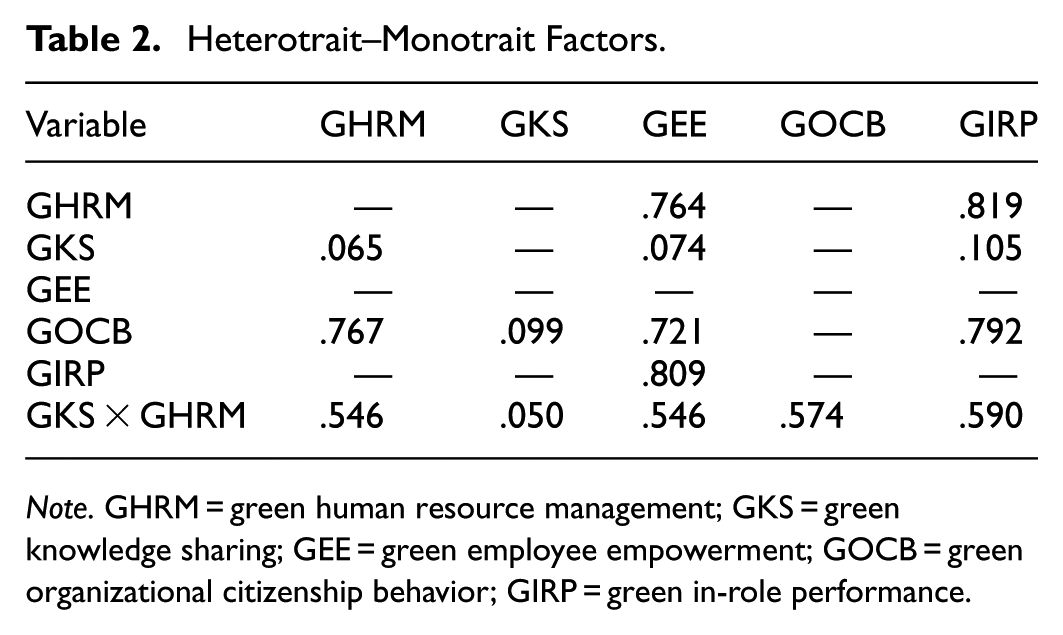
According to Henseler et al. (2015), there are two evaluative thresholds for the Heterotrait–Monotrait (HTMT) to access discriminant validity, including HTMT value greater than .90 (insufficient discriminant validity between latent constructs) and HTMT value equal to or less than .85 (achieved discriminant validity). As shown in Table 2, all HTMT values between the variables are below the .85 threshold. Those things approve that the research model ensures discrimination between the two factors.
Heterotrait–Monotrait Factors.
Note. GHRM = green human resource management; GKS = green knowledge sharing; GEE = green employee empowerment; GOCB = green organizational citizenship behavior; GIRP = green in-role performance.
Assessment in Structural Modeling
Assessment of Multicollinearity
According to Hair et al. (2019), an inner VIF threshold should be below 3 to ensure the absence of multicollinearity in the research model. Based on the testing results, all VIF values for the relationships among latent factors were evaluated to be less than 3. Consequently, this indicates that no significant correlation exists between two or more independent variables and avoids the multicollinearity within the research model (Table 3).
Variance Inflation Factor.

Note. GHRM = green human resource management; GKS = green knowledge sharing; GEE = green employee empowerment; GOCB = green organizational citizenship behavior; GIRP = green in-role performance.
Assessment of the Coefficient of Determination
Building upon the research of Hock and Ringle (2010), the R-squared values of this research range from .33 to .67, indicating a moderate level of explanatory power for the model. Based on Table 1, the R-squared values for the GEE, GOCB, and GIRP scales are .450, .489, and .616, respectively. In other words, the model explained 45.0% of the variation in the GEE scale, 48.9% of the variation in the GOCB scale, and 61.6% of the variation in the GIRP scale.
Common Method Variance (CMV)
CMV is a widely acknowledged issue in survey-based research. To assess the potential influence of CMV in this study, Harman’s single-factor test was employed (Podsakoff et al., 2003). This test, initially proposed by Harman (1976), aims to identify whether CMV affects the measurement of constructs. The results indicated that the survey items were grouped into 39 distinct factors, with the first factor accounting for 33.72% of the total variance, which is significantly below the 50% threshold commonly used to indicate substantial CMV.
Moreover, the significance of the moderating effect of GKS within the model further supports the conclusion that CMV is not a major concern in this study. Previous research suggests that CMV typically weakens interaction effects, making their detection more challenging (Siemsen et al., 2010). Additionally, a full assessment of collinearity was performed using SmartPLS, following the stricter guidelines proposed by Kock (2015), who recommends a Variance Inflation Factor (VIF) threshold of 3.3. This rigorous approach helps detect both vertical and lateral collinearity. The findings revealed that all VIF values were well below 3.3, reinforcing that common method bias is unlikely to pose a significant issue in this research.
Hypotheses Testing
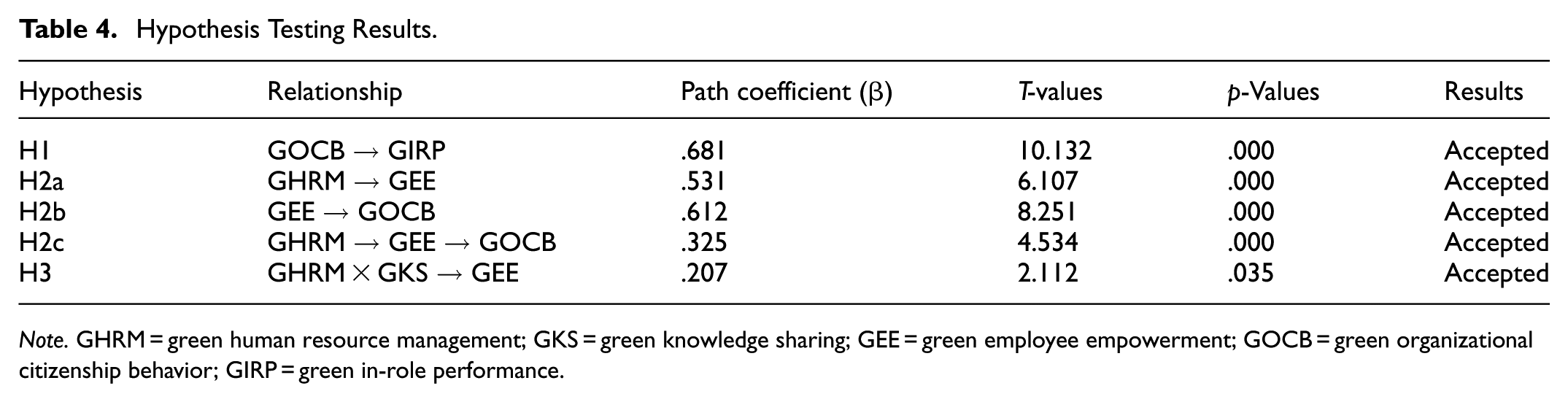
The research hypotheses are accepted if they meet the criteria of 0 < β < 1; t > 1.96; p < .05. Based on Table 4, the direct impact between the independent and the dependent variables is statistically significant.
Hypothesis Testing Results.
Note. GHRM = green human resource management; GKS = green knowledge sharing; GEE = green employee empowerment; GOCB = green organizational citizenship behavior; GIRP = green in-role performance.
Firstly, H1 (β = .681; t = 10.132; p = .000) establishes the intrinsic influence on the relationship between employees’ behavior and performance. This statement that the relationaship between GOCB and GIRP is accepted. Secondly, The relationship between GHRM and GOCB is articulated through three hypotheses, with GEE serving as a mediating factor. Specificially, H2a (β = .531; t = 6.107; p = .000) indicates the positive impact of GHRM on GEE, consistent with the finding of Yu et al. (2020). Next, H2b (β = .612; t = 8.251; p = .000) demonstrates the positive impact of GEE on GOCB. In other words, empowerment promotes and regulates green organizational citizenship behavior (Hameed et al., 2020). Regarding the mediating role of GEE, H2c (β = .325; t = 4.534; p = .000) is accepted. Thus, implementing GHRM activities through green employee empowerment helps employees effectively increase their green organizational citizenship behavior. Finally, the assessment results of H3 (β = .207; t = 2.112; p = .035) ensure statistical significance. Therefore, GKS plays a positive moderating role in the relationship between GHRM and GEE (Figures 2 and 3).
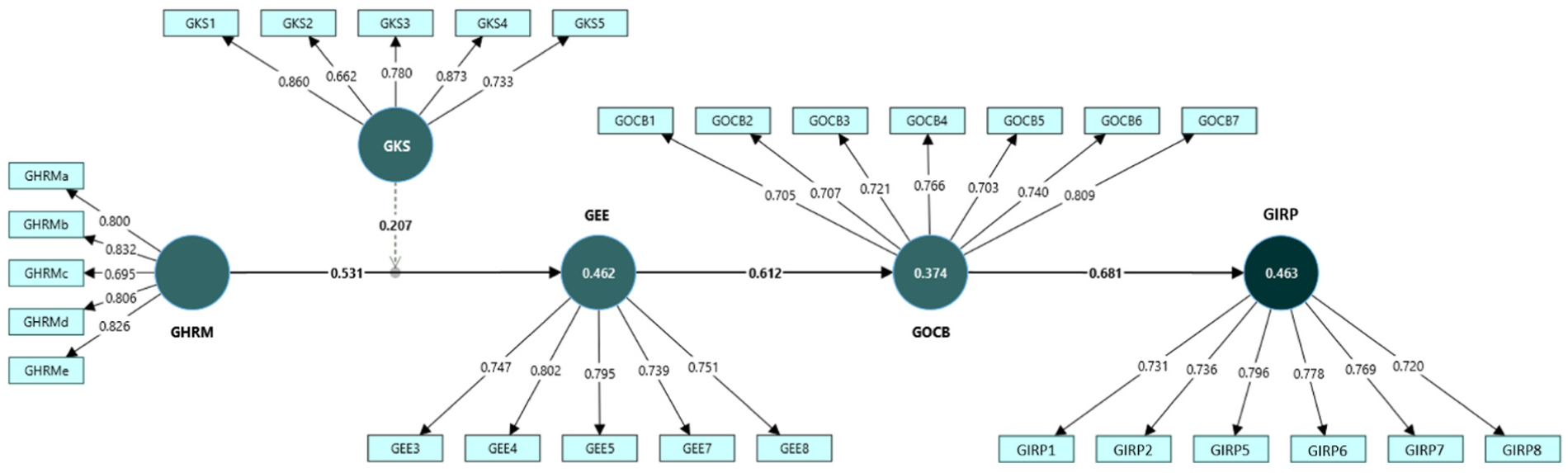
The research results.

Moderating influence of GKS on the interaction between GHRM and GEE.
Discussion
This study demonstrates that GHRM and GEE positively influence GOCB and GIRP in ESG-oriented organizations. The novelty of this research lies in identifying the mediating role of GEE and the moderating role of GKS in the relationship between GHRM and these outcomes. The findings confirm that all hypotheses were supported, highlighting the significant role of GHRM in shaping employee-level sustainability outcomes, such as green behaviors and performance. This study draws on AMO theory to explain the relationships between GHRM, GEE, GOCB, and GIRP. According to AMO theory, by enhancing employees’ ability, motivation, and opportunity, organizations can foster green behaviors that improve employee performance. The research results reinforce AMO theory by demonstrating that GHRM promotes GOCB and GIRP through the mechanisms of ability, motivation, and opportunity. Specifically, GHRM activities such as green recruitment and training help employees develop capacity to implement sustainability initiatives (Renwick et al., 2013). Moreover, intrinsic motivation is reinforced through GEE and reward or compensation practices, as employees feel trusted, autonomous, and find greater meaning in their work, thereby becoming more willing to engage in voluntary green behaviors (Hameed et al., 2020). At the same time, opportunities to learn and practice green behaviors are expanded by green knowledge sharing (GKS) environments, which amplify the impact of GHRM on GEE (Jia et al., 2019). As such, the study extends the AMO framework by clearly identifying the mediating and moderating mechanisms, shedding light on how GHRM translates into employee-level green outcomes in an ESG-oriented organizational context.
The findings confirmed that GHRM has a significant positive impact on GEE and GOCB (H2a, H2b, and H2c), while GKS positively moderates the relationship between GHRM and GEE (H3), consistent with the studies of Saeed et al. (2019) and Li et al. (2024). The difference of this study is that it focuses on how GHRM affects individual-level outcomes, in contrast to previous studies that focused on the relationship between GHRM and organizational performance. Notably, GKS functions as a social mechanism that amplifies the impact of GHRM on GEE. Particularly, green knowledge sharing facilitates employees’ learning and exchange of experiences, fostering confidence in the context of green human resource management, thereby enhancing their sense of empowerment to implement environmental initiatives. Furthermore, the study found that GEE has a significant positive impact on both GOCB and GIRP (H2b, H2c). This finding is consistent with Doble and Encio (2023) and Priyadarshini et al. (2023) who discussed how employee empowerment promotes green behaviors and improves performance. Unlike previous research that focused directly on empowerment, this study emphasizes the mediating role of GEE, emphasizing the process by which GHRM influences employee behavior through empowerment.
The study also demonstrated that GOCB has a positive effect on GIRP (H1), consistent with the findings of Zhang et al. (2023), who showed that organizational citizenship behaviors related to sustainability directly improve employee performance. This finding emphasizes that employees who demonstrate green behaviors contribute significantly to the overall environmental performance of the organization. In addition, GKS was found to moderate the relationship between GHRM and GEE (H3), significantly enhancing the impact of GHRM on GEE. This result suggests that knowledge sharing helps empower employees by providing them with the necessary tools and support to engage in green behaviors (Fawehinmi et al., 2022; Hameed et al., 2020). This finding underlines the importance of GKS in providing employees with access to environmental knowledge and collaborative opportunities.
Moreover, the study confirmed that GEE serves as a mediator in the relationship between GHRM and both GOCB and GIRP (H2c). Empowered employees are more likely to engage in green behaviors, which in turn boosts their performance and enhances the organization’s overall environmental sustainability efforts. This finding adds to the growing body of literature on employee empowerment and highlights the critical role of GEE as a mediator in driving green employee outcomes. In conclusion, this study highlights that GHRM, by fostering green employee empowerment, is a powerful tool for promoting green behaviors and improving the sustainable competitive advantage of organizations. These results offer valuable insights for organizations aiming to strengthen their sustainability practices and employee engagement in green initiatives.
Finally, our findings largely align with prior research (e.g., Li et al., 2024; Saeed et al., 2019), confirming that GHRM positively influences employee green behaviors via empowerment mechanisms. Unlike earlier studies focusing on organizational-level outcomes, this study highlights individual-level effects and the moderating role of GKS in Vietnamese Hospitality & Tourism firms. Contextual factors such as organizational culture and industry-specific sustainability practices likely explain these differences. Survey items reflect the AMO framework: green recruitment and training address employees’ ability, empowerment and motivation measures capture motivation, and GKS provides opportunities to enact green behaviors. While findings offer valuable insights for ESG-oriented organizations, caution is warranted when generalizing to other industries or contexts. Future research could test this model in different service sectors or cross-cultural settings to examine robustness.
Conclusion
This study highlights the pivotal role of GHRM as a strategic lever in promoting both GOCB and GIRP. The findings confirm that GHRM equips employees with essential abilities, intrinsic motivation, and opportunities, thereby strongly fostering green behaviors. GEE serves as a key mediating mechanism, while GKS amplifies the effect of GHRM on GEE, emphasizing the importance of integrating empowerment and knowledge-sharing processes into HRM systems for effective sustainability outcomes. However, these findings should be interpreted in light of several methodological and contextual limitations. The study employed a cross-sectional design and relied on single-source, self-reported data, which may introduce common method bias and limit causal inference.
Moreover, purposive sampling in the hospitality and tourism sector in Ho Chi Minh City may affect generalizability. Future research should consider longitudinal or experimental designs, incorporate multi-source or objective performance measures, and explore other sectors or countries to validate and extend the current findings. Overall, the study underscores that empowering employees through GEE and fostering knowledge sharing not only drives proactive green behaviors but also enhances individual performance and contributes to building a sustainable workplace.
Theoretical Contributions
This study contributes to the theoretical understanding of GHRM by shedding light on the pathways through which GHRM influences GEE, GOCB, and GIRP, using the lens of AMO theory. Specifically, GEE plays two key roles in the model. First, it directly impacts both GOCB and GIRP, showing that empowered employees are more likely to engage in voluntary green behaviors and improve their individual performance. Second, GEE serves as a mediator in the relationship between GHRM and both GOCB and GIRP. This mediation role extends prior research by emphasizing how employee empowerment acts as a bridge, translating GHRM practices into actual green outcomes at the employee level. Unlike previous studies that focused primarily on the direct effects of GHRM, this research highlights that empowerment is a crucial mechanism that enables employees to take action in alignment with sustainability goals, beyond their formal job roles. Moreover, this study shows that GOCB contributes to GIRP, confirming that pro-environmental citizenship behaviors significantly enhance employee performance. This finding aligns with Zhang et al. (2023), who demonstrated that employees engaging in green behaviors positively affect their performance and the overall environmental outcomes of the organization.
A significant and novel contribution of this research is the identification of GKS as a moderator in the relationship between GHRM and GEE. This moderation effect enriches the literature by demonstrating that internal knowledge sharing plays a pivotal role in enhancing the impact of GHRM on employee empowerment. While previous research has typically explored the direct relationship between knowledge sharing and green behaviors (Dumont et al., 2017), this study introduces the concept that knowledge sharing not only influences green behaviors but also moderates how GHRM practices empower employees. By fostering a culture of knowledge exchange, GKS ensures that employees are not only well-informed but also feel supported in taking proactive steps toward achieving sustainability goals. In conclusion, this study highlights that GHRM, by fostering green employee empowerment, is a powerful mechanism for promoting green behaviors and enhancing the sustainable competitive advantage of organizations. These findings offer valuable insights for organizations seeking to enhance their sustainability practices and employee engagement in green initiatives. Future research could further explore the role of organizational culture and leadership styles in influencing the effectiveness of GHRM and its impact on employee environmental behaviors.
Practical Contributions
This study emphasizes the significant role of GHRM in fostering green employee behaviors. The findings highlight that GHRM practices are critical for organizations aiming to drive sustainability at the employee level. Specifically, companies should integrate GHRM practices such as green recruitment, green training, green performance appraisals, and green compensation. These practices create the necessary framework for employees to engage in green behaviors by providing them with the motivation, autonomy, and opportunity to contribute to sustainability goals. A holistic approach to GHRM ensures that employees’ individual actions align with the organization’s environmental objectives, further strengthening their contribution to sustainable development.
Empowering employees through GEE is central to this model. The study shows that GEE plays a crucial role in enhancing both GOCB and GIRP. However, organizations must go beyond implementing GHRM to activate GEE effectively. This can be achieved by fostering green leadership and building a strong green organizational culture. Green leadership creates an environment where employees feel supported and encouraged to take proactive environmental actions, while a robust green culture strengthens intrinsic motivation to engage in sustainability efforts. Empowered employees are more likely to take initiative, go beyond their formal job roles, and actively contribute to the organization’s sustainability efforts, thus improving both green behaviors and individual performance.
GKS plays a key moderating role in the relationship between GHRM and GEE. The study reveals that organizations must actively promote knowledge sharing as part of their GHRM strategy. By facilitating knowledge sharing through platforms where employees can exchange environmental ideas, solutions, and best practices, organizations provide the necessary tools and support for employees to engage in green behaviors. This approach not only enhances employee empowerment but also helps employees contribute more effectively to the organization’s green goals. Additionally, incorporating gamification elements into internal green knowledge-sharing platforms can further boost engagement, foster a sense of community, and encourage healthy competition to meet sustainability targets. Encouraging cross-departmental collaboration on green projects, as well as Monthly Green Days, can help employees improve their green competencies, build teamwork, and promote a shared green culture across the organization.
Moreover, these practical implications are not limited to the hospitality industry; they can be extended to other service-oriented sectors such as retail, banking, healthcare, and education, where employee engagement and sustainability initiatives play a critical role. By adapting GHRM practices, empowerment strategies, and green knowledge-sharing mechanisms to the context of different service industries, organizations can enhance employee green behaviors, improve sustainability outcomes, and strengthen their competitive advantage.
Limitations and Future Research Directions
This study provides useful insights, yet several limitations should be acknowledged. First, the cross-sectional design prevents causal interpretation, as relationships may shift over time or be shaped by unobserved factors. Second, reliance on single-source, self-reported data introduces the risk of common method variance despite our procedural and statistical controls. Future research should employ longitudinal or experimental designs to assess causality more rigorously and use multi-source data such as supervisor ratings or objective indicators of green performance to reduce method bias. Comparative studies across institutional or cultural contexts may also clarify boundary conditions shaping the effectiveness of GHRM practices.
The sampling approach presents additional constraints. Although purposive sampling ensured access to ESG-oriented organizations, it remains a non-probability method that may limit generalizability. Probability-based approaches (e.g., stratified sampling) could strengthen representativeness in future work. Finally, although the GIRP scale was conceptually adapted to reflect green task performance, it originated from a general in-role performance measure. Future studies should apply fully validated green in-role performance scales or develop items tailored explicitly to environmentally oriented task behaviors.
Footnotes
Appendix
The Descriptive Statistical Results.

| Sample size (n = 291) | Quantity | Ratio (%) |
|---|---|---|
| Gender | ||
| Male | 139 | 47.8 |
| Female | 152 | 52.2 |
| Age | ||
| Under 25 years old | 97 | 33.4 |
| Between 25 and under 35 | 142 | 48.8 |
| Between 35 and under 45 | 49 | 16.8 |
| From 45 years old or older | 3 | 1.0 |
| Academic level | ||
| High school | 23 | 7.9 |
| College | 56 | 19.3 |
| University | 188 | 64.6 |
| Postgraduate | 24 | 8.2 |
| Experience | ||
| Under 2 years | 60 | 20.6 |
| From 2 years to less than 5 years | 105 | 36.1 |
| From 5 years to less than 10 years | 96 | 33.0 |
| 10 years or more | 30 | 10.3 |
| Occupation | ||
| Administrative and office support | 82 | 28.2 |
| Engineering | 27 | 9.3 |
| IT and data | 38 | 13.1 |
| Manufacturing and production | 33 | 11.3 |
| Sales and marketing | 58 | 19.9 |
| Operations and logistics | 23 | 7.9 |
| Healthcare and life sciences | 23 | 7.9 |
| Others | 7 | 2.4 |
Acknowledgements
The authors would like to thank colleagues and institutions who supported the research indirectly. No specific assistance or technical support was provided.

Ethical Considerations
This study did not involve human participants or animals, and therefore ethics approval was not required.
Funding
The authors received no financial support for the research, authorship, and/or publication of this article.
Declaration of Conflicting Interests
The authors declared no potential conflicts of interest with respect to the research, authorship, and/or publication of this article.
Data Availability Statement
The data that support the findings of this study are not publicly available due to confidentiality and ethical restrictions but are available from the corresponding author upon reasonable request.