




Abstract
The main idea of this study focuses on how green human resource management (GHRM) can be utilized effectively by discovering practical implementation areas in organizations. The purpose of this research is to link GHRM activities with ISO standards, and contribute to effective utilization of GHRM as a result of implementation of ISO standards in organizations, help in wider practical use of both, thus contribute to sustainability and environmental management (EM). Three hundred seventeen studies on GHRM activities were examined in the scan performed using the Scopus database (as an auxiliary step), 10 prominent GHRM activities were selected from these studies, and mapping the 10-item GHRM activity list with ISO standards formed the core body of the study. Methodologically, document analysis—supported by systematic literature review (SLR) and qualitative synthesis/analysis—was used. Separate links were established for each GHRM activity, each has its own findings detailed in its own subsection, and the established links are summarized in figures in Results & Discussion, depicting seven activities on primary link with 10 standards. Although the linkage of GHRM with ISO standards gives the expected result that HRM standards are dominant, the facts expressed by other related standards as a secondary benefit are also important. Along with the EM standard 14001, which is crucial to be employed in the background, it is observed that quality management (QM) and occupational health & safety (OH&S) management has also emerged as supporting fields in connection of GHRM activities with ISO standards.
Keywords
Introduction
With the expansion of production and consumption levels, which intensified with the consolidation of Industrial Revolution, environmental degradation increased (Jabbour & Santos, 2008, p. 51), biological diversity problems and ecological imbalances continued to increase. Excessive consumption of natural resources as raw materials has led to an increase in environmental pollution (Aggarwal & Sharma, 2015, p. 63). It has emerged that for the future of the world, robust solutions should be brought on the agenda in order to prevent environmental problems and restore the destruction in nature.
Organizations have to change their stance to deal with the ecological dimension regarding proactive EM developed with an action plan guided by the strategies, productive processes and management of products that prevent the occurrence of environmental problems. This strategy considers environmental concerns as the liability of all management areas of an organization (Jabbour & Santos, 2008, p. 51).
Along with sustainability and environmental issues, various trends have emerged in organizational studies, and human resource management (HRM) studies have been driven toward new horizons by HRM scholars & practitioners.
Two guiding accomplishments of Sustainable Development Goals (SDGs) are corporate sustainability and triple bottom line (TBL) with its economic, social, environmental pillars (Silveira Ramalho & de Fátima Martins, 2022). Demands for the sustainability of HRM are intensifying as organizations indicate that they are moving to a more sustainable structure and supporting global sustainable development. In 2010s, sustainable HRM (S-HRM) concept has received increasing interest both in research & practice (Aust et al., 2020, p. 1). GHRM, which has a wide coverage in the literature, aims to create a workplace & organization that is environmentally sensitive, socially responsible and resource efficient. HRM policies & practices intended to promote green behavior in employees in an organization are the focus (Cooke et al., 2020, p. 8).
Institutions have recommended environmental systems & standards to help organizations to establish a new foresight of environmental sustainability (ES). Standards have evolved into ISO’s (International Organization for Standardization) ISO 14000 family (D’Souza, 2004). Studies that associate stages of EM systems (EMS) proposed by ISO 14001 with basic human resource (HR) dimensions have begun to find place (Jabbour & Santos, 2008) in literature.
On the other hand, ISO established a committee in 2011 to contemplate HRM issues in a separate context, and ISO 30400 series of standards have started to be developed (ISO/TC 260, 2022), and scholar studies dealing with these standards have started to take place in literature (Bocean & Sitnikov, 2015).
It seems that GHRM has not actually completed its development yet. It has a wide scope, and there are still research gaps in this area. ES studies for standards other than those mentioned above also exist in literature (e.g., ISO 20000 implications by N. Ahmad et al., 2020). Likewise, many GHRM empirical studies are also employed, for example, Mukherji and Bhatnagar (2022) handled 38 of them. However, as a result of the literature review conducted within the scope of this study, proving research gaps, no studies have been found that reveals the relationship between “GHRM activities” and “ISO standards” (hereafter both will be shortened as “activity(ies)” and “standard(s)”).
ISO’s HRM standards-metrics are still novel (ISO People, 2022), so not aged enough to find broad application in organizations. Moreover, for GHRM studies, Ren et al. (2018) recommends addressing the difficult issue of how to measure GHRM. Further study calls such as analysis of relationship between GHRM and other organizational features (Fachada et al., 2022), and emphasis on processes within organizations in designing & implementing GHRM strategies for growth of field (Bahuguna et al., 2023) bears new horizons. All these disadvantages, guidances, and issues are addressed here as research problem of lack of broad application of GHRM & ISO HRM standards.
Accordingly, purpose of this research is to consider activities in connection with standards and thus contribute to the wider practical use of activities & standards (HRM), and scope is linking activities & standards. Consequently, it is aimed to fill a part of research gaps mentioned. Standards (HRM and other) that can be linked to GHRM activities have been examined through detailed studies. These are implemented by matching activities & standards, using document analysis on ISO website. Standards contribute to United Nations SDGs, so that it can be accepted that the study contributes to SDGs. At the organizational level, detailed study is presented to help move toward more sustainable organizations. In addition to HRM standards, links have been established with other standards of organizational interest, namely the links between activities and these standards has also been revealed. It can be expressed that significance of QM and OH&S management as a supporting field is also observed in connection of activities & standards.
Remainder of article is organized as follows: Sustainability, S-HRM, GHRM, standards on EM & HRM, GHRM & standards, and framework of study are detailed in Background section. Methodology section covers SLR, qualitative synthesis/analysis, and document analysis subsections. Next section provides results & discussion by featuring determining activities, linking them with standards, and constructing a map of activities & standards. Final section presents concluding remarks.
Background
Sustainability and HRM: S-HRM
Sustainability, depicted as the goal of sustainable development, is the situation of the global system in which current needs are provided without compromising the future generations’ ability to meet their own needs. Harmonization of three core elements (environmental protection, economic growth, and societal inclusion) is very crucial for achieving sustainable development (ISO Guide, 2019; UN Sustainable, 2022). Seventeen goals (SDGs) are the designs to achieve a more sustainable & preferable future for all (UN Take Action, 2022), and standards contribute to SDGs by directly addressing environmental, economic and societal dimensions (ISO Standards, 2022).
Stakeholder Theory helps to understand and resolve the decision-making complexities that arise from relationships between various stakeholder groups in organizations. This requires organization to invest in strong communication with all stakeholders to influence and sustain organizational activities based on these relationships (Ribeiro & Gavronski, 2021, p. 4). As organizations move from a single profit-based motivation to the new business model, multi-stakeholder TBL, a systematic and large-scale change in an organization’s processes & systems is needed to meet this essential change in an organization’s mission & orientation. HR is well positioned to achieve this organizational change, as employed in all business functions that need to be used for TBL to be effective and meaningful to all employees. Here, sustainability can be built into HR activities (Westerman, 2021, p. 2).
Sustainability is an indispensable principle for HRM and contributes to attaining organizational performance & goals (Mohiuddin et al., 2022).
HRM can play an important role as a tool in advancing social & ES outcomes. Link between sustainability & HRM has the potential to transform the role of HRM (Kramar, 2022). S-HRM is the adoption of strategies & practices of HRM that enable the accomplishment of social, financial and ecological goals, have an impact outside & inside of the organization, have a long-term scope, and keep negative feedback and undesirable side effects under control (Ehnert et al., 2016, p. 90).
With the growth of sustainability in management literature in last 30 years, most of the management disciplines have been studied in detail. HRM, as a field of practice, has received relatively less attention from academics in management literature (Kainzbauer et al., 2021, p. 1). As a result of the demands on the sustainability of HRM over time, S-HRM has received increasing attention in research & practice over past decade (Aust et al., 2020, p. 1).
Better implementation of S-HRM has affirmative impact on improving performance through operational accuracy (Waiyawuththanapoom & Jermsittiparsert, 2022) and HRM practices reflecting sustainability in a company has features of collaboration, involvement, and employee commitment (Cahyadi et al., 2022).
Green HRM (GHRM)
Jabbour and de Sousa Jabbour (2016) highlight the intensification of greening studies in organizations in 1990s and point out that this intensification is related to growth of EMS and particularly introduction of ISO 14001. With the rise of organizational greening studies since 1990s, it has been grasped that assistance of HR practices such as performance evaluation, training and reward management, is required to carry out greening practices in organizations. Most significant work of that period is known as the book “Greening People” presented by Wehrmeyer (2017) in 1996 on HR & EMS (p. 1826).
When it comes to 2010s, there were very few scientific studies at the intersection of EM & HRM. Studies of scholars & practitioners in Wehrmeyer’s book analyzed the links between EM & HRM from various views. Twelve years after that, Renwick et al. (2008) presented a comprehensive review of articles & books published between 1988 and 2008 pointing to GHRM. Results are classified according to processes from entry-to-exit in HRM (Jackson et al., 2011; Renwick et al., 2008).
In the special issue of “German Journal of HRM,” whose editorial introduction is quoted above, special issue of “Journal of Organizational Behavior” on “Greening organizational behavior” was announced as a working area close to GHRM (Jackson et al., 2011, p. 101). Issue was published in 2013, contributing to development of future studies by including various articles that help to understand organizational greening (Andersson et al., 2013, p. 151).
GHRM is based on a multidisciplinary approach that incorporates theories & methods from fields of economics, management, sociology, and psychology. All issues related to adoption, awareness and implementation of HR practices that have an influence on sustainability are covered under the broad framework of GHRM studies (Benevene & Buonomo, 2020, p. 2).
GHRM practices are significant for employees’ comprehension in aligning their environmental goals and their organization’s environmental strategy (Khan et al., 2019).
Main issues that greening focuses on can also be adapted to organizational context. This new paradigm is built on a sustainability perspective, and offers several implications for HRM when considered in a business context (Saifulina et al., 2020, p. 6). GHRM’s objective is to ensure sustainable performance and corporate sustainability’s long-term survival (Khan et al., 2021). HRM activities are combined with environmental objectives to form activities, from planning of recruitment to exit. Detailed information will be provided in following sections within the scope of this study.
Standards on EM and HRM
The environmental issue has come to the fore as an industrial responsibility, with certain aspects of environmental control being subject to legal regulations. BS 7750 standard of British Standards Institution was first published as an EM standard in 1992, with the necessity of establishing systems to ensure that businesses comply with the license requirements and pressures of increasing international concerns about ES. BS 7750 provides specifications of an EMS’s development, implementation and maintenance. After pilot programs, first general version was published in 1994. ISO also recognized the need of an EM standard. ISO 14001 was published in 1996 based on BS 7750. Furthermore, EMAS (Eco-Management and Auditing Scheme), which overlaps significantly with ISO 14001, was adapted in 1993 and came into force in 1995 (Campos et al., 2015; Edwards, 2001).
ISO 14000 Family (2022) of standards are beneficial for any organization that needs practical tools to manage environmental responsibilities. ISO 14001:2015 is a management system standard (MSS) which takes into account a lifecycle viewpoint of organization, refers to environmental aspects of its products, activities, and services that the organization decides it can influence or control.
There are various studies and citations in literature that associate ISO 14001 with GHRM & HRM either via activities or functions or dimensions (Carmona-Moreno et al., 2012; Gupta, 2018; Jabbour & de Sousa Jabbour, 2016; Jabbour & Santos, 2008).
Previously, HR was far beyond the interest of international standardization bodies, unlike other business functions. Standardization organizations have began to develop HR standards in 2009, began working with ISO to lead ISO’s working group on the development of global HR standards in 2011. First four standards published in 2016 (ISO 30400 in HRM terminology, ISO 30408 in human governance, ISO 30405 in recruitment, and ISO 30409 in workforce planning) were followed by others (Anderson, 2017; Bocean & Sitnikov, 2015; Dörrenbächer et al., 2018).
Most of the standards introduced in this study are presented by ISO committee ISO/TC 260. The objectives and work of the committee align with the SDGs of quality education, gender equality, decent work and economic growth, industry, innovation and infrastructure, and reduced inequalities (ISO/TC 260, 2022).
GHRM and ISO Standards
MSSs regulate management practices in a wide variety of organizations. MSSs are embraced by researchers from very different backgrounds, cultural & political environments, and complex role of application of MSSs makes valuable contributions to a better understanding of role of MSSs for both scholars & practitioners. Despite its complications and multifaceted nature, notion of MSS appears to be a well-defined, clear & mature management concept (Heras-Saizarbitoria & Boiral, 2013). The authors structure the theoretical approaches to academic studies in MSSs in three main groups: Technical (MSSs covering general/mature fields such as System Thinking, QM & EM); Non-technical (New institutionalism, self-regulation, decentralized institutions, etc.); Other eclectic approaches.
Organizational theory is the support behind the use of standards and integration, and there was an increasing interest in integrating MSSs even in 1990s (Wilkinson & Dale, 1999). Sometimes it may be difficult to explain or measure the contribution that standards make. ISO encourages and conducts research to better comprehend the impacts of standards and ways of maximizing their benefits (ISO Research, 2023).
Research in organizational theory emphasizes that diffusion of MSSs is a central topic, and these researches have made significant strides in ensuring an understanding of the factors simplifying this diffusion (Delmas & Montes-Sancho, 2011). Resource-based views and institutional theories enounce that although organizations may adopt MSSs as a response to isomorphic pressures and MSSs may appear analogous externally,—due to versatility of internal norms, resources, capabilities, and cultures—MSSs may be implemented variously (Yin & Schmeidler, 2009).
In aforementioned diversity, templates that can be exploited in academics’ empirical/theoretical/conceptual studies on organizations and practitioners’ management/policy/practice studies as a reference will be beneficial. The links of GHRM & standards produced in this study are intended to provide this benefit, and the links produced will also prepare the ground for integrated use of MSSs since links address many MSSs.
Qualitative researchers often turn to a single concept or phenomenon due to mechanics of qualitative research, large volumes of knowledge, and technical management of data. On the other hand, there is a need to develop methods that accept conceptual co-occurrence. By means of principles and methods of qualitative inquiry, links between the concepts can be determined at every juncture. In order for two concepts to be linked, there should be no inconsistency or incompatibility between their attributes (Morse & Penrod, 1999).
Therewith for the presented article, there are several commonalities in the concepts of GHRM & standards, especially sustainability, SDGs, HRM standards, and environmental concerns. Established links are innovative ways of integrating these organizational and ecological domains (via GHRM) with standards repository. Eventually, it is convenient to take a glance at findings and/or future study calls of selected studies of these concepts to explain the logic and rationale of links established by recruiting green organizational behavior, EM, GHRM, and ISO standards.
Liu and Zhang (2022), linked EM accounting to green organizational behavior by testing the mediator role of GHRM. Noting the theoretical and practical results of study, authors state their implications, particularly for policy makers, and business professionals. Amjad et al. (2021) investigated underlying strategies to improve organizational sustainability. Identifying the exigency for integrating GHRM practices with employee performance to attain organizational performance, the authors contributed by working on these issues. They emphasized that HRM & senior management have extra responsibility to execute green practices by integrating concept of GHRM into vision and mission statement of organization. Truss (2001) discussed controversies & complexities of linking HRM with organizational outcomes in a case study. For those who will study quantitative research in this field, author stated that her study reveals issues such as examining HRM not only at the policy level, but also at the practical level. She focused on HR policies & practices, and noted that there is a further need for systematic investigation beyond a case study based analysis.
Timmermans and Epstein (2010) note that science itself benefits from standardization, and scientists & engineers continue to provide technical expertise for standard-setting. However, it is emphasized that while many sociological working groups deal with standards & standardization, relatively few academics directly analyze the standards. Yeung (2018) has linked ISO 9000 and ISO 26000 with accreditation requirements. Author derived a set of quality indicators by examining the ISO 9001 and ISO 26000 standards, and tabulated the links based on the “clauses” of these standards.
Topics emphasized by authors in academic & practical context and future study calls formed the basis of this study to link GHRM & standards. Presented links expected to contribute to scholars’ understanding & interpretation of GHRM & standards.
Framework
Latterly, S-HRM studies and classifications are centered around main groups such as GHRM, socially responsible HRM, TBL HRM, and common good HRM (Aust et al., 2020; Piwowar-Sulej, 2021).
GHRM, as a component of S-HRM, deals with ES needs (Wagner, 2013). HRM can be conceptualized as an organizational tool uniting people into ES (Fachada et al., 2022), and GHRM’s role is crucial in improvement of environment-friendly norms & practices in organizations and finally guides advanced corporate sustainable performance (Khaskhely et al., 2022). Link between EM & HR can be addressed both in operational & strategic level (Wagner, 2013). GHRM is portrayed as HRM aspects of EM (Renwick et al., 2013). Hence, two main disciplines influencing GHRM are EM & HRM.
Definitions of “Environmental HRM Functions” in Wehrmeyer’s study have been examined by referring to the beginning of GHRM. Due to the growth, development, and changing interests of GHRM in literature since those days (when the connection between EM & HRM was established, but it had not yet been called GHRM), the need to assign and select activities to be used in this study has arisen. Hence, first research question (RQ) is:
RQ-1: What are the main activities of GHRM studies?
GHRM and green management practices differ amongst economies, industries and firms (Dumont et al., 2017), and are naturally not standardized. Then, it is aimed to conduct a study that will help both GHRM and HRM standards to provide maximum benefit together. Main RQ of study arises here as:
RQ-2: How each activity (RQ-1) can be linked to standards?
Limited studies have been conducted with HRM standards, such as analyses of knowledge management (KM) (ISO 30401) (Kudryavtsev & Sadykova, 2019), solutions for adoption of ISO 30401 by organizations (Maximo et al., 2020), designing a comprehensive HR model based on ISO 34000 standard (Shandiz et al., 2020). Therefore, lack of sufficient data on use in organizations prevents empirical work (like these studies). Besides, ISO/TC 260 committee has 34 standards (ISO/TC 260 Standards, 2022) and only a few of them are handled in literature (e.g., aforementioned studies). Furthermore, number of research to guide effective implementation of various environmental strategies is limited (Labella-Fernández, 2021). Consequently, this study was not empirically executed. And study is focused on how activities & standards can be exploited effectively.
A complimentary search is executed to find other concepts & disciplines touching activities/standards along with HRM & EM (e.g., QM), enouncing RQ-3:
RQ-3: Considering title/scope of committees (ISO Committees, 2022; ISO TMBG, 2022) responsible for standards associated with RQ-2, what are the outstanding concepts & disciplines other than HRM & EM?
Responses to RQs are expected to contribute to literature. And objectives of this paper are as follows:
to present a methodological literature review (SLR) and thematic analysis by extracting literature from Scopus database to determine most prominent HRM activities exclusively devoted to GHRM,
to introduce, identify, map, and discuss these GHRM activities that can be linked to ISO standards,
to evaluate both concepts as they coexist mutually, pointing the intersection of both concepts that will lead and give hints to cover future research opportunities for academia for each GHRM activity.
to create a mapping (table/figure) with ISO standards that can be used in the implementation of GHRM, meanly to create a tool for deciding the application of appropriate ISO standards with this map; to reveal outstanding concepts & disciplines other than HRM & EM via scope of ISO committees responsible for these standards,
thus, to present a study that will guide:
the academicians who will work on these subjects,
management who will define objectives and plans for application of GHRM and/or ISO standards,
experts who are responsible for standards & certification in organizations, and who are members of green teams.
Finally, framework & conceptual approach is illustrated in Figure 1.

Framework and conceptual approach.
Research Methodology
Scope of the study is the mapping of activities & standards. However, in order to execute this mapping, some other auxiliary steps were also employed prior to mapping. At the outset of study, literature was reviewed and no studies were found in Scopus database linking standards & activities, which was the main subject of the study. Figure 2 shows research steps.

Integrated research framework.
Addressing RQ-1, following two steps are employed to find activities used in literature and determine activities to be used in standards mapping for this study.
SLR
“Activities” included in GHRM studies in literature were analyzed using Scopus database. Due to its wide coverage (Psomas et al., 2022) and provision of quality scientific articles (Pangarso et al., 2022), Scopus was particularly selected as a data source. An SLR in accordance with PRISMA Statement (Lim et al., 2022; Moher et al., 2009) was conducted to identify significant studies that employ activities.
Here, the purpose of this article is not an SLR study, this stage is an auxiliary step to find activities. Although the term “activity” was preferred throughout this study as Wehrmeyer employed initially, other terms found to be used for same purpose in literature have also been included in query, that is, abilities, functions, dimensions, indicators, practices. Search query was limited to articles published until end of 2021, and following query string was used:
TITLE-ABS-KEY(“green human resource*” OR “GHRM” OR “Green HR*”) AND TITLE-ABS-KEY(“abilities” OR “functions” OR “activities” OR “dimensions” OR “indicators” OR “practices”) AND (EXCLUDE(PUBYEAR,2022))
Three hundred seventeen documents obtained as a result of the search were subjected to screening, and those that did not contain activities were excluded from the study set. Clearly, search scope has been narrowed down to studies that classify activities from entry-to-exit. Consequently, a total of 32-documents obtained. Detailed PRISMA diagram is presented in Figure 3.

PRISMA flow diagram.
Qualitative Synthesis/Analysis
Thematic analysis, as an umbrella term referring to diverse processes of reading texts and converting results into key themes, beyond being a qualitative synthesis methodology, is also a widely used approach in qualitative data analysis of all descriptions (Bearman & Dawson, 2013). Methodology is frequently utilized in various applications where SLR results of PRISMA are handled by synthesis/analysis (e.g., Higgins et al., 2022; Mochkabadi & Volkmann, 2020; Sara et al., 2022).
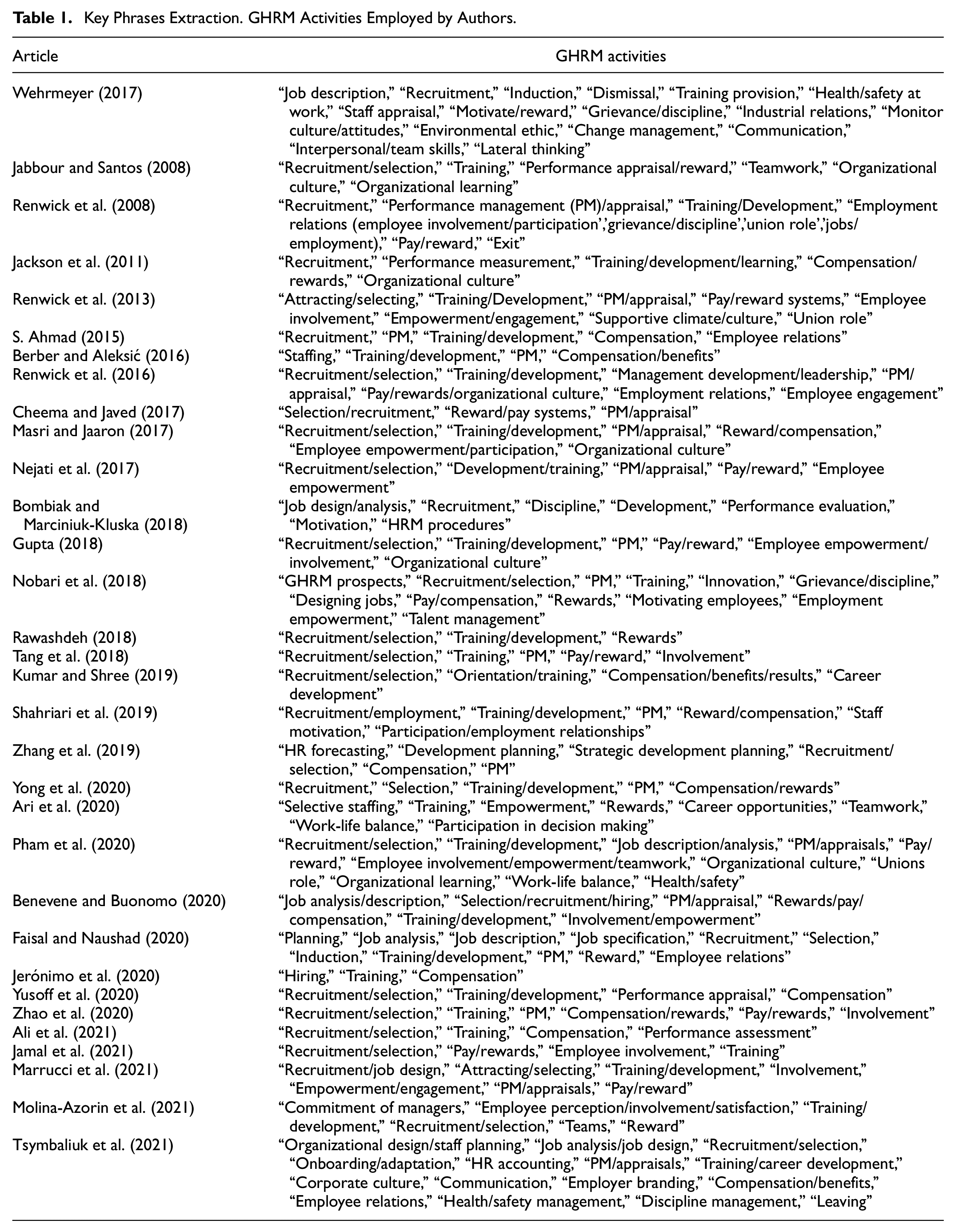
Final 32-documents of SLR step are analyzed for thematic content. Key phrases (activities used in these documents) were extracted and analyzed to yield themes (activity list to use in next step, regarding RQ-1). Results (10-item activities) are presented and discussed in relevant section through Table 1 and Figures 4 and 5.
Key Phrases Extraction. GHRM Activities Employed by Authors.
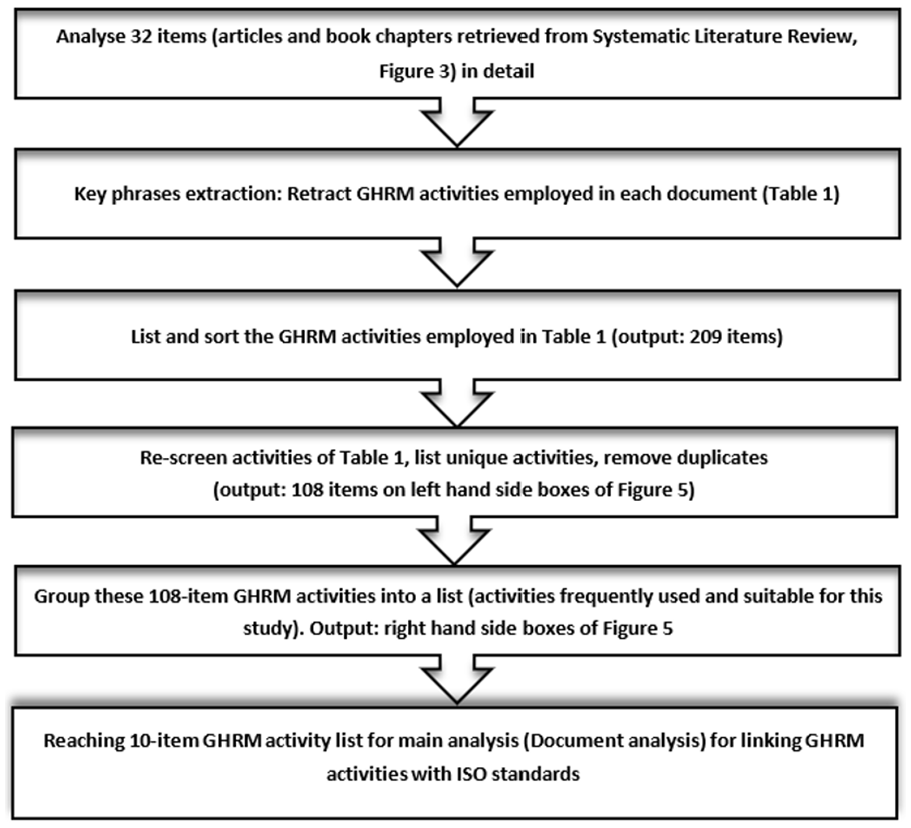
Determination of GHRM activities.
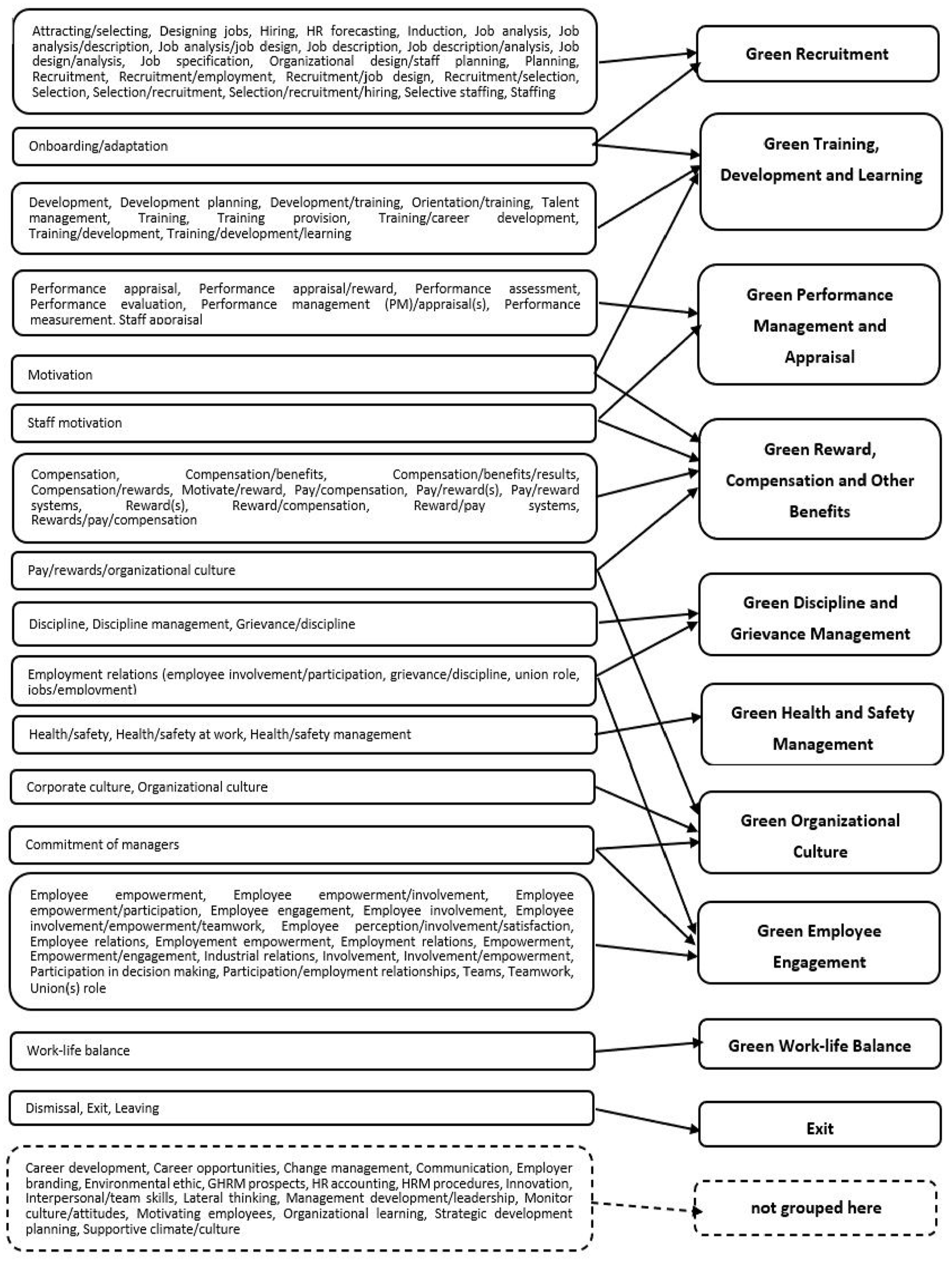
GHRM activities to use in mapping.
Document Analysis
Methodological approach used in the framework of main study, mapping of standards & activities, was document analysis as a qualitative research method (Bowen, 2009; O’Leary, 2004; Rafuls, 1996), utilizing information from ISO website.
As a systematic procedure for document review & evaluation, method encompasses analysis of various types of documents, covers skimming, reading, and interpretation. Method allows researchers to direct difficult-to-complete studies by analyzing preexisting texts, requires examination and interpretation of data to derive meaning, gain understanding, and develop empirical knowledge, like other analytical qualitative research methods (Bowen, 2009; Morgan, 2022).
Initially, HRM standards under direct responsibility of ISO/TC 260 committee were examined via ISO website for this match. Introduction and scope sections of a total of 34 (published/under development) standards of committee were analyzed (ISO/TC 260 Standards, 2022). Where necessary, other appropriate sections of the standards have also been consulted.
Each activity was first perused and basic information was included under relevant activity title. Then, appropriate standards of committee were interrelated with relevant activity by employing theoretical and/or practical application area. Moreover, activities were searched through ISO OBP (Online Browsing Platform) (ISO OBP, 2022), so that the standards of both ISO/TC 260 and other committees suitable for matching with activities were taken into account.
Results and Discussion
Determination of GHRM Activities
As detailed above, auxiliary steps are needed to link activities & standards. Primarily, SLR step (Figure 3) is applied to identify selected studies. Then, by applying a thematic analysis (detailed in Figure 4), resulting 32-documents of SLR step are coded to yield themes (activities).
First sub-step is examining and extracting activity contents of these sources (Table 1).
Other sub-steps are listing, sorting, and re-screening activities of Table 1 (Figure 5, left-hand-side) to determine activities that will be used to link with standards (activities frequently used and suitable for this study).
Final 10-item activity list for use in the next section has been grouped and extracted as follows (Figure 5, right-hand-side):
Green Recruitment;
Green Training, Development and Learning;
Green PM and Appraisal;
Green Reward, Compensation, and Other Benefits;
Green Discipline and Grievance Management;
Green Health and Safety Management;
Green Organizational Culture;
Green Employee Engagement;
Green Work-life Balance;
Exit.
Linking GHRM Activities With ISO Standards
Activities (10-item list) introduced above are detailed below in conjunction with standards. Connections were evaluated as primary or secondary throughout this study, according to close link that can be established. Links are also summarized in resultant Figures 6 and 7 at the end of section.

Links of GHRM activities-ISO standards.

GHRM activities-ISO standards-ISO committees.
As detailed above, ISO 14001:2015, has a significant impact on sustainability and GHRM as well as EM. Standard has therefore been recognized as the driving force behind all activities and is not further addressed in links of activities.
Standards used in the mappings specific to this study generally include generic standards, standards aimed to be applicable to all organizations. Application or sector specific ones have not been matched.
Throughout this study, the term “documents referring to standard” has been used in reference to all documents used in an organization that refer to standards. It may correspond to any documented information, specification, plan, procedure, process, manual, or policy documentation, etc.
Green Recruitment
Wehrmeyer (2017) underlines that recruitment is about associating personal attributes with job descriptions. He states that it would be better if candidate has competencies beneficial to organization to accomplish relevant environmental job definition. Many EM specialist competencies can be obtained more easily through new hires rather than investing in training (p. 14).
Studies on recruitment take Wehrmeyer’s views one step further, demonstrating the positive & significant impact of green recruitment (hiring) on social, economic and ES (Martins et al., 2021, p. 13).
ISO 30405:2016, a well-defined guideline on recruitment, focuses on key processes & practices, for example, policy development on recruitment. It seems that a primary link can be established between green recruitment and this standard. Green recruitment approach can be established in aforementioned policy(ies) to have a robust connection with ISO 30405 standard.
Following standards include metrics related to recruitment activity:
ISO/TS 30410:2018, Impact of hire metric;
ISO/TS 30411:2018, Quality of hire metric;
ISO/TS 30430:2021, Recruitment metrics cluster;
ISO/TS 30407:2017, Cost-Per-Hire.
Recruitment of new employees in accordance with the concept of green recruitment via ISO 30405 may be considered as a direct link. Conversely, interest in ISO 30410, ISO 30411, ISO 30430, and ISO 30407 should include metrics of recruited personnel in line with GHRM purposes. Since such a metric is very specific, it would be appropriate to consider four aforementioned standards as having a secondary role to green recruitment.
Following two activities are interpreted within recruitment activity:
“Green job description”. Job description definitions of Wehrmeyer and ISO are parallel to each other, both depictions are based on job tasks (ISO 30400:2016; Wehrmeyer, 2017). And it is elaborated under clause 4.3.2 of ISO 30405 as a part of talent pool clause, indicating that this activity is a component of recruitment activity in ISO 30405:2016 standard. Wehrmeyer notes that environmental protection tasks and reporting roles should be handled in job definitions as a part of HRM approach to EM (p. 14). Hence, it would be appropriate to include mentioned environmental tasks & roles in documents for HR job descriptions, and therefore associate them with documents referring to ISO 30405 standard including these roles & duties.
“Green pre-boarding and boarding”. Induction activity described by Wehrmeyer (2017), corresponding to initial integration of new recruit (pp. 14, 15), overlaps with ISO delineation of “boarding” and “on-boarding.” ISO defines boarding as activities that usually take place on first day of work and follow pre-boarding, where pre-boarding is used for activities required to move an applicant from acceptance of a job offer to first day of work. After the candidate reports to work, on-boarding starts and is regarded as a separate process (ISO 30400:2016; ISO/DIS 30400: 2022). Accordingly, long-term training activities should be regarded as part of GHRM’s training, development and learning activity, and short-term initial training activities related to pre-boarding and boarding should be considered as part of green recruitment activity. Therefore, ISO 30405 link that applies to green recruitment activity also applies here. Wehrmeyer highlights the role of HRM in EM in assuring that new hires comprehend EM approach and environmental touchpoints of their roles (pp. 14, 15). In the pre-boarding stage of recruitment activity, a document containing basic information about EM approach in new recruit’s role can be prepared in welcome package. And in short-term green boarding stage, information about this document can be explained briefly. This approach to pre-boarding and boarding stages of standards can be considered as a link between GHRM and ISO 30405 standard.
Green Training, Development, and Learning
Training is thoroughly observed in literature as a crucial topic of GHRM. Training activities are means of improving staff awareness of environmental influence of organization’s activities. Moreover, training is a tool for equipping staff with basic skills like collecting relevant waste data, and promoting degree of “eco-literacy” and environmental specialization in organization. Since frontline employees are closest to waste, well trained and environmentally aware frontline employees should preferably be located in a position to identify and reduce waste (Renwick et al., 2013, p. 3).
Green training should also be provided to all employees to heighten environmental awareness, knowledge and abilities of employees. Green training is important in helping employees to learn more about environmentally friendly practices in workplace (Mohammad Ashraful et al., 2021, p. 102).
When dealing with “green training, development, and learning,” close, intertwined and adjacent concepts were encountered both in Table 1 and analysis of standards. As a consequence of search of training, development, education, competence, knowledge, skill, learning, capability, and ability terms (explained in ISO/DIS 30400, 2022; ISO 30400:2016) in ISO OBP, following standards are discussed here.
Under development standard ISO/FDIS 30422 (2022) (Learning and development), can be directly related to green training, development, and learning activity. Fortunately, a draft copy of BS ISO 30422 (2021) standard for public comment is available and helps us in matching activity & standard’s perspective. Although the document is a draft and a subject to change copy, it gives us convenient information on this matching. Namely, correlating “green training, development, and learning” with the guidelines outlined in draft copy of the standard results in a convenient output:
Standard focuses on planned learning & development in an organizational context. Here, learning needs can be analyzed in alignment with GHRM strategies. Areas of skill shortages addressed to GHRM goals can be identified. Also, effective learning & development processes to meet GHRM needs at organizational & individual levels can be planned.
ISO 10015:2019, QM standard (guidelines) for competence management and people development, can help us in consummating green training, development and learning activities. A subcommittee of ISO/TC 176 (2022), Technical Committee of QM and quality assurance prepared the document in collaboration with ISO/TC_260. Standard draws attention to links of competence management and people development. Competence is defined as the ability to apply skills & knowledge to attain intended results, within the scope of standard. And people development accentuates on creation of learning & training opportunities to acquire new or advanced competence.
Green training, development, and learning for specific development goals can be provided by addressing GHRM as an organizational policy. When planning organizational competence activities, a basis for green training, development, and learning can be constructed. For example ecological training needs, employee awareness about environmental factors and EM development needs can be included in planning of organizational competence activities. Hence, standard can have a primary role in linking green training, development, and learning activity if QM is in use in organization. Organizations that implement ISO 9000 family of standards and organizations certified to fulfill the requirements of ISO 9001 QM systems can benefit from the guidance of ISO 10015. They can easily apply these standards together with green training & development requirements.
Furthermore, standards that manage measurement of aforementioned concepts can help in defining relevant metrics. ISO/TS 30428:2021 (Skills and capabilities metrics) can help us to establish a connection between standards and green training, development and learning. Moreover, learning and development metrics standard, which is in “prepatory” stage of development (ISO/AWI TS 30437, 2022), may also be helpful when it becomes available in the near future. Reports prepared with reference to these two metrics standards in green training & development details may help to monitor the expected results from this activity. Both standards can be considered in secondary role when matching with this activity, since there is an indirect relationship.
IWA 30-1:2019 and IWA 30-2:2019 standards are developed by “ISO/TMBG Technical Management Board-groups” and associated with competence of standards professionals who are performing standardization activities in a company or an organization. Standards professionals should have the competence—consisting of knowledge, skills, and attributes—to execute a job or tasks related to these activities.
Consequently, competence explanations mentioned above for ISO 10015 regarding green training, development, and learning activity also apply to these two standards. However, these standards specifically refer to particular groups (IWA 30-1:2019 to companies, IWA 30-2:2019 to standards-related organizations). Hence, within the scope of this study, IWA 30-1:2019 standard is considered to have a secondary role. But, since IWA 30-2:2019 standard do not apply to most organizations, is not listed here within the scope of this study. Likewise, although they are close to the subject in terms of education and learning content, none of the standards ISO 30401:2018 (KM systems), ISO 29993:2017 (Learning services), and ISO 21001:2018 (Educational organizations) are listed here as primary or secondary.
Green Performance Management and Appraisal
Environmental performance measurement approaches encompass the adoption of metrics throughout the organization. Having convenient metrics for evaluation of environmental performance appear to be a requisite for using such metrics to manage employees. Effective performance appraisals fulfill the criteria of reliability, fairness, and validity, as well as providing useful feedbacks for employees and assisting continuous improvements of organization’s environmental outputs (Jackson et al., 2011, p. 105).
According to some scholars, incorporating environmental concerns into PM/appraisal systems is a precondition of crossing corporate social responsibility discourse. Another view states that PM/appraisal implementations and leadership competencies need to be changed in order to achieve progress in ES goals (Renwick et al., 2016, p. 117).
Renwick et al. (2008, 2013, points out discussion paper of Trade Union Sustainable Development and Advisory Committee on greening the workplace. Authors note that a proper launching of PM systems in organizations can be achieved by improving performance indicators on every environmental risk domain. Most of the studies recommends integration of environmental criteria with appraisals to promote a culture of learning in EM. All such responsibilities should be written in employee’s action plans.
ISO 30400:2016, defines PM as management of performance of people, groups and organizations, and more details are covered in under development version (ISO/DIS 30400: 2022). Feedback, mentoring, coaching, review and evaluation are presented as the activities that can be included in PM with the goal of continuous improvement.
It is noteworthy here that ISO regards the performance of groups & organizations, not just a single employee. This approach overlaps with that in which environmental (green) PM is linked to organization, thus ensuring that organizational context is included in establishment of standards & GRHM links.
Nankervis and Compton (2006) attach importance to employee performance review (and PM) which have collective benefits to organizational effectiveness. PM programs contribute to organizations & employees, and can supply aggregated organizational data as well as individual feedback. Data can be used for program evaluation and HR planning, and can support HR development programs, managerial and remuneration plans. Retention, remedial skills/career development and training programs are outputs of individual PM (pp. 84, 85). Consequently, PM touches most HR activities, and these activities are related to most HRM standards. However, points that can be directly related to green PM within these standards are limited.
Activities can be used as inputs to PM when linking with standards, for example, green goals/objectives can be included in employee key performance indicators (KPIs). This will help implementation of a green PM that can also contribute to sustainability goals. However, adding individual objectives or goals with initiative of a senior manager will not be sufficient. For a perfect implementation, it would be appropriate to give these KPIs to all employees within the organization. Depending on roles and involvements in environmental activities, KPI definitions need to be differentiated within the groups. In other words, the organizational context mentioned above in parallel with ISO’s definition of PM has to come to the fore.
Considering green PM KPIs within organizations, following two standards can be evaluated for study:
ISO 30408:2016, Guidelines on human governance:
As explained above, it would be appropriate to define green PM KPIs at all levels within organization rather than individually. Most appropriate standard that may correspond to definitions of these KPIs to be determined appears to be ISO 30408. Herein, considering these KPIs as the needs of organization in documents referring to the standard, approval of KPIs can also be evaluated. These issues should be included in documents referring to standard in connection with fifth and sixth articles (“Roles, responsibilities, commitment and accountability” and “Aligning human governance with organizational needs”) of standard. However, standard has a secondary role in GHRM link as it does not directly address green PM.
ISO/TS 30411:2018, Quality of hire metric:
Metric is crucial for specifying effectiveness of recruitment process, has a significant influence on performance of organization. Quality of hire is defined as measurement of performance of hired employee during a specific period in comparison to pre-hire expectations. When evaluating this, expectations of green PM can also be considered in documents referring to standard. These mappings indicate a secondary role, as they do not directly represent a PM measurement.
Accordingly, no primary matching was found for green PM, where above two standards correspond to secondary role.
However, the standards that somehow refer or relate to PM;
ISO 30414:2018, Human capital reporting,
ISO/TS 30410:2018, Impact of hire metric,
ISO 30415:2021, Diversity and inclusion
are not listed here in matching standards with green PM within the scope of this study.
Green Reward, Compensation, and Other Benefits
Compensation practices of organizations are changing to cover ecological dimensions. Object of reward policies is to attract, retain and motivate best employees and to motivate development of skills, attitudes, and knowledge that help an organization achieve its goals (Jabbour & Santos, 2008, p. 54). Organizations must value employee green behavior and this should be linked to compensation, pay and promotion opportunities. This will motivate and encourage employees to participate in green activities and this participation will contribute to green management goals (Dumont et al., 2017, p. 11). In order to align goals of organization & employees, employees contributed to improvement of ES should be compensated for their contributions. These contributions may be related to downscaling environmental impact of products or processes, as well as to recycling or reducing waste. Organizations should recognize, reward, or compensate for such contributions in order to achieve reduction in environmental impact of their activities (Labella-Fernández & Martínez-del-Río, 2020, p. 7).
While rewards can be monetary or nonmonetary, some authors argue that nonmonetary rewards have a stronger motivation than monetary motivation. For example, recognition and praise may be more motivating than financial incentives for some employees. Nevertheless, this policy is potentially contradictory and a fair organizational climate can be difficult to maintain (Jabbour & Santos, 2008; Jackson et al., 2011; Jermsittiparsert, 2021).
An important point to consider is the need to maintain correct balance between “sticks” and motivational “carrots”. Organizations should strive to equalize effects of underperforming and poor rewards. Harshly punishing poor performance in environmental objectives may result in failure to participate in EM actions. Conversely, very weak rewards can also distract managers from taking significant environmental action (Jackson et al., 2011).
A large number of relevant concepts were observed both in Table 1 and analysis of HRM standards when studying “Green reward, compensation, and other benefits” topic. Existence of terms such as “reward, compensation, benefits, recognition, remuneration, incentives, pay, payroll, payment, overtime, bonus, commission, award, wage, salary, perquisite, stock option, insurance, automobile use, additional medical” in standards are investigated for this activity. After applying searches in ISO OBP, above terms are found to be mentioned in 23 of the standards under direct responsibility of ISO/TC 260, showing severity & weight of subject. HR standards under responsibility of ISO/TC 260 are evaluated, and following standards were included here within the scope of “Green reward, compensation, and other benefits”:
(ISO/AWI 30426: 2022), Compensation system:
Although it is still an ongoing project and needs time to be published, preliminary information on objectives, and key outputs of standard shows that standard will fulfill important functional needs when it is published. Standard is aimed at developing, improving and implementing compensation systems, and aims to design compensation to attain individual & organizational goals. Design of compensation parameters, determination of compensation matrix, improvement of compensation package, and establishment of proportionality between payment parameters will be features of standard.
A compensation system which will include contributions of employees for green activities as explained above will draw the attention of employees. The monetary value of green activity contributions, which will be declared transparently within the organization, will enable employees to adopt GHRM at a high level.
ISO/TS 30427:2021, Costs metrics cluster:
Standard includes the metrics of workforce costs (both total & external), basic salary & remuneration ratio, and employment costs (total). Hence has a wide coverage area. Green compensation alignments can be applied on formulation and reports based on this standard to get maximum employee contributions.
Accordingly, both standards (ISO/AWI 30426, 2022 and ISO/TS 30427: 2021) has a primary role in activities & standards relation.
In internal reports of organization related to following two standards, it is possible to bear formulations and measurements with correlations for green compensation. It can also be ensured that these numerical values are returned as benefits to employees.
ISO/TS 30407:2017, Cost-Per-Hire:
Hire-cost-ratio formulation of ISO/TS 30407 uses total compensation of newly hired individuals. Since it is related to cost of recruiting operation, assumed to be in secondary role for activities link.
ISO 30415:2021, Diversity and inclusion;
Although clause 8.3 is entirely about remuneration issue of HRM lifecycle, scope of the standard is about diversity & inclusion, hence it is mentioned here as in a secondary role for activities connection.
Traces of nonmonetary issues for employee green contributions can be found in ISO 23326:2022 (Employee engagement). Article-10, “Work compensation and recognition” can be helpful in GHRM implementation. Nonmonetary consequences of green employee contributions can be addressed in documents referring to standard. Since standard is mainly about employee engagement, it has been accepted in a secondary role in “Green rewards, compensation and other benefits” and standard relationship.
Green Discipline and Grievance Management
Discipline Management: Discipline management has come to the fore as a tool for self regulation of employees in organization’s environmental protection operations. Regulations and a set of plain rules in accordance with organization’s environmental policy have been implemented in organizations that impose or regulate the concern of employees in protection of environment. One legal expert view is that some organizations may add clauses to their staff contracts and may take actions to provide that environmental obligations are secured. Non-environmental behavior may result in a breach of contract. In case employee violates environmental regulations and rules, disciplinary actions such as warnings, fines, suspensions, and penalties up to dismissal may be carried out (Arulrajah et al., 2016; Renwick et al., 2008).
Grievance Management: While most GHRM studies focus on discipline management, grievance management appears to be relatively neglected (Table 1).
Grievance has been considered as both a process and an institutional mechanism for managing conflicts in workplace emerging between employer & employee. Through union & management relations, use of grievance procedures are institutionalized. Grievance procedures aim to supply peaceful tools to resolve contradiction (Nurse & Devonish, 2007, p. 90). Wehrmeyer (2017, p. 16) emphasizes that employees should have the opportunity to report environmental concerns or non-compliance areas in a conflict-free manner. Organizations can encourage internal whistleblowing on environmental concerns.
ISO/TS 30423:2021 (Compliance and ethics metrics) and ISO 30414:2018 (Internal and external human capital reporting) deals with metrics and reports of compliance and ethics. ISO explains both grievance & disciplinary action. A formal complaint within workplace is portrayed as a grievance. Many causes of raising a grievance may exist, such as discrimination or harassment. If a job-related behavior that does not comply with expected and announced workplace regulations emerges, a disciplinary action is employed as a process. Type and number of grievance filed and disciplinary actions concluded are presented with metrics mentioned in ISO/TS 30423 and ISO 30414.
Internal whistleblowing on environmental concerns (Wehrmeyer, 2017) can also be used to support the grievance management process.
First step should be to move toward a design that distinguishes environmental issues both in grievance & discipline management processes. Procedures & actions such as handling grievances & disciplinary issues should be defined. Environmental issues arising from whistleblowing management systems can be incorporated into both grievance & discipline management processes. Second step is to constitute environmental metrics for grievance & discipline issues guided by ISO/TS 30423 and ISO 30414. Both standards are not directly related to grievance & discipline management processes, but has a distinct role, so they can be considered as in a secondary role for activities link.
Green Health and Safety Management
Wehrmeyer gave point to presenting and continually updating workplace health & safety regulations & practices (Wehrmeyer, 2017, p. 15). Unfortunately, Table 1 shows that, despite Wehrmeyer’s key findings of more than a quarter of a century, enough attention has not been paid to green health & safety management activity.
Preservation or restoration of environment and environmental quality are main contributions to green jobs. “Greening jobs” definition tells us that existing occupations must be adapted to the needs of green economy. Green jobs should be decent work presenting job security, safe working conditions, reasonable career prospects, adequate wages, and worker rights. Therefore, any work—including “green work”—should adhere to governing principles of employee safety & health since they are primary indicators of Decent Work. International Labor Organization (ILO) confirms that “Decent Work is Safe Work”. Implementation of OH & S measures is a prominent support in greening economy & enterprises (EU-OSHA, 2022; ILO, 2012, 2017).
Green sector’s active OH & S policies seems to be essential for designing & implementing rules on OH & S issues, and also fundamental for promoting tangible protection & prevention actions. These actions should be considered at organizational level, should be based on hazard analysis and elimination criteria, and should be a part of risk management (Valenti, 2018).
The scope of ISO/TC 283 committee is on standardization in OH & S management that standardization can help organizations to improve OH & S performance and control OH & S risks (ISO/TC 283 Standards, 2022; ISO/TC 283 Technical, 2022). Two of the committee’s standards are presented here within the scope of this study.
ISO 45001:2018 (Requirements) is a very common MSS in organizations that specifies requirements for an OH & S management system. ISO Survey (2021) of MSS Certifications reports 190,429 valid certificates for ISO 45001 worldwide. Standard helps organizations in maintaining healthy & safe workplaces by both proactively improving organization’s OH & S performance and preventing ill health and injury related to work. ISO/DIS 45002 (2022) (Guidelines for implementation of ISO 45001:2018) is under development and intended to be used together with ISO 45001:2018. ISO 45001 has parallel outcomes with the green health & safety management approaches mentioned above, such as continuous improvement of OH & S performance, achievement of OH & S targets, and fulfillment of legal and other requirements. Another standard on OH & S is ISO/TS 24179:2020 (OH & S metrics) presented by ISO/TC 260. Standard deals exclusively with metrics of OH & S and well-being field, and supplies formula for comparable measures.
Organizations can incorporate these approaches (which are common in green health & safety management and ISO 45001) and measures into all documents referring to standard, starting from the organization’s OH & S policy document(s) to plan, policy, etc., and also can use metrics of ISO/TS 24179. Therefore, these standards (ISO 45001, ISO 45002, and ISO/TS 24179) can be considered to have a primary link with green health & safety management activity.
ISO/TR 30406:2017, Sustainable employability management for organizations, has clauses (e.g., 8.3 Healthy and safe work environment) on OH & S. Likewise, ISO 26000:2010 (Guidance on social responsibility) has a clause (6.4.6.Labor practices issue-4: Health and safety at work) on OH & S. Since both of these standards are not directly related to OH & S, it can be considered as a secondary relationship in linking activities & standards.
Green Organizational Culture
GHRM addresses strategic dimensions of HRM such as organizational culture, teamwork, and employee empowerment as well as traditional HR practices. Organizational culture, as a traditional subject of organizational management, has references to ES when considered together with EM (Jabbour & de Sousa Jabbour, 2016, pp. 1826, 1827).
An organization’s members in a particular cultural environment share a common sequence of beliefs, suppositions, and values that arise from local environment. These environmental cultural values have a very strong influence on behavior of people within organization (Sharma & Sharma, 2010, p. 98).
Here, paving the way for an organizational culture toward ES will encourage employees to improve norm values founded on comprehending results (Fawehinmi et al., 2020, p. 6).
In fact, organizational culture has close links to other activities. Better trained employees will support better EMS to give an influential organizational culture (Opatha, 2013; Rawashdeh, 2018). On the other hand, HR departments can foster employee relationships, involvement and engagement, and create a supportive organizational culture that supports SDGs (Chams & García-Blandón, 2019, p. 115).
ISO/TS 24178:2021 (Organizational culture metrics) and ISO 30414:2018 are concerned with reports and measurements of organizational culture. ISO/TS 24178 is a new metrics standard published in 2021. The relevant metrics of organizational culture should be considered as a continuous and evolving field. Organizations should have an ongoing endeavor to improve their understanding of their own culture. Culture metrics should be linked to key components of a high-performing culture level. Organizational culture metrics in ISO/TS 24178 cover key topics such as engagement, satisfaction, commitment, and retention rate. Basic corporate culture surveys are good starting point to assess health of corporate culture. A workplace encouraging innovation, involvement, engagement, and commitment with corporate vision and purpose is the outcome of a forceful organizational culture (ISO/TS 24178:2021; ISO/TS 24178:2021 (OBP); ISO 30414:2018). Here, this requires a clear & strong corporate vision and policy for EM & HRM that supports GHRM issues, particularly here green organizational culture. Next, current position on organizational culture can be evaluated by comparing the results of surveys on engagement, satisfaction, commitment, and retention rates in organization with previous data or internally across the departments. Evaluations can be helpful in taking actions on factors that affect organizational culture. Here, ISO/TS 24178 has a primary relationship with green organizational culture. ISO 30414, common for most HRM processes, has not been included in linking with this activity.
Scope of standard ISO 30401:2018 is related to requirements & guidelines of an effective management system for KM in organizations. ISO 30401 and ISO/DIS 30400 establish an important connection between KM system and organizational culture. Standards define KM culture as elements of organizational culture, promoting behaviors, values, and activities correlated with KM system.
Therefore, a strong KM system that supports a green culture will be of great help to a green organizational culture.
ISO 30408:2016 emphasizes that an organization can develop an organizational culture that reflects its own organizational values as one of the subjects that organization can implement by aligning strategic planning and active human governance practices. Standard ISO 37000:2021 (Governance of organizations, Guidance) can guide in defining the organizational values.
Here, the link between human/organizational governance and organizational culture can be observed clearly. GHRM subjects employed in human governance of organization can support green organizational culture.
Since a direct relationship does not exist, standards ISO 30401: 2018, ISO 30408:2016 and ISO 37000:2021 can be considered in a secondary role in GHRM & standards link.
Green Employee Engagement
Employee participation is noted as a generic term to describe a variety of practices that are often associated with various related terminology, including employee empowerment, involvement and voice (Markey et al., 2016). QM scholars & practitioners are familiar that “people involvement” term has been replaced by “people engagement” in line with revised ISO QM principles (ISO 10018:2020).
As presented in Table 1, it is observed that concepts of employee involvement, participation, empowerment, engagement, perception, satisfaction, and teamwork, employee relations, and employment relations are used to represent green employee engagement. The terms commitment (management), communication, unions, and industrial relations are also partly related to this topic from the point of view of GHRM. Here, close concepts are presented under the title of green employee engagement.
Accomplished integration and alignment of green activities with strategic goals of organization should take into account responsibility & role of employee. Engagement of employees in EM has three focal points: benefiting from tacit knowledge acquired by employees through their close relationship with production process; engaging and empowering employees to make recommendations on environmental improvements; fostering a culture that promotes environmental improvement efforts in workplace (Haddock-Millar et al., 2016, p. 195).
Green employee empowerment & engagement aims at a system where employees have the opportunity to participate in EM initiatives. A sense of ownership in employees is created in decision-making processes with employees. This helps organizations align their environmental goals with individual goals & capabilities of employees (Gupta, 2018, pp. 202, 204).
Through empirical studies, a number of methods have been identified for engaging the workforce in EM, such as employee training, team formation, fostering a supportive culture, and developing green leadership, among others (Haddock-Millar et al., 2016, p. 195). Use of team formation in addressing problematic issues related to EM has been particularly prominent in manufacturing companies. Such EM groups are referred to as green teams in literature and can be defined as voluntary worker teams (Jabbour & Santos, 2008, p. 54). GHRM literature contains some examples where teamwork is highlighted along with employee engagement (Pham et al., 2020; Verma, 2015). Consequently, teamwork can be considered as a good means of implementing employee engagement.
Negotiation of collective green agreements granting participation rights in all aspects of an organization’s environmental impact was initially on the agenda (Oates, 2017). Over time, demands morphed into requests to take a reasonable amount of time off during working hours related to environmental issues such as supporting sustainable work practices, receiving training, conducting inspections, and consulting on EM policies (Renwick et al., 2013, p. 8). Arguments of employee organizations that a corporate environmental policy can only be accomplished with full employee involvement & commitment (Oates, 2017) are still valid today.
ISO 23326:2022, a fairly new standard published in 2022, includes guidelines directly about employee engagement. Focus of standard is to promote well-being of employees & organization with mutual benefits in employment relationship.
Standard can help to establish an employee engagement framework and to construct relevant processes in organizations. Employees who take on green roles will provide maximum benefit to organizations via their extra-role behavior, which is already mentioned above. Management’s support for green employee engagement will also encourage other employees to contribute to greening activities, for example, encourage them to make suggestions on environmental issues. All these contributions will provide mutual benefits & gains of employer & employee. Consequently, this standard has a primary role in standards & activities link.
Close relationship between organizational culture and employee engagement is also seen in organizational culture metrics standard ISO/TS 24178:2021 (OBP), where engagement, satisfaction, and commitment metrics are included as a key aspect.
“Engagement of people” is one of the seven QM principles that QM standards are based on and has a statement close to understanding of “employee engagement.” Engagement of people considers engaged, empowered, and competent people at all levels of organization, highlighting that these people are crucial to enhance organization’s potential to create and deliver value (ISO, 2015). From this point of view, ISO 10018:2020 (QM, People engagement) can be used in conjunction with ISO 23326:2022 for green employee engagement purposes. Although there are clauses regarding engagement of people in ISO 9000:2015, ISO 9004:2018, and ISO 10006:2017 standards, only ISO 10018:2020 is employed here due to its close relevance.
Hereby, ISO/TS 24178:2021 and ISO 10018:2020 standards can be considered in a secondary role in activities & standards link.
Green Work-Life Balance
Muster and Schrader (2011) discussed green work-life balance as a new perspective on GHRM. Authors emphasized that up to that time both EM & GHRM had focused only on working role of employees and addressed employees only with their “producers” role. Green work-life balance policies focus on dual role of employees as consumers & producers, and full potential of GHRM can only be realized when employees handle it in these two roles. Concept of green work-life balance has been proposed to facilitate environmentally friendly behavior in both living spaces, due to mutual interactions between private life and working life.
Objective work-life balance is associated with the economic concept of time scarcity or time constraint. Since the time people can use is fixed, economic theory estimates that as long as a person has less discretionary time, she/he will devote less time to pro-environmental activities that require more time than non-pro-environmental activities. These activities may be cycling or walking to work rather than driving, separating recyclables rather than throwing them in general trash (Melo et al., 2018, p. 171).
The arising field of green work-life balance, which develops from the areas of sustainability and work-life balance, focuses its analysis largely in the neighborhood of organizational gains of green work-life balance policies, often centers on how individual behaviors can diminish environmental footprint of organization (Ravenswood, 2022, p. 3).
Empirical studies on green work-life balance shows the relationship between performance at work and work-life balance, proving that employee engagement is imperative in mediating this relationship (Iddagoda et al., 2021).
Sustainable employability management for organizations standard, ISO/TR 30406:2017, has a clause (8.8) about work-life balance. Standard establishes a relationship between person, organization and business performance, and refers to quality work throughout working lives.
Here, provision of quality work to employees throughout their working life can be supported to have a better work-life balance.
ISO 23326:2022, counts work-life management in work content and job design (clause 9.5).
Real-life practices regarding green work-life balance can be accomplished with management support in relevant decisions of work content and job design. For example, employee participation in decisions of flexible working hours and work from home can be supported to have a more desirable work-life balance.
Both of the standards, ISO 23326:2022 and ISO/TR 30406:2017 can be contemplated as in the secondary role for activities & standards connection.
Exit
Dismissal activity in EM & HRM relationship has been elaborated by Wehrmeyer as searching ethical or environmental involvement in termination of employment. And he suggested using exit interviews as a tool to investigate possible reasons for cessation, including role of environmental factors (Wehrmeyer, 2017, p. 15). Unfortunately, most studies on GHRM do not take into account exit (resign or dismissal) activity (Table 1).
Turnover and retention metrics standard, ISO/TS 30421:2021, deals with understanding why people leave (clause 4.3.3).
Here, issues related to investigation of environmental factors for leaving the job (any forms of exit such as dismissal, resignation, etc.) can be discussed by conducting an exit interview with person who is about to leave the job. Namely, the ISO 30421 standard has a primary role in establishing link between standards & activities for exit activity.
However, this exit interview also applies to standards implemented on certain issues. Applying a search on ISO OBP (2022) found “termination and change of employment” in 15 standards under responsibility of committees of “ISO/TC 215 (2022) Health informatics” and “ISO/IEC JTC 1/SC 27 (2022) Information security, cybersecurity, and privacy protection.” Standards were examined, three of them were accepted as a secondary contribution to GHRM. Most known of these standards is ISO/IEC 27001:2013, IT security requirements standard. Other two standards are ISO/IEC 27002:2022 and ISO/IEC TS 27008:2019, also IT security standards. Besides, ISO 30415:2021, diversity and inclusion standard, contains a “Cessation of employment” clause (8.10).
Exit interviews that are the subject of these four standards can be designed as a single interview jointly for GHRM purposes, depending on standards implemented by organization. Four standards in question have a secondary role for the exit activity since a direct relationship does not exist.
Final Map of GHRM Activities and ISO Standards
Consequently, activities linked in above 10 sections as an answer to RQ-2 are summarized in Figure 6 with their primary/secondary adherence to standards. Overall, primary connections of 11-standards for 7-activities and secondary connection of 28-standards for 10-activities (including ISO 14001) were established.
While Figure 7 (matched activities & standards, corresponding committees) gives the expected result that HRM standards under responsibility of ISO/TC 260 (2022) committee dominate, a few words can be asserted about other standards presented here in connection with activities, as an answer to RQ-3. It can also be concluded that the standards under responsibility of ISO/TC 176 (2022) and ISO/TC 283 (2022) have primary links with activities. Regarding responsibility of these committees and relevant standards, QM and OH & S management emerge as prominent disciplines following HRM. Results are reasonable and in line with the studies of scholars on special relationship of total QM & HRM in continuous improvement systems (Izvercian et al., 2014), and interaction of SDGs to facilitate human sustainability with OH & S and S-HRM perspectives (Mariappanadar & Hochwarter, 2022). Similarly, responsibility areas of ISO/TC 309 (2022), ISO TMBG (2022), ISO/IEC JTC 1/SC 27 (2022), and ISO/TC 207/SC 1 (2022) committees and their secondary links highlight concepts of EM, governance of organizations, information security, and social responsibility. Figure 8 summarizes concepts & disciplines with these relation levels.

Concepts & disciplines regarding GHRM activities-ISO standards links.
Conclusions
Research on issues related to S-HRM and GHRM have been increasing in recent years (Bahuguna et al., 2023 notes GHRM’s momentum after 2015). Strategic approaches toward sustainability and environmental reflections are exhibited due to research gaps in this field. Focusing on how GHRM can be used effectively in organizations as a practical implementation area, a research was conducted to integrate activities & standards.
Although there is a large number of HRM studies whose scientific contributions are clear, a very low percentage of them are related to ISO standards. Simple queries are executed in Scopus database, and it is observed that less than 1% of HRM studies and less than 2% of GHRM studies until the end of 2021 were handled together with ISO standards.
As Timmermans and Epstein (2010) notes, few scholars directly analyze the standards. And, limited scholars such as Yeung (2018) tabulates the links based on the “clauses” of standards. Six contributions listed below are believed to assist scholars, management, standards & certification professionals and green team members in organizations as outlined in research objective.
Given the lack of a holistic approach in literature in which GHRM is evaluated together with standards, it is aimed that this study will make positive contributions to the literature. Instead of general inferences, links are established separately for each activity. Strictly, 10-item activities were analyzed separately to match standards (primary links for 7-activities with 11-standards and secondary links for 10-activities with 28-standards). Organizations or further studies may employ links, so will result in wider practical uses of activities & standards (mainly HRM). Second contribution is to provide measurable values with the use of metrics (also referred here as standards), for example, linking ISO/TS 30411:2018 comprising KPIs that can be formulated (green PM activity). Thirdly, most links include practical recommendations, such as recommending exit interviews for exit activity concerning four standards. Concisely, presented study proposes a structure that will take the use of GHRM and greening in organizations to a higher level, thus it is anticipated that it will contribute to sustainability & EM.
Fourth contribution, as well as GHRM, is to draw attention to HRM standards, and to promote utilization of HRM standards. Later, like ISO 30401, other HRM standards may also emerge as MSS (ISO Management, 2022), and may also evolve into a process leading to certification, even may be presented in ISO Survey lists.
Along with theoretical basis presented, emergence of GHRM in literature and activities used for greening in organizations in its journey to date are also investigated. Here, fifth contribution, no predefined list of activities has been employed. Instead, 10-item activity list is reached through SLR & qualitative analysis/synthesis, proposing a precise methodology for scholars.
Sixth, relevant ISO Committees and corresponding concepts & disciplines are presented. Results show emergence of QM and OH & S management as supporting fields of HRM, these fields may attract scholars from these disciplines.
After publication, standards are reviewed at least every 5 years (ISO, 2019). There are also unpublished (under development) standards employed in this study. Taking this into consideration, updating the study in following years is the first suggestion for a future study.
Mappings for activities are presented using document analysis through standards. Future studies may also focus on practical applications. Along with the outputs of this study and organizations’ documents such as procedures and policies, GHRM practices using case studies can be implemented in future studies when sufficient data is accumulated.
Paucity of sufficient data on use in organizations due to young standards encumbers empirical studies. In coming years, accumulation of data may trigger future empirical studies.
Undoubtedly, over time, different standards may be applied in matching with future studies. The aim here is to present a model, and it is considered this aim has been achieved.
Although limitation of this study is use of a single source in SLR, existence of a large number of journals covered by Scopus eliminates this disadvantage.
Footnotes
Author’s Note
This research was conducted while Ekin Akdeniz was at İstanbul Okan University. Author is now at Piri Reis University, İstanbul and may be contacted at
Declaration of Conflicting Interests
The author declared no potential conflicts of interest with respect to the research, authorship, and/or publication of this article.
Funding
The author received no financial support for the research, authorship, and/or publication of this article.
Ethics
Not applicable.
