




Abstract
The rapid degradation of today’s environment has required the governments and organizations to introduce effective countermeasures. Governments have enforced green policies, and organizations have drawn on these policies to implement environmentally friendly workplace practices. The success of these practices is very much dependent on the employees and the extent of their green behavior. As such, there is a need to determine whether green behavior can be positively influenced by other variables. One of the suggested influencing variables is green human resource management (HRM). Another variable with the potential mediating effect is personal moral norms (PMN). Also, there is a need to examine the interplay of green HRM, employee green behavior (EGB), and PMN within the context of higher education institutions (HEIs) as they also take responsibility for protecting the environment. It is believed that to date, studies of this nature have not involved academics at HEIs in Malaysia. This study aims to examine the mechanism by which green HRM affects EGB of academics at Malaysian HEIs through PMN as mediator. Data were collected through a cross-sectional quantitative survey among 425 academics at five research universities in Malaysia. The analysis was performed using Smart PLS version 3.2.8. There was a positive significant relationship between green HRM and PMN and a positive significant relationship between PMN and EGB. Hence, green HRM had an effect on EGB through the mediating role of PMN. However, there was no significant direct relationship between green HRM and EGB. Other studies have investigated the effects of several mediating variables in the relationship between green HRM and EGB; however, the effect of one variable—PMN—has not been examined. This study, as it investigates the vital aspect of behavioral formation, is believed to be the first study that examines the mediating role of PMN in the interplay between green HRM and EGB of academics. The theoretical and practical implications are discussed in this study.
Introduction
Background
An increasingly dire issue regarding the environment currently is its rapid degradation. The main causes are the depletion of natural resources and also other human interventions, such as disproportionate cutting of trees and burning of fossil fuel, which have resulted in carbon emission (Fawehinmi et al., 2020; Gao et al., 2017; Yang et al., 2016), consequently leading to natural disasters and climate change that are negatively affecting people’s quality of life and organizations alike (Lukman et al., 2013; Markey et al., 2019; Zhang et al., 2018). As part of countermeasures, most governments, including those of developing countries, have made pledges to global movements, such as AGENDA 2030 (United Nations, 2015), and placed environmental sustainability at the top of their to-do list. For example, Malaysia (2015), one of the emerging economies in Asia, has incorporated in its 11th and 12th National Plans the goal of environmental sustainability. Besides, the governments and regulatory bodies have introduced green policies that aim to boost the participation of organizations toward environmentally friendly practices.
The degradation of the environment has also given organizations a cause for concern. Most organizations practice corporate social responsibility (CSR), which is defined as organization’s situational-specific conducts that put into consideration the bottom line of economic, social, and environmental performance (Aguinis & Glavas, 2012). The most imperative role of CSR is the mitigation of adverse environmental situations through the encouragement of environmentally friendly initiatives (Gligor-Cimpoieru et al., 2017). In the spirit of CSR and to help mitigate the problem, organizations have taken responsibility in protecting the environment by drawing on governments’ policies to implement various green initiatives in the workplace, such as compliance with ISO 14001 for their policies and procedures (Yong, Yusliza, Jabbour, & Ahmad, 2019) and the implementation of environmental management systems (EMS). Initiatives under EMS include reduction of carbon emissions through less use of electricity and office materials and appropriate recycling of materials.
As argued in the literature, environmental degradation can be partly linked to higher education institutions (HEIs). Most HEIs are being operated as business organizations (Al-Zawahreh et al., 2019) and are considered as small cities (Saadatian et al., 2013). Compared with their private counterparts, public HEIs have vast enterprises with offices, residential halls, and event halls filled with human activities that consume much energy and other resources (Gomez & Yin, 2019). Although studies have shown that manufacturing industries consume much energy and contribute immensely to environmental degradation (Fernando & Hor, 2017; Masri & Jaaron, 2017; Yong et al., 2020), they have also shown that HEIs consume a large number of resources, such as energy, water, and solid wastes, and exhume as much carbon emissions, causing negative impact to the environment (Abdul-Azeez & Ho, 2016; Tangwanichagapong et al., 2017). In response to the worsening degradation, HEIs have also taken responsibility in protecting the environment, engaged more fully in CSR, and incorporated environmental sustainability as one of their core values, with this decision receiving a full endorsement from the United Nations (Muniandy & Anuar, 2020).
In counteracting the environmental degradation, organizations and HEIs have started to encourage green behavior among their employees and ensure that their EMS initiatives and the behavior are aligned with each other. According to Boiral (2009), the green behavior of employees is pivotal to the improvement of the overall environmental performance of the organizations, and efforts spent on developing this behavior can more likely ascertain the environmental performance improvement.
Need for the Study
One of the variables that play an important role in organizations’ achievement of environmental performance, as Boiral (2009) maintains, is employee green behavior (EGB). EGB is a set of behaviors practiced by employees to help contribute toward environmental sustainability (Ones & Dilchert, 2012; Stern, 2000). The good conduct of EGB by the organizations’ employees increases the likelihood of their environmental performance achievements. To encourage EGB in the organizations, there have been attempts to find ways by which this green behavior can be influenced (Ardente et al., 2006). A study of EGB among employees in China examined whether EGB can be predicted by green human resource management (green HRM) through the information need of employees (Zhang et al., 2019). Another study among hotel employees in Pakistan showed that EGB was affected by CSR, environmental awareness, environmental concern, and environmental knowledge through the sense of well-being (Ahmed et al., 2020).
A study by Safari et al. (2018) discovered that EGB of employees in Iran was influenced by environmental knowledge and awareness, behavioral intention, environmental attitude, and green commitment. A study among employees from diverse industries in Pakistan showed that EGB of employees was affected by ethical leadership, green psychological climate, and environmental awareness (Saleem et al., 2020). EGB of employees in China was shown to be affected by green transformational leadership, green identity, and value congruence (Wang et al., 2018). A qualitative study of Xing and Starik (2017), which was the reiteration of Wang et al.’s study, discovered that required and voluntary EGB of employees were affected by Taoist leadership values through a pro-environmental attitude of the employees. Furthermore, Dumont et al. (2016) highlighted that the in-role and extra-role EGB of employees in China were affected by green HRM through psychological green climate, with this relationship being moderated by individual green values. Fawehinmi et al. (2020) depicted that EGB of academics in Malaysia was affected by green HRM through their enhanced environmental knowledge. From these studies, it can be seen that EGB can be influenced by many variables. Some of these variables, however, have not been well examined.
One of the variables that need further investigation is green HRM. Green HRM is defined as the facets of green management that encourage employees’ environmentally friendly behavior in the organizations (Renwick et al., 2013). Green HRM is the main platform in organizations through which their environmental performance may be achieved (Zhang et al., 2019). There is evidence that green HRM is linked with EGB; however, it is stated that the literature on green HRM and EGB requires more evidence regarding the underlying mechanisms through which the green HRM affects the EGB (Dumont et al., 2016; Yong, Yusliza, & Fawehinmi, 2019). Past studies on green HRM and EGB were based on underlying mechanism such as psychological green climate (Dumont et al., 2016), organizational commitment (Kim et al., 2019), pro-environmental psychological capital (Saeed et al., 2019), and organizational identification (Chaudhary, 2019). Nevertheless, research on the underlying mechanism between green HRM and EGB is still in its infancy and needs to be conducted further. It has been indicated that when organizational support toward environmental sustainability is perceived by the employees, they are inclined toward environmental sustainability actions. In fact, at the organizational-level study, green intellectual capital as one of the organizational supports positively influenced economic, environmental, and social performance (Yusliza et al., 2020). Xing and Starik (2017) stated that green HRM affects the psychological process that leads to the practice of EGB. Studies have found that green HRM affects the psychological green climate of employees, which affects the performance of EGB (Dumont et al., 2016; Saeed et al., 2019). Other studies have shown that green HRM practices in the organizations activated the commitment toward environmental sustainability, which leads to EGB (Pham et al., 2019). However, to better understand the underlying factors in which green HRM affects EGB, more studies are still encouraged (Ren et al., 2018).
Despite several studies that have examined the underlying effect of green HRM on EGB, it is believed that one variable has not yet been examined and that variable is personal moral norms (PMN). PMN is a person’s perceptions of right and wrong and whether he or she feels morally obligated to perform certain acts (Schwartz, 1977). It may be argued that the sense of moral responsibility toward the environment may be the underlying reason that enables green HRM to impact EGB. PMN is an obligation-based intrinsic motivation (Werff et al., 2013) that motivates the employees to conduct their work pro-environmentally (Stern et al., 1999). Studies have shown that moral reflectiveness of employees was affected by organizations’ green environmental practices, which led to the improvement of EGB (Yang, 2019).
Several researchers have called for studies on green HRM and EGB to be conducted among academics at HEIs. Hooi et al. (2012) revealed that human resources and talent management play a vital role in the successful greening of HEIs. Likewise, Jabbour et al. (2012, 2013), Yusliza et al. (2019), and Roscoe et al. (2019) highlighted the need for green HRM to enhance EMS, for example, encourage employees to recycle wastes and conserve resources at work, such as electricity and water, to help reduce the negative impact on the ecosystem (recycled wastes mean less pollution on the environment). They believed that if green HRM practices serve a key role in the environmental sustainability initiatives at HEIs, academics’ behavior will be more aligned with the initiatives. Recent findings by Anwar et al. (2020) discovered that green HRM (green competence building practices, green motivation enhancing practices, and green employee involvement practices) showed a significant positive effect on organizational citizenship behavior toward the environment among academic staff in a renowned public research university in Malaysia.
Moreover, Saadatian et al. (2013) showed the participation of academics can highly affect the progress of environmental sustainability at the campus. Hence, academics’ contribution in terms of their aligned behavior toward EMS in HEIs would determine the successful environmental performance of HEIs, the society at large, and future generations. Therefore, the level of academic participation in environmental sustainability through the EGB would determine the extent to which students are aware of environmental sustainability, which may have major consequences for future generations (Christie et al., 2015). Based on the current literature, it is believed that studies examining green HRM and EGB have not been conducted among academics at Malaysian HEIs. However, they were the selected participants in several related studies that emphasized human participation in environmental sustainability (Desa et al., 2012; Joseph et al., 2013; Mahat & Idrus, 2016; Nawi & Er, 2018). For instance, Nawi and Er (2018) found that Malaysian academics’ willingness to participate in environmental sustainability was still lacking, although their awareness was high. They also highlighted limitations such as weak policy and low motivation.
Several studies have focused on the various theories used in the investigation of EGB. Several theories were used to explain EGB, such as the theory of planned behavior (TPB; Blok et al., 2014; Safari et al., 2018; Wesselink et al., 2017), value–belief–norms theory (VBN; Tezel & Giritli, 2019; Vanderploeg & Lee, 2019; Yeboah & Kaplowitz, 2016), norm activation model (NAM; Banwo & Du, 2019; Fang et al., 2019), values–identity–personal norms (VIP; Ruepert et al., 2016, 2017), and theory of normative conduct (TNA; Norton et al., 2014). In some studies, the theories used were social exchange theory (Fatoki, 2019; Gkorezis & Petridou, 2017; Hameed et al., 2019), social identity theory (Kim et al., 2019), theory of social learning (Yang, 2019), and technology acceptance model (Zhang et al., 2019), whereas in other studies, the theory used to explain EGB was the ability–motivation–opportunity theory (AMO; Dumont et al., 2016; Fawehinmi et al., 2020; Saeed et al., 2019). However, the use of a mixture of different theories to explain EGB was seen only in a few studies.
It can be seen that several gaps exist in studies on EGB. Given the importance of EGB in the achievement of organizations’ environmental performance, these gaps need to be filled. First, there is little literature available to conclude whether EGB is influenced by green HRM. Second, there have been no studies that examined PMN as a mediator. Third, there have been few studies that involved academics at Malaysian HEIs. And finally, only a few studies have used a mixture of different theories to explain EGB. Given the above gaps, the present study aims to examine the relationship between green HRM and EGB of academics at Malaysian HEIs through the inclusion of PMN as a mediator. Also, the study uses two theories, namely, the NAM and the AMO, as the theoretical foundations. To conduct the analysis, the study uses the data collected through a survey questionnaire handed out to academics at five public research universities in Malaysia. Through this investigation, the study helps to fill the gaps in the literature. This study also reduces the gap in the existing body of knowledge by addressing the issues highlighted by Ting et al. (2012), which opined that the strategy to develop energy sustainability on campus is based on human factors, and by enhancing their abilities and behavior through motivation and clear policies. This study goes further by including other environmental initiatives such as recycling and other resource conservations.
The rest of this article is structured as follows: “Theoretical Framework and Hypotheses Development” section presents the overview of the literature on green HRM, EGB, and PMN, and the developed hypotheses. “Method” section presents the research methods. “Findings” section provides the empirical results. “Discussion” section presents the discussion of the findings, including theoretical and practical contributions and the limitations that can be addressed in future studies. “Conclusion” section provides closure for the article with conclusions.
Theoretical Framework and Hypotheses Development
Theoretical Foundations
This study was based on the premises of the NAM and the AMO theory. NAM was established by Schwartz (1977) in the perspective of altruistic behavior, and the theory was aimed at observing the pro-environmental behavior of individuals (Cordano et al., 2011; Onwezen et al., 2013). In the literature, environmentally friendly behaviors are said to be primarily inspired by pro-social ambition (Han, 2014). This means the selfless act to do what is right based on the awareness of issues and acceptance of responsibility. According to Schwartz (1977), NAM has three precursors for predicting behavior, which are awareness of consequences (AC), ascription of responsibility (AR), and personal norm (PN). AC entails consciousness of an individual regarding the unfavorable outcomes of not being environmentally friendly to the ecosystem (De Groot & Steg, 2009; Schwartz, 1977). AR is termed as feelings of obligation for the undesirable outcomes of not acting pro-socially. PN is defined as the sense of “moral obligation to perform or refrain from specific actions” (Schwartz & Howard, 1981, p. 191). In organizations, such awareness is made known through the emphasis on the green HRM policies and practices, which focus on awareness of environmental detriments, and the embracing of environmental sustainability.
Employees may have a certain perception of the position of the organizations toward the environment, based on the green HRM policies in place, such as environmental awareness, training, performance appraisal, and rewards based on environmental performance, but they will always have a feeling of obligation toward the environment. This feeling comes from the awareness, development of abilities, and motivation through rewards, and the participatory involvement in the process of environmental sustainability. These attributes are also supported by the AMO theory.
The AMO theory believes that employees’ performance and behavior will be aligned with the organizational goals when they are given the right abilities, motivation, and opportunities. The theory also claims that these factors—abilities, motivation, opportunities—can be enhanced through human resource practices (Jackson et al., 2014). Eden (1993), deriving his concept from the AMO theory, proposed that the more self-efficacy an individual has toward performing pro-environmental behavior and the better the ability to perceive oneself as accountable for the adverse effects on the environment, the stronger the desire to partake in environmentally friendly behavior.
The schematic overview of NAM model by Harland et al. (2007) shows that among the variables that activate the PMN to perform environmentally friendly behavior are situational responsibility, efficacy, and ability. Harland and colleagues (2007) referred to situational responsibility as the extent to which an employee feels responsible for the consequences of environmental degradation. Such responsibility can only be derived through the adoption of green HRM initiatives in the organizations. Furthermore, it is opined that efficacy enhances environmentally friendly behavior. Efficacy refers to the extent to which one has the aptitude for acting on acknowledged actions that might improve the environmental situation. Meanwhile, ability refers to an opinion about the accessibility of the resources or required competencies to execute environmentally friendly behavior. These attributes emerge as a result of environmental training and awareness. Hence, the NAM and the AMO theory were used to explain this study.
EGB
Green behavior refers to a set of individuals’ behaviors that are friendlier toward the environment. These behaviors are aimed at mitigating the undesirable effects of human activities on the ecosystem (Stern, 2000) and at contributing to ecological sustainability (Ones & Dilchert, 2012). As stressed in recent times by environmental sustainability researchers such as Norton et al. (2014), Ones and Dilchert (2012), and Paillé and Boiral (2013), green behavior is necessary for organizations, where it is formally referred to as EGB (Bissing-Olson et al., 2013; Lee et al., 1995; Siero et al., 1996).
EGB is encouraged by organizations to ensure the successful implementation of their EMS and increase their environmental performance achievement. These green behaviors at the workplace are measurable behaviors that assist in realizing environmental sustainability in the organizations (Andersson et al., 2013; Norton et al., 2014, 2015; Ones & Dilchert, 2012) and include the following: preventing pollution and excessive carbon emission, reusing/recycling, reducing energy use, and directly or indirectly influencing others to take the initiatives toward better EMS implementation.
The sources of EGB motivation are agreed by environmental psychologists as posing a significant concern (Ture & Ganesh, 2014). This is because inducing green behavior among employees is a daunting task, for the reason that employees do not bear the direct cost of using the resources at work (Davis & Challenger, 2015). However, when EGB is induced, it is long-lasting as well as economically and socially beneficial for the organization (Staddon et al., 2016). For EGB to be long-lasting, employees need to be motivated, and they should not be forced to adopt it. EGB can be induced by making employees realize their obligations toward the environment. This notion is underlined by Bamberg and Moser (2007) who opined that EGB is a set of behaviors driven by moral norms.
Green HRM and EGB
Organizations are faced with the obligation to ensure that ecological sustainability in the workplace is improved (Ardito & Dangelico, 2018). This obligation has placed attention on how the improvement can be brought about through the roles played by the employees. This is where the relevance of green HRM is established. Green HRM refers to organizational practices that serve to help organizations achieve ecological performance by enhancing employees’ awareness and obligation on environmental management matters, which will in turn encourage their ecologically friendly use of resources (Tang et al., 2017). In other words, green HRM facilitates the aligning of employee’s behavior with the strategic goals of the organizations.
Green HRM practices can best be implemented to impact EGB by basing them on each component of the AMO theory—ability, motivation, and opportunity. First, ability is based on a set of practices involving green recruitment and selection, and green training and development initiatives that promote the awareness and skills needed by employees to carry out green activities. The green recruitment and selection practices ensure that only employees with aligned environmental values are recruited. They also form appropriate perception in the employees regarding the environmental position taken by the organizations. Furthermore, green training and development enhance employees’ skills in environmental sustainability. Next, motivation is based on practices such as performance management, which is a practice that allocates nonfinancial and financial rewards based on employees’ green performance. The practice is designed to enhance employees’ efforts to achieve green performance goals. This designation allows employees to align their goals with the organizations’ environmental sustainability goals. Finally, opportunity is a set of practices including participation, awareness, and empowerment practices that encourage employee’s partaking in activities. Green opportunities give employees the chance to give feedback and suggestions that would ease the performance of EGB (Marin-Garcia & Tomas, 2016).
When green HRM practices as highlighted above are experienced by the employees, they tend to be psychologically prepared for and inclined toward the practicing of EGB (Fawehinmi et al., 2020). Studies have shown green HRM affects the environmental commitment of employees (Pham et al., 2020), and such commitment would lead to the performance of EGB. Studies have been carried out between green HRM and EGB in different contexts (Dumont et al., 2016; Kim et al., 2019; Saeed et al., 2019; Zhang et al., 2019). A study of employees at a multinational company in China showed that green HRM significantly predicted in-role EGB (Dumont et al., 2016). In a study among employees from diverse industries, Saeed et al. (2019) discovered that green HRM practices had a significant impact on the EGB of employees. These findings further support the findings by Rubel et al. (2018) that stated the efficacy of high commitment HRM practices in the organization positively related with both in-role and extra-role service behavior. Based on the review of the literature, we hypothesized the following:
Green HRM and PMN
PMN are feelings of substantial moral obligations that employees have that motivate them to engage in pro-social behavior (Schwartz, 1977). They feel responsible for executing specific behaviors morally when they are faced with an ethical situation (Beck & Ajzen, 1991; Leonard et al., 2004) such as environmental conservation. PMN is the predisposition about what is wrong or right based on one’s values (Thøgersen, 2007). These feelings are devoid of self-interest and are based purely on environmental concern and altruism (Ture & Ganesh, 2014).
Bamberg et al. (2007) opined that a vital cognitive prerequisite for developing environmental moral norms is awareness of ecological problems, which also includes awareness of the consequences and awareness of personal responsibility toward the problems. This awareness may be induced by the emphasis placed on environmental sustainability through the implementation of green HRM policies (Saeed et al., 2019). These policies involve recruitment and selection based on green values of the organization, awareness of consequences of neglecting environment sustainability, adequate training and re-training on how to mitigate environmental degradation, an appraisal based on environmental performance, and provision of necessary supports, facilities, and motivation to enhance friendly environmental behavior. Such green HRM practices tend to affect the moral norms of employees (Harland et al., 2007).
Green HRM practices have been shown to affect environmental knowledge (Fawehinmi et al., 2020), which creates awareness of employees’ responsibility toward the environment. Furthermore, green HRM practices have been shown to impact the green passion, which then affects employees’ environmental self-identity (Astakhova & Porter, 2015), thus aligning their values with the organizations’ green values, leading them to form a sense of responsibility toward the environment. Hence, it is presumed that green HRM practices affect the PMN of employees. Based on the review of the literature, we hypothesized the following:
PMN and EGB
It has been shown that EGB is influenced by green HRM, but this study intends to also investigate another underlying variable that activates the employees’ environmentally friendly behavior and that variable is PMN. Based on the NAM, PMN is argued to directly affect EGB (Schwartz, 1977). Employees’ moral obligation, which is induced by ecological consciousness, motivates the employees to conduct their work pro-environmentally (Stern et al., 1999). In a similar vein, Rubel et al. (2018) argued that the role of high-involvement HRM will influence employees’ readiness and motivation to adopt new technology. For instance, it is denoted that employees’ sense of responsibility and motivation would enable the acceptance of electronic HRM, which means adopting paperless operation in the workplace (Ibrahim & Yusoff, 2015). Increasing environmental awareness has driven human resources to embrace green HRM practices with a specific focus on a paperless approach, the reduction of the carbon footprint, and waste management (Ahmad, 2015; Yong, Yusliza, Jabbour, & Ahmad, 2019).
PMN is influenced through social discourse, which then becomes a personal responsibility. Schwartz and Howard (1981) described the process of taking responsibility as a situation in which people construct self-expectations regarding pro-social behavior and then experience as moral obligations. This means that PMN is an obligation-based intrinsic motivation (Werff et al., 2013). Such obligation includes the responsibility toward recycling and saving energy. Although it is not always pleasurable for employees to do so, it may lead to a feeling of intrinsic fulfillment. Hence, PMN is an essential variable in the organization, and few studies have linked them directly with EGB (Ruepert et al., 2016; Ture & Ganesh, 2014). A study by Zhang et al. (2013) revealed that the PMN of employees significantly affected the electricity-saving behavior of employees in China. Likewise, personal moral obligation toward the environment was discovered to highly influence the EGB of employees in Europe (Ruepert et al., 2016). Hence, we hypothesized the following:
Mediating Role of PMN
For organizations to achieve environmental performance, there must be an alignment between their green HRM practices, which reflect values organizations hold dearly, and the green behavior of their employees. Often, this alignment is achieved when there is a mediator, of which one example is PMN. Schwartz (1977) argued that personal norms of employees are the outcome of both the awareness of the consequences of participating (or not participating) in the behavior and the ascription of personal responsibility for carrying out a specific behavior. According to social identity theory (Hogg, 2016), when an organization is engaged in admirable practices, employees would tend to identify themselves with such practices, which can lead to affirmative behavior. Furthermore, the facilitation of organizational culture toward environmental sustainability would encourage employees to develop norm values based on the awareness of consequences and the personal responsibility developed toward this course. This is echoed by Arnaud and Sekerka (2010) who posited that organizational environmental moral values influence employees’ perceptions and behaviors through the socialization process. This insinuates that when employees perceive the organizational support toward environmental sustainability due to the proper implementation of green HRM practices, the employees would have a sense of responsibility toward the environment and hence develop PMN, resulting in the conduct of EGB. Ren et al. (2018) suggested that contextual variables affect the psychological process of employees, which leads to the practice of EGB. For instance, the study by Afsar and Umrani (2020) showed that CSR activities affect the moral reflectiveness of employees, which leads to their EGB.
A handful of studies have been carried out to determine the mediating mechanism between green HRM and EGB (Dumont et al., 2016; Kim et al., 2019; Saeed et al., 2019). Dumont and colleagues (2016) in their study of the relationship between green HRM and EGB examined the mediating effect of psychological green climate and found it to mediate partially. Likewise, a study by Saeed et al. (2019) on the relationship between green HRM and EGB examined the mediating role of pro-environmental psychological capital. This psychological capital is a perception of employees regarding the organizational values, which may lead them to form a feeling of moral responsibility. Furthermore, research has found that in studies on the relationship between green HRM and EGB, both moral and spiritual leaders as mediators can encourage the EGB of employees (Afsar et al., 2016; Yang, 2019). In a study that examined the relationship between environmentally responsible leadership and EGB, there was a mediating effect from moral reflectiveness (Yang, 2019). This type of leadership reflects the implementation and effectiveness of green HRM practices in the organizations. This insinuates that in the relationship between green HRM and EGB, the moral obligation to perform pro-environmentally at work can provide a significant mediating effect.
Studies examining the role of PMN as a mediator are scarce and those that examined the role in the relationship between green HRM and EGB are believed to be nonexistent. Pronello and Gaborieau (2018) described the relationship among activators, personal norms, and behavior. In a study that examined the relationship between environmental self-identity and EGB, the role of PMN as a mediator was also examined, and PMN was found to have a significant mediating effect (Werff et al., 2013). Based on the review of the literature, we hypothesized the following:
Theoretical Framework
The purpose of this study is to examine the effect of green HRM practices on EGB through the mediation of PMN. The proposed theoretical framework is shown in Figure 1.

Theoretical framework.
Method
Participants and Procedure
Data were collected through a self-administered survey between December 2019 and March 2020. The respondents were academics from five public research universities in Malaysia. They were selected using convenience sampling because of the inability to attain the record of the entire target population. A total of 665 questionnaires were distributed, with each questionnaire personally handed to each academic at all faculties/schools/institutes. The minimum sample size for this study was determined using the sampling size table of Krejcie and Morgan (1970) and Raosoft.com (2019), which indicated a minimum sample size of 375 and 373, respectively. In total, 483 questionnaires were returned, of which 425 were valid (63.91% response rate). The participating academics were requested to fill out the survey to measure their EGB, PMN, and perceptions of green HRM practices.
The five public research universities were selected based on the purposive sampling technique; they are pioneer public universities in Malaysia, with long-standing, well-established EMS (Saadatian et al., 2009). It is important to discover their intellectual capacities, such as EMS, to become models for other universities in Malaysia to follow (Sheriff & Abdullah, 2017).
Measurements
Before the items for the main survey were finalized, they were tested through a pilot study to ensure that the measuring instruments were valid and reliable (Waters, 2014). The pilot study was conducted among 74 academics from research universities in Malaysia, from which a total of 45 valid questionnaires were collected (60.81% response rate) and used for further assessment. It was noticed that out of the initial EGB items, some were not useful because of their ambiguity and irrelevance in the Malaysian context. Therefore, the number of items was reduced to 7, which was in alignment with the study of Wesselink et al. (2017). These items were as follows: “I make sure that the air-conditioner is switched off when I leave my office”; “I print and photocopy double-sided”; “I switch off my computer/notebook when I leave my office for a considerable period of time”; “I switch off the lights when I leave my office for a considerable period of time, and there is no one else there”; “I recycle plastics”; “I recycle glass”; and “I recycle batteries.”
The first part of the questionnaire focused on green HRM practices at the HEIs. The six items were adapted from Dumont et al. (2016). The questions aimed at capturing the perception of academics toward green HRM practices at the HEIs. The answers were rated on a scale of 1 (not at all) to 5 (to a very great extent).
The second part of the questionnaire focused on the actual EGB in the workplace. The seven items were adapted from Blok et al. (2014), which originally contained 20 items. Only seven items were adapted because this study focused on specific behaviors. This approach was similar to that of Wesselink et al. (2017) who also adapted items from Blok et al. (2014). Responses were captured on a 5-point Likert-type scale ranging from 1 (never) to 5 (always).
PMN were measured by four items adapted from Ruepert et al. (2016) and Steg and de Groot (2010). The items were measured on a scale of 1 (strongly disagree) to 5 (strongly agree).
The last part of the questionnaire focused on the demographic details and contained general questions such as age, gender, race/ethnicity, marital status, highest level of education, monthly income, and current designation.
Data Analysis
Analyses of the research models were performed using SPSS 25 and Smart PLS 3.0. The analysis was first carried out on the measurement model, followed by the structural model (see Hair et al., 2016).
Furthermore, the common method variance (CMV) was tested. This was done because CMV can be a problem to a study if data are collected from a single source (Podsakoff et al., 2012). To overcome the CMV, this study applied Harman single factor test (HSFT) statistical method. The CMV would be a severe problem for the study if the first factor explained more than 40% of the variance of the study (Babin et al., 2016). Evaluation of the un-rotated factor analysis showed that the first factor weighed 26.18% of the total variance explained, thereby confirming that the CMV was not a serious problem for this study.
Findings
Demographic Profile of Respondents
In total, 665 questionnaires were distributed, but only 483 responses were returned. Of these, only 425 were valid for analysis (63.91% response rate). The participants comprised 289 (68%) females and 136 (32%) males. Their mean age was 41.21 (SD = 1.67, range = 39–43) years. Most (84.9%) held a PhD while 0.7% had other advanced degrees. More than half (56.7%) were senior academics while 6.6% were professors.
Statistical Analysis
The descriptive statistics of the constructs are as shown in Table 1. Green HRM practices recorded a mean value of 2.73 (on a 5-point Likert-type scale) and standard deviation (SD) of 0.97. EGB had a mean of 3.52, with SD of 0.84. PMN had a mean of 4.24, with SD of 0.632. The majority of the respondents were female, at 68%.
Descriptive Statistics.
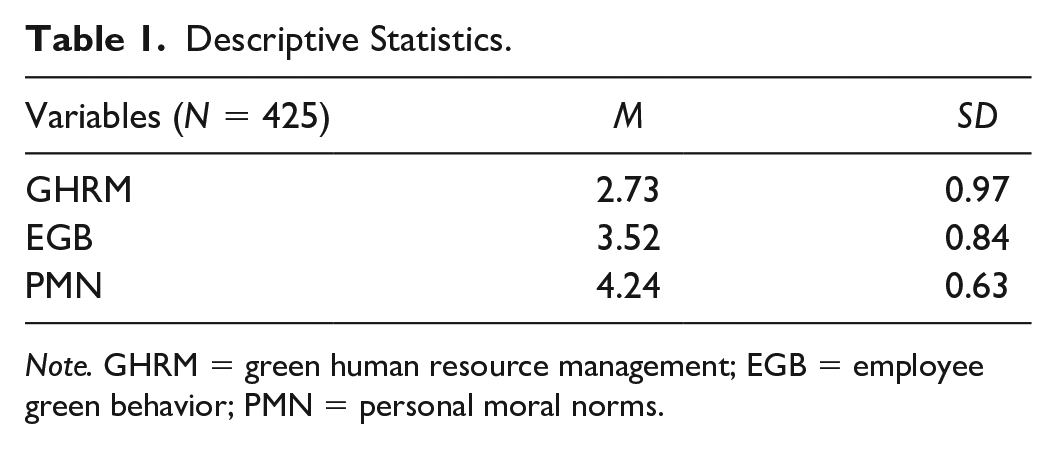
Note. GHRM = green human resource management; EGB = employee green behavior; PMN = personal moral norms.
The findings denoted that the perception of green HRM practices was very low, which possibly reflected the lackadaisical state of the EMS at the HEIs. However, the PMN of the academics was high, meaning they had moral norms and obligations toward the environment. Meanwhile, the EGB was average, which could be attributed to the lack of proper green HRM practices at the HEIs.
Measurement model
To examine the model, the first step taken was to check the convergent validity before testing the discriminant validity. According to Hair et al. (2017), convergent validity can be tested using factor loading, average variance extracted (AVE), and composite reliability (CR).
As indicated in Table 2, all the factor loadings were above 0.7, AVE was above 0.5, and all the CR > .7. Regarding the AVE, the variable was high, that is, above 0.5, making the convergent validity of the constructs satisfactory (Fornell & Larcker, 1981).
Convergent Validity.

Note. EGB 6 and 7 were deleted because of low factor loading. CR = composite reliability; AVE = average variance extracted; EGB = employee green behavior; GHRM = green human resource management; PMN = personal moral norms.
Discriminant validity was tested based on the suggestion by Gholami et al. (2013), which posited that discriminant validity is attained if there is a clear distinction among different constructs and also measures how many indicators characterize only on a single construct. Precise assessment of discriminant validity is vital to confirm that the constructs are statistically unique and differ from other constructs (Hair et al., 2019). As proposed by Henseler et al. (2015), at this stage, the study reported it using the HTMT (heterotrait-monotrait ratio of correlations) ratio. It is posited that if the HTMT value is greater than 0.85, there is a serious issue in discriminant validity (Franke & Sarstedt, 2019). As shown in Table 3, the HTMT criterion was below 0.85 thresholds, demonstrating that the discriminate validity was established.
Discriminant Validity (HTMT).
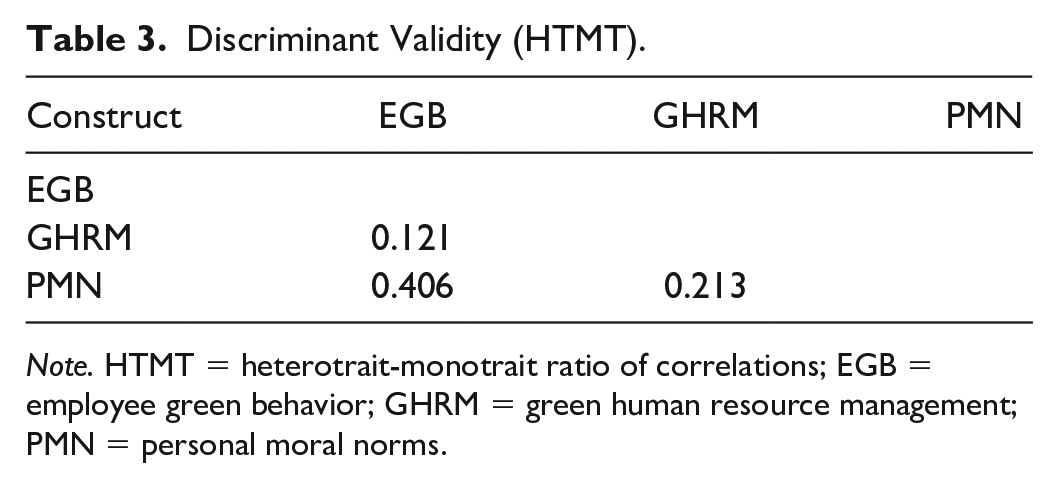
Note. HTMT = heterotrait-monotrait ratio of correlations; EGB = employee green behavior; GHRM = green human resource management; PMN = personal moral norms.
Structural model
Before the hypothesis testing, it was necessary to confirm that there was no problematic issue with lateral collinearity in the structural model. According to Diamantopoulos and Siguaw (2006), the variance inflation factor (VIF), which measures the collinearity, must be lower than 3.3. Table 4 indicates that all the VIF values were lower than the threshold value set by Diamantopoulos and Siguaw (2006), thus confirming that the collinearity was not a problem for this study.
Hypothesis Testing.

Note. Result of Direct effect: Structural Model/Hypothesis Testing. LL = lower limit; UL = upper limit; VIF = variance inflation factor; GHRM = green human resource management; EGB = employee green behavior; PMN = personal moral norms.
For the hypothesis testing, using the bootstrapping technique with a resampling of 5,000, the resolution to accept the hypothesis was established on the t value and p value, with confidence interval bias corrected. Based on the analysis, only two of the three developed hypotheses were supported. Surprisingly, the results showed that green HRM was not positively related to EGB (β = 0.031, t = 0.644: lower limit [LL] = −0.050, upper limit [UL] = 0.108, p > .05); hence, H1 was not supported. Next, the results showed that green HRM was positively related to PMN (β = 0.204, t = 4.661: LL = 0.127, UL = 0.270, p < .001); hence, H2 was supported. Furthermore, PMN was positively related to EGB (β = 0.338, t = 7.467: LL = 0.250, UL = 0.404, p < .001); hence, H3 was supported. For the mediation, the results showed that PMN positively mediated the relationship between green HRM and EGB (β = 0.069, t = 3.733: LL = 0.040, UL = 0.099, p < .001); hence, H4 was supported. The findings of the direct relationship are shown in Table 4 and the mediation analysis in Table 5.
Result of Mediating Effect.

Note. LL = lower limit; UL = upper limit; GHRM = green human resource management; PMN = personal moral norms; EGB = employee green behavior.
Table 6 shows the calculation of the coefficient of determination (R2), the effect size (f2), and the predictive relevance (Q2) of predictive variables on criterion variables of EGB and PMN. Based on the table, the R2 of .12 indicated that green HRM and PMN explained 12.0% of the overall variance of EGB, whereas the R2 of .042 showed that green HRM explained 4.2% of the overall variance of PMN. Falk and Miller (1992) opined that R2 values should be at least .10 to be considered sufficient. Hair et al. (2014) highlighted the strain imposed on a standard for acceptable R2 as it is contingent on both the model intricacy and the study discipline. For predicting human behavior, which is a daunting task, R2 of.10 is satisfactory. In this discipline of study regarding EGB, with two independent variables, an R2 value of 12.0% is acceptable.
Coefficient of Determination (R2), and Effect Size (f2).

Note. EGB = employee green behavior; PMN = personal moral norms; GHRM = green human resource management.
To analyze the predictive accuracy, the study used the Q2 by Geisser (1974). A blindfolding procedure was conducted to assess the predictive power of the model. In an analysis using a distance of 7, the Q2 indicates the predictive significance for definite criterion variables if the Q2 assessment is more than 0 (Fornell & Cha, 1994; Hair et al., 2017). The Q2 of the criterion variables, which were EGB and PMN, was 0.061 and 0.025, respectively, indicating an acceptable predictive relevance.
According to Cohen (1992), effect sizes 0.35, 0.15, and 0.02 are considered large, medium, and small effect sizes, respectively. The findings showed that PMN had a small effect size on the EGB (0.125), whereas green HRM had a small effect size on PMN (0.043). However, green HRM had no effect on EGB (0.001).

Path estimate for the hypothesized relationship (PLS algorithm result).
Discussion
Discussion on Findings
The objective of this study is to assess the impact of perceived green HRM on EGB of academics at HEIs in Malaysia. In the above-mentioned relationship, PMN was examined as a mediator. The findings showed that academics’ perceived green HRM practices at the HEIs were below expectations. The academics had moral obligations toward the environment, but the EGB could not be executed due to a lack of proper platforms. This is a wake-up call for HEIs, especially those in Malaysia. For environmental management initiatives to be successful in a society, there is a need to bridge the gap between theory and practicality. Green HRM is pivotal in this process, and thorough implementation of environmental initiatives should be constructed, with green HRM being the overarching department to oversee other functional departments at the HEIs.
The results surprisingly indicated that green HRM and EGB had no significant direct relationship between them. In some studies, it was found that the relationship between the two was significant (Dumont et al., 2016; Saeed et al., 2019). On the contrary, Kim et al. (2019) found that the relationship between green HRM and EGB in green hotels was not significant. Likewise, Fawehinmi et al. (2020) supported the finding of this study that green HRM has no significant impact on EGB. The reason for the insignificant result could be due to the green HRM practices at the HEIs being inappropriately implemented. Studies have also shown that when green HRM is not properly integrated with the EMS of organizations, green HRM practices are not effective enough to impact EGB (Mazzi et al., 2016). The perceived green HRM practices were rated as below average. This could cause the perception of EGB and the support for carrying out EGB at work among the academics to be affected.
However, the results showed that green HRM and PMN were significantly related. This shows that when green HRM practices were properly implemented, the moral responsibilities of the academics could be affected. This finding is supported by a study that found that the green values enshrined in organizational practices such as green HRM would affect the employees’ intrinsic motivation, which includes personal moral obligation toward the environment (Afsar et al., 2016).
Furthermore, the finding of this study showed that PMN affected EGB significantly. This finding is supported by the NAM, which posits that PMN is a direct predictor of EGB (Schwartz, 1977). It is also supported by the study by Ruepert et al. (2016), which declared that PMN affected EGB significantly. This indicates that when the employees form a moral responsibility toward conserving the environment because of the awareness of consequences as well as their ascription of responsibility, they will be obliged to perform EGB. In this study, this relationship was shown to have the strongest effect.
The results provided support for the significant relationship between green HRM and EGB with a fully mediating role of PMN. This finding is aligned with a study that posited that environmentally responsible leadership can encourage the moral reflectiveness of employees, which can consequently boost EGB (Yang, 2019). This insinuates that the green HRM practices do not directly result in the willingness to practice environmentally friendly behavior. Nevertheless, the green HRM practices do influence the development of employees’ moral obligations toward the environment, which in turn may result in environmentally friendly behavior. This is also supported by a study that reported that employees tend to perform behavior that is aligned with their norms (De Groot & Steg, 2009).
Theoretical Contribution
The findings of this study contributed to the validation of green HRM’s and EGB’s relevance in the successful implementation of EMS (Mazzi et al., 2016; Wagner, 2013). The findings of this study significantly contributed to the theoretical standpoint. First, they contributed to the AMO theory in the sense that in predicting EGB, green HRM has seldom been used. The results revealed that the two had no direct association, but the relationship could be established through the inclusion of an intervening variable such as PMN. Green HRM may be perceived by academics as a positive organizational value that is candid, consistent, reliable, and reflective of HEIs’ stance toward environmental sustainability. If academics have trust in the process and have a positive perception toward green HRM, they will tend to form a moral obligation toward environmental activities and finally fulfill HEIs’ expectations by performing pro-environmentally.
Likewise, giving academics the ability, adequate motivations, and the opportunities to perform may cause their positive perception of environmental sustainability to improve further. This discovery is consistent with that of the study by Harland et al. (2007), which argued about ability, efficacy, and awareness effect on PMN and then environmentally friendly behavior. This ability, efficacy, and awareness can only be attained when proper green HRM practices are in place, which means the green training on environmental issues and how to mitigate these issues. Hence, the findings of this study supported the NAM and the AMO theory by provided empirical evidence.
Second, another essential contribution of the study’s findings is they provided data on the role of green HRM in ensuring the success of EMS at HEIs in Malaysia. Previously, several studies have looked at the EMS of HEIs (Mat et al., 2011; Saadatian et al., 2009; Zhao & Zou, 2015) but paid little attention to the role of green HRM in the HEIs and how it can affect the success of EMS implementation. To the best of our knowledge, this study was the first to be conducted in the context of Malaysian HEIs.
Finally, the findings from this study gave insights into how green HRM affected the commitments of employees (Pham et al., 2020) as well as their green passion toward the environment (Jia et al., 2018). Without the moral reflectiveness and moral responsibility, it may be difficult to encourage employees to be committed and passionate about environmental sustainability; hence, the findings contributed toward the discussion of how green HRM affects the innate drive and resolution of employees.
Practical Contribution
As several scholars and practitioners in the field of higher learning have postulated, it is becoming one of the significant responsibilities for being an institution of learning to possess environmentally friendly behavior toward the EMS (Ávila et al., 2017; Brandli et al., 2015; Nawi & Er, 2018). Regarding the aforementioned statement, the findings of this study provided important and useful information that can be referenced and potentially applied by HEIs as they explore the best strategy for achieving green behavior. For instance, the findings highlighted the ability of green HRM to promote environmentally friendly behavior. Using the findings, it can be proposed that to ensure the sustainment of this appropriate behavior, human resource managers in the HEIs should adopt green HRM practices and policies before other functional efforts in environmental management. Green HRM should be a focal point for other functional areas of the HEIs and should collaborate efficiently with other functional areas, most notably with the EMS department. According to the findings of this study, HEIs must engage in appropriate green HRM practices as such practice improves academics’ positive feelings with their role in environmental conservation and preservation, which not only strengthens their moral norms but also leads to their green behavior.
In addition, the management of the HEIs, when formulating green HRM policies, needs to create organizational fundamental values directed at ecological sustainability. This entails propagating their environmental values so that potential employees with like-minded values would be attracted to join. The HEI should, in turn, use the environmentally friendly process in recruiting and selecting new employees.
Furthermore, the findings of this study showed that EGB can be improved through relevant initiatives from the human resource department. Taking the cues from the findings, the department can organize training programs, seminars, or awareness programs for the academics to enhance their awareness of the importance of environmental sustainability while upholding the environmental conservation and preservation policies of the HEI. The academics can be shown how they can mitigate the negative effects on the ecosystem and briefed to understand the disastrous effect on the ecosystem due to irresponsible disposing of batteries, paper, plastic, and glass.
The findings of this study indicated that employees are central to the achievement of organizations’ environmental performance. To increase the likelihood of the achievement, HEIs can implement a screening process at the recruitment stage to ensure accepted candidates possess pro-environmental attitude. To ensure that this process is well adhered to, there should be the propagation of the environmental values held by the HEIs through green recruitment and selection. This can be through the declaration of the environmental values of the HEI on the recruitment portal. To ensure that recruits’ values are in line with the HEI, interview questions could relate to scenario issues on conserving and preserving the environment. Furthermore, HEIs need to apply the environmental performance of academics into their appraisal system and link it with recognition and reward (nonmonetary and monetary). There should also be room for academics to be involved in the formulation of the policies, through feedbacks and remarks. This will cause their cooperation toward environmental conservation to heighten further.
The findings of this study, which confirmed the existence of the interplay between green HRM and EGB through mediation by PMN, can make the government realize that HEIs have as much role to play in environmental sustainability. Thus, the government should encourage organizations, including HEIs, to continue to focus on ensuring that employees’ behaviors are aligned with environmental sustainability. This can be implemented through government policies that give incentives such as tax reduction to organizations based on their employees’ environmental performance. The government can also assist by creating and encouraging easy access to carbon-less transportation options for employees, such as the provision of carbon-free public transport as well as the provision of cycling-friendly lanes and facilities.
Limitation and Future Research Directions
This study has some limitations that can be addressed in future studies. First, this study was conducted in five public research universities in Malaysia. Hence, its findings are not generalizable to other HEIs. Future studies should be carried out in private universities due to the difference in organizational structure and funding. Furthermore, the findings of this study are not generalizable to other countries due to different cultural contexts. Future studies should be carried out in other countries, especially in emerging and developed economies.
Second, although PMN were found to fully mediate the relationship between green HRM and EGB, the beta value was quite low (at 0.069). Hence, future studies using this model should include a moderating variable that could increase the mediation effect of PMN. Such variables could be a supportive leadership role, top management commitments, or workplace spirituality. Environmental transformation leadership has been indicated to impact the internal motivation to be pro-active toward conserving the environment (Graves & Sarkis, 2018). Workplace spirituality has been shown to impact the intrinsic motivation of employees to protect the environment (Afsar et al., 2016).
Third, this study included only one mediating variable. There is a need to determine other variables that could explain the mechanism between green HRM and EGB. Hence, future studies should use other variables such as self-efficacy, environmental knowledge, and environmental concern to understand the underlying mechanism between green HRM and EGB. It has been cited that employees with sufficient environmental knowledge (Safari et al., 2018) and self-confidence (Meinhold & Malkus, 2005) would behave pro-environmentally at work, so future studies should investigate their mediating role between green HRM and EGB.
Fourth, the common method bias did not affect the findings in this study based on the HSFT test result. Bou-Llusar et al. (2016) recommended that a survey for independent and dependent variables should be acquired from diverse sources to reduce the possibility of common method bias. Future studies should carry out a survey that collects data from different types of respondents for different sections, such as collecting data green HRM practices from human resource managers and EGB from academics. This will shed some light on the situation between actual green HRM practices and the responses of the academics toward this initiative.
Fifth, this study focused specifically on the relationship between green HRM and EGB and the mediating effect of PMN. It will be interesting for future research to assess the moderating role of PMN between green HRM practices and green goal difficulties as green goal requires effort and time to achieve (Pinzone et al., 2019), Furthermore, future studies on the moderating role of PMN between green HRM and environmental commitment of employees would be of great value.
Finally, this study used a quantitative method, with an administered questionnaire to collect data. As such, the results were limited to only numerical descriptions, and there was no detailed narrative to provide elaborate accounts of human perception. Future studies may use the qualitative method through a structured and semi-structured interview to investigate how the role of green HRM supports EGB of academics in the short and long terms.
Conclusion
The current study examined the role that green HRM plays in affecting the EGB of Malaysian academics through their PMN. The results showed that green HRM did influence EGB but with PMN fully mediating the relationship. Effective green HRM practices can shape the personal norms of academics, which would consequently affect their EGB. EGB has been shown to play an important role in supporting the EMS in the organizations. Hence, this study has shown how green HRM is pivotal to the successful implementation of EMS at Malaysian HEIs.
The study of green HRM in the individual context is still at the infancy stage (Dumont et al., 2016), particularly in Malaysia (Yong, Yusliza, Ramayah, & Fawehinmi, 2019). Therefore, this study aims to inform different categories of industries of the vital role of green HRM in supporting environmentally friendly behavior at work and how beneficial it can be for the organizations and the environment. HR practitioners have a role in saving the environment while sustaining the productivity of the employees and keeping them motivated.
The need to go green among organizations and HEIs across the globe is pivotal, including in Malaysia, which is one of the emerging countries in Asia. The heavy demands faced by organizations and HEIs to meet the needs of different parts of the world have caused environmental degradation that has hurt the ecosystem.
Footnotes
Declaration of Conflicting Interests
The author(s) declared no potential conflicts of interest with respect to the research, authorship, and/or publication of this article.
Funding
The author(s) disclosed receipt of the following financial support for the research, authorship, and/or publication of this article: Fundamental Research Grant Scheme (FRGS) from Ministry of Higher Education Malaysia is acknowledged for funding this research (Vot. No. 59600).
