




Abstract
Sustainability issues have compelled hotel organizations to adjust their management practices not only to comply with government regulations but also to meet market demands. The success of sustainability initiatives depends on employees’ green behaviors and the leadership that supports them. This study investigates how green servant leadership shapes green organizational citizenship behavior through various mechanisms. Drawing on social learning theory and conservation of resources theory, we examine the roles of green organizational identification, green self-efficacy, green creativity climate, and perceived meaningful work. We also test the moderating effect of green shared vision on these relationships. Data were collected from 389 employees working in 3- to 5-star hotels in Ho Chi Minh City, Vietnam. The results show that green servant leadership positively predicts green organizational citizenship behavior, and that green shared vision strengthens green servant leadership’s effects on green organizational identification, green self-efficacy, and perceived meaningfulness of work. These findings offer theoretical and practical insights into how leadership fosters extra-role green behaviors in the high-impact hospitality sector.
Plain language summary
This study looks at how hotels can improve environmentally friendly behaviors, focusing on the role of leadership and workplace factors. By surveying 389 employees in 3- to 5-star hotels in Ho Chi Minh City, it found that eco-focused leadership encourages green actions, with teamwork and shared goals further boosting employee engagement in sustainability efforts. These findings offer practical strategies for hotels in Vietnam and similar countries to promote green practices.
Keywords
Introduction
Environmental degradation, climate change, and many environmental sustainability issues have become grand challenges for organizations globally (George et al., 2024), with the tourism and hospitality sector increasingly under scrutiny for its ecological footprint (Yu et al., 2024). In particular, the hotel industry contributes significantly to environmental degradation by generating more than a fifth of tourism’s total footprint through high carbon emissions, waste production, excessive water and energy use, and poor waste management (Leyva & Parra, 2021). The industry also faces operational risks resulting from climate change and increasing regulatory pressures (Jones et al., 2014).
These impacts are especially visible in urban centers such as Ho Chi Minh City, Vietnam where rapid tourism development has placed mounting pressure on infrastructure, living spaces, and natural resources. According to Ho Chi Minh City Department of Tourism (2023), Ho Chi Minh City accounted for over 25% of the nation’s international tourist arrivals in 2022, and the city’s hospitality industry has grown by an average of 7.8% annually over the past 5 years. The city hosts over 3,227 hotel rooms, primarily concentrated in 3- to 5-star establishments, which indicates a high density of energy-intensive operations. Given the city’s strained infrastructure and environmental vulnerabilities, sustainable hotel operations have become imperative.
Furthermore, amid rising expectations for sustainable development, the Vietnamese government has introduced national strategies for green growth and low-carbon development, such as the National Green Growth Strategy (2021–2030). These policies have placed increased pressure on hotels organizations to align their practices with the sustainable development goals and comply with national regulations. On the other hand, sustainability can also serve as a differentiation strategy for businesses to meet the evolving market and consumer expectations, as well as to boost organizational performance (Danso et al., 2019; Walsh & Dodds, 2017). However, translating sustainability discourses and policies into management and organizational practices often requires appropriate leadership from management as well as followership from the side of employees (Elshaer et al., 2021; Zheng et al., 2021). Scholars have suggested that it is essential to investigate the employees’ GOCB (Pham et al., 2019; Xiang & Yang, 2020).
Among the various leadership styles (e.g., transformational leadership) that can positively influence employees’ GOCB (Fahlevi et al., 2022; Felin et al., 2015; Li et al., 2023), several scholars have argued green servant leadership is the most promising for Confucian Asia contexts (Luu, 2019; Siddiquei et al., 2021; Yu et al., 2024). Based on the extant literature on servant leadership (Eva et al., 2019; Ogbonnaya et al., 2025) as well as its environmentally specific variation (Luu, 2019), we refer to green servant leadership as a leadership style where leaders support and empower employees to act on environmental goals by putting sustainability and others’ needs first. These leaders not only model environmental values but also facilitate employee-driven green behavior through psychological support and capacity building (Afsar et al., 2018; Shah et al., 2023).
Despite recent focus on green servant leadership (Yu et al., 2024; Zafar et al., 2025), there remains a gap in understanding the mechanisms through which green servant leadership promote various positive sustainability-related outcomes. Furthermore, except for seminal work by Luu (2019), few research has examined green servant leadership in Vietnamese hospitality context. To address this theoretical gap and contribute to management practices, this study examines the role of green servant in fostering GOCB among hotel employees in Ho Chi Minh City. Specifically, it investigates how green servant leadership influences key mechanisms: green organizational identification, green self-efficacy, green creativity climate, and perceived meaningful work. Green organizational identification refers to the level of employee introspection toward the organization’s value systems and environmental goals (Chen & Chang, 2013). Green self-efficacy refers to the perceived ability and belief of individuals toward environmental goals (Chen et al., 2015). Green creativity climate refers to the degree of organizational support for employees allowing them to creatively achieve a work task (Martins & Terblanche, 2003). Perceived meaningful work refers to the state in which employees feel that the work they are doing is valuable and makes a difference (Kahn, 1990). These variables allow us to examine various attitudinal, cognitive, and cultural mechanisms of green servant leadership.
Building a common green vision is an important factor that promotes the green behaviors within organizations (Chang et al., 2020). This study also considers the moderating role of green shared vision, defined as the degree to which environmental goals are collectively promoted and understood within the organization. By modeling both direct and conditional pathways, the study contributes to a more nuanced understanding of how leadership shapes green behavior in Vietnamese hospitality sector.
Given the economic and environmental significance of the hospitality industry in Vietnam, this study addresses a timely and underexplored issue. The findings were validated through empirical testing of thirteen hypotheses within the proposed research framework. The study concludes with a discussion of the results, highlighting the key findings, practical implications, and potential avenues for future research.
Literature Review and Hypothesis Development
Bibliometric Analysis
Database Management
Bibliometric analysis evaluates the intensity of citation linkages between documents. Higher linkage intensity indicates more shared citations between the target documents (Ma et al., 2022). This method helps track the development and relevance of topics over time. Therefore, this study aims to synthesize the related literature on GOCB through bibliometric analysis. Bibliometric is a big data analysis method used in evaluating systematic documents and includes the quantitative analysis of academic research works. It deeply examines research trends, productivity, and interlinking patterns.
To filter the list of articles used, the author first needs to identify keywords to mine the database from Web of Science, the world’s oldest authority, to find relevant documents. Then, the study uses specific criteria to analyze the content and bibliometric data to integrate into the research, based on retrieving and searching data in the “TOPIC” field using keywords such as: “Organizational citizenship behavior for the environment,”“Organizational citizenship behavior toward the environment,”“Employee environmental commitment,”“Harmonious environmental passion,”“Corporate greening,”“Environmental management,”“Environmental performance,”“Organizational citizenship behavior,”“Eco-initiatives.” The search process was conducted on May 29th, 2024.
To ensure the study meets sufficient evaluation criteria, the research team expanded the search to include research papers and articles published in reputable journals in the fields of Management (4.442), Psychology Applied (2.372), Business (2,090), Psychology Multidisciplinary (732), Hospitality Leisure Sport Tourism (405), Psychology Social (442), Industrial Relations Labor (428), Environmental Sciences (336), Environmental Studies (309) included in the database. Additionally, the study considered and selected articles written in English according to the publication language criteria. After searching the documents based on these criteria, the initial phase results showed 9,400 articles during the search period from 1990 to 2024. To conduct a comprehensive and in-depth analysis of the data, the next step involves inputting the collected data into VOSviewer software.
Growth in the Number of Published Papers and Citations
Based on bibliometric analysis, Organizational Citizenship Behavior (OCB) is identified as a variable of interest in this field through the number of published papers and citations showing that from 1990 to 2003, OCB remained a less academically explored topic, with only a few dozen publications delving into it, reaching 59 publications in 2003, with fluctuating numbers of publications. However, starting from early 2004, academic authors began showing increasing interest in this field, culminating in an explosion of publications in 2022, with 832 publications. Regarding citations, from 1990 to May 2024, out of the 9,400 publications and a total of over 175,785 citations related to this topic (including self-citations), the number of citations utilized by different articles shows a significant upward trend.
Country-Wise Publication Trend
Regarding the level of interest of countries in this topic, focusing on five specific countries in Figure 1, including The United States leads with 3,145 articles, demonstrating profound interest in the topic. Next is the People’s Republic of China with a total of 1,824 articles, highlighting significant engagement in organizational citizenship behavior research. Following China are the United Kingdom with 606 articles, Canada (604 articles), and Australia (523 articles), demonstrating strong commitment to research in their respective countries, demonstrating strong commitment to research in their respective countries. Additionally, other countries such as Pakistan (449 articles), South Korea (440 articles), Taiwan (424 articles), India (373 articles), and the Netherlands (351 articles) also show considerable interest in OCB research. The data underscores each country’s level of interest in OCB research, painting a comprehensive picture of the research landscape with active participation and collaborative efforts from multiple countries in developing a global research community in this field.
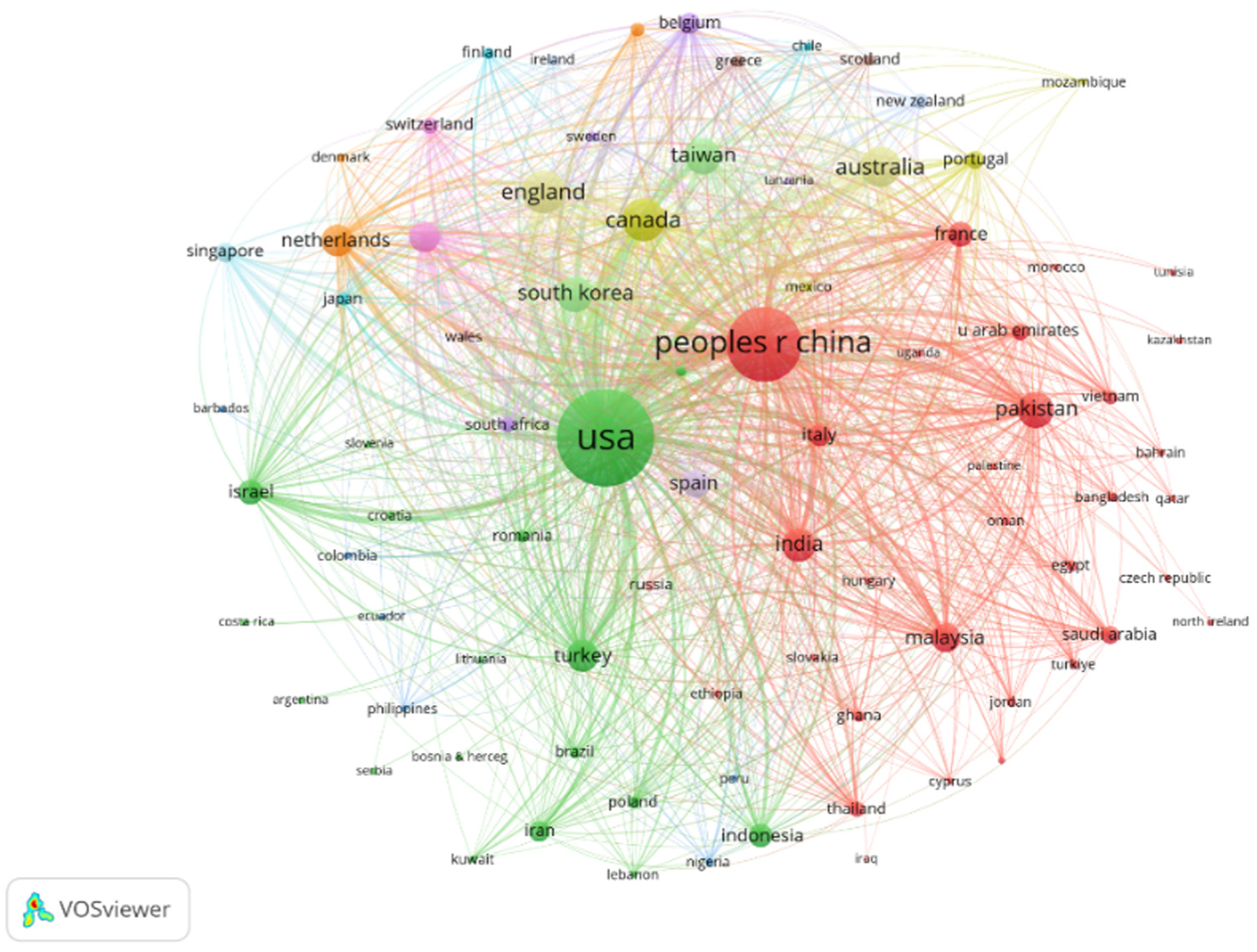
Country publications.
Co-Occurrence Analysis—Author Keywords
The network analysis of co-occurring keywords is based on keywords related to the research topic of previous studies conducted by authors. The research content related to OCB is divided into eight clusters by the VOSviewer software, as shown in Figure 2. Keywords reflect key issues in a specific research field; therefore, this study utilizes CiteSpace’s “keyword” function to extract the top 10 keywords in a certain search period and generate a co-occurrence map of these keywords. The results indicate that “Green Organizational Citizenship Behavior,”“Management,”“Leader-Member Exchange,”“Support,”“Commitment,”“Organizational Justice,”“Corporate Social Responsibility,” and “Work Engagement” are frequently occurring keywords with high centrality, highlighting their importance in this research area.

Keyword co-occurrence results.
The keyword co-occurrence analysis reveals eight thematic clusters that represent the evolving landscape of OCB research. Cluster 1, the largest, focuses on foundational definitions, theoretical underpinnings, and measurement scale development of OCB. Early contributions (Smith et al., 1983) established the construct’s multidimensional nature, while later studies extended it into green contexts, exploring dimensions such as ethical behavior, employee well-being, and performance (Organ, 2014; Paillé et al., 2014).
Cluster 2 emphasizes the contextual and cultural dimensions of GOCB, highlighting how organizational values, communication, and environmental policies shape employees’ voluntary behaviors. This cluster underscores the importance of meaningful work and alignment between personal and organizational environmental goals (Chiang & Hsieh, 2012; May et al., 2004).
Cluster 3 explores the motivational aspects of OCB, particularly how intrinsic motivation and career-related benefits influence individuals to engage in discretionary behavior. Studies have linked these behaviors to autonomy, job satisfaction, and long-term organizational engagement (LePine et al., 2002).
Cluster 4 centers on organizational commitment as both a predictor and mediator of GOCB. Commitment fosters a sense of responsibility, encouraging employees to go beyond formal roles to support sustainability initiatives (Meyer & Allen, 1991).
Cluster 5 reflects a psychological lens, examining how internal states, such as job fit and emotional well-being, affect citizenship behavior. This aligns with the rise of positive organizational psychology in OCB research (Luthans & Youssef, 2007).
Cluster 6 maps the growing interest in leadership styles, with numerous studies demonstrating how transformational, authentic, and servant leadership influence OCB expression across various contexts (Afsar et al., 2018; Liden et al., 2014).
Cluster 7 highlights the role of organizational justice, grounded in equity theory. Perceptions of fairness significantly impact employees’ willingness to contribute beyond formal expectations (Colquitt et al., 2001).
Finally, Cluster 8 though limited in volume, focuses on leadership influence processes, specifically how leaders model citizenship behaviors that employees emulate, reflecting the social learning dynamic within OCB development (Bandura, 1977).
Beyond mapping the existing knowledge landscape, this bibliometric analysis offers valuable insights into emerging scholarly directions and highlights critical gaps that merit further investigation. Although GOCB has been increasingly linked to leadership styles, employee motivation, and environmental identity (Chen, 2011; Xiang & Yang, 2020), few studies have examined these relationships within the high-impact hospitality sector of rapidly urbanizing economies. In particular, the influence of environmentally specific servant leadership (Afsar et al., 2018; Yuan & Li, 2022) and the moderating role of green shared vision (Chen et al., 2015; Chang et al., 2019) remain underexplored. This gap is especially pressing in developing contexts like Vietnam, where environmental pressure intersects with rapid tourism growth (Singjai et al., 2018). Thus, the current analysis not only consolidates prior research but also helps direct future empirical efforts toward addressing these overlooked yet increasingly relevant dimensions of organizational sustainability.
Theoretical Perspectives to Understand Environmentally Specific Servant Leadership
Servant leadership is grounded in a fundamental motivation to serve others (Liden et al., 2014). Servant leaders prioritize the needs of followers and the broader community (Eva et al., 2019; Lemoine et al., 2019). Eva et al. (2019) further specify servant leadership through its motive (an other-oriented drive to serve), mode (individualized focus on followers’ growth), and mindset (commitment to community well-being). Building on these foundations, scholars have conceptualized and mobilized an environmentally specific model of servant leadership and this model has proven theoretically robust and practically relevant in the tourism and hospitality industry (Aboramadan et al., 2020; Luu, 2019; Mughal et al., 2024). Following Mughal et al. (2024), we refer to this concept as green servant leadership.
Green servant leadership is defined as a leadership style in which servant leaders channel their service orientation toward environmental stewardship (Luu, 2019). These leaders model pro-environmental values, actively support employees’ contributions to sustainability, and empower others to engage in behaviors that align with the organization’s environmental goals (Luu, 2019). This leadership style works through the communication of environmental standards and values to facilitate employees’ green actions and encouraging their active participation in green projects (Afsar et al., 2018). By providing resources, leaders promote a shared perspective among employees that the organization highly values their actions (Priyankara et al., 2018).
According to conservation of resources theory (Hobfoll, 1989), individuals strive to acquire, retain, and protect resources. When they perceive themselves as possessing adequate resources, whether material, psychological, or relational, they are more likely to engage in discretionary behaviors that go beyond formal role requirements in order to further enrich their resource pool. In the context of environmental initiatives, green servant leaders provide not only tangible support such as information and tools but also psychological resources such as encouragement and meaning, which can motivate employees to voluntarily contribute to pro-environmental efforts. At the same time, social learning theory (Bandura, 1977) suggests that individuals learn by observing and imitating role models, particularly those in positions of authority. When leaders demonstrate consistent commitment to environmental values through servant behaviors such as prioritizing environmental stewardship and empowering followers to act sustainably, employees are likely to internalize these values, incorporate such social and organizational identity into their sense of self, and mimic such behaviors, leading to increased organizational citizenship behavior. In the subsequent sections, we draw from both theoretical perspectives to hypothesize the mechanisms through which green servant leadership positively influences GOCB.
Hypothesis Development
Proximal Outcomes of Green Servant Leadership
We first argue that green servant leadership can foster green organizational identification, defined as the extent to which employees perceive themselves as part of a green-oriented organization (Liu et al., 2020; Song et al., 2019). Green servant leaders act as moral role models by visibly prioritizing environmental goals and integrating sustainability into daily operations. According to social learning theory (Bandura, 1977), employees internalize these pro-environmental values through observational learning, which gradually shapes how they define themselves in relation to the organization. Over time, this modeling fosters stronger alignment between personal and organizational environmental values, contributing to green organizational identification. Additionally, by emphasizing interpersonal connections and shared purpose, green servant leaders strengthen employees’ emotional attachment to the organization (Siddiquei et al., 2021). This is consistent with Eva et al.’s (2019) view of servant leadership as rooted in an other-oriented motive and enacted through one-on-one relationships that redirect self-interest toward shared commitments. Thus, we hypothesize the following:
Green self-efficacy refers to an individual’s belief in their ability to perform environmental tasks successfully (Sh. Ahmad et al., 2022). From a conservation of resources perspective, self-efficacy functions as a psychological resource that enables individuals to engage in proactive, self-initiated behavior. As a hallmark of servant leadership’s mode of action (Eva et al., 2019), green servant leaders contribute to this by prioritizing followers’ development and providing individualized support. Through encouragement, feedback, and opportunities for skill-building, these leaders equip employees to feel more competent in addressing environmental challenges (Clercq et al., 2022). As confidence increases, employees become more willing to take ownership of green behaviors. Thus, we propose:
A climate for green creativity reflects the organizational support for novel, eco-conscious ideas (Chen & Chang, 2013). Green servant leadership promotes this climate in two interrelated ways. First, from a social learning perspective, leaders act as role models who demonstrate creative engagement with environmental problems, signaling that innovation is valued and safe to pursue (Kim et al., 2020). Second, from a conservation of resources perspective, servant leaders offer resources such as guidance, autonomy, and psychological safety, which reduce the perceived costs of risk-taking and encourage employees to invest in green behaviors (Halbesleben et al., 2014). This aligns with Eva et al.’s (2019) view that servant leaders cultivate followers through one-on-one development and a commitment to their growth, creating conditions that support personal experimentation and collective creativity. When such leadership is present, employees are more likely to contribute ideas and engage in environmentally driven creativity. As such, we propose the hypothesis below:
We posit that green servant leadership helps employees experience their work as more meaningful. Employees who perceive their work as meaningful are more likely to invest effort and engage in extra-role behaviors (Kaur & Mittal, 2020). According to conservation of resources theory, meaningful work is a valued psychological resource that energizes individuals and motivates them to preserve and expand that resource (Chen et al., 2018). Servant leadership enhances this perception by framing environmental tasks within a broader moral and social purpose, consistent with its mindset of stewarding both people and the wider community (Eva et al., 2019). By reinforcing the significance of employees’ contributions to environmental outcomes, green servant leaders elevate the perceived purpose of work. As such, we propose the hypothesis below:
Distal Outcome of Green Servant Leadership
Beside attitudinal and cognitive outcomes, we argue that green servant leadership can also play a role in influencing an important behavioral outcome of GOCB. GOCB refers to employees’ voluntary and proactive efforts to support environmental sustainability beyond formal job requirements (Han et al., 2019). In the hotel industry, where daily operations heavily impact the environment, such behaviors play a critical role in driving environmental performance. While prior research has examined green transformational leadership as a driver of GOCB in hospitality contexts, emerging evidence suggests that servant leadership, with its relational and morally grounded orientation, may be particularly well-suited to fostering such behavior (Bavik et al., 2017; Elche et al., 2020).
According to conservation of resources theory, when employees perceive that their leaders provide ample resources (e.g., support), they are more likely to reciprocate by investing those resources in discretionary, prosocial behaviors. In this case, green servant leadership signals to employees that sustainability initiatives are supported and valued within the organization, which can boost morale and encourage proactive environmental action (Luu, 2019). Thus, when leaders adopt this leadership behavior, employees are more likely to engage in GOCB as a form of resource investment and value alignment. Based on the above discussion, we propose the following hypothesis:
The Role of Green Organizational Identification, Green Self-Efficacy, Green Creativity Climate, and Perceived Meaningful Work in Promoting GOCB
In addition to its direct effects, we argue that green servant leadership also cultivates key attitudinal and cognitive states that, in turn, promote GOCB. Drawing on conservation of resources theory and social learning theory, we posit that green organizational identification, green self-efficacy, climate for green creativity, and employee perceived meaningfulness of work are important mechanisms through which green servant leadership fosters employees’ voluntary pro-environmental behaviors.
Green organizational identification represents the extent to which employees define themselves in terms of the organization’s green values and goals (Song at al., 2019). When employees identify strongly with a green-oriented organization, they are more motivated to act in ways that align with its sustainability agenda, including participating in green initiatives, supporting colleagues’ environmental efforts, and voluntarily promoting green practices (Xiang & Yang, 2020). According to social learning theory, identification is strengthened when leaders model strong environmental commitment, which is central to green servant leadership. Moreover, research suggests that green identification not only predicts behavior but also informs broader strategic awareness and organizational commitment (Dutton & Dukerich, 1991; Sharma, 2000). As such, we propose the hypothesis below:
Green self-efficacy refers to employees’ confidence in their ability to perform environmentally friendly tasks and contribute to sustainability goals (Mughal et al., 2022). As noted above, self-efficacy, from a conservation of resources perspective, functions as a psychological resource that enables individuals to pursue challenging and proactive behaviors. Employees with high green self-efficacy are more likely to take initiative, persist through challenges, and go beyond formal role expectations to support environmental outcomes (Jugert et al., 2016; Schutte & Bhullar, 2017). Given growing environmental pressures in the workplace, self-efficacy has emerged as a critical predictor of sustained engagement in green behaviors (Ullah et al., 2021). Hence, we hypothesize:
Climate for green creativity reflects the extent to which the organizational environment supports, encourages, and rewards eco-conscious innovation. In a climate that promotes green creativity, employees are more likely to propose new ideas, experiment with sustainable practices, and contribute to long-term environmental goals (Aboramadan et al., 2021). Drawing on both social learning theory and conservation of resources theory, this type of climate is reinforced when leaders provide visible modeling, flexibility, support, and recognition for green initiatives (Chiang & Hsieh, 2012; Khan et al., 2021). Research shows that such climates create enabling conditions for employees to engage in GOCB by fostering a sense of ownership, psychological safety, and goal alignment (Zientara & Zamojska, 2018). Accordingly, the following hypothesis is proposed:
Employee perceived meaningfulness of work refers to the degree to which employees perceive their work as purposeful, significant, and aligned with personal and societal values (May et al., 2004). According to conservation of resources theory, meaningful work is a valued resource that fuels engagement and motivates individuals to invest in extra-role behaviors. When employees perceive their green-related tasks as contributing to a broader purpose, such as environmental preservation or community wellbeing, they are more likely to go beyond their formal roles and engage in citizenship behaviors (Bailey et al., 2019; Williamson & Geldenhuys, 2014). This leads us to formulate the following hypothesis:
The Moderating Role of Green Shared Vision
In response to sustainability challenges, green shared vision has emerged as a key organizational resource and strategic tool for organizations and management to further sustainability initiatives. Defined as a collective understanding and commitment to environmental goals across the organization, green shared vision serves as a strategic guide for aligning employee actions with green objectives (Chen & Chang, 2013). When such a vision is clearly articulated, it shapes a shared mindset that supports resource mobilization, guides strategic direction, and inspires employees to exceed expectations in pursuit of collective environmental values (Chang et al., 2019). In other words, green shared vision can enhance the effectiveness of green servant leadership by reinforcing the leader’s environmental priorities as organizationally legitimate and collectively endorsed, thereby strengthening followers’ receptiveness to the leader’s influence.
First, we propose that green shared vision accentuates the impact of green servant leadership by reinforcing clarity and ownership around green goals. Organizations that empower employees to define roles and contribute to environmental targets are better positioned to activate employee engagement and role alignment (Afsar et al., 2020; Chen et al., 2015). When employees perceive their organization as environmentally responsible and socially committed, they are more likely to internalize pro-environmental values and engage in green behaviors encouraged by their servant leaders (Chen et al., 2015). Thus, we propose the following:
Second, a clear and robust green shared vision enables leader to align individual goals with organizational values (Yukl, 1998), helping employees navigate behavioral challenges and commit more fully to green tasks (Bass, 1990). This alignment reinforces green self-efficacy by providing both direction and encouragement, making employees feel more confident in their ability to contribute to sustainability efforts (Kirkpatrick & Locke, 1996). green servant leadership, when coupled with a high level green shared vision, bolsters organizational confidence in environmental outcomes and enhances employee motivation and morale (Kantabutra & Avery, 2010; Zheng et al., 2021). Based on this argument, we hypothesize the following:
Third, green shared vision also plays a critical role in amplifying the effect of green servant leadership in enabling a climate for green creativity. Green shared vision communicates the organization’s forward-looking goals and environmental priorities, thereby creating a context in which new green ideas are encouraged and valued (Rice et al., 1998; Wyer et al., 2010). Green servant leadership’s support for creativity is more impactful when employees understand the broader vision of the organization in relations to sustainability issues. Under a strong green shared vision, the influence of green servant leadership is amplified. Employees are more receptive to the leader’s environmental values, more likely to recognize the significance of environmental issues, and feel psychologically safe to contribute ideas. In this context, servant leaders are more effective in mobilizing collective effort, fostering team cohesion, and directing employees toward green-focused creativity. As such, we propose the hypothesis below:
Lastly, employee perceived meaningfulness of work is also shaped by green shared vision. Work becomes more meaningful when employees see a clear link between their tasks and a socially or environmentally valuable purpose (Lips-Wiersma & Wright, 2012). In this context, green shared vision acts as a reference point for employees to evaluate the significance of their work. When combined with high level of green shared vision, green servant leadership can further enhance the perceived value and impact of employees’ contributions.
Based on the summary of the previous literature review, the research model is presented as follows Figure 3.

Research model.
Methodology
Sample Description
This study adopted a cross-sectional survey design to gather primary data from employees working in 3- to 5-star hotels in Ho Chi Minh City, which is Vietnam’s leading tourism destination. These hotels were selected due to their active engagement in structured environmental initiatives and standardized organizational practices, which provide a suitable context for examining GOCB (Zientara & Zamojska, 2018). Data were collected through both online and paper-based questionnaires administered between January and March 2024.
To ensure a diverse and representative sample, purposive sampling was employed to reach employees across various departments, including front office, housekeeping, food and beverage, and others. A total of 409 responses were collected, of which 389 were deemed valid after data screening for completeness and consistency.
In line with methodological best practices, an a priori power analysis was conducted using G*Power 3.1 to assess the adequacy of the sample size for structural equation modeling. Assuming a medium effect size (f2 = .15), an alpha level of .05, a statistical power of .95, and a maximum of seven predictors, the required minimum sample size was calculated to be 153 (Cohen, 1988). With 389 valid observations, the dataset far exceeds this threshold, ensuring sufficient statistical power for detecting meaningful effects in the PLS-SEM analysis (Hair et al., 2016).
Measures
The measurement scales used in this study were selected based on a thorough review and synthesis of prior validated instruments. The research model comprises seven core constructs, each measured using established scales from previous studies. Environmentally Specific Servant Leadership was measured using 12 items developed by Liden et al. (2014). Green Organizational Identification was assessed with six items adapted from Chen (2011), while Green Self-Efficacy consisted of six items derived from Chen et al. (2015). Climate for Green Creativity was measured with four items from Kim and Yoon (2015), and Employee Perceived Meaningful Work included three items adapted from May et al. (2004). Green Organizational Citizenship Behavior was measured using 10 items from Paillé et al. (2014), and Green Shared Vision (GSV) was assessed using four items developed by Chen et al. (2015). All constructs were measured using a seven-point Likert scale ranging from 1 (strongly disagree) to 7 (strongly agree).
Method of Analysis
The study employed PLS-SEM 4.0 for data analysis due to its strong capacity to handle complex models involving multiple constructs, including both mediating and moderating effects. Unlike covariance-based SEM, which is more suitable for theory confirmation, PLS-SEM is particularly appropriate for exploratory and predictive research aiming to explain variance in key dependent variables (Hair et al., 2019; Sarstedt et al., 2014). This analytical approach aligns well with the study’s objective to assess the predictive power of environmentally specific servant leadership and its influence on GOCB through several psychological and organizational mediators.
Common Method Bias Control
To address the concern of common method bias (CMB), we employed both ex ante procedural and post hoc statistical remedies. Procedurally, anonymity and confidentiality were ensured, and respondents were informed that there were no right or wrong answers, thereby reducing self-reported biases. Statistically, Harman’s single-factor test was conducted, and the first factor accounted for only 34.2% of the total variance, which is below the 50% threshold (Podsakoff et al., 2003). This indicates that CMB is not a major concern in our dataset.
Empirical Results
Descriptive Statistics
Table 1 shows that males (41.4%) and females (58.6%) participated in the study, with slightly more female respondents. In terms of age, the majority were between 26 and 30 years old (31.1%), followed by those between 31 and 35 years old (28.0%). Most participants had a university education (49.1%) and worked in the Food and Beverage department (40.9%). The type of hotel was evenly distributed across 3 to 5-star hotels, with a higher concentration in 4-star hotels (38.6%). Finally, the majority of participants had over 10 years of experience (43.2%), followed by those with 5 to 10 years of experience (40.6%).
The Demographic Characteristics of the Sample.

Source. Authors’ own creation.
All constructs exhibit strong measurement properties. Most outer loadings are above the recommended threshold of .70 (Hair et al., 2019), indicating satisfactory item reliability. High-loading items are particularly evident in constructs such as Green Organizational Identification (GOI), Climate for Green Creativity (CFGC), Employee Perceived Meaningful Work (EPMW), and Green Shared Vision (GSV), where loadings frequently exceed .85. Mean scores for all items range from approximately 5.0 to 5.9 on a 7-point scale, suggesting respondents generally agree with the environmental statements. Standard deviations fall between .7 and 1.3, reflecting moderate variability and absence of response bias (Table 2).
Average Statistics Results.

Source. Authors’ own creation.
Assessment of the Measurement Model
The internal consistency of the dimensions within each construct was tested and confirmed through Composite Reliability (CR) and Discriminant Validity, which was assessed by examining the Average Variance Extracted (AVE) between dimensions (Table 3). Specifically, all constructs showed CR values higher than the recommended threshold, ranging from .832 to .954, surpassing the acceptable level of .70. Additionally, the AVE values ranged from .598 to .847, exceeding the minimum requirement of .50 (Hair et al., 1998), demonstrating that the reliability of the study is within acceptable limits.
Results of Descriptive Statistics, Validity, and Reliability.

Source. Authors’ own creation.
Note. CR = composite reliability; AVE = average variance extracted; N/A = not available.
Two criteria were used to evaluate discriminant validity. First, the Fornell and Larcker (1981) criterion requires that the square root of the AVE should be higher than the correlation between constructs. The second criterion, the Heterotrait–Monotrait ratio (HTMT), requires values below 1 (Gold et al., 2001). The results show that the highest AVE is for the GSV factor (.920), and the lowest is for the GSE factor (.773), and the HTMT values are below .90. This provides sufficient evidence to conclude that all factors in the proposed model achieve discriminant validity. Table 4 presents the detailed results of the parameters.
Results of Discriminant Validity.

Source. Authors’ own creation.
Note. The bold numbers in diagonal rows are the second level of the AVE index of the corresponding variables. Below the diagonal elements are the discriminant validity. Above the diagonal elements are the HTMT values.
Assessment of the Structural Model and Hypothesis Testing
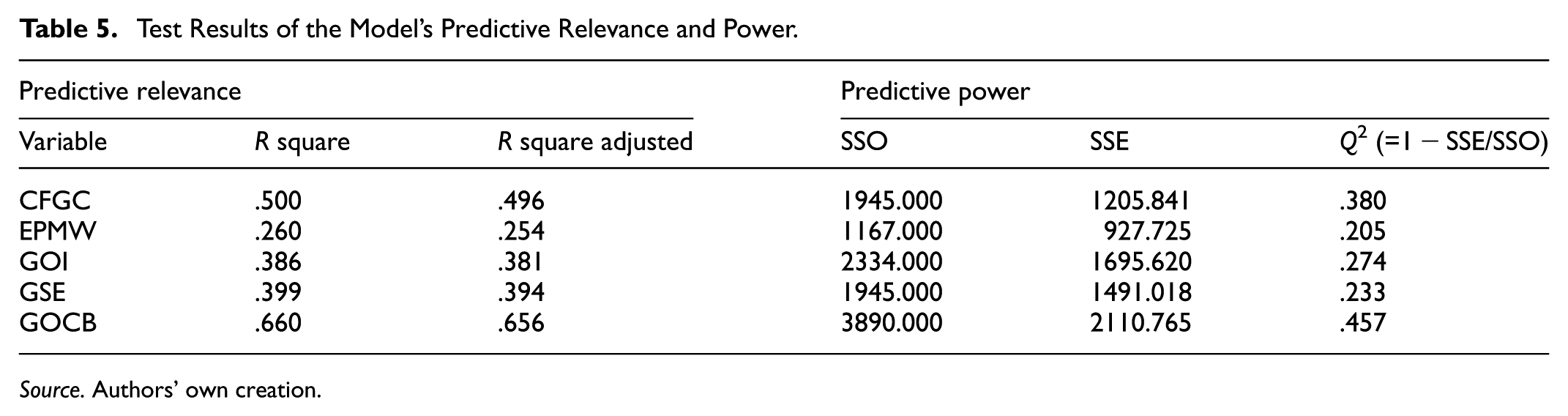
The R2 adjusted is used to measure the predictive ability of a model. This value indicates the extent to which the combined independent variables impact the dependent variable. In other words, it explains the variability of the dependent variable that is accounted for by all related independent variables (Hair et al., 2016). Based on Table 5, the variability of the endogenous variable GOCB is explained by exogenous variables at a high level, with a R2 adjusted of 65.6%. This result indicates the model’s significant predictive ability. Subsequently, CFGC, GSE, and GOI show moderate predictive levels with R2 adjusted values of 49.6%, 39.4%, and 38.1%, respectively. The endogenous variable EPMW has a moderate predictive level with a R2 adjusted of 25.4%.
Test Results of the Model’s Predictive Relevance and Power.
Source. Authors’ own creation.
In addition, to evaluate the explanatory power of each exogenous variable in the model regardless of the sample size (i.e., the strength of the structural model relationships), we computed the f2 effect size, which is the change in R2 value when a given exogenous variable is excluded from the model. The f2 values, as shown in Tables 6 and 7, ranged from .035 to .993, greater than .020 (except the f2 value for the insignificant H12), depicting small and medium f2 effect sizes (Cohen, 1988).
Path Coefficients.

Source. Authors’ own creation.
p < .05. ***p < .001.
Specific Indirect Effects.

Source. Authors’ own creation.
p < .05. ***p < .001.
Blindfolding is a sample reuse technique used to calculate the Q2 statistic. If Q2 > 0, the exogenous variable has a suitable predictive capability for the endogenous variable being considered. This Q2 statistic is a new concept only available in SmartPLS. The Q2 predictive values are .02, .15, and .35, corresponding to weak, medium, and strong predictive capabilities, respectively (Hair et al., 2016). According to the analysis results, ESSL shows a strong predictive capability with CFGC (Q2 = .380 > .35). ESSL has medium predictive capabilities with GOI (Q2 = .274 > .15), GSE (Q2 = .233 > .15), and EMPW (Q2 = .205 > .15). Overall, this indicates that the overall structural model of the study is of high quality.
Test Results of Direct Relationships
Table 6 presents the estimates of the research model. First, ESSL was found to significantly enhance green organizational identification (GOI), supporting H1. This aligns with previous research suggesting that when leaders demonstrate environmental responsibility and empower employees, it fosters alignment between individual and organizational environmental values (Abdou et al., 2023; Chen et al., 2015). Similarly, H2 was supported, showing that ESSL significantly improves green self-efficacy (GSE). This reflects Bandura’s (1986) social cognitive theory, which posits that belief in one’s ability is strengthened through encouragement, modeling, and positive feedback, traits inherent in servant leadership (Liden et al., 2014; Mughal et al., 2022).
Regarding creative capacity, ESSL also positively influenced climate for green creativity (CFGC), confirming H3. By providing resources and psychological safety, servant leaders help employees engage in innovative environmental practices (Luu, 2019; Parris & Peachey, 2013). Furthermore, H4 showed that ESSL significantly contributes to employees’ perception of meaningful work (EMPW), as leaders’ commitment to environmental values enhances employees’ sense of purpose (Van Dierendonck & Patterson, 2015; Van Dierendonck et al., 2024).
H5 confirms that ESSL directly influences GOCB, reinforcing previous findings that green leadership not only models but also cultivates pro-environmental citizenship (Luu, 2019; Robertson & Barling, 2013). This leadership effect is further mediated by individual-level constructs. Specifically, GOI (H6), GSE (H7), CFGC (H8), and EMPW (H9) each had a positive and significant effect on GOCB. These findings support the view that internal identification, self-belief, supportive environments, and meaningful work all play essential roles in driving voluntary green behaviors (Chen, 2011; Lysova et al., 2019).
Moderating Effect Testing
The moderating role of Green Shared Vision (GSV) was partially supported. GSV strengthened the relationships between ESSL and GOI (H10), ESSL and GSE (H11), and ESSL and EMPW (H13). This suggests that a clearly articulated and widely accepted environmental vision enhances the effects of leadership by aligning collective goals and reinforcing environmental purpose (Afsar et al., 2020; Chen et al., 2015). However, H12 was not supported, as GSV did not moderate the relationship between ESSL and CFGC. This unexpected result may reflect a disconnect between organizational vision statements and their practical implementation in encouraging creativity, particularly in hierarchical or resource-constrained hotel environments.
Discussion and Conclusion
Discussion of the Result
The findings provide empirical support for the proposed model, which demonstrates its relevance and applicability to the hospitality industry within the context of sustainable development, specifically among 3- to 5-star hotels in Ho Chi Minh City, Vietnam. Consistent with theoretical expectations, green servant leadership was found to exert a positive effect on GOCB. This supports the view that servant leaders who embody and model environmental values can shape follower behaviors by providing goal clarity, developmental support, and opportunities for environmentally responsible action (Luu, 2019). In line with social learning theory, employees may internalize these values through observational learning; from a COR theory lens, the psychological resources provided by servant leaders facilitate proactive investment in green behaviors. These results align with prior research (Aboramadan et al., 2021), which highlights green servant leadership as a central mechanism for promoting sustainability performance and in organizations.
Moreover, the results confirm the roles of green organizational identification, green self-efficacy, climate for green creativity, and perceived meaningful work in the relationship between green servant leadership and GOCB. These variables function as resources and identity-based mechanisms through which leadership influences voluntary pro-environmental behavior. This finding reinforces and extends earlier work (Chang et al., 2019; Chen, 2011; Chen et al., 2015; Khan et al., 2021; Mughal et al., 2022; Shah et al., 2023; Yuan & Li, 2022) by specifying the proximal psychological conditions under which environmentally specific servant leadership becomes behaviorally consequential. Together, the results contribute a more granular understanding of how leadership styles anchored in moral commitment and individualized development (Eva et al., 2019) can activate multiple motivational pathways to drive green citizenship behaviors.
In addition, this study provides evidence regarding the moderating role of green shared vision in shaping the relationship between green servant leadership and key employee outcomes. The results suggest that when a strong green vision is collectively endorsed within the organization, employees are more likely to align with the environmental values modeled by servant leaders, thereby reinforcing green organizational identification, green self-efficacy, and perceived meaningfulness of work. These findings are consistent with prior research demonstrating that shared vision enhances motivation, goal clarity, and value alignment (Afsar et al., 2020; Chang et al., 2019; Chen et al., 2015).
However, the data did not support a moderating effect of green shared vision on the relationship between green servant leadership and climate for green creativity. The non-significant moderation may stem from conceptual similarity between green shared vision and climate for green creativity. Both reflect collective perceptions about environmental priorities and expectations, making their effects partially redundant. This aligns with findings that leaders can act as substitutes for contextual factors like shared vision when they already embody and model those values (Younas et al., 2023). The conceptual overlap may reduce the likelihood of a significant interaction, as both constructs communicate similar cues about environmental commitment and creativity norms.
Contributions to Theory
This article has contributed to both theoretical and practical implication. Theoretically, this study contributes to the green leadership literature, as well as green organizational behavior, by clarifying the pathways through which green servant leadership influences GOCB. Prior research has established the link between servant leadership and pro-environmental outcomes but has offered limited insight into its mechanisms. By specifying green organizational identification, green self-efficacy, climate for green creativity, and perceived work meaningfulness as distinct mechanisms, this study adds to our understanding of the ways through which servant leadership fosters green behaviors. The findings suggest that green behaviors are not only value-driven but also contingent on perceived support and psychological resources which are shaped directly by leadership.
Second, the study lends credence to both conservation of resources theory and social learning theory by illustrating their joint explanatory power in green organizational behavior context. From a conservation of resources perspective, the results highlight how leadership acts as a source of both instrumental and psychological resources that promote investment in green behaviors by followers. From a social learning perspective, the findings underscore the role of leaders as behavioral models whose actions shape employees’ environmental identity and norms. Together, these insights extend both theories into the domain of green work behavior, where moral values and contextual cues jointly inform individual action.
Practical Recommendations
Regarding practical implications, this study has important implications for managers and organizations, especially in the tourism and hospitality sector in Vietnam and broader Asia Pacific. First, hotels should invest in identifying and developing leaders who not only advocate environmental values but also allocate time, resources, and authority to employees engaging in environmental initiatives. This also requires organizations to move away from the authoritarian leadership model that is popular in Confucian Asia (Pizzolitto et al., 2022). On the other hand, organizations can create and implement leadership development programs that not only help leaders develop their other-oriented drive to serve, individualized focus on followers’ growth, and commitment to community well-being, but also skills to incorporate sustainability efforts as core to managerial performance. However, such initiatives must be backed by organizational commitment, and without structural support, even the most sustainability-driven leaders will face resistance.
Second, leaders play a central role in cultivating green organizational identification. However, identification does not emerge from rhetoric alone and this requires more than aligning personal values with sustainability. Fostering green organizational identification requires that leaders consistently represent and frame environmental goals as integral to the organization’s identity. Leaders must make the environmental agenda visible and actionable through tangible actions such team discussions, everyday conversations, and role modeling. Leaders need to advocate for the integration of sustainability into the business model of the organization, not just how it speaks.
Third, green self-efficacy depends on the leader’s capacity to redistribute power and resources. Employees develop confidence when leaders give them ownership over sustainability initiatives and protect them from procedural obstacles. This requires leaders to actively navigate organizational constraints and secure resources for green experimentation. Rather than delegating responsibility for sustainability to a few individuals, leaders should work to normalize participation by embedding environmental problem-solving into daily roles and expectations.
Fourth, leaders are the primary link between employees’ tasks and the broader meaning of their work. When leaders frame environmental efforts as socially meaningful, and connect individual contributions to visible outcomes, they increase the perceived significance of work. However, creating meaning requires more than storytelling. Leaders must provide space for employees to question, co-create, and shape sustainability efforts on their own terms. Only then can meaning emerge from within the work itself, rather than being imposed from above.
Finally, green shared vision plays a crucial role in amplifying the effectiveness of leadership to promote employees to engage in sustainability-oriented behaviors. Organizations need to reinforce their mission messages so that employees understand and actively support the organization’s sustainable development goals. Realistically, sustainability discourse, on its own, has little effect if it is disconnected from how work is structured and rewarded. Therefore, it is recommended that sustainability vision is reflected in core metrics, job expectations, and performance evaluations so that employees go above and beyond to achieve it.
Limitations and Future Research
This study contains a few drawbacks which should be taken into consideration. While this study offers novel insights into environmentally specific servant leadership and green organizational behavior, several limitations should be acknowledged. First, data were collected from employees in hotels located in Ho Chi Minh City, which may limit the generalizability of findings. Future research should examine diverse regions and industries, particularly those central to sustainable development, such as logistics, manufacturing, and agriculture, to assess the broader applicability of the proposed model.
Second, the use of cross-sectional, self-reported data introduces potential concerns related to common method bias and limits the ability to make strong causal claims (Antonakis et al., 2010; Podsakoff et al., 2024). Future studies would benefit from time-lagged or multi-source designs. Relatedly, the non-significant interaction between green shared vision and green servant leadership on climate for green creativity may stem from modeling all variables at the individual level. Both shared vision and climate variables are conceptualized in prior research emerging from shared experiences and norms within teams or organizations. Modeling them as individual-level constructs may obscure their interactive effects. Future research should employ multilevel modeling techniques (Eckardt et al., 2021) to examine these constructs at their appropriate levels of analysis and assess cross-level interactions between leadership behaviors and shared team or organizational climate.
Third, the measurement instruments used in this study were adapted from constructs developed primarily in Global North contexts. While these instruments have been widely validated, their application in the Vietnamese cultural and organizational setting may introduce measurement error or overlook context-specific dimensions of leadership and pro-environmental behavior. Future research should prioritize scale refinement and localization to ensure cultural and contextual fit.
Footnotes

Funding
The authors received no financial support for the research, authorship, and/or publication of this article.
Declaration of Conflicting Interests
The authors declared no potential conflicts of interest with respect to the research, authorship, and/or publication of this article.
Data Availability Statement
Data sharing not applicable to this article as no datasets were generated or analyzed during the current study.