




Abstract
Translating culture-specific items becomes particularly challenging in cases of self-translation, where the author reinterprets their own cultural identity through another language. This study analyzes Elif Shafak’s novel Honour, and examines how Turkish cultural and folkloric elements are represented and transformed in the novel. The novel is originally written in English, and later retranslated into Turkish with author collaboration. Ten representative text units were specifically selected considering their cultural density and contextual significance, and examined through Peter Newmark’s classification of cultural categories. Raymond van den Broeck’s concept of translation norms and polysystem theory were employed to identify structural and narrative shifts, while Lawrence Venuti’s notions of domestication and foreignisation were applied to determine the translation strategies. The findings reveal that the Turkish version contains notable additions and omissions that extend beyond linguistic equivalence and point toward a deliberate act of rewriting. This phenomenon is further contextualised as self-translation and interpreted through the lens of André Lefevere’s rewriting theory. However, the limited samples suggest potential for broader corpus-based studies. The study argues that Honour exemplifies a case of culturally motivated self-rewriting, functioning as a medium of identity negotiation and cultural repositioning rather than a mere linguistic transfer.
Plain Language Summary
Translating culture-specific items is inherently complex, and this complexity intensifies when an author translates their own cultural background into a foreign language and later re-renders it into their native tongue. This study analyzes Honour, a novel originally written in English by Turkish author Elif Şafak, and investigates how Turkish cultural and folkloric elements are represented in both the English version and the Turkish retranslation, which was prepared in collaboration with the author. Ten culture-specific textual units were selected and examined through Peter Newmark’s classification of cultural categories. Raymond van den Broeck’s concept of translation norms and polysystem theory were employed to identify structural and narrative shifts, while Lawrence Venuti’s notions of domestication and foreignization were applied to determine the translation strategies. The findings reveal that the Turkish version contains notable additions and omissions that extend beyond linguistic equivalence and point toward a deliberate act of rewriting. This phenomenon is further contextualized as self-translation and interpreted through the lens of André Lefevere’s rewriting theory. The study argues that Honour exemplifies a case of culturally motivated self-rewriting, wherein translation functions as a medium of identity negotiation and cultural repositioning rather than a mere linguistic transfer.
Keywords
Introduction
Language and translation are inherently interconnected components of communication. Whether expressed in written, oral, or internal form, translation functions as a fundamental means of expression and articulation (Ece, 2010, p. 9). In literary texts, the complexity of language use and its implicit nature generate emotional resonance in the reader (Aksoy, 2002; Tahir-Gürçağlar, 2019). Within this framework, translation serves not only as a linguistic activity but also as a medium through which cultures interact, transform, and represent themselves to one another (Arı, 2016, p. 29). Accordingly, literary translation plays a pivotal role in facilitating intercultural communication and transmitting culture-specific elements to other linguistic and cultural systems.
Culture-specific elements—ranging from daily practices, belief systems, and celebrations to literary forms and oral traditions—are the accumulated and inherited traits of a community (Nalcıoğlu, 2015, p. 4). Literature, as a product of language, functions as both a mirror and medium of culture. Consequently, literary translation transcends the mere transfer of meaning; it becomes a site of cultural negotiation. It enables a culture to reach out beyond its national boundaries and to engage in dialogue with other cultural identities (Cagac, 2018, pp. 31–34).
In recent years, Turkish authors such as Orhan Pamuk and Elif Şafak have drawn attention not only through the themes they explore but also through the multilingual dynamics of their writing and translation processes. Notably, Elif Şafak, although deeply rooted in Turkish culture, composes many of her novels originally in English. These works are subsequently translated into Turkish, often under her supervision or direct collaboration (Çanaklı, 2020; Tahir-Gürçağlar, 2019). This unique form of authorial involvement blurs the boundary between translation and rewriting, positioning the Turkish versions as self-translated or author-assisted re-creations rather than conventional translations.
One prominent example is Honour (2012), a novel that addresses themes such as migration, adaptation, and the cultural weight of concepts like honour and honour killing. Written originally in English and later translated into Turkish in collaboration with the author, the novel explores the socio-cultural realities of a Turkish family in exile, offering rich material for translation analysis. The bilingual and bicultural nature of this work, along with Şafak’s active role in its retranslation, provides a valuable basis for theoretical research.
Previous studies on this topic are limited in both quality and quantity. Furthermore, it has been observed that culture-specific elements in the context of self-translation have been almost completely ignored, especially in Shafak’s works, which are considered self-translations. The main purpose of this study is to investigate how culture-specific elements in Elif Shafak’s novel Honour are transformed through the self-translation process. In accordance with the aim of this study, it addresses the following research questions:
How are elements specific to Turkish culture represented in the English version of Honour?
How are these elements reinterpreted in the Turkish translation?
What translation strategies and theoretical frameworks best explain these transformations?
By addressing these questions, the study contributes to the field of translation studies by offering insights into the cultural negotiation inherent in self-translation practices. Drawing on Peter Newmark’s categorisation of cultural items, the study identifies and classifies 10 representative textual units. Then, these text units are analysed through Raymond van den Broeck’s polysystem theory to highlight narrative and structural shifts. Lawrence Venuti’s concepts of domestication and foreignisation are employed to evaluate the orientation of the translation strategies. Finally, the analysis is situated within André Lefevere’s theory of rewriting, which emphasises that all translations are forms of rewriting shaped by ideological, poetic, and patronage constraints (Lefevere, 1992). From this perspective, the Turkish novel İskender, translation version of Honour, is interpreted as a culturally motivated act of self-rewriting, where translation functions not merely as linguistic transfer but as a means of cultural identity construction.
In light of these theoretical perspectives, the current study ultimately aims to reveal how Honour exemplifies self-translation as a culturally motivated act of rewriting.
Authorial Collaboration and Narrative Structure in Honour
The novels of Elif Şafak, Baba ve Piç (The Bastard of Istanbul, 2006) translated by Aslı Biçen, Aşk (The Forty Rules of Love, 2009) translated by Kadir Yiğit Us, Araf (The Saint of Incipient Insanities, 2010) translated by Aslı Biçen, and Ustam ve Ben (The Architect’s Apprentice, 2013) translated by Omca Korugan, were translated into Turkish by their respective translators in collaboration with the author herself. This collaboration is noted on the inner cover of the books, with a mention under the translators’ names stating, “in collaboration with the author,” as seen in İskender that is the Turkish translation version of the novel Honour. This recurring pattern of author-translator collaboration reveals Şafak’s consistent interest in controlling the cultural and linguistic framework of his works.
In her works, Elif Şafak generally chooses to tell the story of a female protagonist, but in this book-Honour, she focuses on the transformation and change of a male character. Shafak has expressed that after the birth of her son, she made the decision to explore this theme, as she wanted to understand what it means to be a mother of a male child and experience being a man through the character of İskender (Zileli, 2011). İskender is the title of the Turkish translation version of the book but at the same time it is the name of the male protagonist of the book. The novel begins with a section that points to a family tree and a metanarrative structure. In this section, Esma welcomes her brother İskender, whom she could neither forgive nor let go, on the day he completes his 14-year sentence and brings him back to her home. In other words, the story begins with the ending, and the events are narrated using a flashback technique throughout the book.
Each chapter in the book is typically made up of subsections that are organised around the names of the characters, with events unfolding around them without adhering to a strict chronological order. The protagonist of the book, who also gives the book its title, is İskender Toprak, depicted as an anti-hero. İskender is the first child of a Kurdish-Turkish immigrant family living in London. He is the older brother of a sister and a younger brother.
The Plot Overview
The work tells the story of twin sisters Pembe and Cemile, born into a traditional Kurdish family living in the eastern part of Turkey. Their mother Naze tried to have a son throughout her life, but after numerous miscarriages and births, she was disappointed when the twins were both girls. After many events within the family, Pembe is married off to Adem from Istanbul, who is actually in love with Cemile, one of the twins, but cannot marry her because of his traditional and conservative ideas. Pembe and Adem first live in Istanbul, then migrate to London with their children. Lovelessness never brings them a happy union.
Culture Specific Items and Folklore Elements in the Novel
Elif Şafak is an author who incorporates various motifs from her own life story into her works. While her writing cannot be classified as strictly biographical, it can be said to contain biographical elements. She enjoys establishing connections between the past and the future, and she uses language in a rich and diverse manner, employing various narrative techniques to the fullest extent. The author, who grew up immersed in both written and oral culture and has had a passion for writing since childhood, is an excellent storyteller. She enriches her narratives by incorporating various stories into the structure of her works (Ever, 2009, p. 9). In İskender, Shafak also references elements of written culture, such as stories, fairy tales, and proverbs, as well as elements of oral culture, such as fortune-telling, dreams, and the evil eye.
In accordance with the main purpose of the study, it is important to determine the basic culture-specific and folkloric components that shape the narrative texture of the novel. The folklore elements are common throughout the book and they are presented in relation to İskender’s mother Pembe’s lifestyle as in the following excerpt from the source text;
My mother was a superstitious woman. In our house there were evil-eye beads everywhere. She put glass beads in my pockets, in my rucksack. Once I found one sewn into my leather jacket. We never whistled at night, never opened an umbrella indoors or trimmed our fingernails after sunset. Sometimes we wore our underwear inside out to ward off bad luck. At the dinner table we did not hand each other knives. Mum did everything in her power to protect me from others. But she forgot what was festering in me. Nothing can protect a man from what lies inside. (Şafak, 2012, p. 146)
From the early pages of the novel, elements of folklore such as legends, proverbs, idioms, and fixed expressions, as well as rituals like naming as a tradition, language and expression features, are used extensively. Additionally, rituals related to birth, marriage, death, gift-giving, wishes, prayers, vows, good luck, magic, the evil eye, and hospitality are incorporated as folklore elements. These contribute to the narrative’s structure while emphasising sociological reflections on the relationships between East/West, modern/traditional, rural/urban, and gender. İskender creates a cultural and sociological portrait of society, preserving cultural elements through literary form.
A Translation Problem: The Translation of the Title of the Work
One of the most important translation problems in the novel is related to its title. The Turkish translation of the novel was published under the title İskender. The name “Iskender” refers to Alexander the Great, known throughout history as a great commander. In Turkish culture, this name is often associated with values such as strength, courage, leadership, and masculinity. The mother in the novel gives her son this name, wishing him to be a man respected, strong, and influential by his peers. In this respect, the name represents not only the character’s individual identity but also society’s ideals of masculinity.
The name was given to the main character of the work by his mother, who wished for him to be a brave leader whom people would follow and whose words would be obeyed. İskender assumes a role fitting the qualities of his name, growing into a brave, strong, combative, daring, and leadership-driven character. In Turkish culture, boys are often given names like “Şeref,”“Onur,”“Yiğit,” and “Kahraman,” demonstrating the association of honour and pride with masculinity. These names are closely associated with the roles of protector, authority, and guardian of honour attributed to men in society. Consequently, the name İskender similarly stands out as a symbol of the power and prestige attributed to masculinity. In the novel, this symbolic meaning is deliberately reproduced by the main character’s mother. The story revolves around a character who kills his own mother for the sake of family honour. After the Turkish translation was published, a problem arose regarding the translation of the title for the original English edition. The novel’s English title, “Honour,” represents a symbol that can be directly translated into Turkish as “honour” or “dignity.” However, this concept is used in the work as a family fame, specifically in reference to the number of women. The Turkish title “İskender,” however, directly corresponds to this symbol, shifting the focus to the male character. This shift in belief shifts the novel’s thematic centre from a story about women’s honour to a text that questions masculinity and patriarchal notions of honour. Therefore, the resulting translation is not only a linguistic difference but also a narrative and ideological shift.
Elif Şafak has noted that during the translation process of the novel into different languages, titles had to be adapted to suit the cultural context of each language. This can be explained by Venuti’s “domestication” strategy. To ensure the text was best understood in each target culture, the author reshaped the title according to its values and connotations. Therefore, the transformation from Honour to İskender is not merely a translation choice but also an example of conscious cultural rewriting.
Theoretical Frame
Peter Newmark and the Classification of Cultural Items
In general, culture-specific terms are considered as items with a potential for untranslatability. Translation scholars generally argue that cultural elements can be managed, meaning they can be translated, but they also point out that translating these elements requires special treatment and that translators must have sufficient knowledge of both the source and target languages and cultures to carry out the transfer effectively (Neshkovska & Kitanovska–Kimovska, 2018, p. 166). The types of texts that contain the most cultural elements are typically literary texts. A literary text contains much more than just the words written on the page (Tahir-Gürçağlar, 2019, pp. 36–37). The method and approach the translator chooses depend on factors such as the tolerance level of the target culture and the extent to which the translator can deviate from linguistic constraints. When the focus of translation is culture, problems often arise due to the gap or distance between the source and target culture (Newmark, 1988, p. 94). Newmark discusses ‘culture-specific items’ and he describes them as ‘problematic’ both for the target audience and the translator. He states that there will be no problem in translating cultural elements when there is mutual cultural harmony. However, according to Newmark, this is a rare situation because cultural words are unique, contain a society’s local heritage, and are therefore a challenging task for translators. Therefore, the translation of literary texts poses much greater challenges than translating non-literary texts, as they often contain special thoughts, beliefs, ethics, traditions, and idioms that are familiar to the source text reader but may be perceived as ‘other’ or foreign by the target text reader (Akalın, 2019, p. 65). To make the identification of cultural items easier and facilitate the translator’s work, Newmark proposes a detailed taxonomy of cultural items (Akalın, 2019, p. 69) as following:
a. Ecology—the terms related with the flora and fauna of a certain region.
b. Material Culture (Artefacts)—includes the terms related with such items as food, clothing, architecture and means of transport etc.
c. Public life—Organisations, law and governmental issues, activities, procedures and concepts—the terms related with public life.
d. Social culture—the terms related with social and economic welfare and the health issues.
e. Traditional, habitual and social culture—the terms related with traditions, social activities like sports, the use of body language.
f. Personal interests and passions-the terms related with individual preferences like music, poetry, art, etc. (Newmark, 2010, pp. 174–177).
Newmark’s taxonomy is particularly important for this study because it provides a clear framework for identifying and classifying culture-specific elements in Honour, which is important before analysing their translational processing.
Polysystemic Translation Theory by Raymond van den Broeck
The Dutch translation studies researcher Raymond van den Broeck, in his work “Second Thoughts on Translation Criticism: A Model of Its Analytic Function” (1985), proposed a model for translation criticism and explained in detail why such a model is necessary. In this study, van den Broeck emphasised that translation criticism often fails to go beyond personal judgements, being rooted in subjective tastes and preferences. While earlier translation criticism largely focused on fidelity to the source text, the emergence of target-oriented approaches led translation studies—and, consequently, translation criticism—to shift their focus toward the target language (Yalçın, 2015, p. 89).
In his work, van den Broeck argued that translation criticism should prioritise the target text over the source text. Based on the concept of equivalence, he proposed an analytical model. Drawing inspiration from Catford’s linguistic perspectives on equivalence, van den Broeck suggested that equivalence emerges when the source and target texts—or their features—can be related to one another in terms of their positions within their respective systems. According to him, equivalence must also be established in terms of semantic, textual, and functional communication (Aksoy, 2002, p. 166).
When formulating his analytical model, van den Broeck systematically examined the source text while considering all its literary features, and he used the analysis results to identify and compare findings in the target text. With the advancement of modern translation studies, especially after the late 1980s, translation criticism evolved, aiming to base the critique process on objective criteria related to both the translation product and the translation process, thereby offering a multidimensional, systemic critique (Aksoy, 2002, pp. 40–41).
The Polysystemic Analysis Model is influenced by both the Descriptive Translation approach and the Functionalist translation approach. It is fundamentally shaped around concepts such as comparison, text units, intra-textual relationships, systemic approach, and reconstruction. The model is based on a three-stage analytical framework.
First Stage:
The analysis begins with the assumption of reconstructing the target text in terms of the source text’s functions and textual units.
Second Stage:
This stage involves comparing the overlaps between the target text units and the source text units.
Third Stage:
The final stage provides an objective evaluation based on the changes observed in the previous stage.
This criticism model offers insights that aim to facilitate the translator’s work in systemic and structural terms regarding language, culture, message, and literary features. This model is used in this study to systematically assess the dynamics between Honour’s source and target texts. This allows for an objective comparison of the structural and cultural changes between the two versions.
Domestication and Foreignisation Strategies by Lawrence Venuti
The primary task of all translation strategies is the selection of the foreign text to be translated and the development of a method for its translation. These tasks can be influenced by various factors, including cultural, economic, and political considerations.
A translated text may:
Conform to the norms of the target language and culture, adopting an assimilationist approach that supports the native norms, publishing trends, and policies of the target culture with a protective stance toward the foreign text.
Alternatively, it may embrace the foreign and marginal, adopting foreign texts and translation methods to encourage the acceptance of new cultural forms (Venuti, 2001, p. 240).
The cultural gap between languages and linguistic communities inevitably creates challenges for translators when dealing with certain cultural elements. To overcome these challenges, translators must adopt specific translation strategies. The American translation theorist Lawrence Venuti identifies two primary translation strategies, which can be considered macro strategies: Domestication and Foreignisation.
In domestication translation strategy, the foreignness of the source text is minimised to conform to the norms of the target language and culture. In other words, the author is “brought to the reader,” and the linguistic and cultural differences of the source text are reduced to a minimum (Kuleli, 2020, p. 626). If these linguistic and cultural elements are adapted in accordance with the requirements of the target language, domestication has been applied (Gündoğdu, 2022, p. 24).
Translators may choose to adopt the domestication strategy in their translations for various reasons:
They might aim to reflect the political and cultural environment of their time.
They may wish to contribute to the translation tradition of the target culture.
They might avoid differentiation or unintentionally apply this strategy without realising it.
While employing domestication, translators can utilise functional micro-strategies such as adaptation, addition, omission, or substitution, depending on their preferences (Taş, 2017, p. 7).
Venuti’s theoretical framework helps reveal whether Elif Şafak’s translation choices are directed towards adaptation to the target culture or towards consciously preserving foreign elements; thus, she makes visible her position as both a writer and a translator.
The foreignisation translation strategy is employed in translations where the translator’s presence is visible, the foreign elements of the source text are preserved, and the target reader encounters these foreign elements, leading them to think and question. In other words, the target reader is “brought to the author,” maintaining the linguistic and cultural foreignness of the source language and culture (Venuti, 2001, pp. 240–242). Foreignisation aims to preserve the original cultural context, effectively transporting readers to another culture and offering them the opportunity to experience linguistic and cultural contrasts (Atakişi, 2022, p. 46). Foreignisation remains faithful to the original text and has the advantage of enriching the target culture. It creates a reading experience where the target reader is confronted with a text imbued with foreign elements, which may lead to surprise, questioning, and a break from conventional translation traditions by bringing the “foreign” to the reader (Taş, 2017, p. 7).
When applying foreignisation, the translator can utilise various micro-strategies based on their decisions, including:
Literal translation
Highlighting through quotation marks or italics
Direct transference of terms
Using footnotes
Providing explanations or explications (explanation involves making implicit information explicit, while explication involves conveying the understood meaning as it is)
Adding translator’s notes (Tahir-Gürçağlar, 2019, p. 146; Taş, 2017, p. 7).
André Lefevere and the Theory of Rewriting
While Newmark, van den Broeck, and Venuti offer analytical and strategic perspectives on translation, Lefevere’s theory of rewriting complements the linguistic and systemic approaches of earlier models by moving the discussion into ideological and institutional realms.
André Lefevere’s work positions translation as a dynamic process that goes beyond linguistic equivalence. Rather than viewing translation as a neutral or mechanical operation, he conceptualises it as a form of rewriting, one that is inherently shaped by ideological, cultural, and institutional forces. This approach reframes the translator’s role, emphasising that translators—like editors, anthologists, or critics—actively participate in shaping literary meaning and reception (Lefevere, 1992, pp. vii–viii).
Two central mechanisms underlie this shaping process: poetics and patronage. Poetics refers to the internal literary norms of a target culture—what is stylistically, thematically, or formally acceptable—while patronage encompasses the external institutional forces that influence or authorise a translation’s production and dissemination, such as publishing houses, state institutions, or market-driven actors (Lefevere, 1992, pp. 15–26).
According to this framework, every act of translation becomes a cultural intervention—one that not only adapts but also repositions the source text within the target system. It is through such intervention that translations can reinforce or subvert existing literary hierarchies, introduce marginalised voices, or reconstruct authorial images in ways that suit the receiving audience’s expectations (Lefevere, 1992, pp. 9–10).
Recent scholarship expands this model by situating rewriting within broader systemic concerns. For instance, Dinçel (2017) discusses how Lefevere’s theory accounts for canon formation, especially when examining how foreign authors like Brecht were reintroduced and reframed in English-speaking cultures. She highlights the functional role of translation not only in linguistic transfer but in re-establishing authorial legitimacy across borders—under conditions determined by ideological consensus and literary market norms (p. 143).
Kıran (2020) similarly explores rewriting as a transformative operation embedded in larger cultural matrices. She emphasises that translations do not merely reflect a source culture, but participate in the construction of literary meaning for new audiences, operating within culturally and politically motivated frameworks (p. 86). This makes rewriting a central tool for both cultural transmission and manipulation.
In this context, Lefevere’s framework becomes particularly relevant for examining translations that are produced in close collaboration with authors, as is the case in Elif Şafak’s Honour. The Turkish version, far from being a literal rendering of the English original, demonstrates selective emphasis, expansion, and condensation that respond to the socio-political expectations of the Turkish readership. Such shifts, when interpreted through Lefevere’s model, reveal the presence of ideological filtering and cultural repositioning rather than neutral transmission.
Lefevere’s broader contribution to the field—alongside figures like Bassnett—was instrumental in redirecting translation studies from a linguistics-centred paradigm to one that acknowledges power, ideology, and cultural systems. His notion of rewriting, deeply interwoven with the cultural turn in the 1990s, continues to offer valuable insights into how translation shapes not only texts, but entire literary traditions (Bassnett & Lefevere, 1990; Lefevere, 1992, p. 2; see also Munday, 2016, pp. 191–214).
These theoretical models collectively form the conceptual foundation of this study. Newmark’s classification is used to identify and categorise culture-specific elements; van den Broeck’s multisystem model supports comparative analysis between English and Turkish versions; Venuti’s strategies are used to assess translation orientation; and finally, Lefevere’s rewriting theory demonstrates how these choices can be linked to broader ideological and cultural contexts. All these approaches enable a multidimensional interpretation of Onur as an example of self-translation and cultural rewriting.
Method
Since translation involves the interaction of two distinct languages, each with its own set of rules, the act of transferring meaning between them can naturally become a difficult and problematic process. This study is unique in that it considers not only the translated product but also the process of rewriting the source text. Thus, unlike traditional translation studies, it provides a two-way reading within the context of the phenomenon of self-translation, where literary production and translation intersect.
When the text being translated is a literary work, the cultural elements of the source language come into play, further complicating the translation and making the transfer more complex (Aksoy, 2002, pp. 88–89). Translation requires balancing both identity and difference. The translator works to establish equivalence by taking into account the linguistic and cultural characteristics of the target language, based on the differences between the two languages. This process involves a series of decisions that the translator must make (Aksoy, 2001, pp. 3–4).
This study examines both the original text of Honour and its Turkish translation text İskender. The translation work was published in Turkish in 2011 before the original text had been released. The original work was published in 2012, after the source text had undergone a rewriting process in which certain changes deemed necessary by the author were made after it was translated into Turkish. What distinguishes this work from other translated works is that the source text was subjected to rewriting after the Turkish translation, before its publication.
The selection of 10 textual units to be used in the analysis was made by considering the sections where culturally specific elements are most prevalent. These sections are the examples that most clearly reveal the semantic shifts between the source and target texts, both linguistically and culturally.
In order to identify the similarities and differences in the writing/re-writing and translation processes, a comparative analysis was conducted, and the cultural elements were examined via Peter Newmark’s taxonomy of cultural items. In the comparative analysis, transformations were considered not only at the lexical level but also at the narrative and discursive levels. Thus, the forms of cultural rewriting that emerged during the translation process were evaluated from a more comprehensive perspective.
The reason for specifically choosing Newmark’s taxonomy (2010) in identifying cultural elements is that Newmark’s classification of cultural items was considered the most appropriate for this study, as it addresses nearly every aspect of a society’s life (Akalın, 2019, p. 63). Afterwards, the text was analysed with Raymond Van den Broeck’s comparative textual analysis model, without making any judgements. Extracts from the original text and its Turkish translation were selected and compared. Methodologically, the study centres on the concept of intertextual equivalence, aiming to systematically reveal the shifts in meaning that occur between two texts. In this respect, in addition to Van den Broeck’s comparative analysis model, it also utilises Lefevere’s theory of rewriting. Thus, the act of translation is considered not only a linguistic transfer but also an ideological and cultural reproduction.
Following this comparative analysis, which aims to identify the natural and inevitable variations and deviations, possible in each translation text, the translation strategies of domestication and foreignisation, proposed by Lawrence Venuti, were evaluated in relation to the translator’s choices on the textual units.
The scope of the study is limited to the selected textual examples; therefore, the results cannot be generalised to the entire novel or to the author’s other works. However, the selected examples are highly representative and provide sufficient data to understand the transformation of culture-specific elements in translation. The general flow and operation of the study are summarised in a flowchart (Figure 1). This flow chart illustrates the study’s methodology step by step.

Research flowchart of the study.
Comparative Analysis of the Textual Units of Source and Target Texts
Sample 1

Evaluation
The concept of halva, a type of food, serves as an example of material cultural elements, specifically in the category of food and drink, within cultural element classifications. In the source text, the food is described as “sesame halva,” which has been rendered in the target text as irmik helvası (semolina halva). Although the exact equivalent would be tahini halva made from sesame, the translation did not adhere strictly to the original. Instead, the source text was adapted using a type of halva more commonly recognised in the target culture. The phrase “pretending not to notice” in the source text was translated as fark etmezden gelerek in the target text, rather than the more widely used Turkish equivalent görmezden gelerek. This reflects a closer adherence to the source text’s meaning. Additionally, a comparison between the source and target texts reveals that the conjunction and from the source text was omitted in the translation, with a comma used differently to maintain the meaning. Stylistic differences between the text units of the source and target texts are also apparent. The food terms mentioned in the passage can be classified under material cultural elements according to Peter Newmark’s taxonomy. Furthermore, the translation methods and strategies observed in the excerpt indicate the adoption of Lawrence Venuti’s domestication strategy, as the translation aligns the content more closely with the norms and cultural references of the target culture.
Sample 2

Evaluation
This excerpt describes the situation of Naze, who gave birth to twin girls after having six daughters. The phrase “open window” is not fully translated; the word “open” is omitted, and the meaning is contextually adjusted. Similarly, the expression “as mild as milk” used in the source text is not included in the translation. The word “attentively” in the source text is reinforced in meaning and translated as “with enough attention,” and the sentence using the conjunction “but” in the source text is split in the translation. Words are used beyond their literal meanings, and their meanings are enriched with emphasis expressions. The emotional intensity of Naze’s character has become more perceptible in the translated work due to the use of reinforced words. In the same example, the word “Allah” in the source text is also reinforced in meaning and translated as “The Almighty Creator,” a phrase specifically used in prayer. In this passage, concepts such as “wind” and “sky” can be shown as examples of ecological elements from Peter Newmark’s taxonomy, while the concept of belief can be shown as an example of elements related to personal curiosity and passions. In this example, where semantic reinforcement has been applied and cultural concepts familiar to the target audience are used, it can be stated that formal features in the translation, such as punctuation and conjunction usage and the translation of a word with multiple equivalents, have been altered, and in this context, the domestication strategy has been used.
Sample 3

Evaluation
In the excerpt, it is mentioned that Cemile, Pembe’s twin, practiced midwifery and healing in the “impoverished region” where she lived, and that the local people trusted her skills. In the source text, Cemile’s nickname, given by the local people, is first presented in Turkish and then in English. In the target text, however, the Turkish expression is used directly. The phrase “this impoverished Kurdish region” in the source text is translated into the target text as “bu yoksul diyarın,” with the word “Kurdish” omitted. In the following sentence, “The Virgin Midwife is in command” from the source text is translated into Turkish as “Kız Ebe burada,” where the phrase “in command” has been altered in the translation to create meaning. In the translation of the sentence “Everything will go well,” the expression “hayırlısıyla” (meaning “by God’s will” or “in the best possible way”) has been added to strengthen the meaning in the target text. In the last sentence, the word “thanks” in the source text is replaced by the Turkish idiomatic expression “emanet etmek” (to entrust), which is commonly used in the target language.
In this passage, elements like Azrael, Allah, and expressions like “hayırlısıyla” can be seen as examples of personal curiosity and passion-related elements from Peter Newmark’s taxonomy. Additionally, based on the translation methods and strategies employed, and given that elements commonly used in the target language and culture have been considered, it can be said that Lawrence Venuti’s domestication translation strategy has been adopted.
Sample 4
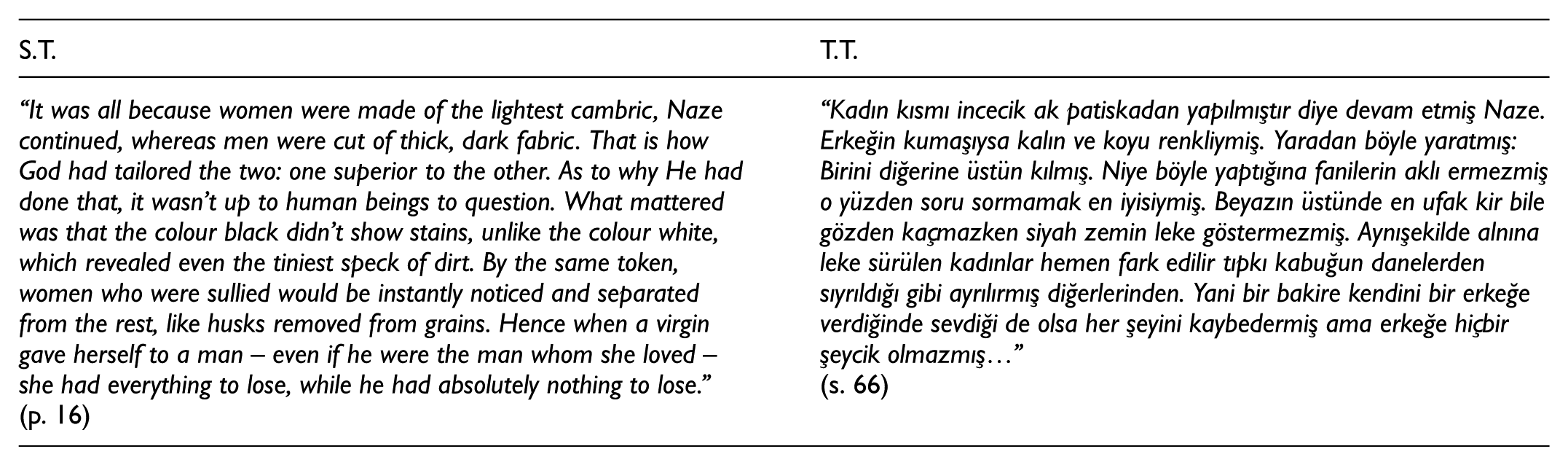
Evaluation
In the excerpt provided, the societal perspective on women and men are conveyed through Naze’s advice to her daughters. In the source text, the first sentence is a connected compound sentence with a conjunction, whereas in the target text, this sentence is split into two separate sentences. Due to the structural change in the first sentence, punctuation marks are also altered, creating stylistic differences between the two texts. The word “God” in the second sentence is translated as “Yaradan” for the expectations of the target language and culture. The source text sentence, “As to why He … question,” is rendered in the target text as “Niye böyle yaptığına … en iyisiymiş.” Although expressions like “aklı ermek” and “soru sormak” are not present in the source text, idiomatic phrases were chosen in the target text to align with the expectations and norms of the target culture. Additionally, the term “human beings” is translated as “faniler,” reflecting the cultural adaptation. This passage, which illustrates societal perspectives on women and men and the gender roles of women and men in social life, can be classified under Peter Newmark’s taxonomy as Social Culture Elements: Social Life. Considering the translation methods and strategies used in this excerpt, it can be stated that Venuti’s domestication translation strategy was predominantly employed.
Sample 5
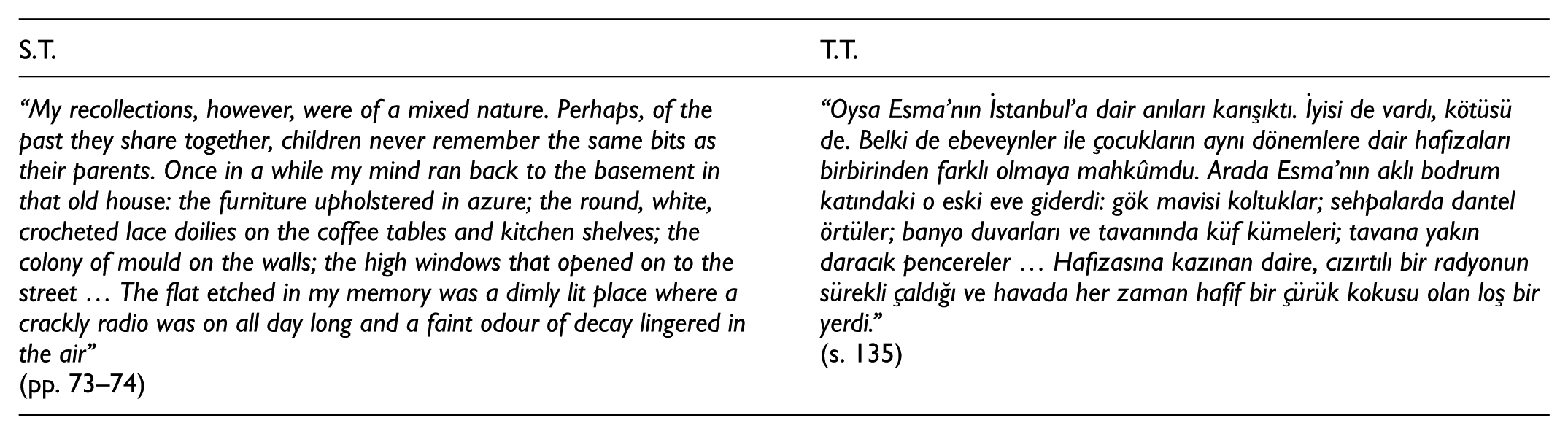
Evaluation
The excerpt provides a spatial description of the house Esma lived in from her perspective. When comparing the source and target text excerpts, the first noticeable difference is the narrative voice. In the source text, the narration is in the first person, conveying a direct account, while in the translation, the narration shifts to the third person as an observer’s account. The spatial descriptions and details provided in the excerpt can be categorised under Peter Newmark’s taxonomy as Material Culture; Personal Life. The first sentence of the source text is rendered in the target text with a literal translation, but the narrator has been changed, and the phrase “İyisi de vardı, kötüsü de” (“Some were good, some were bad”) has been added. In the source text, the phrase “the round, white… shelves” is translated as “gök mavisi koltuklar; sehpalarda dantel örtüler” (“sky blue armchairs; lace doilies on the coffee tables”) in the target text. However, the mention of kitchen shelves is omitted in the translation. Continuing with the spatial descriptions, the source text phrase “the colony of mould on the walls” is rendered as “banyo duvarları ve tavanında küf kümeleri” (“clusters of mould on the bathroom walls and ceiling”) in the target text, with the added mention of ceiling, which is not present in the source text. Similarly, the source text description “the high windows … Street” is translated as “tavana yakın daracık pencereler” (“narrow windows close to the ceiling”) in the target text. While the source text explicitly describes high windows opening onto the street, the target text conveys a completely different meaning. There are macro-level differences in the descriptive elements, likely due to the translator working from a working-copy version. The substantial changes to the source text in this translation suggest that Venuti’s domestication strategy has been employed.
Sample 6
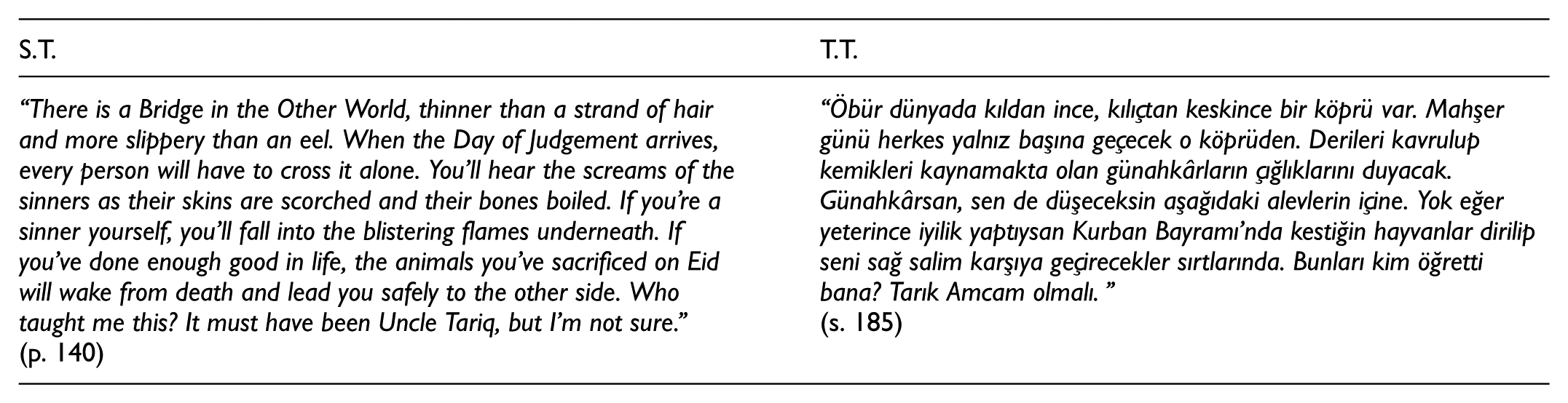
Evaluation
In the excerpt, İskender recalls religious elements and beliefs instilled in him during his childhood. The first few sentences of the source text are translated into the target text through literal translation. In the target text, the bridge described is rendered as “kıldan ince kılıçtan keskin” (“thinner than a hair, sharper than a sword”), reflecting a common belief in the target culture. However, in the source text, it is metaphorically described as “more slippery than an eel,” referencing a fish known in the source culture for its slipperiness, speed, and ability to generate electricity. In the following sentence, the phrase “the Day of Judgement” is translated into the target text as “Mahşer günü,” aligning with a widely recognised term in the target language and culture. The subsequent sentences in the source text are rendered into the target text through literal translation, though the final phrase “I’m not sure” is omitted from the target text. The excerpt discusses religious elements and beliefs, which can be classified under Peter Newmark’s taxonomy as components related to individual curiosities and passions. Based on the translation methods and strategies applied, it can be observed that elements widely used in the target language and culture were prioritised. This indicates that Lawrence Venuti’s domestication translation strategy was adopted.
Sample 7

Evaluation
In the excerpt, the daily routine of Tarık and his wife Meral, where Meral brings food to her husband at lunchtime, is depicted. In this example, the sentences are generally translated using a word-for-word approach. In the sentence where food names are mentioned, the term “minted yoghurt” in the source text is simply translated as “yoğurt” in the target language, while “smoky aubergine purée” is translated as “patlıcan salatası,” a flavour widely known in the target culture, instead of “közlenmiş patlıcan püresi.” In the next sentence, the word “samovar” is translated as “çaydanlık” rather than “semaver” in the target text. Furthermore, the phrase “for during an ordinary day” from the source text does not appear in the target text. In the final sentence, the word “kıtlama” appears in the target text, a term specific to the target culture, which is not mentioned in the source text. The food and beverage names in the excerpt reflect elements of eating and drinking culture, which, according to Peter Newmark’s taxonomy, can be classified as material culture; personal life elements. Moreover, given the use of local elements, it can be concluded that Lawrence Venuti’s domestication translation strategy has been adopted in the passage.
Sample 8

Evaluation
The excerpt provides descriptions of İskender’s perception of his mother’s personality. The expressions are translated predominantly through literal translation up until the final sentence. In the last sentence of the source text, the phrase “Nothing can … inside” is elaborated in the target text with the addition of an idiomatic expression, rendered as “İnsanı kendi ruhundaki habislikten koruyamaz hiçbir şey.” The excerpt also includes details about Pembe’s beliefs and lifestyle, presenting superstitions such as evil eye beads, not cutting nails at night, avoiding whistling, and etc. These elements can be categorised under Peter Newmark’s taxonomy as components related to individual curiosities and passions. Additionally, based on the word choice and translation strategies used in the excerpt, the predominant preference for literal translation suggests that Venuti’s foreignisation translation strategy has been adopted.
Sample 9

Evaluation
The excerpt narrates the story of Hediye, Pembe’s older sister and İskender’s aunt, whose tragic fate unfolds as a consequence of societal honour norms. With no brother to restore the family’s honour, Hediye is coerced into committing suicide by her father and stepmother, thereby “cleansing” the family’s honour. There is a temporal discrepancy between the source and target texts: the year 1957 in the source text is rendered as 1955 in the target text. The phrase “distrusted by most villagers” in the source text is translated as “köylülerin pek güvenmediği” in the target text, omitting the word “most.” Similarly, “hated by all children” is rendered idiomatically as “çocuklarınsa öcü gibi korktuğu biri” in Turkish, replacing “hated” with the expression “öcü gibi korkmak,” which conveys a similar sentiment in a culturally resonant manner. Further, the source text phrase “twelve-year-old Pembe … construe” is excluded in the target text. Instead, the target text introduces a sentence, “hele nasıl olup da konuşabildiklerini Pembe hiçbir zaman öğrenememişti,” which has no direct equivalent in the source text. The passage references concepts such as government, health workers, vaccines, and tuberculosis, which can be categorised under Peter Newmark’s taxonomy as elements related to public life. Based on the translation methods and strategies evident in this excerpt, it can be concluded that Venuti’s domestication translation strategy was employed.
Sample 10
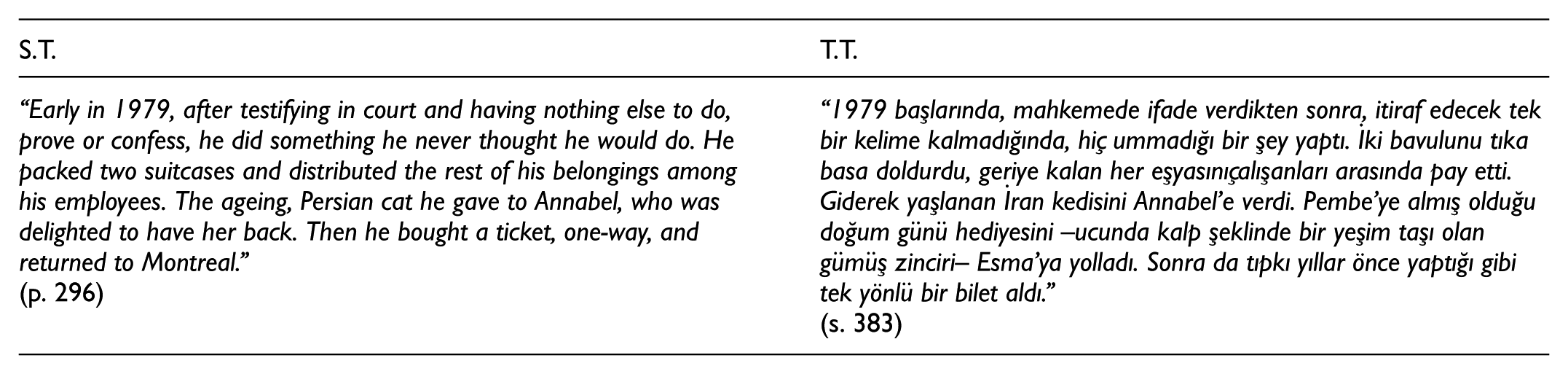
Evaluation
The excerpt describes Elias’s departure from the country following Pembe’s tragedy, after giving his testimony in court. The opening sentence in the source text is translated in the target text as “itiraf edecek tek bir kelime kalmadığında” (“when there was not a single word left to confess”), omitting the term “prove” related to proving something. The following sentences are rendered through literal translation in the target text. Regarding his cat, the source text mentions “who was delighted to have her back,” referring to his ex-wife’s reaction. This phrase is omitted in the target text. Additionally, the target text introduces a new sentence—“Pembe’ye almış olduğu … Esma’ya yolladı” (“He sent the birthday gift he had bought for Pembe—a silver chain with a heart-shaped jade stone pendant—to Esma”), which has no equivalent in the source text. The terms like court, testimony, confession, and proof can be classified under Peter Newmark’s taxonomy of elements related to public life. Objects such as luggage, necklaces, and personal items can be categorised as material culture elements; personal life components. Considering the translation methods and strategies applied in this excerpt, it is evident that Venuti’s domestication translation strategy was adopted.
Conclusion
Elif Şafak’s Honour represents a rare example in Turkish literature where an author writes a culturally rooted narrative in a foreign language and subsequently participates in its translation into her native tongue. This process, as analysed in this study, reveals a unique case of cross-cultural literary negotiation, where translation becomes an extension of authorial agency rather than a mere linguistic activity. This is one of the rare examples in Turkish literature where the author actively mediates between two languages and cultures. Therefore, Honour can be considered not only a novel but also a translational example that reveals the interplay between cultural identity, language, and rewriting.
The novel thematically engages with honour-based violence, migration, and intergenerational conflict, all framed within a rich tapestry of cultural and folkloric elements—from patriarchal norms and traditions to rituals, beliefs, and the East–West cultural dichotomy. These culture-specific elements, analysed using Newmark’s classification, demonstrate how deeply embedded cultural codes are transmitted and transformed in translation. The translation process is not merely a transfer of cultural elements but also a negotiation of identity between two cultures. In this context, the changes observed in the translation of folkloric elements into the target language can be considered an indicator of cultural hybridisation. In Şafak’s text, this translates into a constantly restructuring representation of identity along the East-West axis.
Through a comparative analysis of 10 textual units, the study identified consistent shifts between the source and target texts—ranging from lexical and syntactic to structural levels. These shifts were explained using Van den Broeck’s polysystem model, which accounts for systemic transformations, and Venuti’s translation strategies, where nine instances of domestication and one of foreignisation were identified. These strategies reveal the translator’s (and author’s) preference for aligning the text with the expectations and norms of the target audience, reinforcing the illusion of transparency and enhancing reader accessibility. These findings demonstrate that translation is not only a formal process but also an ideological repositioning process. The translator’s and author’s choices transform the text into a narrative more acceptable and familiar to the target culture.
Crucially, this study frames such translational choices within André Lefevere’s theory of rewriting, emphasising that the Turkish version of Honour should not be regarded as a direct translation but rather as a culturally and ideologically informed rewriting. The translator—under the direct influence of the author—makes selective additions and omissions that reflect prevailing poetic norms and sociocultural sensitivities in the Turkish context. In doing so, the translation acts as a mediated reconstruction, one that reshapes the narrative voice and repositions the text within a different literary and ideological system. From this perspective, Şeref’s Turkish version can be considered a “rewriting.” While Şafak simplifies the English version to suit Western readers, the Turkish version prioritises local values and social sensitivities. Thus, the text becomes, in Lefevere’s words, a rewriting repositioned by the influence of ideological and cultural systems.
Therefore, this study contributes to the field of translation studies by showing how self-translation, when interpreted through rewriting theory, serves not only to transfer but also to reshape and reframe cultural identity. It affirms the idea that translation is not a neutral bridge between languages but a highly strategic act of cultural production, shaped by systems of power, ideology, and authorial intent.
This study offers a unique approach to examining the phenomenon of self-translation within the framework of cultural rewriting, combining translation theory and literary analysis. This approach provides a methodological model not only for Honour’s case study but also for the analysis of texts by authors producing similarly across languages.
Limitations and Recommendations for Future Research
This study has several limitations. First, the research focuses solely on Elif Şafak’s work Honour and the process of self-translation into her own language; this may limit the generalizability of the findings to other authors or texts. Additionally, the analysis relies heavily on text comparisons and existing theoretical frameworks. Finally, the cultural and linguistic nuances specific to Turkish and English may not fully represent translation challenges in other language pairs.
Future research could expand the scope by comparing multiple works by the same author or self-translations by different authors. Furthermore, the addition of empirical studies, such as reader response analyses or translator surveys, could provide deeper insights into how culture-specific elements are interpreted by different reader groups, and exploring how digital tools and machine translation influence intercultural literary production could also offer valuable perspectives on contemporary translation practices for future studies.
Footnotes

Funding
The authors received no financial support for the research, authorship, and/or publication of this article.
Declaration of Conflicting Interests
The authors declared no potential conflicts of interest with respect to the research, authorship, and/or publication of this article.
Data Availability Statement
The data is not available in a public repository at the moment.