




Abstract
Increasing studies approach translation from alternative aspects, either borrowing different methodologies or concepts from other disciplines. These various attempts have expanded the field of translation studies to a broader area with a focus on either intercultural studies or the translator’s studies. Howard Goldblatt, as a respected translator in China, has provided limitless insights into Chinese literature in translation. Recent studies are moving closer to the specific traits of the translator, and this study thus focuses on Goldblatt’s translation of Red Sorghum, as the original work boasts plenty of cultural words, regional dialects, and colloquialisms. The purpose of this study is to determine Goldblatt’s translation tendency, the corresponding translation methods he adopted, as well as the reasons behind correspondent behaviors and choices. To answer the above inquiries, quantitative and qualitative methods will be jointly adopted. Multiple factors leading to the translator’s visibility and invisibility are also analyzed with reference to the quantitative results.
Plain language summary
This research demonstrates a renewed interest in “translator’s invisibility”, a concept proposed by Lawrence Venuti in 2001, through heightening its long neglected opposing aspect of “translator’s visibility”. This article has reexamined disputed viewpoints on Goldblatt’s translation tendency with solid evidence and extended the discussion on foreignization and domestication by substantiating them with specific instructive translation methods. This article has also discussed in greater detail how the translator grapples with fidelity and readability, the author and the market while making compromises when the two aspects conflict. It is hoped that this research may shed insights into trending research on translator’s studies and the ongoing discussion on Venuti’s domestication and foreignization in the particular area of literary translation. It is also hoped to benefit the production of translation in literature and help promote effective cultural exchange and cross-cultural communication.
Keywords
Introduction
Introducing Chinese literature to the English-speaking world through the effective efforts of English-native translators has been regarded as a best example and a useful experience for future endeavors in this arena. Therefore, research on Goldblatt’s translation has been a heated topic for a long while, and the discussion is ongoing. In view of research in the past decades, we can infer that in the early stage, Goldblatt’s strategies, including some forms of manipulation and rewriting, have grown popular amongst evaluators and critics of translation in China. In contrast, the traditional conception of faithfulness has been correspondingly depreciated (Hu, 2010; Liu & Xu, 2014). This is because the Chinese scholars desire a quick and conclusive set of principles or truths that can apply to all translation of Chinese literature into English. Therefore, the translator’s objective uniqueness and individuality is not valued appropriately. The focus of later research on Goldblatt’s translation has shifted from the linguistic level to the narrative aspect, and even levels beyond linguistic aspects, for instance the reception of the target readers (Lv, 2012). Some research began to examine the representation of certain themes of the literary work in translation, for instance the representation of geological content and acceptable practices learned from Goldblatt’s translation (He & Sun, 2022). In the most recent years, comparative studies between Goldblatt and other translators have been conducted for the purpose of examining underlying reasons behind the translator’s behaviors and choices (Zhou & Ding, 2016). The interest in the translator’s uniqueness is heightened, inspiring the new trend of translator studies. Meanwhile, the foreignization/defamiliarization aspect of Goldblatt’s translation has been confirmed in some other research (Shao & Wu, 2022).
Red Sorghum, Hong Gao Liang Jia Zu in Chinese, is a representative work of Mo, the winner of the 2012 Nobel Prize in Literature. As is widely acknowledged, Mo Yan’s work would not have drawn as much international attention as it did but for Goldblatt’s translation. Goldblatt’s translation, especially in terms of culture-specific items, is therefore worth investigating, as the original fiction is filled with expressions of regional dialects and colloquialisms, such as Ba Yin Guo (八印鍋) which is a type of cook pot providing for eight people, Ku Sang Hu (哭喪戶) which refers to the professional mourners who make a living by offering wailing at people’s funerals, a custom practised in some regions of Shandong province. Chi Gang Zi Fan (吃杠子飯) is an informal and colloquial expression describing people who make a living by carrying the bridal sedan at a wedding or a coffin at a funeral, and Ba Ni De Pi Chou Ni De Jin (扒你的皮抽你的筋) is an offensive expression for anger and hatred, which can be literally translated as “skin you alive and rip the tendons right out of your body.” As evidenced in many previous studies, Goldblatt’s translation is unfaithful to the original text, and researchers are quick to conclude that Goldblatt much prefers a domesticating translation. However, recent viewpoints alternatively argue for and demonstrate the tendency of foreignization in Goldblatt’s translation (Shao & Wu, 2022). Considering the differing opinions on his translation strategies, this study intends to re-examine the same issue by focusing on culture-specific items (CSIs). Using both quantitative and qualitative translation, this essay will report on empirical research to determine the translation tendencies exhibited in Goldblatt’s translation. An adapted framework to measure the tendencies of domestication and foreignization will be used for such purpose. Consequently, the specific translation techniques utilized and the reasons behind the translator’s choices will be discussed in greater detail. Further on, this study can contribute to the ongoing scholarship in the translator’s visibility and invisibility by incorporating extra-linguistic factors affecting the translation process. The following under-explored questions will be investigated: 1. Which translation strategy has been more frequently adopted, foreignization or domestication? 2. What specific translation methods have been employed for the translation of CSIs, and how do they result in domestication and foreignization? 3. What are the reasons behind the translator’s choices? This research is situated in the interface between literary translation and translator’s studies.
Literature Review
At its early stage, numerous translations and the introduction of Venuti’s (1998, 2000, 2001) theory were conducted in China, most of which are concerned with differentiation of this theory with literal translation and free translation (Luo, 2004). Literal and free translation are two strategies dealing with linguistic form and content that are often incongruous, while domestication and foreignization are concepts operating on not only linguistic but also cultural and ideological levels (Ge, 2002). Later, with deeper insight into the concepts, Huang (2010) proposes a continuum between foreignization and domestication, distinguishing between various degrees involved—a new perspective, no longer regarding them as two dichotomous notions. Using qualitative and quantitative methods, Ren and Wang (2020) analyze Chinese translations of Venuti’s theory and demonstrate that the connotation of translator’s invisibility has enriched and evolved in China after entering the context of Chinese academia. Based on their statistics of translations of “translator’s invisibility” in academic research, it can be seen that the term basically has two translated versions in Chinese, that is, Yin Shen and Yin Xing. The former refers to the invisibility of the social identity of the translator, and it is contingent on a series of social attributes. By contrast, the latter is used to describe the process when the translator endeavors to erase his traces, a process involving the interaction between the translator and the text itself. In essence, the two concepts entail translation activities at dual levels, within the text and beyond the text. This is the so-called contextualized concept of Venuti’s translator’s invisibility in the Chinese context (Ren & Wang, 2020).
The proposed dichotomous notions of domestication and foreignization have revealed an ethical dilemma encountered by translators in dealing with cultural issues inherent in translation, which often results in the translator’s invisibility due to the consideration for readability or ideological reasons. Coldiron proposed visibility as an inverse corollary to Venuti’s (2001) notion of invisibility and attempted to establish a historical context for the visibility of translators by tracing broader cultural-aesthetic agendas related to translation as they change over time. According to Coldiron (2012), “Questions of visibility and invisibility are on some level questions of how to encounter, use and value things foreign” (p. 189). The significance of his premise is to reveal visibility that “points to, if not solutions, then certain alternative potentials for valuing the foreign” (Coldiron, 2012, p. 190). Through his explication, Coldiron (2012) suggests an ethical dimension of highly visible translations, the purpose of which is to reveal the differences or to show “how the foreign has been used (or abused) and valued (or devalued) over time” (p. 190).
Extending Venuti’s theory, Coldiron (2012) discusses the dialectical aspects of invisibility and visibility by putting them at two ends of a spectrum, claiming, “On a spectrum of values, we might think to align invisibility with sprezzatura (smoothness and ease) and visibility with imitatio (the revealed difference that highlights the translator’s actions)” (p. 192). He goes further to substantiate the two statuses associated with invisibility and visibility; the former is described as “graceful, not labored” whereas the latter notion, “to be recognizable, had to be enough like a known and valued prior text for its own differences to be acknowledged” (Coldiron, 2012, p. 192). Coldiron’s innovation lies in putting invisibility and visibility on a spectrum, heightening the largely overshadowed aspect of the translator’s visibility and presence as reflected in the translator’s dealing with the foreign that is often seen “as sites of friction and interest between two literary systems” (Coldiron, 2012, p. 198). His notions are inspirational for exploring the dynamics in the translator’s behavior.
As seen from the observations above, the birth, growth, and contextualization of Venuti’s (2001) concepts have undergone a process of change. Now, this concept begins to be used to study the translator’s behaviors and indirectly contribute to the field of translation studies. Regarding translator’s studies, various scholars have made efforts in this new area. Hubscher-Davidson (2009) imported concepts and methodology from the field of psychology and argued that the presence of character traits could influence the translator’s performance in translation and become perceptible to potential target readers. Baker (2000) outlined a methodological framework for investigating the question of style in literary translation in terms of whether individual literary translators can be shown to use distinctive styles of their own. Pym (2009) proposes that alternative principles might be able to initiate “a progressive humanization of translation studies.” Such principles include multi-discursive involvement, complex cultural allegiances, and physical mobility. Pym believes that exploration of these principles might expand translation studies towards the intercultural studies.
Built on previous research, especially the conclusion that foreignization and domestication as represented by visibility and invisibility form a continuum between the source text and the target text, this essay, with evidence of the two phenomena gathered by examining the culturally specific items in Goldblatt’s translation of Red Sorghum, intends to demystify the tendency of domestication and foreignization in dealing with such language aspects, as well as the specific translation methods under Venuti’s (2001) domestication and foreignization classifications. This study is also expected to contribute to the translator’s study by looking closely specific methods used under each tendency and each category of CSIs. The broad concept and tendency of foreignization and domestication are examined with explanation of the translator’s choices and the reasons behind them.
Methodology
Information about the data and criteria for the selection of CSIs will be explained in detail. A theoretical framework will be formulated based on reviews of related concepts above and the scholarship concerned.
Data Sources and Data Selection
There exist four Chinese versions of Hong Gao Liang Jia Zu published over time by different firms in China. They are the 1987 version published by PLA literature and Art Press, the 1998 version by Taipei Hong-fan Book Co., the 2007 version by Renmin Press, and the two different versions by Shanghai Literature and Art Press published in 2008 and 2012 one after another. The following two versions are selected as the object of this study: The Chinese original text published in 1998 by Taipei Hong-fan Book Co. and the English target text published in 2003 by New York Viking. Goldblatt stated in the translator’s preface that he chose the Chinese version published by Taipei Hong-fan because it had not undergone censorship.
Hong Gao Liang Jia Zu (1998), Red Sorghum (2003) in English, consists of five chapters: Red Sorghum, Sorghum Wine, Dog Ways, Sorghum Funeral, and Strange Death. The story begins with Grandma’s wedding in 1923 and ends with Grandfather’s death in 1976. It’s first-person narrator relates stories of “my” grandfather’s generation during the historical period of the Japanese invasion that took place in Northeast Gaomi Township. In this novel, local bandits and guerrillas unite with the local government force, taking advantage of each other in the struggle against the Japanese intruders. With bold and unconstrained spirit, Grandma’s and Grandfather’s heroic and relentless pursuit of love amid war becomes a source of pride for their posterity.
The CSIs were sampled and categorized based on Nida’s (2004) categorization of culture. Nida divides culture into five categories: ecological, linguistic, material, social, and religious culture. In this study, CSIs are defined as including not only words but set phrases and expressions; in other words, CSIs are at word level and above word level, their form and content in a source text involve a translation problem and have no equivalence in the target culture. However, further recognition of CSIs needs to draw support from the categorization of culture. Except for linguistic culture, the other four categories are easy to identify. Regarding linguistic culture, Nida regards it as what reflects language differences on phonological, morphological, syntactic, and lexical levels, covering a wide range of linguistic phenomena. Based on the language features of this novel and the differences in linguistic complexities in English and Chinese, this study focuses on four-character words, dialectical expressions, and abusive language, which can reflect linguistic differences between English and Chinese at morphological, lexical, syntactic, and semantic levels. Firstly, dialectical expressions and abusive language contain lexis or phrases that are unique to a language. Second, four-character expressions are prevailing yet inherent in Chinese literary works; some contain an allusion, and some are featured by repetition, for instance, 調虎離山 Diao hu li shan “lure the tiger out of the mountain” (as rendered by Goldblatt) and 雞飛狗跳 Ji fei gou tiao “chickens squawking and dogs yelping” (Nida, 2004).
In Table 1, following Nida’s categorization, 212 CSIs in total are identified and collected from the entire novel. It is observed that the linguistic CSIs, with 68 examples, occupy a larger proportion than other categories, appearing not only in narration but also in dialogue. Ecological CSIs account for 20, material CSIs 45, religious CSIs 20, and social CSIs 37.
Data.

Theoretical Framework
As mentioned earlier, there have been few discussions about how domestication and foreignization are realized through specific translation methods. After examining Aixela’s (1996) frame of translation strategies for dealing with CSIs, it is observed that the frame can be justifiably modified to measure and determine the tendency of domestication/foreignization (p. 60). As shown in Table 2, Repetition, orthographic adaptation, linguistic translation, extratextual gloss, and intratextual gloss are on the continuum of preserving the source text from a greater to a lesser degree (Aixela, 1996, p. 61). The method of repetition, by retaining the source text, is the closest to the source text, followed by orthographic adaptation, in which source text is expressed in different alphabets. Linguistic translation, by choosing a reference denotatively close to the original one, is still regarded as a method orienting toward the source culture. In extratextual gloss and intratextual gloss, the translator first renders the text semantically, then adds a gloss to make the translation more explicit and acceptable to the target readers. The above-mentioned methods can be counted as specific methods for foreignization by preserving the linguistic and cultural differences of the foreign text (Venuti, 2001, p. 20). It should be noted that the method of repetition is based on Aixela’s observation of translation between English and Spanish, both languages derived from one homogeneous Indo-European language system. The method of repetition is nevertheless not a commonly adopted strategy in translation from Chinese to English, languages derived from two heterogeneous language systems. Therefore, this technique will be ruled out for this study.
Theoretical Framework.


At the opposite end of the spectrum, a series of other tendencies are proposed to negate the foreign, for instance, synonymy, limited universalization, absolute universalization, naturalization, and autonomous creation, which are on the continuum of substituting for the source text from a lesser to a greater degree. Synonymy is concerned with recreating the stylistic feature of the term. Limited universalization, absolute universalization, and naturalization form a cline that gradually deviates from the source culture and approaches the target culture. Deletion is considered from ideological, political incorrectness, or contextual importance standpoints. Autonomous creation is manipulated for certain target audiences or certain purposes, such as translation for film titles or children’s literature. It is noted that the above-mentioned methods orient toward either the target culture or the target readers. Among them, synonymy reflects the manipulation of stylistics and poetics; deletion is concerned with the manipulation of ideology; and autonomous creation is manipulation for intended purposes. As defined by Venuti (2001), domestication favors transparent, fluent, and natural translation of the source text where the foreignness of the target text is reduced to the lowest level. The above-mentioned methods all result in domestication. However, since this study focuses on the cultural and linguistic elements of CSIs, the translation methods of synonymy, deletion, and autonomous creation will be ruled out in this study.
Based on the adapted framework (Table 2), translation methods will be identified under each category of CSI, and translation tendency can be consequently determined.
Results and Discussion
In this section, translation methods used for rendering each category of CSIs will first be calculated. Translation tendencies will be determined by calculating the percentage. Second, a qualitative study will be carried out to illustrate how specific translation methods are applied under each category of CSI, as well as how each is determined to be domestication or foreignization. Third, the frequency of translation methods under domestication and foreignization used in the selected CSIs en masse will be calculated to determine Goldblatt’s translation tendency and to find out the specific translation techniques utilized. Last, the research result will be discussed.
Translation Methods and the Tendency for Rendering Ecological CSIs
According to Nida’s definition, ecological CSIs include names for plants, mountains, and places, which are unique in the source language. In this fiction, some places are real while others are fictional, such as Gao Mi Dong Bei Xiang (高密東北鄉), Mo Shui He (墨水河), and so forth. Translation methods used and the general tendency for this category are summarized in Table 3.
Translation Methods and the Tendency for Rendering Ecological CSIs.

Table 3 shows that foreignization is the dominant translation strategy, realized by methods of linguistic translation and intratextual gloss, and the former translation technique is far more frequently used than the latter one. An example of foreignization is shown below, along with a comparison to several occurrences of domestication.
Mo (1988): 河灘上的狗蛋子草發瘋樣生長,紅得發紫的野茄子花在水草的夾 縫裡憤怒的開放 (p. 265)
Goldblatt (2003): Dog-turd reeds grow in profusion on the banks; wild mustard flowers so red they seem purple bloom furiously amid the water grasses. (p. 251)
Gou Dan Zi Cao (狗蛋子草) is the informal name for a type of reed that grows widely in the field. The shape of the reed is vividly compared to a dog-turd through the use of metaphor. This item can absolutely be neutralized and translated as “reed” or “weed.” However, Goldblatt used linguistic translation, a method equal to literal translation. The foreignness of this plant name is presented to the target readers by preserving its linguistic elements. Stories in this fiction are mainly contextualized in the countryside, which can rationalize the abundant use of rural language. Rural features are represented in the naming of all types of items. The proper name quoted above is one such example. The adoption of foreignization can be justified here. As we can see in the second half of the sentence, the plant 野茄子花 is alternatively rendered as “wild mustard flowers.” Description of the countryside is reconstructed through naming of things and foreignizing them. There are various other examples in this category, for instance 墨水河, the recurrent location of many stories in this novel, is translated into “black water river” rather than “Mo Shui river.” Even though transliteration used in the latter translation can also add to the foreignness of the place, certain information is lost as well. A literal translation, “black water,” can meaningfully add to the mysterious character of the river, consequently heightening the theme of the story.
Translation Methods and the Tendency for Rendering Linguistic CSIs
Based on Nida’s definition, linguistic CSIs will be restricted to four-character words, abusive language, and dialect expressions in this study, for they are the most obvious linguistic features in Chinese as well as in this fiction, such as Shao de ta bu qing (燒得她不輕), “She is spoiled.” Altogether, 68 linguistic CSIs are detected, and translation methods concerning this category are summarized in the Table below.
As demonstrated in Table 4, foreignization (55.1%) is the dominant translation strategy, with linguistic translation (49.2%) and intratextual gloss (5.9%) as the realization methods. Domestication, as the less dominant translation strategy, still accounts for a large proportion (44.6%), with limited universalization, (2.9%), absolute universalization (23.8%), and naturalization (17.9%) as the realization methods. Since the three subcategories of linguistic CSIs may indicate different features in Goldblatt’s translation, we will take a closer examination by analyzing them separately.
Translation Methods and the Tendency for Rendering Linguistic CSIs.

In Table 5, translations of four-character words are dominated by foreignizing translation, with linguistic translation and intratextual gloss as the operating methods. Domestication, as the less dominant strategy, is realized by absolute universalization and naturalization.
Translation Methods and the Tendency for Rendering Subcategories of Linguistic CSIs.

Regarding abusive expressions, foreignization is the dominant strategy, realized by linguistic translation (37.5%) and intratextual gloss (16.6%); domestication is the less dominant strategy, achieved by absolute universalization (12.5%) and naturalization (33.3%).
With regard to dialectical expressions, domestication is the dominant strategy, realized by absolute universalization (58.8%) and naturalization (11.7%). Foreignization is the less dominant strategy, achieved by linguistic translation (29.4%). Here are two examples of dialetical expressions involving foreignization and domestication.
2. Mo (1988): 父親說:‘大叔,你掛彩了’ (p. 11)
Goldblatt (2003): “Uncle,” Father said, “you are wounded.” (p. 11)
3. Mo (1988): 爺爺向來是嚴守法則,因為這兩個女人,哪個也不是省油的燈 (p. 368)
Goldblatt (2003): He stuck to his bargain, since neither woman was an economy lantern, someone to be taken lightly. (p. 365)
挂彩 is a vivid expression depicting injured people covered with blood. This expression indirectly shows the characters’ bravery and relentlessness when facing the battles. Yet Goldblatt renders this humorous dialectical expression with a neutral reference, “wounded.” The original vividness, humor, colloquialism, and flavor has been lost by using absolute universalization, a way of domestication. In this case, there is slim possibility for the translator to use foreignization to highlight the rural feature of the expression and the humorous, positive, and courageous people in facing war. In that case, the translation would be too long to recreate the imagery contained in the expression. No other translation can be more economical than the word “wounded.” Therefore, the general principle of linguistic efficacy is prioritized here. However, some dialectical expressions can also be effectively foreignized. For instance, Bu Shi Zhan Sheng You de Deng (不是盞省油的燈) refers to a troublemaker or a calculating person who is not easily fooled, yet this expression contains the image and metaphor of a lantern. The translator introduces the foreign expression to the target reader by using linguistic translation, adding a short explanation to reduce the foreignness of the metaphor for the readership. This expression is another example that involves a rural element, that is, the lantern fueled by oil, the only way of creating light at night in the old China. In fact, the image contained in the expression can absolutely have been left out, preserving only the second half, “someone to be taken lightly.” Nevertheless, some literary flavor is lost by adopting that method, and the author’s original intention of connecting the people with the land and its ruralness would be erased in that way. This kind of foreignization has greatly preserved the local and dialectical flavor of the Chinese fiction.
Translation Methods and the Tendency for Rendering Material CSIs
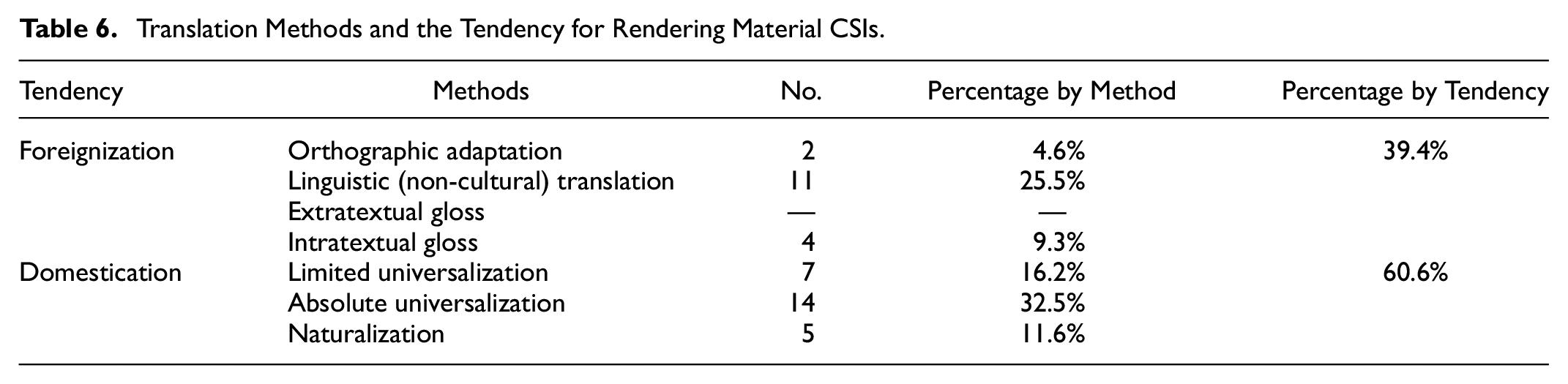
According to Nida’s definition, Chinese material CSIs include measurement, such as Li (裡) and Mu (畝) as well as housing, recreational items, and other daily items that are unique to Chinese culture. In this novel, most of the material items are commonly seen in rural life. The translation methods and tendency for dealing with material CSIs are summarized in the Table below.
Table 6 shows that domestication plays a dominant role in translating this category’s CSIs, with limited universalization, absolute universalization, and naturalization as specific methods used. Foreignization, as the less dominant translation strategy, is achieved by orthographic adaptation, linguistic translation, and intratextual gloss. Here are two detailed instances of two separate translation tendencies.
Translation Methods and the Tendency for Rendering Material CSIs.
4. Mo (1988): 我奶奶當時年僅十六歲,從小刺花繡草,精研女紅,繡花的尖針, 鉸花的剪刀, 裹腳的長布, 梳頭的桂花油等等,女孩的玩意伴她度日過年 (p. 95)
Goldblatt (2003): During her first 16 years, Grandma’s days had been devoted to embroidery, needlework, paper cutouts, foot binding, the endless glossing of her hair, and all other manner domestic things in company of neighbor girls. (p. 93)
5. Mo (1988): 村裡的街道上,村頭的樹蔭下,賣爐包的踩好了土灶,烤燒餅的支好了鍋,賣綠豆涼粉的搭起了白布涼棚 (p. 266)
Goldblatt (2003): On the street and in the shade of trees at the head of the village, dumpling peddlars set up their earthen stoves, flatcake vendors heated their pots, and cold-bean-noodle stands with white canvas awnings were thrown up. (p. 252)
Gui Hua You (桂花油) is a dated sort of fragrant oil derived from Gui Hua flowers that was once used to Chinese women’s hair. By using absolute universalization, a method of domestication, the translator describes only the function of this sort of oil, leaving untranslated the material from which the product is formed. Even if such material could be added via footnotes or explanation, it would impede the flow of the information. As per established linguistic principles, it is widely recognized that excessive information should not be superimposed upon a single sentence. The sentence lists a number of additional activities, each of which is no longer than two words, as can be seen. In this case, providing further explanation for the last item will disrupt the natural flow of the sentence and impede the smooth flow of information. Lv dou Liang Fen (綠豆涼粉) refers to a type of Chinese cold dish. 绿豆, specifically “mung bean,” is generalized as “bean” in this case. The term “noodle” (fen) refers to a type of bean and rice powder-based noodle. The author searched online for different translations of this Asian-inspired dish and came up with Liang Fen (mung bean jelly noodles), mung bean jelly, and Nokdu-muk (a name equivalent in Korea). “Noodle” here acts as an intratextual gloss because “Fen” is a distinctive Chinese dish that has no equivalent in Western cuisine. With the use of intratextual gloss, “cold-bean-noodle” is, overall, structurally fairly accurate to the source text. The author next looked up “noodle” in the Encyclopaedia of Britannica and discovered that it is a common ingredient in both European and Asian cuisine, making it familiar to readers from both cultures. In addition, the translation remains succinct and adheres to the general principle of linguistic efficiency in food nomenclature by incorporating a hyphen.
Translation Methods and the Tendency for Rendering Religious CSIs
According to Nida, religious culture includes the characteristics of religious beliefs and traditions of a certain language community, for example, Lao Tian Ye (老天爺) “old man in heaven” and ren sheng Chan Ji (人生禪機) “the mysteries of life.” The translation methods and tendency for dealing with religious CSI are summarized in the Table below.
Table 7 reflects that in handling religious CSIs, foreignization is the dominant tendency, with linguistic translation (55.5%) and intratextual gloss (5.5%) as the realization methods. Domestication as the less dominant strategy is achieved by limited universalization (5.5%), absolute universalization (27.7%), and naturalization (5.5%). Here are two examples that clearly illustrate two different trends using certain techniques.
Translation Methods and the Tendency for Rendering Religious CSIs.

6. Mo (1988): “不看僧面看佛面,不看魚面看水面,不看我的面子也要看豆官的面子上,留下吧” (p. 9)
Goldblatt (2003): “If not for the sake of the monk, stay for the Buddha. If not for the sake of the fish, stay for the water. If not for my sake, stay for little Douguan.” (p. 9)
7. Mo (1988): “三天新生活,如同一場大夢驚破,有人在一分鐘內成了偉大領袖,奶奶在三天中參透了人生禪機” (p. 66)
Goldblatt (2003): “The 3 days she had just got through were nightmarish. Certain individuals become great leaders in an instant; Grandma unlocked the mysteries of life in 3 days.” (p. 124)
In Chinese culture, Buddhism has been so integrated into people’s speech and thought that they are often unconscious of it when speaking. This aspect reinforces the dialectical features of the novel. Furthermore, the original Chinese speech has parallel sentences that portray a growing sense of tension. The foreignness of Chinese religious belief is retained in the target text through linguistic translation, a way of foreignization. Not only the religious element but also the parallelism have been successfully translated in the target text. Chan ji (禪機), a unique Chinese term, can be defined as a synthesis of Zen philosophy with a method or technique that emphasize intuitive insight, direct experience, and a simplified view of reality. Here, Goldblatt employed absolute universalization, a domestication technique, to seamlessly incorporate this idea into the stories. Even though a portion of the religious connotation is lost in translation, information is still flowing freely.
Translation Methods and the Tendency for Rendering Social CSIs
Based on Nida’s definition, social culture includes customs, lifestyle, social life, historical background, and behavior patterns of a certain language community, for example, 海茂子腔 Hai Mao Zi Qiang “popular local opera” and 黃泉 Huang Quan “the yellow spring.” Translation methods and strategies for dealing with social CSIs are summarized in the table below.
Table 8 exhibits that in Goldblatt’s translation of social CSIs, foreignization is the dominant strategy, with orthographic adaptation, linguistic translation, extratextual gloss and intratextual gloss as the specific methods used, while domestication is the less dominant strategy, achieved by limited universalization, absolute universalization, and naturalization. Here are two examples that use specialized techniques to demonstrate two distinct tendencies.
Translation Methods and the Tendency for Rendering Social CSIs.

8. Mo (1988): “昨天我們騷擾了平度城,迫使鬼子倉惶撤退,這是‘圍魏救趙之計’ 吧,江隊長?” (p. 222)
Goldblatt (2003): ‘We were harassing the town of Pingdu and forcing the Japs to retreat in panic. You could call that the classic “Encircle the Wei to rescue the Zhao” ploy, wouldn’t you say, Commander Jiang?’ (p. 211)
9. Mo (1988): 父親跟奶奶去村東死孩子夼時,奶奶正發狂地迷戀著‘押花會’(一 種賭博方式,跟時下流行的‘買彩票’、‘有獎儲蓄’、‘有獎購物’有類似的性質) (p. 391)
Goldblatt (2003): when Father went to Dead Baby Hollow with Grandma, she was obsessed with the Flower Lottery. (p. 325)
Wei Wei Jiu Zhao (圍魏救趙) is one strategy of 36 from Sun Tzu’s The Art of War. Surprisingly, the historical allusion is wholly retained through linguistic translation without footnotes. Without any background knowledge, the reader can hardly know the meaning of this expression. Even though the foreignness of this expression is greatly retained, the author highly doubts whether the English reader can fully comprehend this translation. The ecology of literary style and dialectical features have been represented by occasionally sacrificing readership. This is a feature worth noting in Goldblatt’s translation. Ya Hua Hui (押花會) is a type of regional lottery where participants wager on flowers. The proper noun in the original Chinese is enclosed in single quotation marks. To maintain the expression’s structure and meaning, intratextual gloss is used by inserting the categorical term “lottery” here. Then, for the entire phrase to function as a proper noun, each word is capitalized.
Translation Methods under Domestication and Foreignization
Translation methods used under each category of CSIs are calculated to find out Goldblatt’s general tendency of translation and the specific methods adopted.
Table 9 shows that the dominant tendency of Goldblatt’s translation is foreignizing. The four realization methods under foreignization serve to retain the linguistic and cultural features of the original reference, among which linguistic translation and intratextual gloss are more frequently adopted. The less predominant translation tendency Goldblatt uses is domestication, under which limited universalization, absolute universalization, and naturalization are the realization methods. The quantitative result indicates that absolute universalization is the most frequently used translation technique, while the other two occupy an almost equal distribution.
Translation Methods Under Domestication and Foreignization.

Discussion: Translator’s Invisibility and Visibility
Regarding the effects of cultural references’ translation, we tend to believe that these details are interwoven into the story and become unmarked compared with the more evident components of the novel, such as the plot. After a glimpse of the book reviews of Red Sorghum on Amazon and Goodreads, one finds that readers’ attention seems mostly focused on the overall structure of the novel; critiques focus largely on aspects such as its flashbacks and lengthy description, which create spoilers and test readers’ patience. Nevertheless, these impressions of the novel may not overshadow the significance of the translation operating at the linguistic level, despite it seeming insignificant. The translation of linguistic details has played an equally important role in the overall construction of the novel. Moreover, the translator’s ethics will be seriously compromised if he/she boldly changes the structure of the novel to cater to the expectation of the target readers. In a sense, the manipulation of macro-structure of the novel through translation is beyond the translator’s flexibility and freedom. However, the translation of linguistic issues on a micro level never fails to underlie some phenomena worthy of study, which may also show practical implications for literary translation.
Translator’s Invisibility
Invisibility of the translator can be represented in several aspects: the translation strategy and methods used by the translator and the use of paratext and reception of the readers. Domestication causes invisibility of the translator. Based on qualitative and quantitative studies, we can observe that even though domestication is the less dominant translation tendency, comprising 43.6%, there is no contrasting distance between it and foreignization. Limited universalization, absolute universalization, and naturalization are realization methods for domestication, exhibiting different degrees of closeness to the target culture. As is observed, absolute universalization is the most frequently adopted technique for domestication. When it is difficult to retain the foreignness of the source culture, the translator usually uses a general term to efface its cultural peculiarity. Linguistic, social, and material CSIs occupy a higher percentage than other categories in using this technique, such as 八印鍋 “cookpot” and 海茂子腔 “popular local opera.” Besides, some dialectical expressions are absolutely universalized when they are difficult to foreignize. Some cultural items, which include both referential meaning and associative meaning are absolutely universalized; for instance, Xiao Mao (孝帽) refers to the head covering worn by the sons and closest relatives of the dead at a funeral, showing their filial piety. As indicated in the translation “sackcloth head covering,” only the type of material is retained. Another example: Di xi he da zhi zi (弟媳和大侄子) is a typical Chinese title, being more complex and sophisticated than western titles. Those features are effaced in the translation “your wife and child.” Goldblatt knows that readability is the primary and fundamental concern in the genre of fiction. In terms of naming of items, economy in expression is also the prioritized principle.
Naturalization is considered the most overt form of domestication. By offering equivalence that is specific to the target reader, it effectively facilitates communication between two cultures and languages, especially for items intended to arouse readers’ strong emotions or demanding a response. Taking offensive words for example, it is better to use domestication to strengthen the cursing force and effects. For example, 兔崽子 is rendered as “you little shit.” Regarding naturalization, it is further from the target culture compared with limited universalization and absolute universalization. This technique attempts to render source culture into a target language, such as Xiang Huo (香火) “family line,” a word for word translation being “incense and fire.” For the target reader, foreignness is erased and replaced with expressions acceptable to the source culture and language.
It is believed that domesticating methods can be considered from the point of view of the readership and economy of expression. In an interview conducted by Meng (2014) Goldblatt states that translators have to take into consideration the target readers and the market, and that the principle of faithfulness should be balanced against the readership, even though the readership is not all that matters. When being asked how to deal with culture-specific expressions, Goldblatt admits that choosing the translation method is challenging. However, he maintains he has not insisted on foreignization by sacrificing the readability and fluency of the English language. In this respect, Goldblatt claims that translation is the art of compromise and believes that his responsibility as a translator is to reproduce the text faithfully and meanwhile guarantee readability. On the other hand, based upon examples discussed earlier, it can be seen that a domesticated translation is usually shorter than a foreignized translation, therefore this trait guarantees the economy of information from the perspective of language use.
Domestication or the translator’s invisibility can also be approached from the perspective of translatorship and authorship. Goldblatt states in the same interview mentioned above (Meng, 2014), “The so-called invisibility claimed by Venuti (2001) is impossible. I have a preference for words and sentence structures. If I forsake all my preferences and accept the author’s choice of words instead, I am simply unable to translate anything. I am only able to conduct this task in the manner I am used to, and using the material in my command. …as a translator, I cannot serve both the author and the readers. What I can do at the least is to make myself satisfied. Surrendering one’s ego is the last thing that a translator should do” (Meng, 2014, p. 49). Perhaps the translator’s sense of self-realization achieved by his partial authorship is the perpetuating force, driving him to complete numerous literary translations. Despite his assertion, we should not underestimate the faithful aspects of his translation as represented in the foreignizing methods he used. Even though cases of frequent domestication for linguistic, material, and social CSIs has been previously shown with instances and arguments, a substantial amount of foreignization cases also shown in the three above stated CSIs. Besides, compared with other three categories, domestication is used less frequently in ecological and religious CSIs. The specific reasons and the compromise made by Goldblatt will be explained in more detail in the section that follows.
Translator’s Visibility
The translator’s visibility can be represented in the following aspects: strategy and methods used, cultural-aesthetic agendas, and reception of the audience.
Foreignization, being the dominant tendency used here, is mainly realized by linguistic translation. The five categories of CSIs all share a high percentage of utilizing this method. When translating ecological CSIs, linguistic translation helps to retain the geographical foreignness of the source text, bringing the target readers an alien reading experience. Linguistic CSIs, possessing unique linguistic and cultural features, are also faithfully rendered via linguistic translation. For example, the four-character word 雞飛狗’ is rendered as “chickens squawking and dogs yelping,” which brings to the target text the unique rural flavor of the novel and aesthetic value, in addition to its linguistic pattern. This expression can be absolutely conveyed through domestication with something like “stir up…” or “a chaotic scene caused by…,” but the contextual and stylistic element will also get lost along the way. With regards to the remaining categories of CSIs (material, religious, and social CSIs), linguistic translation helps to introduce Chinese tangible and intangible culture, religious beliefs, and social customs to the target readers, for instance 七日墳, a type of Chinese funeral ritual, is rendered as “a seventh-day funeral.” Overall, the use of linguistic translation demonstrates Goldblatt’s faithfulness to the original style of the novel.
There are advantages and disadvantages in using linguistic translation. On the one hand, linguistically translating these CSIs in a faithful manner can help to strengthen the authentic setting of this fiction, since CSIs are often embedded in the narration and the characters’ dialogues. However, they may increase the reading difficulties for the target readers, due to the cultural gap without an explanation. Unlike the practice of brutally domesticating foreign expressions, Goldblatt has treated these with more fairness. In an interview, Goldblatt expresses his love of language and his sensitivity to the varying intonations of Chinese characters (Meng, 2014). When dealing with some cultural terms, he patiently consulted the authors and demonstrated his responsibility for accepting the cultural elements as they are rather than erasing them. This shows his faithful and rigorous attitude towards cultural foreignness in the novel. The translator’s rigorous attitude can also be demonstrated through the use of intratextual gloss, another foreignization technique. In translating certain abusive language, the linguistic pattern of the source text is first rendered at the lexical level, and then a gloss is added to strengthen the effects of abusive language. In rendering certain social CSIs, a categorical term is added as a gloss. For example, Han Lin (翰林) is rendered as “Hanlin scholar,” using the categorical term “scholar” to reduce the foreignness of this cultural item. In a word, intratextual gloss orients toward the source culture, serving as an effective way of introducing Chinese culture while counteracting the target readers’ difficulty by offering a short explanation. Therefore, it reduces the possibility of obstructing the flow of reading and adds to the fluency of the translation.
There are very few examples of orthographic adaptation. Material CSIs and social CSIs both have two examples of adopting this technique. It is observed that the just-mentioned cases are, in fact, pre-established translations, such as Kang (炕) and Kou Tou (叩頭). Social CSIs using this technique are famous historical figures or allusions, for example, 武大郎, “Wu Dalang.” Retaining those cultural items can introduce source text culture into the target text culture.
Goldblatt has a special love for Chinese literature, and he has translated a number of Chinese writers’ works. This passion can partly explain why he used foreignization when domestication could absolutely serve the purpose. Only those translators who thoroughly appreciate the literary qualities of the works take care to render those features. As demonstrated in this case of Red Sorghum, many culture-specific items have played an important role in constructing such a vividly rural milieu with such linguistic details. Appreciation of this literary feature is prerequisite to successfully preserving such features, therefore justifying the translator’s adoption of foreignization. Goldblatt has used this method to let English readers experience the exoticness and literariness of the original novel, even though some of his foreignized translation may seem obscure for native English speakers. As the specific foreignization methods range on a continuum from distant to close to the original text, we can also see that Goldblatt has used flexible methods for effective cross-cultural communication.
The translation of CSIs should be consistent with the recurring theme of the fiction. As an example of root-seeking literary works, Red Sorghum embodies typical rural features in terms of backgrounds and characterization. For instance, miles and miles of red sorghum growing in the fields and at the mountainside stand peacefully on the black soil, creating a kind of inner natural harmony. The cultural significance of sorghum is highlighted in the book Red Sorghum not just as a representation of cultural origins but also as a recurring theme that affects the setting, plot, and characters. Colors and symbols contained in the phrases and expressions greatly strengthen the national spirit and tradition connoted in the Chinese fiction. Faithful translation or foreignization with sufficiency is the most desirable strategy in conveying such important aspects of the novel. Besides, the diversified use of words has added to the vividness and uniqueness of its language style. The use of a multitude of Gaomi dialectal phrases has added especially to regional flavor. The distinct contrast of colors as represented in “black water river”, the naming of other items or places, and a range of other expressions or phrases with colors as the element have also added to the visual effects of magical realism.
The translation of “foregrounded” language in Mo’s novel is also insightful, as embodied in CSIs. Mo is good at using defamiliarization to endow words with imagination or to create unconventional logic. Defamiliarization itself in the original text represented with some kinds of artistic effects. Leech (2014) believes deviation in translation bears artistic intention, and he further divided deviations into several categories, such as lexical, grammatical, graphological, semantic, and dialectical deviations, and deviation of register and historical period (p. 42), therefore only recognizing the deviations is not sufficient. Halliday (1971) believes that deviation is purposeful, and the translator is responsible for reflecting such deviation and its artistic value. Through analysis, we find that Goldblatt’s translation reaches beyond literal translation. The communicative information and the whimsical color image are all successfully delivered to the English readers.
Conclusion
Ever since the publication of Venuti’s (2001) monograph on translators’ ethics as represented by foreignization and domestication, translation activity is believed to be hiding behind a veil and an impossible task considering that finding equivalence at linguistic and cultural levels is often theoretically and practically unattainable. To better reveal the translator’s translation tendencies, this study focuses on CSIs to explore specific methods used under domesticating and foreignizing translation. First, culture-specific items are classified under Nida’s categorization, then translation methods and tendencies are analyzed and determined with quantitative measurement, followed by a qualitative study of the translation methods used for each category of CSIs. The finding indicates that foreignization is the dominant translation strategy, while domestication is used less but does not occupy a low percentage. Foreignization is used for preserving the original referential meaning and language structure, while domestication is used for the readers’ consideration, which adds readability and fluency to the translation. Drawing from this study, it can be inferred that various factors, such as the translator themselves, the use of paratext, ideology, poetics, and audience reception, contribute to both the invisibility and visibility of translators. The inevitability of translators’ invisibility can be attributed to ideological and literary disparities. However, it should be noted that this invisibility is only partially accurate, as the translator’s personality and idiosyncrasies can influence their visibility. In essence, the translator plays a mediating role to represent deviations and cultural differences while considering the reception of the audience. Through the empirical study, this article has re-examined disputed viewpoints on Goldblatt’s translational tendencies with solid evidence and extended the discussion on foreignization and domestication by substantiating them with specific translation methods.
Supplemental Material
sj-docx-1-sgo-10.1177_21582440241251473 – Supplemental material for Translator’s (In)visibility: A Case Study of Howard Goldblatt’s Translation of Red Sorghum
Supplemental material, sj-docx-1-sgo-10.1177_21582440241251473 for Translator’s (In)visibility: A Case Study of Howard Goldblatt’s Translation of Red Sorghum by Xia Fang in SAGE Open
Footnotes
Acknowledgements
N/a.
Declaration of Conflicting Interests
The author declared no potential conflicts of interest with respect to the research, authorship, and/or publication of this article.
Funding
The author disclosed receipt of the following financial support for the research, authorship, and/or publication of this article: This work was supported by Yangzhou’s Outstanding Doctoral Programme: Lv Yang Jinfeng Initiative [YZLYJF2020PHD052].
Ethical Approval
N/a.

Supplemental Material
Supplemental material for this article is available online.
Data Availability Statement
Data sharing not applicable to this article as no datasets were generated or analyzed during the current study.
References
Supplementary Material
Please find the following supplemental material available below.
For Open Access articles published under a Creative Commons License, all supplemental material carries the same license as the article it is associated with.
For non-Open Access articles published, all supplemental material carries a non-exclusive license, and permission requests for re-use of supplemental material or any part of supplemental material shall be sent directly to the copyright owner as specified in the copyright notice associated with the article.
