




Abstract
This study investigated how culture-specific items in Chinese-English food menus were translated. The Chinese menu corpus was examined using a descriptive case study method for qualitative analysis and a corpus-based method for relevant data extraction and quantitative analysis. The study aimed to identify the categories of culture-specific items (CSIs) in the corpus and also examine whether, and if so, how CSI categories condition the choice of translation procedures and its influence exerted at the macro macro-level on the image of China, projected as a tourist destination. The results indicated that CSIs categories existent in the corpus include the linguistics, historical, and social categories. These categories were also a conditioning factor modulating the selection and use of a particular translation procedure. The linguistic CSI category influenced the employment of description procedures; retention was largely used for the social category, whereas retention and description procedures were utilized for the historical category. Employing Lawrence Venuti’s domestication and foreignization strategies and the neutralization strategy of some scholars (e.g. Josep Marco) as a conceptual framework, the results also revealed a strong preference for the use of neutralization strategy in translating CSIs where the strangeness of the source text is demystified, their connotative meanings explicitly rendered, thereby projecting China as a friendly, welcoming, and accommodating destination for tourists. The quantitative methodology employed to analyze the translation of CSIs in the menu text is a crucial contribution that counterbalances the predominant qualitative methods employed in the field.
Keywords
Introduction
In recent years, the subject of food translations has received increased attention from scholars (Albala, 2013) and has spurred them to investigate and debate how the themes of food, culture, and translation are interconnected. As a result, conference articles related to food translation (including menus) were published in translation journals, emphasizing the significant role of translation in a large “transcultural cooking pot” and the urgency of addressing the grey area of food translation (Chiaro & Rossato, 2015, p. 238). Food, being a basic necessity for survival, growth, and well-being, entails much more than what we eat. It is a potent lens for reflecting cultural beliefs, traditions, religion, values, social background (Vidal Claramonte & Faber, 2017, p. 190), historical background, and the identities of different nationalities (González-Vera, 2015, p. 247). Chiaro and Rossato (2015, p. 237) state that food is “deeply ingrained in our cultural identity.”
One of the particularities of culture that translators deal with is culture-specific items (CSIs) which present unique challenges for translators since they are inherently culture-specific- they are known and unique to one cultural community but not to others. Even if the “others” are familiar with these items, they might connote different things in diverse cultures.
The translatability of CSIs has long been in focus among translators and translation theorists, with some scholars going as far as describing them as problematic and as “indicating the limits of the translatable” (see Petillo, 2012, p. 248; Cronin, 2000, p. 40). Franco Aixelá (1996, as quoted in Farahani & Mokhtari, 2016, p. 309) notes, “It is well-known that culture-specific items (CSIs) are among the most conflicting phenomena in translation which can make translation an arduous kind of task.” The problems posed by CSIs translation include a lack of equivalence (Amenador, 2022a, 2022b; Baker, 2018, p. 19; Nord, 2013; Petrulionė, 2012), information loss (Jiang, 2014, p. 63) or additions (Marco, 2019), and varying grammatical construction of the two languages (Petronienė et al., 2019, p. 182), etc. What is more, “it is not always clear which words and expressions should be considered culture-specific items, [. . .]” (Terestyényi, 2011, p. 13).
As it has been previously noted, foods are a “cultural signifier” (Marco, 2019) and “are important expressions of national culture” (Newmark, 1998, p. 97). Therefore, CSIs are no doubt prevalent in the food menu text. As a result, the difficulties associated with translating food-related items and food menus are unsurprising, considering the dissimilarities often existing between any two language and cultural pairs involved in food menu translation, especially those belonging to different language groups such as Chinese and English.
Translated food menus are hybrid texts (Ruzaitė, 2006, p. 260; Li, 2019, p. 4) that are both informative and promotional in nature (Saleh, 2011). In addition to offering information about a dish’s ingredients and preparation methods, their function is to “appeal to the expected addressee [. . .] to represent and advertise a restaurant and to play a major part in the tourist business” (Ruzaitė, 2006, p. 259; Xiong, 2013). A high-quality translated food menu can enhance the quality of service and, to some extent, prevents intercultural miscommunication (Lee et al., 2018), resulting in the construction of a good international image of the outfit and the country at large and vice versa.
Scholars have acknowledged that the strategies employed in translations can help construct and project a particular national image (Wu, 2017) and promote tourism. Koskinen (2012), for instance, in her investigation of the role of translation and collective identity, notes that “the lack of municipal translation activity can be interpreted as a non-inclusive gesture. By not providing translations in signposts [the strategy of zero translation], the city seems to be saying that you are not welcome unless you speak the local language” (Koskinen, 2012, p. 87).
Following Koskinen’s (2012, p. 87) assertion, the question that comes to mind is what image is projected in respect of a particular strategy choice adopted in a translation activity, which contributes to the perception of “the outsiders” by that country. Despite the numerous studies on national image construction in translation studies (see Caimotto, 2016; Kim, 2017) and on CSIs translation investigation, most of the existing studies only focused on CSIs translation strategies without finding out what image is constructed in relation to strategy choice. Apart from Turzynski-Azimi’s (2020) research which investigated the categories of CSIs and the impact of their translation strategies on Japan’s image as a destination for tourists, no research has explored what CSI types condition which translation strategy choice and the image that the selected strategy projects in the construction of China’s image as a tourist destination. Also, as the literature review will demonstrate in section 2, studies on Chinese-English menu CSI translation has received limited attention. Even the special issues on food translation published in Semiotica and The Translator in 2016 and 2015, respectively, did not feature any Chinese-related research, as only a few language pairs were included. Thus, this article explores the translation strategies used in rendering CSIs in the Chinese-English food menu corpus. The objectives of the study are to (i) investigate whether the category of CSI influences the selection of micro-level translation procedures, and if so, how; and (ii) elucidate the macro-level implications of the identified strategies on the depiction of China as a tourist destination. Therefore, the research questions are as follows:
RQ1: What CSI categories exist in the specialized menu corpus?
RQ2: Do CSIs categories condition the selection of translation procedures, and if yes, how?
RQ3: What is the macro-level implication of the identified micro-level translation procedures on China’s image as a tourist destination?
The findings of this study will contribute to the accumulation of empirical evidence, which is of critical pedagogical use for training translators in resolving CSI translation challenges related to food menus. Also, it provides insight into the image projected in promoting a country as a destination for tourists, which may lead to policy formulations that standardize translations, which can be manipulated to achieve a specific purpose. Additionally, the current study employs corpus analysis methods to extract over 4,000 names of Chinese dishes and their English translations. This is a noteworthy advancement since most research, particularly in China, exclusively focuses on a few CSIs examples manually retrieved from restaurant menus or acquired through photographing relevant material or text. As important as such investigations are, their findings are limited quantitatively. In terms of validity, they cannot be deemed representative of a generalized conclusion for this domain of translation study.
Translation of CSIs
The Concept and Categorization of CSIs
In the literature of translation, a variety of labels exist for CSIs. These include “culture-specific, bound reference/element/terms/items/expressions, realia, [. . .] or cultural references” (Marco, 2019, p. 2; Ranzato, 2013, p. 47), culture-loaded words/expression/elements (see Liu, 2019; Zhuang, 2020, etc.), which “cannot be easily well-defined,” since “They do not mean only objects, but also words that signify concepts that are related to a specific culture” (Terestyényi, 2011, p. 13). These words might be concrete or abstract and may refer to a social norm, a religious belief, or even a particular kind of food (Baker, 2018, pp. 19–20). As aforementioned, the boundaries of what CSI entails are somewhat vague. On the one hand, for example, CSIs from a specific source culture might get assimilated into the target community in such a way that the target recipients no longer perceive the CSI as foreign or strange to them (Dickins, 2012, p. 50; Leppihalme, 2011, p. 126), on the other hand, they might be unfamiliar or unknown. The latter situation is particularly evident in the case of food-even when they are lexicalized in English; some loanwords might be unfamiliar to the target readers but are considered a common food item in the original culture. Also, other CSIs may seem familiar at a glance, influencing the decision of the translator to employ the translation solution of “Loan Returned to Sender” (Pym, 2016, p. 190)—a situation in which the word is transferred back to the target culture where it first originated. Katan (2012, p. 89) exemplifies this case with an “unsuspected” menu CSIs: “tea” and “toast,” which possess features unique to the indigenous culture and, thus, require explicit annotation with the national origin for the English language audience. Vermes (2004) and Valló (2000), as cited in Terestyényi (2011, p. 14), note that CSIs are context-dependent since the components of any text can be referred to as a culture-specific item insomuch as it bears a connotative meaning in the originating language and culture. Additionally, they emphasize that CSIs are only comprehensible in comparison with the two languages.
Another critical area in the study of CSIs is the efforts to categorize CSIs types, although the classifications vary among scholars. These classifications are developed using a variety of factors, including CSI’s culture of origin and their semantic meaning. Vlahov and Florin (1980, as cited in Terestyényi, 2011, p. 13) examine realia and categorize them into (1) geographical (flora and fauna that are unique to a particular location, man-made geographical objects and geographic formations); (2) ethnographic (food and drink, furniture, clothing, pots, places of living, vehicles, tools, and names of occupations); (3) art and culture (musical instruments, games, music and dance, feasts, rituals, and their characters); (4) ethnic (nicknames, and names of people); and (5) socio-political (ranks, administrative-territorial units, military realia, offices, and representatives) types.
Similarly, Newmark (2010, pp. 173–177) labels and classifies cultural words into “ecology; public life; social life; personal life; customs and pursuits; and private passions” (Newmark, 2010, pp. 173–177), with food being classified under personal life. Another categorization of CSIs proposed by Espindola (2005, pp. 49–50) includes: “toponyms; oponyms; forms of entertainment; means of transportation; fictional character; local institution; measuring system; food and drink; scholastic reference; and religious celebration.” Tang and Malini (2021) examined CSIs in Chinese-English menu data and categorized them to include proper nouns, colors, flavors, ingredients, metaphors, cooking methods, shapes, seasonings, tastes, and allusions. Ranzato (2013, p. 74) notes that “other authors provide even more general lists divided into various categories,” the detailed discussion of which will transcend the scope of this study.
The CSIs descriptions and categories discussed above show that whether theorists critically classify these elements or simply list them, they concur on what these terms designate. That is, CSIs are lexical terms in a language that refers to beliefs, symbols, social norms, food and drinks, historical events, geographical formations, art, and culture of a given country, among others. It is also noteworthy that CSIs are context-dependent, and thus, using a referential equivalence procedure can make it easy to identify and locate the relevant lexical item, as well as simplify the translation process (Terestyényi, 2011). In this article, we adopt the term CSI (Aixelá, 1996; Terestyényi, 2011), which we understand as referring to those words, phrases, concepts, and expressions that are peculiar to the source culture, and therefore lack their counterpart or possess a different semantic and cultural connotation in the target culture. Even if near-equivalents exist for such items, they may rarely represent the exact same message. A typical example of the latter case is demonstrated in the translation of the Chinese foods “ 汤圆”(tang yuan), “元宵”(yuan xiao), and “饺子”(jiao zi), which are all translated in our data by using the generic term “dumplings” in English. These food types do actually differ largely in terms of their ingredients and the social occasions on which they are eaten in the source culture, and thus, the generic name “dumpling” does not offer the exact same information about the items. Thus, to achieve a successful translation for CSIs, the choice of translation solutions for rendering them is critical. Agorni (2012, p. 7) and De Marco (2015, p. 312) note that the manner in which CSIs are addressed determines how well a text meets its informative and evocative functions, ensuring appropriate and effective transfer of the message to tourists and the overall success of a particular translation as cross-cultural communication.
CSI Translation Strategies
Due to the disparities between different languages, cultures, and mediums of investigation, different scholars have put forward diverse typologies of translation strategies for CSIs. However, the criteria for establishing most typologies are nearly never specified. Ramière (2016, p. 4) emphasizes the challenging nature of categorization and the unavoidably flawed procedures that follow from attempts by scholars to address the ensuing opacity this causes. Nevertheless, most taxonomies follow a similar trend of either preserving ST's features or adapting them to the target languages (Davies, 2003, p. 70 cited in Brewster, 2014, p. 160). In other words, the classification of strategies is ordered along the domestication/foreignization continuum (Venuti, 1995, 2008), the exoticizing/naturalizing/adaptation scale (Olk, 2013), or follows a source/target text orientation (Ramière, 2016, p. 3).
In this study, a trichotomy including Venuti’s (1995, 2008) domestication/foreignization continuum, the neutralization strategy (Marco, 2019), and the translator’s intervention are employed as a guide in examining the translation of CSIs in the Chinese-English food menus.
The argument by Venuti (1998, p. 67) that “[t]ranslation holds great influence in shaping representations of foreign cultures” has special significance for texts which leaves an impression on tourist and publicizes tourist destinations, of which menus are no exception, considering the “cultural load implied in the language of tourism” (Gandin, 2013, p. 327). As previously noted, CSIs are critical markers of cultural distinctiveness that must be negotiated to persuade and inform the potential and actual tourists of a specific place. The translator is thus tasked to bridge cultural barriers by employing various translation procedures that either emphasize or conceal cultural elements to varying degrees (Ivir, 1987, p. 45).
The ambition of a tourist or foreigner to experience the unknown presented in a pleasant manner and the way this reflects in the degree to which translators intervene (Marco, 2019) to strategically highlight the “foreign” while also accommodating the target reader’s cultural background has been conceptualized in the current study within the foreignization/ domestication framework (Venuti’s, 1995). This polarized dichotomy between a domestication translation that minimizes or omits elements of strangeness or disguises the object of variance in a way that seems familiar to the target culture and a foreignizing translation that preserves or emphasizes the object of variance, encouraging the reader to engage with the “foreign,” has gained global recognition. The tensions between the two poles are especially severe in the domain of any text that directly or indirectly influences and promotes tourism and whose very essence is to emphasize the “foreign” in a manner absorbable by the target reader. It is evident that a foreignized translation may interfere with communication by distorting information meant for the reader, or undermine the text’s evocative function, whereas excessively domesticating the text’s foreign components may lead to the loss of cultural flavor and exoticism that propels one to step out of their comfort zone to try something new. As a result, De Pedro (1999, p. 321) notes that neither of the extremes is ideal in translation and that a more moderate translation solution (neutralization) is preferable. Li asserts, “It is always important to achieve a balance between foreignization and domestication to achieve a more successful intercultural communication.” This claim is ascertained by the results of Marco’s (2019, p. 21) study, which examined the translation techniques utilized in rendering food-related CSIs in an English-Catalan COVALT corpus and found that neutralization procedures were mainly employed when there was no equivalent CSI of the original in the target culture. Similarly, Petronien et al. (2019) examined 15 Lithuanian restaurant menus and found that neutralization strategies were frequently employed in translating Lithuanian CSIs, while strategies that maintained the source text (ST) CSIs or substituted them with another cultural referent were frequently utilized when rendering CSIs in foreign cuisines. Also, Ajtony (2016, p. 80) distinguished between two broad categories of translations strategies utilized in transferring CSIs: (1) “minimum change” and (2) “intervention,” and notes that the retention strategy is used for the translation of national dish names, involving minimum changes: that is, the dish names are preserved, with their descriptions rendered into English and Hungarian, using the specification strategy (completion and addition).
Tang and Malini (2021) applied Peter Newmark’s (1998 cited in Munday, 2016) taxonomy of strategies in analyzing CSI in the Chinese-English menu and identified that 13 out of the 17 translation strategies proposed were applied in the data. Among the strategies utilized, transference and descriptive equivalence are the most frequently used.
As the literature above indicates, no investigation has particularly been conducted on CSI categories and their translation strategies in Chinese-English menus and how the choice of a particular macro-level strategy orientation influences the country’s image as a tourist destination, as aforementioned. As a result, this research is carried out to fill the literature gaps.
Methodology
Research Design
Descriptive Case Study Approach.
The present study is a descriptive case study that seeks to determine the strategies and procedures utilized to deal with the difficulty of translating terms that carry cultural connotations in Chinese menus. However, it also employs a corpus-based contrastive approach in the extraction of relevant data. Yin (2014, pp. 16, 17) provides a twofold definition of a case study: (1) “A case study is an empirical inquiry that investigates a contemporary phenomenon (the “case”) in depth and within its real-world context, especially when the boundaries between phenomenon and context may not be clearly evident.” (2) “A case study inquiry copes with the technically distinctive situation in which there will be many more variables of interest than data points, and as one result relies on multiple sources of evidence, with data needing to converge in a triangulating fashion, and another result benefits from the prior development of theoretical propositions to guide data collection and analysis.”
From the definitions given above, it is clear that the case study approach explores the phenomenon within the context in which it occurs, as opposed to other methods (such as experiments) in which the phenomenon is examined in isolation and completely detached from its context. According to Saldanha and O’Brien (2013), case studies have been categorized as context-oriented studies for this reason. Yin (2012) contends that, in contrast to experiments, a case study method transcends the limitations of investigating isolated variables. A study case can range from a single individual (translator, interpreter, and author) or text to a whole literary system or organization (Saldanha & O’Brien, 2013). The case under investigation in this study is the English translation of Chinese culinary menus as aforementioned. Consequently, the current research can be considered as a single case study because it is limited to a single translation of a single ST (Chinese food menus; Yin, 2014). According to Hofstee (2006, p. 123), a case study method is useful when detailed knowledge of a particular case is required for specific purposes. Likewise, Yin (2012) notes that a case study method is relevant when the investigator attempts to answer either a descriptive or an explanatory question (what is/has happened or how/why something is/ has occurred).
Corpus-Based Approach.
In order to address the research questions of this study, the corpus-based contrastive analysis methods in Translation Studies (Olohan, 2004, p. 13; Zanettin, 2014, p. 11) is also employed. Sinclair (2005) notes that “[a] corpus is a collection of pieces of language text in electronic form, selected according to external criteria to represent, as far as possible, a language or language variety as a source of data for linguistic research.” In translation studies, the two most common corpora types are parallel corpora and comparable corpora (Johansson, 2003, p. 136). Parallel corpora, consist of “original texts and their translations into one or more other languages” (Johansson, 2003, p. 136) and therefore “have a translation relationship” and are either unidirectional or bidirectional (Zanettin, 2014, p. 11). Contrarily, comparable corpora are made up of “comparable original texts in two or more languages” (Johansson, 2003, p. 136). Consequently, the present study adopts a bilingual unidirectional (from Chinese to English) parallel corpus.
Corpus method was chosen for this research because, as Johansson (2003, p. 136) asserts, corpora design for investigations in translation studies must be directed by research questions—a criterion met in Chapter 1 of this study. Furthermore, this method recognizes the possibility for quantitative and qualitative methods to elucidate the observations and discoveries made using a single method. Depending on the type of corpus analysis tool used (“Sketch Engine” in this study), this method may aid in the easy identification and categorization of CSIs outlined as the first research question, which is, to a certain degree, an instinctive and hence “subjective process” (Olk, 2013, p. 345) that aligns with a qualitative approach. The corpus-based design also allows for integrating a statistical dimension into translation research in order to improve the validity of qualitative studies (Olk, 2013, p. 345) on CSI translation. It is only through quantitative analysis of frequencies that it is viable to carry out a qualitative analysis required in order to “contextualize and co-textualize” (Olohan, 2004, p. 22) CSI translation.
Employing this mixed method approach strengthens the current research’s internal and external validity since, as Yin (2013, p. 324) notes, “data sources” and “. . . methods triangulation (mixed methods) can provide increased confidence in the findings from a study that has combined quantitative with qualitative methods.”
Data Collection and Annotation
Parallel Corpus Sources, Compilation, and Composition.
In carrying out this study, parallel data of about 6,160 typical Chinese dish and drink names translated to English were collected for restaurant menu translations in China by employing corpus analysis tools. Corpora usage is especially well-suited in this study for identifying the types of CSIs and various translation procedures employed by the translator while producing the English versions of the Chinese menus. The corpora of the study include (1) the state-approved translated restaurant menu (2,862 dish names) entitled, “Enjoy Culinary Delights: A Chinese Menu in English” (美食译苑–中文菜单英文译法), 1 compiled to serve tourists who patronized the 2008 Beijing Olympics games; and (2) The “Henan Province Chinese Menu in English” (河南省饮食服务业服务信息 ) 2 which contains 3,298 dish names.
It is also necessary to emphasize that the direction of translation of the data is from Chinese to English, and the unit of analysis is the word, phrase, and entire component of a dish name. Toury (2012, p. 115) asserts that despite how much a person attempts to view the ultimate unit of analysis in translation as the text, this is not possible until source (ST)- target text (TT) segments are split into smaller units. Concentrating on smaller units is further reinforced by our understanding of the process of translation- a set of actions that suggest text decomposition (Toury, 2012, p. 115). Toury further points out that the parameters defined for a unit chosen for comparative analysis in specific research are essentially decided by how the researcher reconstructs a particular translation act. Therefore, if there are grounds to believe that a translation operation happened at the phrase or word level, then the unit for analysis becomes a phrase or word of a source text and its TT phrase or word counterpart. For instance, when we consider the CSI “四宝” in our data, which is an idiom (习语) found in the Chinese dishes: (1) “扒四宝” → Sautéed Four Delicacies, (2) “四宝菌烧素鸡” → Braised Chicken-Flavored Bean Curd with Mushrooms, and (3) “浓汤四宝” →Seafood Soup, it becomes evident that the unit of rendering the English version is at the rank of the word, with strategies such as literal translation, description, and generalization respectively employed to render the ST CSI (“四宝” – “Si bao”) in the TT.
CSI Identification and Extraction.
The two corpora were put together and exported to an Excel spreadsheet to create aligned, side-by-side segments. It was observed that the Henan provincial corpus contained some of the dish names found in the state-approved corpus. As a result, duplicates were deleted from the corpus and uploaded to Sketch Engine—a web-based corpus analysis system selected because it allows uploading self-constructed data and supports parallel datasets in any language, including Chinese and English.
The frequency distributions of single-keyword and multi-keyword lists were initially derived from the ST segment of the corpora employing Sketch Engine. 3 The search terms were restricted to possible CSIs, and subsequent query items were likewise restricted to ingredients, flavors, substances, historical figures, and expressions (idioms and aphorisms). Toponyms such as Shanghai, Beijing, Guangzhou, etc., were omitted from the investigation because they are widely recognized internationally and are often preserved in translation.
The list of words generated electronically consisted of 1,004 distinct word types, each for the single and multi-word forms lists derived from the ST segment of the data. It is worthy to note that these were word forms and not lemmas. Because a keyword list offers lexical words in isolation, the authors were forced to intuitively judge whether the items presented were CSIs in the absence of context. However, it is safe to presume that by employing this method, analysts can retrieve most strings of words and collocations that exist together in the corpus that may be unknown to the investigator. Following a manual scan of the keyword list obtained, another list that included all culture-specific elements was generated. The second list, which contained 189 items, was queried as a “simple/phrase” query. The fact that queries were conducted using word forms aided the concordance processes, as a single query (for example, “say, ‘宫保’”) may return hits for all eight instances of keywords in context in the data (see Figure 1).
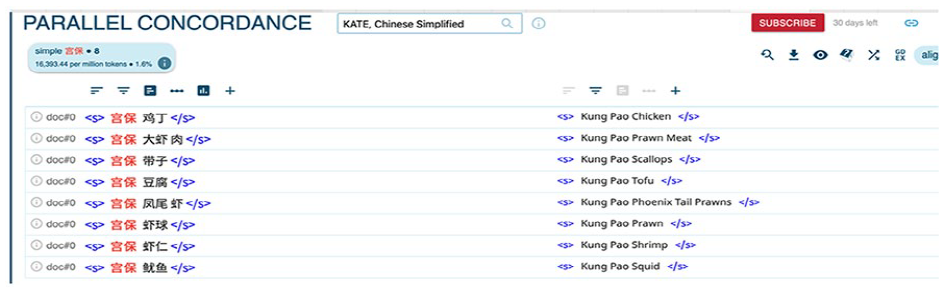
Screenshot of parallel concordance for “宫保” query matches.
The parallel concordances of the search words and their matching English segments were copied to Spreadsheets and examined for the presence of words, dish names, and phrases regarded as CSIs. Additionally, the researchers consulted electronic and manual resources for languages to ascertain the history and meaning of ST elements when in doubt. Materials consulted included the Oxford Advanced Learners’ Online Dictionary, 4 the Merriam Webster Dictionary, 5 the New Century Chinese-English Dictionary (2004), the Chinese Dictionary of Idioms, Baidu, and Google. We, however, noticed that several of the anticipated phrases, dish names, and expressions did not appear in the keyword lists, possibly because they are hapax legomena. Therefore, after extensive deliberations and discussions, we decided to conduct a manual search for corpus elements that we believe are cultural-specific to supplement those already retrieved by the Sketch Engine. The authors carried out this activity independently, with those CSIs appearing on our distinctive lists being deemed extra data. Thus, a total of 24 additional dish names were added, along with their concordances, for further analysis.
CSI Annotation and Classification.
The 213 ST CSIs copied to Excel with their corresponding English segments were analyzed, annotated, and classified, with the relevant counts computed. The taxonomies adopted are based on the nature of CSI types in this specific dataset and by following classifications created by other scholars (see Espindola, 2005, pp. 49, 50; Newmark, 2010; Turzynski-Azimi, 2020, p. 412; Tang & Malini, 2021; etc.) for CSI, which are inductively modified to represent the types discovered in the corpus. After thoroughly examining the specialized corpora, the following three categories of CSIs, presented in Table 1, can be identified.
Classification of CSIs.

This article argues that “A humanist descriptive researcher will need to impose interpretivism or some level of subjectivity on data definition, selection, categorization, and so on” (Remenyi, 2012, p. 101; Williams, 2013, p. 45). As a result, it is only normal that various researchers will label the same research object differently for different purposes. Table 1 below illustrates the classification of CSIs. 6
Annotation and Classification of CSI Translation Procedures.
The CSI segment pairs were also categorized by the translation procedure types found in the data, with the relevant counts computed. Apart from being guided by the foreignization/neutralization/domestication criteria as previously noted, the categorization of both micro-level procedures and macro-level strategies in this article are based on those utilized in our data and follows a longstanding tradition of taxonomies of general-purpose procedures (Leppihalme, 2011; Newmark,1998; Vinay & Darbelnet, 1995/2004; Molina & Hurtado Albir, 2002) to those used particularly for resolving translation problems in rendering CSIs (Leppihalme, 2011; Pedersen, 2011; Marco, 2019). The micro-level procedures identified are as follows:
(a) Retention: Preserving the ST CSIs’ graphic and phonetic form or modifying them to the TL’s morphology, spelling, and phonetic structure. Other researchers use the terms transference (Newmark, 1981), transliteration (Jiang, 2014; Li, 2019; etc.), and (non-lexicalized) borrowing (Al-Rushaidi & Ali, 2017; Marco, 2019; Turzynski-Azimi, 2020) to describe to this procedure.
(b) Literal translation: This procedure is a word-for-word translation that employs the structure of the lexical item and not the phonetic form, as seen in retention.
(c) Neutralization: This is the process of replacing the source CSI with a less or more detailed explanation for its meaning. It is noteworthy that a neutralized CSI loses its cultural properties in a TT. Neutralization strategy may take the form of:
(i) Description: using a non-cultural word to clarify a cultural term, phrase, or rhetorical expression. Dickins (2012, p. 55) states this technique answers the question, 'What is this?
(ii) Generalization: replacing a particular ST component (hyponym) with a general TT element.
(iii) Particularization: employing a more specific TT element instead of generic or general ST CSIs (hypernym).
(d) Amplification/Condensation: Amplification is the process of expanding the ST CSI in the TT, elucidating their underlying meaning to eliminate ambiguity. This is accomplished by purposefully including additional words in the translation such that it becomes lengthier than the source text. Conversely, condensation is the process of removing some amount of information to make the TT shorter than its ST component (condensation is, however, unlikely).
Considering the hypotactic and paratactic nature of English and Chinese, respectively, adding prepositions and copula to compensate for structural and syntactic variations between the two languages is essential in a translation. As a result, these instances were not deemed translating by the amplification procedure in this study. However, when a content word was deliberately added, it was regarded as an instance of amplification, for example, “东坡” →Dongpo style.
(e) Intracultural adaptation: The CSI is exchanged with an alternative SL term that is comparatively familiar and accepted in the target culture.
(f) Substitution: using a target culture word/expression/phrase that is known and substantially equivalent to the ST CSI.
(g) Omission: This involves removing the ST cultural referent from the TT or eliminating components that are regarded superfluous from the translation (Oster & Molés-Cases, 2016, p. 60; Marco, 2019).
Translation procedures A and B are closer to the source culture and do not require bridging the cultural gap between the text and the target readers; procedures C and D bridge the disparity to a certain degree while remaining reasonably distant from the domestication pole; and procedures E, F, and G bridge the cultural gap between the target readers and the text. These techniques will be used to analyze the data. Table 2 below is a tabular depiction of the identified procedures by their macro-level strategies.
A Tabular Representation of the Typology of CSI Translation Strategy.

Results Analysis and Discussion
CSI Category Distribution
To establish which CSIs, exist as a significant resource in marking Chinese culture, a descriptive analysis of CSIs in the specialized corpora glossed for CSI categories was first conducted. See Table 3 for examples of ST CSI with their corresponding segment by CSI categorization type and Figure 2 for the proportionate distribution of the classification types. In Figure 2 below, CSI pertaining to the coarse-grained linguistic category occurs most frequently, accounting for 61% (130 items) of the total CSI (213), which is more than twice the percentage for the social category (22%), and more than thrice the percentage for the history category (17%). Thus, CSIs denoting the linguistic category is most prevalent in the corpus of this study. Here in this linguistic category, the most frequent CSIs are those pertaining to the fine-grained group of idioms (81 times), followed by the fine-grained rhetorical category (49 times), indicating the importance of Chinese language expressions, writing, and thinking patterns in promoting the food culture of this tourist-oriented text.
List of Menu CSIs with Their Segment Pair Distributed Across Category Types.

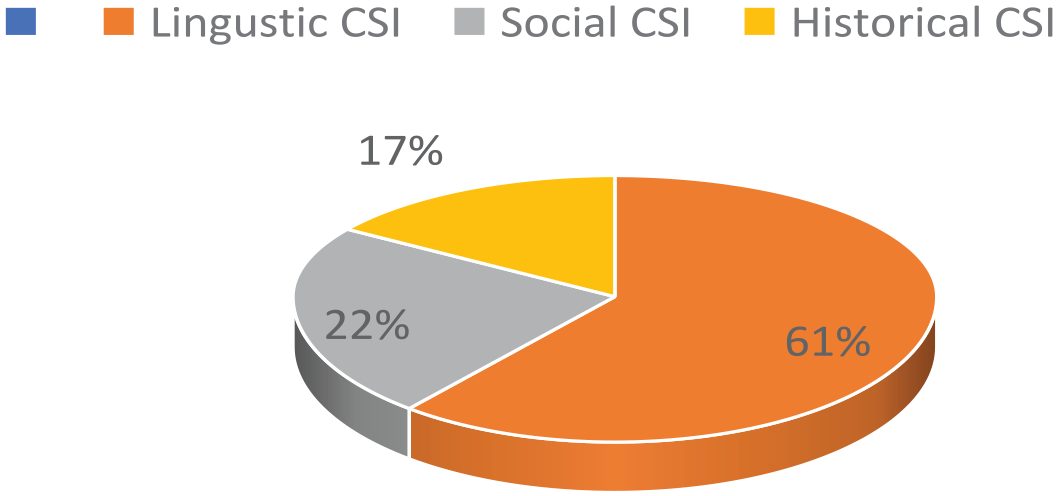
A diagrammatic representation of the proportionate distribution of CSI categories.
CSI Translation Procedures
This section analyzed the micro-level translation procedures identified in the specialized data, considering how CSI categories influence the selection of procedures. We utilize proportional frequencies to report the quantitative results of a specific procedure applied for the variable categorization of CSI. The qualitative analysis intertwines with the quantitative result to discuss the second and third research questions, which border on the effect of macro-level strategies identified in the data in shaping and projecting China’s image as a tourist destination.
Micro-Level Translation Procedures Applied by CSI Category
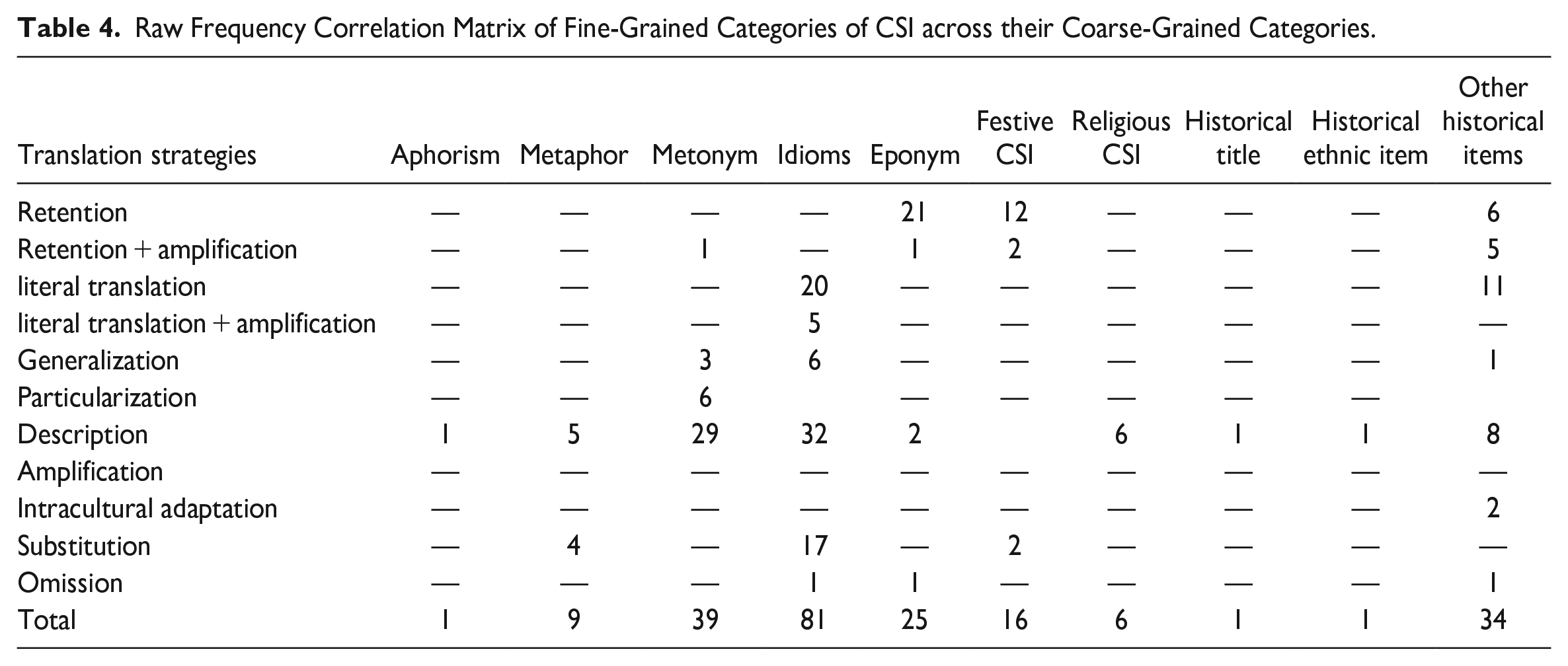
Figure 3 displays the percentage distribution of translation procedures, according to the typology specified in Table 2, used by the coarse-grained category of CSI on the illustrated annotated data (see section 3.2.3). Likewise, Table 4 below illustrates the raw frequency distribution of the fined-grained CSIs types across translation procedure types.
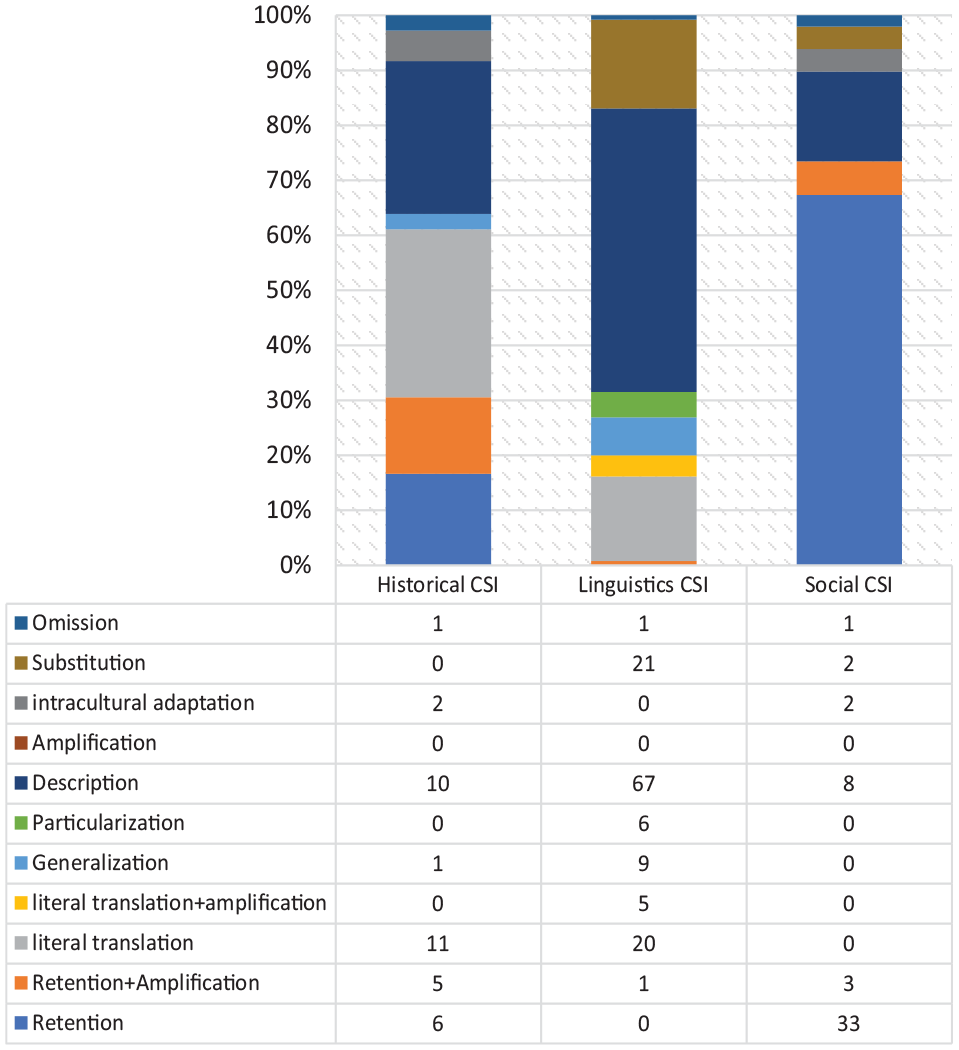
Percentage frequency distribution of micro-level translation procedures by coarse-grained CSI category.
Raw Frequency Correlation Matrix of Fine-Grained Categories of CSI across their Coarse-Grained Categories.
As evident from Figure 3, the procedures employed are not evenly distributed across the dataset in this study. Only description, retention + amplification, and omission procedures are employed across the three coarse-grained categories of CSI, but to a significantly varied proportion.
Description, which accounts for approximately 40% of the procedures, is the most frequently used neutralizing procedure in the entire data and features in the CSI categories of Linguistic (67 times), Historical (10 times), and Social (8 times) in descending order. Table 4 below shows the example of cases where the description was utilized to render CSI, such as idioms (32 cases), metonyms (29 cases), metaphors (5 cases), and once in the case of aphorisms, which make up the linguistic category (Table 5).
Examples of CSIs in the Linguistic Category Translated Through the Procedure of Description.

In the social category of religious fine-grained, description procedure was used six times, for example, “罗汉” as seen in “罗汉羊素肚” → Braised Wheat Gluten and Yellow Fungus, “罗汉鸭” → Steamed Duck with Assorted Vegetables, etc., and twice for eponyms, for example, “老干妈” in “老干妈拌牛肉” → Boiled Beef Slices with Chili Sauce, and “老干妈排骨饭” → Rice with Spare Ribs and Chili Sauce. In the Historical category, the description procedure is employed once for historical titles, for example, “贵妃鸡” →Deep-Fried Chicken, once in the category of historical ethnic CSI, for example, “满汉全席” → Imperial Feast of Manchurian and Han Dishes, and eight times in the category labeled “historical other” items, for example, “臭豆腐干” → Fried Bean Curd of Strong Odour, “窝窝头” → Steamed Corn Bread, etc. “叫花鸡” → Beggar’s Chicken, “蚂蚁上树” → Sautéed Vermicelli with Spicy Minced Pork, amongst others.
Unsurprisingly, the description procedure seems to correlate strongly with the Linguistic category of CSI since language is a crucial factor in projecting and promoting a place as a tourist destination. It is, therefore, reasonable that the translator employed description to (1) demystify the cultural word in order to facilitate easy accessibility and comprehension of the menu text by tourists since, as Petillo (2012, p. 256) rightly notes, to make suitable decisions regarding food, the tourist requires access to culinary words in other languages; and (2) to create a sense of being welcomed by the country (Koskinen, 2012). This is because tourists would not have to learn or speak Chinese or employ the services of a translator, as well as burden themselves with an additional cognitive load which will force them to search for cues elsewhere in the text in order to contextualize the content to be able to access and comprehend information in the menu data, which project a favorable image of China as a tourist destination.
In contrast, retention procedure, which constitutes the second highest used procedure in the corpus, although to a somewhat smaller proportion (18.3%), occurs in the Social (33 cases) and History (6 cases) categories but never in the Linguistics category. As aforementioned, the retention procedure preserves the ST CSI in the TT, whether in its (ortho) graphic or transliterated form. The proportional inclination for the retention procedure indicates, to some extent, the importance of menu text in promoting the social aspect of the country to foreigners, as seen in the retaining of eponyms (21 times) and festive items (12 times) in different dishes. Table 6 below illustrates some social categories of CSIs translated by retention. Cronin (2000, p. 41) explains the utilization of non-lexicalized loanwords (retention) in travel writing as “a palpable written trace of the foreign” that alerts the reader “that the country is elsewhere, the language and mores [are] different,” and that piques the reader’s perception and pleasurable expectations about the foreign destination or encounters described (Petillo, 2012, p. 260). Likewise, Chiaro and Rossato (2015, p. 239) also emphasize the exoticizing effect of non-lexicalized borrowing (retention) in relation to culinary items in tourist-oriented texts. However, other scholars have also cautioned from a pragmatic point of view about translations that transfers the ST CSI in texts that promote social life and historical attractions, asserting that retention of the CSIs leads to “[i]nformation loss” (Kelly, 1998, p. 39), lack of clarity, and misunderstanding of the TT (Al-Rushaidi & Ali, 2017) as it fails to make accessible to the target readers, information available to the ST reader. Koskinen (2012) cautioned about using retention procedures since it portrays an unwelcoming gesture (image) of tourists in one’s space. Even though this observation applies to the CSI categories represented in Table 6 and rendered using the retention translation procedure, one could argue that the extent of loss differs according to the category of CSIs. For instance, with CSIs that denote festive items such as “饺子”→jiaozi, complementing pictures may compensate for the retained item’s obscurity. Contrarily, the transparency of eponyms such as “东坡”→ “Dongpo,” “宫保鸡丁” → Kung Pao Chicken, and the historical category, for example, “大刀面” → Dadao Noodles, may be gravely compromised, as the tourist who is unfamiliar with Chinese social systems and history are unable to match such CSIs onto their equivalents in the target culture.
Examples of CSI in the Social Category of CSIs Translated through the Procedure of Retention.

Literal translation (LT), which occupies 14.60%, is the third most frequently used translation procedure in the data. It occurs in 20 cases (from the fine-grained group of idioms) of the coarse-grained Linguistics category of CSI (see table 6) and in 11 cases of the Historical category- for example, is “八宝” as seen in “八宝饭” → Eight Delicacies Rice, “八宝葫芦鸽” →Pigeon Stuffed with Eight Delicacies, “八宝糖梨” → Steamed Pear with Eight Delicacies, “茶叶蛋” →Tea Eggs, etc. However, this procedure never occurred in the social category, which is not surprising since it would be unreasonable to render social CSIs, such as festive items or eponyms, in a literal manner. Therefore, using the LT procedure is suitable for the fine-grained category of idioms of the Linguistic coarse-grained category, which intends to maintain the form of the original cultural referent in the TT, especially in cases where this does not result in meaning distortion. However, Xiong (2013) has warned against literally translating metaphorical Chinese dish names as it leads to difficulty in comprehension, which may negatively affect the tourist experience (Table 7).
Examples of Idiom CSI Types in the Linguistics Category Translated through Literal Translation..

Substitution is the fourth most used procedure in the corpus and occupies 10.80%. It is highly employed for transferring the coarse-grained linguistics category (21 times), very minimally used for the social category (2 times), but never for the historical category. It is somewhat surprising that the substitution procedure was applied to the highly culturally marked festive item, “汤圆” (tangyuan), as seen in “五仁汤圆” → Sweet Rice Balls with Assorted Nuts, “咸汤圆” → Salty
As is also evident in Figure 3 above, the three categories of CSIs have also influenced other translation procedures but in proportion lower than 5%, with the amplification procedure never used alone in the data, and thus would not be discussed in detail here.
Macro-Level Translation Strategies Applied by CSI Categories.
As earlier mentioned, the concepts of foreignization and domestication refer to Lawrence Venuti’s (1995, 2008) theoretical model by which translated texts are thought to convey an inclination to either the target/source culture or assume a neutralized position (Olk, 2013; Marco, 2019) in translation. These orientations of translation strategies serve to accentuate, neutralize, or substitute the cultural referent, as exemplified by the various functions of CSIs projected to the (prospective) tourists.
It is critical to mention that combinative strategies such as retention + amplification and literal translation + amplification were not included in the overall analysis of the macro-level strategies since these are not considered pure foreignizing strategies (Marco, 2019)
Figure 4 displays the proportionate breakdown of the macro-level translation solutions employed by the CSI category, designated as foreignization, neutralization, and domestication. Figure 4 shows that neutralizing procedures are employed proportionally most frequently, occupying 47.41% (101 cases) of the strategy used across all the coarse-grained categories of CSIs in the entire data. This result contradicts the finding of Turzynski-Azimi (2020), where the domestication strategy was the most frequently applied in percentage terms across the entire corpus. It is evident that the neutralizing strategy was utilized mostly in the linguistic category (82 times) than in the historical (11 times) and social (8 times) categories of CSIs. This could be explained by the somewhat high frequency of the description procedure utilized in the linguistic category of CSI, which has been demonstrated to be desirable for rendering idiomatic, metaphorical, and metonymical Chinese dishes and foodstuff names in order to describe and “de-culturalize” the cultural referent.

Translation strategies (macro-level) employed by coarse-grained CSI category.
On the contrary, foreignization strategy occurs at a proportionately higher rate for CSIs in the Social category and at an appreciable rate in the Historical category than in the Linguistic category, which is congruent with Turzynski-Azimi’s (2020) findings. Overall, the foreignization strategy occupies 32.90% of the strategy used in the corpus of the study. This procedure preference may imply a stronger tolerance for a foreignized translation for items that promote the original culture’s historical and social milieu. In this respect, as previously mentioned, Agorni (2012, p. 6) and Xiong (2013) warn against information loss, arguing that a foreignizing strategy can impede communication, as the reader may be unable to obtain information about unknown or unfamiliar items in a translation. Regarding the corpus analyzed in this study, certain eponyms and historical items popular to Chinese readership are unlikely to be known to foreign readers. In such circumstances, the translator’s failure to discern between the pre-supposed awareness of the original cultural context and the readers of the target language and their culture may be inferred from the lack of the usage of compensatory procedures such as explicitation (Kelly, 1998, p. 39, as cited in Turzynski-Azimi, 2020, p. 21) or amplification as it is labeled in our data. The lack of compensatory translation techniques such as amplification affects the construction of “shared knowledge of local attractions [. . .]” and, for that matter, food, and also on the reader’s “appreciation of these features and their value” (Poncini, 2006, p. 141 as cited in Turzynski-Azimi, 2020, p. 21).
As evident from Figure 4, two distinctive phenomena are at play in this dataset regarding the projected image of China as a tourist destination. On the one hand, the food menu translations through the descriptive procedure (Neutralization strategy) employed largely for the linguistic category of CSI seek to make the tourist feel welcomed and at home, without any fear or apprehension of the unknown and the unfamiliar, expressed through linguistic and cultural components of Chinese food. On the other hand, the text exposes tourists to the rich Chinese culture through the use of retention procedure (Foreignization) in the social and historical category of CSI, as previously stated, which confirms Dann’s (1996, p. 2) explanation that the procedure of non-lexicalized borrowing (retention) brings closer and acquaints the reader with the foreign culture even before they leave home.
However, one can infer from the proportionate frequencies of the macro-level translation strategies employed for translating Chinese-English menus that the neutralized position assumed by the translations is a reflection and projection of China as a tourist destination where the lack of language skills as a tourist may not impede the tourist experience, especially in food culture. However, if the translator has to choose between the strategies of foreignization and domestication, they are more likely to incline toward the former, as indicated by the proportionate frequencies.
Conclusion and Limitation of the Study
CSIs are critical markers of cultural distinctiveness that need to be negotiated in the selection of translation solutions to inform, attract and meet the needs and demands of tourists.
A wide variety of translation procedures are observed to be used for rendering Chinese-English food menu CSIs, which supports Newmark’s (1998, p. 97) argument that “food terms are subject to the widest variety of translation procedures.” In analyzing the CSI category’s influence on selecting procedures in our specialized corpus, a stronger proportionate preference for description procedure in the coarse-grained linguistic category was identified for all of its fine-grained types (see Table 4).
When consideration is given to the retention procedure, a stronger proportionate preference is observed for the coarse-grained social category of CSIs, most of which are items in the fine-grained category of eponyms. Surprisingly, no strong preference for the procedure was observed for the coarse-grained category of history, as both foreignizing and neutralizing strategies prevailed in this CSI category. The other translation procedures in this study can be said to have been used sparingly in the various categories of CSIs since their proportionate frequencies are below 5%, with the amplification strategy never employed at all. Nevertheless, no statistical testing was conducted to determine the correlational strength of these descriptive statistics for significance. Therefore, the modulating impact of the CSI category on the choice of micro-level translation procedures could not be demonstrated.
Considering the significance of CSIs designating food in constructing China’s image, the research results are that (I) the description procedure occurs at a higher proportionate frequency, followed by retention, literal translation, and substitution. (II) In respect of percentage frequencies of translation strategies for CSI along the foreignization-domestication continuum, the study’s findings indicate a predominant orientation toward the neutralizing strategy for the translation of CSIs in Chinese-English food menus, that is, “deculturizing” the CSI to remove the text’s strangeness for its readership that actively seeks an understanding of the foreign. This strategy is employed chiefly for CSIs in the linguistic category, which demonstrates the fact that Chinese-English food menus largely projects a positive image (friendly, welcoming, and diffusing the fear of the known) of the country to the world since tourist would not have to be able to speak Chinese to come to China or to enjoy their rich culture embedded in Chinese cuisines and dishes.
Chinese-English food menu showcases China’s culture, society, and cross-cultural relations with the “Others.” Therefore, studying the phenomenon of CSI for China-others communication and exploring their translation procedures as well as the translation patterns will “facilitate the discovery of and solution to the problems in translation practice” (Mu, 2010, p. 10). The culture-specific items utilized in the food menu are a form of cultural output that promotes China’s culture. In this regard, it is essential to, on the one hand, take the SL forms of food menu translations seriously to preserve the culture, as demonstrated by the fact that the foreignization strategy was employed to an appreciable degree than the domestication strategy. On the other hand, to avoid misunderstandings, it is essential to facilitate food menu translations by enabling the target readers to easily comprehend these cultural references. In this respect, the findings of the study show a high rate of application of the neutralization strategy. It is therefore important to explore the impact of the practical translation problem of rendering cultural referents on the recipients, with a focus on their perception and reception of the translations in order to make informed decisions in terms of policy formulations pertaining to tourism-oriented texts to preserve and promote Chinese culture and also indirectly enhance foreigners’ outlook of China’s image in the international arena.
Regarding the study’s limitation, data are obtained from a small corpus of Chinese-English food menus—a tourist-oriented text promoting the food culture of only mainland China. Investigations extending the findings to more extensive situations and other variables of the genre might be valuable in improving this research’s findings to validate the results for statistical significance. Additionally, research examining CSIs additions could uncover implications for increasing cultural load through amplification, especially in cases inspired by grammatical issues relating to Chinese, which allows for null-preposition /subject structures in the language.
Footnotes
Correction (November 2023):
Article updated online to interchange the author’s surname and forename “Amenador Kate Benedicta and Wang Zhiwei” to “Kate Benedicta Amenador and Zhiwei Wang”.
Declaration of Conflicting Interests
The author(s) declared no potential conflicts of interest with respect to the research, authorship, and/or publication of this article.
Funding
The author(s) received no financial support for the research, authorship, and/or publication of this article.
Ethical Approval
No animal or human participants were involved in this study studies
