




Abstract
Regional Chinese folk-dance traditions, marked by complex symbolic gestures and diverse pedagogical legacies, face increasing threats of cultural dilution. This study aimed to quantitatively model and evaluate gesture transmission, recall, and instructional efficacy across three core Guangdong dance styles using high-rigour experimental protocols. A total of 48 participants were recruited from three instructional sites representing Cantonese Flower Drum, Hakka Rice Harvest, and Pearl River Boat dances. Data included 36 gesture units per style, captured with a dual-camera 4K video and analysed with Kinovea v0.9.5. Interventions consisted of stratified group assignment, spiral-loop instructional models, and audio-narrative integration. Outcomes assessed included gesture accuracy, motif integrity, recall, expressivity, angular drift, and motif gain using repeated measures ANOVA, two-way ANOVA, and post hoc Bonferroni tests. Pearl River Boat had the highest rhythmic density (3.6 ± 0.4 beats/unit) and peak motion angle (113.6 ± 6.9°), while Hakka Rice Harvest had the lowest angular range (101.1 ± 6.8°). Gesture ambiguity was most significant in Pearl River Boat (mean = 4.2 ± 0.8; 44.4% above threshold). Post-training recall was highest in Hakka Rice Harvest for motor accuracy (4.46 ± 0.36), and lowest in Pearl River Boat across recall domains. Inter-rater reliability was high (κ = .86 ± .03). Elder-to-youth instructional loops showed superior gesture accuracy (up to 6.51 ± 0.36) and the highest motif gain (51.9%). Quantitative pedagogical mapping can optimise folk dance curriculum and safeguard regional embodied heritage.
Introduction
The Guangdong–Hong Kong–Macao Greater Bay Area (GBA) spans nine mainland cities (including Guangzhou, Shenzhen, Foshan, and Zhuhai) alongside the Special Administrative Regions of Hong Kong and Macao. (Z. Ma et al., 2024; F. Wang et al., 2025). As a designated cultural innovation zone, the GBA has witnessed policy-driven expansion in arts infrastructure and programming through mechanisms such as youth training subsidies, venue reallocation, and public arts mandates, particularly visible during the National Games (Dai, Huang et al., 2024; Dai, Zhong et al., 2024). However, the pedagogical implications of these initiatives remain under-theorised. While policy discourse assumes top-down diffusion into traditional dance pedagogy, little is known about how these programmes reshape instructional content, aesthetic fidelity, or regional gesture preservation.
The empirical component of this study focuses on three Guangdong sites that function as core transmission nodes within the broader GBA cultural network. These sites concentrate teaching studios, community troupes, and festival venues where Cantonese Flower Drum, Hakka Rice Harvest, and Pearl River Boat traditions remain actively rehearsed and staged. Although the participant sample is geographically situated within Guangdong Province, these dance practices circulate across municipal and SAR borders through touring ensembles, youth exchange programmes, and repertory sharing, thereby linking local instructional settings to the wider GBA policy and heritage framework. The analysis, therefore, treats Guangdong as a high-density microcosm of GBA folk-dance pedagogy, while recognising that the findings primarily generalise to similar Han-majority, Cantonese–Hakka cultural configurations rather than to the full diversity of the region.
Drawing on the cultural policy–pedagogy nexus, defined here as the dynamic tension between institutional governance of artistic forms and their embodied transmission, this study investigates how standardised training protocols intersect with vernacular aesthetics across the GBA.
The present study examines how folk-dance teaching in Guangdong-based training studios responds to GBA cultural policy directives while retaining locally specific movement vocabularies and symbolic motifs. The central aim is to develop and empirically test a Gesture, Affect Transmission Paedagogical Model (GATPM) that links embodied gesture acquisition to narrative meaning-making and affective recall within these traditional forms. By situating the model within a policy-defined GBA framework but grounding measurement in concrete studio practice, the study clarifies how regional cultural agendas translate into micro-level pedagogical routines.
Folk dance, in this study, is delimited as regionally continuous, functionally embedded, and intergenerationally performed movement systems arising from ritual, agricultural, or festival contexts. This includes, for example, lion dance variants in Guangdong martial temples, the Hakka shoulder-harvest gestures of rural Shenzhen, and ceremonial footwork from Macanese religious processions (X. Li, 2024; Wu et al., 2024). These systems are not merely orally transmitted but maintained through embodied imitation (via kinaesthetic modelling), environmental immersion (through spatial-acoustic familiarity), and affective memory (via sensory triggers such as tempo, costume, or terrain; Gao, 2024, Pan et al., 2024). These dimensions are analytically tracked in this study through observational rubrics and reflective participant interviews. Techniques like the lion dance’s “rolling step” are examined not just descriptively, but as spatial-symbolic units that reveal rhythm-environment coupling, enabling their reintegration into formal curricula (Chen & Hou, 2024; Hanyong, 2024).
National aesthetic concepts such as yi jing (artistic conception), shen yun (spiritual charm), and xing shi (form-body unity) are used in this study as movement analysis lenses to evaluate phrasing, continuity, and expressivity in performance (Gong & Daoruang, 2024; Gu et al., 2025; Maksimova & Jiefang, 2024; Shum & Leung, 2025). However, institutional dance training often treats such principles as decorous overlays rather than generative compositional logics, contributing to a visual–motor misalignment (Yu et al., 2024). Within the GATPM framework, national aesthetic concepts such as yi jing (artistic conception), shen yun (spiritual charm), and xing shi (form–body unity) are treated not as purely rhetorical ideals but as latent constructs that can be approximated through observable features of movement and recall. In this study, Yi Jing is reflected in the coherence between gestural phrasing and narrative storyline, Shen Yun is reflected in continuity, weight transfer, and dynamic contrast across key motifs, and Xing Shi is reflected in alignment between torso–limb geometry and canonical style templates. These dimensions are operationalised through motion-capture indices of gesture accuracy and temporal phrasing, motif-level drift scores across repeated performances, and recall tasks that probe the stability of symbolic associations. This design anchors aesthetic theory in quantifiable movement patterns while retaining sensitivity to the cultural meanings attached to each dance tradition.
Taken together, these conditions point to a specific pedagogical problem: folk-dance instruction in Guangdong is increasingly embedded in standardised training systems, yet the mechanisms through which the national aesthetic framework’s structure gestures learning, symbolic encoding, and sensory memory remain weakly specified. The present study addresses this gap by tracing embodied aesthetic vocabularies in three representative folk-dance forms, comparing institutional studio routines with intergenerational elder–youth transmission loops, and testing how narrative and affective scaffolds influence gesture recall and symbolic fidelity. Building on these components, the GATPM is proposed as a regionally grounded, aesthetics-integrated instructional model that can be adapted to other GBA contexts as further empirical evidence accumulates.
This study examines the breakdown in pedagogical transmission in which national aesthetic frameworks fail to structure the acquisition of gesture, symbolic encoding, and sensory memory in GBA folk dance education.
Objectives
To trace embodied aesthetic vocabularies within GBA folk dance using movement-centred microanalysis.
To map discontinuities between institutional curricula and intergenerational transmission pathways.
To evaluate affective-mnemonic mechanisms in the retention and reproduction of symbolic gesture.
To model a regionally grounded, aesthetics-integrated pedagogy for traditional dance instruction.
Literature Review
Codification of Regional Kinaesthetic Signatures Within National Body Aesthetic Frameworks
National body aesthetics (minzu shenti meixue) are typically framed as an integrated alignment of externally visible motif structure, internally felt energetic quality, and culturally legible symbolic intent. Recent scholarship has emphasised how yi jing (artistic conception), shen yun (spiritual charm), and xing shi (form–body unity) encode region-specific kinaesthetic signatures in torso–limb pathways, directional phrasing, and weight dynamics, yet most accounts remain descriptive and iconographic rather than empirically grounded in movement data. Existing work rarely specifies how such aesthetic principles might be translated into quantifiable indices, such as error-tolerant angular ranges, motif-level sequencing patterns, or recall stability for symbolic gestures. This gap leaves unclear how national body aesthetics could be used to design or evaluate pedagogical interventions that target both technical correctness and the preservation of embodied meaning in regional folk dance.
Comparative and spatial studies exploring codification often emphasise symbolic fidelity without adequately testing pedagogical transfer. Wei (2024) conducted a comparative survey study (n = 210) evaluating audience responses to classical versus regional dance gestures based on national aesthetic criteria. Findings indicated that regional motifs, such as the Guangdong shoulder dip, significantly enhanced perceived authenticity. However, the analysis was limited to audience perception, omitting performance-based assessments or feedback from dancers undergoing codified training. The study’s proposed codification model remains theoretical, with no evidence of its integration into instructional frameworks or live choreography sessions.
More recent studies move closer to embodied codification but still stop short of testing pedagogical transfer in live teaching contexts. Wei (2024) used national aesthetic criteria to compare canonical and regionalised motifs, showing that micro-variations such as shoulder dip amplitude significantly altered perceived authenticity among trained viewers. P. Li (2024) proposed a dance symbol lexicon derived from She ethnic practices and argued for its integration into formal instruction. Yet, the framework has not been validated through instructor feedback or learner performance trials. Collectively, these contributions indicate that national body aesthetics can be articulated in motif-level taxonomies. Still, they do not yet demonstrate how such taxonomies function as dynamic teaching tools capable of sustaining symbolic fidelity under classroom constraints.
Paedagogical Discontinuity Between Institutional Dance Curricula and Intergenerational Folk Transmission
Empirical studies reveal a sharp disjunction between community-based dance transmission and institutional instruction. Su et al. (2025) implemented a mixed-methods approach, combining surveys (n = 331) with expert interviews. They identified limited adoption of folk practices in institutional settings and proposed interventions such as credentialing and folk master workshops. However, no pilot trials were conducted to evaluate actual implementation outcomes, leaving the strategy unverified in classroom dynamics. X. Ma (2025) Similarly, a survey of 179 educators found that 64% lacked training in cultural heritage pedagogy. Structured interviews revealed teachers’ uncertainty about applying oral or embodied formats, but, as before, no corrective frameworks were tested.
Jin (2025) used action research in two experimental classes to integrate oral folk literature into teaching. Thematic structures, such as riddles and proverbs, increased engagement by 35%, and qualitative data indicated enhanced receptivity to rhythmic communal forms, suggesting direct pedagogical relevance for folk dance transmission. In contrast, Y. Wang et al. (2025) employed pre/post-intervention surveys in medical education, showing that culturally embedded narratives improved memory retention by 22.3%. While the findings resonate with folk pedagogy, the disciplinary misalignment limits direct application. Guan (2025), through curriculum comparison, critiques China’s uniform-age teaching system as obstructive to intergenerational modelling a key element in traditional dance. Yet the proposed mixed-age projects were not tested in dance-specific scenarios. Across this set, Jin’s action research remains the only dancer-relevant, trialled intervention; others describe the gap without demonstrable embodied solutions.
Reframing Expressive Symbolism Through Localised Aesthetic-Functional Gesture Systems
Research on expressive symbolism in folk arts increasingly recognises that visual and narrative motifs must be anchored in repeatable bodily practice if they are to support long-term cultural transmission. X. Li (2024) links temple dance motifs to musical structures and identifies stable symbolic pairings between melodic patterns and directional footwork, while Lin (2024) maps semantic features of folk song texts onto particular bodily actions and group formations. Pan et al. (2024) combine cross-cultural gesture comprehension tasks with teaching trials, showing that guided exposure to culturally grounded motifs increases symbolic recognition in the short term. However, across these studies, symbolic retention is rarely tracked through multi-session performance data or quantitative indices of motif drift, leaving unanswered questions about how expressive symbols are embodied, stabilised, and transformed within ongoing training regimes.
Lin (2024) used Systemic Functional Linguistics (SFL) to map folk song semantics onto bodily actions. Her findings suggest direct links between repetition and group choreography or tonal shifts and physical bowing. While pedagogically promising, the method remains confined to Northern Shaanxi and has not been tested in Guangdong-based classrooms. Wong (2024) used thematic analysis and digital ethnography to observe Gen Z adaptations of folk gestures in cosplay contexts. Participants expressed emotional continuity with cultural roots, but formal curricular integration or retention testing was not addressed. Pan et al. (2024) used surveys and teaching trials to assess cross-cultural gesture comprehension, finding an increase in symbolic recognition post-intervention. However, the study did not measure long-term embodiment, replication, or sequencing in learners. Together, these works underscore gesture symbolism’s transmissibility but do not verify its integration into durable somatic pedagogy.
Development of an Embodiment-Centred Teaching Model Rooted in Affective-Mnemonic Dynamics
Across education research, affective engagement is consistently associated with improved recall, transfer, and learner persistence, yet most studies operationalise this link outside of dance or somatic arts. Moreno (2025) demonstrates that emotionally charged narrative simulations deepen empathic understanding among trainee educators, while Lyanda and Owidi (2025) report strong associations between teachers’ emotional intelligence and student engagement in online learning environments. Yixuan and Mohd Ali (2025) identify a perceived lack of emotional depth in sports dance curricula and call for the integration of festival narratives. Kardosh et al. (2025) show that emotion induction can enhance retention of abstract material. Despite their disciplinary diversity, these studies converge on the view that emotion–memory coupling shapes learning trajectories. Yet, they seldom include motor tasks, gesture sequencing, or choreographic recall as outcome measures. This leaves a critical gap at the intersection of affective-mnemonic mechanisms and somatic learning, particularly in folk-dance contexts where symbolic meaning is carried by repeated, culturally saturated gesture patterns.
Conceptual Model
In the present framework, national body aesthetics denotes culturally sanctioned standards for how regional motifs should look and feel in performance, encompassing stance organisation, dynamic phrasing, and the relational positioning of bodies in space. Symbolic fidelity refers to the degree to which a performed gesture or sequence preserves its intended cultural meaning across repetitions, as inferred from expert ratings and learner recall of narrative or ritual associations. Motif gain describes cumulative shifts in a learner’s execution of a canonical gesture unit, capturing both improvement and drift in alignment with expert-defined templates over time. These constructs provide a shared vocabulary for interpreting prior work on codification, transmission, expressive symbolism, and affective-mnemonic dynamics, and they underpin the empirical analyses reported in subsequent sections.
To resolve the gaps in codification, transmission, symbolic retention, and affective embodiment, this study proposes the Gesture-Affect Transmission Paedagogical Model (GATPM; see Figure 1). The model operates through three interlinked components: (i) Kinaesthetic Motif Mapping, using dancer-validated motion trials to classify regional gestures in live teaching contexts; (ii) Emotion-Linked Narrative Embedding, in which each choreographic sequence is situated within culturally resonant stories to enhance recall; and (iii) Intergenerational Spiral Instruction, a curriculum structure that reintroduces vertical modelling via cross-age rehearsal sessions. Together, these layers ensure symbol retention, emotional anchoring, and pedagogical transfer in the embodied training of traditional dance.
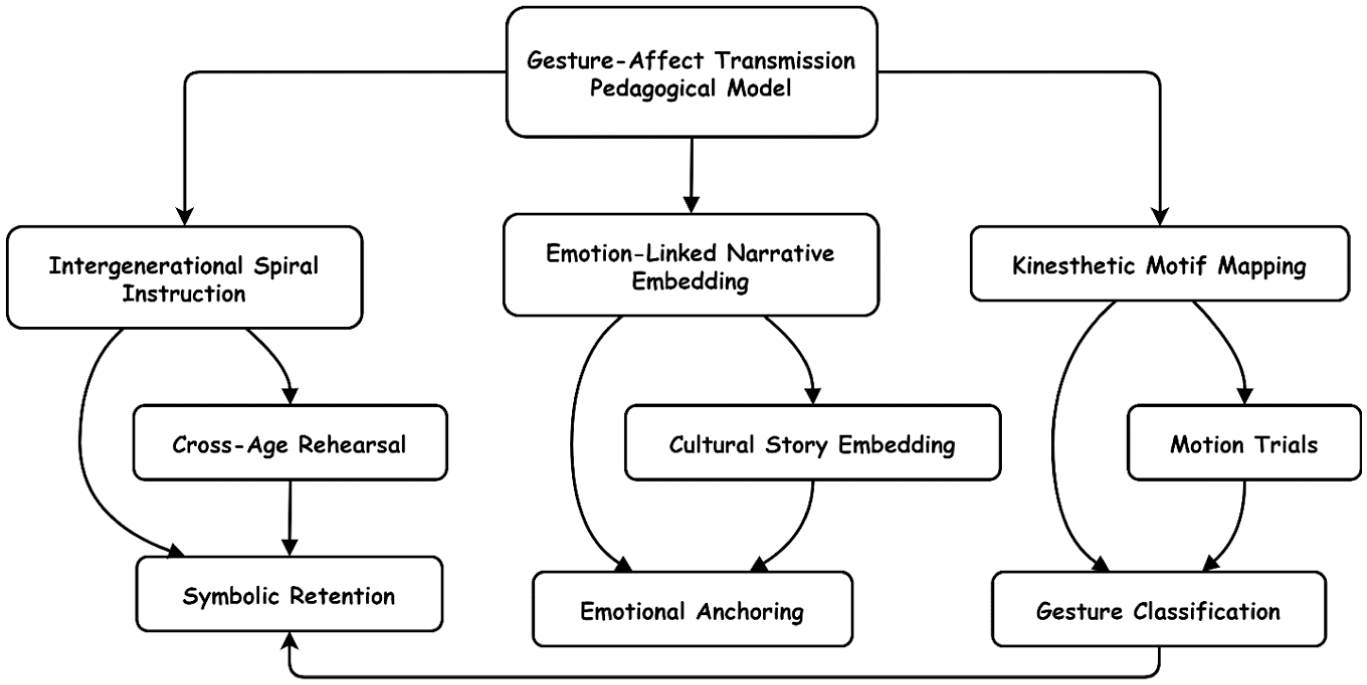
Framework of the gesture–affect transmission paedagogical model showing linked pathways for classification, embedding, rehearsal, and retention.
Methodology
Research Setting
Geographic and Institutional Sites
Implementation was carried out at three regional sites in the Guangdong–Hong Kong–Macao Greater Bay Area to ensure cultural and instructional diversity. The selected locations were: (i) Guangzhou Academy of Performing Arts (formal academy with structured syllabi); (ii) Foshan Nanhai Folk Culture School (community-integrated with semi-formal instruction); and (iii) Longgang District Hakka Heritage Centre (vernacular setting focussed on oral and mimetic transmission). These sites provided differentiated exposure to Cantonese, Hakka, and Pearl River folk dance repertoires. Each site was equipped for movement-based instruction, narrative delivery, and recording-based analysis of folk-dance skills, including heel strikes, shoulder rolls, open-palm gestures, and arc-based locomotion.
Institutional Access and Environmental Controls
Studio work at all three sites took place in comparable teaching studios that were quiet, well-lit, and free of visual obstructions, providing a stable environment for both instruction and recording. Floors and wall layouts were similar enough to support the safe execution of travelling, turning, and floor-based sequences without requiring any adaptation to the choreography. Basic room conditions, such as temperature, ventilation, and background noise, were kept within a comfortable range for sustained rehearsal, so that differences in performance would not be attributable to fatigue or discomfort. Two fixed camera viewpoints were used in every session, with consistent framing of the dancer’s whole body, to ensure that gesture quality and spatial pathways could be compared across sites.
Ethics
All study procedures were reviewed and approved by the Ethics Committee for Guangdong Teachers College of Foreign Languages and Arts (Approval No. GAPAR-2024-013). Informed consent was obtained from all participants or their legal guardians, as applicable. Participants were informed of their right to withdraw at any stage without penalty. To ensure participant comfort and bodily autonomy, verbal assent was reconfirmed at the start of each video-recorded session. Data were anonymised at the point of capture and securely stored on encrypted institutional drives accessible only to the primary investigators.
Participants
Recruitment
Participants were recruited through stratified purposive sampling across three GBA-based instructional sites (see Figure 2). Recruitment was coordinated via institutional programme directors and community heritage liaisons. A total of 48 individuals were enrolled: 24 formal academy learners, 12 peer mediators with dual exposure, and 12 senior folk practitioners. All applicants completed a two-stage screening process involving document verification and an on-site movement assessment to determine instructional suitability.

Participant sampling flow showing site types, selection categories, screening stages, stratification by dance style, and bias controls.
The sample was structured to mirror typical trajectories through regional folk-dance education in Guangdong. Formal academy learners represented standardised curricular pathways in Cantonese Flower Drum, Hakka Rice Harvest, and Pearl River Boat training programmes, peer mediators occupied an intermediate position with concurrent exposure to institutional classes and community troupes, and senior folk practitioners embodied intergenerational, lineage-based modes of transmission. This three-tier configuration facilitated comparison of gesture standardisation, narrative continuity, and symbolic fidelity across institutional and vernacular instructional roles, while recognising that the focus on Guangdong-based Han-majority, Cantonese–Hakka contexts delineates a bounded segment of the broader GBA cultural landscape.
Eligibility
Inclusion criteria were as follows: (i) age between 14 and 21 years for learners, 22 to 35 years for mediators, and 55 to 75 years for folk masters; (ii) demonstrated familiarity with at least one target folk dance style (Cantonese Flower Drum, Hakka Rice Harvest, Pearl River Boat); (iii) full physical capability to complete 90-min sessions; and (iv) gesture performance score of 70 or higher on a standardised 45-s movement sequence assessed for timing, joint control, and spatial direction. Exclusion criteria were: (i) concurrent involvement in non-dance disciplines without prior folk-dance training; (ii) declared or documented impairments affecting memory or musculoskeletal function; (iii) participation in prior movement pedagogy studies within the last 12 months; and (iv) failure to meet the gesture performance threshold or incomplete screening attendance.
Power Analysis
Sample size estimation was performed using G*Power v3.1 (Heinrich-Heine Universität Düsseldorf, Germany) for a mixed ANOVA model with three groups and two time points, assuming α = .05, power = 0.80, and medium effect size (f = 0.30). The minimum required sample was 42. A total of 48 participants were retained to account for attrition and subgroup balance, ensuring statistical power across instructional comparisons.
Although the total sample size of 48 participants is modest for three-group comparisons, it exceeds the minimum requirement derived from a priori power analysis and was structured to prioritise depth of observation within a bounded cultural ecology rather than broad population coverage. The recruitment frame was intentionally limited to Guangdong-based Cantonese and Hakka folk-dance lineages, providing sufficient statistical power to detect medium-sized instructional effects while acknowledging that the findings do not extend to non-Han traditions or to folk forms outside the Greater Bay Area network.
Stratification and Bias
Participants were stratified based on instructional background (formal academy-trained, community-taught, or dual exposure) and regional dance affiliation: (i) Cantonese Flower Drum Dance, (ii) Hakka Rice Harvest Dance, and (iii) Pearl River Boat Dance. Stratification ensured coverage of distinct gesture vocabularies, symbolic codes, and spatial schemas inherent to each tradition. Each instructional group was balanced across sites by both training history and dance style. Instructor rotation was applied across all conditions to reduce interpersonal and expectancy bias. Pre-assessment scores were concealed from instructional staff. Sequence order and video prompt exposures were counterbalanced across sessions to eliminate presentation effects. Assessments were conducted by independent raters blinded to condition and cohort. All known procedural, instructional, and environmental biases were identified in advance and actively controlled through session design and evaluator blinding.
In the study, Cantonese Flower Drum Dance (also referred to as Yue Flower Drum), Hakka Rice Harvest Dance (also referred to as Hakka rice ear or Hakka rice harvesting), and Pearl River Boat Dance (also referred to as Zhujiang Boat) are treated as equivalent labels for the same three traditions, with these standardised names used consistently across instructional descriptions, coding procedures, and analytical reporting.
Kinaesthetic Signature
Group Allocation
Following stratified recruitment, all 48 participants were assigned to one of three instructional configurations: (i) Institutional Control, (ii) GATPM Hybrid, and (iii) Community Model. Allocation was conducted using a block-randomisation procedure to ensure that gesture proficiency and regional dance affiliation were evenly distributed across conditions. Six randomisation blocks were constructed in R version 4.2.2 (R Foundation for Statistical Computing, Austria), with a block size of 8. Random number generation was performed using the Mersenne Twister algorithm (seed = 20,240,201). Each block contained at least two participants per dance type (Cantonese Flower Drum, Hakka Rice Harvest, Pearl River Boat) and at least one representative of each training background. Assignment sheets were generated by an independent assistant and sealed before distribution. Participants and instructors were unaware of grouping during pre-session calibration and skill testing.
Motion Analysis
Motion sequences were recorded for all three folk dances using a dual-camera setup. Each session employed two Sony PXW-Z90V 4K camcorders (Sony Corporation, Japan), mounted on Manfrotto 290 Light aluminium tripods (Manfrotto, Italy) with fixed height (130 cm) and calibrated lens alignment (2.8 m frontal axis, 1.2 m lateral offset). Reference frames were recorded before each session using a standardised three-point body axis grid (shoulder, pelvis, knee) marked with 25 mm reflective stickers. Lighting was stabilised using a Godox SL150W II LED system (Godox, China) at 5600K colour temperature and 100% output. Ambient lighting was measured at 600–700 lux using a TES-1,330A digital lux metre (TES Electrical Electronic Corp., Taiwan).
For each regional dance, a 90-s standard movement phrase was analysed. (i) Cantonese Flower Drum Dance began with bilateral shoulder rolls and downward arm spirals, transitioned into triple-weighted knee bounces with lotus-step foot patterns, and ended with a left-to-right arc sweep accompanied by open-palm lifting gestures. (ii) Hakka Rice Harvest Dance initiated with hip-width stance, executing synchronous heel strikes and torso-forward flexion, followed by mid-line hand tapping mimicking rhythmic rice sifting, and concluded with low sweeping turns and a backward gliding step pattern. (iii) Pearl River Boat Dance featured deep plié leg drops simulating water resistance, layered with shoulder-pulled paddle strokes and rotational torso releases; the final third introduced diagonal cross-body extensions and two-stroke symbolic paddling arcs ending in squat–rise recovery.
All motion was analysed using Kinovea v0.9.5 (Joan Charmant, France) to extract spatiotemporal markers. Each gesture unit was annotated for peak joint angles, angular velocity, path curvature, and duration (in frames). Velocity thresholds were determined using a ≥ 20% reduction in speed over five consecutive frames. Gesture replication trials were video-recorded from three angles (frontal, sagittal, and aerial) to enable three-dimensional cross-validation.
Gesture Lexicon Construction
Following motion capture (see Figure 3), gesture units were decomposed into a standardised five-attribute structure: (i) anatomical origin and termination (shoulder to fingertip); (ii) trajectory vector (horizontal sweep, vertical drop, diagonal arc); (iii) rhythmic density (beats per unit); (iv) symbolic tag (“lotus bloom," "paddle stroke,”“grain toss”); and (v) spatial framing (inward, outward, circular, lateral). Each unit was assigned a unique lexicon ID (H2-Mid-Arc) and linked to its corresponding video timestamp, audio cue, and narrative segment. A complete listing of the 36 core gesture units, including anatomical descriptors, trajectory vectors, rhythmic density, symbolic tags, ambiguity scores, and interdependence indices, is presented in Supplemental Table S1.

Motion and ambiguity profiles with representative visuals of Cantonese flower drum and hakka rice harvest dances.
Across all 3 dances, a total of 36 core gesture units were documented: 12 for Cantonese Flower Drum, 12 for Hakka Rice Harvest, and 12 for Pearl River Boat. These were entered into a centralised gesture lexicon database using ATLAS.ti v23 (ATLAS.ti Scientific Software Development GmbH, Germany), tagged with cross-references to symbolic interpretations and affective anchors. Each unit was reviewed by a panel of three senior instructors, and ambiguity ratings were assigned to resolve overlap between gestures with similar biomechanics but differing symbolic purpose. Gesture frequency, overlap probability, and motif interdependence were calculated and stored as metadata within the lexicon to support instructional sequencing in later modules.
Ambiguity was operationalised as the probability that two or more gesture units could plausibly be mapped to the same symbolic tag by expert raters. For each unit, three senior instructors independently indicated whether another lexicon entry could substitute without altering perceived narrative meaning; ambiguity scores were computed as the proportion of affirmative responses (0–1 scale). Units with ambiguity greater than 0.50 were re-labelled or merged following consensus discussion. Interdependence coding captured the extent to which a gesture unit functioned as a transitional bridge within a motif sequence. For each dance, raters identified obligatory predecessors and successors for every unit; units with at least two mandatory neighbours were flagged as high-interdependence and treated as anchors in pedagogical sequencing. The decision to retain 12 core gesture units per dance was based on saturation analysis: additional candidate units either duplicated existing biomechanical patterns or failed to reach agreement (≥80%) on symbolic tag and narrative placement.
Narrative and Mnemonics
Story Embedding Protocol
Each of the three regional dances was mapped to a culturally grounded narrative constructed in consultation with heritage custodians and senior instructors from the GBA region. The Cantonese Flower Drum Dance was linked to the Spring Lantern Ritual (urban courtship parable); the Hakka Rice Harvest Dance to the Twin Crops Legend (ancestral rice deity myth); and the Pearl River Boat Dance to the Cross-River Bride Tale (inter-village ceremonial voyage). Each narrative was segmented into four episodic units synchronised to key gesture transitions. A total of nine narrative sequences (3 dances × 3 variants) were developed and pre-recorded in Mandarin and Cantonese by a native voice artist and edited. Segment-by-segment alignment between narrative episodes, key symbolic images, and the corresponding gesture units for each regional dance is summarised in Supplemental Table S2.
Instructional Integration
Each dance session incorporated the narrative audio overlay synchronised frame-to-frame with the movement sequence. During the learning phase, participants viewed the gesture video accompanied by synchronised narrative, and then replicated the phrase without narrative support. This sequence was repeated for three cycles per session. The narrative component was also embedded in the rehearsal phase through echoic cueing: a short phrase from the narrative was played 1.5 s prior to each corresponding gesture onset to support symbolic recall. Presentation order of narrative-gesture pairings was counterbalanced across participants using a Latin square rotation.
Retention Testing
Recall accuracy was assessed 72 hr post-training. Participants viewed muted gesture prompts and reconstructed the entire sequence through a live demonstration. Three blinded evaluators scored responses on a five-point ordinal scale measuring (i) motor accuracy, (ii) symbolic coherence, and (iii) temporal sequencing. Inter-rater calibration was conducted using a benchmark set of five pilot videos rated weekly to monitor drift. Calibration concordance was maintained at Cohen’s κ ≥ .84 using weighted κ calculations across 90 gesture units. A total of 486 scoring instances (54 participants × 3 raters × 3 criteria) were logged in a blinded scoring interface.
Instructional Transfer and Curriculum Deployment
Spiral Rehearsal Format
Instructional transfer was implemented through a structured Intergenerational Spiral format involving three staged loops: (i) elder-to-youth demonstration using live gesture modelling by senior practitioners aged 50 to 65 years; (ii) peer-to-peer reinterpretation within youth cohorts aged 18 to 25 years; and (iii) youth-to-youth relay teaching where learners restated and taught the sequences to their groupmates unaided. Each loop utilised a six-motif sequence comprising region-specific gestures validated during prior motion analysis. The rehearsal cycle spanned 3 consecutive weeks with two 90-minute sessions per week in controlled studio settings.
For clarity of instructional roles, “elder-to-youth loop” denotes rehearsal cycles in which senior folk practitioners demonstrate and coach sequences for younger learners; “peer-to-peer reinterpretation” refers to collaborative refinement of the identical sequences within age-homogeneous youth groups; and “youth-to-youth relay” describes sessions in which youth learners assume the role of temporary instructors and transmit the sequences to peers without direct elder involvement. These three loops are treated as distinct yet interconnected configurations within the Intergenerational Spiral format, and the corresponding labels are consistently used across all procedural descriptions and analyses.
Feedback Capture and Reiteration
Across all rehearsal loops, multimodal feedback mechanisms were embedded. Participants maintained gesture response journals and completed symbolic reinterpretation sketches using preformatted iconographic sheets. Simultaneously, each rehearsal was video recorded using Sony PXW-Z90V 4K camcorders (Sony Corporation, Japan) under standardised lighting conditions and reviewed with timestamped playback. Annotated response sheets were scored using three metrics: (i) motif fidelity, (ii) symbolic reinforcement, and (iii) expressive clarity. All feedback artefacts were digitised and coded using MAXQDA 2022 (VERBI GmbH, Germany), enabling thematic extraction of motif drift patterns. Coding was verified bi-weekly using intercoder agreement checks (κ ≥ .81 across 72 codes).
Transfer Drift and Performance Evaluation
Post-loop assessments involved blind-scored performances in which each participant performed the six-motif sequence solo. Three evaluators independently rated (i) motif integrity, (ii) emotional expression, and (iii) narrative sequencing using a seven-point interval scale. Drift scores were computed as absolute deviation from reference motif benchmarks (in degrees and timeframes) using Kinovea v0.9.5 (Joan Charmant, France). Motif gain was recorded where reinterpretation enhanced clarity without altering symbolic intent. A total of 162 individual performances (54 participants × 3 dances) were assessed.
Drift was quantified at the unit level as the absolute deviation between each participant’s performance and the expert benchmark in both spatial and temporal domains. Spatial drift was computed as the mean absolute difference in peak joint angles (in degrees) across the key frames of each unit. In contrast, temporal drift was calculated as the absolute difference in unit duration (in frames) normalised to the benchmark. Temporal flattening referred to a specific pattern in which internal rhythmic accents were compressed or stretched such that inter-beat intervals converged towards a uniform value; this was identified when the standard deviation of inter-beat timing decreased by at least 30% relative to the benchmark while total unit duration remained within ± 10%. Motif gain was coded when a participant’s execution approached expert-defined angular ranges and rhythmic contour while maintaining correct symbolic intent, resulting in reduced spatial and temporal drift scores compared with pre-loop performance.
Curriculum Assembly and Pilot Implementation
Using validated motif–narrative pairs, a modular 4-week curriculum was assembled, with each week dedicated to one regional form (see Supplemental Table S3). Each module comprised: (i) one video cue sheet, (ii) synchronised narrative track, (iii) gesture prompt deck, and (iv) peer assessment rubric. The pilot was deployed in two institutional dance classrooms with 28 learners (14 per site). Instructors conducted weekly recall tests, tracked motif accuracy using peer scorebooks, and maintained detailed instructional logs. Fidelity was verified by external observers using a fidelity rating scale (0–10) across 12 instructional behaviours. The detailed structure of the 4-week GATPM curriculum, including targeted gesture units, narrative episodes, instructional loops, and assessment activities, is presented in Supplemental Table S3.
Instructor Training and Deployment
Six facilitators (two per regional form) were trained in a 2-day GATPM immersion workshop. The programme included lexicon mastery, narrative cue delivery, affective modulation strategies, and spiral loop management. Pre-training and post-training tests included gesture labelling, timing alignment, and drift detection tasks. Average fidelity scores improved from 6.1 to 9.3 across modules. Deployment logs were archived for process validation.
Statistical Analysis
All analyses were conducted using IBM SPSS Statistics v28.0 (IBM Corp., USA) and MAXQDA 2022 Analytics Pro (VERBI GmbH, Germany). Data distributions were assessed for normality using Shapiro–Wilk tests and Q–Q plots. A mixed-design ANOVA was employed to compare gesture retention and narrative recall across three instructional loops (between-subjects factor: group type; within-subjects factor: motif sequence), with Mauchly’s test used to verify sphericity. Post hoc comparisons were adjusted using Bonferroni correction. Subgroup analyses were performed by regional dance form and rehearsal loop type. Sensitivity tests included dropout-adjusted models and performance-only reanalysis to control for confounding instructional exposure. All tests were two-tailed with statistical significance set at p < .05.
Results
Participants in the institutional control, GATPM hybrid, and community model groups showed comparable demographic and training characteristics (see Figure 4A and B). Mean age was 21.6 ± 2.1, 22.1 ± 1.9, and 21.9 ± 2.3 years, respectively. Female representation was 56.3%, 62.5%, and 50.0%. Years of dance experience averaged 4.8 ± 1.4, 5.1 ± 1.7, and 4.9 ± 1.5. Instructional exposure hours were 43.2 ± 3.5, 44.1 ± 2.9, and 43.8 ± 3.2. Dance type affiliation counts were similar across all groups.

Baseline group and dance-type characteristics: (A) demographic and training indicators by instructional group (mean age, weekly instructional hours, and percentage female), (B) distribution of pre-test gesture proficiency scores for institutional control, GATPM hybrid, and community groups, (C) rhythmic density and anatomical span of core gesture units for Cantonese flower drum dance, hakka rice harvest dance, and pearl river boat dance, and (D) distribution of low- versus high-ambiguity gestures and percentage of high-ambiguity units across the three dance types.
Across groups, the distribution of dance types was balanced, with Cantonese participants numbering 5, 5, and 6; Hakka, 6, 6, and 5; and Pearl River, 5, 5, and 5, respectively (see Figure 4C and D). Mean pretest gesture proficiency scores were 18.4 ± 2.5 in the institutional control, 18.1 ± 2.7 in the GATPM hybrid, and 18.2 ± 2.4 in the community model. No significant differences were observed between groups for either dance type distribution or pretest scores.
Lexicon attributes for each dance type indicated that the average anatomical span was 2.3 ± 0.4 segments for Cantonese Flower Drum, 2.1 ± 0.5 for Hakka Rice Harvest, and 2.4 ± 0.3 for Pearl River Boat (see Figure 5A and B). The dominant trajectory types were horizontal sweep, vertical rise, and diagonal arc. Mean rhythmic density was 3.2 ± 0.5 b/u in Cantonese, 3.3 ± 0.6 in Hakka, and 3.6 ± 0.4 in Pearl River. Common symbolic tags and dominant spatial framing varied by dance.

Gesture lexicon and motion–ambiguity characteristics across the three folk-dance forms: (A) motion profile comparison showing mean peak joint angle and rhythmic density (beats per unit) for Cantonese flower drum dance, hakka rice harvest dance, and pearl river boat dance, (B) symbolic lexicon density, with bar heights indicating the proportion of gestures carrying explicit symbolic tags and the line showing the percentage of high-ambiguity tags (rating ≥5), (C) spatial framing proportions (outward, inward, circular, meandering) with overlaid mean gesture duration in frames for each dance type. and (D) motion–ambiguity bubble map plotting mean peak angle against mean ambiguity rating for each dance, with point labels indicating dance type and bubble size corresponding to the number of tagged gestures.
Gesture ambiguity and frequency analysis revealed that the mean ambiguity rating was 3.5 ± 0.9 for Cantonese Flower Drum, 3.6 ± 1.1 for Hakka Rice Harvest, and 4.2 ± 0.8 for Pearl River Boat (see Figure 5C and D). Frequency ranged from 27 to 38 in Cantonese, 25 to 36 in Hakka, and 29 to 37 in Pearl River. The average overlap probability was .17 ± .04, .15 ± .06, and .17 ± .07, respectively, with 44.4% of Pearl River gestures showing high ambiguity.
Motion parameters showed Pearl River Boat had the highest peak angle (113.6 ± 6.9°) and velocity (128.6 ± 6.1 °/s), with Cantonese and Hakka lower in both metrics; gesture durations ranged from 43.3 ± 2.9 to 48.1 ± 3.4 frames (see Figure 6A). Post-training recall scores were highest in Hakka for all criteria—motor (4.46 ± 0.36), symbolic (4.39 ± 0.33), and temporal (4.17 ± 0.48)—compared to Cantonese and Pearl River (see Figure 6B). Inter-rater κ agreement remained high across recall criteria: motor 0.87 ± 0.03, symbolic 0.84 ± 0.04, and temporal 0.88 ± 0.02; overall κ averaged .86 (see Figure 6C). Narrative recall scores were higher in Mandarin with continuous cues (motor = 4.44 ± 0.35) than in Cantonese (4.28 ± 0.43), with a significant language × cue interaction (p = .031; see Figure 6D).
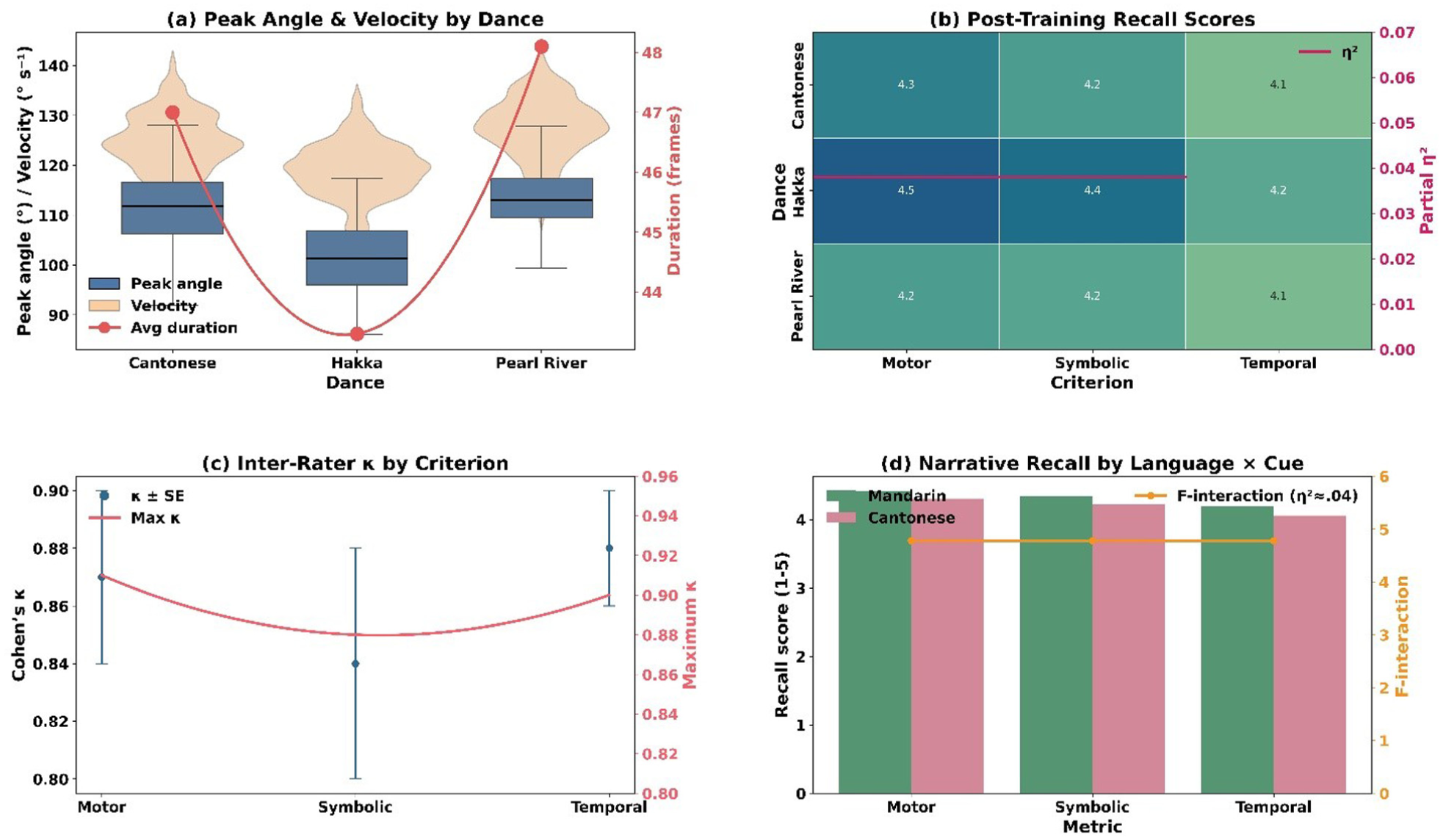
Motion parameters, recall performance, and rater agreement across dances and cue conditions: (A) peak angle, velocity, and average gesture duration by dance type, showing higher values for pearl river boat dance, (B) post-training recall matrix (motor, symbolic, temporal) by dance, with overlaid partial η2 values indicating effect sizes for recall differences, (C) inter-rater reliability for motor, symbolic, and temporal scoring, with mean Cohen’s κ and maximum κ for each criterion, and (D) narrative recall scores by language (Mandarin, Cantonese) and cue condition, with the F-interaction line indicating the magnitude of the language × cue interaction.
Gesture journal fidelity logs showed gesture compression as the most frequent drift (124 occurrences, 25.5%), followed by symbol ambiguity (22.4%) and inverted sequencing (19.8%), with high inter-rater reliability across categories (κ = .79–.85; mean κ = .822 across 485 units; see Figure 7A).
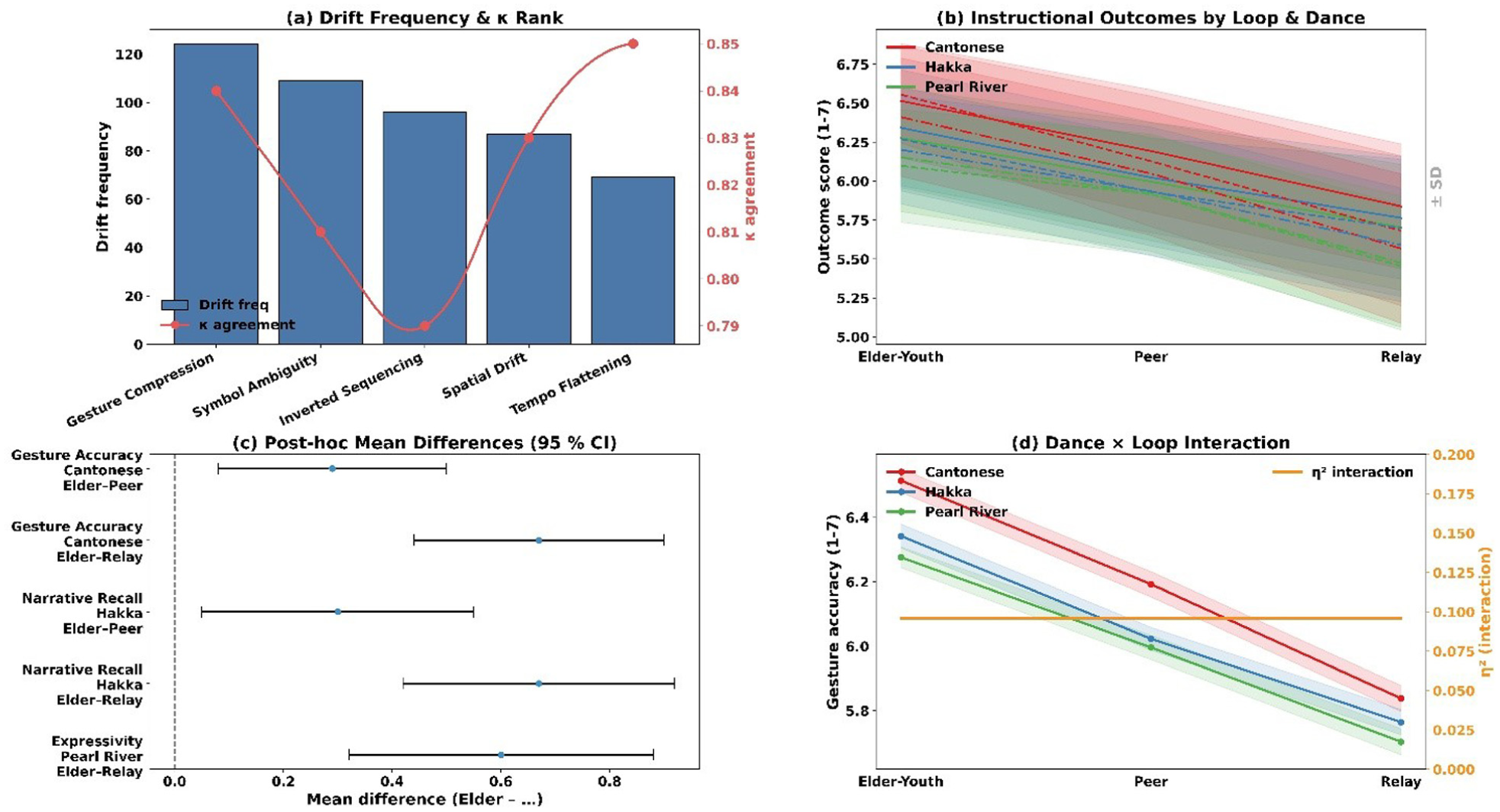
Drift patterns and instructional loop effects on performance outcomes: (A) drift frequency and inter-rater agreement (κ) for gesture compression, symbol ambiguity, inverted sequencing, spatial drift, and tempo flattening, (B) gesture outcome scores (1–7) across elder–youth, peer, and relay loops for Cantonese flower drum dance, hakka rice harvest dance, and pearl river boat dance, with shaded bands indicating ± 1 SD, (C) post-hoc mean differences (elder–peer, elder–relay) with 95% confidence intervals for gesture accuracy, narrative recall, and expressivity, and (D) dance × loop interaction in gesture accuracy, with separate lines for each dance and an overlaid η2 interaction trend.
Instructional outcomes favoured elder-to-youth loops across all dances and metrics (see Figure 7B). In Cantonese Flower Drum, gesture accuracy was 6.51 ± 0.36 in elder loops versus 5.84 ± 0.45 in relay; narrative recall reached 6.39 ± 0.40, 6.15 ± 0.38 in Hakka, and 6.09 ± 0.39 in Pearl River. Peer instruction yielded intermediate scores.
Post hoc comparisons confirmed significant loop-wise differences (see Figure 7C). In Cantonese, gesture accuracy differed by 0.29 (p = .018) between elder and peer, and 0.67 (p = .001) between elder and relay. In Hakka, narrative recall differed by 0.30 (p = .024) and 0.67 (p = .001). In Pearl River, expressivity was 0.60 higher in elder than relay (p = .002).
Two-way ANOVA confirmed main and interaction effects for dance and loop types (see Figure 7D). Gesture accuracy showed effects for dance (p = .002, η2 = 0.142), loop (p = .001, η2 = 0.152), and interaction (p = .004, η2 = 0.096); motif integrity (p = .005), expressivity (p = .005), and narrative recall (p = .004) showed similar interactions.
These η2 values indicate medium effects of both dance type (η2 = 0.142) and loop configuration (η2 = 0.152) on gesture accuracy, with a smaller but non-trivial interaction (η2 = 0.096). In practical terms, loop configuration accounts for a meaningful share of variability in how accurately motifs are executed, and the loop-by-dance pattern shows that the performance advantage of elder-to-youth instruction is strongest for Pearl River Boat Dance, followed by Hakka Rice Harvest Dance and Cantonese Flower Drum Dance.
Group-level comparisons showed significant angular drift differences across dances, with Pearl River Boat highest at 9.0 ± 1.3°, followed by Hakka (8.1 ± 1.4°) and Cantonese (7.4 ± 1.2°; see Figure 8A). ANOVA confirmed a dance-type effect (F = 10.56, p = .001, η2 = 0.119). Motif gain was most frequent in elder-to-youth loops (51.9%, χ2 = 8.41, p = .015, V = 0.212). Temporal flattening occurred in 14.2% of entries (κ = .85). Post hoc tests confirmed that Pearl River drift exceeded both Hakka (−0.9°, p = .031, d = 0.67) and Cantonese (−1.6°, p = .002, d = 1.23), while Hakka also exceeded Cantonese (−0.7°, p = .044, d = 0.55; see Figure 8B). Instructor scores improved significantly across all modules (see Figure 8C): motif labelling rose from 4.23 ± 0.67 to 6.18 ± 0.42 (t = 6.27, p = .001, d = 1.81), gesture cueing from 4.47 ± 0.71 to 6.05 ± 0.48 (t = 5.14, p = .002, d = 1.48), and drift detection from 3.88 ± 0.74 to 5.92 ± 0.59 (t = 7.03, p = .001, d = 2.03).

Angular drift, motif gain, and instructor learning across modules: (A) angular drift by dance type with overlaid mean gesture duration, showing the largest deviations and longest phrases in pearl river boat dance, (B) motif gain counts by instructional loop with residuals relative to the mean, indicating that elder–youth loops produce the highest number of gains, (C) pre- and post-training instructor scores for motif labelling, gesture cue delivery, and drift detection, with Cohen’s d values summarising the magnitude of improvement for each competency, and (D) pre- and post-training score ranges for the three instructor measures, illustrating compression of ranges towards higher scores following GATPM training.
Score ranges increased consistently (see Figure 8D): motif labelling from 3.2–5.1 to 5.4–6.8, cueing from 3.5–5.3 to 5.2–6.5, and drift detection from 2.9–4.6 to 5.1–6.7.
Peer assessment metrics improved steadily across 4 weeks (see Figure 9A). Motif accuracy rose from 4.72 ± 0.51 to 5.61 ± 0.38 (slope: +0.30/week), while narrative recall increased from 4.56 ± 0.48 to 5.42 ± 0.37 (+0.29/week). Fidelity scores followed a similar pattern, rising from 4.39 ± 0.57 to 5.33 ± 0.43. Post hoc analysis confirmed significant week-to-week gains (see Figure 9B): motif accuracy improved by +0.34 between Weeks 1 and 2 (95% CI[0.18–0.49]), +0.28 between Weeks 2 and 3 (95% CI[0.15–0.41]), and +0.27 between Weeks 3–4 (95% CI[0.13–0.40]), while narrative recall improved by +0.33 (Weeks 1–2; 95% CI[0.19–0.47]), +0.29 (Weeks 2–3; 95% CI[0.17–0.42]), and +0.24 (Weeks 3–4; 95% CI[0.11–0.37]), with all confidence intervals lying entirely above zero, indicating robust progression in both motor execution and symbolic remembering across the 4-week curriculum. Baseline comparisons showed no significant differences in gesture (+0.04, p = .731) or narrative recall (+0.16, p = .242) between retained and dropout participants (see Figure 9C and D). Fidelity scores differed significantly (+0.29, 95% CI [+0.03–+0.55], p = .029), indicating higher baseline consistency among retained individuals.

Week-to-week changes in learner performance and baseline attrition checks: (A) motif accuracy over 4 weeks, with line and shaded band showing mean trend (±SE) and bars indicating week-specific gains (Δ accuracy), (B) narrative recall over weeks, with trend line and shaded band plus bars showing weekly change (Δ recall), (C) post-hoc week-to-week mean differences in accuracy and recall (W2–W1, W3–W2, W4–W3) with 95% confidence intervals, and (D) baseline gesture, narrative, and fidelity scores for retained versus dropout learners, with overlaid Cohen’s d values summarising the magnitude of baseline differences.
Discussion
Our study systematically examined differences across three traditional dance forms: Cantonese Flower Drum, Hakka Rice Harvest, and Pearl River Boat. We evaluated rhythmic density, motion range, gesture ambiguity, and post-training recall. The Pearl River Boat dance showed the most complex rhythmic and motion profiles, but also the highest ambiguity in its symbolic gestures. In contrast, the Hakka Rice Harvest group achieved the strongest performance in motor recall and symbolic coherence. Instructional effectiveness was consistently higher in elder-to-youth transmission loops across all outcome measures. Narrative recall improved under continuous cueing and varied by language track. Across all conditions, Cantonese Flower Drum demonstrated the most excellent stability in angular execution, while motif retention was most prominent in intergenerational instructional formats. Although these patterns were consistent across analyses, the observed advantages of particular dances and loops should be interpreted as emergent properties of a specific training ecology rather than as fixed hierarchies of cultural or pedagogical value, since prior exposure, cohort composition, and site histories may also shape performance trajectories.
The present study identified pronounced differences in rhythmic density and peak joint motion across the three regional dance types, with Pearl River Boat dances displaying the highest kinetic complexity. Prior research (Li, 2024; Liao, 2024; Wei, 2024; Zheng et al., 2025) established that audience evaluations of authenticity in Chinese dance are closely linked to micro-movements and rhythm-specific bodily control, especially motifs such as the shoulder dip in Guangdong styles. Kong (2024) further demonstrated that musical phrasing in both Xinjiang and Hakka traditions mirrors bodily rhythms, reinforcing the link between musical and kinaesthetic structure in traditional dance pedagogy. J. Li et al. (2025) mapped ritual zones tied to folk dance survivals, confirming the spatial anchoring of embodied kinetic vocabularies in specific regions. Our work extends this by quantitatively disaggregating gesture density and anatomical span, showing that regional codification is empirically traceable and can inform new standards for pedagogical extraction in multi-ethnic settings. At the same time, reliance on discretised measures of rhythmic density and anatomical span may under-represent more diffuse qualities of national body aesthetics, such as micro-tonal weight shifts or shared affective atmosphere, indicating that any codification emerging from these metrics should be treated as a flexible support for pedagogy rather than a prescriptive template for artistic conformity.
Gesture ambiguity and frequency of symbolic overlap were most prominent in the Pearl River Boat repertoire, contrasting with the more clearly codified Cantonese and Hakka forms. Zhong (2024) Similarly, it showed that minority dance gestures in media derivatives are prone to expressive distortion unless encoded with clear symbolic tags, underscoring the risk of loss in transmission. Nemkina (2025) found that the symbolic stability of core movement metaphors can persist despite media stylisation, provided semantic anchors are preserved. Our analysis demonstrates that gesture ambiguity is not merely a function of choreographic complexity, but a reflection of underlying mnemonic and transmission architectures, and highlights the need for explicit symbolic reinforcement in instructional models. High-ambiguity zones in the Pearl River Boat repertoire, therefore, function as a double-edged space: they can enable creative reinterpretation and cross-context adaptation, but they also increase the risk that gestures will be decontextualised, commodified, or appropriated in curricular or media formats that no longer recognise the original lineage, ritual function, or community ownership of the movement.
Post-training recall outcomes demonstrated that Hakka Rice Harvest participants had superior motor and symbolic recall, with recall performance generally enhanced by continuous audio cueing and Mandarin narrative tracks. X. Li (2024) found that cyclical musical motifs support kinaesthetic literacy in cross-cultural audiences by scaffolding gesture memory through auditory codes. Lin (2024) illustrated that semantic coupling in folk song structures facilitates embodied mnemonic retention, which can be directly mapped to gesture-based recall in dance learning. Z. Ma et al. (2024) showed that contextualised gesture symbolism retains communicability across language boundaries, mainly when supported by bilingual modules. This study advances previous research by providing empirical evidence that auditory scaffolding and language selection interactively modulate symbolic recall, justifying their inclusion in cross-regional pedagogical frameworks. The advantage of Mandarin continuous cues, while pedagogically effective, also reflects the institutional dominance of national lingua franca over regional and minority languages, raising questions about how curriculum design can support mnemonic gains without further marginalising local vernaculars and the oral registers through which many folk narratives are traditionally transmitted.
Instructional efficacy was highest in elder-to-youth loops, where gesture accuracy and motif retention significantly outperformed peer and youth relay formats. Pan et al. (2024) reported that community-based experiential modules, analogous to elder modelling in dance, raised engagement and performance by 60%, reinforcing the value of vertical knowledge transfer. Hanyong (2024) drew parallels between traditional motif adaptation in sculpture and dance, showing that core forms are best preserved through guided transmission rather than autonomous reinterpretation. Our findings underscore that intergenerational instructional loops safeguard both technical and symbolic aspects of dance, filling a critical gap in existing curricular models that often emphasise peer learning alone. These advantages, however, depend on sustained access to recognised bearers of tradition and may place additional emotional and pedagogical labour on elder practitioners, highlighting the need for compensation, authorship recognition, and shared governance so that intergenerational loops do not inadvertently reproduce extractive dynamics in which community knowledge is formalised into curricula without equitable benefit to its custodians.
Drift analysis revealed that gesture compression and symbol ambiguity accounted for nearly half of all observed interpretive deviations, with motif gains primarily concentrated in elder-to-youth loops. Gu et al. (2025) found that spatial planning and green zone integration promote the retention of traditional arts by facilitating repeated, high-fidelity rehearsals. Yu et al. (2024) showed that regional coordination and infrastructural scaffolding reduce interpretive drift in cultural participation metrics. Chen and Hou (2024) highlighted that positive media framing and curriculum design can further minimise ambiguity, increasing fidelity in youth dance training. By triangulating drift type, context, and instructional format, our findings highlight concrete mechanisms, both spatial and curricular, that preserve or enhance symbolic integrity in evolving dance repertoires. The present study contributes a replicable, data-driven methodology for quantifying, codifying, and strengthening regional folk dance pedagogy, positioning it as a model for the dynamic integration of tradition, innovation, and sustainable cultural development. At the policy level, these mechanisms suggest that standard-setting bodies and curriculum designers can intentionally dampen drift by foregrounding context-rich motifs and rehearsal ecologies. Still, they also caution against over-standardisation that would freeze living repertoires into narrow score-based criteria, thereby limiting the adaptive, community-led evolution that underpins the vitality of folk dance traditions.
Thus, the findings point to unresolved tensions between safeguarding and appropriation in the formalisation of regional folk dance within institutional curricula. The systematic mapping of gesture lexicons and instructional effects creates powerful tools for curricular reform. Still, it creates opportunities for bodies outside originating communities to extract, rebrand, or selectively adopt motifs, thereby eroding local control over meaning and use. Ethical deployment of the GATPM, therefore, requires transparent crediting of source lineages, mechanisms for community co-governance in curriculum decisions, and policy safeguards that prevent high-visibility programmes in elite institutions from displacing low-resource. These community-based transmission sites remain central to the lived practice of national body aesthetics.
Practical Implications
This study offers a scientifically validated framework for regional folk dance pedagogy by quantifying gesture lexicons, recall mechanisms, and instructional loops. The protocol enables arts educators to implement data-driven curriculum design, optimise intergenerational teaching, and systematically enhance symbolic fidelity. Policymakers and cultural institutions can use these findings to allocate resources more efficiently, support infrastructure planning, and integrate regional body aesthetics into broader educational and artistic strategies for sustained heritage preservation. At the same time, the granularity of these tools means that institutional stakeholders could also use them for narrow performance benchmarking or surveillance of stylistic conformity; careful governance is therefore required to ensure that implementation prioritises community-defined goals of transmission, equity, and cultural flourishing over purely technocratic performance optimisation.
Limitations and Future Research
A key limitation of this research is the relatively small, purposively selected cohort drawn from three sites in Guangdong, which constrains statistical generalisability and may mean the patterns observed reflect local training histories rather than the full diversity of Greater Bay Area practice. The intervention was short and assessed over a single 4-week cycle. Hence, the durability of motif retention, symbolic clarity, and instructor gains beyond the immediate post-test window remains unknown. Intensive video monitoring and repeated assessments may also have introduced Hawthorne effects, particularly in elder-to-youth loops where performers are highly aware of being documented for institutional use. In addition, the focus on Han-majority Cantonese and Hakka lineages in controlled studio environments limits its applicability to non-Han and rural ritual settings, where floor conditions, costume constraints, and social hierarchies shape movement in different ways. Future research should therefore extend the GATPM framework to longer-term, community-embedded designs, incorporate additional ethnic traditions, and combine motion analysis with ethnographic work to capture how dancers and elders themselves interpret the appropriateness and impact of these pedagogical interventions.
Conclusion
This research systematically mapped, quantified, and evaluated regional gesture vocabularies, mnemonic recall, and intergenerational teaching dynamics within three iconic Guangdong folk dance traditions. These contributions should not be interpreted as a substitute for community-led adjudication of authenticity or value, but rather as a set of analytic resources that can support dialogue between educators, policy-makers, and tradition bearers in negotiating how national body aesthetics are taught, adapted, and safeguarded under contemporary conditions. The results demonstrate robust main and interaction effects of dance type and instructional loop on gesture accuracy, recall, and fidelity. By operationalising symbolic ambiguity, motif drift, and recall mechanisms, the study delivers a novel data-driven template for curriculum reform and heritage pedagogy. These insights provide a robust foundation for arts policy and practice, empowering cultural agencies to integrate regional dance sustainably into education and urban development planning.
Supplemental Material
sj-docx-1-sgo-10.1177_21582440261417834 – Supplemental material for Research on the Transformation of Traditional Dance Skills Teaching Model Based on National Body Aesthetics-Taking Folk Dance in Guangdong-Hong Kong-Macao Greater Bay Area as an Example
Supplemental material, sj-docx-1-sgo-10.1177_21582440261417834 for Research on the Transformation of Traditional Dance Skills Teaching Model Based on National Body Aesthetics-Taking Folk Dance in Guangdong-Hong Kong-Macao Greater Bay Area as an Example by Weiyu Liu in SAGE Open
Footnotes

Ethical Considerations
All study procedures were reviewed and approved by the Ethics Committee of Guangdong Teachers College of Foreign Languages and Arts (Approval No. 2024-XK8-562-66). To protect participants' privacy, data were anonymised at the point of collection and stored on encrypted institutional drives with access restricted to the primary investigators.
Consent to Participate
Informed consent was obtained from all participants and, where applicable, from legal guardians. Participants were informed that participation was voluntary and that they could withdraw at any time without penalty. For video-recorded sessions, verbal assent was re-confirmed immediately before each recording to ensure continued willingness and comfort.
Funding
The author disclosed receipt of the following financial support for the research, authorship, and/or publication of this article: This research was funded by the Humanities and Social Sciences Research Programme of the Ministry of Education of the People’s Republic of China (Project No. 24YJC760079).
Declaration of Conflicting Interests
The author declared no potential conflicts of interest with respect to the research, authorship, and/or publication of this article.
Data Availability Statement
All data generated or analysed during this study are available from the corresponding author upon reasonable request.*
Supplemental Material
Supplemental material for this article is available online.
References
Supplementary Material
Please find the following supplemental material available below.
For Open Access articles published under a Creative Commons License, all supplemental material carries the same license as the article it is associated with.
For non-Open Access articles published, all supplemental material carries a non-exclusive license, and permission requests for re-use of supplemental material or any part of supplemental material shall be sent directly to the copyright owner as specified in the copyright notice associated with the article.
