



Abstract
China’s Grand Canal is a large-scale, cross-regional, linear cultural heritage site that preserves local historical memories and is an important heritage tourism attraction. However, the development of cultural tourism along the canal has remained relatively stagnant. A combination of heritage protection and cultural tourism, cultural routes have achieved significant results in Europe. Therefore, this study uses this concept to explore how to balance the relationship between tourist needs and attraction planning to establish a sustainable canal culture tourism system in China. This study considered the water transport hub of the Huai’an Grand Canal as the project area. First, the relevant materials of grain transporting cultural resources were collected; then, they were coded and categorized according to heritage attributes. Scattered heritage attractions were made in series through serial narratives, and final interviews with local residents were conducted to assess the feasibility of route planning. The study found that (1) the classification of heritage categories is helpful for the establishment of the grain transporting cultural value cognition; (2) recreating heritage scenes in the form of sequential narratives can enhance visitor experience; and (3) attraction planning can simultaneously meet the needs of tourists and the development of the place.
Plain Language Summary
This study explores the integration of heritage protection and cultural tourism through the development of cultural routes, specifically focusing on the Huai’an Grain Transport cultural heritage. It investigates how using cultural routes can enhance the preservation of heritage resources, enrich tourist experiences, and support local development. We believe that our study makes a significant contribution to the literature because it offers a comprehensive framework for developing cultural tourism systems that not only preserve heritage resources but also create meaningful and engaging experiences for tourists. Moreover, it highlights the potential for cultural routes to foster intercultural dialogue and community engagement, providing a model that can be adapted to other regions and contexts. This study also identifies gaps in the involvement of relevant stakeholders, suggesting areas for future research and practical application.
Keywords
Introduction
Tourism is the third-largest economy in the world and one of the most influential social, cultural, ecological, and political forces. Despite a decline due to the pandemic in recent years, international tourism saw a significant rebound, increasing by 102% in 2022 compared to 2021, and by 86% in the first quarter of 2023 (The World Tourism Organization, 2023). Cultural tourism, in particular, meets contemporary people’s desire for enriched spiritual experiences and contributes to shaping national strategies (Megeirhi et al., 2020). The European Union, in collaboration with the World Tourism Organization and the European Travel Commission, has effectively integrated heritage protection with cultural tourism (Berti, 2015; Council of Europe, 2011, 2013). The European Institute of Cultural Routes posits that sustainable cultural tourism fosters stable social development and highlights cultural routes’ distinctive social attributes in the modern era: thematic focus, interpretation of local history and culture, and promotion of universal values (Severo, 2017). This approach underscores cultural routes as a sustainable, ethical, and socially responsible form of tourism that leverages local knowledge, skills, and heritage assets (Berti & Mariotti, 2015; S. Zhang et al., 2023). To date, Europe has established 45 cultural routes for tourists (Figure 1), demonstrating a significant investment in this area, whereas research and development in Asia, including China, have been comparatively limited (Berti, 2019; Figure 2). China’s Grand Canal, a UNESCO World Heritage Site, serves as an existing cultural route. However, research on this route has predominantly focused on definitional aspects rather than on development and practical application (Guo & Yang, 2015; Severo & Zhang, 2018; J. B. Wang & Ruan, 2009; World Heritage Committee, 1994; K. Zhang et al., 2022).

European cultural routes (Berti, 2015).

Asian cultural routes.
UNESCO’s latest operational guidelines for the implementation of the world heritage convention state that canals, as products of early human migration and trade, have left important material and intangible cultural heritage, encompassing cultural thoughts, social values, and regional customs (UNESCO, 1972, 2021). For example, the Beijing-Hangzhou Grand Canal facilitated economic, cultural, and social development in its surrounding regions and served as an early military defense measure that consolidated central government control and strengthened north-south exchanges in China (Xun, 2006; G. J. Yin, 2019). Its engineering, shipping lanes, water-conservation technology, and other heritage sites have outstanding universal value (Y. Zhao et al., 2023). Towns along the Canal have gradually become popular tourist destinations (Jiang, 2019). Shan (2009) proposed that the Grand Canal, a historic waterway, has witnessed a decline in cities and regions along its course and should be included in discussion of cultural routes. However, coastal cities have largely overlooked developing tourism through the perspective of heritage sites, focusing instead on tourist and resident experiences (Kaaristo & Rhoden, 2017; Mehran et al., 2020; Pinkster & Boterman, 2017; Qian, 2020), attraction construction, and tourism strategies (Fallon, 2012; Flemsæter et al., 2020; Jomsri, 2019; McKean et al., 2017; Rhoden & Kaaristo, 2020). This indicates that the Grand Canal, as a World Heritage Site and cultural route, holds significant tourism value and potential for promoting local development. However, the current study has not carried out the development practice in the form of a cultural route.
Huai’an is a historical canal capital that has achieved certain results in its heritage protection and urban tourism development. Heritage protection efforts have primarily focused on the protection and management strategies for canal sites (Wu, 2019; Y. L. Xu & Xi, 2011; Q. Zhang, 2013; Zhu, 2017). Heritage categories include the cultural preservation of ancient towns and water conservancy heritage (P. Dong, 2017; J. Q. Li, 2020; X. X. Zhang, 2008), and the characteristics and impact of the current preserved heritage (Q. Dong & Xi, 2010; Xi, 2011). In terms of tourism development, folk culture and paper-cut handicrafts are important tourism experiences (An & Zhang, 2019; M. Y. Wang, 2020); Huai-yang cuisine provides tourists with the opportunity to taste local delicacies (R. Yin, 2016; L. Zhang & Sun, 2014), and the waterfront space and ecological space along the coast form an excellent leisure place for visitors (Qi & Ma, 2021; Sun & Luo, 2016). Most importantly, research on water transport has promoted the creation of Huai’an tourism brands (Guan, 2016; Lv & Liu, 2016b). However, these heritage tourism studies remain largely theoretical and fail to construct distinctive local characteristics, significantly restricting their urban influence, cultural diffusion, and tourism brand competitiveness. Huai’an has employed the cultural route model to explore and promote the inheritance and development of its local canal culture. This study explored heritage tourism in the form of cultural routes for the development of China’s canal areas.
This study explores the integration of heritage protection and cultural tourism through the development of cultural routes, specifically focusing on the Huai’an Grain Transport cultural heritage. It investigates how using cultural routes can enhance the preservation of heritage resources, enrich tourist experiences, and support local development. The study offers a comprehensive framework for developing cultural tourism systems that not only preserve heritage resources but also create meaningful and engaging experiences for tourists. Moreover, it highlights the potential for cultural routes to foster intercultural dialog and community engagement, providing a model that can be adapted to other regions and contexts. The structure of this article is as follows: first, it introduces the research area of the canal cultural heritage; second, it explore how to develop the grain transport by cultural routes and landscape narratives, then the content analysis method is used to transform the Huai’an grain transportation cultural heritage into the practice of cultural routes; and analyze the heritage tourism routes established by the research; finally, the conclusion of the article are presented.
Materials and Methods
Research Area
The research area in this study was the city of Huai’an, located in Jiangsu Province, China, which is situated in the Yangtze River Delta region, just at the convergence of the Yellow River, Huai River, and Canal (Figure 3). Its longitude and latitude coordinates are 33°02′–33°78′ N, 118°48′–119°27′ E. By the end of 2022, the city had four districts and four counties, with a total area of 10,100 km2, a resident population of 4.5531 million, and the gross domestic product (GDP) of RMB 474.242 billion. As a water transfer station, Huai’an was once known as one of the four capitals of the Beijing-Hangzhou Canal (or Grand Canal), along with Yangzhou, Suzhou, and Hangzhou (Jin et al., 2017). Huai’an was the location of the Grain Transport Management Agency during the Qing Dynasty because of its special geographical location, which has the title of water transport capital. The research scope mainly focused on the downtown area of Huai’an, including Qingjiangpu District, Huaiyin District, and part of Huai’an District (Figure 4).

Huai’an and the grand canal.

Scope of the study area.
Huai’an is an important city along the Canal Line that integrates northern and southern cultures, and its cultural resources for grain transportation are particularly plentiful. After the Beijing-Hangzhou Grand Canal was successfully applied for World Cultural Heritage status, 42 heritage items from the Huai’an section were enrolled in the overall protection plan, accounting for 1/8 of the total number (H. H. Wang, 2017). Another 93 items are included in the regional protection list, and the types are diverse, including 35 water conservancy projects, such as the old watercourse of the Yellow River, Hongze Lake embankment, and Gaojia weir; eight settlement sites; two ecological landscape protection areas; 27 intangible cultural heritage items; and 21 items in other categories (Yao & Wang, 2019; Q. Zhang, 2014). Moreover, there are many high-level resources of intangible cultural heritage. For example, six items, including Huaihai Opera, Peking Opera, Huai Opera, Shifan Gongs and Drums, Hongze Lake Fishing Drums, and Jinhu Yangko, have entered the national list, and 33 items, including Nanzha folk songs, have entered the provincial list (X. Li, 2018). As the first important hub of the Grand Canal, heritage projects preserved in Huai’an ensured the normal passage and transit of grains along the canal route (Xun, 2006; Y. L. Xu & Xi, 2011). The transportation of grain enabled the area along the canal to develop into a huge economic belt; Huai’an became an important distribution center for strategic materials and various commodities, and its economic development reached its peak (X. X. Zhang, 2008; Q. Zhang, 2014). Additionally, the water transport system based in Huai’an not only strengthened the feudal state’s management of water transport but also improved its political, economic, and cultural status in the country (Xi, 2011; G. J. Yin, 2019). This material and intangible cultural heritage, as well as the derived cultural resources that form Huai’an’s Grain Transport cultural system, spread to various places along the canal while constituting abundant heritage tourism resources (Table 1). However, Huai’an’s Grain Transportation heritage tourism development focuses solely on the tourist attractions of scenic spots and ignores the overall heritage narrative context (An & Zhang, 2019; P. Dong, 2017; Qi & Ma, 2021; R. Yin, 2016; D. C. Zhou et al., 2019). Therefore, this study integrates the landscape narrative context of the Grain Transport heritage with tourists’ travel experience needs, exploring the inheritance and development strategies of Huai’an Canal culture using the cultural route model.
Huai’an Grain Transport Culture Category.

Grain Transportation
Grain transport promoted the formation of important political and economic systems during the Ming and Qing Dynasties and was highly valued by the central government. Cao means waterways or canals, and Liang represents grains and supplies. The method of transporting supplies through the Grand Canal is called grain transport, which involves transporting food and other materials through water channels from a region of abundant resources to the capital for palace consumption, military salary payments, official salaries, etc. (W. Z. Li & Jiang, 1995; S. H. Wang, 2017). The Grand Canal is divided according to its water system relationships, water sources for transportation, and water conservancy project characteristics and includes Baicao, Weicao, Zhacao, Hecao, Hucao, Jiangcao, and Zhecao. For example, E. Z. Zhao (1976) stated in an ancient book, “If Baicao uses the Baihe River to defend water transportation and guide Wei water, then Zhacao and Hucao will respectively receive lake water from the Jiangnan River.” This indicates that the grain transport culture produced by the excavation of the canal is a belt-shaped cultural collection formed after the integration of living circles along the canal across different regions. It promotes the development of cities along the canal that involve customs, artistic skills, working methods, social values, and so on (An & Shen, 2014; Q. Zhang, 2022). After the end of the Grain Transport era, Huai’an retained cultural resources from different periods that attracted tourists, such as various types of shiplocks, hydraulic engineering sites, management institutions, local food, and folk customs (H. H. Wang, 2017; M. Y. Wang, 2020; Q. Zhang, 2014; L. Zhang & Sun, 2014). Currently, the construction of the Grand Canal National Park has also been promoted at the national strategic level, and scholars have attempted to inherit and reuse heritage resources in multiple ways, such as canal cultural heritage protection, ecological environment improvement, restoration of famous cities and towns, a combination of culture and tourism, and canal navigation upgrading (Mao et al., 2022; Su & Ge, 2020; K. L. Wang et al., 2022; Zhan & Wang, 2012). However, these developments did not involve the grain transportation aspects of canal heritage, nor did they present the historical context of heritage resources for tourists.
Grain transportation is a key link in the canal culture system formed by the diversion of goods from south to north in Chinese history. Huai’an became a grain transport hub on the Canal because of its special geographical location, which preserved many cultural heritage resources (Figures 5 and 6). At present, research on grain transport in Huai’an is mainly based on cultural inheritance, such as grain transport wharfs (Mo, 2003; Chen & Deng, 2016), grain Transport architecture (H. Y. Zhao et al., 2022; D. C. Zhou et al., 2019), grain transport and mazu (X. J. Zhang, 2016), grain transport and agriculture (Y. J. Wang & Wang, 2022), and grain transport gang culture (Zheng, 2017). The exploration of the culture of grain transportation has also promoted its inheritance and protection (Cao & Wu, 2018). The reuse of the grain transport culture is also a research emphasis, such as the development of cultural and creative products (Ye & Kuai, 2022), the design of grain depots (Niu et al., 2018), and the construction of the creative industry (Lv & Liu, 2016a). However, there are relatively few studies on grain transport cultural tourism in Huai’an, such as the introduction of grain transport attractions (Guan, 2016), tourist satisfaction (Y. L. Li et al., 2019), and the construction of grain transport tourism brands (Yan, 2020). This shows that the development of grain transport cultural heritage tourism has not attracted sufficient attention from Huai’an locals, nor has heritage inheritance been combined with resource reuse. The cultural route is a combination of heritage, industry, stories, and tourism that promotes the value of cultural heritage while establishing a sense of ownership of common heritage by society, thereby achieving sustainable preservation and development of heritage. Therefore, the inheritance and development of Huai’an’s grain transportation culture relies on the cultural route model, which carries out local heritage tourism practices on the premise of protection.

Grain transport governor’s department in Huai’an.

Grain transport Museum in Huai’an.
Cultural Routes
Cultural routes are a practical result of continuous improvements in the cultural heritage protection concepts. In 2005, the World Heritage Convention Operational Guidelines listed cultural routes as one of four heritage categories. Subsequently, the Cultural Route Charter, prepared by the International Committee on Cultural Routes (CIIC) in 2008 and published by ICOMOS, was widely used as a unified definition (ICOMOS, 2008). It not only finds new ways of cultural heritage protection but also provides an approach for the reuse of local heritage resources (Taylor, 2013). These routes link various attractions, thereby promoting local tourism by encouraging visitors to explore different locations (Meyer, 2004). A cultural route is a selected journey or progression among a series of elements, representing the path taken to reach a specific destination (Boniface & Boniface, 2001; Splendiani et al., 2023). As a container, it accommodates the cultural context and structural attributes of the heritage sites in its area (Messineo, 2012). Furthermore, heritage trails represent collective memory, which is an opportunity to restore the historical, cultural, environmental, and economic assets of an area in which it is located (Trono & Oliva, 2017). This evolution confirms that the concept of cultural routes has expanded from protecting single sites to incorporating broader heritage backgrounds, and now coordinates with local development to seek comprehensive, large-scale, and systematic protection strategies.
Europe began to vigorously promote local development practices through cultural heritage tourism after the concept of cultural routes gradually improved. This is because cultural routes emphasize the value of paths, people, environments, and regions. However, this also stems from its potential impact on economic growth (Genovese, 2016; Majdoub, 2010). Route tourism can bring together less-well-known attractions and propagate them more effectively under a unified theme (D. J. Timothy & Boyd, 2006). Trails and routes help visitors experience an important part of a trip that is popular in the tourism industry (D. Timothy & Boyd, 2015). Vintage items can also be displayed through paths to provide visual consumption, thereby promoting a sense of nostalgia and enhancing the tourism experience (Domínguez-Quintero et al., 2020). Additionally, the essence of cultural route is consistent with “cultural landscapes” that both aim to integrate cultural assets and promote overall preservation (Campolo et al., 2016). This process includes the spatial recording of landscape features, documentary research, and oral recordings (Oli et al., 2013). In other words, cultural routes establish a network of cultural footprints that understand the landscape in terms of its spatial, social, and economic components and other connections. For these reasons, there is a growing interest in cultural routes as part of local tourism development, which enhances the understanding and preservation of tangible and intangible assets. Therefore, this study takes the example of the European cultural route model to develop cultural tourism practices in Huai’an, China. The reuse of attractive grain transport heritage resources promotes sustainable development of local heritage preservation.
Landscape Narrative Context
Landscape is a form of cultural heritage that can enhance people’s experiences when combined with narrative expressions. “Landscape” is the visual impression formed by human eyes capturing beautiful scenery, which originates from the concept of Western visual esthetics. The European Landscape Convention defines “landscape as an area perceived by people” and affirms that it is part of cultural heritage (Council of Europe, 2000). Just as one sees heritage elements in life—houses, roads, trees, hills, etc—they have landscape meaning only through mutual connections (Meinig, 1979). And “narrative” gradually refines the stories and content of personal understanding in them by telling the experiences and discoveries (Riessman, 2003). The key is to analyze the “research questions,” such as actions, scenes, situations, characters, methods, purpose, meaning, etc. (Labov, 1982). For example, Potteiger and Purinton (1998) and Feng (2008) found that people use landscape stories and historical facts to explain their living environment to make the place real and natural. The combination of landscape and narrative can help people capture the beautiful scenery of the past and understand the changes in local history. de Rojas and Camarero (2008) believe that the attraction of the cultural route lies not only in the exploration of the stories behind cultural heritage but also in relation to personal emotions and experiences. The Pilgrimage Route develops themed paths for pilgrims that satisfy their spiritual experiences by collecting the deeds of Jesus, while other tourists visit the same attractions only for cultural experiences by appreciating the heritage of the destination (D. J. Timothy, 2018). This shows that a landscape narrative is a personal understanding of a place that can help people gradually complete their personal experiences while visiting cultural heritage sites.
The construction of cultural routes using landscape narratives can promote the development of local cultural tourism and empower heritage management. Cultural routes combine attractive landscape resources in different regions through a certain theme, while protection is the fundamental purpose, demonstrating the dynamic role of cultural tourism (Trono & Oliva, 2017). For example, Campolo et al. (2016) believe that the European cultural path highlights the appeal of spiritual heritage in the theme and encourages tourists who have intellectual enthusiasm to come and explore. At the same time, an increasing number of heritage tourism destinations realize the socio-economic potential brought about by sharing stories with visitors and constantly providing tourists with regional route narratives (Lowenthal, 2015). From this perspective, the thematic narratives of landscapes can provide added value to route travelers and enhance the attractiveness of local tourism. Additionally, cultural routes connect material and intangible forms in the heritage landscape, protecting and enhancing them according to the specific characteristics of the route (Genovese, 2016). People are not just observers of route tourism but also become creators because of their exploration of the landscape’s charm while potentially participating in oral propaganda (Severo & Zhang, 2018). Moreover, the cultural route is helpful in developing a series of attractions and facilities that allow tourists to be evenly distributed, which improves the environmental carrying capacity and balances economic interests on the path (Denstadli & Jacobsen, 2011; Meyer, 2004). This shows that the cultural route is not just a short cultural trip but an integrated cultural management system that uses landscape narratives to plan the context of heritage resources, which encourages the public to take the initiative to undertake oral publicity and empowerment management. Therefore, this study comprehensively develops Huai’an grain transport heritage resources based on the concept of the cultural route, which connects local cultural attractions through thematic narratives to enhance tourism attractiveness and create a sustainable development practice model.
Based on the discussion above, this study addresses the following research questions: How can local heritage resources be reused to enhance a city’s cultural tourism attractions? How can landscape narratives be combined to construct a sustainable management model for urban heritage sites along the Canal? What strategies can be used to effectively promote the transformation of cultural route research from theory to practice in China and Asia? In this study, Huai’an, the capital of grain transportation in China, was selected as the research area. It establishes a cultural route network with themed stories based on its history and background so that tourists can perceive the value of heritage in the process of understanding the landscape, thereby giving meaning to the cultural route and forming a sustainable heritage preservation system.
Research Methods
The main goal of this study is to reshape Huai’an’s canal capital charm through sustainable and resilient cultural route tourism practices and to transform the current city image into an isolated, underdeveloped, and unattractive one. This research will develop grain transport in Huai’an under the concept of a cultural route, which combines cultural heritage protection, heritage tourism, landscape narrative, destination planning, and tourist experience. Local heritage resources must be sorted to obtain data on grain transportation in Huai’ an. The content analysis method was suitable for the collection and induction of a large amount of data in the early stage of this study and is a narrative research method of systematically and objectively conducting quantitative analysis based on the literal meaning of document content (Brent et al., 1990). The specific research steps are as follows:
Step 1: Conceptual Review of Cultural Routes
Regarding the transformation of the cultural route from theory to practice, this research mainly summarizes its core concepts through information published by authoritative institutions. Examples include the UNESCO’s Convention on the Protection of World Cultural and Natural Heritage, Guidelines for the Implementation of the World Heritage Convention, relevant documents from the Council of Europe on the Cultural Routes Program, and Cultural Routes Charter issued by ICOMOS (ICOMOS, 2008). Additionally, there are a series of documents published by the European Cultural Route Research Institute (EICR), such as the Revision of the European Cultural Route Granting Conditions (Council of Europe, 2013), Cultural Route Management: The European Cultural Route Tourism Index System (Council of Europe, 2010), Theory to Practice (Council of Europe, 2015), etc. The main concepts finally summarized include five aspects: cultural heritage protection, heritage tourism, tourist experience, landscape narrative, and destination planning.
Step 2: Collect data on Huai’an Grain Transport Heritage
This study considers Huai’an’s grain transportation with its heritage of material, intangible, and cultural derivatives as route planning resources. Material heritage and cultural derivative resources are distributed in different local areas, while intangible heritage is either held by preservers or the social community. The methods used to obtain this information in this research mainly included periodicals, books, reports, reviews, introductions, websites, and Huai’an Grain Transport scholars. The specific operation is to search for keywords in the published materials like “the culture of Huai’an Water Transport,”“the culture of Huai’an Grain Transport,”“Huai’an Cultural Heritage,”“Huai’an Canal Heritage,” and “Huai’an Heritage Protection.” After selection, 589,632 words were collected, including 83 journal articles (mainly from the China National Knowledge Infrastructure, CNKI), 8 books, 13 gr transport tourism introductions, five guided tour introductions, 52 tourist attraction reviews, and 32 news reports (Table 2). The data codes were academic literature (A), tourism website introductions (W), and news reports (N).
Step 3: Classification of Huai’an Grain Transport Cultural Heritage
Huai’an Grain Transport Heritage Data Source.

Heritage resources have different functions and attributes that are directly related to tourist visits and experiences. For example, in a study of cultural tourism in Denmark, Andersen et al. (1997) identified castles, gardens, museums, and historical buildings as important attributes that attracted tourists. In a similar study conducted in China, Sofield and Li (1998) corroborated that traditional festivals, historical events, beautiful landscape heritage, historical relics, architecture, folk arts, and folk cultural villages are important heritage attributes. This shows that heritage attributes are not only the key attractions of heritage tourism but also directly affect tourists’ satisfaction with the experience of tourist destinations. Therefore, this study uses field surveys to verify the preservation conditions and availability of Huai’an Grain Transport’s material heritage resources and then classifies them according to heritage attributes to establish a systematic route element to satisfy tourists’ experience needs. This is mainly carried out through a qualitative coding method, which involves spindle and auxiliary axis coding according to the attributes of the site. Ultimately, the results were divided into six main categories: grain transport institutions, projects, support facilities, towns, folk customs, and derivatives (Table 3).
Step 4: Reliability analysis of data
Summary of Grain Transport Cultural Heritage Resources.

Relevant information on the cultural heritage resources for grain transportation in Huai’an was collected and converted into verbatim manuscripts. Then the study selected Three researchers with similar expertise analyzed the same manuscript to observe whether the results were consistent. This is because the data require interactive reliability and different researchers use the same method to explore the research phenomenon (Kirk & Miller, 1986). The specific formula for calculating reliability is to multiply the same open codes among researchers by the number of researchers divided by the total number of open codes among researchers (Figure 7). If the coefficient is less than 0.6, the internal consistency reliability is considered insufficient, and researchers should re-discuss the choice of common codes until it exceeds 0.6 to improve the reliability of the research data.
Step 5: Construction principles of cultural routes

Reliability calculation formula.
The route is a composite system in which heritage resources and scenic spots on the path are arranged and distributed in an inspiring manner to facilitate tourist reading (Cojocariu, 2015). pointed out that cultural route development should follow some pillar content, such as culture, structure, services, and accompanying activities. Aksenov et al. (2014) believed that cultural route planning must comply with the following: what to visit, in what order, and the transportation methods used to travel between different locations. A coherent story establishes a framework for understanding and persuasion according to specific situations and rhythms that subtly affect those who interpret the story (Freytag, 1894). Japan has designed clear story themes based on local customs and history to explain the value of a region’s cultural heritage (Akagawa, 2014). This shows that stories, heritage, and landscapes can be combined and that the theme, coherence, clarity, and sequence of the story affect its presentation. Therefore, this study will carry out logical and sequential planning of the nodes on the route under the premise of protection, using themed stories to connect local heritage, culture, attractions, and related service resources, thereby enhancing tourists’ experiences of grain transport heritage.
Step 6: Evaluation of Cultural Route
The development of cultural routes is not only committed to providing tourists with a good heritage experience but also cultivates local citizens’ cultural identification through heritage preservation. This is because the construction of a route requires the participation and support of locals in the process of mobilizing heritage resources. Interviews through face-to-face communication between people can obtain interviewees’ subjective views, attitudes, and cognitions about objects, which is a basic method for studying and understanding society (Chen, 2017; Lincoln & Guba, 1985). Therefore, the researchers planned a landscape narrative theme of the Huai’an Grain Transport Culture Route based on six major heritage attribute categories and conducted qualitative research. We interviewed professional researchers, such as canal culture workers, tourism college teachers, and planners, to evaluate the feasibility of the route. Additionally, people who had lived in Huai’an for more than 30 years were specially selected to understand the rationality of the route; data saturation was reached by the eighth person, and data saturation was interviewed (Table 4).
Interviewer Information Sheet.

Results
This study attempted to construct a sustainable development model for grain transport heritage resources in the form of a cultural route in Huai’an, China. First, the concept of the cultural route was summarized in the literature. The Huai’an grain transport heritage attractions were classified by field investigation and text content analysis as a node resource for the design of the route, and interviews with local people were conducted to inspect its feasibility. After integrating the information, 75 gr transport nodes were extracted and divided into five categories: engineering facilities (code E), livelihood guarantee (code L), political institutions (code P), famous people (code F), and cultural derivation (code C). The Huai’an Grain Transportation cultural route is planned based on these five categories, which establish a sequential story of heritage tourism that allows tourists to interpret the connotations and significance of the local heritage during the experience process. The radiation range of the route was 3 km along the canal, and the maximum span from north to south was approximately 15 km. The node landscape is mainly composed of tangible cultural heritage that can be viewed while incorporating intangible cultural heritage such as stories, legends, and skills and integrating catering, commercial, and other services (Figure 8).

General map of Huai’an grain transport cultural route.
Cultural Route of Engineering Facilities
This type of route attraction will help tourists understand the origin and background of the Huai’an Grain Transport culture, while the nodes are evenly scattered throughout the city (Figure 9). The entire route follows the thematic perspective of “origin display” and integrates Huai’an’s Grain Transport engineering heritage resources into its formation process. It shows the first excavation of the canal in the spring and autumn periods of China, according to historical development. And the folk customs, such as the legend of floods that submerged Sizhou city and the Nanzha songs integrated into local life that gradually formed the grain transport capital, just like Ganluo and Banzha town, which are the city’s predecessors of Huai’an. The ancient city of Huai’an (now Huai’an District) was the seat of successive governments, and the culture of grain transportation spread to the surrounding area. In these attractions, visitors will learn about the following historical stories of grain transportation: King Fuchai dug Hangou for military expansion; Yao Bin set up five dams (benevolence, justice, propriety, wisdom, and trust) for sea transportation; Chen Xuan built the Qingjiang Gate in order to reduce labor and financial costs; the three wharf gates (Yifeng, Fuxing, and Xinzhuang gates) to make Qingjiang prosperous; songs and legends related to the canal have been spread among the folk; the construction of Huai’an; and towns how to inherit ancient culture. These projects are representative of the early grain transport construction in Huai’an, while also demonstrating the beginning of the Beijing-Hangzhou Grand Canal. They not only established Huai’an’s important position in the history of the canal but are also significant heritage resources for understanding the origin of the grain transportation culture. Therefore, it was presented to tourists in the first stage of the story on the route (Table 5).
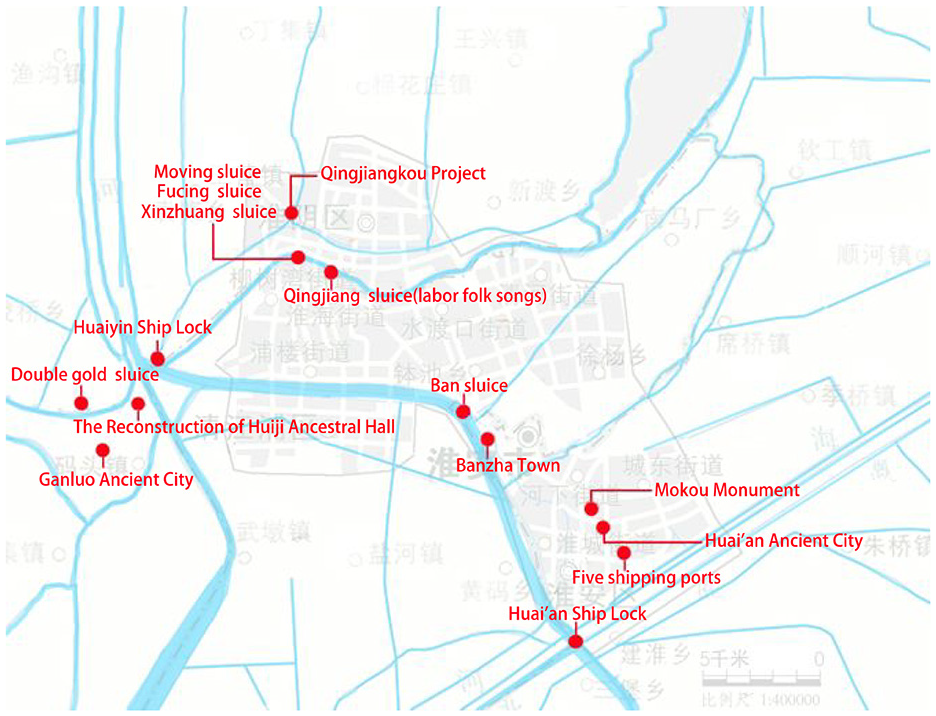
Map of engineering facilities grain transportation cultural route.
Cultural Route of Engineering Facilities.

Cultural Route of Livelihood Guarantee
This type of grain transportation route attraction mainly consists of shipyards, granaries, and cultural towns that helped tourists understand how Huai’an became a necessary stop on the Beijing-Hangzhou Grand Canal in the past (Figure 10). The route follows the thematic perspective of “historical reappearance” that represents the guarantee resources that maintain the operation of grain transportation according to the prosperity of the past, allowing visitors to learn about the context of the development of Huai’an. The route setting represents the role of Huai’an as a city for the transportation of people traveling from south to north. It constructed the largest shipyard in China at that time and built multiple granaries to supply all parts of the country, while the Qianlong and Kangxi emperors visited it many times. Along these nodes, visitors will experience the following stories of grain transport sites: passengers coming here by boat from the south and horseback riding from the north have to change their means of transportation and start again; Kangxi and Qianlong would stop at the Huai’an Imperial Wharf when they visit southern China every time and leave a monument, Qingjiang Shipyard, as a specialized manufacturer and repair station for grain transport vessels that had jurisdiction over the country’s shipping business. The maximum capacity and the largest number of granaries for Grain Transfer were retained. Merchants purchased land and built villas in the town of Hexia for the long-term transit of goods in Huai’an, which made it a famous commercial center along the canal. Shipyards, granaries, and travel tools are the transport guarantee heritage resources that represent the key position of Huai’an in the canal. These heritage attractions are all testimonies to the promotion of Huai’an’s historical status in China’s water transportation, which was presented to tourists as the story of the second stage of the route (Table 6).

Map of livelihood guarantee grain transportation cultural route.
Cultural Route of Livelihood Guarantee.

Cultural Route of Political Institutions
This type of route takes office space derived from the political and economic development of grain transportation as the main planning line, helping tourists understand how officials coordinate the waterways and taxation of the Beijing-Hangzhou Grand Canal, which promotes Huai’an as the capital of water transportation (Figure 11). The path follows the thematic perspective of “place scene” and integrates heritage resources such as grain transportation institutions, the office and residence of officials, and merchant’s hall into it. According to the functional importance of the places in the historical period, tourists will visit the following places: the world’s first customs tax authority, the first-level organization of the Grain Transport Governor-General’s Department, Huai’an Government Office, which ranks first in China; the Flood Control Strategy Center of Nanhe Governor’s Office; Tiegong Bao changed the name of the building to prayer for river safety; the most luxurious official garden of Qingyan Garden; Guild halls where officials and businessmen discuss transportation matters. Visitors listen to the following stories at these attractions: Canal tariffs became the main source of income for the nation’s operations during the Ming Dynasty, which aroused special attention from the country. Therefore, two of the nine admirals were assigned to Huai’an, the governor of grain transportation, and the governor of rivers. Governors often discussed strategies for river regulation affirmed by the emperor, and the commendation stone tablet in the Qingyan Garden is evidence. Furthermore, they were the best-paid officials among admirals who enjoyed luxurious official residences, gardens, and delicious food. However, these officials gradually became corrupt, leading to a decline in grain transportation in the later period. These grain transport offices, government gardens, salt distribution sites, tax collections, and other institutions maintained smooth operation of the canal waterway, which is important proof that Huai’an was the management center of the Beijing-Hangzhou Canal. They are the resources in the most glorious period of Huai’an’s grain transport culture, which is presented to tourists in the third stage of the story (Table 7).

Map of political institutions grain transportation cultural route.
Cultural Route of Political Institutions.

Cultural Route of Famous Person
This route focuses on celebrities and their deeds during the historical period of grain transportation, including the founders of transportation regulations, flood control strategists, outstanding poets, famous novelists, and traditional Chinese medicine scientists. The stories of these characters help tourists understand their contributions to the development of Huai’an Grain Transportation (Figure 12). The path abides by the theme perspective of “biographies of characters” and combines celebrity anecdotes and viewing of former residences into it. On this trail, tourists visited the following memorial sites: The temple of Chen and Pan was set up for officials who had outstanding achievements in river management. The former residence of Wu Cheng’en, who was one of China’s four great classical novels. The temple of Liang Hongyu, a female general, fought against the Jurchen invasion during China’s Song Dynasty. The former residence of Wu Jutong, a famous Chinese medicine expert, discovered effective methods for treating febrile diseases. The famous historical general, Han Xin, repaid Piaomu for her kindness by giving him a meal. During the trail experience, visitors will also hear about some of the management techniques used by river officials, such as the magistrate of the Northern Song Dynasty, Chen Zuoyao, who created a wooden revetment mainly used in rivers with high sand content to protect banks by picking slips to prevent erosion and hanging silt to consolidate embankments. Chen Xuan, a water conservancy expert in the Ming Dynasty, invented the technology of scouring sediment deposition in the Yellow River by clearing water from the Huai River and built the Qingkou hub project. Pan Jixun later created new governance strategies that tightened the river channel and used the momentum of water to impact the sediment at the bottom of the riverbed, thereby achieving the purpose of dredging and preventing floods. At the end of the Qing Dynasty, a method for pouring water into ponds for irrigation and transportation was proposed because of the rising water levels of the Yellow River. Additionally, the literary and artistic creations of poets, lyricists, writers, and painters have had a profound impact. Similar to Mei Cheng, who established a milestone in Chinese literature, the Chinese medicine expert Wu Jutong on febrile diseases became famous by taking advantage of the canal’s spread from north to south. Liu E compiled what he saw and heard along the canal and created “Lao Can’s Travels.” Wu Cheng’en integrated the legend of Wu Zhiqi and the Huai’an floods to create “Journey to the West.” These works became distinctive local folk customs and promoted the Huai’an Grain Transport culture to reach its peak. The local government has established temples and renovated former residences to commemorate these celebrities. Therefore, they are important humanistic resources that are presented to tourists as story chapters in the fourth stage of the route (Table 8).

Map of famous person grain transportation cultural route.
Cultural Route of Famous Person.

Cultural Route of Cultural Derivation
Although grain transportation ended with the collapse of the Qing Dynasty, it still left a profound cultural imprint on Huai’an that increased its unique heritage. This route focuses on the newly built cultural attractions in each district of Huai’an, which help tourists understand cultural connotations through modern landscapes (Figure 13). The path follows the appreciation perspective of “cultural journey” and integrates Huai’an’s newly landscape node of Grain Transportation into a derived cultural system. This is because the Huai’an Municipal Government successively launched a series of planning projects to better propagate the grain transport culture among citizens. Specifically, the building of the Grain Transport Museum, off-site reconstruction of the new Qing Jiangpu tower, construction of the Li Canal Scenic Belt, arrangement of canal cruise activities, reopening of Huaiyang Food Wenlou soup dumplings, and design of landmark sculptures of demarcation lines between North and South. Along this route, tourists visit the following new Grain Transportation attractions: the only theme museum reflecting Grain Transportation in China, the National Water Conservancy Scenic Area Li Canal Promenade, the Qingjiang Pu Tower in Zhongzhou Island Park, and the Huaiyang Cuiian Museum, which combines visits, experiences, and tasting. These new cultural places are the derivative resources of Huai’an’s urban culture in the post-canal transport era, which also express local cultural inheritance in the modern context. They can provide tourists with a multidimensional perspective of appreciating the water transportation landscape, so tourists are presented in the story chapter of the fifth stage in the path (Table 9).

Map of cultural derivation grain transportation cultural route.
Cultural Route of Cultural Derivation.

The grain transportation cultural routes planned in this study are divided into five main categories. The engineering facilities category mainly focuses on the sites of water conservancy projects that maintain a smooth flow in canal channels. Through the exploration of these places, tourists’ need for historical and authentic cultural heritage experiences can be met. Livelihood-guaranteed transportation ensures the operation of canals that mainly focus on shipyards, granaries, ship manufacturing technology, and moored piers. Visitors can combine this series of Huai’an grain transportation networks to gain local historical knowledge. The political institutions category focuses on tours of the Grain Transport Governor’s Mansion, the River Governor’s Mansion, and the Tax Authority. It provides tourists with an understanding of the functional departments appreciated by historical building sites. The famous people include river management generals, poets, painters, and writers. The works of these historical figures are world-renowned for the north-south navigation of the canal, which allows tourists to realize the prosperity that the grain transportation culture once brought to Huai’an. Cultural derivation focuses on new modern resources, including the Grain Transport Museum, Li Canal Cultural Corridor, Huaiyang Cuiian Museum, and the Governor’s Grain Transport Department Heritage Park. This allows visitors to feel the connection between their past history and modern culture. Overall, the study establishes these five routes to enhance tourists’ comprehensive experience of the Huai’an grain transport culture.
Discussion
This research classified grain transport cultural resources based on heritage attributes after a preliminary literature discussion and content analysis, and then combined the theme story and the integrity of the historical context to connect heritage attractions in Huai’an City. Route planning uses a landscape narrative to represent grain transportation culture and balances the relationship between heritage resource protection and tourist experience. Interviews were then conducted to further understand the views of local people on the development of grain transportation cultural routes. Finally, it was found that constructing the Huai’an Grain Transport Heritage Tourism System can achieve the sustainability of local cultural resources from three aspects: 1. Tourists establish awareness of the cultural value of grain transportation through heritage categories; 2. Using sequential narratives to recreate historical scenes can enhance the experience of tourists; 3. Attraction planning meets tourist needs and local development simultaneously.
Heritage Category in the Grain Transportation Cultural Route is Helpful for the Cognition of Attraction Value
Cultural routes are a subcategory of cultural landscapes closely related to local culture and heritage landscapes. The Florence Charter clarifies that landscape is an integral part of the heritage that proposes them as human values. Humans observe landscapes and make decisions based on what they see, know, or perceive. A summarized and classified heritage landscape is more conducive to tourist identification. In this study, different interviewees described the attractions that they believed could represent the image of Huai’an Grain Transport, including familiar historical buildings, beautiful scenery along the canal, sites with high certification levels, and places popular with locals. They can not only satisfy tourists’ visual appreciation experience, but also become carriers for understanding local cultural connotations. Therefore, this study combined the protection level, popularity, and cultural value of heritage resources to connect grain transport attraction categories with high recognition to form a cultural route for tourists. Historical buildings are scenic spots with geographical characteristics and cultural identities in a region, which are key nodes for tourists. For example, the couplets preserved in the Jiangpu Tower during the Qing Dynasty have become the main landscape of the Li Canal because of the management of grain transportation. Local residents mentioned that Qingjiangpu is an important intersection of the Huai’an Canal. In order to commemorate Chen Xuan’s management of the river crossing here, the old Qingjiangpu Tower was moved to the city center and has now become a symbol of the Li Canal landscape” (I-TV-04-G-22). Furthermore, Van der Laarse (2010) examined the dynamics of the garden’s transformation process through landscape language analysis and found that the narrator created cultural self-evidence and identity. This is because every tourist destination has attractions that do not have official status, but are widely recognized by locals. Qingyan Garden has a good reputation in the local area because of its comfortable environment and the background characteristics of grain transportation. “Although it is incomparable with the gardens in Suzhou, Huai’an locals like it very much and often go to it on weekends. There are rockery, waterscape, many stone tablets that you can take a walk in it” (I-TV-04 -Z1-13). In summary, the types of attractions in the Grain Transport Cultural Route include both beautiful scenery and local culture, which can satisfy tourists’ visual appreciation needs while establishing their perceptions of history. Therefore, the classification of grain transport heritage categories is conducive for tourists to recognize their cultural connotations and facilitate their understanding and memory.
Sequential Narrative to Reappear Historical Scenes in the Grain Transportation Cultural Route is Helpful to the Experience of Tourists
The landscape also has a narrative function besides visual appreciation, in which the series of grain transport attractions can tell previous stories by recreating historical scenes, thus enhancing the visitor experience. According to Freytag (1894), the theme, coherence, clarity, and sequence all affect the state of the story presentation and the visitor’s experience. Landscape narration is a personal retelling of a place’s experience and understanding that can help discover the perception process of how individuals organize value. This shows that both locals and tourists can increase their perceptions of heritage value by experiencing landscape scenes with storylines. This study found that folk tales about grain transport attractions are spread in the form of oral narratives in Huai’an, and that the content of the stories can arouse people’s curiosity. The historical context, causes, and consequences of these stories can enable tourists to further understand the grain transport culture. For example, the theme story of the Grain Transport Project combines the first excavation site of Hangou, the Qingkou Project built after the Yellow River changed its flow route, and five diversion dams. Scenes of the past are then reproduced through the story series, such as the reasons for construction, historical turning points, and glorious development, which can inspire tourists to explore. Alternatively, the scene could be reproduced through the background introduction of each node, such as the Chen and Pan Temples, as an architectural attraction directly related to rain transportation officials that contain the changes and management of the canal. “Everyone knows that Chen Xuan and Pan Jixun have controlled many floods and invented advanced water control techniques, especially the problem of the Yellow River. Now we still have ancestral halls to commemorate them” (I-SV-05-H1-36). In short, using landscape narratives to research cultural routes is a way to find past forms of heritage from personal thinking systems, because landscapes and storylines can connect heritage resources to reproduce historical scenes that are an important attraction in heritage tourism. People combine past experiences with their social backgrounds to understand the narrative theme, establish route value awareness in the process of landscape observation, and give meaning to it.
Planning of Scenic Spots in the Grain Transportation Cultural Route Simultaneously Meets Tourist Needs and Local Development
The overall planning of the grain transportation cultural route in this study is mainly distributed in the Huai’an Canal area, which not only arranges tangible cultural heritage that can be viewed but also intangible resources such as stories, legends, and skills related to the nodes. Furthermore, it considers catering, commerce, and other service support facilities. Tourists generally collect relevant information before a trip, such as investigating which route is more convenient, what type of transportation is needed, or whether the attraction requires admission fees. The study integrated government buildings in various urban areas by connecting a series of grain transportation political institutions, which provide convenient tour routes to meet the different experience needs of tourists. For example, “There are several grain transport offices in Huai’an where one in Chuzhou and one in Qinghe, but they seem to have different management contents. By the way, there are also several granaries” (I-SV-02-L-29). Besides, interviews also found that residents are aware of the economic benefits brought by grain transport heritage tourism, and the protection and management of heritage resources can promote local development. Currently, Huaian’s grain transport heritage resources can be divided into four levels: world-class, national, provincial, and municipal. Visiting these officially certified sites is an important part of tourists’ itineraries because they can satisfy their need to take photos. “Qingjiang Gate is probably the highest-level scenic spot that has surpassed the national level. It also has a world-certified sign. Everyone likes to see these famous scenic spots” (I-EV-03-S-10). This shows that the model of the Grain Transport Heritage Tourism Route categorizes the viewing of important nodes and helps tourists save travel time. Moreover, the thematic connection of grain transportation heritage resources emphasizes the substantive value of all elements as a whole. This is conducive to the centralized management and maintenance of existing heritage sites by local governments, which also attracts the attention of local residents. Briefly, the grain transport cultural route has been planned to meet the needs of tourists for leisure and relaxation while promoting the protection of heritage resources and the growth of cultural tourism to achieve the sustainable development of local cultural heritage.
Conclusions
Cultural routes closely integrate heritage protection and cultural tourism, facilitating the inheritance and development of local cultural heritage resources. They utilize landscape narratives to contextualize historical settings and enhance heritage management practices. The public actively engages in oral publicity and educational efforts on local heritage, which promotes heritage protection and establishes tourists’ recognition of heritage value during the construction of cultural routes. This study focuses on the Huai’an Grain Transport cultural heritage resources, using them as the main theme for developing cultural routes. It plans an integrated cultural tourism system that fosters a bidirectional relationship between landscapes and tourists, which offers a comprehensive framework for developing cultural tourism systems that not only preserve heritage resources but also create meaningful and engaging experiences for tourists. This study planned five route categories based on heritage attributes to meet tourists’ experience needs: engineering facilities, livelihood guarantees, political institutions, famous people, and cultural derivations. The historical context of the Grain Transportation heritage attractions was described using sequential narratives for each theme category. The study concluded that using the cultural route model for the Huai’an Grain Transport cultural heritage tourism system achieves sustainable preservation and development of heritage resources from three aspects: 1. Tourists gain awareness of the cultural value of grain transportation through heritage categories; 2. Sequential narratives that recreate historical scenes enhance the tourist experience; 3. Attraction planning aligns with tourist needs and local development objectives simultaneously. Moreover, it highlights the potential for cultural routes to foster intercultural dialog and community engagement, providing a model that can be adapted to other regions and contexts. Overall, cultural route practice development is a direct means of implementing heritage values, promoting a cohesive society, and promoting intercultural dialog.
The limitations of this study mainly considered the experience needs of tourists during the theoretical transformation process of cultural routes but did not consider the influence of relevant stakeholders, such as local governments and owners of specific attractions, from which further exploration can be carried out.
Footnotes

Author Contributions
D.F. contributed to the conceptual design of the study, data collection, drafting the article, formal analysis, and final approval. S.-C. C. contributed to the conceptual design of the study, supervision of the progress, and final approval. Y.Z. conducted the investigation process in research. F. W. contributed to the conceptual designing computer programs. All authors have read and agreed to the published version of the manuscript.
Funding
The author(s) disclosed receipt of the following financial support for the research, authorship, and/or publication of this article: This research was supported by the Jiangsu Province Program of Higher Education Philosophy and Social Sciences Research Project in 2025(No.2025SJYB1406). This research was supported by the Hunan Province Program of Philosophy and Social Science Fund Youth Project in 2022 (No. 22YBQ080), China. This research was supported by the Program of National Social Science Fund Project in 2019 (No. 19BZJ022), China. This research was also supported by the Program of Jiangsu Provincial Social Science Fund Project in 2023 (No. 23YSB002), China.
Declaration of Conflicting Interests
The author(s) declared no potential conflicts of interest with respect to the research, authorship, and/or publication of this article.
Data Availability Statement
Not applicable.