



Abstract
We examine how Korean heritage speakers (KHSs) in the United States, the minority population using Korean at home and English in daily life, understand their cultural identity and conflicts in their adolescence and college periods. While recognized as “model minority” with their academic and socioeconomic achievements, KHSs have been understudied and underrepresented regarding diversity, equity, and inclusion issues. Drawing on qualitative data collected from interviews with 24 KHSs, we find that KHSs establish their cultural identity after extensively experiencing cultural confusion and conflicts with their parents, peers, and the society. KHSs need more emotional support and practical information that help understand their heritage language and culture. We conclude this article with a discussion on cultural identity, conflicts, and support programs for KHSs.
Keywords
Introduction
Given the current trend of globalization and immigration, there are growing academic and practical needs for a better understanding of Heritage Speakers (HSs). HSs refer to a group of minority populations raised in homes where a non-majority language is spoken while using a dominant language in daily life (Torres et al., 2019; Venturin, 2019). Scholars agree upon the importance of HSs as dedicated participants in constituting a diverse society. HSs with bicultural and bilanguage competence demonstrate a high level of self-esteem and confidence as well as better academic and vocational performance with superior cognitive and socio-affective strategies than those not (Hoffman, 1991; LaFromboise et al., 1993; J. S. Lee, 2002). Thus, the maintenance of heritage language and culture is of great benefit for our linguistically and culturally diverse world (Garcia, 2003; Serafini & Roca-Ramirez, 2024).
HSs have common vulnerabilities, which notably differ from those of domestic students or second language learners who acquire a language that is not their native or first language. Van Deusen-Scholl (2003) called HSs a heterogeneous group with various levels of heritage language usage, who also have a different sense of feeling connected to their heritage culture. The limited opportunities, resources, and network to understand their heritage in greater depth culminate in partial acquisition (and even attrition) of their identity as HSs (J. S. Lee, 2002). HSs face significant challenges to their heritage maintenance given language education policies that overwhelmingly adhere to English monolingualism (Leeman & Fuller, 2021). They are further daunted from the limited social recognition of heritage language and culture in the dominant society, which often leads them to prioritize the mainstream society over the heritage society during their socialization process.
HSs establish their cultural identity while recognizing cultural conflicts at the same time during their adolescence. Cultural identity is formed through the complex process of one’s recognition of surrounding cultures and social interactions between groups to which one belongs in practice (J. S. Lee, 2002). While most adolescents experience the process of establishing their own identity, HSs encounter the same process in a more complex manner due to the influence of two major cultural systems (Hamers & Blanc, 1993), thereby undergoing difficulties in understanding and developing a particular identity (Lambert, 1975). They experience fluctuating and conflicting identities, leading them to feel alienated in both communities (Venturin, 2023). However, little attention has been paid to how HSs make sense of past critical experiences to understand their cultural identity and conflicts (Mercer, 2011; Serafini & Roca-Ramirez, 2024).
The present study focuses on Korean heritage speakers (KHSs) living in the United States. KHSs are characterized as first- or second-generation Korean immigrants’ children experiencing limited access to Korean language while using the dominant language—English—in daily life (Jee, 2018). With the increasing attention to Korean culture around the globe, many tertiary institutions are offering Korean studies programs, including courses and resources on Korean language, culture, and society. However, the long-lasting stereotypes of “model minority” on KHSs regarding their academic and socioeconomic achievements render them deviated from other communities of color while being stuck in the place of forever foreigners in the U.S. society (Wang & Santos, 2023). Furthermore, the recent social atmosphere against Asian immigrants and minority groups during/after the COVID-19 pandemic makes KHSs feel more isolated and marginalized. It clearly shows the persisting negative biases towards Asian-American, which has been a serious threat to KHSs’ physical safety, mental health, and cultural identity (Tessler et al., 2020).
In this study, we explore KHSs’ experience on cultural identity and conflicts. HSs have been present in the US society for over two centuries, but there has been the lack of scholarly attention to HSs’ linguistic, cultural, and social profiles and needs (Martínez, 2003; Serafini & Roca-Ramirez, 2024). While a growing body of research recently examines various aspects of HSs, much work has involved the dominant HS groups such as Hispanics or Chinese in the United States (Torres et al., 2019; Zhang & Slaughter-Defoe, 2009). Despite the environment exposed to both languages and cultures, KHSs present a high rate of being assimilated to the mainstream culture in the second generation with a lower level of cultural competence (Crawford, 1992; B. Y. Lee, 2013). In addition, numerous studies on HSs have focused primarily on heritage language acquisition, though both language and culture play an essential role in shaping one’s identity. Thus, little is still known as to KHSs’ experience and reflections regarding their cultural identity and conflicts, which serves as one core dimension defining HSs (López-Beltrán & Carlson, 2020). Lastly, although various opportunities are available for KHSs to learn Korean culture and language, little evidence exists on what support or resources are needed in tertiary-level education to develop and maintain their cultural identity.
We specifically analyze narratives generated from 24 KHSs who were born in the US or immigrated to the US before the age of five to answer the following research questions:
(1) How do KHSs recognize their cultural identity?
(2) What types of cultural conflicts do KHSs experience?
(3) What types of support or programs do KHSs need?
Literature Review
Importance of Heritage Speakers
An increasing trend of globalization and immigration, together with a growing sense that minority languages are worth preserving, invites the need for systematic approaches to HSs as dedicated participants constituting our society (Carreira & Kagan, 2018; Montrul, 2010; You & Liu, 2011). HSs are often described as individuals who were raised in homes where a non-majority language is spoken, which refers to immigrant, refugee, and indigenous languages other than English with which a speaker has a certain level of proficiency and personal connection (J. S. Lee & Wright, 2014). HSs thus have a limited access to their home language from early on, manifesting distinctive gaps in knowledge about the heritage language and culture (Montrul, 2010; O’Grady et al., 2011). The number of HSs has been increasing at a substantially faster rate than the average growth of the US population over the last three decades (Nagano, 2015), prompting us to have a deeper understanding of HSs in the United States. Thus, research has begun to explore the construction of HSs’ identity in various contexts (Leeman, 2015).
HSs receive growing attention from multilingual and multicultural research, attributing its unique developmental trajectories to the interplay between their internal and environmental factors (Benmamoun et al., 2013; Venturin, 2019). The limited opportunities, resources, and networks to understand their heritage in greater depth culminate in partial acquisition and attrition of their identity as HSs (Jia & Paradis, 2015; Jo, 2001). They are further daunted by the limited recognition of their heritage legacy in the dominant society, undergoing the difficult process of choosing a particular way of life between the two or more cultural systems (J. S. Lee, 2002). However, existing literature on this topic (particularly within the US context) has been skewed towards the major HS populations (Torres et al., 2019), which does not ensure generalizability of its implications toward wider underrepresented HS populations.
Asian Americans have been an understudied minority group in the United States. They comprise the single fastest growing racial and ethnic group in the United States (Budiman, 2020). Although Asian Americans are often perceived as a “model minority” due to their academic and socioeconomic achievements, they continue to be underrepresented in discussions and initiates regarding diversity, equity, and inclusion (S. J. Lee et al., 2017). The term of “model minority” was first coined by a New York Times Magazine article in 1966 to illustrate how Asian Americans could overcome racial prejudice based on cultural values of perseverance, compliance, and frugalness (Pettersen, 1966). However, scholars criticized that it has been a tool to control groups of color through divisions, thereby continuing the agenda of White supremacy (Poon et al., 2016). “Model minority” bolsters negative stereotypes for other underrepresented groups (Kay et al., 2013), while constraining Asian Americans in their pursuit of a variety of academic and career tracks (Czopp, 2010). The model minority myth thus makes Asian Americans alienated from other communities of color such as Black and Hispanic communities while maintaining their place as a middleperson minority and forever foreigner of the U.S. society (Wang & Santos, 2023; Wu, 2002). Nevertheless, little attention has been paid to Asian Americans, including how this group perceives their heritage language and culture in the US context.
In this study, we focus on Korean heritage speakers (KHSs)—HSs using Korean in home while using the dominant language (i.e., English) in daily life—residing in the United States. KHSs in our research includes students ranging from those with limited Korean speaking skills to those with more advanced levels in all areas. Similar to the context in which other Asian Americans are surrounded, KHSs are regarded as a model minority group in the United States. Korean communities have grown over the last decades, occupying the eight-largest HS group and the fifth-largest Asian-American subgroup in the United States (Nagano, 2015). Around 1.9 million people now speak Korean as a heritage or community language (U.S. Census Bureau, 2021). However, KHSs struggle with establishing their identity. Compared to other HS groups, KHSs tend to lose their home language eventually (Alba et al., 2002). Although community schools and religious institutions support them in maintaining their culture and language (Song, 2020), these institutions are clustered in particular regions (e.g., California, New York) and their support is rather sporadic, which does not effectively guarantee KHSs’ pursuit of their heritage in the United States.
Moreover, recent changes in the societal environment, partly driven by the COVID-19 pandemic, are generating “Asian Hate,” which threatens KHSs’ physical safety, mental health, and identity. The pandemic frankly disclosed the racial dynamics among Asian Americans, White, and other minority groups. Since the outset of COVID-19, hate crimes targeting Asian Americans began to receive increasing attention in main-stream news outlets (Donaghue, 2020). Korean Americans are the second largest group experiencing hate during the pandemic, right after Chinese Americans (Wang & Santos, 2022). Together, in this study, we recognize KHSs as an understudied HS group whose status has been hyperbolized, minimized, and even threatened. Therefore, it is timely to explore KHSs’ narratives regarding cultural identity and conflicts, particularly in their adolescence and college periods.
Cultural Identity and Cultural Conflicts
Culture embraces a set of symbolic systems, including values, beliefs, norms, knowledge, language, customs, and skills accumulated by individuals as a group within a given society. In this regard, Pandharipande (1992) defined cultural identity as a comprehensive term that includes linguistic, racial/ethnic, geographic, and religious characteristics. Relatedly, Ojha (2003) illustrated cultural identity as a social image and a sense of belonging, presenting how people behave and communicate within a cultural and ethnic group. Establishing cultural identity thus necessitates complex processes of recognition of surrounding cultures and social interactions between groups to which one belongs in practice (J. S. Lee, 2002).
Cultural identity is influenced by social contexts and language acquisition (Fought, 2006), as well as by individual choices (Davies & Harré, 1990). Identity positioning allows individuals to better understand their and others’ cultures, including attitudes, values, and behaviors, thereby helping them work appropriately in cross-cultural situations (Cross et al., 1999). Although the loss of one identity factor does not lead to the loss of cultural identity, the loss of one or more factors may reinforce the loss of the remaining factors (J. S. Lee, 2002). Among various factors establishing cultural identity, language is understood as a prominent factor that constitutes one’s cultural schemes and ethnic identity (Noels et al., 1996), because it serves as a main tool for transmitting and developing cultural identity from generation to generation (Giles & Coupland, 1991).
While most adolescents experience the process of establishing their own cultural identity, HSs especially encounter complicated processes due to the influence of two major cultural systems (Hamers & Blanc, 1993). Lambert (1975) suggested four scenarios of how HSs respond to the demand of the wider society: (1) rejecting their heritage language and culture; (2) rejecting the language and culture of the dominant society; (3) becoming not affiliated to both their own community and the dominant society; and (4) becoming comfortably bilingual and bicultural in both societies. Though the ideal case would be to fully understand two different cultures, enhance a sense of belonging in two cultures, and form one unique bicultural identity, HSs often experience substantial struggles in their adaption of two cultural systems, societies, and communities whose values may be bipolarized (Venturin, 2023). Focusing on Spanish HSs in college, Serafini and Roca-Ramirez (2024) underscored the importance of considering critical past experiences in the formation of cultural identity and how these interact with current and future cultural developments.
KHSs tend to exhibit an incomplete sense of belonging to both the Korean heritage and the mainstream cultures, which yields the cultural conflict and identity crisis. As marginalized outsiders, KHSs often face restrictions in expressing their perspectives or participating in broader societal initiatives (Coombs et al., 2014). They continue to confront prejudices and conflicts (Pyke & Dang, 2003), which can hinder their cultural integration during the socialization process. The lifelong experience of navigating both Korean and English languages often leads to a sense of division between two cultural communities. Although KHSs are exposed to Korean at home and English in educational settings, many become predominantly English-speaking rather than fully bilingual (B. Y. Lee, 2013), reflecting a strong tendency toward assimilation into English-speaking American culture by the second generation (J. S. Lee, 2002).
Multiple factors contribute to the development of heritage culture among HSs. Positive attitudes held by both parents and children toward their heritage language and culture are foundational in fostering and preserving cultural identity (Zhang & Slaughter-Defoe, 2009). Consistent engagement with peers and adults who share the same cultural background also reinforces a strong sense of cultural identity (Phinney et al., 2001). Participation in heritage language schools and cultural community events further enhances HSs’ motivation to sustain their cultural heritage (Otcu, 2010). Additionally, school environments that recognize and value heritage cultures—supported by both teachers and mainstream peers—play a critical role in promoting positive cultural identity (Guardado, 2002). Overall, the formation of strong cultural identity is shaped by a complex interplay of social relationships, educational settings, and broader systems. While scholars underscore the importance of preserving heritage language and culture as valuable personal, societal, and national assets (Brecht & Walton, 1993), KHSs frequently experience a marked decline in heritage language proficiency, particularly after entering the K–12 school system, often leading to challenges in maintaining and cultivating their cultural identity.
Various factors play notable roles in establishing heritage cultures. For example, parents’ and children’s positive attitudes toward their heritage language and culture enable HSs to promote and retain their cultural identity (Zhang & Slaughter-Defoe, 2009). Frequent interactions with peers and adults from the same heritage also have a positive impact on their strong cultural identity, measured by the Multigroup Ethnic Identity Measure (Phinney et al., 2001). Participating in heritage language schools or community activities influences HSs’ motivation to develop and maintain their cultural identity (Otcu, 2010). The school environment where the heritage culture is encouraged and valued from teachers and peers in the mainstream community also leads HSs to having positive cultural identity grounded on the semi-structured interview data (Guardado, 2002). Together, strong cultural identity is achieved by a range of people, environments, and systems surrounding HSs. Scholars emphasized the importance of maintaining heritage culture and language as personal, societal, and national resources (Brecht & Walton, 1993), but KHSs often experience significant loss of heritage language ability specifically after entering the K-12 school system, which culminates in a struggle to maintain and develop cultural identity.
Support and Programs for KHSs
Reports on the role of family and peer support in exploring cultural identity and conflicts language are inconclusive. Mossakowski and Zhang (2014) found that emotional support from family reduced the psychological stress of Asian Americans. Singh et al. (2015) showed that peer support moderated the relation between experiences of racial discrimination and emotional stress. Tannenbaum and Howie (2002) suggested that HSs tend to better maintain their home language when having more close and cohesive relationships with their family. On the contrary, Wei et al. (2013) found that family support was not significant to protect Asian Americans from the racial discrimination. Kwon (2020) also showed that family cohesion and partner support did not have a buffering effect, while family conflicts exacerbate the negative effects of discrimination. These mixed findings suggest the role of support systems and its complexities and richness for those experiencing racial isolation and discrimination. Additionally, previous studies claimed that Asian Americans, including KHSs, tend to rely more on informal resources, such as internet support groups and self-help groups, than professional services such as psychologists and healthcare professionals (P. Y. Kim et al., 2016).
Community-based language schools and college-level programs have played an essential role in facilitating KHSs’ growth and maintenance of cultural identity. Heritage language education programs intend to promote linguistic and cultural diversity while acknowledging specific/selective needs and goals for HSs (Carreira & Kagan, 2018; J. S. Lee & Wright, 2014). Chinen and Tucker (2005) found that students who attended heritage language classes showed a stronger sense of affiliation with and attachment to their heritage culture. Examining Spanish language programs in the US postsecondary institutions, Beaudrie and Marrero-Rivera (2024) pointed out that the vast majority of the programs were small in size, hindering the potential support for bilingual and academic development of Hispanic HSs. Meanwhile, Pak (2003) suggested Korean churches as one of the important local communities where KHSs learn their heritage culture and language, leading to Korean culture/language maintenance. Many tertiary-level Korean Studies programs also offer various opportunities to learn Korean culture, language, and society. However, these programs are not inherently designed for KHSs but for those interested in Korean in general, thus falling short of taking into account KHSs’ unique experiences and circumstances as a marginalized group (Song, 2020). Therefore, not much has been addressed about how KHSs establish their cultural identity as a response to what community-based language schools and tertiary-level Korean Studies programs offer them.
Methods
This study drew on interview data collected from 24 KHSs. We focused specifically on KHSs in the United States because the largest population of KHSs lives in the US that has experienced numerous multilingual and multicultural issues including HSs (Nagano, 2015). Though Mixed-race Koreans and transnational adoptees could be included in the broader KHS category (Tsuda, 2025), individuals with such backgrounds were not included among the interview participants in this study.
Participants
Participant recruitment was guided by purposive and maximum variation sampling strategies (Patton, 2015). We intended to recruit information-rich KHSs who were willing to share their experiences and thoughts on heritage identity, cultural conflicts, and Korean Studies programs. To collect the participants, we shared a research flyer through social media and Korean American community websites. The initial participants sometimes recommended other participants who might be able to provide rich responses to our inquiry (Parker et al., 2019). We limited the participants to those who were born in the US (second generation) or immigrated to the US before the age of five (1.5 generation). We sought to maximize variations of KHSs’ backgrounds such as gender and region to explore broadly shared phenomena among KHSs, though our participants may not be fully representative of the KHS population in the U.S. As shown in Table 1, our participants include 9 males and 15 females with age ranging from 17 to 31. Respondents resided across 11 states at the time of interview. We purposively recruited participants who lived in the states with the smaller portion of Korean Americans, such as Indiana and Wisconsin, to examine how regional contexts relate to KHSs’ cultural identity and conflicts.
Demographic Description of Participants.
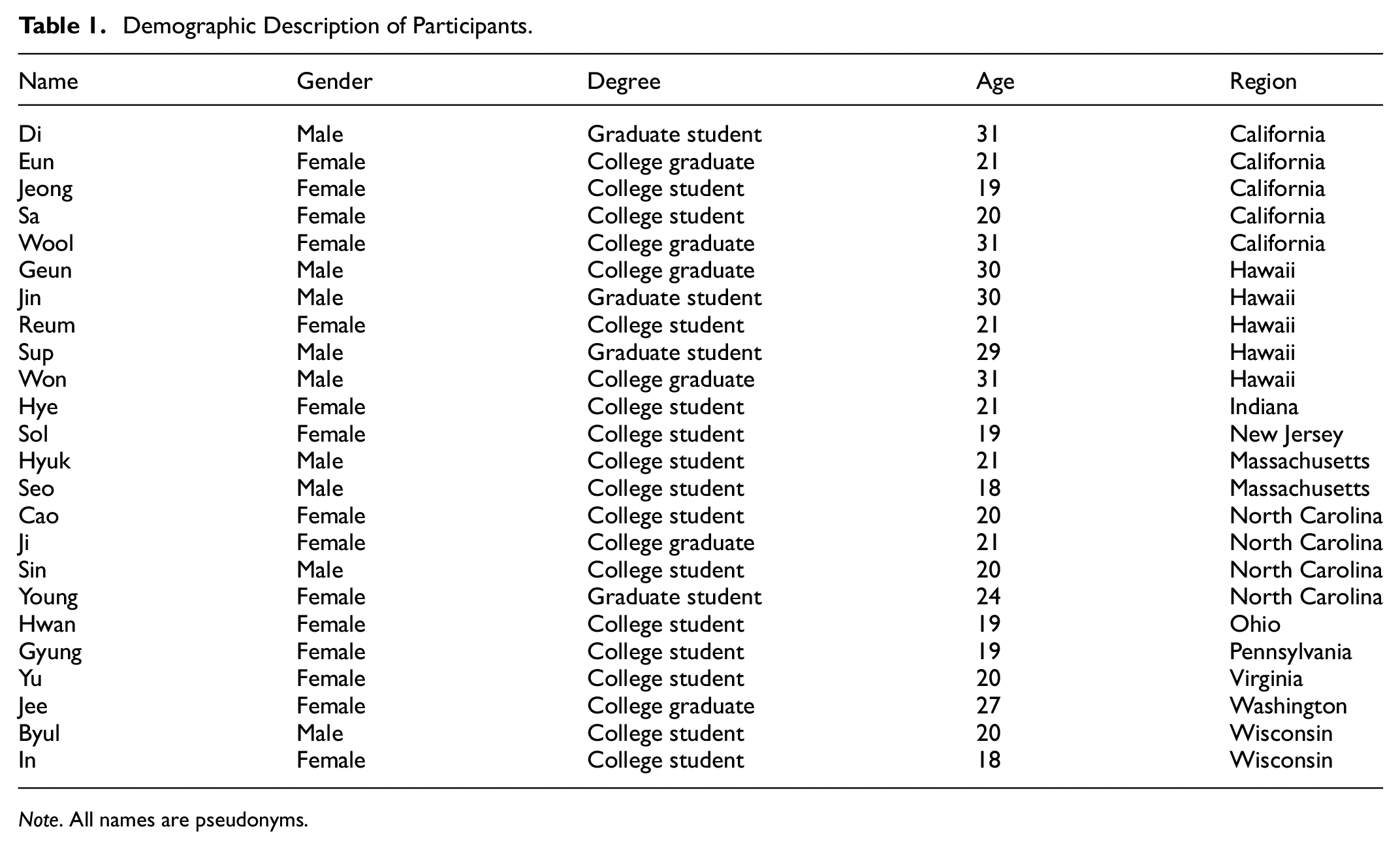
Note. All names are pseudonyms.
Data Collection and Analysis
We conducted 24 individual interviews from May to July 2022 through Zoom. Considering the uneven distribution of participants across the states and the pandemic situation, we primarily conducted the preliminary survey and interview in a web-based manner. All interviews were video-recorded. The interviews were semi-structured and ranged from 40 to 60 min. Based on the previous studies (Jee, 2018; Kwon, 2020; J. S. Lee, 2002) and results from the preliminary survey we conducted, we developed an interview protocol covering participants’ adolescence experience as KHSs, cultural perspectives, language use, career plans, and takeaways from Korean Studies programs. Interviews were conducted in two languages, Korean and English, based on the participants’ preference and fluency. All interview records and memos were translated and transcribed in English. Following interviews with 24 participants, we concluded that data saturation had been achieved, as no new significant themes or insights emerged (Saunders et al., 2018). This aligned with existing literature suggesting that saturation in interview-based data collection is typically reached with approximately 20 participants (Hennink & Kaiser, 2022).
We used thematic and pattern coding (Braun & Clarke, 2021) to analyze the interview data. The analysis process began by each researcher thoroughly reading and rereading transcripts and interview memos line-by-line to gain a deeper understanding of the content. We then adopted multiple cycles of coding (Saldaña, 2015) to identify participants’ common experiences and thoughts. The initial stage of coding was more inductive and explored participant-centric terms and recurring patterns grounded in the data. We found our participants primarily shared their sense of heritage identity, challenges, and opportunities as KHSs in the United Sates, and their experience in Korean Studies programs. These codes were subsequently reorganized into overarching themes, capturing the essence of the participants’ experiences and perspectives as KHSs. The later stages were more deductive and related the data to our framework of cultural identity and conflicts. The participant-centric terms were then changed to researcher-centric terms (Linneberg & Korsgaard, 2019) according to our research questions. Coding was conducted individually and collectively, and discussion and analysis occurred through weekly research group meetings via Zoom. We continued the work of thematic analysis until the point of saturation (Saunders et al., 2018). To ensure the rigor of our coding procedures, we tested for intercoder reliability, yielding a Cohen’s kappa coefficient of .84, which indicates a high level of agreement among researchers during data analysis (Cheung & Tai, 2023).
Data Validation
For the credibility of this study, we used triangulation and research flexibility (Creswell & Miller, 2000) for data validation. Our data were triangulated across theories, frameworks, prior literature, and media reports concerning “Asian American,”“Korean American,”“heritage speakers,”“Korean heritage,”“cultural identity,”“model minority,”“COVID,” or “Asian hates” to corroborate our findings. Researcher flexibility was also utilized throughout the data analysis by recognizing the authors’ distinct perspectives, research backgrounds, biases, and life experiences (Morrow & Smith, 2000).
Researcher Positionality
We concede that both our previous experiences and current positions shaped our interactive perspectives on this research. All authors are from Korea, received their doctoral degree in education policy, linguistics, and Korean language, respectively, and currently work at the universities in the U.S. The first author focuses on how education policies have (un)intended consequences for underrepresented students. The second author is a linguistics scholar who examines language acquisition and development under various usage/learning contexts. The third author has taught Korean language to college students for 10 years. Along with our expertise in heritage language, culture, and education programs, we felt a strong sense of responsibility as Korean immigrant scholars to tell the lived experiences of KHSs who encounter issues of cultural identity and conflicts in their daily life. Like our participants, the authors were also influenced by the rise of anti-Asian racism during the pandemic in the research process, including data collection and interpretation. That is, we were also part of the revelatory nature of our research design.
Results
Our participants discussed insights on the interplay between language, culture, community, and society. KHSs presented how they felt and shaped their own cultural identity through the comparison and interaction between two cultures. They also shared their past and current cultural conflicts they faced when interpreting their status in the U.S. society. Finally, they suggested possible support and programs to identify and establish their cultural identity based on their lived experience.
We found that KHSs tended to establish their cultural identity as entering college, while having extensively experienced cultural confusion during their adolescence. Their identity recognition is associated with the level of relationships with their parents and communities (e.g., public school, Korean church). Our participants used to alter their identity and behavior to fit a particular context, although there was by-individual variation.
It’s Just Ambiguous
Our participants frequently used the word, “ambiguous,” to express their unstable status in their community and the U.S. society. This ambiguity was observed in two distinct layers: (1) identity confusion between Korean and American and (2) an invisible position among minority groups.
Half of our participants considered themselves half-American-half-Korean, but they felt not fully affiliated in both Korean and US societies. KHSs particularly reported that their race/ethnicity and nationality were not welcomed in both communities. Participant Ji described her experience of being rejected from two communities: Because I was not seen as a one hundred percent American by American friends here, I was so excited when I visited Korea, thinking that “finally I meet my own community!” and “they are the group who totally understand myself, so I can feel a sense of belonging!” However, when I met my relatives and people there, they said “you are an American” and “you are different from us,” so I got totally embarrassed … My illusions were completely shattered.
Experiencing such episodes during their adolescence, KHSs confirmed their ambiguous position in the United States, reinforcing their identity as a stranger. As recognizing that they lie in somewhere between Korean and American, they likely accepted the middleperson status with uncertainty and frustration. Participant Yu noted: “I am not a complete Korean nor American, so I feel like an ambiguous status, in the middle of somewhere between them. I assume many Korean Americans have such identity.”
The other ambiguity that KHSs experience is being (un)intentionally excluded in the discussion about minority groups and relevant issues. They felt invisible in the conversation about race/racism and thus daunted in being active and voicing their concerns in the U.S. Participant Young reported her observation of how the U.S. society excludes KHSs in the race discussion: I think the discourse in race/ethnicity in the U.S. is primarily focused on White or Black people only, so I feel a bit alienated in such conversation. … it feels like … the status of Korean-American is quite ambiguous.
Partly due to such ambiguity, many young KHSs tended to switch their identity voluntarily and/or involuntarily contingent on with whom and where they interact, possibly worsening their uncomfortable feeling of being not affiliated in any communities. They also felt dilemma or confusion that such toggling did not work well depending on different situations and people. Participant Sin commented: I think I tend to create sample categories that help me behave differently in and out of home and based on people whom I engage with.
Efforts for Better Understating of Their Cultural Identity
Our participants participated in both Korean and American activities to better understand and establish their cultural identity. These activities include having close communication with parents, contacting with K-culture products, and learning Korean language and culture while actively engaged in American school and community activities. Many KHSs reported that their parents who immigrated to the U.S. taught them to use Korean at home at least and led them to community- or church-based Korean language schools. Although they were too young to be motivated by such learning opportunities, these relationships and experience eventually led them to explore more about “Korean” during their college period. Participant Gyung shared her reflection on this aspect: I was mostly like … I was the only Korean [in her local community] so I wanted to reconnect to my routes and to be more proud of my Korean part, like culture identity, I think it is important to learn more about it.
Our participants were not confident to choose which culture and community they felt more engaged in. However, the unique multicultural and multilingual experience led some of our participants to feel more empowered to understand the complicated issues of race/racism and establish their own cultural identity. Participant Geun said: Because I have experienced both cultures, I can better understand other cultures as well as Korean and American cultures, try to understand them, and avoid prejudice or stereotypes.
Facing with “ambiguity” about their unstable status in the community and society, KHSs felt difficulties in forming their own cultural identity. These initial responses align with previous studies that Asian Americans are restricted to the foreigner place of unassimilable middleperson (C. J. Kim, 1999; Wu, 2002) and that paying attention to their concerns are overlooked in the Black–White racial discourse (Wang & Santos, 2023). However, our participants struggled to make their own efforts to manage the “ambiguity” and “exclusion,” thereby developing their own cultural identity during their adolescence period.
While understanding and developing their cultural identity, our participants encountered numerous cultural conflicts, particularly with their parents, peers, and the society. They had to struggle with stereotypes of being high-achieving students and immune to racism. Such taken-for-granted assumptions continued to influence KHSs, even in the midst of an COVID-19-related sociopolitical climate.
Parents: Living in the Different World at the Same Home
Our participants underscored the influence of their parents on their identity and career plans, which sometimes led to conflicts between them. Parents of KHSs, mostly the first-generation immigrants, desired for their children to attain a high level of English proficiency, academic achievement, and social status while hoping for their children to maintain their heritage language and culture. Our participants responded that their parents are too strict and conservative for their life-long decisions. Therefore, they felt confused between the Korean and American values, which are often contrasting. Particularly, they experienced lots of pushes for academic excellence and language barriers with their parents, worsening their establishment of cultural identity. Participant Ji recalled her conflict with her parents: When I was a middle school student, I tended not to speak Korean because my community where I live consists of almost White people. I wanted to mingle with them more and become like them, so I mostly spoke English to my parents at home. My parents were very upset and scold me, saying “you need to speak Korean at home.” So, I just responded that “if so, I will not talk to you.”
She added her comment about how her parents wanted to engage in her study schedule and career plan: “For my career choice, I have gotten so many pushes and comments from my parents that I need to be a medical doctor.”
Recognizing the different views between their parents and the wider U.S. society, our participants felt a sense of cultural distance with their parents and tried to find friends and communities who can understand their unique difficulties. Participant Di said: I think I was so confused due to the difference between my home and the world outside. I was too young to fully understand there are cultural differences.
Friends: Aren’t You Smart and Docile?
While growing as a KHS and attending public schools, our participants experienced stereotypes and prejudice to become a model student. Although most of the assumptions are somewhat positive in terms of academic performance and behaviors, it can negatively impact other minority groups such as Hispanic and Black students (Shi & Zhu, 2023). KHSs also needed to overcome the prejudice and prove their own character and ability. Participant Eun remarked on such stereotypes: Although it is a positive stereotype that Asian-American are good at Mathematics and Science, it was quite burdensome to have such bias and expectations.
KHSs also needed to struggle with ignorance about “Asian” and social exclusion in the peer interaction and school activities. Participant Gyung pointed out the invisible barriers and criteria judging people based on their race/ethnicity.
All Asians are grouped together, and they’re not really seen as individual people and also they’re like socially excluded. (…) White kids are popular and cool, and the Asians are just maybe like the smart kids or something.
Society: I Like Your Culture, but I Don’t Like You Are Here
Our participants continued to fight against the prejudices and stereotypes permeated in the U.S. society. Although many of them did not experience serious physical threats, they reported that Asian-hate and relevant microaggressions have been more pervasive during the pandemic. Our participants also mentioned the lack of mainstream media coverage on anti-Asian racism during COVID-19, pointing out it as a resource for raising their invisibility and strengthening stereotypical images of Asian Americans. Participants Seo and Young shared their experience, respectively: It [discrimination, microaggression] is getting worse since COVID-19, I experienced several times that someone in their car passing to me insult me when I was walking by with my mask up. I just thought like … if the pandemic came out from Europe, for example, like the UK, I was wondering if people rebuke the UK. I don’t think they would, so it is not quite right.
Despite the increasing Asian-hate and microaggression, KHSs started to recognize the recent positive change that more Americans began enjoying Korean culture. The existence of people and culture that present “Korean” in the U.S. makes KHSs feel proud and relieved. Our participants Cao and Hye commented: I believe “Gangnam style” and “BTS” have a huge impact on the Americans’ perception about Korean. I was just an “exception” before … I hoped not it would be getting better, but now I feel that it is a possible change. There were no Korean public figures who could inspire me, but I see a lot now.
Interestingly, KHSs reported different experiences depending on where they live. Accessibility to other KHSs and Korean communities affects the level of cultural conflicts they experienced. Participants Sub and Young mentioned, respectively: Our regional lived experiences in America are very different as well. I’ve met many Korean Californians, and I don’t think they are the same people with me. That was the time when moving to North Carolina from California that I felt it was quite different. There was no Asian in the class, so I felt a little bit out of place from then on.
When asked whether our participants were able to find resources available for their cultural identity and conflict management, KHSs mentioned that they need more emotional support and practical information that help understand their parents and Korean language/culture. Particularly, the level of fluency in Korean was a key resource for KHSs’ cultural identity, conflict management, and future life plans. Participant Jee shared her conversation with a friend: I had a conversation with my friend recently, he resented his parents a lot … He can’t speak Korean at all but grew up in the U.S. He didn’t know why his parents brought him to the U.S. Although he looks Korean, but he is not culturally fitted in the U.S nor in Korea. So, he told me that he couldn’t go anywhere. So, lots of conversation with parents are essential.
Her comment shows that the existing language courses at the community level (e.g., Korean church) could not effectively help KHSs’ language acquisition and cultural development (J. S. Lee, 2002). Because their parents could not meet diverse needs and status of their children, KHSs recommended region-specific approaches considering the unique characteristics of KHSs for empowering their cultural identity. Participants Sol and Sin shared their thoughts: You know some regions where many Koreans live, like New Jersey and California. As compared to those areas, I think Korean Americans who live in the Midwestern or other areas are more likely to be Americanized … So, it may be necessary to activate Korean communities more in such places. There’s always a room for Americans, there’s always a room for Koreans, but heritage speaker people who are stuck in the middle don’t have really room or like spaces available.
Discussion
The present study qualitatively documented how KHSs living in the U.S. recognize their cultural identity, experience cultural conflicts, and need social support and programs. Similar to other Asian-American groups, KHSs tend to feel alienated from other communities of color while being positioned as a middleperson minority in the U.S. society. Although growing attention has been paid to Asian-Americans following a surge in hate crimes since the pandemic (Margolin, 2020), we know little about KHSs, particularly their recognition of cultural identity, conflicts, and social support/programs.
We note three major findings of this study. First, KHSs struggled with their unstable status in both Korean community and the U.S. society. Their feeling of ambiguity and exclusion was observed in two distinct forms: identity confusion between Korean and American, and invisible status among the minority groups. Our participants explored and established their own cultural identity after facing with two different cultures, languages, and expectations during their adolescence. KHSs’ parents, mostly Korean immigrants, wanted KHSs to keep their identity as Koreans by supporting their children’s heritage language maintenance. We found the level of fluency in Korean was a key feature in recognizing KHSs’ cultural identity, which aligns with prior literature that the proficiency in a heritage language is positively related to bicultural identification (J. S. Lee, 2002). KHSs also reported their experience of not being welcomed from both communities. This experience of ambiguity and alienation led many KHSs to switch their identity contingent on with whom and where they interact, possibly reinforcing their position of the unassimilable foreigners in the U.S.
Our participants also ended up with muteness and invisibility in the conversation about minority groups and relevant issues. Though KHSs continue to confront prejudices and stereotypes, they are supposed to listen to other minority groups’ storytelling with their similar narrative being muted. Thus, KHSs remain minor among the minority groups and underrepresented concerning diversity, equity, and inclusion issues. Furthermore, the model minority myth makes other racially minoritized groups deem KHSs not facing real racism or oppression (Poon et al., 2016). Situated in a triangulated position between Whiteness and Blackness in the U.S. Society, KHSs are limited in their power in civic ostracism, which regards them as immutable middleperson foreigners (C. J. Kim, 1999; Wu, 2002). Thus, Anti-Asian racism is overlooked in the black–white racial discourse (Wang & Santos, 2023).
Second, we revealed conflicts that KHSs are facing with parents, peers, and the society in daily life. They encountered intensive pressure on academic excellence from and language barriers with their parents, exacerbating their understanding and establishment of cultural identity. Their parents’ perspectives (e.g., micromanaging for KHSs’ career decisions) tended to contrast with the values or beliefs of peer groups or the mainstream society. KHSs also needed to overcome the prejudice/stereotype from being a model student and prove their own ability within the school. Although such stereotypes include higher academic expectation, the “model minority” stereotype of classroom teachers toward Asian-American students had a negative academic impact on other minority groups such as Hispanic and Black students (Shi & Zhu, 2023). Our participants did not experience serious physical threats during the COVID-19 pandemic, which is distinct from previous studies that reported a surge in anti-Asian hate crimes (Wang & Santos, 2022). However, they continued to fight with prejudices and microaggressions imposed on them, which have been more pervasive during the pandemic. It is noteworthy that a large portion of KHSs feel marginalized in both Korean and US communities, along with the cultural conflict and identity crisis. In the end, they tend to lose their identity as Korean and are attached more to the major community as a reference group (B. Y. Lee, 2013).
Lastly, we found the importance of emotional support and practical information that help understand KHSs’ heritage culture and language. J. S. Lee (2002) maintained 20 years ago that KHSs had difficulty in exploring their heritage culture and language in greater depth, and our participants still encountered the lack of resources and opportunities to understand their heritage. Korean communities in the U.S. have made a great effort to help KHSs maintain their language and culture, including the growing number of Korean language schools and Korean ethnic associations. However, KHSs still observe the lack of social recognition in maintaining their heritage culture, which may prevent their extra efforts for maintaining and developing their heritage in the wider society. Recently, our participants recognized the increasing positive attention to products of Korean culture (Lin et al., 2024). The existence of people and culture that present “Korean” in the U.S. makes KHSs feel proud and relieved. Positive attitudes towards heritage culture, expressed not only by KHSs themselves, but also by their peers, teachers, and the wider society promote a propitious impact on heritage language maintenance, and influence KHSs’ cultural identity formation (B. Y. Lee, 2013).
The findings and implications of this study invite possible avenues for future research and practice. First, research on KHSs should be conducted beyond the commonly studied settings. While much research on KHSs has paid attention to their adolescence or college experiences, as this research also did, there is less research on cultural identity and conflicts of KHSs in the workplace settings. Additionally, our focus on cultural identity and conflicts can be advanced through the examination of KHSs’ long-term developmental trajectories as a function of cultural competences constructing their uniqueness. Second, quantitative inquiry will help provide empirical evidence on the degree to which KHSs’ educational and occupational outcomes are influenced by the cultural identity KHSs formed or cultural conflicts KHSs experienced. It would be also fruitful to examine if educational support programs operate well to help KHSs in growing and maintaining their heritage identity, which help discover difficulties in the program process and suggest necessary resources.
Finally, a series of ideas on policy and practice would be suggested for KHSs and broader populations in the U.S.: highlighting individualized support for KHSs, strengthening partnership between Korean Studies programs, offering mutual curricula across the programs, raising policy-wise attention from both Korea and US governments, and so forth. S. J. Lee et al. (2017) maintained that schools are critical sites for the (re)production of racial inequalities and that Asian Americans particularly grapple with the stereotypes and invisibility in the racial discourses. Wang and Santos (2022) thus highlighted the need to teach Asian-American history in mainstream education, such as in mandatory K-12 curricula, to educate the public and facilitate a critical consciousness of Asian Americans. Since 2022, New York City public schools have begun to teach Asian American histories as ethnic studies curricula (Bellamy-Walker, 2022). The incorporation of the Korean language and culture as one of the elective subjects for college graduation would also arouse interest and motivation for learning Korean heritage, especially among young KHSs. Phillippo (2019) further argued that educational programs such as school choice served as an informal civic learning experience for students to better understood how their place and status were situated in broader society. Meanwhile, Kwon (2013) suggested that community-based organizations could facilitate Asian American students’ recognition of racial injustice and advocacy. Ultimately, our study makes an important avenue for subsequent research on policymaking and education practices for KHSs in the U.S. in an interdisciplinary manner.
Conclusion
Overall, our study contributes to deeper understandings of the lived experience of KHSs by exploring their cultural identity, conflicts, and support programs. The maintenance of heritage language and culture is important for HSs living in the Unites States, a linguistically and culturally diverse society (Serafini & Roca-Ramirez, 2024), little scholarly attention has been paid to KHSs’ linguistic, cultural, and social profiles and needs, whose status has been rather hyperbolized, minimized, and even threatened. Using qualitative interview from 24 KHSs, our analyses uncovered feelings, beliefs, values, confusions, prejudices, changes, and opportunities in the process of establishing KHSs’ own heritage identity in the U.S. context. In particular, KHSs constructed their cultural identity after extensively experiencing cultural challenged and conflicts with their parents, peers, and the society. KHSs recommended more emotional support and practical information that help understand their heritage language and culture.
We concede several areas that the current study has not covered, thus awaiting future research. First, our data are collected in two languages, Korean and English, depending on the participants’ preference and fluency. This language choice may have (un)intended consequences on how they presented their perspectives and experiences (Venturin, 2019). Koven (1998) also suggested that HSs describe the “same” story differently with different styles and communicative strategies in two languages. Future research on KHSs would benefit from examining their cultural identity and experience described in both Korean and English for each participant. Second, as our study focused on common phenomena shared across KHSs in the U.S., future work should be done via case studies to analyze how multiple contexts (e.g., countries, regions) inform KHSs’ cultural identity and conflicts. Third, as our interview data were collected at a single point in time, longitudinal research tracking participants’ cultural identity development and relevant conflicts would offer valuable insights for both scholarship and practice. Lastly, this study utilized a range of key concepts such as model minority and racial triangulation but did not provide an integrated theoretical framework that incorporate such concepts. Thus, additional research is necessary to develop theoretical frameworks on the relationships between key concepts, which help guide future studies on KHSs and enhance the interpretation of findings.
Despite the limitations, this study extends scholarship on language, identity, and education that highlighted the importance of further academic and practical attention to KHSs, dedicated participants in constituting a diverse society. This study also makes an important avenue for subsequent research on the other HS subgroups, fostering better educational policymaking and practices. Ultimately, we believe this study contributes to enhancing a sense of diversity, equity, and inclusion in education.
Footnotes

Funding
The authors disclosed receipt of the following financial support for the research, authorship, and/or publication of this article: This work was supported by the Korean Studies Grant 2022 (AKS-2022-R016) from the Academy of Korean Studies. The opinions expressed are those of the authors and do not represent the views of the Academy of Korean Studies.
Declaration of Conflicting Interests
The authors declared no potential conflicts of interest with respect to the research, authorship, and/or publication of this article.
Data Availability Statement
The data that support the findings of this study are available on request from the corresponding author. The data are not publicly available due to privacy or ethical restrictions.