




Abstract
Mathematics education around the world has increasingly come under scrutiny for how well it supports not only academic achievement but also students’ holistic development, including their values. As national curriculum reforms continue to prioritise valuing in teaching and learning, understanding how valuing pedagogies are integrated becomes crucial. This study sought to contribute to the ongoing discourse on mathematics education in Ghana, highlighting the importance of aligning curricular goals with pedagogical practices that support students’ values development. It reports on the differences and similarities in valuing pedagogies across grade levels of the Ghanaian mathematics curricula. Content analysis was performed on three purposively sampled mathematics curricula—lower primary, upper primary, and junior high school mathematics curricula. The references to valuing pedagogies were counted and further analysed using percentages and chi-square tests of independence, supported with excerpts from the curricula. The results revealed that all three curricula emphasise affective and cognitive valuing pedagogies over social valuing pedagogies. In addition, the espousal of social valuing pedagogies decreases from lower primary to junior high school, whereas cognitive and affective valuing pedagogies increase. Across lower primary, upper primary, and junior high school curricula, serious learning, domain learning, achievement, and realising learning consistently outrank their complements: playful learning, life learning, EDI, and saving face. The chi-square test (χ2 > 5.991) further revealed significant differences in the representation of valuing pedagogy pairs across grade levels, except for domain and life learning. The implications of the results and recommendations for further studies are discussed accordingly.
Introduction
Mathematics is a crucial component of curricula worldwide, promoting intellectual growth and analytical thinking. In addition to acquiring knowledge, students’ engagement with mathematics influences their perspectives and attitudes towards the subject. Global assessments like the Trends in International Mathematics and Science Study (TIMSS) emphasise the significance of not only content mastery but also the values and dispositions students develop towards mathematics (Mullis et al., 2020).
In that regard, recent educational reforms in various countries have increasingly emphasised integrating values into mathematics curricula. Barwell et al. (2024) argue that a major change in the recent mathematics curriculum in Norway and Ontario, Canada, is the explicit inclusion of values. For example, the Norwegian curriculum incorporates pedagogical activities that seek the development of six values: human dignity; identity and cultural diversity; critical thinking and ethical awareness; the joy of creating, engagement and the urge to explore; respect for nature and environmental awareness, and democracy and participation (Ministry of Education & Research, 2017). These are the core values that need to be prioritised in the teaching of curriculum subjects, including mathematics.
In Ghana, the mathematics curriculum has undergone several revisions aimed at improving educational outcomes. Ghana’s Ministry of Education (MOE), like other ministries of education around the world, has recognised the need for a robust mathematical foundation by explicitly defining values teachers should teach through their valuing pedagogies ( Ministry of Education [MOE], 2020). While governments around the world, including Ghana, have become intentional about integrating values in mathematics, current research attention has been given to looking at best practices to address valuing deficiencies (Carr, 2019). There remains a gap in understanding how these curricular changes have purposely laid down valuing pedagogies aiming at developing students’ values. Also, grade level differences have been overlooked by many studies that looked at values espoused in mathematics curriculum documents and tasks internationally and locally (Barwell et al., 2024; Essien & Davis, 2024; Ismail & Imawan, 2023). Meanwhile, grade level differences have been reported among students valuing (Carr et al., 2023; Davis et al., 2019).
Theoretical Basis: Valuing Pedagogies in Mathematics Education
Seah (2019) defined valuing as “an individual’s embracing of convictions in mathematics pedagogy which are of importance and worth personally” (p. 107). Key to this definition is that there should be a pedagogical activity which will provide the context for students’ value development. These pedagogical activities are termed as valuing pedagogies (Chiu & Seah, 2024). Chiu and Seah referred to valuing pedagogies as instructional strategies and practices that instil values in students. These teaching methods and practices are usually spelt out in curriculum documents. Teachers are hence encouraged to adopt the appropriate stated pedagogies to achieve the aim of the curriculum. For instance, it is stated in the Ghanaian curriculum that:
The CCP [common core programme] emphasises creative and inclusive pedagogies that are anchored on authentic and enquiry-based learning, collaborative and cooperative learning, differentiated learning, holistic learning, cross disciplinary learning (i.e. the 4Rs across the Curriculum) as well as developing the core competencies ( MOE, 2020, p. xxii).
Thus, through these pedagogical activities, teachers guide learners to ensure they attain the expected proficiency at each grade level. Examining mathematical pedagogical activities in affect-focussed lessons, Chiu & Seah’s (2024) study identified six complementary pairs of valuing pedagogies, categorised under cognitive, affective, and social aspects. The explicit against implicit learning, and playful against serious learning were identified under the affective aspect, domain against life learning, and quality against quantity were identified under the cognitive aspect. In contrast, achievement against Equity, Diversity and Inclusivity (EDI), and saving face against realising learning were identified under the social aspect of valuing pedagogies.
Valuing life learning - domain learning refers to prioritisation of the immediate use of mathematics knowledge in everyday contexts and its application to real-world situations, (Life learning) and, on the other hand, emphasising abstract mathematical knowledge or theories (Domain learning).
Since values are culturally dependent, it is argued that the valuing pedagogies proposed in this framework may not be the same across the Ghanaian cultural context. However, since studies have shown different cultures developing similar values, although with different emphasis (Davis et al., 2024; Hill et al., 2022; Seah & Bishop, 2000), then different cultures may portray similar valuing pedagogies. The reason has been that usually, these pedagogical activities are characteristic of mathematics teaching and learning and are less likely to be different in other cultures, especially curricula that are described as western (see Seah et al., 2017; Bishop, 1988). Valuing pedagogies discussed in the study’s framework is evident. For instance, it is clearly articulated in numerous mathematics classrooms and curriculum documents that educators are expected to connect the mathematics content and instruction to students’ life experiences and real-world applications (portraying life learning—domain learning). Therefore, the Ghanaian case offers an important lens to examine how valuing pedagogies are simultaneously shaped by global neoliberal discourses on accountability and culturally situated traditions of collective learning. This dual perspective highlights the need to view valuing pedagogies as both descriptive categories and as dynamic practices negotiated between teachers, students, and curriculum policies.
Values and Valuing Across Grade Levels
Numerous value studies conducted have focussed on taking research data from different grade levels, yet there is a paucity of research that looks at grade-level differences and similarities (Davis et al., 2019). The few studies looking at grade-level differences focussed on students’ values. Studies on values involving documents such as national curriculum, textbooks, workbooks, and modelling tasks do not focus on valuing differences (i.e., Dede, 2006; Dede et al., 2021; Essien & Davis, 2024). For instance, Seah and Bishop (2000) compared values espoused from different cultural contexts. Although Seah and Bishop’s preliminary study analysed different grade-level texts, their main aim was to compare values espoused in different cultures.
Despite these gaps, studies have shown valuing differences of students across grade levels. For instance, as primary students in China prioritise values such as ability, effort, and diligence, secondary students emphasise knowledge and mathematical thinking more. Seah et al. (2019) also revealed a statistically significant difference between Japanese students’ values across grade levels. Moreover, Eastern Chinese students have been influenced by achievement pressure and valuing attributes such as memorisation and control (Tang et al., 2021) as they progress from primary to secondary school. If students’ values are influenced by what they have been taught, then research attention should not turn completely away from what is intended to be taught.
Thus, as these students’ valuing differences and similarities exist, there is a need to look at the major source of these values—the intended curriculum defined in curriculum documents (Davis et al., 2019). Research such as this might contribute to the understanding of valuing differences in the’ curriculum attained by students at different grade levels.
Ghanaian Mathematics Curricula and Values
The current pre-tertiary mathematics curriculum is divided into lower primary (grades 1–3), upper primary (grades 4–6), Junior High School (JHS; grades 7–9), and Senior High School (SHS; grades 10–12) levels. Each curriculum spells out the aims and standards to attain at each level. Before the introduction of the current curriculum, the Ghanaian mathematics curriculum was objective-based. The curriculum laid down a set of objectives that students are expected to achieve at the end of the academic year, which are levelled down into individual lesson objectives. However, the current mathematics curriculum focuses on standards instead of objectives.
The current standard-based curriculum focuses on developing core competencies. These core competencies include critical thinking and problem solving, creativity and innovation, communication and collaboration, cultural identity and global citizenship, personal development and leadership, and digital literacy (MOE, 2018). These core competencies are in the lower primary, upper primary, and JHS curricula. Thus, lower primary, upper primary, and JHS curricula share the same core competencies.
Learners are expected to achieve some level of proficiency at the end of each academic year to progress to the next level. Notwithstanding, students who did not achieve the proficiency level are not repeated as it happened in the previous curriculum, but rather progress and are given extra attention to make up for their deficiencies. This also poses a challenge as students may not make up for the deficient competencies due to the curriculum overload in the next grade level, leading to cognitive deficits (Davis et al., 2022).
The previous curriculum strictly followed the three learning domains, namely, cognitive, affective and psychomotor. As a result, the objectives were tailored to develop students’ knowledge, attitudes and skills. Conative variables, such as values, had no place in curriculum documents. To address such gaps the current mathematics curriculum defines its profile of learning behaviour dimension to include knowledge and understanding, application of knowledge, and attitudes, values and process skills. Explicitly introducing values in the Ghanaian curriculum, MOE (2020, p. xvii) states “Values: As such, every part of this curriculum, including the related pedagogy is consistent with the following set of values”: respect, diversity, equity, commitment to achieving excellence, teamwork/collaboration, and truth and integrity. These core values run through all the other disciplines and all grade levels. Bishop (1996) considers these values as general educational values which are not peculiar to mathematics pedagogical practices.
The curriculum encourages teachers to assess all the domains of learning behaviour, including values. Nevertheless, there are no clear-cut strategies for assessing students’ values in the curriculum, thus suggesting that teachers implicitly measure them through their class exercises, assignments, project works, etc. In such a context, there is always the likelihood of teachers neglecting or not giving much attention to difficult-to-assess hidden traits such as values (Chan & Wong, 2019). In addition, the National Standardised Test (NST) is conducted to “Generate data at the national level on how well learners in Ghana’s schools are meeting the standards of the curriculum” (MOE, 2023a, p.1). The NST aims at assessing learners’ numeracy and literacy proficiency at Basic 2, 4 and 8. Reports from this assessment are used to guide learning in the next academic phase. In the mathematics context, even though the NST aimed at assessing the attained curriculum, it strictly focussed on computation skills without paying much attention to other learning behaviours such as attitudes and values. For instance, MOE (2023b) describes the framework of the Basic 2 mathematics NST results as stated:
The mathematics contained eight subtasks that measured a range of numeracy skills, from procedural to conceptual. The subtasks were: number identification, number discrimination practice, missing numbers, addition level 1 and 2, subtraction level 1 and 2 and word problems practice (p. 7).
Although the previous curriculum did not explicitly include values, studies conducted at the time revealed students acquiring values implicitly (Seah et al., 2017 ; Davis et al., 2019). That is, teachers teach students values unknowingly, and are also not certain of the source of the values students learn. Thus, it is worthwhile to consider integrating values in the mathematics curriculum.
Moreover, it is argued that even though values are stated in the introductory sections of curriculum documents, they are not integrated fully throughout the pedagogical activities in the curriculum. Hence, if the current curriculum focuses on values, there should be evidence showing valuing pedagogies that support teaching and learning of mathematics, which should, in the long run, contribute to the development of the values. For instance, as it is stated that the curriculum integrates values such as diversity and equity, there should be a likelihood of identifying valuing pedagogies such as EDI. Thus, viewing the Ghanaian mathematics curricula through the lens of valuing pedagogies clearly indicates how well values are represented in the curricula.
Research Questions
The study sought to answer the following research questions:
What are the commonalities in valuing pedagogies espoused in the lower primary, upper primary, and JHS Ghanaian mathematics curricula?
What are the differences in valuing pedagogies espoused in the lower primary, upper primary, and JHS Ghanaian mathematics curricula?
How are the complementary valuing pedagogy pairs portrayed across lower primary, upper primary, and JHS in the Ghanaian mathematics curricula?
Research Methods
Research Design
This paper forms part of a larger study that looked at general educational values, valuing pedagogies, and the relationship between the values and valuing pedagogies in the Ghanaian mathematics curriculum. The study adopts a qualitative research design, specifically employing content analysis to explore how valuing pedagogies in the Ghanaian mathematics curricula for Lower Primary, Upper Primary, and Junior High School (JHS) are espoused. Content analysis allows for a systematic examination of curricular documents to identify themes and patterns related to the incorporation of values in mathematics education (Neuman, 2007).
Curricula Selection
The study focussed on the lower primary, upper primary, and JHS mathematics curricula. These curricula were selected due to the similarity in frameworks used to develop them. All three curricula are standards-based and focus on developing the same core competencies. More importantly, all three curricula defined the same values: commitment to achieving excellence, equity, diversity, truth and integrity, teamwork\collaboration, and respect (MOE, 2019a, 2019b, 2020). These curricula focus on values and provide ideal data for analysis using a valuing pedagogies framework (Chiu & Seah, 2024) to address the research objective. Moreover, it will contribute to how mathematics curricula of the same culture and framework can espouse similar or different valuing pedagogies.
Data Collection
The primary data sources are the official curricula documents for Lower Primary, Upper Primary, and JHS mathematics. These documents were obtained from NaCCA’s website (https://nacca.gov.gh/learning-areas-subjects/new-standards-based-curriculum-2019/#1554979862927-4c1cecfa-0cf1). Table 1 gives background information of the three curricula. The entire document was considered for analysis, yet certain pages, such as the list of curriculum contributors, front page, blank pages, etc., were not considered for analysis. This exclusion criterion was strictly adhered to in all curricula, and the number of pages analysed in each curriculum is reported in Table 1. The number of pages shows how voluminous the curriculum becomes when progressing through grade levels. The upper primary mathematics curriculum is about twice the size of the lower primary mathematics curriculum whereas the JHS mathematics curriculum is about three times the size of the lower primary mathematics curriculum.
The Lower Primary, Upper Primary and JHS Mathematics Curricula.

Data Analysis
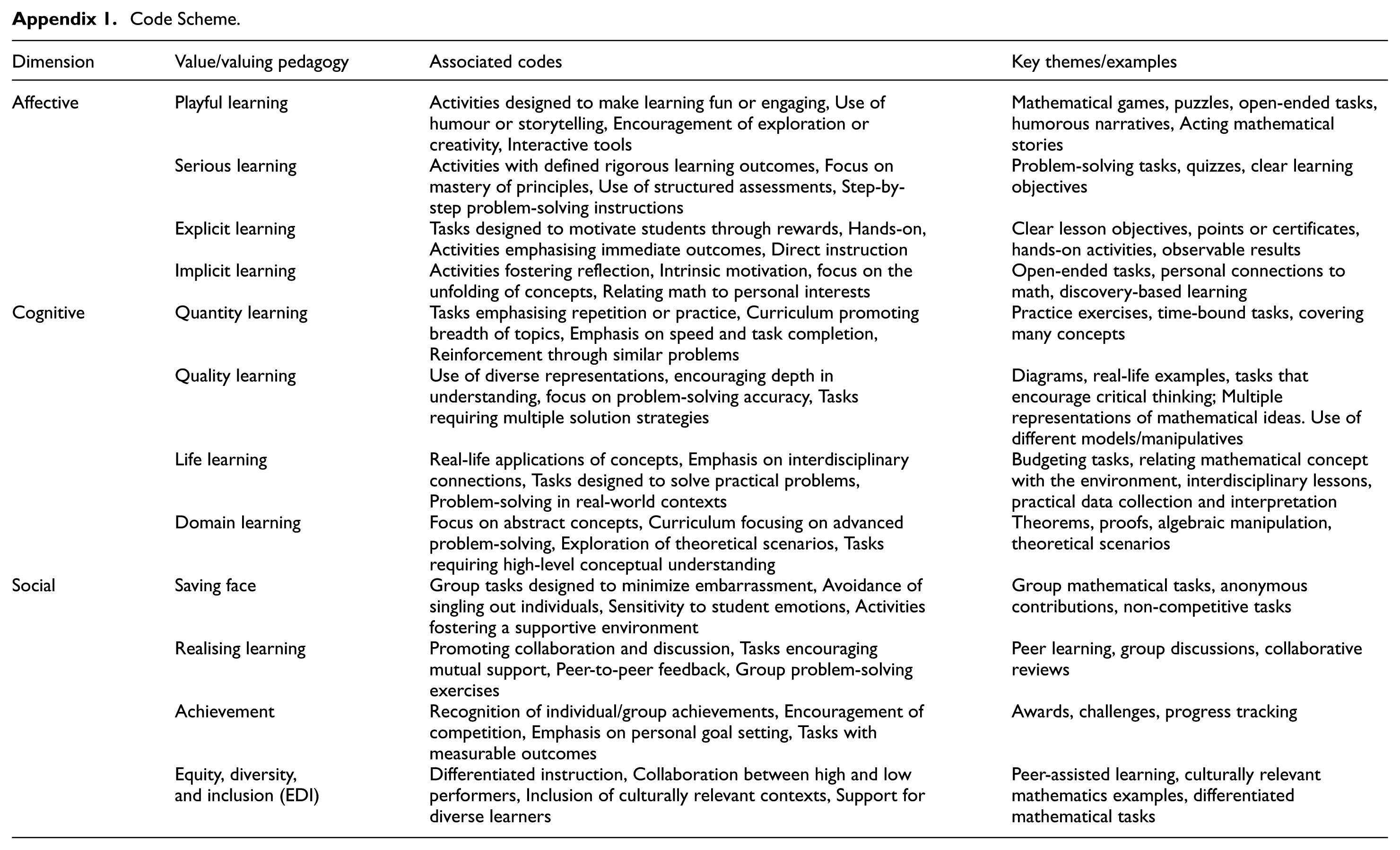
The three curricula documents were read through multiple times to gain an initial understanding of the content after loading into NVivo software, followed by the creation of initial codes using Chiu & Seah (2024) valuing pedagogies framework. However, since the framework is being utilised in a different cultural context, the data was coded openly to identify any emerging themes. A code book (see Appendix 1) was developed using the framework to guide the coding process. For example, the curriculum statement
“Use objects and pictorial models to solve word problems involving joining, separating, and comparing sets within 20 …” (LP1, p. 6)
was coded under explicit learning due to its emphasis on externally structured, object-based instructional strategies. Conversely, the statement
“Count by 1s (forwards and backwards)… Identify and correct errors or omissions in counting or skip counting sequences.” (LP1, p. 2)
was categorised under implicit learning, as it promotes learner reflection, self-monitoring, and internalisation of mathematical thinking processes. Further, the pedagogical statement:
“Recognise Ghanaian coins by name, including one pesewa, five pesewas, ten pesewas, twenty pesewas, fifty pesewas and one cedi by value and describe the relationship among them.” (LP2, p. 21)
was identified as an instance of life learning, given its emphasis on financial literacy and the application of mathematics to real-world contexts.
Each of these instances was recorded as a single reference in NVivo under its respective valuing pedagogy. The entire document was systematically coded for each value and its corresponding valuing pedagogy in sequence. This method captured all underlying values and their occurrences, acknowledging that a single pedagogical activity or mathematical task might embody multiple values simultaneously.
NVivo’s matrix feature was then employed to analyse the distribution of references and percentages across various grade levels for interpretation. Ultimately, the results were presented as coded valuing pedagogies alongside their reference counts and percentages, which were used to address the research questions. The interpretation and discussion of the results were primarily done with references to the percentages, since the number of pages can influence the number of references. A curriculum with more pages is likely to have more references, which can make comparing values across curricula misleading. In this study, Table 1 shows huge curriculum page differences; hence, the references alone might not provide enough benchmarks for comparison. Percentages were calculated for each valuing pedagogy proportional to the total number of references of all valuing pedagogies in the same curriculum.
In response to research questions 1 and 2, individual valuing pedagogies were compared across grade levels to check similarities or observable trends (differences) respectively. Also, since valuing pedagogies are in pairs, there was a need to check how they balance or otherwise across grade levels in response to research question 3. In that regard, the percentages of the identified valuing pedagogies were calculated with their pair within the same curriculum. Significant differences were determined using the Chi-square test of independence. Excerpts from curriculum documents were used to support the findings. Excerpts taken from Lower Primary, Upper Primary, and JHS mathematics curricula were coded as LP1-3, UP4-6, and JHS 7-9, respectively. The numbers in the codes signify the specific grade level from which the excerpt was taken.
Validity and Reliability
The validity of the coding system was assessed by experts and specialists in values and valuing within mathematics education research, and its robustness was further supported by previous pertinent literature (Chiu & Seah, 2024; Chiu et al., 2025). Colleagues experienced in qualitative research were involved throughout the data analysis to review the coding process and thematic interpretations. Reliability remains a concern, given that the same statement may be interpreted in various ways (i.e., as different values) in latent coding. To mitigate this, findings across the three curricula were compared to identify common and contrasting themes. Additionally, the data were independently replicated by engaging two extra coders. Intercoder reliability was calculated using NVivo software, which yielded high-reliability scores (greater than 0.80; Neuman, 2007) with percentage agreements ranging from 85% to 96%, thus demonstrating a robust data system.
Results
Commonalities in Valuing Pedagogies Across Ghanaian Mathematics Curricula
The analysis revealed that all three curricula—Lower Primary, Upper Primary, and Junior High School (JHS)—incorporated cognitive, affective, and social aspects of valuing pedagogies. The distribution of valuing references across these three aspects showed a consistent pattern, with affective aspects receiving the highest emphasis, followed by cognitive aspects, and then social aspects. This pattern is presented in Table 2.
Distribution of Aspects of Valuing Pedagogies References Across Grade Levels.
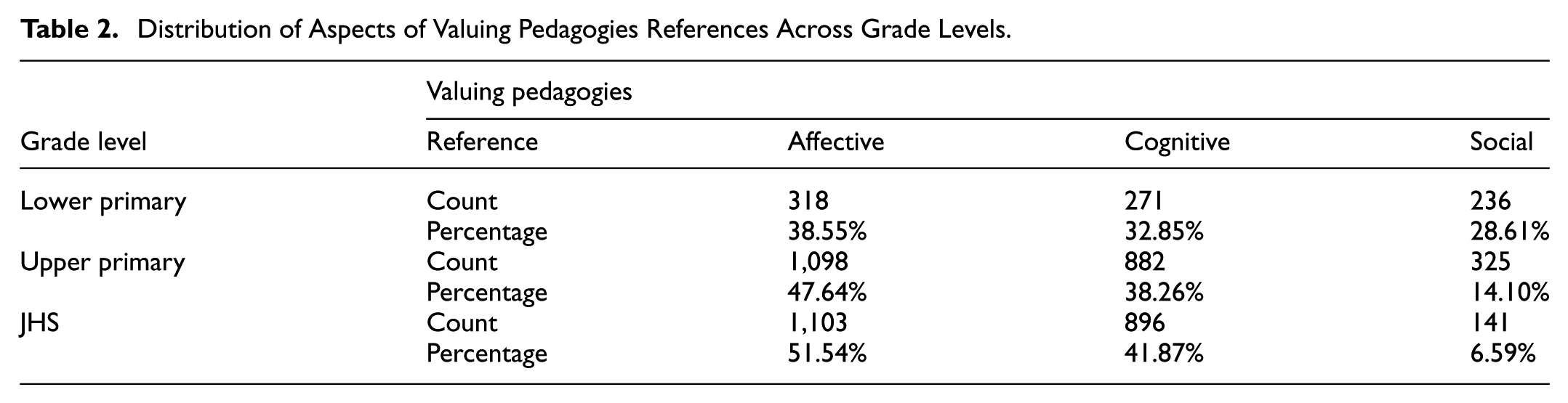
It can be seen from Table 2 that valuing of affective, cognitive and social aspects of pedagogies followed the same pattern in all the curricula. Thus, the high emphasis on the affective aspect followed by the cognitive and lastly by social valuing pedagogies was consistent at all grade levels.
In addition, all 12 valuing pedagogies were espoused in the curriculum with varying degrees of representation. Table 3 shows the references and their percentages of each valuing pedagogy as compared to the total valuing pedagogy references in each curriculum. The results give an overview of how each valuing pedagogy is prioritised more or less across grade levels. The criterion for considering the degree of prioritisation of a valuing pedagogy among other valuing pedagogies is by ranking the valuing pedagogies considering their references. The top 4 of the 12 valuing pedagogies are considered high prioritisation, whereas the bottom 4 of the 12 valuing pedagogies are considered less prioritisation.
Distribution of Percentages of References of Individual Valuing Pedagogies.

Note.↑ = valuing pedagogies ranked in the top 4; ↓ = valuing pedagogies ranked in the last 4; EDI = equity, diversity and inclusion.
The results, as shown in Table 3, show similar prioritisation of valuing pedagogies in lower primary, upper primary and JHS curricula. The top four ranked valuing pedagogies include explicit learning, implicit learning, serious learning and domain learning, except the lower primary curriculum, where achievement replaced implicit learning in the rank. Also, the bottom four ranked valuing pedagogies (EDI, playful learning, realising learning, and saving face), showing less prioritisation, were consistent across all curricula. Three of these valuing pedagogies (i.e., EDI, realising learning, and saving face) are social aspects of valuing pedagogies supporting the initial findings that social aspects of valuing pedagogies are represented less across all the curricula. Playful learning, which falls under the affective aspect, was found among the less represented valuing pedagogies, showing an unbalanced representation as its pair (Serious learning) is highly prioritised in all curricula.
Differences in Valuing Pedagogy Across Ghanaian Mathematics Curricula
Value references differed as we looked at individual aspects across grade levels, as shown in Table 2. Emphasis on the affective aspect increased from lower primary (38.55%) to JHS (51.54%), as well as the cognitive aspect from lower primary (32.8%) to JHS (41.87%). That is, affective and cognitive valuing pedagogies having a high representation are also emphasised more moving up the grade level. On the contrary, the valuing of social pedagogies reduced across grade levels from lower primary (28.61%) to JHS (6.59%). The excerpts in Table 4 show how the emphasis on affective and cognitive pedagogies increases, whereas social pedagogies lessen moving across grade levels.
Excerpts of Valuing Pedagogies from the Three Curricula.

The excerpt depicts how cognitive and affective pedagogical practices are prioritised across grade levels. In teaching addition and subtraction at basic three (Case 1), learners are exposed to more friendly and less rigorous mathematical computations, whereas at basic 6 (Case 2) and basic 7 (Case 3), the rigorous mathematical activities increase, thus focussing more on the cognitive aspect. The excerpts are a few instances that demonstrate the valuing of social pedagogies in the lower primary mathematics curriculum, “teacher explaining,” and “creating questions for colleagues”. Looking at the same concept at the higher grade (grade 6) the curriculum emphasised teacher-learner interaction- “help learners to” while dropping learner-learner interaction. In addition, at the JHS, the curriculum focussed on the cognitive task without highlighting any social pedagogical practice.
This support results in Table 3 showing an increasing focus on serious learning, rising from 9.88% in the lower primary to 19.29% in the upper primary and peaking at 23.74% in JHS, suggesting a shift towards more structured, outcome-driven pedagogical strategies as students advance. Likewise, implicit learning, which fosters an internalised, conceptual grasp of mathematics, gained prominence from 9.52% in the lower primary to 13.98% in the upper primary and further to 17.53% in JHS, indicating a transition towards deeper learning experiences over time.
B5.3.1.1 Identify and sort quadrilaterals, including rectangles, squares, trapezoids, parallelograms, and rhombuses, according to their attributes—UP5. p. 94
B7.3.1.1 Demonstrate understanding of angles including adjacent, vertically opposite, complementary, supplementary and use them to solve problems JHS7, p.47
We see how less implicit activities such as ‘describe’ in the upper primary curriculum evolve to more implicit “identify”“, sort,”“demonstrating understanding” and “solve problems” at the upper primary and JHS, respectively. Also, the upwards trend of serious learning is demonstrated in Case 4 as students are tasked to describe general features of 2D and 3D objects at the lower primary level, but in the upper primary, they need to engage in more rigorous activities to identify specific 2D objects amidst several of them, even after knowing the features. At its peak, the JHS curriculum moved from knowing and sorting to applying the knowledge to solving problems, which is more demanding.
In contrast, the findings highlight a systematic de-emphasis on playful learning, EDI, realising learning, and saving face across all curricula. Playful learning declined significantly from 6.56% in the lower primary to 1.90% in the upper primary and nearly disappeared (0.89%) in JHS. This shift reflects an increasing focus on structured academic rigour at the expense of interactive and engaging pedagogies. The JHS curriculum allows little room for social interactions, as demonstrated in Case 3 and Case 4, and does not provide pedagogical practices that engage learners in playful activities. Similarly, EDI references decreased sharply from 6.65% in the lower primary to 2.57% in the upper primary and 0.58% in JHS, suggesting that inclusivity and fairness receive progressively less emphasis in higher grades. The declining emphasis on playful learning and EDI raises concerns about the balance between traditional academic expectations and the need for fostering creativity, enjoyable learning experiences, diversity, and inclusiveness in mathematics education.
Also, Explicit learning, domain learning, life learning, quality, quantity, realising learning, and saving face showed no trend across grade levels. Thus, although there are differences in valuing representations of these pedagogies, the differences do not show any observable pattern across grade levels from primary to JHS. It rather revealed the highest representation of quantity (8.54%) in the lower primary curriculum; explicit learning (16.46%), quality (10.64%), realising learning (3.69%), and saving face (1.89%) in the upper primary curriculum; serious learning (23.74%), domain learning (17.59%), and life learning (8.11%) in the JHS curriculum.
Portrayal of Complementary Valuing Pedagogy Pairs Across Grade Levels
Considering the disparities in valuing pedagogies of individual values across grade levels it is worth noting whether these differences influence the balance of the valuing pedagogy pairs. Thus, the data were further analysed to find out whether valuing pedagogy pairs are represented similarly or differently across the grade levels.
Commonalities Across Grade Levels
Firstly, the prioritisation of valuing pedagogies in each pair is similar in all curricula. Table 5 shows that serious learning, domain learning, achievement, and realising learning were emphasised over playful learning, life learning, EDI, and saving face in all grade levels. Explicit-implicit learning and quality-quantity valuing pedagogical pairs were prioritised similarly in lower and upper primary curricula, different from the JHS curriculum.
Distribution of Percentages of References of Valuing Pedagogy Pairs Across Grade Levels.
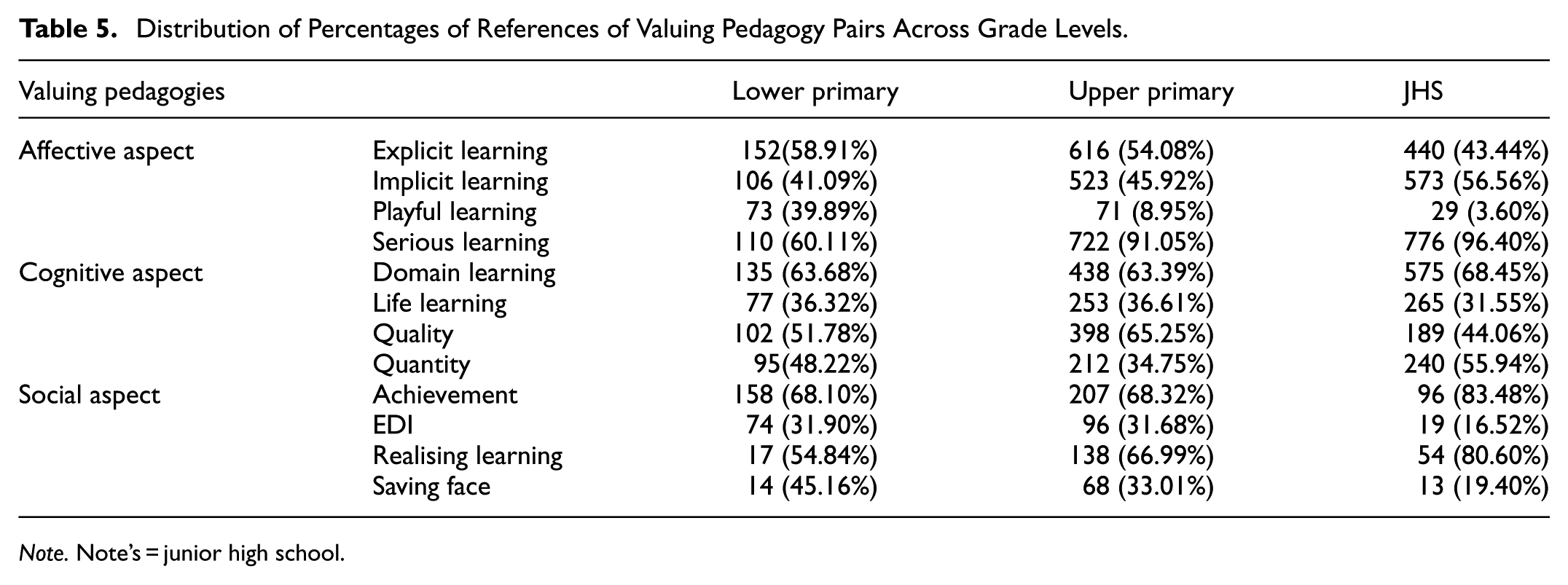
Note. Note’s = junior high school.
For instance, the curriculum demonstration of the teaching of number identification in grade 2 states:
whereas in grade 5,
and finally in grade 7,
Here, we see a similar valuing of explicit learning by making use of number charts that run across all the curricula. However, Case 5 and Case 6 show similar valuing of explicit learning as teachers display a “number chart” first, followed by a “number grid”. In Case 7, students identify numbers in the number chart and progress to writing the numbers in words. This shows that at JHS, less emphasis is placed on the explicit teaching of mathematics concepts and focuses more on the implicit meaning and understanding of the concepts. Also, Case 5 and Case 6 emphasise quality over quantity, whereas Case 7 prioritises quantity over quality, supporting the results displayed in Table 5. Thus, the lower primary and upper primary curricula as shown in Cases 5 and 6 respectively emphasise the use of different representations to display a mathematical concept, hence, highlighting quality in their pedagogy whereas at the JHS emphasis is on performing numerous mathematical tasks such as “identify,”“read,”“write” numbers, “which number is on the right of 3,187,500?” and “Write the number in words” highlighting valuing of quantity.
Also, valuing pedagogy pair that was nearly balanced in its representation is realising learning (54.84%)-saving face (45.16%), explicit learning (54.08%)-Implicit learning (45.92%), and quality (44.06%)-quantity (55.94%) in the lower primary, upper primary and JHS curricula respectively. Thus, not only does the lower primary curriculum prioritise the social aspect of valuing pedagogies compared to other grade levels, but it also ensures, to some extent, a balance in valuing pedagogical pairs. In addition, the balance shifted towards affective valuing pedagogies (explicit learning—implicit learning) at the upper primary and cognitive valuing pedagogies (quality—quantity) at the JHS. This shows a shift in prioritisation of valuing pedagogies at different stages in the curriculum, where the curriculum puts balancing of social, affective and cognitive valuing pedagogies in a spectrum as you move up grade levels.
Differences Across Grade Levels
The chi-square analysis across the three grade levels—Lower Primary, Upper Primary, and JHS—revealed that most valuing pedagogy pairs exhibit distinct patterns of emphasis as shown in Table 6.
Chi-Square Analysis of Valuing Pedagogy Pair Preferences Across Grade Levels.

With the significance level set at χ2 > 5.991 (p = .05, df = 2), explicit versus implicit learning (χ2(2) = 33.24, p < .00001), playful vs. serious learning (χ2(2) = 224.8, p < .00001), quality vs. quantity (χ2(2) = 47.34, p < .00001), achievement vs. EDI (χ2(2) = 10.68, p = .0048), and realising learning vs. saving face (χ2(2) = 7.04, p = .0296) varied significantly across grades, while domain vs. life learning (χ2(2) = 4.84, p = .0889) did not. Pairwise comparisons indicated significant shifts primarily between Lower Primary and JHS and between Upper Primary and JHS for most pedagogy pairs—for instance, explicit versus implicit learning (χ2(1) = 19.76–24.40, p < .00001) and playful vs. serious learning (χ2(1) = 19.55–211.76, p < .0001)—whereas some pedagogy pairs, such as explicit versus implicit learning between Lower and Upper Primary, were non-significant (χ2(1) = 2.0, p = .1573).
Thus, the results show a significant increase in prioritisation of realising learning, achievement, serious learning, and implicit learning against their valuing pedagogy pairs, saving face, EDI, and explicit learning, with a decrease in prioritisation.
These findings indicate that the emphasis on specific valuing pedagogy pairs shifts notably as students progress through the curriculum, except for domain learning and life learning, which appear relatively stable. These results are not surprising, per our discussions so far. As social valuing pedagogies are being dropped to prioritise affective and cognitive pedagogies, it would not be surprising that valuing pedagogies such as serious learning and implicit learning increase in prioritisation. It also contributed to the increase in valuing realising learning over saving face since any pedagogical activity that focuses less on social interaction will prioritise individual understanding of concepts and not social support, as depicted in Case 8.
E.g. 2 The table below shows the area of the sitting room floors of each of 7 real estate houses (A, B C, …) in Kwashiman

i. In small groups, work out the mean, median, mode.
ii. Draw a bar chart to represent the data collected, and
iii. Explain why the values are the same -JHS2, p.159
Moreover, the upwards trend resulted in widening the gaps between valuing pedagogies pairs resulting in the JHS curriculum recording the highest percentage differences for achievement (83.48%)-EDI (16.52), realising learning (80.60%)-saving face (19.40), domain learning (68.45%)—life learning (31.55%), playful learning (3.60%)—serious learning (96.40) valuing pedagogy pairs. This highlights the unequal portrayal of equally important valuing pedagogies in the JHS mathematics curriculum.
Although these trends occurred, closing or widening the gaps, they did not result in total change except for implicit learning. This happened because the valuing of pedagogies which initially had higher representations increased, whereas those with less representation decreased. Implicit learning exception has resulted from the JHS curriculum’s overemphasis on implicit learning as presented earlier (e.g., Case 7).
Meanwhile, domain-life learning and quality-quantity representation exhibited no identifiable trend. Chi-square analysis of lower primary, upper primary, and JHS of the domain—life learning does not significantly decrease or increase. Also, despite a significant difference in quality-quantity, it showed no trend. These valuing pedagogies all fall under the cognitive aspect. This implies that even though cognitive valuing pedagogies increase across grade levels, the balance of each pedagogical pair does not depend on grade level to some extent.
Discussion
Grade-Level Commonalities of the Portrayal of Valuing Pedagogies
The findings from the analysis of the Ghanaian mathematics curricula indicate a consistent predominance of pedagogies that value affective and cognitive aspects over social ones. It is puzzling that all three curricula place less emphasis on social valuing pedagogies, despite explicitly highlighting six core values: commitment to achieving excellence, equity, diversity, truth and integrity, teamwork and collaboration, and respect in the national curriculum (MOE, 2018). Given the nature of specific values, such as equity, diversity, respect, and teamwork/collaboration, one would expect the curricula to prioritise social valuing pedagogies more prominently. This focus likely arises from the curriculum’s strong emphasis on attaining quantifiable performance standards, which privileges cognitive and affective objectives that are more easily measured over social competencies.
Interestingly, this pattern is not unique to Ghana. Comparative insights show that international curriculum reforms, such as those in Australia and Singapore, similarly foreground cognitive and affective orientations, emphasising reasoning, modelling, and deep learning (Australian Curriculum, Assessment and Reporting Authority [ACARA], 2022; Leikin, 2009; Seah et al., 2017). By contrast, East Asian contexts often prioritise social valuing pedagogies, where achievement and “saving face” are deeply embedded in classroom practices (Bishop, 1988; Seah & Bishop, 2000). At the same time, global policy trends shaped by neoliberal reforms continue to privilege quantifiable outcomes over inclusion and collaboration (Darling-Hammond, 2017). Ghana’s reduced emphasis on social valuing pedagogies, therefore, reflects both a local prioritisation of measurable performance standards and broader global currents that increasingly privilege affective and cognitive objectives over social ones.
Moreover, the differential prioritisation among the 12 identified valuing pedagogies reinforces the concern that while explicit, domain, and serious learning are robustly represented, others - playful learning, EDI, saving face, and realising learning- receive comparatively little attention in all curricula. Such discrepancies may have significant implications, as literature strongly supports the educational benefits of some of these pedagogies. For instance, playful learning has been linked to increased creativity, reduced anxiety, supportive class environment, and enhanced engagement in complex subjects (Chiu et al., 2025; Boaler, 2016). Its underrepresentation could limit opportunities for holistic learning experiences that cultivate rigorous analytical skills while encouraging innovative thinking and interpersonal connectivity. One plausible implication is that teachers, working within these curricular frameworks, might lean heavily on methods that promote individual achievement and cognitive skill development while less frequently engaging in strategies that foster collaboration and peer learning (Amuah et al., 2025; Baidoo-Anu & Ennu Baidoo, 2024). This division might inadvertently influence how students perceive mathematics, not only as a subject to be mastered through individual effort but also as a discipline where collaborative inquiry and dialogue provide significant educational benefits (Patricie et al., 2023).
Differences in the Portrayal of Valuing Pedagogies Across Grade Levels
The results reveal that as students progress through the Ghanaian mathematics curricula, there is a notable shift towards more structured and cognitively demanding learning approaches. The increased emphasis on the affective and cognitive aspects, from lower primary to JHS, indicates that curriculum designers intend students to develop stronger individual analytical skills and a positive disposition towards mathematics as they move to higher grade levels. Thus, in addition to already higher representation of valuing pedagogies such as implicit, serious, and domain learning, their emphasis increases across grade levels from lower primary to JHS. This significant shift suggests a deliberate design to deepen conceptual understanding and analytical thinking. This might also be curriculum developers aligning curriculum targets with already existing Ghanaian students’ values, as studies such as Davis et al. (2019) noted that students’ valuing of achievement and cognitive strategies increases as they progress through educational levels in Ghana. The high representation of life learning pedagogies at JHS compared to the lower and upper primaries is surprising. One would expect that as we focus more on serious, intrinsic valuing pedagogies, the rippling effect will be on life learning, which would have decreased in representation. The JHS curriculum rather sought to introduce more pedagogies that demonstrate the link between mathematical concepts and practical and immediate usage. This shift also addresses concerns about the need to ensure mathematics teaching and learning does not take place outside the context of the learner (Ariana et al., 2023; Edo et al., 2023). For instance, Karakoç and Alacacı (2015) emphasise the necessity of utilising real-life examples in mathematics teaching to bridge the gap between abstract concepts and students’ lived experiences.
In contrast, the significant decline in the social valuing of pedagogies across grade levels is noteworthy. This is consistent with current patterns in which educational systems that even place a higher priority on social learning pedagogies see a reduction moving up the academic ladder. For example, recent research conducted in Hong Kong shows that while instructors prioritise exploration and enjoyment in elementary school, they shift their focus to achievement and test-taking strategies in secondary education (Zhang & Lam, 2024).The reduced emphasis on social valuing pedagogies, such as EDI, maintaining saving face, and realising learning in lower primary through to the junior high school (JHS) curricula raises concerns regarding lost opportunities to promote collaboration and peer learning. This alteration may affect students’ capacity to collaborate effectively in groups and gain advantages from shared problem-solving experiences. Research underscores that students derive substantial benefits from sustained opportunities to participate in mathematical discussions with their peers, particularly those from underrepresented groups (Espinosa, 2011; Ismail & Imawan, 2023; Voigt et al., 2022). The trend towards content mastery over holistic development reflects international patterns. These patterns have been criticised in Western contexts, arguing that overemphasising standards and cognitive rigour can marginalise students who benefit from interactive, playful, or culturally responsive pedagogy (Boaler, 2016; Darling-Hammond, 2017).
The decline of playful learning from 6.56% in lower primary to 0.89% in JHS matters for students’ mathematical identity, creativity, and equity of participation. Research shows playful math engagement promotes student motivation, enjoyment, and nurtures their identities as capable mathematical thinkers (Ellis et al., 2025; Lee et al., 2023). Diminished playful pedagogies may constrain innovative thinking and reduce opportunities for exploration essential for creative cognitive development in math. Its implication on equity, diversity, and inclusion was demonstrated in the decline of EDI from lower primary through to JHS. Playful learning offers inclusive learning spaces that can particularly benefit marginalised or diverse learners by reducing anxiety and fostering collaborative peer interactions (Espinosa, 2011; Ismail & Imawan, 2023). The decline in such pedagogies risks narrowing participation patterns and restricting equitable access to positive math learning experiences. In addition, the reduced emphasis on EDI in Ghanaian mathematics curricula across grade levels has important implications for marginalised students, who often require culturally responsive and inclusive pedagogical approaches to fully engage with mathematics learning (Atta & Bonyah, 2023). Without consistent attention to EDI, curricular opportunities for these learners may be limited, affecting equity of access and participation.
Although the trend depicts that the lower primary curriculum has a high representation of social valuing pedagogies and JHS has high affective and cognitive valuing pedagogies, it is worth noting that the upper primary curriculum distorted this pattern. The Upper Primary curriculum had a high representation of explicit learning, realising learning, quality, and saving face. This shows a little balance in the valuing pedagogy representation as compared to the other two curricula, as it does not automatically follow an increasing or decreasing trend. Although it shows the need for students to perform rigorous mathematical activities, it looks somewhat balanced with integrating activities related to mathematical conceptions with concrete materials and the use of different representations for students to have an in-depth understanding and control of the concepts. This calls for the need for future studies to investigate the balance of the valuing pedagogies across the curricula. It is also important to recognise that the findings presented here reflect the intended curriculum, as documented in policy texts. The extent to which these valuing pedagogies are enacted in classrooms remains uncertain, particularly given that Ghana’s standards-based curriculum is still in the early stages of implementation. Emerging reports suggest that while teachers have begun engaging with the revised frameworks, classroom practices may not yet fully mirror the curricular intentions due to challenges of resource availability, teacher preparation, and assessment alignment (Buabeng & Amo-Darko, 2025; Takyi et al., 2025). Attending to this implementation dimension is therefore crucial for understanding whether the privileging of cognitive and affective pedagogies over social ones translates into lived classroom practice.
Complementary Valuing Pedagogy Pairs
Across Lower Primary, Upper Primary, and JHS curricula, four pedagogies—serious learning, domain learning, achievement, and realising learning—consistently outrank their complements (playful learning, life learning, EDI, saving face). More specifically, valuing pedagogy pairs evolving across grade levels is notable. This gradual shift emphasises the importance of moving from concrete knowledge to more abstract reasoning, a transition supported by the findings of Osei and Agyei (2024), who highlight the need for developing higher-order thinking skills in students. This reflects Ghana’s policy emphasis on academic standards and core competencies (MOE, 2018) and mirrors students’ reported preference for values like achievement, fluency, and authority (Seah et al.,2017 ).
The chi-square analysis further illustrates significant differences in the representation of valuing pedagogy pairs across grade levels. The pronounced increase in serious and implicit learning over playful and explicit learning from Primary to the JHS level indicates a curriculum prioritising academic achievement as students climb the academic ladder. This agrees that mathematics becomes more detached from daily representations to actual conceptions at the higher grade levels. Meanwhile, Carr et al.’s (2023) study revealed that JHS students are more interested in fun activities than those that require hard work. Again, the heavy focus on achievement relative to EDI as we move up the grade levels suggests a shift towards a definition of mathematical success that may overlook the importance of collaborative learning and interpersonal skills, which are vital in the Ghanaian educational context. This aligns well with previous findings that Ghanaian students at higher stages (JHS) prioritise direct teaching to explore mathematics with others (Baafi, 2020; Carr et al., 2023).
Moreover, the unequal representation gap between realising learning versus saving face increased significantly, progressing through grade levels. In addition, as primary curricula prioritise quality over quantity, the JHS curricula differ by prioritising quantity over quality. These observations align with and explain to some extent earlier findings that Ghanaian students value openness less and control more as they move up the academic ladder, as previous studies have revealed (Carr et al., 2023; Davis et al., 2019). Interestingly, domain learning and life learning stability across the grade levels indicate that these cognitive components could serve as anchors for integrating more social and playful pedagogies.
Another important consideration relates to the challenges teachers may face in transitioning from the previous objective-based curriculum to the current standards-based framework. Teachers who are accustomed to traditional approaches may encounter difficulties in integrating social valuing pedagogies, balancing playful with serious learning, and assessing students’ values in ways that are both valid and practical. Research from other contexts suggests that such transitions often demand significant shifts in teacher beliefs, pedagogical repertoires, and assessment practices (Li & Huang, 2024). Without sustained professional development and clear assessment guidelines, there is a risk that social and affective dimensions of valuing pedagogies may remain under-implemented despite their presence in curriculum policy.
Conclusions and Implications
This study responds to a call for research investigating curriculum documents (Davis et al., 2019; Essien & Davis, 2024). It highlights the potential of curricula in contributing to students’ value development. This study contributes to the notion that a standards-driven curriculum usually yields pedagogical approaches that emphasise individual achievements over collective efforts. In the Ghanaian context, as demonstrated in this study, even though curriculum developers took steps to inculcate social valuing pedagogies, the curricula focus less on it in the long run. Moreover, the study also demonstrates that pedagogical approaches evolve and align with the content of mathematics to be taught. That is, as mathematical tasks become voluminous and mathematical concepts become more abstract, the pedagogical activities place a greater priority on intrinsic qualities. Thus, the curricula shift focuses to serious pedagogical engagement at the expense of fun, collaborative, and all-inclusive mathematical activities. Mastery is now considered more important as mathematical concepts become more complex.
Notwithstanding, considering previous studies revealing students’ finding attributes such as fun lessons to be of worth to them irrespective of the grade levels (Carr et al., 2023; Chiu et al., 2025), there is a need to rethink the position of how we present mathematics to students at higher grades. The main issue here is adopting cultural pedagogies approaches, activities that situate the learning within both real life and collaborative mathematics context (Davis & Seah, 2016; Nabie, 2008). By so doing, we will not lose focus on developing cognitive, affective and social abilities at the same time. This balanced approach not only prepares students for academic challenges but also equips them with the skills necessary for meaningful participation in their communities.
The limitations of this study leave a gap for further research. For instance, learner characteristics might play a significant role in the prioritisation of pedagogical activities for each grade level. Hence, further studies can look at how the prioritisation of valuing pedagogies aligns with the cognitive, affective and social demands and readiness of students at each grade level. Further studies can look at how valuing pedagogies evolve within each grade level to enrich the findings of this study. This will also provide a deeper understanding of how valuing pedagogies are defined for learners of similar age groups, unlike the current study, which looked at different age groups.
Lastly, while this study has provided insights into the intended curriculum, it does not capture how the identified valuing pedagogies are enacted in classrooms. Implementation of Ghana’s standards-based mathematics curriculum remains an important area for further investigation, as classroom practices may amplify or diverge from the curricular intentions. Future research that attends to this enactment will provide a more comprehensive understanding of how valuing pedagogies shape students’ experiences and outcomes.
Footnotes
Appendix
Code Scheme.
| Dimension | Value/valuing pedagogy | Associated codes | Key themes/examples |
|---|---|---|---|
| Affective | Playful learning | Activities designed to make learning fun or engaging, Use of humour or storytelling, Encouragement of exploration or creativity, Interactive tools | Mathematical games, puzzles, open-ended tasks, humorous narratives, Acting mathematical stories |
| Serious learning | Activities with defined rigorous learning outcomes, Focus on mastery of principles, Use of structured assessments, Step-by-step problem-solving instructions | Problem-solving tasks, quizzes, clear learning objectives | |
| Explicit learning | Tasks designed to motivate students through rewards, Hands-on, Activities emphasising immediate outcomes, Direct instruction | Clear lesson objectives, points or certificates, hands-on activities, observable results | |
| Implicit learning | Activities fostering reflection, Intrinsic motivation, focus on the unfolding of concepts, Relating math to personal interests | Open-ended tasks, personal connections to math, discovery-based learning | |
| Cognitive | Quantity learning | Tasks emphasising repetition or practice, Curriculum promoting breadth of topics, Emphasis on speed and task completion, Reinforcement through similar problems | Practice exercises, time-bound tasks, covering many concepts |
| Quality learning | Use of diverse representations, encouraging depth in understanding, focus on problem-solving accuracy, Tasks requiring multiple solution strategies | Diagrams, real-life examples, tasks that encourage critical thinking; Multiple representations of mathematical ideas. Use of different models/manipulatives | |
| Life learning | Real-life applications of concepts, Emphasis on interdisciplinary connections, Tasks designed to solve practical problems, Problem-solving in real-world contexts | Budgeting tasks, relating mathematical concept with the environment, interdisciplinary lessons, practical data collection and interpretation | |
| Domain learning | Focus on abstract concepts, Curriculum focusing on advanced problem-solving, Exploration of theoretical scenarios, Tasks requiring high-level conceptual understanding | Theorems, proofs, algebraic manipulation, theoretical scenarios | |
| Social | Saving face | Group tasks designed to minimize embarrassment, Avoidance of singling out individuals, Sensitivity to student emotions, Activities fostering a supportive environment | Group mathematical tasks, anonymous contributions, non-competitive tasks |
| Realising learning | Promoting collaboration and discussion, Tasks encouraging mutual support, Peer-to-peer feedback, Group problem-solving exercises | Peer learning, group discussions, collaborative reviews | |
| Achievement | Recognition of individual/group achievements, Encouragement of competition, Emphasis on personal goal setting, Tasks with measurable outcomes | Awards, challenges, progress tracking | |
| Equity, diversity, and inclusion (EDI) | Differentiated instruction, Collaboration between high and low performers, Inclusion of culturally relevant contexts, Support for diverse learners | Peer-assisted learning, culturally relevant mathematics examples, differentiated mathematical tasks |

Consent to Participate
This study does not involve any human participants, so informed consent is not necessary.
Author Contributions
Both authors have read and approved the final manuscript, and they agree with the order of authorship.
Funding
The authors received no financial support for the research, authorship, and/or publication of this article.
Declaration of Conflicting Interests
The authors declared no potential conflicts of interest with respect to the research, authorship, and/or publication of this article.
Data Availability Statement
The datasets collected during and/or analysed during the current study are available from the corresponding author on reasonable request.*