




Abstract
The importance of applying cooperative learning and aiming toward an increase in motivation to maximize the effectiveness of the learning process has not sparked an intense research interest in the Bosnian EFL context. Thus, the current study, conducted among 211 high-school participants, explores the impact of gender and grade level on students’ cooperative learning and motivation for EFL learning and aims to determine whether any cooperative learning components are significant predictors of students’ motivation and their EFL achievement. The findings showed no significant gender and grade level differences in cooperative learning and motivation. Additionally, the results revealed that individual accountability and interpersonal skills are significant predictors of participants’ motivation and that promotive interaction and interpersonal skills are significant predictors of their EFL achievement. The research points to the importance of incorporating cooperative learning strategies and motivation-strengthening activities into EFL teaching, which will eventually lead to the improvement in students’ EFL achievements.
Introduction
A student-centered approach needs to be adopted to facilitate independent language learning and create learners able to utilize their knowledge and skills in everyday situations (McCombs, 2000). A useful instructional technique promoting such an approach is cooperative learning comprising “a number of related methods of organizing classroom instruction in order to achieve common learning goals via cooperation” (Dörnyei & Ushioda, 2011, p. 27). This type of learning is based on the assumption that humans are not passive recipients of information, but active participants directly involved in constructing their knowledge, selecting information, modifying it and making sense of it, which presents the main idea of Constructivism (Bruner, 1973, 1986; Yager, 1991). In fact, recent research has confirmed that instruction relying on the concepts of constructivism and collaboration affects learning outcomes in various domains (Fekri, 2016; Gillies & Boyle, 2010; Zarrabi, 2016).
Thus, cooperative learning is generally associated with higher academic achievement (Cole, 2012; Johnson & Johnson, 1994; Kagan, 1994; Namaziandost et al., 2020; Pattanpichet, 2011; Slavin et al., 1984), but is also highly beneficial to learners’ self-esteem (Fathman & Kessler, 1993) and self-efficacy (Dörnyei, 1997; Slavin, 1996), critical thinking skills (Johnson & Johnson, 1994; Kagan, 1994), learner autonomy (Candy, 1991), interpersonal relationships as well as to adopting more positive stances toward the learning material (Johnson & Johnson, 1994) and decreasing their level of anxiety (Crandall, 1999; Slavin, 1980). Cooperation within classrooms is also believed to prepare learners for real-life situations (Slavin, 1980) in which an immense value is attached to team work promoting the development of social skills such as communication, leadership, trust building, and decision making (Smith, 1995). Bearing in mind all the aforementioned, we realize that much attention should be paid to promoting the use of this instructional technique among students at various levels of education.
The current study will provide further insight into cooperative learning, but within the context of learning English as a foreign language (EFL) among high-school students in Bosnia and Herzegovina (B&H), the country where English holds the status of a foreign language, but where, as a global language, it has permeated all domains of everyday language use (Dubravac, 2016, 2018). In B&H curricula, the English language course occupies a prominent place. It is mandatory at all education levels, with 2 or 3 hours allocated to this course weekly. Throughout elementary and high school, students are exposed to different teaching methods, and cooperative learning plays an important role within language teaching methodology. Students are very frequently engaged in group activities in the classrooms but are also commonly given group homework assignments which prompt them to collaborate even more. Therefore, they form groups and communicate through different social networks in order to cooperate efficiently on school projects assigned by EFL teachers.
This study will show whether such teaching practice eventually affects students’ perceptions about cooperative learning, and whether these perceptions are related to their overall EFL achievement. Moreover, the potential of cooperative learning to lead to students’ higher EFL motivation will be investigated, which has been proved significant in similar learning contexts (Sachs et al., 2003; Yang, 2005; Yoshida et al., 2014). To advance the understanding of the matter, the study will also analyze the variability in cooperative learning and motivation based on grade level and gender. Due to the lack of similar studies involving participants from this learning environment, the research is expected to report novel findings likely to serve as useful guidelines to language educators. Furthermore, since this learning milieu is comparable to a number of EFL contexts, the study will also present results applicable worldwide and thus gain international significance.
Cooperative Learning Model and Its Variability
The whole concept of cooperative learning is based on learning through group activities and achieving instructional goals collaboratively, whereby the success of a group of students is conditioned by the success of their collaborative peers (Johnson & Johnson, 2003). To reach its full potential, cooperative learning needs to incorporate five components, namely positive interdependence, individual accountability, promotive interaction, interpersonal skills and group processing, as proposed by Johnson and Johnson (1994) and Johnson et al. (1994), whose model is followed in the current research.
Firstly, to foster positive interdependence, learners must realize the importance of group work and understand that the group’s success is dependent upon the participation of its members. Secondly, they must be aware of their individual roles in the team and the interrelatedness of their goals in order to be able to work together productively and achieve success (Neo et al., 2012). This way a pleasant and comfortable work environment is created in which students foster healthy interpersonal relations through promotive interaction, their mutual support and encouragement (Johnson & Johnson, 1994), which presents the third component. Next, working together on achieving mutual goals, students develop interpersonal skills needed for effective team functioning such as listening carefully, asking for clarification, accepting others’ points of view, providing constructive suggestions, etc. (Tanner et al., 2003). Students are expected to reflect on their role, effort and contribution to the overall team success, which comprises the fifth component, namely the group processing component (Johnson et al., 1991). This allows them to overcome disputes, make necessary modifications and eventually achieve better results. Once all these aspects are satisfied, the benefits of cooperative learning are shared by all learners in general with some differences being assigned to specific individual learner characteristics.
For instance, there are some indications that female students tend to achieve better results through cooperative learning (Ellison & Boykin, 1994; Rodger et al., 2007) than when involved in individualistic tasks, because their sense of self is more based on connection and relatedness (Jordan et al., 2004). Conversely, male students tend to show better results in competitive working situations (Inglehart et al., 1994). However, the effectiveness of cooperative learning has been rarely empirically assessed between gender-based groups, so in the EFL context, these findings are scarce and conflicting. On the one hand, Khoshsima and Saed (2014) showed that females made greater progress than males after being involved in cooperative learning activities. On the other hand, Nikou et al. (2014) revealed no gender-based differences in EFL achievement as a result of cooperative learning. Such inconsistency in gender-related research clearly indicates that further studies are needed to clarify this variability in the effectiveness of cooperative learning, which presents one of the aims of the current study.
Another aim is related to the exploration of the differences in the effectiveness of cooperative learning based on grade level. Although cooperative learning appears effective among all students regardless of their level of education (Gillies, 2016; Johnson & Johnson, 1989), it seems particularly important for high school students, who experience transition from elementary to high school, and collaboration with classmates might be the best instruction type to help them overcome it (Gillies, 2016). Furthermore, a grade level is taken as a significant variable to show whether cooperative learning benefits are most visible among the first-grade students, when they just start a new educational cycle, or they are equally noticeable among all high school students regardless of the grade level. No study to our knowledge has taken high-school grade level as a variable, so this research will present some novel findings in this respect.
Importance of EFL Students’ Motivation and Its Variability
Motivation has occupied one of the central places in the theory of language acquisition (Dörnyei & Ushioda, 2011). Different models have been developed to measure its presence among language learners, but this study will rely on the one developed by Schmidt and Watanabe (2001), which aimed to illustrate the multidimensional character of motivation. They measured motivation using 12 subscales, four of which were included in the present study instrument, namely intrinsic motivation referring to enjoyment in language learning, motivational strength denoting learners’ readiness to give their best in an attempt to acquire the target language, expectancy control underlying students’ positive expectations related to passing the course, and interest in foreign languages and cultures in general.
Besides a strong relationship between motivation and achievement (Gardner et al., 1997; Masgoret & Gardner, 2003), some interesting variations based on learners’ individual differences have been identified. The majority of previous studies (e.g., Coleman et al., 2007; Dörnyei & Csizér, 2005; Henry & Cliffordson, 2013; Williams et al., 2002; Xiong, 2010) have revealed that females have higher motivation than males. Still, when different types of motivation are compared, the research shows that girls have higher intrinsic motivation, whereas boys have higher extrinsic motivation. Clear reasons behind these differences in intrinsic and extrinsic motivation have not yet been identified (Carr & Pauwels, 2006), and future enquiries are expected to provide further insight into the issue.
Research has also investigated the impact of age on motivation and the findings tend to reveal that the older students get the less motivated they tend to be (Bernaus et al., 2007; Gardner et al., 2004; Inbar et al., 2001). However, when the type of motivation is taken into consideration, the findings seem to be opposing. Catania and Randall (2013) reported a significant but negative correlation between age and extrinsic motivation and an insignificant correlation between age and intrinsic motivation (Catania & Randall, 2013). On the contrary, some findings suggested that intrinsic motivation for learning in general, and for learning English in particular, decreased with age (Harter, 1981; Lepper et al., 1997), which is especially noticeable among weaker students (Falout et al., 2009). Similarly, Lepper et al. (2005) and Gillet et al. (2012) pointed to a decrease in intrinsic motivation over time, but also reported an increase in extrinsic motivation over the same time frame. Such contradictory findings indicate that motivation is dependent on some other factors, and that much can be done to use its dynamic character and work constantly on its improvement and internalization.
Even though the concept of motivation has been relatively widely investigated worldwide, it is still insufficiently researched in the context of B&H. Those few previous studies have revolved around motivation and achievement and the factors impacting the two. Thus, Bećirović (2017) explored the impact of age on motivation and achievement of 210 elementary and high-school students learning English as a foreign language. The findings indicated a significant positive correlation between motivation and achievement as well as a significant relationship between age and motivation, with the youngest students being the most highly motivated. Furthermore, Bećirović (2017) measured the impact of gender on elementary and high-school students’ motivation for learning English as a foreign language as well as on their achievement. The results pointed to a significant impact of gender on motivation, with female students being more motivated for learning English as a foreign language than male students. Females proved to be more successful at learning English than males and this difference was noticeable at each grade level. Ahmetović et al. (2020) confirmed a strong relationship between motivation and EFL achievement among 160 middle and high school students. This clearly indicates that conditions for the development of motivation should be further investigated in this learning context. Cooperative learning is often seen as a significant variable in this respect. Presenting an environment conducive to students’ socialization, interaction and learning (Neo et al., 2012), cooperative learning leads to a pleasant positive atmosphere among classmates, and eventually to considerably higher students’ motivation (Long & Porter, 1985). Such a connection between this type of group-based classroom structure and motivation is believed to rely on three factors: goal structure, reward structure and group dynamics (Dörnyei, 1997, 2001; Johnson et al., 1998; Slavin, 1995). In particular, Ning and Hornby (2014) emphasized that cooperative learning might solve the issue of decreasing motivation among older EFL students (Busser & Walter, 2013).
Based on the adopted theoretical framework, the following hypotheses were tested:
H1: Grade level and gender have a significant influence on cooperative learning.
H2: Grade level and gender have a significant influence on motivation for learning English as a foreign language.
H3: Cooperative learning is a significant predictor of students’ motivation for learning English as a foreign language when the influence of age is controlled.
H4: Cooperative learning is a significant predictor of students’ achievement in learning English as a foreign language when the influence of gender and grade level is controlled
Method
Research Design
This non-experimental quantitative study employed a comparative and prediction research design (Creswell, 2012; McMillan, 2012). According to McMillan (2012), a comparative study compares two or more groups on one or many variables (pp. 178–179). We aimed to compare students’ experience in and perceptions of cooperative learning and their motivation to learn English as a foreign language based on their grade level and gender. Furthermore, in a prediction research design, a researcher may be interested in several predictor variables that help explain the outcome variables (Creswell, 2012, p. 342). In the present study, we aimed to use cooperative learning as a predictor variable of students’ motivation and achievement in learning English as a foreign language. Age, gender and grade level are controlling variables within the prediction research design.
Participants
The research sample comprised 211 participants studying at three different high schools in Bosnia and Herzegovina. One school is located in Sarajevo Canton, the other one in Zenica-Doboj Canton and the third one is located in The Central Bosnia Canton. All three high schools belong to the same type of grammar school. In all three schools, the English language course is mandatory and three hours are allocated to it weekly. Convenience sampling was applied in the process of participant selection. At the time of sample collection, there were 50 first-grade students (23.7%), 67 second-grade students (31.7%), 57 third-grade students (27%), and 37 fourth-grade students (17.5%). Seventy-six students were female (36%) and 125 students male (64%) and their age ranged between 14 and 18, with an average age of 16.2 (SD = .93).
Measures
The questionnaire constructed by Schmidt and Watanabe (2001) was administered to collect data on students’ motivation for learning English as a foreign language. In the process of development and validation of this instrument, Schmidt and Watanabe (2001) included 2,089 learners of five different foreign languages (Mandarin Chinese, Filipino [Tagalog], French, Japanese, and Spanish) (p. 311). Beside the scales measuring foreign language motivation, the original instrument included the scales analyzing language learning strategies and learner preferences for various kinds of pedagogical activities. The whole instrument or some of its parts have been used multiple times across the countries and samples. For the purpose of the present study, four subscales of EFL motivation comprising 20 items were selected, namely intrinsic motivation (My language class is a challenge that I enjoy), interest in foreign languages and cultures (I enjoy meeting and interacting with people from many cultures), expectancy control (I can guess the meaning of new vocabulary words very well), and motivational strength (I can truly say that I put my best effort into learning this language). The instrument is based on a 5-point Likert scale, so students could choose one out of five answers for each statement (strongly agree, agree, neutral, disagree, and strongly disagree).
According to Hair et al. (2014), a Confirmatory factor analysis (CFA) “is used to provide a confirmatory test of our measurement theory which specifies how measured variables logically and systematically represent constructs involved in a theoretical model” (p. 603). CFA was performed on the initial 20 items of the Motivation Questionnaire constructed by Schmidt and Watanabe (2001). The test revealed relatively unsatisfactory model fits with χ2 (84) = 235.2 (p < .001), root mean square error of approximation (RMSEA) = .093, PCLOSE < .001 comparative fit index (CFI) = .868, Tucker–Lewis index (TLI) = .835, goodness of fit index (GFI) = .868 and adjusted goodness of fit index (AGFI) = .811. The factor loadings were inspected for 20 items, following which three items were removed due to weak factor loading (i.e., less than 0.40), one from the intrinsic motivation subscale, one from the expectancy control subscale and one belonging to the motivational strength subscale. Furthermore, the modification index was examined with few co-variances proposed to be freely estimated. These resolutions were accepted and the model was altered. The Confirmatory factor analyses were then performed again with the remaining 17 items and modifications. The fit indices of the model improved to χ2 (67) = 135.2 (p < .001), RMSEA = .070, PCLOSE .029, CFI = .935, AGFI = .867, and the goodness of fit index was GFI = .916, TLI = .912, which can be considered acceptable.
The internal consistency reliability was examined by measuring Cronbach’s alpha coefficients. According to Taber (2018), “alpha values were described as excellent (0.93–0.94), strong (0.91–0.93), reliable (0.84–0.90), robust (0.81), fairly high (0.76–0.95), high (0.73–0.95), good (0.71–0.91), relatively high (0.70–0.77), slightly low (0.68), reasonable (0.67–0.87), adequate (0.64–0.85), moderate (0.61–0.65), satisfactory (0.58–0.97), acceptable (0.45–0.98), sufficient (0.45–0.96), not satisfactory (0.4–0.55), and low (0.11)” ( p. 1278). The overall items’ alpha value (α = .86) as well as the value obtained for the interest in foreign language and culture subscale (α = .84) were reliable. The values obtained for intrinsic motivation (α = .76) and motivational strength (α = .69) were fairly high and reasonable respectively, whereas the expectancy control value was adequate.
Cooperative learning was investigated by using the questionnaire adapted and constructed by Neo et al. (2012) based on Johnson et al. (1994). The questionnaire includes five components of cooperative learning, namely (1) positive interdependence (I managed to depend on my members as they depend on me), (2) individual accountability (I was able to find working cooperatively very motivating), (3) promotive interaction (The interaction with my peers helped improve my performance), (4) interpersonal skills (I was able to listen to and respect the ideas of others), and (5) group processing (I enjoyed working with my group members as a team) (Neo et al., 2012, p.860). The questionnaire consists of 23 items based on a 5-point Likert scale ranging from 1 = strongly disagree to 5 = strongly agree.
A CFA allows us to examine how well the measured variables represent the investigated constructs (Hair et al., 2014). The questionnaire on cooperative learning was developed and used with other samples and we performed a CFA to examine how measured variables represent cooperative learning with our research sample. In the present study, AMOS 23 was used for performing a CFA on the initial 23 items of the Cooperative Learning Questionnaire, and it showed relatively unsatisfactory model fits with χ2 (157) = 321.0 (p < .001), root mean square error of approximation (RMSEA) = .072, PCLOSE = .001, comparative fit index (CFI) = .913, Tucker–Lewis index (TLI) = .891, goodness of fit index (GFI) = .862 and adjusted goodness of fit index (AGFI) = .810. After inspecting the factor loadings for 23 items, three items, one from the individual accountability subscale, one from the promotive interaction subscale and one from the interpersonal skill subscale were removed because of weak factor loading (i.e., less than 0.40). After we inspected the modification index with few co-variances proposed to be freely estimated, these suggestions were adopted and the model was modified. The Confirmatory factor analyses were then conducted again with the remaining 20 items and modifications, and the model fits improved to χ2 (102) = 187.7 (p < .001), RMSEA = .063, PCLOSE .064, CFI = .943, AGFI = .859, goodness of fit index GFI = 906, TLI = .925, which can be considered acceptable.
The internal consistency reliability was measured by calculating Cronbach’s alpha coefficients, and all the variables showed an acceptable level of reliability: the correlation coefficient being α = .92 for all the items, α = .72 for positive interdependence, α = .75 for individual accountability, α = .75 for promotive interaction, α = .73 for interpersonal skills, and α = .80 for the group processing subscale.
As for the students’ EFL achievement, we used official average EFL course grades assigned by EFL teachers. More precisely, students’ EFL performance and achievement are consistently graded in the course of two semesters and, then, at the end of the semester and school year, an average EFL course grade is obtained by calculating the sum of all the grades received throughout the semester divided by the number of grades. The average grade ranging between 1and 1.4 is considered a failing grade denoted as 1, the average grade ranging between 1.5 and 2.4 is the lowest passing grade 2, the average grade ranging between 2.5 and 3.4 is a slightly higher passing grade 3, while the average grades ranging between 3.5 and 4.4, on the one hand, and between 4.5 and 5.0, on the other hand, are considered high passing grades 4 and 5, with 5 being the highest of all.
Procedures
The questionnaire was distributed to students at the end of the winter semester in three high schools in Bosnia and Herzegovina. After an informed consent was obtained from the schools’ administration and the participants themselves, guaranteeing anonymity, confidentiality, and the volunteer nature of participation, the questionnaire was administered in school premises in English language classes. The researchers themselves provided the participants with the explanation on how to fill out the Likert-type questionnaire. The participants were informed about the purpose of the research and they were asked to read each statement carefully, and respond to all the statements truthfully. Filling out the questionnaire took approximately 20 minutes.
Data Analysis
In order to assess how well the model fits the data, a CFA was conducted using the statistics program AMOS 23. Following Hair et al. (2010), multiple indices were considered as follows: χ2/df, root mean square error of approximation (RMSEA), comparative fit index (CFI), tucker–lewis index (TLI), goodness of fit index (GFI), adjusted goodness of fit index (AGFI) and PCLOSE. A great model fit to the data would be obtained by insignificant chi-square test results, a CFI and a TLI greater than .95, SRMR < .09, RMSEA < .10 and PCLOSE > .05 (Hair et al., 2010).
Furthermore, by using the statistics program SPSS 23, descriptive statistics, bivariate correlations, reliability analysis, hierarchical multiple regression and a two-way MANOVA were performed. MANOVA implies the usage of multiple dependent variables and, according to Stevens (2001), there are two advantages in measuring more than one dependent variable: firstly, any independent variable will probably influence participants in multiple ways, so there arises a need for additional dependent variables, and, secondly, by measuring multiple variables, a researcher may get a more holistic picture of the research problem. A two-way MANOVA was performed to measure the effect of grade level (four study years) and gender (two groups of participants, i.e., females and males) on the participants’ cooperative learning practices and their motivation for learning English as a foreign language.
Results
Descriptive Results and Correlations
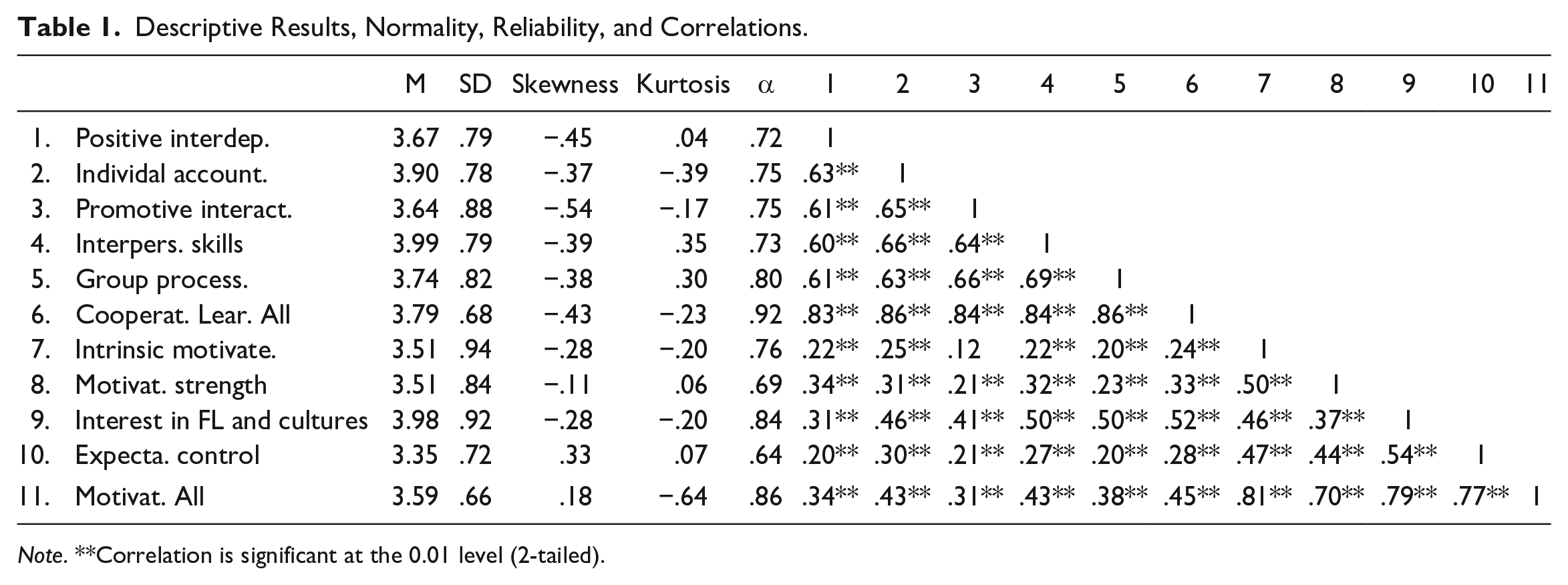
Before performing the descriptive analysis and testing the hypotheses, we considered the normality distribution of the variables examining skewness and kurtosis. The normality test results (Table 1) showed that all skewness and kurtosis values were within the passable range (from −1 to +1), which designated that there were no deviations from normal distribution of all the measured variables (Hair et al., 2010).
Descriptive Results, Normality, Reliability, and Correlations.
Note. **Correlation is significant at the 0.01 level (2-tailed).
The data displayed in Table 1 show relatively high mean values obtained for all the components of cooperative learning, with the mean (M = 3.99; SD = 0.79) for interpersonal skills being the highest. This indicates that the students felt quite free to communicate with their peers, ask questions and constructively resolve any disagreement arising as a result of collaboration with other students. The students scored the lowest mean (M = 3.64; SD = 0.88) on the promotive interaction subscale, even though this was still a high score. Such results could be expected because students would rather establish positive interdependence within groups, individual accountability, positive interpersonal relations with group members and facilitate group processing than promote success of other students, group members. The total score on the cooperative learning scale was high as well (M = 3.79; SD = 0.68).
Similar findings were obtained for EFL motivation, with the mean values ranging from M = 3.35 for expectancy control to M = 3.98 for interest in foreign languages and cultures. Thus, the participants obtained the highest score on the subscale of interest in foreign languages and cultures (M = 3.98; SD = 0.92), followed by the subscales of intrinsic motivation and motivational strength (both M = 3.51). The total score on motivation to learn English as a foreign language was also relatively high (M = 3.59; SD = 0.66).
Interestingly, the scores for the overall items measuring cooperative learning and those measuring motivation correlated significantly (r = .45, p < .001). Significant correlation coefficients (p < .001) were also found between all the subscales of cooperative learning, with the highest one observed between group processing and interpersonal skills (r = .69, p < .001). Similar results were obtained for EFL motivation subscales whereby all relationships were statistically significant (p < .001), with the relationship between expectancy control and interest in foreign language and culture being the highest one (r = .54, p < .001). As for the associations between cooperative learning and EFL motivation subscales, all of the relationships were positive and significant except for the relationship between intrinsic motivation and promotive interaction (r = .12, p > .05). The correlation between interest in foreign language and culture and interpersonal skills as well as group processing were the highest (r = .50, p < .001). The subscales of intrinsic motivation and expectancy control tend to show the lowest correlation with the five subscales of cooperative learning.
Gender and Grade Level Differences in EFL Students’ Motivation and Cooperative Learning
A two-way MANOVA was performed to examine the influence of grade level and gender on the combined dependent variables of motivation to learn English as a foreign language. As mentioned previously, grade level included four levels and gender consisted of female and male. The interaction effect of grade level x gender was insignificant Wilks’ Lambda λ = 0.941, F (12, 529) = 1.02, p = .427, η² = .020. Furthermore, a two-way MANOVA revealed that grade level, Wilks’ Lambda λ = 0.919, F (12, 529) = 1.44, p = .145, η² = .028, and gender, Wilks’ Lambda λ = 0.938, F (4, 200) = 3.305, p = .012, η² = .062, do not significantly affect the combined dependent variables of motivation for learning English as a foreign language.
A two-way MANOVA was also conducted to determine the influence of grade level and gender on the combined dependent variables of cooperative learning (positive interdependence, individual accountability, promotive interaction, interpersonal skills and group processing). The interaction effect of grade level x gender was also insignificant Wilks’ Lambda λ = 0.937, F (15, 549) = 0.868, p = .601, η² = .021. Furthermore, the main effects of grade level, Wilks’ Lambda λ = 0.890, F (15, 550) = 1.59, p = .072, η² = .038, and gender, Wilks’ Lambda λ = .978, F (5, 199) = 0.904, p = .479, η² = .022 on the combined dependent variables of cooperative learning were insignificant.
The Influence of Cooperative Learning on EFL Students’ Motivation and Achievement
Hierarchical multiple regression was performed to investigate the ability of group work factors (positive interdependence, individual accountability, promotive interaction, interpersonal skills and group processing) to predict motivation for learning English as a foreign language, after controlling the influence of the participants’ age. Prior to testing the hypothesis, the preliminary analyses were applied to ensure no violation of the assumptions of normality, linearity, and homoscedasticity. Furthermore, the correlations amongst the predictor variables included in the study were calculated. Even though all the correlations were large, ranging between r = .61, p < .001, and r = .69, p < .001, the assumption of multicollinearity (r = 0.8 or greater) was not violated (Tabachnick & Fidell, 2007). Additionally, all the predicting variables were significantly correlated with motivation, which shows that the data were suitably correlated with the outcome variable so that hierarchical multiple linear regression might be reliably undertaken.
In the first step of hierarchical multiple regression, the aforementioned five predictor variables were entered. The results showed that this model was statistically significant F (5, 205) = 11.1; p < .001 and explained 22.6% of variance in motivation language. Two out of five group work factors made a significant unique contribution to the model (Table 2). After the participants’ age was entered at Step 2, the total variance explained by the model as a whole was 24.1% (F [6, 204] = 10.8; p < .001). The entry of the participants’ age explained the additional 1.6% of variance in motivation for learning English as a foreign language, after controlling for positive interdependence, individual accountability, promotive interaction, interpersonal skills and group processing (R2 Change = .015; F [1, 204] = 4.06; p = .045). In the final adjusted model three out of six predictor variables were statistically significant (Table 2), with individual accountability having the highest Beta value (β = .26, p = .005) in comparison to interpersonal skills (β = .22, p = .023) and age (β = −.124, p = .045). Individual accountability and interpersonal skills had a significant positive influence on the students’ EFL motivation. However, the controlling variable students’ age negatively predicted students’ EFL motivation.
Summary of Hierarchical Regression Analysis for Variables Predicting Motivation to Learn English as a Foreign Language.

Note. Statistical significance: *p < .05. **p < .01. ***p < .001.
Hierarchical multiple regression was also conducted to examine the ability of group work factors (positive interdependence, individual accountability, promotive interaction, interpersonal skills and group processing) to predict achievement in learning English as a foreign language, after the influence of the participants’ gender and grade level was controlled. Initial analyses were performed to ensure no violation of the assumptions of normality, linearity, and homoscedasticity. Likewise, the correlations among all the predictor variables included in the study were large, ranging between r = .61, p < .001, and r = .69, p < .001, which indicated that multicollinearity was unlikely to present a problem (Tabachnick & Fidell, 2007).
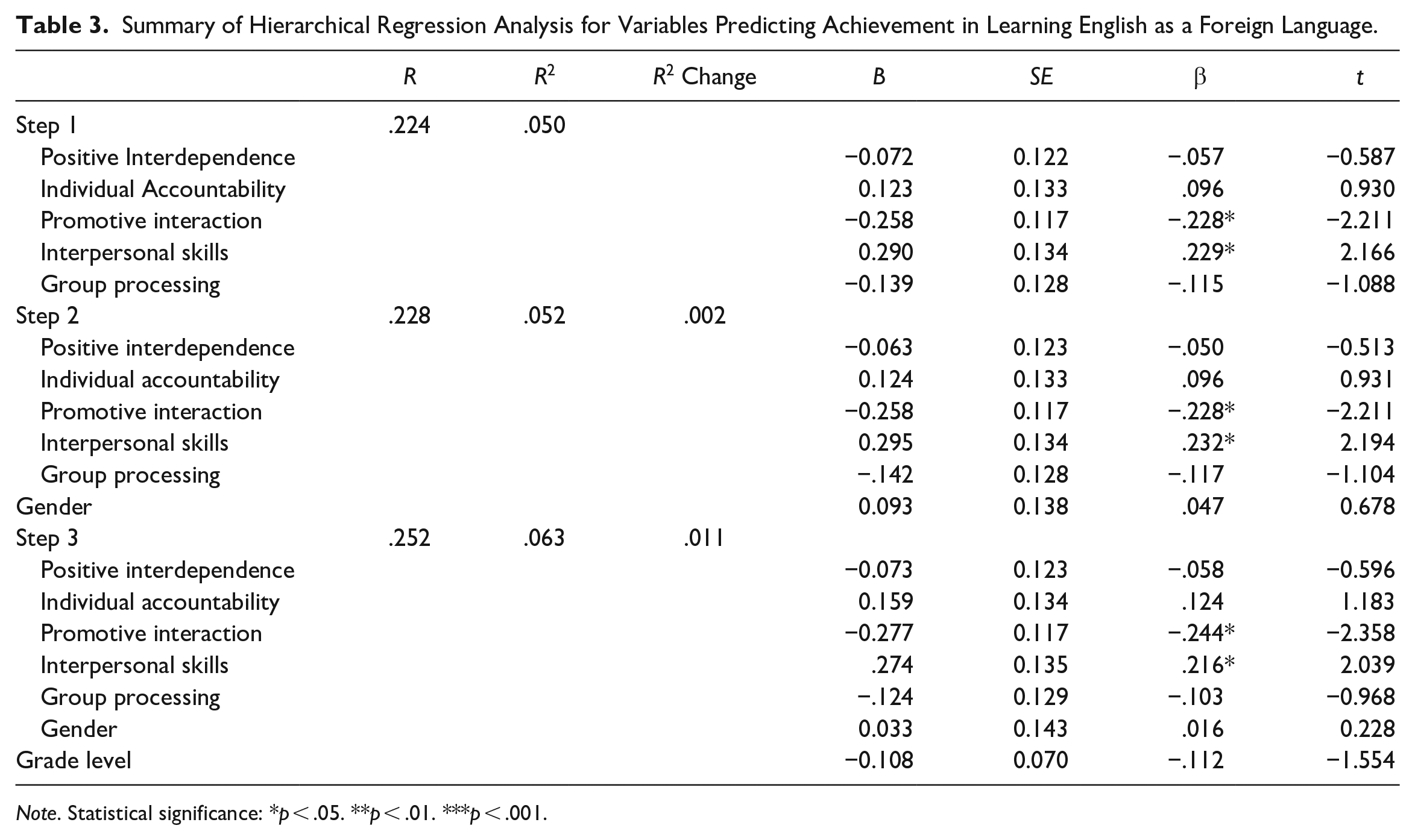
As within the previous hypothesis testing, in the first step of hierarchical multiple regression, five predictors were entered: positive interdependence, individual accountability, promotive interaction, interpersonal skills and group processing. This model was statistically insignificant F (5, 205) = 2.6; p = .060 and explained 2.7% of variance in the achievement in learning English as a foreign language. Two factors, namely promotive interactions and interpersonal skills made a significant unique contribution to the model (Table 3). After the participants’ gender was introduced at Step 2, the total variance explained by the model as a whole was 2.4% (F [6, 204) = 1.871; p = .087). The introduction of the participants’ gender as a covariate variable explained less 0.3% of variance in the EFL achievement, after positive interdependence, individual accountability, promotive interaction, interpersonal skills and group processing (R2 Change = .002; F [1, 204] = .459; p = .499) were controlled (Table 3). After the participants’ grade level was included at Step 3 the total variance explained by the model as a whole was 3.1% (F [7, 203] = 1.960; p = .062). The introduction of the participants’ grade level explained the additional 0.7 % of variance in the EFL achievement, after positive interdependence, individual accountability, promotive interaction, interpersonal skills and group processing (R2 Change = .011; F [1, 203] = 2.416; p = .122) were controlled. In the final adjusted model two out of seven predictor variables were statistically significant, with promotive interaction having a higher Beta value (β = −.244, p = .019) than interpersonal skills (β = .216, p = .043). The results showed that promotive interaction was a significant negative predictor while interpersonal skills positively predicted the students’ EFL achievement.
Summary of Hierarchical Regression Analysis for Variables Predicting Achievement in Learning English as a Foreign Language.
Note. Statistical significance: *p < .05. * *p < .01. * **p < .001.
Discussion
The present study findings point to an insignificant effect of gender on motivation for learning English as a foreign language and reveal that female students are more highly motivated than male students in terms of motivational strength, expectancy control and interest in foreign languages and cultures but not in terms of intrinsic motivation. This is in contrast with some previous findings which pinpoint gender as a significant impacting factor (Bećirović, 2017; Coleman et al., 2007; Dörnyei & Csizér, 2005; Henry & Cliffordson, 2013; Williams et al., 2002; Xiong, 2010) as well as with those findings which reveal that female students are more intrinsically motivated than male students (Carr & Pauwels, 2006; Vallerand & Blssonnette, 1992). Moreover, the participants’ motivation is not affected by their grade level, which is aligned with Balenovic (2011) and Berg and Corpus (2013). However, it is noticeable that both male and female participants in the current study demonstrated a rather high level of motivation for learning English as a foreign language. The lack of gender-based differences might be assigned to proper instructional setting these learners have been exposed to, so it seems that both groups have experienced EFL learning as the process in which they generally enjoy, readily participate, expect positive results and share equally high interest.
Contrary to some previous findings emphasizing gender relatedness to cooperative learning and female students’ increased performance achieved through cooperative learning tasks (Ellison & Boykin, 1994; Jordan et al., 2004; Rodger et al., 2007), the current findings indicate that gender is not an important factor in that respect and that male and female participants do not significantly differ in their application of cooperative learning. Likewise, the participants’ application of cooperative learning is not impacted by their grade level. Still, rather high scores were achieved on the cooperative learning construct, which can be observed through high mean values measured overall and, on every subscale, specifically. The students’ performance in two components of cooperative learning increases with each grade level, namely individual accountability and group processing. This indicates that the older the students get the more mature they become and they are prepared to accept responsibility for their contribution to the team and at the same time create a stimulating working environment by providing support and encouragement to each other. Moreover, the students achieved the highest score on the interpersonal skills subscale, with female students surpassing male students. Such findings seem to be well substantiated by a commonly-held belief about the communicative and emphatic nature of females, which enables them to verbally express their ideas and constructively resolve all the conflicts that arise.
With respect to the participants’ application of cooperative learning and motivation, the results demonstrate that they are very positive about the use of cooperative learning and also highly motivated for learning English as a foreign language irrespective of their age and gender. This might also be put forth as one of the plausible causes for a statistically insignificant impact of gender and grade level. Namely, the current study participants genuinely want to learn English, due to its global use and expansion in various international domains, and they consider it a useful tool for their future academic and professional achievements. In addition to this, the importance of obtaining higher English language proficiency is constantly emphasized and the English language course is an obligatory course throughout elementary and high-school education in Bosnia and Herzegovina (Bećirović, 2017; Brdarević-Čeljo et al., 2018; Brdarević-Čeljo et al., 2021; Dubravac, 2018; Dubravac et al., 2018; Kovačević et al., 2018; Laličić & Dubravac, 2021).
Numerous research studies conducted in different learning environments have reported high practical effectiveness of cooperative learning (Abrami et al., 2000; Johnson & Johnson, 1989; Slavin, 1995) and have also established a direct positive relationship between cooperative learning and the level of motivation (Johnson & Johnson, 2003; Law, 2008). The current study concurs well with the previous findings as the model measuring whether cooperative learning components are significant predictors of students’ motivation for learning English as a foreign language when age is controlled is statistically significant.
The most dominant cooperative learning predictor of motivation is the individual accountability component, which further substantiates the previous findings emphasizing the importance of personal responsibility in increasing the level of motivation (Stanton & Fairfax, 2007). Such findings might be explained by the fact that a large number of current study participants attend high schools which are not situated in the place of their residence. Attending those schools requires them to either travel alone or move to completely new surroundings. Thus, traveling or living separately from their families, the participants need to be more emotionally mature and take responsibility for their own actions. When they develop intense awareness of the fact that their individual performance will be assessed and that they are accountable for their own actions and performances and consequently for the overall group performance, their motivation increases. Likewise, peer pressure, which has a particularly powerful influence on adolescents, might also be a contributing factor, as team members deem each other responsible for their share of work (Johnson & Johnson, 1994) and individuals become more aware of their personal responsibility and more motivated to have a better performance and subsequently they achieve better individual competencies (Johnson et al., 1998).
The second significant cooperative learning predictor of motivation is the interpersonal skills component, which indicates that when the participants improve communication, listen to views of all group member, voice constructive criticism and become open to such criticism and different opinions, learn how to solve and overcome conflict situations, learn to ask good, clarifying questions (Tanner et al., 2003), they adopt more positive attitudes toward EFL learning and as a consequence their motivation for learning EFL strengthens. Acquiring and nurturing such interpersonal skills is of particular importance to adolescents, and accordingly to the current study participants, as they are passing through a rather turbulent period in which they are constantly striving to establish a sense of personal identity and foster positive social relationships for the purpose of experiencing a sense of belongingness (Grieve et al., 2013). Thus, when taught how to communicate their ideas to the group and solve conflicts constructively, the participants will gain a stronger sense of personal identity, which will help them overcome all the obstacles in foreign language learning and become more motivated in that respect. The stated results can be further substantiated by the fact that a large number of current study participants spend some time after school studying together within separate sessions devoted to repeating the content covered during that day and also do some group assignments outside of class through collaboration via group chats on different social media platforms, such as Facebook, Instagram as well as Viber and WhatsApp. This largely helps them establish effective communication, pay attention to what the others are saying and solve conflicting situations and hence improve their interpersonal skills. Thus, cooperative learning can be used as a suitable mechanism to prevent any motivation loss among high school students. Although they share relatively high motivation, it can still be improved, and collaborative task assignments clearly present one way of achieving this.
In addition to linking two components of cooperative learning to motivation, the current study model also links age as a controlling variable to motivation and reveals that age is a significant negative predictor of motivation for foreign language learning, which lends support to some previous findings reporting a decrease in motivation caused by age progression (Bećirović, 2017; Bernaus et al., 2007; Gardner et al., 2004; Inbar et al., 2001). Hence, Author 1 and Bećirović (2017) revealed a consistent age-triggered decrease in motivation, with the lowest level of motivation observed among the oldest participants, namely 18-year-old high-school students.
Research has also indicated that cooperative learning affects students’ achievement (Johnson & Johnson, 1989; Nichols & Miller, 1994; Slavin et al., 1984). This study does not appear to fully confirm previous findings as the model measuring the ability of the components of cooperative learning to predict achievement in learning English as a foreign language when the influence of participants’ gender and grade level are controlled was insignificant. However, two components of cooperative learning were dominant in the model and are deemed significant predictors of achievement in foreign language learning and those are promotive interaction and interpersonal skills, with promotive interaction being a negative predictor and interpersonal skills a positive predictor of students’ achievement. As pointed out earlier, developing interpersonal skills has multiple benefits for foreign language learning, and one substantial benefit is adopting positive attitudes to foreign language learning, which consequently leads to a greater achievement. Rather surprisingly, promotive interaction is confirmed to be a significant negative predictor of achievement, which might indicate that when our participants interact with other group members more, encourage and facilitate their efforts to fulfill tasks to reach the group’s goal, their focus fully shifts toward the group’s achievement, which might negatively impact their individual achievement in EFL learning.
As for the study’s limitations and suggestions for further research, experimental and quasi experimental research measuring the effectiveness of cooperative learning and its impact on students’ motivation and achievement could also be conducted and contribute to the study’s value. Thus, students’ motivation and achievement would be measured before and after the experiment involving the treatment by means of the cooperative learning method, which would clearly show whether students’ engagement in cooperative learning tasks improves their motivation and achievement in foreign language learning, particularly so when the results of the experimental group are compared with the results of the control group. In addition to this, the impact of some other variables could also be taken into consideration, such as the type of the task, time allocated for its performance, students’ previous exposure to collaborative tasks, as well as some demographic variables.
Conclusion
This study investigated whether cooperative learning predicts EFL motivation and achievement as well as whether some individual differences, namely gender and grade level, have an effect on EFL motivation and cooperative learning. Some general conclusions can be drawn from the obtained results, namely (1) high-school students are very positive about the use of cooperative learning and also highly motivated for learning English as a foreign language irrespective of their age and gender, (2) gender and grade level have an insignificant effect on the students’ application of cooperative learning as well as on their motivation for learning English as a foreign language, (3) cooperative learning is a significant predictor of motivation for learning English as a foreign language, with the most dominant cooperative learning predictor being individual accountability, followed by interpersonal skills, and (4) the overall model of cooperative learning has proved insignificant in predicting students’ achievement in foreign language learning, with two of its components, namely promotive interaction and interpersonal skills, being significant predictors of EFL achievement, the former a negative predictor and the latter a positive predictor.
The study’s practical relevance lies in identifying which cooperative learning components can contribute to higher motivation and achievement in learning English as a foreign language as these findings can help teachers shift their focus toward developing these skills and consequently lead to an increase in students’ motivation and achievement in learning EFL. Thus, teachers should incorporate more cooperative rather than individualistic activities in EFL teaching since cooperative work contributes to students’ overall motivation for EFL learning. When organizing such group activities, teachers should assess the performance of each individual in the group and identify those individuals who need some assistance in the process of learning English as a foreign language. This might contribute to students’ awareness of the fact that they are personally accountable for their own learning and that by taking concrete steps in that direction they can become more motivated for learning the language and increase their performance. Through well-structured group activities, teachers can also work on improving communication among group members, encourage students to express constructive criticism openly and make group members more tolerant and open to criticism, as well as apply certain tactics to teach students to overcome conflict situations. Such cooperative interactions and productive learning environments will also help students give and receive constructive feedback and establish and maintain good relationships. If this is achieved through well-organized group work, it can contribute to students’ higher achievement and motivation for learning English as a foreign language.
Footnotes
Declaration of Conflicting Interests
The author(s) declared no potential conflicts of interest with respect to the research, authorship, and/or publication of this article.
Funding
The author(s) received no financial support for the research, authorship, and/or publication of this article.
Ethics Statement
All procedures performed in studies involving human participants were in accordance with the required ethical standards.
