




Abstract
The study focused on the errors and misconceptions that learners manifest in the addition and subtraction of directed numbers. Skemp’s notions of relational and instrumental understanding of mathematics and Sfard’s participation and acquisition metaphors of learning mathematics informed the study. Data were collected from 35 Grade 8 learners’ exercise book responses to directed numbers tasks as well as through interviews. Content analysis was based on Kilpatrick et al.’s strands of mathematical proficiency. The findings were as follows: 83.3% of learners have misconceptions, 16.7% have procedural errors, 67% have strategic errors, and 28.6% have logical errors on addition and subtraction of directed numbers. The sources of the errors seemed to be lack of reference to mediating artifacts such as number lines or other real contextual situations when learning to deal with directed numbers. Learners seemed obsessed with positive numbers and addition operation frames—the first number ideas they encountered in school. They could not easily accommodate negative numbers or the subtraction operation involving negative integers. Another stumbling block seemed to be poor proficiency in English, which is the language of teaching and learning mathematics. The study recommends that building conceptual understanding on directed numbers and operations on them must be encouraged through use of multirepresentations and other contexts meaningful to learners. For that reason, we urge delayed use of calculators.
Background
As the Department of Education (2012) encourages integration of subjects such as the physical sciences, social sciences, and mathematics, one needs to have a good background of mathematics to do well in these subjects. Also science, technology, engineering, and mathematics (STEM) education (Basham & Marino, 2013; Bybee, 2013; DeJarnette, 2012) requires the integration of science and mathematics to help in solving real-world problems. In science, for example, there are calculations problems that require one to apply mathematical knowledge to solve them. In such cases, learners may be able to work out the scientific part, but when they come to the mathematics part, they fail to manipulate the calculations, especially those that involve directed numbers.
Regularly at the Association for Mathematics Education of South Africa conferences the concern is raised that learner performance in mathematics is very poor in South Africa when compared with other countries (Taylor & Vinjevold, 2013). The poor performance in mathematics contributes to shortages of mathematics teachers in South Africa; hence, this country relies mostly on the expertise of expatriates regarding engineering activities and medical needs like doctors. For example, in 2007, the South African government in a policy conference decided to accelerate the employment of foreign mathematics and science teachers as an intervention strategy to beef up the teaching and learning of mathematics and science in our country. The shortages of mathematics and science teachers could be due to the less production of good mathematics and science learners in Grade 12, and this could be due to the poor understanding of basic algebra concepts such as directed numbers from the lower grades.
The records of analysis of mathematics tests and examinations scripts done by school-based heads of departments indicate that learners experience difficulties in working with directed numbers. The topic directed numbers is one of the topics that constitutes fundamental mathematics background knowledge needed in algebra and higher mathematics. It is a topic that, if not attended well in Grade 8, might always contribute to poor performance in mathematics and other subjects as well because almost all calculations involve directed numbers.
Negative numbers are regarded as an extension of natural numbers, and these negative numbers are useful to describe values on scale that go below 0, such as temperature, and also in bookkeeping where they can be used to represent credits. In bookkeeping, amounts owed are often represented by red numbers or a number in parenthesis as an alternative notation to represent negative numbers. Negative numbers are referred to as those numbers less than 0, and nonnegative numbers are numbers that are positive and above 0.
Most employers are concerned that the matriculants who they absorb into their business sectors struggle with calculations on accounts because accounts involve the use of positive and negative numbers. In general, learners struggle with the manipulation of directed numbers.
Hayes and Stacey (1998) found that some learners hold fundamental misunderstandings on operations on directed numbers, such as the following:
(i) −3 + 5 = 8
(ii) −3 − 5 = 8
(iii) −3 × 5 = 15
(iv) −3 × (−5) = −15
In the first three of these cases, the learners totally disregard the negative signs! In the fourth case, the learner perhaps factored (−1); thus (−1)(3) × (−1)(5) = (−1)(3 × 5) = −15.
Such findings further reveal that negative numbers are difficult to teach. Hence, many students experience learning difficulties, starting with subtracting a large number from a smaller number because learners think they cannot take away what they do not have. Olivier (1989) regarded misconceptions as faults in the thinking of a person.
Research Questions
This study was guided by the following questions:
Rationale
The South Africa mathematics item analysis in 2013 showed that in all the grades at school, the topic that is performed most poorly is one that involves directed numbers. At the Circuit cluster meeting intervention workshop in 2013, teachers who teach both mathematics and physical sciences in the Further Education and Training (FET) band raised a concern that learners seem to have misconceptions on working with directed numbers as they make a lot of errors in calculations that involve negative numbers. The concerns also indicated that it is not only mathematics that is affected by these errors and misconceptions but also subjects like physical sciences, accounting, geography, and so on. In 2011, at a meeting on learner performance, parents at Jacob Mdluli Secondary School raised concern that their children’s consistent poor performance in mathematics across all grades compromised their children’s future. It then became clear that an urgent intervention was needed because mathematics is one of the key subjects to a brighter future. On the basis of the observations and comments mentioned above, the researchers deemed it fit to study the errors and misconceptions in the learning of addition and subtraction of directed numbers at Grade 8 where the topic of directed numbers is introduced at secondary school as understanding of directed numbers is basic to proficiency in mathematics.
Theoretical Framework
In view of the challenges faced in the teaching and learning of mathematics, Olivier (1989) advocated for the application of clearly articulated theories to overcome these challenges. Olivier cautioned that “teachers are often wary of theory—they want something practical” (p. 1). However, as Dewey pointed out, “in the end, there is nothing as practical as a good theory” (Lewin, 1951, p. 169). Why? Because theory is like a lens through which one views reality, it is like a torch in a dark cave in a dark night. It influences what one sees and what one does not see (Anfara & Mertz, 2014; Olivier, 1989), and thus, ultimately, influences what one really does. If the theory is inadequate, one’s thoughts are blinkered and limited; thus, one acts on the basis of faulty information. Facts and action can only be interpreted in terms of some theory as theory stands for meaning making. Without an apt theory, one cannot state what the actual facts are, and therefore, one works on the presupposition of mistaken knowledge, which results in uneconomic and ineffectual practice.
As the origin of many difficulties in learning mathematics today that results in errors and misconceptions is misunderstanding, the notions of relational and instrumental understanding (Skemp, 1987) informs this research. According to Skemp (1987), relational understanding refers to when a person gets to comprehend and know something by actually working it out inductively from different instances until a concise algorithm for it is formulated. It is explained as an understanding of knowing how a generalization was arrived at so that though one may forget it he or she will still be able to reconstruct the ideas to work out the given problem at any time. On the contrary, an instrumental understanding is deductive, it refers to remembering a formula and its application only but not how it was derived (Skemp, 1987). For example, one can know that the formula to calculate the area of a triangle is A = ½ base × height without knowing how it was derived. Such understanding only enables one to use the formula to get correct answers and ultimately claim that one understands how to determine areas of triangles, whereas in actual fact, they do not understand because if they may forget the formula, they will not be able to work out the problem (Sarwadi & Shahrill, 2014).
According to Makonye (2012), misconceptions are the underlying wrong beliefs and principles in one’s mind that causes a series of errors. So Skemp’s notions help us to see which understanding is responsible for errors and misconceptions on operations on directed numbers.
The theory of constructivism (Meyer, 2009) is apparently supportive to relational understanding because it informs that in the learning process, for example, in the learning of addition and subtraction with negative numbers, giving ready-made rules will not be helpful, rather a learner must be provided with opportunities to be an active participant in the construction of his or her own understanding about addition and subtraction of directed numbers. The theory of constructivism argued for by von Glasersfeld (1989) holds that learning occurs as a result of the interaction of a child’s existing ideas and new ideas, that is, new ideas are interpreted, organized, and understood in light of the child’s own current knowledge. If learners are not given that opportunity to recreate ideas, it will mean for them merely using rules and formulae to fulfill the ritual of getting correct answers. Skemp (1987) pointed out that being based on rote learning, instrumental understanding was difficult to remember and apply in new contexts because it was shallow and meaningless. So instrumental understanding may be the basis of many mistakes in the work that involves, for example, negative numbers as learners try to apply partially meaningless rules that fail to properly relate to what they know; for example, a negative number times a negative number results in a positive number. To be viable, to be connectable to other mathematics concepts, knowledge has to be recreated by the learner; but it does not mean that they can make them any way they like as construction of knowledge is constrained. According to von Glasersfeld (1987), facts are considered viable as long as they do not clash with experience.
Learning mathematics can also be viewed in terms of the acquisition metaphor and the participation metaphor (Sfard, 1994). This happens in discourses (Sfard, 2014). According to Sfard (1994), an acquisition metaphor regards learning as accumulation of knowledge that is gradually refined and combined to form an ever richer cognitive structure. With the acquisition metaphor, knowledge is seen as a thing that one can have or not have. The acquisition metaphor views learning as an individual activity, in the sense that the learner as a person is the one who actively constructs meaning of the cognitive structures in his or her mind. So this notion of acquisition metaphor is apparently tantamount to the theory of constructivism as the learner is a constructor of his or her conceptual structures: the schemas. On the contrary, the participation metaphor does not regard learning as a thing to be acquired but rather as participation in a community of practice through a process of legitimate peripheral participation (LPP; Lea & Nicoll, 2013). Thus, as a learner participates more and more in a practice, he or she uses the resources of the practice as he or she develops from a newcomer to a master of the trade. We explain that if learners do not participate by answering questions, posing questions, doing exercises, discussing with others, and using their creativity to solve problems, they remain at the periphery where they remain holding various mathematical errors and misconceptions. In the same way, teaching strategies that maximize learners’ participation in mathematics classes help learners to learn and resolve their errors and misconceptions.
Also Baroody and Dowker’s (2013) explanation of mathematical proficiency is chosen to capture what is believed is necessary for anyone to learn mathematics successfully. Schoenfeld and Kilpatrick (2008) proposed that mathematical proficiency has five components or strands, which are as follows:
Conceptual understanding—comprehension of mathematical concepts, operation, and relation.
Procedural fluency—skill in carrying out procedures flexibly, accurately, efficiently, and appropriately.
Strategic competency—ability to formulate, represent, and solve mathematical problems.
Adaptive reasoning—capacity for logical thought, reflection, explanation, and justification.
Productive disposition—habitual inclination to see mathematics as sensible, useful, and worthwhile, coupled with a belief in diligence and one’s own efficiency.
It was argued that the five strands are not independent, though they represent different aspects of mathematical proficiency; they are interwoven and interdependent in the development of proficiency in mathematics. Schoenfeld and Kilpatrick’s (2008) interpretation of mathematical proficiency informs that every important mathematical idea, including that of negative numbers, can be understood at many levels and facets. If any facet is misunderstood, that can result in errors and misconceptions.
Research Design
Qualitative research approach has been used in this research. Of the challenges in answering tasks on addition of directed numbers with no preconceived hypothesis to be tested, this approach was more preferable than the others because one would be able to describe systematic observation on the study (McMillan & Schumacher, 2014). After that, errors on written tasks on directed numbers were noted. Basing on those errors, in-depth interviews (Mears, 2012) were held with the learners to further elicit and probe learners’ thinking behind those errors. As this research was seeking to find the errors and misconceptions in addition of integers, in-depth interviews were viewed to be helpful to gain better insight into the categories of errors and misconceptions that the learners exhibited, and find out the causes thereof.
The sample consisted of 35 Grade 8 learners (16 boys and 19 girls) of Jacob Mdluli High School in Mpumalanga, South Africa. This was a class taught by one of the researchers. Sixteen learners were of below-average mathematics performance, 10 learners were of average, and the last nine learners were above average in mathematics performance. Written tasks on addition and subtraction of directed numbers were given to the learners, and their exercise books were analyzed. Learners who performed poorly in the written tasks were interviewed to get an understanding of the errors and misconceptions they exhibited in the tasks. Six learners were individually interviewed (three boys and three girls) in about 25 min by both the researchers. We needed to understand learners’ reasoning within and beyond their written responses on the tasks. We wanted to provide the learners with an opportunity to say more than they wrote and also check whether we had interpreted their responses correctly or the learners themselves had understood their own thinking.
All ethical protocols were strictly followed and adhered to.
Data Analysis
Schoenfeld and Kilpatrick’s (2008) mathematical proficiency framework was used to categorize learner errors in the addition and subtraction of directed numbers. This means the first research question was analyzed by identifying and noting the frequencies of the following types of errors: misconception (poor conceptual understanding), procedural errors, strategic errors, logical errors (poor adaptive reasoning), and, last, the poor attitude to learning of directed numbers (poor productive disposition) in mathematics.
Learners’ Exercise Books Analysis
We viewed 35 learners’ exercise books on how they answered tasks on addition and subtraction of directed numbers to answer the question “What categories of errors do learners have in answering questions on directed numbers?”
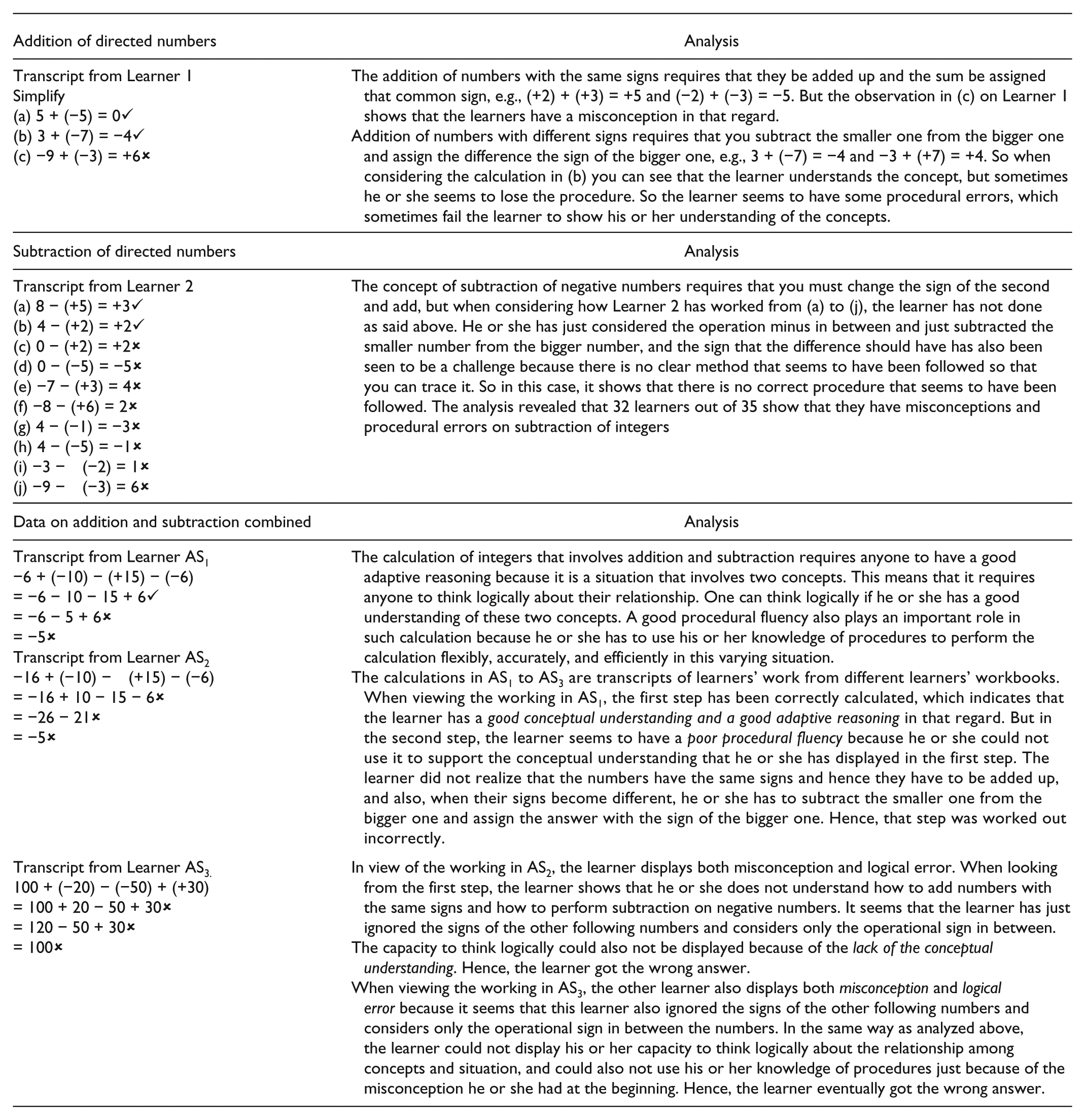
Task Analysis
This analysis is focused on the task on the topic of directed numbers. It is a task that includes arranging directed numbers in ascending order, addition and subtraction, multiplication and division, directed numbers on a number line, and word problem on directed numbers. What appears on the left reflects the exact responses of the learners.
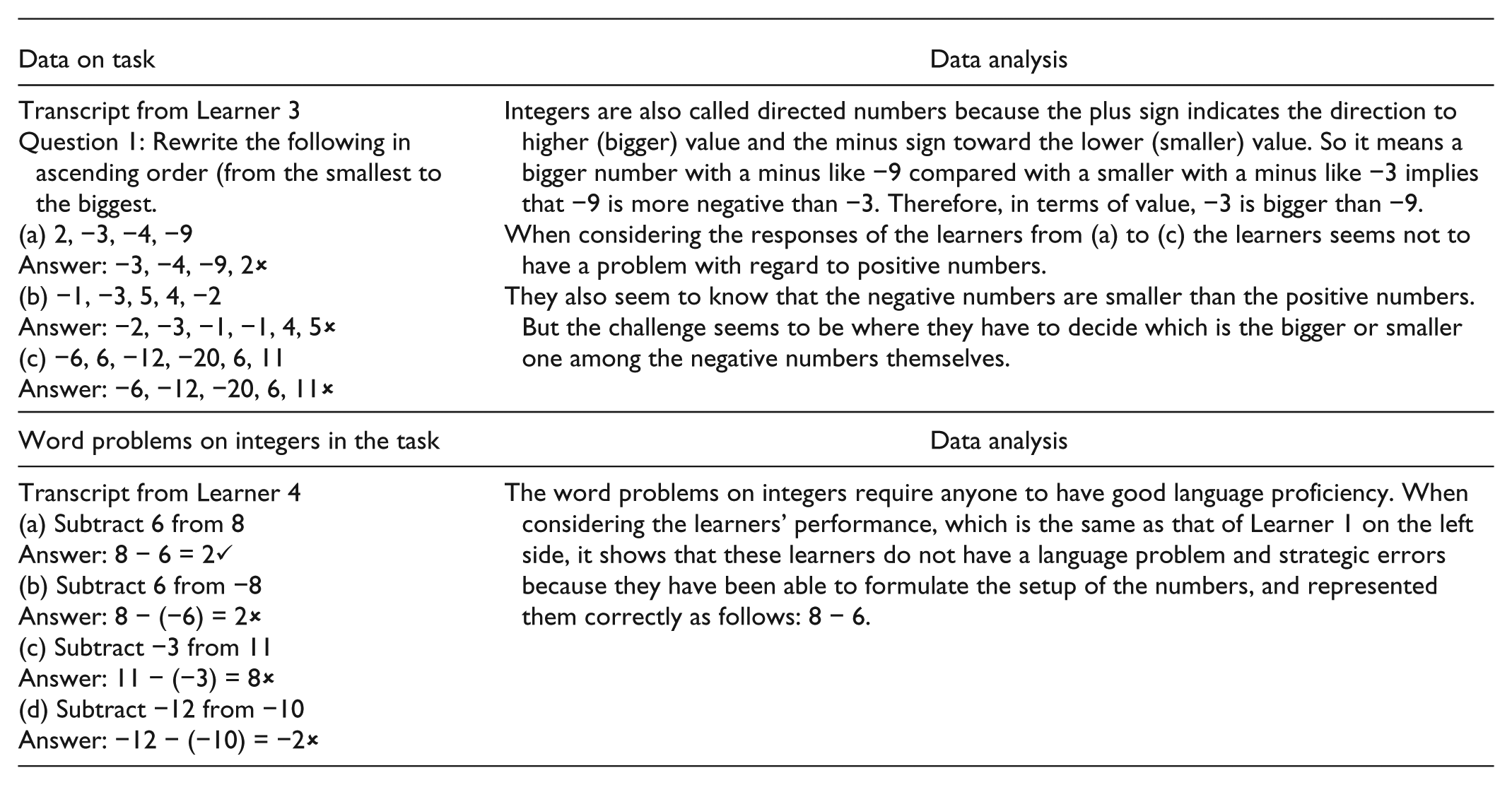
Analysis of Interviews
The discussion in this section is aimed at answering two research questions put at the beginning of this article. The underlined clauses are the highlights of the errors and misconceptions that the learners have.

Quantification of the Findings
From Table 1, the analysis of book viewing and the task shows that 57% of 35 learners have misconceptions in the learning of integers. The learner interview data analysis revealed that 83.3% of 35 learners have misconceptions. From interviews, we found that learners found some answers correct in the written tasks by fault thinking. The misconceptions are exhibited in numbers with the same or different signs in front of them.
Percentage of Errors and Misconceptions in Learners’ Written Work.

Table 1 also shows that 62.9% of the learners have procedural errors when dealing with operations on directed numbers. From Table 2, the analysis of the learner interview confirms the existence of procedural errors by indicating 16.7% of learners. The procedural errors are about failure of the learners to manipulate the signs in front of the numbers in conjunction with the sign in operation, which is either a plus or a minus. From Table 1, we also learn that 67% of the learners out of 35 have strategic errors, and 28.6% of them have logical errors, but in Table 2, the interview analysis could not confirm both strategic and logical errors. The failure of the interviews to confirm these types of errors could be because the misconceptions overwhelm the situation.
Percentage of Errors and Misconceptions in Learner Interviews.

The data analysis on the learners’ work also revealed that 34.3% of the learners have poor proficiency of the language used in the learning of integers, which results in errors (Table 1). This challenge of language is also confirmed from interview data (Table 2), where 83.3% of learners make errors because of poor understanding of English.
It was not possible to assess the level of productive disposition of the learners through workbook viewing and task analysis, but the interview analysis indicated that there is 0% of poor attitude in the learners toward learning of integers.
Discussion
With learner errors and misconceptions in working with directed numbers in mind, data collected from learners’ exercise books and interviews were analyzed through Schoenfeld and Kilpatrick’s (2008) five strands of mathematical proficiency. We rush to point out that these errors were not independent; thus, poor conceptual understanding intimately affected errors in other strands such as procedural fluency and so on.
A major obstacle in students’ learning that we had not factored in was students’ poor command of the English language, which is predominantly used during instruction. We found out that learners’ epistemic access to knowledge of directed numbers was affected in that first they had to negotiate the language of teaching and learning, that is, English, for them to gain mathematic epistemic access. Even mathematics itself is a language (Brown, Cady, & Taylor, 2009). It has its own terminology, which is different from English. For example, what does directed number mean? This is a precise mathematics term that strictly does not mean anything much in English. So learners had to contend with two language barriers before learning mathematics properly: English language as well as mathematical language. As Vygotsky (1978) argued, language is critical in the meditation of learning. If language is not transparent, then the object of learning becomes invisible. Students could not construct mathematical meaning in the realm of directed numbers if the medium of learning was not transparent. They could not assimilate concepts of directed numbers into the schema of number they built from primary school. That way, when they performed operations on directed numbers, they adhered to their primary school number schemas, that is, 8 − (− 6) = 2, and when asked to arrange the set of four given numbers in ascending order, some wrote as follows: −3, −4, −9, 2. Such errors show that students are fixated to primary school arithmetic schemas, that is, 8 − 6 = 2. Also taking from their primary school knowledge that 9 is bigger than 2, they believe that −9 is bigger than −3! One learner on being asked about that said “. . . because 9 is more than 3, so −9 is more than −3 . . . more is more . . .” The learner was considering absolute values of the numbers. We noted that learners struggle to deal with mathematical procedural knowledge (Hiebert & Lefevre, 1986). Mathematics procedural knowledge deals also with understanding of and the ability to use mathematical notation. So some of the learners’ errors were procedural due to lack of familiarity with mathematical notation; in this case, students only noted the similarity of 9 and −9—their absolute value, |9| = |−9|. They had partial understanding of the relationships between the two numbers. They could not, however, notice the differences of the two numbers. In the Sfard (1994) sense, it would seem that such misconceptions are caused by lack of meaningful participation in mathematics sense making as well as a misunderstanding of the tools in a community of practice: the mathematics class. More participation would lead to acquisition of mathematical concepts, directed numbers, and operating with them.
We noted a display of rote learning of symbols without relating to the real context: a form of instrumental understanding (Skemp, 1987). Perhaps the use of models for teaching directed numbers could help learners construct relational and conceptual understanding. The use of models such as number lines or use of examples of above the ground and basement floors in high-rise buildings (if available) could help; for instance, asking the question, “Which person is higher, one on the −2 floor (two floors below ground level) and one on −5 floor (five floors below ground level)?” Such realistic metaphors might help learners to develop a sense of directed numbers. We noted that premature use of calculators can predispose instrumental understanding rather than relational understanding of directed numbers as some learners hurried to use the calculators. Because the learners had no understanding, they had no idea of how to check whether their answers were right or wrong if, for example, they punched the buttons wrongly. Use of calculators must be delayed until learners have developed relational understanding of directed numbers, although they can still be used intelligently in an exploratory sense. We think that relational understanding of directed numbers develops slowly, but once developed, the copious time spent in developing it will be more than rewarded in the ease with which students will learn future mathematics topics in which this notion is always inherent, including applications to science.
Conclusion
The poor performance of learners in schools, the failure of the first-year students to cope with the university mathematics, and the failure of the postmatriculants to handle tasks that involve directed numbers in the workplace necessitated the research on learners’ errors and misconceptions on directed numbers in Grade 8.
In conclusion, in the research about what errors and misconceptions the learners have in the learning of directed numbers in Grade 8, we have used Schoenfeld and Kilpatrick’s (2008) five strands of mathematical proficiency to analyze the learners’ written work and learner interviews, and identified the following errors and misconceptions.
Errors and Misconceptions
In the learners’ exercise books, there was hardly any work showing relational understanding. This means that the entire learning of directed numbers was through instrumental understanding. The analysis of the learners’ interviews confirmed the persistence of learner errors. Eighty-three percent of learners had misconceptions, and 17% showed procedural errors. It was difficult to come up with strategic and productive disposition errors for this group. The analysis of the learner’s work and learner’s interview further indicated that English as a medium of instruction and assessment potentially increased difficulties in the learning of addition and subtraction of integers. The analysis of the learners’ work in the workbooks and in the tasks showed that 34.3% of learners have poor proficiency in English, and the analysis of the learners’ interviews confirmed this by indicating that 83.3% of learners have poor proficiency in English.
Causes
The analysis of the learners’ work in workbooks and tasks indicate that the causes of the challenges in the learning of integers in Grade 8 is lack of the use of number line model as a strategy to show relational understanding of addition and subtraction of directed numbers. The analysis of the learners’ interviews indicated that the causes of errors in the learning of integers are the premature use of calculators, textbooks with insufficient examples, and poor proficiency of the learners in English. The poor attention of some learners during lesson presentation could be a result of the fact that directed numbers are not placed in a real-life context that learners can relate to.
Recommendation
In the light of the findings, we recommend that conceptual understanding of directed numbers needs to be foregrounded before procedural knowledge. The study recommends the use of models—number line, stake or row model of colored cubes, and others—to help learners understand the concept of directed numbers and how to add and subtract directed numbers. We encourage the deliberate use of code-switching between the learners’ mother tongue and English to overcome the English language barrier to learn directed numbers.
Footnotes
Declaration of Conflicting Interests
The author(s) declared no potential conflicts of interest with respect to the research, authorship, and/or publication of this article.
Funding
The author(s) received no financial support for the research and/or authorship of this article.