




Abstract
Despite its importance being acknowledged in a plethora of studies, developing reading strategies appears absent from many classrooms, which justifies a considerable research interest in this topic. The present study aims to investigate how gender, nationality, and grade point average affect the frequency of the usage of different types of reading strategies among Bosnian university students. The research sample comprised 228 students studying at three universities in Bosnia and Herzegovina. The analysis revealed moderate to high awareness of reading strategies, the problem-solving strategies being most frequently used. A three-way ANOVA showed a significant main effect of gender as well as a significant interaction effect of Nationality × Grade Point Average on The Survey of Reading Strategies questionnaire. Moreover, a three-way MANOVA revealed that gender had a significant main effect on the combined variables, namely global, support, and problem-solving reading strategies. Similarly, the interaction effect of Nationality × Grade Point Average was significant on the three combined variables, while the interaction effects of Grade Point Average × Gender and Grade Point Average × Nationality proved significant only on the Problem-Solving subscale. The current study is expected to contribute to understanding the reading strategy use in a foreign language context, and to inspire educators to recognize the importance of their use in the classroom.
As a core language skill (Levine, Ferenz, & Reves, 2000; Maasum & Maarof, 2012) and one of the main tools for independent language learning (Carrell & Grabe, 2002), reading has occupied a prominent place within language classrooms since the very onset of systematic language teaching and learning dating back to 4,000 years ago (Fotos, 2005). However, the conception of one’s competence to read in the target language has been redefined over the course of time. Once perceived as mere decoders of images imprinted on a page (Carrell, Devine, & Eskey, 1988), readers have taken a more active role and efficient readers are now deemed constructively responsive readers (Pressley & Afflerbach, 1995), “strategic meaning-makers” (Lawrence, 2007, p. 55), and self-regulated readers (Nash-Ditzel, 2010). Reading started being viewed as a psycholinguistic game (Goodman, 1967) in which meaning is deciphered by relying on the text, context, and background knowledge (Pritchard, 1990) in the process of fluent and strategic reading (N. J. Anderson, 2003a), with the former usually seen as the aim of the instruction, and the latter as a means of gaining it.
It soon became evident that a thorough understanding of the text is not gained automatically, especially in the case of second and foreign language learners, but it entails using controlled deliberate acts, that is, reading strategies (Afflerbach, Pearson, & Paris, 2008). Through extensive research it has been demonstrated that planning, monitoring, and evaluating the whole process of reading differentiates skilled from unskilled readers (Pressley & Afflerbach, 1995; Sheorey & Mokhtari, 2001), contributing greatly to a considerable increase in their reading proficiency. Thus, the awareness of those acts, which correlates with the use of metacognitive strategies (MS), is believed to eventually lead to an efficient learning process (N. J. Anderson, 1991; Chamot, 2005; O’Malley & Chamot, 1990; Oxford, 1990; Sheorey & Mokhtari, 2001), making reading an easier, enjoyable experience (Oxford, 1990) which simultaneously improves learners’ independence and autonomy (R. C. Anderson, 1984; Carter & Nunan, 2001).
However, despite their efficacy, reading strategies are still absent from many classrooms (Pressley, Wharton-McDonald, Mistretta-Hampston, & Echevarria, 1998) and a full awareness of their importance has not still been raised in practice. Thus, many second and foreign language students, once they encounter academic texts in the target language, experience particular difficulty, and then, not having been properly trained in that respect (Dreyer & Nel, 2003), they apply wrong strategies (Wood, Motz, & Willoughby, 1998) and not rarely feel frustrated and disappointed when experiencing difficulties in understanding the content (Nalliveettil, 2014). Therefore, there is a compelling need to introduce teachers, and students in particular, to the reading strategies inventory and to raise awareness of their use, which might lead to a noticeable improvement in their reading skills (Cantrell, Almasi, Carter, Rintamaa, & Madden, 2010; Mijušković, 2014; Mijušković & Simović, 2016; Sheorey & Mokhtari, 2001).
Bosnia and Herzegovina (B&H) is a country where English has become the most prevalent foreign language (Buckingham, 2016; Dubravac, 2016), being learned formally through educational institutions but also as a global lingua franca easily acquired via the media, the Internet, and additional language courses. Despite the fact that all skills are regularly practiced in a formal educational milieu, reading appears to be, in the opinion of elementary and high school students, the second most practiced skill and, at the same time, in the opinion of English language teachers, the easiest one (Ogrić-Kevrić & Dubravac, 2017). However, the easiness here does not refer to approaching texts in a strategic way but to the accuracy in reading and translating texts, as one of the ultimate objectives of teaching reading is perceived by the majority of teachers and students. Thus, raising awareness of the use of different reading strategies might effect change in the conception of reading, its importance, and potential. The aim of this article is to investigate the use of MS by English as a Foreign Language (EFL) university-level learners exposed to English in different learning environments in the Bosnian context, largely underexplored so far. Addressing the issue of reading strategies is believed to make both learners and teachers more aware of their importance in the whole process of language learning.
Literature Review
The term “metacognitive strategies” was first introduced in the 1970s by Flavell (1976), who defined these types of strategies as “one’s knowledge concerning one’s own cognitive processes and products or anything related to them” (p. 232). In other words, MS refer to “thinking about thinking” (N. J. Anderson, 2002, p. 23) or the self-awareness of mental processes (Byrd, Carter, & Waddoups, 2001) employed while striving to understand the message conveyed. Up to the present days, metacognitive reading strategies have been classified in different ways (O’Malley & Chamot, 1990; Oxford, 1990; Sheorey & Mokhtari, 2001) and explored by the use of various instruments, including Metacognitive Awareness of Reading Strategies Inventory (MARSI; Mokhtari & Reichard, 2002) and the Survey of Reading Strategies (SORS; Mokhtari & Sheorey, 2002; Sheorey & Mokhtari, 2001) which stand out as the ones used in a broad range of first, second, and foreign language learning contexts among adult students reading school-related or academic English. The instruments were designed to explore students’ awareness of the reading strategy use in three aspects, namely cognitive, metacognitive, and supportive (Sheorey & Mokhtari, 2001), later renamed into global reading strategies (GLOB), problem-solving reading strategies (PROB), and support reading strategies (SUP) (Mokhtari & Reichard, 2002; Mokhtari & Sheorey, 2002).
GLOB refer to the preparatory activities for the reading task such as setting the purpose of reading, predicting the meaning of the text, and deciding on the message how to approach it (Mokhtari & Reichard, 2002). PROB include while-reading activities which might enhance the reading performance such as adjusting the rate of reading, rereading some parts, and using context to understand unknown words (Mokhtari & Reichard, 2002). SUP denote some additional actions which might assist in a better performance of the reading task. They include taking notes, paraphrasing, underlining, summarizing, using dictionaries, or discussing the text (Mokhtari & Reichard, 2002).
Investigating the perceived use of the aforementioned strategies in different learning contexts, for instance, Turkish (Solak & Altay, 2014; Yuksel & Yuksel, 2012), Iranian (Tavakoli, 2014; Zare & Maftoon, 2014), Taiwanese (Chen & Chen, 2015; Lien, 2014), Japanese (Shikano, 2013), and Omani (Alami, 2016), the scholars have asserted that students have a moderate to high awareness of reading strategies. Furthermore, excluding Tavakoli’s (2014) results suggesting the most frequent use of support, followed by GLOB and PROB, the other studies have mainly indicated students’ clear preference for PROB over the other two. In most of the enquiries (Alami, 2016; Shikano, 2013; Solak & Altay, 2014; Yuksel & Yuksel, 2012; Zare & Maftoon, 2014), SUP were least used. Students generally appear to approach the text with as little effort as possible, so they employ most of those strategies directly related to reading itself, while they tend to disregard those associated with preparing for reading and especially those denoting the use of some additional resources, enhancing reading comprehension. Following this, it appears that various variables exert an impact on the strategy use, such as the approach to teaching reading, students’ proficiency level, and their field of study and gender differences, to name a few.
The studies (Alhaqbani & Riazi, 2012; N. J. Anderson, 2003b; Karbalaei, 2010; Sheorey & Mokhtari, 2001) comparing two groups of participants acquiring English in different learning contexts confirmed the difference exists either in the overall use of MS or in some subtypes, although reaching more detailed conclusions seems rather difficult. For instance, exploring the differences in the metacognitive awareness and perceived use of strategies by U.S. native English speakers and Moroccan college students as English as a Second Language (ESL) learners, Sheorey and Mokhtari (2001) suggested that ESL learners generally used strategies more than native speakers. When ESL and EFL groups of students were compared in the studies by Anderson (2003b) and Karbalaei (2010), the former indicated that EFL students used more reading strategies, while the latter suggested the opposite. Thus, although the learning context might present a significant determinant affecting metacognitive reading strategy use, it is definitely not the only contributory factor, so a study investigating the mutual impact of more variables might reveal more precise results.
Gender-based differences have attracted a keen interest of many scholars exploring reading strategy use (Abu-Rabia, 1999; Bugel & Buunk, 1996; Chavez, 2001; Green & Oxford, 1995; Kaylani, 1996; Mayer, 1996; Sheorey, 1999; Sheorey & Mokhtari, 2001). In general, most research results have demonstrated that females use reading strategies more frequently than males (Bećirović, Brdarević-Čeljo, & Sinanović, 2017; Dreyer & Oxford, 1996; Green & Oxford, 1995; Kaylani, 1996; Oxford & Nyikos, 1989; Phakiti, 2003; Sheorey, 1999), although, similarly to the other variables explored, some results have revealed quite the opposite (Baily, 1996). Furthermore, the dominance of males in the use of some strategies and females in the use of others was also observed (Brdarević-Čeljo & Asotić, 2017; Goh & Fong, 1997; Lee, 2012). The findings of the studies using MARSI or SORS are similarly conflicting, either revealing a significantly greater use of reading strategies, overall and different subtypes, by female students (Alami, 2016; Chen & Chen, 2015; Poole, 2009; Sheorey, 2006; Sheorey & Baboczky, 2008), or challenging such an overwhelming dominance of females participants (Kamran, 2013; Lien, 2014; Mahasneh, Alkhawaldeh, & Almakanin, 2016; Poole, 2005; Sheorey & Mokhtari, 2001, for ESL learners; Shikano, 2013; Tavakoli, 2014).
Despite the fact that the topic of reading strategies has been investigated in different contexts, it has remained an underexplored topic in B&H. However, a few studies from neighboring countries have shown that teaching MS improves reading comprehension (Kolić-Vehovec & Bajšanski, 2003; Mijušković, 2014; Mijušković & Simović, 2016) and that more proficient foreign language users employ strategies such as summarizing, taking notes, and applying gained knowledge more often than those less proficient ones. Mikulec (2016) analyzed the use of MS while reading academic texts in the 124 participants’ native Croatian language and in English as a foreign language. The results indicated that students use similar strategies in L1 and L2, their use being highly correlated with the language proficiency. Furthermore, the author concluded that there is a significant correlation between the use of strategies and students’ grade point average (GPA) as well as the grade obtained in related courses.
Such results indicate that a wider context should be taken into account, and that numerous other factors may impact the choice and frequency of strategy use, so the investigation of the interaction effect of multiple factors might offer some new insights into the strategy use, which is what the current study attempts to do.
Method
The design employed in the current study is what differentiates it from many others tackling the same issue. Besides descriptive results, reported in most of the previous research, we also measured how different factors, such as nationality, gender, and GPA, acting and interacting simultaneously, affect the application of various types of reading strategies. As many factors concomitantly affect the dependent variables, this study yields unique results as we investigate a common influence of different factors on diverse types of reading strategies as well as combined types. This provides a more holistic picture about the perceived use of reading strategies in the Bosnian EFL context. Thus, the present study aims to investigate how gender, nationality, and GPA affect the frequency of the usage of different types of reading strategies in this specific context. Therefore, the following hypotheses were tested:
Participants
The research sample comprised 228 university students. The stratified random sampling method was employed in the process of participant selection. The participants were students from three universities in B&H: 53 participants from one public university located in Zenica-Doboj Canton, 115 students from one private international university, and 60 participants from another private university, both located in Sarajevo Canton. Students studying at two private universities come from the Balkan region and Turkey, with some students from other countries around the world as well. The research sample was composed of 149 female and 79 male participants, with the age span from 18 to 35 (M = 21.4, SD = 2.43). The respondents were 131 Bosnian students, 65 Turkish students, and 32 students of other nationalities, all of them being either freshmen, sophomores, juniors, seniors, or master-level students. Based on the students’ GPA, the research sample includes four groups: Group 1 with GPA 5 to 6.99, Group 2 with GPA 7.0 to 7.99, Group 3 with GPA 8.0 to 8.99, and Group 4 with GPA 9.0 to 10. A detailed description of the participants is provided in Table 1.
Descriptive Analysis of Participants.

Note. GPA = grade point average.
Measures
The data for this research were collected by employing the SORS developed and validated by Mokhtari and Sheorey (2002). SORS was developed to measure the frequency of students’ perceived use of different reading strategies, and it consists of 30 statements, each of which uses a 5-point Likert-type scale ranging from 1 (“I never or almost never do this”) to 5 (“I always or almost always do this”). It showed high reliability (α = .89) and is composed of three subscales: GLOB (α = .92), SUP (α = .87), and PROB (α = .79). The GLOB subscale includes 13 items, with an item example being “I take an overall view of the text to see what it is about before reading it.” The SUP subscale encompasses eight items and an example item of this subscale is “I take notes while reading to help me understand what I read,” whereas the PROB subscale consists of nine items, with an example item “When text becomes difficult, I re-read it to increase my understanding.”
The instrument comprises two sections: Section A containing items related to demographic variables and Section B contains items related to the type of reading strategies. The data about participants’ GPA were collected through students’ self-report statements. Based on the grading system used in the Bosnian higher education, the minimum possible grade is 5 and the maximum is 10.
Procedures
After obtaining adequate informed consent from the universities’ administration and participants themselves clarifying anonymity, confidentiality, and the volunteer nature of participation, the inventory was administered to the students in classrooms through undergraduate and graduate English language courses, with the explanation on how to complete Likert-type scales being provided by the researchers themselves. As the medium of instruction at two international universities is English and as the public university participants study at the Department of English Language and Literature, there was no need for the translation of the instrument; thus, the original version of SORS was utilized. The participants also answered several demographic questions, for example, their nationality, gender, type of the university they study at, and GPA. The average time spent on completing the inventory was around 15 min and no financial or any kind of compensation was granted for the participation. The students were kindly asked to read each statement carefully and denote the number that indicates the frequency with which they use the reading strategy suggested in the instrument.
Data Analysis
By using Amos 23.0, the confirmatory factor analysis (CFA) was employed to confirm the theory-based factor structure of the reading strategy use assessed by 30 items. Based on the results of CFA, by using SPSS 23.0, the following analysis was performed. Following the guidelines provided by the authors of SORS (Mokhtari & Sheorey, 2002), frequencies and means, including the subscales, were computed to ascertain the frequencies and the types of the strategies used by the participants. Higher means indicate a more frequent perceived use of the reading strategy concerned. The scores on the scales were interpreted based on the interpretation key provided by the authors of SORS which is based on Oxford and Burry-Stock’s (1995) interpretation of general learning strategy usage. Thus, Mokhtari and Sheorey (2002) determined three levels of reading strategy usage as high (the mean of 3.50 or higher), moderate (the mean of 2.5-3.49), and low (the mean of 2.49 and below). The reliability of the instrument as it was used in the Bosnian EFL context was indicated by the Cronbach’s coefficient.
To examine the effects of nationality, GPA, and gender on SORS, a three-way ANOVA was employed. A comparative analysis between these factors was conducted to determine the interaction effects on SORS. Employing a factorial ANOVA is expected to yield more accurate results as the investigation of the impact of a single factor on a dependent variable does not seem to meet the standards of full scientific rigor (Mertler & Reinhart, 2017), as behaviors are most commonly affected by various factors acting and interacting simultaneously (Gravetter & Wallnau, 2008). A three-way MANOVA was employed to measure the effects of nationality, GPA, and gender on GLOB, SUP, and PROB and the follow-up comparison procedures were conducted to determine interaction effects. There are many advantages of using MANOVA as opposed to making a multiple simple ANOVA. Any important treatment will affect participants in more than one way and the inclusion of more than one dependent variable will yield a more holistic picture (Stevens, 2001).
Results
Factor Analysis
CFA was conducted on the initial 30 items of the Reading Strategy Questionnaire, and it revealed relatively unsatisfactory model fits with χ2(402) = 832.7 (p < .001), root mean square error of approximation (RMSEA) = .07, comparative fit index (CFI) = .73, Tucker–Lewis index (TLI) = .71, and adjusted goodness of fit index (AGFI) = .77. After inspecting the factor loadings for 30 items, two items, one from GLOB and one from PROB, were removed because of weak factor loading (i.e., less than .40). After inspecting the modification index with few co-variances suggested to be freely estimated, we adopted these suggestions and modified the model. The CFA was then conducted again with the remaining 28 items and modifications, and the model fits improved to χ2(280) = 500.2 (p < .001), RMSEA = .06, CFI = .84, AGFI = .83, TLI = .813, which can be considered acceptable model fits. The internal consistency reliability was measured by Cronbach’s alpha, according to which all the variables showed an acceptable level of reliability: α = .89 was found for the total items, α = .79 for GLOB, α = .74 for SUP, and α = .69 for PROB subscale.
Preliminary Analyses
The descriptive results of the dependent variable and its subscales explored in this study are displayed in Table 2 which encompasses means, standard deviations, correlations, and reliabilities. The participants scored highly on SORS (M = 3.55, SD = 0.56), achieving the highest score on PROB (M = 3.78, SD = 0.61). The scores obtained on GLOB and SUP were equal (M = 3.46), with only a minor difference in SD (0.60 and 0.67), and moderate, almost high, meaning that the participants use GLOB and SUP frequently while reading their academic materials. A Pearson product–moment correlation coefficient showed a significant positive correlation between GLOB and SUP, r(228) = .71, p < .001. The association between GLOB and PROB was also significantly positive, r(228) = .70, p < .001, and the third association between SUP and PROB was significant and positive, as well, r(228) = .63, p < .001.
Descriptive Statistics, Reliabilities, and Correlations.

Note. GLOB = global reading strategies; SUP = support reading strategies; PROB = problem-solving reading strategies; SORS = Survey of Reading Strategies.
Correlation is significant at the .01 level (two-tailed).
The Main and Interaction Effect of the Explored Factors on the Reading Strategy Use
A three-way ANOVA was conducted to determine the influence of three independent variables (nationality, gender, and GPA) on SORS. All main effects, except for gender, were statistically insignificant. The main effect for nationality yielded an F ratio of F(2, 205) = 0.078, p = .925, η2 = .001, suggesting that nationality did not affect SORS significantly and indicating an insignificant difference in SORS between Bosnian students (M = 3.58, SD = 0.57), Turkish students (M = 3.53, SD = 0.54), and “Other” students (M = 3.43, SD = 0.55). Gender had a significant effect on SORS, F(1, 205) = 8.617, p = .004, η2 = .040, and female participants (M = 3.64, SD = 0.58) tend to use reading strategies significantly more than male participants (M = 3.37, SD = 0.47). The estimates of the effect size revealed an almost medium effect of gender on SORS. The interaction effect for Gender × Nationality was insignificant, F(2, 205) = 0.234, p = .792, η2 = .002. Similarly, GPA did not have a significant effect, F(3, 205) = 2.094, p = .102, η2 = .030, on SORS. The students belonging to GPA Group 3 (M = 3.71, SD = 0.55) use reading strategies most frequently, followed by the students from GPA Group 4 (M = 3.63, SD = 0.59). The students with the lowest GPA (GPA Group 1, M = 3.41, SD = 0.48) use reading strategies least frequently. The interaction effect for Gender × GPA was insignificant, F(3, 205) = 1.928, p = .126, η2 = .027, while the interaction effect for Nationality × GPA was significant, F(6, 205) = 2.832, p = .011, η2 = .077, and the estimates of the effect size revealed low strength in association. The results showed the largest differences in GPA Group 1 and GPA Group 4. The Bosnian students from Group 1 use SORS least frequently, whereas the Turkish students from the same group use SORS most frequently. As for the GPA Group 4, the best results were obtained by Bosnian students, while Turkish students achieved the lowest score (Figure 1). Finally, the interaction effect for Gender × Nationality × GPA was insignificant, F(5, 205) = 0.909, p = .476, η2 = .022.
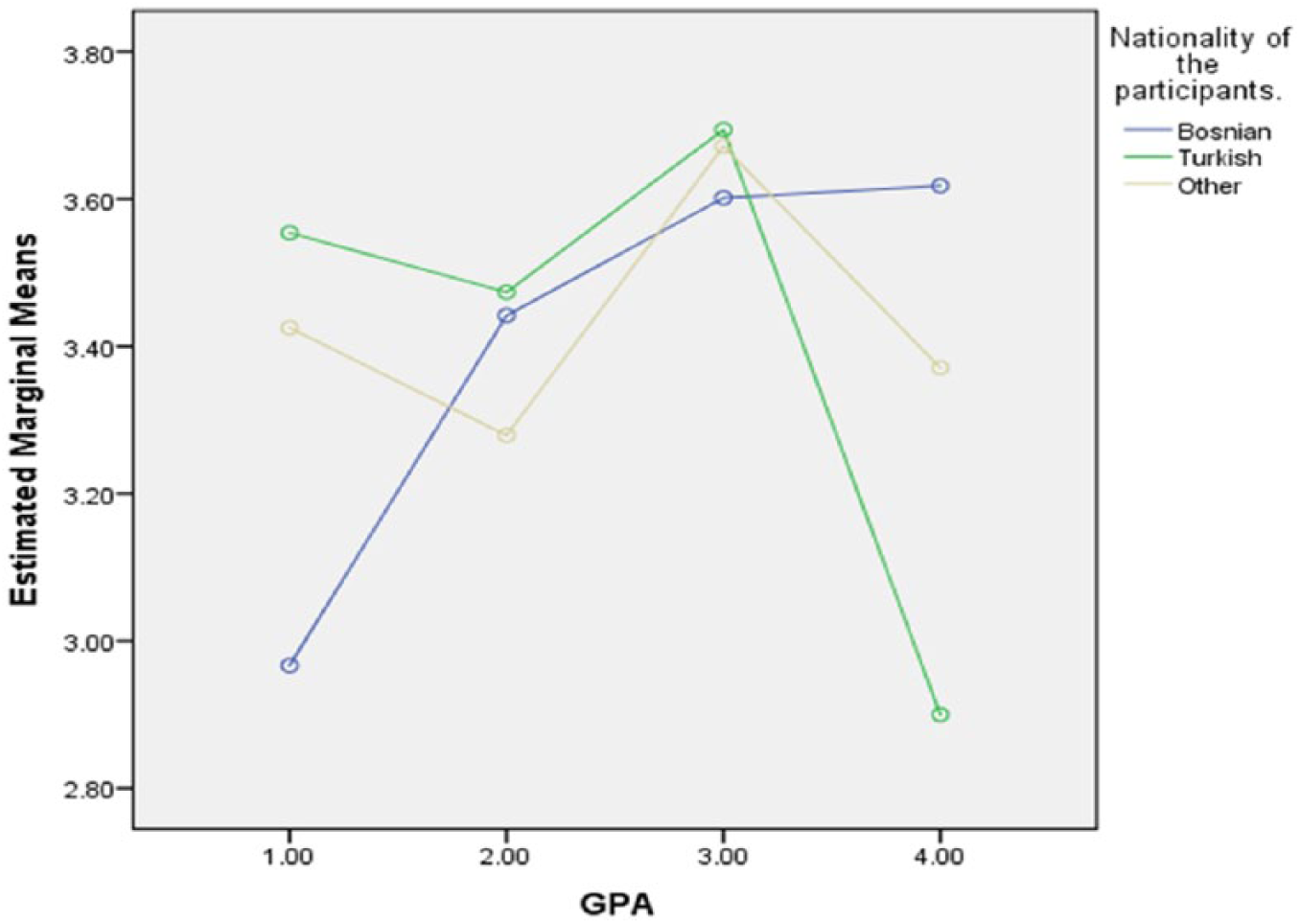
Nationality differences between GPA groups on SORS.
A three-way MANOVA was conducted to determine the influence of nationality, GPA, and gender on GLOB, SUP, and PROB. It revealed that nationality—Wilks’s Lambda λ = 0.979, F(6, 406.000) = 0.737, p = .062, η2 = .011—and GPA—Wilks’s Lambda λ = 0.956, F(9, 494.199) = 1.035, p = .411, η2 = .015—did not significantly affect the combined dependent variables GLOB, SUP, and PROB, whereas gender—Wilks’s Lambda λ = 0.921, F(3, 203.000) = 5.788, p = .001, η2 = .079—had a significant effect on the combined variables GLOB, SUP, and PROB and the multivariate effect size was medium. The interaction effect for Nationality × GPA was significant—Wilks’s Lambda λ = 0.854, F(18, 574.656) = 1.836, p = .019, η2 = .052—with a small effect size, while the interaction effect for Nationality × Gender was insignificant—Wilks’s Lambda λ = 0.982, F(6, 406.000) = 0.606, p = .725, η2 = .009. Furthermore, the interaction effect for GPA × Gender was insignificant—Wilks’s Lambda λ = 0.934, F(9, 615.000) = 1.558, p = .125, η2 = .022—as well as the interaction effect for GPA × Nationality × Gender—Wilks’s Lambda λ = 0.931, F(15, 560.795) = 0.984, p = .471, η2 = .024.
There was no significant main effect of nationality on GLOB (p = .846), PROB (p = .443), and SUP (p = .963) (Table 3). On the contrary, gender had a significant effect on SUP, F(1, 205) = 10.938, p < .001, η2 = .051, with a small, almost medium multivariate effect size. Female students (M = 3.61) use SUP strategies significantly more frequently than male students (M = 3.18). Furthermore, a significant difference based on gender was found on PROB, F(1, 205) = 11.030, p = .001, η2 = .051, with the same effect size as on SUP, with females (M = 3.88) again using PROB significantly more frequently than males (M = 3.59). There was no significant effect of gender on GLOB (p = .101). The effects of gender on reading strategies are displayed in Table 4. As for the GPA, the analysis did not reveal a significant main effect on GLOB (p = .279), SUP (p = .101), and PROB (p = .112) (Table 5), while the interaction effect for GPA × Gender was significant on PROB, F(3, 205) = 4.163, p < .001, η2 = .057, with an almost medium multivariate effect size. The largest differences were found in GPA Group 1 and Group 4, and in both groups, females use PROB more frequently than males (Figure 2). The interaction effect of GPA × Gender on GLOB (p = .228) and SUP (p = .607) was insignificant, while the interaction effect of GPA × Nationality on PROB, F(6, 205) = 4.258, p < .001, η2 = .111, was significant. The largest differences were also found in GPA Group 1 with Bosnian students using PROB least frequently and Turkish students most frequently and in GPA Group 4 in which the opposite results were shown, with Turkish students achieving the lowest score and Bosnian students the highest score (Figure 3). The insignificant interaction effect was found for GPA × Nationality on GLOB (p = .052) and SUP (p = .158) and for Nationality × Gender on GLOB (p = .891), SUP (p = .648), and PROB (p = .514). Moreover, the results did not show a significant interaction effect of GPA × Nationality × Gender on GLOB (p = .609), SUP (p = .726), and PROB (p = .123).
Multivariate ANOVA Between National Groups on Reading Strategies.

Note. GLOB = global reading strategies; SUP = support reading strategies; PROB = problem-solving reading strategies; SORS = Survey of Reading Strategies.
ANOVA of Reading Strategies Based on Gender.
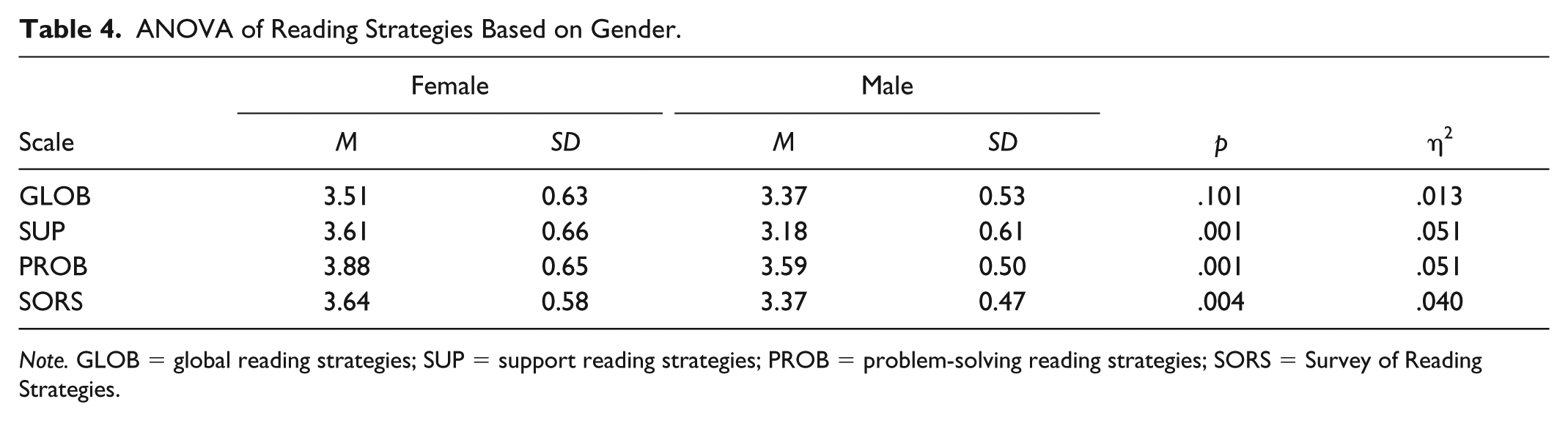
Note. GLOB = global reading strategies; SUP = support reading strategies; PROB = problem-solving reading strategies; SORS = Survey of Reading Strategies.
Multivariate ANOVA Between GPA Groups on Reading Strategies.

Note. GPA = grade point average; GLOB = global reading strategies; SUP = support reading strategies; PROB = problem-solving reading strategies; SORS = Survey of Reading Strategies.

Gender differences between GPA groups on PROB.
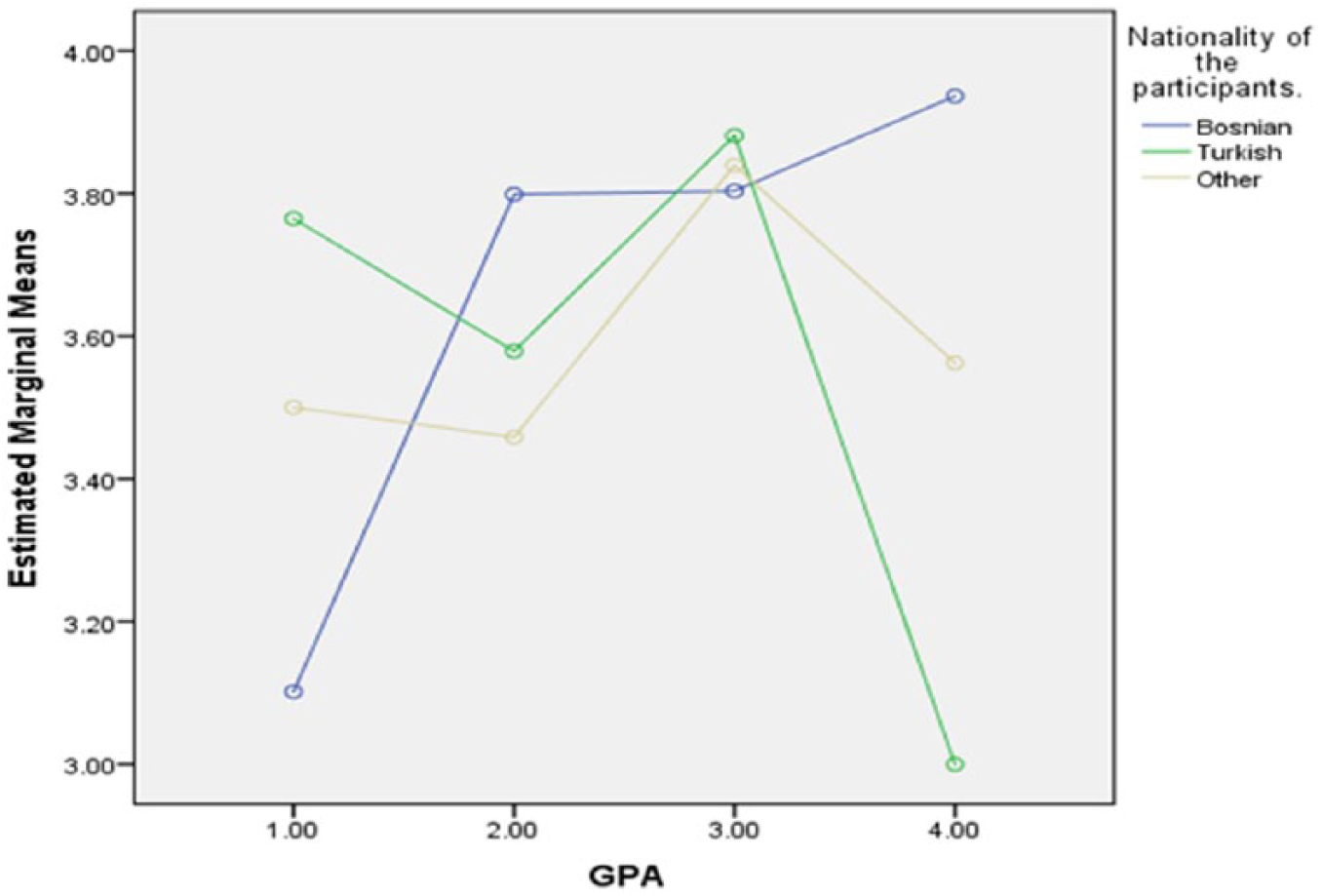
Nationality differences between GPA groups on PROB.
Discussion and Conclusion
The focus of the present study was on analyzing the main and interaction effects of nationality, gender, and GPA on SORS and the multivariate effects of these factors on three SORS subscales, namely, PROB, GLOB, and SUP. Based on Mokhtari and Sheorey’s (2002) three levels of reading strategy usage, our participants achieved high scores on SORS and PROB, and moderate scores on GLOB and SUP. The results indicating that the participants use PROB most frequently are fully in line with the previous research in different EFL contexts, including the neighboring countries of B&H (N. J. Anderson, 2003b; Karbalaei, 2010; Mikulec, 2016; Mokhtari & Reichard, 2004; Solak & Altay, 2014; Stanojević Gocić, 2016; Yuksel & Yuksel, 2012; Zare & Maftoon, 2014). However, our findings diverge from some other studies, where either GLOB (Chen & Chen, 2015) or SUP (Jafari & Shokkrpour, 2012; Sheorey & Baboczky, 2008; Sheorey & Mokhtari, 2001; Tavakoli, 2014) were used most frequently. Interestingly, our results also showed that the participants use GLOB and SUP with exactly the same frequency, which is not commonly observed in different EFL contexts, where SUP are often reported as least used (Solak & Altay, 2014; Yuksel & Yuksel, 2012; Zare & Maftoon, 2014).
The null hypothesis stating that no significant difference in reading strategy use exists on SORS based on nationality was supported. With Bosnian and Turkish students achieving a high score and “Others” a moderate score, none of the three groups obtained a low score average. Despite the fact that Bosnian students scored higher than the students from the other two groups on SORS, this difference was not statistically significant. The difference in SORS by culturally diverse people was also observed earlier (Alhaqbani & Riazi, 2012; N. J. Anderson, 2002; Bećirović et al., 2017; Karbalaei, 2010; Mokhtari & Reichard, 2004; Oxford & Burry-Stock, 1995); however, only in few studies has it been found statistically significant (Alhaqbani & Riazi, 2012). Further findings of our research revealed no significant difference in the use of different types of strategies by students of different nationalities, as the multivariate effect of nationality on three combined subscales was insignificant. In addition, nationality does not have a significant main effect on PROB, GLOB, and SUP subscales.
The null hypothesis stating that no significant difference exists on SORS based on students’ GPA was also supported. Although the students with higher GPA (GPA Groups 3 and 4) scored more highly on SORS than students with lower GPA (GPA Groups 1 and 2), the difference was not statistically significant. No significant difference was also found when the multivariate effect of GPA was measured on the three combined subscales. Similarly, GPA does not have a significant main effect on PROB, GLOB, and SUP subscales when measured individually. These findings are fully aligned with Mahasneh et al.’s (2016) results, which revealed that no significant difference in the use of reading strategies existed among university students in Jordan based on their GPA. The fact that higher achieving students, in general, achieved higher scores on SORS is consistent to some extent with Mikulec (2016), who found that the students who have a higher GPA perceive that they use reading strategies more frequently than the students with a lower GPA. However, Mikulec’s findings are only partially aligned with our results, as our students from Group 3 scored more highly on SORS and on SUP and GLOB subscales than the students from GPA Group 4. On the contrary, this is in line with Mahasneh et al.’s (2016) results, which revealed that the lower achieving students scored more highly on all subscales than the higher achieving students and they even gained a better score than the highest achieving students on SUP and GLOB subscale. These results could be attributed to nonuniform grading practices at different faculties.
The null hypothesis stating that there is no significant difference in SORS based on gender was refuted, as female students use reading strategies more frequently than male students. The null hypothesis stating that there is no difference in PROB, GLOB, and SUP based on gender was also refuted. Female participants achieved higher scores than male participants on all three subscales, but the main effect of gender was significant only on PROB and SUP. Our research results are fully aligned with previous findings suggesting that females use reading strategies more frequently than males (Bećirović et al., 2017; Dreyer & Oxford, 1996; Green & Oxford, 1995; Kaylani, 1996; Oxford & Nyikos, 1989; Sheorey, 1999), whereas they markedly diverge from the findings showing a greater use of reading strategies by males (Baily, 1996), as well as from those revealing that males dominate in the use of some strategies and females in the use of others (Goh & Fong, 1997; Lee, 2012). Moreover, our results are fully aligned with Sheorey’s (2006) and Poole’s (2009) findings, which revealed significant gender differences on SORS and its two subscales. Sheorey (2006) conducted research into the use of reading strategies by 599 Indian university students, which showed a significantly greater use of the overall strategies and two SORS subtypes, namely PROB and SUP, by female students. On the contrary, Poole’s (2009) study into 352 Colombian university students’ use of reading strategies showed that females achieved a significantly higher score on SORS as well as on PROB and SUP. This similarity can be considered quite interesting, as it is based on a rather large sample, particularly so since many previous research studies produced the opposite results. When it comes to the Bosnian context, the dominance of female participants in terms of strategy use might be explained by referring to the research results reported by Bećirović (2017) indicating that female students are significantly more motivated and significantly more successful at learning English in the Bosnian EFL context. Thus, our findings seem to strengthen the previous findings that gender-based differences do exist and are an important factor impacting reading strategy use and language learning in general.
What is of particular interest is that our research results have shown that gender interacts with GPA but only on PROB, which indicates that the effect of gender on PROB depends on the level of GPA. The largest differences are observed in GPA Group 1 and in GPA Group 4. The best score was achieved by the female participants from Group 3, while the male participants from Group 1 got the lowest score. As can be seen from the listed results in Table 3, female participants from all groups and male participants from Groups 2 and 3 achieved a high score, while the male participants from Groups 1 and 4 achieved a moderate score. These findings show that the participants, female participants in particular, use PROB very frequently, and that female participants use PROB more than males, which is in line with the results of Mahasneh et al. (2016), Sheorey (2006), Sheorey and Mokhtari (2001), Poole (2009), and so on and diverges from the results obtained in Poole (2005), Tavakoli (2014), and so on, where male participants were observed to use PROB more than female participants. The fact that when gender interacts with GPA, its effect is significant only on PROB is important to note. This might point to the fact that two variables, namely gender and GPA, and not gender alone, impact the reported usage of PROB.
The null hypothesis stating that there are no significant interaction effects of Nationality × Gender × GPA on SORS was supported. However, the interaction effect of Nationality × GPA on SORS was significant, despite the fact that the main effects of both nationality and GPA individually on SORS were insignificant, suggesting that the effect of nationality on SORS depends upon the level of GPA. The largest differences have been observed in GPA Groups 1 and 4. Overall, the highest score was achieved by Bosnian students from GPA Group 3 and the lowest score was achieved by Turkish students from Group 4. The fact that the highest achieving Turkish students use strategies least frequently is rather surprising given the fact that researchers have found that strategy use is usually related to reading ability (Baker & Brown, 1984). Reading ability, on the contrary, is often considered to be a prerequisite to the overall success at the faculty level in particular; thus, skilled readers normally use more strategies and achieve better results. Nationality × GPA significantly interact also on PROB, with the significant differences in GPA Groups 1 and 4. Among four GPA groups of Bosnian students, Group 4 achieved the highest score, followed by Group 3, then Group 2 and Group 1 which achieved the lowest score. Among the students from GPA Group 1, Bosnian students achieved the lowest score, while Turkish students achieved the highest score, indicating that Bosnian students with the lowest GPA use reading strategies less than Turkish and other students with the same GPA. In the group of Bosnian students, the use of reading strategies increases with the increase in their GPA, which is fully in line with Mikulec (2016). Thus, these findings indicate that the effect of nationality on PROB depends on the level of GPA, although neither nationality nor GPA, when measured separately, had any significant effect on PROB. Furthermore, the hypotheses stating that there are no significant interaction effects of Nationality × Gender × GPA on the combined subscales or on PROB, GLOB, and SUP separately were supported.
Pedagogical Implications
This study has some important practical implications. As the findings point to some complex issues deeply rooted in the educational process, they might help raise awareness of the need to incorporate teaching reading strategy usage into curricula and to organize workshops and training seminars which would guide teachers toward a more effective way of teaching reading strategies. Due to the fact that the research sample comprised participants of different nationalities, the aforementioned implication might be widely applicable. The increase in reading strategy use will inevitably help improve students’ language performance, as the greater use of reading strategies has been shown to improve reading comprehension and leads to more successful learning (Alexander & Jetton, 2000; Sheorey & Mokhtari, 2001).
Footnotes
Declaration of Conflicting Interests
The author(s) declared no potential conflicts of interest with respect to the research, authorship, and/or publication of this article.
Funding
The author(s) received no financial support for the research, authorship, and/or publication of this article.