




Abstract
This multiple case study explored early childhood educators’ implementation of a suite of play-based mathematics activities with children aged 3 to 5 years in six different early childhood education and care programs in Melbourne, Australia. Educators approached the enactment of the activities differently; however, those educators who used the activities reasonably frequently and with attention to the underpinning mathematical concepts reported an increase in their self-confidence in supporting children’s mathematical thinking. For these educators, increasing self-confidence, in conjunction with children’s enthusiasm, led to increased frequency and further gains in self-confidence. Some educators did not implement the activities and no change in attitude was observed. New ways to support early childhood mathematics teaching practice, as a means to challenge entrenched attitudes and beliefs, are needed.
Keywords
When children regularly spend many hours in the company of an early childhood educator, the early childhood educator is a proximal and highly influential element of the child’s evolving social and cultural ecology (Bronfenbrenner, 1979). Early childhood educators’ attitudes are pervasively important: positive, enthusiastic attitudes to problem solving are likely to engender enthusiasm and positivity in children’s approaches to learning, but the corollary holds true as well—negative attitudes and avoidance of concepts are likely to lead to negativity and avoidance in children (Bellock, Gunderson, Ramirez, & Levine, 2010; Connor & Neal, 2014; McCray & Chen, 2011; Stipek, Givvin, Salmon, & MacGyver, 2001). In the context of early childhood education, this influence occurs very early in a child’s learning trajectory and thus potentially affects children’s perception of their own abilities as they continue into formal school-based education (Lake & Kelly, 2014; Tschannen-Moran & Woolfolk Hoy, 2001) and onwards.
Much of an educator’s attitude toward teaching mathematics derives from memories and experiences relating to their own mathematics learning, and is likely to influence their teaching practice in some way (Brown, 2005). Describing the “framing” function of cognitive schemas, Bruner (1990) states that the prominent aspect of a memory is often the attitude attached to that memory. Educators’ beliefs have been defined as “tacit, often unconsciously held assumptions about students, classrooms, and the academic material to be taught” (Kagan, 1992, p. 65), which are stable, resistant to change, and manifest in their pedagogical practice. Changing beliefs and attitudes requires an individual to make personal, cognitive adjustments to incorporate new ideas. This is particularly difficult in the teaching environment if the changes do not align with the individual’s personal beliefs and goals for children’s learning (Curby et al., 2009). The resistance may be a personal response to negative memories rather than denial that supporting children’s mathematical thinking is in children’s interests (Ginsburg, Lee, & Boyd, 2008). This is important, because studies have found a connection between educators’ attitudes to mathematics and the attitudes of their students to mathematics (Bellock et al., 2010; Connor & Neal, 2014; Kalder & Lesik, 2011).
Changes in recent years in early childhood education in Australia have resulted in educators being mandated to implement a recognized early years learning framework (Australian Children’s Education and Care Quality Authority [ACECQA], 2011). This requires educators to support children’s mathematical thinking and their acquisition of mathematical language. A significant association has been found between the frequency and duration of play-based mathematics activities enacted within early childhood programs and children’s learning outcomes (Cohrssen, Tayler, & Cloney, 2015). However, new ideas are inevitably filtered through existing knowledge structures (Curby et al., 2009; Kagan, 1992) and conceptual change is difficult. Consequently, some aspects of educators’ practice remain unaltered (Spillane & Zeuli, 1999; Stigler & Herbert, 1998). Variability of early childhood practitioners’ knowledge, attitudes, and professional practices leads to inconsistency in fidelity of implementation (Zvoch, 2009), a situation which is further confounded by variables specific to individual settings (Durlak, 2010; Zvoch, 2009) such as individual educators’ own mathematics knowledge. Nonetheless, whereas educators’ attitudes, beliefs, and confidence in their mathematics abilities affect the extent to which they intentionally teach mathematical ideas (Lee & Ginsburg, 2009), educators’ confidence is a variable that can be addressed by targeted professional learning (Chen, McCray, Adams, & Leow, 2014), and changes to teachers’ practices, when observed to contribute to changes in children’s learning outcomes, have been associated with changes in teachers’ beliefs (Guskey, 2002a, 2002b).
Educators need to have a clear vision of how curriculum materials are intended to help children learn and faith that the curriculum materials provided will equip them to support students achieving the intended learning objectives; further, curriculum materials need to support teachers’ learning along with children’s learning (Drake & Sherin, 2009). Increased educator self-confidence is likely to be associated with more frequent mathematics talk in early childhood settings. This is important because learning mathematical language is an important tool for exploring mathematical ideas and the amount of educators’ maths talk has been found to be significantly related to growth in children’s mathematics knowledge (Klibanoff, Levine, Huttenlocher, Vasilyeva, & Hedges, 2006). One of the aims of this study—and the focus of this article—was to observe the effect of providing teaching materials in the form of a suite of play-based mathematics activities with clear learning objectives, step-by-step explanations for the activities, and a description of the mathematical thinking that underpins each activity, on early childhood (EC) educators’ attitudes toward mathematics in early childhood. We anticipated that supporting educators’ pedagogical practices may contribute to an increase in their self-confidence and a more positive attitude toward intentionally supporting mathematical thinking during play-based activities.
Method
Changes in children’s learning outcomes, observed to be associated with the frequency and duration of the play-based activities presented by the educators in this study, have already been reported (Cohrssen et al., 2015). The aim of this article is to explore the mechanisms at work that contributed to the change in teachers’ attitudes.
Participants
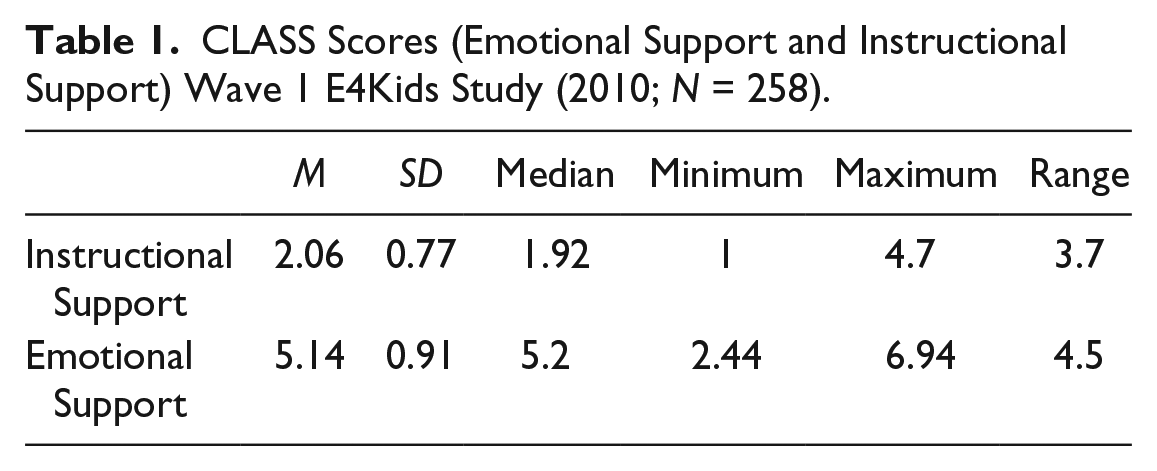
This implementation study was positioned within a broader longitudinal study, the E4Kids study (Tayler, Ishimine, Cleveland, Cloney, & Thorpe, 2013). Potential participants were selected according to room-level Instructional Support scores recorded for educators employed at early childhood education and care (ECEC) centers in the state of Victoria during the first round of E4Kids’ data collection. For the purpose of this sample, the room that received the lowest Instructional Support score using the Classroom Assessment Scoring System pre-K to K (Pianta, La Paro, & Hamre, 2008) was the start of the “low” category and the median score was the start of the “mid range” category. Although all room-level readings of Instructional Support were relatively low, for the mid range category, the first author contacted one center immediately above the median score, followed by one center below, repeating this pattern to remain as close to the median score as possible. The room with the maximum Instructional Support score was the start of the “high” category. Minimum and maximum scores are presented in Table 1.
CLASS Scores (Emotional Support and Instructional Support) Wave 1 E4Kids Study (2010; N = 258).
Many of the 128 educators involved in the E4Kids study in Victoria during the first round of data collection were excluded. Grounds for exclusion included, for example, the consented educator having resigned or retired, the majority of the children in the room being aged below 3 years, educators were employed at family day care centers 1 or sessional kindergartens, 2 and in one instance, a potential conflict of interest was identified as the lead educator worked with the first author in a different capacity.
After approaching remaining potential participants by telephone, the first author met with center coordinators and educators to describe the study and the implications of participating in the study in more detail. Participation consent was then sought at center level and from educators.
Five participants were female and one was male. Educators’ qualifications ranged from a 2-year diploma in early childhood services to a master’s degree in early childhood education (see Table 2). All participants held full-time appointments. The first educator in Room 4 unexpectedly took long leave mid-way through the study; however, the assistant educator in the room stepped up immediately to the lead role and undertook to continue with the study. None of the participants had attended any post-qualification EC mathematics professional learning sessions. A remark made by the lead educator in Room 5 illuminates this point:
. . . there’s not a lot of professional development for early childhood workers in maths, like you know, at the conference that we went to in June there was none, but there’s sessions about literacy, there’s sessions about incorporating indigenous culture, there’s sessions about social emotional development, but there’s no sessions about maths or science . . . there’s a lot of stuff I suppose that they do in early years in primary schools that would relate to us as well.
Educators’ Early Childhood Teaching Qualifications; Age Ranges of Children in These Classes.

Play-Based Mathematics Activities
The play-based mathematics activities included in the study were drawn primarily from the American Navigations Series (Cavanagh et al., 2004; Findell et al., 2001; Greenes, Cavanagh, Dacey, Findell, & Small, 2001; Sheffield et al., 2002) as no early childhood mathematics curriculum had been formally validated with young children in Australia. Additional activities that provided play-based number word and counting activities more appropriate to an Australian early childhood context were adapted from an additional early years mathematics text (Wright, Stanger, Stafford, & Martland, 2006). Activities related to number and operations; data collection, organization, and display; and geometry and algebra. Mathematical concepts underpinning the activity were described in each case, and clear learning objectives facilitated formative assessment of children’s understanding.
Activities explicitly encouraged educators to talk about the activity and to encourage children’s problem solving, experimentation, and investigation, for example,
Talk about how the patterns are different and how they are the same
and
When children are about to place their card on the washing line, ask questions such as “Is it before or after this number?” and “Which two numbers should it go between?”
With the exception of a teddy bear, as one activity required a familiar toy to be used in an activity focusing on language of location, educators were provided with all necessary equipment (from numeral cards to clothes pegs), an instruction manual that described the delivery of each activity, including learning objectives and the mathematical concepts underpinning each activity, and an abbreviated card each educator could keep beside them as a prompt when presenting an activity. Educators were at liberty to implement the activities in the order that best suited the broader room curriculum.
Although not “free play” activities, the activities were planned, “playful explorations” (Yelland, 2001, p. 6), enacted initially as educator guided, small group learning experiences. For example, one counting activity required each child to roll a die, identify the number rolled by subitizing or counting the dots, and count a corresponding number of colored counters from a pile in the center of the table. Players then compared how many counters they had “won” and talked about who had “more than,” “less than,” and “the same as,” articulating their reasoning. Some educators spoke of playing games with the children and then making the games available to children to use independently. Further examples of the activities are provided in the appendix.
Data
Self-reported data were obtained from two sources—implementation logs and semi-structured interviews. Semi-structured interviews with participants at three points over a 7-month period were audio-recorded, transcribed, and analyzed thematically to explore participants’ reported implementation approach and to gain insight into the participants’ attitudes at the start and at the end of the study toward playfully yet intentionally teaching mathematical concepts in their programs.
First-round interview questions were the same for each educator. Second-round interviews explored issues raised by different educators or observed mid-way through the study. Third-round interviews were very similar in content as issues raised by most participants were in fact similar.
At the start of the study, participants undertook to use one activity each day with a small group of children. Because it was not possible for the first author to monitor patterns of implementation directly on a week-by-week basis to observe nuances of implementation (Baker, Kupersmidt, Voegler-Lee, Arnold, & Willoughby, 2010), the second source of data was implementation logs. Educators were asked to complete the log after the implementation of an activity noting the date, how many children participated in the activity, how long the activity was sustained, and what changes were made, if any, to the delivery of the activity. The implementation logs provided an indication of frequency, duration, and fidelity of implementation of the suite of learning activities.
Results and Discussion
Table 3 provides a summary of the educators’ engagement with the activities and an indication of reported self-confidence at various points throughout the project. Notable is the relationship between the consistency and frequency of implementation—that is, engaging small groups of children in the activities—and educator attitude toward or perception of the merit of the play-based opportunities for mathematical thinking. Specifically, those educators who used the activities reasonably frequently, intentionally focusing on the underpinning mathematical concepts as set out in the description of each activity, reported an increase in their self-confidence in supporting children’s mathematical thinking. For these educators, increasing self-confidence combined with the enthusiasm with which children took part in the activities, led to changes in their practice. Activities were implemented more frequently and children’s learning was observed. Supported by growing familiarity with the activities, implementation frequency increased and further gains in educators’ self-confidence were reported. Educators’ reports of self-efficacy are also included in the summary, and the implications are considered in the discussion to follow.
Educators’ Attitudes and Practices in Implementing Play-Based Mathematics Activities Reported During Semi-Structured Interviews.

Implementation of Activities
Wide implementation variability, in enactment and frequency, was observed among participants in this study despite their initial undertakings to present at least one activity each day to a small group of children. First, we discuss low implementation cases. The discussion will then address reports from teachers who implemented the play-based activities with greater frequency and consistency.
After 4 weeks, the educator in Room 1 withdrew from the study. In this program, the activities (designed to be small group activities) were presented to groups as large as 17, resulting in children spending a lot of time waiting for a turn. The educator selected activities based on perceived ease of delivery, rather than their “fit” to children’s observed skills and understanding. Taking both characteristics of delivery into account, it is not surprising that children’s engagement was sub-optimal and may have contributed to the teacher’s report that the children did not “respect the equipment” (see Table 3). There was a change in staff in Room 4. The second educator in Room 4 set up activities in the room after recalling that they were in the storeroom; however, the selection of activities appears to have been unsystematic. The educator in Room 5 rarely implemented the activities and similarly kept them in the storeroom. Finally, the implementation strategy employed by the educator in Room 6 cannot be established, as this teacher did not complete implementation logs.
Our attention now turns to the educators in Rooms 2 and 3, and the first educator in Room 4. These educators took a systematic approach to implementing the activities. In Room 2, activities were used as an add-on to the program throughout the study, however in response to children’s demands—and the educator’s recognition that the activities afforded opportunities for social and emotional learning—the activities were used with increasing frequency. The educator reported that she came to see that learning priorities in the broader program were supported by the play-based mathematics activities. Consequently, not only were they used more frequently, but the educator also deliberately revisited some of the activities that had been presented earlier in the year:
. . . not everyone’s had the opportunity to do every game . . . because some are here five days, some are here one day, some are two days . . . maybe sometimes it’s to give someone else an opportunity to do that. Or maybe . . . I thought, “oh no, I do understand that a bit better now” or what the outcome (should have been). (Room 2, Round 3 interview)
The educator in Room 3 described uncertainty about how to go about teaching mathematical ideas in her program and consequently enacted the activities with a high degree of fidelity; she followed instructions provided for each activity closely. Children’s enthusiastic participation in the activities, coupled with the educator’s growing confidence and familiarity with the suite of activities resulted in more frequent, flexible, and open-ended use of the materials.
The first educator in Room 4 incorporated the activities in the program plan from the start of the study, selecting activities that aligned with children’s interests:
If the children are really . . . interested in Snakes and Ladders and using the dice, so that would be something that comes out, and then . . . you can explain to children how you use the dice in that situation and how you use it when you’re playing Snakes and Ladders . . . (Room 4, Educator 1, exit interview)
One activity was set up each week on a designated table in the room. Although each activity involved small groups of children, the educator usually waited for children to initiate the play at this table and most activities were then teacher directed in their delivery.
Having provided a broad brush stroke description of how educators approached the incorporation of the suite of activities in their curricula, the next section narrows our focus to the use of specific learning objectives for each game to assess children’s learning through play.
Formative Assessment of Children’s Learning
Educators in Rooms 2 and 3 reflected on the contribution of the suite of learning experiences to their observation and assessment of children’s learning, as well as to curriculum planning.
The educator in Room 2 commented on unanticipated opportunities for turn-taking, peer conversations and for children to lead activities.
. . . I suppose my opinion has changed a little bit, that I didn’t realise, I hadn’t thought how much they might enjoy it and how much they’re still doing all those things I’m wanting them to do, you know, like the sharing and . . . [interruption] . . . when they’re interested in something, often they will put a little bit more effort into that socio-emotional stuff, yeah I will wait for my turn, yeah I will let them have their turn, do you know what I mean? Cause I want to have my turn. So yeah, I have found that that’s a real positive. (Room 2, Round 2 interview)
In addition, the children’s response to the activities was remarked upon several times during the course of the study:
. . . they’ve really enjoyed them . . . you know, it’s been challenging for them, and they’ve enjoyed having the play-based maths . . . yeah, they’ve enjoyed having the activities. Cause when I pull out a game, I say, “I want to play a game,” they’re very eager to do that. Like, a lot of the board-type games, and then they will . . . I say, “Well, we’re not gonna fight over this pink card” or something,
3
and they have to agree, yes we won’t, because we really want to play the game. (Room 2, Round 2 interview)
Explicit learning objectives focused the educator’s observations and were used to assess whether children had mastered underpinning mathematical concepts and were ready to explore extension activities, or whether further rehearsal or a drop-back activity would be appropriate. Conversations with families were informed by the educator’s assessment of the extent to which children achieved learning objectives embedded in activities, supporting meaningful conversations with families about their children’s learning.
Yeah, some have found it easy; others of the same age and same skill in counting and making patterns still found that difficult . . . they do sort of patterns in music and we do, like, beading. They’ve done a lot of patterns and stuff like that, so I thought they had an understanding of patterns, but then sometimes with the clowns like sitting there in front of them, it’s almost like . . . they didn’t realise they know how to do it, you know. They thought this is more complicated or something. (Room 2, Round 2 interview)
The educator in Room 3 spoke of increasing self-confidence and excitement at her growing ability to observe, assess, and support children’s learning by using the learning objectives for each activity to assess children’s understanding. Encouraged to persevere by the children’s positive response to the games, this educator described having previously over- or underestimated different children’s competency.
I’ve got one child who has been in care [child care] since she was a baby five days a week, and very proactive at home, very proactive here. Whenever we do any of these activities, she knows straight away. I watched her the other day. She goes, “You’ve added an extra two there.” She was explaining it to one of the other children, because they couldn’t quite figure it out. She goes, “Well, you’ve added an extra two, so that makes six.” And I’m just looking at her . . . And then we did the patterning, and straight away, after, I said, “You can come up with your own pattern and picture,” she was the first one to sit there, put all the pieces together, figured out her pattern, drew it up, and said, “It reminds me of a mouse” and then continued pattern making. (Room 3, Round 1 interview) But also the children are the ones who are driving it, because they have particular games in there that they love, so they won’t let me do the other ones. (Room 3, Round 2 interview)
At the start of the study, the first educator in Room 4 described intentionally using learning objectives to assess children’s mathematical understanding as a new approach:
Writing down all that—how they went and what happened and all that—and observing all that is more what we normally do. (Teacher 1, Room 4, Round 1 interview)
This issue was pursued at the second (exit) interview with the first lead educator. It appears that the learning objectives contributed to formative assessment of children’s knowledge and using learning objectives to support written observations demonstrates a shift in this educator’s teaching practice:
At times, yeah, at times I did feel, oh I didn’t know he could do this, and that kind of helped plan further in the sense how could it be more challenging for that child . . . So would you write up observations based on what you’d seen from these maths activities? Some of them, yes . . . because we have them in daily reflections . . . (Teacher 1, Room 4, Round 2, exit interview)
The second lead educator in Room 4 reported not having used the activities as an opportunity to assess children’s learning:
No, I didn’t personally, but I think . . . Actually I think (the assistant) did. Another educator in the room, I think she saw an activity that was happening and some concepts that were being used, I think it was the geometry patterns one. (Teacher 2, Room 4, Round 3 interview)
The second lead teacher commented further:
. . . we thought (some of the activities) would be a bit too difficult in that it would be more one-on-one, like teacher and child, or we didn’t really understand what the concept . . . or like how to implement it, or we just didn’t get time because we used the same . . . sometimes we use the same activities later on in each week . . . we feel that in our room it’s just . . . like we’d love to do one on one things but it’s just too busy in our room to be able to sit down and do that with other children . . . (Room 4, Round 3 interview)
In summary, the educators in Rooms 2 and 3, and the first educator in Room 4 remarked that many children’s demonstrated skills and understanding either exceeded or, conversely, did not yet meet the educators’ expectations, when assessed against the learning objectives provided for each activity. It is well established in research and in practice that children’s mathematical understanding varies substantially and much may be attributed to environmental stimuli (see, for example, Gould, 2012; Klibanoff et al., 2006). Recognizing this variability points to the critical importance of authentic and accurate assessment to differentiate learning opportunities for children.
Reported Changes in Attitude
We now consider how enacting the activities impacted on educators’ attitudes toward intentionally teaching mathematics in early childhood. Two participants (Rooms 1 and 2) raised concerns about incorporating another element in their programs.
The educator in Room 1 withdrew from the study.
The educator in Room 2 recognized that incorporating the activities into the program provided opportunities to extend children’s mathematics learning and social and emotional learning. Her attitude underwent a significant change and the activities were enacted more frequently. Rather than needing to unlearn existing understanding to learn new ideas (Snider, 2004; Spillane, 2000), which would have required a significant change in cognitive schema, this educator quickly recognized benefits of implementing the activities and was open to a more intentional, evidence-based approach:
I think I have definitely been more mindful of the mathematics in the children’s play because . . . I know that they understand so much more about it, about numbers now, so we have been able to extend a little bit like when we’re playing, you know, in different . . . (Room 2, Round 3 interview) It made me more focused and broadened (my) understanding of different aspects of maths that can be taught to preschoolers, that’s my short answer. (Room 2, Round 3 interview)
The educators in Rooms 2 and 3 expressed concerns at the start of the study about using “the right language.” Mathematics language-related uncertainty inhibited their self-confidence and consequently their willingness to engage children in such activities. Using the activities directly addressed these concerns, as examples of questions and relevant language to model were provided with each activity. Reading the provided step-by-step explanations of each activity was reported to equip the educators with sufficient knowledge to feel more confident and consequently, to model the language in conversations with children. This contributed to an upward spiral of increasing self-confidence and more frequent enactment of the activities and the educators’ practice changed.
Echoing Bruner’s (1990) statement that it is frequently the attitude attached to a memory that persists, the educator in Room 3 reflected on her own mathematics education:
. . . it was about right and wrong, and if you were wrong, there was a consequence for getting it wrong at school with maths, I found. Or they made it very competitive, you know, who could get it quicker could get this, could have this prize, or whatever it was, so that already would put anxiety there about getting it right, and then . . . I don’t know what everyone else’s experience is, for me it would be about I just shut down so I wouldn’t think at all. (Room 3, Round 2 interview)
This educator’s personal experience of mathematics differed substantially from the play-based approach in which enactment of the activities demanded, and required, personal memories and deep-seated, learned attitudes toward mathematics to be set aside (Bruner, 1990) to learn new ideas (Snider, 2004; Spillane, 2000). The speed with which the educator’s attitude turned around was remarkable. By the end of the study, the conversation was more light-hearted (evidenced by her laughter). Rather than focusing on a perceived skills deficit, the educator spoke of improving her own skills to influence children’s regard for mathematics positively:
Yes, I think I don’t know enough (about mathematics). (Laughs.) And also because I don’t have that confidence in mathematics as well and I think that’s something I need to work on because I’m trying to give something to the next generation, to give them the groundwork and the interest in maths, not just literacy . . . (Room 3, Round 3 interview)
A marked change in attitude was apparent at the end of the study:
For me, I think it is because this is not something that I’m going to stop now just simply because we’ve done the study. So to me, it’s a lifelong journey. And I think well if I take this activity, where can I take it? Can I take it to something else, or can I keep using it over and over again because it’s a useful tool as well for assessing where children are also, and helping them with numeracy. I’d like to keep going and see when I’ve got that extra time that I can make to work on it, what will the difference be for me as a teacher as well? And then for the children, what will happen? (Room 3, Round 3 interview)
The educators in Rooms 4 and 5 waited for children to initiate interactions around the activity or request an activity—although the activities were not always accessible to the children as they were stored in a different room. Their attitudes remained unchanged throughout the duration of the study, reflecting their persistent pedagogical beliefs about the role of the early childhood educator. Although all three educators in these rooms stated a belief in the importance of supporting children’s emerging mathematics skills, none believed this to include purposeful formative assessment to plan systematically to support and extend children’s developing mathematical thinking. Somewhat ironically, both educators in Room 4 were observed to engage in highly teacher-directed, question-and-answer interaction patterns, thus creating or perpetuating the pressure for children “to get it right,” an approach that both educators reported intending to avoid. Research has demonstrated that educators filter new ideas through existing knowledge (Curby et al., 2009; Kagan, 1992) and when exposed to new ideas, are inclined to focus on superficial similarities to familiar knowledge and unlearning may be required to gain new knowledge (Snider, 2004; Spillane, 2000). However, this process of unlearning is not always successful and practice may not change (Spillane & Zeuli, 1999; Stigler & Herbert, 1998). In both cases, by choosing to join in with children’s play only when requested, rather than guiding children’s use of the play-based activities in a purposeful manner, these educators limited their opportunities to observe the gains in children’s learning that when coupled with a change in teaching practice, contribute to changes in teachers’ beliefs and attitudes (Guskey, 2002a, 2002b).
The educator in Room 6 did not provide implementation logs, but reported in interviews that using the activities prompted her awareness that she did not lack the necessary skills and understanding to deliver the resources. This awareness proved empowering, and her anxiety at the start of the study was reportedly replaced by an increasing sense of self-confidence.
Conclusion
Early childhood educators have reported a need for increased professional learning in early childhood mathematics (Barber, Cohrssen, & Church, 2014). We know that educators’ mathematics content knowledge predicts children’s learning and engagement in mathematical thinking (Hill, Rowan, & Loewenberg Ball, 2005; Shulman, 1986). Furthermore, educators’ attitudes, beliefs, and confidence impact on how mathematics teaching is (or is not) purposefully incorporated in early childhood programs (Lee & Ginsburg, 2009). Chen and colleagues (2014) have found that educators’ confidence can be addressed by targeted professional learning. In this study, we observed the impact of implementing play-based mathematics activities with small groups of children on some early childhood educators’ confidence, beliefs, and attitudes toward purposefully teaching mathematics in early childhood.
When educators persevered with play-based activities that clearly set out the intended mathematics learning and provided examples of questions for teachers to ask to suit children’s emerging understanding, their confidence increased. It appeared that this was a collaborative and iterative process: reviewing the objectives of each activity familiarized the educators with the underpinning mathematical ideas and supported their ability to recognize when children achieved the learning objectives. As their confidence grew, and spurred on by children’s enthusiastic response and observed learning gains, activities were enacted more frequently. When the suite of activities was enacted with reasonable fidelity and frequency, children’s made gains in learning (Cohrssen et al., 2015).
Professional learning and change in teacher practice, when observed to contribute to change in children’s learning outcomes, contributes to change in teacher attitudes and beliefs (Guskey, 2002a, 2002b). Educators who implemented the activities systematically reported a change in attitude and beliefs, as the activities-as-resource (a) demonstrated opportunities for supporting social and emotional learning, (b) provided educators with the explicit language to both enact the activities and to share the aims of this play-based learning with children’s families, (c) equipped educators with strategies to facilitate children’s learning by providing greater specificity in learning objectives, which subsequently (d) supported gains in children’s learning (Cohrssen et al., 2015), and (e) facilitated formative assessment of and for learning.
Although the suite of activities was not designed as a professional development resource per se, providing educators with information about specific mathematical concepts as well as step-by-step instructions for the implementation of the games, in effect supported the educators’ professional learning. Those educators who implemented the activities changed their teaching practice. When the learning objectives were used to support formative assessment of children’s knowledge, educators observed the efficacy of their practice. This positive outcome, coupled with children’s observed enthusiasm in taking part in the activities encouraged educators to change their beliefs and to offer further activities from the provided suite of activities.
Increasingly positive attitudes to the activities and greater self-confidence led to more frequent use of the activities, and thus more systematic implementation. Importantly, an increase in educators’ self-confidence in teaching mathematics is likely to lead to educators modeling positive attitudes about mathematics to children, encouraging children to feel positive about mathematics (Kalder & Lesik, 2011). Children’s positive responses to educators initiating these activities encouraged educators to persevere, and thus, the cycle of teaching and learning continued.
Familiarity with the learning objectives of activities and increased self-confidence enable educators to approach the activities in a more purposeful manner, facilitating the learning in play-based learning, reflecting an imperative in effective early childhood education (ACECQA, 2011; Cohrssen, Church, Ishimine, & Tayler, 2013; Department of Education Employment and Workplace Relations, 2009). Specific learning objectives also provided educators with competencies against which to assess children’s developing understanding in an objective manner. This in turn facilitated accurate, evidence-based teaching. In short, by providing a range of play-based activities that were relevant and interesting to the children, along with accompanying instructions, prompts, and suggestions for extending activities, educators were better equipped to enact child-centered practice.
The over-arching goal of early childhood education is to provide optimal learning opportunities for children. Implementation of a suite of play-based early childhood mathematics activities provided early childhood educators with the resources needed to support and extend pre-school children’s mathematical thinking and mathematical language. Implicit in this process is ongoing formative assessment of children’s learning. This not only enables educators to tailor learning experiences to support children’s demonstrated interests and skills but also provides educators with regular feedback on the efficacy of their efforts, increasing the likelihood that they will persevere with the new practices and contributing to a change in teacher beliefs regarding early childhood mathematics (Guskey, 2002a, 2002b).
Our findings show that the provision and enactment of a purposefully designed suite of play-based mathematics activities may enable educators to develop increasing confidence in the intentional teaching of mathematics in early learning environments. This is encouraging evidence of the potential impact of an evidence-based, play-based, validated early childhood mathematics curriculum. Finding ways to challenge educators’ beliefs and to encourage new ways of thinking about mathematics teaching and learning are crucial if educators are to meet the demands of early childhood education and the future learning needs of children.
Footnotes
Appendix
Acknowledgements
The authors sincerely thank the ECEC services, directors, teachers/staff, children, and their families for their ongoing participation in this study.
Authors’ Note
E4Kids was led by Professor Collette Tayler at the Melbourne Graduate School of Education, The University of Melbourne, in partnership with Queensland University of Technology.
Declaration of Conflicting Interests
The author(s) declared no potential conflicts of interest with respect to the research, authorship, and/or publication of this article.
Funding
The author(s) disclosed receipt of the following financial support for the research and/or authorship of this article: This research was funded by an Australian Postgraduate Award Industry Scholarship as part of E4Kids, a longitudinal study investigating the effectiveness of early learning experiences in early childhood settings in Australia. E4Kids was funded by the Australian Research Council Linkage Projects Scheme (LP0990200), the Victorian Government Department of Education and Early Childhood Development, and the Queensland Government Department of Education and Training.