




Abstract
Coworking spaces (CWS) have become an important alternative for modern workplaces, providing not just essential amenities like office equipment and internet access, but also areas designed for relaxation and socializing. Over the last decade, their rapid expansion has positioned them as key actors within the sharing economy, promoting collective use of both work and social environments. Despite their rapid growth, the internal dynamics and operational models of coworking spaces remain underexplored in the management literature. This study aims to map the intellectual landscape of coworking spaces by situating them as “third places” within the broader framework of the sharing economy. Drawing on bibliometric analysis and data visualization tools such as VOSviewer, the research identifies core theoretical approaches and examines the economic and urban implications of coworking practices. Recent literature increasingly emphasizes the concept of the “third place”—a hybrid space that bridges the home and the office—where coworking spaces play a central role in shaping flexible work arrangements and urban labor geographies. The analysis research reveals an increasing academic interest in the intersection of social, economic, and technological factors in coworking spaces. Key themes that emerged include the “sharing economy,”“entrepreneurship,”“Innovation,” and “coworking,” each contributing to the reconfiguration of coworking models. Among these, the sharing economy stands out as a pivotal theme, closely linked to sustainability initiatives, and innovative business practices. Graphical representations illustrate the interconnectedness of these concepts and their significance within the coworking discourse.
Plain Language Summary
This study examines how coworking spaces have become important places in cities that support innovation, collaboration, and sustainability. Originally designed to help freelancers avoid working alone, these spaces have grown rapidly, especially after the 2008 financial crisis and the COVID-19 pandemic. Today, coworking spaces act as “third places”— social hubs beyond home and traditional offices — where people meet, share ideas, and build new businesses. Using bibliometric analysis, this research uncovers key themes in coworking studies, showing how economic factors, technology, social connections, and environmental concerns all play a role in their development. The findings highlight how coworking spaces encourage entrepreneurship, knowledge sharing, and sustainable business models while adapting to digital change and new work styles. These insights can help urban planners, managers, and policymakers create coworking environments that drive economic growth, foster community, and promote sustainability in modern cities
Introduction
Coworking, first introduced by Brad Neuberg in 2005 (Cabral & Winden, 2016), initially aimed to reduce the isolation of freelancers but has since evolved into a transformative model of modern work (Janathanan, 2024; J. Johns et al., 2024). Its growth accelerated after the 2008 financial crisis, as vacant offices were repurposed to meet the rising demand for flexible work environments (Avdikos & Merkel, 2020; Capdevila, 2015; Gandini & Cossu, 2021; Spinuzzi et al., 2019). By 2022, global coworking users reached approximately 3.1 million (Statista, 2022a), with remote employees accounting for nearly one-third by 2019 (Lescarret et al., 2022). The COVID-19 pandemic further intensified this trend (Felstead, 2022; Hern, 2020; J. Johns et al., 2024). Between 2015 and 2024, the number of coworking spaces increased fivefold globally (Statista, 2022b), leading to the emergence of multinational providers that facilitate professional interaction in settings reminiscent of traditional offices (Gandini & Cossu, 2021).
Global corporations are increasingly utilizing coworking spaces to enable employees to hot-desk and work remotely (J. Johns et al., 2024). At their core, coworking spaces offer diverse work environments equipped with essential amenities such as office equipment and internet access, alongside areas for relaxation and social interaction (Akhavan, 2021; Orel & Bennis, 2021; Scaillerez & Tremblay, 2017). This flexible arrangement empowers individuals to select work environments that align with their preferences and needs, enhancing both productivity and work-life balance. Additionally, these spaces foster networking opportunities and expose users to diverse professional communities, promoting creativity and innovation (Pavithra, 2024). Thus, coworking spaces play a vital role in promoting innovation, enhancing communication, and facilitating connectivity—elements increasingly important in shaping the future of work (Pavithra, 2024). The primary users of coworking spaces are typically knowledge workers from various professions (R. Bouncken et al., 2020).
Furthermore, these environments serve as “third places” that facilitate connections among individuals from creative and academic backgrounds, thereby bolstering the growth of startups and new ventures (Pavithra, 2024). The concept of the third place refers to informal, publicly accessible spaces where individuals gather outside the boundaries of home and work. These settings foster meaningful social interactions, encourage civic participation, and strengthen collective identity and social cohesion. By facilitating everyday encounters among friends, neighbors, and even strangers, third places contribute to the formation of social capital and enhance the cultural and communal fabric of urban life. Key characteristics of third places include accessibility, inclusivity, and a welcoming atmosphere that supports spontaneous dialog and community-building (Mehta, 2024; Mehta & Bosson, 2010; Ratih, 2022)
Moreover, coworking spaces contribute to the broader context of the sharing economy and economic growth by fostering innovation and collaboration through diverse professional networking (Pavithra, 2024). The sharing economy can be described as a business approach in which individuals’ access and exchange underutilized assets or resources collectively, rather than relying on traditional models of personal ownership (Diallo, 2023).
Technological advancements further enhance the appeal and functionality of coworking spaces by enabling shared environments for location-independent workers, small businesses, startups, and remote teams (Crovara, 2023). In this context, coworking spaces can be conceptualized as a form of “sharing economy in two dimensions,” providing access not only to shared physical assets—such as office space, infrastructure, and cafeterias—but also to intangible resources, including information and knowledge (R. Bouncken et al., 2020; R. B. Bouncken et al., 2023; Bouncken & Reuschl, 2018; J. Johns et al., 2024).
Despite extensive research on coworking spaces, the relationships among their various dimensions remain unclear. In particular, the economic dimension of coworking spaces as a “third place” within the sharing economy lacks a defined position in the literature. This gap is important both theoretically and practically, as understanding these relationships can guide the design, management, and policy-making of coworking spaces as drivers of innovation and urban regeneration. To address this, the present study investigates two key questions:
By addressing these questions, this study seeks to clarify how coworking spaces function at the intersection of third places and the sharing economy, and to explain the interplay among economic, social, environmental, and managerial dimensions that shape them. Ultimately, the research aims to develop a coherent conceptual framework that highlights the role of coworking spaces in fostering collaboration, innovation, and sustainable economic growth.
To achieve these objectives, the next section synthesizes existing literature to identify key dimensions and theoretical foundations; the Methodology section explains the bibliometric analysis and data collection procedures; and the final sections discuss the findings, implications for practice and policy, and directions for future research.
Theoretical Framework
Coworking Spaces in Urban Contexts as Third Places
CWS have emerged as a significant urban phenomenon, providing infrastructure and fostering interaction among independent professionals and freelancers. Reflecting the evolving nature of knowledge work, CWS accommodate flexible, project-based tasks that can be performed autonomously across various locations, such as traditional offices, libraries, cafés, and homes (Nakano et al., 2020). These spaces are defined as non-traditional work environments where individuals, teams, and organizations work together to leverage synergistic encounters within a shared community. The design of CWS is typically intentional, fostering interactions among users (R. B. Bouncken et al., 2023; J. Johns et al., 2024). While accessible to all types of workers, CWS are predominantly utilized by self-employed professionals, especially those in the ICT, marketing, and consulting sectors (Deskmag, 2019). Entrepreneur Brad Neuberg is widely recognized as the pioneer of the formal and modern concept of coworking, when he organized “Spiral Muse” in San Francisco in 2005 (Howell, 2022). Coworking spaces can be classified by operational model into six types: publicly accessible spaces, fee-based venues, collaboration hubs, short-lease coworking hotels, entrepreneurial incubators, and flexible shared studios (Janathanan, 2024; Kojo & Nenonen, 2016). These types differ in location, layout, design, services, and overall environment, which shape their functionality and appeal (Lescarret et al., 2022).
CWS are predominantly located in urban areas (Frenkel & Buchnik, 2025), and typically provide users with a leased desk, Wi-Fi, and essential amenities such as reading areas, lunchrooms, and washrooms. Many of these spaces also offer a range of additional services (Bandinelli, 2020; Janathanan, 2024; Yang et al., 2019)—such as social events, professional activities, and comfort-oriented facilities—to enhance user satisfaction and broaden their appeal. In some cases, their service model resembles that of the hospitality sector, offering flexible support to meet diverse user needs (R. B. Bouncken et al., 2018). Alongside shared office equipment and meeting rooms, CWS emphasize community-building, affordability, comfort, and environmental awareness (T. Johns & Gratton, 2019).
As work models evolve, virtual workers are increasingly looking for opportunities to exchange ideas that can drive innovation. Coworking spaces bring together freelancers and individuals from various companies who have different backgrounds and objectives (Bueno et al., 2018). These spaces create a professional atmosphere that encourages networking and the exchange of knowledge (Spinuzzi, 2012).
CWS offer many positive benefits for individuals, communities, and urban areas. They provide valuable networking opportunities for freelancers and startups, facilitate access to technical and managerial expertise, and contribute to urban renewal while extending activity hours into evenings and weekends. In mid-sized cities, CWS can improve living standards, create jobs, boost local income, reduce environmental impacts, and revitalize downtown districts and historic buildings (Fiorentino, 2019; Jamal, 2018). Along with makerspaces, fab labs, incubators, and accelerators, they form part of the urban innovation ecosystem, often hosting meetups, hackathons, and workshops (Cohendet et al., 2010; Nakano et al., 2020). Moreover, CWS play a crucial role in bridging the commercialization gap in scientific research by facilitating collaboration, information sharing, and network building (Clayton et al., 2018). These features enhance individual learning, support technology transfer among businesses, and stimulate innovation in small and medium-sized enterprises (SMEs; Nakano et al., 2020). Key functions of CWS include providing infrastructure, fostering social and professional networks, facilitating knowledge exchange, connecting local resources and actors, and supporting innovation-oriented interactions (Brown, 2018; Capdevila, 2013; Kojo & Nenonen, 2016; Nakano et al., 2020; Richardson, 2017; Spinuzzi et al., 2019).
The concept of coworking spaces aligns closely with the idea of “third places,” as introduced by Oldenburg (1989) referring to informal spaces outside of home (first place) and office (second place). These spaces, including CWS, address the needs of nomadic workers by integrating work functionality with opportunities for social interaction and community-building (Orel & Bennis, 2021; Scaillerez & Tremblay, 2017). CWS blend elements of homes (relaxation), offices (productivity), and public spaces (socialization), thus meeting diverse professional and personal needs (Firdaus & Fuad, 2021). In coworking contexts, Oldenburg’s third place transcends traditional café or bar settings by offering a hybrid work-social environment where informal interactions foster innovation and belonging.
The rise of mobile technologies has contributed to the growth of “third places,” which offer professional yet informal environments away from traditional offices and homes. These include libraries, cafés, hotels, and coworking spaces, offer inspiring atmospheres for collaboration and interaction (Amin & Roberts, 2008; Brown, 2018; Cabral & Winden, 2016). CWS, as third places, combine workspaces with social areas such as kitchens and lounges (Figure 1), to encourage spontaneous interaction and the development of professional networks (Akhavan, 2021; Orel & Bennis, 2021).

The interconnection between coworking spaces and the sharing economy.
CWS are increasingly recognized as important hubs in urban areas, fostering both social and economic interactions (Koperska, 2025). They not only provide workspaces but also encourage networking, knowledge sharing, and local business development, highlighting their broader impact on communities and urban life (Weißwange et al., 2025). These spaces underscore key social and economic dimensions, which are discussed in the following sections.
Social Perspectives on Coworking Spaces
From an urban perspective, CWS align well with the smart city paradigm, promoting both productivity and social unity. Smart workplaces illustrate this dual aim by integrating economic efficiency with human-centered interactions (Firdaus & Fuad, 2021). Through this integration, CWS embody a blend of smart urban design and social opportunities, fostering professional networks across the city.
Socio-spatial and physical attributes play a central role in shaping individuals’ workplace preferences. One of the most decisive factors is the convenience of reaching the location through different modes of transportation (Di Marino & Lapintie, 2017). For this reason, coworking spaces are often established in central districts of large metropolitan areas (Mariotti et al., 2021). Such strategic placement typically provides strong connectivity to public transit systems commuting easier for users. Consequently, accessibility, whether by private vehicle or public transport, emerges as the primary criterion for many people when evaluating potential workplaces (Weijs-Perrée et al., 2019).
Coworking spaces are also socio-material environments that embody more than attractive physical design; they function as intricate settings shaped by the interaction of spatial arrangements, technologies, and human dynamics (Aslam et al., 2021).
Typically, CWS incorporate open and shared social areas that encourage interaction among users. Their architectural openness naturally promotes spontaneous social exchanges. Fundamentally, these spaces provide both the physical infrastructure and the social context that support professional engagement, knowledge sharing, creativity, and innovative activity (R. Bouncken et al., 2020; Garrett et al., 2017).
Bouncken and Reuschl (2018) emphasize that coworking environments promote the joint use of office facilities and communal zones, thereby nurturing social interaction, knowledge transfer, and the generation of new ideas. Similarly, members benefit from opportunities to form social relationships, learn from others, and collaborate (Hughes et al., 2011).
The values of community-building, collaboration, openness, and accessibility are central to CWS. Often described as “serendipity accelerators,” these spaces rely on unplanned encounters to inspire new ideas (Moriset, 2013). Their collaborative design helps strengthen networks and supports innovation (Cabral & Winden, 2016). They also foster the development of social capital, enabling members to connect with others, share knowledge, and collaborate on projects (Cabral & Winden, 2016; Ellison et al., 2007). CWS bridge the gap between individual creativity and corporate innovation, acting as hubs of innovation through shared spaces, events, and projects (Bueno et al., 2018). A key attraction of CWS is their ability to combat socio-professional isolation, offering self-employed individuals a sense of community, social support, and opportunities for collaboration (Bianchi et al., 2018; Gerdenitsch et al., 2016; Spinuzzi et al., 2019). For remote workers in particular, coworking spaces provide a social and professional network often missing in solitary work settings (Lescarret et al., 2022; Vayre, 2019).
The COVID-19 pandemic heightened attention to the social dynamics of coworking spaces—particularly their role in fostering innovation—and sparked growing interest in their expansion into rural and peripheral regions (Frenkel & Buchnik, 2025).
Economic Dimensions of Coworking and the Sharing Economy
Globalization together with advances in information and communication technologies (ICTs) continues to reshape the relationship between place, space, and economic activity (Durante & Turvani, 2018), ultimately transforming urban and regional geographies. The technological innovation associated with ICTs parallels major shifts in cities and in labor market structures. As digitization has progressed, it has altered long-standing notions of work and working communities (Buksh & Mouat, 2015), contributing to what has been termed the “third wave of virtual work” (Johns & Gratton, 2019).
The first wave of virtual work began with personal computers and email, allowing individuals to work independently as freelancers. The second wave emerged when companies adopted virtual work to reduce costs, though this often weakened long-term commitment between employers and employees. Consequently, remote workers sought a sense of community and ways to maintain social connections (Kubatova, 2014). This led to the “third wave of virtual work,” in which virtual workers physically reunite in specific spaces (Johns & Gratton, 2019). creating localized environments for collaboration and innovation, such as coworking spaces. Sharing economy platforms support this transformation by enabling community participation, facilitating collaboration, and providing access to affordable online services—like e-commerce, e-marketing, e-procurement, and remote assistance—that enhance flexible work (Durante & Turvani, 2018).
Coworking has come to be viewed as a “new model of work” and a representative example of the broader sharing and collaborative economy (Durante & Turvani, 2018). The sharing economy itself has expanded across numerous sectors—retail, logistics, transport, tourism—and into various domains such as labor market organization, finance, and office provision (Codagnone & Martens, 2016). What unites these diverse fields is the facilitation of access to goods and services on both the demand and supply sides through digital platforms (Richardson, 2015), making the sharing economy a pervasive force influencing the wider economic landscape (Durante & Turvani, 2018).
The diffusion of sharing practices is closely tied to ICTs and digitization, which enable the creation of digital platforms and make it possible for workers to operate from multiple locations. Coworking is therefore often situated within the broader sharing-economy discussion (Richardson, 2015), as it entails access to shared physical assets—such as office space, infrastructure, and amenities—as well as the sharing of intangible resources, including information and knowledge (Durante & Turvani, 2018).
Several scholars have attempted to categorize sharing-economy activities and platforms. Richardson argues that the phenomenon is best understood “as a series of performances, rather than a coherent set of economic practices,” emphasizing its fluid and heterogeneous nature. Spinuzzi et al. (2019) similarly note that most coworking spaces are hybrid forms that combine community-oriented and market-oriented features. From this perspective, coworking spaces can be interpreted as intermediate organizational forms, positioned between the market mechanisms and hierarchical structures described by Williamson (1985), Clifton et al. (2022), and Durante and Turvani (2018).
Economically, coworking spaces tend to cluster in urban regions characterized by strong economic performance, abundant skilled labor, and dynamic entrepreneurial ecosystems (Frenkel & Buchnik, 2025).
Building on the economic and sharing-economy perspectives, the existing literature on CWS can be organized around five main themes: (a) learning, collaboration, and sharing; (b) typologies; (c) labor market challenges and informality; (d) infrastructure management; and (e) the effects of CWS on individual learning and urban environments. The first theme links CWS to the sharing economy (Brown, 2018), emphasizing principles such as community, collaboration, openness, diversity, and sustainability (Merkel, 2015). This optimistic perspective aligns with the idea of a networked society, where resources and knowledge are shared to enhance economic efficiency (Benkler, 2006). On the other hand, CWS also respond to labor market challenges such as rising unemployment and the shift toward IT-enabled, project-based work, which produces a growing number of self-directed professionals without formal ties to employers (Nakano et al., 2020). They are thus expected to serve not only as physical spaces but also as catalysts for community building and innovation (J. Johns et al., 2024).
Two analytical perspectives are predominant in the literature: an inward-looking focus on fostering community and an outward-looking view positioning CWS within urban business ecosystems, including makerspaces, incubators, and accelerators (Kojo & Nenonen, 2016; Nakano et al., 2020; Schmidt & Brinks, 2017). The inward approach examines how individualistic and communitarian behaviors coexist (Spinuzzi et al., 2019), while the outward approach explores collaborative shared environments in the urban middle ground (Kojo & Nenonen, 2016; Nakano et al., 2020; Schmidt & Brinks, 2017; Figure 2).
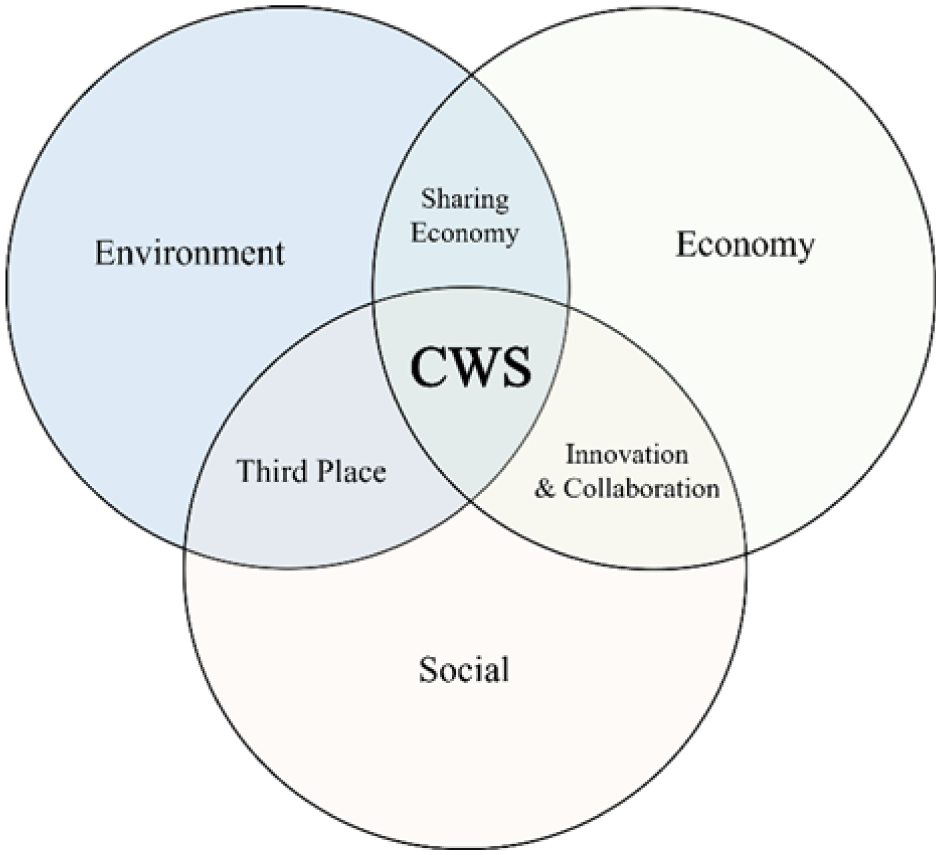
Key elements of coworking spaces.
Methodology
The methodology adopted in this research aims to systematically examine the theoretical foundations of CWS and their impact on economic development through a structured bibliometric approach. A three-phase process was applied to collect and filter relevant academic literature. The analysis focused on studies published between 2005 and 2025, addressing the emergence and evolution of coworking spaces and following PRISMA guidelines. One effective way to illustrate the structure of scientific knowledge is keyword co-occurrence analysis. This method helps identify conceptual relationships across scientific texts, informing policy decisions and guiding research topic selection (Khaseh et al., 2021). Through bibliometric techniques, this study identified key research themes and trends within the literature on coworking spaces. The co-occurrence mapping offered a quantitative framework for examining how different concepts are interconnected, forming a foundation for understanding the thematic evolution of this interdisciplinary field (Bagheri et al., 2023; Ullah et al., 2023).
The data collection process began with the identification of articles related to coworking spaces. Rather than conducting an extensive search across multiple databases, the focus was streamlined to ScienceDirect. The initial search on ScienceDirect, without applying preliminary filters, yielded a total of 652,935 articles. To refine these results, the PRISMA screening approach was utilized. In the first stage of PRISMA screening, filters were applied for publication timeframe (2005–2025), document type (research articles), and language (English), narrowing the dataset to 2,031 articles. The second stage involved applying Subject Area filters and removing duplicate articles, resulting in a dataset of 926 articles. Finally, full-text reviews were conducted to exclude papers unrelated to coworking spaces. This rigorous screening process resulted in a final dataset of 864 articles. These were exported in RIS format, and imported into VOSviewer software for bibliometric mapping and analysis (Figure 3).
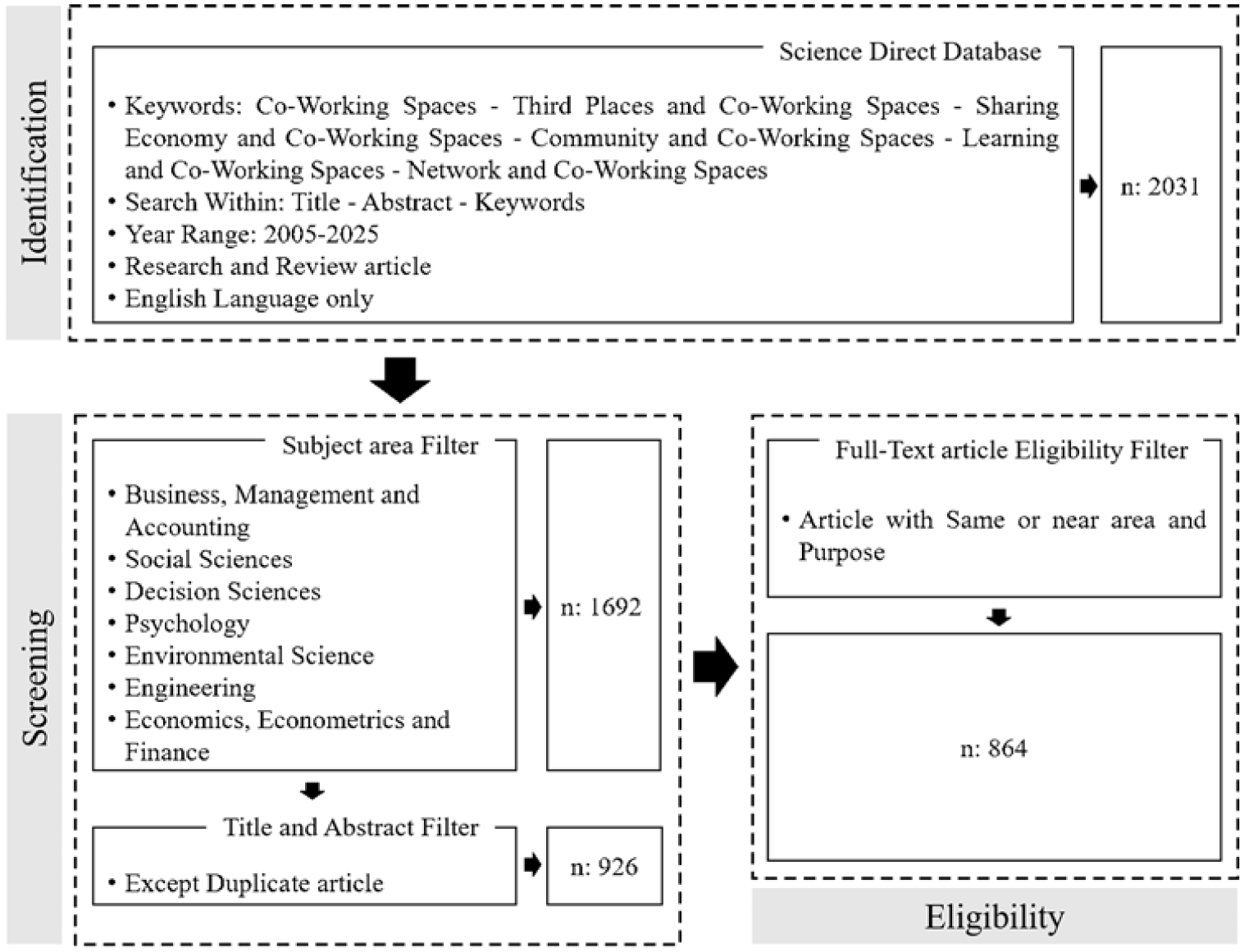
PRISMA edited flow diagram.
The final phase of the methodology employed VOSviewer software for bibliometric analysis, emphasizing keyword co-occurrence mapping to uncover underlying patterns and thematic clusters within the literature. VOSviewer enables the visualization of bibliometric data, showcasing the most referenced works, co-occurring keywords, and authors networks. In this study, keyword co-occurrence was selected to identify thematic clusters related to the concepts of CWS, third-place and sharing economy. Keywords were extracted from the titles, abstracts, and author-assigned keywords of the selected articles (Khaseh et al., 2021). The identified terms and their relationships, were visualized as network maps, offering valuable insights into the intellectual structure of the research domain. These visualizations highlighted clusters of interconnected concepts, illustrating their thematic proximity and relative importance (Ding, 2019; Van Eck & Waltman, 2019). The method of counting keywords chosen for this analysis was fractional counting. The distinction between this approach and complete counting lies in the principle that all keywords in the research should carry equal weight. This means that a researcher’s decision to cite a publication that has been referenced five times should hold the same significance as citing a publication that has been referenced 500 times (Perianes-Rodriguez et al., 2016). For the co-occurrence analysis, a minimum frequency of 10 was established to achieve a better semantic weight for generating bibliometric maps. Keywords that appeared Under 10 times were predominantly related to research methods, while those with a frequency of 10 or more were more associated with topics related to coworking spaces, economics, and third places.
Finally, a keyword standardization process was conducted. This involved consolidating plural and singular forms, merging synonyms, and ensuring consistency across terms. This refinement step ensured a more accurate and interpretable visualization of the conceptual landscape (Figure 4).

Bibliometric analysis.
Results
This research employed co-word analysis as a core content analysis, focusing on the co-occurrence of keywords. The keyword extraction process began with an initial text mining analysis using five seed keywords, which generated a corpus of 884 terms. Notably, in the early iterations (up to the fifth keyword), no concepts directly related to shared workspaces were detected. From the sixth keyword onward, terms associated with collaborative workspaces and economic domains began to appear; however, their frequency and thematic relevance were inconsistent. Specifically, iterations six through nine produced repeated but poorly aligned terms, such as fragmented references to the “collaborative economy” and “digital work,” which lacked thematic cohesion.
By the 10th iteration, the keyword set had stabilized, resulting in 131 semantically relevant terms. A systematic refinement process was then undertaken. First, methodologically extraneous terms—including country names, research-specific terminology, and unrelated technical jargon—were eliminated. Next, lexical variants (e.g., singular/plural forms, hyphenated vs. non-hyphenated spellings) were consolidated by selecting the most frequently occurring form (e.g., standardizing on “co-working” over alternative spellings). The dataset was normalized to 72 high-frequency keywords, which were then clustered in VOSviewer, producing 12 preliminary thematic groups.
The analytical maps provide a detailed view of the relationships among key concepts—such as coworking spaces, innovation, the sharing economy, sustainability, entrepreneurship, and advanced technologies—over 2005 to 2025. Based on bibliometric analysis, these visualizations help understand connections between keywords, where circle size represents frequency, color indicates cluster membership, and line thickness reflects co-occurrence strength. In Figure 5, central keywords include “coworking,”“innovation,”“sharing economy,” and “sustainability.” These keywords lie at the core of multiple clusters and exhibit extensive relationships with other concepts. The larger size of the circles representing these keywords signifies their higher frequency of occurrence in scientific articles and their critical importance in the research domain. Thick lines between keywords, such as those between “coworking” and “innovation” or “sharing economy” and “entrepreneurship,” represent strong connections, indicating frequent co-occurrence of these terms across titles, abstracts, and keywords of relevant studies. The keywords have been categorized into several distinctive clusters based on their semantic and contextual relationships, with each cluster reflecting a specific research domain or thematic focus associated with coworking spaces.

Visualization of keyword co-occurrence networks.
The keyword density map (Figure 6), generated using VOSviewer, illustrates the frequency and thematic focus of core concepts in the scholarly literature on coworking spaces from 2005 to 2025. Key topics include innovation, the sharing economy, sustainability, entrepreneurship, and advanced technologies. The visualization employs a color gradient to represent keyword: yellow and red areas indicate high-density regions with frequent occurrences of particular concepts, whereas green and blue areas denote lower-density regions. Keywords such as coworking, innovation, sharing economy, sustainability, and entrepreneurship are centrally positioned on the map with high density, highlighting their prominence and recurrence within the research literature. The strong interconnection and high frequency of these keywords underscore their strategic importance in exploring topics related to coworking spaces. A closer examination of the map reveals distinct clusters of concepts that reflect the multifaceted nature of these topics. The central cluster, which includes keywords such as coworking, innovation, remote work, and digital nomadism, indicates a focus on the transformation of work environments enabled by innovation and digital tools. This cluster highlights the direct impacts of innovation on workspaces and emphasizes the role of digital technologies in fostering productivity and creativity. Additionally, concepts such as the “15-minute city” and “proximity knowledge” indicate an interest in optimizing efficiency and adaptability in the design of coworking spaces. sharing economy and entrepreneurship cluster, including terms like sharing economy and entrepreneurship, demonstrates the vital role of the sharing economy in fostering entrepreneurial models and social engagement. The co-occurrence patterns in this cluster also reveal a focus on organizational strategies and collaborative practices as integral components of coworking ecosystems. Another cluster, encompassing keywords such as sustainability, circular economy, bioeconomy, and urban governance, emphasizes environmental principles and sustainability, indicating researchers’ efforts to integrate sustainability frameworks and collaborative consumption practices into coworking spaces. Connections with renewable energy within this cluster underline the importance of renewable resources and efforts to merge urban governance with environmental sustainability principles.

Visualization of word occurrence density.
Finally, the advanced technologies cluster—featuring keywords such as Artificial Intelligence, Internet of Things, and Industry 5.0, underscores the pivotal role of modern technologies in transforming coworking environments. Work models leveraging advanced technologies address the complex demands of the digital age and introduce widespread applications within the digital economy. The keyword density map as a whole reveals the semantic connections among these clusters, particularly the strong relationships between innovation, sharing economy, and technology, which emerge as three core pillars driving coworking space development.
Figure 7 illustrates the relationships among keywords in scholarly literature on coworking spaces and related domains, including innovation, the sharing economy, sustainability, entrepreneurship, and advanced technologies. Connections are shown graphically, with node size representing keyword frequency, link strength indicating associations, and color gradients reflecting temporal trends and topic significance from 2005 to 2025. The color spectrum ranges from blue, representing concepts prevalent in the earlier years (2005), to yellow, denoting terms associated with more recent research (2025). As observed in the map, the keyword “coworking” emerges as the most prominent and central node within the network. This indicates the pivotal role of coworking spaces as the primary focus of research in the field. Closely associated keywords such as “innovation,”“sharing economy,” and “entrepreneurship” are positioned near the center of the map, signifying strong semantic linkages between these concepts and their critical roles across academic literature. These interconnections clearly illustrate the interplay between coworking spaces, innovation, the sharing economy, and entrepreneurship.

Visualization of keyword overlap in recent years.
Temporal trend analysis is also evident in this visualization. Keywords like “coworking,”“sharing economy,” and “innovation,” concentrated at the map’s center, are highlighted in yellow, signifying their growing prominence in recent years, particularly between 2020 and 2025 (Figure 8). This observation highlights the growing research focus on fostering innovation in collaborative work models. It also emphasizes the development of the sharing economy, driven by the shift toward the digital economy and social changes caused by COVID-19. Peripheral clusters show emerging keywords such as “digital nomadism,”“remote work,” and “hybrid work.” These trends reflect how crises like COVID-19 have accelerated changes in work patterns and the adoption of flexible, hybrid models. Moreover, keywords such as “sustainability” and “circular economy” appear in distinct yet interconnected clusters with the map’s central themes. This demonstrates the rising prominence of sustainability and circular economy principles in the design and management of coworking spaces.

Published articles from 2005 to 2025.
Keywords such as “Artificial Intelligence,”“Industry 5.0,” and “Internet of Things” form a separate peripheral cluster, shown in blue and green. They received initial scholarly attention between 2005 and 2020, with their significance gradually increasing in recent years. These terms highlight the role of advanced technologies in transforming work models and integrating digital innovations into economic and entrepreneurial contexts.
Overall, the visualization in Figure 7 reflects a cohesive and meaningful network of keyword associations, highlighting the multidimensional nature of coworking space-related research. On the one hand, keywords such as the sharing economy and innovation serve as prominent drivers within this domain, while on the other, temporal data vividly underscores the influence of external factors such as global crises, digitalization, and the movement toward sustainability. This map provides valuable insights for guiding research initiatives and formulating effective strategies to further develop coworking spaces.
The clusters identified through the co-occurrence analysis were subsequently subjected to manual review to ensure conceptual validity and grouped into four overarching thematic categories (as presented in Table 1). This secondary categorization was guided by two principles: (1) semantic coherence, ensuring that sub-themes logically fit within broader domains (e.g., grouping “remote work” and “flexwork” under Workplace Transformation), and (2) theoretical alignment, where clusters were linked to established academic frameworks (e.g., associating “circular economy” and “smart cities” with Sustainable Development). The resulting four Broad Themes are as follows:
Broad Theme 1: This theme addresses the reconfiguration of work environments and organizational practices, encompassing clusters such as collaborative work and learning, remote work and COVID-19 impacts, creative collaboration, and digital productivity. The central concepts include hybrid work, telecommuting, work-from-home (WFH), work-life balance, coworking, 15-min cities, and digital nomadism. Ultimately, this theme emphasizes shifts in labor dynamics, post-pandemic work models, and the spatial reorganization of work.
Broad Theme 2: This theme concentrates on innovation ecosystems and entrepreneurship, featuring clusters such as innovation ecosystems, entrepreneurship and global networks, business models, and startups. Key concepts include the maker movement, venture capital, open innovation, stakeholder networks, coopetition, and digital transformation. The academic focus is on ecosystem governance, startup scalability, and institutional support for innovation.
Broad Theme 3: This theme centers on sustainable development and emerging economies. It includes clusters like the circular economy and rural development, smart cities and the sharing economy, and Industry 5.0 and advanced technologies. Key concepts feature bioeconomy, urban governance, social innovation, and collaborative consumption. The academic focus is on green transitions, tech-driven sustainability, and inclusive urban-rural development.
Broad Theme 4: This theme highlights knowledge infrastructure and digital foundations, including the knowledge cluster. Key concepts involve knowledge creation, diffusion, and management. The academic focus is on epistemic frameworks, digital literacy, and knowledge-based economies.
Thematic Classification of CoWorking Spaces.

Discussion
This study examines the role of coworking spaces, often referred to as “third places,” on various environmental dimensions. Research by Zhao et al. (2020) highlights that coworking spaces have become vital urban environments, offering essential support to an increasing number of freelancers who encounter challenges such as informality, uncertainty, and the risks associated with independent work. The implications for urban planning involve creating more collaborative spaces and reconfiguring existing urban areas to meet this growing demand, which is anticipated to further increase the need for c-working environments. This research builds on these insights, focusing on several key advantages of coworking spaces, including understanding local demand, reflecting on business practices, staying updated with new technologies and work standards, exploring opportunities for business transformation, networking, team building, fostering new ventures among peers, facilitating referrals to external clients, and cultivating a sense of community. Discussions about coworking spaces often emphasize their social and economic dimensions. For instance, Koperska (2025) notes that CWS are increasingly recognized as important hubs in urban areas, fostering both social and economic interactions. Similarly, Weißwange et al. (2025) highlight that CWS not only provide workspaces but also encourage networking, knowledge sharing, and local business development, demonstrating their broader impact on communities and urban life. J. Johns et al. (2024) further emphasize the importance of developing communities that promote innovation while integrating economic considerations into coworking space design. Other studies by Kojo and Nenonen (2016), Schmidt and Brinks (2017), and Nakano et al. (2020) have also explored indicators related to these dimensions. This paper aims to explore the role of coworking spaces within management theory literature to develop economic models and understand their significance. It aligns with findings from Bouncken and Reuschl (2018) and Leclercq-Vandelannoitte and Isaac (2016), who identified gaps in the internal processes of these spaces and their potential to enhance the operations of participating businesses.The analyses indicate that interaction is crucial not only in terms of environmental aspects but also across social, economic, and technological dimensions. Key themes such as “circular economy,”“sustainability,” and “social partnerships” are relevant to this study and are rapidly evolving areas of interest. Changes over time highlight the increasing importance of innovation and new capabilities in addressing global challenges. Visual representations of key concepts illustrate how different ideas influence and reinforce one another. The term “Circular Economy” emerges prominently in research discussions, linking closely with sustainability and sustainable business models. This shift reflects a move away from traditional linear economic models toward more sustainable practices that prioritize recycling and resource reuse. Blomsma and Brennan (2017) characterize the circular economy as “a repurposed concept rather than an original one,” suggesting that various strategies aimed at extending resource use are not individually new but collectively form a significant approach. Corvellec et al. (2022) noted that different definitions share a common foundation in separating the extraction and use of natural resources from economic production, emphasizing resource efficiency as a primary goal. Some findings from this research raise important questions that warrant further exploration. Initially, one might assume that businesses entering coworking spaces primarily focus on securing funding for independent locations. However, the dynamic atmosphere of coworking environments—where energetic individuals with innovative ideas come together—creates an ideal setting for business growth. Knowledge sharing is a vital process in knowledge management that enhances creativity and organizational performance; thus, identifying complementary factors arising from knowledge sharing is particularly important. Technological factors have also been incorporated into the environmental, social, and economic dimensions explored in this research. This study addresses an emerging scenario in today’s workforce characterized by increased fluidity and mobility, driven by rapid advancements in digital technologies. Crovara (2023) emphasizes the significance of digital technology in creating supportive coworking environments for individuals, startups, and companies alike. Benefits associated with collaborative workspaces include new opportunities, innovative products, improved processes, cost reductions, enhanced business environments, talent attraction and retention, as well as customer engagement—all linked to the growing role of ICT in social contexts. Additionally, Simeonova (2018) and Zimmerman et al. (2018) have highlighted how new technologies with networking capabilities facilitate knowledge sharing among companies while overcoming traditional IT barriers. Overall, this study underscores the multifaceted benefits of coworking spaces in fostering innovation, collaboration, and sustainable practices within contemporary work environments. The findings offer several practical implications for both practitioners and policymakers. Coworking spaces should be viewed as hybrid socio-economic infrastructures that create value through shared resources, community-building, and knowledge exchange. Enhancing this value requires environments that balance social interaction with economic opportunities, supported by targeted services and local partnerships.
Moreover, their strong connection to the sharing economy positions coworking spaces as strategic tools for urban and regional development, with the potential to support entrepreneurship, local employment, and urban regeneration. Finally, the growing role of digital technologies—such as AI, Industry 5.0, and IoT—highlights the need for investment in technological infrastructure and training to strengthen innovation capacity within these spaces.
Conclusions
Coworking spaces, along with accelerators and coaching centers, serve as vital urban intermediaries that nurture innovation, economic development, social interaction, and community well-being. They function not only as flexible work environments but also as distinct “third places” that foster community-building by facilitating social and professional networking beyond conventional office boundaries. The findings of this study demonstrate that coworking spaces encompass interconnected social, economic, technological, and environmental dimensions. Effectively managing these multi-faceted aspects is essential to foster environments that promote innovation, productivity, and sustainability simultaneously. Our bibliometric and cluster analyses highlight the critical roles of technology and sustainability as driving forces shaping coworking space development, especially in response to recent global challenges such as the COVID-19 pandemic and climate change. In the post-pandemic context, coworking spaces have gained renewed significance as hubs for economic resilience, social cohesion, and environmental responsibility. They provide platforms that support knowledge sharing, collaborative innovation, and access to green technologies, aligning with circular economy principles and sustainable urban development goals.
This research also underscores the importance of integrating coworking spaces into urban planning and policy frameworks to leverage their full potential in fostering sustainable economic growth and social inclusivity. For practitioners and policymakers, designing coworking environments that prioritize user well-being, adaptability, and technological integration is paramount. Despite providing a comprehensive thematic mapping of the literature, this study is subject to several limitations. First, as a bibliometric analysis, it primarily captures structural patterns and thematic linkages, offering limited insight into the lived experiences, social interactions, and governance mechanisms through which coworking spaces function as “third places.” Second, although the concept of coworking as a third place underpins the study, the findings reveal that existing research tends to emphasize productivity, innovation, and technological efficiency, while the social, cultural, and community-building dimensions of third places remain comparatively under-theorized. Third, the literature is largely shaped by economic and technology-driven perspectives, leaving issues such as inclusivity, power relations, and spatial inequality less systematically examined. These gaps point to the need for future research that moves beyond thematic mapping toward deeper empirical and comparative investigations. Integrating coworking spaces into urban planning and policy frameworks, examining their long-term impacts through longitudinal studies, and exploring the influence of emerging technologies such as Artificial Intelligence and Industry 5.0 can help advance the field. Moreover, comparative analyses across diverse urban, peripheral, and rural contexts, as well as studies focusing on more holistic understanding of coworking spaces as engines of sustainable economic development and social inclusion.
In conclusion, coworking spaces are becoming key components of modern urban ecosystems, supporting new work practices, promoting sustainable development, and fostering social and economic innovation. Their continued evolution will depend on the dynamic interplay between technological progress, environmental priorities, and emerging social needs.
Supplemental Material
sj-docx-1-sgo-10.1177_21582440261417411 – Supplemental material for Co-Working Spaces as Third Place: Initiatives for Sharing Economy Development
Supplemental material, sj-docx-1-sgo-10.1177_21582440261417411 for Co-Working Spaces as Third Place: Initiatives for Sharing Economy Development by Shayan Amani Janati, Seyedeh Zahra Hosseini, Payam Ariafard, Zahra Zarabadipour and Zahra Sadat Saeideh Zarabadi in SAGE Open
Footnotes
Acknowledgements
The authors have no acknowledgments to declare.

Ethical Considerations
This study did not involve any human participants or personal data. It is based solely on secondary bibliometric analysis, and therefore did not require ethical approval or informed consent.
Consent to Participate
Written informed consent was obtained from all participants prior to their participation in this study.
Consent for Publication
All participants provided informed consent for the publication of anonymized data and quotes from their interviews.
Author Contributions
All authors contributed to data collection and writing the original draft of the manuscript. Conceptualization, methodology, secondary writing, and data analysis were performed by the first and second authors. Data curation and reference management were carried out by the third and fourth authors. Supervision and scientific guidance, as well as project administration, were provided by the corresponding author (the fifth author).
Funding
The authors received no financial support for the research, authorship, and/or publication of this article.
Declaration of Conflicting Interests
The authors declared no potential conflicts of interest with respect to the research, authorship, and/or publication of this article.
Data Availability Statement
The data supporting this study’s findings are not available upon request from the corresponding author.
Supplemental Material
Supplemental material for this article is available online.
References
Supplementary Material
Please find the following supplemental material available below.
For Open Access articles published under a Creative Commons License, all supplemental material carries the same license as the article it is associated with.
For non-Open Access articles published, all supplemental material carries a non-exclusive license, and permission requests for re-use of supplemental material or any part of supplemental material shall be sent directly to the copyright owner as specified in the copyright notice associated with the article.
