



Abstract
The role of parents in child socialization has been an inquisitive subject of inquiry. Parenting style forms one of the widely adopted lenses through which child-rearing patterns have been conceptualized. Though well-researched, gaps persist in comprehending the core works in the parenting style-child socialization relationship domain and their linkages. This study employs bibliometric techniques to present an objective assessment of 1,812 articles containing 93,720 cited documents, using citation and co-citation analysis. Prominent works in the discipline and associated clustering patterns are revealed. Further, the centrality parameters of the parenting style research network are deciphered via social network analysis. The exercise adds to theory by clarifying the scholarly dialog and depicting the intellectual structure of parenting style research. Further, through the findings, potential research directions are outlined.
Introduction
Socialization, as a process of one’s adaptation to the environment, is a continual lifelong one. Though its phenomenological significance transcends contexts and temporality, the nature and goals of socialization are nevertheless viewed as contingent on several aspects. One such well-adopted distinction is the lifecycle stage of the referent individual. It is well-accepted that adult socialization is more context-specific and influences a relatively narrow range of outcomes, for example, organizational adaptation in a work-career context determines individual and business-level consequences (Rafky, 1971). On the other hand, child development and socialization is a much broader process, potentially impacting not just the family members involved but also extended families, communities, and socio-economic systems.
Though various aspects of children’s environment have been linked with the process of their adaptation, parenting style has consistently been amongst the most intuitively appealing, conceptually relevant, and empirically validated factors. This interest in exploring the meaning and underlying connection of the broad ways of rearing and psychosocial development has been visible since at least the beginning of the 20th century (Darling & Steinberg, 1993).
Several unresolved issues are enmeshed in the general acceptance of the nurture school of development. First, though human development and socialization is indeed a naturally complex subject, the research on the influence of parenting presents a still disproportionate maze of concepts and terminologies. Extant literature conceptualizes the role of parenting via a confluence of parenting practices, dimensions, skills, styles, and strategies. While each concept has a unique meaning, the same has not been often clarified. In some studies, parenting style is meant as an overall emotional climate (Darling & Steinberg, 1993), independent of the content of parent’s behavior (Kremers et al., 2003). In contrast, other works see it as a constellation of practices (Steinberg et al., 1994). While practices are expectedly infinite across diverse contexts, dimensions also present substantial multiplicity, for example, warmth, behavioral control, harsh control, psychological control, and autonomy granting (Pinquart, 2016). Concepts that seem related to each other, for example, autonomy granting appears to be opposed to some form of control, are presented as distinct. Though unproblematic, when seen individually, conceptualizing parenting as a skill or strategy is inconsistent with the instinctive and affective nature of the parent-child relationship. Second, despite salient attempts, the degree of cultural variation in the parenting-socialization relationship remains ambiguous. Some studies have attributed the observed inter-group differences in the parenting-socialization linkages across social and ethnic groupings to cultural moderation (R. K. Chao, 1994), whereas others have treated other environmental influences, for example, peers or nature (genes), as the underlying explanation (W. A. Collins et al., 2000; Steinberg, Dornbusch, & Brown, 1992; Xu et al., 2008).
Ambiguities such as the above suggest that scholars working in the domain need to pause and take stock. Literature reviews incrementally address the alternative viewpoints in any research domain and synthesize extant understanding. A review of the parenting style research at this juncture can depict the different underlying thought schools and suggest potential research opportunities. Though extant research on parenting influence includes a reasonable number of review articles (Table 1), most of these studies are constrained to a narrow focus, for example, the relationships with specific outcomes. While being useful in their sub-domains, their relevance to broader issues of the domain remains limited. Second, to nascent researchers, who begin work exploring this domain, they present uni-dimensional views of an otherwise holistic discipline. On a positive note, many reviews demonstrate adequate rigor, employing techniques such as the systematic selection of articles and meta-analytic methods. Third, none of these reviews have identified the underlying themes of parenting style research. Similarly, none has assessed the evolution of the domain, its notable contributions, and what linkages are observable among the influential works. Apart from these review articles (Table 1) identified via a qualitative ancestry-mapping-based view of the literature, a systematic keyword-based search was also employed. The Web of Science database search with a logical AND operation on “Parenting style” and “bibliometric,” in the topic section (Title, Abstract, and keywords), yielded no search results.
An Illustrative Exposition of Literature Reviews in Parenting Style Research.

To fill this research gap, this paper attempts to complement the extant reviews in the parenting style domain through a quantitative analysis. A logical synthesis of prior studies is critical for advancing a research domain. Amongst such efforts, conceptual and systematic reviews perform the vital function of theoretical, methodological, thematic, or conceptual exposition (Snyder, 2019). However, despite their widely accepted relevance, certain aspects like author bias, lack of objectivity, and insufficient rigor have been regularly raised (Arora & Chakraborty, 2021a). As a second category, meta-analytic reviews present a means to overcome some of the above issues by adopting an objective technique. However, they bring their own limitation in terms of restriction of analysis to specific and narrow problems. Accordingly, while helping quantify individual relationships at an aggregate level, they are sub-optimal when focusing on broader issues concerning a research discipline (Schmidt, 2008). Instead, we provide an integrative structural map of the field by employing different bibliometric methods. Such methods are more objective, systematic, and reproducible (Zupic & Čater, 2015).
Specifically, the techniques of citation, co-citation, and network analysis have been used. These methods reveal the influential works in parenting style research and their linkages. An analysis of joint citations in a subsequent work brings out the convergence between past significant contributions of a discipline (White & Griffith, 1981). Such an approach of presenting the informal research network portrays the intellectual structure of parenting style research. While it reveals the key ideas that shape the parenting style domain, it also outlines an evolutionary view of the discipline and identifies future research areas.
Specifically, this paper sets out the following objectives:
An identification of the vital contributions to parenting style research.
Mapping the linkages between the key contributions of the parenting style domain and outlining the multiple research perspectives that have shaped its informal thought clusters.
An assessment of the centrality features of the parenting style research network.
Introduction of bibliometric methods widely employed in several research domains, for example, business management to the developmental psychology domain.
The remainder of the paper is structured into three sections. In the first section, the bibliometric methods employed are discussed. Subsequently, the underlying data extraction and analysis are elaborated, and the results are discussed. The article concludes by discussing the substantive findings, future research directions, and limitations.
Background
Conceptualization
The emotional context and practices followed by parents have vital ramifications on child development (O. F. García et al., 2018; Gimenez-Serrano et al., 2022). Parenting style represents the mesh of relatively consistent patterns of behaviors and attitudes that parents hold and exhibit while guiding, protecting, and nourishing their children (Darling & Steinberg, 1993; Martínez et al., 2019). It manifests in the degrees to which parents employ control, display responsiveness, evince warmth, and resort to punishment (Dwairy & Achoui, 2006). While parenting is indeed a dynamic and multi-faceted process, representation of its characteristics using a set of limited illustrative categories nevertheless holds immense value. Typologies of such kind are a form of mid-range theory and thus serve as analytical frames toward simplifying complex phenomena (Arora & Chakraborty, 2021b). Baumrind’s (1971) Three-way conceptualization of parenting styles as authoritarian, authoritative, and permissive serves as a seminal theorization in this respect. Whereas both authoritarian and authoritative parents are high on demandingness, the former are less responsive and grant lower autonomy to their children than the latter. On the other hand, permissive parents are low on demandingness but give high autonomy. Maccoby and Martin (1983) expanded Baumrind’s (1971) typology into a four-way classification by bifurcating the permissive category into indulgent and neglectful forms, with high and low responsiveness, respectively, while being similar on low demandingness and high autonomy.
The Role of Culture
Culture is the macro environment representing the confluence of norms, values, beliefs, practices, and customs that shape human behavior (Pinquart & Kauser, 2018). Like other facets of behavior, parenting is intensely shaped by the cultural context (F. Garcia et al., 2019). This aspect becomes even more salient when parenting outcomes are considered (O. F. Garcia & Serra, 2019). Sizeable research has explored the form and style of parenting that could lead to better outcomes in terms of academic achievement and broader socialization (Queiroz et al., 2020; Steinberg et al., 1989). Though the findings are inconclusive at an aggregate level, evidence for cross-cultural variation is too substantial to be ignored. While Anglo-Saxon contexts place authoritative parenting as best for a child’s psychosocial maturation (Lamborn et al., 1991), studies in eastern societies find authoritarian styles to perform better in several aspects (Dwairy et al., 2006). Further, indulgent parenting has been shown to score over other types in some European and South American countries (Martínez et al., 2021). Variation is also visible within a particular geography on account of studying different sub-groups based on ethnicity, social class, etc. (R. K. Chao, 2001). Accordingly, culture and parenting, remains a vital domain to explore (O. F. Garcia et al., 2020).
Measurement
Concepts and constructs need operationalization for assessment in our quest toward refined theory and improvised practice. However, measuring parenting attitudes and behaviors is far from straightforward. Several issues arise, for example, should one rely on parents’ self-reports or children’s responses? Similarly, should one measure different dimensions of parenting, for example, warmth, control, etc., separately, or these be combined? Still, further, does a context-independent measure perform better, or should we demarcate measurement across different reigns of a child’s life, for example, schooling, feeding, playing, and screen time? In line with these diversities, numerous scales for measuring parenting practices and styles exist (e.g., Arnold et al., 1993; Goodman, 1997; Jackson et al., 1998; Reitman et al., 2002; Robinson et al., 1995). Another vital aspect is the lifecycle stage at which the assessment is made, for example, scholarly work can be demarcated across the study of children, adolescents, and youth (Buri, 1991; Gimenez-Serrano et al., 2022). Such studies often modify the content structure of specific items to fit corresponding subjects rather than generating refined scales.
With this brief theoretical introduction to the meaning and richness of parenting as a phenomenon, we move on to elaborate on the specific methods employed in this work.
Methods
Scholars have consistently stressed the objective of enhancing scientific rigor in the study of science (Boyack et al., 2005). Toward this goal, bibliometric methods emerged in the library and information science discipline. This umbrella term denotes a set of methods that unsheathe and organize the extant literature to trace the underlying structures and synopsis of research disciplines (Zupic & Čater, 2015). The underlying premise of such methods is the quantitative trail left by any research document. Accordingly, bibliometric techniques are systematic, objective, transparent, and indispensable in revealing any research discipline’s distinct yet related thought schools (Wang et al., 2016). Such methods assume that citations are an efficacious measure of the prominence of a scholarly work. There is broad agreement on such a stand amidst sparing voices challenging the objectivity of citations on the grounds of cronyism and networking (Stremersch et al., 2007).
We observe a relative absence of bibliometric methods not just from parenting style research but more broadly from the broader discipline of developmental psychology. A search undertaken with the keyword bibliometric on several journals of the subject, for example, Child Development, Developmental Psychology, International Journal of Behavioral Development, Journal of Applied Developmental Psychology, Journal of Adolescence, Journal of Research on Adolescence, and Parenting, yielded only two results, one each from the Child Development, and the International Journal of Behavioral Development journal. The first article (Yan, 2018) only reported the word to indicate that such a method was not employed in the study. The second one (Schui & Krampen, 2010) performed an evolutionary assessment of the journal rather than a research domain. Other keywords, such as co-citation, were used to check for the intended search’s exhaustivity and similarly yielded no result. Accordingly, beyond its identification of the intellectual structure of parenting style research, this paper makes a modest attempt to introduce bibliometric methods to the developmental literature. Scholars can use these widely adopted objective techniques to map better the current state of knowledge in their respective sub-domains and identify future research potential.
At an aggregate level, bibliometric methods can be viewed as an amalgam of five techniques: citation analysis, bibliographic coupling, co-citation analysis, co-author analysis, and co-word analysis (Zupic & Čater, 2015). While the first three techniques work on citation data, co-author analysis matches authors to assess collaboration. Finally, the content of a document, for example, abstracts, keywords, titles, or the main body, is employed in the co-word analysis. While belonging to a method umbrella, each technique is differentially suitable based on the research goal. Citation and co-citation analysis are often used together when a researcher aims to generate a research discipline’s underlying structure and synopsis. Network analysis complements these two techniques by visualizing and quantitatively assessing the output generated (Arora & Chakraborty, 2021a).
Citation Analysis
Citation analysis reveals the key contributions to a research discipline in an objective manner. Being based on citations as signposts of the relatedness of two documents (Phelan, 1999), citation analysis highlights all the major schools of thought in a discipline. Although citations may occur for several reasons, scholars broadly agree that their number reflects the impact a work has made (Dieks & Chang, 1976). Any research domain finds multiple dialogs at any point in time. Accordingly, all the major themes in a research domain enjoy an equal opportunity as far as citation is concerned (Small, 1978). Further, besides identifying seminal works, a temporal assessment of citations can track the evolution of a discipline and the relative popularity of sub-themes.
Co-Citation Analysis
A co-citation of two scholarly works in a later document is viewed as a degree of their thematic similarity. In other words, documents having inherently convergent arguments have a higher probability of being co-cited. Accordingly, co-citations help identify informal thinking clusters, popularly termed “invisible schools” (Arora & Chakraborty, 2021a). As earlier categorized, an alternative literature mapping technique is author co-citation analysis. Initially proposed by White and Griffith (1981), author co-citation reflects the frequency of two authors being cited together. Accordingly, the reference changes from documents to authors. This study has adopted document co-citation instead of author co-citation for two reasons. First, an analysis based on authors fails to incorporate the role of secondary authors. Second, researchers seldom restrict to a single research discipline and instead contribute to various such domains. Accordingly, an assessment based on authorship potentially transcends a particular research domain’s boundary, which is not the intention of this study as it is restricted to the parenting style domain. Further, co-citation analysis is a widely adopted bibliometric technique (Arora & Chakraborty, 2021a; Wang et al., 2016). It is employed when the aim is to trace the thematic links between the influential contributions of a research discipline. Co-citation analysis can achieve a comprehensive mapping as it allows for accommodating differential viewpoints within a research discipline (Arora & Chakraborty, 2021a).
Social Network Analysis
Social network analysis (SNA) investigates the relational structures in a social network (Otte & Rousseau, 2002). Each edge or linkage in a social system is viewed as a relationship between the nodes or individuals. Accordingly, this study used SNA to complement the assessment of citations and co-citations, citations being an attribute of nodes and co-citations representing edges. The centrality features of SNA pinpoint the important social actors and their linkages with other actors. In the context of bibliometrics, highly cited works in a research domain represent the actors or nodes of SNA. Three centrality measures are usually chosen in SNA- degree, betweenness, and closeness (Arora & Chakraborty, 2021a). Degree centrality denotes the number of linkages a node possesses in a network. A higher score indicates relative importance and sovereignty. Betweenness is the degree to which an actor can facilitate the bridging of other actors. The ability to interlink disparate parts of a network means that some nodes act as brokers (Everett & Valente, 2016). Finally, closeness centrality measures an actor’s geodesic distance from other network actors. A higher score on closeness implies that a node is relatively near all the other nodes.
Data Aggregation and Analysis
Bibliographic data constitutes the primary component of the research performed in this study. Accordingly, it is vital to specify the manner of selecting such data and how it was refined for amenability. The process flow of the study is depicted in Figure 1. Additionally, since one of this paper’s objectives is to facilitate scholars to undertake similar analyzes in other sub-domains of developmental psychology, the entire process adopted in the study is elaborated sequentially in Supplemental Appendix 1B.

The workflow of the study.
Article Selection
This study relied on the Social Sciences Citation Index, available through the Web of Science (WoS), for identifying relevant research. WoS SSCI is a comprehensive database incorporating the publication output of about 3,400 journals spread over 58 subjects. Several published articles using bibliometric methods have employed WoS SSCI (Arora & Chakraborty, 2021a). A keyword search was performed on WoS with the phrase “parenting style.” Alternatively, more comprehensive searches were also conducted with keyword combinations such as “child rearing” and “parenting practices.” Since the final analysis is performed on the highly-cited references within the identified articles, the parsimonious and the alternative searches were materially similar in terms of the data they generated for this study. Accordingly, the initial search keyword was kept unchanged.
The search was restricted to English-language articles without setting any temporal filters and was executed in August 2020. Parenting style has been researched for a long period, and research articles accordingly date back to before the 1950s. One of the salient aims of this study is to identify the intellectual structure, that is, various thought schools within parenting style research and their linkages (White & Griffith, 1981). The use of time-free search allows for recognizing citations and co-citations that build over time. No part of the research faces any disadvantage with such an approach. Further, it potentially identifies a more comprehensive range of relevant studies to work on.
No manual intervention at a reduction of the search result was undertaken in order to preserve the objectivity of selection. Though some out-of-scope results were anticipated, the nature of bibliometric exercise allows for nullifying the impact of such inclusion since their cited references would be divergent from the relevant articles and references. One thousand eight hundred twelve research articles were retrieved, having 93,720 references, that is, an average of 51.72 cited documents per identified article. As anticipated, the cited documents (N = 93,720) include conference proceedings, journal articles, books, doctoral dissertations, and reports. WoS database allows for exporting the search results with the option of choosing multiple fields for each identified item. All cited references of each identified article constituted the most crucial field for the analysis performed in this study. For other types of assessments, such as co-word analysis, abstracts, keywords, etc., are relevant.
This WoS output plain text file was refined before being employed for citation and further analysis. One aspect that needed rectification was the duplication present due to various semantic differences in representing each entry. Second, books having multiple editions were cited as different records, whereas a combined citation count is appropriate for assessing its influence. Such inconsistencies were corrected manually, and the final WoS plain text file was entered into Bibexcel for performing citation and co-citation analysis. Bibexcel is a free-to-use bibliometric software that allows a convenient interface for such analysis. The output co-citation matrix from Bibexcel was subsequently employed for multivariate analysis. SPSS 24.0 was used for this purpose. Visualization of parenting style research was done using VOSviewer, and social network analysis (SNA) was finally performed using UCINET. Both VOSviewer and UCINET are also free-to-use applications. Regarding SPSS, it was used for factor and cluster analysis (as detailed later), and the same can be performed by any multivariate analysis application.
Co-Citation Matrix
As can be intuitively visualized, the count of rows and columns in the co-citation matrix is equal to the number of documents selected for analysis. Thus a co-citation matrix is a square matrix. Further, this study initially identified 1,812 articles having 93,720 documents. There were a very high number of unique documents among these cited references (N = 93,720). Accordingly, it was considered necessary to trim the consideration set for citation and co-citation analysis. Beyond the need for simplification, such an approach is further supported by the argument that not all these documents merit a unique study. The extant literature on bibliometric methods provides several and often inconsistent data pruning guidelines (Arora & Chakraborty, 2021a). One widely accepted way is to calculate stress value via multidimensional scaling (MDS) (Kruskal, 1964). Stress-value is a badness of fit measure, and thus a lower value needs to be preferred. As followed in several similar bibliometric works, this study included documents having a minimum of 30 citations (Culnan, 1986). The corresponding stress score was 0.04500, which is acceptable, being between the range of excellent and good threshold (Kruskal, 1964).
This lower bound of 30 citations was satisfied by 87 parenting style research documents. These 87 documents were next put into an 87 × 87 square matrix, with each cell having the count of co-citations of each row-column pair of documents. As a record cannot be co-cited with itself, the co-citation matrix’s diagonal cells contain zeroes. These zeroes need to be replaced before multivariate analysis, and this study used the method suggested by White and Griffith (1981). For each such entry, the zero was replaced by half of the algebraic sum of the three largest co-citations. Such diagonal values reflect the corresponding node’s significance, that is, document and act as a proxy for the second largest distribution score. To tackle the scale differences, the original co-citation counts were transformed into Pearson correlation scores by employing SPSS. Along with alternative approaches to normalization like the Jaccard index normalization and Salton cosine (Zupic & Čater, 2015), this method of employing Pearson correlation as a similarity score has also been widely adopted (Boyack et al., 2005).
Extant literature using bibliometric methods guides the applicability of four broad approaches to the thematic demarcation of a research discipline: community detection algorithms, factor analysis, multidimensional scaling, and hierarchical cluster analysis (Zupic & Čater, 2015). This study checked for factor and cluster analysis, while community detection and MDS were not used. Whereas community detection algorithms like the Louvain algorithm are suitable for large-sized data sets, they often yield artifact groups containing a single node or document. MDS also presents a lacuna of leaving the decision of group assignment to be taken manually. While both factor and cluster analysis are multivariate techniques aiming at data reduction, the former seeks to identify latent structure within observed variables. In contrast, the latter intends to group units based upon scores on the variables. In our case, both techniques are analogous as rows (units) and columns (variables) both have the same information (co-citation matrix being a square matrix). Thus, though both the techniques gave similar patterns, the latter was preferred, for few records had cross-loading on multiple factors, giving rise to interpretation difficulty in factor analysis.
Accordingly, hierarchical clustering was employed on Pearson’s correlation matrix obtained from transforming the co-citation matrix. Since the number of underlying groups in the parenting style research distribution is unknown, hierarchical clustering with Ward’s method is suitable (Zupic & Čater, 2015). This approach simultaneously attempts to maximize between-cluster and minimize within-cluster Euclidean distances (Szekely & Rizzo, 2005). The clustering results thus obtained are interpretable using a graphical assessment of the Dendrogram visualization. A Dendrogram is a tree diagram that shows which groups combine or split at each process stage. Thus, while Ward’s method serves as an algorithm for cluster analysis, the dendrogram depicts and deciphers the results of the latter. As it utilizes an agglomerative approach, Ward’s method iteratively suggests a different number of groups. For the data underlying this study, it gave nine clusters initially. However, the second-level solution having nine groups, was finalized. To retain maximum qualitative information from the clustering process, the nine sets of the first stage are designated as sub-groups of the final five clusters and interpreted separately (Arora & Chakraborty, 2021a).
Results
Citation Analysis
All the cited documents in the 1,812 identified articles were sorted in descending order of the number they were cited via Bibexcel. The documents with more than 30 citations were designated as influential parenting style research works from this list. Further analysis based on co-citation and network parameter assessment was restricted to these documents. A list of these 87 works is provided in Table 2 in the descending order of citation. Consider that these citation counts (Table 2, Column 3) reflect the number of times a document is cited within the literature set of 1,812 articles. Accordingly, this count is lesser than the overall citations of any document. For example, Darling and Steinberg’s (1993) paper, which has more than 2,000 citations as per WoS, is cited in 371 of the 1,812 articles.
Highly Cited Documents in Parenting Style Research.

The following observations are made from Table 2:
The composition of these 87 documents defining parenting style research is moderately skewed toward the pre-2000 period (N = 52). Many of these works are quite dated, indicating their persistent importance to the domain.
The conceptual review by Darling and Steinberg (1993) and the four-level parenting style exposition by Maccoby and Martin (1983) emerge as the two most referred documents, cited 371 and 322 times, in that order.
A few methodology-related documents also appear among the influential works in parenting style research.
This list of 87 documents includes 72 journal articles, and 15 Books, Handbooks, Book chapters, Manuals, or Encyclopedias. A listing of the journals that have published the 72 research articles is given in Table A1 (Supplemental Appendix 1A). The distribution of these 72 articles is spread across a variety of 42 journals. Additionally, the journals belong to different subject domains like health and nutrition, family studies, personality, and clinical psychology, in addition to developmental and broader psychology.
Co-Citation Analysis
The analysis of co-citations at the document level enables the identification of the underlying thought schools of parenting style research. Specifically, five clusters with nine sub-groups emerge. Table 3 maps the different contributions and their clusters or sub-groups.
The Cluster Structure of Parenting Style Works.

The highest proportion of highly cited parenting style works falls in cluster one. A more granular analysis identifies three sub-clusters within this broad group. While the collection can be viewed as a domain definer over an aggregate basis, subgroup 1a includes the conceptual foundation of parenting style research. Baumrind (1971) stands among the seminal contributions that shaped the typological view of parenting influence by conceptualizing three styles: authoritative, authoritarian, and permissive. While authoritative parents were seen as both demanding and warm, authoritarian parents exhibited lesser warmth, and permissive parents displayed lesser control on a relative basis. Maccoby and Martin (1983) expanded this trilogy to a four-group typology based on two dichotomous dimensions of demandingness and responsiveness. Effectively, the permissive concept was bifurcated into indulgent and neglectful styles based on whether the low demandingness originates from a trusting or a disengagement orientation. Whereas Lamborn et al. (1991) provide empirical validation for the four-group parenting style typology, Darling and Steinberg (1993) provide an integrative view of the discipline, relating parenting style to parenting practices. Further, they attempt to explain cultural variations through the lens of differential goals and values across ethnicities and geographies.
Cluster 1b extends the exploration into cultural differences by adopting parenting influence on academic outcomes as a broad subject of inquiry. Whereas Leung et al. (1998) identify cultural variation across a triadic cross-country setting, R. K. Chao (1994, 2001) makes the same point by comparing Chinese immigrants with European-American counterparts in the same geography. The latter studies emphasize different meanings of the authoritarian style for Asian cultures and adopt it to explain differential academic impacts relative to western ethnicities. Steinberg, Dornbusch, and Brown (1992) use other environmental influences like peer support to explain these differences.
Cluster 1c, while broadly belonging to the domain-defining bracket, expands the horizon to include different dimensions and patterns of parenting, as also its influence on diverse outcomes. Spera (2005) assesses the role of parental practices like involvement and monitoring and their aspirations, in addition to the effects of parenting styles on academic outcomes. Whereas Steinberg et al. (1989) highlight the instrumental utility of the authoritative parenting style toward school competence, Steinberg et al. (1991) include the effects on psychological distress, self-reliance, and delinquency. Further, they validate the authoritative approach’s optimality across ecological contexts determined by ethnicity, family composition, and socio-economic status. In a similar broadening attempt, Milevsky et al. (2007) associate parenting styles with depression, self-esteem, and life satisfaction. Simons and Conger (2007) conceptualize differences between the styles adopted by both parents and adopt the perspective of a family parenting style while studying the influence on similar outcomes as in Steinberg et al. (1991) and Milevsky et al. (2007). Aunola et al. (2000) expand the discussion by assessing the adolescent’s achievement strategies rather than outcomes as a function of the parenting styles. Several other studies explore specific aspects such as psychological control (Barber, 1996) or monitoring (Pettit et al., 2001). Steinberg (2001) reviews the state of knowledge in the parenting style domain relative to the broader issues of genetic influence and the temporal changes as a child moves into adolescence.
Cluster two represents two facets, that is, the social foundation of parenting influence and the measurement aspect. Accordingly, sub-group 2a includes the broad social learning context espoused by Bandura (1977, 1986). Ideas like cognition-driven observational learning and reciprocal influence clarify the debate between nature and nurture to some extent. W. A. Collins et al. (2000) extend this debate further by taking a methodological position while comparing the traditional and contemporary research approaches. Few documents in the sub-group operationalize and measure the relevant constructs like parental styles, for example, Jackson et al. (1998), Reitman et al. (2002), and Robinson et al. (1995, 2001). Finally, there is an effort toward assessing the adverse socialization outcomes within the sub-group by some works, for example, Hoeve et al. (2009), Radziszewska et al. (1996), and Querido et al. (2002).
Cluster 2b aims to enhance method rigor and, in a similar vein, searches for an optimal style of child-rearing. Whereas works like Aiken and West (1991), Bentler (1990), and Hu and Bentler (1999) suggest methodological aspects, others cater to the second dimension. F. García and Gracia (2009) question the idea of authoritative parenting as the optimal style. Stattin and Kerr (2000) and the other work by the same authors also vie for optimality, but via exploring parental practices rather than styles. They emphasize that monitoring behaviors need to move away from tracking and surveillance to realize the intended beneficial outcomes.
Cluster three presents a dual picture of child profiling and the Asian perspective on the parenting-socialization relationship. The internalizing and externalizing behavior checklists provided by Achenbach (1991) and later revised in the form of Achenbach and Rescorla (2001) present an operationalization of diverse child outcomes across age groups. Other studies in the sub-group focus on non-western conceptualization and validation of parenting styles and practices, for example, Chang et al. (2003), X. Chen et al. (1997), Lin and Fu (1990), and Wu et al. (2002).
Cluster 4 links parenting style research to related domains. Cluster 4a includes measurement scales focused on assessing parenting aspects related to but distinct from the popular operationalization via parenting styles. Arnold et al. (1993) provide a rating measure to score dysfunctional discipline behaviors of parents. While focusing on disciplinary practices, they acknowledge that parenting is much broader (Arnold et al., 1993; p.142). Goodman (1997) similarly presents a measure of children’s behaviors, relationships, and emotions via the strengths and difficulties questionnaire.
Cluster 4b is focused on viewing child-rearing from the attachment theory perspective. Bowlby (1969) and Ainsworth et al. (1978) provide a foundation for this theme of parenting style research by viewing the parent-child relationship as an innate biological response as well as a behavioral system, and the parent caregiver’s bond as a secure base of a child’s exploration of this world and life. Whereas Rapee (1997) reviews the two often-studied parenting dimensions of rejection (opposite of warmth) and control or demandingness, Parker et al. (1979) and Perris et al. (1980) provide inventories for the measurement of parenting behavioral dimensions. Finally, McLeod et al. (2007) summarize this theme’s findings with a meta-analysis linking these two dimensions of parenting behavior with childhood anxiety.
Cluster five unequivocally examines the linkage between parenting styles and children’s eating behaviors and health outcomes. Whereas a more considerable emphasis has been on investigating weight, obesity proneness, and related outcomes (e.g., Berge et al., 2010; K. E. Rhee et al., 2006), some studies have explored the consumption of specific food categories, for example, fruits (Kremers et al., 2003), and sweetened beverages (van der Horst et al., 2007).
To conclude this section, structural visualization of the parenting style research domain is presented in Figures 2 and 3. As stated, the same has been realized through the application of VOSviewer. This visualization software can work directly on citation database files, such as from the Web of Science. Alternatively, the network file generated by other programs, for example, Bibexcel, can be supplied to VOSviewer. Both methods provide the same results, subject to data quality and refinement. The thematic structures are represented via dotted lines, superimposed on the VOSviewer output.

A visualization of parenting style research network.
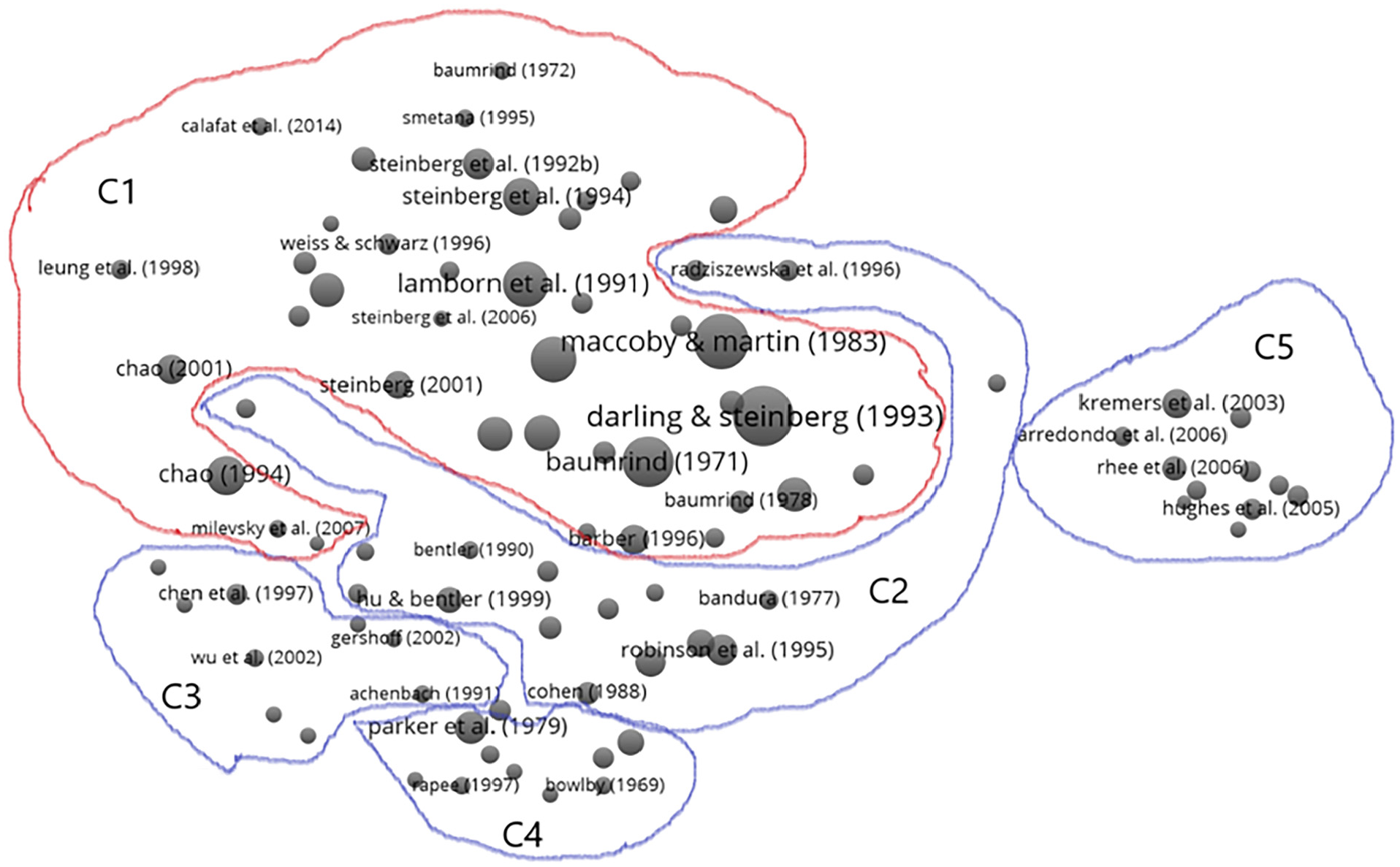
Intellectual structure of parenting style research.
Social Network Analysis
Network centrality parameters indicate the compactness, connectedness, and concentration in the parenting style research network. As discussed earlier, SNA measures facilitate the measurement and interpretation of these aspects. While applying SNA to co-citation data, network nodes are represented by individual research documents, whereas their co-citations denote the distances between them. SNA was performed using UCINET in this study. The aggregate degree centralization of the parenting style research network came out to be 21.40%. Corresponding closeness and betweenness centralizations were 33.29% and 0.26%, respectively. These results indicate a moderately decentralized network. While the scores are lower than maximum values realizable for a perfect star network, they are relatively high compared to similar assessments of other research domains (Arora & Chakraborty, 2021a). Accordingly, the parenting style domain emerges as a moderately concentrated network.
Table 4 lists the top 10 documents on each of the three centrality parameters. Whereas 23 records share the top 10 scorers on degree centrality, 13 do the same when all three centrality parameters are considered together. Interestingly, these documents cater to the different parenting style research clusters like conceptualization (Darling & Steinberg, 1993; Maccoby & Martin, 1983), cultural moderation (R. K. Chao, 1994), rearing patterns, and socialization outcomes (Buri, 1991; Steinberg et al., 1994), measurement and adverse outcomes (Baron & Kenny, 1986; Robinson et al., 1995). At the same time, several other groupings like the quest for an optimal style and methodological rigor (cluster 2b), child profiling and Asian perspective (cluster 3), boundary-spanning (cluster 4a, 4b), and health outcomes (cluster 5) are not central to the network despite being well-cited.
Parenting Style Works Highest on Different Centrality Measures.

Discussion
The current section maps the outcome of the study with the objectives set out at the outset. Accordingly, three aspects are looked at; the vital contributions, an interpretation of clustering results, and potential future research directions.
Key Contributions to Parenting Style Research
This study has revealed several critical contributions to parenting style research. Defining works like Baumrind (1971), Maccoby and Martin (1983), and Darling and Steinberg (1993) deserve special mention, among others. Another noteworthy aspect is the complementarity of citation and network analysis in assessing a scholarly work’s significance. Very few highly-cited documents in the parenting style domain are equally vital on centrality parameters. Correspondingly, while being highly cited, some contributions score relatively low on centrality (e.g., R. K. Chao, 2001).
Although author analysis is not the focus of this study, a review of influential works reveals significant personal contributions. While disregarding the order of authors in contributory works, Laurence Steinberg and Diana Baumrind contribute 13 and 10 documents, respectively, to the identified list. Their works have not only given a conceptual life to the parenting style domain but have also given due attention to methodological rigor. At the next level is the contribution of Sanford M. Dornbusch, with six documents among the 87 highly influential ones. The work of Nancy Darling, Susie D. Lamborn, and Clyde C. Robinson deserves the following mention on account of influence, though several authors equal it in terms of the sheer count of documents. The other authors with three contributions to the list are Ruth K. Chao, Craig H. Hart, Stef Kremers, Nina S. Mount, Susanne F. Olsen, and Hakan Stattin.
Further, a substantial number of influential documents identified as a part of the parenting style research associate the construct with academic competence. Additionally, a significant proportion of these works are comparatively skewed toward the pre-2000 period. Accordingly, it is observed that academic competence formed the first socialization outcome to be associated mainly with parenting styles. Over time, the association has considerably widened.
Additionally, it can be inferred from a pooled analysis of Tables 2 and 3 that some thought schools of parenting style garner a disproportionately higher number of citations. For example, conceptual domain definers like Maccoby and Martin (1983) present a typology of parenting style that has stood the test of time and is relevant across the study of different outcomes. On the other hand, documents applying the parenting style influence in specific effects, for example, diet and health outcomes, are relatively cited only in their own sub-domains.
Finally, some methodological works emerge as highly influential in parenting style research. A broad reliance on the positivist paradigm of knowledge discovery and dissemination is visible across the social sciences. A natural consequence of such a paradigmatic approach is the explicit need for method rigor for peer acceptance. Though some articles like Baron and Kenny (1986) and Cohen (1988) are more universally applicable independent of the specific tool employed, others like Aiken and West (1991) or Hu and Bentler (1999) are specific to a particular research method.
Thought Clusters of Parenting Style Research
An analysis of co-citations has revealed a rich legacy of thematic works in parenting style research. One visible aspect is the relative inseparability of socialization outcomes from different clusters of this domain. Accordingly, though diet and health outcomes appear as a separate group, different consequences are inherently enmeshed within each cluster at an aggregate level and even within most individual documents at the micro-level. For most social sciences constructs, an assessment of consequences or outcomes can be better segregated from the phenomenon itself. For example, most constructs of the marketing domain, like consumer satisfaction, perceived value, and purchase intention, have been studied both alongside and independently of their consequences (S. C. Chen & Lin, 2019). However, in parenting style research, the concepts and outcomes seem more intertwined.
The parenting-child socialization influence can also be viewed from an evolutionary expansion of the diversity of outcomes. The initial studies exhibit a bias toward measuring the association between parenting style and children’s academic competence or achievement. However, the focus has over time moved into such diverse behaviors like internet addiction, substance abuse, violence, and obesity on the negative valence (Calafat et al., 2014; Kumcağız, 2019; Wijeratne et al., 2014) and healthy lifestyle, psychosocial maturity, and life satisfaction on the positive side (Arredondo et al., 2006; Bartholomeu et al., 2016; Guastello et al., 2014). This continuum encompasses relatively neutral or ambiguous outcomes like consumer behavior and materialism (Mikeska et al., 2017; Poraj-Weder, 2014).
Further, though cultural moderation has been emphasized sparingly, at an aggregate level, very few documents or clusters recognize these differences. This is striking compared to several other research domains, where cross-cultural comparisons have been made at several levels with hierarchical granularity, for example, inter-continental, national, regional, and even individual-level cultural variation.
Finally, the different groups revealed by the co-citation analysis emerge as broadly uniform in research methods, except for a temporal augmentation of method rigor. There appears to be an emphasis on longitudinal designs and a focus on the conjunctive use of self-reports and observation.
Research Opportunities in Parenting Style Research
Though conceptually broad and reasonably integrative, extant research on parenting styles, in particular, and child-rearing, in general, presents gaps in understanding, as revealed in the thematic analysis performed in this study. Even at the cost of some repetition, it is stressed that a greater need for cross-cultural studies is evident throughout the investigation. The visible efforts in this direction, for example, R. K. Chao (1994, 2001), Dornbusch et al. (1987), and Steinberg, Dornbusch, and Brown (1992), among others too, present inconsistent findings.
Additionally, the calls for exploring the mechanisms of parenting influence on children’s outcomes raised by many scholars (e.g., by Darling & Steinberg, 1993) have largely gone unanswered. A simple search for the term mediat* among the highly cited 87 documents identified in this study revealed that less than 10% of the studies were hit. Even among these works, more than half were selected only because a referred article included the keyword in its title. Accordingly, in line with broader research in the social sciences, the explanation(s) of the identified parenting style-socialization outcome relationship(s) should be better attempted.
In another area of concern, very few works (e.g., Belsky, 1984; Xu, 2011) have looked at the antecedents of parenting styles, that is, what decides the emotional climate parents offer to their children. This situation holds across the identified themes and individual documents. Beyond the parenting style aspect, other lenses through which parenting influence has been conceptualized, for example, practices, dimensions, skills, and strategies, have seen almost no exploration toward antecedents.
On the consequences front, an evaluation of the different outcomes linked to parental influence reveals potential under-researched areas on both the positive and negative valence side of socialization outcomes, for example, creative and innovative behavior, internet abuse, and cyberbullying. A related potential area can be the linkages between the parenting style and children’s typological views in other aspects of behavior, such as learning styles and consumer decision-making styles. Few identified studies, for example, Mikeska et al. (2017), motivate the need to plug such gaps.
Finally, human behavior is expansive. Several aspects of a child’s behavior are internalized and recur later in life. Accordingly, a linkage with adult behaviors, such as leadership, organizational commitment, etc., can be envisaged. Some promising studies, for example, Kudo et al. (2012) and Liu et al. (2020), provide pointers in this direction.
Limitations
This study suffers from some limitations generally associated with bibliometric methods. The primary criticism questions the appropriateness of citations to measure the salience of a scholarly work (Phelan, 1999). Such criticism is grounded in the argument that research works are often cited for factors such as networking, geographic bias, cronyism, author, or journal prestige (Stremersch et al., 2007). A related issue is the Matthew effect, that is, when citations exhibit positive reinforcement or, in other words, when money begets money (Arora & Chakraborty, 2021a). A more significant aspect is the possibility of methodological similarity as an underlying cause of citation. Further, negative citations also occur, that is, a work is cited for critiquing it rather than conceptually agreeing to it (Stremersch et al., 2007).
A major impediment is the disadvantage faced by recent works (Phelan, 1999). Citations build over time, and accordingly, a systemic bias exists among bibliometric methods in favor of older works. Within this study, the most recent work in the identified data-set dates back to 2014. It has to be acknowledged that established disciplines like parenting style are less susceptible to this limitation. Finally, niche scholarly works may not have emerged from quantitative analysis, despite the identification of several strands and themes in this study.
Further, for similar reasons as above, some of the research directions proposed in this study need more critical assessment. The focus on seminal articles, though useful, can obscure niche works that present novel ways of looking at a phenomenon. Accordingly, there needs to be a more detailed investigation of recent literature for concretizing some of the research gaps we have identified. Therefore, while this study has attempted to summarize and present a synopsis of parenting style research, wherein significant works and their inter-linkages have been stressed, a detailed and more granular conceptual analysis may complement the identified research themes.
Supplemental Material
sj-docx-1-sgo-10.1177_21582440231167843 – Supplemental material for Intellectual Structure of Parenting Style Research: A Bibliometric Analysis
Supplemental material, sj-docx-1-sgo-10.1177_21582440231167843 for Intellectual Structure of Parenting Style Research: A Bibliometric Analysis by Ritu Arora in SAGE Open
Footnotes
Declaration of Conflicting Interests
The author declared no potential conflicts of interest with respect to the research, authorship, and/or publication of this article.
Funding
The author received no financial support for the research, authorship, and/or publication of this article.

Supplemental Material
Supplemental material for this article is available online.
References
Supplementary Material
Please find the following supplemental material available below.
For Open Access articles published under a Creative Commons License, all supplemental material carries the same license as the article it is associated with.
For non-Open Access articles published, all supplemental material carries a non-exclusive license, and permission requests for re-use of supplemental material or any part of supplemental material shall be sent directly to the copyright owner as specified in the copyright notice associated with the article.
