




Abstract
This study examines how digital economic development affects income distribution in China, using panel data from 31 provinces between 2011 and 2021. Employing a two-way fixed effects model and robustness tests, it finds that the digital economy significantly increases household income, primarily through wage growth. However, the effects are uneven across different groups. Urban residents benefit more than rural ones, widening the urban–rural income gap. Regionally, the eastern provinces experience greater income gains than central and western areas. Industry-wise, high-digital sectors such as mining, finance, and energy see stronger effects, while traditional sectors like agriculture and public services show limited impact. Non-state-owned enterprises also gain more than state-owned ones, due to their flexibility and adaptability. These findings suggest the digital economy brings both opportunities and challenges—enhancing income overall but also contributing to inequality. Policy recommendations include improving digital infrastructure in less-developed areas, supporting digital upskilling, and strengthening regulations to ensure inclusive and equitable digital development.
Plain language summary
Income inequality is a growing concern in China and worldwide. The digital economy, driven by technology and innovation, offers new opportunities to improve income distribution. This study examines how digital economic development influences household income in China. Using data from 2011 to 2021, we measure digital economy growth and analyze its impact across different regions, industries, and urban-rural areas. Our findings show that while the digital economy helps increase overall income, its benefits are not evenly distributed. Urban residents gain more than rural residents, widening the income gap. Similarly, economically developed regions and highly digitized industries see greater income growth compared to less developed areas and traditional industries. These disparities highlight the need for policies that ensure the digital economy promotes fair and inclusive growth for all.
Keywords
Introduction
The digital economy is now the fastest-growing sector in many countries. In recent years, it has become increasingly recognized that data, as a novel production factor, has surpassed traditional inputs such as capital and labor in driving economic growth (Sutherland & Jarrahi, 2018). In 2021, the U.S. digital economy contributed over $2.4 trillion in value added—more than double that of a decade earlier—surpassing the finance and insurance sectors and ranking second only to manufacturing. This rapid development has transformed the global economy, reshaping factor, industrial, and market structures. Data has emerged as a critical production factor with comparable significance to capital and labor, fostering the formation of an independent data value chain and accelerating the digitalization of economies worldwide (Kenney & Zysman, 2016).
According to a 2019 UNCTAD report, the digital economy accounted for 15.5% of global GDP, with the U.S. at 21.6% and China at 30%. As a key driver of global economic growth, the digital economy profoundly impacts production modes, daily life, and particularly income distribution patterns (Goldfarb & Tucker, 2019). Digitalization has also changed labor markets by replacing routine jobs while simultaneously creating new forms of employment and altering labor demand structures (Carlsson, 2004). Importantly, these effects are heterogeneous, varying across regions, demographic groups, and firm types, which contributes to differentiated income distribution outcomes.
Reducing income inequality remains a critical issue for governments and scholars. According to China's National Bureau of Statistics, per capita disposable income rose to about $5,000 in 2022—2.23 times that of 2012. Despite this growth, significant disparities persist across regions and social groups. Over the past decade, China's Gini coefficient has remained around .47, highlighting the persistent and entrenched nature of income inequality in the country, as depicted in Figure 1.

Evolution of per capita disposable income and Gini coefficient in China from 2003 to 2021.
The impact of the digital economy on income inequality largely depends on the “discrepancy in returns” that different groups derive from it, potentially either narrowing or widening income gaps (Brynjolfsson & Collis, 2019). This dual effect highlights the complex and heterogeneous nature of digital economic development on income distribution. On one hand, new digital business models such as the gig economy, platform economy, and sharing economy have created ample employment opportunities for low-income groups. Flexible and informal work enables these workers to boost their earnings, contributing positively to overall income distribution. On the other hand, the digital economy drives demand in knowledge- and skill-intensive sectors, which increases wage premiums for high-skilled workers and exacerbates income disparities between skilled and unskilled labor. Thus, optimizing income distribution amid digital development requires targeted policies that address unequal access to “technological” or “information” dividends across diverse labor groups.
The digital economy has also fueled overall income growth and presents new opportunities to reduce urban–rural income disparities (Amuso et al., 2019). Urban residents benefit from greater access to employment and entrepreneurial information via digital platforms. Rural residents, too, have begun leveraging digital tools—particularly through rural e-commerce—to sell local goods and engage in entrepreneurship. However, rural regions still face significant structural barriers, such as poor digital infrastructure, a shortage of skilled talent, and pronounced regional disparities. These challenges hinder digital diffusion and limit the inclusive benefits of digital technologies for rural populations, underscoring the need for regionally differentiated development strategies.
This raises a critical question: Can the digital economy simultaneously promote equity and efficiency? More specifically, how does it influence income distribution across regions, demographic groups, and industries? To explore these questions, this study employs panel data from 31 Chinese provinces between 2011 and 2021 to empirically examine the digital economy's impact on residents' income. It further investigates heterogeneity by analyzing disparities across urban–rural divides, regions, and industries, thereby providing a more nuanced understanding of the mechanisms at play.
This study offers three main contributions. First, it extends academic discourse, which has largely focused on labor market dynamics, by developing an integrated analytical framework to explore the mechanisms through which the digital economy affects income distribution, contributing novel theoretical insights into equitable digital development. Second, it provides updated empirical evidence on how the digital economy—driven by big data and the internet—shapes income patterns, offering robust quantitative findings that highlight the differentiated effects of digitalization on various population groups and sectors. Third, from a practical perspective, with China’s digital economy reaching $7.1 trillion in 2021, the findings offer valuable and context-specific policy implications for emerging economies seeking to harness digitalization to reduce income gaps, promote inclusive growth, and overcome the middle-income trap.
Literature Review
In the backdrop of an accelerating new wave of technological revolution and industrial transformation, the digital economy has emerged as the most vibrant new economic paradigm (Savina, 2018). Historical evidence shows that technological revolutions and industrial transformations reshape labor demand structures, thereby influencing income distribution patterns among populations (Williams, 2021). The robust growth of digital technologies—such as artificial intelligence, cloud computing, and big data—has established the digital economy as a pivotal driver of national economic growth. Its inherent technological capabilities are fundamentally reshaping traditional production models and exerting profound impacts on labor markets and income distribution (Li et al., 2020).
The scholarly debate surrounding the impact of the digital economy on income distribution dates back to the early stages of digitalization (Bruno et al., 2023; Kobilov et al., 2022). Due to its complexity and multidimensional nature, this debate centers on whether the digital economy acts as a force that mitigates or exacerbates income inequality. Some scholars argue that digital development plays a positive role in reducing income disparities (Tayibnapis et al. 2018). This positive influence—termed the “digital dividend”—is attributed to the generation of diverse employment opportunities, promotion of entrepreneurship and self-employment, and enhancement of the value of digital skills (Grove et al. 2011).
Proponents of the digital dividend perspective emphasize several mechanisms. First, the digital economy creates a wide array of employment opportunities across multiple domains, from technical development to digital marketing, attracting young professionals and technical experts, and thereby increasing overall wage levels (Schmid, 2001; D. Zhang et al., 2022). Second, it stimulates entrepreneurship and self-employment, enabling more individuals to accumulate wealth and generate new jobs, which energizes the labor market. Third, the rising demand for digital skills has boosted the market value of individuals with these competencies, allowing them to secure higher salaries (Frias et al., 2017). Collectively, these mechanisms contribute to a potentially more balanced income distribution.
However, concerns remain that digital development may exacerbate income disparities, primarily due to the “digital divide”—the unequal access to digital technology and resources (Friemel, 2016). This new form of inequality arises as emerging digital technologies, especially the internet, create uneven opportunities across regions, industries, and demographic groups (Cruz-Jesus et al., 2012).
At the regional level, the digital divide widens the gap between developed and developing regions. Developed regions usually enjoy advanced digital infrastructure and technology adoption, enabling fuller participation in the digital economy and creation of high-paying jobs. In contrast, developing regions suffer from inadequate infrastructure, hindering their integration and amplifying income inequality (Brandtzæg et al., 2011). Across industries, automation and digitalization may reduce labor demand in traditional manufacturing, depressing wages, while high-tech and digital services sectors reward skilled workers with higher wages, further expanding wage disparities (Cruz-Jesus et al., 2018). Additionally, urban-rural disparities are exacerbated by unequal digital infrastructure and employment opportunities. Urban areas attract a young and skilled workforce, raising urban incomes, whereas rural residents face slower income growth due to limited access to digital resources.
Overall, the digital economy’s impact on income distribution is complex and multifaceted. While the digital dividend offers increased opportunities to some, the digital divide risks deepening inequality among regions, industries, and social groups (Bauer, 2018).
In summary, prior studies have illuminated the dual effects of digitalization on income distribution, but gaps persist regarding its heterogeneous impacts across regions, industries, and demographic groups. This study aims to address these gaps through a unified, multidimensional analysis that integrates theoretical reasoning, empirical panel data evidence, and policy relevance, thereby contributing a more comprehensive understanding of how digital economic development shapes income inequality.
Theoretical Analysis and Research Hypotheses
To understand the mechanisms through which the digital economy affects income distribution, this study integrates and extends three key theoretical frameworks: (a) Digital Divide Theory, which addresses inequalities in access to and usage of digital tools and skills that create heterogeneous opportunities; (b) Human Capital Theory, emphasizing how education and digital capabilities influence individual wage levels and labor market outcomes; and (c) Structural Transformation Theory, explaining labor reallocation and sectoral upgrading driven by technological advancement and economic development. These frameworks collectively guide our empirical hypotheses and provide a comprehensive analytical structure for investigating both the direct and heterogeneous effects of digitalization on income distribution.
The rapid development of the digital economy is reshaping the socio-economic landscape and generating broad opportunities for income growth (Sorescu & Schreier, 2021). Driven by cutting-edge technologies such as the internet, artificial intelligence, big data, and blockchain, it has fostered new business models, innovative industries, and diverse employment pathways. Emerging sectors like cloud computing, virtual reality, the Internet of Things, and smart healthcare have created high-paying jobs and entrepreneurial opportunities, especially for technical and professional talent (Sovbetov, 2018; Wu & Yang, 2022).
Simultaneously, the digital economy revitalizes traditional industries through digital upgrades. For example, e-commerce has expanded market reach in retail, increasing demand for sales and service roles. Digital transformation in manufacturing improves operational efficiency and generates more jobs for skilled workers (Doellgast & Wagner, 2022). Moreover, the digital economy underscores the importance of continuous learning and upskilling. As digital transformation accelerates, many residents pursue lifelong learning through online courses and training programs to adapt to evolving labor demands and improve income prospects (Litvinenko, 2020).
From emerging technology sectors to traditional industries, and from entrepreneurship to skills upgrading, the digital economy provides diverse and sustainable income sources, thereby promoting overall income growth.
Despite the widespread expansion of the digital economy, its effects on income distribution are heterogeneous across regions, industries, and demographic groups (Schor, 2017). In economically developed regions, advanced infrastructure and innovation ecosystems attract digital investments and high-paying jobs, thereby boosting residents’ incomes (Ravenelle, 2017). Conversely, less developed areas face technological and infrastructural barriers, limiting their ability to capitalize on digital economy opportunities and worsening income inequality.
Industrial impacts vary as well. Automation and digitalization have reduced labor demand in traditional manufacturing sectors, resulting in wage suppression for certain workers. In contrast, high-tech and digital services sectors demand specialized skills and tend to offer higher incomes (Cruz-Jesus et al., 2018). Furthermore, the urban-rural divide is salient: urban areas with superior digital infrastructure and abundant digital job opportunities attract younger, tech-savvy workers, fostering income growth, whereas rural areas lag due to limited digital access and resources.
More specifically, the digital economy significantly boosts urban residents’ income but has a comparatively limited effect on rural residents, potentially widening the urban–rural income gap (Philip et al., 2015). This disparity arises from differences in digital infrastructure, skill availability, employment opportunities, and entrepreneurial ecosystems. Urban areas, as digital economy hubs, benefit from advanced infrastructure, pervasive internet access, and diversified digital services, enabling participation in online economic activities such as remote work and e-commerce (Wei et al., 2022). In contrast, rural regions often face inadequate infrastructure, restricting digital economy participation. Furthermore, digital skills such as programming, data analysis, and digital marketing are in high demand in urban labor markets, providing residents with high-paying jobs. Rural populations, limited by lower education and training access, often lack these skills, constraining their income growth (Chen & Guo, 2023). Entrepreneurship opportunities similarly favor urban residents due to better access to digital platforms, funding, and innovation networks.
Digital industrialization—a core driver of corporate digital transformation—has significantly affected various industries (T. Zhang & Li, 2023). However, heterogeneity in digital adoption intensity across industries leads to disparate impacts on workers’ incomes, potentially widening income gaps between employees in highly digitized versus low-digitized industries. Digitalization allows firms to optimize operations, enhance efficiency, and innovate business models, but the pace and scope of transformation vary considerably across sectors (Xu & Xu, 2023).
Highly digitized industries such as high-tech, finance, and e-commerce offer numerous well-paying jobs fueled by growing demand for digital skills. In contrast, traditional manufacturing and low-digitization service sectors experience slower adoption, resulting in fewer job opportunities and lower wages. Additionally, digital technologies in some industries automate routine, labor-intensive tasks, reducing demand and wages for low-skilled workers (J. Zhang et al., 2022). Conversely, other sectors increase demand for highly skilled workers, driving wages upward for these roles.
Disparities in factor infrastructure and data platform development between economically advanced and underdeveloped regions have caused significant differences in digital economy growth and its influence on residents’ income (Szeles & Simionescu, 2020). Economic inequality fosters regional gaps, with infrastructure and data platform levels as key drivers of uneven digital economy development.
Economically advanced regions have invested heavily in communication, energy, and transportation infrastructure, laying a foundation for rapid digital economy growth. The widespread adoption of high-speed broadband and advanced data centers supports efficient data collection, transmission, and processing, fostering innovation and digital applications (Domnina et al., 2021). These regions attract high-tech industries, digital services, and innovative enterprises, drawing quality talent and investments that accelerate digital economy expansion. Ample innovation resources and market demand further promote industrial upgrading and job growth. Consequently, the digital economy’s role in boosting resident income is more pronounced in developed areas, where advanced digital technologies and services create more high-paying jobs, improving wage levels and quality of life.
Conversely, economically disadvantaged regions lag in infrastructure and data platform development. Poor network coverage, limited data processing capabilities, and inadequate infrastructure constrain digital economy growth (Grimes, 2003). While the digital economy may spur some economic activity in these regions, its effect on resident income is relatively weaker due to foundational constraints. This imbalance exacerbates income gaps between developed and underdeveloped areas. Residents in advantaged regions benefit from talent pools, innovation, and digital economy gains, leading to higher incomes (W. Zhang et al., 2021), whereas those in disadvantaged areas face digital divides and skill shortages, limiting their access to digital opportunities.
In summary, the development of the digital economy can significantly affect resident income and thereby influence income distribution among residents. Nonetheless, the impact of digital economic development on resident income exhibits marked regional, urban-rural, and industrial heterogeneity, as illustrated in Figure 2.

Mechanisms of the impact of digital economic development on income distribution.
Model Design and Data Description
Model Design
The analytical framework of this paper is as follows: first, we analyze the impact of the digital economy on resident income to elucidate the relationship between the digital economy and resident income. Then, we examine the effect of the digital economy on the urban-rural income gap, as well as its impact on the income levels of residents in different regions and industries, in order to further analyze the effects of the digital economy on resident income. Based on this, we establish the baseline regression model with resident income and income gap as the dependent variables, the digital economy as the independent variable, and other control variables as follows:

In Equation 1, DEP denotes the dependent variables such as resident income and income gap, while DIG stands for the calculated digital economic development index for various regions in this study. Control represents the collection of control variables in the econometric model, including industrial structure, economic development level, urbanization level, human capital, infrastructure development, foreign direct investment, degree of openness, and business environment. α0 is the constant term, α1 represents the regression coefficient of the core explanatory variable, α n represents the regression coefficients of the control variables, i denotes provinces, t denotes years, γ i denotes individual fixed effects, ψ t denotes time fixed effects, and ε it represents the random disturbance term.
Data Description
Dependent Variables
① Level of residents' income (ainc). Measured using per capita disposable income of all residents.
② Level of urban and rural residents' income and the urban-rural income gap. Urban residents' income level (uinc), measured using per capita disposable income of urban residents. Rural residents' income level (rinc), measured using per capita disposable income of rural residents. Absolute income gap between urban and rural residents (absgapinc), measured as the absolute difference between per capita disposable income of urban and rural residents. Relative income gap between urban and rural residents (relgapinc), measured as the ratio of per capita disposable income of rural residents to that of urban residents.
③ Income levels by enterprise type. Analyzing the influence of the digital economy on the average wages of employees in state-owned enterprises, urban collective enterprises, and other enterprises based on their nature, in order to assess the heterogeneity of the digital economy across enterprise types.
④ Income levels by industry for residents. Analyzing the effect of the digital economy on the average wages of employees in 19 different industries, such as agriculture, mining, and manufacturing, following the classification standards of Chinese industries, to dissect the industry-specific heterogeneity of the digital economy.
Independent Variables
The core independent variable in this study is digital economic development, and there is currently no uniform measurement indicator for digital economy. The essence of digital economic development lies in digital industrialization and industrial digitization. Hence, this paper measures the level of digital economic development through two dimensions: digital industrialization and industrial digitization. It employs the entropy value method to calculate the digital economic development index for different regions.
Digital industrialization primarily encompasses electronic information manufacturing capability, telecommunication business communication capability, internet penetration rate, and software technology service level. Specifically, electronic information manufacturing capability is quantified by integrated circuit production volume; telecommunication business communication capability is assessed by the mobile phone penetration rate; internet penetration rate is determined by the ratio of internet users to the population; and software technology service level is evaluated based on software business revenue.
Industrial digitization mainly comprises industrial internet, smart manufacturing, digital logistics, and digital retail. Specifically, industrial internet is quantified by the number of kilometers of long-distance optical cable per million people; smart manufacturing is assessed by the number of industrial robots installed per million people; digital logistics is determined by express delivery business revenue; and digital retail is evaluated based on online retail sales.
Control Variables
To comprehensively analyze the income distribution effects of the digital economy, it is necessary to set control variables that may influence the development of the digital economy. Therefore, this paper selects the following control variables. Industrial structure (ins), measured as the value of the tertiary industry divided by the value of the secondary industry. Economic development level (eco), measured using per capita GDP. Urbanization level (urb), measured by the percentage of urban population. Human capital (edu), assessed using per capita years of education. Infrastructure (inf), measured using per capita postal and telecommunications services volume.Degree of openness to the outside world (for), assessed by the proportion of total imports and exports to GDP. Business environment (mar), assessed based on the marketization index (Table 1).
Variable Description Table.

Data Origins and Descriptive Statistics
This paper uses 31 provinces in China from 2011 to 2021 as the research sample. The data used in the study are sourced from the “China Statistical Yearbook” for the years 2012 to 2022 and from various provincial statistical yearbooks. In the case of missing data for certain years, this paper applies a smoothing process based on their trends. To enhance comparability among data from different years, this paper utilizes the 2010 base year and applies CPI and GDP deflators for data adjustment. Table 2 presents the descriptive statistics of the main variables in this paper.
Presents the Descriptive Statistics of the Main Variables.

Empirical Analysis
The empirical methodology of this study: First, it investigates the influence of the digital economy on household income to analyze the correlation between the digital economy and residents' income. Secondly, it verifies the effect of the digital economy on the income disparity between urban and rural residents, analyzing the income distribution impact of the digital economy across urban and rural areas. Thirdly, by analyzing the influence of the digital economy on the income levels in different regions and industries through industry and regional heterogeneity, it dissects the income distribution impact of the digital economy across regions and industries.
Analysis of the Impact of the Digital Economy on Household Income
Before performing regression analysis on panel data, the Hausman test was conducted to determine the appropriate econometric model. The test produced a statistic of 7.38 (p = .003), leading to the rejection of the null hypothesis that random effects are consistent and efficient. This confirms the appropriateness of a fixed effects model, which better controls for unobserved heterogeneity across provinces and years.
This study adopts a two-way fixed effects model (with both time and regional fixed effects) to evaluate the impact of the digital economy on household income. The results are presented in Table 3. Column (1) reports the baseline regression without control variables. The coefficient of the digital economy is significantly positive, indicating a strong and direct effect on total household income. Column (2) introduces control variables such as financial development (ins), economic development (eco), urbanization (urb), education (edu), infrastructure (inf), openness (for), and marital status (mar), while also controlling for time and region fixed effects. The coefficient of the digital economy remains positive and highly significant, and the model's R2 increases from .8806 to .9818, confirming the robustness and explanatory power of the full model. Specifically, a one-percentage-point increase in the digital economy index is associated with a 5.213% rise in total household income, significant at the 0.1% level. This provides strong empirical support for Hypothesis 1, which posits that digital economy development promotes income growth.
Regression Results of the Impact of the Digital Economy on Household Income.

Note. Standard errors in parentheses.
p < .05. **p < .01. ***p < .001.
Columns (4) and (6) further investigate the heterogeneous effects on urban and rural residents: After incorporating all control variables, the digital economy significantly enhances income in both urban and rural areas, but with a stronger impact observed in urban regions. A one-percentage-point increase in the digital economy raises urban income by 5.737%, compared to 3.931% in rural areas, both statistically significant at the 0.1% level. This urban-rural difference in marginal effects underscores the unequal diffusion of digital dividends, revealing the presence of structural gaps in infrastructure, digital literacy, and access to digital platforms between urban and rural populations.
These findings confirm Hypothesis 2.1, which asserts that the digital economy has a more pronounced income-boosting effect in urban areas, thus potentially contributing to the widening urban–rural income gap. The results call for targeted policy interventions to expand digital infrastructure and human capital investments in rural regions, aiming to narrow spatial income inequalities and enhance the inclusiveness of digital transformation.
Considering that the impact of digital economic development on household income may exhibit a time lag, this study conducts a robustness test by introducing a one-period lag for the core explanatory variable and the control variables. Specifically, we estimate the effect of the lagged digital economy index and lagged control variables on the current period’s household income, in order to test the stability of the baseline results.
The regression results are reported in Table 4. The findings show that the signs and significance levels of the coefficients for the lagged digital economy variable remain largely consistent with the baseline estimates. In particular, the lagged digital economy variable still exerts a positive and statistically significant influence on household income.
Robustness Test Results for the Impact of the Digital Economy on Household Income.

Note. Standard errors in parentheses.
p < .05. **p < .01. ***p < .001.
These results reinforce the credibility of the original findings, suggesting that the digital economy continues to play an income-enhancing role even when accounting for potential delayed effects. Therefore, the conclusion that digital economy development contributes to household income growth remains robust and empirically valid.
Analysis of the Impact of the Digital Economy on the Income Gap Between Urban and Rural Residents
As discussed earlier, the digital economy has a greater income-boosting effect on urban residents than on rural ones. This raises a crucial question: Does the development of the digital economy exacerbate income inequality between urban and rural areas by expanding the income gap? To address this, we empirically analyze how digital economic development affects the urban–rural income gap.
Over the past decade, China's income dynamics reveal an interesting duality. From 2011 to 2021, the relative income gap between urban and rural residents narrowed—from 2.91 to 2.49—while the absolute income gap widened significantly, from RMB 14,033 to RMB 28,481 (Figure 3). This implies that although rural incomes have grown at a faster rate, their lower starting point means the absolute disparity continues to rise. In sum, urban–rural income inequality remains prominent, especially in absolute terms.
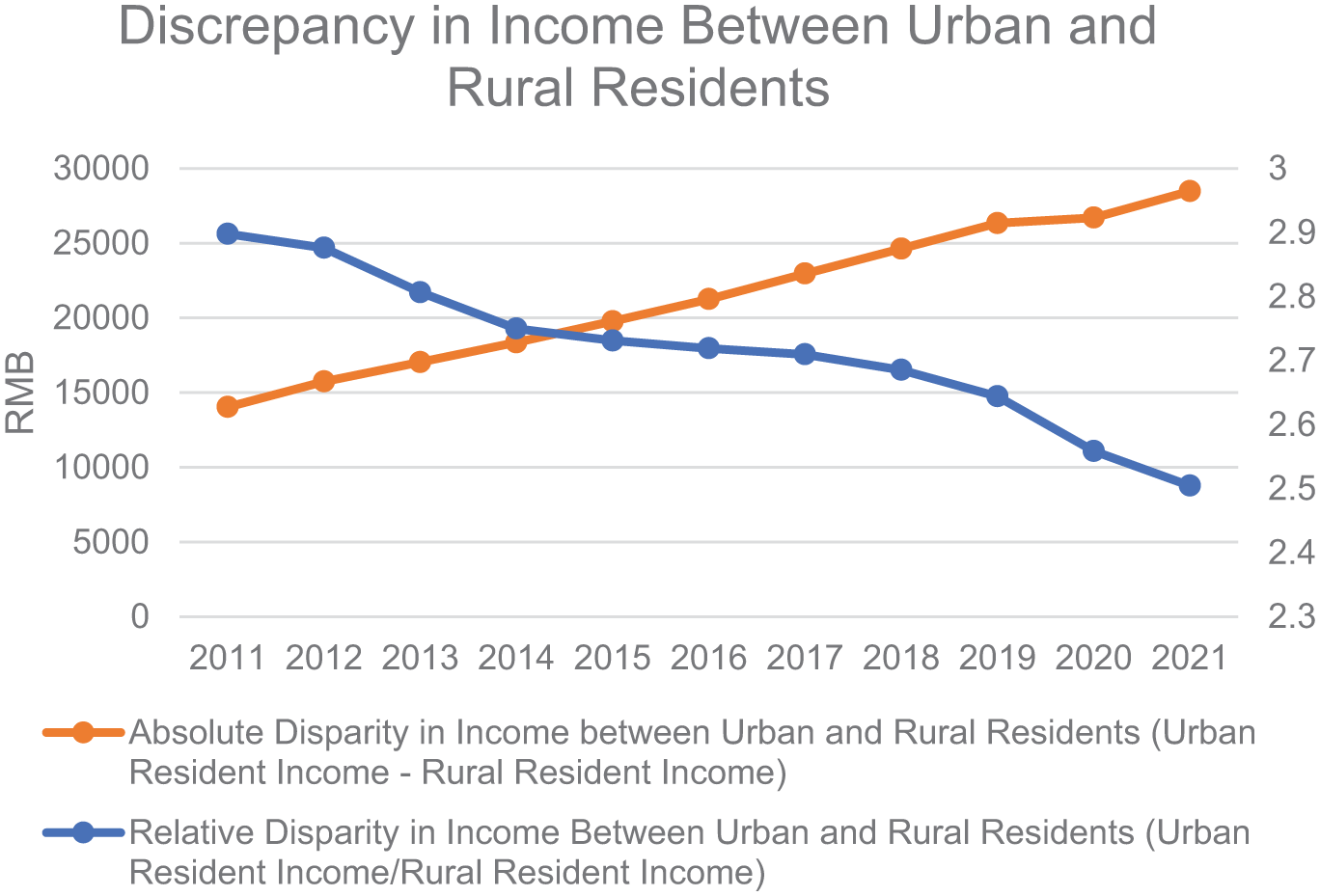
Income disparity between urban and rural residents in China, 2011 to 2021.
The digital economy, as a transformative growth engine, enhances income through job creation, skill returns, and new economic opportunities. However, its distributional effects vary across urban and rural settings, necessitating a closer examination. To ensure model reliability, Hausman tests were conducted. The test results for both Model (1) & (2) and Model (3) & (4) yielded p-values of 0.0003 and 0.0000, respectively, indicating fixed effects models are appropriate.
Model (1) estimates the effect of digital economic development on the relative urban–rural income gap without controls. The coefficient of the digital economy variable is negative and highly significant (p < .001), indicating that digitalization helps to narrow the relative income gap. In Model (2), after controlling for socio-economic and demographic variables, the coefficient remains negative and significant, with the model fit (R2) improving from .6868 to .8081. Specifically, a 1-percentage-point increase in the digital economy index is associated with a 1.659-point reduction in the relative income gap, supporting the “digital dividend” hypothesis.
In contrast, Model (3) examines the impact of digitalization on the absolute urban–rural income gap without controls. The result is positive and significant, suggesting that digital development worsens absolute income inequality. Model (4) confirms this finding with controls included, and the R2 rises from .9054 to .9759. The results imply that although both urban and rural residents benefit from digitalization, urban residents benefit disproportionately more, leading to a widening absolute gap.
These findings demonstrate a “dual effect” of the digital economy on urban–rural inequality: while it reduces relative disparities by accelerating rural income growth, it also increases absolute disparities due to unequal access to digital infrastructure and opportunities—thus validating Hypothesis 2.1 (Table 5).
Regression Results of the Impact of the Digital Economy on Urban and Rural Income Distribution.

Note. Standard errors in parentheses.
p < .01. ***p < .001.
To further verify the robustness of the above results, we lagged both the core explanatory variable and the control variables by one period. Table 6 presents the regression results from this robustness check. The signs and statistical significance of the lagged digital economy variable remain consistent with the baseline, affirming the stability of our findings. This further strengthens the conclusion that digital economic development simultaneously reduces relative and increases absolute income disparities between urban and rural residents.
Robustness Analysis of the Impact of the Digital Economy on Urban and Rural Income Distribution.

Note. Standard errors in parentheses.
p < .01. ***p < .001.
Heterogeneity Analysis
Regional Heterogeneity Analysis
Considering the uneven pace of economic and digital development across China’s regions, this study performs a stratified regression analysis for eastern, central, and western China. The estimation results are presented in Table 7, with Columns (1) to (3) corresponding to Eastern China, (4) to (6) to Central China, and (7) to (9) to Western China. In all regressions, the Hausman test results support the use of fixed effects models.
Regional Heterogeneity Analysis of the Impact of the Digital Economy on Urban and Rural Residents' Income.

Note. Standard errors in parentheses.
p < .05. **p < .01. ***p < .001.
Across all three regions, the digital economy demonstrates a positive and statistically significant impact on residents’ income at the 1% level, indicating that digital development has become a consistent driver of income growth nationwide. However, the magnitude of this impact differs considerably by region, underscoring significant regional heterogeneity.
In Eastern China—the country’s most economically advanced region—the digital economy exhibits the strongest income effect across all income groups. For example, the coefficient for urban residents is 7.815, while for rural residents it is 5.064, both significant at the 0.1% level. These values reflect the region’s robust digital infrastructure, talent concentration, and higher rates of digital technology adoption.
In contrast, Central China sees a more modest effect. The digital economy significantly boosts household income overall, with urban and rural coefficients at 2.908 and 3.740, respectively. These figures suggest that while Central China is benefiting from digitalization, it still faces constraints in infrastructure and innovation capacity.
Western China, often the least developed region, shows the smallest overall effect. The digital economy increases urban income by 4.639 and rural income by 2.910, both statistically significant but comparatively lower than in other regions. These results may reflect Western China’s geographic challenges, infrastructural deficits, and limited access to digital platforms and services.
Overall, these findings affirm Hypothesis 2.3, which posits that regional disparities in digital economy development—driven by differences in infrastructure, resource endowments, human capital, and innovation ecosystems—translate into uneven income benefits for residents. The urban–rural gap persists within each region, but is most pronounced where digital infrastructure is concentrated in cities.
Looking forward, achieving inclusive digital economic growth requires a more balanced regional development strategy. Investments in digital infrastructure, public education and training, and the digitalization of traditional sectors—particularly in central and western regions—will be essential to narrowing both regional and urban–rural income disparities. Such measures are critical to ensuring that the digital economy becomes a truly nationwide engine for shared prosperity.
Industry Heterogeneity Analysis
The digital economy not only reshapes the spatial distribution of industries but also exerts differentiated effects across sectors due to variations in enterprise ownership, policy environments, and resource flexibility. Prior studies suggest that excessive administrative intervention can increase industrial homogeneity across regions, thereby undermining the efficiency of resource allocation. In contrast, digital technologies—such as big data, the internet, and AI—facilitate cross-regional enterprise mobility and foster a more decentralized economic geography. Furthermore, the digital economy is transforming modes of government governance and regulatory efficiency, which can differentially affect firms depending on their ownership structure.
Given the heterogeneity in strategic goals, resource endowments, and responsiveness to digital transformation, it is critical to examine whether digital economic development influences income distribution differently across state-owned enterprises (SOEs), collective enterprises, and non-state (i.e., private or other) enterprises. This section, therefore, disaggregates the analysis by enterprise type to explore the income effects of the digital economy in China’s diverse industrial landscape.
The Hausman test results indicate that fixed effects models are appropriate across all specifications. After incorporating control variables and applying both time and individual fixed effects, the signs and significance of the core explanatory variables remain stable. Additionally, the overall model fit improves slightly, suggesting robustness and the appropriateness of the selected covariates. The regression results are presented in Table 8.
Regression Analysis of the Impact of the Digital Economy on Income for Different Types of Enterprises.

Note. Standard errors in parentheses.
p < .05. **p < .01. ***p < .001.
Model (2) estimates the effect of digital economic development on the average wage of urban employees overall. The results show a highly significant positive effect: a 1-percentage-point increase in the digital economy index is associated with a 19.88% increase in the average wage level of urban workers, significant at the 0.1% level. This provides strong support for the argument that the digital economy promotes labor income growth in urban settings.
However, a closer look reveals substantial heterogeneity across enterprise types. Models (4), (6), and (8) analyze the impact of the digital economy on the average wages of employees in state-owned, collective, and non-state (private and other) enterprises, respectively. The results indicate that: The wage-enhancing effect of the digital economy is most pronounced in non-state enterprises, where the coefficient is large and statistically significant; the effect is weaker and less significant in state-owned and collective enterprises, even after controlling for covariates.
This variation can be attributed to the inherent flexibility, market orientation, and innovation capacity of private enterprises. Non-state firms are typically more agile in adopting new technologies and exploring innovative business models. They are also more exposed to market competition, which incentivizes them to implement digital tools that enhance productivity, reduce costs, and improve competitiveness.
In contrast, state-owned and collective enterprises often operate within more rigid bureaucratic structures, with layered decision-making processes and less immediate pressure to innovate. These institutional constraints may hinder their ability to fully leverage the benefits of digital transformation, thus leading to weaker income gains for their employees.
Overall, these findings confirm Hypothesis 2.2, which posits that industry-level differences in digital adoption lead to unequal income effects, with workers in more digitally advanced industries or enterprises benefiting more from wage growth. The digital economy, therefore, may act as a polarizing force within the labor market, amplifying wage disparities between workers in highly digitized versus less digitized sectors.
The income effects of digital economic development are not uniform across industries, primarily due to varying levels of digitalization. In general, industries such as agriculture and traditional services rely more on low- to medium-skilled labor and thus have lower levels of digital integration. In contrast, high-tech sectors—notably information transmission, manufacturing, and utilities—tend to adopt digital technologies more extensively, creating greater potential for productivity enhancements and wage growth.
To analyze these disparities, we classify China’s economic sectors into 19 major industry categories, following the national industry classification standards. We then estimate the effect of digital economic development on the average wage level of employed individuals within each industry. The regression results are reported in Table 9.
Regression Analysis of the Impact of the Digital Economy on Income in Different Industries.

Note. Standard errors in parentheses.
p < .05. **p < .01. ***p < .001.
Through research, it was discovered that: The results demonstrate significant heterogeneity in the income effects of digital economic development across industries. The mining industry shows the most pronounced effect: a 1-percentage-point increase in the digital economy index is associated with a 43.14% increase in average wages. This may be due to the growing use of digital safety monitoring, intelligent mining equipment, and remote sensing technologies, which increases the demand for specialized digital labor. High and significant income gains are also observed in the financial sector and the electricity, gas, and water supply industry, reflecting their advanced digital infrastructures and higher skill demands. The digital economy has a statistically significant positive impact on wages in 11 industries, including: Manufacturing, Construction, Transportation, Warehousing, and Postal ServicesInformation Transmission, Software, and IT Services, Wholesale and Retail Trade, Leasing and Business Services, Education, Scientific Research and Technical Services, Healthcare and Social Welfare, Accommodation and Food Services, Culture, Sports, and Entertainment.
These sectors tend to be more digitally intensive, benefit from digital platforms, automation, and data-driven decision-making, and exhibit faster digital adoption curves—factors that contribute to wage growth. In contrast, no significant income-enhancing effect is observed in five traditional or public service industries, including: Agriculture, Real Estate, Water Resources and Environmental Management, Residential and Other Services, Public Administration and Social Organizations
This lack of effect may stem from limited digital infrastructure, lower capital investment, and a relatively low demand for digital skills in these sectors. Many workers in these industries also occupy low-paid, labor-intensive roles that are less affected by digital transformation in the short term. These results confirm Hypothesis 2.2, demonstrating that the income distribution effects of digital economic development are industry-specific. Sectors with higher digital maturity and technology penetration tend to experience stronger income gains, while more traditional, less digitized sectors benefit less.
Conclusion and Policy Implications
Drawing on panel data from 31 Chinese provinces spanning 2011 to 2021, this study empirically investigates the impact of digital economic development on income distribution. Specifically, it addresses two central questions: (a) To what extent does the digital economy, as a modern engine of economic growth, influence household income? (b) Does its development foster inclusive growth, or does it amplify existing income disparities?
The empirical findings indicate that digital economic development significantly enhances household income, primarily through wage increases. However, its effects are markedly heterogeneous, giving rise to both digital dividends and digital divides. Urban households benefit more than rural ones, thereby widening the urban–rural income gap. At the regional level, the impact is most pronounced in the economically advanced eastern provinces, followed by the central and western regions. In terms of industry, the income-boosting effect of the digital economy is more evident in market-oriented, non-state-owned enterprises and digitally intensive sectors such as mining, finance, and energy, while it remains limited in traditional sectors such as agriculture, real estate, and public administration.
In light of these findings, we propose the following policy recommendations:
① Promote Inclusive Digital Development
Policymakers should actively advance the digital economy while addressing its distributional consequences. This includes accelerating smart agriculture and rural digitalization to boost productivity and reduce vulnerabilities in underdeveloped areas. Regional strategies should be differentiated: Eastern provinces should deepen high-tech innovation and expand digital services; Central provinces should focus on digital transformation of traditional industries; Western provinces should prioritize foundational digital infrastructure and connectivity. Financial and policy support should be tailored to reduce regional digital disparities.
② Enhance Digital Infrastructure and Accessibility
Investments in broadband networks, cloud computing, and data infrastructure must be scaled up to lower access barriers and improve nationwide digital participation. By leveraging China’s comparative advantages in digital technology, such efforts can stimulate innovation-driven growth and help the country avoid the middle-income trap.
③ Address Skill-Biased Technological Change
Given the skill-biased nature of digital transformation, it is crucial to prevent widening employment and income inequalities. Targeted interventions are needed to close the digital skill gap, particularly among low-income and rural populations. Measures may include: Integrating digital literacy into formal education; Expanding access to digital learning platforms in rural areas; Providing free digital training and enhancing data accessibility, while ensuring privacy protection.
④ Strengthen Governance and Market Regulation
As the digital economy evolves, regulatory mechanisms must be modernized to address emerging challenges, such as monopolistic behavior driven by information asymmetries. Transparent, accountable, and balanced intervention from the government is needed to foster fair competition and ensure the equitable and sustainable development of digital markets.
Limitations and Directions for Future Research
This study examines the impact of digital economy development on income distribution, but several limitations should be acknowledged. First, although the paper addresses whether and how the digital economy affects income distribution, the explanation of its transmission mechanisms remains insufficient. Future research should provide a more detailed theoretical clarification of the channels through which digitalization influences income inequality. Second, the analysis primarily relies on regional and industry-level macro data, which may not fully capture the heterogeneity among different groups, households, or firms. Subsequent studies are encouraged to focus on micro-level subjects and specific industries to uncover heterogeneous effects. Third, the findings of this study are mainly based on the Chinese context, and their external validity requires further testing. Future research could conduct cross-country comparative analyses to enhance the generalizability of the conclusions.
Looking ahead, future studies should improve both data and methodologies by integrating macro- and micro-level perspectives as well as quantitative and qualitative approaches. Such efforts would provide a more comprehensive understanding of the complex mechanisms through which the digital economy affects income distribution, and offer more targeted policy implications.
Footnotes

Funding
The authors disclosed receipt of the following financial support for the research, authorship, and/or publication of this article: This study was supported by the National Social Science Foundation in China (24CGL135).
Declaration of Conflicting Interests
The authors declared no potential conflicts of interest with respect to the research, authorship, and/or publication of this article.
Data Availability Statement
The data that support the findings of this study are available from the corresponding author upon reasonable request.