




Abstract
The relationship between decentralization and inequality remains puzzling. The primary objective of this paper is to study the effects of decentralization on regional education inequality in China where national higher education policies systematically prioritize large cities. We apply the Gini coefficient and the econometric model of regional convergence (i.e., Barro regressions) to study original provincial college admission data in China from 2005 to 2013. We discover that the provincial Gini coefficients have been declining throughout the period. The Barro regression results also suggest that the provincial-level college-going rates have been converging. We further demonstrate that the convergence is driven by provincial rather than national universities. Access to elite national universities remained unequal across provinces and still favored super cities. We conclude that decentralization helps to drive down the regional inequality of access to higher education that is due to national polices. It is not yet clear whether our conclusion is applicable to other policy domains or other countries.
Plain Language Summary
It is conventionally believed that decentralization may lead to regional inequality. We argue that decentralization may alleviate the national government favor in certain regions if provincial governments have power and incentives to do their own business. We use college-going data in China to demonstrate an undocumented finding, namely that the Chinese regional inequality in higher education has declined, thanks to the development of provincial universities.
Introduction
Education decentralization is usually portrayed as a cause of education inequality. There is abundant evidence for this at all levels of education worldwide (Diaz-Serrano & Meix-Llop, 2019; Egalite et al., 2017; Parry, 1997; Salinas & Solé-Ollé, 2018). In the higher education field, the transition away from central planning and the devolution of higher education are usually portrayed as contributing to rising inequality in higher education (W. Li, 2008; C. Li, 2014; Liang et al., 2012; L. Wang, 2011; Wu et al., 2020). Rapid economic growth since Chinese economic reform has greatly magnified regional economic inequality. During the process, the decentralization of education has exacerbated the regional gap in school funding. The poor regions are hit hard, with rural students seeing the biggest drop in access to college (Hannum & Meiyan, 2006; H. Li et al., 2015; F. Sun & Barrientos, 2009; Wu et al., 2020).
While we acknowledge that decentralization in general tends to increase regional disparity, we nevertheless argue that higher education decentralization may reduce a specific type of regional inequality that is caused by strong “urban bias” in national policies. In China, the geographical distribution of universities was so uneven that decentralization would benefit provinces with many good universities in the beginning. However, the number of universities is not a fixed variable in the long term. Because of decentralization, provincial governments also got more power and incentives to improve higher education in their own provinces through establishing new universities or expanding the existing provincial universities.
China offers an appropriate institutional setting to study our theoretical question. Developing countries often adopt national policies that prioritize large cities at the expense of less-developed regions. In China, Beijing, one of the province-level super cities, has more universities than any other province. The decentralization policy appears to exacerbate the higher education inequality within an urban-bias context (Tam & Jiang, 2015). The physical concentration is sometimes justifiable under the theories of new economic geography (Krugman, 1998). But providing residents of big cities better access to college is a distributive issue. In China the university quota is allocated in an old planned-economy fashion. China is thus a good example for our research given its tight control on internal migration and an explicit national education policy of assigning more college quota to a few province-level super cities. Moreover, China decentralized its higher education sector in the 1990s, offering a nice setting to study how decentralization policies interact with an “urban bias” national policy. The new autonomy that was granted to local provincial governments and universities (Bickenbach & Liu, 2013) may increase the incentives of less-developed regions to close the educational gap with developed regions (Agasisti & Bertoletti, 2022).
Our argument emphasizes not the resources but the power and incentives of regional governments. While it is true that decentralization may reduce the amount of resources being available for universities in less-developed regions, decentralization also provides regional governments discretionary powers and incentives that did not exist when higher education was centralized at the expense of less-developed regions. Chinese provincial governments have good reasons to develop higher education institutions under their control given the existence of regional economic competition (H. Li & Zhou, 2005), and high social and economic returns to higher education (Moretti, 2004; Schofer et al., 2021).
We study the disparity of access to higher education at the provincial level by collecting and aggregating two million micro-level admission records of essentially all 4-year public colleges from 2005 to 2013 in China. This is the first time such a huge database of admission records is utilized in academic research. Even though our main analysis is at the province level, having access to the raw records allows us to precisely measure the composition of university enrollment by institution types and destination provinces. These measures allow us to uncover the mechanisms behind the data. Our research is impossible if researchers only have access to official college enrollment statistics.
Our data confirm that there was a huge regional inequality at the beginning of the period, with the three super cities (Beijing, Shanghai, and Tianjin) that are officially treated as provinces enjoying a lot more university slots. We then discovered a strong trend of improving across-province equity over time. The micro-level college admission records allow us to attribute improving equity to bottom-up efforts from the provincial governments rather than allegedly equalizing central-government policies. In particular, we show that the provinces with poor access to education in 2005 were more likely to expand the colleges under their control through expanding existing regular 4-year colleges and upgrading 3-year tertiary institutions to regular ones. Students have more access to provincial universities from their own provinces. But access to elite national universities remains highly unequal across provinces and still favors the super cities.
Our research challenges the established view on the link between decentralization and inequality (Cheong et al., 2019; Fan et al., 2011; K. H. Mok, 2013). We also go beyond discussions that only focus on regional disparities in economic growth and school funding (Bosker et al., 2018; Luo et al., 2020; Rodriguez-Pose & Ezcurra, 2010). We offer the first piece of macro-level evidence for how this link between decentralization and inequality might work in the context of Chinese higher education, borrowing a novel technique that is usually applied to the field of macroeconomics.
Theoretical and Empirical Background
The topic of regional inequality has been actively researched in the context of China (Fraumeni et al., 2019; Ou & Hou, 2019; Rong & Deng, 2022). Most studies examine economic inequality in general (Bosker et al., 2018; Luo et al., 2020). It is highly plausible that regional disparity has increased over the reform period. For example, electricity consumption, an index that is believed to be a reliable indicator of real economic growth, has been diverging across Chinese provinces (Cheong et al., 2019). Regions with better economic endowments possibly benefit more from economic growth (Chen & Zheng, 2008). More backward regions bear a large part of the burden of educating the children of migrant workers while their parents work and pay taxes in more developed regions (Fan et al., 2011).
The theoretical relationship between decentralization and regional inequality remains ambiguous. As regional inequality of educational opportunities is a general problem, the governments around the world have tried many solutions, one of which is to develop education through decentralization (Karlsen, 2000). The effect of decentralization has been widely discussed (Lessmann, 2009) and hotly debated (K. H. Mok, 2013). Rodriguez-Pose and Ezcurra’s (2010) summary of studies on developing countries shows a positive relationship between decentralization and regional disparities in general; and more investment in education tends to benefit more advanced regions. However, some influential scholars always believe that decentralization improves the overall efficiency of government (Charles, 1956; Oates, 1972), because local officials understand local needs better than central bureaucrats and can formulate the best local policies. K. H. Mok (2013) argues that decentralization policies give local authorities more decision-making freedom and flexibility that is necessary for economic development. The theoretical argument that higher education regional disparity could decline across provinces because of the expansion of provincial colleges has solid theoretical foundation and yet is still provocative and certainly not obvious in the decentralization literature.
Before the 1990s, most universities were run by the central authorities. The university admission in China was centrally managed, with central authorities setting, for applicants in each province, a detailed admission quota of each major in each college according to the workforce plan of each line ministry and province (K. Mok, 2002). Also, the university was free and heavily subsidized, with jobs being centrally assigned to every graduate (Min, 2004). If there was any regional inequality in access to college, the inequality must have been a direct consequence of central government policy. The quota system is widely regarded as the direct cause of regional inequality in access to higher education, as super cities enjoy disproportionately more quotas of college openings. In general, central-planning authorities are known to display strong regional biases favoring large cities (Lipton, 1977) and to install strong internal migration restrictions. A college degree essentially becomes an extremely valuable visa to large cities.
Since the adoption of decentralization reforms, the provincial and local governments have been empowered with more autonomy to operate higher education institutions. The Ministry of Education and other line ministries gradually transferred most universities to the provincial government or below. The central government even started to allow private organizations or individuals to set up higher education institutions. Decentralization and the introduction of private forces in education were accompanied by marketization reforms and a huge expansion of the higher education sector. In general, provincial and local governments, as well as higher education institutions themselves, can exercise more discretion to determine matters related to admissions, appointments, and management (J. K. H. Mok, 2001).
However, the reform did not create a market-based higher education admission market. The quota system from the planned-economy era has remained unchanged. Applicants in a province can only compete for a pre-determined number of quota per university set by the central authorities.
Economic reform also fundamentally changed the policy preferences of regional governments, which tend to compete with each other for economic growth (H. Li & Zhou, 2005). The provincial government in the reform era has demonstrated strong incentives to develop higher education institutions within their jurisdictions. The universities are viewed as a powerhouse of high-tech innovation and a steady supply of highly skilled labor, both of which are perceived to be critical for local economic development.
The changing power and incentives of the provincial government that are associated with decentralization reforms have fundamental implications for across-province higher education inequality. First, we expect the provinces to upgrade and expand colleges within their jurisdictions. As it is extremely difficult to get approval from central authorities to set up new colleges, a more realistic strategy is to upgrade and expand the existing colleges, an action that still requires the permission of the central authorities. Second, the provinces tend to allocate more college quota under their direct control to applicants within their jurisdictions. The incentives to assign more college quota to applicants within their jurisdictions should be the strongest in provinces that historically had less access to college. The social and economic returns to college should be most significant in these disadvantaged provinces. Given the power and incentives of the provincial government, we expect to see the convergence in provincial access to college in the reform era.
Data and Method
The micro-level College Entrance Examination Dataset 1 that we assembled is based on official information of more than two million records from 26 provinces between 2005 and 2013. 2 Our analysis is designed to understand the long-term effects of the higher education decentralization reform that was primarily implemented in the 1990s. Each observation includes the detailed admission quota and average college entrance test scores, together with other variables, for each major-province combination. For example, Jilin University enrolled two students from Shanghai into the Spanish Language major in 2010. In total, the dataset that we collected contains 1,368 public universities, which include most national and major provincial universities. This is the first dataset that contains rich raw information of admission records at the university and year level.
Our analysis makes use of admission information aggregated from our raw dataset. Essentially all prior research of Chinese higher education inequality is based on crude college-going rates that came from the Chinese statistics agency. Our research represents the first analysis that is based on large-scale micro-level data. We can calculate various types of the university-going rate at the province-year level using our raw data so that we can better understand the underlying theoretical mechanisms. The overall university-going rate is defined as the number of college-going quota divided by the number of cohort born 18 years ago in the same province for a given year. The birth cohort data come from the official census statistics from 1987 to 1995. Chinese universities can be divided into national universities and provincial universities based on their ownership. We calculate the national university-going rate and provincial university-going rate at provincial level. We also calculate the number of university-going quota being reserved for each province by universities (including both national and provincial universities) that are physically located in home province and call this measure same-province university going rate.
We will apply two methods to measure cross-province inequality in each year. The first method is the well-known Gini coefficient for the provincial-level college-going rate. A large literature measures inequality in education using Gini coefficients (Dundar & Lewis, 1998; Hofflinger & von Hippel, 2020; Tandberg, 2010; Thomas et al., 2001). The second method is adopted from the macroeconomic convergence literature, which defines regional economic convergence as the phenomenon that poorer regions enjoy faster economic growth over a fixed period of time (Barro & Sala-i-Martin, 1992). The original model regresses the growth rate of per capital incomes from 1880 to 1988 on the per capital incomes in 1880 at the state level in the US. Its statistically significant negative slope coefficient implies that states with lower per capital incomes grew faster than richer states and that there was convergence of per capita income at the state level in the US. In our context, convergence means that provinces with a lower college-going rate in 2005 enjoy a higher average growth rate in the college-going rate from 2005 to 2013. Following the convention of the economics literature, the tendency of convergence is defined to be the slope coefficient of the regression that regresses the average provincial college access growth rate (2005–2013) on the provincial university-going rate in the base year 2005.
We estimated the convergence parameters for five different subgroups, Table 1 summaries the independent variables by categories. We use these variations to explore which subgroups might be driving provincial convergence, if there is any. To take into account the size of different provinces, we will run our regressions by different groups.
Independent Variable by Category.

To directly measure the effect of college expansion, we also calculate the provincial-level university admission capacities per year. We define it as the number of university-going quota being offered by this province to national applicants divided by the size of birth cohort of this province.
Any increase in college enrollment from a province comes from three sources in the long run: those from existing colleges within the same province, those from out-of-province colleges, and those from 3-year colleges within the same province that are upgraded to be regular colleges. In the Chinese context, a good measure of the incentives of the provincial government to expand the higher education institutions under its jurisdiction is the upgrading of 3-year colleges. College upgrading can provide a large increase in capacities, whereas increases from the other two sources are always more limited. The upgrading has to be approved by the Ministry of Education, which sets a minimum requirement for the scale and quality of the college. It is not easy to get approval. The provincial governments must invest resources in lobbying the central authorities on behalf of the colleges. The number of upgradings cases directly reflects the incentives of the provincial government to expand tertiary education under its direct control. We do not measure the incentives of the provincial government using provincial funding that is allocated to higher education because information of such funding allocation is not systematically available in China.
We collected the University Upgrading Dataset from the Ministry of Education’s official website, which contains 292 cases of college upgrading from 2001 to 2018. We then calculated the number of upgrading cases for each province during the period of our study. We plan to study whether provinces with the lower college-going rate in 2005 end up with more college upgrading.
Interprovincial Convergence
Figure 1 shows that the provincial Gini Coefficients have been declining throughout the period of 2005 to 2013, which suggests that the provincial inequality of higher education has been decreasing.
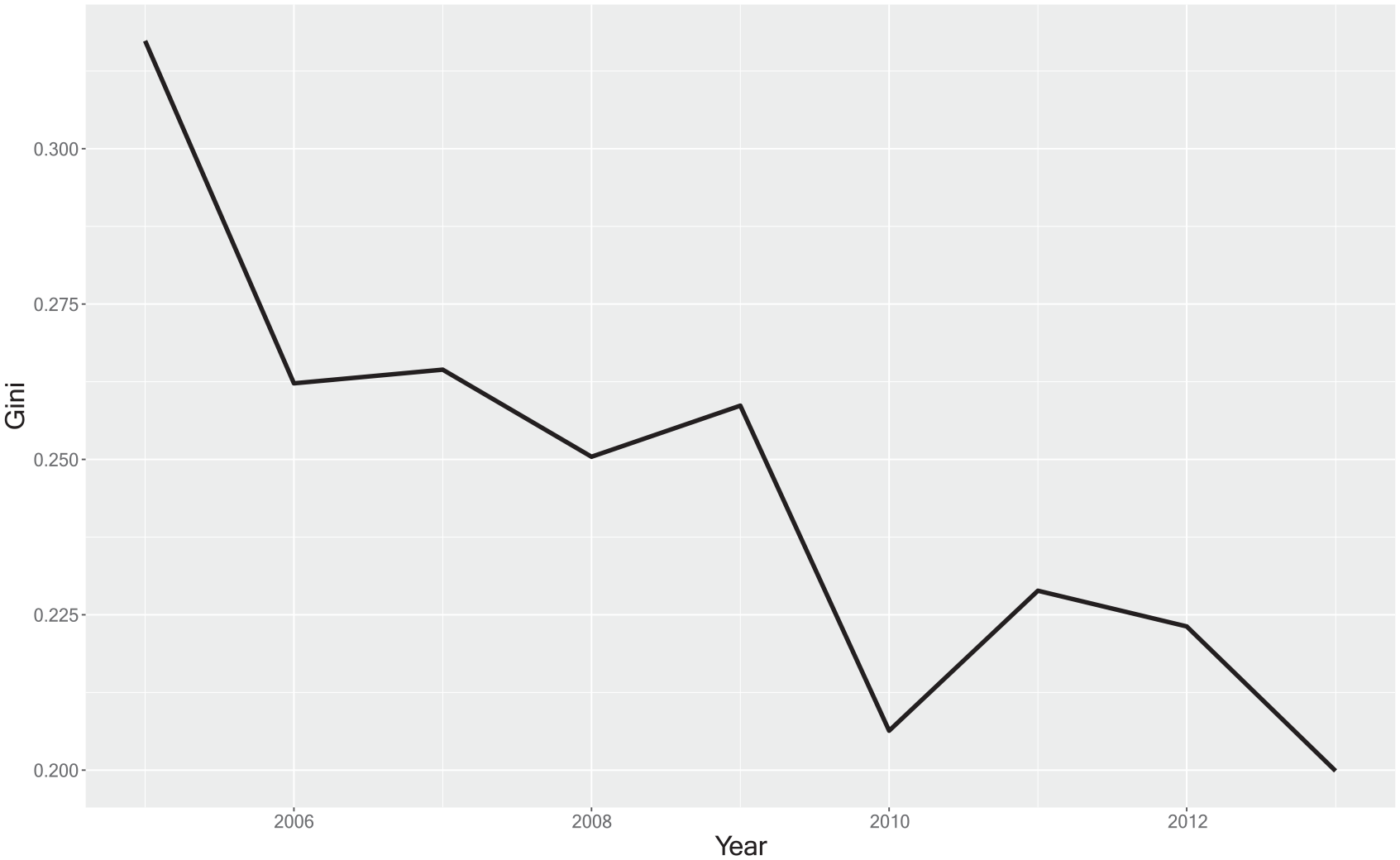
The Gini coefficient of Chinese college admission across provinces.
The upper panel of Figure 2 presents the main results of the provincial-level convergence of the college-going rates. Provinces with higher university-going rates in 2005, such as Beijing and Shanghai, had a lower growth of university-going rates from 2005 to 2013. On the other hand, provinces with lower university-going rates in 2005, such as Yunnan and Guizhou, had higher growth of university-going rates from 2005 to 2013. Overall, the college-going rates become a lot more homogeneous across provinces in 2013 than in 2005.

The convergence of provincial-level university-going rate.
The three big cities (Beijing, Shanghai, Tianjin) that are treated as provinces in China are clear outliers. They had the highest college-going rates in 2005, reflecting the deep policy favor that they enjoyed under the centralized system. The bottom panel of Figure 2 presents our results when we remove these three cities. The convergence pattern is strengthened.
Our findings provide evidence that access to higher education has become more equal over time in China if we only focus on cross-province differences. In the next section, we will explore whether these improvements are due to central government policy or provincial efforts.
What Drives Interprovincial Convergence?
Is the reduction in regional inequality driven by provinces or by the central authorities? In our data, we distinguish this question by dividing universities into national universities and provincial universities. National universities can obtain more funds from the central government than provincial universities. National universities are more controlled by the central government. We first explore whether national universities or provincial universities drive the inter-provincial convergence. In Figure 3, surprisingly we found that the admission to national universities did not converge. We can see that there is a little downward trend. The tendency is only statistically significant for the provincial university-going rates in Figure 4.

The non-convergence of provincial-level national-university-going rate.

The convergence of provincial-level provincial-university-going rate.
Our findings about unequal access to national universities are consistent with our field knowledge of the Chinese education system. The unequal access to elite universities has angered provincial elites, in a way that is rare in a closed authoritarian regime. Li Guangyu, a representative of the otherwise rubberstamp National People’s Congress, once complained in public about the problem: “It is 24 times more difficult for the students to enter the prestigious Peking University than the students from Beijing in 2008; Later in 2013 it became 31 times” (Q. P. Zhang et al., 2015). The same complaint reappeared at the People’s Congress in 2016 (J. Wang, 2016). Similar complaints from national representatives of Hubei, Guangdong and Shandong provinces also attracted a lot of rare media attentions (Z. Li, 2006; J. Sun, 2017; R. Zhang, 2014).
In a word, the national universities that get the lion’s share of national higher education budget did not contribute to regional equality. The observed increase in regional equality came from provincial universities.
Another important focus is how do provincial governments reach the convergence. From the previous results, it can be concluded that the provincial governments made more efforts than the central government to promote higher education convergence. A more intuitive detection method is to divide universities into universities in the province and universities outside the province based on whether the university’s geographic location is within the province. One admission bias is that universities often admit more students into their home provinces. In Figure 5, we show that those provinces where universities admitted relatively few students from their home provinces in 2005 saw higher increases in the rate of enrolling students from the home province from 2005 to 2013.

The convergence of provincial-level same-province university-going rate.
To establish a more direct link between the reduction in regional inequality and the expansion of the provincial colleges, we analyze convergence by looking at the provincial-level same-province university enrollment rate over this period. Figure 6 shows the results of this analysis. Provinces that were only able to offer a small number of admission slots in 2005 expanded their capacities faster throughout the period of analysis. Our results are robust whether we include or exclude the three big cities. Mu Yangchun, director of the Department of Development Planning of the Ministry of Education, said in a 2004 interview that one of the priorities of the future college enrollment plan is to tilt toward provincial universities (Y. Wang, 2004). This evidence once again shows that improved higher education equality is largely due to provinces rather than the central government.
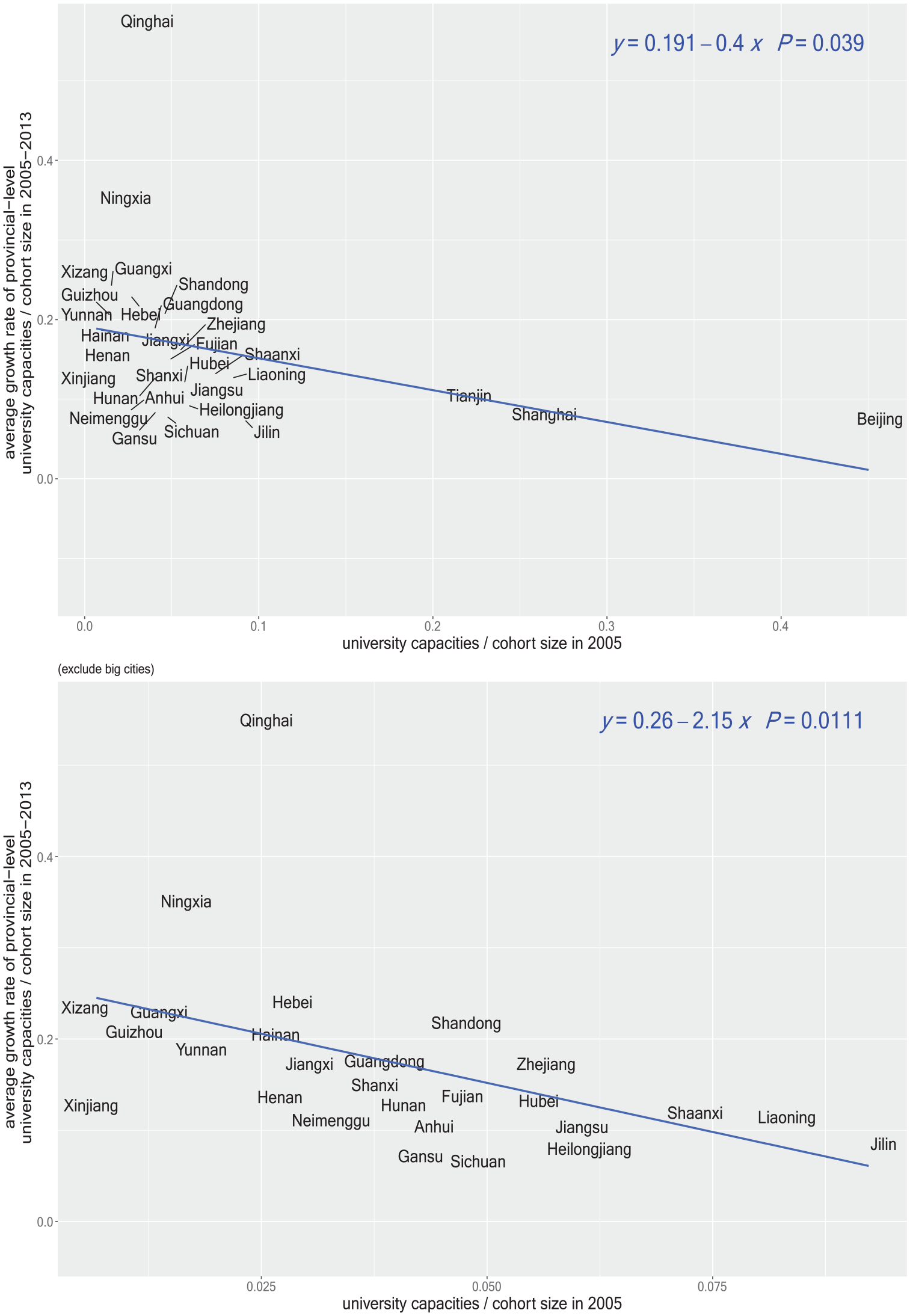
The convergence of provincial-level university capacities.
Where does the expanded supply come from? The upgrading of universities appears to be an obvious source. We combine university upgrading data from 2005 to 2013 with our main data. The upgrading of universities falls into one of the following types: setting up a new college or university, upgrading associate college to college, upgrading college to university, merging colleges into a new university. Figure 7 further demonstrates that provinces that upgraded more colleges enjoy higher growth rate of university admission capacities. College upgrading appears to be an important driving force of the expansion of colleges under the control of the provincial government.

University upgrading drives the expansion of provincial-level university admission capacities.
All our empirical evidence combined suggests that the reduction in regional inequality of higher education is mainly due to a bottom-up process. It is the expansion of colleges under the direct control of the provincial governments, together with more favorable treatment of applicants from provincial universities thanks to the decentralization of college admission power, that improved the college-going rates in disadvantaged provinces.
Existing top-down equalizing policies that were implemented by the central authorities cannot explain our convergence results. The central government implemented two types of policies to alleviate regional inequality in higher education. The first policy that was implemented in 2012 asked the national universities to set aside some admission quota for poor regions. This policy certainly cannot explain the regional convergence from 2005 to 2013, not only because it was implemented too late, but also because the quota reserved for poor regions is relatively small compared to the total size of college enrollment. The second policy that was implemented in 2008 asked 11 provinces with more colleges (e.g., Tianjin, Shanghai, and Liaoning) to provide more admission quota to five provinces that lacked college resources (Neimenggu, Anhui, Henan, Guizhou, and Gansu). However, this policy cannot explain why other provinces closed the regional gap. Even if we exclude the five provinces that received extra help from other provinces, our convergence results remain robust. In addition, these five provinces also expanded their own colleges.
Asking provinces to help each other does not constitute a long-term solution to regional inequality. This centralized plan backfired in the summer of 2016 during the college admission season. Angry parents from donor provinces staged open demonstrations before the provincial government halls in Jiangsu, Hubei, and several other provinces for several days. This kind of demonstration is very rare in China. The demonstrations were suppressed, yet the provincial governments also backed down and promised not to decrease the university going rates for students of their own provinces.
In summary, the university-going rates have become more homogeneous due to the contributions from provincial universities rather than those from national universities, nor to equalizing policies from the Ministry of Education. Access to elite national universities remains unequal.
Discussion
Our convergence results suggest that the gains of regional equality come from the provinces, in particular from the provinces with historically low access to higher education. For provinces with historically high access to higher education, their college-going rates have largely remained the same. For provinces with historically low access to higher education, their college-going rates have increased significantly, largely due to their own investments in provincial universities. Our results are consistent with anecdotal evidence (Chen & Zheng, 2008).
The reduction in regional higher education inequality helps to overcome the bias introduced by national policies. Before the decentralization of higher education, universities were more concentrated in a few provinces, and the central government did not promote equality at the national universities (Lipton, 1977; K. Mok, 2002). The reduction in regional higher education inequality helps to “correct” the previous inequities in the distribution of higher education (Hannum & Meiyan, 2006; H. Li et al., 2015; F. Sun & Barrientos, 2009; Wu et al., 2020).
The reduction in regional higher education did not fundamentally change China’s dual-tier higher education system, which includes top-tier national universities under the direct control of central authorities and more numerous bottom-tier provincial universities under the direct control of provincial governments (J. K. H. Mok, 2001). As the provincial universities expanded significantly relative to the national universities, the gap between national and provincial universities probably increased. As prestigious national universities that are all located in super cities exhibit no tendency of assigning more college seats to provinces with historically low access to higher education, the dual-tier system becomes more entrenched.
Our paper strengthens the theories of decentralization. Decentralization enables economic and social change, thereby increasing efficiency and competitiveness (Oates, 1972). Decentralization of higher education could help to address unequal higher education development (Bickenbach & Liu, 2013; Karlsen, 2000), as disadvantaged regions have power and incentives to catch up (Agasisti & Bertoletti, 2022; H. Li & Zhou, 2005). It would be interesting to show in future research whether our conclusion also applies to other policy domains or in a different institutional context.
Conclusion
Studying detailed admission records from almost all public universities in China from 2005 to 2013, we discover that the regional inequality in higher education access has been reduced. We further show that decentralized reforms, rather than top-down equalizing policies, drive this change. Access to national universities that are beyond the direct control of provincial governments remains highly unequal and still favors a few super cities.
Even though we only study access to higher education, our research has general implications for how to reduce regional inequality. The top-down policies that emphasizes regional transfer are usually emphasized as a golden policy to deal with regional inequality. But such policies have political and economic costs. Moreover, it might not work effectively. Empowering regional governments and providing them the right incentives appears to be a more powerful alternative approach.
Footnotes
Acknowledgements
The author would like to thank Kun Mo, Wenqing Huangfu, Zhengyu Wang, the referees and the editor for helper comments.
Declaration of Conflicting Interests
The author(s) declared no potential conflicts of interest with respect to the research, authorship, and/or publication of this article.
Funding
The author(s) received no financial support for the research, authorship, and/or publication of this article.
An Ethics Statement
The authors declare it is not applicable for an ethics statement (including the committee approval number) for animal and human studies.

Data Availability Statement
Data sharing not applicable to this article as no datasets were generated or analyzed during the current study.