




Abstract
While promoting the high-quality development of foreign trade, digital service trade has also had a complex and far-reaching effect on the wage income gap between urban and rural residents. On the basis of Chinese provincial data from 2009 to 2019, this study uses the fixed effect model and the Difference-in-Differences(DID) model for empirical analysis. The development of digital service trade significantly reduces the wage income gap between urban and rural residents. The development of digital service trade can effectively improve resource allocation efficiency, promote industrial structure optimization and upgrading, and enhance agricultural total factor productivity. In areas with high levels of digital inclusive finance, education resources and marketization, the effect of digital service trade development on narrowing the wage income gap between urban and rural residents is more prominent. The innovative development pilot policy of service trade carried out by the Chinese government in 2016 promoted the development of digital service trade and narrowed the wage income gap between urban and rural residents in the pilot provinces. The conclusions of this study provide a reference for the government to leverage the development of digital service trade to narrow the income gap between urban and rural residents in the future.
Plain language summary
This paper empirically investigates the impact of digital service trade on the wage and income gap between urban and rural residents and finds that the development of digital service trade significantly reduces the wage income gap between urban and rural residents. The development of digital service trade reduces the wage income gap between urban and rural residents by improving the efficiency of resource allocation.
Introduction
In the era of the digital economy, information technology and international trade continue to integrate, accelerating the process of digitizing trade in services, creating new models of trade in services, and making digital trade in services a new mode of global trade and a new engine of economic growth. China’s digital service trade has made promising achievements, and the scale of trade has been expanding. According to data from the UN Trade and Development (UNCTAD) database, the value of digital service trade in China increased from 48.859 billion dollars in 2005 to 271.810 billion dollars in 2019. In 2020, China’s digital service trade volume increased by 8.4%, and the trade scale reached 294.76 billion dollars, accounting for 44.5% of the total service trade in the same year. According to UNCTAD data, from 2010 to 2019, the average annual growth rate of China’s digital service trade volume was 6.7%, and the growth rate of trade was 4.0% points greater than that of goods trade and 2.3% points greater than that of service trade. The “14th Five-year Plan for the Development of Service Trade” clearly aims to “vigorously develop digital trade, promote the digital high-end of service outsourcing, promote the digital transformation of traditional service trade, and establish a sound digital trade management system.”
However, new opportunities present new challenges. Although digital service trade is a powerful impetus for foreign trade development, it also has a complex and far-reaching effect on the wage income gap between urban and rural residents. Many scholars have noted that digital service trade does not present symmetrical development (Yin & Choi, 2022). It tends to gather in large cities, leading to the coexistence of stronger and weaker cities, which further marginalizes the already poor and backwards rural areas (Seuba et al., 2018). The “digital inequality” induced by the “digital divide” may become a new source of the wage income gap between urban and rural residents (Guellec & Paunov, 2017). Currently, the wage income gap between urban and rural residents is evident in China. According to data from the China Yearbook of Household Survey, the per capita wage income of urban residents in China was 26,380.7 yuan in 2020, but at the same time, the per capita wage income of rural residents was only 6973.9 yuan, representing a 3.8-fold difference. Excessive income disparity not only undermines the efficiency of economic operations but also leads to political and social conflicts.
In this context, research on how the development of digital service trade affects the wage income gap between urban and rural residents is highly important. This paper theoretically analyzes the impact of digital service trade on the wage income gap between urban and rural residents based on the new characteristics of the trade, which supports the understanding of the issue and promotes related research to improve the welfare effects of international trade theory. In terms of practical significance, China is currently at a critical stage of transforming its foreign trade growth momentum and promoting the development of shared prosperity in urban and rural areas. Digital service trade is a strategic growth point in the new era. However, China’s urban–rural dual structure has led to a noticeable wage income gap between urban and rural residents. The study of the impact and mechanism of the development of digital service trade on the wage gap between urban and rural residents could provide a scientific reference for Chinese society to undertake new initiatives.
Literature Review
The study of the impact of trade on income inequality has a long history, and scholars have drawn different conclusions from different perspectives. Some scholars believe that international trade affects the demand for labor with different skill levels and relative wages, thereby widening domestic income inequality. Using wage income data, Anwar and Sun (2012) found that trade liberalization widened the income gap between workers with different skill levels in China’s manufacturing industry. Chen et al. (2017) reported that a decrease in tariff levels leads to the liberalization of intermediate input trade, which in turn leads to a higher skill premium for skilled labor. Yang and Tsou (2022) examined the relationship between China’s exports and the demand for skilled labor and found that exporters typically require more skilled workers than nonexporters do, which increases the income gap between labor forces. Song and Cieslik (2020) suggested that signing a free trade agreement would widen China’s income gap and that the impact of a free trade agreement on the average wage level would be greater in land border areas than in coastal areas.
However, scholars also believe that trade development can reduce monopolies and thereby reduce income inequality. On the basis of panel data from 92 economies with different income levels, Nguyen and Su (2022) found that improving export quality can reduce income inequality. Rudsinske (2023) studied import tariffs in an asymmetric general oligopoly equilibrium trade model. Although he reported that unilaterally increasing import tariffs increases domestic welfare, the cost is the widening domestic income inequality, which suggests that trade liberalization reduces domestic income inequality. Gnangnon (2024), in a study of 101 developing countries, observed that improving the quality of exported products leads to greater inclusive growth, which includes an increase in real per capita income, a reduction in domestic income inequality, and a reduction in poverty. Lupindra (2019) found through research based on Indonesian labor force survey data that trade liberalization caused by tariff cuts can improve production efficiency, promote an increase in wages for unskilled labor, and effectively alleviate the income gap between workers with different skill levels.
In addition, scholars believe that the impact of trade on income inequality is nonlinear. In a study in Central Africa, Tchitchoua et al. (2024) reported that export diversification exacerbates income inequality. However, its influence is nonlinear and presents an inverted U shape. Xu and Ouyang (2017) compared data before and after China’s accession to the World Trade Organization and noted that industry-oriented tariff cuts have expanded China’s wage inequality by affecting product prices, but world price competition has reduced China’s wage inequality through product prices.
Research on the impact of digital service trade on income inequality is still emerging, and some scholars believe that the development of digital service trade will increase income inequality. Liu et al. (2017) argued that there is a bidirectional causal relationship between economic level and digital service trade. The development of digital service trade may exacerbate digital inequality, contribute to the “digital divide,” and widen the wage income gap between developed and developing countries. However, the development of digital service trade can also reduce income inequality within a country and promote economic growth in underdeveloped areas within the country (Liu et al., 2024). Seuba et al. (2018) proposed that there is a significant “Matthew effect” in the field of the digital economy, which attracts resources to large enterprises and results in a highly concentrated market. The development of digital service trade is more beneficial for innovative enterprises, reducing the market share of enterprises with insufficient innovation and widening the wage income gap between enterprises. Digital service trade has created a “winner take all” market structure with greater market power and risk, increasing market rents, bringing disproportionate benefits to high-income groups, and thereby exacerbating the wage income gap (Guellec & Paunov, 2017).
However, scholars have noted that the development of digital service trade can effectively promote technological innovation and that technological progress is the fundamental solution to address income inequality (Wen et al., 2023). In the short term, the benefits may be concentrated in developed countries, but the import of digital products from developed countries benefits developing countries through knowledge spillovers. Therefore, in the long run, developing countries will benefit more. The development of digital service trade can thus help alleviate the wage income gap between countries (Terzi, 2011).
The internet, which allows the online search and delivery of products, has effectively overcome the traditional trade barriers of developing countries and increased the opportunities for digital service trade, which can help reduce the income gap between countries (Meltzer, 2015). Digital service trade enables many small and medium-sized enterprises to enter international markets that they previously could not reach through cross-border digital trade platforms. This expands the opportunities for developing countries to participate in the global value division of the labor system, supports mutually beneficial development, and reduces wage income disparities between countries (Horowitz, 2015).
Digital trade can promote the development of e-commerce, which helps narrow the income gap between urban and rural areas (Yin & Choi, 2022). OECD (2017) proposed that the enhancement of digital connectivity gradually reduces barriers to information flow, expands the scope of tradable goods, enables more trade in services to be achieved through digital means, reduces the cost of entry for enterprises into international markets and provides rare development opportunities for small and medium-sized enterprises in African and other developing countries (MacLeod, 2018), narrowing the wage income gap between enterprises. Digital service trade further enhances the regional characteristics of the international division of the labor value chain, which is conducive to the participation of poor and underdeveloped areas in the global market and narrowing the wage income gap between regions (Gnangnon & Iyer, 2018).
Digital service trade significantly reduces the costs and barriers associated with traditional trade flows. Cross-border digital platforms can help small and medium-sized enterprises establish cross-border transaction channels and provide necessary settlement and logistics services, helping them participate in the cross-border digital service trade and alleviating wage income disparities between enterprises (Fefer et al., 2017). J. Wang and Xu (2023) reported in a study of 81 developing countries that digital trade can have a positive impact on public health through intermediary channels that suppress income inequality, with this impact being most pronounced in African and middle-income countries.
In summary, the literature on the impact of traditional trade on the wage income gap between urban and rural residents is rich. However, there are few studies on the impact of digital service trade on the income gap between residents and none on the wage income gap between urban and rural residents, as studies focus mainly on the intercountry and interfirm perspectives. Not only does this area lack a targeted theoretical foundation, but few empirical studies exist. Thus, further exploration and research are needed.
Theoretical Analysis and Research Hypotheses
First, an essential prerequisite for traditional trade is the cross-border transaction cost, which is not only reflected in the “iceberg cost” of transportation but also includes the cost of international market entry, information collection, and international settlement and exchange. Owing to their remote location and inadequate infrastructure, it is often challenging for rural areas to participate directly in international trade via traditional trade modes, and their primary products need to be traded to cities first and then exported overseas after secondary processing by intermediate goods dealers. In this process, due to price discrimination in the exchange of industrial and agricultural products, a large portion of the value added of products in rural areas is stripped by intermediate goods traders in urban areas. This results in a severe mismatch between capital and labor, which exacerbates the wage income gap between urban and rural residents.
The development of digital service trade promotes the continuous integration and penetration of digital technology and services, so the digitization of the traditional services trade increases significantly. Services that rely on physical media and the movement of people are transformed into network transactions. Geographic mobility is greatly enhanced by digital technology to achieve low-cost or even zero-cost cross-border transmission (Petersen & Rajan, 2002). The growth of new trading models, such as “Taobao villages” and live sales, has enabled more rural products to be sold directly to consumers through the direct sales model, reducing intermediary trading links and improving transaction efficiency. Moreover, the popularity of international e-commerce platforms has made the information between buyers and sellers complete and symmetrical; this results in low-cost and high-efficiency peer-to-peer connections (Foster & Graham, 2017), significantly reduces the cost of information searching and matching, and promotes more openness and transparency of market transactions. The two-way flow of production factors promotes the integrated development of urban and rural areas and creates a highly integrated production network. In turn, this effectively reduces the structural mismatch of resources, improves the efficiency of resource allocation between urban and rural areas, and reduces the wage income gap between urban and rural residents.
Second, in the era of traditional commodity trade, new-new trade theory holds that enterprises have a productivity threshold to participate in international trade. Only large enterprises with high productivity can participate in international trade. Many small and medium-sized enterprises in rural areas can serve only the local market. With the development of digital service trade, new trade patterns and models have emerged, and the forms of service trade have become more diversified. Many small and medium-sized enterprises have integrated into the global value chain system through cross-border e-commerce platforms, C2C and O2O, and other diversified trade methods and have taken on “fragmented” orders to achieve the “long tail effect” (Jiang & Luo, 2019). Digital service trade weakens the participation threshold and sunk costs of export enterprises, encouraging more enterprises to locate in rural areas where land and human factors are more advantageous, creating more jobs and expanding channels for rural residents to increase their income while optimizing the rationalization of the layout of the rural industrial structure.
The development of digital service trade also drives infrastructure improvement in rural areas. The construction of the “broadband countryside” promotes the integration of digital technology and traditional industries. Digital service trade can give full play to the multiplier effect, enhance the tradability of rural products and services, and create new economic growth points in rural areas. Digital service trade makes technology dissemination more convenient and efficient, which gives rural laborers more diversified channels for access to knowledge and supports the establishment of a networked innovation system in rural areas. The development of digital service trade promotes innovation synergy and achievement transformation, improves production efficiency, optimizes product quality through green technology innovation, and effectively enhances the technical complexity of export products in rural areas (Yao, 2021). The optimization and upgrading of the industrial structure in rural areas increases residents’ income and narrows the wage gap between urban and rural residents.
Finally, the development of digital service trade and the promotion of the construction of digital infrastructure in rural areas enable them to build a new agricultural Internet of Things system consisting of emerging sensing technology, computing technology, and network communication technology. This system will enable rural areas to more accurately perceive and control agricultural production conditions, such as temperature, humidity, and light, and to achieve precise and dynamic control of agricultural input and output. The development of digital service trade drives the penetration of digital technology into all aspects of agriculture, forming an open, distributed, and collaborative horizontal scale economic system and promoting the transparency of the entire transaction process of the agricultural industry chain. This finding supports the sustainable operation of the market mechanism of high-quality and reasonably priced agricultural products. In the agricultural product sales stage, digital service trade development drives the development of a rural e-commerce and logistics system. By directly connecting the rural production supply and the urban consumption demand, the “Hema Village” changes the traditional agricultural operation mode and makes moderate-scale operation, precision and intelligent production, and controllable traceability systems more common. This can effectively solve the problems of decentralization, lack of standards, excessive supply chain length and difficult traceability associated with agricultural production and significantly improve the quality and efficiency of the agricultural production supply system.
In addition, digital service trade drives the development of rural digital inclusive finance and agricultural insurance, increasing the geographical penetration of financial services and insurance services while reducing service costs and reaching more customers in rural areas that traditional physical outlets cannot cover. With the help of big data analysis technology, the launch of multiscenario and multidimensional services for farmers alleviates the problems of agricultural production financing difficulties, high financing costs, and high insurance thresholds. This enables more farmers to purchase advanced production machines, reduces agricultural production risks and improves agricultural production stability. The development of digital service trade thus significantly improves total factor productivity in agriculture and effectively narrows the wage income gap between urban and rural residents.
On the basis of the above analysis, we propose the following research hypotheses:
Model and Data
Model setting
We set up an econometric model of the following form:

where the subscripts
Indicator construction and data description
Dependent variable
Theil: The Theil index of the wage income gap between urban and rural residents. The China Statistical Yearbook divides the disposable income of residents into four categories: wage income, property income, business income, and transfer income. Wage income is an essential source of disposable income for residents, and international trade influences residents’ income mainly through the wage channel. Therefore, based on the study’s characteristics and the data collection accuracy, we focus on the wage income gap between urban and rural residents. Using the per capita disposable wage income data and population data of urban and rural residents in each province, we construct a population-weighted Theil index by province and year. The Thiel index is proportional to the gap between urban and rural residents’ wage income.
Independent variable
REST: The openness of digital service trade. On the basis of the definitions of the United Nations Conference on Trade and Development (UNCTAD) in the Extended Balance of Payments Services (EBOPS), we define intellectual property services, telecommunications computer services, information technology services, unique culture and entertainment services, insurance services, financial services and other business services (including professional and management consulting services) in the China Business Statistics Yearbook as digital service industries. The degree of openness of digital service trade in each province is measured by the proportion of the total imports and exports of digital service industries in the province’s GDP.
Mechanism variables
(1) Resource allocation efficiency includes labor allocation efficiency (LAAC) and capital allocation efficiency (CAAC). We put labor and capital into a unified framework, set a production function with variable returns to scale, and measure the degree of factor mismatch by the difference between effective productivity and actual productivity. Then, we use the reciprocal of labor mismatch and capital mismatch to measure the efficiency of labor allocation and capital allocation so that the efficiency of factor allocation can be converted into a positive indicator, with larger values indicating greater allocation efficiency.
(2) Industrial structure optimization and upgrading, including industrial structure rationalization (CYSR) and industrial structure upgrading (CYSH). Referring to Gan et al. (2011), we use the inverse of the Thayer index to measure the degree of industrial structure rationalization on the basis of the number of people employed in the three major industries and the value added of the industries in each province, and the larger the value of the industrial structure rationalization index after the inverse correction is, the more reasonable the regional industrial structure is. Referring to Fu (2010), we build an index of advanced industrial structure to consider the relative importance of industry and the evolution of its structure. The higher the value is, the more advanced the industrial structure is. Referring to Fu (2010), we measure the degree of advancement of the industrial structure by the vector angle, considering industries’ relative importance and structural evolution. The larger the value is, the more advanced the industrial structure.
(3) Agricultural total factor productivity (ATFP). We use the DEA method’s output-oriented VRS radial global Malmquist index to measure the ATFP. The VRS radial return to scale is variable, which is more suitable for the reality of this study. The global Malmquist index is transitive and can be multiplied, so the calculation results are more accurate. TFP can be decomposed into technical progress and technical efficiency. When there is a scale effect, technical efficiency can be further decomposed into pure technical efficiency and scale efficiency. Therefore, we decompose the ATFP into three subdimensions: technical progress (TECH), pure technical efficiency (PTEF), and scale efficiency (SCEF).
Control variables
Referring to the research of Sun and Wu (2012), we control the following control variables: the relative ratio of the number of people covered by the minimum living standard in urban and rural areas (MISR); the relative ratio of fixed asset investment in urban areas to the amount of fixed asset investment in rural households (FAIR); the relative ratio of the consumer price index (CPIR) and the relative ratio of retail commodity prices (GSIR) between urban and rural residents; the relative ratio of the number of people in urban and rural areas (RPER); the relative ratio of the secondary industry (RPJR) and value of value-added of output (IAVR) in the secondary and tertiary sectors relative to employment in the primary sector; and the ratio of the industrial producer price index to the agricultural production material price index (PPIR).
Among the above variables, the data on the disposable wage income of residents are obtained from the China Household Survey Yearbook, and the population data are obtained from the China Statistical Yearbook. Data on digital service trade are obtained from the China Business Statistical Yearbook and provincial statistical yearbooks, and data on GDP are obtained from the China Statistical Yearbook. The gross domestic product, number of employees, fixed asset investment, and agricultural product price data are obtained from the China Statistical Yearbook, the average years of education data are obtained from the China Labor Statistical Yearbook, and the land stock and land price data are obtained from the CEIC’s China Economic Database. The data on the added value of the three industries in each province and the data of the employees needed to calculate the indicators are all from the China Statistical Yearbook. The data on the output values of agriculture, forestry, animal husbandry, and fishery services are obtained from the China Tertiary Industry Statistical Yearbook; the data on farmers’ education levels are obtained from the China Population and Employment Statistical Yearbook; and other data are obtained from the China Rural Statistical Yearbook and the statistical yearbooks of each province. The data on the number of people covered by the minimum living standard are obtained from the China Social Statistical Yearbook; the consumer price index, retail commodity prices, and output price index are obtained from the China Price Statistical Yearbook; and the amount of fixed asset investment, the regional population, the number of employees in the three industries and the value added by industry are obtained from the China Statistical Yearbook.
Considering the data restrictions and the impact of the COVID-19 epidemic on international trade after 2020 (Candila et al., 2021), the sample period we use is 2009 to 2019, and the data cover 31 provinces and cities in China, excluding Tibet, Hong Kong, Macao, and Taiwan. The empirical process variables are processed logarithmically. The variables are logarithmized during the empirical process, and the descriptive statistics of the variables are shown in Table 1.
Descriptive statistics.

Results
Baseline
According to the econometric model setting and the Hausman test results, the fixed effects model is selected as the baseline regression to control for the fixed effects of year and province. The regression results are shown in Table 2.
Baseline regression.

Note: In brackets is the corresponding t value of the estimated result; ***, **, and * represent statistical significance at the 1%, 5%, and 10% levels, respectively.
The results in Table 2 show that the regression coefficient of digital service trade openness is significantly negative, regardless of whether other control variables are included. This finding indicates that the development of digital service trade can significantly narrow the wage income gap between urban and rural residents, which is consistent with the results of the theoretical analysis. The development of digital service trade has weakened the threshold of participation in international trade, enabling more residents in rural areas to participate in international trade, increasing development opportunities and channels to increase income, and significantly narrowing the gap between urban and rural residents’ wage income, demonstrating the universality of its development.
Endogeneity
On the one hand, provinces with higher levels of digital service trade development have more sufficient government revenues. They can strengthen the transfer payments between urban and rural areas and narrow the income gap. On the other hand, provinces with more balanced development between urban and rural areas can collaborate more efficiently in terms of production factors and labor between urban and rural areas to jointly promote the development of digital service trade. Therefore, there may be an endogeneity problem caused by the two-way causality between the openness of digital service trade and the wage income gap between urban and rural residents.
To address this endogeneity problem, we use the true tariff level (Tariff) of each province as an instrumental variable. The true tariff rate can directly affect digital service trade of each region because although the nominal tariff level is determined by the central government and provinces have less influence, the different combinations of digital products and services in different provinces result in significant differences in time tariffs among different provinces and satisfy the requirement of correlation of instrumental variables. Moreover, the tariff level has the same impact on residents in urban and rural areas within provinces. It thus does not affect the wage income gap between urban and rural residents, which satisfies the requirement of exogeneity of the instrumental variable.
We first classify the products into sectors according to HS codes on the basis of historical Chinese product tariff data and foreign trade data and then obtain the tariff amount by multiplying the current tariff rate of each commodity by the current trade volume. We then sum the tariff amount of goods in each industry and divide it by the total trade volume of the industry to obtain the tariff level of each industry. Finally, the tariff level of each province is obtained by weighting the proportion of employees in each industry by the total number of people in the country.
To ensure the robustness of the results, we also use the comparable telecoms business (Itrp) price in each province as an instrumental variable. China’s telecom business is owned by state-owned enterprises, which have greater social responsibility obligations and pay more attention to social justice. The prices they charge in urban and rural areas within provinces tend to be the same and do not differ significantly, so they do not directly affect the residents’ income gap and meet the exogenous requirements of the instrumental variables. Moreover, the price of telecommunication services is directly related to the participation of residents in digital service trade. The higher the total comparable price of telecom businesses is, the greater the cost of residents’ electronic commerce, the lower the degree of participation in digital service trade, and the lower the volume of digital service trade in that province; therefore, the correlation requirements of the tool variables are satisfied. The regression results are shown in columns Model 7 and Model 8 of Table 3.
Endogeneity treatments.

Considering that the wage income gap between urban and rural residents results from the comprehensive impact of multiple factors, such as history, culture, and the economy, over a long period, it is difficult to change rapidly in a short period. It has autocorrelation and a long-term nature, and the value in the previous period largely influences the value in the current period. Therefore, we incorporate the first-order lagged terms of the dependent variables into the model setting and establish a dynamic panel model, which provides the model’s dynamic interpretation ability. We use two estimation methods, system GMM and difference GMM, and the regression results are shown in columns Model 9 and Model 10 of Table 3.
The results of Model 7 of Table 3 show that the estimated coefficients of the tariff level and the comparable price of telecom business on the openness of digital service trade are significantly negative. This indicates that an increase in the tariff level and comparable price of telecommunication services will increase the cost of trade, weaken residents’ motivation to participate in digital service trade, and thus reduce the openness of digital service trade. The results of Model 8 of Table 3 show that the estimated coefficient of digital service trade openness is significantly negative, indicating that the conclusion that the development of digital service trade can effectively narrow the wage income gap between urban and rural residents remains robust after instrumental variables are used to eliminate the endogeneity problem caused by possible two-way causality.
The results of Model 9 and Model 10 of Table 3 show that the estimated coefficient of the first-order lagged term of the dependent variable is significantly positive, indicating that the wage income gap between urban and rural residents has some long-run autocorrelation. Income inequality is the result of multiple factors accumulated over the long term, so eliminating the wage income gap between urban and rural residents should receive more attention to break the vicious cycle and prevent the aggravation of poverty.
Robustness
We conduct robustness tests in six ways. First, the Gini coefficient of the disposable wage income of urban and rural residents is used to measure the income gap. Second, the relative ratio of the disposable wage income of urban and rural residents is used to measure the income gap. Third, considering that the gap in residents’ consumption levels indirectly reflects the gap in their income levels, we construct the relative ratio of urban and rural residents’ per capita consumption expenditure as the explanatory variable. Fourth, the random effect model is used for regression. Fifth, considering the Chinese government’s focus on “targeted poverty alleviation” in 2013, governments increased income subsidies and transferred payments to rural residents beginning in that year. To prevent potential interference caused by the targeted poverty alleviation policy, we retain only the samples from 2009 to 2012, the years before the policy was proposed, for the empirical test. Sixth, according to the ranking of the relative ratio of per capita disposable wage income between urban and rural areas in 2020, we delete the top five provinces (Gansu, Inner Mongolia, Tibet, Qinghai, and Xinjiang) and the bottom five provinces (Zhejiang, Shanghai, Tianjin, Beijing, and Jiangsu) for regression to prevent the impact of extreme values in the sample. The regression results are shown in Table 4.
Robustness tests.

As shown in Model 11 and Model 12 of Table 4, the estimated coefficients of digital service trade openness are significantly negative whether the Gini coefficient or the relative ratio is used to measure the wage income gap between urban and rural residents. The research conclusion that the development of digital service trade can effectively reduce the wage income gap between urban and rural residents and thus does not change with the use of different income gap measurement methods. The results of Model 13, shown in Table 3, reveal that the development of digital service trade drives up residents’ wage income and that the gap between urban and rural residents’ consumption levels is alleviated. The results of Model 13 to Model 16, shown in Table 4, indicate that the estimated coefficient of digital service trade openness remains significantly negative after the model estimation method is replaced, indicating that our research conclusion is not affected by the choice of empirical estimation method. It is still stable and effective after deleting the samples in possible abnormal years and extreme values.
Mechanism
To explore the specific mechanism of the effect of digital service trade development on narrowing the wage income gap between urban and rural residents, we examine this mechanism from three perspectives: resource allocation efficiency, the industrial structure, and agricultural TFP. Referring to Ma and Zhang (2017), we first explore the impact of the core independent variable on each mechanism variable and then further introduce the interaction term of the core explanatory variable and each mechanism variable to verify whether the mechanism of action is established. The results of the mechanism tests of resource allocation efficiency and industrial structure are shown in Table 5, and the results of agricultural TFP and its subdimensions are shown in Table 6.
Mechanistic test of resource allocation efficiency and industrial structure.

Mechanistic test of agricultural TFP and its subindicators.

According to the results of Model 17 to Model 20 of Table 5, the estimated coefficients of the effect of digital service trade openness on labor allocation efficiency and capital allocation efficiency are significantly positive. In contrast, the estimated coefficients of the interaction term are significantly negative, indicating that the development of digital service trade can significantly improve the allocation efficiency of labor and capital between the agricultural and nonagricultural sectors, reducing the wage income gap between urban and rural residents. Improving resource allocation efficiency is a critical transmission mechanism. The root cause of the urban–rural income gap lies in the misalignment of factors, inefficient resource allocation, and the slow development of a unified factor market. The development of digital service trade, through the digital trade platform, integrates and develops market information, promotes data resource sharing, effectively alleviates “information silos” and “information blind spots,” enables efficient docking of factor supply and demand, and promotes smooth factor flow between urban and rural areas. The development of digital service trade drives the precise matching and coordination of all aspects of factor flow, enhancing the efficiency of factor allocation of labor and capital and narrowing the wage income gap between urban and rural residents.
The results of Model 21 to Model 24 of Table 5 show that the estimated coefficients of the effect of digital service trade openness on industrial structure rationalization and industrial structure upgrading are significantly positive. In contrast, the estimated coefficients of the interaction terms between digital service trade openness and industrial structure rationalization and industrial structure upgrading are significantly negative, indicating that the development of digital service trade can promote industrial structure rationalization and advancement, which in turn reduces the wage gap between urban and rural residents. The development of digital service trade drives the digital transformation of the original industry, helps the traditional industry develop intelligently via networks and automation, and improves the added value of products by extending the industrial chain. The development of digital industrialization fosters many new industries and has a multiplier effect through industrial integration and technology diffusion to broaden the channels through which residents increase income. The development of digital service trade drives the rationalization and upgrading of regional industrial structure and effectively reduces the wage income gap between urban and rural residents.
The results in Table 6 show that the estimated coefficients of digital service trade openness on agricultural TFP and its subdimensions of technical progress, pure technical efficiency, and scale efficiency are all significantly positive. In contrast, the estimated coefficients of the interaction term between digital service trade openness and agricultural TFP and its subdimensions are significantly negative, indicating that digital service trade development can significantly promote agricultural TFP and narrow the wage income gap between urban and rural residents. According to the estimated coefficients of the subdimension indicators, the development of digital service trade has the most significant impact on pure technical efficiency in agriculture. Digital service trade promotes the development of intelligent agriculture, digital agriculture, and modern agriculture in rural areas. It promotes the penetration of information technology, such as sensors, the Internet of Things, and big data, into agricultural production, enhancing agricultural production efficiency. The development of digital service trade drives inclusive digital finance to tilt toward the agricultural field, improves the availability of rural finance, provides financial support for rural residents to introduce and absorb advanced agricultural production technology and machinery and equipment, and reduces agricultural production costs and operational risks. The development of digital service trade improves agricultural TFP in multiple directions and effectively reduces the gap in wage income between urban and rural residents.
Heterogeneity
The development of inclusive digital finance can effectively increase the accessibility of financial services for SMEs and poor people and alleviate the financing difficulties of vulnerable groups. Digital inclusive finance overcomes the limitations of traditional financial service outlets and reduces the gap in financial service accessibility between urban and rural residents (Bhuiyan et al., 2022). To examine the influence of heterogeneity in the development level of inclusive digital finance on the narrowing of the urban–rural wage income gap, we divide the sample into two groups with high and low development levels of inclusive digital finance by using the annual median of Peking University’s digital inclusive finance index as the threshold and carry out regression by grouping. The regression results are shown in Model 3 and Model 4 of Table 7.
Heterogeneity analysis.

Note: Empirical p values are used to examine the significance of differences in coefficients between groups, obtained by self-sampling 1,000 times.
Since there is a significant positive correlation between educational resources and residents’ income, educational resources can affect the level of residents’ employment skills, which in turn affects their wage income. To examine how the balanced level of educational resources influences the effect of digital service trade on reducing the wage income gap, we take the annual median of the relative ratio of the number of primary and secondary schools in urban and rural areas of each province to the regional population as the threshold, divide the sample into provinces with high and low balanced educational resources, and carry out regression by grouping. The regression results are shown in Model 3 and Model 4 in Table 7.
Considering that the level of marketization has a significant effect on the flow of production factors, improving the level of marketization can increase the vitality of the main body of the market economy and improve residents’ income. To examine the influence of heterogeneity in the marketization level on the effect of digital service trade, we divide the sample into two groups of high and low marketization levels on the basis of the annual median of the marketization index (X. Wang et al., 2021) of each province as the threshold and carry out regression by grouping. The regression results are shown in Model 5 and Model 6 of Table 7.
The results in Table 7 show that the estimated coefficient of openness to digital service trade in provinces with a high level of inclusive digital finance development is significantly negative. In contrast, the corresponding estimated coefficient of provinces with a low level of inclusive digital finance development is not significant. This finding indicates that the development of inclusive digital finance can effectively improve the coverage and availability of financial services and alleviate financing difficulties in rural areas and can more effectively support the role of digital service trade in narrowing the wage income gap between urban and rural residents.
The absolute value of the estimated coefficient of digital service trade openness in provinces with a high education resource balance is significantly greater than that in provinces with a low education resource balance. This finding indicates that the higher the education resource balance is, the more beneficial it is to improving workers’ compensation by increasing their education level and alleviating the wage income gap between urban and rural residents by narrowing the skill level gap. Moreover, improving the balance of education resources can enhance the accumulation of employment skills and human capital in rural areas, strengthen the profitability of digital service trade, and narrow the wage income gap between urban and rural residents.
The estimated coefficient of digital service trade openness in provinces with high marketization levels is significantly negative. However, the corresponding estimated coefficient in provinces with low marketization levels is not significant, indicating that an increase in marketization levels can help eliminate the dual economy pattern, enhance the efficiency of regional resource allocation, promote the nonfarm employment of surplus rural labor, and narrow the wage income gap between urban and rural residents.
Expanded Analysis
In 2016, the Chinese State Council issued the “Approval of the Pilot Project on the Innovative Development of Trade in Services,” agreeing to carry out an innovative development pilot of digital service trade in 13 provinces and cities, including Tianjin, Heilongjiang, Shanghai, Jiangsu, Zhejiang, Shandong, Hubei, Guangdong, Hainan, Chongqing, Sichuan, Guizhou, and Shaanxi. The pilot policy proposed “to explore and promote the digitization of service trade, use digital technology to enhance the tradability of services, and promote the rapid development of new formats and new models of digital service trade.” In 2019, the import and export of digital service trade in the pilot areas accounted for more than 75% of the total import and export of digital service trade in the country, and the level of development of digital service trade in the pilot provinces was significantly greater than that in the nonpilot provinces.
The Chinese State Council plans a pilot policy for the innovative development of trade in services in general. Provinces have less influence and cannot predict whether they will become pilot areas, so this pilot policy provides a rare quasinatural experiment for studying the impact of digital service trade on the wage income gap between urban and rural residents in provinces. Therefore, we use the quasinatural experiment of the 2016 digital service trade innovation and development pilot policy as the starting point and use the difference-in-differences (DID) model to explore the impact of digital service trade development on the wage income gap between urban and rural residents.
DID model
We construct the DID model in the following form:

where
Results of the DID model
The results of the DID model estimation are shown in Table 8. Since the pilot policy was launched in February 2016, the sample from 2016 can be taken as either before or after the year of policy occurrence, so we remove the sample from 2016 for a robustness test in Model 42 of Table 8.
Results of the DID model.
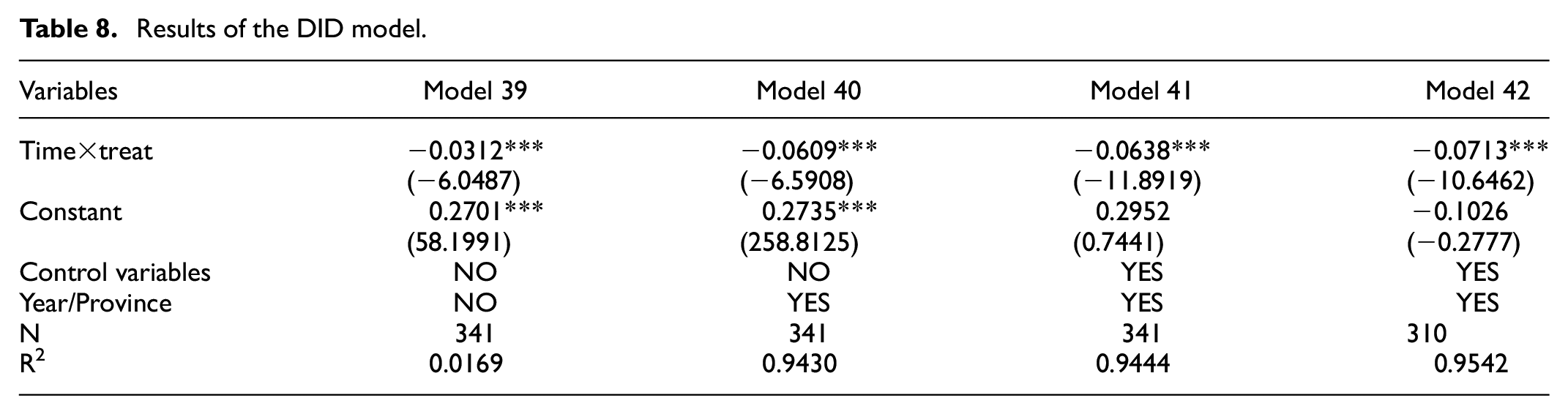
The regression results in Table 8 show that the estimated coefficients of the policy interaction of the service trade innovation development pilot project are significantly negative, indicating that the implementation of the service trade innovation pilot policy makes the pilot areas pay close attention to the development of digital service trade and create new technologies, new industries, and new models led by “digital service+.” The pilot provinces actively explore the optimization of trade in service support policies and promote supply-side structural reform of digital service trade, which brings rare opportunities and take-off momentum for developing digital service trade in rural areas and effectively narrows the wage income gap between urban and rural residents.
Parallel trend and placebo test
We take 2009 as the benchmark year to empirically test the change in estimated coefficients in different years. Figure 1 shows the estimated results of the coefficients under the 95% confidence intervals. The results show that the estimated coefficients are not significant until the year the policy is implemented, indicating that our study satisfies the parallel trend hypothesis.

Parallel trend test.
We use a random assignment of pilot years and a random assignment of pilot provinces for the placebo test. Figure 2 shows the distributions of the 500 estimated coefficients and their associated p values. The results show that the estimated coefficient distributions are all concentrated around zero and are far from the actual value, indicating that there is no placebo effect in the estimated results.
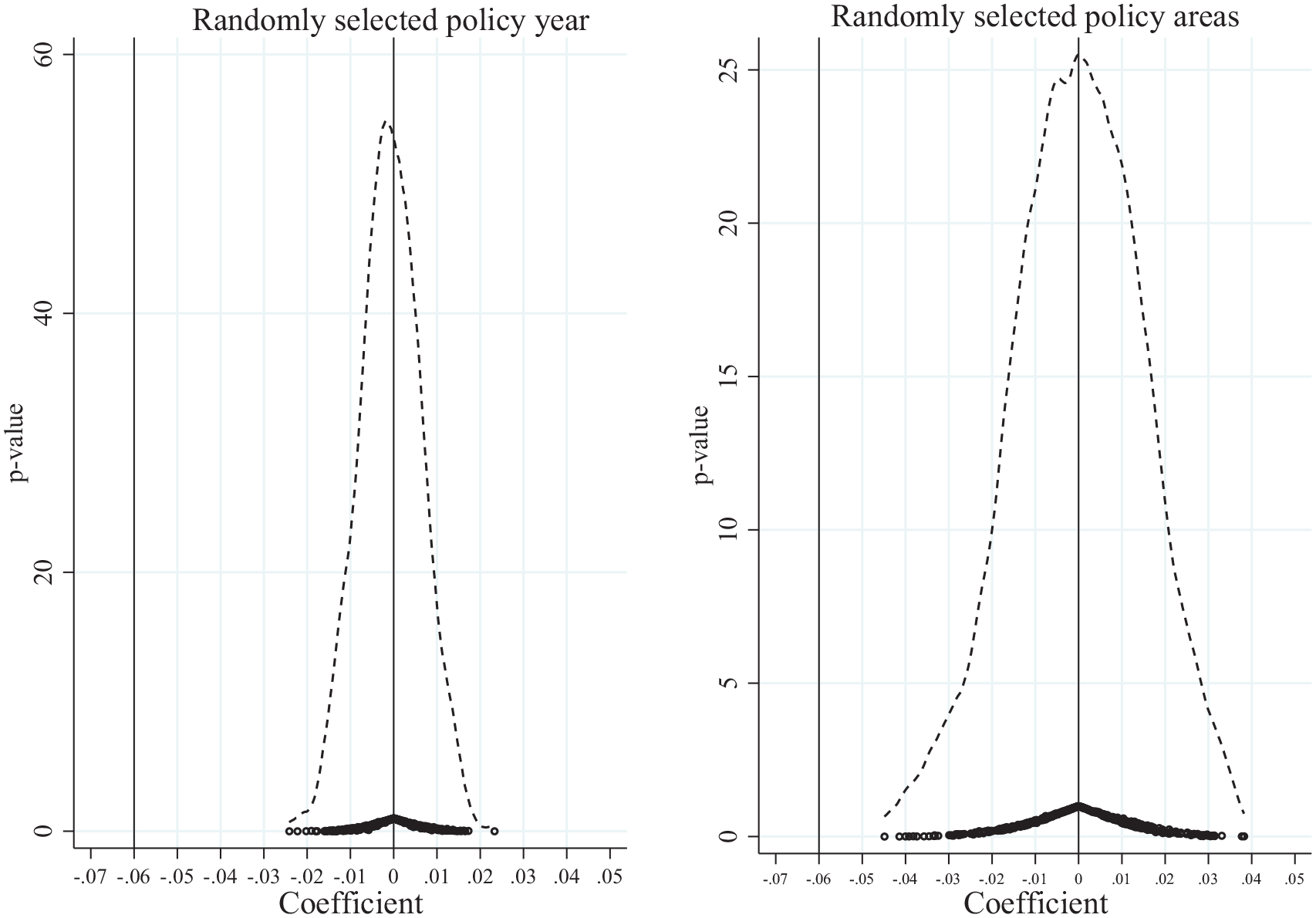
Placebo test.
Conclusions and Policy Recommendations
While promoting the high-quality development of foreign trade, digital service trade has also had a complex and far-reaching effect on the wage income gap between urban and rural residents. In this context, on the basis of the theoretical analysis, this paper empirically tests the impact of the development of digital service trade on the wage income gap between urban and rural residents by using data on digital service trade and wage income in each province of China from 2009 to 2019.
The research reveals the following:
First, the development of digital service trade significantly narrows the wage income gap between urban and rural residents, and this finding is robust to various tests, such as changing the measurement index, changing estimation methods, removing the samples of possible abnormal years and extreme values, and using instrumental variables to eliminate endogenous influences.
Second, the heterogeneity analysis shows that the effect of the development of digital service trade on narrowing the wage income gap between urban and rural residents is more evident in areas with a high development level of inclusive digital finance, areas with a greater balance of educational resources, and areas with a greater level of marketization.
Third, the mechanism test shows that the development of digital service trade narrows the wage income gap between urban and rural residents, mainly through improving the allocation efficiency of labor and capital, promoting industrial structure rationalization and advancement transformation, and increasing agricultural TFP.
Fourth, the extended analysis shows that the implementation of digital service trade innovation and development pilot policy by the Chinese government in 2016 enormously improved the level of digital service trade development and reduced the wage income gap between urban and rural residents in the pilot provinces.
On the basis of the study’s results, we propose the following policy recommendations:
First, government departments should improve the construction of digital infrastructure and the development of inclusive rural finance. They should improve the construction of rural digital infrastructure through government funding allocation, technical assistance, and preferential policies. Second, government departments should enhance skills training to alleviate the digital “capability gap.” For low-skilled laborers in rural areas, a rural digital talent training system with multiple levels and distinctive features should be built to improve rural residents’ digital skills and digital literacy. Finally, government departments should improve marketization and expand opening patterns. For regions with a low level of market development, government departments should further streamline administration and delegate power, improve marketization, eliminate the gap between urban and rural areas, and achieve complementary and coordinated development.
However, due to data availability, author ability and other reasons, this study has several limitations. For example, although we theoretically analyzed the impact of the development of digital service trade on the wage income gap between urban and rural residents, we were not able to construct a rigorous mathematical model to analyze the mechanism from the perspective of a theoretical model. In addition, owing to limited data availability, the sample size and timeliness of the empirical research in this article may be insufficient. In the future, with the timely release of more recent data, we hope to further promote research in this field.
Footnotes
Declaration of Conflicting Interests
The author(s) declared no potential conflicts of interest with respect to the research, authorship, and/or publication of this article.
Funding
The author(s) disclosed receipt of the following financial support for the research, authorship, and/or publication of this article: This study was supported by the projects of Humanities and Social Sciences Research Fund of Yangzhou University (Grant No. xjj2023-34)
Ethics statement
This is not applicable

Data Availability Statement
Data will be made available on request.