




Abstract
This research uses satellite remote sensing data to measure the urban spatial form and analyzes the impact of changes to urban spatial structure on the income gap between urban and rural residents. The results indicate that the compactness of the urban spatial form is positively correlated with the income gap between urban and rural residents. However, there is no statistically significant relationship between the urban spatial extension rate and the urban–rural income gap. A subsequent analysis of the control variables shows that fiscal policy is positively correlated while urbanization is negatively correlated with the income gap between urban and rural residents. These conclusions provide the basis for formulating policies to narrow the urban–rural income gap. Appropriately reducing the spatial compactness of cities can narrow the income gap. In addition, changing excessive preferences for urban fiscal policy and increasing the level of urbanization can also promote a reduction in the income gap between urban and rural residents.
Introduction
Income gaps have long been the focus of research (Alderman et al., 1997; Ma et al., 2017), particularly in developing countries (Carter, 1997; Molero-Simarro, 2017). Additional study on this topic is urgently needed for the following reasons. (a) The Gini coefficient for China is very high. With the rapid urbanization of China, the income of rural residents has gradually increased, but the income gap between urban and rural residents is also at a high level (Carter, 1997; J. X. Li & Zhao, 2018). For example, considering the urban–rural division in China and gray income, the actual Gini coefficient for China may exceed 0.5 (Chang, 2009), which is a far higher level of inequality than the internationally recognized level. (b) The income gap between urban and rural areas causes social conflicts. The unbalanced development between urban and rural areas in China has become an important factor restricting the balanced development of the economy. Furthermore, this imbalance will increase social instability, leading to conflict between urban and rural residents. If no effective countermeasures are taken, the situation will further expand. This problem has already presented severe challenges to all levels of government in China. Therefore, there is an urgent need for more study on this topic that can support the formulation of effective policies to narrow the income gap between urban and rural residents and promote social justice. Effective policy development needs to determine the reasons for the income gap between urban and rural residents, as it is affected by many factors, such as industrial structure, education, financial policy, and transportation infrastructure (Nilsson & Delmelle, 2020).
However, it is very rare to analyze the urban–rural income gap in terms of urban spatial structure. In particular, the spatial structure in China is changing, driven by China’s rapid urbanization. What kind of urban spatial structure is conducive to reducing the income gap between urban and rural residents? The analysis in this article is aimed at this question. The present research employs remote sensing data, and its contribution and novelty are that (a) it addresses the relationship between urban spatial structure and the urban–rural resident income gap, and (b) from the perspective of urban spatial structure, it proposes countermeasures to narrow the income gap between urban and rural residents. These policies, based on research conclusions, could help narrow the income gap between urban and rural residents through urban spatial management.
The scope of the research mainly includes measuring the urban spatial form and analyzing the impact of changes to the urban spatial structure on the income gap between urban and rural residents. Thus, this article is divided into “Literature Review,” “Method,” “Results and Analysis,” and, finally, “Conclusion and Policy Suggestions” sections.
Literature Review
This article summarizes the causes of urban–rural income inequality in terms of the following five aspects based on an analysis of the existing literature.
City-Oriented Policies
Urban-biased policies that divide urban and rural areas exist worldwide, especially in developing countries. The urban-bias theory is based on the argument that city-oriented policies result in cities benefiting more than rural areas from economic and social development, with rural areas being relatively neglected; this neglect is not conducive to China’s future development and can further increase urban and rural inequalities (C. Wang et al., 2014; Yang, 1999). Before the reform and opening-up policy of China, China’s social welfare distribution policy had a clear urban and this urban-oriented distribution policy still exists in some forms today (Zhang & Kanbur, 2005). This urban-oriented policy gives urban residents a substantial advantage over rural residents in obtaining social welfare, such as housing, education, and health care (Kanbur & Rapoport, 2005). Yang (1999) analyzed the relationship between urban preference policies and income growth inequality using household survey data from Sichuan Province and Jiangsu Province for 1986, 1988, 1992, and 1994. He found that the government implemented a series of urban-biased policies, such as support for city investment and construction, urban resident medical insurance, and high-quality educational resources, making income inequality between rural and urban areas the main cause of overall income inequality.
Fiscal Policy
Fiscal policy is considered to be a very important factor affecting urban–rural income inequality in China. They argued that because local governments in China are pursuing local economic growth as their primary goal, the proportion of expenditures supporting agricultural production in all areas of fiscal expenditure has generally declined (Lu & Chen, 2006). This may be an important reason for the widening income gap between urban and rural areas. In addition, industries such as culture, education, science, and health are mainly concentrated in urban areas, so the increase in the proportion of expenditures in these industries will widen the income gap between urban and rural areas. Y. P. Chen et al. (2010) confirmed that the urban–rural income gap in the early stage of reform could be explained by fiscal policy, which also highlights the role of fiscal policy in urban–rural income inequality. A good fiscal policy is considered to be helpful in reducing the income gap between urban and rural areas.
Urbanization and the Urban–Rural Income Gap
There are two main views on the relationship between urbanization and the urban–rural income gap: One view is that urbanization widens the urban–rural income gap (Y. P. Chen et al., 2010; Wan et al., 2006) and the other is that urbanization narrows it and even contributes to the eventual equality between urban and rural areas (Lucas, 2004; Todaro, 1969). From the late 1970s to the mid-1980s, the urban–rural gap in China declined, but since that time, it has grown considerably (Wan et al., 2006). Hu (2002) argued that if rural–urban migration restrictions and interregional migration restrictions are retained, regional income disparity will remain high and even increase with rising manufacturing agglomeration.
Moreover, although the income of migrant farmers working in cities is higher than that of rural farmers, migrant farmers still have lower incomes than urban residents. The large amount of surplus value they create stays in the cities, benefiting the urban population and leading to a widening income gap. The findings partly support the research by Joona (2011). In addition, during the process of urbanization, the excessive development of large cities and the neglected coordination of the development of small and medium-sized cities have also led to an expanding urban–rural income gap, especially in the eastern region of China (Su et al., 2015). Wu and Rao (2017) believe that the urbanization ratio of 0.53 is a threshold. Once urbanization is higher than 0.53, income inequality will be reduced.
Economic Openness (EO) and the Urban–Rural Income Gap
Considering panel data from 55 countries at different development levels, Lessmann (2013) found that the increase in foreign direct investment (FDI) and the opening up directly widened regional income inequality. The study by Lessmann (2013) showed that net FDI inflows increased regional inequality in low- and middle-income countries. Jing and Chen (2017) argue that FDI can indirectly expand the income gap by promoting improvement of the industrial structure. As FDI develops, the increasing investment in cities will show external diseconomies, and governments will begin to lead the investment in rural areas, which can bring capital, technology, and human resources to rural areas and promote regional development. Meanwhile, Ezcurra and Rodríguez-Pose (2013) investigated the relationship between economic globalization and regional inequality in a panel of 47 countries. Their results show that there is a positive and statistically significant association between economic globalization and the magnitude of regional disparities. When developing countries open to trade, they become more exposed to technologies and innovations produced in more advanced countries (Gaisford & James, 2007). Therefore, the increased volume of trade may benefit a small percentage of the population and widen the income gap (Mahesh, 2016).
Financial Market Development
Some people believe that financial policies cause urban–rural income gaps. As financial institutions and bank systems are highly concentrated in cities, financial policies may benefit the urban sector more than the rural sector. Y. P. Chen et al. (2010) used panel data for 28 provinces from 1978 to 1998 to test the relationship between the expansion of financial intermediation and urban–rural inequality disparity in China. The study illustrated that the urban-biased development of financial intermediation contributes significantly to the increase in disparity.
Some scholars believe that financial development has an inverted U-shaped relationship with the income gap between urban and rural residents. In the early stage of financial development, funds and financial institutions rapidly accumulate in cities, while rural financial development lags behind. This scenario can result in a widening income gap. With further development of the financial market, financial resources spread to rural areas, and urban–rural differences will gradually weaken. Thus, over the long term, financial development leads to a reduction in income inequality (Jalil & Feridun, 2011).
Based on the above literature review, existing research has provided valuable contributions to understanding the urban–rural income gap, such as by identifying various factors affecting the gap. However, there are few studies on the urban–rural income gap from the perspective of the urban spatial structure. An empirical study on the urban–rural income gap in China based on remote sensing data has not been found.
Method
A variety of research methods have been used, such as theoretical model analysis (Gaisford & James, 2007; Lucas, 2004), data analysis (Radetzki & Jonsson, 2010), econometric models (Jalil & Feridun, 2011; Lessmann, 2013), and questionnaire surveys (Iida, 2014). However, using satellite remote sensing data and panel analysis models, very few studies exist that analyze the urban–rural income gap in China. Meanwhile, the changes in the urban spatial structure in China have affected residents’ income. Especially given the expansion of the spatial structure, rural residents’ income has changed significantly. Therefore, the method adopted in this study is conducive to a quantitative analysis of the urban spatial structure and urban–rural income gap, which deepens the understanding of this gap.
Indicators of the Urban Spatial Form
The present research used data from China’s 30 provincial capital cities and municipalities in 2000, 2007, 2010, and 2016 as the research object. The reasons for choosing these years for analysis are as follows: Since 1996, China’s urbanization rate has exceeded 30%. Entering the stage of rapid urbanization promotes changes in the urban spatial structure. As urban spatial change has a certain time lag, 2000 is used as the starting year. Meanwhile, the calculation of the urban spatial structure is based on satellite remote sensing data. Changes in the urban spatial structure are only separated by several years, so they can be recognized by satellites. However, due to cloud cover, the remote sensing images in some years are not clear and cannot be used. In summary, we have selected data from the above-mentioned years for research.
There is no unified method for quantitatively calculating the urban spatial form, and different studies have adopted different calculation indicators. For example, Huang et al. (2007) used spatial compactness and complexity indicators, and Tang and Wang (2007) employed building lot space and green space indicators. Recently, Morganti et al. (2017) designed seven indicators, including a floor space index and density, while Najaf et al. (2018) created a list of 23 indicators, such as network miles per square mile. Therefore, there is no standard formula for the quantitative calculation of urban spatial form. According to different research purposes and data availability, different calculation methods have been used (Pozoukidou & Ntriankos, 2017).
This research used the Urban Spatial Compactness Indicator (USCI) and the Urban Spatial Elongation Indicator (USEI) to measure urban spatial form. The USEI involves measuring the basic spatial characteristics of cities, which are compactness and elongation, for the entire city. The USCI is based on the urban minimum circumscribed circle as a standard. Cole (1960) proposed the following formula:

The larger the calculation result of the index is, the higher the spatial compactness of the city. The USEI is used to calculate urban spatial elongation, which is based on the formula proposed by Webbity (Haggett, 1997):

The higher the value of the index is, the higher the spatial extension of the region.
Indicators of Urban–Rural Income Gaps
This article used urban and rural income data, which were mainly obtained from the “China Regional Economic Statistical Yearbook” for the selected years and the “China City Statistical Yearbook” for each city.
Based on a review of the literature, current scholars have generally selected the ratio of the per capita disposable income of urban residents to the per capita net income of rural residents (B. J. Chen & Lin, 2014; Dong & Hao, 2018; Y. C. Li et al., 2014; Sicular et al., 2007; Xu & Yuan, 2018), the Theil Index, the Gini coefficient, and so on, to represent urban–rural income gaps. Considering the availability of data at the city level, this article uses the ratio of per capita disposable income of urban residents to per capita net income of rural residents to reflect the income gap between urban and rural residents, that is, the Urban–Rural Income Gap (URIG) = Urban residents’ Per Capita Disposable Income (UPCDI)/Rural residents’ Per Capita Net Income (RPCNI):

Panel Data Model
This research uses a panel data analysis model to quantitatively explore the relationship between the urban–rural income gap and urban spatial structure. To comprehensively analyze the relationship between these factors, we used control variables. Based on the existing literature, the following variables were employed as control variables.
Financial market development
As China’s financial resource allocation has a clear urban inclination, the main beneficiaries of financial development are urban residents. Therefore, the expansion of financial development may not be conducive to narrowing the urban–rural income gap. To control the impact of financial development on the urban–rural income gap, this article uses the ratio of the loan balance of financial institutions to gross domestic product (GDP) as an indicator to measure the scale of financial development.
EO
Compared with rural areas, cities have relatively complete infrastructure, such as transportation and communication, and human capital conditions. They can attract more FDI by virtue of these advantages, and the EO level is higher than that of rural areas. Therefore, the increase in EO is likely to increase the income of urban residents and widen the income gap (Liu, 2017). To control for the influence of EO, we use the proportion of FDI to GDP of each city to measure EO. FDI is converted according to the average exchange rate of the U.S. dollar against the renminbi (RMB).
Urbanization
This indicator is measured by the proportion of the regional urban population to the total population. On one hand, because the urbanization process decreased the rural population and increased the urban population, the marginal productivity of rural labor will increase, while that of urban labor will decrease. This scenario will lead to a higher average accumulated income for rural residents and a lower average accumulated income for urban residents, thereby prompting a reduction in the accumulated income gap between these two groups (Ma et al., 2017). On the other hand, under the strong constraints of the household registration system, only the economically strong groups among rural residents can be transformed into urban residents, while the economically weak groups cannot attain this privilege. Therefore, this scenario will increase the urban–rural income gap without changing the income of the residents (Ruan et al., 2002). Thus, the direction of this coefficient is uncertain.
Fiscal policy
This indicator is used to measure the government’s participation in economic activities and is calculated as the proportion of local government fiscal expenditure in GDP. As China’s current evaluation of local governments is mainly based on GDP, local governments often regard the development of their economy as their primary goal. Because economic growth mainly depends on nonagricultural industries in urban areas, only a few local fiscal expenditures are rural-oriented. Local government expenditures implemented with the aim of economic growth have a strong urbanization tendency (Liu, 2017) and result in only a few benefits for rural areas (Jin et al., 2018). The higher the proportion of local expenditures in GDP, the more benefits urban areas receive, leading to a larger income gap. Therefore, this coefficient is expected to be positive.
Level of economic development (LED)
This indicator is expressed as the logarithm of the per capita GDP of the region and is used to control the impact of economic development on the urban–rural income gap. The effect of economic development on the urban–rural income gap has two aspects. On one hand, under the scenario of emphasizing economic efficiency, the excessive pursuit of economic growth tends to coincide with the neglect of social equity, which is not conducive to narrowing the urban–rural income gap. Moreover, the high-income group tends to receive more income from economic growth, leading to increased income inequality (Rubin & Segal, 2015). On the other hand, economic growth also plays a vital role in increasing income and employment, reducing poverty, and, to some extent, alleviating the urban–rural income gap (X. L. Wang & Fan, 2005). Thus, the direction of this coefficient is uncertain. The final panel model is shown in Equation 4. Due to the lack of data, this study used data collected in 28 cities, including municipalities directly under the central government and some provincial capitals in China.


According to Table 1, the urban financial market development level is gradually improving, and the average increased from 1.69 in 2000 to 2.11 in 2016; however, the gap between cities is widening. The development of the urban economy has promoted the development of the urban financial market. A significant gap in the economic development levels exists among cities in China, and the financial market’s development also shows a gap. The EO variable is gradually shrinking. EO has exhibited an overall downward trend, part of which is the result of adjustments to the government’s opening-up policy, especially adjustments to the FDI access conditions. The level of urbanization is steadily increasing each year: The average value of urbanization in 2000 was 0.44 and that in 2016 was 0.58. The LED is also steadily increasing each year. The Chinese government has been committed to promoting the development of urbanization to stimulate the development of LED. These two indicators have obvious trends in the same direction.
Descriptive Statistical Analysis of Control Variables.
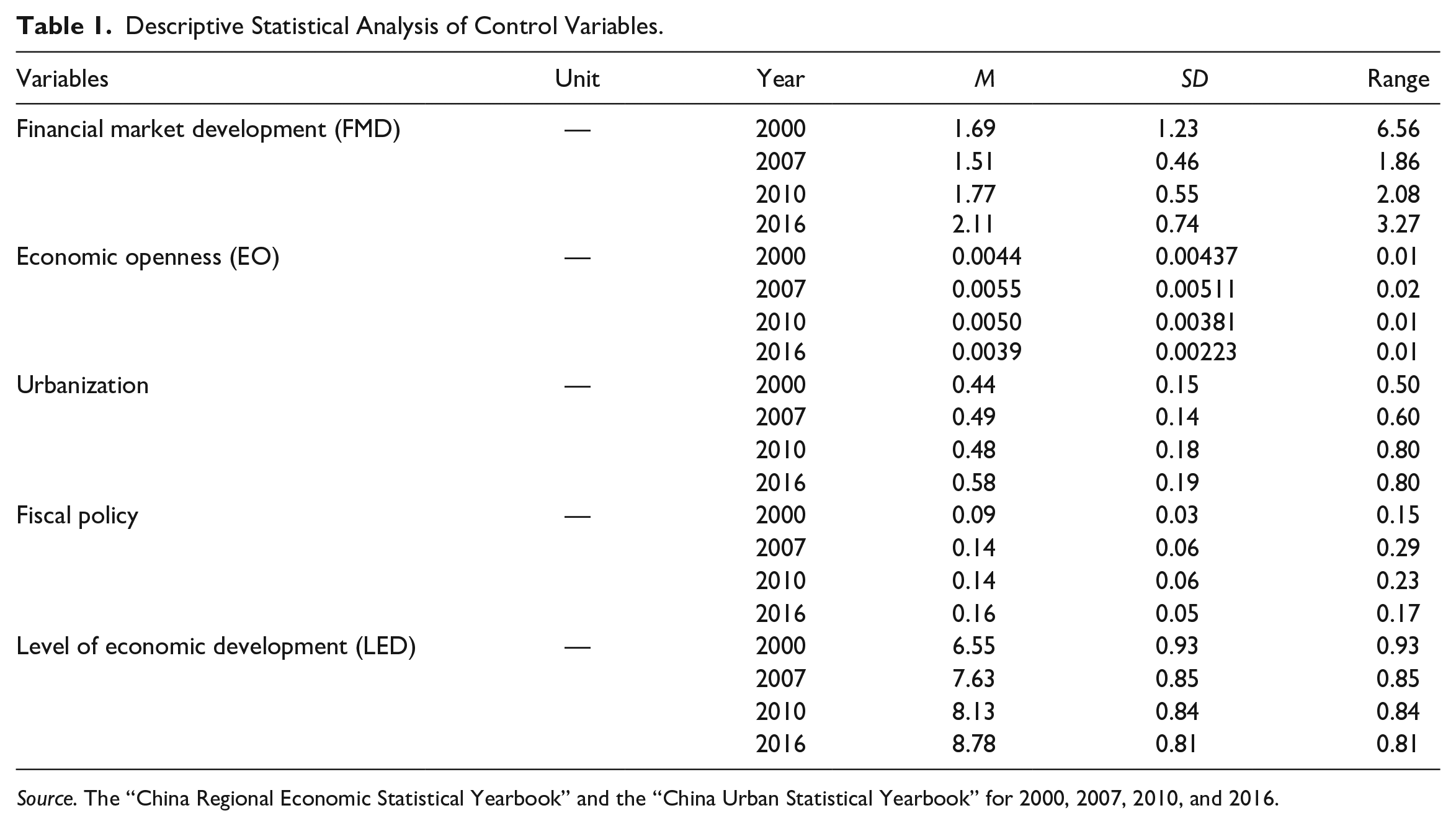
Source. The “China Regional Economic Statistical Yearbook” and the “China Urban Statistical Yearbook” for 2000, 2007, 2010, and 2016.
Results and Analysis
Urban Spatial Form
The urban area was calculated based on Landsat images and related thematic maps. The thematic maps were obtained from the National Basic Geographic Information Center in China. Environment for Visualizing Images 5.3 and Geographic Information System 10.2 were used to perform data processing. Photo interpretation and visual interpretation were employed to digitize the urban area, and auxiliary information was used to ensure the accuracy of digitization. Thematic Mapper (TM) band combinations of five, four, and three (Landsat TM) and six, five, and four in the red, green, and blue color space, respectively, were used to explore urban land. The calculation results are shown in Figures 1 and 2.

Results from calculating the Urban Spatial Compactness Indicator.

Results from calculating the Urban Spatial Elongation Indicator.
Generally, the spatial compactness of cities is increasing, especially that of Shanghai and Changsha. The compactness of the urban spatial form was slightly greater in 2016 than in 2000. The agglomeration economy is an important driving force in the existence and development of cities. The agglomeration economy is mainly composed of external economic benefits, wherein the production and operation activities of an enterprise have an impact on other enterprises and improve their economic efficiency. Cities have obvious economic benefits of agglomeration, which is precisely what promotes the agglomeration of various resources in cities. The aggregate economic benefits are not absolute: A larger scale of concentration is not always better. When all types of resources are excessively concentrated, it will cause external diseconomies, increase production and circulation costs, cause environmental pollution (Schindler & Caruso, 2014), destroy reasonable economic structures and proportions, and eventually lead to a decline in aggregate economic benefits. At present, some large cities in China have already experienced excessive aggregation.
As shown in Figure 2, urban spatial elongation shows a very significant increasing trend. All cities extend spatially to varying degrees. The most prominent city is Haikou, which had a far greater spatial elongation level in 2016 than in 2000. Harbin has the next greatest spatial elongation level, and it also shows a significant increasing trend. With the rapid urbanization in China, the urban spatial structure has expanded rapidly. The expansion of the urban spatial structure is also related to the development of the urban agglomeration economy. Given the agglomeration of various economic resources in a city, generating the economic benefits of agglomeration also brings the negative effects of excessive agglomeration. To alleviate these negative effects, the urban spatial structure will gradually expand. Moreover, in China, the economic development model is dominated by land sales, which further promotes the expansion of spatial structure. In fact, according to the research of Fernandez Milan and Creutzig (2016), municipal policies affect urban spatial sprawl patterns; however, municipal debt and land value affect municipal policies. To a certain extent, this has promoted urban economic growth, but the sustainability of this economic growth model is poor.
Urban–Rural Income Gap
The results from calculating the income gap between urban and rural residents show that the overall gap is narrowing. The minimum value decreased from 1.86 in 2000 to 1.65 in 2016, while the average value decreased from 2.41 in 2000 to 2.28 in 2016 (see Table 2).
Descriptive Statistical Analysis of the Urban–Rural Income Gap.

The income gap between urban and rural residents has slightly narrowed. This conclusion is closely related to urban economic development. The acceleration of urbanization has brought more employment opportunities to rural residents that, in turn, has increased their income. Meanwhile, the increase in the supply of rural public services can reduce the urban–rural income gap to a certain extent (B. Li et al., 2017). Existing research also indicated that urbanization promotes the development of the transportation road network and allows all types of production resources to flow smoothly between urban and rural areas, narrowing the 5% to 7% income gap. In addition, the Chinese government has been increasing its poverty alleviation efforts, and measures such as minimum living security have directly increased the incomes of poor farmers. However, according to Table 2, the urban–rural income gap is widening in some cities, such as Yinchuan, Guangzhou, and Nanjing. Some studies believe that this widening is occurring because of the decline in the share of wages in China’s income distribution structure, which has led to an increase in urban households’ top incomes, thereby expanding the urban–rural income gap.
Correlations Between Urban–Rural Income Gaps and Urban Forms
As Table 3 shows, the calculation results of the panel model indicate that urban spatial compactness is positively related to the urban–rural income gap. The spatial compactness of urban areas is significantly beneficial to the growth of the per capita disposable income of urban residents. In China, urban spatial compactness results in an allocation of resources with clear urban center tendencies. Therefore, the external scale economy effect, specialization effect, network economy effect, and innovation incentive effect brought by urban spatial compactness are more significant in cities than in rural areas. Urban residents will benefit and see increased incomes, which lead to increases in urban households’ top incomes (Molero-Simarro & Ricardo, 2017).
Results of Panel Data Analysis.

p < .01.
In contrast, the increase to the income of rural residents is very limited. The income gap between urban and rural residents has widened because of urban spatial compactness. Although farmers can work in cities, their wages and available public services in cities are very limited. The reasons for this situation are related not only to their labor skills but also to the household registration policy, which is bound too many urban public services. Although the Chinese government has relaxed the restrictions for migrant workers to settle in cities and enjoy public services, the high cost of living in the central city, such as housing prices, makes living there unaffordable; therefore, these workers can only live in suburban areas with relatively low housing prices. Acutely, urban household registration prevents them from enjoying the benefits of the urban agglomeration economy, which party echoed the findings of Smith (2014). The negative effects of household registration include conditioning life chances and producing inequity.
Nevertheless, compared with the low income in rural areas, young adults in rural areas still choose to work in cities. The loss of a large amount of labor has further restricted the development of rural areas, and farmers’ incomes cannot be fundamentally increased. Therefore, urban spatial compactness plays an important role in promoting the development of central urban areas but also restricts the development of surrounding rural areas and ultimately widens the urban–rural income gap.
The results also indicated that fiscal policy was positively related to the urban–rural income gap. From fiscal consolidation, existing studies have proven the impact on income inequality (Agnello & Sousa, 2012), but the situation in China is different. Local governments in China play an important role in economic activities. The central government assesses the performance of local governments through their GDP growth rate. Thus, the primary goal of the local government is to develop a local economy. Economic growth comes mainly from nonagricultural industries in urban areas. Therefore, only a small portion of local fiscal expenditure is oriented toward rural areas. To ensure GDP growth, governments at all levels have a strong urban preference in fiscal expenditures. Investments in fixed assets in cities are far greater than those in rural areas, which leads to a widening of the income gap between urban and rural areas.
In contrast, the results indicated that urbanization was negatively related to the urban–rural income gap. Some studies have shown that urbanization has exacerbated income inequality, and other studies have shown that this relationship is nonlinear and depends on the stage of development (Sulemana et al., 2019). In China, as the urbanization process accelerates, a large amount of rural land becomes occupied as commercial land, and factories and houses are built, so farmers can obtain more employment opportunities and increase income. Various economic resources will spread from the overcrowded central urban area to the new urban area, providing a variety of opportunities to increase farmers’ income, including the opportunity to sell agricultural products and provide cleaning services. Existing studies have also verified this conclusion: Urbanization is conducive to narrowing the gap between urban and rural areas.
Conclusion and Policy Suggestions
Conclusion
This research integrates remote sensing data from major cities in China and analyzes the relationship between the urban–rural income gap and urban spatial structure. The results indicate that the compactness of the urban spatial structure is positively correlated with the income gap between urban and rural residents. Increased spatial compactness in urban areas results in benefits for urban residents, but the effect on the income of rural residents is weak. Thus, the income gap between urban and rural residents has widened.
At the same time, based on the control variables, there is a significant relationship among fiscal policy, urbanization, and the income gap between urban and rural residents. Government-led fiscal policy demonstrates a clear urban regional preference and relatively little investment in rural areas, and there is thus a significant relationship between fiscal policy and the income gap. However, the increased urbanization level plays a significant role in narrowing the income gap between urban and rural residents. With the improvement in the urbanization level, the income of rural residents will increase and help narrow the income gap with urban residents.
Policy Suggestions
Based on the positive correlation between urban spatial compactness and the urban–rural income gap, appropriate reductions in urban spatial compactness would be conducive to narrowing the income gap between urban and rural residents. Reducing spatial compactness in urban areas can allow some resources to diffuse to the city periphery, which promotes the economic development of the rural areas around cities; thus, the income of rural residents can be increased. The positive effects of urban spatial compactness can spill over to rural areas. The factories in the central city can be relocated to the suburbs, as can some commercial centers and entertainment venues. These policies would not only ease congestion in the central urban area but also promote the employment of rural residents and increase income.
Based on the positive correlation between government fiscal policy and the urban–rural income gap, the government’s fiscal policy needs adjustment, with changes to the excessive preference for urban areas. Financial investment in rural areas needs to increase. Increasing financial policy support is conducive to rural economic development and increasing the income of rural residents. In particular, educational investment in rural areas should be increased. This investment should include investment in the training of rural residents’ labor skills and investment in rural hospitals to improve the quality of the rural labor force, thereby increasing their income.
Based on the positive correlation between urbanization and the urban–rural income gap, the level of urbanization should be further improved; in particular, the level of urbanization in China’s relatively poor areas needs to be continuously developed. Therefore, governments at all levels should increase the urbanization level of these areas, introduce a modern industrial system, provide a variety of employment opportunities for poor rural areas, and increase income channels.
This research has some limitations. The measurement of urban spatial structure involves no comprehensive calculation, as the measurement is part of the calculation of urban spatial structure. In addition, the income gap between urban and rural residents is affected by many factors. This study only analyzes some of the factors. Future research will include more factors for analysis.
Footnotes
Acknowledgements
The authors thank Pei Liu and Dieyi Li for their help in data collection.
Declaration of Conflicting Interests
The author(s) declared no potential conflicts of interest with respect to the research, authorship, and/or publication of this article.
Funding
The author(s) disclosed receipt of the following financial support for the research, authorship, and/or publication of this article: This research was supported by the National Social Science Fund (Grant No. 18BZZ061).
