




Abstract
Building an intellectual property powerhouse represents China’s strategic response to the new round of technological and industrial revolution. Establishing a well-coordinated intellectual property policy framework is essential to provide the institutional foundation for achieving this goal. Recently, the Chinese government has actively introduced policies to advance intellectual property development. This study analyses the vertical and horizontal coordination of intellectual property policies across China’s national, provincial, and municipal levels, employing content analysis of policy texts from 2008 to 2024. Research findings reveal that China’s intellectual property policy framework remains imperfect, cooperation among policy entities requires strengthening, and structural imbalances exist in using policy tools. In light of the current state of intellectual property policy coordination in China, this study proposes three policy recommendations: to enhance policy adaptation to local contexts, to strengthen inter-departmental collaboration, and to promote a more balanced use of policy tools. These measures aim to foster an institutional environment conducive to innovation, with the ultimate aim of supporting China’s goal of building an intellectual property powerhouse.
Introduction
As the new round of technological and industrial revolution gathers pace, scientific and technological innovation has emerged as a pivotal force reshaping the global socio-economic landscape and competitive dynamics. As a cornerstone of innovation, intellectual property (IP) is instrumental in advancing national innovative capacity (Deng & An, 2022) and stimulating economic growth (Cho et al., 2015). As the world’s largest developing economy, the Chinese government has placed IP development high on its agenda to tackle growing digital challenges. It has successively introduced a series of policies, including the Outline of the National Intellectual Property Strategy and the Outline for Building an Intellectual Property Powerhouse (2021–2035) (hereinafter referred to as the ‘Outline’), progressively refining its policy framework. China had climbed to 10th place in the Global Innovation Index (World Intellectual Property Organization [WIPO], 2025). However, China’s IP development faces the problem of being ‘large but not strong’, especially in terms of its low quality and low commercialisation rate (Strategic Planning Department of the China National Intellectual Property Administration, 2021). In response, the goal of establishing China as an IP powerhouse has become central to its future development.
China’s path towards becoming an IP powerhouse is underpinned by a legal protection framework. The central government sets a series of quantitative targets, such as the number of high-value invention patents per 10,000 population, and the proportion of GDP accounted for by the added value of the copyright industry. These targets are assigned to local jurisdictions (such as provinces and cities) (Ma, 2016). Against this backdrop, China has established an IP policy system covering the national, provincial and municipal levels. As various policy subjects are scattered across different power chains and policy formulation is incremental (Yu, 2004), the coordination of IP policies is particularly crucial. However, against the backdrop of continuously expanding policy scope and depth, a comprehensive understanding of IP policy coordination in China remains underdeveloped. This study seeks to address the following research questions: (1) What are the key characteristics of IP policy coordination in China? (2) Given these characteristics, how can we further promote the coordination of IP policies based on China’s current situation to achieve the goal of becoming an IP powerhouse?
In response to the aforementioned issues, this study analyses the coordination of IP policy texts at the national, provincial and municipal levels in China. The analysis focuses on Shaanxi Province and Xi’an City. Shaanxi’s economic and IP development ranks around the median among China’s 31 provincial-level regions. Xi’an, the only National IP Protection Demonstration Zone in Shaanxi, has made IP-driven urban development a key focus. The explorations undertaken by Shaanxi Province and Xi’an City in the development of IP exemplify the average standard of IP policy formulation and implementation in China. Therefore, this study analyses the key characteristics of coordination within China’s IP policies. The aim is to offer insights for optimising policy measures and refining the overall framework, ultimately better guiding policy reform and implementation.
Literature Review
Policy Coordination
Policy coordination refers to the process in which different government entities design policy measures that are consistent and coherent, or at least non-conflicting (Boston, 1992). The policy coordination assessment model employs the fundamental elements of public policy, encompassing policy subjects (Pelkonen et al., 2008), policy tools (Du et al., 2021), and policy timing (Flanagan et al., 2011). While research on policy coordination is advancing in fields like sustainable development and healthcare, it remains scarce in the context of IP. In China, scholarly inquiry into this area initially focused on monetary policy coordination before gradually extending to other domains. Coordination analyses are conducted based on central and local government policies. For instance, P. L. Li et al. (2021) reviewed science and technology entrepreneurship policies at the national level in China, finding an uneven application of policy tools. Hu et al. (2020) collected manufacturing transformation and upgrading policies from four provincial-level regions, conducting a policy coordination analysis from both the policy subjects and policy tools.
Intellectual Property Policy
Research on IP policy focuses on the overall protection of IP, designing optimal policies (Acemoglu & Akcigit, 2012; Lu et al., 2023), and also involves the optimal design of policies in specific domains such as patents and copyright (Beard et al., 2018; Gan, 2024). Some scholars focus on shifts in the conceptual foundations and specific measures of IP protection within the digital age (W. J. Wang, 2020; Weiser, 2003). Concurrently, a smaller cohort of researchers examines IP policies from an international perspective, with studies focusing on regions such as Africa (Blakeney & Mengistie, 2021) and the Global South (Naghavi, 2007).
Against the backdrop of China’s emphasis on scientific and technological innovation, scholars have conducted normative research on IP policies, focusing on the historical evolution of policies (Sheng & Kong, 2011; Yang & Wang, 2016) and studies of the overall policy framework (Song et al., 2016). Other research has centred on issues such as evaluation systems (Lin & Zhao, 2019) and policy impacts (Woo et al., 2015). A limited number of scholars have pursued comparative analyses of IP policies between China and other countries (Le et al., 2023). Some researchers have approached the subject from the perspective of policy tools (F. Li & Zhang, 2017; Lin et al., 2023), undertaking studies based on collections of central and local policy texts. For example, recent studies have analysed central-level IP policies (Wei et al., 2021), as well as those within specific regional frameworks like the Chengdu–Chongqing Economic Circle (Xiang et al., 2021).
A review of the literature reveals that although existing research has undertaken quantitative analyses of China’s IP policies, there are still notable shortcomings. First, few studies have directly addressed the theme of policy coordination within China’s IP policies. Previous research has not systematically encompassed both central and local policies, making it difficult to present a comprehensive picture of coordination across the policy landscape. Second, research perspectives on policy coordination remain relatively narrow. There is a scarcity of studies that comprehensively analyse the fundamental elements of China’s IP policies to assess their coordination, which hinders the precise identification of systemic characteristics. Third, this research conducts an in-depth analysis of the government’s preferences in employing IP policy tools, thereby enriching research in this field. Consequently, this study employs content analysis to examine key components of China’s IP policies, revealing the fundamental features of policy coordination. The findings are expected to contribute insights from China’s experience in science and technology innovation development, offering valuable lessons for other nations seeking to optimise their IP policies.
Methodology
Construction of Analytical Framework
The theory of policy coordination originated in monetary and economic policy research during the 1950s and has gradually expanded into other fields. It requires the coherent integration of various policy system components to achieve established objectives (Mieńkowska-Norkienė, 2014), with the core challenge of this process being the vertical and horizontal division of labour (Bouckaert et al., 2002). Applied to IP, vertical coordination ensures alignment between national and local policies, while horizontal coordination seeks harmonisation among core elements-like policy timing, subjects, and tools-within the same governance level (L. Feng et al., 2021; B. F. Xu et al., 2019).
Policy timing lies in analysing the historical evolution of the current policy text (Nan et al., 2020; Yao & Zhang, 2018). Different developmental stages present distinct requirements for IP protection, with IP policies exhibiting varying characteristics at each phase.
Effective coordination among policy subjects is pivotal to achieving policy objectives (Roberts & Milman, 2024), as it determines both the scope of policy implementation and the comprehensive fulfilment of associated responsibilities. This study examines policy coordination in China, analysing it through the lens of both standalone documents issued by core departments and joint documents issued by multiple departments (T. Feng & Nan, 2021).
Policy tools serve as the critical bridge between policy objectives and their implementation, transforming abstract ideas into concrete action. The rational choice and scientific combination of policy tools directly affect the effectiveness of such policies. Combined with the content of IP policy, this paper refers to the Rothwell and Zegveld (1984) and Tan et al. (2021) classification methods and classifies policy tools into supply-side, demand-side, and environmental policy tools according to the role of IP policy. Supply-side policy tools are government policies that provide key resources to promote IP work, such as talent cultivation, infrastructure, capital investment, information, and public services. Demand-side policy tools are government policies that provide demand-side momentum to drive IP development, such as government procurement, international exchanges, and service outsourcing. Environmental policy tools are government policies that provide a favourable institutional environment to promote IP development, such as target planning, financial and taxation, regulatory control, and strategic measures.
In summary, IP policy coordination encompasses both vertical and horizontal coordination. The vertical coordination between national and local policies manifests itself in several key aspects. In terms of policy timing, local government departments align with national IP policy directions to guide regional IP development. Regarding policy subjects, influenced by political factors, local policy subjects exhibit a degree of continuity with national policy subjects. Regarding policy tools, local governments implement national policy measures while adopting distinctive policy tools tailored to local circumstances. From the perspective of horizontal coordination of policy elements, key policy components encompass the policy timing, policy subjects, and policy tools. The coherence of the policy timing reflects the dynamic equilibrium and continuity in IP policy formulation. The coordination of policy subject encompasses both the issuance of documents by core IP departments acting independently and the joint issuance of documents by other departments in conjunction with core departments. The consistency of policy tools focuses on the balance between translating policy objectives into concrete implementation methods, thereby underpinning the achievement of policy goals. From Figure 1, this study provides a comprehensive overview of the current state of IP policy coordination in China, offering valuable insights for future policy design and innovation.

Framework for analysing the coordination of intellectual property policies.
Methods
Content analysis is a research method used to systematically identify, categorise, and interpret meaningful patterns within recorded communication (Kolbe & Burnett, 1991). Over time, content analysis has evolved from a rudimentary counting exercise to a sophisticated interpretive technique grounded in qualitative research paradigms (Lindgren et al., 2014). Content analysis is applied in policy research across various policy domains, such as artificial intelligence and technology sectors. A key advantage of content analysis lies in its capacity to draw objective conclusions from extensive, long-term data (Liu, 2014). Given its applicability, this study employs content analysis to examine the selection of policy tools within China’s intellectual property framework, with a specific focus on evaluating both its horizontal and vertical policy coordination.
Materials
Data Collection
IP policy refers to the relevant laws, regulations and administrative normative documents formulated by the Chinese government. Given that text quality directly impacts the reliability of conclusions, the study is restricted to officially promulgated policies from national, provincial (Shaanxi), and municipal (Xi’an) governments to avoid bias from unofficial sources. The collected policies were manually identified and screened to exclude those of low relevance. The final corpus consists of IP policies enacted between 2008 and 2024. These policies primarily comprise laws, regulations, notices and other documents directly related to IP, including 256 national-level policies, 59 provincial-level policies and 14 municipal-level policies. The specific retrieval strategy is as follows:
This study mainly adopts two types of retrieval platforms, including the Peking University Law Database (PKU Law) and the official government website. PKU Law, which archives all laws and regulations enacted in mainland China since 1949, constituted the primary source. To ensure the completeness of the dataset, a supplementary search of official government websites was conducted to identify any unrecorded policies and to meticulously verify the collected texts.
The selection of search keywords is grounded in authoritative legal texts. The scope of IP, as delineated in Article 123(2) of the Civil Code of the People’s Republic of China and Part II of the TRIPS Agreement, provided the definitive basis for this process. Consequently, the final search expressions incorporated the following terms: Patent, Trademark, Copyright, Layout Design of Integrated Circuits, New Plant Variety, Geographical Indication, Trade Secret, and Intellectual Property.
The study analyses policies promulgated between 2008 and 2024. This period commences in 2008, the year in which IP was formally established as a national strategy in China. Since then, IP policy has played a crucial role in the nation’s scientific, technological, and economic development. The policy texts examined in this study comprehensively cover IP policies during this critical period.
This study employs a representative case to analyse coordination in China’s IP policy system. The cases were selected according to the following criteria. First, the scope encompasses the 31 provincial-level administrative regions of mainland China, with the focus on those regions occupying an intermediate position in terms of economic development and IP advancement. Additionally, cities within these provinces that possess relatively comprehensive IP policies are chosen. This approach prevents the analysis results from exhibiting extreme outcomes, thereby ensuring the accuracy and credibility of the research content. Second, the selected provinces and cities have demonstrably engaged in practical work towards building powerful IP provinces and cities, achieving tangible results in the process. This ensures that the policy texts under analysis are substantive and operational, rather than merely declarative. Within this context, Shaanxi Province consistently maintained a mid-tier economic position, ranking 14th nationally in GDP from 2019 to 2024. Its IP development also reflects this intermediate standing, placing 15th in the number of IP service institutions (Intellectual Property Services Industry Statistical Survey Report Compilation Group, 2024) and 13th in the IP market operation index in 2023 (The Office of Interdepartmental Joint Conferences on Building an IP Powerhouse, 2024). Xi’an is the only National IP Protection Demonstration Zone within Shaanxi Province and has promulgated multiple policies to bolster its IP capabilities. Considering these factors, the IP policy texts of Shaanxi Province and Xi’an City were ultimately selected as representative cases.
Data Processing
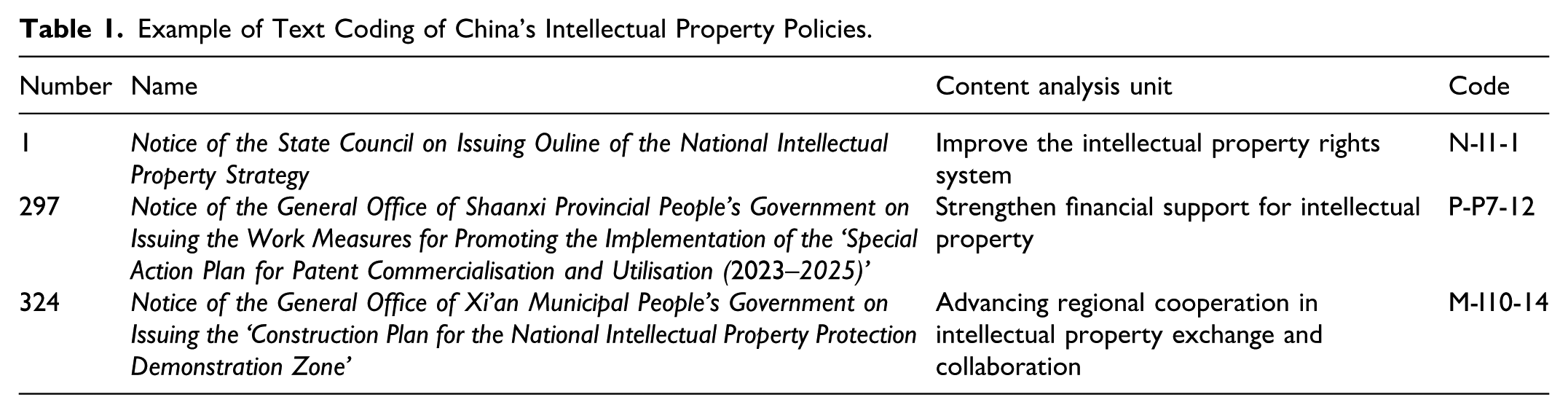
According to the above search categories, the 329 IP policy texts were categorised and subdivided into groups of national, provincial, and municipal policy texts. They were then numbered within each group and coded. The specific articles or chapter titles of the texts were used as the unit of analysis in the form of ‘Policy No.-Article/Chapter Serial No.’ (Table 1). For example, the national policy text in the IP category entitled ‘Notice of the State Council on Issuing Ouline of the National Intellectual Property Strategy Outline’ is coded as N-I1, and the ninth meaningful sentence is coded as N-I1-9. On this basis, the policy entries related to the purpose of the study were resolved and named as first-level codes. Second- and third-level codes were subsequently developed through systematic organisation and classification under these primary categories. Guided by the aforementioned analytical framework, three first-level codes were refined: policy timing, policy subjects, and policy tools (Table 2). The coding results generated by two independent researchers demonstrated a 92% consistency rate. All discrepancies were addressed through collective team discussions to reach consensus. In cases where disagreements persisted, input was sought from two IP experts until full agreement was achieved. One researcher subsequently verified and finalised the policy coding dataset, which was then used to conduct an empirical analysis of coordination within the IP policy system.
Example of Text Coding of China’s Intellectual Property Policies.
Coding for Content Analysis of Policy Texts.

Results
Policy Timing
From the perspective of policy timing at the same level (Figure 2), the development trajectories of national and local IP policies exhibit distinct differences. National-level policies have undergone two significant turning points. First, in 2014, the General Office of the State Council forwarded The Further Implementation of the National Intellectual Property Strategy Action Plan (2014–2020), which for the first time explicitly put forward the new goal of endeavouring to build an IP powerhouse and exploring pathways for IP development. In that year, the number of policies issued by the central government reached 20, forming a minor peak. Second, in 2021, the Outline established a major top-level design for IP development over the next 15 years. Building upon extensive practical experience in the field, this policy marks the commencement of China’s new journey towards building an IP powerhouse. In that year, the central government issued 25 policies in succession. In contrast, local governments have introduced a limited number of IP policies: 59 at the provincial level and 14 at the municipal level in total. To implement the Outline and advance the goal of building an IP powerhouse, provincial-level IP authorities issued 7 policies in 2021 to promote the development of regional IP.

Annual number of China’s intellectual property policies, 2008 to 2024.
The temporal distribution of policies across government levels indicates that vertical policy coordination requires improvement. Although national policies have set the direction and guided the effort to build an IP powerhouse, and local policies have largely followed this top-down approach, a significant disparity in output remains. Specifically, the 256 national policies issued between 2008 and 2024 vastly outnumber those at lower levels, with only 59 at the provincial and 14 at the municipal level.
Policy Subjects
From the perspective of policy subjects at the same level (Table 3), the IP management system has continued to improve, yet inconsistencies remain. Policies formulated by a single department significantly outnumbered those developed jointly by multiple departments, accounting for 75.1% of the total. 70% of all multi-department policies were issued at the national level, with the remainder being 21 at the provincial level and 4 at the municipal level. For instance, the China National Intellectual Property Administration has issued a relatively large number of joint documents with the Ministry of Education, the Ministry of Science and Technology, and other departments, but has issued relatively few policy documents in cooperation with the National Development and Reform Commission and the National Financial Regulatory Administration in support of industrial development demands.
Overall Distribution of Policy Subjects.

From the perspective of policy subjects at different levels, IP policies are issued predominantly by administrative departments acting alone. National-level policies are mainly issued by the China National Intellectual Property Administration, and the main subject of joint issuance involves other cooperative departments related to building an IP powerhouse. The proportion of separate issuance by the people’s government of local IP policies is higher, and the proportion of issuance by the people’s government rises in a stepwise manner as the policy level decreases.
Policy Tools
From the perspective of policy tools adopted by policies at the same level, there are structural differences in the preference for the use of policy tools (Figures 3 and 4). Specifically, the Chinese government emphasises the role of environmental and supply-side policy tools in promoting IP development, yet the potential of demand-side policy tools remains underutilised. (1) Environmental policy tools. National-provincial-municipal policies emphasise the use of regulatory control and strategic measures, with the proportion of their use being greater than 16%. The utilization rate of the target planning tools is above 9%, while financial and taxation tools are used relatively infrequently. (2) Supply-side policy tools. National policies favour public services (14.66%) and information tools (12.17%). Talent cultivation, capital investment, and infrastructure accounted for relatively lower proportions. Provincial policies also emphasise public services (13.56%), with information tools (9.71%) and capital investment (8.78%) being similarly represented, while talent cultivation and infrastructure feature less prominently. At the municipal level, policies rely more heavily on public services and capital investment (12.88%), with other tool types being used less frequently. (3) Demand-side policy tools. National, provincial and municipal policies emphasise the use of international exchange tools, accounting for 5.63%, 4.01%, and 5.52% respectively. Government procurement and service outsourcing tools are employed to a lesser extent.
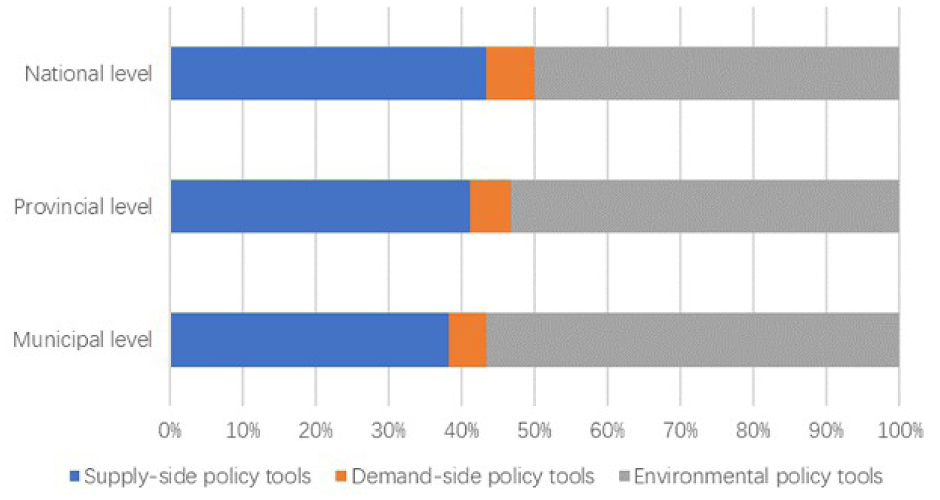
Overall distribution of policy tools.
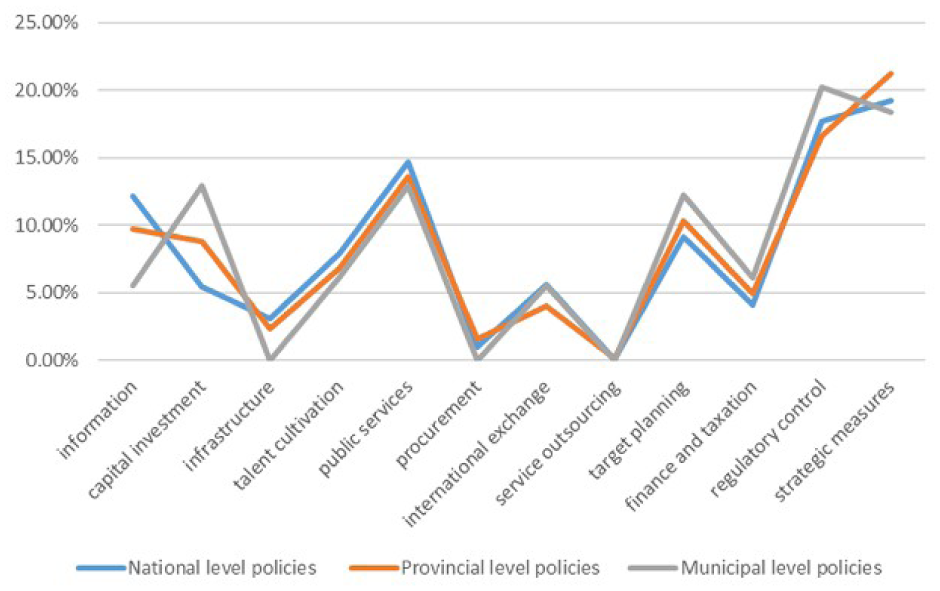
Application of policy tools.
From the viewpoint of policy tools adopted by policies at different levels, the tool selection of IP policies lacks harmonisation (Figures 3 and 4). First, the proportion of supply-side policy tools application of national-provincial-municipal policies is 43.21%, 41.14%, and 37.42%, respectively. This indicates a gradual decrease in the reliance on supply-side tools as the administrative level of the issuing body descends. The trend of the application of public services and talent cultivation tools in policies at different levels is relatively consistent. Local IP policies tend to favour capital investment, but make less use of information tools. Second, the use of demand-side policy tools in the policy system needs to be improved. At present, national-level policies place greater emphasis on the application of this tool, but local governments make insufficient use of international exchange measures. Third, the proportion of national-provincial-municipal policy environmental tools is 50.13%, 53.16%, and 57.06% respectively. Provincial-level policies prioritise strategic measures, which account for 21.26% of their total tool use. Municipal-level policies exhibit a preference for regulatory control tools (20.25%). Additionally, municipal policies demonstrate a preference for finance and taxation tools, constituting 6.13%.
Discussion
Based on the analysis of the above results, this paper elaborates on the coordination of China’s IP policies in terms of three aspects—policy timing, policy subjects, and policy tools—and then explores the deficiencies and problems in the policy system.
Discrepancies in the Number of Intellectual Property Policies
The number of national-level IP policies exceeds that of local ones, reflecting the pivotal role of the central government in charting the future course of China’s IP landscape. This is closely linked to the current state of China’s economic development (Johnson & Koyama, 2017). Specifically, in 2008, to accelerate the transformation of the economic development model, the IP strategy was elevated to a national strategy. IP has developed rapidly; however, the quality of various types of IP is generally not high (Sun, 2024). In 2014, IP strategy shifted its focus from quantity to quality, aiming to drive stable economic growth and structural optimisation. As the distinctive path of IP development progresses, China’s high-quality economic development urgently requires a systematic approach to planning the advancement of its IP endeavours. In 2021, the Outline made comprehensive arrangements for building an IP powerhouse. IP policies at different stages have all been shaped by the distinct demands of China’s economic, social and technological development. IP policy-makers can also continue to innovate based on previous IP policies, learn from their experiences, reflect on their shortcomings and make continuous improvements.
Research findings indicate a significant disparity between the volume of central and local IP policies. Documents issued by local governments, such as those pertaining to training seminars and statistical reports, are classified as administrative correspondence. Since they lack explicit policy measures and don’t constitute administrative normative documents, they have been excluded from this study’s scope. The more significant reason lies in the manner in which policy is formulated and implemented in China. Similar to practices in Japan and South Korea, innovation policies in China often follow a top-down approach (Hossain, 2022; Lee & Su, 2015). This allows for clear articulation of development objectives at the macro level and helps minimise deviations in policy execution. However, this model tends to constrain local governments within the confines of political momentum, making it difficult for them to formulate operational and specific substantive measures in light of the current situation of regional IP development. Significant disparities exist in IP development across different regions of China. If local governments implement central policies mechanically without adapting them to local conditions, the improvement of the country’s overall IP capabilities may be hindered. Therefore, achieving a balance between central and local IP policies is essential. Local governments should focus on developing policies tailored to their regional circumstances, making localised adjustments in line with the macro-level direction of IP development.
Insufficient Cooperation Among Policy Subjects
China’s IP policies are primarily issued by individual government departments. One challenge in implementing these policies lies in inadequate inter-agency coordination (W. Li & Chan, 2009). To address this, the Chinese government has adopted multiple approaches to enhance interdepartmental collaboration. First, to enhance the ‘wholeness’ and ‘unity’ of IP management, the administrative responsibilities and departmental affiliation of the National Intellectual Property Administration underwent adjustments in 2018 and 2023. These continuous refinements to its mandate have addressed longstanding issues such as overlapping functions and inconsistent regulatory standards, establishing the administration as China’s principal authority for IP affairs. Second, the government proposes specific policies through formal coordination, such as jointly issuing policies (Huang et al., 2015). IP policies at the national, provincial and municipal levels are primarily issued by individual departments, with insufficient interdepartmental coordination and collaboration. Particularly, inadequate communication and cooperation with relevant departments such as industrial development and financial regulation may constrain the realisation of comprehensive IP protection across the entire chain. The European Union has strengthened coordination in IP protection for the digital age, promoted intergovernmental cooperation, and advanced unified IP safeguards. China should learn from relevant international experience to ensure improved coordination among its institutions (Cao et al., 2013). Policies should further foster collaboration between relevant IP departments, consolidate innovation resources, and advance the development of an IP powerhouse.
Structural Imbalances in Policy Tools
Research findings indicate that the Chinese government tends to favour environmental and supply-side policy tools, while having yet to fully harness demand-side policy tools. This tendency is closely linked to the trajectory of China’s economic and technological development (Jia et al., 2023; P. Xu & Luo, 2020). During the early stages of IP development, China employed environmental policy tools to foster technological innovation by refining institutional frameworks and optimising industry ecosystems. Guided by objectives of high-quality economic development and technological advancement, policy focus shifted towards process-oriented service safeguards—such as public platform services and information support—enabling widespread application of supply-side policy tools. The formulation and implementation of IP policies also remain influenced by China’s political system. As a traditionally centralised state (Bo, 2020), China’s deployment of environmental and supply-side policy tools reflects a top-down, government-led mechanism for policy support and implementation. However, existing policies have yet to fully leverage demand-side tools that effectively combine governmental authority with market forces (Q. Wang et al., 2025). From the perspective of policy implementation and objective attainment, coordinated policies strike a balance between different types of tools. Consequently, IP policy tools should be mutually reinforcing and deployed in a coordinated manner.
The application of national, provincial and municipal policy tools varies across regions. Regional policies must capitalise on existing local capacities to cultivate and secure comparative advantages in relevant activities (Balland et al., 2019). In practice, significant disparities exist in IP development among different regions of China. Taking the number of patent applications and grants for inventions, utility models, and designs as an example, Guangdong Province recorded 1,004,280 applications and 692,635 grants for the three types of patents in 2024. In contrast, Hainan Province recorded only 26,922 applications and 13,112 grants in the same year (National Bureau of Statistics of China, 2025). Local governments in China retain a degree of autonomy (Zhou & Tou, 2025), allowing them to leverage their current innovation capacity and employ specific policy tools to address local developmental gaps. The selection of policy tools by local governments requires comprehensive consideration of both the local IP landscape and national development priorities.
Conclusions
Policy coordination is essential for addressing the complex challenges of building an IP powerhouse. This paper analyses the coordination of China’s IP policies from 2008 to 2024 across three dimensions. This multi-dimensional approach helps to outline an overall picture and identify key characteristics of the IP policy system. The findings reveal that central policies significantly guide the direction of IP development in China, whereas the number of policies issued at the local level remains comparatively low. IP policies are predominantly issued by single departments, with inter-departmental collaboration could be further strengthened. The utilisation of IP policy tools exhibits structural imbalances, which impede the coordination of policy implementation. Drawing upon these findings, this study informs policymakers in advancing IP development and fostering scientific innovation.
First, enhance the local adaptation of IP policies to better reflect regional characteristics. Given the varying levels of IP development across China, local governments should formulate policies under macro-level guidance while taking into account local circumstances. In the process of building an IP powerhouse, it is essential to improve down-up policy feedback mechanisms to maximise synergistic effects. Policy priorities should be customised according to local economic conditions and the key IP challenges faced in each region.
Second, interdepartmental collaboration on IP should be strengthened. As IP matters span multiple government departments, it is essential to clarify the responsibilities of government agencies and establish a unified objective for building an IP powerhouse. China should foster cooperation among its IP departments by integrating the strategic goal of building an IP powerhouse into policy evaluation, thereby enhancing the coordinated impact of policies. Furthermore, collaboration between IP departments and relevant industrial departments should be reinforced throughout the policy formulation and implementation process. This will help pool resources for IP development and lay the groundwork for achieving strategic policy objectives.
Third, the structural layout of policy tools should be optimised. (1) Enhance the effectiveness of environmental policy tools. Improve the substance of regulatory frameworks and strategic measures, ensuring policies are operationally viable. Increase the clarity and coherence of both policy design and implementation. (2) Adjust the structure of supply-side policy tools. Raise the quality of public services and information provision, and strengthen the function of infrastructure, such as IP service centres. Prioritise the integrated development of industry, academia, research and application, and emphasise IP education. Further enhance the role of social capital in driving IP development and diversify its funding channels. (3) Promote the utilisation of demand-side policy tools. It is recommended to capitalise on instruments, including government procurement and service outsourcing, thereby stimulating the advancement of IP. International IP exchange mechanisms should be strengthened to facilitate China’s active engagement in relevant global initiatives.
Limitations and Future Research Directions. A quantitative analysis of 329 IP policy texts provides a foundational overview of policy coordination within China’s IP system. Future research could extend this analysis to examine policy coordination across different Chinese provinces. It should be noted that the policy texts analysed in this study focus exclusively on China’s IP policies. Future work should broaden the sources of policy texts, conduct comparative studies of IP policies across different nations or regions, and delve into the policy characteristics shaped by the interplay of economic, political, and technological factors.
Footnotes

Ethical Considerations
This research did not involve human or animal participants.
Funding
The authors received no financial support for the research, authorship, and/or publication of this article.
Declaration of Conflicting Interests
The authors declared no potential conflicts of interest with respect to the research, authorship, and/or publication of this article.
Data Availability Statement
The data and materials used in this paper are available from the corresponding author on reasonable request.