



Abstract
Green technological innovation (GTI) is a key instrument of climate change alleviation. It raises the standard of environmental protection as well as economic prosperity. However, it is difficult to promote GTI only by government involvement due to its double positive externality. It’s also crucial to have the appropriate intellectual property rights. This article adds to the body of knowledge on intellectual property protection in relation to environmental regulation and green innovation. We examine the effects of heterogeneous environmental regulations (ER) on GTI using fixed effect (FE) and system GMM (SYS-GMM) methodologies utilizing China’s provincial data from 2000 to 2019. Additionally, we further conduct a moderation analysis to examine the role of intellectual property protection (IPP) in the impacting mechanism of ER on GTI. The findings show that both ER and IPP positively affect GTI, and the promotion effect remains significant after an array of robustness analysis. However, the moderating analysis suggests that the positive effect of ER on GTI might decrease with the increase of IPP. Further analysis shows that all the different types of ER, namely command-and-control regulation (CR), market-incentive regulation (MR) and voluntary environmental regulation (VR), exert a promotion influence on GTI, while the synergetic effect of IPP and heterogenous ERs are significantly negative. Hence, it is necessary for policymakers to implement green intellectual property polices to protect and stimulate green technologies.
Introduction
Due to its leapfrogging economic development pattern, China has become the largest emerging country and has ranked the second biggest economy worldwide. On alarming note, China is confronted with acute ecological complications due to the consumption of energy resources over the course of rapid economic development. Therefore, how to maintain a balanced tradeoff between economic growth and environment has posed a huge challenge to China. Green technological innovation can preserve resources, reduce or even avoid pollutant emissions and recycle raw materials and wastes (Barbieri et al., 2020), which is widely regarded as an important instrument to improve the quality of both economic growth and environment in parallel. However, there are also studies suggest that GTI may reduce carbon dioxide emissions in the long run, but in the short run, the impact is opposite (Mongo et al., 2021). It is mainly due to its dual externality problem. Most emissions-intensive firms show unwillingness to carry out green research and development investment, which might reduce enterprise’s GTI (Rennings, 2000). Therefore, it is imperative for policymakers to implement proper environmental policy and innovation policy to stimulate green technological innovations.
In the face of increasingly severe environmental pollution, the Chinese government firstly publicized China’s Environmental Protection Law, and established a relative coordinated framework of ecological regulations. Recently, China’s environmental protection law framework incorporates nearly 26 related laws, approximately 800 standards, more than 50 regulations and about 660 normative legal documents, primarily addressing the control of pollution, and the security of natural resources (Cai et al., 2020). As Xie et al. (2017) stated, the current ER system can be divided into three types: CR, MR and VR. Among the three types, CR has the strongest enforcement force and can effectively reduce pollutant, but it has problems such as high enforcement cost, reduced enterprise performance and insufficient intrinsic incentive. MR is conducive to economic subjects to choose pollution control means that suitable for their own development, to incentivize enterprises to engage in green innovation and pollution abatement. But when the market system is not sound, it may not play a role effectively. VR has the lowest mandatory binding force, and meanwhile reduces the cost of government environmental supervision, which reflects the process of administrative democratization. Therefore, empirical findings on the nexus between ER and GTI are inconclusive. scholars have opposing views ranging from positive impact (M. M. Guo et al., 2023; X. Li et al., 2023), negative impact (Tang et al., 2020), varied impact (J. X. Zhang et al., 2020) to the inverted U-shaped nexus (Ouyang et al., 2020; L. Xu et al., 2023). It is necessary to explore the nexus between ER and GTI. And whether innovations are green-biased under the heterogeneity of environmental regulation also need to be further examined.
Furthermore, even neglecting dual externalities and information inequalities, regions have paid a high price in their pursuit of green innovation (Luo, Lu, et al., 2023). As a result, intellectual property rights (IPRs) serve as another crucial tool for state regulation aimed at fostering innovation, particularly green innovation. In 1994, with the release of the “World Trade Organization’s Trade-Related Aspects of Intellectual Property Rights (TRIPs)” and the free trade doctrine, emerging countries including China, were directed instinctively to strengthen their IPRs (Hall, 2007). Therefore, creating innovation-friendly environment and increased implementation of intellectual property rights, appeared as an essential policy agenda in both developed and developing countries. The innovation-based development strategy of China is showing prominent results. The “National Development and Reform Commission (NDRC)” and the “Ministry of Science and Technology of P.R.C. (MOST)” (Ministry of Ecology and Environment of P.R.C, 2020) jointly advocated that the government should strengthen the intellectual property protection (IPP) to create a good market environment for green innovation. With respect to IPRs-green innovation nexus, the conclusions range from positive impact (Ernst, 2001; Xia et al., 2023), an inverted U-shaped association (Hashmi, 2013), insignificant effect (Lerner, 2009) to a negative impact (Suominen et al., 2023). The nexus between IPP and GTI needs to be explored, and the interaction with environmental regulation should be considered.
Therefore, this article attempts to explore the nexus between heterogeneous ER and IPP on GTI. The motivation of this study is as follows. (1) It is challenging to develop GTI only through market mechanisms because of the positive externalities of GTI and the negative externalities of environmental concerns. To solve these issues, there is an urgent need for environmental control and intellectual property rights. The combined effects of ER and IPP on GTI have unfortunately received little attention from research. (2) Developing nations are particularly affected by environmental issues. China, the largest emerging nation, has paid a hefty price in its quest for economic growth. It is crucial for China to investigate the proper GTI in order to address its environmental issues.
These are the potential contributions of this article. First off, the majority of studies have only looked at the effects of a particular piece of legislation on GTI. In this article, we add to the literature by examining the effects of IPP and ER on GTI in order to address the dual externalities of GTI. Additionally, this study undertakes a heterogeneity analysis, which is helpful in the creation of tailored policies, and investigates the mechanisms of ER and IPP on GTI from two perspectives: R&D investment and industrial structure upgrading. Lastly, we further introduce the interactive term of IPP and ER to explore the synergistic effects on GTI, which is often ignored in environmental research area.
The continuing section of this study is arranged as follow: Section “Literature Review and Hypothesis Development” states summary of previous studies and puts forward research hypotheses. Section “Methodology and Data” is the methodology and data. Section “Results and Discussion” discusses the empirical findings. Section “Conclusions and Policy Implications” elaborates conclusion and policy recommendations.
Literature Review and Hypothesis Development
Environmental Regulation and Green Technological Innovation
Research on the relationship between ER and GTI has yielded rich achievements and considerable progress. Relevant studies present both positive and negative impacts of ER on GTI. According to a static perspective, the implementation of environmental regulations will increase business expenses and reduce competition among businesses since firms will allocate resources based on their lowest cost (Luo, Lu, et al., 2023). Environmental regulation increases expenses and decreases research and development expenditures, which discourages innovation (Qiao et al., 2022). On contrary, Porter (1991) and Porter and Van der Linde (1995) criticized the traditional static research for being one-sided, and claimed that ER profitably promoted green innovation. They added further that suitable ER could enhance the capacity of firms’ R&D activities and improve economic growth through first-mover welfares and innovation compensation. Ahmed (2020) found stringent environmental regulation can promote green innovative capacity in 20 OECD countries. A non-linear connection between ER and China’s GTI was also discovered between 2004 and 2016 by F. Fan et al. (2021). The findings show that the majority of Chinese cities are close to the inflation point for environmental regulations, indicating that the degree of regulations needs to be increased.
Furthermore, each type of ER may exert different effect on green technological innovation. By studying the dynamic nexus between ER and technological innovation in China’s provinces from 2006 to 2015, Pan et al. (2019) found that MR had a significant impact on technological innovation, while CR had no significant impact. J. X. Zhang et al. (2020) found MR and VR are more efficient at stimulating green innovation than CR. Fang and Shao (2022) found that MR is more suitable for region green technology innovation than CR. Based on the firm-level survey data, Bu et al. (2020) indicated that ISO 14000 certification has a significant positively impact on innovation input and output of Chinese enterprises.
In summary, the impact of ER on GTI is uncertain. Based on the above analysis, the following hypotheses are proposed:
Hypothesis 1a. Environmental regulation positively affect GTI in China.
Hypothesis 1b. Heterogenous ERs exert different effects on GTI in China.
Intellectual Property Protection and Green Technological Innovation
The existing literature on IPP and green innovation is rare. In this article, we review the literature on IPP and innovation to clarify the potential nexus among intellectual property protection and GTI. The relationship among IPP and innovation can be dated back to the seminal studies by Nordhaus (1969) and Judd (1985) who confirmed that strong IPP intensifies innovation. However, the subsequent research on this subject provides divided opinions. The relationship between R&D investments and China’s intellectual property protection was examined by T. Chu and Zhou (2022). They found that strengthening intellectual property protection would confine technology spillovers and encourage enterprises to increase R&D investment. Wen and Deng (2023) evaluated the effects of intellectual property protection on corporate digital transformation. The outcomes of concurrent equations revealed that intellectual property protection had a favorable impact on raising R&D expenditure and reducing financial restrictions.
A. C. Chu et al. (2018) found that strong intellectual property protection stimulates innovation in the sectors that utilized local inputs. Other strand of previous studies identified the negative effect of IPP on innovation (A. C. Chu et al., 2014; Ho, 2022). While, Liu et al. (2018) validated an inverted U-shape relationship between IPP and innovation across 80 advanced manufacturing SMEs in China over the period 2013 to 2015. To sum up, the above literature indicates that IPP might also exert two-way effect on GTI.
Hypothesis 2. The strengthening of intellectual property protection can trigger green technological innovation.
The Moderating Effect of Intellectual Property Protection
ER exerts “innovation compensation” and “compliance cost” effects on GTI (Porter, 1991). When the benefits of GTI exceed the costs under the burden of ER, enterprises are inclined to develop innovation (He et al., 2020). Firms are less motivated to create green technologies, nevertheless, as a result of the dual externality problem of GTI (Rennings, 2000; Tan et al., 2022). Moreover, the absence of proper property protection will not guarantee the green innovation benefits (He et al., 2020), which will further reduce companies’ willingness to invest in green innovation. Hence, the Porter’s effect of ER on GTI may also moderated by a good property protection. Schmidt (2023) also pointed that the government needs at least two different policy tools to solve the problem of dual externalities. With the strengthen of intellectual property protection, the economic benefits of innovation, including green innovation, can be protected, which will steer firms to innovate (Estrin et al., 2013). On the other hand, the increase of IPP intensity, the R&D cost will also raise. which will aggravate the “compliance cost” of ER, and weaken its “Porter’s effect.” In this case, the joint effects of IPP and ER might generate substitute impact on green technological innovation. Based on the above analysis, we develop the third hypothesis as follows:
Hypothesis 3. IPP has a moderating influence on the nexus among ER and GTI.
Based on the above literature, the theoretical conceptualization of this paper is illustrated in Figure 1.

The hypothesized conceptual framework.
Methodology and Data
Data
A panel data of China’s 30 provinces (except Tibet, Hong Kong, Macaw, and Taiwan due to availability of the data) is collected from 2000 to 2019. The GTI raw data is extracted from databased of CNIPA (China National Intellectual Property Administration), referring to “IPC Green Inventory.” Compared with design patent, invention patent and utility patent can reflect more substantial innovation. Hence, this article collects the amount of green invention patent authorization and utility patent authorization. Figure 2 shows the trend of different green patents during the period 2000 to 2019. Clearly, total green patent rose slightly from 2000 to 2009, and then experienced a dramatic increase from 2009 to 2019. Specifically, the growth of green patents in China mostly comes from utility patents, while the growth of invention patents is increasing slowly. This also illustrates that the basic research and development of GTI is insufficient in China. It is imperative for China to impose some polices to develop green invention patent.
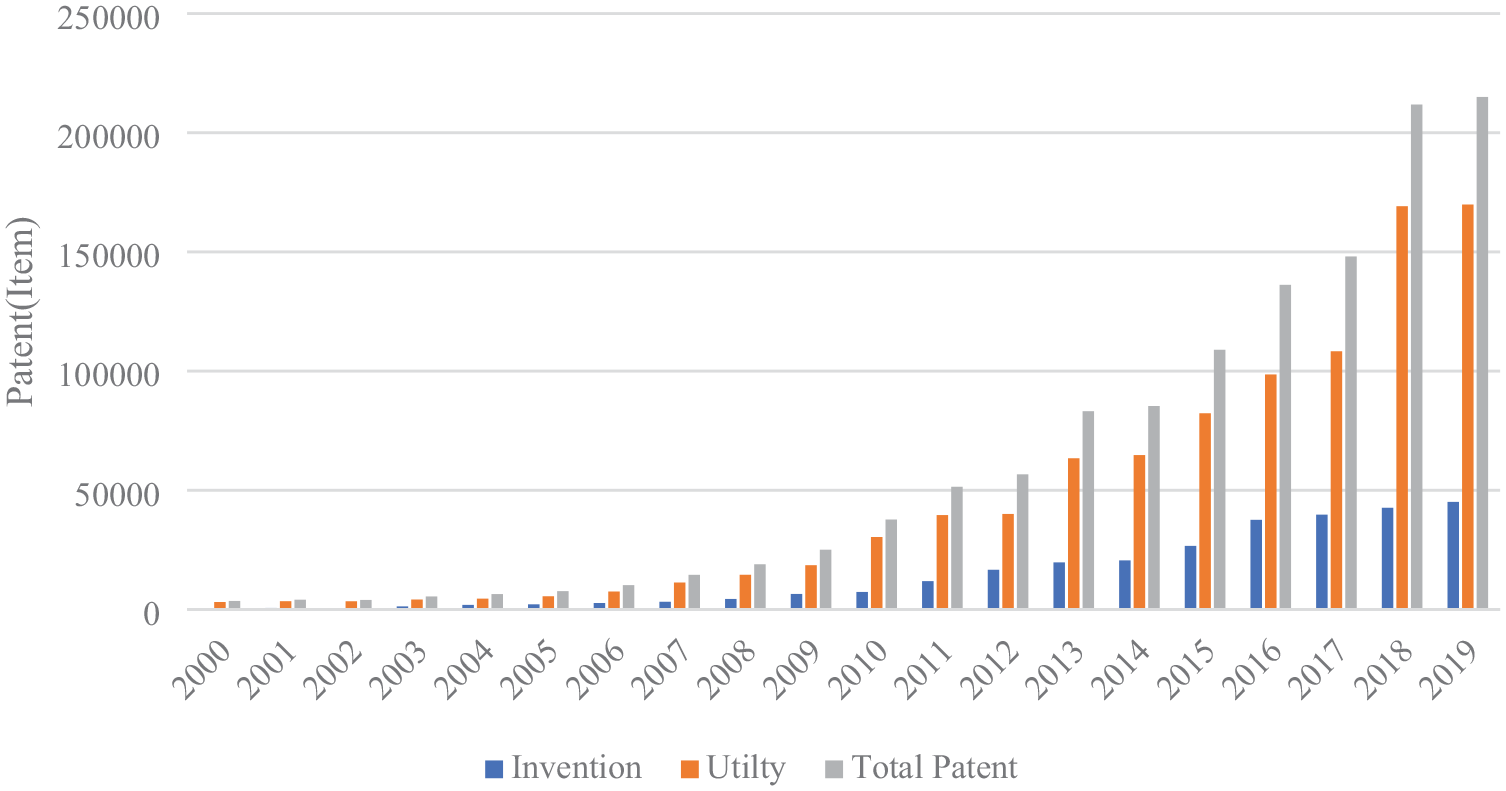
Trend of different green patent in China from 2000 to 2019.
The data of environmental regulation is collected from China Environment Yearbook. The indexes to measure the IPP are organized from China Intellectual Property Yearbook, China Statistical Yearbook and China Yearbook of Lawyers. Other data are from China Statistical Yearbook of Science and Technology, China Statistical Yearbook and Statistical Bulletin of China’s Outward Foreign Direct Investment. Table 1 reports the descriptive statistics of core variables.
Descriptive Statistics.
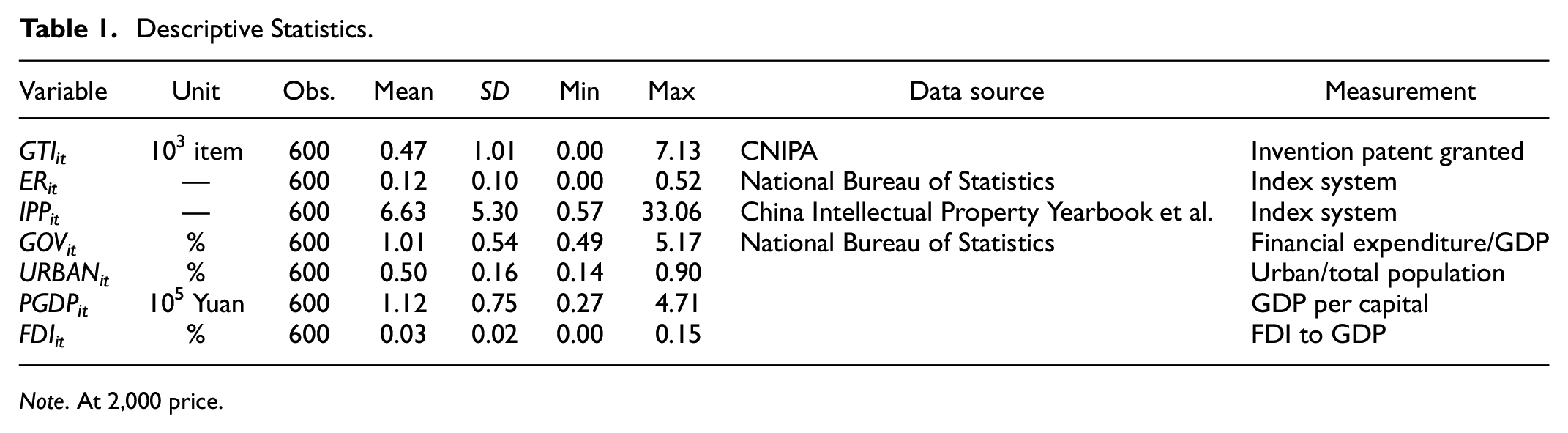
Note. At 2,000 price.
Variable Selection
Dependent Variable
Green technological innovation (GTIit). In the existing literature, GTI is usually measured by research and development input (Popp & Newell, 2012), eco-label (Lin et al., 2014), and green patent (Brunel, 2019). Given the availability of data, this article uses the green patent to measure GTI. Based on “IPC Green Inventory” proposed by WIPO, this article collects the number of invention patent granted related to “Alternative energy production,”“Transportation,”“Energy conservation,”“Waste management,”“Agriculture/forestry,”“Administrative, regulatory or design aspects,” and “Nuclear power generation.”
Figure 3 depicts the kernel distribution of GTI in China during 2000–2019. It can be observed that the GTI in China is left-skewed. The kernel density peak of GTI shifts from left to right during 2000 to 2019, suggesting that China’s GTI shows an increasing trend in recent years. Moreover, the peak height of GTI becomes lower and the width becomes wider. It shows that the difference of GTI among regions is expanding, exhibiting the characteristics of dynamic divergence.
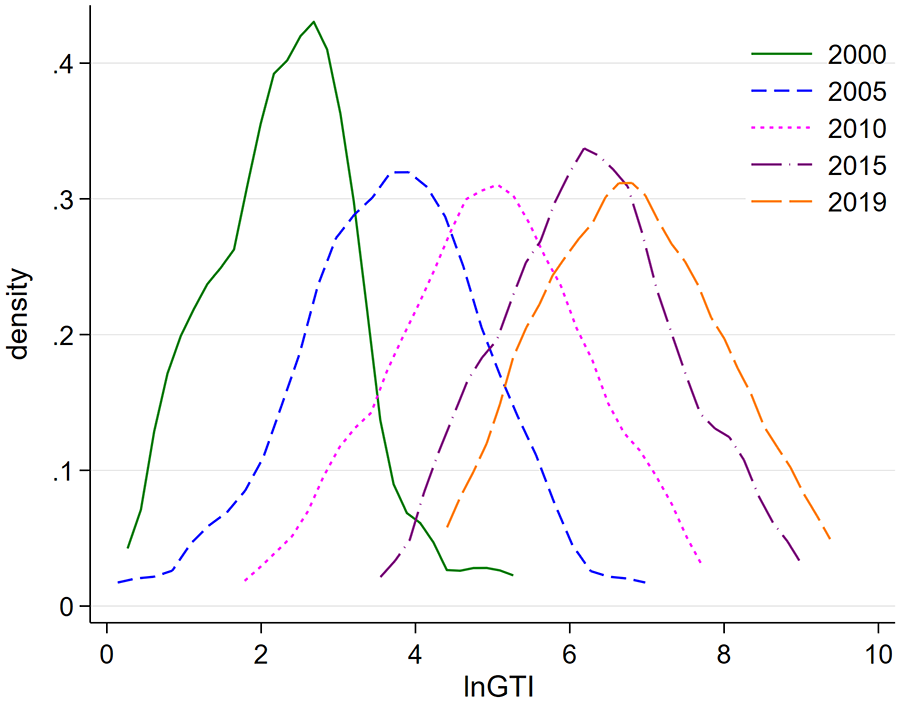
2000 to 2019 China green technology innovation nuclear density profile.
As can be seen from Figure 4a and b, the coastal region has the greenest patents. With the China’s reforms and opening up, a large amount of physical and human capital flows to the coastal provinces such as Jiangsu, Shanghai and Guangdong, which promote the development of innovation, including green innovation. Compared with that in 2000, the overall green patents in 2019 showed a large growth, with Guangdong and Zhejiang provinces growing rapidly. In contrast, the northeast provinces saw a slow growth.

(a) GTI in 2000 and (b) GTI in 2019.
Key Explanatory Variables
(1) Environmental regulations (ERit). Considering that a single indicator is hard to reflect the actual ER level in China (Luo, Mensah, et al., 2022). In order to measure the ER, we therefore use the evaluation index system proposed by Wu and Hua (2023) and the entropy weight TOPSIS approach.
Figure 5a and b display the China’s ER level in 2000 and 2019. It can be found that there are obvious differences in different regions of China. Coastal provinces such as Guangdong, Liaoning, and Jiangsu have a high level of environmental regulation in these 3 years, while inland provinces such as Qinghai, Ningxia, and Inner Mongolia have a low level of environmental regulation.

(a) ER in 2000 and (b) ER in 2019.
Moreover, the distribution of average CR, MR and VR in China during 2000 to 2019 are also shown in Figure 6. It can be seen that Guangdong (0.430) has the largest CR intensity, followed by Jiangsu (0.330) and Zhejiang (0.261). By contrast, the average value of CR in Qinghai (0.009) is lowest. Regarding the average value of MR, Shandong and Jiangsu are the top two provinces with the value of 0.451 and 0.399, respectively. Meanwhile, the average value of VR in Guangdong is the largest with the value of 0.334. Jiangsu (0.265) ranks the second place during the sample period (see Table 2).

Distribution of China’s heterogeneous environmental regulations.
(2) Intellectual property protection (IPPit). Intellectual property protection has direct impact on innovation, including GTI. In line with the calculation methods of Han and Li (2005), Luo, Xu, et al. (2023), we build an index evaluation system to measure China’s IPP based on the G-P index proposed by Ginarte and Park (1997).
Index Evaluation System of China’s Intellectual Property Protection.

In the above index evaluation system, legislative intensity (LI) is established based on G-P index, and each province in China shares the same value. While, enforcement intensity (EI) considers the regional differences among China’s provinces. The value of regional IPP is measured by the following equation.

where, L(t) and E(t) denote legislative intensity and enforcement intensity, respectively. It can be found that China’s intellectual property protection grew rapidly, with the maximum value increasing from 3.7 to 33.1 during the period 2000 to 2019. The highest region is mainly in the Coastal and other regions with rapid economic development, showing a more obvious imbalance in regional development (see Figure 7a and b).

(a) IPP in 2000 and (b) IPP in 2019.
Control Variables
Government intervention (GOVit) refers to the level of government intervention in the economy and is measured as the ratio of general financial expenditure to GDP (Luo, Lu, et al., 2022). Urbanization development (URBit) signifies the shift of the populace towards urban regions with the aim of enhancing living standards, which might also drive the development of GTI (Chen et al., 2023). In this study, URBit is measured by the proportion of urban population in the total population (J. J. Fan et al., 2023). Economic level (lnPGDPit) also contributes to promoting GTI. In this study, we adopt GDP per capital with logarithm to proxy economic level. FDI might also bring advanced green technologies from developed countries (Yi et al., 2023), which might exert a positive impact on GTI. Therefore, the ratio of FDI to GDP is introduced as proxies of foreign technology spillover.
Econometric Model
Static Panel Model
Following J. Guo and Lv (2020), this study firstly employs a static panel data model with fixed effect (FE) methods to analyze the effects of ER and IPP on GTI (see equation (2)).

where, GTIit denotes the green technological innovation of i province at period t, ERit and IPPit represent the environmental regulation and intellectual property protection intensity of i province at period t, respectively. Xit represents other control variables. µ i and δ t denote the individual effect and year effect. ε it is the random error term.
Dynamic Panel Model
The anticipated green technological breakthrough cannot be realized in the near future due to a lack of technology, economic growth, and political support. Only slowly will it be able to advance toward the desired level of green innovation. F. Zhang (2023) asserts that it is possible to analyze the partial adjustment using the lagged term of the dependent variable (see equation (3)).

Where the coefficient 1−λ (0 < λ < 1) measures the adjustment speed from actual GTI to desired GTI.
Substituting equations (3) into (2), this paper obtains the following dynamic panel models.

where, λ denotes the effect of the previous GTI on the current one, which can measure the accumulative effect mentioned above.
This work uses a system GMM (SYS-GMM) estimator suggested by Blundell and Bond (1998) to address the issue of the lagging component of GTI in the dynamic panel model that may lead to endogenous problems (F. Zhang, 2023). The Arellano-Bond (AR) test is used to evaluate the SYS-GMM assumption that there should be a first-order serial correlation and no second-order correlation in the error term. Furthermore, SYS-GMM stipulates that model instruments’ variables must not be over-identified. Therefore, Hansen test is adopted in this paper.
Moderating Model
Furthermore, this paper introduces the interaction term (ERit × IPPit) to analyze the moderating impact of IPP in the impacting mechanism of ER on GTI. The moderating model is displayed as follows.

Moreover, this study also examines the syngenetic effect of IPP and different types of environmental regulation, namely, CR, MR and VR, to explore the possible substitution or complementary effect between ERit and IPPit.
Results and Discussion
Multicollinearity Analysis
Table 3 shows the multicollinearity analysis results, specifically focusing on the Variance Inflation Index (VIF). The maximum value among the selected variables is 4.07, indicating that there is no obvious multicollinearity problem in the variable data. Furthermore, the correlation coefficient shows that ER, IPP, and GTI are positively correlated in China, at a significant level of 1%.
Multicollinearity Analysis.

*p < .1. **p < .05. ***p < .01.
Benchmark Analysis
Static Analysis
Table 4 presents the benchmark regression analysis of ER and IPP on GTI. The regression results of OLS, RE and FE without control variables are reported in the Column (1) to (3), respectively. According to the Hausman test, FE model is better. The estimated coefficients of the ERit are all positive at the significance level of at least 5%. And the results remain valid after adding control variables. It suggests that strengthening ER can effectively promote the development of GTI. Moreover, IPP also exerts a significant and positive influence on GTI at 1% level. GTI is characterized by high input and high risk (He & Chen, 2022; Luo et al., 2023). However, due to the positive externality of innovation, other firms can easily access the latest green technology without strict intellectual property protection, which will harm the legitimate rights of innovation subject. Therefore, the stricter IPP imposed by government would lead to the development of green patents, which verifies Hypothesis 2.
Benchmark Analysis.

Note. The standard errors are in parentheses. AR (1), AR (2) and Hansen report the p value.
*p < .1. **p < .05. ***p < .01.
Regarding the control variables, the estimated coefficient of GOVit is significantly negative. It indicates that the adoption of a GDP-centric evaluation system may drive the government to develop production technologies, rather than green technologies. The development of urbanization can significantly promote GTI. In addition, the effect of lnPGDPit and FDIit on GTI in static analysis fail to pass the significance level.
Dynamic Analysis
Based on the static panel model, the lagged term of GTI is introduced to form the dynamic panel model (see Table 4). Through SYS-GMM estimation, the impact of ER and IPP on GTI is analyzed. In Table 4, the statistics of AR (1) tests are significant, suggesting that the first-order error term are autocorrelated. The p-values of both AR (2) and Hansen tests are above .1, indicating that the second-order serial is not correlated, and IVs are not overidentified. It suggests the estimated outcomes based on SYS-GMM are valid. Moreover, the lagged term of GTI positively affect the current GTI, indicating that the development of GTI requires a long trajectory. The estimated coefficient of ER and IPP does not change significantly after considering GMM, verifying Hypothesis 1a and Hypothesis 2.
Analysis of Different Types of Green Technology Innovation
Considering the huge regional differences and uneven technological development in China, we further conduct a heterogeneity analysis to examine the influence ER and IPP on GTI (see Table 5). In line with Luo, Lu, et al. (2022) we divide the full sample into coastal and inland areas. It can be found that the lagged GTI significantly promotes GTIit in both coastal and inland regions. The role of ER on GTI in inland areas is positive, which is consistent with the results in Table 4. It suggests that under the influence of ER, GTI in inland areas, such as Shanxi, Hubei and Sichuan, has been significantly improved. These regions face serious environmental challenges and have a more urgent need for strong environmental regulation and green technologies (Z. H. Li et al., 2023). However, the promotion effect of ER fails the significance test in term of coastal area. Following are some possible explanations. Strong environmental regulations and green technologies are more urgently needed in inland regions since they face significant environmental issues (Z. H. Li et al., 2023).
Analysis of Different Types of Green Technology Innovation.

Note. Same as above.
Moreover, this study further divides the total sample into high and low groups based on the average value of green technology innovation (4.67). In term of Low-GTI group, the strengthening of ER can significantly promote GTI at 5% level, while the Porter’s effect of ER in High-GTI group is no significant. This shows that the promotion effect of ER is more obvious for regions with low GTI, such as Gansu, Inner Mongolia and Ningxia. The application of environmental regulations will increase local awareness of environmental conservation. The implementation of environmental regulation policies will form an incentive effect on local enterprises, increasing green R&D investments. Additionally, the coefficients of IPPit in High-GTI group is positive at the 10% significance level, indicating the stricter IPP intensity is needed in the provinces with high green innovation level. The absence of technical advancements in low GTI regions may explain why they are less sensitive to robust intellectual property protection (Roh et al., 2021).
Mediating Effect
The mediating effects of ER and IPP on the development of green technologies are also examined in this research. According to Ren et al. (2023), industrial structure upgrading (Iud) can hasten industrial transformation and foster industry cooperation. Additionally, it is crucial in the search for green innovation (Qiu et al., 2023). Additionally, research and development (RD) offers the technical and financial assistance required for green innovation (H. L. Zhang, 2022). The mediation model is as follows.


Where, Iudit and lnRDit are the mechanism variables, respectively. Refer to the study of Ren et al. (2023), this paper adopts the ratio of tertiary industry and secondary industry to present Iudit. RD investment is used to proxy the RD intensity. Other variables are the same as equation (4).
Table 6 displays the outcomes of the mediating effect. The impact of ER and IPP on the aforementioned mechanism variables is examined using SYS-GMM. We can see that whereas ER is not, IPP can greatly support upgrading of the industrial structure. This shows that strict environmental regulations have high governance costs and take time to have an impact on industrial structure (Y. S. Xu et al., 2023). The growth of RD, which is consistent with Zheng et al. (2021), is facilitated by both IPP and ER.
Mediating Effect.

Note. Same as above.
Robustness Analysis
In this study, SYS-GMM is used above to control the endogeneity problem among variables. To guarantee the credibility of the conclusion drawn above, we further conduct a series of robustness tests.
Changing the Dependent Variable
To comprehensively assess the influence of ER and IPP on GTI, this study also employs green utility patents and the aggregate count of green patents to proxy GTI. The findings presented in Table 7 demonstrate that both ER and IPP exert substantial promotional effects on GTI, thereby corroborating the robustness of the conclusions drawn above.
Change the Core Variable.

Note. Same as above.
Changing the Core Variable
The deliberate selection of the dependent variable may cause potential estimation bias. Thus, we further use entropy weight method (EWM), TOPSIS method and principal component analysis method (PCA) to re-evaluate the ER intensity, and analyze its promotion influence. The results in Table 7 agree with that in Table 4 again.
Change the Sample Size
In 2008, the Ministry of Environmental Protection of the People’s Republic of China released the Classified Management List of Environmental Verification Industries of Listed Companies (Luo, Lu, et al., 2022). It offered clear environmental management standards and criteria that were industry-specific. As a result, this study uses sample data from 2008 to 2019 to revisit how ER and IPP affect GTI (see Table 8). It can be found that the effects of ER and IPP remain positive at 5% level. Moreover, to prevent the interference of outliers of individual indicators, this paper winsorizes the continuous variables at the level of 1% and 5%. Table 8 displays that the coefficients of ER and IPP have not changed significantly.
Change the Sample Size.

Note. Same as above.
Changing the Estimation Technique
Consider that the criterion for measuring green technology innovation is a discrete-valued integer. Heteroscedasticity problems would be exposed while using OLS model alone (Sugano & Matsuki, 2014). Hence, we further employ the Poisson distribution regression model to reevaluate the influence of ER and IPP on GTI (see Table 9). The estimated coefficients for ERit and IPPit are 1.312 and 0.118, respectively, exhibiting statistical significance at the 1% level. The result of Poisson regression is aligning with that in benchmark regression. In addition, in order to reflect the full picture of the distribution of the explained variables. This article further uses quantile regression for robustness analysis, and the results remain robust.
Changing the Estimation Technique.
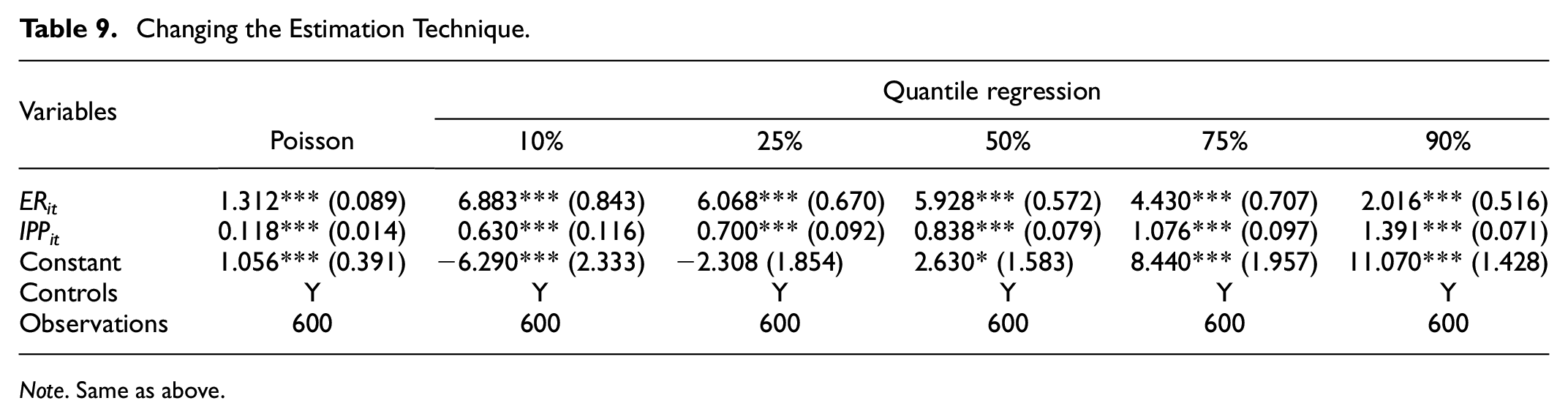
Note. Same as above.
Moderating Analysis
Table 10 reports the moderating effect of IPP in the influencing mechanism of ER on GTI. It can be found that the coefficient signs of ERit and IPPit in Table 10 both significantly positive, consistent with that in Table 4. However, the coefficient of interaction term ERit × IPPit is significantly negative. It indicates that there is a significant substitution effect between ER and IPP. The growth in IPP could have a detrimental influence on the selection of non-green inventions, reducing the “Porter effect” of environmental rules. As mentioned above, the R&D input on GTI is much larger than that on traditional innovation. The strengthening of IPP will increase the green R&D cost, which might aggravate the burden of GTI for enterprises. Consequently, the “Porter effect” of ER on GTI might be weaken.
Moderating Analysis.

Note. Same as above.
Analysis of the Impact of Heterogenous ER on GTI
Given the diverse nature of various categories of environmental regulation, this article further explores the syngenetic effect of IPP and heterogenous ERs, namely, CR, MR and VR, on promoting GTI (see Table 11). It can be found that CR, MR and VR all have a positive effect on green technology innovation, against the Hypothesis 1b. The strengthening of the three types of environmental regulations will stimulates potential entrants to engage in R&D and cross the threshold using green technology. Ultimately, this generates an “innovation compensation effect” that promotes the enhancement of GTI efficiency. Moreover, intellectual property protection also plays a pivotal role in enhancing GTI in Table 11, which is consistent with the results in Table 4. It serves as an effective mechanism to tackle the infringement of IPP resulting from market failures and safeguard the interests of enterprises. However, the coefficients of the interaction terms, namely CRit × IPPit, MRit × IPPit, and VRit × IPPit, are significantly negative at 5% level. This demonstrates how the effects of intellectual property protection and disparate environmental rules together will drive up R&D costs and impede the development of GTI.
Analysis of the Impact of Heterogenous ER on GTI.

Note. Same as above.
Conclusions and Policy Implications
Conclusions
Previously, few researchers have focused on the impacts of different ER and IPP on GTI. In this article, both static and dynamic panel models are constructed to testify the Porter’s Hypothesis by analyzing a provincial data from 2000 to 2019. The above analysis draws several key conclusions, which are summarized below. First, ER exerts a significant positive impact on GTI. Moreover, the influences of CR, MR and VR on GTI are also significantly positive, which validates the Porter’s hypothesis. Second, intellectual property protection can positively affect GTI. Third, with the increase of IPP, the impacts of heterogenous ERs on GTI might decrease.
Policy Implications
Based on the above findings, this paper suggests several policy implications. First, the positive impacts of heterogeneous ER on GTI in China imply that the local government should increase the mandatory environmental regulation intensity, improve the construction of market regulation and strengthen public environmental education to stimulate green innovations and cope with the serious environmental degradation. And, the reform experience from China can serve as a reference for other countries.
Second, the increase of intellectual property can significantly promote green patents. Hence, it is imperative for policymakers to implement strict intellectual property protection policies to develop green technologies. Along with this, the government must direct businesses to increase their investments in green R&D and propose focused intellectual property rules on green patents.
Third, to lessen the financial burden placed on businesses by investing in green research and development, the government should offer tax breaks and subsidies for green innovation. In this case, government can better leverage the joint efforts of intellectual property protection and environmental regulation, which can stimulate green technological innovations.
Limitations and Future Research
This article also has some limitations. Due to the data availability, we use the panel data covering China’s 30 province during 2000 to 2019. The data should be expanded in the future. Additionally, it may be important to investigate how ER and IPP affect green technology innovation at the city or micro company level. Future research can also look into how ER and IPP affect the effectiveness of green innovation, better capturing the characteristics of green innovation capability
Footnotes
Declaration of Conflicting Interests
The author(s) declared no potential conflicts of interest with respect to the research, authorship, and/or publication of this article.
Funding
The author(s) disclosed receipt of the following financial support for the research, authorship, and/or publication of this article: This study is supported by China Postdoctoral Science Foundation (2023M731371), National Statistical Science Research Project (2024LY041), Natural Science Foundation of the Higher Education Institutions of Jiangsu Province (24KJB630003), Humanities and Social Sciences Youth Foundation, Ministry of Education (23YJC790096). This funding has been instrumental in enabling us to conduct this study, and we believe it’s important to include this information in the publication for proper acknowledgment.

Data Availability Statement
The data that support the findings of this study are available from the corresponding author upon reasonable request.