




Abstract
This study explores how digital comic application interfaces affect reader comprehension, cognitive processing, and narrative engagement. As comic reading transitions from print to digital platforms, app-based interfaces such as full-page multi-panel layouts, guided view sequences, and single-frame scrolling fundamentally reshape the reader’s narrative experience. This research employs a mixed-methods approach, combining a general survey (N = 84), a controlled reading experiment (N = 24), and interviews with five professional comic artists to examine how different interface designs influence readers’ visual narrative processing. Participants read identical comic content through three distinct interface modes, followed by immediate recall tasks and engagement assessments using the User Engagement Scale (UES). Visual Language Fluency Index (VLFI) scores were used to analyze individual differences in cognitive processing. Results indicate that guided view interfaces significantly enhance narrative recall and emotional engagement among readers with lower visual language fluency, while higher-fluency readers preferred full-page layouts for their flexibility and richer visual context. The single-frame format was found to simplify comprehension in complex narratives but reduce perceived esthetic satisfaction. Interviews with comic artists further revealed that app interfaces influence not only readers but also creative practices, particularly in pacing, panel composition, and the use of visual cues. The study concludes that interface design is not a passive vessel but an active agent in shaping digital reading cognition and experience. These findings have implications for digital literacy, interface usability, and the evolving storytelling strategies in digital comic media.
Plain Language Summary
Many people now read comics on mobile apps instead of in print. But do the design choices in these apps, such as how the panels are displayed or how readers move through a story, change how people understand and enjoy the comic? This study explores how different comic app designs affect how people read, process, and remember comic stories. We asked 84 people in Taiwan about their comic reading habits and then invited 24 of them to take part in an experiment. They read the same comic stories using three different app formats: full-page layouts (similar to printed comics), single-frame scrolling (one panel at a time), and guided view (where the app controls the reading flow). After reading, participants recalled the story and rated their engagement. We found that the guided view format helped people with lower visual literacy remember the story better and feel more emotionally involved. On the other hand, people with higher visual literacy preferred the full-page format, which gave them more control and a richer view of the artwork. The single-frame format made complex stories easier to understand but was rated lower in terms of visual enjoyment. We also interviewed five experienced comic artists. They said that digital formats require different approaches to storytelling and design. For example, app-based formats can speed up reading or change how time and emotion are felt in the story. This research shows that comic apps are not just a new way to display old comics. They actively shape how stories are told and understood. These findings can help app designers, educators, and artists create better comic reading experiences for all types of readers.
Keywords
Introduction
The evolution of digital platforms has reshaped public reading habits. The increasing diversity of screen sizes, the availability of high-resolution displays, and widespread access to high-speed internet have expanded the possibilities for designing and delivering digital content. Under these technological developments, digital comics have gradually taken a significant share of the traditional print comics market. Compared to text-based e-books, image-centric media such as comics have been even more profoundly impacted.
Industry reports from Japan and Taiwan indicate a long-term contraction of print-comic sales, accompanied by rapid growth in mobile reading applications. These shifts highlight readers’ increasing preference for flexible, interactive, and personalized storytelling formats. At the same time, advances in app interface technologies have allowed comic reading to move beyond fixed, page-by-page layouts toward dynamic formats such as vertical scrolling, guided view, and single-frame sequencing. Such transitions not only alter the delivery of content but also reshape how readers process narrative information.
Existing research has primarily examined comic cognition from linguistic, semiotic, or visual-narrative perspectives, focusing on panel transitions, gutter closure, and visual literacy. However, relatively few studies have empirically investigated how interface design itself mediates reader cognition, comprehension, and engagement. From a human–computer interaction (HCI) perspective, an interface’s affordances (Gibson, 1979; Norman, 2013) and the sociomaterial context of use (Bødker, 2006) shape how readers navigate and interpret digital narratives. Design research also highlights the balance between feature richness and usability, indicating that simplified or guided interactions can improve cognitive focus and learning efficiency. Integrating these frameworks clarifies how interface structures actively shape users’ perceptual and interpretive processes. Drawing upon theories of distributed cognition (Hutchins, 1995) and affordances (Gibson, 1979), this study conceptualizes digital comic interfaces as cognitive environments that shape users’ perceptual and interpretive strategies.
Accordingly, this research employs a mixed-methods approach combining questionnaire surveys, controlled reading experiments, and creator interviews to explore how different digital comic application interfaces influence reader comprehension, cognitive processing, and narrative engagement. By comparing full-page multi-panel layouts, guided-view sequences, and single-frame scrolling formats across Taiwanese, American, and Japanese platforms, this study seeks to clarify the cognitive mechanisms underlying digital comic reading and to identify design principles that enhance user experience and digital literacy education.
The Visual Vocabulary of Comics
Visual communication is often considered more powerful than text (Parkinson, 2012). In comics, complex narratives require readers to engage their imagination and inference skills to interpret meaning from a combination of text, images, facial expressions, panel progression, color, and onomatopoeic effects (Wildfeuer, 2019). As such, readers’ visual literacy encompasses the ability to understand various comic elements, including panels, frames, gutters, and speech balloons (Yus, 2005). In comics, a panel refers to a single static image within a sequence, typically framed by a frame, which defines its boundaries (Cohn et al., 2014). The space between panels is called the gutter and plays a crucial role in closure, which is the cognitive process where readers mentally fill in the missing details between panels (Iyyer et al., 2017). Dialog, thoughts, or narrative cues are conveyed through balloons, while motion lines illustrate movement within an image (Cohn & Maher, 2015; Forceville et al., 2010). A transition indicates the change from one action, condition, or location to another across the sequence (Chen & Jhala, 2023).
Monnin (2010) described gaps or spaces between panels as opportunities for readers to use their imagination to advance the narrative. Although each panel may contain its own story or plot elements, the gutter stitches these moments together into a coherent sequence. Panels can take various forms: text-based, image-based, or a combination of both. McCloud (1993) defines closure as “observing the parts but perceiving the whole,” which is considered a crucial concept in comics. Within the limitations of static images, authors rely on the gutter to convey a sense of time and the illusion of motion to the reader. Eisner (1985) further described the gutter as an indicator of temporal dimensions, linking the sequence, beginning and end, and causal logic of panels. Through different uses of these panel types, combined with speech, thought, dialog, and speech balloons, complex stories are conveyed. Readers must interact with the text and form key connections to understand and expand the narrative (Saraceni, 2003).
Visual Narrative Structure
Narrative or storytelling is defined as a sequence of related events (Genette & Levonas, 1976). Narratives appear across various forms of human-created art and entertainment, and comics are one such medium (Cohn et al., 2014). Narrative inherently involves a timeline, signifying a dynamic and ongoing process of expression. Barthes and Duisit (1975) proposed that narrative operates on three levels: function, action, and narration. “Function” refers to the fundamental units of narrative, “action” deals with character structures, and “narration” relates to the context in which the author and reader are engaged in a process of giving and receiving meaning. Comics are filled with visual codes that embody the messages the author intends to convey. Readers decode these visual signs by interpreting the clues embedded in panels and gutters, engaging in a process of closure. Eco (1990) proposed three interpretive intentions in textual analysis, which are the author’s intent, the text’s intent, and the reader’s intent. In comics, the artist relies on the gutter and the reader’s active participation to make inferences and reach conclusions, enabling the progression of time and action. Even though readers may form their own interpretations, the author can still influence those conclusions with various types of transitions.
Comic narratives are initiated by the creator through a layout of sequential panels, gutters, visual flow, and transitions that together construct a coherent visual flow (Cohn, 2013a). Visual flow refers to how the reader’s eyes navigate across the page (Kirtley et al., 2023). Japanese comics are read from right to left, while Western comics are read from left to right. This is a fundamental principle of comic reading (Cohn, 2013b). However, there is no absolute rule in the combination of panels, frames, and gutters (Cohn & Campbell, 2014). The proximity of gutters implies the narrative relationship between panels: smaller gutter spaces suggest a closer connection and encourage continuous reading, while wider spaces indicate a separate group of panels (Cohn et al., 2017). Overlapping panels act as a bridge and represent segments the creator strongly recommends reading together. Embedded panels are particularly effective for highlighting creative elements (Cohn & Campbell, 2014).
Time is another crucial factor that shapes visual flow, but it is also represented through the size, shape, and placement of panels to convey scene importance and narrative emphasis (Poharec, 2018). The amount of time a reader spends on a panel determines the pace of the event and the perception of time progression, larger panels typically result in longer eye fixation, thus slowing the reading pace (Kirtley et al., 2018). Some comics utilize distinctive visual storytelling by altering panel segmentation and reading order, thereby challenging the reader’s imagination and engagement with the story (Cohn, Holcomb et al., 2012). The infinite canvas concept, proposed in digital comics theory, emphasizes flexible navigation, and continuous spatial storytelling rather than fixed page boundaries. Although this study does not directly examine infinite canvas formats, the idea relates conceptually to the digital interfaces tested here. Single-frame scrolling formats reflect aspects of infinite canvas design by presenting content as a continuous vertical flow, while guided view systems approximate a controlled, step-by-step traversal of that extended narrative space. These connections provide a theoretical backdrop for understanding how different interface structures reshape the reader’s cognitive path through a story.
Development of Comic Reader Apps in Taiwan, the United States, and Japan
The development of comic reader apps varies among Taiwan, the United States, and Japan (Lee, 2024). While print comics are read by turning pages, app-based readers rely on swiping (Henchobdee & Teeravarunyou, 2022). Comic reader apps developed in Taiwan and Japan, such as LINE Manga, Manga Plus, and Comico, not only digitize printed comics through scanning but also offer reading formats based on individual panels (Oh & Koo, 2018). However, when multiple panels are placed within a single page frame, users must manually zoom in and out, resulting in a less smooth reading experience, sometimes even less convenient than traditional print (Henchobdee & Teeravarunyou, 2022). Although these apps allow users to customize swipe direction according to reading habits and dominant hand, the customization remains limited. Traditional print comics have been constrained by the framework of page-by-page reading. However, the diverse presentation methods enabled by app-based comic readers allow for new forms of visual expression. In Reinventing Comics, McCloud (2000) introduced the concept of the “infinite canvas,” arguing that screens should be seen as windows rather than pages. He believed that there is no reason to divide elongated panels across multiple pages when the reader’s gaze can move fluidly. Nonetheless, some critics contend that comics should thrive within the very limitations that define the medium. Figure 1 highlights the differences in panel arrangement and reading flow between traditional page-based formats and digital infinite canvas formats.

Comparison of reading flow between page-based frames and digital infinite canvas layouts (Illustrated by the Author).
However, American comic reader apps, in addition to the features mentioned above, also offer the ability to break down full-page panel layouts into individual panels. Readers can easily follow the creator’s intended narrative sequence simply by tapping. For example, Amazon’s Comixology includes this functionality and provides official customization for both Marvel and DC (Johnston, 2017). Marvel has also developed its own reader, which differs from Comixology by allowing users to choose between Full Page (traditional full-page reading) and Smart Panel (panel-by-panel reading) modes (Wershler, 2011). Additionally, the Dark Horse app offers more customizable reading options, such as allowing users to preview the full page first and then view it panel by panel, or vice versa (Lavin, 1998). The reading flow is predetermined by the creator. This demonstrates that the application of “guided view” is an inevitable aspect of the digital comic reading experience (Aggleton, 2019). Beyond Dark Horse, Madefire introduced Motion Book technology, which adds depth-of-field effects within panels and enables subtle parallax movements between foreground and background, as shown in Figure 2. Furthermore, it incorporates minor animations for characters and objects within panels, accompanied by realistic sound effects and visual onomatopoeia (Crawford & Chen, 2017).

Example interface screens from Dark Horse Comic and Madefire, showing guided-panel sequencing and motion-enhanced transitions used in digital comic applications. Compiled by the author.
From observing the development of these apps, we understand that the main distinction between comics and animation lies in how comics continue to evolve within their inherent limitations (Gowdy, 2018). Aggleton (2019) highlights the British Library’s view on digital comics, noting that one of their key characteristics is the “interdependence” of panels within a single panel or a sequence of panels (Groensteen, 2007), which is considered more desirable than strict “sequentiality” (Eisner, 1985; McCloud, 1993). This emphasis on interdependence can also be observed in the development of app-based comic readers. The customizable interaction settings in comic reader apps raise questions about how different choices affect the reader’s process of “closure” during story comprehension (Sayılgan, 2022). The implementation of “guided view” alters narrative pacing, and these effects are precisely what this study aims to explore in depth.
Research Methodology
This study first conducted a questionnaire survey to gather general readers’ experiences with comic reading, aiming to understand their habits and preferences regarding comics from Taiwan, the United States, and Japan, as well as their experiences with comic reader apps as shown in Figure 3. Following this, Survey 1 was designed to recruit participants for a reading comprehension experiment while also investigating their preferences. The goal was to examine whether presenting the same comic story through different app readers would affect participants’ comprehension. After completing the task, participants filled out assessment scales and took part in semi-structured interviews. Survey 2 involved semi-structured interviews with five comic artists to explore how the evolution from print to digital comics, along with changes in reader interface design, has influenced comic creation.

Research process illustrating the sequence of the preliminary questionnaire, reading comprehension experiment, user engagement assessment, and comic artist interviews.
Preliminary Questionnaire Survey
The questionnaire consisted of two sections: one focused on comic reading experience and the other on personal background information, totaling 28 questions. The target respondents were individuals in Taiwan who had read both print comics and digital comics (via web browsers or apps). The survey employed a non-probability convenience sampling method, supplemented by snowball sampling in which respondents were invited to share the survey with others after completing it. The questionnaire was hosted on the online platform SurveyCake, and a link was provided to participants. The survey included single-choice questions, multiple-choice questions, 5-point Likert scale items, and open-ended questions.
Survey 1: Reading Comprehension Experiment and Reader Preferences
Participants were recruited online, with an equal number of male and female participants. There were no restrictions on age or prior comic reading experience. Upon confirming participation in the experimental task, each participant first completed the Visual Language Fluency Index (VLFI) to assess and analyze their fluency level with visual language. The 24 experimental participants were drawn from the larger preliminary survey group (N = 84). To ensure diversity and minimize sampling bias, participants of different genders and age ranges who reported regular experience reading both print and digital comics were invited. They were randomly assigned to one of three counter-balanced interface-order conditions to reduce possible learning or fatigue effects across sessions. Each participant completed the same reading tasks on identical tablet devices under controlled lighting conditions.
In this experimental task, each participant was required to complete two assessment scales: the VLFI and the User Engagement Scale (UES) administered after the task. Understanding visual narratives requires a certain degree of “fluency,” which develops with age and experience. Individuals lacking this fluency may find it difficult to create or comprehend visual narratives (Núñez & Cooperrider, 2013). The VLFI, developed by Neil Cohn and other scholars, is a tool designed to measure a reader’s fluency in the visual language of comics (Cohn, 2013b). The VLFI scale assesses domain-specific knowledge relevant to visual narrative research experiments. VLFI scores have been shown to correlate with the frequency of comic reading and drawing, as well as with ERP amplitude (Cohn & Kutas, 2015; Cohn & Maher, 2015; Cohn, Paczynski et al., 2012), reaction time (Cohn, Paczynski et al., 2012), self-paced viewing time (Cohn & Maher, 2015; Cohn & Wittenberg, 2015), accuracy detection (Hagmann & Cohn, 2016), and perceived segment ability. Using this metric, an ideal average score is around 12. Any score below 8 is considered low, while scores near or above 22 are considered high (Cohn & Bender, 2017). The User Engagement Scale (UES) measures users’ engagement with interactive media and was developed by O’Brien and Toms (2008). It has been applied in studies examining the effects of textual environments on reading comprehension, as well as in research on online news, e-commerce, and data visualization. The original scale consists of 25 items, but a shortened 10-item version has also been developed (O’Brien et al., 2018), which was used in this study. The scale assesses four dimensions: focused attention, perceived usability, esthetics, and perceived reward.
Internal consistency for the VLFI and UES instruments was established in their original validation studies, with Cronbach’s α coefficients reported above 0.80 for the VLFI (Cohn, 2013b) and ranging from 0.85 to 0.91 for the UES short form (O’Brien et al., 2018). Because this study used only the total-scale scores and did not collect item-level responses, Cronbach’s α values could not be recalculated for the current sample. This limitation has been noted for transparency, and future work using full item-response data will enable direct reliability assessment within this research context.
The experimental session lasted approximately 1 hr, during which participants viewed three comic samples from a single module in randomized order. Reading time was not restricted during the experiment. Participants were instructed to read at the same pace as they would when casually reading comics. Timing began as each set of materials was presented. After reading one sample, the iPad Pro was put away, and participants were given a character reference sheet (with characters labeled by codes) from the comic sample. They were then asked to verbally recall and describe the story they had just read, with an emphasis on providing as much detail as possible. Narrative recall was scored by a trained rater following standardized criteria; because only one rater performed the scoring, inter-rater reliability could not be assessed and is noted as a methodological limitation. After each reading task, participants completed the User Engagement Scale (UES). Once all three tasks were completed, a semi-structured interview was conducted.
This study utilized three different presentation formats and three different types of comic stories, resulting in nine experimental sample combinations. These were coded as A-P, A-F, A-G, B-P, B-F, B-G, C-P, C-F, and C-G (see Table 1). Each participant was assigned three test groups, each consisting of a unique combination of format and story type. Every group featured a complete narrative segment. For each of the three comics, the selected story segment covered approximately 18 pages in print, with a reading duration of around 3 min.
Coding Scheme for Comic Stories and Formats.

Demon Slayer ranked first in cumulative comic sales in Japan as of the 19th month of 2019. Haikyuu!! topped the single-volume sales rankings for Tong Li Publishing in Taiwan. Spy × Family was chosen by readers as the second-best new manga in the Top 100 New Manga Ranking of 2019 and won first place in the 2020 Manga Taisho Awards. These three comics differ in style, yet their tightly woven plots effectively capture readers’ attention. Each 18-page story segment contains a complete narrative arc, making them well-suited as experimental samples.
The nine experimental sample groups were arranged using Keynote software to simulate the experience of comic reader apps. Participants advanced through the stories by tapping the screen, with each page transition incorporating a blended transition effect. The experiment was conducted on a 12-inch Apple iPad Pro, and the entire reading session was recorded on video for later coding and analysis.
After completing the tasks with the three experimental sample groups, participants took part in a follow-up interview. They were asked which panel provided the most objective and the most subjective understanding of the story, and to explain their reasoning. They also reflected on which panel was the most complex and which was the simplest, considering factors such as style, structure, and meaning. Finally, they were asked which presentation format they would prefer for reading a long-form comic.
All data were analyzed using SPSS. Descriptive statistics summarized reading time, story-recall performance, and user-engagement scores across the three interface formats. In addition, Pearson correlation, Welch t-test, and chi-square analyses were performed to examine the relationships among visual-language fluency, reading efficiency, and interface preference.
A formal a priori power analysis was not conducted during the original study design. Because item-level data were not retained, it is not possible to retrospectively compute an accurate power estimate using G*Power. This limitation is now acknowledged in Section 4, and future studies will incorporate formal power analysis during the planning stage.
Survey 2: Comic Artist Interviews
This phase included five Taiwanese comic artists, aged between 50 and 55. Their peak creative periods occurred during the 1990s, and they remain active in the comics field today, either continuing to create or engaging in comic education. Each artist has between 20 and 40 years of experience in comic creation.
The comic artist interviews were conducted as one-on-one semi-structured interviews. The interviews focused primarily on differences in their creative processes between print and digital media. To ensure consistency in qualitative interpretation, the interview data were coded independently by two researchers trained in visual-narrative analysis. Differences in coding were discussed until full agreement was reached. The following questions represent the core areas of interest for this study:
Results
General Reader Questionnaire Results
A total of 203 questionnaires were distributed, with 84 valid responses collected, resulting in an effective response rate of 41.3%, all from readers in Taiwan. Among the respondents, the majority were aged 18 to 29 (41.7%), followed by those aged 40 to 49 (32.1%). In terms of education, most held a bachelor’s degree (41.7%), followed by a master’s degree (33.3%). The largest occupational group was office workers, accounting for 60.7%.
Regarding reading preferences, 98.8% reported having read Japanese comics, 83.3% had read Taiwanese comics, and 60.7% had read American comics. Japanese comics were the most preferred, favored by 88% of respondents. In terms of reading time, 54.7% of respondents spent less than 1 hr per week reading comics, 22.6% spent 1 to 2 hr, 14.2% spent 3 to 5 hr, and 8.3% reported spending more than 7 hr per week. As for mobile applications currently installed, “Webtoon” was the most frequently used comic app, with 17 users, followed by “Manhuaren” with seven users. Notably, 47 respondents reported not having any comic app installed on their mobile phones.
As shown in Table 2, responses to the statement “I prefer online/app-based comics over print comics” indicate that 70.3% of respondents aged 40 to 49 selected either “strongly disagree” or “somewhat disagree.”
“I prefer online/app-based comics over print comics.”

p = .023 < .05.
For the statement “I used to frequently visit rental bookstores to read comics,” 83.3% of respondents aged 30 to 39 selected either “somewhat agree” or “strongly agree,” while 77.8% of respondents aged 40 to 49 chose these two options (Table 3).
“I used to frequently visit rental bookstores to read comics.”

p = .000 < .05.
Table 4 shows the responses to the statement “The format I currently use most often to read comics is print,” 48.1% of respondents aged 40 to 49 indicated that they still primarily read comics in print. In contrast, among respondents aged 18 to 29, 68.6% selected either “strongly disagree” or “somewhat disagree.”
“The format I currently use most often to read comics is print.”

p = .001 < .05.
Chi-square tests showed significant age-related differences in the following items (Tables 2–4): preference for online/App-based comics (p = .023 < .05), frequency of visiting rental bookstores in the past (p < .001), and current preference for print format (p = .001 < .05). These results indicate that younger readers tend to favor digital formats, while older readers prefer print.
Survey 1: Experimental Method
Comic Narratives and Reader Cognition
A total of 24 participants completed the experimental task in this study. The experiment involved three comic stories, A, B, and C, each consisting of a narrative segment. Stories A and B contained 16 pages each, while Story C comprised 18 pages. The number of words in the dialog boxes and the number of panels for each comic narrative segment are shown in Table 5.
Number of Words in Dialog Boxes and Number of Panels for Each Comic Narrative Segment.

As shown in Table 6, Story B had the longest average reading time among the three stories, with a mean duration of 367 s. Table 7 presents the average reading time across the nine experimental groups, indicating that Group B to F spent the most time reading, while Group A to F had the shortest reading time. Table 8 shows the average reading time by reading mode, with Mode G resulting in the slowest reading time, averaging 296 s.
Average Reading Time Per Comic Story (in seconds).

Note. Descriptive statistics; higher values represent longer average reading time across the three interface conditions.
Average Reading Time for Each of the Nine Experimental Groups (in seconds).

Note. Descriptive statistics summarizing mean reading times for each story–format combination. No inferential tests were conducted for these data.
Average Reading Time by Reading Mode (in seconds).

Note. Descriptive statistics showing average reading time by interface mode (P, F, G). Values reflect observed group means without inferential testing.
To assess individual differences, this study used Neil Cohn’s Visual Language Fluency Index (VLFI) for measurement and cross-analysis. According to this metric, an ideal average score is around 12. Scores below 8 are considered low, and scores near or above 22 are considered high. The average VLFI score among participants in this study was 13.57. Participants with VLFI scores higher than 12 read the three comic modules, on average, 75 s faster than those with scores below 12.
To further examine the role of visual narrative fluency, a Pearson correlation analysis was conducted between participants’ VLFI scores and their mean reading time across all interface conditions. The result showed a significant negative association, r(22) = −0.46, p = .022, indicating that higher VLFI scores were associated with shorter reading times.
A Welch t-test comparing the high-VLFI group (VLFI ≥ 12) and the low-VLFI group (VLFI < 12) confirmed this effect. The high-VLFI group read significantly faster than the low-VLFI group, t(17.5) = −2.28, p = .033, with a large effect size (d = 0.85). This supports the interpretation that visual narrative fluency substantially enhances reading efficiency in digital comic interfaces.
In contrast, a chi-square test was used to examine the association between VLFI level (high vs. low) and preferred interface format (page-based, single-frame scrolling, or guided view). The association was not significant, χ2(2) = 0.64, p = .727, suggesting that while VLFI influences how efficiently readers process content, it does not strongly determine their stated interface preferences.
In this experimental task, participants were asked to immediately recall and verbally retell the content they had just read. The average number of actions and scenes described by each participant was calculated as an indicator of cognitive performance related to comprehension and short-term memory. For a response to be scored, participants had to accurately identify the characters and their actions, as well as the scenes and contexts within the narrative. Each correct element counted as one point. For example, the sentence “A smells blood outside the house and assumes someone inside is injured” constitutes a complete narrative sentence, containing a subject, verb, and object or complement.
As shown in Table 9, each story contained a fixed number of narrative events: 41 for Story A, 49 for Story B, and 44 for Story C. On average, participants recalled 15 events (37%) for A, 14 (29%) for B, and 16 (36%) for C. Figure 4 visually presents these recall rates, highlighting the notably lower performance in Story B compared to Stories A and C. In terms of above-average performance, the guided-view mode (G) had the highest number of participants exceeding the average in both Stories A and C (n = 5 each), while the single-frame mode (F) performed best in Story B (n = 6). The full-page multi-panel mode (P) consistently had the fewest participants above average. Overall, G mode showed the highest engagement, whereas P mode was the least effective.
Number of Narrative Events, Average Recall Performance, and Number of Participants Above Average for Each Story.
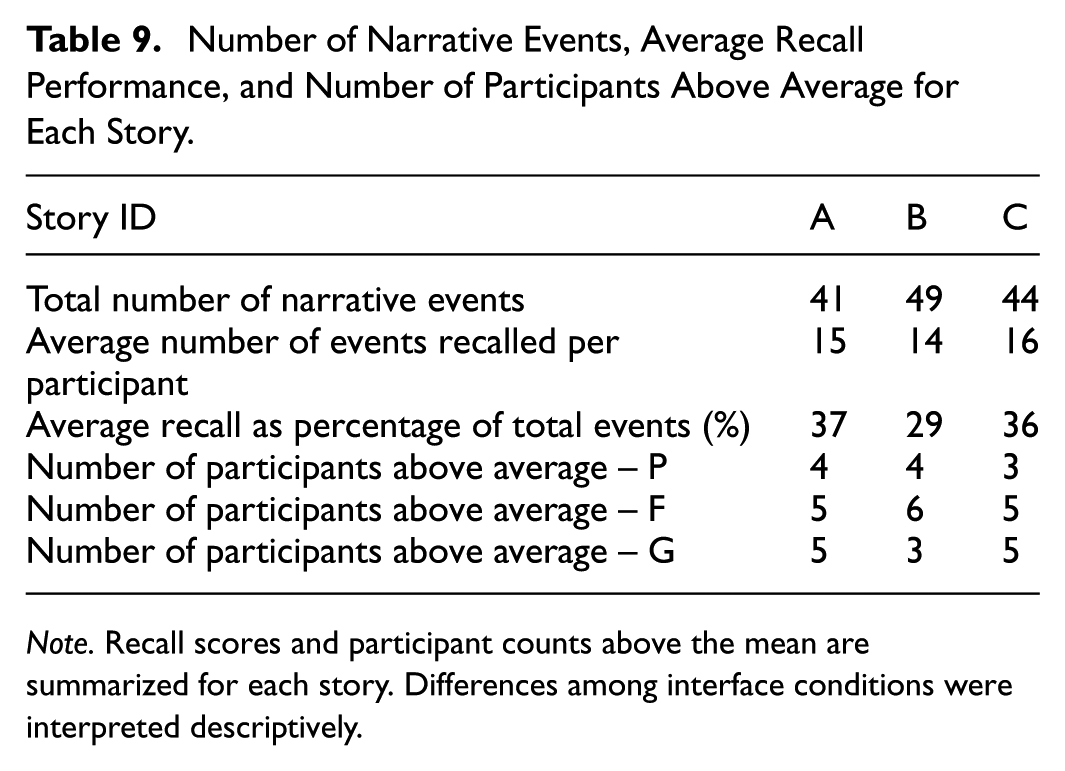
Note. Recall scores and participant counts above the mean are summarized for each story. Differences among interface conditions were interpreted descriptively.

Average narrative recall percentage across the three comic stories. Story B (Haikyuu!!), which contained the highest text and panel density, showed the lowest average recall performance (29%) compared to Story A (37%) and Story C (36%).
Differences in VLFI Scores in Relation to Cognitive Performance
As shown in Table 10, participants were stratified into High VLFI (score ≥ 12) and Low VLFI (score < 12) groups. While the Guided View (G) mode frequently elicited high engagement scores, there was a distinct divergence in personal preference based on visual fluency. Among the High VLFI group, 60% preferred the Full-Page multi-panel mode (P), compared to only 30% for Guided View (G) and 10% for Single-Frame (F). This preference aligns with the group’s significantly faster reading speeds, suggesting an ability to navigate complex layouts efficiently.
Comparison of Reading Time and Interface Preference by Visual Language Fluency Index (VLFI) Group.

Note.*p < .05.
Overall, the majority of participants (14 out of 24) preferred mode P, citing its ability to present the full layout, visual hierarchy, and authorial emphasis. It also allowed flexible navigation, reviewing or skipping panels as desired. One participant noted, “If a fight scene is fragmented, it feels disconnected without seeing the full page.”
In contrast, the Single-Frame mode (F) was preferred by 21% of the Low VLFI group (compared to only 10% of the High VLFI group), primarily for its simplicity and immersive focus on one panel at a time. However, qualitative feedback indicated that this format could disrupt narrative continuity, with some readers feeling it diminished the intended sense of pacing. Although mode G maintained panel order, it was described as “restrictive” by several participants, a criticism not found in responses regarding the full-page mode."
Cognitive Processing of Single Panels
When participants were asked to identify objectively understandable panels, this referred to frames in which the meaning intended by the artist could be clearly understood without relying on contextual inference or guesswork. Seven participants selected action-based panels, such as fight scenes, as the most objectively comprehensible.
In contrast, subjectively interpreted panels were those where the intended meaning was unclear within a single frame, requiring the reader to make assumptions or rely on surrounding context. However, even with inference, participants could not be certain their interpretation matched the artist’s intent. Common examples included close-ups of characters, panels with no text, frames crowded with multiple characters, excessive dialog balloons, or disorganized compositions that made it unclear which speech belonged to which character.
For the most visually complex panels, participants considered factors such as small and crowded frames, numerous characters and dialog balloons, and inconsistent font usage. Regarding the simplest panels, participants described these as having clear panel sequencing, clean and forceful line work, and orderly layouts. Additional reasons included single-character speech or simple, unambiguous actions.
Survey 2: Comic Artist Interviews
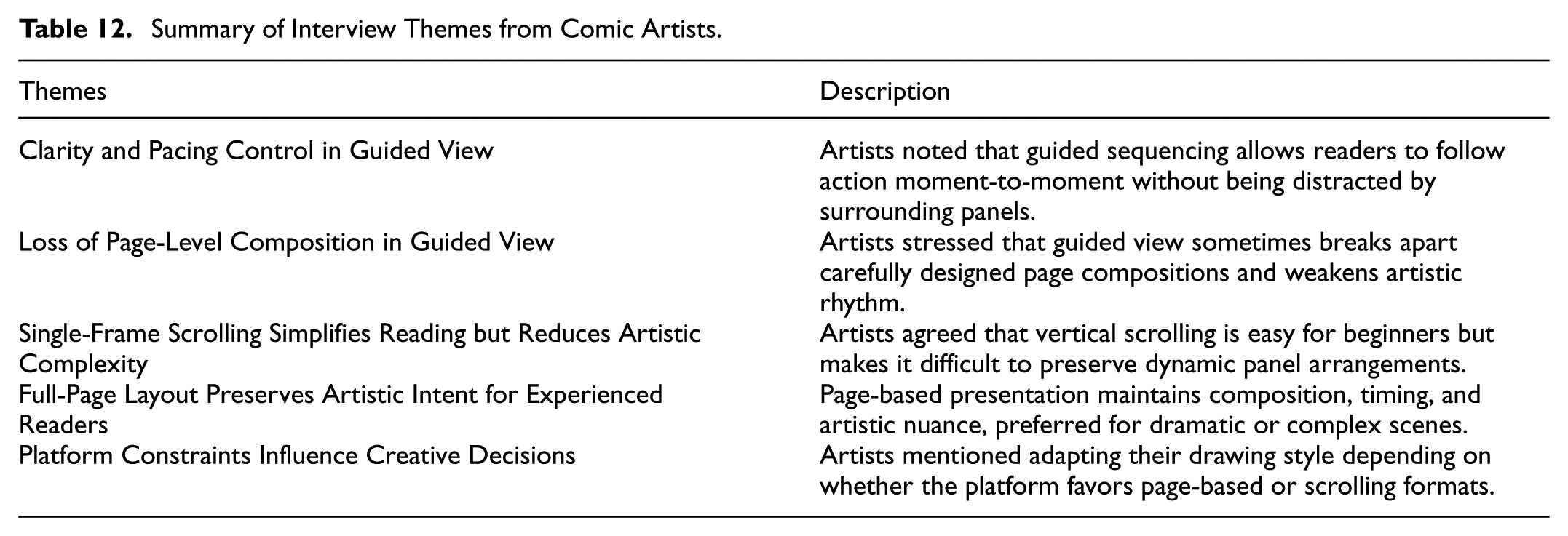
The one-on-one interviews conducted in this study involved five comic artists whose story genres and art styles varied considerably. This diversity provided valuable insights into how comic creation differs across various media formats. During the interviews, the artists often discussed multiple topics together, so the analysis was organized into four main themes: (1) Differences in the reading process. (2) Differences in the creation and drawing process. (3) Which comic element is most affected by the app format? (4) Whether the app format is a limitation or an expansion for comics? Table 11 lists the codes used for the five comic artists.
Comic Artist Codes.

Differences in the Reading Process
This part of the discussion included the following two guiding questions:
Artist A noted that for app-based comics, the most important thing is that they are “easy to use (operate)”. The “sense of time” can be created depends on whether there is space for the artist to build it. Now that mobile reading is based on scrolling, the reading speed is indeed much faster than before, so the emotional buildup may feel “thinner” compared to earlier times. Artist C added that comics differ from film and animation because they require the reader’s active participation. While reading, readers use their imagination to complete the story. Sometimes readers guess correctly about what happens in the gutters between panels, and if they guess wrong, that unexpected twist can enhance the comic’s appeal. Artist L commented that the reading pace for vertical scroll comics is faster because of the up-and-down scrolling, which can result in losing the artistic quality or visual impact that full-page comics can convey through their layout. However, as interface technology continues to evolve, there may be new visual presentation methods that surpass traditional page layouts. Artist Y noted that app-based comics are convenient to carry and can be read anytime, with no storage issues, and they are cheaper than print. Print comics offer the freedom of page-turning and hold advantages in image quality and special printing effects.
Considering readers’ habits, whether they read page-based or scroll-based comics online, they face the issue of not being able to flip pages freely. Therefore, narrative flow may be even more important for web serials.
Differences in the Creation and Drawing Process
This part of the discussion focused on the following three guiding questions:
Artists A and C both noted that today’s creation tools are very different from the past. In the past, many assistants were needed, but working on a computer now saves time and effort, for example, inking can be done with a single click. Artist L said that storytelling and directing skills are still the most important factor. If the storyboarding is done well, both scroll and page formats can be effectively executed. If both page-based and vertical-scroll formats are to be published, the composition strategy must be planned with both formats in mind. Artist Y explained that horizontal swiping in a two-page mode allows the work to be presented more naturally. But when limited by a mobile screen, reading is confined to one page at a time (whether swiped horizontally or vertically), which affects visuals like double-page spreads.
Which Comic Element is Most Affected by the App Format?
Artist Y said that image quality is the most affected. Lines can lose sharpness, and the fine details of screentones may not be fully visible. Web comics can be published in full color, whereas full-color print comics are still uncommon due to cost limitations.
Artist J noted that while digital tools may struggle to replicate the texture of hand-drawn lines, they do not hinder the overall creative process. Other artists noted that they did not think the app format has a significant impact on comic elements overall.
Do You Think the App Format is a Limitation or an Opportunity for Comic Storytelling?
Artist C believed that print comics will likely become more niche and collected as keepsakes in the future, while app-based comics will serve more as quick, casual entertainment. Artist J expressed that comic storytelling is about allowing creators to fully express themselves. If artists can decide their creative path early whether to be a commercial comic artist or an artistic comic artist, they will have greater longevity.
Artist L observed that app-based comics have become mainstream, and younger readers may no longer get used to print formats. He does not view apps as limiting narrative potential, but rather as offering a different mode of storytelling that still relies on the creator’s narrative skill. Artist Y considered app formats to be innovative, predicting the emergence of new forms such as animation and voiceover. With advancing technology and faster internet speeds, comic expression is expected to continue evolving. To consolidate these qualitative insights, Table 12 summarizes the major themes that emerged across the five creator interviews.
Summary of Interview Themes from Comic Artists.
Discussion
Cross-analysis of participants’ VLFI scores and their format preferences showed that readers with higher visual language fluency read comics faster than those with lower visual language fluency. In other words, readers with high visual language fluency tend to process comics more quickly.
Regardless of whether a participant’s VLFI score was high or low, the traditional full-page comic layouts remained popular among readers. However, user engagement was higher in both the guided and single-frame modes compared to the full-page format. Participants with high VLFI scores tended to prefer the full-page multi-panel mode. Participants who preferred the single-frame format all had VLFI scores below the average, indicating that they found single-frame reading easier because it does not require thinking about panel sequence.
When examining the four aspects of engagement, there was no significant difference among the three formats for “focused attention (immersion).” However, in terms of perceived usability, the single-frame format scored noticeably higher than the other two. For esthetics and perceived reward, the guided view format scored slightly higher than the single-frame format, while the full-page format scored lowest. This suggests that compared to Japanese formats, American and Taiwanese comic apps can provide readers with a sense of immersion and engagement, but readers still prefer the freedom offered by the traditional full-page multi-panel format to some extent.
On the other hand, the story recall results showed that for Story A (Demon Slayer), regardless of the reading mode, there was little difference in readers’ understanding and memory of the story. However, for Story B (Haikyuu!!), which was considered the most complex by most participants, the single-frame format was most effective in helping readers understand the plot. This suggests that comics with simpler storyboards and panel structures can be read effectively in any mode, while comics with more complex storyboards or a large number of panels are better suited to the single-frame reading mode.
The quantitative patterns align with the themes identified in the creator interviews. Guided sequencing improved recall and moment-to-moment clarity for readers with lower visual narrative fluency, and creators similarly noted that guided pacing helps direct attention through complex scenes. At the same time, readers with higher fluency preferred full-page layouts, reflecting creators’ concerns that guided views can restrict artistic composition and reduce the expressive potential of page-based storytelling.
The five comic artists all agreed that the story itself remains the most important aspect of comic creation. As long as the plot and narrative structure can capture readers’ attention and keep them wanting to read more, the medium and presentation format can be adjusted and adapted accordingly.
The differences between print comics and app-based comics mainly involve different considerations for how to arrange storylines and distribute panels. In page-based comics, elements like the function of gutters, the sense of time within a panel, and the visual impact created by breaking frames or using double-page spreads may not translate directly to scroll comics. However, comic artists should find ways to create the atmosphere they want within the physical limitations of mobile phones or tablets.
This study has several limitations. The experimental sample was small (N = 24) and consisted solely of participants from Taiwan, which limits the generalizability of the findings. The reading sessions were brief and did not include longitudinal observation, eye-tracking data, or cross-device comparisons (e.g., smartphone vs. tablet). This study also did not include a formal a priori power analysis, and item-level data were not retained, preventing retrospective power estimation. Future studies should incorporate planned power analyses during study design. Future studies should expand participant diversity, conduct longer or repeated reading tasks, and incorporate multimodal measures of cognitive processing. Despite these constraints, the results provide useful implications for interface and educational design. Guided-view sequencing can help scaffold comprehension and recall for novice or low-VLFI readers, whereas full-page layouts may better support advanced readers who benefit from holistic page context and flexible navigation. Additionally, narrative recall was scored by a single rater, and future studies should incorporate multiple raters to establish inter-rater reliability.
Conclusion
This study investigated how different digital comic reading interfaces across Taiwanese, American, and Japanese manga apps influence readers’ narrative comprehension and creators’ visual expression strategies. Through a combination of reading experiments, surveys, and creator interviews, we found that app interfaces significantly affect both reading behavior and interpretive engagement. In particular, American apps employing guided-view modes provided higher immersion and user engagement, while Taiwan’s popular vertical-scroll single-frame design enabled effortless, fast-paced reading. Japanese apps, often digitized from print, offered less immersive experiences, and demanded more frequent zooming and panning due to screen size limitations.
Quantitative results further showed that readers with higher visual language fluency not only comprehended more narrative events but also read at a significantly faster pace, indicating that interface design and visual literacy are mutually reinforcing factors in digital comic consumption. From the perspective of creators, the interface’s affordances aligned with narrative intentions, those designing for apps prioritize clarity and fluidity, often embracing techniques beyond traditional paneling to enhance storytelling, such as subtle motion effects or UI integration.
This research highlights the interplay between interface design, reader cognition, and creative strategy, suggesting that app-based comic reading is not merely a digitization of print but a distinct narrative form. Recent work has similarly shown that interface structure shapes readers’ navigational strategies and comprehension, as demonstrated in recent eye-tracking research (Kirtley et al., 2023), and that simplified or guided mobile layouts can improve reading performance and usability efficiency (Henchobdee & Teeravarunyou, 2022). By situating the present findings within these broader empirical insights, this study contributes to a growing understanding of how digital comic interfaces function as cognitive environments that guide narrative processing. Future studies may continue exploring how emerging digital formats reshape visual storytelling, thereby supporting both local creativity and global reach for comics as a culturally rich and evolving medium.
Footnotes

Ethical Considerations
This study was reviewed by the Institutional Review Board (IRB) of National Taipei University of Technology (NTUT) and deemed exempt from formal approval because it involved minimal risk and non-identifiable participants.
Consent to Participate
All participants provided informed consent prior to participation, in accordance with the APA Ethical Principles of Psychologists and Code of Conduct.
Funding
The authors disclosed receipt of the following financial support for the research, authorship, and/or publication of this article: This work was supported by the Ministry of Culture, Taiwan [Grant number 6908].
Declaration of Conflicting Interests
The authors declared no potential conflicts of interest with respect to the research, authorship, and/or publication of this article.
Data Availability Statement
Due to confidentiality agreements, supporting data can only be made available to bona fide researchers subject to a non-disclosure agreement. Details of the data and how to request access are available from Meng-Cong Zheng (