




Abstract
Integrating intelligent machines into human work represents a critical challenge that requires effective cooperation between humans and technology. This article explores the concept of augmenting technology-human symbiosis and investigates the role of organizational learning in facilitating this cooperation. The aim of this qualitative study is to examine the intentions, dimensions, and manifestations of augmenting technology-human symbiosis in work processes and identify pathways to its realization. Data was collected through interviews with 21 senior managers in technical service organizations in China. The study reveals four key aspects of effective symbiosis: coexistence, evolution, asymmetry, and reciprocity. Additionally, it delves into five principles of organizational learning that facilitate optimal symbiosis: team learning, shared vision, personal mastery, mental models, and systems thinking. These findings provide valuable insights for promoting integration and cooperation between augmenting technologies and humans, contributing to the fields of human-computer cooperation and organizational learning. By adopting an organizational learning perspective, this research enhances our understanding of augmenting technology-human symbiosis and paves the way for further research and practical implementation of intelligent machines.
Keywords
As the technological landscape continues to evolve, the cooperation between humans and intelligent machines becomes increasingly complex. Augmenting technologies, with their ability to process large volumes of data, detect patterns, and provide predictive recommendations (D’Agostino, 2022; Murray et al., 2021), are considered crucial for the future of human-computer cooperation. These technologies, particularly those that enhance decision-making, generate significant business value surpassing other AI functions (Zhou et al., 2021). However, data from 3,000 surveys of 29 industry organizations worldwide by the McKinsey Global Institute indicates that despite the gradual increase in organizations using AI, only 20% of companies reap considerable financial benefits from AI technology (Chui et al., 2021). This highlights the need to address the challenges and limitations of intelligent machines and establish a pathway for effective cooperation with augmenting technologies (Amiri, Heidari, Darbandi, et al., 2023; Amoako et al., 2022; Shackel, 1997). Consequently, the pressing question arises: how can we effectively integrate intelligent machines into human work? (Farooq et al., 2019; Ransbotham et al., 2020) To address this critical issue, our research focuses on the intersection of augmenting technologies and human interaction. We examine the concept of augmenting technology-human symbiosis and investigate the role of organizational learning in facilitating symbiotic cooperation. Our approach aims to provide a comprehensive understanding of how employees can facilitate this symbiosis, offering a practical pathway through the lens of organizational learning. Symbiosis, originally rooted in biology, has long been recognized as a phenomenon based on cooperation, interaction, and mutual dependence among organisms (Bary, 1879; Mann, 1991). Expanding upon this notion, Licklider (1960) introduced the concept of “human-computer symbiosis” to describe the collaborative work between humans and intelligent machines. Our research seeks to contribute valuable insights to this field by examining the intentions, dimensions, and manifestations of augmenting technology-human symbiosis within symbiotic cooperation, as well as identifying pathways to its realization, thereby fostering optimal human-computer cooperation.
We first draw on recent human-computer symbiosis research and summarize three dimensions of realizing the symbiosis relationship to embed AI in human work. Second, using the case study method, we explore why and how organizational learning could facilitate human-computer symbiosis. Through understanding how organizational learning behaviors promote symbiosis in cases, we can determine the specific role, importance, and priority of the five principles of organizational learning. Ultimately, this research seeks to shed light on the potential of human-computer symbiosis and the role of organizational learning in enabling successful integration of AI in organizational settings. We aim to contribute to the advancement of knowledge in this field and provide practical insights for organizations navigating the complexities of human-computer cooperation.
Human-Computer Symbiosis and Augmenting Technology
Ergonomics research in the early 20th century explored machines designed to improve working conditions and efficiency by enhancing the functionality of the human body. As computer intelligence increased, machine functions gradually evolved from the performance of simple or dangerous tasks to decision-making. Cooperative work between intelligent machines and humans influences the value of existing positions (Pedota & Piscitello, 2022).
Licklider used the term “human-computer symbiosis” to identify computer–human relationships in the 1960s. Unlike the earlier relationships of “human being strengthened by machine” and “machine working independently,” human-computer symbiosis describes humans and computers building a partnership relationship. However, for Licklider (1960), full human-computer symbiosis remains a conceptual vision owing to technical limitations. Since then, researchers have explored the possibilities for computer–human cooperation and the relevant problems, such as how to develop better computer–human interactions, complement advantages, and improve skills; dependency issues have also been investigated (Lakhmani et al., 2019; Li et al., 2021; Pacaux-Lemoine & Trentesaux, 2019).
Some researchers investigated how computers affect the symbiotic coupling mode as reflected in how they help humans provide behavioral options or make decisions (Murray et al., 2021). They divided human-computer symbiosis into four forms according to the technology-work type: (1) assisting technologies—human-led behaviors and decisions; (2) arresting technologies—human-led behaviors/computer-led decisions; (3) augmenting technologies—computer-led behaviors/human-led decisions; and (4) automating technologies—computer-led behaviors and decisions (Murray et al., 2021). Among them, augmenting technology has wide applicability in commercial organizations (Zhou et al., 2021). Augmentation technologies must match human cognition to provide more decision-making options, further strengthening humans.
Realization Path of Human-Computer Symbiosis
With the development of intelligent machine technology, particularly AI, cooperation between humans and computers has changed from static to dynamic adjustment. Computer tasks must match human skills (Liu & Zeng, 2021). Specific vocational training and content impact employees differently, whereas studies using machines for work show significant differences (Baron & Bielby, 1982). Ren (2016) proposed a conceptual framework for a dynamic balance in mutually promoting human and computer capabilities in human-engaged computing (HEC). HEC promotes cooperation and interaction between humans and computers, such that machines adjust according to the status of tasks and human decisions, such as recording human behaviors and preferences. Humans can improve their work efficiency by self-adjusting after considering how to optimize their computer use (Amiri, Heidari, Darbandi, et al., 2023; Ren, 2016). However, further research is required to determine methods to increase knowledge, promote motivation, and activate human potential.
Mutual promotion is also important for designing future jobs (Dombrowski & Wagner, 2014; Song et al., 2022; Wagner et al., 2017) by considering how humans can improve their skills to the level required for human-computer cooperation. Position changes require adaptive practices based on tasks and personal work preferences (Seeck & Kantola, 2022). Through machine-learning methods such as maximum entropy inverse reinforcement, computers develop reward shaping with the help of human demonstrations, optimize behavior, and cooperate with human partners to complete shared tasks (Amiri, Heidari, Darbandi, et al., 2023; Amiri, Heidari, Navimipour, et al., 2023). Technology applications within organizations typically require a forward-looking construction process that includes active human-computer symbiosis for maximum operational flexibility and efficiency (Gattringer et al., 2021). Two-way cooperation requires organizational members to be empathetic and work toward common goals (Dresp-Langley, 2020; Larsson & Knudsen, 2022). Achieving such two-way cooperation requires knowledge modeling methods such as knowledge networks, reinforcement learning, and imitation learning (Abedin et al., 2022; Li et al., 2021).
If the human-computer relationship is not complementary, it can become harmful. For example, despite stale data, humans could rely on machines to complete their work. Moreover, when humans find interactions with computers easier and more pleasant than interactions with humans, they gradually lose social skills (Pacaux-Lemoine & Trentesaux, 2019). These potential problems indicate a lack of proper cognition and the related ability of human-computer symbiosis. Intelligent machines have changed their positions from communication channels or media to communicators. Therefore, humans must understand computers’ new positions, improve their learning skills from the perspective of communicators (Guzman & Lewis, 2020; Xu et al., 2023), complement each other in social technology systems, and use their unique potential to adapt to the new digital age demands (Aroles & Küpers, 2022; Menz et al., 2021; Mitki et al., 2019).
In human-intelligent machine collaborations, poor skills but smooth interactions are better than good skills but defective processes (Cremer & Kasparov, 2021). A comprehensive literature review addressed resilience and dependability management issues between humans and intelligent machines, which require collaboration and interaction between humans and intelligent machines in different positions (Amiri et al., 2022; Arslan et al., 2021; Van der Aalst, 2021). Information processing capabilities and analysis methods enable computers to expand human cognition and solve complex issues. Humans can apply nonlinear and creative thinking to deal with uncertainty and ambiguity in decision-making, whereas computers can often offer more appropriate decisions when complex and ambiguous issues are involved (Dellermann et al., 2019; Jarrahi, 2018; Malik et al., 2019). Human-computer symbiosis allows humans to focus on solving problems related to human nature with compassion (Kannan & Bernoff, 2019). Humans make final decisions by understanding the principles behind computer behavior and possibly predicting results, reflecting a manifestation of AI literacy (Eshet-Alkalai, 2004; Lakhmani et al., 2019). The research that produced these insights inspired the direction of human skill improvement and exploration toward a path to human-computer symbiosis.
These scholars and their work inspired further research directions, and the benefits of promoting symbiosis have been verified. However, a systematic path is still needed to improve the capacity for symbiosis. For example, research on human-computer interactions lacks an integrated structure, including intention, dimensions, and manifestations. Combined with the direction of existing research, this research topic inspired our exploration of the interactive processes and capacity requirements of human-computer symbiosis from the perspective of an organization and further study of the path to achieving symbiosis. Table 1 summarized the dimensions of the symbiosis relationship to embed AI in human work in some typical research.
Dimensions of the Symbiosis Relationship to Embed AI in Human Work.

Organizational Learning
As learning comes from adjusting past behaviors by either strengthening or modifying them (Argyris & Schön, 1978), organizational learning is the product of adjustment measures that respond to environmental changes and long-term effectiveness. Maintaining organizational learning is at the core of Senge’s learning organization theory. In The Fifth Discipline: The Art and Science of Learning Organizations, he defines a learning organization as one wherein employees can expand their ability to create expected results (Hermelingmeier & von Wirth, 2021; Senge, 1991). Further, he lists five principles that define the critical dimensions of establishing a learning organization: mental models, systems thinking, personal mastery, shared visions, and team learning.
Previous research focused on the characteristics of the learning organization, including its ability to learn, adapt, and change. Yang et al. (2004) used an integrative model of learning organization provided by Marsick and Watkins (2003) to build a reliable measurement tool. Senge’s principles can guide the status of a learning organization, but they do not identify clear observable characteristics (Yang et al., 2004). Current organizational learning research focuses on describing concepts but lacks measurement tools and observable features. However, practitioners like Chandele (2020) share their experiences building learning organizations. For example, establishing a continuous example and a humble leader, building a knowledge management culture, focusing on user experience, and not being afraid of failure. Chandele provides five critical points of phenomena and cases that align with the principles of learning organizations: Chandele’s research inspired us to use symbiosis as a visible measurement metric, enabling organizational learning to focus on specific phenomena and establish systematic realization processes.
Methods
We utilized a case study method to delve into the intentions, dimensions, and manifestations of augmenting technology-human symbiosis within cooperative work and identifying pathways to its realization. The case study method was chosen for its ability to provide in-depth insights into specific instances of the concept of augmenting technology-human symbiosis and investigate the role of organizational learning within work processes. We selected cases from various industries and organizational types to ensure a diverse range of contexts and experiences. Each case was analyzed through the lens of the five principles of organizational learning, allowing us to understand how these principles contribute to promoting symbiosis. Our methodology was designed to have two parts, aimed to ensure a comprehensive understanding of the potential of human-computer symbiosis and the role of organizational learning in the integration of AI. By offering a blend of theoretical understanding and practical insights, we aimed to contribute to the advancement of knowledge in this field and provide valuable guidance for organizations navigating the complexities of human-computer cooperation. The study followed the Declaration of Helsinki (World Medical Association, 2013) and did not involve any treatment or other procedures that might affect the psychological or social well-being of participants. The design and performance of this study is clearly described and justified in the informed consent form. Participants could stop the interview at any time if they recognized their interests had been harmed.
Sampling
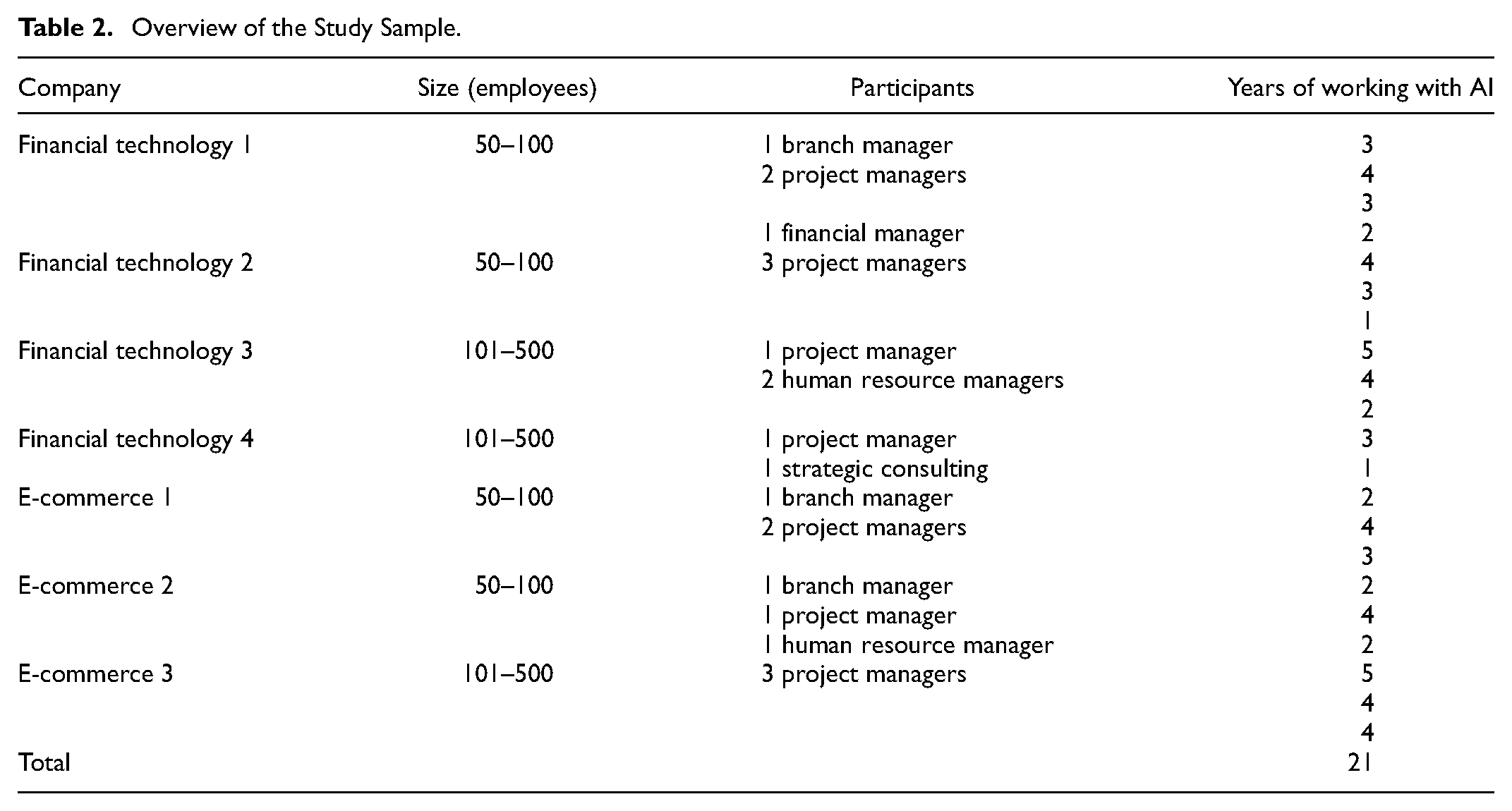
This study used the snowballing technique to recruit data sources. The data sources contained knowledge of the realization path for augmenting technology-human symbiosis. We interviewed 21 managers from 7 technical service companies in China. Technical service companies includes 4 financial technology and 3 e-commerce companies. All of the participants are middle to senior managers aged 18 to 65 years who wanted to participate in the study. Participants have experience of working with AI and participated in the organizations’ training plan, activities, or related organizational behaviors for human-computer cooperation. Table 2 presents an overview of the study sample.
Overview of the Study Sample.
Data Collection
To comprehensively explore the potential of human-computer symbiosis and the role of organizational learning in the integration of AI, we conducted semi-structured interviews divided into two parts. Each of the 21 interviews had an average duration of approximately 60 min, although the length varied based on the depth of participants’ responses.
To ensure a systematic approach during the in-depth interviews, we developed a semi-structured interview protocol. These protocols served as guides to maintain focus and minimize any digressions into irrelevant discussions (Pedota & Piscitello, 2022). Table 3 provides an overview of the interview protocol, including the two parts of the interviews and key questions. By keeping the interview process open-ended, we aimed to encourage participants to freely express their underlying concepts and perspectives. This approach allowed us to gather rich qualitative data and gain insights into the nuances of human-computer symbiosis and organizational learning in the context of AI integration. The open-ended nature of the interviews facilitated a comprehensive exploration of participants’ thoughts and experiences, enabling us to capture a diverse range of perspectives on the topic.
Interview Protocol for Data Gathering.

At the 16th interview, new information was still forthcoming; thus, we continued this process. Data saturation was indicated when the 21st interviewee reiterated only the previously provided information; hence, no additional participants were required. This study used peer examination and audit trials to ensure that the results were consistent with the collected data and that the data covered all the information related to this phenomenon. Feedback was incorporated into the data to eliminate potential interview inaccuracies. The interviews were audio-recorded and transcribed. Each participant was given an email with a copy of the interview transcript to check the transcription and provide feedback. Two participants provided modification feedback, emphasizing the key points they described as working with intelligent computers and how they matched their new positions. After making the necessary revisions, we imported the transcription data into NVivo.
Data Analysis
This study utilized NVivo software to analyze the qualitative data, following Merriam and Tisdell’s (2016) data analysis program. The data analysis process involved several key steps to ensure a thorough examination of the data. First, the recorded interviews were accurately transcribed into written text, preserving the participants’ responses. This transcription step ensured the fidelity of the data for further analysis.
Next, a systematic coding approach was employed to assign codes to relevant segments of the transcriptions. Open coding was initially used, generating codes that captured various concepts, ideas, or themes related to augmenting technology-human symbiosis and organizational learning. These codes were then grouped together to form broader themes or categories, enabling a more organized and structured analysis.
Once the coding process was completed, the data exploration phase commenced. During this phase, each theme was thoroughly examined by exploring the coded segments within them. Sub-themes or patterns were identified using qualitative analysis techniques like constant comparison or pattern recognition. This in-depth exploration aimed to uncover insights and develop a comprehensive understanding of the data. Interpretation of the findings followed the data exploration phase. Relationships between themes were carefully analyzed, recurring patterns were identified, and any notable variations or discrepancies were considered. The interpretations were then aligned with the research objectives and existing literature to provide meaningful insights and contribute to the overall understanding of the topic.
To ensure the validity of the findings, a rigorous validation process was undertaken. This involved comparing the interpretations with the original interview data to verify accuracy, context, and the representation of participant’ perspectives. Seeking feedback from participants and co-authors also played a crucial role in enhancing the credibility of the analysis.
Finally, the presented framework was compared to the existing findings in the literature and integrated into the broader context of human-computer symbiosis and organizational learning research. This integration allowed for a comprehensive understanding of the topic and facilitated meaningful contributions to the field.
Intention, Dimension, and Manifestation of Augmenting Technology-Human Symbiosis: Four Aspects of Symbiosis Effectiveness
The data analysis revealed the intention, dimension, and manifestation of augmenting technology-human symbiosis and its realization path. The keywords explained in this section—coexistence, evolution, asymmetry, and reciprocity—are four aspects of symbiosis effectiveness.
Coexistence
Coexistence is reflected in humans and computers working together to achieve a common goal. From the description, coexistence expresses the premise of human-computer symbiosis: humans need to understand computers. Organizations should always evaluate coexistence from the technological side and employees’ capability to accept and use intelligent machines such as augmenting technologies. Participant C1 stated the following:
Whether you are talking about augmenting technology, people need the skills to use it; if they do not understand it, they will not be effective in using it. No one wants to cooperate with a stranger because one does not know what they will do. (C1)
WZ1 stated that computer–human cooperation is not simply making employees use a new tool such as a calculator or dictionary; it is embedding intelligent computers into key workflows.
For example, promoting the establishment of expert systems and applying data analysis to decision-making, performance evaluation, and business analysis. We must gradually establish the concept of having augmenting technologies in mind, becoming familiar with them, and using them when encountering problems. Among them, it is necessary to possess cognition and professionalism in intelligent machines. If there is no evaluation system, it can only provide an encouraging and guiding experience. Employees will not understand the benefits of using intelligent machines and will be unable to use them actively. (WZ1)
Some participants described coexistence as a dimension of mutual trust. The premise for working together is mutual trust. Participant YM1 shared his experience of computer–human interaction through communication between humans. The role of intelligent machines in organizations has changed from that of auxiliary tools to that of organizational members. Mutual trust stimulates cooperation between members.
Employees seem to trust data more than leaders’ vague plans. The numbers provided by intelligent computers are more persuasive than people’s words when it comes to a company’s situations and tasks. Conversely, with the help of computers, employees can also provide data support and feedback from the bottom up to help managers understand the front-line status and adjust strategies. (YM1)
Coexistence indicates that humans and computers work together and use computers during work. Coexistence requires both sides to understand each other and ensure that they work toward the same goal. Partners could be critical in manifesting effective human-computer symbiosis.
Evolution
Evolution in symbiosis is the growth, change, or development of things. This study found that evolution in human-computer symbiosis showed an adaptive process of trial and error, inspection, and evaluation. Evolution does not discuss ideas such as the technological wave that occurs every 80 years in the human species. Revolutionary ideas are separate events but are not always successful. Participant S1 emphasized that “today’s solutions are tomorrow’s problems.” Organizations must continually adjust the changes and methods of achieving their goals as an iterative process. Humans and computers must identify problems and adjust during continuous improvement.
Some participants shared details regarding their adjustment processes. For example, employees who take the lead get in and out faster, as in the first-in-first-out inventory control process. The affected people first understood the processes and critical points of computer symbiosis. Participant X1 noted that during adjustment, humans must effectively learn new skills in human-computer symbiosis instead of relying on past advantages. The purposeful abandonment of past advantages is an evolutionary principle.
Therefore, we believe that once you have sent it to a higher level, you cannot use the same skill set at the same level to accommodate technology implementation. New skills require new skills. What gets you there is not what keeps you there. (X1)
Additionally, participant XG1 noticed that the computer–human interaction required a matching process. The machine records employees’ behaviors and adjusts based on their search and input preferences. Employees adjust their behaviors to adapt to the machine, such as strengthening or correcting their search preferences. Further, the issues that intelligent machines can solve do not match the problems that employees encounter. The matching process evolved from a dynamic imbalance to a balance through information exchange and adjustments; thus, the evolution between humans and computers effectively embodied the intention of symbiosis.
Asymmetry
Asymmetry arises from intentions regarding independence. Symbiosis enables interactions among individuals in various categories to achieve better results than those of a single species (Aroles & Küpers, 2022; Menz et al., 2021; Mitki et al., 2019). In a symbiotic relationship, humans and computers must have comparative advantages such that the significance of cooperation is maintained. While participants affirmed that intelligent machines help employees, they also explained that machines cannot completely replace them.
Participant H1 noted that intelligent machines independently find problems through digital processes, providing unique information for humans to analyze and deal with.
In my case, intelligent computers can determine what happens within the workers’ world and have them come up with pain points and things they see as the biggest challenges. Then, take some time and use the correct method to start looking at the pain points. We designed things to deal with this. (H1)
Intelligent machines can participate in the preprocessing, processing, and post-processing projects of organizational tasks, thus covering the entire production cycle in a digital format. S1, X1, SG1, and many other participants described additional comparative advantages between humans and computers. As intelligent machines can efficiently replace human analytical capabilities, employees must retain their unique advantages, such as relationship-building and creative thinking skills, in computer–human cooperation. Comparative advantage is a critical dimension that gains significance by creating additional value through symbiosis. Participant X1 expressed this concept as follows:
Therefore, [the machine] makes clear decisions regarding how a person wants to go. If it is a more sales-oriented or relationship-building function in their work, they still need to understand the technology but do not need to be part of its development. However, if they decide to maintain some analytical ability, they must get their hands dirty with everything happening. In both cases, they must decide where to go. (X1)
This asymmetry creates additional value. Participant SK1 supported the idea that the division of labor between humans and intelligent machines could promote emergence. He believes that the most significant benefit of intelligent machines is the modularization and digitization of work. Modularization enables computers to help employees complete tasks without worrying about disconnection, and employees can free their time to perform other critical tasks. Digitalization makes work more intuitive and quantifiable, helps employees find highlights and pain points, and creates extra value. Creating additional value through cooperation is essential for building asymmetry and is a manifestation of augmenting technology-human symbiosis.
Reciprocity
The last intention of augmenting technology-human symbiosis is reciprocity. In social psychology, reciprocity promotes the continuous exchange of positive behaviors between individuals. Human-computer symbiosis can enable employees and intelligent machines to make joint decisions. Using computer data and digital expressions can increase the efficiency of operations and decision-making. Participant S2 indicated that cooperation is difficult if organizations and individual employees do not benefit from computer–human cooperation.
So, I mean that the technologies need to support the employee, and we should not have the employee going out of their way and doing strange gestures or acts to try to make the technology work. This is going the wrong way. (S2)
Reciprocity emphasizes mutual benefits, except that humans benefit from computers; computers also need to gain benefits to keep improving. Although technology will continue to improve, computer evolution will require human guidance to make better cooperation. Some participants, such as S1, S2, and HD1, noted that intelligent machines also require adjustments. In a cooperative work process, employees would provide feedback based on the selection and judgment of intelligent machines. Machines can become more aligned with human needs in future tasks. Contrastingly, if humans only obtain information from machines, the underlying logic of the machines will not improve and generate valuable data. Participant S1 called this “garbage in, garbage out.” If employees do not have the correct information, they will not obtain it from intelligent machines. Humans need to progress with computers. Reciprocity ensures the effectiveness and continuity of symbiosis.
Using Organizational Learning to Facilitate Symbiosis Effectiveness
Participants’ descriptions of human-computer symbiosis indicated their understanding and experience of realizing augmenting technology-human symbiosis. Our findings highlight five critical principles that describe the realization path and promote organizational learning: team learning, shared vision, personal mastery, mental models, and system thinking.
Team Learning
The first critical segment was team learning. All participants agreed that team learning could promote organizational communication and cooperation. Employees working with a large group trust those with knowledge outside their expertise. In human-computer symbiosis, human and computer experts can store and interact with information in their respective areas. In the case of participant S2, effective team learning stimulated asymmetry and promoted progress. Participant S2 stated the following:
I will not just have some trainers come in and lecture people because it never works. By working with another person in your group, you must accept new technology (augmenting technologies). You might know a part better than anything else and help explain it to them. It is important for them to communicate with and help each other through new technologies. The greater the difference between communication members, the more they gain from each other and the more willing they are to maintain this interaction state. (S2)
Other participants shared their experiences promoting team learning, particularly between humans and intelligent machines. Participant S1 encouraged the employees to discuss issues openly and freely. Participants YM1 and ZJ3 believed that a main obstacle from individual to team learning was the instinct for self-protection. Realizing a comparative advantage can sometimes mean abandoning past strengths. Organizations must create a culture that allows mistakes and encourages trial and error to allow employees to transition confidently. Participant YM1 gave this clarification:
As my employees shared their experiences and insights during the discussions, their recognition and abilities improved. Some of the human–machine collaboration issues encountered by employees were addressed in the seminar, and these employees are now actively combining intelligent computers to improve their work outcomes. (YM1)
Most participants realized the importance of team learning and focused on implementation but found achieving the ideal state of full sharing of learning among team members challenging. Participants consistently explored more effective ways of promoting team learning. Team learning encourages employees to interact with other team members, including intelligent machines. Promoting team learning is also an essential link to achieving human-computer symbiosis.
Shared Vision
Vision represents successful future development’s goal, task, cause, or mission. A shared vision is essential for motivating employees to learn; it can create a common identity and provide focus and energy for learning. Participants supported the effectiveness of their shared vision. C1, H1, and S2 stated that employees must understand their vision to make their cognition, goals, and behavior consistent.
You should be able to convince those people that they have to understand the objectives and show them that you have empathy and an understanding of technology. (C1)
Participant T5 added that the shared vision contained why it was vital to develop a strategy. All these changes were made to accommodate the organization’s goals. A shared vision can promote augmenting technology-human symbiosis by providing a view that includes coexistence. Participant ZC2 noted that a shared vision can enable employees to participate in the process of building the organization’s future and increasing their sense of mission and belonging.
Our employees have seen excellent results of human-computer symbiosis in other industries and society and have their own bottom-up cooperation needs. We need to build a computer–human cooperation vision belonging to our organization from top to bottom so that employees can participate and benefit from it spontaneously. (ZC2)
Most participants mentioned that computers can adaptively help employees adjust their vision-based behavior through digital expressions such as functions. Digital expressions can translate a vision into clear instructions, enabling employees to understand what the organization wants to achieve and know when and what to do. A shared vision should include all organizational members. Ensuring a consistent shared vision of the cognition, goals, and behaviors of humans and intelligent machines is essential to symbiosis.
Personal Mastery
Personal mastery refers to learning to expand one’s abilities as a process in which individuals consistently improve themselves to achieve their goals. All participants noted their self-awareness and adjustments before working with intelligent machines. Personal mastery is the process of recognizing the status quo of an organization and its necessary skills. Participant XG1 noted that employees could respond to changes by understanding and preparing for cooperation, which could lay the foundation for reciprocity.
First, we must understand ourselves to develop corresponding countermeasures. This can minimize resistance and enable effective preparations for possible changes. Using some of our data now, we can speculate about what changes and impacts will be brought to us after implementing computer–human cooperation, whether it is beneficial, or what kind of impact it will suffer. (XG1)
Personal mastery adaptively promotes organizational members’ reflection and the development of comparative advantages. Some participants regarded self-adjustment as a job-crafting process. Participant YM1 mentioned that employees could identify machine partners’ communication highlights and shortcomings and counterbalance them step-by-step with their work. Participant WL1 emphasized the role of empowerment in encouraging employees to engage in reflective thinking during job crafting. Organizations can avoid cooperative issues by improving their employees’ understanding, cognition, and related abilities toward intelligent machines. These self-adjustment processes could help employees actively think about relevant issues in their positions and recognize potential risks.
Mental Models
Mental models explain the thinking process regarding how things work in the real world; they represent the logic of how humans shape their behavior and solve problems. Because the underlying logic of an intelligent machine is an objective function, human logic is a mental model. Humans can respond to evolution more effectively when they change their behavioral logic. Although the mental model is the least mentioned organizational learning principle by participants, its extended content affects various aspects. All participants indicated that transforming behavioral logic was a critical prerequisite for change. Participant S1 explained his mental model to analyze and find solutions to problems at the organizational and individual levels.
I need to constantly adjust my methods to cope with changes and realize that coping with changes is an iterative process. If the current method does not work, problems must be identified and adjusted; if the method works, the effective part should be further strengthened. (S1)
Participant XG1 shared his understanding of the mental model in computer–human cooperation, which helped employees deal with evolution:
Our employees have used previous working methods and habits. The interaction between diverse employees can help determine the behaviors that can be improved and those that need to be abandoned. For example, abandoning rhetoric allows employees to convey information more accurately. (XG1)
Participants H1, X1, K3, and others added how they changed their perceptions and thoughts and adjusted their behavior. The mental model could help an organization avoid adhering to rules when dealing with changes. The mental model represents the elements the organization attaches importance to and is ultimately reflected in behavior. The mental model changes behaviors to cope with human-computer symbiosis. The process of human-computer symbiosis also affects the mental model, which influences and adapts to each other.
System Thinking
System thinking is a way of understanding the complexity of a world. System thinking can grasp the overall picture of events, understand causal relationships, and understand the nature of the problem. Many participants mentioned that system thinking is necessary because some issues can only be found when running in the system. Participant ZC1 explained that organizations must conduct systematic optimization according to needs with the increasing complexity of the business. Organizations must consider the parallelism and nonlinear interactions of multiple organization members to meet these requirements. Specifically, in human-computer symbiosis, the diversity of organizational members causes a sense of separation. A systematic view can regard humans and intelligent machines as a whole to avoid potential issues. Participant SG1 stated the following:
Computer–human cooperation is more empowering for employees. Computers can provide employees with more comprehensive information and help them develop ideas about an organization’s strategy. It can be said that machines help employees understand them better. (SG1)
Participant S2 and some other participants elaborated on how to promote system thinking. Compared to managers with strategic thinking, employees need to build system thinking, specifically, those who need to cooperate with intelligent machines. From the perspective of the feedback cycle, the organization needs to ensure that employees always grasp the core of the technology to provide advice. In human-computer symbiosis, the parallelism and nonlinear interaction of diversified employees in the feedback cycle can promote the quality of information by members of the organization. Information interaction between multiple members can increase systematic cognition inside and outside the organization and encourage adaptive adjustment. System thinking can help understand how and why organizations change. Mastering the whole picture and understanding the complexity of human-computer symbiosis is an essential segment for realizing this path.
The data showed an understanding of augmenting technology-human symbiosis based on participants’ experiences. The realization path is a systematic process, and the range described by participants includes five key elements of organizational learning. Using semi-structured interviews, we focused on vital words regarding organizational learning and explored the realization path.
Discussion
Recent studies have shed light on the relationship between humans and computers. However, there is a lack of comprehensive exploration regarding the symbiotic nature of this relationship, hindering our understanding of its connotation and dimensions. Therefore, further research is necessary to effectively integrate this symbiotic relationship into practical applications. To achieve this, practitioners must consider matching humans and computers’ capacities (Ren, 2016), promoting forward-looking construction (Gattringer et al., 2021; Larsson & Knudsen, 2022), balancing distributing tasks (Amiri et al., 2022; Jarrahi, 2018), and avoiding the loss of social skills (Pacaux-Lemoine & Trentesaux, 2019). This necessitates a deep understanding of the roles and positions within organizations that can facilitate symbiosis. Building upon the findings of researchers like Ren (2016), Jarrahi (2018), and Amiri et al. (2022), our own research has summarized the patterns of human-computer cooperation. However, further investigation is needed to explore the pathways of symbiotic cooperation in more detail.
Our findings demonstrate that the principles of organizational learning—team learning, shared vision, personal mastery, mental models, and systems thinking—can act as guiding principles for establishing a symbiotic environment. By incorporating these principles into the organizational culture, organizations can cultivate a collaborative atmosphere that facilitates effective symbiotic cooperation.
Furthermore, we have leveraged previous research on the dimensions and manifestations of human-computer symbiosis, categorizing it into coexistence, evolution, asymmetry, and reciprocity. These categories highlight the diverse intentions, dimensions, and manifestations of augmenting technology-human symbiosis. By recognizing the value of symbiotic cooperation and systematically evaluating its effectiveness, organizations can achieve long-term mutual benefits between humans and intelligent machines (Ren, 2016).
However, organizations must take proactive measures to mitigate potential risks and responsibly implement symbiotic technologies. Additionally, the challenges faced by organizations in adopting symbiosis need to be addressed. This involves providing comprehensive training on new technologies, fostering a collaborative culture, and ensuring the equitable distribution of benefits. By overcoming these challenges, organizations can maximize the potential benefits of symbiotic cooperation.
In conclusion, this study underscores the ongoing need for multidisciplinary exploration of human-computer symbiosis. By integrating the principles of organizational learning, understanding the factors that contribute to effective symbiosis, and addressing implementation challenges, organizations can fully harness the potential of symbiotic cooperation across various fields.
Theoretical Contributions
Our findings have several theoretical implications for future studies. Computer–human interaction has received substantial research attention (Jarrahi, 2018; Menz et al., 2021; Ren et al., 2019). We examine how intelligent machines affect computer–human cooperation practices, processes, and cognition. One critical influence of intelligent machines is that humans increasingly deal with computers as partners, not tools. This aspect requires the organization to change the roles of machine members and consider specific cooperation issues (Murray et al., 2021). This study focused on augmenting technologies as the research direction of computer–human interaction to target in-depth research on specific positions. The cooperative way augmenting technologies support humans has a higher value in studying human behavior than machines. Humans must adapt to the new working modes of interacting with their machine partners (Jaiswal et al., 2022). This study’s research on computer–human interaction provides support for the organizational field. Additionally, relevant research should be conducted to match the capabilities of humans and computers.
Our study enhances the theoretical understanding of human-computer symbiosis in organizational settings by emphasizing the significance of organizational learning principles. These principles, including team learning, shared vision, personal mastery, mental models, and systems thinking, play a crucial role in establishing a symbiotic environment. By integrating these principles, organizations can cultivate a collaborative atmosphere that facilitates effective symbiotic collaboration. This theoretical framework offers insights into the organizational factors that contribute to the success of human-computer symbiosis.
Furthermore, we build upon recent research in the field of human-computer symbiosis and categorizes the dimensions of symbiosis into coexistence, evolution, asymmetry, and reciprocity. This categorization offers researchers and practitioners a more profound understanding of the intricacies involved in augmenting technology-human symbiosis (Liu & Zeng, 2021; Mitki et al., 2019; Ren, 2016). It serves as a valuable theoretical framework for comprehending the diverse intentions, dimensions, and manifestations of symbiotic cooperation.
Our article contributes to the theoretical understanding of human-computer symbiosis by highlighting the role of organizational learning principles and categorizing the dimensions and manifestations of symbiotic collaboration. Further exploration could involve strategies for comprehensive training on new technologies, fostering a culture of cooperation, and ensuring equitable distribution of benefits. Through deeper investigation in these areas, researchers can provide more robust theoretical insights and practical recommendations for organizations seeking to maximize the potential benefits of human-computer symbiosis.
Practical Implications
Achieving human-computer symbiosis can lead to effective cooperation and create additional value (Licklider, 1960). This study has several important implications. Firstly, to enhance collaboration practices and promote successful human-computer symbiosis, organizations should integrate organizational learning principles. This can be achieved by fostering a culture of team learning, shared vision, personal mastery, mental models, and systems thinking, thereby creating an environment conducive to symbiotic cooperation.
The findings proposed that practitioners can leverage these findings to design training programs that empower employees to develop the necessary skills for interacting with intelligent machines. These programs should focus on enhancing team collaboration, fostering a shared understanding of goals and objectives, and facilitating individual mastery of relevant technologies and tools. Encouraging the development of mental models that facilitate seamless integration between humans and computers, as well as promoting systems thinking to comprehend the broader implications and interdependencies within symbiotic relationships.
Furthermore, practitioners can assess their organization’s current state of symbiotic cooperation by utilizing the categorization of symbiotic dimensions. This framework enables them to identify areas for improvement and develop targeted interventions to address specific challenges related to coexistence, evolution, asymmetry, and reciprocity in augmenting technology-human symbiosis.
Practitioners can deepen their understanding of human-computer symbiosis by implementing strategies that incorporate organizational learning principles and utilize the categorization of symbiotic dimensions. By doing so, they can establish a supportive environment that facilitates effective collaboration between humans and machines, maximizing the potential benefits derived from this symbiotic relationship.
Limitations and Future Research Directions
This study explored why and how organizational learning could facilitate human-computer symbiosis using a case study method but is limited to sample interview data. Future researchers could use a quantitative research design to test hypotheses to build models and test the relationship between critical elements in human-computer symbiosis. In addition to the four critical elements explored in this study, future researchers can explore core elements from different perspectives, such as diversity, dependability and resilient to clarify and implement computer–human cooperation (Amiri et al., 2022; Amiri, Heidari, Navimipour, et al., 2023).
We focused on augmenting technologies that provide options and support human decision-making (Zhou et al., 2021). However, examining a single type of intelligent machine limits the generalizability and implications of these findings. If an organization implements automation machines, employees’ cooperative methods and skills could have other priorities. More in-depth research should be directed at selecting appropriate intelligent machines according to the needs of an organization. Similar research ideas are reflected from the perspective of organizational learning. We did not consider that the positions of the principles could differ in cooperation with other intelligent machines. These uncertain perspectives can enlighten future research directions and expand the scope of the research.
As technological development accelerates, AI has begun to be embedded in management processes. Additional interviews and data sources could expand the findings on traditional managerial problems and find more directions. For example, future research could focus on the factors that hinder information interaction between humans and computers in self-organization and distributed management.
Conclusions
In summary, this study highlights human-computer symbiosis as a means to achieve effective collaboration and create additional value within organizations. By fostering a culture of team learning, shared vision, personal mastery, mental models, and systems thinking, organizations can create an environment that is conducive to symbiotic collaboration. This approach enables organizations to leverage the strengths of both humans and computers, resulting in improved decision-making, enhanced creativity, and increased productivity. Additionally, practitioners can use the categorization of symbiotic dimensions as a valuable tool to assess their organization’s current state of symbiotic cooperation and identify areas for improvement. However, future research is needed to explore individual-level factors that influence human-computer symbiosis, test the effectiveness of proposed strategies in real-world settings, and examine the dynamic nature of this relationship. Overall, this study underscores the significance of human-computer symbiosis and offers practical guidance for organizations to enhance collaboration practices and promote effective symbiotic collaboration, which can drive innovation, productivity, and success in the digital age
Footnotes
Declaration of Conflicting Interests
The author(s) declared no potential conflicts of interest with respect to the research, authorship, and/or publication of this article.
Funding
The author(s) disclosed receipt of the following financial support for the research, authorship, and/or publication of this article: This work was supported by National Natural Science Foundation of China under Grant 72072119.

Data Sharing and Data Availability Statement
The data that support the findings of this study are available on request from the corresponding author. The data are not publicly available due to privacy or ethical restrictions.