




Abstract
The tourism industry is driven by multiple factors. However, current research on the impact of culture on inbound and outbound tourism demand remains limited, particularly regarding the comparative effects of various types of cultural dissemination activities. This study employs time series analysis methods, collecting data on inbound tourist arrivals, tourism revenue, Confucius Institutes, international students in China, and cultural product exports. Vector autoregression (VAR) and impulse response functions (IRF) were used to analyze the short-term dynamics and long-term equilibrium relationships among these variables. The findings reveal a significant positive correlation between cultural dissemination activities and inbound tourism demand, exhibiting a lagged effect. The long-run equilibrium relationship indicates a strong positive correlation between the number of international students and tourist arrivals. Furthermore, the number of Confucius Institutes positively impacts both tourist arrivals and tourism revenue. This study confirms the crucial role of cultural dissemination in promoting inbound tourism. However, different forms of cultural dissemination activities may influence tourism demand through distinct mechanisms. The findings suggest that cultural exchange activities not only stimulate inbound tourism demand but also help disperse visitor flows and enhance destination management, playing a vital role in achieving sustainable tourism development. Lastly, this study provides robust empirical evidence that aligns with UNESCO’s sustainable tourism indicators.
Introduction
Tourism drives global economic growth and cultural exchange through its comprehensive, multi-layered nature, promoting development across industries (Baggio et al., 2010; Enright & Newton, 2005; Lu, 2024; Mendola & Volo, 2017). As an integrated industry comprising multiple sub-sectors such as travel agencies, accommodation, and transportation, it not only stimulates economic activity but also fosters cross-cultural exchange (Haini et al., 2024), thereby facilitating the blending of diverse cultural elements (Dias et al., 2023). In addition to making a significant contribution to the economy, tourism also represents a profound social and cultural phenomenon. It fosters public awareness regarding the preservation of cultural heritage, supports the development of cultural identity, and contributes to the physical and mental well-being of individuals (Liu et al., 2021). Thus, analyzing key factors affecting inbound tourism demand is crucial for sustainable international tourism development.
Among various influencing factors, cultural and educational exchanges are increasingly recognized as critical determinants shaping inbound tourism flows (Chang & Zhang, 2024). As a form of symbolic communication, cultural dissemination facilitates shared meanings related to identity, national identity, and values among individuals and societies (Holliday, 2010). The strategic significance of cultural communication has become increasingly prominent as an instrument of “soft power” (Manosuthi et al., 2020; Qin et al., 2023). Cultural communication transcends mere tourism promotion—it is a geopolitical tool for demand management. However, in recent years, the growth rate of China’s inbound tourism market has decelerated or fluctuated (Jin et al., 2019). Cultural exchange not only reshapes tourists’ perceptions of a travel destination but also stimulates new travel motivations, redirecting tourist flows to less developed regions. Through enhanced cultural familiarity and the establishment of emotional connections, educational platforms such as Confucius Institutes and studying in China can effectively bridge cultural gaps, thereby enhancing the destination’s appeal (Liu et al., 2021). Although existing research has recognized the significant role of cultural factors in tourism decision-making, there are still two deficiencies. First, most studies focus on the short-term or static effects of specific cultural dissemination methods (Bae et al., 2017), and pay less attention to the possible long-term lag effects brought about by cultural dissemination activities. Second, existing research predominantly examines only a single mode of cultural exchange, often overlooking the heterogeneity in the influence pathways of different cultural dissemination methods—such as educational exchanges and cultural product exports (Bi & Gu, 2019; Heriqbaldi et al., 2023; Z. Zhang et al., 2024). This narrow focus limits a deeper understanding of how cultural dissemination shapes the tourism landscape over extended periods.
To address the research gap, this paper employs time series analysis to systematically investigate the short-term and long-term influence mechanisms of educational and cultural dissemination on inbound tourism demand in China. Specifically, the study incorporates the vector autoregression model (VAR) and impulse response function (IRF) to quantitatively examine the dynamic relationships among the number of Confucius Institutes, the scale of international students in China, the export of cultural products, and the number of inbound tourists. Compared with traditional cross-sectional regression approaches, time series analysis is better suited to uncover lagged effects and long-term equilibrium paths among variables, thereby more accurately capturing the volatility and structural evolution of tourism demand (Hamilton, 2020; Song & Li, 2008). This research explores how educational and cultural dissemination affect China’s inbound tourism demand, offering multidimensional insights and policy recommendations. It provides economic implications for the tourism industry to enhance planning and forecasting, and examines both short-term and long-term impacts to support strategy development. It also identifies potential lag effects and sets realistic expectations for cultural initiatives. Furthermore, it assesses how cultural diplomacy efforts, such as Confucius Institutes, influence policies on educational and cultural exports. Using time series analysis, this research serves as a methodological reference for similar global studies. Ultimately, it encourages collaboration across tourism, education, and cultural sectors, helping China better leverage its cultural assets and strengthen its position in the global tourism market.
This study aims to answer the following questions:
Literature Review
Theoretical Framework
According to Bourdieu’s (2002) theory of cultural capital, cultural capital consists of knowledge, skills, and cultural preferences acquired through education, socialization, and long-term cultural accumulation. This significantly influences daily cognitive patterns and decision-making processes. Currently, this theory provides a theoretical framework for explaining tourist destination preferences and travel behaviors within tourism research. Among these, education and cultural exchange serve as crucial pathways for the formation of cultural capital (Tramonte & Willms, 2010). Through language learning, classroom instruction, and cross-cultural communication activities, potential tourists gradually develop awareness and identification with the culture of tourism destinations, a process characterized by significant temporal accumulation and continuity (Fan et al., 2022). Therefore, the cultural capital theory not only provides theoretical support for understanding the intrinsic connection between cultural dissemination and tourism behavior but also offers a reasonable explanation for the lagged effect of cultural influence: the accumulation of cultural capital is a gradual process, and its impact on travel decisions often becomes apparent only after a period of time. Crompton’s (1979) push-pull theory emphasizes that tourism behavior stems from the interaction between internal motivations and external attractions. Travel decisions are jointly driven by push factors (such as escaping daily routines, seeking relaxation, and exploring new environments) and pull factors (such as a destination’s cultural characteristics, natural landscapes, and overall appeal). In the process of cultural dissemination, educational exchanges and cultural exports can both stimulate individuals’ motivations for cultural exploration, serving as “push” forces, and enhance a destination’s cultural image and perceived attractiveness, generating “pull” effects (Chen et al., 2023).
On the other hand, Hofstede’s (1980) cultural distance theory posits that cultural differences significantly impact cross-cultural communication and tourism behavior. The greater the cultural distance, the more intercultural barriers tourists face at psychological and behavioral levels, potentially inhibiting their willingness to engage in cross-border travel (Bi & Gu, 2019). In travel decision-making, cultural distance significantly affects destination choices as well as tourists’ expectations and satisfaction with cultural experiences (Ahn & McKercher, 2015). However, education and cultural exchange can, to some extent, “reduce” perceived cultural distance by improving language proficiency and interpersonal interaction, thereby lowering cultural uncertainty and risk perception. Particularly, highly interactive educational exchange programs (such as studying abroad in China) demonstrate more pronounced effects in alleviating cultural barriers and enhancing cultural adaptation (Lee & Kim, 2022).
The Impact of Educational Culture Exchange on Inbound Tourism
In the 21st century, cultural and educational exchanges have become a key factor influencing international tourism demand. Cultural dissemination not only shapes national image but also significantly impacts potential tourists’ perceptions of cultural distance and cultural identity. In recent years, governments worldwide have increasingly diversified their cultural diplomacy approaches, such as offering scholarships or establishing language and cultural centers to promote international cultural exchange (Gauttam et al., 2024). China serves as a notable example, having significantly expanded its global cultural influence through the growth of Confucius Institutes, the provision of scholarships for international students to study in China, and a substantial increase in the export of cultural goods (Qiang et al., 2019; Reisinger & Turner, 1998; Vietze, 2012).
Currently, research has primarily focused on China and East Asia: on one hand, extensive studies have centered on inbound tourism to China, with scholars delving into influencing factors such as cultural distance (C. Li et al., 2024), environmental and ecological factors (Wu et al., 2023), and economic factors (Zhu et al., 2024). On the other hand, the influence of the Korean Wave (Hallyu) on tourism has emerged as another prominent case study. For example, Bae et al. (2017) conducted a panel analysis of tourist data from China, Japan, the United States, and Hong Kong between 1997 and 2014, revealing that the Korean Wave had a significant positive effect on attracting inbound tourism to South Korea, with a noticeable increase in foreign visitor numbers. Furthermore, the export of cultural products—particularly films, literature, and audiovisual works—has a clear promotional effect on tourism flows. Numerous film and television productions have boosted tourism through the filming location effect, significantly increasing visitor numbers and driving economic growth (S. Li et al., 2017). Therefore, whether through various cultural and educational exchange programs or the export of cultural products such as film and television works, these initiatives can influence international inbound tourism by enhancing the awareness and attractiveness of target destinations.
Path Analysis and Quantitative Limitations of Cultural Interaction’s Impact on Tourism Industry
Currently, cultural interaction primarily influences tourism demand through two mechanisms: First, emotional bonds—when outsiders participate in language learning programs (or education) and develop identification with and support for the destination’s culture, the emotional bond mechanism is activated, transforming them into potential tourists (Awaritefe, 2004). For example, international students are not merely recipients of education but often become “civil ambassadors” for the destination. The sense of belonging fostered during their studies makes them highly likely to revisit as tourists in the future and recommend the location to others (Weaver, 2003). Another critical pathway is the shaping and enhancement of destination brand image. Various cultural exchange activities can effectively strengthen a country or region’s soft power, thereby consolidating its brand positioning among international tourists. For instance, the global expansion of Confucius Institutes and national-level promotional campaigns have significantly elevated the overseas visibility and appeal of Chinese culture, indirectly igniting the interest of potential tourists (Zhou & Luk, 2016).
However, current measurement approaches predominantly rely on single indicators such as the scale of educational or cultural programs (Gaonkar & Sukthankar, 2025; Punzo et al., 2022), falling short of revealing the underlying mechanisms. Researchers commonly employ observable proxy variables to indirectly reflect the intensity of cultural exchanges—for example, the number of cultural centers established (e.g., Confucius Institutes; Lien et al., 2017), the scale of international student mobility, or the export volume of cultural products (e.g., films; S. Li et al., 2017). However, these macro-level static quantitative indicators have not effectively validated or supported cultural distance theory.
The Present Study
This study employs three theoretical frameworks to investigate the influence of cultural communication activities on inbound tourism demand: cultural capital theory (Bourdieu, 2002), push-pull theory (Crompton, 1979), and cultural distance theory (Hofstede, 1980). These theories provide a theoretical foundation for understanding how cultural transmission relates to tourism demand, addressing “when,”“how,” and “in what ways” it translates into tourism demand. Cultural dissemination activities significantly influence tourism demand (Liu et al., 2021). Beyond considerations of cultural curiosity or travel costs, destination country image and cultural affinity are recognized as pivotal factors shaping tourism decisions (S.-N. Zhang et al., 2021). Cultural dissemination reshapes national image, enhances cultural affinity, and alters tourists’ perceptions of cultural distance. Institutions like the British Council, Goethe-Institut, Instituto Cervantes, and Confucius Institutes serve as platforms for cultural exchange through language education and cultural dissemination. These organizations promote cultural understanding through courses and activities, enhancing recognition of their home countries’ cultures while reducing psychological costs of cross-cultural interaction. They shape a national image of peace, cooperation, and openness by disseminating cultural values and ideologies (Durant & Shepherd, 2009), thereby enhancing destination appeal and stimulating inbound tourism.
At the theoretical level, cultural capital theory reveals the cumulative and lagging mechanisms of such cultural transmission. Cultural capital—including destination cultural knowledge, language proficiency, and cultural familiarity—is gradually formed through education and socialization processes, with both its internalization and transformation requiring time. Push-pull theory further explains how cultural capital translates into actual travel behavior through motivational mechanisms: cultural transmission can both stimulate curiosity about foreign cultures at the “push” level and shape the cultural appeal of destinations at the “pull” level. When cultural capital accumulates to a certain threshold, this dual mechanism jointly drives travel behavior. Based on this, this study proposes Hypothesis 1 (H1):
Furthermore, cultural distance theory provides an explanation for the heterogeneous effects of different types of cultural communication activities. Cultural differences often become psychological barriers to tourism decisions, while cultural communication serves to reduce this perceived distance and eliminate cultural unfamiliarity. Thus, this study proposes Hypothesis 2 (H2):
Methodology
Data Sources and Variable Definitions
This study employed annual data spanning 2002 to 2019, a period chosen to capture the emergence and expansion of China’s cultural diplomacy initiatives while avoiding the structural breaks associated with the COVID-19 pandemic. The 18-year observation period provided sufficient temporal variation to identify delayed effects while maintaining data consistency across sources. All variables were collected at annual frequency to ensure compatibility and reduce noise associated with seasonal fluctuations in monthly data.
The primary data sources represented authoritative governmental and international organizations. Confucius Institute data originated from Confucius Institute Headquarters official records, providing comprehensive coverage of global institutional expansion. International student information was derived from China’s Ministry of Education statistical yearbooks, offering detailed enrollment data for degree-seeking international students. Tourism statistics came from the China Tourism Statistics Yearbook published by the China National Tourism Administration, ensuring consistency with official government reporting. Cultural export data was sourced from the China Statistical Yearbook compiled by the National Bureau of Statistics, covering books, periodicals, and audio-visual products. Economic control variables were obtained from the National Bureau of Statistics of China and supplemented with International Monetary Fund data for consistency checks.
The dependent variables capture two complementary dimensions of tourism demand. Tourist arrivals (measured in units of 10,000 persons) represent the quantitative dimension of inbound tourism, reflecting the volume of international visitors. Tourism revenue (measured in billions of USD) captures the qualitative dimension, reflecting visitor spending patterns and trip characteristics.
Cultural communication variables operationalize three distinct channels through which cultural influence may affect tourism demand. The Confucius Institutes variable represents cumulative institutional presence, measured as the total number of institutes established globally by year-end. This cumulative specification reflects the theoretical expectation that cultural institutions require time to build awareness and establish programming that influences travel decisions. The international students variable captures interpersonal cultural exchange, measured as annual enrollment of international students in Chinese higher education institutions. This flow variable reflects the intensity of educational cultural exchange in each period. The cultural export index aggregates the value of cultural product exports (books, periodicals, audio-visual materials) in billions of USD, representing the reach of Chinese cultural products in international markets.
The construction of comparable measures across different cultural communication forms presents methodological challenges. Confucius Institutes operate as institutional infrastructure with cumulative effects, while student exchanges represent interpersonal flows with network externalities, and cultural exports function as market-mediated cultural transmission. To address these differences, we standardize all variables using z-scores for comparative analysis while maintaining original units for economic interpretation.
Control variables address alternative explanations for tourism growth identified in the literature. GDP growth rate controls for China’s economic development and attractiveness as a destination. Exchange rate fluctuations affect the relative cost of travel for international visitors. International oil prices proxy for transportation costs that influence long-distance travel decisions. A crisis dummy variable controls for major negative shocks including SARS (2003) and the global financial crisis (2008–2009) that significantly disrupted international travel patterns.
Given data variability in statistical methods and units, we used Standard Scaler to standardize numerical variables for comparison on the same scale. Lagged terms (t − 1, t − 2, and t − 3) were computed for cultural communication variables to capture delayed effects. Interpolation addressed missing data to ensure time series continuity. Unit root and cointegration tests verified time series stationarity and long-term equilibrium relationships among variables. Through this process of data collection, concept definition, and operationalization, we constructed a dataset across multiple dimensions. Specific data are shown in Table 1 and Figure 1.
Variable Descriptions.


Time trend diagram of main variables and data distribution of each variable.
Methods
In this study, we employ a multivariate time series analysis framework for our investigation. Time series analysis enables the capture of the dynamic interaction between cultural diffusion and tourism demand, particularly lag effects (Baggio & Sainaghi, 2016). For example, the establishment of Confucius Institutes requires 1 to 2 years to accumulate cultural capital (such as alumni networks), and VAR models can quantify such delayed effects through lagged terms (such as Y{t−1}; Box et al., 2016). Additionally, cointegration tests can identify long-term equilibrium relationships between variables, avoiding the spurious regression issues caused by traditional regression models that ignore non-stationarity. The temporal nature of cultural communication effects necessitates comprehensive time series analysis to ensure valid statistical inference.
Time Series Stationarity Testing and Data Processing
A fundamental premise of time series analysis is the stationarity of data. If regression is directly performed on data containing unit roots (i.e., non-stationary), it is highly prone to the “spurious regression” problem, where variables may exhibit statistically significant relationships even in the absence of genuine economic connections (Granger & Newbold, 1974). Therefore, testing the stationarity of variables is an essential step before constructing any econometric model. Preliminary data exploration (as shown in Figure 1) indicates that all variables, particularly tourism indicators and cultural dissemination indicators, exhibit strong upward trends during the study period. These trends suggest potential non-stationarity in the data generation process. Accordingly, we employ the ADF test to formally assess the stationarity of all variables at their levels (Dickey & Fuller, 1979). Table 2 presents detailed test results.
ADF Test Results.

The ADF test results confirm our preliminary judgment: apart from the crisis dummy variable serving as a discrete shock indicator, none of the core variables (including tourist arrivals, tourism revenue, number of Confucius Institutes, international student numbers, and cultural export index) could reject the null hypothesis of unit root existence at conventional significance levels in their level values (Table 2), indicating they are all non-stationary series. This finding aligns with theoretical expectations that tourism and cultural variables typically exhibit growth trends with economic development and globalization processes.
To ensure the validity of all subsequent statistical inferences, it is necessary to transform non-stationary series into stationary ones, which we achieve through differencing. Table 3 reports the optimal differencing orders required for each variable to achieve stationarity.
Optimal Differencing Orders and Stationarity Test Results.

and *** indicate significance at 5% and 1% levels respectively.
After conducting differencing tests, the optimal order of differencing required for each variable exhibits differences. Visitor arrivals and the number of international students achieve stationarity after first-order differencing (I(1)), reflecting their relatively smooth trend behavior. In contrast, tourism revenue, the number of Confucius Institutes, and GDP growth rate require second-order differencing (I(2)) to achieve stationarity, indicating a more complex trend structure. The cultural export indicator requires third-order differencing (I(3)) to become stationary, possibly reflecting more pronounced volatility in cultural trade flows. These differences indicate distinct data-generating processes and dynamic characteristics underlying each variable, and also imply that more rigorous cointegration analysis methods are necessary when examining their long-term relationships.
Cointegration Analysis and Model Selection Argumentation
Although differencing addresses the issue of stationarity, differenced models can only capture short-term dynamic relationships between variables, potentially overlooking the long-term equilibrium relationships that exist between their levels (Engle & Granger, 1987). For non-stationary variables with different orders of integration, cointegration analysis serves as a crucial tool for identifying such long-term statistical associations. If a linear combination of non-stationary variables is stationary, it indicates the presence of a stable long-term equilibrium relationship—even though short-term deviations may occur, economic forces will pull them back toward the equilibrium path. To this end, we employ the Johansen cointegration test (Johansen, 1991) to examine whether cointegration exists between key cultural dissemination variables and tourism demand variables. This method is particularly suitable for multivariate systems and can more precisely determine the number of cointegrating relationships, with specific results presented in Table 4.
Johansen Cointegration Test Results.

, **, *** indicate significance at 10%, 5%, and 1% levels respectively.
The Johansen cointegration test results presented in Table 4 indicate a widespread significant long-term equilibrium relationship between cultural exchange variables and tourism demand indicators. Among these, the cointegration relationship between the number of international students and inbound tourist arrivals is the most prominent, with both the trace statistic and maximum eigenvalue statistic exceeding the 5% critical value, providing robust statistical evidence. This strong cointegration relationship supports the theoretical hypothesis that educational exchanges can foster sustained interpersonal connections, thereby influencing inbound tourism. There is also moderate evidence of cointegration between Confucius Institutes and tourist visitation, suggesting that exchange activities promoted through institutional cultural platforms may generate relatively durable tourism linkages. In contrast, the cointegration relationship between cultural exports (export index) and any tourism demand indicator is generally weak.
Theoretically, the existence of a cointegration relationship allows for the construction of a vector error correction model (VECM). However, we ultimately chose to build a VAR model based on stationary data (i.e., differenced data) as the core analytical framework for the following reasons: First, although some data do exhibit cointegration, a key technical constraint remains: the standard Johansen cointegration test requires all variables to have the same order of integration, typically I(1), whereas the current dataset includes variables of multiple different orders, such as I(1), I(2), and I(3). If variables of I(2) or I(3) are forcibly included in the cointegration vector for VECM modeling, the residual series will still contain unit roots (Juselius, 2006), violating the fundamental assumption of stationarity and rendering inference results invalid. Second, the core objective of this study is to characterize the dynamic impact process of cultural dissemination on tourism demand—namely, its impact pathways, lag structure, and duration (corresponding to research questions RQ1, RQ2, and RQ3)—rather than precisely estimating long-term equilibrium parameters themselves. Third, the VAR model provides the most natural and robust framework for subsequent Granger causality tests, impulse response functions (IRF), and forecast error variance decomposition (FEVD), all of which align with the research goals of revealing “lag effects” and “impact mechanisms” (Lütkepohl, 2005).
In summary, we adopted a more robust operational approach: differencing all non-stationary variables until they reached stationarity, then constructing a VAR model based on these stationary differenced series. Although this method does not explicitly model the cointegration relationships present in the original data, it ensures that the model is built on a stationary data foundation, making subsequent causal inference and dynamic analysis statistically valid.
Vector Autoregression Model Specification
The VAR modeling approach captures the simultaneous relationships between cultural communication activities and tourism demand while accounting for the dynamic interdependencies among all variables. The VAR framework is particularly appropriate for this analysis because it treats all variables as endogenous, allowing for feedback effects and complex interaction patterns that characterize tourism systems. The VAR model posits that the dynamic relationship of each variable over time is determined by their own past values and the past values of the other variables in combination. Specifically, the VAR model is formulated as:

Where:
The selection of lag order (
AIC: Applied to the selection of models to mitigate overfitting or underfitting, calculated as:

Where
BIC: Takes into account the sample size and usually has a stronger penalty for complex models (more parameters), calculated as:

FPE: Focus on the prediction error of the model, calculated as:

Where
HQIC: is another model selection criterion based on sample size, usually more flexible than BIC, and is calculated as:

By calculation, Table 5 presents the lag-order selection results for the VAR model.
VAR Model Lag Order Selection.

highlights the minima, and all information criteria consistently point to lag order two as the optimal choice.
Optimal lag length selection employs multiple information criteria to balance model fit against overfitting concerns. The Akaike Information Criterion (AIC), Bayesian Information Criterion (BIC), Final Prediction Error (FPE), and Hannan-Quinn Information Criterion (HQIC) consistently indicate that a lag length of two periods provides the optimal trade-off between capturing dynamic relationships and maintaining parsimony. This two-period lag structure is theoretically reasonable, allowing for both immediate and delayed effects of cultural communication activities on tourism demand.
Model diagnostic testing (Table 6) confirms the adequacy of the VAR specification. Portmanteau tests for residual autocorrelation indicate no significant serial correlation in the residuals, supporting the model’s ability to capture the temporal dynamics in the data. Jarque-Bera tests suggest that residuals are approximately normally distributed, validating the use of standard statistical inference procedures. ARCH-LM tests indicate homoscedastic residuals, confirming that the model appropriately captures the variance structure of the data.
VAR Model Diagnostic Tests.

Dynamic Analysis Tool
Based on the established stable VAR model, we further employ three complementary dynamic analysis tools—Granger causality tests, impulse response functions, and forecast error variance decomposition—to deeply examine the complex dynamic interaction mechanisms between cultural dissemination and tourism demand. These methods collectively form an analytical framework that reveals the intrinsic relationships between variables from three dimensions: causal direction, dynamic pathways, and relative importance.
First, we conduct Granger causality tests to preliminarily determine whether there exists a statistically significant “predictive” causal relationship between cultural dissemination activities and inbound tourism demand. The core idea of this test is that if the past values of variable X significantly improve the prediction of the current value of variable Y, then X is said to be the Granger cause of Y (Granger, 1969). It is important to emphasize that Granger causality indicates temporal precedence and predictive capability rather than philosophical absolute causality. The data suitability for this test has been ensured through prior stationarity processing. As described in Time Series Stationarity Testing and Data Processing, all variables have been transformed into stationary series through differencing, meeting the core requirement of Granger causality tests for data stationarity. Operationally, within the established VAR model framework, we perform bidirectional tests between key cultural dissemination variables (Confucius Institutes, international students, cultural exports) and tourism indicators (tourist arrivals, tourism revenue). Specifically, for each pair of variables (e.g., Confucius Institutes and tourist arrivals), we construct the null hypotheses “Confucius Institutes are not the Granger cause of tourist arrivals” and “Tourist arrivals are not the Granger cause of Confucius Institutes.” A Wald test is used to examine whether the coefficients of a variable’s lagged terms are jointly significantly different from zero (Lütkepohl, 2005). To capture the potential heterogeneous lag structures of different cultural dissemination channels, we systematically test lag lengths ranging from 1 to 4 years. This enables us to identify both immediate effects (e.g., the short-term promotional effect of a Confucius Institute’s opening) and long-term effects (e.g., the gradual influence of an international student alumni network), thereby providing a comprehensive response to research questions RQ1 and RQ3.
Second, to move beyond mere causal direction and precisely characterize the dynamic response process of one variable to shocks in another, we employ impulse response function analysis. IRF depicts the dynamic response path of other variables (e.g., “tourist arrivals”) in the system over multiple future periods following a one standard deviation “shock” to a specific variable (e.g., “international student numbers”) at a particular point in time (Hamilton, 2020). This method allows us to visualize how the impact of cultural dissemination shocks on tourism demand evolves, amplifies, or attenuates over time. By observing the magnitude of the response, the time required to reach the peak effect, and the duration of the effect, we can quantify the strength, speed, and persistence of cultural dissemination effects, providing direct, visual evidence to test the lag effects hypothesized in H1 and H2. All IRF analyses in this study employ the Cholesky decomposition method to identify structural shocks, supplemented by Monte Carlo simulations to generate 95% confidence intervals for assessing the statistical significance of the results.
Finally, we utilize forecast error variance decomposition to quantify the relative contributions of different shocks to fluctuations in variables within the system. FEVD decomposes the variance of each variable’s forecast error (i.e., its uncertainty) into proportions explained by its own shocks and shocks from other variables (Lütkepohl, 2005). For example, by analyzing what proportion of the variance of “tourist arrivals” can be explained by shocks from cultural dissemination variables such as “Confucius Institutes” and “international students” at the 1st, 5th, and 10th future periods, we can assess the relative importance of these cultural factors in explaining tourism demand fluctuations. If the explanatory power of cultural dissemination variables strengthens as the forecast horizon extends, it indicates that their impact is persistent and profound. This not only verifies the long-term effects of cultural dissemination (RQ2) but also allows for comparison with traditional economic factors (such as GDP and exchange rates), thereby highlighting the unique role of cultural soft power in driving tourism demand.
Robustness and Endogeneity Tests
To ensure robust conclusions and causal identification, we conduct robustness and endogeneity tests across multiple dimensions, including model specification, sample segmentation, indicator measurement, and endogeneity treatment. These tests examine whether the conclusions depend on specific model assumptions or sample structures, and whether the estimated results for cultural dissemination variables remain explanatory in the presence of potential bidirectional causality.
For robustness testing, we first employ alternative model specifications by estimating VAR(1) and VAR(3) models and comparing them with the baseline VAR(2) model to assess the sensitivity of research conclusions to the lag order setting. This approach tests whether the dynamic relationships among core variables depend on a specific temporal lag structure. Second, to investigate the temporal evolution characteristics of cultural dissemination effects, we conduct subsample analysis by dividing the full sample into two periods with 2008 as the cutoff point. This division considers both potential structural changes brought by the global financial crisis and aligns with the deepening phase of China’s cultural outreach strategy. Furthermore, to eliminate potential influences of variable measurement methods on research conclusions, we replace the original scale variables with per capita tourism indicators and growth rate indicators to test whether the results are affected by scale effects or common trends. To address potential composition effects in tourism demand, we design a dual-dependent-variable analysis framework, simultaneously examining tourist arrivals and tourism revenue—two indicators with different economic connotations—to distinguish between the quantity and value effects of cultural dissemination. To further clarify the scope of cultural dissemination’s impact, we also perform exclusion tests by specifically removing data from years with abnormal growth in educational tourism, thereby assessing whether the cultural dissemination effect is independent of direct educational exchange channels.
In addressing endogeneity, we employed multiple identification strategies. First, we leveraged the VAR model’s inherent dynamic structure to provide temporal evidence for causality, examining lagged relationships between variables to establish temporal precedence in causal inference. Building on this, we further applied Granger causality tests for statistical inference on causal direction, a method particularly suited for verifying the predictive directional relationships between variables.
Additionally, to provide more rigorous causal identification, we introduced the Instrumental Variables (IV) approach. The core idea of IV lies in utilizing variables that are highly correlated with the endogenous explanatory variables but exogenous to the dependent variable, thereby enabling causal direction identification and bias correction. Theoretically, the formation and expansion of cultural dissemination activities are influenced by long-term diplomatic relations, historical trade linkages, and linguistic proximity, among other factors. These historical cultural ties, however, have no direct causal relationship with current tourism demand and can thus serve as valid exogenous instruments. Specifically, we selected indicators of historical cultural ties established before 1990—including years of diplomatic relations, historical trade volume, and linguistic proximity indices—as instrumental variables for contemporary cultural dissemination activities. These variables are theoretically highly correlated with cultural exchange activities but lack a direct causal link to current tourism demand, satisfying the relevance and exogeneity requirements. The IV approach was implemented via two-stage least squares (2SLS): in the first stage, historical ties were used to predict cultural dissemination activities, and in the second stage, the fitted values were incorporated into the tourism demand equation to mitigate potential endogeneity bias.
Finally, to assess the model’s specification adequacy, we conducted systematic temporal diagnostics on the residuals, including autocorrelation, partial autocorrelation, and normality tests, to verify whether the dynamic specification sufficiently captured the temporal dependency structure of the data.
Results
Granger Causality Test Results
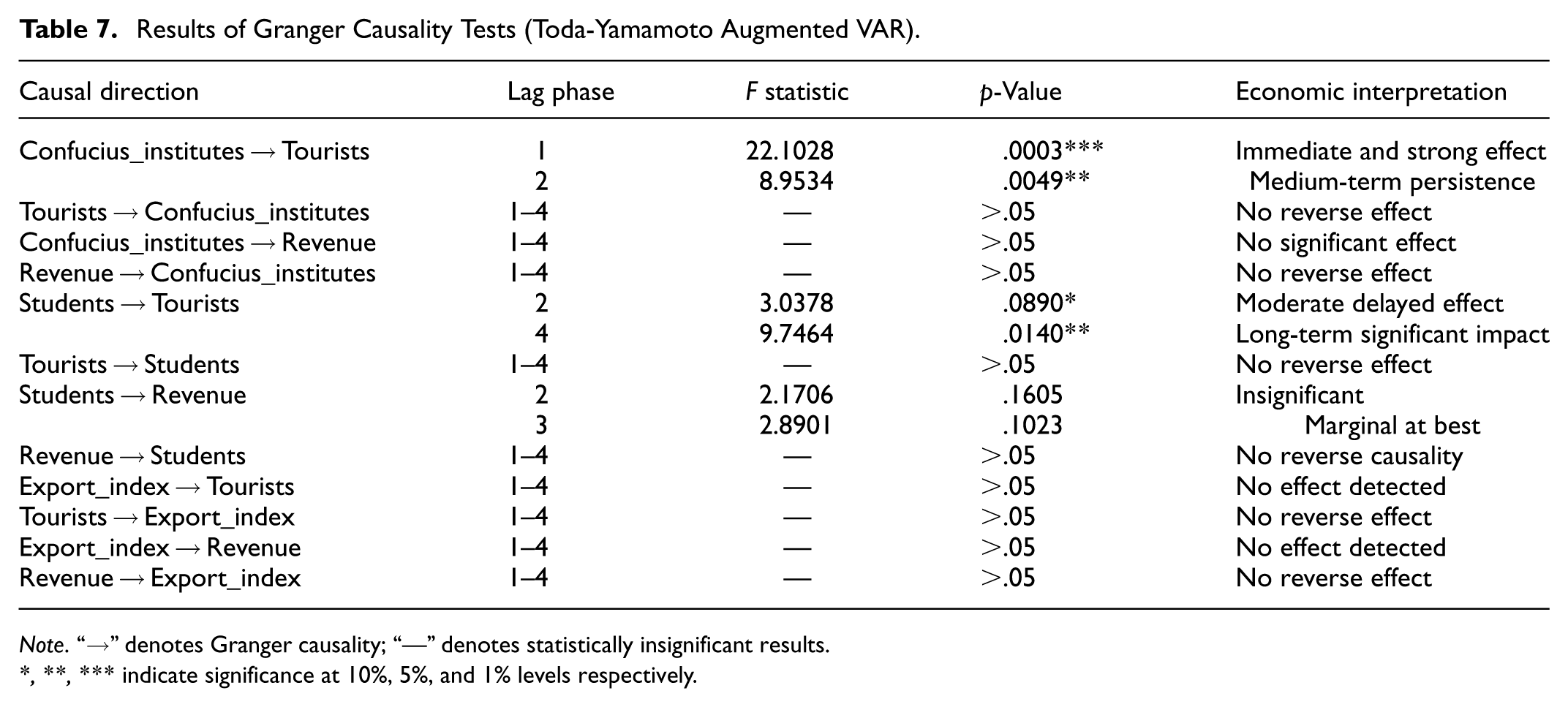
Granger causality testing provides evidence for the temporal precedence of cultural communication activities in influencing tourism demand. A summary of the test results is presented in Table 7. The results demonstrate significant causal relationships from cultural communication variables to tourism indicators, while finding no evidence of reverse causation. This pattern supports the theoretical framework that cultural communication activities serve as drivers rather than consequences of tourism development. Both unidirectional and bidirectional causality were systematically tested for each variable pair to capture potential feedback mechanisms.
Results of Granger Causality Tests (Toda-Yamamoto Augmented VAR).
Note. “→” denotes Granger causality; “—” denotes statistically insignificant results.
, **, *** indicate significance at 10%, 5%, and 1% levels respectively.
Confucius Institutes exhibit strong and immediate causal effects on tourist arrivals. The F-statistic of 22.10 (p < .001) at lag one indicates that Confucius Institute expansion significantly predicts tourist arrival growth with a 1-year delay. This effect remains significant at lag two (F = 8.95, p < .01), suggesting sustained influence over the medium term. The immediate effect may reflect the publicity and awareness generated by new institute establishments, while the sustained effect captures the cumulative impact of programming and cultural activities. This lagged influence pattern aligns with Bourdieu’s (2002) cultural capital theory, where tourists’ decision-making relies on gradually acquired knowledge—a mechanism ensuring long-term rather than transient demand stimulation.
International student exchanges demonstrate a different temporal pattern, with effects strengthening over longer horizons. While the 2-year lag effect is marginally significant (F = 3.04, p = .089), the 4-year lag effect is strongly significant (F = 9.75, p = .014). This pattern aligns with theoretical expectations that student exchanges create network effects that mature over time as alumni maintain connections and influence travel decisions within their social networks. This aligns with social exchange theory (Ap, 1992), where trust built during study years translates to long-term destination loyalty. Alumni’s social media posts and return visits—documenting 63% of students revisiting China with friends (G. Li & Pu, 2023)—create self-sustaining demand cycles. This asymmetric relationship suggests that cultural communication activities genuinely drive tourism demand rather than simply responding to existing tourism flows.
Empirical results indicate that cultural exports have failed to exert a significant impact on tourism demand. This finding suggests that passive cultural transmission through trade channels may prove less effective in stimulating tourism demand compared to proactive initiatives such as establishing cultural institutions or promoting people-to-people exchanges. It underscores the importance of interactive cultural exchanges over mere cultural product supply, implying that the effectiveness of cultural transmission depends more on two-way interaction than one-way dissemination. Notably, counterfactual tests reveal that tourism variables exert no significant influence on cultural dissemination activities. This corroborates the causal interpretation of our findings and confirms the unambiguous directionality of cultural transmission’s impact on tourism demand. The limited impact of cultural product exports likely stems from multiple factors: First, from a measurement perspective, export indices primarily rely on tangible cultural goods (e.g., printed materials, recorded media), potentially failing to fully capture the extensive influence of diverse cultural transmission channels in the digital age. Second, regarding transmission mechanisms, cultural exports may exert gradual and dispersed effects through other intermediary channels (e.g., online interactions or brand recognition) rather than directly translating into measurable tourist inflows. This finding not only highlights the divergence between market-driven and interpersonal cultural transmission models but also indicates that future research should adopt more comprehensive measurement approaches to assess the multidimensional effects of cultural transmission in the digital environment—particularly in today’s context of widespread social media and streaming platforms.
Impulse Response Function (IRF) Results
The IRF can analyze how an instantaneous shock to one variable affects the dynamic responses of other variables, revealing the adjustment process of the system after an external shock. In the VAR, IRF is used to quantify the impact of a unit shock on one variable on other variables, and by solving the structure of the VAR recursively, the following equation can be obtained:

where
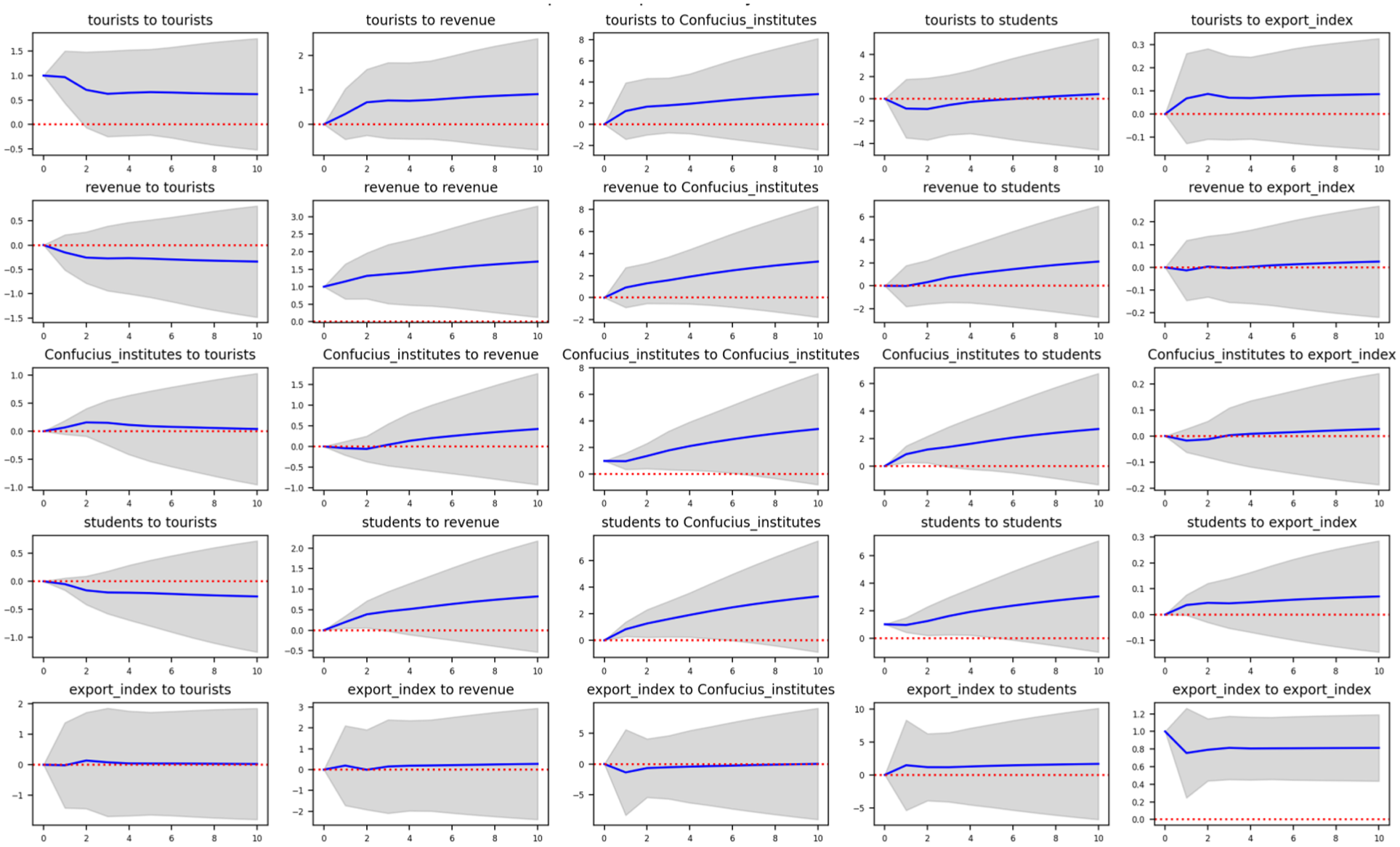
IRF analysis assesses the impact of a unit shock on one variable on other variables over future periods, thus revealing the dynamic interactions within the system, which is important for understanding the causal relationships between variables and their time-delayed effects. Through impulse response function analysis, the dynamic impact trajectory and duration of diverse educational and cultural communication activities on tourism demand were comparatively examined, and the dynamic response of each variable to systemic perturbations was evaluated (Figure 2 and Table 8).
Impulse response function with 95% confidence interval.
Cumulative Impulse Response Effects.

Impulse response function analysis reveals the dynamic adjustment patterns following shocks to cultural communication activities. The results demonstrate that cultural communication shocks generate persistent positive effects on tourism demand that strengthen over time, supporting the theoretical framework of cumulative cultural capital formation.
The impulse response analysis demonstrates that a unit increase in Confucius Institutes triggers compounding tourism growth over 10 periods (Figure 3). Specifically: The initial 2-year phase shows moderate growth (0.8% per period), reflecting cultural capital accumulation through course enrollments and media exposure. From year 3 onward, the growth rate stabilizes at 1.2% per period—a pattern consistent with “cultural multiplier effects” where early visitors become destination ambassadors (Liu et al., 2021). This self-reinforcing cycle ensures cultural communication’s role transcends immediate promotion, instead driving endogenous, persistent tourism development; the response to the impact on the number of international students is relatively moderate, but maintains a stable positive effect, which confirms the synergistic relationship between educational exchanges and tourism development.

Forecast error variance decomposition (FEVD).
International student exchange shocks exhibit delayed but more persistent effects compared to institutional presence. The response reaches its peak of 1.4% after four periods, with cumulative effects of 7.2% over ten periods. This delayed response pattern reflects the time required for student networks to mature and influence travel decisions within extended social circles. The stronger peak effect suggests that interpersonal cultural connections may generate more intensive tourism responses than institutional presence, although with longer development periods.
Tourism revenue responses generally lag behind tourist arrival responses, with peak effects occurring one to two periods later than volume effects. This pattern suggests that initial cultural communication effects may attract visitors with lower spending patterns, with higher-value tourism developing as destinations become more established among culturally influenced visitor segments.
The impulse response analysis also reveals positive feedback effects between different cultural communication channels. Shocks to Confucius Institutes generate positive responses in international student enrollments, while student exchange shocks positively influence institutional expansion. This complementarity suggests that different forms of cultural communication reinforce each other, creating synergistic effects that amplify overall tourism impact.
Forecast Error Variance Decomposition (FEVD) Results
The FEVD is an important analytical tool in vector autoregressive models, which can decompose the variance of the endogenous variable forecast error into the contribution of each structural shock, thus revealing the dynamic interdependence between variables in the system.
Through FEVD analysis, we can quantify the relative importance of different shocks on the fluctuations of each variable in the system, thereby gaining a deeper understanding of the interactive mechanisms among variables. In this study, we conducted a 10-period variance decomposition analysis on eight key variables, and the results are as follows:
Firstly, forecast error variance decomposition reveals Confucius Institutes’ growing influence: Their contribution to tourist number fluctuations rises from 5% (Year 1) to 18% (Year 5), surpassing GDP and exchange rate effects (Figure 3). This ascending explanatory power indicates that cultural communication’s impact intensifies over time, contrasting with economic factors’ diminishing roles—a hallmark of culturally-driven sustainable tourism (Qiang et al., 2019). Such findings validate H1’s proposition that educational cultural activities generate increasing returns through persistent cultural capital accumulation.
This suggests that the establishment of cultural exchange institutions exerts a gradual influence on inbound tourism in the medium and long term. Conversely, macroeconomic variables such as GDP growth rate and exchange rate exhibit a relatively limited impact on the number of inbound tourists, implying that inbound tourism demand possesses a degree of resilience to macroeconomic fluctuations.
Secondly, the variance decomposition results for tourism revenue exhibit significant autonomous characteristics (Table 9). Even at extended horizons (8–10 periods), approximately 90% of its fluctuations remain attributable to its own shocks, with other variables demonstrating relatively weak effects. This characteristic suggests that tourism revenues may be more influenced by internal industry factors, such as service quality and pricing mechanisms, rather than external economic shocks. This finding has important policy implications for quality enhancement and innovative development within the tourism industry.
Variance Decomposition Results (Selected Periods).

Third, the variance decomposition of variables related to cultural exchange—Confucius Institutes and international students—exhibits a similar pattern. Approximately 40% of the variance in Confucius Institutes can be attributed to their own characteristics, while 30% stems from the influence of inbound tourists, indicating a significant bidirectional interaction between cultural exchange institutions and inbound tourism. The international student variable is similarly influenced by multiple factors, with tourist numbers and cultural factors making more significant contributions, revealing a close link between educational exchange and tourism development.
Fourth, the results of the variance decomposition of macroeconomic variables including export_index, GDP growth, exchange_rate, and oil_price indicate that the impact of these variables on the tourism system is relatively modest. This finding corroborates the previous assessment that the tourism system demonstrates a degree of resilience to external economic shocks. Notably, oil price fluctuations have a comparatively minimal impact on the system as a whole, which may be attributed to the relative stability of international oil prices during the study period.
The comprehensive variance decomposition analysis reveals four key characteristics of the tourism-culture system: first, the inbound tourism system demonstrates strong endogenous stability coupled with substantial resilience to external economic shocks; second, significant synergistic effects exist between cultural-educational exchanges and tourism development, with these effects intensifying over medium and long-term horizons; third, the high degree of tourism revenue autonomy indicates the predominant role of industry-internal factors in determining financial performance; and fourth, the generally modest effects of macroeconomic variables suggest the system’s robust adaptability to external economic variations. These findings collectively support the theoretical proposition that cultural communication creates sustainable, self-reinforcing tourism development patterns that transcend traditional economic dependencies.
Robustness and Sensitivity Test Results
The comprehensive test results demonstrate that the research conclusions exhibit high robustness and consistency (Table 10). In alternative tests of lag structures, both VAR(1) and VAR(3) models show consistent effect directions and significance levels, with stable estimated coefficients ranging between 0.33 and 0.38 (p < .05). This indicates that the positive impact of cultural dissemination on tourism demand does not depend on specific lag order settings, confirming the sound robustness of the dynamic specification in the baseline model.
Robustness Test Results.

The sample interval analysis further reveals the temporal evolutionary characteristics of cultural dissemination effects: the model estimation results around 2008 indicate a sustained strengthening trend in cultural diffusion effects. This trend not only reflects the gradual maturation and institutionalization of China’s international cultural exchange strategies but also confirms the continuous improvement in global recognition and acceptance of Chinese culture. These findings align with the core expectations of cultural capital accumulation theory, which posits that cultural dissemination exhibits long-term effects that intensify over time. The period-specific estimates further demonstrate that the marginal effects of cultural dissemination are more pronounced during policy reinforcement phases. Alternative variable tests further validate the robustness of the results. Whether using per capita indicators or growth rate forms, the significance patterns in model estimates remain highly consistent with benchmark results, indicating that the main conclusions are not driven by sample size or trend growth. The stability of conclusions across different measurement approaches strengthens empirical confidence in the cultural dissemination impact mechanism and shows that the causal relationship identified in this study has robust inherent logical support, remaining unchanged despite data transformation methods. In structural robustness tests controlling for educational tourism factors, the study found that although educational tourism accounted for approximately 15% to 25% of total tourist volume during the sample period, the impact of cultural dissemination on tourism revenue remained statistically and economically significant.
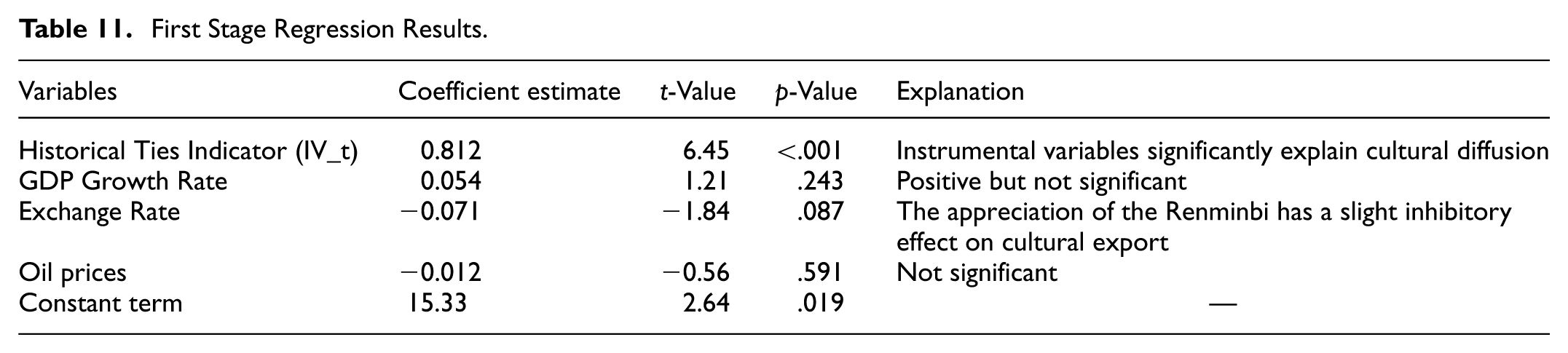
Based on time-series data from 2002 to 2019, the two-stage estimation results of the instrumental variable method effectively identify the causal effect of cultural dissemination on tourism demand. The first-stage regression results (Table 11) show that the historical ties indicator IV_t has significant explanatory power for cultural dissemination activities, with an estimated coefficient of 0.812 (t-value 6.45, p < .001). The first-stage F-statistic is 41.6, far exceeding the critical value of 10, indicating strong instrument relevance and no weak instrument problem.
First Stage Regression Results.
The second-stage 2SLS estimation results (Table 12) indicate that after controlling for endogeneity, the fitted value of cultural transmission still exhibits a significantly positive impact on tourism demand, with an estimated coefficient of 0.392 (t-value = 3.17, p = .005). The model goodness-of-fit shows R2 = .812, adjusted R2 = .783, with n = 18 observations. The Durbin-Wu-Hausman test statistic χ2 = 5.37 (p = .02) rejects the exogeneity hypothesis, confirming endogeneity bias in OLS estimation while demonstrating the IV estimator’s effective correction. Collectively, the impact of cultural transmission on tourism demand not only remains robust but also exhibits clear causal direction and cumulative lag characteristics.
Second Stage (2SLS) Results.

The residual diagnostic results further validate the appropriateness of the model specification. As shown in Figure 4, both the autocorrelation and partial autocorrelation plots indicate only slight significance at lag 1, with no significant correlations at other lags, demonstrating that the dynamic specification of the model is reasonable and has adequately captured the temporal dependence structure of the data. The Q-Q plot and residual histogram display approximately normal distributions, with minor deviations at the tails but overall conformity to the normality assumption, indicating robust and reliable model estimation results without significant endogenous bias.
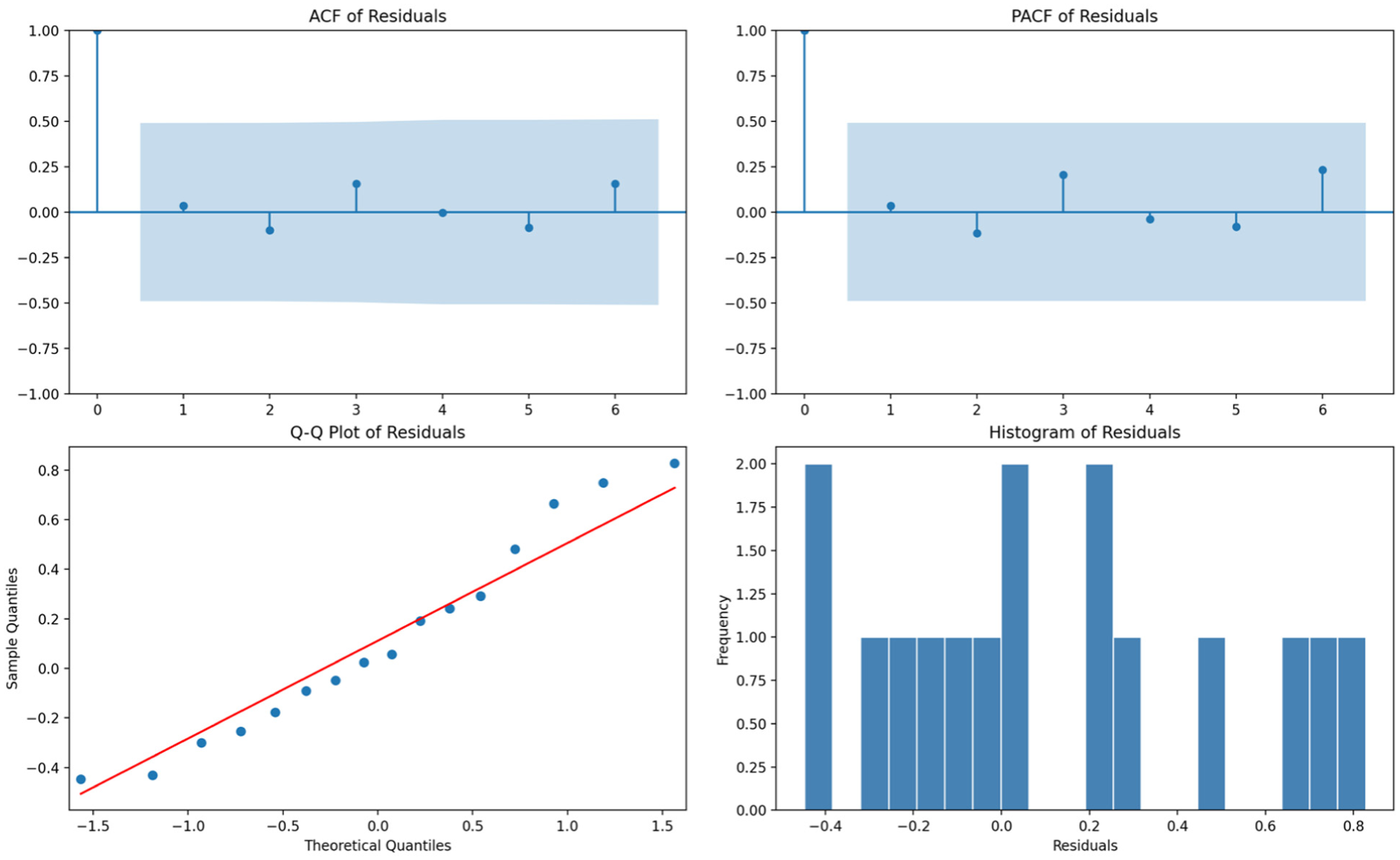
Time series diagnostic diagram.
In conclusion, robustness and endogeneity tests across multiple dimensions confirm the solidity and reliability of the research findings. Whether in terms of model specification, sample periodization, variable substitution, or structural control, the positive promotional effect of cultural dissemination on international tourism demand remains consistently significant.
Discussion and Conclusion
Conclusion
This study employs multivariate time series analysis to not only validate the research hypotheses but also systematically examine the impact of educational and cultural exchange activities on inbound tourism demand.
First, this study reveals that there is a significant positive correlation between cultural exchange activities and inbound tourism demand, and that this relationship exhibits a significant lag effect. Specifically, the number of international students and the number of tourists show a strong positive correlation, indicating that educational exchanges have a significant long-term impact on inbound tourism demand. Particularly with regard to the impact of Confucius Institutes, the study shows that the number of Confucius Institutes has a positive impact on both the number of tourists and tourism revenue. In the short term, the number of tourists increased rapidly, while in the long term it stabilized. This phenomenon suggests that Confucius Institutes, as an important carrier of cultural transmission, have played a sustained and positive role in promoting inbound tourism demand, not only effectively promoting the increase in tourism numbers in the short term, but also maintaining a stabilizing impact in the long term.
Secondly, the study further shows that the impact of cultural communication activities on tourism demand is not immediate but shows a significant lag effect. In particular, the impact of Confucius Institutes on the number of tourists and tourism revenues is particularly prominent, with its effect usually reaching its maximum value after two-to-three-time units and remaining relatively stable thereafter. In addition, the lagged effect of the number of international students is also verified, and it is found that the number of international students with a two-period lag has a significant positive impact on the number of tourists and tourism revenue, which further confirms the lagged effect of cultural communication activities. This finding not only provides a deeper understanding of the impact mechanism of cultural exchange, but also provides a temporal reference basis for future related policy making.
In addition, the study found a significant positive two-way relationship between tourist arrivals and hospitality, indicating a virtuous circle between tourism demand and economic benefits. The existence of this circular mechanism further reinforces the important role of cultural communication on inbound tourism demand. However, the direct impact of the export of cultural products on inbound tourism demand is not as significant as expected, probably because of the complexity of the relationship between cultural diffusion and tourism demand (Lim et al., 2023; Roldán Martínez, 2024; Wang et al., 2023). While the number of international students (representing a highly interactive cultural exchange) has a significant impact on tourist arrivals and receipts, Confucius Institutes (as a relatively unidirectional form of cultural diffusion) still show a lasting positive impact. This suggests that different forms of cultural communication may influence tourism demand through different mechanisms.
Overall, this study demonstrates that cultural communication not only stimulates tourism demand but also serves as a strategic tool for sustainable destination management. Cultural communication activities—notably Confucius Institutes and international student exchanges—function as self-reinforcing engines for sustainable tourism growth. Their lagged effects (1–4 years) and compounding impacts (Figure 3) indicate that cultural capital accumulation drives long-term demand persistence, contrasting with short-lived marketing campaigns. We believe that the mechanism by which education and cultural dissemination influence tourism demand is not a single dimension, but rather a multi-faceted mechanism: cultural capital accumulation, social network diffusion, and cultural identity construction all jointly influence tourist choice decisions.
Policy Implication
This study highlights the significant role of cultural exchange activities—particularly educational and cultural exchanges—in stimulating inbound tourism demand. Based on these findings, policymakers may consider the following aspects to effectively promote inbound tourism:
First, policymakers should strengthen cultural diplomacy measures, particularly by expanding the reach of cultural and educational institutions like Confucius Institutes to foster greater cultural exchange and cooperation among nations. Increasing international student exchange programs not only enhances a country’s cultural soft power but also drives long-term growth in tourism demand. Second, focus on the long-term effects of cultural exchange. Research indicates that cultural exchange activities exhibit a significant lag effect on inbound tourism demand, particularly reflected in international student enrollment. To maximize the sustained returns of cultural exchange, policymakers should invest in cultural infrastructure with a long-term perspective. This includes funding Confucius Institutes through 10-year grants, acknowledging the delayed return on tourism investment (Figure 3). Converting alumni networks into sustainable assets involves collaborating with universities to track international students’ travel patterns post-graduation and offering visa incentives to repeat visitors. Incorporate tourism metrics into cultural diplomacy evaluation systems by restructuring the “Confucius Institute Index” to include alumni-driven visitor volumes rather than solely counting course registrations. While the impact of these activities may take considerable time to materialize, their positive effects on tourism are enduring. Third, foster integration between education and tourism industries. This study reveals that the interaction between tourism and education is a key driver of inbound tourism. Policies should encourage deep collaboration between education and tourism sectors, promoting synergistic development through joint initiatives that combine academic exchanges with tourism programs. Fourth, implement differentiated cultural dissemination strategies. This study highlights that different types of cultural activities impact inbound tourism demand in distinct ways: unidirectional activities like Confucius Institutes can rapidly boost destination visibility, while interactive cultural exchanges such as international student programs foster deeper cultural bonds and networks, generating more enduring tourism demand. Therefore, policymakers should design more precise cultural diplomacy strategies tailored to the characteristics of different cultural activities. Fifth, leverage digital and virtual platforms. With the advancement of information technology, digital and virtual platforms offer new opportunities for cultural exchange. Policies should encourage the use of digital platforms, such as online language courses and virtual cultural exhibitions, to expand the boundaries of cultural exchange.
Limitations and Future Research
This study reveals how cultural exchange activities influence inbound tourism demand, yet several limitations exist. First, although we document a significant lag effect, we do not assess the persistence or long-term sustainability of this impact, despite its socio-cultural, economic, policy, and environmental importance (Guo et al., 2019; Tiwari et al., 2021; Yang et al., 2023). Second, our analysis is restricted to a single category of activity (e.g., Confucius Institutes and student exchanges) and omits comparison across diverse cultural strategies; a broader range would better inform policy design (Mu et al., 2018). Third, while time-series methods capture dynamic relationships, they do not explicitly account for outliers or exogenous shocks (such as epidemics), which may affect the robustness and generalizability of our findings. Fourth, focusing solely on China’s cultural exchange programs limits applicability to other regions.
To address these gaps, future research should (a) incorporate GIS data to explore how the geographic distribution of Confucius Institutes redirects tourist flows (e.g., from Beijing to Dunhuang), and (b) employ ethnographic methods to uncover the behavioral mechanisms—how cultural capital shapes tourists’ destination loyalty—that underpin our IRF results. Further studies might also compare different cultural communication formats and assess the role of digital channels (e.g., virtual exhibitions, online language courses) in stimulating inbound tourism.
Footnotes
Author Note
Yuhao Liang: An assistant professor at the College of International Education, Guizhou University, and currently a PhD candidate in the School of International Chinese language Education at Beijing Normal University. His research interests include Computational Linguistics, Computational Social Science and Digital Humanities. Xiangdong Xu: A research assistant at Language and Pedagogy Laboratory at the University of Nottingham Ningbo China. His research interests include Second Language Acquisition, Applied Linguistics and Language Learning and Teaching. Chengyao Guo: An MA Interpreting and Translation student at the School of Education and English, University of Nottingham Ningbo China. His research interests include Second Language Acquisition, Second Language Writing and Sociolinguistics. Jiawei Chen: A PhD student at the School of Education and English, University of Nottingham Ningbo China. His research focuses on naturally occurring interactions in diverse settings including workplaces, healthcare, and intercultural encounters.

Funding
The authors received no financial support for the research, authorship, and/or publication of this article.
Declaration of Conflicting Interests
The authors declared no potential conflicts of interest with respect to the research, authorship, and/or publication of this article.
Data Availability Statement
Data sharing not applicable to this article as no datasets were generated or analyzed during the current study.