




Abstract
This study examined Vietnamese local residents’ attitudes toward the reopening of their country to international tourists amid COVID-19 from March to April 2021. It began with a qualitative analysis of local residents’ opinions (n = 240) to identify the factors that could affect their attitudes, then continued with a review of the literature to create a theoretical model. Finally, the study implemented a structured survey to collect quantitative data (n = 412) to confirm the model. The outcomes revealed that “perceived vaccine efficacy” and “xenophobia” were two significant predictors of “attitude toward inbound tourism.” Implications of this study were then discussed.
Introduction
COVID-19 is an unprecedented exterminator of world tourism. International tourist arrivals decreased 72% in 2021 from the 2.28 billion mark in 2019 (The World Tourism Organization [UNWTO], 2022). World tourism literally returned to 1990 levels. This negative trend may continue in the upcoming years if effective countermeasures are not devised and adopted.
Fortunately, in addition to the travel corridors or bubble initiatives between/among certain countries (Channel News Asia, 2021; Iwamoto, 2020), the starting and spreading of COVID-19 vaccination around the world (Holder, 2022) also provide some light at the end of the tunnel as international tourism can be made easier. However, local residents’ reactions to the reopening of their country’s border to inbound tourists must be carefully investigated. Any reopening plan without the support of local residents will potentially lead to conflicts in the socioeconomic environment of a country in the future (Carr, 2020; Qiu et al., 2020).
Local residents’ opinions, nonetheless, are not easy to ascertain, especially given the chaotic context of the COVID-19 pandemic. Prior research often built theoretical models based on the literature to investigate different aspects of local residents’ opinions, including their perceptions and behaviors or their attitudes (Joo et al., 2021; Kamata, 2022; Tse & Tung, 2021). This approach, nevertheless, often did not closely reflect the real situation of a tourist destination or a country, as the models are the results of subjective motives or judgments. Implications for tourist destination management, thus, might be inadequate and unrealistic.
Therefore, this study examined local residents’ attitudes toward the reopening of their country to international tourists in the midst of the COVID-19 pandemic, taking into account the recent development of COVID-19 vaccines and mass vaccination. However, different from previous research, this study used a mixed design to explore the attitudes of the local residents from their own perspectives (Figure 1). The study began with a qualitative analysis of local residents’ opinions to identify the factors that could affect their attitudes toward inbound tourists given the recent developments of COVID-19 vaccines and vaccination (March 2021). It then continued with a review of the literature to discover correlations between the impacting factors and the attitudes and constructed a theoretical model. Finally, a structured survey was implemented to collect quantitative data to confirm the model and to determine the relative importance of each impacting factor with local residents’ attitudes toward inbound tourists (April 2021). The results of this study would provide important implications for the management of tourist destinations in the post COVID-19 period, as well as enrich the literature about local residents’ attitudes in this extraordinary situation.

Research process.
Literature Review
Local Residents’ Attitudes Toward International Tourists Before COVID-19
Before COVID-19, tourism was a big industry in many economies. On a worldwide scale, revenues from international tourism had increased from 979 billion USD in 2010 to 1,478 billion USD in 2019 (Statista Research Department, 2020). With its enormous financial contribution, international tourists were welcomed by local residents at many tourist destinations, for example, Malaysia, Thailand, and Vietnam (Chang et al., 2020; Marzuki, 2012; Suntikul et al., 2016). Nonetheless, inbound tourism might have been detested due to problems with the quality of employment available and the equality of income distribution (Alam & Paramati, 2016; Suntikul et al., 2016). In addition, inbound tourism had given local residents much-appreciated opportunities to show international tourists their natural, cultural, and historical heritages and richness, thus increasing their community pride and well-being (Magno & Dossena, 2020; Suntikul et al., 2016). However, the appearance of outsiders whose understandings and habits differed, either slightly or greatly, from those of the local residents had doubtlessly disrupted the normal rhythms, values, and living conditions of the latter’s daily lives (McCaughey et al., 2018; Siu et al., 2013).
Thus, the economic, socio-cultural, and environmental contributions and problems of tourism had significantly affected local residents’ attitudes toward this industry. Nonetheless, the health risks caused by tourism and their impacts on local residents’ attitudes had largely been neglected although tourists’ perceptions of such risks had been thoroughly examined (Huang et al., 2020; Jonas et al., 2011). As a result, local residents’ evaluation of the preventive measures of tourism-induced health risks, such as that of vaccination, was also missing.
Overall, it was likely that local residents supported tourism activities, including inbound tourism, if they saw more benefits than costs contributed by this sector (Nunkoo & So, 2016). Their positive attitude might also have been affected by other factors, both internal and external, including perceived identity (Nunkoo & Gursoy, 2012), dependency on tourism (Chang et al., 2020), perceived destination images (Stylidis et al., 2014), and trust in the government (Zuo et al., 2017), among others. Without these conditions, or if the conditions were not favored, local residents might have opposed tourism and its development. Noticeably, local residents’ opinions concerning the tourism industry in their own and other countries had not been properly regarded in this respect.
The abovementioned factors, however, only reflected the cognitive precedents of local residents’ attitudes. Other affective elements, such as empathy on the one hand (Tucker, 2016), and xenophobia on the other hand (Ikeji & Nagai, 2021) had also caused some impacts on the attitudes of the local residents. An integrated understanding of the impacts of both of these cognitive and affective elements, nevertheless, was mostly absent.
Local Residents’ Attitudes Toward International Tourists During COVID-19
The sudden arrival and the lengthy impacts of COVID-19 have disrupted the socioeconomic conditions of many countries and their residents. In China, where the first cases of COVID-19 were reported, approximately half of the local residents sampled in Liaoning reported that they felt horrified and apprehensive due to the pandemic (Zhang & Ma, 2020). In the US, where the highest numbers of COVID-19 cases have been noted, the current quality of life and the future prospects of those in the lower rungs of society, such as students, were greatly affected (Chick et al., 2020; Khusid et al., 2020). In Vietnam, where the pandemic had been effectively controlled in 2020 and early 2021, millions of people might still be exposed to the poverty trap caused by barriers to accessing the preventive measures, economic disruption, and financial uncertainties (B. X. Tran et al., 2020).
Unfortunately, tourism is not an exception amid this pandemic. More seriously, since tourism involves travel, including cross-border travel, this sector has been excessively affected. Many countries have opted to shut down their tourism industry, especially international tourism, to reduce the risks of coronavirus transmission (Farzanegan et al., 2021). Under these conditions, certain groups of local residents have already shown their discrimination against tourists (xenophobia; Tse & Tung, 2021). However, others may want to accept tourists to support the recovery of the economy (empathy or sympathy), even though they also are concerned about infection risks (Kamata, 2022; Salman et al., 2022).
It should be noted that in the presence of COVID-19, the perceived health risks are a significant determinant of local residents’ support-for-tourism attitude (Joo et al., 2021). Preventive and facilitating measures such as vaccination and vaccination certificates or passports are expected to be able to counter such risks as well as to restart and recover the tourism industry, including international tourism (Sharun et al., 2021). Opinions about domestic tourism can also affect local residents’ attitudes toward inbound tourism to some extent (Ram et al., 2022). Opinions about other countries’ actions and reactions concerning the reopening of inbound tourism, however, have not been observed.
Method
Context
This study chose Vietnam as its context. Given limited economic and medical resources, Vietnam almost completely closed its border to international tourists and overseas Vietnamese from March 2020 to prevent and eliminate the risks of the COVID-19 pandemic (Duong et al., 2020). As a result, the number of international tourist arrivals in 2020 only reached 3.8 million, down 78.7% compared to a year earlier (General Statistics Office, 2021). That of 2021 was even less than 0.2 million (VietnamPlus, 2021). Thus, the tourism industry, other related economic sectors, and the public at large have been greatly affected (Dao Le & Gan, 2021; P. B. Tran et al., 2020).
Under these conditions, the recent developments of COVID-19 vaccines and vaccination (VnExpress, 2022) have presented opportunities for the country to reopen in the near future, which should help revive the economy, in general, and the tourism industry, in particular. However, reopening may also create doubts and worries for many local residents since they have been well protected from the impacts of COVID-19 due to the close-border and zero-COVID policies. In addition, certain COVID-19 variants, such as Delta and Omicron (Abdool Karim & Abdool Karim, 2021; Chookajorn et al., 2021), have also been adding pressure and threats to the reopening plan and efforts. An examination of Vietnamese local residents’ attitudes toward inbound tourism, therefore, was necessary.
Qualitative Study
This study began with a qualitative attempt in March 2021. This month was selected as the starting point because this was a stable time before the beginning of the fourth and the most serious wave of infection in Vietnam (April 2021 onward; Viet Nam News, 2021). Given the successes of COVID-19 prevention in the prior periods, government officials, experts, and civilians started talking about the reopening of the country, including that of tourism. This study was also facilitated by this occurrence.
The researchers carried out this qualitative research using local residents’ comments (user-generated content; Lu & Stepchenkova, 2015) about the “COVID-19 vaccine passport” proposal mentioned on Vnexpress.net, one of the most popular news sites in Vietnam (Alexa, 2021), both in terms of the number of accesses and the number of reader comments. The first article about “COVID-19 vaccine passports” that caught readers’ attention was posted on 27 February 2021. However, a series of articles on the same topic posted between 10 and 13 March 2021 ignited a real wave of comments and discussions. Therefore, the authors opted to focus on the opinions contributed by Vnexpress.net readers during these 4 days. The collection of the comments took place on the second Sunday of March 2021. The time of collection was right after the last article was published and commented upon. However, given the large amount of content continually appearing on a news website, the majority of the comments concerning an article were mainly contributed on the day of its release. Thus, the point of time did not greatly affect the number of comments collected.
As a result, four articles were referred to, and a total of 240 comments were compiled. The comments were kept in an Excel file for further analysis. The two researchers and an independent analyst read and reread all of these comments to identify the main themes (Braun & Clarke, 2006) mentioned by Vnexpress.net readers. They worked together and reached an agreement before concluding the analysis to ensure its reliability (Kassarjian, 1977). Consequently, eight main themes (factors) were identified: “perceived vaccine efficacy,” “perceived vaccine passport authenticity,” “perceived risks,” “preventive measures’ effectiveness,” “current situations of tourism in other countries,” “attitude toward domestic tourism,” “sympathy toward tourism industry,” and “xenophobia.” All of these factors affected the readers’ attitudes toward inbound tourism in the upcoming months, either positively or negatively. Examples of the comments can be found in Table 1. The translations of the quotes from Vietnamese to English were initially prepared by the first researcher and then checked and approved by the second researcher.
Extracts of Comments.

Theoretical Model
After determining the potential impacting factors of local residents’ attitudes toward inbound tourism in Vietnam in the upcoming months, the researchers conducted a review of the existing literature to discover and justify the associations between/among these variables in a larger context. Interestingly, both the before and during COVID-19 literature provided evidence to support these relationships.
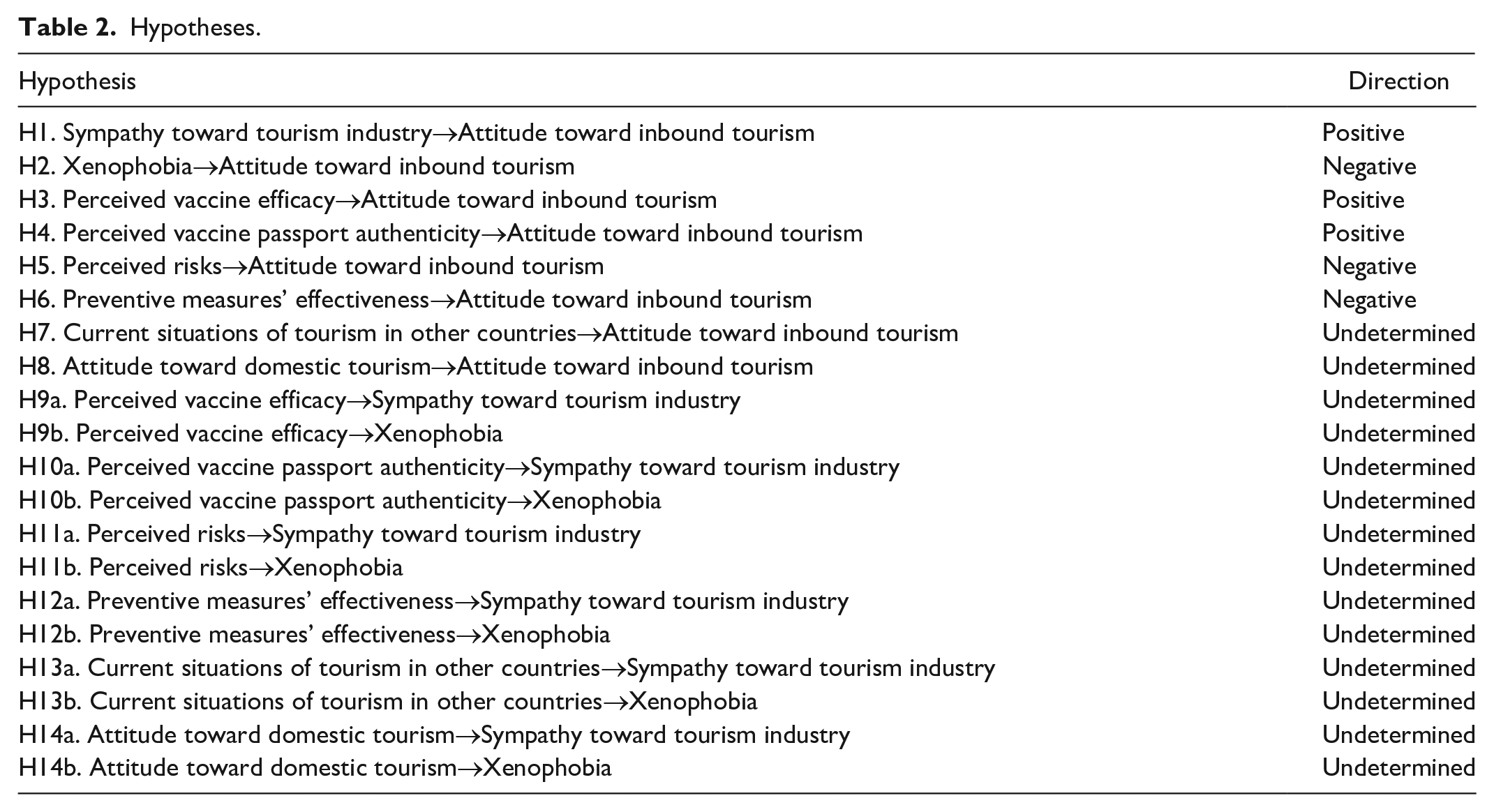
First, the existing research found that local residents’ tolerance for tourism positively affected their supportive attitudes (Qin et al., 2021). The link between empathy and tourism activities was also strongly supported in a general sense (Tucker, 2016). On the other hand, it was observed that xenophobia could negatively affect local residents’ perceptions of the bad impacts of tourism, which in turn influenced their attitudes toward the lodging sector in their location (peer-to-peer accommodations in Kyoto, Japan) (Ikeji & Nagai, 2021). In a non-tourism context, it was found that xenophobia had an impact on behaviors toward Asian Americans in the US during the COVID-19 pandemic (Reny & Barreto, 2022). Therefore, it was hypothesized for the quantitative study that (H1) “sympathy toward tourism industry” had a significant positive impact while (H2) “xenophobia” had a significant negative impact on Vietnamese local residents’ attitudes toward inbound tourism in the COVID-19 context.
Second, previous studies confirmed that perception of vaccine efficacy could positively affect individuals’ attitudes, for example, parents’ opinions about vaccinating their children (LaVail & Kennedy, 2013) and gay men’s intention to engage in risky sexual encounters (Newman et al., 2010). The positive relationship between perceived COVID-19 vaccine efficacy and consequent attitudes (e.g., acceptance or hesitancy) were also established recently (Soares et al., 2021). Similarly, although the role of COVID-19 vaccine passport authenticity was not yet observed, the existing literature, both in tourism and non-tourism contexts, suggested that a positive association between perceived authenticity and behaviors could also be predicted (Castéran & Roederer, 2013; Lee et al., 2019). Therefore, it was hypothesized for the quantitative study that (H3) “perceived vaccine efficacy” and (H4) “perceived vaccine passport authenticity” had significant positive impacts on Vietnamese local residents’ attitudes toward inbound tourism in the COVID-19 context.
Third, a recent study in the tourism sector confirmed that local residents’ risk perception negatively affected their supportive attitude given the current pandemic conditions (Joo et al., 2021). Other studies in the healthcare sector in China and Vietnam found that perception of the effectiveness of public preventive measures positively affected local residents’ behaviors toward adopting practices aimed at reducing the risks of COVID-19 infection (Duan et al., 2020; Nguyen et al., 2020). Since banning inbound tourism was part of the public policy (Duong et al., 2020), reopening the borders might be evaluated unfavorably. Therefore, it was hypothesized for the quantitative study that (H5) “perceived risks” and (H6) “preventive measures’ effectiveness” had significant negative impacts on Vietnamese local residents’ attitudes toward inbound tourism in the COVID-19 context.
Fourth, the existing literature has pointed out that tourism was a competitive industry. On both global and regional scales, the tourism sector of one country must compete with that of the others to attract inbound tourists (Mackay & Spencer, 2017; Patsouratis et al., 2005; Pearce, 1997). Due to COVID-19, many countries have opted to close their borders. This has accidentally returned these countries to their starting points. Therefore, it was reasonable to assume that a country must consider the decisions in their neighboring countries concerning reopening inbound tourism to do that on their own. Reopening too early might increase health risks, but reopening too late might increase economic risks. In addition, the attitude toward domestic tourism might also affect the attitude toward inbound tourism in a sense that, in a given time period, if the former could create enough benefits, it might replace the latter to some extent (Llorca-Rodríguez et al., 2020). The same rationale was applicable in the COVID-19 pandemic. Therefore, based on the literature, it was again hypothesized for the quantitative study that (H7) “current situations of tourism in other countries” and (H8) “attitude toward domestic tourism” had significant impacts on Vietnamese local residents’ attitudes toward inbound tourism in the COVID-19 context.
Finally, while “perceived vaccine efficacy,” “perceived vaccine passport authenticity,” “perceived risks,” “preventive measures’ effectiveness,” “current situations of tourism in other countries” and “attitude toward domestic tourism” might be considered cognition-based phenomena, “sympathy toward tourism industry” and “xenophobia” could be regarded as the affect-based phenomena (Breckler, 1984; Hilgard, 1980). Given the fact that cognition was an antecedent of affect (Breckler, 1984; Hilgard, 1980) and this relationship has also been validated by tourism researchers (Zheng et al., 2019), it was further hypothesized for the quantitative study that (H9) “perceived vaccine efficacy,” (H10) “perceived vaccine passport authenticity,” (H11) “perceived risks,” (H12) “preventive measures’ effectiveness,” (H13) “current situations of tourism in other countries” and (H14) “attitude toward domestic tourism” had significant impacts on Vietnamese local residents’ (a) “sympathy toward tourism industry” and (b) “xenophobia” in the COVID-19 context.
The hypotheses are summarized in Table 2.
Hypotheses.
Quantitative Study
Based on the above discussion, a theoretical model was formed to guide the quantitative study (Figure 2). A questionnaire was then created to gather the data.

Theoretical model.
To generate the questions for the questionnaire, the researchers revisited Vnexpress.net readers’ comments to extract their specific opinions about each of the nine variables included in the theoretical model through a deductive content analysis (Elo & Kyngäs, 2008). Again, the two researchers and the independent analyst worked together to identify the measures, and their agreement served as the reliability criterion (Kassarjian, 1977). As a result, 2 to 4 items were selected as the measures of each variable, totaling 22. These measures were translated from Vietnamese to English by the first researcher and checked and approved by the second researcher. They were also compared with the existing literature to ensure their cognition, affect, or conation natures (Bean & Catania, 2013; Cibinskiene & Snieskiene, 2015; Joo et al., 2021; Kock et al., 2019; Nghiêm-Phú, 2016; Nguyen et al., 2020; Verillon & Rabardel, 1995). It should be noted that conceptually attitude was a combination of perception (cognition and affect) and conation (Breckler, 1984). However, in the theoretical model of the quantitative study, “attitude toward domestic tourism” only reflected the cognitive perception element, and “attitude toward inbound tourism” only implied the conative element of attitude in general. All these measures were evaluated on a five-point scale, ranging from totally disagree to totally agree.
In addition to these main measures, the questionnaire also included some sociodemographic questions about the respondents’ age, biological sex, occupation, and income (reduced compared to before COVID-19, same as before COVID-19, and increased compared to before COVID-19). Moreover, it contained one question about the participants’ “tendency to worry” as a personality trait since COVID-19 was one of the major causes of worries at the time of the research (Zysberg & Zisberg, 2022). This item (I am always worried about something) was taken from the Penn State Worry Questionnaire (Meyer et al., 1990), and was also rated on the five-point scale mentioned earlier. The translation of this particular question from English to Vietnamese was implemented similarly to the Vietnamese to English translation process.
Since the measures were newly developed, the questionnaire was pretested on a small sample (n = 50) of tourism researchers and educators in Vietnam in the fourth week of March 2021 to further guarantee its validity. An online version of the questionnaire (Google Forms) was used. Given the small number of measures of each construct, Corrected Item-Total Correlations (CITC) values (>.30) were examined to decide whether to keep or remove an item (Morgan et al., 2004). As a result of the pretest, 19 items to measure the 9 constructs were retained for the main survey from an original pool of 22 items.
The main survey was implemented online over a 10-day period in the first and second weeks of April 2021. The online questionnaire was posted on the Facebook page of the second researcher, who had a big social network there (almost 5,000 friends and 3,000 followers, as compared to the average number of friends of approximately 300; Hughes, 2020; Smith, 2014; Statista Research Department, 2021). A total of 412 answers were contributed randomly and voluntarily by the participants. The randomness was achieved by controlling the time of posting the link to the questionnaire on the page, and the time of accepting the answers from the prospective participants.
After that, the data was analyzed in IBM SPSS in several steps. In the first step, the characteristics of the dataset were revealed through a descriptive analysis (Tables 3 and 4). The outcome suggested that the data was normally distributed (skewness values <3.0 and kurtosis values <5.0; Kim, 2013). All the items of a construct correlated well with one another (CITC > .3) (Morgan et al., 2004). The Cronbach’s alphas for “preventive measures’ effectiveness” (.52), “xenophobia” (.55), and “attitude toward inbound tourism” (.67) were relatively small yet acceptable given the fact that these constructs had only two items (Tavakol & Dennick, 2011). In the second step, evaluations by the respondents about the measures were compared between or among different groups (age, sex, education, occupation, income, and the tendency to worry). Independent sample t-tests (comparing two groups) and analyses of variance ANOVA (comparing three or more groups) were chosen as the analysis techniques. In the third step, the hypotheses were tested using hierarchical regression analysis, given the linear correlations among the variables. This method could also help reveal the total effect of the whole model as well as the individual effect of each variable. The average values of all of the constructs were used in the analyses after considering their internal consistencies (all CITCs > .3). With six to eight independent variables per one dependent variable, the sample of 412 generated the respondent-to-variable ratios of approximately 51 to 68, which were relevant to regression analysis (Brooks & Barcikowski, 2012; Knofczynski & Mundfrom, 2008).
Description of Variables.

Note. SD = standard deviation; CITC = corrected item-total correlation.
Cronbach’s Alphas of and Correlations Among Variables.

Note. APVE = perceived vaccine efficacy; APPA = perceived vaccine passport authenticity; APR = perceived risks; APME = preventive measures’ effectiveness; ASTO = situations of tourism in other countries; AADT = attitude toward domestic tourism; AST = sympathy toward tourism industry; Axeno = Xenophobia; AAIT = attitude toward inbound tourism.
Significance at the .001 level.
Significance at the .01 level.
Significance at the .05 level.
Findings
A profile of the respondents is displayed in Table 5. Most were between 20 and 49 years old, with approximately 68% of them being female and almost 99% having undergraduate degrees or higher. The age and sex characteristics of the sample corresponded well with those of the Facebook users in Vietnam in recent years, while the education characteristic was better than average (Meta for Business, 2015). In addition, approximately 56% of the respondents worked in the tourism sector, and approximately 58% reported a reduced income due to COVID-19. More than 40% tended to worry. The number of those who worried more often almost doubled the number of those who worried less often.
Profile of the Respondents.

The results of the comparisons of opinions of different groups are shown in Table 6. According to these comparisons, the age-, sex-, education-, occupation-, and income-based groups seemed to share similar evaluations of the measures. Differences, when there were any, were only sporadic. However, the worry-tendency-based groups’ evaluations were different, with only one exception of “perceived vaccine efficacy.” This result suggested that the participants’ attitude toward inbound tourism, on the one hand, and their perceived vaccine passport authenticity, risks, preventive measures, domestic and regional tourism performances, sympathy, and xenophobia, on the other hand, might be affected by their personal tendency to worry.
Group Comparison.

Finally, the outcomes of the testing of the hypotheses are presented in Table 7. Overall, the combination of the six cognitive variables (“perceived vaccine efficacy,” “perceived vaccine passport authenticity,” “perceived risks,” “preventive measures’ effectiveness,” “situations of tourism in other countries,” and “attitude toward domestic tourism”) could significantly affect both the affective variables, including “sympathy toward tourism industry” (adjusted R2 = .059, p = .000), and “xenophobia” (adjusted R2 = .184, p = .000). The total effect that this combination had on the former was much smaller than it had on the latter, although both of them were weak (Morgan et al., 2004). Similarly, the aggregation of the eight cognitive and affective variables appeared to have significantly influenced “attitude toward inbound tourism” with a small effect (adjusted R2 = .148, p = .000). On an additional note, the small VIF (variance inflation factor) values showed that the multicollinearity issue was avoided across all analyses (Morgan et al., 2004).
Testing of Effects.

Note. APVE = perceived vaccine efficacy; APPA = perceived vaccine passport authenticity; APR = perceived risks; APME = preventive measures’ effectiveness; ASTO = situations of tourism in other countries; AADT = attitude toward domestic tourism; AST = sympathy toward tourism industry; Axeno = Xenophobia; AAIT = attitude toward inbound tourism; VIF = variance inflation factor.
When looking at the individual impact of each variable, it was observed that only the correlations of “preventive measures’ effectiveness” and of “situations of tourism in other countries” with “sympathy toward tourism industry” were significant. The directions of the effects were both positive. On the other hand, “perceived vaccine efficacy,” “perceived risks,” “preventive measures’ effectiveness,” and “attitude toward domestic tourism” were significantly correlated with “xenophobia.” The direction of the first variable was negative, while those of the remaining three were positive. Lastly, “perceived vaccine efficacy” and “xenophobia” were two significant predictors of “attitude toward inbound tourism.” The effect of the former was positive, while that of the latter was negative. Considering these outcomes, H2, H3, H9b, H11b, H12a/b, and H14b were supported. The directions of the effects hypothesized in H1, H4, H5, and H6 were correct, but the effects themselves were insignificant. The remaining hypotheses were not supported.
Discussion
At the time of this study (March and April 2021), local residents in Vietnam were not very enthusiastic about the reopening of their country to inbound tourists (average mean = 3.36 out of 5 points). Their perception of vaccine efficacy (average mean = 3.40) was less positive compared to that of vaccine passport authenticity (average mean = 3.67). The respondents’ evaluation of COVID-19 risks, including health risks, was high, but their opinion about the effectiveness of the current preventive measures was also positive (both average means = 4.25). In addition, the respondents seemed not to worry much about the reopening of inbound tourism in neighboring countries (average mean = 3.05) but were quite confident about domestic tourism (average mean = 3.81). Finally, they demonstrated a high level of sympathy for the tourism industry, on the one hand (average mean = 4.19), and a somewhat strong xenophobia toward inbound tourists, on the other hand (average mean = 3.71).
Although the preliminary qualitative research suggested that the above-mentioned eight cognitive and affective variables might affect Vietnamese local residents’ attitudes toward inbound tourism, the quantitative analyses found that only two of them actually had significant impacts. The first variable was the cognitive perception of COVID-19 vaccine efficacy. Perhaps if the vaccines were perceived to be effective and people were given chances to get vaccinated, they would be more tolerant of the risk-induced activity of the country reopening, as previous research in other fields of study demonstrated (LaVail & Kennedy, 2013; Newman et al., 2010). The second variable was xenophobia toward inbound tourists (affective perception). The finding regarding the correlation between xenophobia and (un)supportive attitude was in line with the observations of previous studies both in the tourism and non-tourism contexts (Ikeji & Nagai, 2021; Reny & Barreto, 2022). However, the antecedents of xenophobia in the context of Vietnam amid the COVID-19 pandemic were revealed for the first time. Specifically, the stronger the risks, preventative measures’ effectiveness, and attitude toward domestic tourism were perceived, the higher the level of xenophobia became. However, the more positive the perception of vaccine efficacy was, the less the xenophobia was. These specific correlations were supported by the theory about the relationship between cognition- and affect-based phenomena (Breckler, 1984).
Moreover, even though Vietnamese local residents showed much sympathy for the tourism industry, this particular opinion did not significantly affect their attitude toward inbound tourism. The relationship between residents and tourism was, therefore, more complicated than what has been reported (Qin et al., 2021; Tucker, 2016). Of course, tourism was only one of the many working sectors in the economy of a country. Sympathy or empathy, thus, was not enough to encourage the local residents at a given tourist destination to support tourism if they perceived that these activities would potentially create more risks than benefits, especially the health ones, during a global pandemic (Carr, 2020; Kamata, 2022; Qiu et al., 2020; Salman et al., 2022). The significant antecedents of sympathy, including opinions about the effectiveness of the preventive measures and the current situations in other countries regarding the reopening of the tourism industry, were not closely related to these respondents’ attitudes toward inbound tourism, either.
Theoretical Implications
Due to the appearance of COVID-19, health risks have become a very prominent impact of tourism, especially for the local residents of a country or a tourist destination. Cognitive perception of these risks, undoubtedly, could affect local residents’ affective response toward tourists and tourism, particularly the negative one (xenophobia). From now on, such risks should be properly mentioned and dealt with at tourist destinations in addition to the more traditional and widely accepted ones of economic, socio-cultural and environmental impacts. Health risks, eventually, do not only affect tourists but also local residents.
In addition, with its tremendous impacts, COVID-19 could be regarded as a permanent time marker. Before the pandemic, local residents’ support for tourism, including inbound activities, might have been affected by their perceptions of identity, destination attributes, trust, and dependency (Chang et al., 2020; Nunkoo & Gursoy, 2012; Stylidis et al., 2014; Zuo et al., 2017). During the pandemic, their attitudes might be influenced by their evaluation of health risks instead of these factors (Joo et al., 2021). However, this study found that none of the above-mentioned variables affected the surveyed Vietnamese local residents’ attitudes toward inbound tourism amid the COVID-19 pandemic. The two most important impacting factors were xenophobia (negative impact) and perceived vaccine efficacy (positive impact), with the effect of the former weaker than that of the latter. This outcome suggested that a situation-based approach might be more reliable than a theory-based approach when trying to determine local residents’ opinions in the tourism context, especially during a global health pandemic.
From another perspective, xenophobia and attitudes toward inbound tourism could be influenced by a personality trait of the local residents: the tendency to worry. These relationships were supported by findings of previous studies both in tourism and non-tourism contexts (Barbarino & Stürmer, 2016; Moghavvemi et al., 2017). Perception of vaccine efficacy, however, was not affected by this particular trait. This observation suggested that while the tendency to worry could affect people’s feelings and behaviors, it might not impact their cognitive thinking. The reasons were not yet clearly understood, given the difficulties in explaining them both theoretically and empirically (Griffin et al., 2015). An examination of the importance of each personality trait in a given context should be considered instead of combining a pool of traits in a general setting, as has regularly been done (Soubelet & Salthouse, 2011).
Furthermore, the significance of vaccine passport authenticity was not confirmed in all cases. Thus, although vaccine passports might be regularly mentioned recently (Chen et al., 2020; Hall & Studdert, 2021), they might not be very important for local residents’ perceptions of and behaviors toward the tourism industry, particularly the inbound practices. This was also the situation in Israel as reported by Ram et al. (2022). Thus, the meaningfulness of the creation and acceptance of the vaccine passports must be further considered and tested.
Practical Implications
The findings of this study suggested that to strengthen local residents’ attitudes toward the favorability of inbound tourism amid the COVID-19 pandemic, particularly in Vietnam’s context, it was necessary to address their opinions about vaccine efficacy and their tendency to be xenophobic. Interestingly, control of the former could also help manage the latter. To do so, information about vaccines, their effectiveness, as well as their benefits and costs, should be given to the local residents honestly and promptly (Lazarus et al., 2021; Malik et al., 2020). In this process, information from the government was more trusted than information from other sources. Fortunately, adequate information could also facilitate the intention to get vaccinated by the local residents (Lazarus et al., 2021; Malik et al., 2020).
In addition, to lessen xenophobic opinions, it might be necessary to revise the current public message that the promotion of domestic tourism could effectively replace inbound tourism (Quang et al., 2022). When the time comes and the conditions permit, it might also be necessary to reduce the strictness of the preventive measures. If these barriers were not dealt with first, a smooth and healthy reopening and recovery of the tourism industry, not only in Vietnam, could not be made possible. Fortunately, the Vietnam government has been gradually lifting such restrictions (i.e., no more zero COVID strategy) given the recent advancement of domestic vaccination and the compelling need for cross-border transactions (Vietnam Briefing, 2021).
Finally, in the longterm, closing a whole country’s borders cannot be considered an efficient and effective method to deal with the health risks caused by international tourism. Opening is undoubtedly a necessity. However, the government of a country must properly educate, persuade, and remind their citizens, while the people must be aware of and constantly practice the self-protection protocols, such as hand sanitizing, mask wearing, and vaccines accepting (Jabbari et al., 2020; Lazarus et al., 2021; Malik et al., 2020). When these protocols are widely accepted and exercised, inbound tourism can be allowed and the health risks for the local residents can be controlled or limited. This is the antecedent for the other economic, social, and cultural impacts of tourism to follow in the post COVID-19 period.
Concluding Remarks
Reopening borders for inbound tourists was the burning wish of many countries’ governments and tourism industries given the long and economically negative impacts of COVID-19. In this study in Vietnam in March and April 2021, it was revealed that the local residents surveyed did not strongly support this desire. However, providing appropriate and adequate information about COVID-19 vaccines’ efficacies might help reduce the xenophobia toward international tourists and improve the residents’ attitudes toward inbound tourism. Even when the local residents were not fully vaccinated, information about the situations of vaccination in the targeted markets from which the international tourists originate might be helpful.
When advertising this information, especially at an early stage, a mass-oriented approach might be adopted, since the local residents’ perceptions seemed not to differ much across age, sex, education, occupation, and income groups. It should be noted that these differentiation criteria were the overt ones, unlike the tendency to worry, a covert criterion. However, in the longterm, certain personality traits of the population should also be referred to in order to increase the effects of the promotion efforts. Personality traits (e.g., tendency to worry), rather than sociodemographic traits (e.g., age, sex, education, occupation, and income), were more stable and reliable, especially in the adult groups of the population (Hampson & Goldberg, 2006).
Limitations and Future Research Directions
This study could not avoid some limitations. First, in the qualitative study, only a small number of comments from an unidentified sample of contributors who were readers of one online news portal were collected. As a result, the opinions of non-readers, non-commentators, and experts, as well as those of readers of other news portals were not included. The variables identified, thus, might not be complete. Second, in the quantitative study, only the people who were social media users were approached. Consequently, the opinions of other groups in the population, especially older people (>60 years of age), less educated people (high school diploma holders or lower), and non-social-media users were mostly overlooked. Third, the context was limited to only one country with a very strict policy toward COVID-19 prevention. The safety and peaceful domestic environment likely unintentionally biased the local residents’ opinions about COVID-19 related issues, including those of the tourism industry. Fourth, the time of the study only represented one particular short period as compared to the lengthy appearance of COVID-19. The opinions gathered, therefore, were better located within this point in time (March–April 2021). Vietnamese local residents’ attitudes in the following periods, given the spreading of COVID-19 vaccination, the loosening of the preventive strategies, and the relaxation of the border controlling policies, might differ from this certain period. Fifth, the low R2 value of the sympathy model suggested that certain antecedent variables might be missing in the prediction. The formation of sympathy, even in the COVID-19 context, might be more complicated.
Considering these limitations and other observations, future research may expand the scale of this study to include other groups of the population to further diversify and strengthen the opinions, the theoretical model, and the generalizability of the outcomes. Researchers may want to retest and expand the model built in this study in other periods or contexts to discover variations and their applicability then and there. In addition, researchers can explore the roles of other personality traits in addition to the tendency to worry (Schmitt et al., 2007). They can further examine the role of xenophobia as an independent attribute of a tourist destination, or a personality trait of the local residents at the said destination. Findings of these efforts will provide helpful implications for the better management of tourist destinations, given the fact that xenophobia is spreading, especially during and after the COVID-19 pandemic (Reny & Barreto, 2022).
Footnotes
Declaration of Conflicting Interests
The author(s) declared no potential conflicts of interest with respect to the research, authorship, and/or publication of this article.
Funding
The author(s) received no financial support for the research, authorship, and/or publication of this article.
