




Abstract
The research examined how green marketing perception affects tourists’ green purchasing behaviour, using the stimulus-organism-response (SOR) framework, with green marketing perception as the stimulus and green trust and concern as the organism, leading to purchasing intention and actual behaviour as the response. It identified green trust and concern as mediators and age as a potential moderator. Data were collected through a non-probability, web-based self-administered survey of 693 tourists who had visited the Canary Islands within the previous 12 months. The data were analysed using Partial Least Squares Structured Equation Modelling (PLS-SEM) with SmartPLS 4.0, chosen for its suitability for predictive and complex models. The results confirmed that green marketing perception significantly predicted purchase intention (β = 0.441, p < 0.001), green trust (β = 0.295, p < 0.001) and green concern (β = 0.644, p < 0.001). In turn, green trust (β = 0.170, p < 0.001) and green concern (β = 0.289, p < 0.001) both positively influenced purchase intention, while purchase intention strongly predicted actual behaviour (β = 0.656, p < 0.001). The study supported a direct relationship between green marketing perception and tourists’ green purchase intention and identified green concern as a partial mediator (β = 0.186, p < 0.001; VAF = 29.6%). It was also discovered that the impact of perceived green marketing on green concern is comparatively weaker among younger tourists. The study’s findings have important implications for green marketers, highlighting the need for tourist accommodations to prioritise environmental concerns and motivate young people to turn their green purchase intention into action.
Plain Language Summary
As more people become aware of environmental issues, tourism businesses are increasingly promoting their eco-friendly practices. This study looked at how tourists perceive green marketing and how it influences their decision to choose eco-friendly accommodations. Using a model to understand how these perceptions lead to actual purchasing decisions, the research focused on two key factors: green trust (how much tourists trust the environmental claims of accommodations) and green concern (how much they care about the environment). The study involved 693 tourists and used statistical analysis to explore the relationships between these factors. It found that green marketing perceptions strongly influenced tourists’ intentions to make eco-friendly purchases, and that green concern played a key role in turning these intentions into actual behaviour. However, the study also discovered that younger travellers were less influenced by green marketing when it came to their environmental concerns, suggesting that they may need more specific encouragement to act on their green intentions. The findings suggest that businesses targeting young travellers should work harder to address their environmental concerns and encourage them to make more sustainable travel choices. Green marketers can use this information to better tailor their strategies to different age groups and increase the effectiveness of their campaigns.
Introduction
Tourism generates a significant impact on climate change and air pollution, partly due to the high influx of tourists and unsustainable consumption patterns (Akram et al., 2024; Zhang & Chan, 2021). However, this sector also has the potential to contribute towards a green market. It becomes crucial for travellers to adopt environmentally friendly lifestyles in order to promote sustainable tourism (Chin et al., 2018; Khan et al., 2021). By choosing eco-friendly options for tourist activities, travellers can reduce the negative impact on the environment. The trend towards eco-friendly alternatives among consumers can also increase the demand for green products in the tourism industry.
Green marketing has emerged as an appealing tool for promoting sustainable tourism. Many tourism organisations worldwide have adopted green marketing strategies to gain a competitive edge, enhance brand credibility and loyalty, or respond to pressure from the government, environmentalists and NGOs (Cuc et al., 2022; Davari & Strutton, 2014). Despite the considerable investments in green marketing, it remains unclear whether travellers accurately perceive these efforts and whether such perceptions translate into behaviour change towards green options.
The impact of green marketing on consumer purchasing behaviour has been widely discussed in tourism marketing studies (K.-C. Chang et al., 2019; Chin et al., 2018; Mele et al., 2019). However, further investigation is still needed into how green marketing affects purchasing behaviour in specific tourism industries. This article focuses on the visitor accommodations industry, which plays a crucial role in tourism (Patwary et al., 2022).
The increasing demand for sustainable tourist accommodations has led to research on consumer motivation. As green behaviours of travellers vary across economic and cultural contexts (Chi et al., 2022; Kwon & Ahn, 2021), studies report inconsistent results on the factors determining green accommodation booking behaviour. Comprehensive reviews by Brandão and Cupertino De Miranda (2022), K.-C. Chang et al. (2019) and Nekmahmud et al. (2022) highlight various factors motivating travellers to choose green accommodations, including green messaging, perceived motives of green initiatives, quality, value and social image. Despite abundant research on general tourist populations, there remains a knowledge gap regarding the impact of green marketing practices on the purchasing behaviour of specific segments of travellers. Regrettably, too few studies have delved into this topic, particularly concerning age groups within the tourist accommodation industry.
This study seeks to explore the influence of perceived green marketing on the purchasing behaviour of tourists. The study draws upon the stimulus-organism-response (SOR) theory proposed by Mehrabian and Russell (1974) to achieve this objective. By introducing the construct of green marketing perception as stimuli, green trust and concern as an organism, and purchase intention and actual behaviour as a response, this study seeks to validate a novel model that takes into account the mediating effect of green trust and concern, as well as the moderating effect of age. While previous research has examined these variables individually (Dhir et al., 2021; Guerreiro & Pacheco, 2021; Guo et al., 2017; Lai & Cheng, 2016; Song et al., 2020), the current study aims to test their integration empirically. The SOR theory has also been applied to explain sustainable accommodation patronage intention (Tan, 2023), though with different stimuli and organism factors. Thus, the novelty of this research lies in its approach to conceptual and empirical modelling the impact of carefully selected factors on green purchasing, utilising the SOR framework to examine both direct and indirect relationships, and testing the model across youth and adults. The study addresses the following research questions:
RQ1. Do green marketing practices impact green purchasing within the tourist accommodation industry?
RQ2. Does age moderate the relationship between green marketing and green purchasing?
The remainder of this paper is structured as follows. Section “Literature Review and Theoretical Framework” presents the theoretical background of the study. Section “Materials and Methods” outlines the research methodology. The results of the study are reported in Section “Results.” Section “Discussion” discusses the findings. Finally, Section “Conclusion, Implications and Limitations” concludes the paper with the implications and limitations.
Literature Review and Theoretical Framework
The current study attempts to expand upon the existing theoretical and empirical evidence on green purchasing by utilising the SOR theory, as introduced by Mehrabian and Russell (1974) within the field of environmental psychology. This theory posits that external stimuli (S) can trigger individuals’ internal states (O), which in turn drive their behavioural responses (R).
The fundamental SOR model includes stimulus as the external driver (independent variable), organism as the internal processing state (mediator), and response as the behavioural outcome (dependent variable). However, as Mehrabian and Russell (1974) noted, each SOR model utilises different variables to represent stimulus, organism and response based on the research questions and context. Therefore, this study applies SOR theory.
Stimulus: Green Marketing
Stimulus refers to the external factors that an individual is exposed to (Tan, 2023). Stimulus has the potential to affect the internal and organismic states of the individual (Eroglu et al., 2001). In the context of this study, the stimulus under consideration is related to green marketing.
Green marketing was first introduced in the 1960s and has been called different names, such as organic, sustainable, environmental and ecological marketing. While there has been a recent surge in interest in green marketing, there is still no agreed-upon definition. Based on previous research (Vilkaite-Vaitone et al., 2022; Vilkaite-Vaitone & Tamuliene, 2023), we define green marketing as ‘an organisation’s engagement in strategic, tactical and operational marketing activities and processes that have a holistic aim to create, communicate and deliver products with the minimal environmental impact’. Green marketing is considered vital for building a competitive edge, enhancing brand reputation and fostering customer loyalty (Ali et al., 2025; Aly et al., 2025).
Scholars have reported that green marketing is crucial in shaping people’s intention to buy environmentally friendly products. For example, Chin et al. (2018) discovered that the three-dimensional construct of green marketing instruments – eco-branding, eco-labels and environmental advertising – is strongly and positively linked with green purchasing behaviour in rural tourism destinations. Hossain and Khan (2018) argue that green products and promotions can influence consumers’ purchasing choices. Y. Hu and Ma (2020) verified this connection using neuromarketing techniques. A study in the Indian consumer market revealed that people’s perception of eco-labels and environmental advertisements positively impact their green purchasing (Jaiswal et al., 2022). Thus, we propose the following hypothesis:
Organism: Green Trust and Green Concern
The second stage of the SOR framework considers organism factors – an individual’s internal perceptions, emotions and feelings that can impact their behaviour (Mehrabian & Russell, 1974). For our research, we are focusing on consumers’ green trust and green concern as critical components of this stage. These internal states can be influenced by green marketing efforts aimed at consumers.
Green Trust
When making environmentally conscious decisions, green trust significantly contributes to relational success (Davari & Strutton, 2014). Green trust refers to consumers’ confidence in the environmental performance of a product, service or brand, particularly under conditions of risk and uncertainty (Choi et al., 2015; Guerreiro & Pacheco, 2021).
Davari and Strutton (2014) discovered that green products significantly and positively impact brand trust, indicating that companies can enhance consumer trust by creating and launching eco-friendly products. By contrast, studies have shown that greenwashing erodes trust (Chauhan & Goyal, 2024; Guerreiro & Pacheco, 2021; Guo et al., 2017). These findings imply that authentic green marketing, as opposed to greenwashing, is crucial for building consumers’ trust. Based on these studies, we predict that:
Trust is closely related to behavioural outcomes as it reduces perceived risk and supports intention formation (Davari & Strutton, 2014). Amin and Tarun (2021) also found that green trust is crucial in determining whether consumers will opt for environmentally friendly purchases. It mediates between consumption values and the intention to make green purchases. In line with this, Nekmahmud et al. (2022) reported that if travellers trust a hotel’s green image, they are more likely to choose it as a place to stay. Moreover, green trust simplifies the decision-making process (Nguyen-Viet & Tran, 2024).
Given these findings, green trust is expected to positively impact consumers’ intention to make green purchases. Accordingly, we put forward the following hypothesis:
Based on the SOR theory, an external stimulus indirectly influences an individual’s behaviour by being filtered through the organism. In this regard, the study argues that green marketing perception has a positive relationship with green trust, which in turn influences green purchase intentions, as stated in H2 and H3. In addition, the research points out that green marketing perception is positively related to green purchase intention in H1. Thus, we expect that green marketing perception may affect the consumers’ green purchase intention via the green trust. Consequently, this study argues that:
Green Concern
Green concern refers to an individual’s sense of responsibility towards the environment (water, air, land pollution, waste generation, etc.) and their awareness of environmental challenges (Aly et al., 2025). It often manifests as pro-environmental behaviour aimed at reducing ecological imbalance (Jaiswal et al., 2021). Notably, young consumers show a marked tendency to be especially concerned about environmental issues (Orea-Giner & Fusté-Forné, 2023).
Green marketing is a powerful tool for shaping consumers’ attitudes towards environmental problems and can enhance their sense of responsibility (Lai & Cheng, 2016). Song et al. (2020) confirmed that green product attributes and eco-labels positively impact environmental concern. Based on this, we suggest that:
Green concern has been widely shown to predict purchase behaviour across cultural contexts (Aly et al., 2025; Ch et al., 2021; Davari & Strutton, 2014; Pham, 2019; Tetrevova et al., 2025). Consumers with higher concern are more motivated to seek greener alternatives and are more willing to pay a premium (Davari & Strutton, 2014). A recent study by Hussain et al. (2020) further supports this, demonstrating that environmental concern, self-image and social impact significantly influence green purchasing. Hoang and Tung (2024) also confirmed that environmental concern positively impacts young customers’ green purchase intention. In light of these insights, the following hypothesis is postulated:
Based on the literature review, we argue that green marketing perception is positively related to green concern, which positively affects green purchasing, as stated in H5 and H6. Additionally, we expect that green marketing perception directly affects green purchase intention, as stated in H1. Thus, the effect of green marketing perception on green purchasing can be both direct and indirect through green concern. Consequently, we suggest that:
Response: Green Purchase
Moving on to the third stage of the SOR framework, we examine how the stimulus affects the organism and ultimately leads to a response. The response factor refers to an individual’s behaviour in response to the stimulus, as influenced by their internal responses (Mehrabian & Russell, 1974). In our study, we are primarily looking at green purchasing as a response factor, which has attracted considerable academic interest in recent years (Kaur et al., 2024).
Green purchasing refers to actions taken by consumers to purchase green products (Sh. Ahmad et al., 2022). It encompasses consumers’ willingness to opt for green products instead of traditional alternatives. According to Su and Swanson (2017), firms that convey an overall perception of strong social responsibility will be rewarded with positive environmentally oriented behaviours. Consumer purchasing behaviour, according to Mahmoud et al. (2024), is elucidated through purchase intentions. Thus, we argue that green purchase intention is reflected in consumers’ behavioural decisions – green purchase behaviour. Accordingly, we put forward the following hypothesis:
Moderating Effect of Age
Recent scholarship indicates that demographic characteristics significantly influence consumer behaviour patterns (Dimitrova et al., 2022; Varese et al., 2025; Waites et al., 2020). Among these characteristics, age has been shown to have a significant moderating effect in research involving green housing purchases (J. Kumar et al., 2024), green banking adoption (Iqbal et al., 2024), green apparel buying behaviour (Dhir et al., 2021) and purchasing green products online (Srisathan et al., 2023).
The literature suggests that younger consumers are more knowledgeable about environmental issues and sustainability (Bagnato et al., 2025; Salam et al., 2022; Tandon & Sethi, 2017) and tend to favour pro-environmental choices (Orea-Giner & Fusté-Forné, 2023). The average age of a green consumer has been shown to be lower than that of a typical consumer (Witek & Kuźniar, 2020). Taborecka et al. (2023) found out that younger consumers (Generations X and Y) demonstrate significantly stronger actual green purchasing than older consumers (Baby Boomers). Therefore, age is considered an important factor in consumer research, as it may moderate the relationships in our model that explain the impact of green marketing on consumers’ green purchasing.
The relevance of age as a moderator may be explained through the lens of established theories. We suggest integrating social cognition theory (Bandura, 1986) together with the theory of intergenerational difference (Mannheim, 1952). Social cognition theory, as proposed by Bandura, highlights the dynamic interaction between individuals, their environment and behaviours, stressing that individuals’ thoughts, feelings and interpretations of experiences shape how they respond to external stimuli (Kattoum & Baillie, 2025). Since cognitive processing and interpretation of marketing cues can vary by age, it is plausible that younger and older consumers differ in how they perceive and respond to green marketing. The theory of intergenerational differences further substantiates this reasoning suggesting that individuals from different cohorts develop different attitudes, ideas and behaviours shaped by the socio-historical contexts of their formative years (Moreno-Gené & Gallizo, 2021). The combination of these two theories provides a basis for expecting differences in how age moderates the pathways in our theoretical model (Figure 1). Research has demonstrated that age plays a crucial role in how consumers perceive a brand’s use of green marketing principles when making purchasing decisions (Nadanyiova et al., 2020). Halibas et al. (2025) found that green marketing is one of the key factors influencing green purchase decisions among Gen Z. Thus, it is plausible that age may play a moderating role in the connection between green marketing perception and green purchasing.
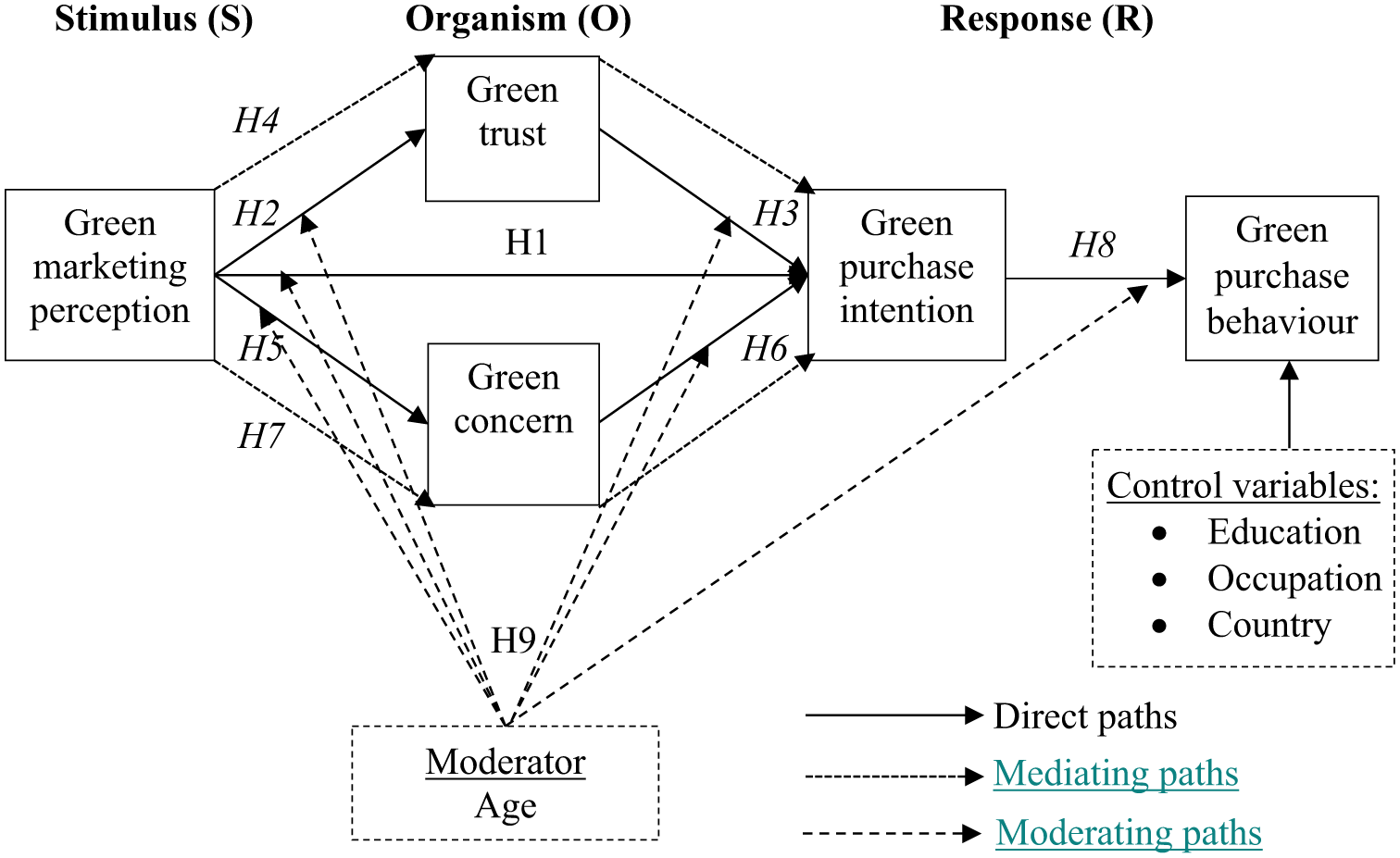
Proposed relationships between the study variables.
Furthermore, it has been observed that green marketing activities wield a strong influence on the green trust of younger populations. Specifically, younger consumers are more susceptible to green marketing and are more likely to trust brands that employ green marketing tactics than older consumers (Waites et al., 2020). Additionally, Aldaihani et al. (2024) found that green packaging as a green marketing strategy has a positive influence on the purchase intentions of Gen Z. Furthermore, Sonkar et al. (2025) identified the moderating effect of generational differences in how consumers respond to green marketing messages. These findings highlight the importance of considering age as a moderator in the relationship between green marketing perception and trust.
A recent study by J. Kumar et al. (2024) has revealed that green trust is crucial in determining the likelihood of Gen X and Gen Y making eco-friendly purchases. Interestingly, the influence of green trust on purchase intention was found to be stronger for Gen X than for Gen Y.
Additionally, the relationship between green concern and the intention to adopt green services is significantly influenced by age (Iqbal et al., 2024). Delistavrou et al. (2021) revealed that among youth, environmental unconcern has a stronger negative impact on pro-environmental purchasing (β = −0.690) compared to adults (β = −0.335), thereby highlighting the moderating effect of age. Furthermore, Dimitrova et al. (2022) discovered that age influences the relationship between green purchase intention and green purchase behaviour. The study revealed a positive relationship between the two constructs. Moreover, it has been affirmed that green purchase intention can significantly predict green purchase behaviour, particularly among individuals from Gen X and Gen Y (J. Kumar et al., 2024).
Based on prior research, we would expect to find differences in consumers’ perceptions of green marketing and their impact on green purchasing based on age:
Materials and Methods
The study employed a self-administered survey to examine the role of green marketing perception in shaping tourists’ purchasing behaviour in the accommodation sector of the Canary Islands. Individuals who had visited at least one of the Canary Islands within the preceding 12 months were invited to participate, ensuring that respondents had recent and relevant travel experience. After data cleaning, which involved removing incomplete and biased responses, the final sample consisted of 693 valid cases for analysis using PLS-SEM.
Research Context
Consumers’ preferences for environmentally friendly behaviour are context-specific (Pham, 2019). The present study focused on accommodation services in the Canary Islands, considering that their contribution to the environmental welfare of the region is significant. Tourist accommodation services were specifically chosen due to their significant contribution to the environmental welfare of the region (Inchausti-Sintes & Voltes-Dorta, 2020) and the industry’s high resource consumption (Choi et al., 2015). The questionnaire focused on hotels, but respondents were encouraged to consider other types of accommodations they were familiar with.
Measurement
The study collected data using a structured and self-administered survey. Each construct was operationalised using multiple reflective measurement items adapted from previous research to ensure both theoretical alignment and contextual relevance to sustainable accommodation in the Canary Islands. All items were assessed using a five-point Likert scale (1 = Strongly disagree, 5 = Strongly agree).
Specifically, the green marketing perception scale was derived from the works of Matthes and Wonneberger (2014), Mele et al. (2019) and Paco et al. (2019). The five specific items were chosen because they capture consumer evaluations of green marketing practices in the hospitality context. We adapted the wording to explicitly reference hotels as the focus of this study.
We utilised a three-item measure developed by P. Kumar and Ghodeswar (2015) to gauge green concern. This scale was selected as it reflects consumers’ general pro-environmental orientation and prioritisation of green choices, which is highly relevant for assessing tourists’ disposition towards sustainable accommodation.
To measure green trust, we used a three-item scale from Ahmad et al. (2022) and Román-Augusto et al. (2022). The scale captures beliefs about the reliability, credibility and honesty of environmentally friendly claims.
Green purchase intention was measured through a four-item scale proposed by Ku et al. (2012), Nekmahmud and Fekete-Farkas (2020) and Román-Augusto et al. (2022). The items operationalise consumers’ willingness and likelihood to opt for sustainable accommodation, which directly aligns with the response component of the SOR framework.
To assess green purchase behaviour, we adopted a three-item measure suggested by Paco et al. (2019), Riskos et al. (2021) and Shrum et al. (1995). The chosen items reflect behavioural tendencies, such as avoiding, switching or actively choosing accommodation options.
Sampling and Data Collection
People who visited at least one of the Canary Islands in the preceding 12 months were the target population for this study. A period of 12 months was considered consistent with previous studies (de Freitas et al., 2020; Guttentag et al., 2018). A screening question was used to identify eligible respondents ensured that respondents had a specific experience in the selected service category. A web-based questionnaire was developed to collect the data. The link to the questionnaire was disseminated by the non-governmental organisation ‘Canary Green’ team in December 2023.
The sampling procedure was non-probabilistic, which is a common sampling strategy in tourism and hospitality research (Ahmed et al., 2023; Richardson, 2009; Turnšek et al., 2020). This approach was appropriate as the study focused on specific and recent travel experiences and required reaching such respondents effectively. However, non-probabilistic sampling may have limited the generalisability of the findings to the whole population of tourists in the Canary Islands. Therefore, the results should be interpreted with a degree of caution, acknowledging that the sample may not reflect the attitudes of all visitor segments.
747 completed surveys were returned. After discarding 54 responses due to outliers, biased and straight-lining responses, and finally, 693 valid responses remained and were used for data analysis in PLS-SEM after thorough data screening.
Data Analysis
As the purpose of the research is prediction, we have chosen to apply Partial Least Squares (PLS) modelling. The estimations were carried out using the SmartPLS 4.0 program. The data analysis was developed in two independent stages: the measurement model analysis and the structural model analysis.
Age was included as a moderator in the current study to differentiate between young and adult consumers. Specifically, the study adopted a recommended age cutoff point of 29 years (König & Larsen, 2017; Lachance, 2012). This study tested the moderating role of age via multi-group analysis (Hair et al., 2016).
Results
Descriptive Statistics
The demographic analysis reported the majority of women (60.6%) in the sample (Table 1). Taking into account their education, most were graduates. Of all respondents, 21.1% were residents of the United Kingdom, and 18.9% were German. Furthermore, 47.9% of the respondents were employed. Most respondents (39.4%) reported annual income up to 24,999 euros.
Respondents’ Profile.

Measurement Model Assessment
Before assessing the measurement model, the potential threat of common method bias was examined. The present study utilised Harman’s single-factor test with variance inflation factor (VIF) to assess the potential threat of common method bias. Following the guidelines proposed by Kock et al. (Kock et al., 2021), all measurement items underwent exploratory factor analysis (EFA). The unrotated factor solutions revealed that only 38.6% of the variance in the variables was accounted for by a single factor. In addition, the VIF values ranged from 1.324 to 1.833, indicating that the dataset was not affected by multicollinearity. Thus, the findings suggest that the potential impact of common method bias on the study’s results was unlikely.
To test the measurement model, we measured Cronbach’s α values for all four constructs to assess scale reliability (Table 2). The values for the measurement constructs ranged from 0.712 to 0.820, which exceeded the minimum cut-off value of 0.70. This suggests that all measurement scales had a good internal consistency of reliability (S.-H. Chang, 2015).
Measures and Properties.

M = mean; SD = standard deviation; FL = factor loadings, CR = composite reliability, AVE = average variance extracted.
Next, we estimated composite reliability (CR) values, ranging from 0.836 to 0.881 (Table 2). All latent factors had CR values above the threshold of 0.70, thus confirming the convergence consistency of scale reliability (Hair et al., 2010).
We then examined the validity of our constructs by examining their convergent validity. To do this, we calculated the Average Variance Extracted (AVE) for each latent factor. These values were greater than 0.5. All 18 items had factor loadings between 0.720 and 0.865, above the cut-off value of 0.7 (Fornell & Larcker, 1981). Therefore, we can conclude that all constructs have sufficient convergent validity.
The Fornell-Larcker criterion and Heterotrait-monotrait ratio (HTMT) were used to confirm discriminant validity. Table 3 displays that the square root of the AVE for each measure exceeded its bivariate correlation coefficients with other constructs. The highest construct correlation is 0.834, indicating that discriminant validity was established. The findings met the HTMT criterion (less than 0.9). As a result, validity measures taken together demonstrate that the measurement model is sufficient in terms of reliability, convergent and discriminant validity.
Discriminant Validity of the Constructs (Fornell-Larcker Criterion).
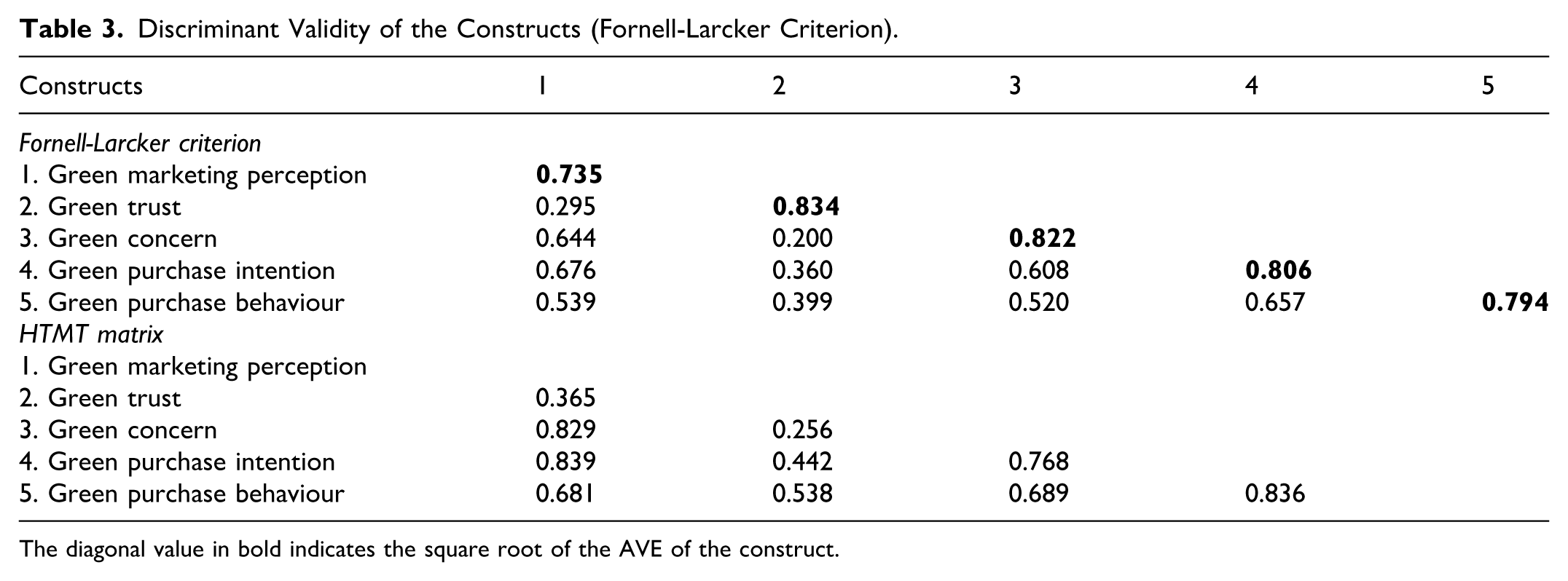
The diagonal value in bold indicates the square root of the AVE of the construct.
Control Variables
The potential effects of education, occupation and country on green purchase behaviour were analysed. The results of the control variables demonstrated that the country (β = 0.278; p = 0.038) significantly controlled consumers’ green purchasing intention. However, education (β = −0.239; p = 0.270) and occupation status (β = 0.117; p = 0.523) did not control green purchasing behaviour.
General Model
In line with the recommendations of Hair et al. (2016), we assessed the structural model by measuring the significance of path coefficients, coefficient of determination (R2), Q2 predictive relevance and model fit as SRMR.
Green marketing perception explained 42% of the variance in green concern and 9% in trust. Furthermore, green marketing perception, green trust and green concern were found to explain 54% of the variance in green purchase intention, while 43% of the variance in green purchase behaviour was explained by purchase intention.
The model’s predictive relevance (Q2) surpassed zero meaningfully, indicating that the endogenous constructs had good predictive relevance through exogenous constructs. The proposed model’s goodness of fit, as measured by SRMR, was 0.076, lower than the recommended threshold of 0.08 (L. T. Hu & Bentler, 1999).
The inner model measurement and the structural model assessment results revealed that the overall model fits the research’s predictive aim. In addition, to test the relationships of all hypotheses, a bootstrapping with 5,000 subsamples was conducted (Figure 2).

A structural model with coefficients, R2 and Q2 values.
The model loadings support all the hypothesised paths (Table 4). The link between green marketing perception and green purchase intention can be confirmed (H1: β = 0.441, p < 0.001). We hypothesised that green marketing would positively impact green trust and, later, green purchasing. The data obtained confirm both hypotheses (H2: β = 0.295, p < 0.001; H3: β = 0.170, p < 0.001). Green marketing perception has a comparatively strong effect (H5: β = 0.644, p < 0.001) on green concern, and the latter significantly predicts green purchase intention (H6: β = 0.289, p < 0.001). As hypothesised, green purchase intention significantly affects actual behaviour (H8: β = 0.656, p < 0.001). Table 4 summarises the hypothesis tests. It can be confirmed that H1, H2, H3, H5, H6 and H8 were supported. The impact of green marketing perception on green concern (H5) and the effect of green purchase intention on actual behaviour (H8) were the strongest overall.
Hypotheses and Results.

n = 693. Estimates represent 5,000 bootstrapping tests.
p < 0.001.
Mediating Effects
A mediation analysis was conducted using bootstrapping resampling with 5,000 subsamples to investigate the role of green trust and green concern as mediators. The results revealed that green trust had a significant indirect effect on green purchase intention (H4: β = 0.050, p < 0.001, CI: 0.030–0.073). However, the variance accounted for (VAF = 10.2%) did not provide clear evidence of either full or partial mediation by green trust, as it was below the recommended threshold of 20% (Hair et al., 2017). Therefore, H4 was not supported. On the other hand, the indirect effect of green concern on green purchase intention was also significant (H7: β = 0.186, p < 0.001, CI: 0.135–0.240). The VAF confirmed partial mediation by green concern (VAF = 29.6%), thus H7 was supported. In practical terms, green concern accounts for nearly one-third of the total green marketing perception effect on purchasing intention, whereas green trust explains only a small share.
Multi-Group Analysis
Our last hypothesis focused on whether age acted as a moderator for the initial hypothesised relationships. To explore this, we conducted multi-group testing, dividing participants into youth (18–29 years) and adult (30 years or more) age groups (Table 5).
Results of Multi-Group Analysis.
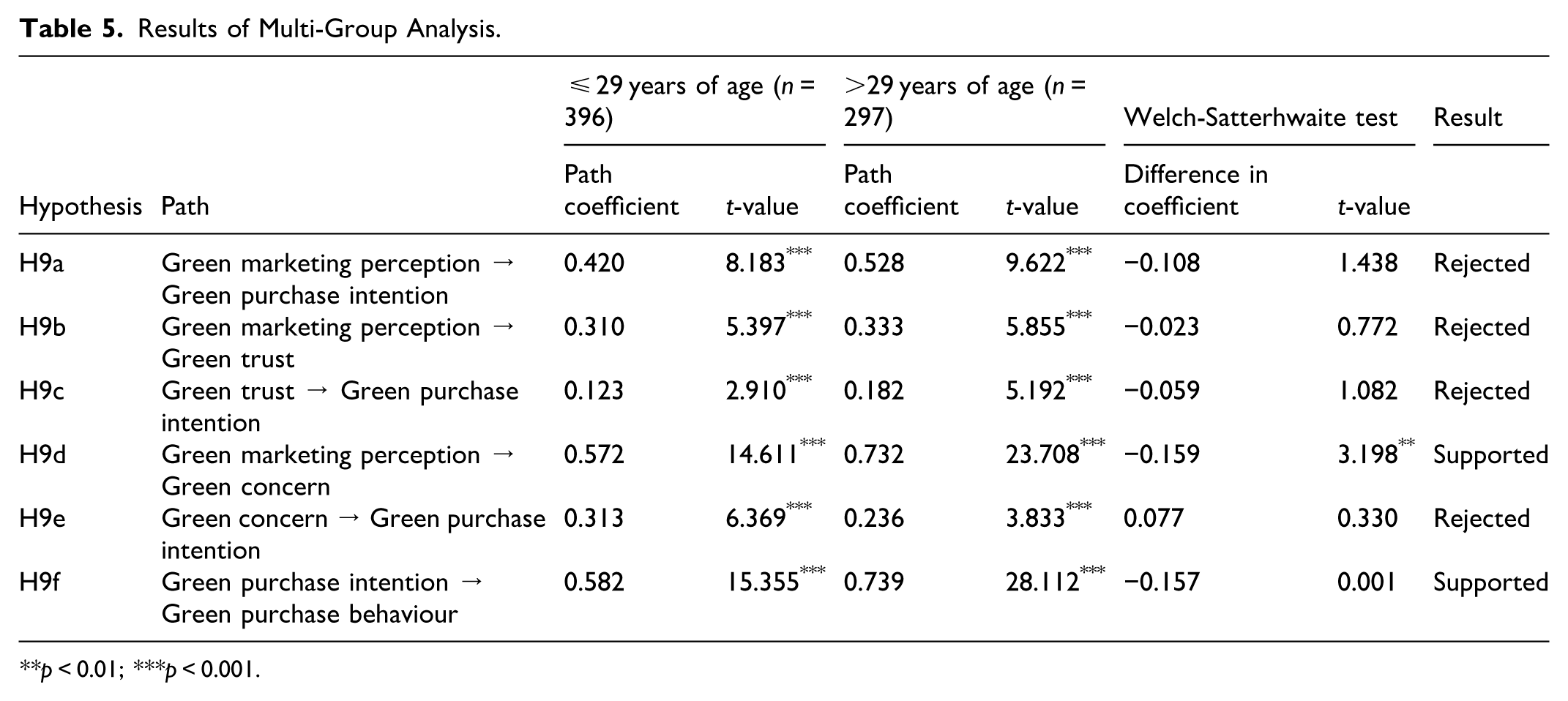
p < 0.01; ***p < 0.001.
Our findings show that the relationship between green marketing perception and green purchase intention is positive for both groups (youth: β = 0.420; p < 0.001; adults: β = 0.528; p < 0.001). Notably, the difference between the two path coefficients is insignificant across the two groups and thus H9a was not supported. Similarly, green marketing perception positively predicted green trust in both groups (youth: β = 0.310, p = 0.449; adults: β = 0.333, p = 0.449). The difference between groups was not significant, meaning H9b was not supported. The relationship between green trust and purchase intention was positive for both youth (β = 0.123; p < 0.001) and adults (β = 0.182; p < 0.001), with no significant difference. Therefore, H9c was not supported. In contrast, green marketing perception had a stronger effect on green concern among adults (β = 0.732; p < 0.001) than among youth (β = 0.572; p < 0.001), and this group difference was significant. Thus, H9d was supported. Moreover, the positive relationship between green concern and green purchase intention was observed for both youth (β = 0.313; p < 0.001) and adults (β = 0.236; p < 0.001), but the difference was not significant. Accordingly, H9e was not supported. Finally, purchase intention significantly predicted actual behaviour for both youth (β = 0.582; p < 0.001) and adults (β = 0.739; p < 0.001), with a significant difference, indicating a stronger effect among adults. Therefore, H9f was supported. This suggests that adults rely more on their intentions to translate into actual behaviour than youth do.
Discussion
The research set out to test and validate an integrative approach to the effect of green marketing perception on green purchase intention and actual behaviour, underpinned by SOR theory. The study used green marketing as a stimulus, which refers to cues from the external environment; green trust and green concern as proxies for the organism, which refer to individuals’ internal cognitions and emotions. Finally, the study used green purchase intentions and actual behaviour as proxies for the response, which represents to consumers’ feedback influenced by the external stimulus and internal organism.
The study’s findings demonstrate the applicability of SOR theory by showing that green marketing can positively influence consumers’ perceptions of green trust and concern, increasing their intentions and strengthening actual behaviour towards green purchases.
A significant finding in this study concerns the expected positive and significant impact of green marketing perception on green purchase intention (H1). The findings demonstrated that green marketing perception significantly predicted green accommodation booking intention (RQ1). This finding aligns with the study of Martins (2022), who discovered a positive relationship between distinct green marketing dimensions and green purchasing.
The results revealed that green marketing perception has a positive effect on green trust and green trust positively predicts green purchase intention, thus supporting H2 and H3. However, the mediation test (H4) showed that the indirect effect of green trust on purchase intention was weak, failing to meet the threshold for partial mediation. These findings, suggesting that while consumers find green marketing initiatives trustworthy, trust alone does not substantially drive intention, are in line with Nguyen-Viet’s (2022) research on milk consumers in Vietnam, confirming trust’s mediating role in the link between green marketing and purchase intent. Thus, green trust appears to act more as a supportive mechanism than a core driver of green purchasing.
Green marketing perception strongly predicted green concern and green concern significantly predicted purchase intention, thus confirming H5 and H6. Moreover, mediation analysis (H7) revealed that green concern significantly mediated this relationship, confirming partial mediation. This finding underscores the central role of green concern as a psychological pathway: consumers who internalize green communication messages develop genuine environmental concern, which in turn fosters their purchasing intention.
As predicted, green purchase intention had a strong positive effect on actual behaviour, thus confirming H8 and highlighting the predictive validity of purchase intention for actual behaviour in the tourism context. This finding reinforces the applicability of the Theory of Planned Behaviour (Ajzen, 1991) that considers intention as an essential determinant of behaviour.
Taking age as a vital factor in researching green purchasing (Dhir et al., 2021; Iqbal et al., 2024; J. Kumar et al., 2024; Srisathan et al., 2023), this study regarded age as a moderator variable. Our findings confirm that age plays a significant role in the relationship between green marketing and green concern (H9d). This suggests that older consumers are more likely to translate green marketing cues into genuine concern; this may be explained by greater life experience and a specific value orientation. These findings are in line with the results of the study conducted by Sonkar et al. (2025), who confirmed that generational differences moderate responses to green marketing messages. Similarly, the link between intention to make green purchases and actually doing so was stronger for the adult group, thus supporting H9f. Younger respondents were less likely to convert their green purchase intentions into actual behaviour than their older counterparts (RQ2). By contrast, no significant age differences were found for the relationships between green marketing perception and purchase intention (H9a), green marketing perception and trust (H9b), green trust and purchase intention (H9c), or green concern and purchase intention (H9e). Taken together, these findings offer important insights into intergenerational differences in green purchasing.
The findings may be explained through the lens of the Elaboration Likelihood Model (Petty & Cacioppo, 1986), which posits that the processing of persuasive messages goes through a central route (deep cognitive elaboration of arguments) or a peripheral route (surface-level cues). The weaker translation of green marketing cues into green concern and actual behaviour among the younger consumer group suggests a greater reliance on peripheral processing. In contrast, adults seem to engage more in central processing, more carefully integrating green marketing messages with the existing values. This explains the stronger concern formation and greater behavioural consistency among the adult group. The integration of ELM with the theory of intergenerational differences (Mannheim, 1952) provides a theoretical foundation for the observed moderation effects of age, showing that both cognitive processing styles and socio-historical contexts are relevant in shaping consumers’ behaviour.
Conclusion, Implications and Limitations
This study provides evidence supporting the capacity of the SOR theory, initially developed for environmental psychology, to be extended and applied to the study of tourists’ behaviour, particularly concerning their intentions to choose sustainable accommodation and their actual behaviours. The research also reveals the mediating role of green concern in the relationship between green marketing perceptions and purchasing decisions. The findings demonstrate the strength of green concern in boosting green purchase intentions, emphasizing the importance of fostering green concern to encourage tourists to select sustainable accommodation. This expands the SOR framework, showing that concern rather than trust is the stronger organism variable that translates external marketing stimuli into actual purchasing behaviour.
This research has significantly contributed to the existing body of knowledge. First, the study’s results validate the use of the SOR framework, including green marketing as an environmental stimulus that encourages green trust and green concern as internal states of individuals, which further influence intentions and actual behaviour as responses. By empirically distinguishing between the two organism variables, the study clarifies that concern serves as a stronger mediator than trust, extending previous applications of the SOR model. The application of the SOR theory provides substantial value to the research model for green marketing studies and can be extended to other research involving sustainable organisational practices. Secondly, the study aimed to enhance knowledge of the differences in green purchase behaviour among young and adult travellers. By measuring the moderating effect of age, the study highlights the diverse effects of green marketing perception, green trust and green concern in explaining the complexity of the green purchasing phenomenon. These factors have not been analysed cohesively before, either among young travellers or among adults. The weaker concern among the youth suggests an intergenerational processing gap, offering a new angle to integrate information processing theories, such as the Elaboration Likelihood Model. Thirdly, the research consolidates distinct findings on green marketing, purchase intention, concern and trust from the tourism market perspective. As such, the findings serve as a valuable guide for further studies in tourist destinations.
This study provides valuable insights for marketing teams, tourism organisations and policymakers to enhance the consumption of green tourism products. Firstly, the study results suggest that improving travellers’ perceptions of green marketing practices is not enough to increase green purchases among both young and older consumers. To encourage green purchasing, hotels and other accommodation providers must develop effective marketing strategies that include environmentally friendly messaging and education to strengthen consumers’ green trust and concern. Green marketing without these tools will not motivate consumers to make sustainable purchasing choices. In particular, strategies targeting younger travellers should prioritise deepening green concern, for example, through experiential tourism activities, interactive campaigns and digital storytelling. Secondly, the study highlights the need for tourist accommodation entities to strengthen travellers’ trust. The overall level of green trust among Canary Islands tourists was not high, indicating that this area requires further development. Lastly, it is recommended that all stakeholders, including government, tourism associations, service providers, travellers and green marketers, unify their efforts and cooperate in promoting environmental welfare. It is also recommended to develop guidelines for sustainable accommodation to create best practices in supporting travellers’ interests and influencing their purchasing choices.
Although this research has its merits in explaining travellers’ behaviour in purchasing accommodation services, it is not beyond certain limitations that may be treated as possible avenues for future studies. The first limitation is that the research was geographically confined to the Canary Islands. The generalizability of the research results needs to be expanded to include other tourist destinations through further studies with a comparative viewpoint to understand the issue better. Secondly, all variables were measured during a single period, leaving room for future studies to validate the conceptual model longitudinally. Thirdly, the use of a non-probability sampling approach may have introduced self-selection bias, as individuals who are more interested in sustainability could have been more likely to participate. Fourthly, the cross-sectional design prevents conclusions about causality and limits the possibility of observing behavioural changes over time. Future research could therefore employ longitudinal studies or qualitative follow-ups to capture the dynamics. Finally, while this study explored the impact of green marketing on tourist accommodation booking, other tourist products must be investigated to encourage sustainable travel.
Footnotes

Ethical Considerations
The study was conducted according to The Code of Academic Ethics of Vilnius Gediminas Technical University. As the Institution does not have an Ethics Committee, ethics approval was not required.
Consent to Participate
Informed consent was included in the questionnaire. All respondents’ information was anonymized. Respondents’ data will not be shared with third parties.
Funding
The authors received no financial support for the research, authorship and/or publication of this article.
Declaration of Conflicting Interests
The authors declared no potential conflicts of interest with respect to the research, authorship and/or publication of this article.
Data Availability Statement
The dataset analysed during the current study are available from the corresponding author on reasonable request.