




Abstract
A compelling question that constantly arises in our society today is “How do we build a healthy brand that is closely associated with environmental activities?” Enhancing green brand equity is among the answers. This article integrates consumer environmental values with brand knowledge and brand relationships to arrive at an integrated view of how green brand equity can be maximized. Our research employs a questionnaire-based survey to collect data from consumers of electronics products in Ho Chi Minh City using a cluster sampling method. A structural equation modeling method was used to validate the hypothetical relationships. Our analysis suggests that (a) attitudes toward green products and the environmental concern affect consumer’s associations with the green brand, followed by green brand equity and (b) an eco-friendly image and trust in the brand’s green commitments drive a competent green brand. Our article broadens the current understanding of green consumers’ behavior by providing a theoretical model that investigates the associations between brand relationships and consumers’ personal motives which are closely connected with green brand management. Altogether, this study presents a broad picture of green branding mechanisms.
Keywords
Introduction
Modern economic activities have severely deteriorated the quality of the environment, posing serious problems worldwide (Chen, 2008). Many companies are adopting green marketing in response to rigorous regulations as well as a shift in consumer preferences (Chen et al., 2006; Grant, 2008). The benefits gained from joining the green movement inspired many firms to embrace eco-friendliness as a guiding principle of their businesses (Mourad & Serag Eldin Ahmed, 2012). There are a great number of reasons for promoting the implementation of a more eco-friendly business, such as motivations to achieve the firm’s goals, authority requirements, social responsibility, and competitive advantage (Polonsky, 1994). Economic benefits can eventually be generated and social responsibilities can be fulfilled by green initiatives (Mourad & Serag Eldin Ahmed, 2012). No firms can ignore green marketing if they want to remain competitively important in the marketplace (Chen, 2010; Ha, 2020; Ha & Trinh, 2021).
Commonly believed to describe just the promotion of green product attributes such as “eco-friendly” and “recyclable,” the term “green marketing” actually covers a full range of green initiatives observed in all business activities (Chen, 2010; Ha, 2020; Ha & Trinh, 2021; Polonsky, 1994). When competition grows high, businesses must focus on establishing a competent green brand that can make all marketing mix dimensions become green (Kang & Hur, 2012; Polonsky, 1994). In addition to developing environmentally friendly products without offsetting traditional characteristics, businesses also have to respond to the increasing challenge of creating positive customer perceptions of the corporate attempts to sustain the environment (Ng et al., 2014). Therefore, establishing a brand that is solidly eco-friendly in consumers’ minds requires considerable contributions from both organizations and academians. This primary purpose is closely linked to “green brand equity” (GBE) development, that is, the intangible assets of a brand related to its environment-related activities that may produce additional values to its products and services (Chen, 2010; Ha, 2020; Ha & Trinh, 2021; Keller, 1993; Yoo et al., 2000). Brand equity (BE) brings financial benefits as well as nonfinancial advantages to the firm, including competitively enhancing strengths and creating a range of options for an extension of a brand (Kang & Hur, 2012; Yoo et al., 2000). Furthermore, BE provides managers with insightful understanding into the desires and preferences of the customers (Mohd Yasin et al., 2007). It also functions as a connection between the previous and prospective marketing efforts. In other words, BE is built on past marketing efforts, which in turn forms a baseline to guide later actions (Keller, 1993).
There have been several attempts, including those by Ha (2020), Ng et al. (2014), and Chen (2010), to discover the determinants which constitute GBE. However, the previous research mostly examines green brands without considering consumers’ personal factors. They introduced many concepts, including green satisfaction (GSA), green brand image (GBI), and green trust (GTR), although none included the internal processes of consumers. The synthesis by Chamorro et al. (2009) revealed that green marketing research consists of two prominent branches: behavior perspective and communication perspective. The former is concerned with general patterns of green behaviors that can be explained by theories of consumers’ values, beliefs, and attitudes (Bamberg, 2003; Butt et al., 2016; Joshi & Rahman, 2015; Lin & Huang, 2012; Stern et al., 1999). The latter, on the contrary, primarily revolves around the impacts of brand building activities on consumers’ environmentally responsible actions (Bekk et al., 2016; Butt et al., 2016; Chen, 2010; Ha, 2020; Ha & Trinh, 2021; Kang & Hur, 2012; Ng et al., 2014). The issue arises when most scholars address these two strands of research in isolation. Green brand frameworks completely neglected the role of consumers’ motivations, which may be the cause of failure in discerning the connection between environmental values and actual eco-friendly behaviors (Butt et al., 2016). Brands and consumers exist in a close-knit interdependent relationship. Green brands act as a means for consumers to carry out their intended actions (Butt et al., 2016). Kotler and Keller (2016, p. 351) contended that “there are no brands without customers and there are no customers without brands.” Thus, the most appropriate method to examine the nature of green marketing is to link personal values with models of brand associations and relationships (Butt et al., 2016; Ng et al., 2014).
By linking personal drivers, including attitudes toward green products, and environmental concerns, with concepts of brand (BE, trust, satisfaction, and brand image), this article aims at establishing an integral strategy to explain the determinants of GBE. Several theories, including the theory of planned behavior (TPB) (Ajzen, 1991), image congruence theory (Hogg et al., 2000), and means-end theory (Gutman, 1982), are employed to justify the relationship between environmental concerns and how customers evaluate a green brand. The formulation of antecedents of GBE is primarily based on the “associative network memory model” (Keller, 1993, p. 2) and theories of brand relationships (Blackston, 1993; Esch et al., 2006; Fournier, 1998). This article makes an important contribution by establishing and verifying a model that investigates the connections between consumers’ personal motives and brand relationships which are closely connected with green brand management to maximize GBE. In addition, this article is among the very few studies which add values to the increasing literature of green brand management. This helps to systematically and comprehensively broaden our understanding of the behavior of green consumers.
Literature Review and Hypothesis Development
GBE
A construction of a powerful brand is a strategically critical mission for every business (Kang & Hur, 2012). Having strong BE provides financial benefits to a company while also providing nonfinancial benefits such as enhancing competitiveness and creating potentials for the extension of a brand (Kang & Hur, 2012; Yoo et al., 2000). Furthermore, it acts as a link between marketing efforts in the past and future events. It is built on past marketing efforts, which in turn forms a benchmark for guiding forthcoming activities (Keller, 1993). In addition, BE provides decision makers with useful knowledge into the interests and preferences of consumers (Mohd Yasin et al., 2007).
This body of research has resulted in a number of different definitions of BE. In the case of BE, it has been proposed by a number of academicians that it may be characterized as the added value that the brand generates (Chen, 2010; Farquhar et al., 1991; Kamakura & Russell, 1993; Mohd Yasin et al., 2007). Another school of thought asserted that BE is the change in the total brand value and the total value of its tangible assets (Yoo et al., 2000). The majority of works may be divided into three types of main paths: those that are strictly financial in nature (Simon & Sullivan, 1993), those that are purely customer in nature (Keller, 1993; Yoo & Donthu, 2001), and those that are a combination of the two (Dyson et al., 1996; Motameni & Shahrokhi, 1998). This research studies BE as a consumer-centric liability, hence providing a basis for the integration with consumer decisions and consumer values.
Customer-based brand equities are intangible assets of a brand resulting from marketing activities that differentiate it from its rivals even though they offer no distinction any feature other than brand name (Bekk et al., 2016; Keller, 1993; Yoo et al., 2000). BE is a multifaceted concept that includes “brand associations,” “brand loyalty,” and “perceived quality” (Aaker, 1996, p. 105). Later, Yoo et al. (2000, p. 201) coined these terms as “overall brand equity.” Chen (2010, p. 310) characterizes it as “a set of brand assets and liabilities about green commitments and environmental concerns linked to a brand, its name and symbol that add to or subtract from the value provided by a product or service.”
GBI and Brand—Consumer Relationships
As a relational asset, GBE is driven mainly by associations with stakeholders outside the control of the business. To be specific, BE is the final outcome of the interplay between a brand and its customers where trust and satisfaction are key drivers. Together, all of these factors are provoked by brand knowledge (Esch et al., 2006). With respect to this view, this study proposes three fundamental antecedents of BE, including GBI, GSA, and GTR.
GBI
Keller (1993, p. 2) characterizes “brand knowledge” as a critical component of BE and is crucial as it influences “what come to mind when a consumer thinks about a brand.” Keller (1993, p. 3) further characterizes “brand image” as the “perception about a brand as reflected by the brand associations held in consumer’s memory,” and asserts that it is essential to “brand knowledge.” Green brands differentiate themselves from their competitors through notable green benefits, thereby achieving the affection of environmentally conscious customers (Grant, 2008). Chen (2010, p. 309) characterizes GBI as “a set of perceptions of a brand in a consumer’s mind that is linked to environmental commitment and environmental concerns.”
Appropriate marketing strategies, such as product quality or price, can improve brand image (Theotokis et al., 2012). When marketing strategy is inspired by environmental consciousness, a corporate’s GBI is expectedly elevated (Joshi & Rahman, 2015). Green brands differentiate themselves from their competitors by significant environmental benefits, thereby attracting environmentally conscious consumers (Grant, 2008). Green brand imaging is known as possibly being able to influence customers’ buying behaviors (Rahmi et al., 2017).
The perceptions of customers, particularly those who are committed to the environment, constitute a GBI (Ha, 2020; Ha & Trinh, 2021; Mourad & Serag Eldin Ahmed, 2012). To be considered “green,” a brand should trigger significant environmental attitudes, perceptions, and practices of consumers (Ng et al., 2014). Moreover, GBI pertains to both green product and the behavior of firms toward the environment. GBI can be measured through some criteria such as performance, reputation, benchmarks, trustworthiness, and environmental issues (Chen, 2010; Ha, 2020). Various studies have postulated that brand image positively affects and substantially strengthens BE (Bekk et al., 2016; Butt et al., 2016; Chen, 2010; Faircloth et al., 2001; Ha, 2020; Ha & Trinh, 2021; Namkung & Jang, 2013; Ng et al., 2014). Hence, the following hypothesis is proposed.
Hypothesis 1 (H1): GBI will be significantly associated with GBE.
Brand–consumer relationships: GSA and GTR
Brand image on its own is sometimes inadequate for distinguishing one brand from another because it only reflects customers’ superficial perceptions of a brand’s features whereas brand association goes more deeply into consumers’ evaluations of a brand’s attitudes (Blackston, 1993). Brand relationship theories contend that the engagement of consumers with certain brands is comparable to that of their interpersonal relationships (Blackston, 1993; Esch et al., 2006). The connection with a brand influences consumers’ emotions and thoughts, thus constituting a close-knit bond between the brand and customers (Esch et al., 2006; Fournier, 1998). Eventually, as relationship-based assets, brand relationships can be considered crucial contributing to BE (Esch et al., 2006).
Esch et al. (2006) posit that brand–consumer relationships can have two defining characteristics. The first is trust that resembles the collective dimension of a connection in which one individual has some sentiments about the other. The second is satisfaction that is the product of the sharing dimension in an association in which the attitude of an individual centers around comparing what is given and what is received (Esch et al., 2006).
Trust seems to be a commonly discussed subject in several fields such as marketing and psychology (Chen, 2010; Delgado-Ballester & Luis Munuera-Alemán, 2005; Ha, 2020; Ha & Trinh, 2021). It reflects the trust in the brand’s ability to convey its promises (Chaudhuri & Holbrook, 2001; Delgado-Ballester & Luis Munuera-Alemán, 2005). In addition, trust can be considered to be one of the primary drivers of a brand-consumer tie (Chen, 2010; Delgado-Ballester & Luis Munuera-Alemán, 2005; Flavián et al., 2005; Ha, 2020; Ha & Trinh, 2021). The theory of social exchange implies that people behave according to their assumptions about the incentives they earn (Blau, 1986; Cook et al., 2013). Mistrust, according to the fundamental reciprocity rule, creates distrust, and leads to a decline in long-term commitment (Morgan & Hunt, 1994). Furthermore, signaling theory posited that asymmetric information exists on the market because only businesses are certain of the quality of the product, whereas customers cannot fully assess it (Erdem & Swait, 1998; Stiglitz, 2002). Under these circumstances, the brand name is a promise of quality.
Trust becomes far more prominent in the context of growing environmental concerns, where customers are wary of a brand’s commitment to environmental sustainability as a result of greenwashing (Chen & Chang, 2013). The dishonesty of self-declared green brands in the long run will damage the trust of customers in not only certain brands but also the whole green market (Chen et al., 2014). Prior studies back up the idea that a higher level of trust in green marketing can increase GBE (Akturan, 2018; Butt et al., 2016; Chen, 2010; Ha, 2020). Consequently, we formulate the hypothesis as follows:
Hypothesis 2 (H2): GTR will significantly influence GBE.
Oliver (2010, p. 8) characterizes “satisfaction is the consumer’s fulfillment response. It is a judgment that a product/service feature, or the product or service itself, provided a pleasurable level of consumption-related fulfillment.” GSA reflects a consumer-related state of happiness when a brand fulfills the environmental demands and desires of consumers (Chang & Fong, 2010; Chen, 2010). Previous works confirmed how satisfaction leads to customers’ behavioral loyalty (for example, word of mouth and the desire to repurchase) (Hallowell, 1996), and attitudinal loyalty (e.g., brand attachment) (Esch et al., 2006; Hallowell, 1996). Customers are expected to remember the products or items that please them more than other rival brands (Chen, 2010). Those results are indicative of BE as it is a reflection of the customer’s favorable attitude and purchasing behaviors (Mohd Yasin et al., 2007). Pappu and Quester (2006) further posited that happy users should have solid and positive relationships with a brand. In a similar vein, numerous studies have reported that satisfaction positively influences GBE accordingly (Bekk et al., 2016; Chen, 2010; Kim et al., 2008; Pappu & Quester, 2006). Therefore, we formulate the hypothesis as follows:
Hypothesis 3 (H3): GSA will positively impact on GBE.
Fundamentally, satisfaction is an essential component of trust because trust stems from past interactions and brand awareness (Esch et al., 2006; Garbarino & Johnson, 1999). When it comes to trust, interactive experience, either indirect (e.g., brand communication or word of mouth) or direct (e.g., consumption), has the greatest impact because it generates the most legitimate and intimate relationships (Delgado-Ballester & Luis Munuera-Alemán, 2005). In turn, a successful affirmation of success of a brand would improve customer interest in the competence and trustworthiness of that brand, thereby creating a high trust level (Lankton et al., 2010). In other words, how much customers are satisfied decides how much they trust a brand (Delgado-Ballester & Luis Munuera-Alemán, 2005). The affirmation is also supported by previous studies in green brand management (Ha, 2020; Kang & Hur, 2012; Wang et al., 2018). Therefore, we formulate the hypothesis as follows:
Hypothesis 4 (H4): GSA will be positively correlated with GTR.
Brand relationships emerge from brand image as consumers cannot create brand relationships unless they have a brand image in their minds (Delgado-Ballester & Luis Munuera-Alemán, 2005). Furthermore, trust may also be judged on the basis of consumer assessment by either direct or indirect exposure of brand associations (Delgado-Ballester & Luis Munuera-Alemán, 2005). Consumer trust is increased by virtue of a positive corporate image (Flavián et al., 2005). Businesses marketing themselves as green may take into account the need of developing a trustworthy image as it will increase certainty and reduce the cost of information discovery for consumers (Erdem & Swait, 1998). This claim has been supported by various studies as well (see, for example, Bekk et al., 2016; Butt et al., 2016; Chen, 2010; Delgado-Ballester & Luis Munuera-Alemán, 2005; Esch et al., 2006). In a similar vein, brand image and satisfaction are expected to correlate each other. Brand image is considered to be an account of previous behaviors which can be used to predict potential brand experiences (Martenson, 2007). As a consequence, brand image shapes consumer preferences, which in turn affects satisfaction. It was found that brand image affects consumer satisfaction in various sectors, including retail (Ha, 2020; Martenson, 2007), green marketing (Bekk et al., 2016; Chen, 2010), telecommunication (Yeboah-Asiamah et al., 2016), and tourism (Chi & Qu, 2008). Thus, we posit the hypotheses as follows:
Hypothesis 5 (H5): GBI positively affects GTR.
Hypothesis 6 (H6): GBI positively affects GSA.
Attitudes Toward Green Products and Environmental Concern
Various attempts have been made to precisely explain environmental concern (Bamberg, 2003). Fransson and Gärling (1999) reviewed literature in this field and asserted that environmental concern has been primarily conceptualized under two approaches: (a) an evaluation or attitude toward a specific object or behavior that concerns the environmental well-being and (b) a general value orientation. This study employs the second approach that treats the concept under the broader scope of a value system. Environmental concern, in the context of this study, encompasses a person’s general perception, feelings, attitude, and values relating to environmental issues (Bamberg, 2003; Dunlap & Van Liere, 1978; Fransson & Gärling, 1999; Maloney & Ward, 1973; Weigel & Weigel, 1978). Environmental concern is a key element in determining consumer eco-friendly behaviors. Extensive research has shown that environmental concern is among the most critical drivers of environmental-friendly actions (Balderjahn, 1988; Bamberg, 2003; Czap & Czap, 2010; Fransson & Gärling, 1999; Roberts & Bacon, 1997).
In a similar vein, it was found that value, attitude, and behavior create a sequence that explains how a person performs an action (Homer & Kahle, 1988). Specifically, value guides the formulation of attitude, then attitude inclines a person to act accordingly. Three different levels occur in which value is the most abstract; behavior is the most tangible; and attitude is in between the two extremes. This approach explains how environmental concerns, attitudes toward green products, and consumer perceptions of eco-friendly brands interact with each other.
Value is the core component that shapes human thoughts, beliefs, and attitudes (Rokeach, 1973; Vaske & Donnelly, 1999). Environmental values influence consumer actions by framing our perception of a specific situation. Such a perception affects consumer attitude, behavioral control, and subjective norms, all of which are antecedents of actual behaviors (Bamberg, 2003; Fishbein & Ajzen, 1975). Furthermore, image congruence theory implies that attitude serves a “value expressive” function as one tries to meet internalized standards and accomplish self-worth (Hogg et al., 2000, p. 643). Accordingly, green consumers expected to have favorable attitudes regarding green brands to maintain a harmony between their internal environmental values and their consumption patterns (Butt et al., 2016). Attitude then also acts as a “filter” on a person’s perception of an object (Lutz, 1991). Brand attitude is among the most critical components which affect brand images, so a favorable attitude toward eco-friendly products may stimulate a favorable perception of eco brands (Keller, 1993). In addition, a favorable attitude toward a product group is likely to produce a preference for brands belonging to that group (Shamim & Butt, 2013; Walgren et al., 1995).
Value-Belief-Norm theory (VBN) proposed that beliefs and values in regards to environment serve as a major driver of pro-environmental behaviors (Stern et al., 1999). Lee (2008) found environmental concern was the second most influential factor that affects Hong Kong’s millennial green consumption behaviors. Similarly, consumers who care about the well-being of the environment are more likely to consume renewable energy (Hartmann & Apaolaza-Ibanez, 2012). As TPB posits, attitude is a reliable precedent of behavior (Ajzen, 1991). Therefore, environmentally sustainable consumption is expected to positively associate with attitude toward green brand and products. Thus, it is reasonable to formulate the hypothesis as below:
Hypothesis 7 (H7): Environmental concern has a significant association with attitude toward green products.
Means-end theory speculates that consumers make decisions based on the consequences that an action may yield (Gutman, 1982). As a result, consumers may find a brand beneficial if it satisfies their personal values (Dibley & Baker, 2001). Those who are concerned about the environment often assume that eco-friendly brands benefit them in such a way that their environmental values can be met, thus associating them with positive images (Butt et al., 2016). Image congruence theory also implies that choices of products are motivated by the desire to maintain and strengthen their self-concepts (Grubb & Grathwohl, 1967). Consumers tend to navigate toward purchasing products that adhere to their images to promote self-consistency (Sirgy, 1982). If an individual is pro-environmental, his or her choice of brands should fall into the eco-friendly range.
Environmental values influence how consumers perceive a green brand through their ability to stimulate adjustment or modification in buyers’ attitudes (Bamberg, 2003). In particular, values affect consumer behavior indirectly by framing their perception of a given situation. Such a perception affects consumer attitude, behavioral control, and subjective norms which are antecedents of actual behaviors (Bamberg, 2003; Fishbein & Ajzen, 1975). Besides, brand attitude is also one of the most important components influencing brand images (Keller, 1993), so a positive attitude toward green brands would give these brands a favorable perception. It also acts as a “filter” on a person’s perception of an object (Lutz, 1991). Research proposed that environment-conscious consumers generally hold positive perceptions toward eco-friendly brands (Butt et al., 2016; Ottman et al., 2006). Therefore, we propose the hypotheses as follows:
Hypothesis 8 (H8): Environmental concern and GBI are positively correlated.
Hypothesis 9 (H9): Attitude toward green products and GBI are positively correlated.
Figure 1 presents a hypothesized model of this article that shows the interrelationships among the variables of interest.
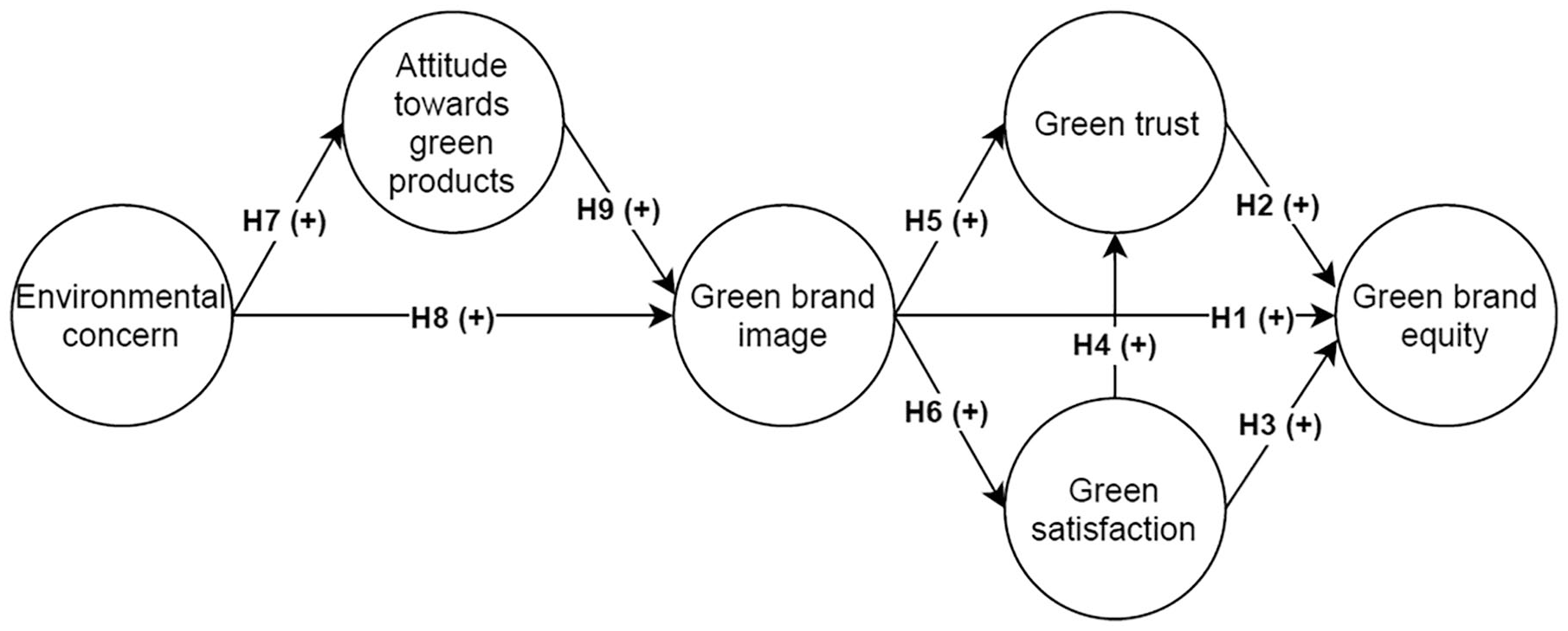
Hypothesized model.
Methodology
Data Collection and Sampling
To validate the proposed hypotheses, our research adopted a questionnaire-based survey design. Respondents for this study are customers who purchased electronics products in HCMC, the busiest city in Southern Vietnam. Domestic appliances, which are the objects of this study, consist of refrigerators, air conditioners, washing machines, televisions, stoves, freezers, dishwashers, and so on. These products were selected as a vast majority of customers regularly use them in their daily lives, and environmental technologies were used intensely. Such commodities are also subject to very strict international environmental laws and regulations, including Kyoto Protocol, Vienna Convention, Montreal Convention, and the like, so consumers need to buy environmentally friendly domestic appliances and electronic products to meet their environmental needs (Chen, 2010; Chen et al., 2006). A group of 15 participants each participated in a face-to-face interview for a pretest (Malhotra & Dash, 2016). The objective of the pretest was to find out and eradicate possible errors as regards wording, content, sequencing, and question difficulty (Malhotra & Dash, 2016). The responses to the pretest questionnaire provided valuable feedback that helped to improve the construct validity of the questionnaire (Shadish et al., 2002).
Data were collected by trained third-year students using a face-to-face interview technique. The use of this technique can decrease the probability of nonsampling errors in data collection (Malhotra & Dash, 2016). The cluster sampling method was used (Malhotra & Dash, 2016; Trochim et al., 2016) to choose five districts out of a total 24 in HCMC at random, and then 400 customers who purchased electronics products at big electronics product stores in these five randomly selected districts at both weekends and weekdays, various time slots of the day to prevent noncoverage problems and periodicity (Pappu & Quester, 2008). The application of the cluster sampling method contributes to generalizability of the findings (Shadish et al., 2002). Data gathering took place during December 2019 and January 2020 which was the peak time for shopping during the year in Vietnam as customers prepared their homes for Tet holidays in the lunar calendar. Data screening returned 302 valid responses ready for analysis, yielding a high response rate of 75.5%, and this decreases the probability of response bias (Colton & Covert, 2007). All respondents are aged between 25 and 60. Females account for 71.2% of the respondents, and males account for 28.8%.
Measure of Constructs
The questionnaire used existing scales adapted from previous research to establish content validity (Trochim et al., 2016). The scale for attitude toward green products was adapted from Butt et al. (2016); the scale for environmental concern was adapted from Butt et al. (2016) and Lee (2008); the scale for GBE was adapted from Chen (2010) and Yoo et al. (2000); the scale for GSA was taken from Chen (2010) and Wang et al. (2018); the scale for GTR was taken from Butt et al. (2016) and Chen (2010); and the scale for GBI was taken from Chen (2010) and Huang et al. (2014). Likert-type scales (5-point) from “1” (“strongly disagree”) to “5” (“strongly agree”) were used to assess the measures. Table 1 exhibits all constructs and measures.
Constructs, Measures, Reliability, and Convergence Validity Testing Results.
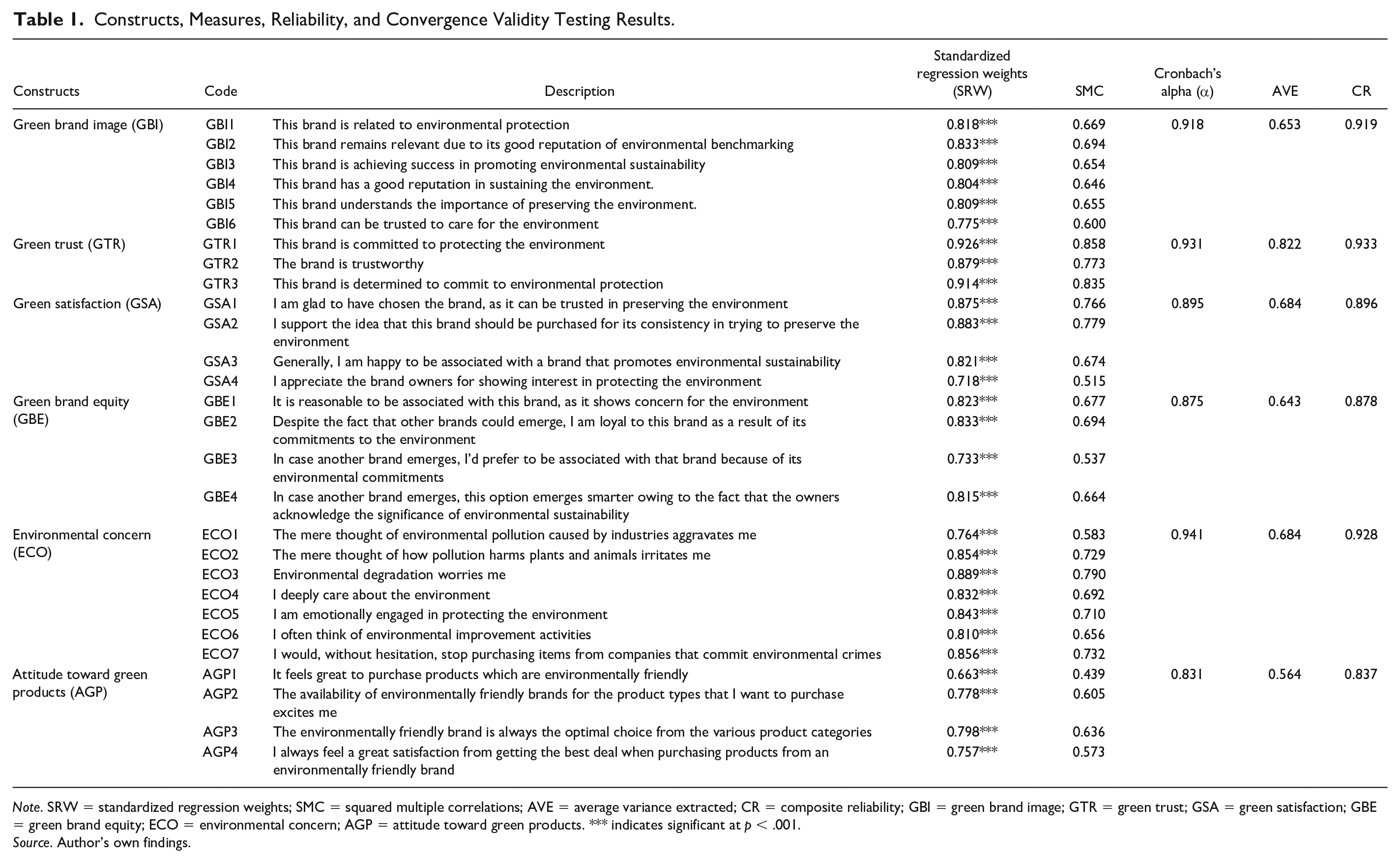
Note. SRW = standardized regression weights; SMC = squared multiple correlations; AVE = average variance extracted; CR = composite reliability; GBI = green brand image; GTR = green trust; GSA = green satisfaction; GBE = green brand equity; ECO = environmental concern; AGP = attitude toward green products. *** indicates significant at p < .001.
Source. Author’s own findings.
Data Analysis
We employed IBM AMOS version 24 to analyze data using a two-step procedure (Anderson & Gerbing, 1988). The first is to assess a measurement model, including evaluation of model fit, reliability, and validity. The reliability test used composite reliability (CR), which should surpass a threshold of 0.70 (Fornell & Larcker, 1981). Then, both convergence validity and discriminant validity are verified. The convergence validity test verified SRW that must be statistically significant for all items (Anderson & Gerbing, 1988). The SMC (squared multiple correlations) must be greater than 0.40 for all items (Bollen, 1989); and the AVE (average variance extracted) must be larger than 0.50 for all latent variables or constructs (Fornell & Larcker, 1981). The discriminant validity test achieves when the square root of the AVEs for each construct is larger than the variance of any of the interconstruct correlations (Fornell & Larcker, 1981). Ultimately, goodness-of-fit indices were used to evaluate the model fit for both the measurement and structural models, respectively. These include comparative fit index (CFI) or Tucker–Lewis index (TLI), root mean square error of approximation (RMSEA), and standardized root mean square residual (SRMR) (Hu & Bentler, 1999).
Results
Evaluation of Measurement Model
Initially, there are two key assumptions to be handled. This means that there should be no outliers in the data set and the data are normally distributed (Byrne, 2016; Kline, 2015). Data screening detected and eliminated a total of four outliers. The normality assessment was carried out by employing kurtosis and a skewness test. It is confirmed that, if the kurtosis is smaller than 7.0, and skewness is smaller than 3.0 in an absolute value, then the data are normally distributed (Byrne, 2016; Kline, 2015). Furthermore, no missing data were found in the data set.
Table 1 presents the SRW, SMC of all indicators, and the CR and AVE of all constructs in our measurement model. We can see that all SRWs are significant at p ≤ 0.001 (Anderson & Gerbing, 1988), and were >0.50 (Hair et al., 2019). All SMCs were well above the threshold value of 0.40 (Bollen, 1989). All CRs (ranging from 0.837: AGP to 0.933: GTR) were well above the cut-off value of 0.70, and all AVEs (ranging from 0.564: AGP to 0.822: GTR) were > 0.50 (Fornell & Larcker, 1981), implying that our model met the convergence criteria. All α were from 0.831 (AGP) to 0.941 (ECO), implying that the measures are reliable and exceeded 0.70 threshold (Nunnally & Bernstein, 1994).
The discriminant validity was further assessed. Table 2 shows that no violation of discriminant validity can be found following Fornell and Larcker’s (1981) criteria. Model fit statistics showed an excellent fit. Specifically, χ2 = 658.695 (df = 335, p = .000), CMIN/df = 1.966, SRMR = 0.042, CFI = 0.950, TLI = 0.943, and RMSEA = 0.057 (Hu & Bentler, 1999). Therefore, the constructs’ validity and reliability are confirmed.
Discriminant Validity Results.

Note. AVE = average variance extracted; AGP = attitude toward green products; ECO = environmental concern; GBI = green brand image; GSA = green satisfaction; GBE = green brand equity; GTR = green trust. ***significant at p < .001 level.
Source. Author’s own findings.
Evaluation of Structural Model
After CFA, a structural analysis was performed. Table 3 entails the results of hypothesis testing. Except H3, all remaining hypotheses are significant at ρ ≤ 0.05. The subsequent procedure involves an estimation that uses maximum likelihood method to validate all the hypothesized relationships postulated from the research model (Byrne, 2016). Model fit measures revealed that χ2 = 720.698, p = .000 with 341 df. With the χ2/df (2.113) within the thresholds of 1 and 3, the model was proved to be parsimonious. The SRMR was 0.064, and RMSEA was 0.061, while CFI was 0.941. Overall, all findings revealed that our model renders absolute and incremental goodness of fit from acceptable to excellent level (Hu & Bentler, 1999; Hair et al., 2019). All associations apart from H3 were significant as their probability values were below 0.01. The results of model testing are presented in Table 3.
Hypothesis Testing Results.

Note. GBE = green brand equity; GBI = green brand image; GTR = green trust; GSA = green satisfaction; AGP = attitude toward green products; ECO = environmental concern. *** ρ < 0.001; ns Not significant at ρ < 0.05.
Source. Author’s own findings.
Furthermore, a mediation analysis employing a bootstrapping method was performed to fully understand the cause–effect associations between the variables of interest (Preacher & Hayes, 2008). A 95% level of bias-corrected confidence interval was set, and the analysis performed 2,000 bootstrap samples. Our findings indicated that GBEs are strongly influenced by GTR and GBI. In addition, our study also revealed a partial mediation of (a) GTR in the positive association between GBE and GBI, (b) GSA in the positive association between GTR and GBI, and (c) attitudes toward green products in the interrelationship between environmental concerns and GBI. The association between GBE and GSA was fully mediated by GTR. Therefore, with the exception of H3 all hypothetical relationships were confirmed. Table 4 exhibits the mediation analysis results.
Products of Mediation Analysis.

Note. ECO = environmental concern; AGP = attitude toward green products; GBI = green brand image; GSA = green satisfaction; GBE = green brand equity; GTR = green trust. ** ρ < 0.001; (ns) non-significant at ρ < 0.05.
Source. Author’s own findings.
Discussion and Implications
Discussion
A growing interest in green marketing requires a better insight into the issue so that firms may improve their performance using this as a competitive advantage (Chen, 2010). Our study is among the very few studies contributing to the growing literature by validating the model that investigates the relationship between brand relationships and consumers’ personal motives that are connected in green brand management. It is confirmed that BE is driven by a complicated sequence of various components coming from both consumer values and elements of the brand structure. All eight hypotheses were validated, except for hypothesis H3. Our study characterizes the dynamics between the important constructs of brand management and consumers’ personal concerns.
Consistent with previous literature conducted on BE (see, for example, Butt et al., 2016; Chen, 2010; Esch et al., 2006; Ha, 2020), GBI is found to have a positive effect on GBE. GTR is also an impactful determinant of GBE, as postulated by theories of brand relationship (Blackston, 1993; Esch et al., 2006; Fournier, 1998; Ha, 2020). In addition, both attitudes and environmental concerns toward green products assert positive influences on GBI. However, GSA, a dimension of the brand-consumer association, does not affect GBE. Consequently, GBI has a direct impact on GBE (Ha, 2020). This result shows that it is not GSA which inspires customers to endorse a certain green brand. They would instead rely on brand performance evaluations to assess whether or not the brand is trustworthy. Ultimately, trust determines whether an individual tends to engage in a green brand. The association between brand relationship elements is verified because satisfaction helps to build consumer trust. In addition, GBI contributes greatly to consumer’s satisfaction and trust (Chen, 2010; Ha, 2020). This finding is consistent with well-established research that relationships of brand arise from brand knowledge (Delgado-Ballester & Luis Munuera-Alemán, 2005). Generally, an overview is provided on how various brand elements interact. It suggests that BE, relationships, and knowledge are interconnected and influence each other in a close network.
With regards to consumer values (hypotheses H7–H9), our findings demonstrate that environmental concerns are associated with the attitude toward green products, which is consistent with behavioral theories (Ajzen, 1991; Dietz et al., 2005; Stern et al., 1999). Through the connections portrayed by the Value-Attitude-Behavior model, these consumer-centric concepts were demonstrated to have a connection with how a green brand is perceived (Homer & Kahle, 1988). Consequently, it strengthens the argument of Butt et al. (2016), which states that GBE is constituted by a variety of factors from both the brand side and the consumer side.
Implications
Our work offers significant implications for firms seeking to develop a powerful green brand. First, the value of a competent green image should be realized by firms. GBI could provide a brand with substantial added value through proper positioning and communication, particularly those specialized in targeting the new or emerging market. Positive and eco-friendly associations are also a powerful source for increasing consumer satisfaction as well as trust.
Second, our study emphasizes the significant role that trust plays in the eco-friendly movement. As regards green brands, a firm’s pro-environmental promise is a truly fundamental element for forming consumer expectations. Communication efforts and eco-friendly commitments alone are inadequate if the firm cannot prove that they can deliver as promised. Thus, gaining customers’ trust in corporate green initiatives is crucial. Our study offers a useful way to build trust by also providing favorable performances that surpass customer expectations. Green consumers appraise the credibility of brand messages through their experience and are keen to commit to that brand.
Finally, customers’ green attitudes and values deserve significant attention as they are influential factors of GBE. Specifically, polishing a brand image is equivalently important to educating the public as well as adjusting their beliefs regarding environmental challenges. As a result, firms must escape the pitfall of running marketing programs which are not informed by customers’ insights.
Limitations and Future Research Avenues
A change in behavior could not be identified as data were collected using the survey design. Therefore, a longitudinal design may be employed to capture changes in consumer preferences or patterns in future studies. An insightful understanding of the consumer’s patterns or preferences may provide firms with effective interventions. In addition, future work may take a qualitative or mixed methodology to investigate the subject. The use of a qualitative approach, such as exploring various options which promote green brand preferences, may reveal a more informative and deeper understanding, which the quantitative approach could not explain. Finally, BE consists of different elements about which this study is unable to detect the full significance, since it considers only one aspect of the concept. The incorporation of other aspects of BE, including financial performance and loyalty, into the model could therefore provide a more holistic insight.
Footnotes
Acknowledgements
The author sincerely thanks all survey respondents and IU students who took part as interviewers for their commitment, time, and input.
Declaration of Conflicting Interests
The author(s) declared no potential conflicts of interest with respect to the research, authorship, and/or publication of this article.
Funding
The author(s) received no financial support for the research, authorship, and/or publication of this article.
