




Abstract
The desire to live in a healthy “green” environment is becoming increasingly important to global populations. The term “green” is overused, confusing, and inconsistently used among and between consumers, corporate enterprises, environmental groups, government entities, and other segments globally. Research studies suggest that defining and applying the term “green” to behaviors and decision-making is constantly changing, further complicating the study of corporate and consumer environmental responsibility. In this study, we focus on the consumer. Not all consumers behave the same or have the same beliefs and perceptions regarding what is environmentally “green.” As such, we segmented consumers in Slovakia into unique “green” groups based on behaviors and perceptions. Further, we propose “green” marketing strategies for each unique consumer group. Cluster analysis for 1,061 respondents resulted in four unique clusters or groups of green consumers: “Indifferent Greens,”“Economical Greens,”“Engaged Greens,” and “Image Conscious Greens.” In addition, exploratory factor analysis was used to identify optimal components of the marketing mix that can be used to educate and target each identified green cluster. Results may provide Slovakian companies, or enterprises elsewhere, with a specific set marketing mix tools to enhance reach and profit maximization for their relevant “green” customers.
Plain Language Summary
The core of this study is based on two research questions. As an answer to the first question, we managed to segment consumers in Slovakia into “green” groups based on their affinity for “green” purchasing decisions. Based on these findings, the second question was answered by proposing “green” marketing strategies for each unique consumer group. Specifically, cluster analysis for 1,061 respondents resulted in four unique clusters of green consumers and this is the novelty of our study. In addition, exploratory factor analysis was used to identify optimal components of the marketing mix that can be used to educate and target each identified green cluster. So, the relevance also lies in the design of green marketing strategies. Results may provide Slovakian companies, or enterprises elsewhere, with a specific set marketing mix tools to enhance reach and profit maximization for their relevant “green” customers. This study has several limitations. (1) The results represent the opinions of self-selected respondents in one country; (2) The non-probability sampling procedure results are not generalizable to the entire population of the Slovak republic; (3) We focused mainly on marketing mix factors which influence consumer purchase behavior when buying consumer goods; (4) We focused on four basic green marketing strategies describes by Ginsberg and Bloom.
Keywords
Introduction
Companies and customers throughout supply chains are among many stakeholders that influence environment decision making regarding product, price, cost, and value. Other important stakeholders include local, regional, and national governments, the public sector, non-governmental organizations (NGOs), and international institutions and enterprises. Either proactive or reactive behaviors by these stakeholders to address an increasing consciousness and desire for more eco-friendly products and processes globally has compelled companies to create approaches that address trends that society deem to be beneficial. Consumers seek to maximize their own materialistic wants, while as citizens they are concerned with what constitutes a “good society” (Cooper & Hart, 1992, p. 22). It is often difficult for companies to identify buying behavior of their customers, let alone buying behavior in the green product/process market space. Economists use preferences as the normative criteria in studies dealing with an individual’s choice between alternatives. In that way, a decision is determined by individual preferences (Kaputa et al., 2020). Consumers vary in influences their buying behavior has on the environment and, as such, they may make buying decisions with an inaccurate understanding of what the actual environmental effects might be.
To successfully market to environmentally and socially aware consumers requires that companies do not view people as monolithic “consumers” with insatiable appetites for material goods, but as human beings looking to lead full, healthy lives (Ottman, 2019). Companies strive to make a profit, and many see penetration into evolving and growing green markets as an opportunity to convey a more environmental corporate philosophy. The fundamental role of green marketing can be seen in promoting and designing green products that have a positive environmental impact (Dangelico & Vocalelli, 2017; Peattie, 2001). Yunus and Rahman (2014) also see this role in promoting responsible consumer behavior toward the environment. Enterprises can use statistical analytics to identify customer green/non-green segments. If green segments can successfully be identified and quantified, companies may find that conventional marketing strategies and tactics are not optimal to target eco-conscious consumers; companies may potentially uncover varying levels of “greenness” in the green consumer segment leading to focused green marketing strategies and marketing mix tools for each sub-segment. A body of work in the literature examines further segmentation of consumer green behaviors and attitudes. Tactics and marketing strategies can differ for these sub-segments. In this study, we disaggregate consumers into distinct green clusters, and propose marketing mix tools for each segment.
Literature Review
Green Marketing
“Green” or “environmentally-friendly” philosophies have been part of the global socio-economic landscape to some degree for over a century. Polonsky (2011) points out the range of terms used by scholars in discussing or defining green marketing—for example, ecological marketing, environmental marketing, and responsible marketing. The common focus of these definitions is on the exchange process, with a proviso that exchange considers and minimizes environmental harm. The concept of sustainable marketing has evolved over time, couched in similar terms and models such as, ecosystem, ecological, green, and sustainable marketing (post – 2000) (Katrandjiev, 2016). Sustainable marketing goes further than environmental marketing; it addresses a wider range of interests and relationships. Indeed, sustainable marketing activities have evolved to encompass shared social value management beyond Corporate Social Responsibility (CSR) (Choi et al., 2019). In this way, these activities not only have a positive effect on brand image enhancement and corporate profit growth (Kandampully & Suhartanto, 2003; Maignan & Ferrell, 2001; Porter & Kramer, 2006), long-term development (Martínez & del Bosque, 2013), but also contribute to the pursuit of social good.
Kotler (2011) perceived a change in marketing thinking relative to a growing awareness of limited resources and increasing environmental costs or consequences. In this light, many companies have introduced corporate environmental imperatives and have leaned toward social marketing. Banerjee (2002) examined how and why companies adopted strategic planning due to environmental concerns. Banerjee (2002) also suggested that an increased environmentally-oriented marketing focus in some enterprises does necessarily translate into firms becoming more “green” or socially responsible. Unruh and Ettenson (2010) were interested sustainability standardization in various industries and efforts of companies to meet emerging standards to prevent being marginalized in growing green markets. Banerjee et al. (2003) stated that in a moderate environmental impact sector, competitive advantage significantly affects corporate environmentalism while in a high environmental impact sector, public concern is the driving factor of corporate behavior.
So, what is green marketing and what is its relevance to company-customer dynamics and/or consumer behavior? The core of green marketing as viewed by Peattie (2001) is activities that reduce the negative social and environmental impacts of existing products and production systems and in promoting products and services that minimize environmental degradation. The American Marketing Association (AMA) defines green marketing from three perspectives: (i) the retailing perspective, focusing on environmental safety, (ii) defined through the lens of social marketing where the development and marketing of products are designed to minimize negative effects on the physical environment and optimally improve environmental quality, (iii) the effort of organizations to produce, promote, package, and reclaim products in a manner, that is, sensitive or responsive to ecological concerns (American Marketing Association [AMA], 2022). Dangelico and Vocalelli (2017) characterize green marketing as an approach that supports the development and promotion of green products on the supply-side, and sustainable consumption on the demand-side. Peattie and Charter (2003, p. 727) define green marketing as a holistic management process responsible for identifying, anticipating, and satisfying the needs of customers and society, in a profitable and sustainable way.
Companies have a significant responsibility to accurately communicate green actions to customers (Turunen & Halme, 2021). An abuse of this responsibility and conveying a lack of truthfulness is referred to as “green-washing” and can create false perceptions of a company’s commitment to environmental sustainability. For example, Hartmann et al. (2005) suggested that a green marketing approach can create green brand positioning including influencing customer “green” perceptions. Pino et al. (2016) stated that when consumers are well-informed about company green marketing activities including CSR, it can enhance positive attitudes toward that company. CSR attributes are closely linked to the concept of sustainable marketing (Bussard et al., 2005; Dubey, 2008; Polonsky, 1994). In this context, green marketing and promotion practices broadly influence perceptions of every stakeholder of the company. Customers often expect not only a company to act sustainably but it’s entire supply chain to behave in this manner as well (F. M. Belz & Peattie, 2009; Bridges & Wilhelm, 2008; Oyewole, 2001). Similarly, Emery (2012) and F. M. Belz and Peattie (2009) argue that sustainable marketing should focus on the entire market. On the other hand, skepticism about whether environmental marketing achieves its goals is the subject of numerous studies (Geels et al., 2015; Olson, 2022; Polonsky, 2011).
Green Consumers
Early academic studies identified an increase in green consumerism and a shift in consumption toward greener products (Prothero, 1990; Vandermerwe & Oliff, 1990). An integrative literature review (Sivapalan et al., 2021) examines two sets of distinct consumer value systems (personal values and consumption values) which offer insights into green consumer behavior responding more to either gentleness-related or strength-related offerings. Naderi and Van Steenburg (2018) examined psychographic variables of young Millennials and revealed that rational and self-oriented rather than emotional and others-oriented motives lead them to act pro-environmentally in their consumption. Sheth et al. (2011) advocate mindful consumption and argue that the nature of the relationship between caring mindset and temperate consumption behavior needs to be explored. Phipps et al. (2013) add that important is to think about the relationship between behavior and the wide variety of personal factors related to behavior. They depicted interdependency of the three general factors—personal, environmental, and behavioral. Roche et al. (2009) found an increasingly positive trend of consumer alignment with environmental issues. Similarly, ASDA (2011) and Neff (2012) found that green customer discernment is increasing; they expect a product to be economically effective and sustainable. However, Dunlap and Mertig (1995), Dunlap et al. (2000), Kaplan (2000), and Ali et al. (2011) found that customer environmental awareness or beliefs do not always reflect their environmental behavior. Cherian and Jacob (2012) suggest that continuing analysis is warranted to better understand customer knowledge and behaviors relative to green marketing activities. They propose that knowledge of diverse attributes that influence customer decision-making processes can help companies to use pro-environmental marketing tactics to develop competitive advantages.
According to the Eurobarometer in 2020, 94% of respondents thought that protection of the environment was personally important to them (European Commission, 2020). Almost one-third of respondents considered eco-labels in general to be important in their purchasing decisions, while one-quarter trusted products specifically carrying the EU eco-label to be environmentally friendly (European Commission, 2017). An ASDA (2011) study focused on the typology of green consumers. Green consumers fell into six groups based on their values, attitudes and behaviors around sustainability. A relevant finding is that the lowest income households in the UK care a lot about environmental matters. Based on a study showing an increased demand for healthy food in relation to the healthy lifestyle of Slovak consumers, Jánská et al. (2023) states that lifestyle affects the purchasing behavior of consumers. Do Paço et al. (2009) identified green segments of consumers with different sensitivities to green issues by using variables related to the environment and demographics. F.-M. Belz and Peattie (2012, p. 155) defined group LOHAS (Lifestyle of Health and Sustainability)—consumers which do not limit their consumption, but only buy products that meet sustainable development criteria. They are ready to pay more. The second group LOVOS (Lifestyle of Voluntary Simplicity)—consume less, live a simple lifestyle, and find a balance between efficiency and sufficiency; not an attractive customer segment for most companies due to lower consumption and purchasing. McDonald et al. (2012) presented their own typology on green segmentation. They found that green consumers can be characterized by the strategies they use to greening their lives rather than segmenting consumers in terms of behavioral or attitudinal constructs.
a. Do Slovakian consumers differ in their awareness of the environmental consequences of their buying decisions?
b. If so, can they be segmented into significantly different clusters?
Green Marketing Strategies
In addition to defining a green product and identifying segments of green consumers, an appropriate mix of marketing components should be identified and actively used in strategic marketing for each segment if possible (Dangelico & Vocalelli, 2017). Maignan et al. (2005) and Haanes et al. (2011) advocate for the implementation of green marketing strategies to change social and global well-being of consumers. Dahlstrom (2010) and Kotler (2011) suggested that overlaying an environmental atmosphere on the four traditional elements of marketing mix (product, price, promotion, place) it is possible to design and implement an environmentally-centric marketing mix. Peattie and Charter (2003) divided green marketing strategists into: (i) reactive (tend to focus on compliance with legislation and responding to customer pressure to improve socio-environmental performance) and (ii) proactive (tend to focus on pre-emptive communication with all stakeholders). The research of Leonidou et al. (2013) showed that firms may benefit from responding to pressures to enhance green components of their marketing programs. They suggested examining the effects of green marketing practices from a customer’s perspective, as customers may respond differently to its various components. Guo and Wang (2022) see the goal of environmental entrepreneurship not only in technology improvement and cost reduction, but also in the development of “environmental innovation” in products, services and processes. Their study summarizes that managers should also be aware of the economic benefits of environmental innovations, which help build a green image, improve the company’s reputation and increase the company’s performance. Stakeholder pressure also contributes to this.
Green marketing strategies proposed for the relevant clusters of consumers identified in this study are based on the model developed by Ginsberg and Bloom (2004). They designed a green marketing strategy matrix in relation to (i) substantiality of green consumer segments, and (ii) differentiability on greenness. The value of the green segment and corporate ability to distinguish their products in a green way are considered. They identified four green corporate marketing strategies in which the four elements of the marketing mix tools are utilized differently and appropriately:
(1)
(2)
(3)
(4)
Lean Green and Defensive Green can be perceived as a kind of reactive strategies and Shaded Green, Extreme Green as proactive strategies. Suitability of these green strategies do not depend on company size. We consider such an approach to be a practical tool for corporate marketers and therefore suitable for setting strategies for individual groups of green consumers revealed by our research
Research on Green Marketing in Slovakia
Majerova (2015) found green marketing activities mostly in large companies, while small and medium-sized companies rarely used them. The study indicated that the level of green product character has a positive correlation with buying behavior; the improvement in company’s eco-performance has a positive influence on buying behavior; no significant relationship between household income and willingness to pay price premium. The research of Nadanyiova et al. (2015) indicated that most of the surveyed Slovak companies recognized the term green marketing and majority had applied principles of green marketing in its communication mix. Nevertheless, a holistic philosophy has not been adopted. Moravcikova et al. (2017) surveyed managers of automotive companies in Slovakia. Half of them claimed that the company’s environmental activity was not correlated to increased competitiveness. The risks of the green marketing strategy implementation were associated with being time consuming; investment demanding and requiring a skilled workforce; lengthy testing of conventional product design; low acceptance of greener products by customers.
In summary, these studies focused on companies and their attitudes toward green marketing strategies or green products. As stated by Singh and Pandey (2012), companies need to have a deeper understanding of green consumers to be able to react more effectively to their demands.
To our knowledge, in Slovakia, no research has not been conducted to segment green consumers and identify marketing mix tools appropriate for each segment. As such, the objectives of this research were to (1) see if Slovakian consumer green clusters/segments could be identified, (2) identify the main factors that influence their purchasing behavior, and (3) propose appropriate tools of the marketing mix to target resulting segments.
Methods
Questionnaire Design
A quantitative research method was chosen to conduct an empirically research-based study that is, a survey using a questionnaire. The study is exploratory nature as is a first foray into interconnecting consumer green segments with targeted marketing mix strategies. The questionnaire consists of two main sections. The first section contained questions regarding consumer demographic characteristics. The second part of the questionnaire consisted of three constructs with questions focused on:
(1) The green products buying process (Table 2—14 items)
(2) Factors that influence consumer green product purchasing (19 items—see below)
(3) General environmental behavior and green habits of respondents (8 items—see below)
All items were structured as Likert-type scales: 1 (definitely yes), 2 (somewhat yes), 3 (neither yes nor no/indifferent), 4 (somewhat no), and 5 (definitely no). Cluster analysis was used to identify green segments among respondents (green consumers’ profiles), and 14 items for the Green Products Buying Process Construct were selected based on relevant studies (Borin et al., 2013; Dagher et al., 2015; Kaputa et al., 2018; Papista et al., 2018; Vlosky et al., 1999).
After green clusters were identified, exploratory factor analysis was conducted (on 27 items—constructs 2 and 3) to determine a reasoned mix of the fundamental 4 Ps of marketing (Product, Price, Promotion, Place) for each green segment. For Construct 2, 19 items were used based on previous studies (Kaputa et al., 2018; Kong et al., 2014; Matova et al., 2018): “My buying decision is affected by”
(1) Low product price;
(2) Product quality (manufacturing quality);
(3) Product life cycle (length of use);
(4) Country of origin of the product;
(5) Product brand, or the name of the producer;
(6) Product packaging (appearance, shape, design, etc.);
(7) Product promotion (advertising, leaflets, etc.);
(8) Whether product is environmentally friendly;
(9) The composition of the product (elements of which the product is made from);
(10) Information on the product packaging;
(11) Product fashion (product is modern, trendy);
(12) If the product or its part can be recycled;
(13) Trusted manufacturer/or trusted brand;
(14) Reputation of the manufacturer/or reputation of the brand;
(15) If the product has any environmental (or even social) labeling;
(16) Family recommendations or other available references and recommendations (not commercial);
(17) If purchase of products contributes to “a good thing” (e.g., Supporting local producers);
(18) If the product is new on the market;
(19) If buying decision is affected by ad campaigns.
Finally, for Construct 3, eight items were drawn from Borin et al. (2013), Apaydin and Szczepaniak (2017), Wuertz (2015), and Benda-Prokeinova (2015) to examine general environmental behavior and green habits of respondents.
(20) If possible I separate waste (e.g., at home, at work, etc.)—paper, plastics, metals, glass, bio-waste;
(21) If possible, I buy products in reusable, or recyclable packaging;
(22) I am looking for ways, how to reuse products (e.g., make the decorations);
(23) I take used batteries, incandescent lamps, broken electrical appliances to a garbage collector or I make sure, they get there;
(24) I buy foods, detergents, personal cosmetics in e-shop or a store that offers organic and ethical products;
(25) I buy products from local producers;
(26) I boycott some products and brands (e.g., animal-tested cosmetics);
(27) I take to the pharmacy all medicines after the warranty period.
Sampling and Data Collection
A link to a web-based questionnaire was sent in the body of an email to 30 university marketing class students. After they completed the questionnaire, they were instructed to send the link to their social network contacts for completion. These contacts, in turn, were asked to distribute the survey link to their social media contacts to complete. This non-probabilistic “snowball technique” process took place from January 1, 2017 to February 27, 2017 when the questionnaire collection utility was closed. The final sample consisted of 1,061 completed questionnaires (after excluding 35 due to inconsistent answers or missing values). Response rate and non-response bias could not be determined due to the anonymous self-selection of individuals that responded from an unknown population. Again, this is a reason we position the study research as exploratory.
Data Analytical Techniques
Data were analyzed using the statistical software SPSS® PASW Statistics 18, STATISTICA® 12 for Microsoft® Windows® and Microsoft® Excel®. Simple means and descriptive analyses were used to examine patterns in demography.
Cluster analysis was conducted to reveal “logical” green clusters (homogeneous groups) from among the total group of respondents, addressing the first research objective. Dolnicar (2003) analyzed 243 studies and stated that cluster analysis remains most widely applied method for segmentation to identify homogeneous groups. For the cluster analysis, the k-Means and EM algorithms in the Generalized EM and k-Means Cluster Analysis module of the STATISTICA 12 software were used. The Generalized EM and k-Means Cluster Analysis module uses a modified v-fold cross validation scheme to determine the best number of clusters from the data. For the distance measure, a Squared Euclidean measure was used.
The second research objective was to identify the factors (components) which influence the buying process of the revealed green consumer clusters and propose the suitable green marketing strategies for companies to reach these different green consumers. For this purpose, principal component analysis (PCA) as a form of exploratory factor analysis (EFA) was done using the SPSS® PASW Statistics 18 software. The aim of PCA is to reduce a set of variables into a smaller set of previously unknown dimensions which are also referred to as components (Field, 2013; Janssens et al., 2008). PCA was done for every cluster resulting from cluster analysis. We used 27 items from the questionnaire as variables for PCA. During PCA we calculated: correlation matrix, determinant, anti-image correlation matrix, Bartlett’s test of sphericity and Kaiser-Meyer-Olkin measure of sampling adequacy (MSA). We have performed oblique rotation and orthogonal rotation of the components. We conducted a parallel analysis and scree plot to determine the appropriate number of relevant components. Each factor analysis in our study was conducted according to these assumptions: Kaiser-Meyer-Olkin values must exceed 0.5 (Field, 2013; Hair et al., 1998). In the anti-image correlation matrix, we studied MSA linked to each individual variable (main diagonal in matrix) to eliminate variables from the analysis. A value of MSA less than 0.50 is unacceptable (Field, 2013; Janssens et al., 2008). The determinant of the correlation matrix should be greater than .00001 (Field, 2013). Bartlett’s Test of Sphericity should be significant at the level 0.05 (Field, 2013).
To estimate the number of factors to retain in PCA, we used the eigenvalues procedure (eigenvalues should be greater than 1) and parallel analysis developed by Horn (Watkins, 2018). Communalities of the variables must be greater than 0.5 (Field, 2013). Field (2013) has suggested that communality values less than 0.5 can be retain when sample size is greater than 500. From a practical point of view, factor loadings must be at least 0.5 before a variable may be assigned to a certain factor and this rule requires a minimal sample size of 100 (Janssens et al., 2008). Regarding cross loaded variables on two or more factors, we excluded them from the analysis. A “cross-loading” item is an item that loads at 0.32 or higher on two or more factors (Costello & Osborne, 2005). Internal consistency of the components was measured by Cronbach’s coefficient alpha. The Alpha value .60 and .80 indicates a “good” result (Janssens et al., 2008).
Results
Results of Cluster Analysis
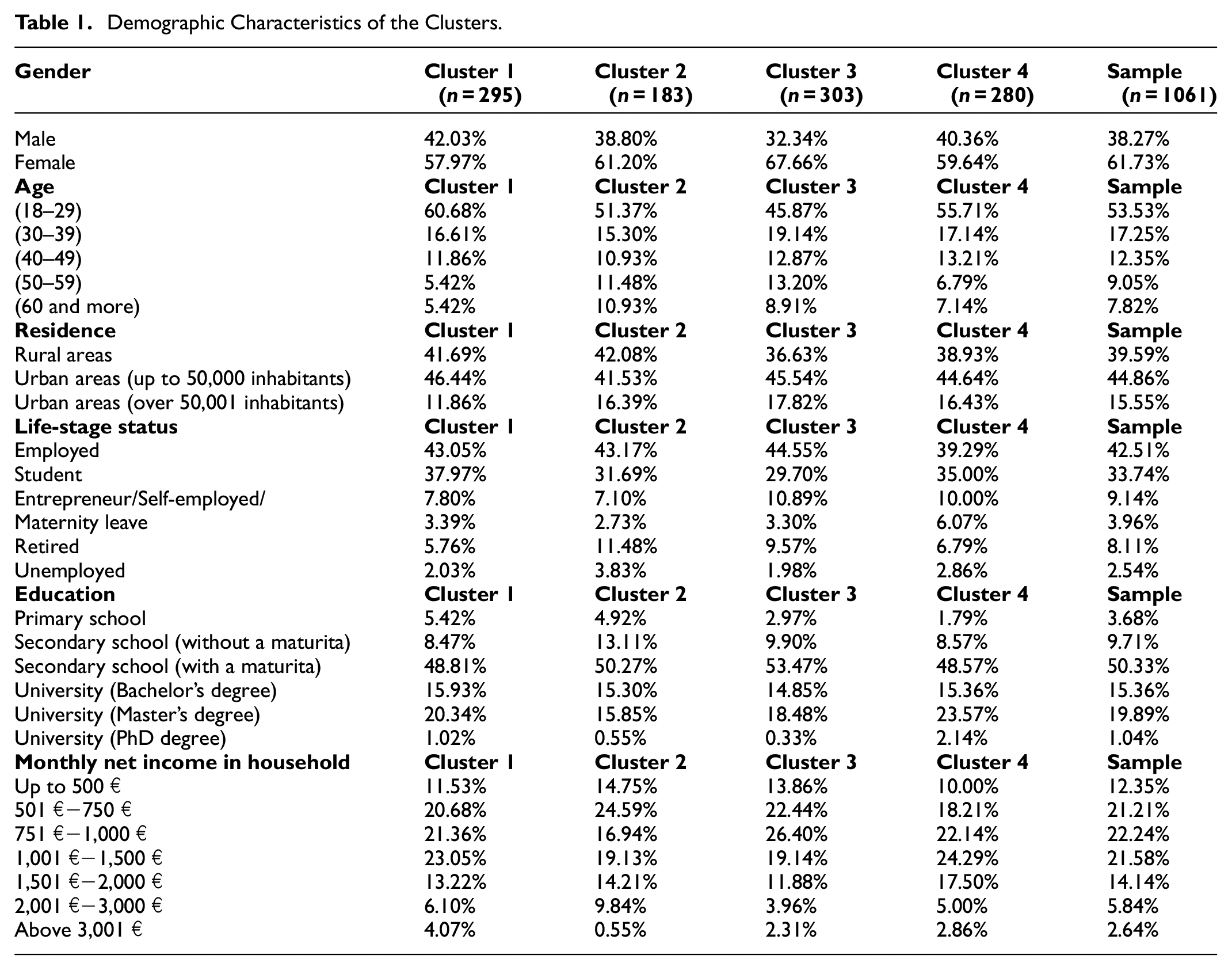
Cluster analysis revealed four clusters of green consumers (Table 1). Clusters were named by the authors according to their willingness to prefer a green product over a conventional non-green product (Table 2): Indifferent Greens, Economical Greens, Engaged Greens, and Image Conscious Greens.
Demographic Characteristics of the Clusters.
Green Consumers’ Profiles.

Note. Centroids for k-means clustering – Total number of cases: 1,061
Preferences: 1—definitely yes; 2—somewhat yes; 3—neutral/indifferent; 4—somewhat no; 5—definitely no.
Cluster 1—Indifferent Greens (n = 295)
This cluster is comprised of 58% females and 42% males. More than three quarters of the cluster members were younger than 39 years, 60.7% of respondents were between 18 and 29 years old, and 16.6% of respondents ranged between 30 and 39 years old. A secondary education degree was held by 48.8% of members in this cluster and 37.3% have a university degree. There were three income groups (out of a total of seven), each of which had a share of more than 20% of respondents in this cluster: 501 to 750 €, 751 to 1,000 €, and 1,001 to 1,500 € (Table 1). Together, they make up more than 65% of the respondents in this cluster. In this group of the Indifferent Greens, a moderate level of eco-friendly attitudes toward green products is present. They show uninterested attitudes toward green products. Their neutral attitude is seen in the areas, that require a deeper individual interest in environmental issues. Individual ability to contribute to the improvement of the environment is neutral rather than active. Cluster 1 consists of respondents who are willing to buy the product, if available, is cheap and environmentally friendly: “If you deliver your green product and it has a low price, I’m willing to buy it.” The main inner motivator is comfort, and easy way to get the product. When it comes to the interest in the environment protection, or searching for environmentally friendly products, they reported neutral attitude.
Cluster 2—Economical Greens (n = 183)
This cluster consisted of 61.2% females, 38.8% males and 51.4% of respondents were aged 18 to 29 years. About 42% of the respondents in this cluster are living in rural areas and 50.3% hold a secondary education degree. Around one-quarter have a monthly net household income ranging between 501 and 750 €. This could explain the high sensitivity of the Economical Greens to price. When considering the purchase of a green product, they are looking for an economic advantage. Age categories 18 to 29 years and 30 to 39 years are the most frequent. Their individual ability to contribute to ecological improvement is rather neutral than active. This might be the main characteristic of this group: “If you want me to buy your green product, it has to be cheap. I don’t care what other people say or what you say.” The main stimuli is the (low) price. The results show that this cluster is strongly indifferent to external impulses, such as recommendations from family members or friends. They do not prefer a green product, because it is fashionable or represents a new environmental trend. When it comes to the green product, price is the most relevant factor that matters.
Cluster 3—Engaged Greens (n = 303)
Cluster 3 consisted of 67.7% females and 32.3% males. More than half of the cluster members were younger than 39 years. Specifically, 45.9% of respondents ranged between 18 and 29 years and 19.1% between 30 and 39 years. Most (63.4%) lived in urban areas. In terms of social status, the majority of cluster respondents (55.4%) were either employed or self-employed (as entrepreneurs). This may explain different attitudes toward active engagement into green products, and environment improvement. Most of cluster members (53.5%) had completed secondary education and 33.7% completed some degree of university education. Over a quarter of cluster respondents had income from 751 € to 1,000 €. In the previous two clusters, a strong orientation on the benefits of the person buying a green product could be seen. In this cluster the trend is reverse. Its members’ attitude is more conscious toward the environment. They have a strong environmental awareness and behave in this way. They feel and want to be part of a cycle of people that has a positive impact on the environment and consciously participates in pro-environmental activities. They do not follow current eco-fashion or ecological trends, nor do they build a positive image of an eco-friendly person. These two factors do not affect them when considering the purchase of a green product. They consider buying a green product to be the right decision – with a higher value and as a good alternative to conventional products. A price that is 10% higher than the average price is accepted, which makes this cluster less price sensitive compared to other clusters. Engaged Greens are highly conscious about eco-labeling and environmental certification and seem to be able to take an active part in environmental actions. Their status can be expressed as: “If your green product is not too expensive, is ecological, has certification, I’ll buy it. I’ll not do it for my better image, but because I, my family and friends believe it. I believe that buying green products has a positive impact on our environment.” The main inner motivator is to have all information available and being an active part of the green cycle with all.
Cluster 4—Image Conscious Greens (n = 180)
This cluster consists of 59.6% females and 40.4% males. Over half of respondents (55.7%) were between 18 and 29 years old and over 60% lived in an urban environment. More than 39% of the Image Conscious Greens were employed and 35% were students. Interestingly, 24.3% of the group members had a monthly net income that ranged from 1,001 € to 2,000 €, which is one income category higher compared to Cluster 3. High school was completed by 48.6% of respondents and 41.1% achieved some university education. This group has strong pro-environmental attitudes and strongly denies the influence of eco-trends and eco-fashion. However, one of the motives for buying green products is building a positive image among others. This pattern is present only in the Image Conscious Greens group. If they buy a green product, they believe it is a good decision and consider green products to be more valuable than conventional products. According to them, green products are a good choice because they do not harm the environment. A green product with a lower price is preferred, but a price that is 10% higher than the average price can also be accepted. A neutral attitude is expressed if the price is more than 10% higher than the average price. They can be influenced by family members, friends, customer recommendations, and company’s image. They have a strong environmental awareness, search for image and experience. Their individual ability to contribute to environmental improvement is moderate active rather than strongly active. “I’ll buy your green product, but don’t tell me it’s trendy. I will listen to my friends and customers who have tried your product. I’m curious about your company, your certification, I don’t mind buying a product that has a price 10% higher than the average price but prove to me that it’s environmental enough.” The main inner motivator is a positive personal green image and a positive green image of the company from which they buy.
Results of Principal Component Analysis (PCA)
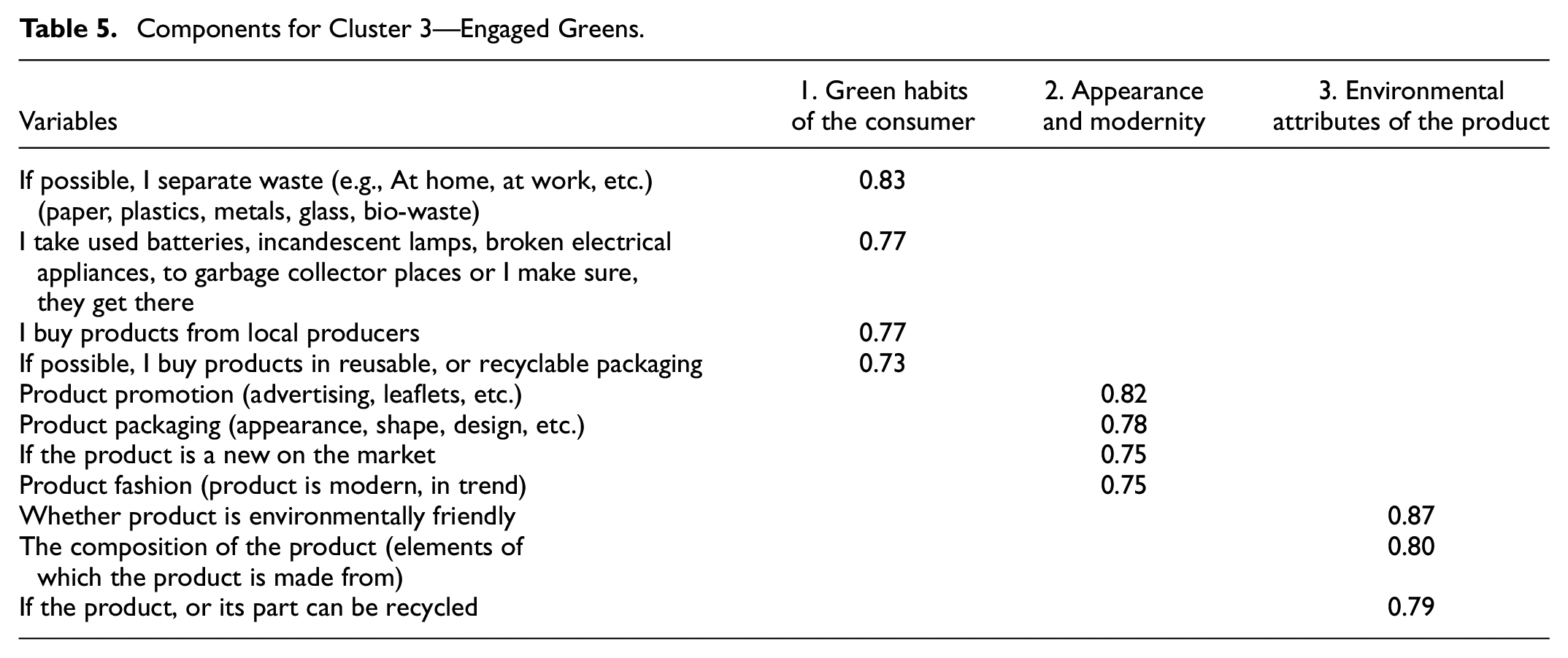
The aim of the study is also to propose suitable green marketing strategies for companies operating in Slovak markets. The exploratory factor analysis (EFA) was performed on 27 variables that influence the buying behavior of respondents from each identified cluster. These 27 variables were selected based on the tools of the marketing mix—Product, Place, Price and Promotion. The results are shown in Tables 3 to 6.
Components for Cluster 1—Indifferent Greens.

Components for Cluster 2—Economical Greens.

Source. The authors.
Components for Cluster 3—Engaged Greens.
Components for Cluster 4—Image Conscious Greens.

Using the EFA–PCA, components were revealed that affect the purchase behavior of respondents in clusters. Based on the results of the EFA and the cluster analysis, for each cluster separately, we recommended for companies operating on Slovak market green marketing strategy from four existing—Lean, Defensive, Shaded, and Extreme green (based on Ginsberg & Bloom, 2004).
Results of PCA for Cluster 1—Indifferent Greens
Table 3 presents the of EFA-PCA results for Cluster 1 (n = 295 respondents)—Indifferent Greens. Three components were revealed by the varimax rotation. Each component consists of three variables. Total variance explained by three components was 64.919%. KMO was 0.683, Bartlett’s Test of Sphericity shows significant level at p = .000. The determinant is 0.123 and it is greater than 0.00001. From the original 27 variables, 9 final variables were extracted in three components. The Cronbach’s alpha for the first component was .785, for the second .715, and for the third .657. Based on Janssens et al. (2008, p. 275), these values of the Cronbach’s alpha are acceptable.
The variables from the first component “Environmental Attributes of the Product” are related to green product values, product and packing and eco-labeling of the product. The second component: “Promotional Activities associated with the Product” are related to promotion, packing (design, shape, appearance) and to fashion. Variables of the third component “Proven Durability of the Product” are associated with product and recommendations from other users (the world of mouth). From this point of view, Indifferent Greens are very sensitive to the product and its attributes when buying consumer goods. According to the result of the cluster analysis, they can be described: “If you deliver your green product to me, and it has a low price, I’m willing to buy it.”
These finding can be useful for companies which use the “Lean Green” marketing strategy – the companies exhibited their greenness mostly in product development, design and manufacturing. These companies do not want to promote their green activities or green product attributes for fear of being held to a higher standard and they do not see green segments as a source of substantial revenue. They strongly focus on the Product from the marketing mix (Ginsberg & Bloom, 2004). The Lean Green strategy is a reactive strategy, and the members of Indifferent Greens are also reactive. To offer them the green product would mean: focus on any attributes of the product (durability of the product must be proven), promote it in the traditional way, distribute it widely and use low price.
Results of PCA for Cluster 2—Economical Greens
Table 4 presents the EFA-PCA results for Cluster 2 (n = 183 respondents)—Economical Greens. We analyzed selected factors that affect the buying behavior of consumers buying consumer goods. The two components were revealed by varimax rotation. Total variance explained by two components was 57.04%. KMO was 0.745, Bartlett’s Test of Sphericity shows significant level at p = .00. The determinant is 0.062 and that is more than 0.00001. From the original 27 variables, 9 final variables were extracted in two components. The Cronbach’s alpha for the first component was .815, for the second .726 (according to Janssens et al. (2008) acceptable values).
The variables from the first component “Product Attributes and Information” are related to the green product values (the second and the third item) and eco-labeling of the product. The respondents from the second cluster are sensitive to composition of the product and their purchase behavior is influenced by information on the packaging. Also, they take into consideration appearance, modern design and novelty of the product (see the component “Appearance and Modernity”). The variables in these two components are mostly associated with the product and its mix. Economical Greens have strictly refused to prefer a green product over a conventional one because of: modernity, popularity among other consumers or among their relatives and friends and have also strictly refused to pay a higher price for a green product (Table 2). Their description can be stressed as: “When you want me to buy your green product, it has to be cheap. I don’t care what other people say or what you say.”
These findings can be useful for those firms, which used Lean Green marketing strategy. Here, the company exhibits its greenness mostly in product development, design and manufacturing. The company often does not want to promote its green activities or green product attributes for fear of being held to a higher standard and does not see green segments as a source of substantial revenue. They are strongly focused on the product from the marketing mix (Ginsberg & Bloom, 2004). We see another opportunity for companies that have Defensive Green marketing strategy. As mentioned by Ginsberg and Bloom (2004), the Defensive Green company focuses on product and promotion from the marketing mix. Promotion activities are related to quieter public relations’ actions rather than with for example, advertising. Green marketing tools are used in response to competitors. These companies admit that green segments are important and profitable. They have environmental initiatives, but they promote them sporadically. They do not have the ability to differentiate themselves from the competitors by greenness. They do not want to create high expectations regarding greenness among their stakeholders. The Lean and the Defensive Green strategies are reactive strategies and the members of Economical Greens are also reactive. To offer them a green product would mean: focusing on any attribute of the product (providing them with information), promoting it in the traditional way (highlighting the low price) distributing it widely and having a low price. Economical Greens would respond to your actions, they do not care what people say.
Results of PCA for Cluster 3—Engaged Greens
Table 5 represents the result of the EFA–PCA for Cluster 3 (n = 303 respondents)—Engaged Greens. Selected factors that influence buying behavior were analyzed. Three components were revealed by varimax rotation. Total variance explained by three components was 64.398%. KMO was 0.765, Bartlett’s Test of Sphericity shows significant level at p = .000. The determinant is 0.033, so more than 0.00001. From originally 27 variables, 11 final variables were extracted in three components. The Cronbach’s alpha for the first component was .793, for the second .785, and for the third .768. According to Janssens et al. (2008), such values are acceptable.
The variables from the first component: “Green Habits of the Consumer” are related to green place from marketing mix (associated especially with the reverse logistic) and post-purchasing consumer behavior. The second component: “Appearance and Modernity” is associated with the promotional activities, packing (appearance, design), novelty and modernity of the product. The third component we named “Environmental Attributes of the Product” and the variables from this component are related to the green product values and the composition of the product.
The Engaged Greens seem to be the greenest of the revealed clusters (Table 2). They strictly state that they prefer a green product to a conventional one. They are willing to pay “extra” for green products and do not prefer a green product because of a “good image” in society or because buying a green product is trendy. To describe them (according to cluster analysis results) we can state: “If your green product is not too expensive, is ecological, has certification, I’ll buy it. I’ll not do it for my better image, but because I, my family and friends believe it. I believe that buying green products has positive impact on our planet.” They seem to be an active part of the green cycle with all.
Companies that have the Extremely Green marketing strategy can focus on this cluster. As described by Ginsberg and Bloom (2004), the whole marketing mix is used in this holistic strategy. The main objective is to be green and the greenness is integrated into every process in the company, for example, in manufacturing or in the total quality environmental management. They sell their products through special stores or channels. Cluster 3 can be also appropriate for companies that have the Shaded Green strategy. Within the marketing mix, it focuses on product, promotion and price. This strategy places a secondary emphasis on greenness in its more pronounced promotional efforts and pursues greenness in product development, design and manufacturing. If cost efficiencies can be achieved by greenness, they use green price (Ginsberg & Bloom, 2004). The Extreme and Shaded Green strategies are proactive strategies and the Engaged Greens are also proactive. Reaching them would mean: use the whole marketing mix, focus on the green product and green innovations, lead them to participate in the green cycle, give them opportunity to become part of reverse logistic, distribute your products widely or in special stores (they will find your green product), you can use an even higher price (they will appreciate your greenness and effort) and talk to them using promotion mix.
Results of PCA for Cluster 4—Image Conscious Greens
Table 6 presents the result of the EFA–PCA for Cluster 4 (n = 280 respondents)—Image Conscious Greens. Selected factors which influence the purchasing behavior of consumers buying consumer goods were analyzed. Three components were revealed by varimax rotation. Total variance explained by three components was 60.618%. KMO was 0.784, Bartlett’s Test of Sphericity shows significant level at p = .000. The determinant is 0.055 (higher than 0.00001). From originally 27 variables, 11 final variables were extracted in three components. The Cronbach’s alpha for the first component was .770, for the second .759, and for the third .664 (according to Janssens et al. (2008 acceptable values). The variables from the first component: “Appearance and Modernity” is associated with the promotional activities, packing (appearance, design), novelty and modernity of the product. The second component was named “Environmental Attributes of the Product” and the variables from this component are associated with the green product values, eco-labeling and information on the packaging. The third component, “Trust and Reputation” is associated with reputation and trust of the brand or producer. Reputation and trust are related to marketing communication, public relations, world of mouth and product. Respondents from Cluster 4 are green (Table 6) but cautious about eco-labeling (we assume that this is linked to the PCA component “Trust and reputation”). Interestingly, they would prefer green products over conventional ones if the purchase increases their image in society (self-presentation is also associated with their reputation in society). They are also willing to pay for a green product if its price does not exceed 10% compared to a conventional product. We can characterize them as follows: “I’ll buy your green product, but don’t tell me it’s trendy. I will listen to my friends and customers who have tried your product. I’m curious about your company, your certification. I don’t mind to buy a product that has a price 10% higher than the average price, but prove to me that it’s ecological enough.” They build their own positive green image and must to see the positive proven green image of the company they are buying from.
This cluster can be a target for companies that have the Extreme Green strategy and use all elements of the green marketing mix, but these companies must be careful because of their own reputation. Simply put, trust must be earned. This cluster is also suitable for Shaded Green strategies. Within the marketing mix, Shaded Greens focus on product, promotion and price. They communicate to customers direct, tangible benefits of the products and sell their through mainstream channels. Also, they invest in long-term, system-wide environmentally friendly process (Ginsberg & Bloom, 2004). Proactive corporate behavior can lead to trust and good reputation and result in long-term relationships between customers and companies. The Extreme and Shaded Green strategies are proactive strategies and members of the Image Conscious Greens group are also proactive. Reaching such customers means: use the whole marketing mix, focus on the green product and green innovations, distribute your products widely or in specialized stores (they will find your green product). Reputation and honesty can build trust and brand equity. Higher prices are possible once this trust is established and relationships are strengthened.
Discussion
Studies referred to in subchapter 2.2. (Green Consumers) try to describe the “black box” of the consumer: inner motivators and stimuli that influence green buying behavior. Our study identifies and characterizes green consumers in four clusters and based on PCA analysis predicts how they can respond to external stimuli—the marketing mix of companies. Based on the findings, the answer to our first research question (RQ 1) is positive: Yes, there are various green consumers in our sample.
Benda-Prokeinova (2015) dealt with sustainable consumption patterns and published the results (representative for entire Slovak population). Most Slovak respondents declare a non-consumerist attitude: “I only buy a product if I really need it.” The reason for consumerist behavior were “difficulties to resist discounts.” Only about a third of Slovaks pay attention to environmental or social impact and to environmental labeling of product before buying. Slovaks showed more activity in the post-purchase phase (green habits such as sorting of household waste or activities that can bring some economic benefit). In our study, the component “Green habits of the consumer” (Table 5) characterizes and affects the behavior of the Engaged Greens (almost 29% of respondents) in relation to the post-purchase (waste separation and environmentally friendly disposal of garbage), but also the pre-purchase phase (products from local producers and products in reusable, or recyclable packaging). Benda-Prokeinova (2015 identified three main barriers to greener consumption: i) lack of confidence in eco-labeling, (ii) too high price of the green products, and (iii) their insufficient availability. This is in line with the findings of our study: (i) we identified almost three-quarters of respondents with a neutral attitude to environmental labeling, (ii) more than half of our respondents are not willing to pay up to 10% more for a green product, (iii) almost 83% of the respondents claimed that they prefer to buy a green product over a conventional one if it is available at the place, where they usually buy.
The study of Rypakova et al. (2015) suggested that Slovaks became more environmentally responsible (e.g., saving energy, buying eco-labeled products, recycling), but it has essentially an economic motive. Such findings correspond with ours since about 55% of Clusters 3 and 4 respondents declared a positive attitude toward green buying, while about 45% of respondents from Clusters 1 and 2 focus mainly on the price and economic benefits of green buying. Rypakova et al. (2015) divided young 18 to 25 years old Slovaks into two subgroups: youth extremely involved in saving environment and youth that totally does not care. In our study, young respondents (18–29 years old) formed the groups of Indifferent Greens (31.51%) and Image Conscious Greens (27.46%). Respondents (of the study of Rypakova et al.) between 26 and 55 years are the most economically active and quite stable. They think about their purchase in a long run, try to live healthy and avoid negative impacts on the environment. Approximately 60% of 30 to 59 years old respondents in our study formed clusters “Engaged Greens” and “Image Conscious Greens”—the greener groups. The authors recommended to companies: educate customers about sustainability and engage them in the products development process. The decision whether to target on green consumers’ segments or not must be made. Vicente et al. (2021) summarize that even if households’ ecofriendly behaviors (waste sorting and recycling, water and energy conservation, and purchase of green goods) does not affect the willingness to bear additional cost in support of the environment, their stronger “perceived behavior control” and “environmental activism” still contribute to the acceptance of higher prices, if it benefits the environment.
The second objective was to set strategies for identified groups of green consumers. We suggest that for Indifferent Greens consumers, a company can use the Lean green strategy. It is a reactive strategy focused on the product. To offer them a green product would mean: focus on any attributes of the product (its durability must be proved), promote it in the traditional way, distribute widely and use a low price.
Economical Greens are sensitive to “Product attributes and information” and “Appearance and modernity.” The items in these two components are mostly associated with the product policy mix. We suggest for companies to use Lean or Defensive green strategy to reach these consumers. In case of Defensive green, the company’s marketing mix is focused on product and promotion. To offer them the green product would mean: focus on any attributes of the product (provide them information); promote it in the traditional way (highlight the low price and other economic benefits); distribute it widely, use a low price and no price premium. Economical Greens and Indifferent Greens are strongly orientated on the personal benefits. Jeevan (2017) identified in her study similar group “The Economizer” and provided the advice: promotional messages should be aimed at saving money with the product or reducing cost later; provide them with as much information as possible about your product; they need them to make right economic decision. The results of the Afridi et al. (2021) study show that consumers who are less concerned about the future are less likely to buy green products and services and may need more persuasive strategies to be appropriately focused.
For the group Engaged Greens we recommend the Extreme or Shaded green strategies—proactive strategies. To reach them would mean: use the whole marketing mix; focus on the green product and green innovations; lead them to participate on a green cycle; give them opportunity to be a part of the reverse logistic; distribute products widely or in special stores (such costumers find your green product); use even a higher price (they appreciate your greenness and effort) and talk to them using promotion mix. Additionally, Jeevan (2017) recommended simple reports to companies as a tool to address true green consumers—“The Idealist” (group comparable to our Engaged Greens): you do not have to emphasize trendiness or cost saving; be honest and fair to them. They are willing to pay extra premium because they see value beyond money.
The group Image Conscious Greens is sensitive to “Appearance and modernity of the product” and it is associated with the promotional activities, packing (appearance, design), novelty and modernity of the product. They are also influenced by “Environmental attributes of the product” and the items of this component are associated with the green product values, the ecolabels and information on the packaging. “Trust and reputation” is associated with reputation and trust of a brand or producer. Reputation and trust are related to marketing communication, public relations, world of mouth and product. They build their own positive green image and need to see the positive and proved green image of the company they are buying from. This cluster can be a target for companies that have the Extreme green and Shaded green strategy. These companies need to be careful about their reputation. Jeevan (2017) also identified a group similar to our Image Conscious Greens and called it “The Eco-Chic” (defined also by Barendregt & Jaffe, 2014). Jeevan has recommended companies that want to address this group to promote the trendiness and prestige associated with the green product. Concerning activity, Indifferent Greens and Economical Greens appear less green and reactive to environmental issues compared to the Engaged Greens and Image Conscious Greens who are greener and more proactive.
Conclusions
The core of this study is based on two research questions. The answer to the first is the identification and description of four different green groups of consumers among Slovak respondents. Based on these findings, the second question is answered by proposing a green marketing strategy with specified marketing mix tools. The proposed tools have the potential to influence the relevant group of green consumers identified on the Slovak market. When proposing strategies, we considered the sensitivity of cluster members to the marketing mix factors that affect their buying behavior, the characteristics of each green consumers group, and whether they behave more reactively or proactively. Moravcikova et al. (2017) showed statistically significant relationship between the application of green market principles and the competitiveness of enterprises in the Slovak Republic. Also, Majerova (2015) concluded that the green character of product has an impact on buying behavior of majority of respondents in Slovakia and the improvement in company’s eco-performance has an impact on buying behavior of most respondents. Choosing the right green strategy and tools from the marketing mix is only possible if the company knows its customers. As suggested by Do Paço et al. (2009), if a company applies green marketing strategies, it will be able to obtain advantages of opportunities presented by environmental consumerism. Cherian and Jacob (2012) mentioned that knowledge of diverse attributes, that affect the customer decision-making process, can help companies to use pro-environmental marketing tactics, and reach competitive advantages. Corporate environmental strategy has a demonstrable direct impact on employees’ green awareness. This leads to a higher level of voluntary environmental behavior of employees. (Biswas et al., 2021).
Grant (2007) wrote that the challenge for marketing for the next 20 years is to be a part of a green wave of innovation. He suggested the following to make more people willing and able to go green: (i) education; (ii) get green living out of the green lifestyles niche; (iii) extend green culture and lifestyles beyond the middle classes; and (iv) acculturation—make outlandish green choices attractive in cultural terms and make damaging current practices unattractive. Beder (2011) also emphasized the role of education stating that individual preferences are shaped to a large extent by information available to people about the consequences of their choices. Consequences of the knowledge gap about environmental (and other) attributes of products or its impact on respondents’ attitudes are covered by various studies (Burton, 2014; Maťová & Kaputa, 2018; Williams et al., 2012; Zorić & Hrovatin, 2012). However, the term environmental strategy is often understood to include also social challenges. The implementation of green marketing strategy can lead to social and global well-being (Haanes et al., 2011; Maignan et al., 2005). Or vice versa, when “human ecology” is respected within society—environmental ecology also benefits (Benedict, 2009). We see the application of green marketing principles in companies as an opportunity to reach green consumers, adapt to their changing needs, obtain competitive advantages, and to influence the overall wellbeing of society.
Theoretical and Practical Implications
The theoretical implication: the study provides a review of approaches to the green marketing (including consumers and strategies). The results offer a deeper understanding of green consumer decision-making in Slovakia. The novelty of this study consists in the identification of four clusters of Slovak consumers based on their affinity for “green” purchasing decisions. Concrete demographic characteristics of Slovak consumers in clusters with a description of their attitudes and preferences are useful for companies’ decision-making. The relevance of the study also lies in the design of marketing strategies and components of the marketing mix for each of the revealed clusters. In this way, the Slovakian companies have the proposal of specific marketing mix tools to which consumers in individual clusters are sensitive. These outcomes can be used in a theoretical study of green marketing and green consumer, in future research and taken into account in comparative studies.
The practical/managerial implication: the marketing managers can use the specifications of green consumers when communicating new products, when deciding on a price or product design. It will help them realize that some green consumers are sensitive to all parts of the marketing mix and that the price of a green product is as important to them as design and communication. Other consumers are more sensitive to product characteristics related to sustainability and do not care about the price. In addition, it can help companies communicate more effectively on sustainable consumption, as targeting is more specific and the tools used for each green group of consumers may be more appropriately chosen. This can lead to production and consumption that will be more thoughtful.
In any setting, environmental or not, companies need to follow (usually rapidly changing) trends in markets they serve, whether domestic or international. That being said, being socially and environmentally aware and responsible is more than a trend. It is a paradigm for today and the future.
Limitations
This study has several limitations. (1) The results represent the opinions of self-selected respondents in one country; (2) The non-probability sampling procedure results are not generalizable to the entire population of the Slovak republic; (3) We focused mainly on marketing mix factors which influence consumer purchase behavior when buying consumer goods; (4) We focused on four basic green marketing strategies describes by Ginsberg and Bloom (2004). There are also other strategies for example, green innovation, greening the organization and green alliance (Cronin et al., 2011) or strategies described by Sitnikov et al. (2015).
In this study, we suggest marketing strategies and tools of the marketing mix that companies could use when approaching and engaging with each green consumer group. Further research should expand on specific steps and actions for each marketing mix tool in the context of targeting each cluster or simply the cluster where a company wants to be positioned.
An additional limitation of the study is from a geographical point of view. In spite of fact that Slovakia is a relatively small market, it is a fully open and pro-export economy heavily dependent on foreign trade, where most of goods and services are exchanged within the common European market. Slovak consumers thus encounter a number of imported products, not excluding green. “Territorial limitation” is not related to the supplied or available products, but to the values and attitudes of individuals, which together create a more or less generalized “national culture” specific also for the Slovak population. Groups of green consumers identified in this study should reflect these specificities.
Footnotes
Acknowledgements
The authors would like to thank the Scientific Grant Agency of the Ministry of Education, Science, Research and Sport of the Slovak Republic, grant No. 1/0475/22 “Environmental consumer and environmental citizen.” This publication is also realized thanks to the implementation of the project: “Progressive research of performance properties of wood-based materials and products” (LignoPro), ITMS: 313011T720 supported by the Operational Programme Integrated Infrastructure (OPII) funded by the ERDF.
Declaration of Conflicting Interests
The author(s) declared no potential conflicts of interest with respect to the research, authorship, and/or publication of this article.
Funding
The author(s) received no financial support for the research, authorship, and/or publication of this article.
Ethics Statement
Not applicable

Data Availability Statement
Data sharing not applicable to this article as no datasets were generated or analyzed during the current study.